Discuss the professionalstandards for
teachers in the Philippines.
Reflect on the challenges posted by
the new professional standards for all
teachers in the field.
Appreciate the new roles of teachers
specified in the new professional
standards for teachers.
OBJECTIVES:
3.
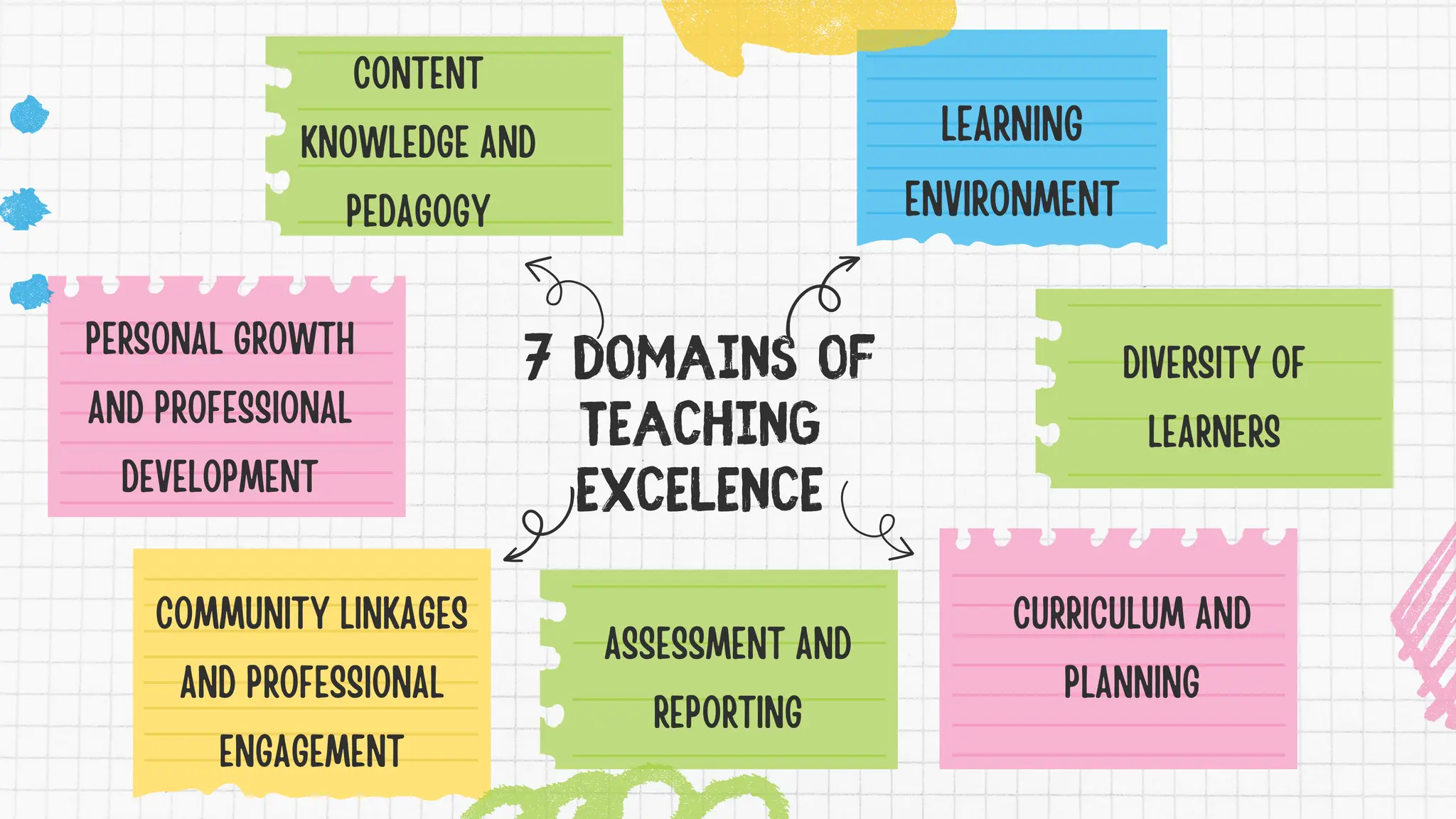
7 domains of
teaching
excelence
CONTENT
KNOWLEDGEAND
PEDAGOGY
PERSONAL GROWTH
AND PROFESSIONAL
DEVELOPMENT
COMMUNITY LINKAGES
AND PROFESSIONAL
ENGAGEMENT
CURRICULUM AND
PLANNING
DIVERSITY OF
LEARNERS
LEARNING
ENVIRONMENT
ASSESSMENT AND
REPORTING
4.
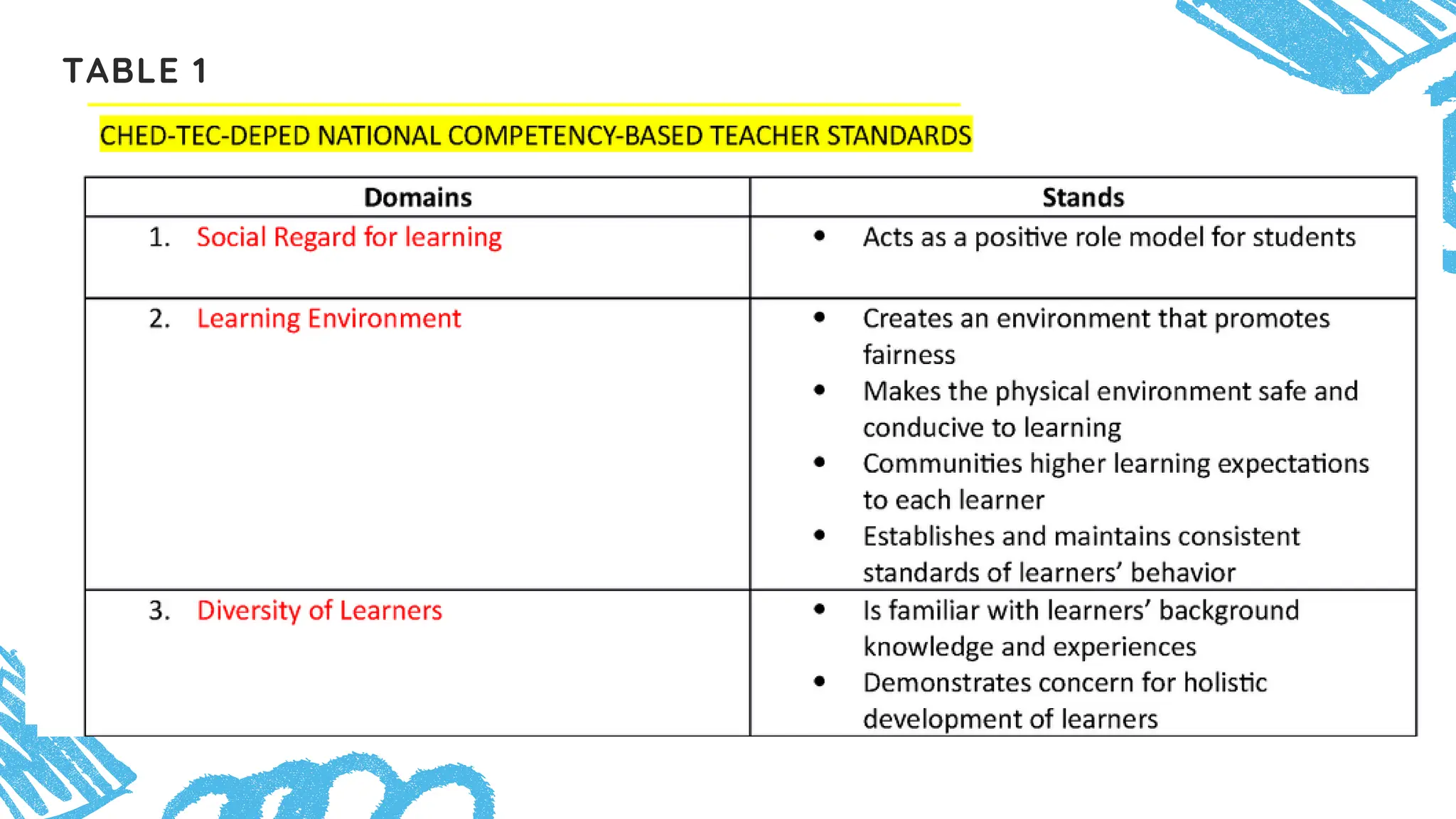
The content ofthe National
Competency - Based Teacher Standards
(NCBTS, 2007), as a national program
of the DepEd, CHED, and the Teacher
Education Council (TEC), identified
necessary competencies that all
teachers should possess.
These competencies are considered in
developing curriculum standards for
pre- service and in-service teacher
education in the country.
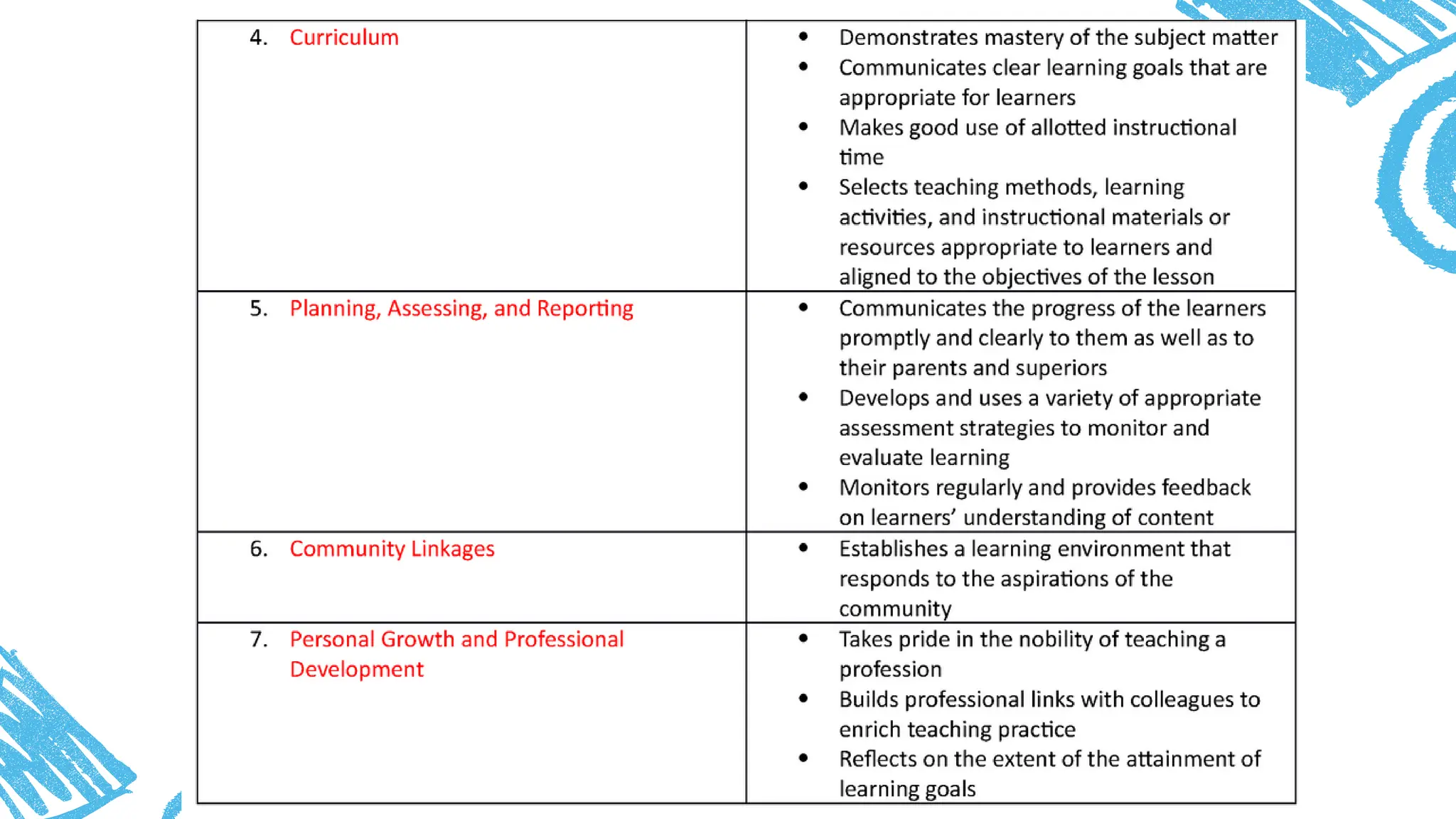
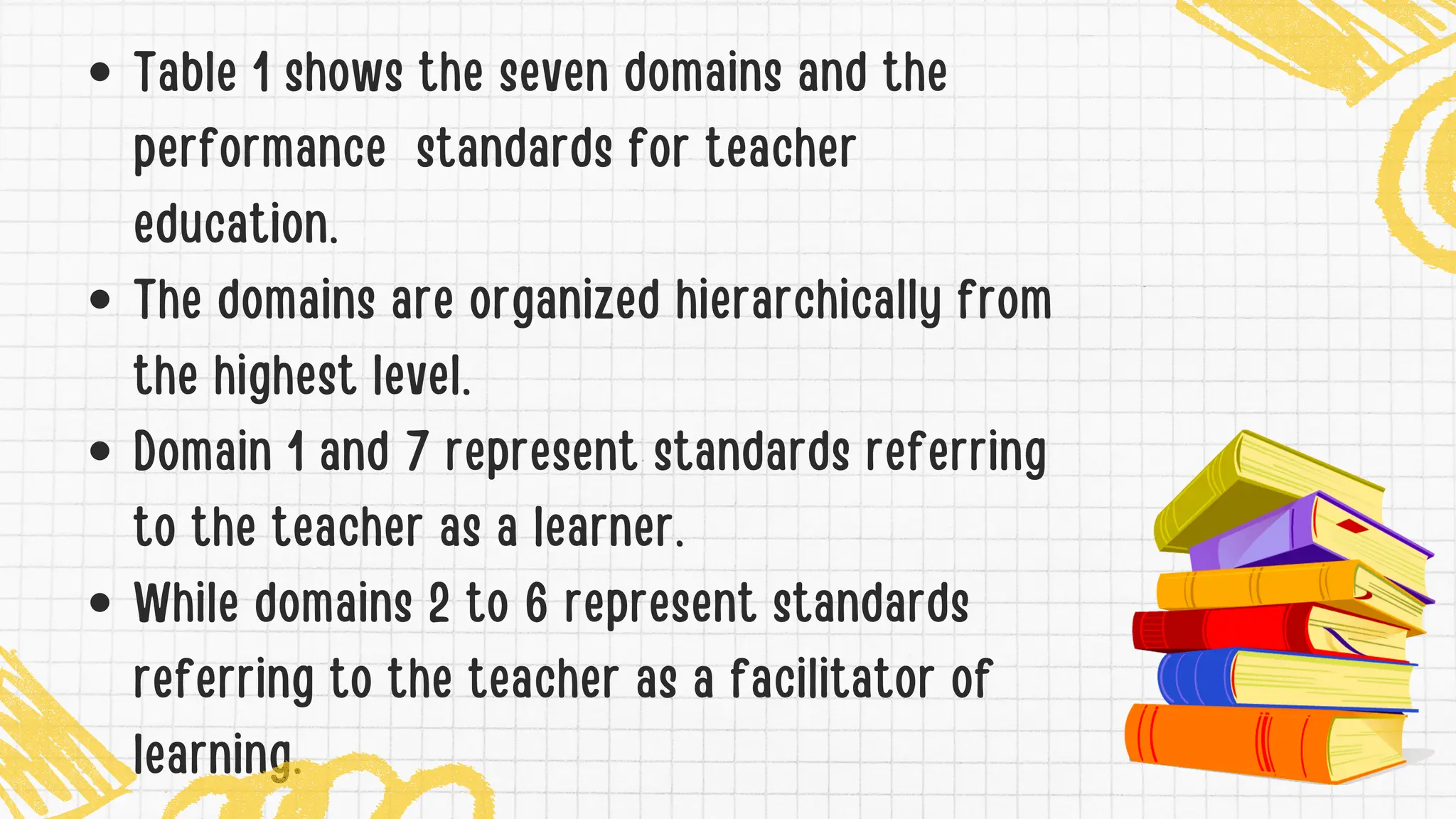
Table 1 showsthe seven domains and the
performance standards for teacher
education.
The domains are organized hierarchically from
the highest level.
Domain 1 and 7 represent standards referring
to the teacher as a learner.
While domains 2 to 6 represent standards
referring to the teacher as a facilitator of
learning.
8.
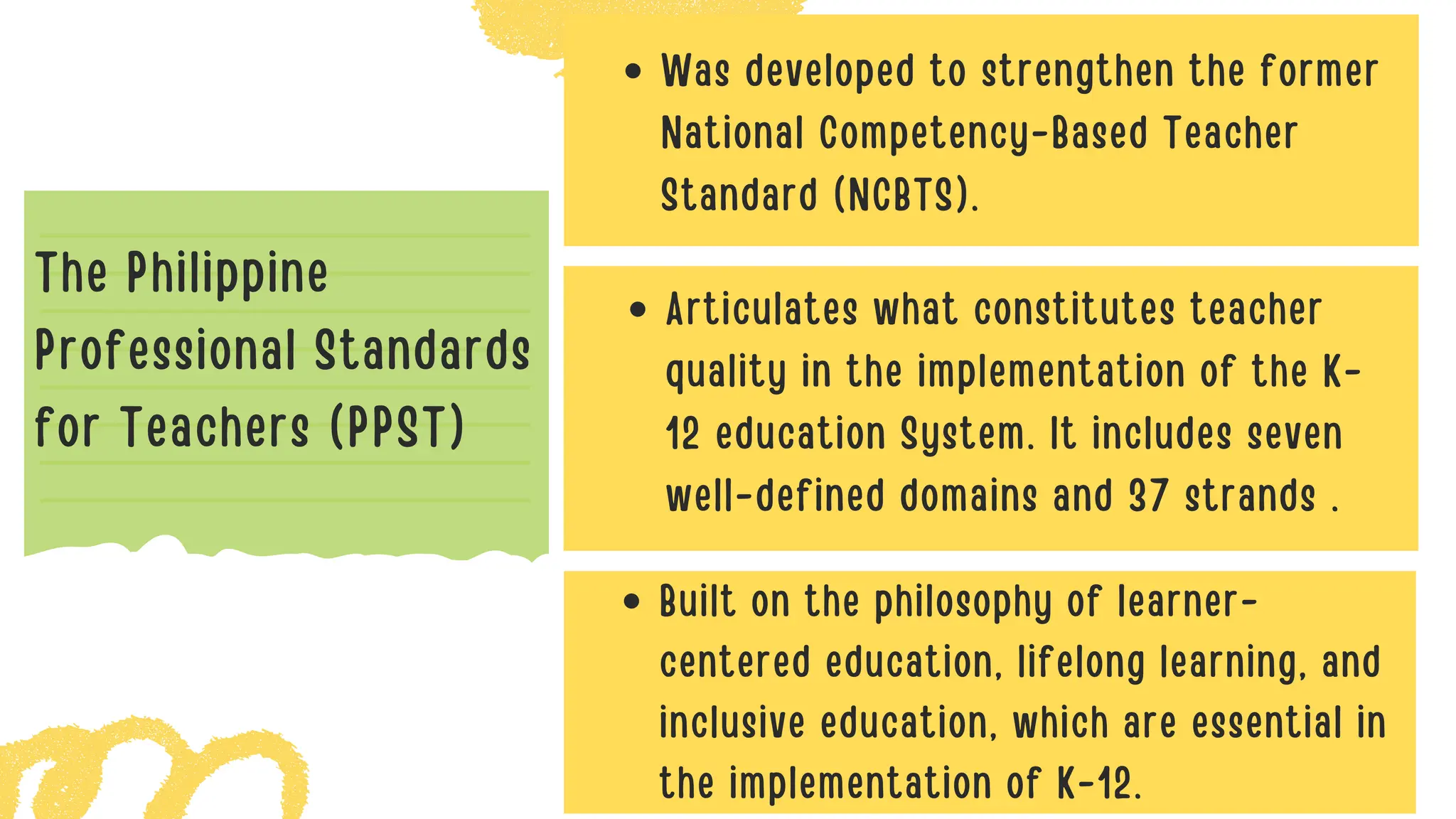
Was developed tostrengthen the former
National Competency-Based Teacher
Standard (NCBTS).
Articulates what constitutes teacher
quality in the implementation of the K-
12 education System. It includes seven
well-defined domains and 37 strands .
Built on the philosophy of learner-
centered education, lifelong learning, and
inclusive education, which are essential in
the implementation of K-12.
The Philippine
Professional Standards
for Teachers (PPST)
9.
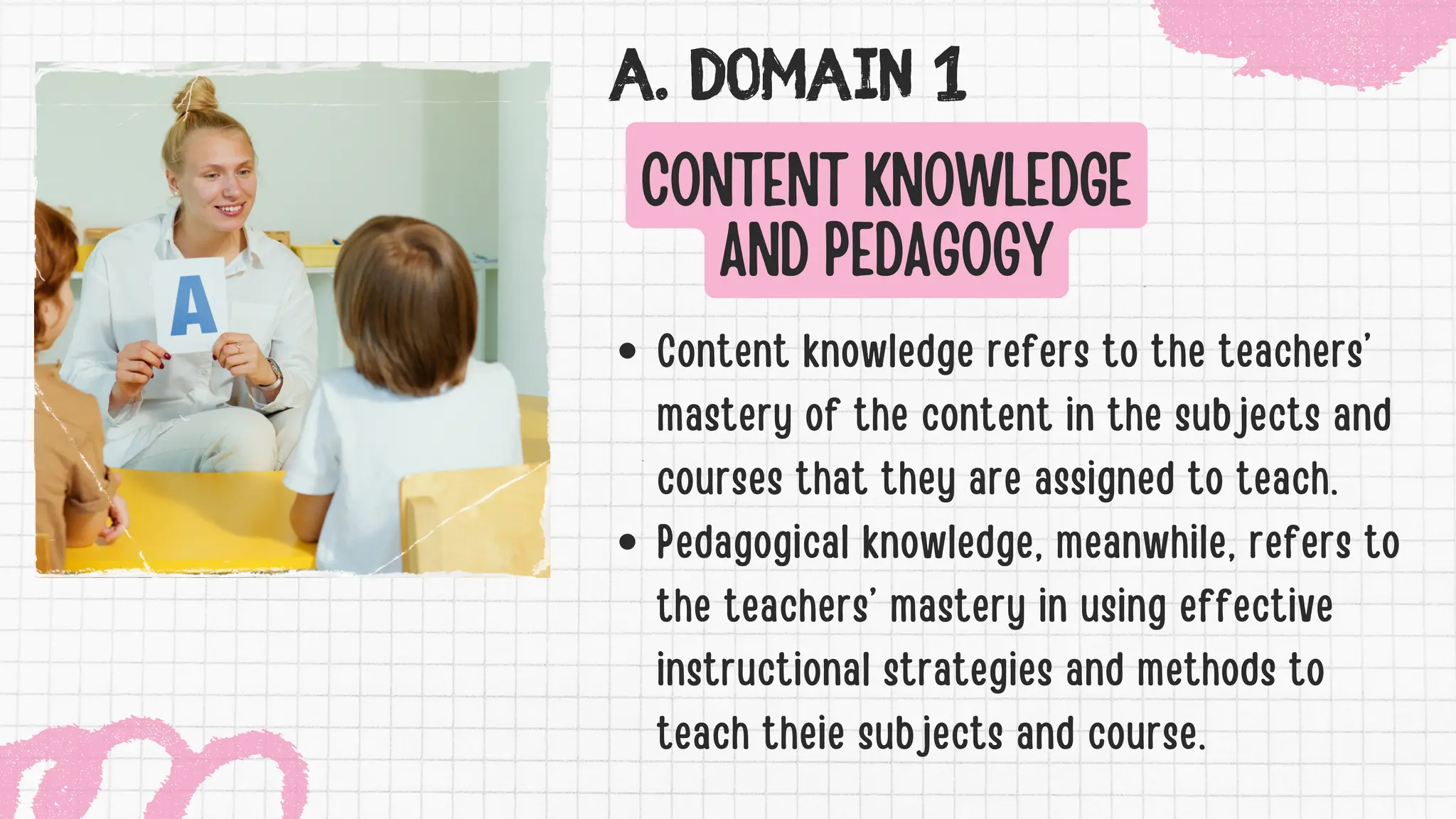
A. DOMAIN 1
CONTENTKNOWLEDGE
AND PEDAGOGY
Content knowledge refers to the teachers’
mastery of the content in the subjects and
courses that they are assigned to teach.
Pedagogical knowledge, meanwhile, refers to
the teachers’ mastery in using effective
instructional strategies and methods to
teach theie subjects and course.
10.
The First Domainis composed of seven strands:
Content Knowledge and its application within and across curriculum
areas.
1.
Research- based knowledge and principles of teaching and learning.
2.
Positive use of ICT.
3.
Strategies for promoting literacy and numeracy.
4.
Strategies for developing critical and creative thinking, as well as
other higher-order thinking skills.
5.
Mother tongue, Filipino, and English in teaching and Learning.
6.
Classroom communication strategies.
7.
11.
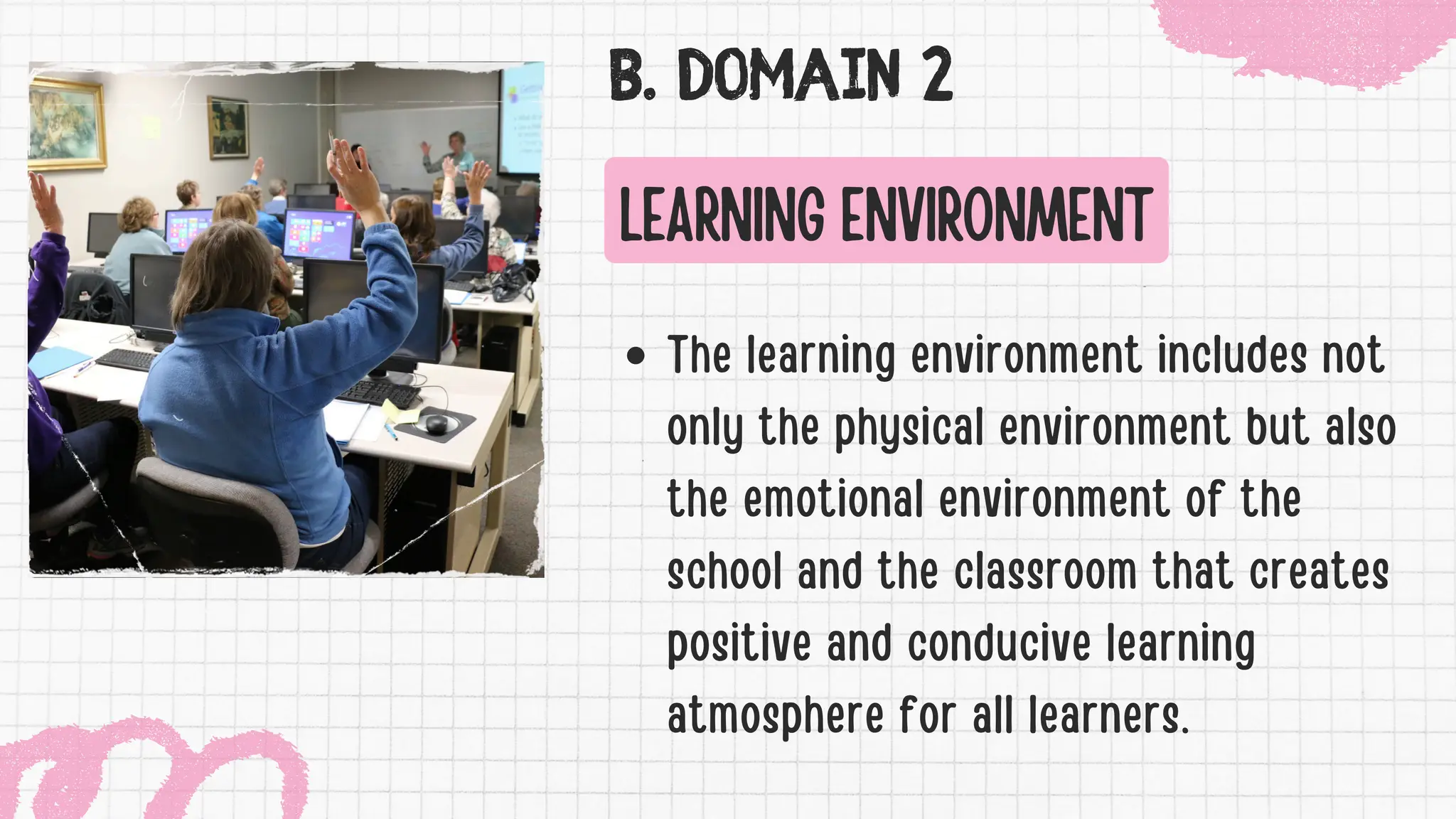
B. DOMAIN 2
LEARNINGENVIRONMENT
The learning environment includes not
only the physical environment but also
the emotional environment of the
school and the classroom that creates
positive and conducive learning
atmosphere for all learners.
12.
This second domainconsists of six strands:
Learner safety and security.
1.
Fair learning environment.
2.
Management of classroom structure and activities.
3.
Support for learner participation.
4.
Promotion of purposive learning.
5.
Management of learner behavior.
6.
13.
C. DOMAIN 3
DIVERSITYOF LEARNERS
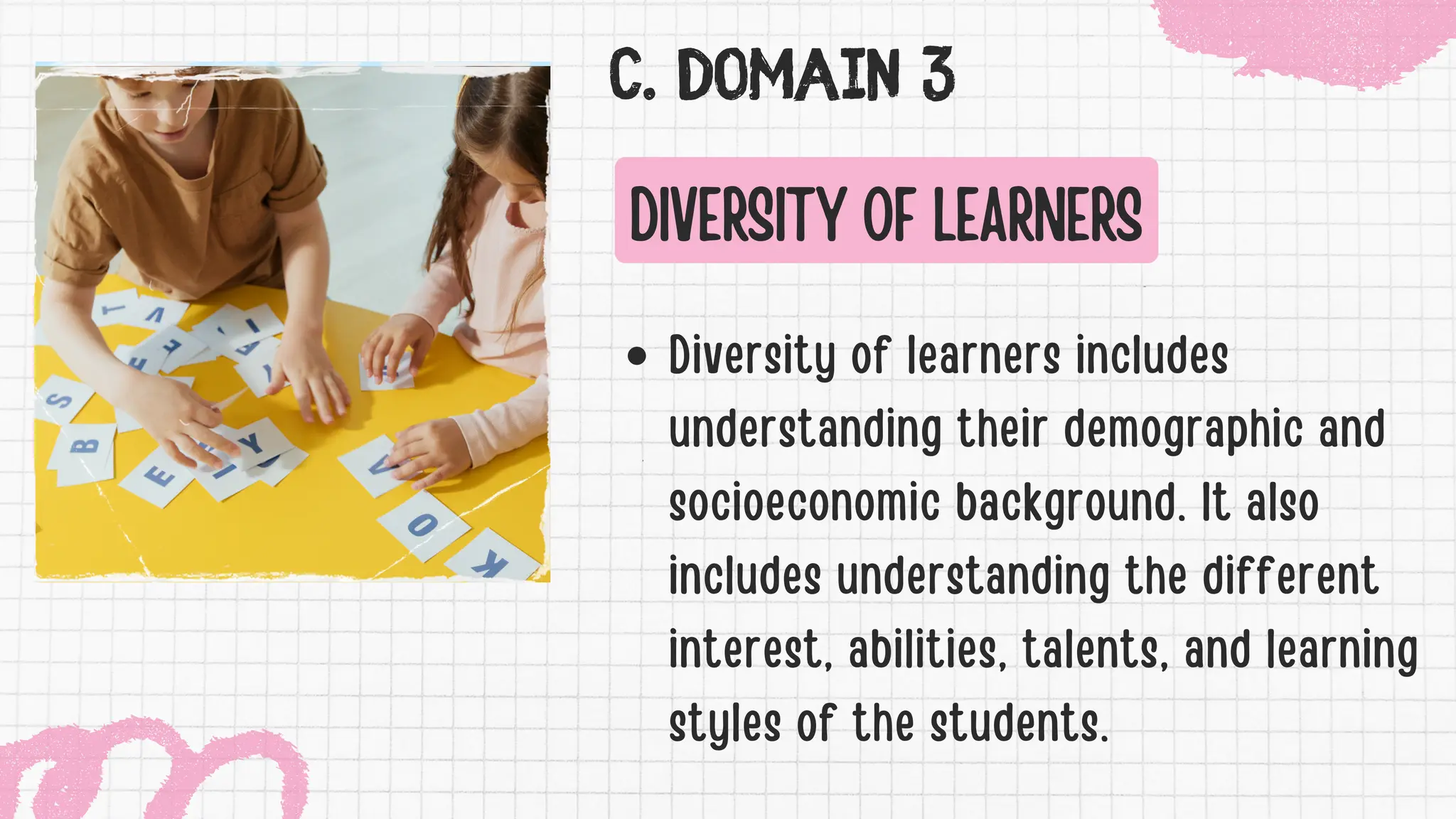
Diversity of learners includes
understanding their demographic and
socioeconomic background. It also
includes understanding the different
interest, abilities, talents, and learning
styles of the students.
14.
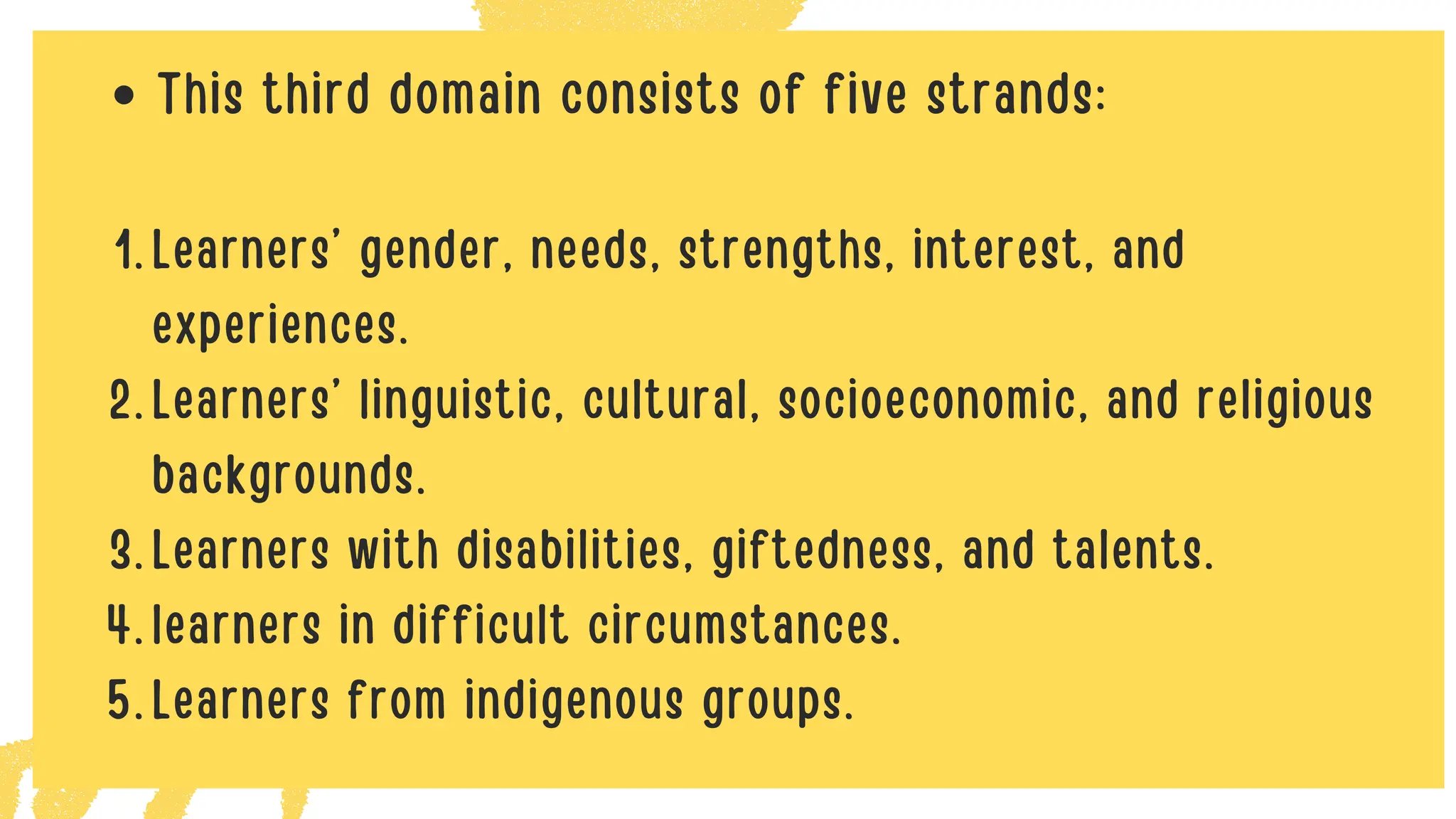
This third domainconsists of five strands:
Learners’ gender, needs, strengths, interest, and
experiences.
1.
Learners’ linguistic, cultural, socioeconomic, and religious
backgrounds.
2.
Learners with disabilities, giftedness, and talents.
3.
learners in difficult circumstances.
4.
Learners from indigenous groups.
5.
15.
D. DOMAIN 4
CURRICULUMAND
PLANNING
Curriculum includes the subjects and learning
experiences planned for all students. it
includes the learning competencies and
instructional activities designed for the
students.
Teachers as curriculum and instructional
leaders need to plan for the implementation
of the curriculum.
16.
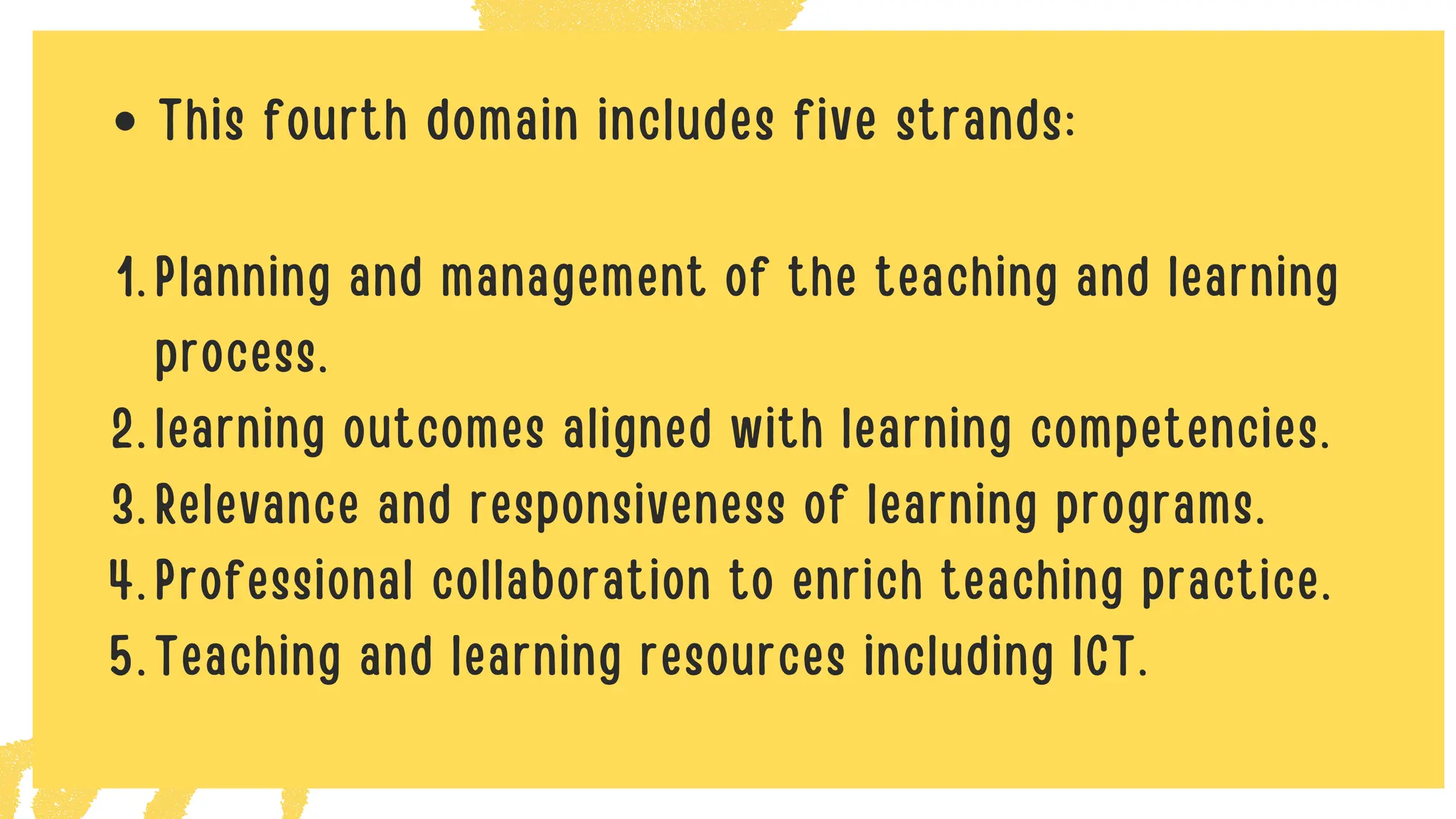
This fourth domainincludes five strands:
Planning and management of the teaching and learning
process.
1.
learning outcomes aligned with learning competencies.
2.
Relevance and responsiveness of learning programs.
3.
Professional collaboration to enrich teaching practice.
4.
Teaching and learning resources including ICT.
5.
17.
E. DOMAIN 5
Assessmentis an important component of
teaching and learning. It includes gathering
the necessary data to measure the mastery
of the subject and courses of the students.
It measures the achievements of every
learning outcome.
It can be traditional (quizzes, exams) or
authentic (portfolio, performance tasks).
ASSESSMENT AND
REPORTING
18.
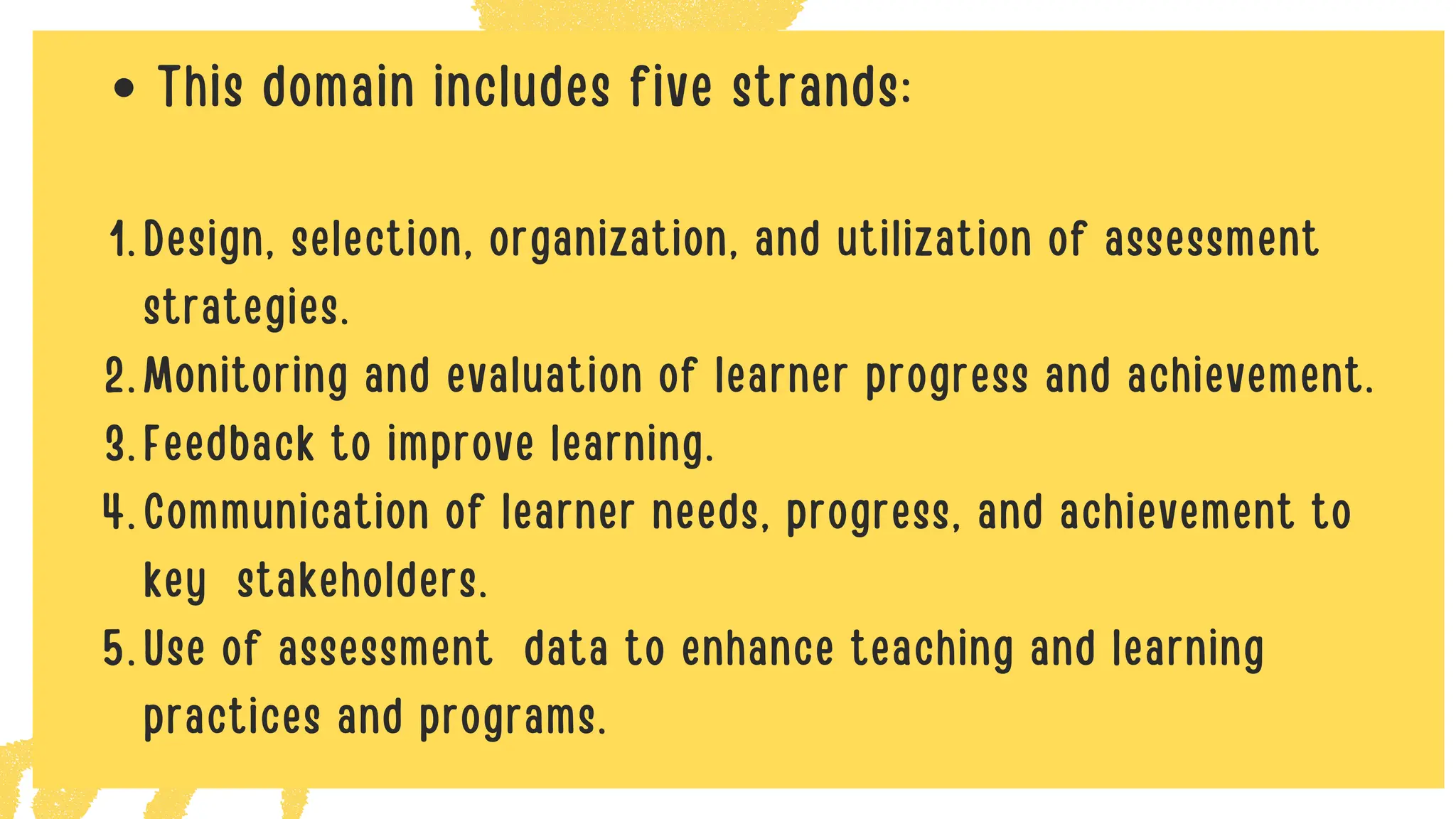
This domain includesfive strands:
Design, selection, organization, and utilization of assessment
strategies.
1.
Monitoring and evaluation of learner progress and achievement.
2.
Feedback to improve learning.
3.
Communication of learner needs, progress, and achievement to
key stakeholders.
4.
Use of assessment data to enhance teaching and learning
practices and programs.
5.
19.
F. DOMAIN 6
COMMUNITYLINKAGES AN
PROFESSIONAL ENGAGEMENT
School and community partnership is
essential in ensuring quality learning; a
strong and positive partnership can
guarantee success and excellence in
learning among students.
20.
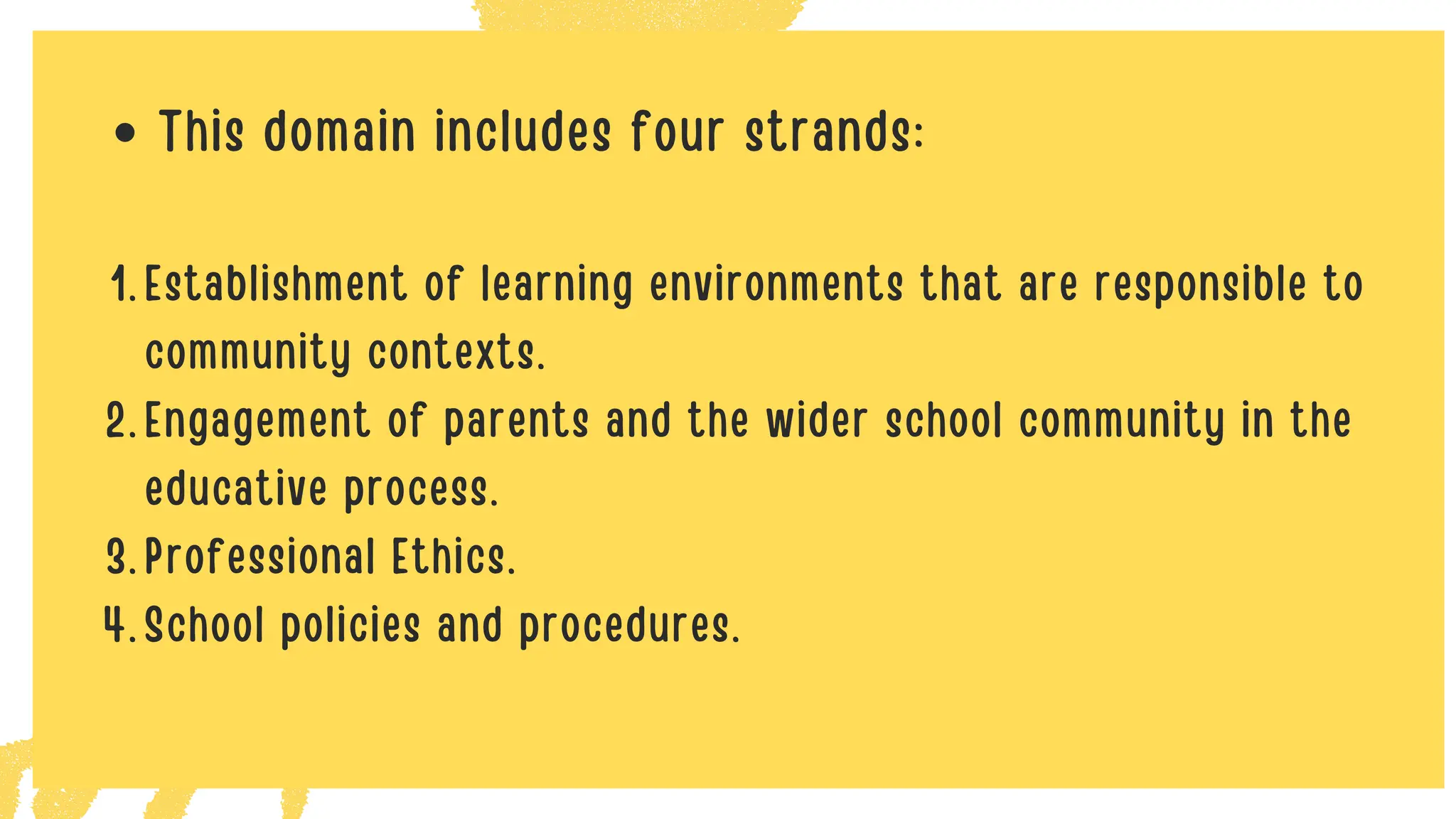
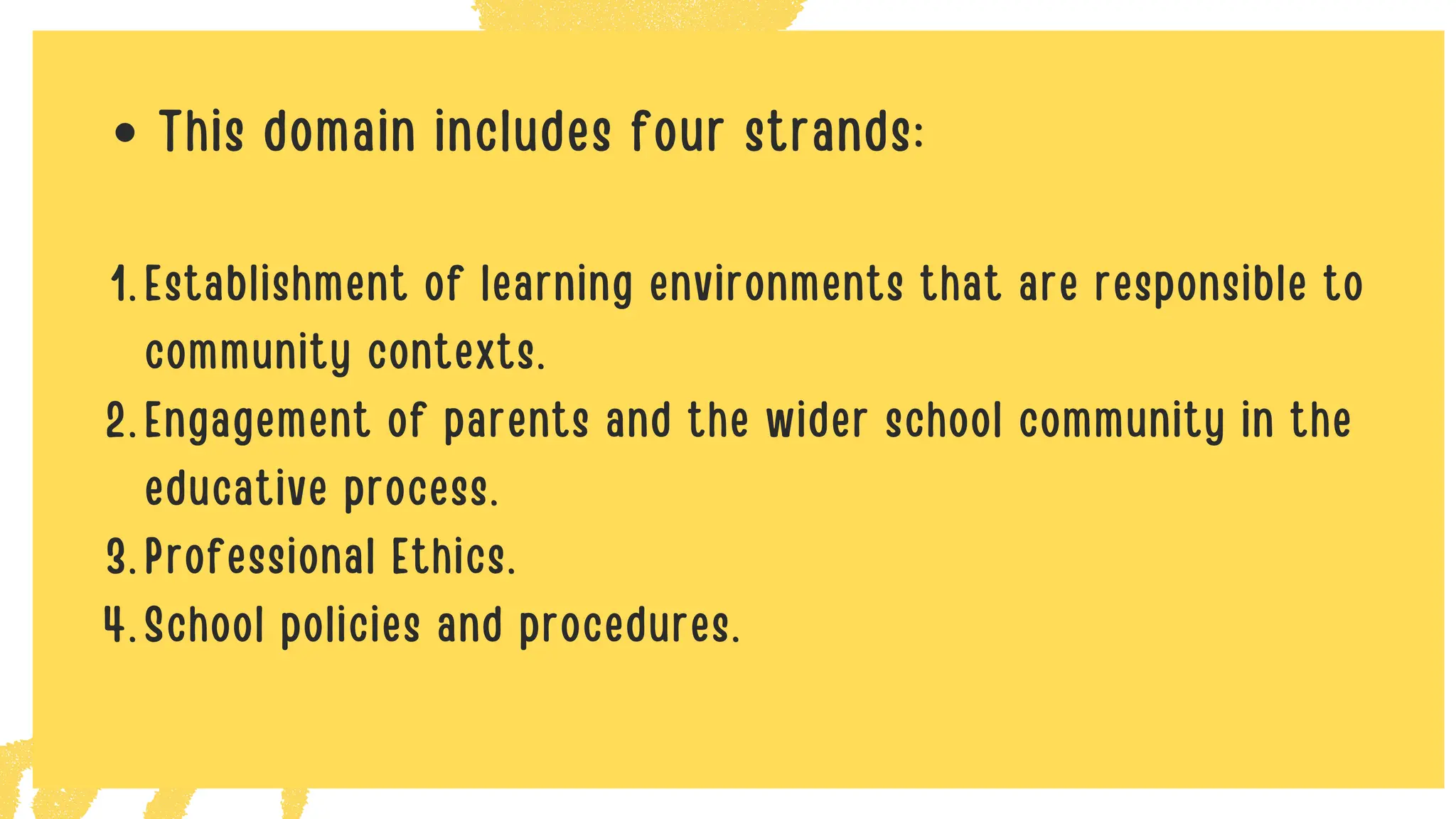
This domain includesfour strands:
Establishment of learning environments that are responsible to
community contexts.
1.
Engagement of parents and the wider school community in the
educative process.
2.
Professional Ethics.
3.
School policies and procedures.
4.
21.
G. DOMAIN 7
PROFESSIONALGROWTH AND
PERSONAL DEVELOPMENT
Teachers, as professionals, need to grow personally and
professionally. This is essential in sustaining their sense of
mission and passion in the teaching profession.
Professional Development to keep updated in their field of
Specialization. Personal growth to develop maturity in the
conduct of teaching duties
22.
This domain includesfour strands:
Establishment of learning environments that are responsible to
community contexts.
1.
Engagement of parents and the wider school community in the
educative process.
2.
Professional Ethics.
3.
School policies and procedures.
4.
23.
Anchored on theprinciple of lifelong
learning, the professional standards for
teachers recognize the significance of a
standards framework that articulates
developmental progression as teachers
develop, refine their practice, and respond
to the complexities of educational reforms.
(DO No. 42 s2017, 7)
H. DIFFERENT CARRER STAGES Of
professional teachers in the philippines
24.
CAREER STAGE 1:BEGINNING TEACHERS
a. Gained the qualifications recognized entry into the teaching
profession.
b. Have a strong understanding of the subjects/areas in which they are
trained in terms of content knowledge and pedagogy.
c. Possess the requisite knowledge, skills, and values that support the
teaching and learning process.
d. Manage learning programs and have strategies that promote learning
based on the needs of their students.
e. Seek advice from experienced colleagues to consolidate their teaching
practice.
25.
CAREER STAGE 2:PROFICIENT TEACHERS
a. Professionally independent in the application of skills vital to the
teaching and learning process.
b. Provide focused teaching programs that meet curriculum and
assessment requirements.
c. Display skills in planning, implementing, and managing learning
programs.
d. Actively engage in collaborative learning with the professional
community and other stakeholders for mutual growth and advancement.
e. Reflective practitioners who continually consolidate knowledge, skills,
and practices of Beginning Teachers.
26.
CAREER STAGE 3:HIGHLY PROFICIENT TEACHERS
a. Consistently display a high level of performance in their teaching
practice.
b. Manifest an in-depth and sophisticated understanding of the teaching
and learning process.
c. Have high education- focused situation cognition, are more adept in
problem- solving, and optimize opportunities gained from experiences.
d. Work collaboratively with colleagues and provide them support and
mentoring to enhance their learning and practice.
e. Continually seek develop their professional knowledge and practice by
reflecting on their own needs and those of their colleagues and students.
27.
CAREER STAGE 4:DISTINGUISHED TEACHERS
a. Embody the highest standard for teaching grounded in global best
practices.
b. Exhibit exceptional capacity to improve their teaching practice and that of
others.
c. Are recognized as leaders in education, contributors to the profession, and
initiators of collaborations and partnerships.
d. Create lifelong impact in the lives of colleagues, students, and others.
e. Consistently seek professional advancement and relevance in pursuit of
teaching quality and excellence.
f. Exhibit commitment to inspire the education community and stakeholders
for the improvement of education provision in the Philippines.
28.
REMEMBER THIS: TEACHER’SREFLECTION
Content Knowledge and Pedagogy - Teachers must have mastery or
expertise in the subjects and courses they teach. They should also have
excellent pedagogical skills to teach different subjects and courses.
Learning Environment-Teachers need to maintain a healthy emotional
and physical environment for learners.
Diversity of Learners - Teachers need to understand and respect the
individual differences of learners.
Curriculum and Planning - Teachers are curriculum and instructional
leaders in their schools. They help implement the curriculum and plan
appropriate instruction for the learners.
29.
Assessment and Reporting- Teachers need to use various assessments that
are appropriate for measuring the success of every learning outcome. They
also need to know how to communicate the result of assessment
effectively to improve learning and motivate the learners in their studies.
Community Linkages and Professional Engagement - Teachers should act as
social agents that advocate positive changes in society through education.
Personal Growth and Professional Development - Teachers are encouraged
to grow professionally and personally by attending seminars, trainings,
conferences, and establishing linkages with other educators to update
their curriculum knowledge and pedagogical skills. They are also
encouraged to enroll in graduate programs to broaden their knowledge in
the teaching profession.
30.
LET’S DO THIS:
Basedon your reading, write a concise
reflection on the Professional Standards
for Teachers in the Philippines, consisting
of at least three paragraphs.