Beatriz G. Torno, DPM 
Executive Director II 
Teacher Education Council 
Teacher Education and Development Program (TEDP) – National Competency-Based Teacher Standards (NCBTS) Philippine Education Reform
I wish I could persuade every teacher to be proud of his/her occupation-not conceited or pompous , but proud. People who introduce themselves with the shame remark that they are, “just teachers”, give me despair in my heart.
Did you ever hear a lawyer say depreciatingly that he was only a patent attorney? 
Did you ever hear a physiciansay “I am just a brain surgeon?”
I beg of you to stop apologizing for being a member of the most important profession in the world. Draw yourself up to your full height; look at anybody squarely in the eye and say, “I AM A TEACHER.” 
William Garr
Department of EducationOverview 
Mission: to provide quality basic education that is equitably accessible to all and lay the foundation for life-long learning and service for the common good
Overview 
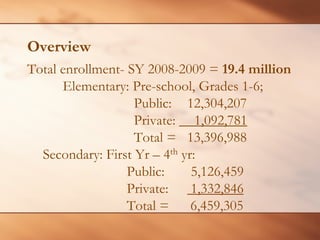
Total enrollment-SY 2008-2009 = 19.4 million 
Elementary: Pre-school, Grades 1-6; Public: 12,304,207 
Private: 1,092,781 
Total =13,396,988 Secondary: First Yr –4thyr: 
Public:5,126,459Private: 1,332,846 
Total = 6,459,305
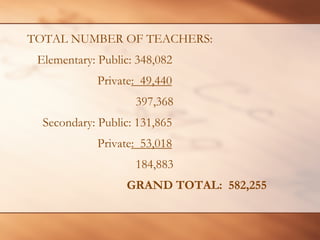
TOTAL NUMBER OF TEACHERS: 
Elementary: Public: 348,082 
Private: 49,440 
397,368 
Secondary: Public: 131,865 
Private: 53,018 
184,883 
GRAND TOTAL: 582,255
BASIC EDUCATION SECTOR REFORM AGENDA (BESRA) TEDP and NCBTS 
TEDP is TEACHER EDUCATION and DEVELOPMENT PLAN 
- 
is the master plan for Teacher Education. 
- 
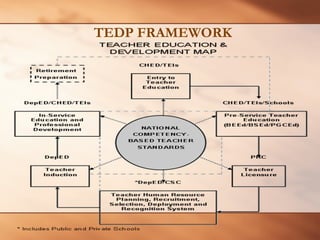
is the articulation of a singular competency- based framework for teaching and teacher development that would guide all policies, reforms, and activities related to teaching and teacher development.
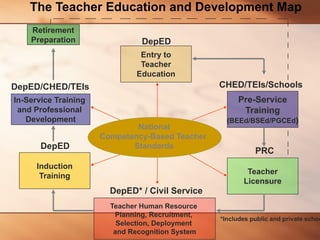
Entry to 
Teacher 
Education 
DepED* / Civil Service 
CHED/TEIs/Schools 
Teacher 
Licensure 
PRC 
Teacher Human Resource 
Planning, Recruitment, 
Selection, Deployment 
and Recognition System 
DepED/CHED/TEIs 
Induction 
Training 
DepED 
In-Service Training 
and Professional 
Development 
DepED 
Retirement 
Preparation 
Pre-Service 
Training 
(BEEd/BSEd/PGCEd) 
National 
Competency-Based Teacher 
Standards 
The Teacher Education and Development Map 
*Includes public and private schoo
Introduction 
CAR- AGA 
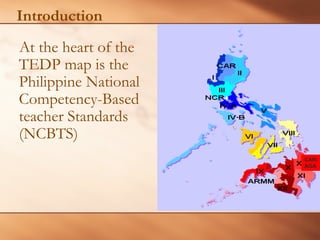
At the heart of the TEDP map is the Philippine National Competency-Based teacher Standards (NCBTS)
™ 
TEDP conceptualizes a teacher’s career path as a continuum that starts with the entry to a teacher education program and concludes when a teacher reaches retirement from formal service 
What is TEDP?
™Agencies working hand in hand for the good of the teaching profession are Department of Education (DepEd), Commission on Higher Education (CHED), Professional Regulation Commission (PRC), Civil Service Commission (CSC) and Teacher Education Institutions (TEIs) 
What is TEDP?
™The National Competency_ Based Teacher Standards (NCBTS) is at the heart of the TEDP. It is the key element of 
the TEDP (Teacher Education 
and Development Program). 
Abstraction
•NORM 
• 
CRITERION 
• 
BENCHMARK 
• 
YARDSTICK 
• 
MODEL 
• 
MEASURE 
• 
PARADIGM 
• 
TOUCHSTONE 
What is a standard?
What is 
NCBTS? 
™NCBTS defines effective teaching as being able to help all types of students learn the different learning goals in the curriculum
What is 
NCBTS? 
™An integrated theoretical framework that defines the different dimensions of effective teaching
What is 
NCBTS? 
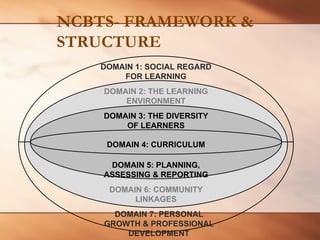
™It is based on the core values of Filipino teachers and on effective teaching and learning with seven (7) domains, 23 strands and 80 performance indicators.
™ 
Teacher Education Institutions (TEIs) shall use it to design and implement effective pre-service teacher education curricula 
™ 
Professional Regulation Commission (PRC) shall refer to it to design the LET
™ 
Institutions and 
agencies that provide 
Professional 
Development or INSET 
shall refer to it to 
develop the 
intervention they desire 
• 
Award giving bodies
™DepEd shall use the NCBTS to formulate its hiring, promotion, supervision and other policies related to the 
teaching profession.
™Most of all, individual teachers in all public elementary and high schools 
shall use it for their 
professional development 
activities
Domain 1: Social Regard for Learning 
Key Question for the Teacher: 
“Can my students appreciate and model the value of learning through my interactions with them?”
Domain 1: Social Regard for Learning 
Explanation: 
The domain of Social Regard for Learning focuses on the ideal that teachers serve as positive & powerful role models of the values of the pursuit of learning & of the effort to learn, & that the teachers actions, statements, & different types of social interactions with students exemplify this ideal.
Domain 2: Learning Environment 
Key Question for the Teacher: 
“Do I create a physical and social environment in class that allows my students to attain maximum learning?”
Domain 2: Learning Environment 
Explanation: 
The domain of Learning Environment focuses on importance of providing for a social and physical environment within which all students, regardless of their individual differences in learning, can engage the different learning activities and work towards attaining high standards of learning.
Domain 3: Diversity of Learners 
Key Question for the Teacher: 
“Can I help my students learn whatever their capabilities, learning styles, cultural heritage, socio-economic backgrounds, and other differences are?”
Domain 3: Diversity of Learners 
Explanation: 
The domain of Diversity of Learners emphasizes the ideal that teachers can facilitate the learning process in diverse types of learners, by first recognizing and respecting individual differences, then using knowledge about students’differences to design diverse sets of learning activities to ensure that all students can attain appropriate learning goals.
Domain 4: Curriculum 
Key Question for the Teacher: 
“Can my students understand and attain the goals of the curriculum through the various learning resources and activities I prepared? Have I made use of ICT appropriately”
Domain 4: Curriculum 
Explanation: 
The domain of Curriculum refers to all elements of the teaching-learning process that work in convergence to help students attain high standards of learning and understanding of the curricular goals and objectives. These elements include the teacher’s knowledge of subject matter, teaching-learning approaches and activities, instructional materials and learning resources including ICT.
Domain 5: Planning, Assessing and Reporting 
Key Question for the Teacher: 
“Do I assess my students’learning and knowledge using appropriate educational assessment procedures, and do I use the information from these assessment procedures in planning my teaching-learning activities for the students?”
Domain 5: Planning, Assessingand Reporting 
Explanation: 
The domain of Planning, Assessing & Reporting refers to the aligned use of assessment and planning activities to ensure that the teaching-learning activities are maximally appropriate to the students’current knowledge and learning levels. In particular, the domain focuses on the use of assessment data to plan & revise teaching-learning plans, as well as the integration of formative assessment procedures in the plan and implementation of teaching-learning activities.
Domain 5: Planning, Assessing and Reporting (continuation) 
In particular, the domain focuses on the use of assessment data to plan & revise teaching-learning plans, as well as the integration of formative assessment procedures in the plan and implementation of teaching-learning activities.
Domain 6: Community Linkages 
Key Question for the Teacher: 
“Are the goals and characteristics of the teaching-learning activities I implement relevant to the experiences, values and aspirations in my students’communities?”
Domain 6: Community Linkages 
Explanation: 
The domain of Community Linkages focuses on the ideal that school activities are meaningfully linked to the experiences and aspirations of the students in their homes and communities. Thus, the domain focuses on teachers’ efforts directed at strengthening the links between school and community activities as these help in the attainment of the curricular objectives.
Domain 7: Personal Growth and Professional Development 
Key Question for the Teacher: 
“Do my actions and statements indicate a high regard for the teaching profession and for my continuous development as a professional teacher?”
Domain 7: Personal Growth and Professional Development 
Explanation: 
The domain of Personal Growth and Professional Development emphasizes the ideal that teachers value having a high personal regard, concern for professional development, and continuous improvement as teachers.
DepEd Current Intervention –offshoot of the NCBTS is the Teacher Induction Program (TIP)–institutionalized support system for beginning teachers with 0-3 yrs in service 
TIP Package includes 17 self-paced 
modules with Pre and Post Assessments
•Modules 1-5: Orientation learning guides to help teachers be acquainted with the DepEd system especially their roles and responsibilities and their rights and benefits; 
• 
Modules 6 –17 : Curriculum and Instruction focuses on the teaching of the different subjects: content update, teaching strategies, authentic assessment of learning outcomes and lesson exemplars
Thank you for listening.
National Competency- Based 
Teacher Standards (NCBTS)- 
Teacher Strengths and Needs Assessment (TSNA) and Individual Plan for Professional Development ( IPPD) for TeachersDr. Beatriz G. TornoExecutive Director II-DepED
TEDP FRAMEWORK
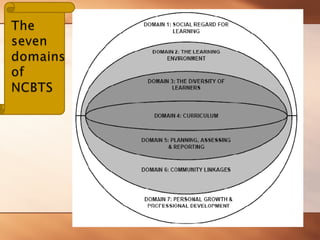
NCBTS-FRAMEWORK & STRUCTURE 
DOMAIN1: SOCIAL REGARD 
FOR LEARNING 
DOMAIN 2: THE LEARNING 
ENVIRONMENT 
DOMAIN 3: THE DIVERSITY OF LEARNERS 
DOMAIN 4: CURRICULUM 
DOMAIN 5: PLANNING, 
ASSESSING & REPORTING 
DOMAIN 6: COMMUNITY LINKAGES 
DOMAIN 7: PERSONAL GROWTH & PROFESSIONAL 
DEVELOPMENT
BESRA KRT2 
ÂľBESRA as a policy reform is expected to create critical changes necessary to accelerate, broaden, deepen and sustain the improved education effort already started by DepEd. 
Âľ 
BESRA KRT2 will raise teacher standards in the profession to meet the demands for better learning outcomes.
Main Policy Actions of BESRA KRT2 
ÂľA framework for competency-based standards for teachers. 
Âľ 
A rolling 5-year projection of teacher hires. 
Âľ 
Progressive upgrades in division level teacher hiring practices. 
Âľ 
Regional, division and school level targets for distribution of class sizes.
Main Policy Actions of BESRA KRT2 
ÂľRegional, division and school level targets for distribution of class sizes. 
Âľ 
Division and school focus in improving teaching practices in schools. 
Âľ 
Pre-service teacher education and licensing to support future hiring standards. 
Âľ 
New legislation governing teacher (non-teaching staff) compensation, benefits and conditions of employment.
Background 
ÂľNational Competency-Based Standards (NCBTS) defines Effective Teaching. 
Âľ 
NCBTS clearly stated the strategic and indispensable role of the TEACHER in the learning process of the students.
NCBTS to TSNA 
ÂľTeacher Strengths and Needs Assessment (TSNA) was designed in the context of NCBTS. 
Âľ 
TSNA is anchored on the overarching concept of teacher professional development to promote student learning. 
Âľ 
TSNA will be utilized for Individual Plan for Professional Development (IPPD) 
Âľ 
IPPD as an input to the School Improvement Plan (IPPD)
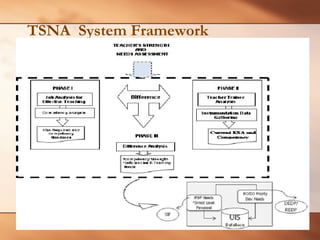
TSNA System Framework
General Purposes of TSNA 
ÂľTo gather data for the continuous training and professional development of teachers 
Âľ 
To identify teacher’s professional attributes, knowledge, understanding, skills and attitudes. 
Âľ 
To identify teacher strengths that would complement the learning needs and requirements of the learners.
Specific Purposes of TSNA 
ÂľDetermine the competency status profile, strengths and weaknesses of individual teacher vis a vis the standards set by NCBTS in the 7 seven domains. 
Âľ 
Determine the Individual Professional Teacher Index from the TSNA results and use the data to develop teachers Individual Plan for Professional Development
Specific Purposes of TSNA 
ÂľTo consolidate the TSNA results at the school, division levels as reference to the School Improvement Plan (SIP) and the Annual Improvement Plan (AIP)
EXPECTED OUTPUT 
ÂľAt the Individual Level 
An Individual Teacher Scoring Template that contains TSNA results indicating the strengths and training needs in each of the 7 domains, 23 strands, 80 indicators and 270 KSAs.
EXPECTED OUTPUT 
ÂľAt the School Level 
School data-based results that reflect the general strengths and learning needs of the teachers in the particular school.
EXPECTED OUTPUT 
Âľ 
At the cluster/division level 
Division data-based results of participating schools teachers in a given cluster/division.
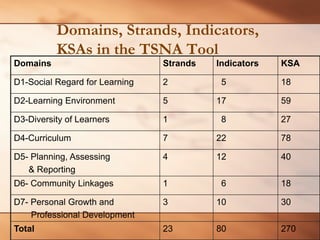
Domains, Strands, Indicators, KSAs in the TSNA Tool 
Domains 
Strands 
Indicators 
KSA 
D1-Social Regard for Learning 
2 
5 
18 
D2-Learning Environment 
5 
17 
59 
D3-Diversity of Learners 
1 
8 
27 
D4-Curriculum 
7 
22 
78 
D5-Planning, Assessing 
& Reporting 
4 
12 
40 
D6-Community Linkages 
1 
6 
18 
D7-Personal Growth and 
Professional Development 
3 
10 
30 
Total 
23 
80 
270
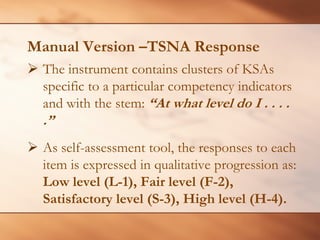
Manual Version –TSNA Response 
¾The instrument contains clusters of KSAs specific to a particular competency indicators and with the stem: “At what level do I . . . . .” 
Âľ 
As self-assessment tool, the responses to each item is expressed in qualitative progression as: Low level (L-1), Fair level (F-2), Satisfactory level (S-3), High level (H-4).
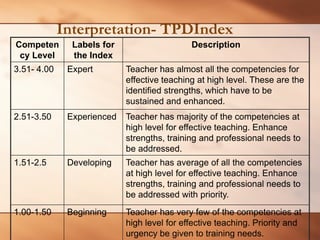
Interpretation-TPDIndex 
Competency Level 
Labels for the Index 
Description 
3.51-4.00 
Expert 
Teacher has almost all the competencies for effective teaching at high level. These are the identified strengths, which have to be sustained and enhanced. 
2.51-3.50 
Experienced 
Teacher has majority of the competencies at high level for effective teaching. Enhance strengths, training and professional needs to be addressed. 
1.51-2.5 
Developing 
Teacher has average of all the competencies at high level for effective teaching. Enhance strengths, training and professional needs to be addressed with priority. 
1.00-1.50 
Beginning 
Teacher has very few of the competencies at high level for effective teaching. Priority and urgency be given to training needs.
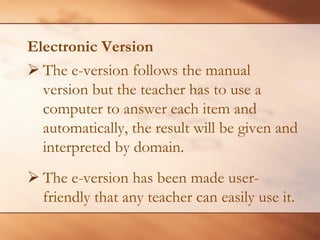
Electronic Version 
ÂľThe e-version follows the manual version but the teacher has to use a computer to answer each item and automatically, the result will be given and interpreted by domain. 
Âľ 
The e-version has been made user- friendly that any teacher can easily use it.
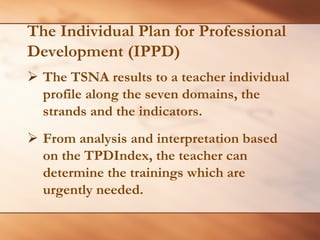
The Individual Plan for Professional 
Development (IPPD) 
ÂľThe TSNA results to a teacher individual profile along the seven domains, the strands and the indicators. 
Âľ 
From analysis and interpretation based on the TPDIndex, the teacher can determine the trainings which are urgently needed.
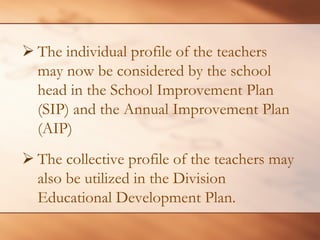
ÂľThe individual profile of the teachers may now be considered by the school head in the School Improvement Plan (SIP) and the Annual Improvement Plan (AIP) 
Âľ 
The collective profile of the teachers may also be utilized in the Division Educational Development Plan.
Thus…. 
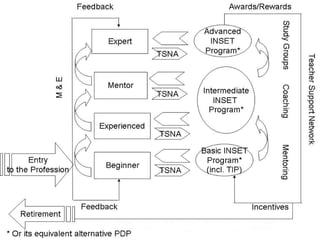
The use of TSNA will guide individual teacher and school heads in following the Teacher Capacity Building Roadmap as shown in the next figure.
Thank you very much

Overseas presentation ncbts_and_tsna

  • 1.
    Beatriz G. Torno,DPM Executive Director II Teacher Education Council Teacher Education and Development Program (TEDP) – National Competency-Based Teacher Standards (NCBTS) Philippine Education Reform
  • 2.
    I wish Icould persuade every teacher to be proud of his/her occupation-not conceited or pompous , but proud. People who introduce themselves with the shame remark that they are, “just teachers”, give me despair in my heart.
  • 3.
    Did you everhear a lawyer say depreciatingly that he was only a patent attorney? Did you ever hear a physiciansay “I am just a brain surgeon?”
  • 4.
    I beg ofyou to stop apologizing for being a member of the most important profession in the world. Draw yourself up to your full height; look at anybody squarely in the eye and say, “I AM A TEACHER.” William Garr
  • 5.
    Department of EducationOverview Mission: to provide quality basic education that is equitably accessible to all and lay the foundation for life-long learning and service for the common good
  • 6.
    Overview Total enrollment-SY2008-2009 = 19.4 million Elementary: Pre-school, Grades 1-6; Public: 12,304,207 Private: 1,092,781 Total =13,396,988 Secondary: First Yr –4thyr: Public:5,126,459Private: 1,332,846 Total = 6,459,305
  • 7.
    TOTAL NUMBER OFTEACHERS: Elementary: Public: 348,082 Private: 49,440 397,368 Secondary: Public: 131,865 Private: 53,018 184,883 GRAND TOTAL: 582,255
  • 8.
    BASIC EDUCATION SECTORREFORM AGENDA (BESRA) TEDP and NCBTS TEDP is TEACHER EDUCATION and DEVELOPMENT PLAN - is the master plan for Teacher Education. - is the articulation of a singular competency- based framework for teaching and teacher development that would guide all policies, reforms, and activities related to teaching and teacher development.
  • 9.
    Entry to Teacher Education DepED* / Civil Service CHED/TEIs/Schools Teacher Licensure PRC Teacher Human Resource Planning, Recruitment, Selection, Deployment and Recognition System DepED/CHED/TEIs Induction Training DepED In-Service Training and Professional Development DepED Retirement Preparation Pre-Service Training (BEEd/BSEd/PGCEd) National Competency-Based Teacher Standards The Teacher Education and Development Map *Includes public and private schoo
  • 10.
    Introduction CAR- AGA At the heart of the TEDP map is the Philippine National Competency-Based teacher Standards (NCBTS)
  • 11.
    ™ TEDP conceptualizesa teacher’s career path as a continuum that starts with the entry to a teacher education program and concludes when a teacher reaches retirement from formal service What is TEDP?
  • 12.
    ™Agencies working handin hand for the good of the teaching profession are Department of Education (DepEd), Commission on Higher Education (CHED), Professional Regulation Commission (PRC), Civil Service Commission (CSC) and Teacher Education Institutions (TEIs) What is TEDP?
  • 13.
    ™The National Competency_Based Teacher Standards (NCBTS) is at the heart of the TEDP. It is the key element of the TEDP (Teacher Education and Development Program). Abstraction
  • 14.
    •NORM • CRITERION • BENCHMARK • YARDSTICK • MODEL • MEASURE • PARADIGM • TOUCHSTONE What is a standard?
  • 15.
    What is NCBTS? ™NCBTS defines effective teaching as being able to help all types of students learn the different learning goals in the curriculum
  • 16.
    What is NCBTS? ™An integrated theoretical framework that defines the different dimensions of effective teaching
  • 17.
    What is NCBTS? ™It is based on the core values of Filipino teachers and on effective teaching and learning with seven (7) domains, 23 strands and 80 performance indicators.
  • 18.
    ™ Teacher EducationInstitutions (TEIs) shall use it to design and implement effective pre-service teacher education curricula ™ Professional Regulation Commission (PRC) shall refer to it to design the LET
  • 19.
    ™ Institutions and agencies that provide Professional Development or INSET shall refer to it to develop the intervention they desire • Award giving bodies
  • 20.
    ™DepEd shall usethe NCBTS to formulate its hiring, promotion, supervision and other policies related to the teaching profession.
  • 21.
    ™Most of all,individual teachers in all public elementary and high schools shall use it for their professional development activities
  • 23.
    Domain 1: SocialRegard for Learning Key Question for the Teacher: “Can my students appreciate and model the value of learning through my interactions with them?”
  • 24.
    Domain 1: SocialRegard for Learning Explanation: The domain of Social Regard for Learning focuses on the ideal that teachers serve as positive & powerful role models of the values of the pursuit of learning & of the effort to learn, & that the teachers actions, statements, & different types of social interactions with students exemplify this ideal.
  • 25.
    Domain 2: LearningEnvironment Key Question for the Teacher: “Do I create a physical and social environment in class that allows my students to attain maximum learning?”
  • 26.
    Domain 2: LearningEnvironment Explanation: The domain of Learning Environment focuses on importance of providing for a social and physical environment within which all students, regardless of their individual differences in learning, can engage the different learning activities and work towards attaining high standards of learning.
  • 27.
    Domain 3: Diversityof Learners Key Question for the Teacher: “Can I help my students learn whatever their capabilities, learning styles, cultural heritage, socio-economic backgrounds, and other differences are?”
  • 28.
    Domain 3: Diversityof Learners Explanation: The domain of Diversity of Learners emphasizes the ideal that teachers can facilitate the learning process in diverse types of learners, by first recognizing and respecting individual differences, then using knowledge about students’differences to design diverse sets of learning activities to ensure that all students can attain appropriate learning goals.
  • 29.
    Domain 4: Curriculum Key Question for the Teacher: “Can my students understand and attain the goals of the curriculum through the various learning resources and activities I prepared? Have I made use of ICT appropriately”
  • 30.
    Domain 4: Curriculum Explanation: The domain of Curriculum refers to all elements of the teaching-learning process that work in convergence to help students attain high standards of learning and understanding of the curricular goals and objectives. These elements include the teacher’s knowledge of subject matter, teaching-learning approaches and activities, instructional materials and learning resources including ICT.
  • 31.
    Domain 5: Planning,Assessing and Reporting Key Question for the Teacher: “Do I assess my students’learning and knowledge using appropriate educational assessment procedures, and do I use the information from these assessment procedures in planning my teaching-learning activities for the students?”
  • 32.
    Domain 5: Planning,Assessingand Reporting Explanation: The domain of Planning, Assessing & Reporting refers to the aligned use of assessment and planning activities to ensure that the teaching-learning activities are maximally appropriate to the students’current knowledge and learning levels. In particular, the domain focuses on the use of assessment data to plan & revise teaching-learning plans, as well as the integration of formative assessment procedures in the plan and implementation of teaching-learning activities.
  • 33.
    Domain 5: Planning,Assessing and Reporting (continuation) In particular, the domain focuses on the use of assessment data to plan & revise teaching-learning plans, as well as the integration of formative assessment procedures in the plan and implementation of teaching-learning activities.
  • 34.
    Domain 6: CommunityLinkages Key Question for the Teacher: “Are the goals and characteristics of the teaching-learning activities I implement relevant to the experiences, values and aspirations in my students’communities?”
  • 35.
    Domain 6: CommunityLinkages Explanation: The domain of Community Linkages focuses on the ideal that school activities are meaningfully linked to the experiences and aspirations of the students in their homes and communities. Thus, the domain focuses on teachers’ efforts directed at strengthening the links between school and community activities as these help in the attainment of the curricular objectives.
  • 36.
    Domain 7: PersonalGrowth and Professional Development Key Question for the Teacher: “Do my actions and statements indicate a high regard for the teaching profession and for my continuous development as a professional teacher?”
  • 37.
    Domain 7: PersonalGrowth and Professional Development Explanation: The domain of Personal Growth and Professional Development emphasizes the ideal that teachers value having a high personal regard, concern for professional development, and continuous improvement as teachers.
  • 38.
    DepEd Current Intervention–offshoot of the NCBTS is the Teacher Induction Program (TIP)–institutionalized support system for beginning teachers with 0-3 yrs in service TIP Package includes 17 self-paced modules with Pre and Post Assessments
  • 39.
    •Modules 1-5: Orientationlearning guides to help teachers be acquainted with the DepEd system especially their roles and responsibilities and their rights and benefits; • Modules 6 –17 : Curriculum and Instruction focuses on the teaching of the different subjects: content update, teaching strategies, authentic assessment of learning outcomes and lesson exemplars
  • 40.
    Thank you forlistening.
  • 41.
    National Competency- Based Teacher Standards (NCBTS)- Teacher Strengths and Needs Assessment (TSNA) and Individual Plan for Professional Development ( IPPD) for TeachersDr. Beatriz G. TornoExecutive Director II-DepED
  • 42.
  • 43.
    NCBTS-FRAMEWORK & STRUCTURE DOMAIN1: SOCIAL REGARD FOR LEARNING DOMAIN 2: THE LEARNING ENVIRONMENT DOMAIN 3: THE DIVERSITY OF LEARNERS DOMAIN 4: CURRICULUM DOMAIN 5: PLANNING, ASSESSING & REPORTING DOMAIN 6: COMMUNITY LINKAGES DOMAIN 7: PERSONAL GROWTH & PROFESSIONAL DEVELOPMENT
  • 44.
    BESRA KRT2 ÂľBESRAas a policy reform is expected to create critical changes necessary to accelerate, broaden, deepen and sustain the improved education effort already started by DepEd. Âľ BESRA KRT2 will raise teacher standards in the profession to meet the demands for better learning outcomes.
  • 45.
    Main Policy Actionsof BESRA KRT2 ÂľA framework for competency-based standards for teachers. Âľ A rolling 5-year projection of teacher hires. Âľ Progressive upgrades in division level teacher hiring practices. Âľ Regional, division and school level targets for distribution of class sizes.
  • 46.
    Main Policy Actionsof BESRA KRT2 ÂľRegional, division and school level targets for distribution of class sizes. Âľ Division and school focus in improving teaching practices in schools. Âľ Pre-service teacher education and licensing to support future hiring standards. Âľ New legislation governing teacher (non-teaching staff) compensation, benefits and conditions of employment.
  • 47.
    Background ÂľNational Competency-BasedStandards (NCBTS) defines Effective Teaching. Âľ NCBTS clearly stated the strategic and indispensable role of the TEACHER in the learning process of the students.
  • 48.
    NCBTS to TSNA ÂľTeacher Strengths and Needs Assessment (TSNA) was designed in the context of NCBTS. Âľ TSNA is anchored on the overarching concept of teacher professional development to promote student learning. Âľ TSNA will be utilized for Individual Plan for Professional Development (IPPD) Âľ IPPD as an input to the School Improvement Plan (IPPD)
  • 49.
  • 50.
    General Purposes ofTSNA ¾To gather data for the continuous training and professional development of teachers ¾ To identify teacher’s professional attributes, knowledge, understanding, skills and attitudes. ¾ To identify teacher strengths that would complement the learning needs and requirements of the learners.
  • 51.
    Specific Purposes ofTSNA ÂľDetermine the competency status profile, strengths and weaknesses of individual teacher vis a vis the standards set by NCBTS in the 7 seven domains. Âľ Determine the Individual Professional Teacher Index from the TSNA results and use the data to develop teachers Individual Plan for Professional Development
  • 52.
    Specific Purposes ofTSNA ÂľTo consolidate the TSNA results at the school, division levels as reference to the School Improvement Plan (SIP) and the Annual Improvement Plan (AIP)
  • 53.
    EXPECTED OUTPUT ÂľAtthe Individual Level An Individual Teacher Scoring Template that contains TSNA results indicating the strengths and training needs in each of the 7 domains, 23 strands, 80 indicators and 270 KSAs.
  • 54.
    EXPECTED OUTPUT ÂľAtthe School Level School data-based results that reflect the general strengths and learning needs of the teachers in the particular school.
  • 55.
    EXPECTED OUTPUT Âľ At the cluster/division level Division data-based results of participating schools teachers in a given cluster/division.
  • 56.
    Domains, Strands, Indicators,KSAs in the TSNA Tool Domains Strands Indicators KSA D1-Social Regard for Learning 2 5 18 D2-Learning Environment 5 17 59 D3-Diversity of Learners 1 8 27 D4-Curriculum 7 22 78 D5-Planning, Assessing & Reporting 4 12 40 D6-Community Linkages 1 6 18 D7-Personal Growth and Professional Development 3 10 30 Total 23 80 270
  • 57.
    Manual Version –TSNAResponse ¾The instrument contains clusters of KSAs specific to a particular competency indicators and with the stem: “At what level do I . . . . .” ¾ As self-assessment tool, the responses to each item is expressed in qualitative progression as: Low level (L-1), Fair level (F-2), Satisfactory level (S-3), High level (H-4).
  • 58.
    Interpretation-TPDIndex Competency Level Labels for the Index Description 3.51-4.00 Expert Teacher has almost all the competencies for effective teaching at high level. These are the identified strengths, which have to be sustained and enhanced. 2.51-3.50 Experienced Teacher has majority of the competencies at high level for effective teaching. Enhance strengths, training and professional needs to be addressed. 1.51-2.5 Developing Teacher has average of all the competencies at high level for effective teaching. Enhance strengths, training and professional needs to be addressed with priority. 1.00-1.50 Beginning Teacher has very few of the competencies at high level for effective teaching. Priority and urgency be given to training needs.
  • 59.
    Electronic Version ÂľThee-version follows the manual version but the teacher has to use a computer to answer each item and automatically, the result will be given and interpreted by domain. Âľ The e-version has been made user- friendly that any teacher can easily use it.
  • 60.
    The Individual Planfor Professional Development (IPPD) ÂľThe TSNA results to a teacher individual profile along the seven domains, the strands and the indicators. Âľ From analysis and interpretation based on the TPDIndex, the teacher can determine the trainings which are urgently needed.
  • 61.
    ÂľThe individual profileof the teachers may now be considered by the school head in the School Improvement Plan (SIP) and the Annual Improvement Plan (AIP) Âľ The collective profile of the teachers may also be utilized in the Division Educational Development Plan.
  • 62.
    Thus…. The useof TSNA will guide individual teacher and school heads in following the Teacher Capacity Building Roadmap as shown in the next figure.
  • 65.