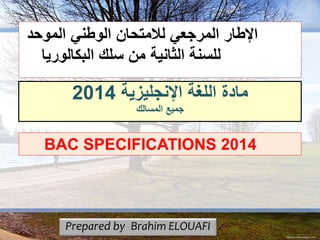
‫اإلنجليزية‬ ‫اللغة‬ ‫مادة‬
2014
‫المسالك‬ ‫جميع‬
‫الموحد‬ ‫الوطني‬ ‫لالمتحان‬ ‫المرجعي‬ ‫اإلطار‬
‫البكالوريا‬ ‫سلك‬ ‫من‬ ‫الثانية‬ ‫للسنة‬
Prepared by Brahim ELOUAFI
BAC SPECIFICATIONS 2014
The National Baccalaureate Exam
Specifications
English Subject 2014
All Streams
The Baccalaureate English exam is a summative written
achievement test produced by the Moroccan National Centre of
Evaluation and Exams. It is taken for certification purposes at the
end of the secondary school education. It is administered to all
eligible candidates. The content of the exam paper is directly
based on the national curriculum and aims at assessing testees’
knowledge and skills in reading, vocabulary, grammar, language
functions and writing.
The test paper comprises three sections :
INTRODUCTION
The specifications of the above are enclosed in the
present document.
Section One:
Section Two:
Section Three:
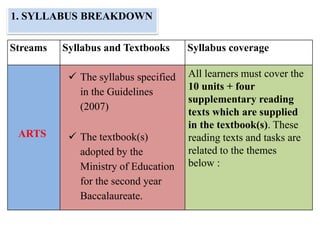
1. SYLLABUS BREAKDOWN
Streams Syllabus and Textbooks Syllabus coverage
ARTS
 The syllabus specified
in the Guidelines
(2007)
 The textbook(s)
adopted by the
Ministry of Education
for the second year
Baccalaureate.
All learners must cover the
10 units + four
supplementary reading
texts which are supplied
in the textbook(s). These
reading texts and tasks are
related to the themes
below :
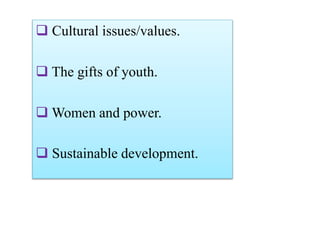
 Cultural issues/values.
 The gifts of youth.
 Women and power.
 Sustainable development.
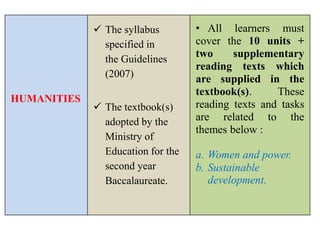
HUMANITIES
 The syllabus
specified in
the Guidelines
(2007)
 The textbook(s)
adopted by the
Ministry of
Education for the
second year
Baccalaureate.
• All learners must
cover the 10 units +
two supplementary
reading texts which
are supplied in the
textbook(s). These
reading texts and tasks
are related to the
themes below :
a. Women and power.
b. Sustainable
development.
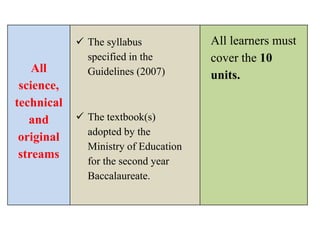
 The textbook(s)
adopted by the
Ministry of Education
for the second year
Baccalaureate.
 The syllabus
specified in the
Guidelines (2007)
All learners must
cover the 10
units.
All
science,
technical
and
original
streams
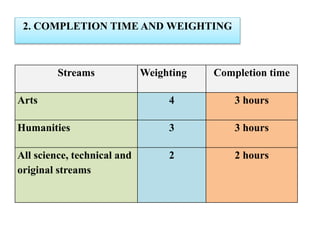
Streams Weighting Completion time
Arts 4 3 hours
Humanities 3 3 hours
All science, technical and
original streams
2 2 hours
2. COMPLETION TIME AND WEIGHTING
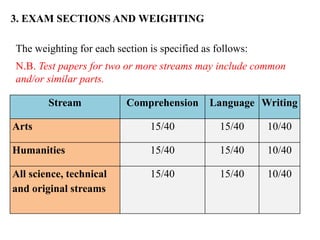
Stream Comprehension Language Writing
Arts 15/40 15/40 10/40
Humanities 15/40 15/40 10/40
All science, technical
and original streams
15/40 15/40 10/40
3. EXAM SECTIONS AND WEIGHTING
The weighting for each section is specified as follows:
N.B. Test papers for two or more streams may include common
and/or similar parts.
4. SECTIONS, TEST TECHNIQUES
AND RUBRICS
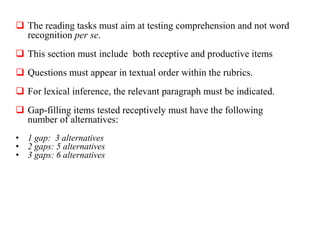
 The reading tasks must aim at testing comprehension and not word
recognition per se.
 This section must include both receptive and productive items
 Questions must appear in textual order within the rubrics.
 For lexical inference, the relevant paragraph must be indicated.
 Gap-filling items tested receptively must have the following
number of alternatives:
• 1 gap: 3 alternatives
• 2 gaps: 5 alternatives
• 3 gaps: 6 alternatives
4.1.1. READING SUBSKILLS
Testees should be able to:
 Identify main idea and details;
 Identify specific information;
 Make inferences;
 Infer word meaning from the context;
 Identify referents;
 Identify discourse markers and their functions in the text;
 Distinguish fact from opinion;
 Identify the author’s attitude;
 Identify the author’s purpose;
 Transfer information from text to chart, diagram or table;
 Identify the logical order of ideas in the text;
 Evaluate ideas expressed in a text ;
 Draw conclusions from the text.
 Extract information
4.1.2. TEXT TYPES AND TOPICS
.
The comprehension section can include one or more texts.
Texts need to be of an appropriate level of difficulty, and
should preferably target issues related to the topics and themes
in the syllabus. They should also relate to testees’ interests,
age, background knowledge and experience.
Reading texts could be in the form of articles, letters, emails,
biographies, film/book reviews, reports, advertisements, and
may include charts, pictures, maps, diagrams, etc. They can be
narrative, informative, descriptive, expository, or argumentative
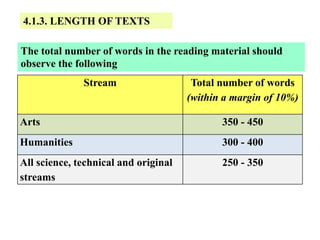
Stream Total number of words
(within a margin of 10%)
Arts 350 - 450
Humanities 300 - 400
All science, technical and original
streams
250 - 350
4.1.3. LENGTH OF TEXTS
The total number of words in the reading material should
observe the following
4.1.4. TEST TECHNIQUES
The following techniques are designed to test various reading
sub-skills. They should be varied so that no particular
technique would become so predictable. They should also
lead to clear and reliable scoring.
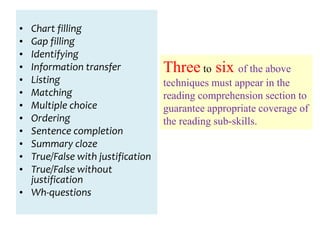
Three to six of the above
techniques must appear in the
reading comprehension section to
guarantee appropriate coverage of
the reading sub-skills.
• Chart filling
• Gap filling
• Identifying
• Information transfer
• Listing
• Matching
• Multiple choice
• Ordering
• Sentence completion
• Summary cloze
• True/False with justification
• True/False without
justification
• Wh-questions
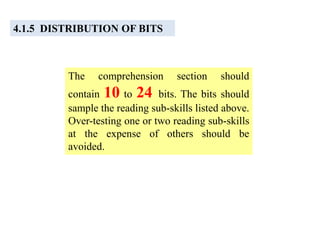
4.1.5 DISTRIBUTION OF BITS
The comprehension section should
contain 10 to 24 bits. The bits should
sample the reading sub-skills listed above.
Over-testing one or two reading sub-skills
at the expense of others should be
avoided.
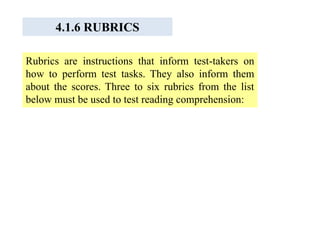
4.1.6 RUBRICS
Rubrics are instructions that inform test-takers on
how to perform test tasks. They also inform them
about the scores. Three to six rubrics from the list
below must be used to test reading comprehension:
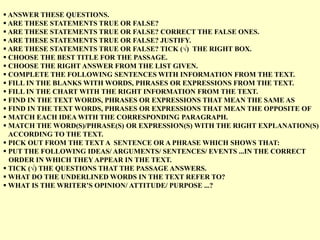
 ANSWER THESE QUESTIONS.
 ARE THESE STATEMENTS TRUE OR FALSE?
 ARE THESE STATEMENTS TRUE OR FALSE? CORRECT THE FALSE ONES.
 ARE THESE STATEMENTS TRUE OR FALSE? JUSTIFY.
 ARE THESE STATEMENTS TRUE OR FALSE? TICK (√) THE RIGHT BOX.
 CHOOSE THE BEST TITLE FOR THE PASSAGE.
 CHOOSE THE RIGHT ANSWER FROM THE LIST GIVEN.
 COMPLETE THE FOLLOWING SENTENCES WITH INFORMATION FROM THE TEXT.
 FILL IN THE BLANKS WITH WORDS, PHRASES OR EXPRESSIONS FROM THE TEXT.
 FILL IN THE CHART WITH THE RIGHT INFORMATION FROM THE TEXT.
 FIND IN THE TEXT WORDS, PHRASES OR EXPRESSIONS THAT MEAN THE SAME AS
 FIND IN THE TEXT WORDS, PHRASES OR EXPRESSIONS THAT MEAN THE OPPOSITE OF
 MATCH EACH IDEA WITH THE CORRESPONDING PARAGRAPH.
 MATCH THE WORD(S)/PHRASE(S) OR EXPRESSION(S) WITH THE RIGHT EXPLANATION(S)
ACCORDING TO THE TEXT.
 PICK OUT FROM THE TEXT A SENTENCE OR A PHRASE WHICH SHOWS THAT:
 PUT THE FOLLOWING IDEAS/ ARGUMENTS/ SENTENCES/ EVENTS ...IN THE CORRECT
ORDER IN WHICH THEY APPEAR IN THE TEXT.
 TICK (√) THE QUESTIONS THAT THE PASSAGE ANSWERS.
 WHAT DO THE UNDERLINED WORDS IN THE TEXT REFER TO?
 WHAT IS THE WRITER’S OPINION/ ATTITUDE/ PURPOSE ...?
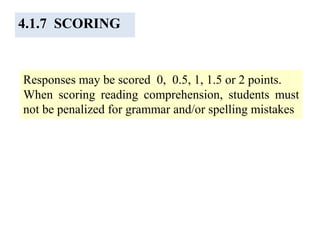
4.1.7 SCORING
Responses may be scored 0, 0.5, 1, 1.5 or 2 points.
When scoring reading comprehension, students must
not be penalized for grammar and/or spelling mistakes
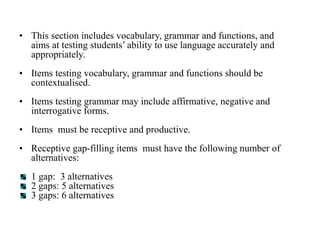
• This section includes vocabulary, grammar and functions, and
aims at testing students’ ability to use language accurately and
appropriately.
• Items testing vocabulary, grammar and functions should be
contextualised.
• Items testing grammar may include affirmative, negative and
interrogative forms.
• Items must be receptive and productive.
• Receptive gap-filling items must have the following number of
alternatives:
1 gap: 3 alternatives
2 gaps: 5 alternatives
3 gaps: 6 alternatives
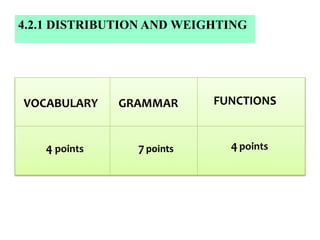
4.2.1 DISTRIBUTION AND WEIGHTING
VOCABULARY
4 points
GRAMMAR FUNCTIONS
7points 4points
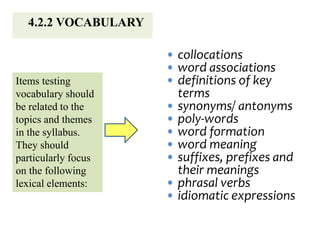
4.2.2 VOCABULARY
Items testing
vocabulary should
be related to the
topics and themes
in the syllabus.
They should
particularly focus
on the following
lexical elements:
• collocations
• word associations
• definitions of key
terms
• synonyms/ antonyms
• poly-words
• word formation
• word meaning
• suffixes, prefixes and
their meanings
• phrasal verbs
• idiomatic expressions
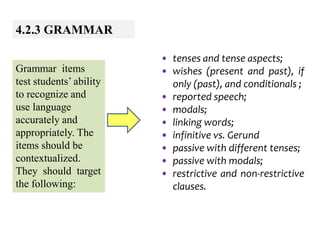
4.2.3 GRAMMAR
Grammar items
test students’ ability
to recognize and
use language
accurately and
appropriately. The
items should be
contextualized.
They should target
the following:
• tenses and tense aspects;
• wishes (present and past), if
only (past), and conditionals ;
• reported speech;
• modals;
• linking words;
• infinitive vs. Gerund
• passive with different tenses;
• passive with modals;
• restrictive and non-restrictive
clauses.
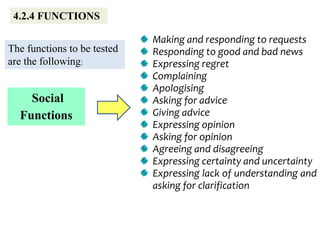
The functions to be tested
are the following:
Social
Functions
Making and responding to requests
Responding to good and bad news
Expressing regret
Complaining
Apologising
Asking for advice
Giving advice
Expressing opinion
Asking for opinion
Agreeing and disagreeing
Expressing certainty and uncertainty
Expressing lack of understanding and
asking for clarification
4.2.4 FUNCTIONS
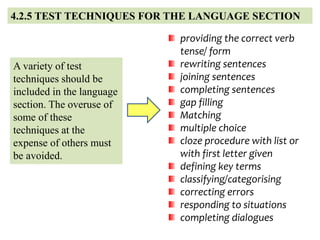
4.2.5 TEST TECHNIQUES FOR THE LANGUAGE SECTION
A variety of test
techniques should be
included in the language
section. The overuse of
some of these
techniques at the
expense of others must
be avoided.
providing the correct verb
tense/ form
rewriting sentences
joining sentences
completing sentences
gap filling
Matching
multiple choice
cloze procedure with list or
with first letter given
defining key terms
classifying/categorising
correcting errors
responding to situations
completing dialogues
The rubrics below are to be used when testing grammar,
vocabulary and functions.
4.2.6 RUBRICS
1. COMPLETE THE FOLLOWING DIALOGUE(S) APPROPRIATELY
2. CHOOSE THE RIGHT ANSWER.
3. CORRECT THE ERRORS IN THESE SENTENCES. THERE IS ONE ERROR
IN EACH SENTENCE.
4. CORRECT THE UNDERLINED MISTAKE(S)
5. FILL IN THE GAPS WITH APPROPRIATE COLLOCATIONS.
6. FILL IN THE GAPS WITH APPROPRIATE PHRASAL VERBS
7. FILL IN THE GAPS WITH APPROPRIATE WORDS OR EXPRESSIONS
FROM THE LIST
8. FILL IN THE GAPS WITH APPROPRIATE WORDS OR EXPRESSIONS
9. GIVE AN APPROPRIATE DEFINITION TO EACH OF THE FOLLOWING
WORDS
10. GIVE THE CORRECT FORMS OF THE WORDS IN BRACKETS.
11. JOIN THE PAIRS OF SENTENCES WITH THE LINKING WORDS GIVEN.
12. MATCH EACH EXPRESSION WITH ITS APPRORIATE FUNCTION.
13. MATCH THE EXCHANGE(S) WITH THE APPROPRIATE FUNCTION(S).
14. MATCH THE WORDS THAT GO TOGETHER TO MAKE APPROPRIATE
COLLOCATIONS.
15. MATCH THE WORDS WITH THE CORRESPONDING DEFINITIONS/
SYNONYMS/ ANTONYMS.
16. PROVIDE THE APPROPRIATE WORD FOR EACH OF THE FOLLOWING
DEFINITIONS.
17. PUT THE FOLLOWING EXCHANGES IN THE CORRECT ORDER
18. PUT THE FOLLOWING WORDS/PHRASES/SENTENCES IN THE CORRECT
ORDER.
19. PUT THE VERBS IN BRACKETS IN THE CORRECT FORM.
20. PUT THE VERBS IN BRACKETS IN THE RIGHT TENSE.
21. REPLACE EACH UNDERLINED VERB WITH AN APPROPRIATE PHRASAL
VERB.
22. REPLACE EACH UNDERLINED VERB WITH THE APPROPRIATE PHRASAL
VERB FROM THE LIST.
23. REPLACE THE UNDERLINED WORDS WITH APPROPRIATE SYNONYMS
24. REWRITE THE SENTENCES AS INDICATED.
25. REWRITE THE SENTENCES BEGINNING WITH THE WORDS GIVEN.
26. THERE ARE ... ERRORS IN THIS PARAGRAPH. CORRECT THEM.
27. TICK (Ѵ) THE CORRECT SENTENCE (S).
28. WHAT DOES EACH SENTENCE EXPRESS?
29. WRITE AN APPROPRIATE RESPONSE TO THE FOLLOWING SITUATION(S).
4.2.7 DISTRIBUTION OF BITS
4.2.8 SCORING
The language section must contain 10 to 24 bits. The
bits must sample the language components (grammar,
vocabulary and functions) included in the syllabus.
A minimum of four rubrics must be used in the
language section.
Responses may be scored 0, 0.5, 1,
1.5 or 2 point(s).
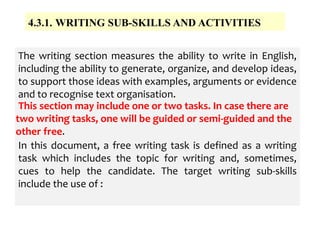
4.3.1. WRITING SUB-SKILLS AND ACTIVITIES
The writing section measures the ability to write in English,
including the ability to generate, organize, and develop ideas,
to support those ideas with examples, arguments or evidence
and to recognise text organisation.
In this document, a free writing task is defined as a writing
task which includes the topic for writing and, sometimes,
cues to help the candidate. The target writing sub-skills
include the use of :
This section may include one or two tasks. In case there are
two writing tasks, one will be guided or semi-guided and the
other free.
• adequate and relevant content;
• appropriate text structure according to the targeted
format ;
• appropriate style according to audience;
• cohesive devices and transitions to organize their
writing;
• correct use of mechanics (spelling, punctuation,
capitalization);
• appropriate structures and vocabulary to get the
message across;
• variety of sentence structures: simple and complex ones.
Tasks related to writing may include:
 developing a topic sentence;
 writing a topic sentence;
 transferring information;
 completing a paragraph;
 punctuating a paragraph
 rewriting a paragraph;
 writing a paragraph from a given list of words
 completing a dialogue;
 describing a picture;
 describing a process;
 drawing an outline
 filling a diagram
 writing an article;
 writing an ad
 telling a story
 joining sentences
 filling in forms
The following table shows different format/genres and
types of writing to be tested:
Format/Genre of Writing Types of Writing
formal/ informal letters
film/ book reviews
articles
e-mails
reports
paragraphs
multi-paragraph essays
biographies
Narrative
Descriptive
Argumentative
Expository
persuasive
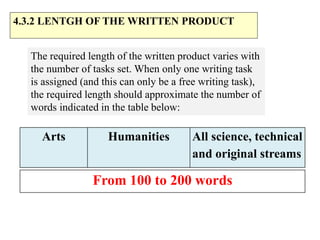
From 100 to 200 words
4.3.2 LENTGH OF THE WRITTEN PRODUCT
The required length of the written product varies with
the number of tasks set. When only one writing task
is assigned (and this can only be a free writing task),
the required length should approximate the number of
words indicated in the table below:
Arts Humanities All science, technical
and original streams
Arts Humanities All science, technical
and original streams
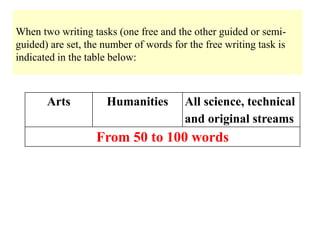
From 50 to 100 words
When two writing tasks (one free and the other guided or semi-
guided) are set, the number of words for the free writing task is
indicated in the table below:
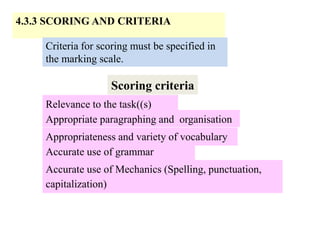
4.3.3 SCORING AND CRITERIA
Criteria for scoring must be specified in
the marking scale.
Relevance to the task((s)
Appropriate paragraphing and organisation
Appropriateness and variety of vocabulary
Accurate use of grammar
Accurate use of Mechanics (Spelling, punctuation,
capitalization)
Scoring criteria
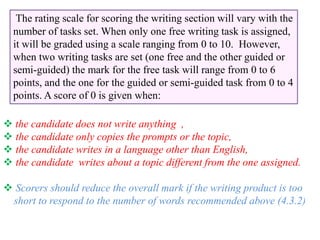
The rating scale for scoring the writing section will vary with the
number of tasks set. When only one free writing task is assigned,
it will be graded using a scale ranging from 0 to 10. However,
when two writing tasks are set (one free and the other guided or
semi-guided) the mark for the free task will range from 0 to 6
points, and the one for the guided or semi-guided task from 0 to 4
points. A score of 0 is given when:
 the candidate does not write anything ,
 the candidate only copies the prompts or the topic,
 the candidate writes in a language other than English,
 the candidate writes about a topic different from the one assigned.
 Scorers should reduce the overall mark if the writing product is too
short to respond to the number of words recommended above (4.3.2)
THANK YOU FOR YOUR ATTENTION

BAC SPECS - changes made 2014 exam b.pptx

  • 1.
    ‫اإلنجليزية‬ ‫اللغة‬ ‫مادة‬ 2014 ‫المسالك‬‫جميع‬ ‫الموحد‬ ‫الوطني‬ ‫لالمتحان‬ ‫المرجعي‬ ‫اإلطار‬ ‫البكالوريا‬ ‫سلك‬ ‫من‬ ‫الثانية‬ ‫للسنة‬ Prepared by Brahim ELOUAFI BAC SPECIFICATIONS 2014
  • 2.
    The National BaccalaureateExam Specifications English Subject 2014 All Streams The Baccalaureate English exam is a summative written achievement test produced by the Moroccan National Centre of Evaluation and Exams. It is taken for certification purposes at the end of the secondary school education. It is administered to all eligible candidates. The content of the exam paper is directly based on the national curriculum and aims at assessing testees’ knowledge and skills in reading, vocabulary, grammar, language functions and writing. The test paper comprises three sections : INTRODUCTION
  • 3.
    The specifications ofthe above are enclosed in the present document. Section One: Section Two: Section Three:
  • 4.
    1. SYLLABUS BREAKDOWN StreamsSyllabus and Textbooks Syllabus coverage ARTS  The syllabus specified in the Guidelines (2007)  The textbook(s) adopted by the Ministry of Education for the second year Baccalaureate. All learners must cover the 10 units + four supplementary reading texts which are supplied in the textbook(s). These reading texts and tasks are related to the themes below :
  • 5.
     Cultural issues/values. The gifts of youth.  Women and power.  Sustainable development.
  • 6.
    HUMANITIES  The syllabus specifiedin the Guidelines (2007)  The textbook(s) adopted by the Ministry of Education for the second year Baccalaureate. • All learners must cover the 10 units + two supplementary reading texts which are supplied in the textbook(s). These reading texts and tasks are related to the themes below : a. Women and power. b. Sustainable development.
  • 7.
     The textbook(s) adoptedby the Ministry of Education for the second year Baccalaureate.  The syllabus specified in the Guidelines (2007) All learners must cover the 10 units. All science, technical and original streams
  • 8.
    Streams Weighting Completiontime Arts 4 3 hours Humanities 3 3 hours All science, technical and original streams 2 2 hours 2. COMPLETION TIME AND WEIGHTING
  • 9.
    Stream Comprehension LanguageWriting Arts 15/40 15/40 10/40 Humanities 15/40 15/40 10/40 All science, technical and original streams 15/40 15/40 10/40 3. EXAM SECTIONS AND WEIGHTING The weighting for each section is specified as follows: N.B. Test papers for two or more streams may include common and/or similar parts.
  • 10.
    4. SECTIONS, TESTTECHNIQUES AND RUBRICS
  • 12.
     The readingtasks must aim at testing comprehension and not word recognition per se.  This section must include both receptive and productive items  Questions must appear in textual order within the rubrics.  For lexical inference, the relevant paragraph must be indicated.  Gap-filling items tested receptively must have the following number of alternatives: • 1 gap: 3 alternatives • 2 gaps: 5 alternatives • 3 gaps: 6 alternatives
  • 13.
    4.1.1. READING SUBSKILLS Testeesshould be able to:  Identify main idea and details;  Identify specific information;  Make inferences;  Infer word meaning from the context;  Identify referents;  Identify discourse markers and their functions in the text;  Distinguish fact from opinion;  Identify the author’s attitude;  Identify the author’s purpose;  Transfer information from text to chart, diagram or table;  Identify the logical order of ideas in the text;  Evaluate ideas expressed in a text ;  Draw conclusions from the text.  Extract information
  • 14.
    4.1.2. TEXT TYPESAND TOPICS . The comprehension section can include one or more texts. Texts need to be of an appropriate level of difficulty, and should preferably target issues related to the topics and themes in the syllabus. They should also relate to testees’ interests, age, background knowledge and experience. Reading texts could be in the form of articles, letters, emails, biographies, film/book reviews, reports, advertisements, and may include charts, pictures, maps, diagrams, etc. They can be narrative, informative, descriptive, expository, or argumentative
  • 15.
    Stream Total numberof words (within a margin of 10%) Arts 350 - 450 Humanities 300 - 400 All science, technical and original streams 250 - 350 4.1.3. LENGTH OF TEXTS The total number of words in the reading material should observe the following
  • 16.
    4.1.4. TEST TECHNIQUES Thefollowing techniques are designed to test various reading sub-skills. They should be varied so that no particular technique would become so predictable. They should also lead to clear and reliable scoring.
  • 17.
    Three to sixof the above techniques must appear in the reading comprehension section to guarantee appropriate coverage of the reading sub-skills. • Chart filling • Gap filling • Identifying • Information transfer • Listing • Matching • Multiple choice • Ordering • Sentence completion • Summary cloze • True/False with justification • True/False without justification • Wh-questions
  • 18.
    4.1.5 DISTRIBUTION OFBITS The comprehension section should contain 10 to 24 bits. The bits should sample the reading sub-skills listed above. Over-testing one or two reading sub-skills at the expense of others should be avoided.
  • 19.
    4.1.6 RUBRICS Rubrics areinstructions that inform test-takers on how to perform test tasks. They also inform them about the scores. Three to six rubrics from the list below must be used to test reading comprehension:
  • 20.
     ANSWER THESEQUESTIONS.  ARE THESE STATEMENTS TRUE OR FALSE?  ARE THESE STATEMENTS TRUE OR FALSE? CORRECT THE FALSE ONES.  ARE THESE STATEMENTS TRUE OR FALSE? JUSTIFY.  ARE THESE STATEMENTS TRUE OR FALSE? TICK (√) THE RIGHT BOX.  CHOOSE THE BEST TITLE FOR THE PASSAGE.  CHOOSE THE RIGHT ANSWER FROM THE LIST GIVEN.  COMPLETE THE FOLLOWING SENTENCES WITH INFORMATION FROM THE TEXT.  FILL IN THE BLANKS WITH WORDS, PHRASES OR EXPRESSIONS FROM THE TEXT.  FILL IN THE CHART WITH THE RIGHT INFORMATION FROM THE TEXT.  FIND IN THE TEXT WORDS, PHRASES OR EXPRESSIONS THAT MEAN THE SAME AS  FIND IN THE TEXT WORDS, PHRASES OR EXPRESSIONS THAT MEAN THE OPPOSITE OF  MATCH EACH IDEA WITH THE CORRESPONDING PARAGRAPH.  MATCH THE WORD(S)/PHRASE(S) OR EXPRESSION(S) WITH THE RIGHT EXPLANATION(S) ACCORDING TO THE TEXT.  PICK OUT FROM THE TEXT A SENTENCE OR A PHRASE WHICH SHOWS THAT:  PUT THE FOLLOWING IDEAS/ ARGUMENTS/ SENTENCES/ EVENTS ...IN THE CORRECT ORDER IN WHICH THEY APPEAR IN THE TEXT.  TICK (√) THE QUESTIONS THAT THE PASSAGE ANSWERS.  WHAT DO THE UNDERLINED WORDS IN THE TEXT REFER TO?  WHAT IS THE WRITER’S OPINION/ ATTITUDE/ PURPOSE ...?
  • 21.
    4.1.7 SCORING Responses maybe scored 0, 0.5, 1, 1.5 or 2 points. When scoring reading comprehension, students must not be penalized for grammar and/or spelling mistakes
  • 23.
    • This sectionincludes vocabulary, grammar and functions, and aims at testing students’ ability to use language accurately and appropriately. • Items testing vocabulary, grammar and functions should be contextualised. • Items testing grammar may include affirmative, negative and interrogative forms. • Items must be receptive and productive. • Receptive gap-filling items must have the following number of alternatives: 1 gap: 3 alternatives 2 gaps: 5 alternatives 3 gaps: 6 alternatives
  • 24.
    4.2.1 DISTRIBUTION ANDWEIGHTING VOCABULARY 4 points GRAMMAR FUNCTIONS 7points 4points
  • 25.
    4.2.2 VOCABULARY Items testing vocabularyshould be related to the topics and themes in the syllabus. They should particularly focus on the following lexical elements: • collocations • word associations • definitions of key terms • synonyms/ antonyms • poly-words • word formation • word meaning • suffixes, prefixes and their meanings • phrasal verbs • idiomatic expressions
  • 26.
    4.2.3 GRAMMAR Grammar items teststudents’ ability to recognize and use language accurately and appropriately. The items should be contextualized. They should target the following: • tenses and tense aspects; • wishes (present and past), if only (past), and conditionals ; • reported speech; • modals; • linking words; • infinitive vs. Gerund • passive with different tenses; • passive with modals; • restrictive and non-restrictive clauses.
  • 27.
    The functions tobe tested are the following: Social Functions Making and responding to requests Responding to good and bad news Expressing regret Complaining Apologising Asking for advice Giving advice Expressing opinion Asking for opinion Agreeing and disagreeing Expressing certainty and uncertainty Expressing lack of understanding and asking for clarification 4.2.4 FUNCTIONS
  • 28.
    4.2.5 TEST TECHNIQUESFOR THE LANGUAGE SECTION A variety of test techniques should be included in the language section. The overuse of some of these techniques at the expense of others must be avoided. providing the correct verb tense/ form rewriting sentences joining sentences completing sentences gap filling Matching multiple choice cloze procedure with list or with first letter given defining key terms classifying/categorising correcting errors responding to situations completing dialogues
  • 29.
    The rubrics beloware to be used when testing grammar, vocabulary and functions. 4.2.6 RUBRICS 1. COMPLETE THE FOLLOWING DIALOGUE(S) APPROPRIATELY 2. CHOOSE THE RIGHT ANSWER. 3. CORRECT THE ERRORS IN THESE SENTENCES. THERE IS ONE ERROR IN EACH SENTENCE. 4. CORRECT THE UNDERLINED MISTAKE(S) 5. FILL IN THE GAPS WITH APPROPRIATE COLLOCATIONS. 6. FILL IN THE GAPS WITH APPROPRIATE PHRASAL VERBS 7. FILL IN THE GAPS WITH APPROPRIATE WORDS OR EXPRESSIONS FROM THE LIST 8. FILL IN THE GAPS WITH APPROPRIATE WORDS OR EXPRESSIONS 9. GIVE AN APPROPRIATE DEFINITION TO EACH OF THE FOLLOWING WORDS 10. GIVE THE CORRECT FORMS OF THE WORDS IN BRACKETS. 11. JOIN THE PAIRS OF SENTENCES WITH THE LINKING WORDS GIVEN. 12. MATCH EACH EXPRESSION WITH ITS APPRORIATE FUNCTION. 13. MATCH THE EXCHANGE(S) WITH THE APPROPRIATE FUNCTION(S). 14. MATCH THE WORDS THAT GO TOGETHER TO MAKE APPROPRIATE COLLOCATIONS.
  • 30.
    15. MATCH THEWORDS WITH THE CORRESPONDING DEFINITIONS/ SYNONYMS/ ANTONYMS. 16. PROVIDE THE APPROPRIATE WORD FOR EACH OF THE FOLLOWING DEFINITIONS. 17. PUT THE FOLLOWING EXCHANGES IN THE CORRECT ORDER 18. PUT THE FOLLOWING WORDS/PHRASES/SENTENCES IN THE CORRECT ORDER. 19. PUT THE VERBS IN BRACKETS IN THE CORRECT FORM. 20. PUT THE VERBS IN BRACKETS IN THE RIGHT TENSE. 21. REPLACE EACH UNDERLINED VERB WITH AN APPROPRIATE PHRASAL VERB. 22. REPLACE EACH UNDERLINED VERB WITH THE APPROPRIATE PHRASAL VERB FROM THE LIST. 23. REPLACE THE UNDERLINED WORDS WITH APPROPRIATE SYNONYMS 24. REWRITE THE SENTENCES AS INDICATED. 25. REWRITE THE SENTENCES BEGINNING WITH THE WORDS GIVEN. 26. THERE ARE ... ERRORS IN THIS PARAGRAPH. CORRECT THEM. 27. TICK (Ѵ) THE CORRECT SENTENCE (S). 28. WHAT DOES EACH SENTENCE EXPRESS? 29. WRITE AN APPROPRIATE RESPONSE TO THE FOLLOWING SITUATION(S).
  • 31.
    4.2.7 DISTRIBUTION OFBITS 4.2.8 SCORING The language section must contain 10 to 24 bits. The bits must sample the language components (grammar, vocabulary and functions) included in the syllabus. A minimum of four rubrics must be used in the language section. Responses may be scored 0, 0.5, 1, 1.5 or 2 point(s).
  • 33.
    4.3.1. WRITING SUB-SKILLSAND ACTIVITIES The writing section measures the ability to write in English, including the ability to generate, organize, and develop ideas, to support those ideas with examples, arguments or evidence and to recognise text organisation. In this document, a free writing task is defined as a writing task which includes the topic for writing and, sometimes, cues to help the candidate. The target writing sub-skills include the use of : This section may include one or two tasks. In case there are two writing tasks, one will be guided or semi-guided and the other free.
  • 34.
    • adequate andrelevant content; • appropriate text structure according to the targeted format ; • appropriate style according to audience; • cohesive devices and transitions to organize their writing; • correct use of mechanics (spelling, punctuation, capitalization); • appropriate structures and vocabulary to get the message across; • variety of sentence structures: simple and complex ones.
  • 35.
    Tasks related towriting may include:  developing a topic sentence;  writing a topic sentence;  transferring information;  completing a paragraph;  punctuating a paragraph  rewriting a paragraph;  writing a paragraph from a given list of words  completing a dialogue;  describing a picture;  describing a process;  drawing an outline  filling a diagram  writing an article;  writing an ad  telling a story  joining sentences  filling in forms
  • 36.
    The following tableshows different format/genres and types of writing to be tested: Format/Genre of Writing Types of Writing formal/ informal letters film/ book reviews articles e-mails reports paragraphs multi-paragraph essays biographies Narrative Descriptive Argumentative Expository persuasive
  • 37.
    From 100 to200 words 4.3.2 LENTGH OF THE WRITTEN PRODUCT The required length of the written product varies with the number of tasks set. When only one writing task is assigned (and this can only be a free writing task), the required length should approximate the number of words indicated in the table below: Arts Humanities All science, technical and original streams
  • 38.
    Arts Humanities Allscience, technical and original streams From 50 to 100 words When two writing tasks (one free and the other guided or semi- guided) are set, the number of words for the free writing task is indicated in the table below:
  • 39.
    4.3.3 SCORING ANDCRITERIA Criteria for scoring must be specified in the marking scale. Relevance to the task((s) Appropriate paragraphing and organisation Appropriateness and variety of vocabulary Accurate use of grammar Accurate use of Mechanics (Spelling, punctuation, capitalization) Scoring criteria
  • 40.
    The rating scalefor scoring the writing section will vary with the number of tasks set. When only one free writing task is assigned, it will be graded using a scale ranging from 0 to 10. However, when two writing tasks are set (one free and the other guided or semi-guided) the mark for the free task will range from 0 to 6 points, and the one for the guided or semi-guided task from 0 to 4 points. A score of 0 is given when:  the candidate does not write anything ,  the candidate only copies the prompts or the topic,  the candidate writes in a language other than English,  the candidate writes about a topic different from the one assigned.  Scorers should reduce the overall mark if the writing product is too short to respond to the number of words recommended above (4.3.2)
  • 41.
    THANK YOU FORYOUR ATTENTION