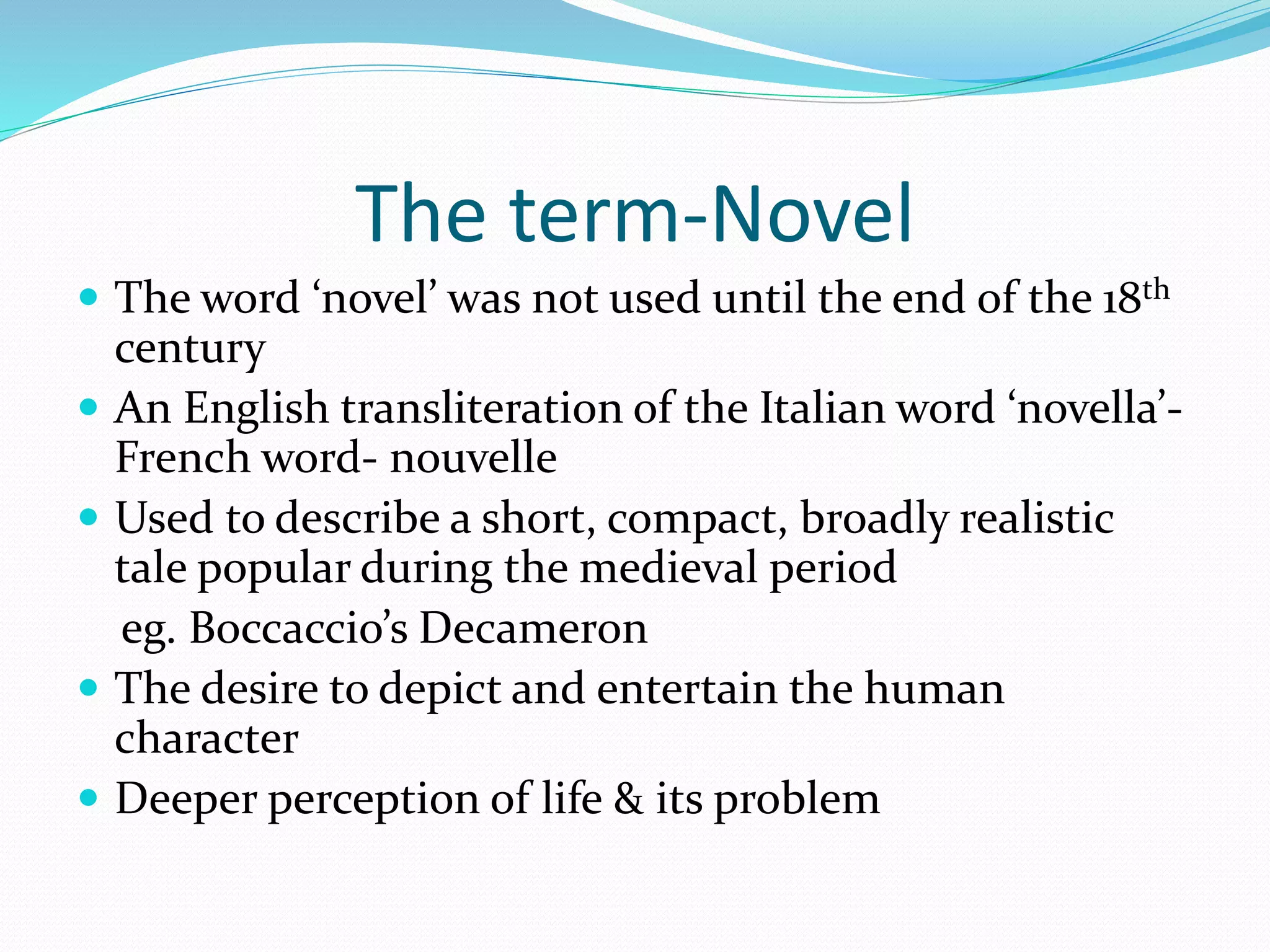
The term-Novel
 The word ‘novel’ was not used until the end of the 18th
century
 An English transliteration of the Italian word ‘novella’-
French word- nouvelle
 Used to describe a short, compact, broadly realistic
tale popular during the medieval period
eg. Boccaccio’s Decameron
 The desire to depict and entertain the human
character
 Deeper perception of life & its problem
Definition
The Shorter Oxford
Dictionary defines a
novel as
“a fictitious prose
narrative of
considerable length, in
which characters and
actions representative
of real life are
portrayed in a plot of
more or less
complexity”.
 Plot- What happens in
the story
 Characters-Who is
involved in what
happens in the story
 Point of view- how the
story is told
 Setting- When & where
the story takes place
 Novelist’s criticism-the
interpretation or
philosophy of the writer
Hybrid genre
The novel
 is the loosest form of literary art
 encompasses many different sub-genres
 is always in search of a definition
 battled with other genres from the very
beginning
 Very effective medium of the portrayal of
human thought and action
 Often contains letters, dialogues, narration,
poetry etc.
The precursors of novel
 Medieval European Romances Arthurian tales
culminating in Malory’s Morte D Arthur
 Prose romances
John Lyly-Euphues,The Anatomy of wit(1578)
Robert Greene- Pandosto(1588)
Thomas Lodge- Rosalynde(1590)
Philip Sidney- Arcadia(1590)
 Thomas Nashe’s The Unfortunate Traveller(1594)
 Deloney’s Jack of Newbury(1626)
 John Bunyan’s Pilgrim’s Progress (1678)
Only Connect ... New Directions
The increase of the reading public in the Augustan Age was due to
the growing
importance
of the middle class
the individual’s
trust in his own
abilities
the practice of
reason and self-
analysis
Most readers were
middle-class women
They used to borrow books
from circulating libraries
The rise of the novel
The novel
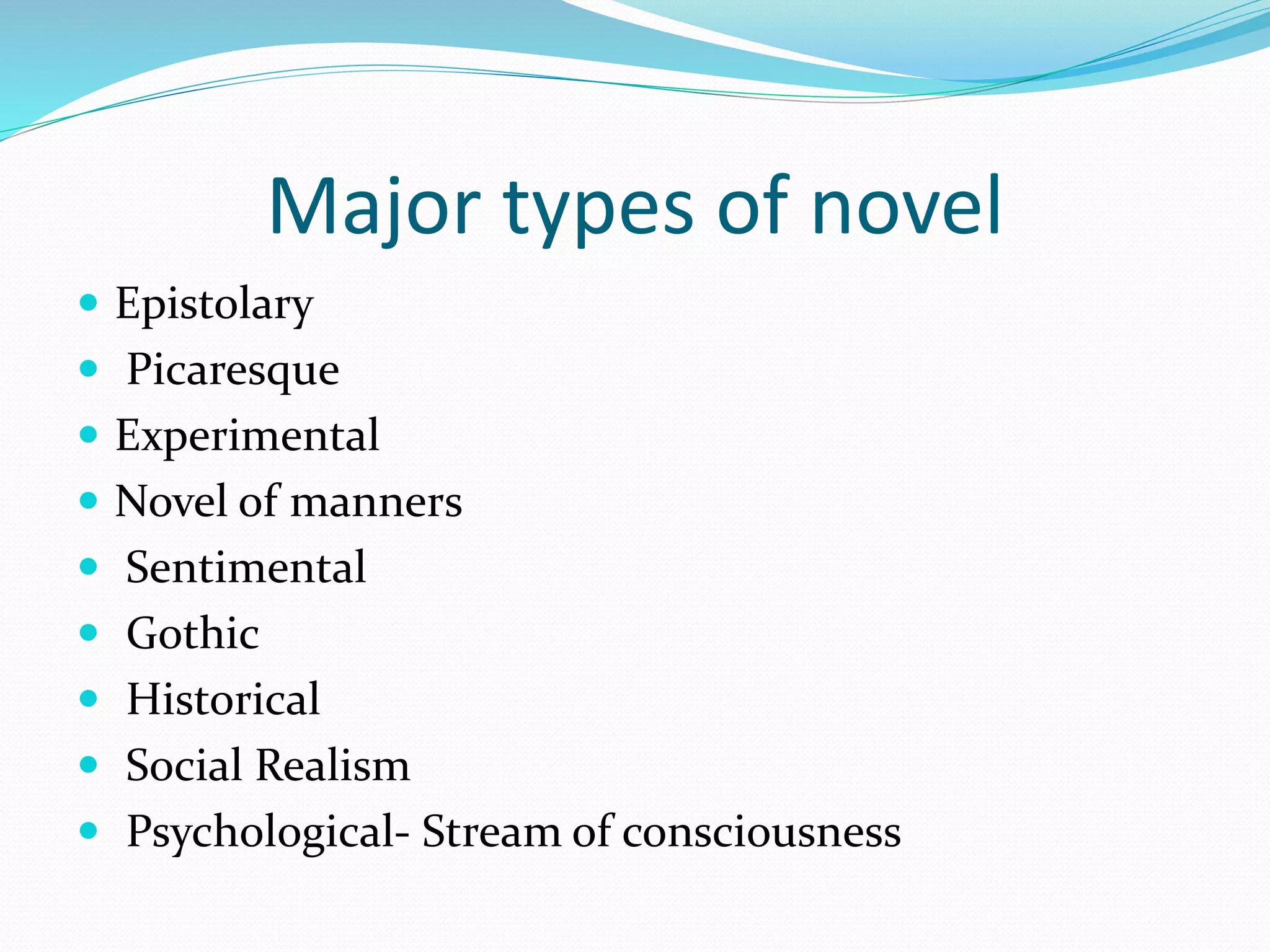
Major types of novel
 Epistolary
 Picaresque
 Experimental
 Novel of manners
 Sentimental
 Gothic
 Historical
 Social Realism
 Psychological- Stream of consciousness
Epistolary novel
 Novels in which the
narrative is told in
letters by one or more
of the characters
 Allows author to
present feelings and
reactions of characters
 allows multiple points
of view
 Psychological realism
Samuel Richardson,
(1689-1761)
 Pamela (1740)
 Clarrisa (1748)
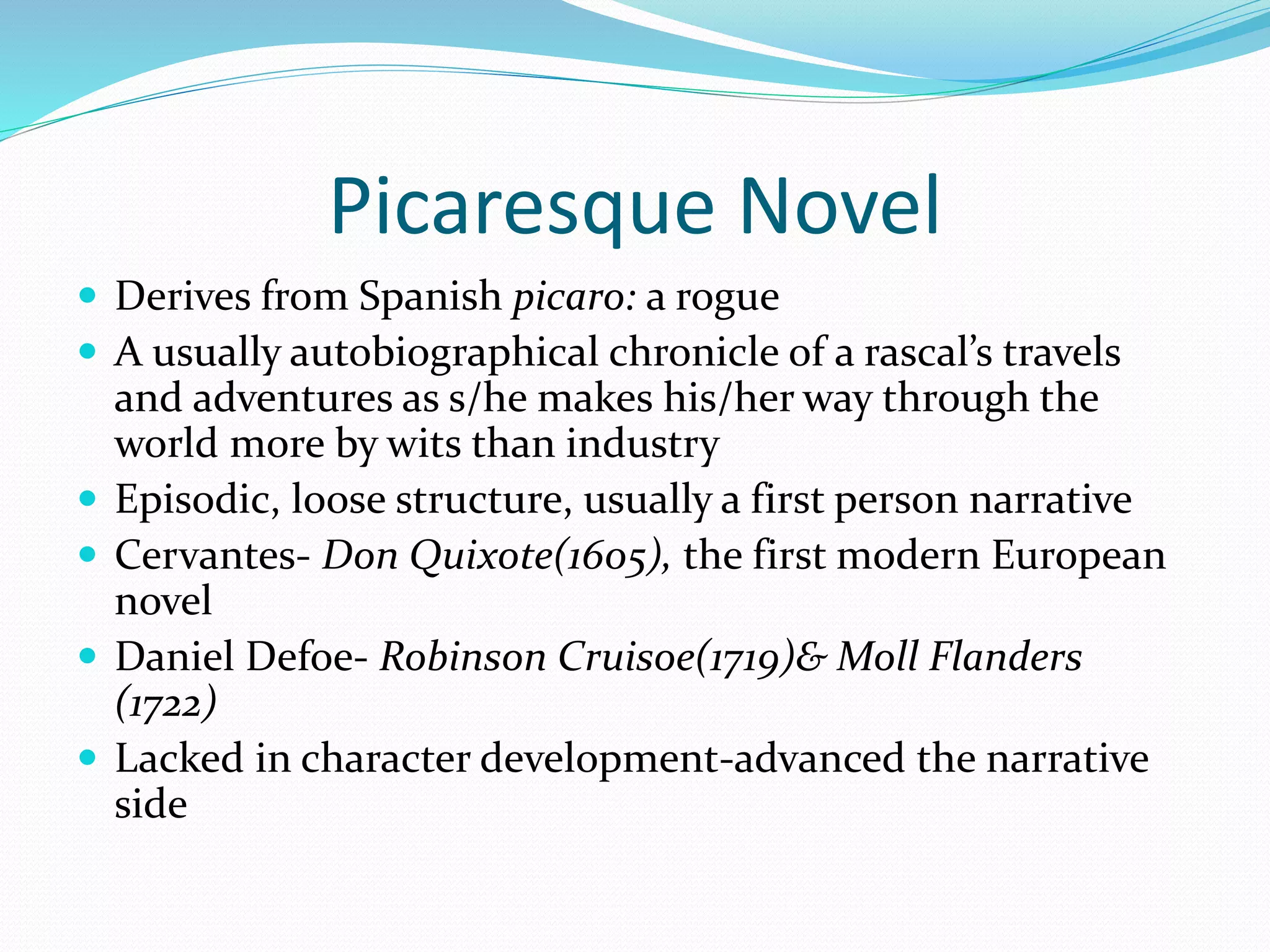
Picaresque Novel
 Derives from Spanish picaro: a rogue
 A usually autobiographical chronicle of a rascal’s travels
and adventures as s/he makes his/her way through the
world more by wits than industry
 Episodic, loose structure, usually a first person narrative
 Cervantes- Don Quixote(1605), the first modern European
novel
 Daniel Defoe- Robinson Cruisoe(1719)& Moll Flanders
(1722)
 Lacked in character development-advanced the narrative
side
Masters of picaresque novel
 Henry Fielding (1707-1754)
Shamela (1741)
Joseph Andrews (1742)
Tom Jones (1749)
 Sir Walter Scott -‘the father of
English Novel’
Tobias Smollett(1721-1771)
Roderick Random (1748)
Peregrine Pickle(1751)
• Markedly different in his
humor
• Realistic style & wry sense
of humor
• The comedic misadventure
of unscrupulous vagabond
Experimental novel (meta-novel)
Laurence Sterne(1713-1768)
Tristram Shandy 1759- in nine volumes
 One of the greatest comic novels in English
 Rambling plot
 Meddling and maddening third person narrator
 Digressions as important as main plot
 A forerunner for many modern narrative devices
 stream of consciousness
 self-reflection
 modernist and postmodernist writing
Sentimental novel
 A heightened emotional response to events
 Self-indulgence and elevated feeling
 Conventional situation, stock characters & rhetorical
devices
 Oliver Goldsmith- The Vicar of the Wakefield
 Emotion is touted as superior to reason
 Extremely moral & didactic
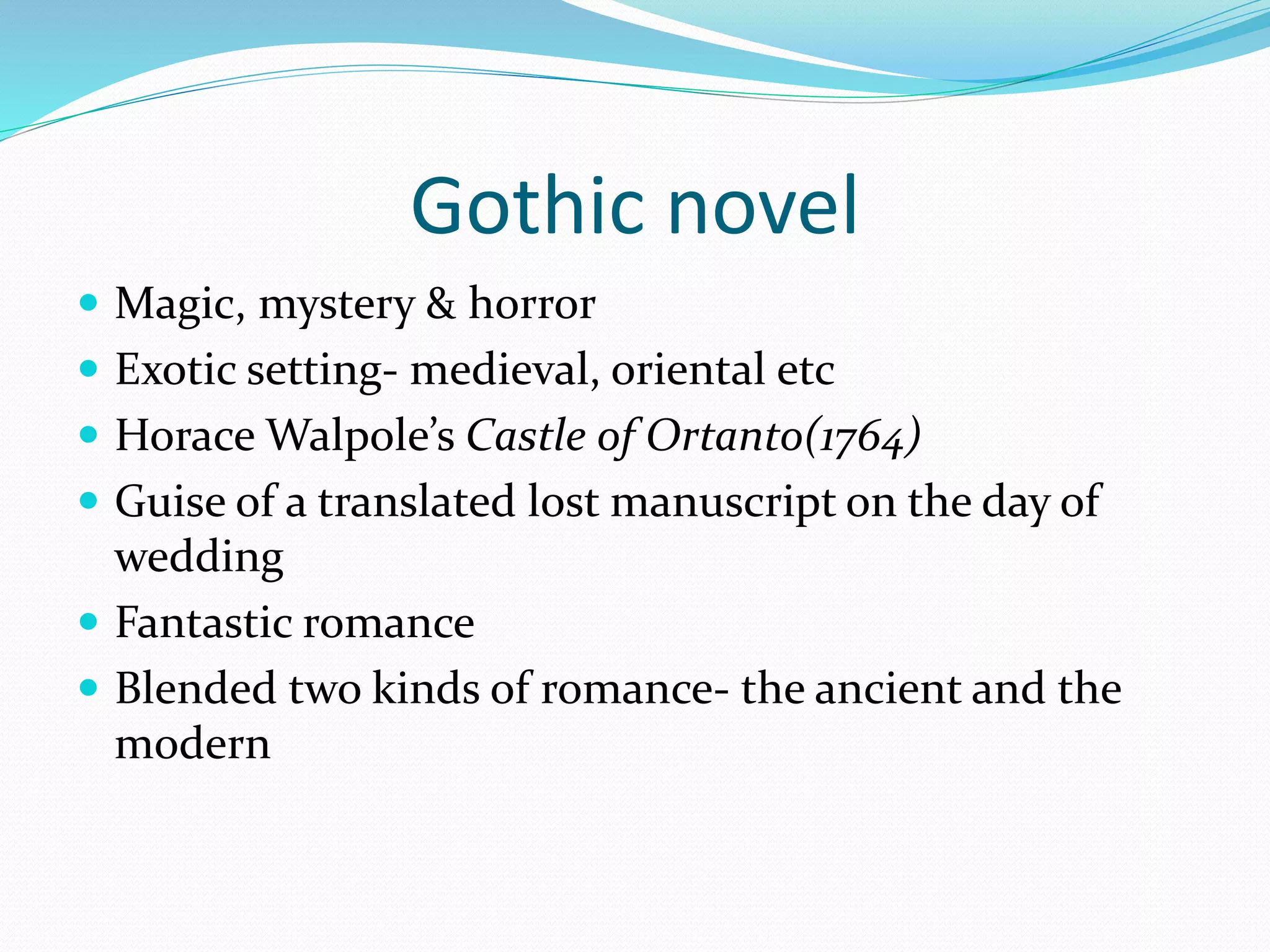
Gothic novel
 Magic, mystery & horror
 Exotic setting- medieval, oriental etc
 Horace Walpole’s Castle of Ortanto(1764)
 Guise of a translated lost manuscript on the day of
wedding
 Fantastic romance
 Blended two kinds of romance- the ancient and the
modern
Historical novel
 Novels that reconstruct a past age, often when two
cultures are in conflict
 Fictional characters interact with historical figures in
actual events
 Sir Walter Scott (1771-1832),the father of the historical
novel:
The Waverly Novels (1814-1819)
Ivanhoe (1819)
Evokes the atmosphere of a vanished era
Social realism
 Social or Sociological novels deal with the nature,
function and effect of the society which the characters
inhabit – often for the purpose of effecting reform
 Social issues came to the forefront with the condition
of laborers in the Industrial Revolution and later in the
Depression: Dickens’ Hard Times, Gaskell’s Mary
Barton; Eliot’s Middlemarch; Steinbeck’s Grapes of
Wrath
 Slavery and race issues arose in American social
novels: Stowe’s Uncle Tom’s Cabin, 20th c. novels by
Wright, Ellison, etc.
Stream of Consciousness novel
 Narration that mimics the ebb and flow of thoughts of
the waking mind
 Uninhibited by grammar, syntax or logical transitions
 A mixture of all levels of awareness – sensations,
thoughts, memories, associations, reflections
 Emphasis on how something is perceived rather than
on what is perceived
 James Joyce, Dorothy Richardson, Virginia Woolf,
Thomas Wolfe, William Faulkner
Stream of Consciousness Ulysses- the master piece
 written in a number of
differing literary styles,
ranging from internal
monologue to first-person
speculation to question-
and-answer
 During the twenty four
hours of narrative time, the
characters move through
their day in Dublin,
interacting with a stunning
variety of individuals
James Joyce
1882-1941
The Dubliners
Portrait of an Artist
Ulysses
Finnegan’s Wake
Virginia Woolf
1882-1941
To the LightHouse
The Waves
Mrs. Dalloway
Orlando

Types of novel

  • 2.
    The term-Novel  Theword ‘novel’ was not used until the end of the 18th century  An English transliteration of the Italian word ‘novella’- French word- nouvelle  Used to describe a short, compact, broadly realistic tale popular during the medieval period eg. Boccaccio’s Decameron  The desire to depict and entertain the human character  Deeper perception of life & its problem
  • 3.
    Definition The Shorter Oxford Dictionarydefines a novel as “a fictitious prose narrative of considerable length, in which characters and actions representative of real life are portrayed in a plot of more or less complexity”.  Plot- What happens in the story  Characters-Who is involved in what happens in the story  Point of view- how the story is told  Setting- When & where the story takes place  Novelist’s criticism-the interpretation or philosophy of the writer
  • 4.
    Hybrid genre The novel is the loosest form of literary art  encompasses many different sub-genres  is always in search of a definition  battled with other genres from the very beginning  Very effective medium of the portrayal of human thought and action  Often contains letters, dialogues, narration, poetry etc.
  • 5.
    The precursors ofnovel  Medieval European Romances Arthurian tales culminating in Malory’s Morte D Arthur  Prose romances John Lyly-Euphues,The Anatomy of wit(1578) Robert Greene- Pandosto(1588) Thomas Lodge- Rosalynde(1590) Philip Sidney- Arcadia(1590)  Thomas Nashe’s The Unfortunate Traveller(1594)  Deloney’s Jack of Newbury(1626)  John Bunyan’s Pilgrim’s Progress (1678)
  • 6.
    Only Connect ...New Directions The increase of the reading public in the Augustan Age was due to the growing importance of the middle class the individual’s trust in his own abilities the practice of reason and self- analysis Most readers were middle-class women They used to borrow books from circulating libraries The rise of the novel The novel
  • 7.
    Major types ofnovel  Epistolary  Picaresque  Experimental  Novel of manners  Sentimental  Gothic  Historical  Social Realism  Psychological- Stream of consciousness
  • 8.
    Epistolary novel  Novelsin which the narrative is told in letters by one or more of the characters  Allows author to present feelings and reactions of characters  allows multiple points of view  Psychological realism Samuel Richardson, (1689-1761)  Pamela (1740)  Clarrisa (1748)
  • 9.
    Picaresque Novel  Derivesfrom Spanish picaro: a rogue  A usually autobiographical chronicle of a rascal’s travels and adventures as s/he makes his/her way through the world more by wits than industry  Episodic, loose structure, usually a first person narrative  Cervantes- Don Quixote(1605), the first modern European novel  Daniel Defoe- Robinson Cruisoe(1719)& Moll Flanders (1722)  Lacked in character development-advanced the narrative side
  • 10.
    Masters of picaresquenovel  Henry Fielding (1707-1754) Shamela (1741) Joseph Andrews (1742) Tom Jones (1749)  Sir Walter Scott -‘the father of English Novel’ Tobias Smollett(1721-1771) Roderick Random (1748) Peregrine Pickle(1751) • Markedly different in his humor • Realistic style & wry sense of humor • The comedic misadventure of unscrupulous vagabond
  • 11.
    Experimental novel (meta-novel) LaurenceSterne(1713-1768) Tristram Shandy 1759- in nine volumes  One of the greatest comic novels in English  Rambling plot  Meddling and maddening third person narrator  Digressions as important as main plot  A forerunner for many modern narrative devices  stream of consciousness  self-reflection  modernist and postmodernist writing
  • 12.
    Sentimental novel  Aheightened emotional response to events  Self-indulgence and elevated feeling  Conventional situation, stock characters & rhetorical devices  Oliver Goldsmith- The Vicar of the Wakefield  Emotion is touted as superior to reason  Extremely moral & didactic
  • 13.
    Gothic novel  Magic,mystery & horror  Exotic setting- medieval, oriental etc  Horace Walpole’s Castle of Ortanto(1764)  Guise of a translated lost manuscript on the day of wedding  Fantastic romance  Blended two kinds of romance- the ancient and the modern
  • 14.
    Historical novel  Novelsthat reconstruct a past age, often when two cultures are in conflict  Fictional characters interact with historical figures in actual events  Sir Walter Scott (1771-1832),the father of the historical novel: The Waverly Novels (1814-1819) Ivanhoe (1819) Evokes the atmosphere of a vanished era
  • 15.
    Social realism  Socialor Sociological novels deal with the nature, function and effect of the society which the characters inhabit – often for the purpose of effecting reform  Social issues came to the forefront with the condition of laborers in the Industrial Revolution and later in the Depression: Dickens’ Hard Times, Gaskell’s Mary Barton; Eliot’s Middlemarch; Steinbeck’s Grapes of Wrath  Slavery and race issues arose in American social novels: Stowe’s Uncle Tom’s Cabin, 20th c. novels by Wright, Ellison, etc.
  • 16.
    Stream of Consciousnessnovel  Narration that mimics the ebb and flow of thoughts of the waking mind  Uninhibited by grammar, syntax or logical transitions  A mixture of all levels of awareness – sensations, thoughts, memories, associations, reflections  Emphasis on how something is perceived rather than on what is perceived  James Joyce, Dorothy Richardson, Virginia Woolf, Thomas Wolfe, William Faulkner
  • 17.
    Stream of ConsciousnessUlysses- the master piece  written in a number of differing literary styles, ranging from internal monologue to first-person speculation to question- and-answer  During the twenty four hours of narrative time, the characters move through their day in Dublin, interacting with a stunning variety of individuals James Joyce 1882-1941 The Dubliners Portrait of an Artist Ulysses Finnegan’s Wake Virginia Woolf 1882-1941 To the LightHouse The Waves Mrs. Dalloway Orlando