Creative
Writing: Focus
on Fiction.
Words and spaces.
Characters and characterization.
the speaker’s square forefinger emphasized his observations by underscoring every sentence with a line on the schoolmaster’s
sleeve. The emphasis was helped by the speaker’s square wall of a forehead, which had his eyebrows for its base, while his eyes
found commodious cellarage in two dark caves, overshadowed by the wall. The emphasis was helped by the speaker’s mouth, which
was wide, thin, and hard set. The emphasis was helped by the speaker’s voice, which was inflexible, dry, and dictatorial. The
emphasis was helped by the speaker’s hair, which bristled on the skirts of his bald head, a plantation of firs to keep the wind from its
shining surface, all covered with knobs, like the crust of a plum pie, as if the head had scarcely warehouse-room for the hard facts
stored inside. The speaker’s obstinate carriage, square coat, square legs, square shoulders,—nay, his very neckcloth, trained to take
him by the throat with an unaccommodating grasp, like a stubborn fact, as it was,—all helped the emphasis.” (Charles Dickens/Hard Times
chapter 1).
What does Dickens use as techniques
there that I did not name?
• …the speaker’s square forefinger emphasized his observations by underscoring every sentence with a line on the schoolmaster’s
sleeve. The emphasis was helped by the speaker’s square wall of a forehead, which had his eyebrows for its base, while his eyes
found commodious cellarage in two dark caves, overshadowed by the wall. The emphasis was helped by the speaker’s mouth, which
was wide, thin, and hard set. The emphasis was helped by the speaker’s voice, which was inflexible, dry, and dictatorial. The
emphasis was helped by the speaker’s hair, which bristled on the skirts of his bald head, a plantation of firs to keep the wind from its
shining surface, all covered with knobs, like the crust of a plum pie, as if the head had scarcely warehouse-room for the hard facts
stored inside. The speaker’s obstinate carriage, square coat, square legs, square shoulders,—nay, his very neckcloth, trained to take
him by the throat with an unaccommodating grasp, like a stubborn fact, as it was – helped the emphasis.by the throat with an
unaccommodating grasp, like a stubborn
More ways of characterization or making
a character.
• “No human action is too small to be recorded: Karenin's knuckle-cracking, Anna screwing up her eyes, Vronsky touching
the ends of his moustache. The characters are always smiling, frowning, blushing, twitching, fidgeting, touching, kissing,
bowing, sobbing, and deconstructing these signs in each other. They come to us alive with intentionality, describing
themselves in movement, waltzing through the ballroom, trudging through the marsh after wildfowl, racing horses, cutting
hay.”
How to read/analyse/create character/s?
Points of view.
Setting/s.
It was a town of red brick, or of brick that would have been red if the smoke and ashes had allowed it; but as matters stood, it was a
town of unnatural red and black like the painted face of a savage. It was a town of machinery and tall chimneys, out of which
interminable serpents of smoke trailed themselves for ever and ever, and never got uncoiled. It had a black canal in it, and a river
that ran purple with ill-smelling dye, and vast piles of building full of windows where there was a rattling and a trembling all day
long, and where the piston of the steam-engine worked monotonously up and down, like the head of an elephant in a state of
melancholy madness. It contained several large streets all very like one another, and many small streets still more like one another,
inhabited by people equally like one another, who all went in and out at the same hours, with the same sound upon the same
pavements, to do the same work, and to whom every day was the same as yesterday and to-morrow, and every year the counterpart
of the last and the next.” Charles Dickens/Hard Times/The Keynote
Themes.
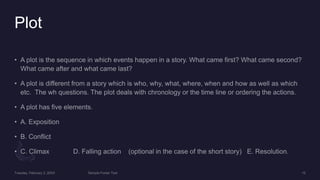
Plot
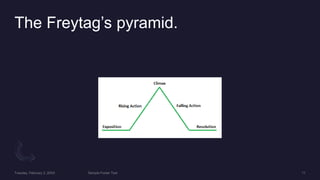
The Freytag’s pyramid.
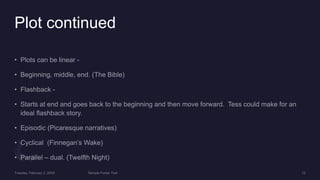
Plot continued
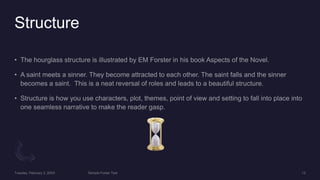
Structure
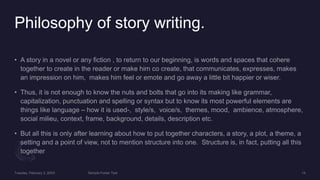
Philosophy of story writing.
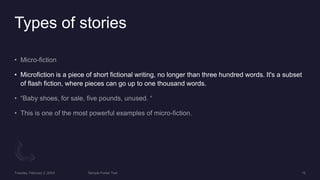
Types of stories
• Microfiction is a piece of short fictional writing, no longer than three hundred words. It's a subset
of flash fiction, where pieces can go up to one thousand words.
Flash fiction
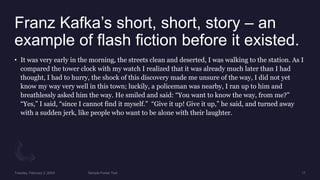
Franz Kafka’s short, short, story – an
example of flash fiction before it existed.
• It was very early in the morning, the streets clean and deserted, I was walking to the station. As I
compared the tower clock with my watch I realized that it was already much later than I had
thought, I had to hurry, the shock of this discovery made me unsure of the way, I did not yet
know my way very well in this town; luckily, a policeman was nearby, I ran up to him and
breathlessly asked him the way. He smiled and said: “You want to know the way, from me?”
“Yes,” I said, “since I cannot find it myself.” “Give it up! Give it up,” he said, and turned away
with a sudden jerk, like people who want to be alone with their laughter.
Make your own fiction.
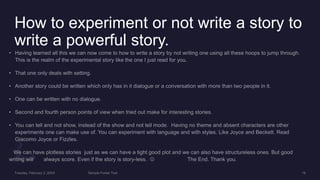
How to experiment or not write a story to
write a powerful story.

creative writing focus on fiction.pptx

  • 1.
  • 2.
  • 3.
    Characters and characterization. thespeaker’s square forefinger emphasized his observations by underscoring every sentence with a line on the schoolmaster’s sleeve. The emphasis was helped by the speaker’s square wall of a forehead, which had his eyebrows for its base, while his eyes found commodious cellarage in two dark caves, overshadowed by the wall. The emphasis was helped by the speaker’s mouth, which was wide, thin, and hard set. The emphasis was helped by the speaker’s voice, which was inflexible, dry, and dictatorial. The emphasis was helped by the speaker’s hair, which bristled on the skirts of his bald head, a plantation of firs to keep the wind from its shining surface, all covered with knobs, like the crust of a plum pie, as if the head had scarcely warehouse-room for the hard facts stored inside. The speaker’s obstinate carriage, square coat, square legs, square shoulders,—nay, his very neckcloth, trained to take him by the throat with an unaccommodating grasp, like a stubborn fact, as it was,—all helped the emphasis.” (Charles Dickens/Hard Times chapter 1).
  • 4.
    What does Dickensuse as techniques there that I did not name? • …the speaker’s square forefinger emphasized his observations by underscoring every sentence with a line on the schoolmaster’s sleeve. The emphasis was helped by the speaker’s square wall of a forehead, which had his eyebrows for its base, while his eyes found commodious cellarage in two dark caves, overshadowed by the wall. The emphasis was helped by the speaker’s mouth, which was wide, thin, and hard set. The emphasis was helped by the speaker’s voice, which was inflexible, dry, and dictatorial. The emphasis was helped by the speaker’s hair, which bristled on the skirts of his bald head, a plantation of firs to keep the wind from its shining surface, all covered with knobs, like the crust of a plum pie, as if the head had scarcely warehouse-room for the hard facts stored inside. The speaker’s obstinate carriage, square coat, square legs, square shoulders,—nay, his very neckcloth, trained to take him by the throat with an unaccommodating grasp, like a stubborn fact, as it was – helped the emphasis.by the throat with an unaccommodating grasp, like a stubborn
  • 5.
    More ways ofcharacterization or making a character. • “No human action is too small to be recorded: Karenin's knuckle-cracking, Anna screwing up her eyes, Vronsky touching the ends of his moustache. The characters are always smiling, frowning, blushing, twitching, fidgeting, touching, kissing, bowing, sobbing, and deconstructing these signs in each other. They come to us alive with intentionality, describing themselves in movement, waltzing through the ballroom, trudging through the marsh after wildfowl, racing horses, cutting hay.”
  • 6.
  • 7.
  • 8.
    Setting/s. It was atown of red brick, or of brick that would have been red if the smoke and ashes had allowed it; but as matters stood, it was a town of unnatural red and black like the painted face of a savage. It was a town of machinery and tall chimneys, out of which interminable serpents of smoke trailed themselves for ever and ever, and never got uncoiled. It had a black canal in it, and a river that ran purple with ill-smelling dye, and vast piles of building full of windows where there was a rattling and a trembling all day long, and where the piston of the steam-engine worked monotonously up and down, like the head of an elephant in a state of melancholy madness. It contained several large streets all very like one another, and many small streets still more like one another, inhabited by people equally like one another, who all went in and out at the same hours, with the same sound upon the same pavements, to do the same work, and to whom every day was the same as yesterday and to-morrow, and every year the counterpart of the last and the next.” Charles Dickens/Hard Times/The Keynote
  • 9.
  • 10.
  • 11.
  • 12.
  • 13.
  • 14.
  • 15.
    Types of stories •Microfiction is a piece of short fictional writing, no longer than three hundred words. It's a subset of flash fiction, where pieces can go up to one thousand words.
  • 16.
  • 17.
    Franz Kafka’s short,short, story – an example of flash fiction before it existed. • It was very early in the morning, the streets clean and deserted, I was walking to the station. As I compared the tower clock with my watch I realized that it was already much later than I had thought, I had to hurry, the shock of this discovery made me unsure of the way, I did not yet know my way very well in this town; luckily, a policeman was nearby, I ran up to him and breathlessly asked him the way. He smiled and said: “You want to know the way, from me?” “Yes,” I said, “since I cannot find it myself.” “Give it up! Give it up,” he said, and turned away with a sudden jerk, like people who want to be alone with their laughter.
  • 18.
    Make your ownfiction.
  • 19.
    How to experimentor not write a story to write a powerful story.