The Development of English Novels
• What is a novel?
• A Novel is the best device to present a picture of
life lived in a given society against a stable
background of social and moral values by the
people.
• It is a photographic presentation of life.
• The novel presents a work of prose fiction
portraying in one or more plot lying in the
interrelationship of a number of characters.
CC-12 1
Dr. Md. Ejaz Alam
The Development of English Novels
The modern
European novel
developed out of
the Italian
Renaissance
novella form,
typified by
Boccaccio’s
Decameron.
The origin of the novel in
England is traced out in
Geoffrey Chaucer’s Troilus
and Criseyde, a long narrative
work.
CC-12 2
Dr. Md. Ejaz Alam
The Development of English Novels
• The age of Elizabeth is related
to the rise of the prose
romance.
• A romance is a fictional story
in verse or prose that relates to
improbable adventures of
idealized characters.
• Thomas Nash [1567-1601]who
wrote ,The Unfortunate Traveller,
or The Life of Jack Wilton which
might be called the first English
novel.
• Thomas Dekker[1570-1632]wrote
stories and descriptions of London
life and the suffering of London
people during the plague of of
1603.
CC-12 3
Dr. Md. Ejaz Alam
The Development of English Novels
 In England Daniel
Defoe is regarded as
the founder of the
English novel with his
Robinson
Crusoe(1719)and Moll
Flanders(1722).
 He wrote Picaresque
novels dealing with
the lives of a
wandering rogue.
 This style of Picaresque
novel remained popular
till the days of Smollett
and Fielding.
 In the picaresque novel,
the protagonists are
rascal and they lead a
wandering life, have
many adventures and at
last scandalous.
CC-12 4
Dr. Md. Ejaz Alam
The novels during the18th century:
• Epistolary Novels:
• During the 18th
century, the habit of
writing letters became
very popular and it
gave birth to the
epistolary novels.
• Richardson’s
Pamela (1740) is
regarded as one of
the best epistolary
novels of the time
which had the
requisites of plot,
characters and
dialogue and these
were of high merit.
CC-12 5
Dr. Md. Ejaz Alam
The novels during the18th century:
• Fielding’s Tom Jones (1749) is an established form of novel in its full
maturity.
• Smollette while writing Roderick Random(1748) reverted to the
picaresque manner.
• Sterne wrote Tristram Shandy(1760) and made the novel sentimental
and fantastic, and founded a sentimental school.
• The research into national affairs gave birth to the study of history and
the historical novels were written. David Hume , Robertson and
Gibbon are the important names.
CC-12 6
Dr. Md. Ejaz Alam
The novels during the19th century:
• Jane Austen(1775-1817) :
• Her first novel, Pride and
Prejudice published in 1813.
she focused on the middle-class
people.
• The heroine is a girl of spirit but
she had no extra ordinary
qualities.
• Her second novel, Sense and
Sensibility deals with the
romantic possibilities but at the
end the heroine remains
undeceived.
• Features of her Novels :
• Her characters are developed
with minuteness and accuracy.
They are ordinary people, but
are convincingly alive.
• Her plots are unromantic. Life in
her novels is governed by an easy
decorum and moments of fierce
emotions.
• Austen will be remembered for
her clear and careful style with
an ironic tinges.
CC-12 7
Dr. Md. Ejaz Alam
The novels during the19th century:
• The novel achieved its predominance in the 19th century .
• It was the golden age of the novel writing.
• Charles Dickens(1812-70) and other writers found a huge audience
and focused on the issues of the time.
• Dickens ‘s works like Oliver Twist, Hard Times and Bleak House etc.
are preoccupied with social problems. His pictures of poverty and
his hopes for improvement gave a new turn to the novels.
CC-12 8
Dr. Md. Ejaz Alam
The novels during the19th century:
• W.M. Thackeray(1811-63) :
• He was very much influenced by
Fielding’s Tom Jones and his
work , Vanity Fair proved the
genius of the novelist.
• The book is chiefly concerned
with the fortune of the
protagonist, Becky Sharp but it
reveals the vanities of mankind in
general.
• Thackeray will be known
for his humour and
pathos. In his pathos
he is seldom
sentimental, but
effective and usually
quite.
CC-12 9
Dr. Md. Ejaz Alam
The novels during the19th century:
• The Bronte's:
• Charlotte(1816-
55),Emily(1818-48) and
Anne(1820-49).
• Charlotte wrote the
important novels like, The
Professor and Jane Eyre. In
her novels she brought an
energy and passion that
gave to commonplace
people the wonder and
beauty of the romantic
world.
Emily Bronte: Her one novel,
Wuthering Heights is unique in
English literature. It presents the
spirit of the wild, desolate moors.
The passions of the characters have
an elemental force which carries
them into the realms of poetry.
Anne Bronte : she is the
least important figure of
the three. Her works are
much inferior to those
of her sisters.
CC-12 10
Dr. Md. Ejaz Alam
The novels during the19th century:
• George Eliot (1819-80) wrote
her novels like Adam Bede,
the Mill on the Floss and Silas
Marner that deal with the
tragedy of ordinary lives.
• Her characters are usually
drawn from the lower classes
of society.
• She is important in the history
of fiction because she is
always concerned with the
problems of the human
personality.
George Meredith (1828-1909):
Most of his characters are of
the higher ranks of society .
They have been subtly
analysed and elaborately
featured.
With the publication of the work,
The Egoist(1879), Meredith
reached the climax of his art.
Meredith was very careful to
make his female characters at
least as important as his male
ones.
CC-12 11
Dr. Md. Ejaz Alam
The novels during the19th century:
 Thomas Hardy(1840-1920) was associated with the concluding part
of the 19th century.
 He picked up mostly ordinary men and women living close to the soil.
 Hardy’s aim was to present man or woman rather than a particular
man or a particular woman.
 He was a serious novelist attempting to present a view of life through
fiction.
 His important works are the Mayor of Caster bridge, Tess of the
D’Urbervilles and Jude the Obscure.
CC-12 12
Dr. Md. Ejaz Alam
The novels during the 20th century:
 The novel during the 20th century moved towards a greater increase in
psychological subtlety.
 Henry James in particular had brought a new precision and complexity into
the description of states of mind.
 The theme of the isolation of the individual consciousness became
prominent where every individual was seen confined to his own self and
his unique stream of consciousness.
 The 20th century novelists analyzed with their insight the relation between
loneliness and love .
CC-12 13
Dr. Md. Ejaz Alam
The novels during the 20th century:
E.M.Forster[1879-1970] developed the theme of
human relationships in his novels deliberately.
His A passage to India described the relations
between the English and the Indians with the
possibilities and the limitations of human
relationships.
Forster is basically a moralist, concerned with the
importance of the individual personality.
He is the advocate of culture, tolerance, and
civilization against barbarity and provincialism.
CC-12 14
Dr. Md. Ejaz Alam
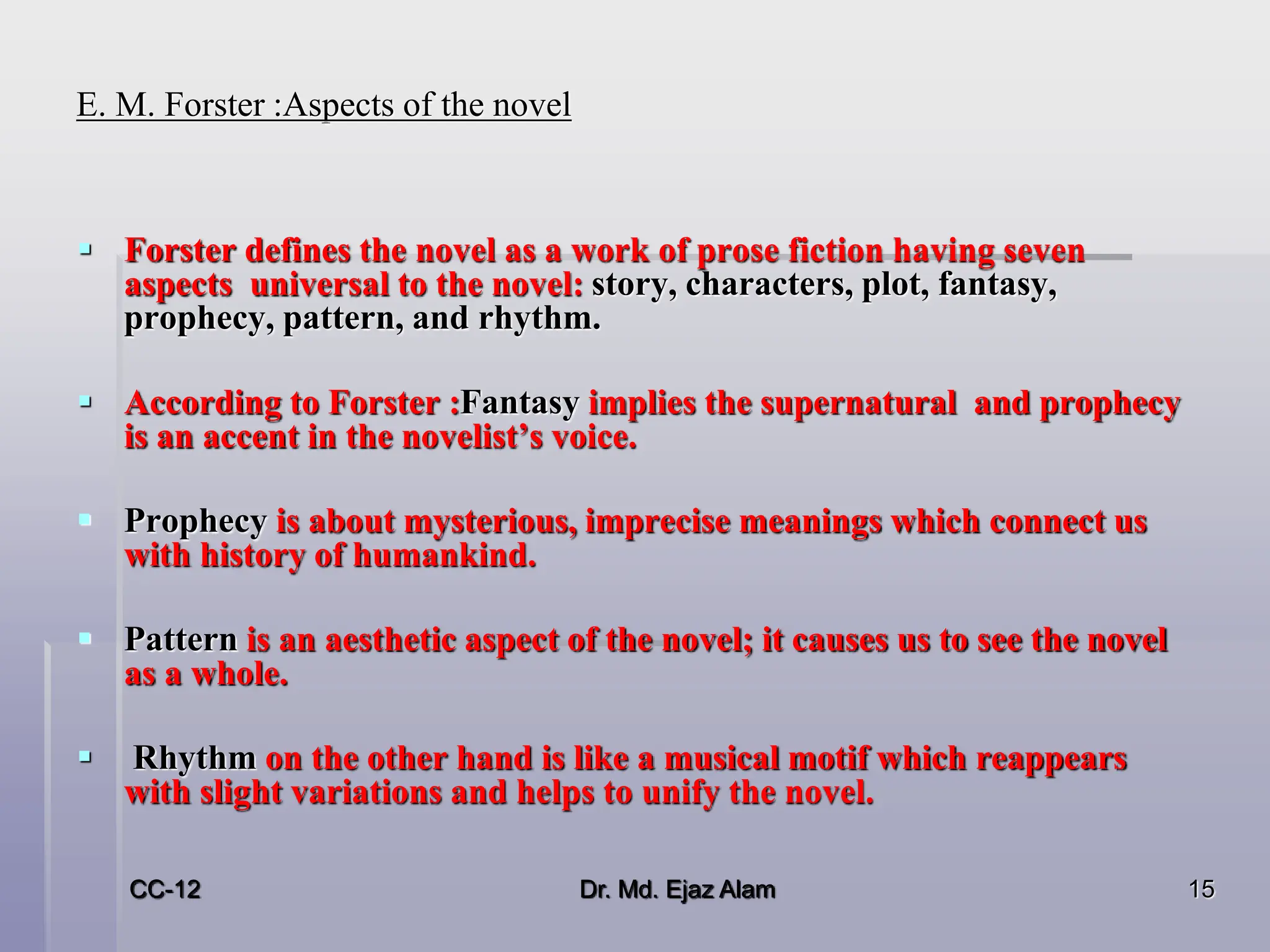
E. M. Forster :Aspects of the novel
 Forster defines the novel as a work of prose fiction having seven
aspects universal to the novel: story, characters, plot, fantasy,
prophecy, pattern, and rhythm.
 According to Forster :Fantasy implies the supernatural and prophecy
is an accent in the novelist’s voice.
 Prophecy is about mysterious, imprecise meanings which connect us
with history of humankind.
 Pattern is an aesthetic aspect of the novel; it causes us to see the novel
as a whole.
 Rhythm on the other hand is like a musical motif which reappears
with slight variations and helps to unify the novel.
CC-12 15
Dr. Md. Ejaz Alam
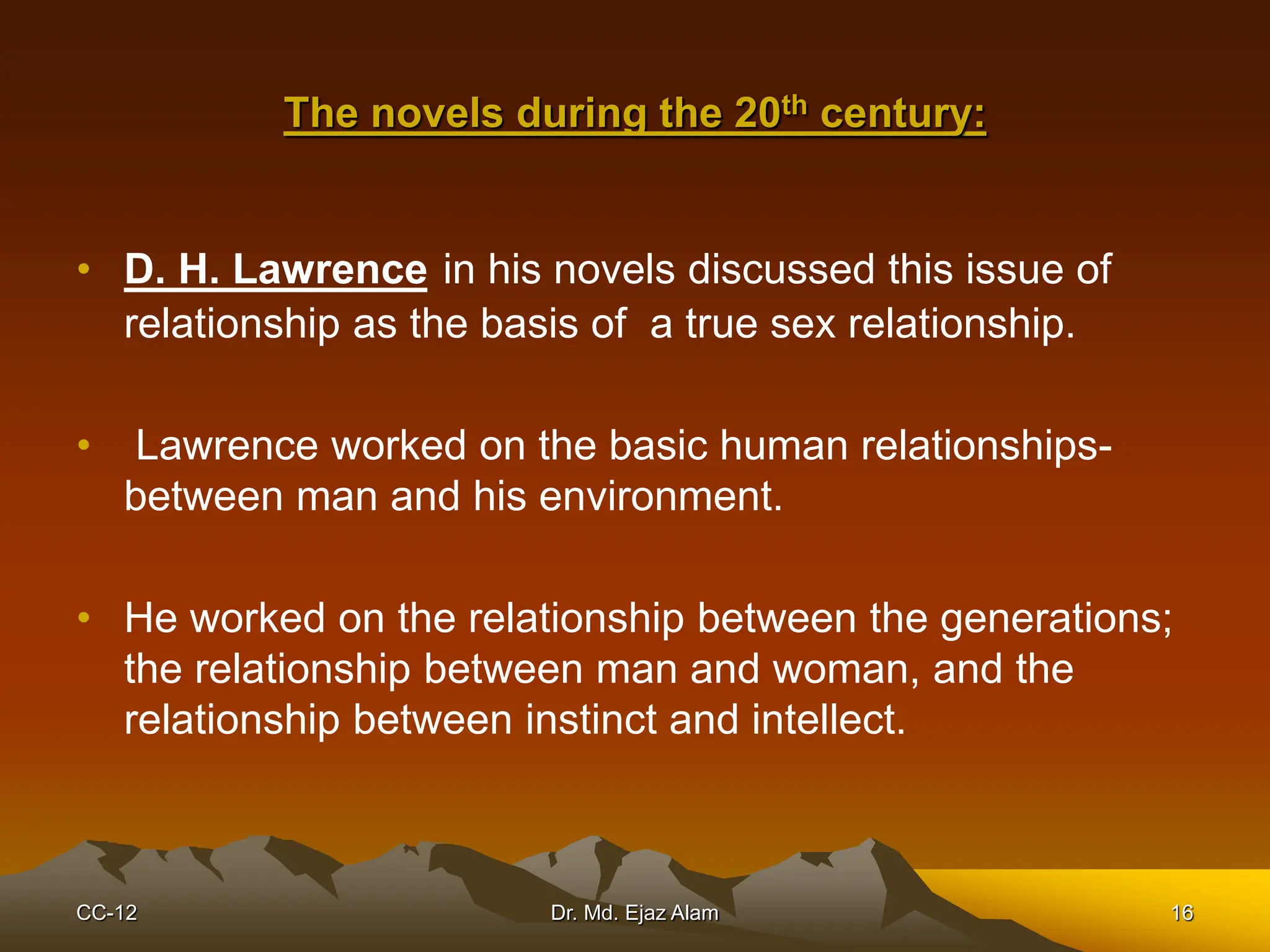
The novels during the 20th century:
• D. H. Lawrence in his novels discussed this issue of
relationship as the basis of a true sex relationship.
• Lawrence worked on the basic human relationships-
between man and his environment.
• He worked on the relationship between the generations;
the relationship between man and woman, and the
relationship between instinct and intellect.
CC-12 16
Dr. Md. Ejaz Alam
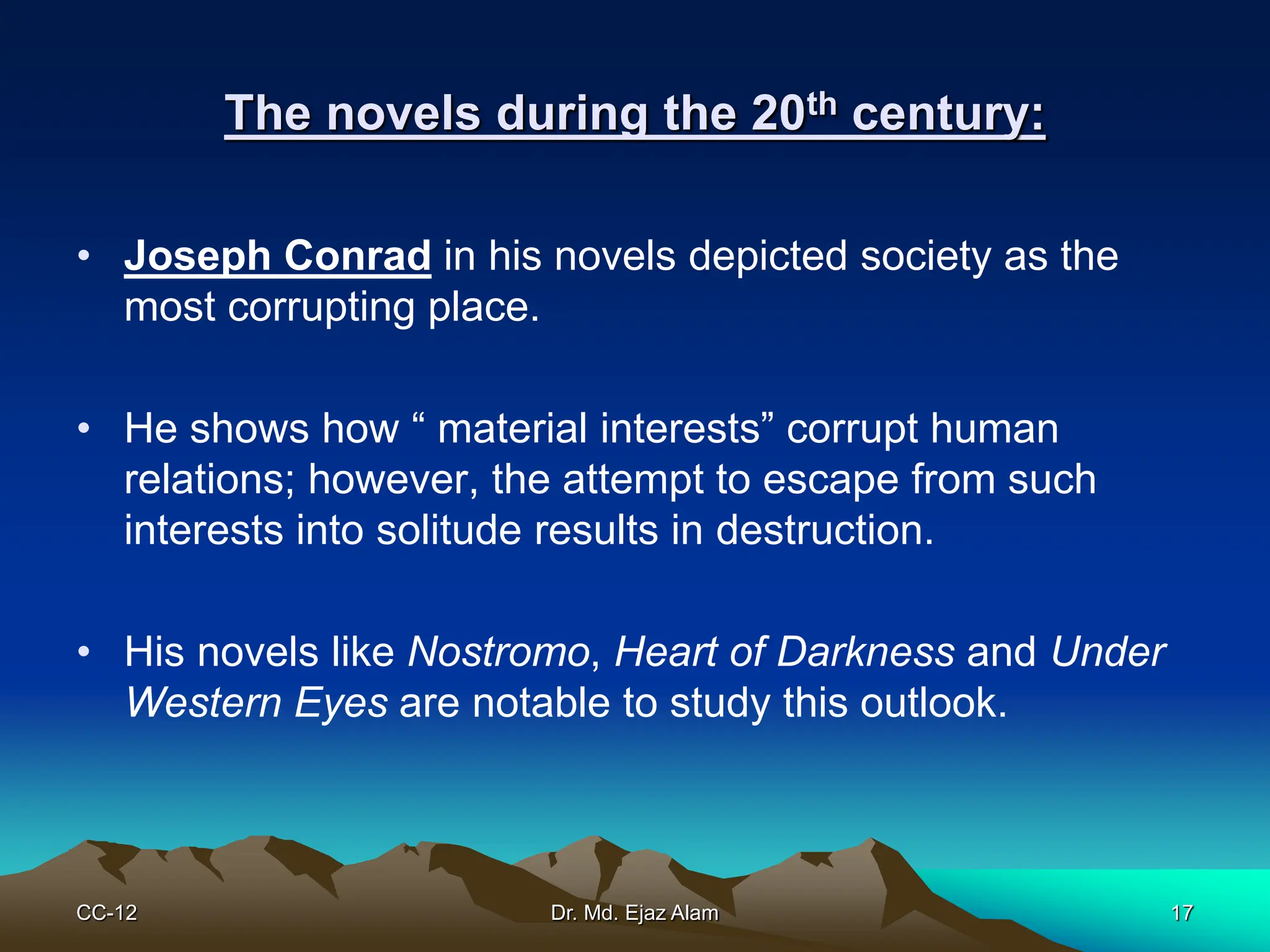
The novels during the 20th century:
• Joseph Conrad in his novels depicted society as the
most corrupting place.
• He shows how “ material interests” corrupt human
relations; however, the attempt to escape from such
interests into solitude results in destruction.
• His novels like Nostromo, Heart of Darkness and Under
Western Eyes are notable to study this outlook.
CC-12 17
Dr. Md. Ejaz Alam
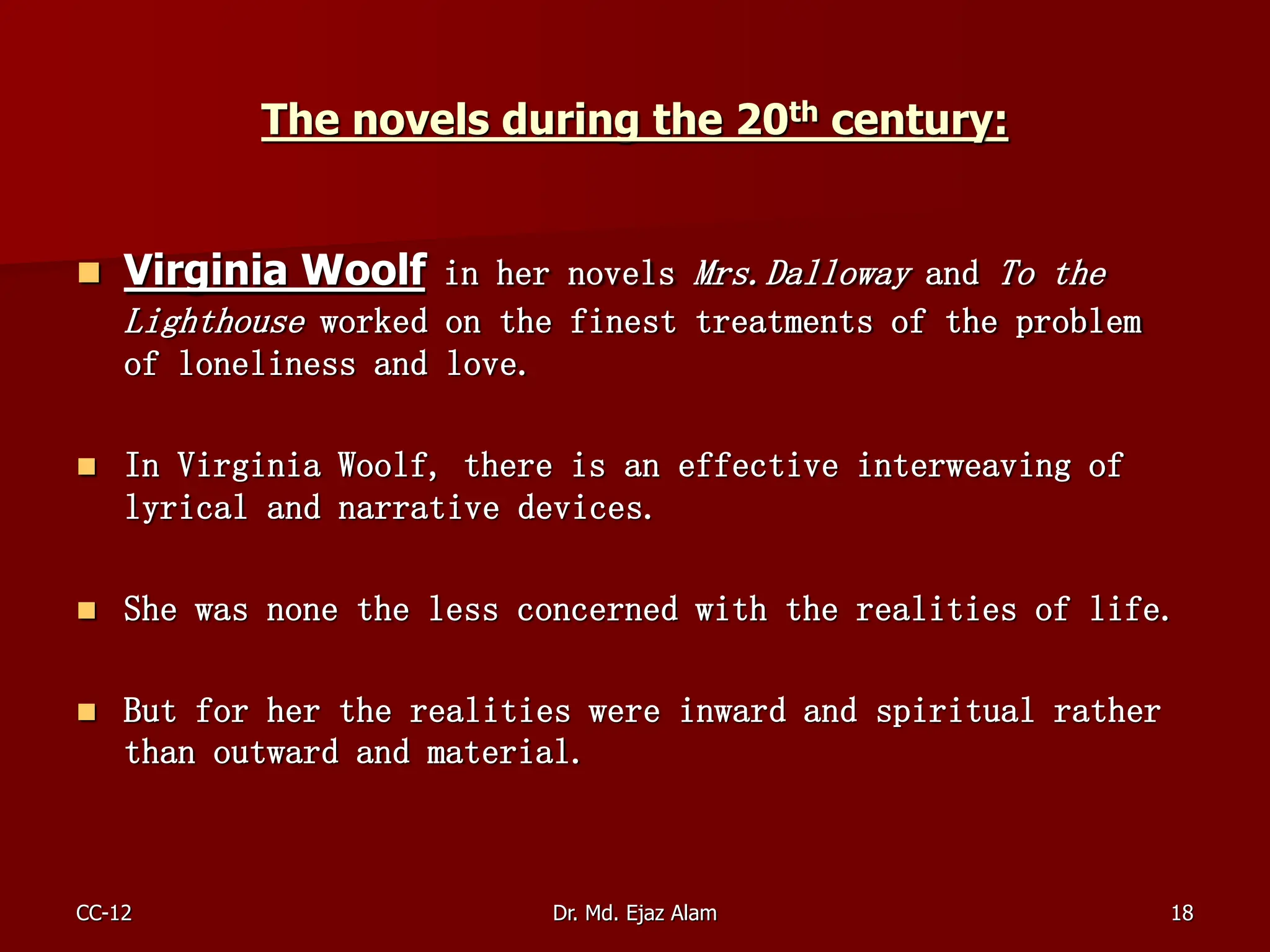
The novels during the 20th century:
 Virginia Woolf in her novels Mrs.Dalloway and To the
Lighthouse worked on the finest treatments of the problem
of loneliness and love.
 In Virginia Woolf, there is an effective interweaving of
lyrical and narrative devices.
 She was none the less concerned with the realities of life.
 But for her the realities were inward and spiritual rather
than outward and material.
CC-12 18
Dr. Md. Ejaz Alam
The novels during the 20th century:
James Joyce was an Irish novelist, short
story writer, poet and practitioner of
experimental narrative techniques.
His works like A Portrait of the Artist as
a young Man and Ulysses are notable for
these techniques.
CC-12 19
Dr. Md. Ejaz Alam
The novels during the 20th century:
Aldous Huxley :
 After an important theme of the relation between loneliness and
love, the novelists of the inter-war period explored another very
modern problem: the relation between knowledge and value.
His important work is Brave New World.
 Aldous Huxley in his novels worked as a reflector of the
feelings of his age. As a novelist he has limitations; he has no
deep characterization and his novels are slight in plot.
 Above all, he is a satirist having polished style with a ready wit
and an alert mind.
CC-12 20
Dr. Md. Ejaz Alam
The novels during the 20th century:
 Conclusion
 On the whole, the novel in the 20th century manifested the
disillusionment, cynicism, despair and bewilderment of the
age.
 Some serious novelists attempted to establish new values to
replace the old. In the works of the important novelists, an
interpretation of life is often implicit, rarely directly stated.
CC-12 21
Dr. Md. Ejaz Alam
The novels during the 20th century:
 Conclusion
 Impressionism gave place to an expressionistic
technique. The novelists instead of explaining the
outward appearance, concentrated on the inner
realities of life.
 The presentation of the “ Stream of Consciousness”,
the use of interior monologue and an allusive style
were the chief weapons of the novelists attempting
to write from within the mind of his character.
CC-12 22
Dr. Md. Ejaz Alam

Development of novels, brief history of novel ppt

  • 1.
    The Development ofEnglish Novels • What is a novel? • A Novel is the best device to present a picture of life lived in a given society against a stable background of social and moral values by the people. • It is a photographic presentation of life. • The novel presents a work of prose fiction portraying in one or more plot lying in the interrelationship of a number of characters. CC-12 1 Dr. Md. Ejaz Alam
  • 2.
    The Development ofEnglish Novels The modern European novel developed out of the Italian Renaissance novella form, typified by Boccaccio’s Decameron. The origin of the novel in England is traced out in Geoffrey Chaucer’s Troilus and Criseyde, a long narrative work. CC-12 2 Dr. Md. Ejaz Alam
  • 3.
    The Development ofEnglish Novels • The age of Elizabeth is related to the rise of the prose romance. • A romance is a fictional story in verse or prose that relates to improbable adventures of idealized characters. • Thomas Nash [1567-1601]who wrote ,The Unfortunate Traveller, or The Life of Jack Wilton which might be called the first English novel. • Thomas Dekker[1570-1632]wrote stories and descriptions of London life and the suffering of London people during the plague of of 1603. CC-12 3 Dr. Md. Ejaz Alam
  • 4.
    The Development ofEnglish Novels  In England Daniel Defoe is regarded as the founder of the English novel with his Robinson Crusoe(1719)and Moll Flanders(1722).  He wrote Picaresque novels dealing with the lives of a wandering rogue.  This style of Picaresque novel remained popular till the days of Smollett and Fielding.  In the picaresque novel, the protagonists are rascal and they lead a wandering life, have many adventures and at last scandalous. CC-12 4 Dr. Md. Ejaz Alam
  • 5.
    The novels duringthe18th century: • Epistolary Novels: • During the 18th century, the habit of writing letters became very popular and it gave birth to the epistolary novels. • Richardson’s Pamela (1740) is regarded as one of the best epistolary novels of the time which had the requisites of plot, characters and dialogue and these were of high merit. CC-12 5 Dr. Md. Ejaz Alam
  • 6.
    The novels duringthe18th century: • Fielding’s Tom Jones (1749) is an established form of novel in its full maturity. • Smollette while writing Roderick Random(1748) reverted to the picaresque manner. • Sterne wrote Tristram Shandy(1760) and made the novel sentimental and fantastic, and founded a sentimental school. • The research into national affairs gave birth to the study of history and the historical novels were written. David Hume , Robertson and Gibbon are the important names. CC-12 6 Dr. Md. Ejaz Alam
  • 7.
    The novels duringthe19th century: • Jane Austen(1775-1817) : • Her first novel, Pride and Prejudice published in 1813. she focused on the middle-class people. • The heroine is a girl of spirit but she had no extra ordinary qualities. • Her second novel, Sense and Sensibility deals with the romantic possibilities but at the end the heroine remains undeceived. • Features of her Novels : • Her characters are developed with minuteness and accuracy. They are ordinary people, but are convincingly alive. • Her plots are unromantic. Life in her novels is governed by an easy decorum and moments of fierce emotions. • Austen will be remembered for her clear and careful style with an ironic tinges. CC-12 7 Dr. Md. Ejaz Alam
  • 8.
    The novels duringthe19th century: • The novel achieved its predominance in the 19th century . • It was the golden age of the novel writing. • Charles Dickens(1812-70) and other writers found a huge audience and focused on the issues of the time. • Dickens ‘s works like Oliver Twist, Hard Times and Bleak House etc. are preoccupied with social problems. His pictures of poverty and his hopes for improvement gave a new turn to the novels. CC-12 8 Dr. Md. Ejaz Alam
  • 9.
    The novels duringthe19th century: • W.M. Thackeray(1811-63) : • He was very much influenced by Fielding’s Tom Jones and his work , Vanity Fair proved the genius of the novelist. • The book is chiefly concerned with the fortune of the protagonist, Becky Sharp but it reveals the vanities of mankind in general. • Thackeray will be known for his humour and pathos. In his pathos he is seldom sentimental, but effective and usually quite. CC-12 9 Dr. Md. Ejaz Alam
  • 10.
    The novels duringthe19th century: • The Bronte's: • Charlotte(1816- 55),Emily(1818-48) and Anne(1820-49). • Charlotte wrote the important novels like, The Professor and Jane Eyre. In her novels she brought an energy and passion that gave to commonplace people the wonder and beauty of the romantic world. Emily Bronte: Her one novel, Wuthering Heights is unique in English literature. It presents the spirit of the wild, desolate moors. The passions of the characters have an elemental force which carries them into the realms of poetry. Anne Bronte : she is the least important figure of the three. Her works are much inferior to those of her sisters. CC-12 10 Dr. Md. Ejaz Alam
  • 11.
    The novels duringthe19th century: • George Eliot (1819-80) wrote her novels like Adam Bede, the Mill on the Floss and Silas Marner that deal with the tragedy of ordinary lives. • Her characters are usually drawn from the lower classes of society. • She is important in the history of fiction because she is always concerned with the problems of the human personality. George Meredith (1828-1909): Most of his characters are of the higher ranks of society . They have been subtly analysed and elaborately featured. With the publication of the work, The Egoist(1879), Meredith reached the climax of his art. Meredith was very careful to make his female characters at least as important as his male ones. CC-12 11 Dr. Md. Ejaz Alam
  • 12.
    The novels duringthe19th century:  Thomas Hardy(1840-1920) was associated with the concluding part of the 19th century.  He picked up mostly ordinary men and women living close to the soil.  Hardy’s aim was to present man or woman rather than a particular man or a particular woman.  He was a serious novelist attempting to present a view of life through fiction.  His important works are the Mayor of Caster bridge, Tess of the D’Urbervilles and Jude the Obscure. CC-12 12 Dr. Md. Ejaz Alam
  • 13.
    The novels duringthe 20th century:  The novel during the 20th century moved towards a greater increase in psychological subtlety.  Henry James in particular had brought a new precision and complexity into the description of states of mind.  The theme of the isolation of the individual consciousness became prominent where every individual was seen confined to his own self and his unique stream of consciousness.  The 20th century novelists analyzed with their insight the relation between loneliness and love . CC-12 13 Dr. Md. Ejaz Alam
  • 14.
    The novels duringthe 20th century: E.M.Forster[1879-1970] developed the theme of human relationships in his novels deliberately. His A passage to India described the relations between the English and the Indians with the possibilities and the limitations of human relationships. Forster is basically a moralist, concerned with the importance of the individual personality. He is the advocate of culture, tolerance, and civilization against barbarity and provincialism. CC-12 14 Dr. Md. Ejaz Alam
  • 15.
    E. M. Forster:Aspects of the novel  Forster defines the novel as a work of prose fiction having seven aspects universal to the novel: story, characters, plot, fantasy, prophecy, pattern, and rhythm.  According to Forster :Fantasy implies the supernatural and prophecy is an accent in the novelist’s voice.  Prophecy is about mysterious, imprecise meanings which connect us with history of humankind.  Pattern is an aesthetic aspect of the novel; it causes us to see the novel as a whole.  Rhythm on the other hand is like a musical motif which reappears with slight variations and helps to unify the novel. CC-12 15 Dr. Md. Ejaz Alam
  • 16.
    The novels duringthe 20th century: • D. H. Lawrence in his novels discussed this issue of relationship as the basis of a true sex relationship. • Lawrence worked on the basic human relationships- between man and his environment. • He worked on the relationship between the generations; the relationship between man and woman, and the relationship between instinct and intellect. CC-12 16 Dr. Md. Ejaz Alam
  • 17.
    The novels duringthe 20th century: • Joseph Conrad in his novels depicted society as the most corrupting place. • He shows how “ material interests” corrupt human relations; however, the attempt to escape from such interests into solitude results in destruction. • His novels like Nostromo, Heart of Darkness and Under Western Eyes are notable to study this outlook. CC-12 17 Dr. Md. Ejaz Alam
  • 18.
    The novels duringthe 20th century:  Virginia Woolf in her novels Mrs.Dalloway and To the Lighthouse worked on the finest treatments of the problem of loneliness and love.  In Virginia Woolf, there is an effective interweaving of lyrical and narrative devices.  She was none the less concerned with the realities of life.  But for her the realities were inward and spiritual rather than outward and material. CC-12 18 Dr. Md. Ejaz Alam
  • 19.
    The novels duringthe 20th century: James Joyce was an Irish novelist, short story writer, poet and practitioner of experimental narrative techniques. His works like A Portrait of the Artist as a young Man and Ulysses are notable for these techniques. CC-12 19 Dr. Md. Ejaz Alam
  • 20.
    The novels duringthe 20th century: Aldous Huxley :  After an important theme of the relation between loneliness and love, the novelists of the inter-war period explored another very modern problem: the relation between knowledge and value. His important work is Brave New World.  Aldous Huxley in his novels worked as a reflector of the feelings of his age. As a novelist he has limitations; he has no deep characterization and his novels are slight in plot.  Above all, he is a satirist having polished style with a ready wit and an alert mind. CC-12 20 Dr. Md. Ejaz Alam
  • 21.
    The novels duringthe 20th century:  Conclusion  On the whole, the novel in the 20th century manifested the disillusionment, cynicism, despair and bewilderment of the age.  Some serious novelists attempted to establish new values to replace the old. In the works of the important novelists, an interpretation of life is often implicit, rarely directly stated. CC-12 21 Dr. Md. Ejaz Alam
  • 22.
    The novels duringthe 20th century:  Conclusion  Impressionism gave place to an expressionistic technique. The novelists instead of explaining the outward appearance, concentrated on the inner realities of life.  The presentation of the “ Stream of Consciousness”, the use of interior monologue and an allusive style were the chief weapons of the novelists attempting to write from within the mind of his character. CC-12 22 Dr. Md. Ejaz Alam