The Missing Link:
Pragmatics and Pronunciation

           Tamara Jones
       jonestamara@hotmail.com
     SHAPE Language Center, Belgium
pragmatics                 pronunciation


             perceptions
                 of
             politeness
Pragmatics
… knowing how, when, and
why to say what to whom

       NSFLE (2000)
• Close the window,
  please.
• Would you mind if
  I closed the
  window?
• Brr, it’s chilly in
  here.
It does not take massive
     breakdowns to create
 tensions between people of
       different cultural
backgrounds. Rather, it is a
cumulative process made up
 of uncomfortable moments
    and small frustrations.
          Beal (1992)
Pronunciation
“Thank
you very
 much.
 Please
  come
 again.”
Pronunciation

   I love you.
                 Intonation
   I love you.

   I love you.
                 Sentence
                  Stress
   I love you.
When grammar and intonation are at
odds, the intonation directly carries the
 illocutionary force of the speech act.

            Wennerstrom (2001)
Bringing Pragmatics and
 Pronunciation into our
Conversation Classrooms
To Teach or not to Teach?
         Environment helps,
                BUT
    Exposure alone is not enough.

We have to take an explicit approach!
Intonation


             Pronunciation
             Mini Lessons

Sentence
 Stress
• Awareness raising
Intonation   • Arrows
             • Choral repetition
               – Conducting
               – Kazoos
             • Recordings


   Hello! Are you alright?

   Yes. How about you?
•   The fences from Well Said
           •   Dots above stressed words
Sentence
 Stress    •   Clapping
           •   Rubber bands
           •   Recordings

 Would you mind if I borrowed your pen?
                                   pen
 It’s been nice chatting with you.
Morley
(1992)   Martinez-
          Flor &
         Uso-Juan
          (2006)


My Lesson Plan
My Lesson Plan

 1.   Warm Up
 2.   Consciousness Raising
 3.   Explicit Instruction
 4.   Practice
 5.   Assessment (?)
Warm Ups
Getting Started
• Observations
• Surveys
Consciousness Raising
Video Clips
• Television clips
  – Reality TV Aneesa: I feel like she loves attention. I can’t
  – Scripted TV (last resort) I have to say in the back of
                 believe people.
                    my mind, like, “you need attention, you need
• DIY               attention, you need attention.”

  – Unscripted communicativelyattention, yes. speakers
                Cara: She does need competent
        • Video
                    Aneesa: And I am just like …
        • Audio
                    Cara: Actually, she is very needy. But, I still think
                    that she’s physically ill as well.
Tiffany: Hey! How’s it going?
Tamara: Good.
Tiffany: Hey, let’s … can I just look at your calendar? Because I
have a question. I know you’ve got your weekends planned
months in advance, but Elmer and I were just thinking about,
and we’re not sure about this at all, but for the concert, possibly,
if we’re going to be there all day on Saturday, maybe staying in a
hotel room that night.
Tamara: Oh, yeah?
Tiffany: So, if, and this is totally if this works with your guys’
schedule, if you guys wouldn’t mind and you wanted to come up
for that weekend, would you mind watching the dogs?
Tamara: Yeah, no problem.
Tiffany: If it works. If it totally works. Are you sure you don’t
mind?
Tamara: Sure.
Tiffany: Oh! The doggies will be so happy!
Tiffany: Hey! How’s it going?
Tiffany: … if you guys wouldn’t mind and you wanted to come

up for that weekend, would you mind watching the dogs?
Tamara: Yeah, no problem.

Tiffany: If it works. If it totally works.

Are you sure you don’t mind?

Tamara: Sure.
Explicit Instruction
Communicate that you are Listening!
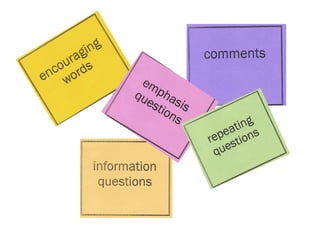
• encouraging words:    • repeating questions:
   – Mhmm.                 – word / phrase as
   – Yeah.                   a question
   – Wow!               • information
• comments:               questions:
   – How interesting!      – Why did she do
                             that?
   – That’s amazing!       – What happened
• emphasis questions:        next?
   – Really?
Disagreeing Top 4
1. Agreement prefaced disagreement
  –   “Yes, but”
  –   Agreement part is faster and weaker
2. Showing discomfort
  –   “Well”
  –   Long and flat intonation
3. Checking the statement
  –   “Really?”
  –   Rising intonation
 4. Pretending a lack of comprehension
   – “What?”
   – Rising Intonation
minimizing   checking    promising


Favor Asking Steps

  disarming     warning     introducing
Practice
Who will colonize Marzipan?
Assessment
Great Pronunciation Supplements
• Avery, P. and Erlich, S. (1997) Teaching American English
  Pronunciation, Oxford University Press
• Beisbier, B. (1994) Sounds Great, Thompson and Heinle
• Gilbert, J. (2001) Clear Speech, Cambridge University Press
• Grant, L. (2001) Well Said, Heinle and Heinle
• Hancock, A. (1995) Pronunciation Games, Cambridge
  University Press
• Meyers, C. & Holt, S. (2001) Pronunciation for Success, Aspen
  Productions
• Miller, S. (2005) Targeting Pronunciation, Houghton Mifflin Co
• Noll, M. (2007) American Accent Skills, Ameritalk Press
Great Pragmatics Supplements
• Foreign Affairs Canada website, www.intercultures.ca
• CARLA website: www.carla.umn.edu/speechacts
• Teaching Pragmatics website:
  http://exchanges.state.gov/englishteaching/resforteach/prag
  matics.html
• Martinez-Flor, A. and Uso-Juan, E (2006) A comprehensive
  pedagogical framework to develop pragmatics in the foreign
  language classroom: The 6Rs approach, Applied Language
  Learning, 16(2)
We want our students to be

    fully effective
   communicators.

     Kanellou (2009)
Thank you for your interest!

          Tamara Jones
     jonestamara@hotmail.com
   SHAPE Language Center, Belgium

The Missing Link

  • 1.
    The Missing Link: Pragmaticsand Pronunciation Tamara Jones jonestamara@hotmail.com SHAPE Language Center, Belgium
  • 2.
    pragmatics pronunciation perceptions of politeness
  • 3.
  • 4.
    … knowing how,when, and why to say what to whom NSFLE (2000)
  • 5.
    • Close thewindow, please. • Would you mind if I closed the window? • Brr, it’s chilly in here.
  • 6.
    It does nottake massive breakdowns to create tensions between people of different cultural backgrounds. Rather, it is a cumulative process made up of uncomfortable moments and small frustrations. Beal (1992)
  • 7.
  • 8.
    “Thank you very much. Please come again.”
  • 9.
    Pronunciation I love you. Intonation I love you. I love you. Sentence Stress I love you.
  • 10.
    When grammar andintonation are at odds, the intonation directly carries the illocutionary force of the speech act. Wennerstrom (2001)
  • 11.
    Bringing Pragmatics and Pronunciation into our Conversation Classrooms
  • 12.
    To Teach ornot to Teach? Environment helps, BUT Exposure alone is not enough. We have to take an explicit approach!
  • 13.
    Intonation Pronunciation Mini Lessons Sentence Stress
  • 14.
    • Awareness raising Intonation • Arrows • Choral repetition – Conducting – Kazoos • Recordings Hello! Are you alright? Yes. How about you?
  • 15.
    The fences from Well Said • Dots above stressed words Sentence Stress • Clapping • Rubber bands • Recordings Would you mind if I borrowed your pen? pen It’s been nice chatting with you.
  • 16.
    Morley (1992) Martinez- Flor & Uso-Juan (2006) My Lesson Plan
  • 17.
    My Lesson Plan 1. Warm Up 2. Consciousness Raising 3. Explicit Instruction 4. Practice 5. Assessment (?)
  • 18.
  • 19.
  • 20.
  • 21.
    Video Clips • Televisionclips – Reality TV Aneesa: I feel like she loves attention. I can’t – Scripted TV (last resort) I have to say in the back of believe people. my mind, like, “you need attention, you need • DIY attention, you need attention.” – Unscripted communicativelyattention, yes. speakers Cara: She does need competent • Video Aneesa: And I am just like … • Audio Cara: Actually, she is very needy. But, I still think that she’s physically ill as well.
  • 22.
    Tiffany: Hey! How’sit going? Tamara: Good. Tiffany: Hey, let’s … can I just look at your calendar? Because I have a question. I know you’ve got your weekends planned months in advance, but Elmer and I were just thinking about, and we’re not sure about this at all, but for the concert, possibly, if we’re going to be there all day on Saturday, maybe staying in a hotel room that night. Tamara: Oh, yeah? Tiffany: So, if, and this is totally if this works with your guys’ schedule, if you guys wouldn’t mind and you wanted to come up for that weekend, would you mind watching the dogs? Tamara: Yeah, no problem. Tiffany: If it works. If it totally works. Are you sure you don’t mind? Tamara: Sure. Tiffany: Oh! The doggies will be so happy!
  • 23.
  • 24.
    Tiffany: … ifyou guys wouldn’t mind and you wanted to come up for that weekend, would you mind watching the dogs?
  • 25.
    Tamara: Yeah, noproblem. Tiffany: If it works. If it totally works. Are you sure you don’t mind? Tamara: Sure.
  • 26.
  • 27.
    Communicate that youare Listening! • encouraging words: • repeating questions: – Mhmm. – word / phrase as – Yeah. a question – Wow! • information • comments: questions: – How interesting! – Why did she do that? – That’s amazing! – What happened • emphasis questions: next? – Really?
  • 28.
    Disagreeing Top 4 1.Agreement prefaced disagreement – “Yes, but” – Agreement part is faster and weaker 2. Showing discomfort – “Well” – Long and flat intonation 3. Checking the statement – “Really?” – Rising intonation 4. Pretending a lack of comprehension – “What?” – Rising Intonation
  • 29.
    minimizing checking promising Favor Asking Steps disarming warning introducing
  • 30.
  • 32.
  • 34.
  • 36.
    Great Pronunciation Supplements •Avery, P. and Erlich, S. (1997) Teaching American English Pronunciation, Oxford University Press • Beisbier, B. (1994) Sounds Great, Thompson and Heinle • Gilbert, J. (2001) Clear Speech, Cambridge University Press • Grant, L. (2001) Well Said, Heinle and Heinle • Hancock, A. (1995) Pronunciation Games, Cambridge University Press • Meyers, C. & Holt, S. (2001) Pronunciation for Success, Aspen Productions • Miller, S. (2005) Targeting Pronunciation, Houghton Mifflin Co • Noll, M. (2007) American Accent Skills, Ameritalk Press
  • 37.
    Great Pragmatics Supplements •Foreign Affairs Canada website, www.intercultures.ca • CARLA website: www.carla.umn.edu/speechacts • Teaching Pragmatics website: http://exchanges.state.gov/englishteaching/resforteach/prag matics.html • Martinez-Flor, A. and Uso-Juan, E (2006) A comprehensive pedagogical framework to develop pragmatics in the foreign language classroom: The 6Rs approach, Applied Language Learning, 16(2)
  • 38.
    We want ourstudents to be fully effective communicators. Kanellou (2009)
  • 39.
    Thank you foryour interest! Tamara Jones jonestamara@hotmail.com SHAPE Language Center, Belgium