MARKETING
ESSENTIALS
CASE STUDY:
How Dignity Health Got
Consumers to Break the
Smartphone Addiction
Category:
Social media, digital
video, out-of-home
Vertical market:
Healthcare
Agency:
Allison & Partners;
Eleven Inc.; R/GA;
Horizon
Campaign:
‘Take Back Your
Morning’
Timing of
campaign:
November 2015-
January 2016
Summary:
Convincing people
to take back a few
minutes at a time
every morning to
improve their own
health and extend the
idea that strong social
connections can lead
to better health.
2 | APRIL 2016 ADVERTISING AGE
CASE STUDY:
DIGNITY HEALTH
MARKETING ESSENTIALS
THE MARKETING CHALLENGE
It’s no secret that consumers are more plugged
into personal digital devices than ever before. Most
people also know that uber-connected smartphone
habits are probably not good for them. But how do
you take that not-so-cheerful insight and not only
make it relevant, but also turn it into a positive
association for a healthcare brand?
Dignity Health, the fifth-largest hospital system in
the U.S., had been running an inspirational health
and wellness campaign about the power of human
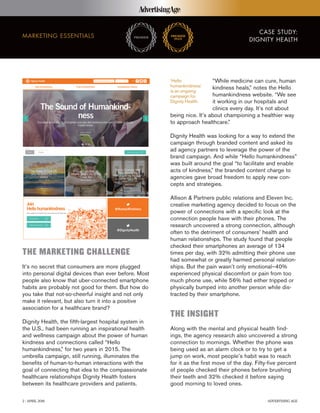
kindness and connections called “Hello
humankindness,” for two years in 2015. The
umbrella campaign, still running, illuminates the
benefits of human-to-human interactions with the
goal of connecting that idea to the compassionate
healthcare relationships Dignity Health fosters
between its healthcare providers and patients.
“While medicine can cure, human
kindness heals,” notes the Hello
humankindness website. “We see
it working in our hospitals and
clinics every day. It’s not about
being nice. It’s about championing a healthier way
to approach healthcare.”
Dignity Health was looking for a way to extend the
campaign through branded content and asked its
ad agency partners to leverage the power of the
brand campaign. And while “Hello humankindness”
was built around the goal “to facilitate and enable
acts of kindness,” the branded content charge to
agencies gave broad freedom to apply new con-
cepts and strategies.
Allison & Partners public relations and Eleven Inc.
creative marketing agency decided to focus on the
power of connections with a specific look at the
connection people have with their phones. The
research uncovered a strong connection, although
often to the detriment of consumers’ health and
human relationships. The study found that people
checked their smartphones an average of 134
times per day, with 32% admitting their phone use
had somewhat or greatly harmed personal relation-
ships. But the pain wasn’t only emotional–40%
experienced physical discomfort or pain from too
much phone use, while 56% had either tripped or
physically bumped into another person while dis-
tracted by their smartphone.
THE INSIGHT
Along with the mental and physical health find-
ings, the agency research also uncovered a strong
connection to mornings. Whether the phone was
being used as an alarm clock or to try to get a
jump on work, most people’s habit was to reach
for it as the first move of the day. Fifty-five percent
of people checked their phones before brushing
their teeth and 32% checked it before saying
good morning to loved ones.
‘Hello
humankindness’
is an ongoing
campaign for
Dignity Health.
ADVERTISING AGE APRIL 2016 | 3
CASE STUDY:
DIGNITY HEALTH
MARKETING ESSENTIALS
“All of these data points led to the idea if you
could claim a moment back in time, you could cre-
ate deeper personal connections. The research
gave us a great hook for the earned side,” said
Cathy Planchard, president of All Told, the inte-
grated marketing division of Allison & Partners.
“We narrowed down to what can someone do and
focused on Take Back Your Morning as the cam-
paign call to action.”
The team realized that convincing people to take
back a few minutes at a time every morning–
reconnect with family at breakfast, hold a loved
ones hand for a few quiet moments or enjoy a
chat with a colleague–would not only improve
their own health, but also contribute to the overall
mission.
THE CAMPAIGN
“Take Back Your Morning” was created by Dignity’s
band of agencies, Allison & Partners and Eleven,
along with digital agency R/GA and media-buying
agency Horizon, which worked as a team to create
the campaign that began with a pledge. The Nov. 2
launch—purposefully chosen for the same date day-
light savings added an extra hour—Dignity Health
invited people to hashtag #TakeBackYourMorning
on social media and pledge to start the day device-
free. People were also encouraged to tag a friend
and share personal stories and ideas. Twitter and
Facebook content was posted from the Dignity
team offering ideas, suggestions and health bene-
fits.
A series of online videos were created by Eleven
with copy suggesting, “Let’s spend less time on
our devices. And more time with each other,” and
intercut with scenes of problematic overuse of
phones–a distracted woman walking into an eleva-
tor door, an on-the-phone dad ignoring his child,
and a baby who dissolved into cries when the
phone she’s playing with is taken away. The media
plan by Horizon was designed and implemented to
maximize morning visibility.
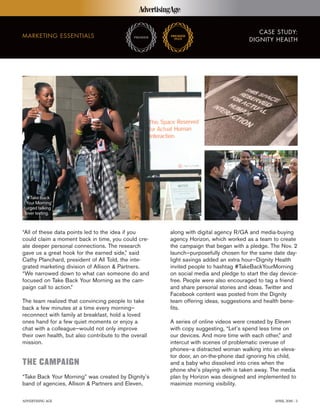
‘#Take Back
Your Morning’
urged talking
over texting.
CASE STUDY:
DIGNITY HEALTH
MARKETING ESSENTIALS
The next phase of the campaign literally took to the
streets of downtown Phoenix, and Sacramento,
Calif., in late November and December. Dignity
teams painted white-lined walking lanes labeled
“This space reserved for actual human interaction.”
The stunt was covered widely across news and
social media, generating conversations about too
many digital distractions and the cost of sacrificing
real interactions.
Through the holidays, the online social media push
continued with reminders about the physical and
emotional health benefits of spending in-person
time with family and friends.
“Human connections actually heal. When people
are present to each other–caregivers to patients, or
loved ones to one another–the capacity of the
human body to heal is that much greater,” said Mark
Viden, VP-brand marketing at Dignity Health. “The
campaign resonated so well because there’s a cul-
tural tension obviously there. People want to be
more engaged with each other and less engaged
with their technology.”
THE RESULTS
I 38,000 social engagements on platforms
Facebook, Twitter and Instagram
I More than 2.3 million video views total by
end of campaign
I 11 million earned media impressions
The campaign was promoted through Dignity
Health’s social media channels, boosting fan
engagement to an all-time high. The video shorts
resulted in the most engagement across all social
platforms, including Twitter and Instagram and
Facebook. Dignity Health’s social channels featured
130 posts related to Take Back Your Morning. The
posts resulted in nearly 38,000 social engagements
and more than 1.5 million estimated social impres-
sions. The top social post on Facebook garnered
more than 8,700 likes, 677 comments and 2,007
shares. Facebook performed as the top channel for
engagement, making up 96% of the total social
media engagements.
NEXT STEPS
While the Take Back Your Morning campaign has
officially ended–the microsite is still active and
occasional social media postings continue–Dignity
Health plans to continue to extend its Hello
Humankindness campaigns in similar ways.
“Healthcare can be a very serious topic. We think
campaigns like Take Back Your Morning allow for a
more engaging lighthearted approach to the deliv-
ery of health,” Mr. Viden said. “We know that the
most sacred encounter you’re going to have is
between your caregiver and you. We want to share
our mission of healing in a way that is broader than
just our industry and allows for, hopefully, a greater
societal change.”
MARKETING LESSONS
Challenge industry thinking. Hospital adver-
tising doesn’t always have to feature doctors in
white coats and patient testimonials to be effective.
Dignity Health took a firm stand to build its re-
brand in 2013 around human kindness and con-
nections and pushed out that altruism in marketing
–not a white coat in sight.
Don’t be afraid to “stretch” marketing suc-
cess. “Hello humankindness” was working well for
Dignity, but branching out into the mobile isolation
theme offered an opportunity to resonate with new
consumers.
Make sure agencies work together. Too
often each agency stays silo-ed in its specialty–
creative, PR, digital–resulting in discordant cam-
paigns. Planchard said get them together early and
often for the effective integrated work.
4 | APRIL 2016 ADVERTISING AGE

Dignity Health Case Study_April 2016

  • 1.
    MARKETING ESSENTIALS CASE STUDY: How DignityHealth Got Consumers to Break the Smartphone Addiction Category: Social media, digital video, out-of-home Vertical market: Healthcare Agency: Allison & Partners; Eleven Inc.; R/GA; Horizon Campaign: ‘Take Back Your Morning’ Timing of campaign: November 2015- January 2016 Summary: Convincing people to take back a few minutes at a time every morning to improve their own health and extend the idea that strong social connections can lead to better health.
  • 2.
    2 | APRIL2016 ADVERTISING AGE CASE STUDY: DIGNITY HEALTH MARKETING ESSENTIALS THE MARKETING CHALLENGE It’s no secret that consumers are more plugged into personal digital devices than ever before. Most people also know that uber-connected smartphone habits are probably not good for them. But how do you take that not-so-cheerful insight and not only make it relevant, but also turn it into a positive association for a healthcare brand? Dignity Health, the fifth-largest hospital system in the U.S., had been running an inspirational health and wellness campaign about the power of human kindness and connections called “Hello humankindness,” for two years in 2015. The umbrella campaign, still running, illuminates the benefits of human-to-human interactions with the goal of connecting that idea to the compassionate healthcare relationships Dignity Health fosters between its healthcare providers and patients. “While medicine can cure, human kindness heals,” notes the Hello humankindness website. “We see it working in our hospitals and clinics every day. It’s not about being nice. It’s about championing a healthier way to approach healthcare.” Dignity Health was looking for a way to extend the campaign through branded content and asked its ad agency partners to leverage the power of the brand campaign. And while “Hello humankindness” was built around the goal “to facilitate and enable acts of kindness,” the branded content charge to agencies gave broad freedom to apply new con- cepts and strategies. Allison & Partners public relations and Eleven Inc. creative marketing agency decided to focus on the power of connections with a specific look at the connection people have with their phones. The research uncovered a strong connection, although often to the detriment of consumers’ health and human relationships. The study found that people checked their smartphones an average of 134 times per day, with 32% admitting their phone use had somewhat or greatly harmed personal relation- ships. But the pain wasn’t only emotional–40% experienced physical discomfort or pain from too much phone use, while 56% had either tripped or physically bumped into another person while dis- tracted by their smartphone. THE INSIGHT Along with the mental and physical health find- ings, the agency research also uncovered a strong connection to mornings. Whether the phone was being used as an alarm clock or to try to get a jump on work, most people’s habit was to reach for it as the first move of the day. Fifty-five percent of people checked their phones before brushing their teeth and 32% checked it before saying good morning to loved ones. ‘Hello humankindness’ is an ongoing campaign for Dignity Health.
  • 3.
    ADVERTISING AGE APRIL2016 | 3 CASE STUDY: DIGNITY HEALTH MARKETING ESSENTIALS “All of these data points led to the idea if you could claim a moment back in time, you could cre- ate deeper personal connections. The research gave us a great hook for the earned side,” said Cathy Planchard, president of All Told, the inte- grated marketing division of Allison & Partners. “We narrowed down to what can someone do and focused on Take Back Your Morning as the cam- paign call to action.” The team realized that convincing people to take back a few minutes at a time every morning– reconnect with family at breakfast, hold a loved ones hand for a few quiet moments or enjoy a chat with a colleague–would not only improve their own health, but also contribute to the overall mission. THE CAMPAIGN “Take Back Your Morning” was created by Dignity’s band of agencies, Allison & Partners and Eleven, along with digital agency R/GA and media-buying agency Horizon, which worked as a team to create the campaign that began with a pledge. The Nov. 2 launch—purposefully chosen for the same date day- light savings added an extra hour—Dignity Health invited people to hashtag #TakeBackYourMorning on social media and pledge to start the day device- free. People were also encouraged to tag a friend and share personal stories and ideas. Twitter and Facebook content was posted from the Dignity team offering ideas, suggestions and health bene- fits. A series of online videos were created by Eleven with copy suggesting, “Let’s spend less time on our devices. And more time with each other,” and intercut with scenes of problematic overuse of phones–a distracted woman walking into an eleva- tor door, an on-the-phone dad ignoring his child, and a baby who dissolved into cries when the phone she’s playing with is taken away. The media plan by Horizon was designed and implemented to maximize morning visibility. ‘#Take Back Your Morning’ urged talking over texting.
  • 4.
    CASE STUDY: DIGNITY HEALTH MARKETINGESSENTIALS The next phase of the campaign literally took to the streets of downtown Phoenix, and Sacramento, Calif., in late November and December. Dignity teams painted white-lined walking lanes labeled “This space reserved for actual human interaction.” The stunt was covered widely across news and social media, generating conversations about too many digital distractions and the cost of sacrificing real interactions. Through the holidays, the online social media push continued with reminders about the physical and emotional health benefits of spending in-person time with family and friends. “Human connections actually heal. When people are present to each other–caregivers to patients, or loved ones to one another–the capacity of the human body to heal is that much greater,” said Mark Viden, VP-brand marketing at Dignity Health. “The campaign resonated so well because there’s a cul- tural tension obviously there. People want to be more engaged with each other and less engaged with their technology.” THE RESULTS I 38,000 social engagements on platforms Facebook, Twitter and Instagram I More than 2.3 million video views total by end of campaign I 11 million earned media impressions The campaign was promoted through Dignity Health’s social media channels, boosting fan engagement to an all-time high. The video shorts resulted in the most engagement across all social platforms, including Twitter and Instagram and Facebook. Dignity Health’s social channels featured 130 posts related to Take Back Your Morning. The posts resulted in nearly 38,000 social engagements and more than 1.5 million estimated social impres- sions. The top social post on Facebook garnered more than 8,700 likes, 677 comments and 2,007 shares. Facebook performed as the top channel for engagement, making up 96% of the total social media engagements. NEXT STEPS While the Take Back Your Morning campaign has officially ended–the microsite is still active and occasional social media postings continue–Dignity Health plans to continue to extend its Hello Humankindness campaigns in similar ways. “Healthcare can be a very serious topic. We think campaigns like Take Back Your Morning allow for a more engaging lighthearted approach to the deliv- ery of health,” Mr. Viden said. “We know that the most sacred encounter you’re going to have is between your caregiver and you. We want to share our mission of healing in a way that is broader than just our industry and allows for, hopefully, a greater societal change.” MARKETING LESSONS Challenge industry thinking. Hospital adver- tising doesn’t always have to feature doctors in white coats and patient testimonials to be effective. Dignity Health took a firm stand to build its re- brand in 2013 around human kindness and con- nections and pushed out that altruism in marketing –not a white coat in sight. Don’t be afraid to “stretch” marketing suc- cess. “Hello humankindness” was working well for Dignity, but branching out into the mobile isolation theme offered an opportunity to resonate with new consumers. Make sure agencies work together. Too often each agency stays silo-ed in its specialty– creative, PR, digital–resulting in discordant cam- paigns. Planchard said get them together early and often for the effective integrated work. 4 | APRIL 2016 ADVERTISING AGE