




The Minimum Viable Product (MVP)
Planning the minimum for the maximum
                                       © Ayman Basheer, 2012
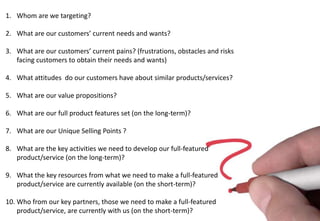
First, you should have answers for the following
10 questions …
1. Whom are we targeting?

2. What are our customers’ current needs and wants?

3. What are our customers’ current pains? (frustrations, obstacles and risks
   facing customers to obtain their needs and wants)

4. What attitudes do our customers have about similar products/services?

5. What are our value propositions?

6. What are our full product features set (on the long-term)?

7. What are our Unique Selling Points ?

8. What are the key activities we need to develop our full-featured
   product/service (on the long-term)?

9. What the key resources from what we need to make a full-featured
   product/service are currently available (on the short-term)?

10. Who from our key partners, those we need to make a full-featured
    product/service, are currently with us (on the short-term)?
Alignment:
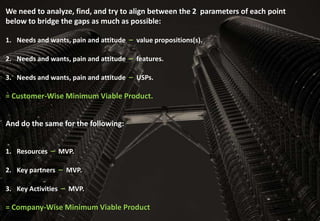
We need to analyze, find, and try to align between the 2 parameters of each point
below to bridge the gaps as much as possible. Then, we align between the
customer-wise and the organization-wise MVPs:


1. Needs and wants, pain and
   attitude AND value
                                                              1. Resources AND MVP.
   propositions(s).                        AND

2. Needs and wants, pain and                                  2. Key partners AND MVP.
   attitude AND features.
                                                              3. Key Activities AND MVP.
3. Needs and wants, pain and
   attitude AND USPs.                                                    =
                                                                 Organization-Wise
              =                                                Minimum Viable Product
        Customer-Wise
    Minimum Viable Product.
MVP Math:
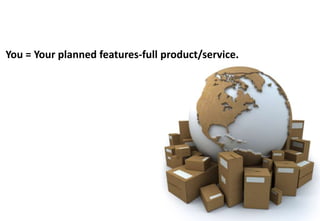
You = Your planned features-full product/service.
Market = You + Competitors
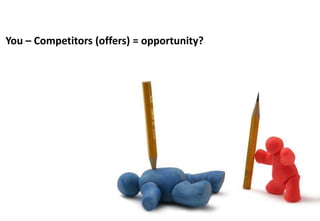
You – Competitors (offers) = opportunity?
Our MVP - opportunity =

- If (+), then it’s more than enough for your current
  market! Go for it!


- If (≈ 0), then it’s almost perfect for your current market
  with a competitive advantage.


- If (-), then does it worth the market entry with that
  MVP? Do we need to revise the MVP that we’ve
  planned?
Fine tuning:
Based on the answers from the questions below, we’ll get a comprehensive idea of
our market and our competitors, which we can use to fine tune (reflect upon) our
previous organization-customer aligned results:

- Competitive Analysis:
   - Who are our current competitors with similar offers to our MVP?
   - What do they offer (product & services)?
       - Description.
       - Features
       - USP.
       - Pricing.
   - How much is their market share?
   - Who are their current customers?
   - Who are their key partners, alliances and distributors?
   - What are their promotion and positioning strategies?
   - What is their recent news?
   - SWOT Analysis.
   - Who are our potential competitors?

- What are the current market trends?

- How much is our potential market share with our planned MVP?

- How much is our potential growth rate?
After all of that,
      it’s always good to develop you
product(s)/Service(s) road map at this stage.
Thank you!


By Ayman Basheer
Mobile : +962 78 5839 887
E-mail : aymanbasheerfx@gmail.com
P.O.Box : 7570 Amman 11118 Jordan

The Minimum Viable Product - Planning The Minimum for The Maximum

  • 1.
    The Minimum ViableProduct (MVP) Planning the minimum for the maximum © Ayman Basheer, 2012
  • 2.
    First, you shouldhave answers for the following 10 questions …
  • 3.
    1. Whom arewe targeting? 2. What are our customers’ current needs and wants? 3. What are our customers’ current pains? (frustrations, obstacles and risks facing customers to obtain their needs and wants) 4. What attitudes do our customers have about similar products/services? 5. What are our value propositions? 6. What are our full product features set (on the long-term)? 7. What are our Unique Selling Points ? 8. What are the key activities we need to develop our full-featured product/service (on the long-term)? 9. What the key resources from what we need to make a full-featured product/service are currently available (on the short-term)? 10. Who from our key partners, those we need to make a full-featured product/service, are currently with us (on the short-term)?
  • 4.
  • 5.
    We need toanalyze, find, and try to align between the 2 parameters of each point below to bridge the gaps as much as possible. Then, we align between the customer-wise and the organization-wise MVPs: 1. Needs and wants, pain and attitude AND value 1. Resources AND MVP. propositions(s). AND 2. Needs and wants, pain and 2. Key partners AND MVP. attitude AND features. 3. Key Activities AND MVP. 3. Needs and wants, pain and attitude AND USPs. = Organization-Wise = Minimum Viable Product Customer-Wise Minimum Viable Product.
  • 6.
  • 7.
    You = Yourplanned features-full product/service.
  • 8.
    Market = You+ Competitors
  • 9.
    You – Competitors(offers) = opportunity?
  • 10.
    Our MVP -opportunity = - If (+), then it’s more than enough for your current market! Go for it! - If (≈ 0), then it’s almost perfect for your current market with a competitive advantage. - If (-), then does it worth the market entry with that MVP? Do we need to revise the MVP that we’ve planned?
  • 11.
  • 12.
    Based on theanswers from the questions below, we’ll get a comprehensive idea of our market and our competitors, which we can use to fine tune (reflect upon) our previous organization-customer aligned results: - Competitive Analysis: - Who are our current competitors with similar offers to our MVP? - What do they offer (product & services)? - Description. - Features - USP. - Pricing. - How much is their market share? - Who are their current customers? - Who are their key partners, alliances and distributors? - What are their promotion and positioning strategies? - What is their recent news? - SWOT Analysis. - Who are our potential competitors? - What are the current market trends? - How much is our potential market share with our planned MVP? - How much is our potential growth rate?
  • 13.
    After all ofthat, it’s always good to develop you product(s)/Service(s) road map at this stage.
  • 14.
    Thank you! By AymanBasheer Mobile : +962 78 5839 887 E-mail : aymanbasheerfx@gmail.com P.O.Box : 7570 Amman 11118 Jordan