The Middle Ages
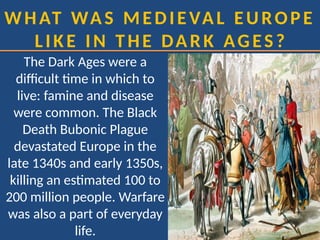
WHAT WAS MEDIEVAL EUROPE
LIKE IN THE DARK AGES?
The Dark Ages were a
difficult time in which to
live: famine and disease
were common. The Black
Death Bubonic Plague
devastated Europe in the
late 1340s and early 1350s,
killing an estimated 100 to
200 million people. Warfare
was also a part of everyday
life.
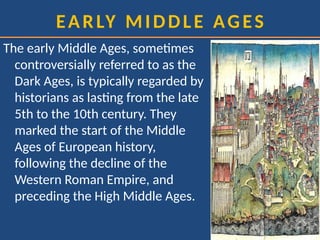
EARLY MIDDLE AGES
The early Middle Ages, sometimes
controversially referred to as the
Dark Ages, is typically regarded by
historians as lasting from the late
5th to the 10th century. They
marked the start of the Middle
Ages of European history,
following the decline of the
Western Roman Empire, and
preceding the High Middle Ages.
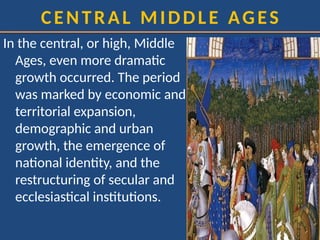
CENTRAL MIDDLE AGES
In the central, or high, Middle
Ages, even more dramatic
growth occurred. The period
was marked by economic and
territorial expansion,
demographic and urban
growth, the emergence of
national identity, and the
restructuring of secular and
ecclesiastical institutions.
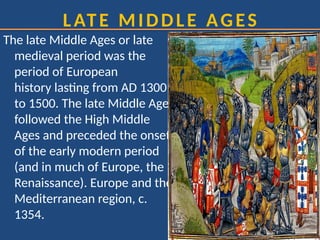
LATE MIDDLE AGES
The late Middle Ages or late
medieval period was the
period of European
history lasting from AD 1300
to 1500. The late Middle Ages
followed the High Middle
Ages and preceded the onset
of the early modern period
(and in much of Europe, the
Renaissance). Europe and the
Mediterranean region, c.
1354.
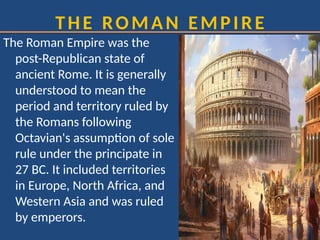
THE ROMAN EMPIRE
The Roman Empire was the
post-Republican state of
ancient Rome. It is generally
understood to mean the
period and territory ruled by
the Romans following
Octavian's assumption of sole
rule under the principate in
27 BC. It included territories
in Europe, North Africa, and
Western Asia and was ruled
by emperors.
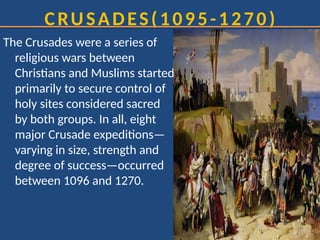
CRUSADES(1095-1270)
The Crusades were a series of
religious wars between
Christians and Muslims started
primarily to secure control of
holy sites considered sacred
by both groups. In all, eight
major Crusade expeditions—
varying in size, strength and
degree of success—occurred
between 1096 and 1270.
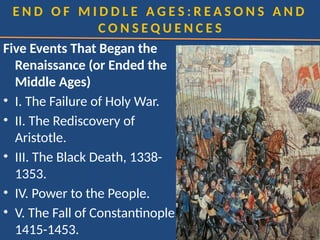
E N D O F M I D D L E A G E S : R E A S O N S A N D
C O N S E Q U E N C E S
Five Events That Began the
Renaissance (or Ended the
Middle Ages)
• I. The Failure of Holy War.
• II. The Rediscovery of
Aristotle.
• III. The Black Death, 1338-
1353.
• IV. Power to the People.
• V. The Fall of Constantinople,
1415-1453.
MIDDLE (4).pptxjfjkdfjfksldddddddddddddddddkllllll

MIDDLE (4).pptxjfjkdfjfksldddddddddddddddddkllllll

  • 1.
  • 2.
    WHAT WAS MEDIEVALEUROPE LIKE IN THE DARK AGES? The Dark Ages were a difficult time in which to live: famine and disease were common. The Black Death Bubonic Plague devastated Europe in the late 1340s and early 1350s, killing an estimated 100 to 200 million people. Warfare was also a part of everyday life.
  • 3.
    EARLY MIDDLE AGES Theearly Middle Ages, sometimes controversially referred to as the Dark Ages, is typically regarded by historians as lasting from the late 5th to the 10th century. They marked the start of the Middle Ages of European history, following the decline of the Western Roman Empire, and preceding the High Middle Ages.
  • 4.
    CENTRAL MIDDLE AGES Inthe central, or high, Middle Ages, even more dramatic growth occurred. The period was marked by economic and territorial expansion, demographic and urban growth, the emergence of national identity, and the restructuring of secular and ecclesiastical institutions.
  • 5.
    LATE MIDDLE AGES Thelate Middle Ages or late medieval period was the period of European history lasting from AD 1300 to 1500. The late Middle Ages followed the High Middle Ages and preceded the onset of the early modern period (and in much of Europe, the Renaissance). Europe and the Mediterranean region, c. 1354.
  • 6.
    THE ROMAN EMPIRE TheRoman Empire was the post-Republican state of ancient Rome. It is generally understood to mean the period and territory ruled by the Romans following Octavian's assumption of sole rule under the principate in 27 BC. It included territories in Europe, North Africa, and Western Asia and was ruled by emperors.
  • 7.
    CRUSADES(1095-1270) The Crusades werea series of religious wars between Christians and Muslims started primarily to secure control of holy sites considered sacred by both groups. In all, eight major Crusade expeditions— varying in size, strength and degree of success—occurred between 1096 and 1270.
  • 8.
    E N DO F M I D D L E A G E S : R E A S O N S A N D C O N S E Q U E N C E S Five Events That Began the Renaissance (or Ended the Middle Ages) • I. The Failure of Holy War. • II. The Rediscovery of Aristotle. • III. The Black Death, 1338- 1353. • IV. Power to the People. • V. The Fall of Constantinople, 1415-1453.