The Joys of Language Development
REDUCING TANTRUMS BY INCREASING
COMMUNICATION
Two Little Eyes
• Two little eyes to look to God.
• Two little ears to hear His word.
• Two little feet to walk His way.
• Hands to serve Him all my days.
Objectives
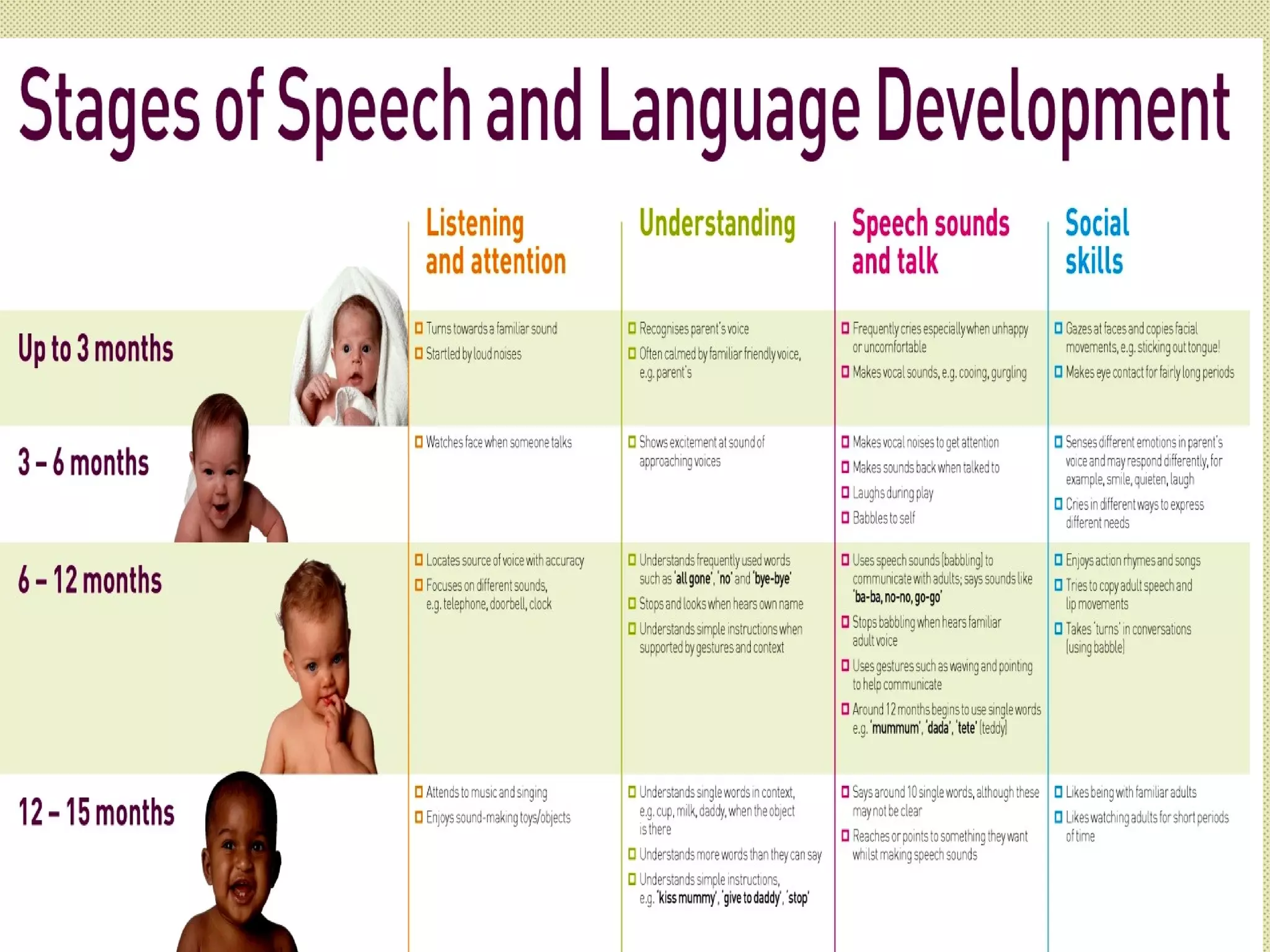
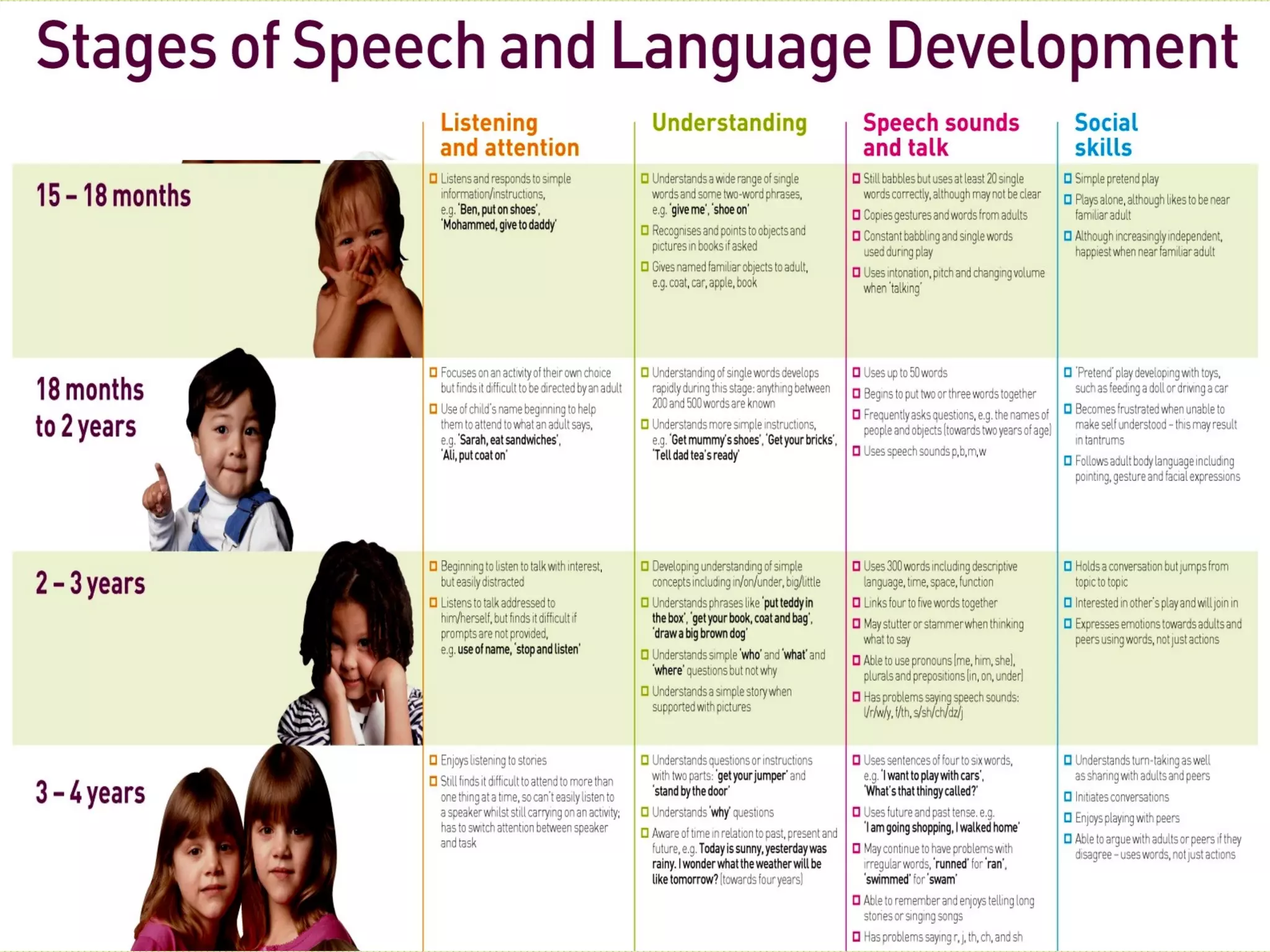
• Learn the precursors and stages of
language development.
• Learn strategies to promote
communication, speech, and language.
• Teaching children to communicate needs.
• Make language learning fun!
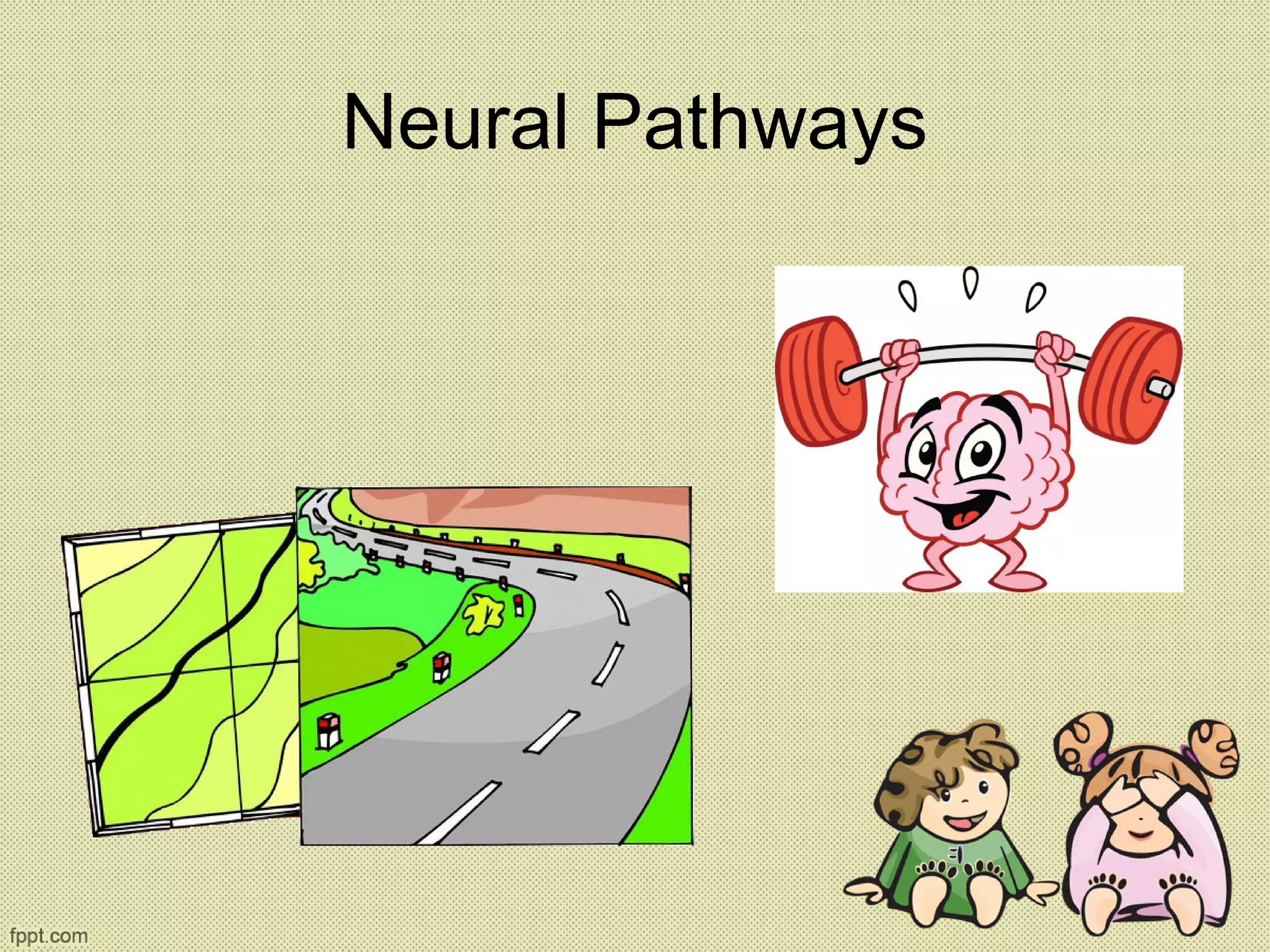
Neural Pathways
Precursors to speech
Beginning Speech
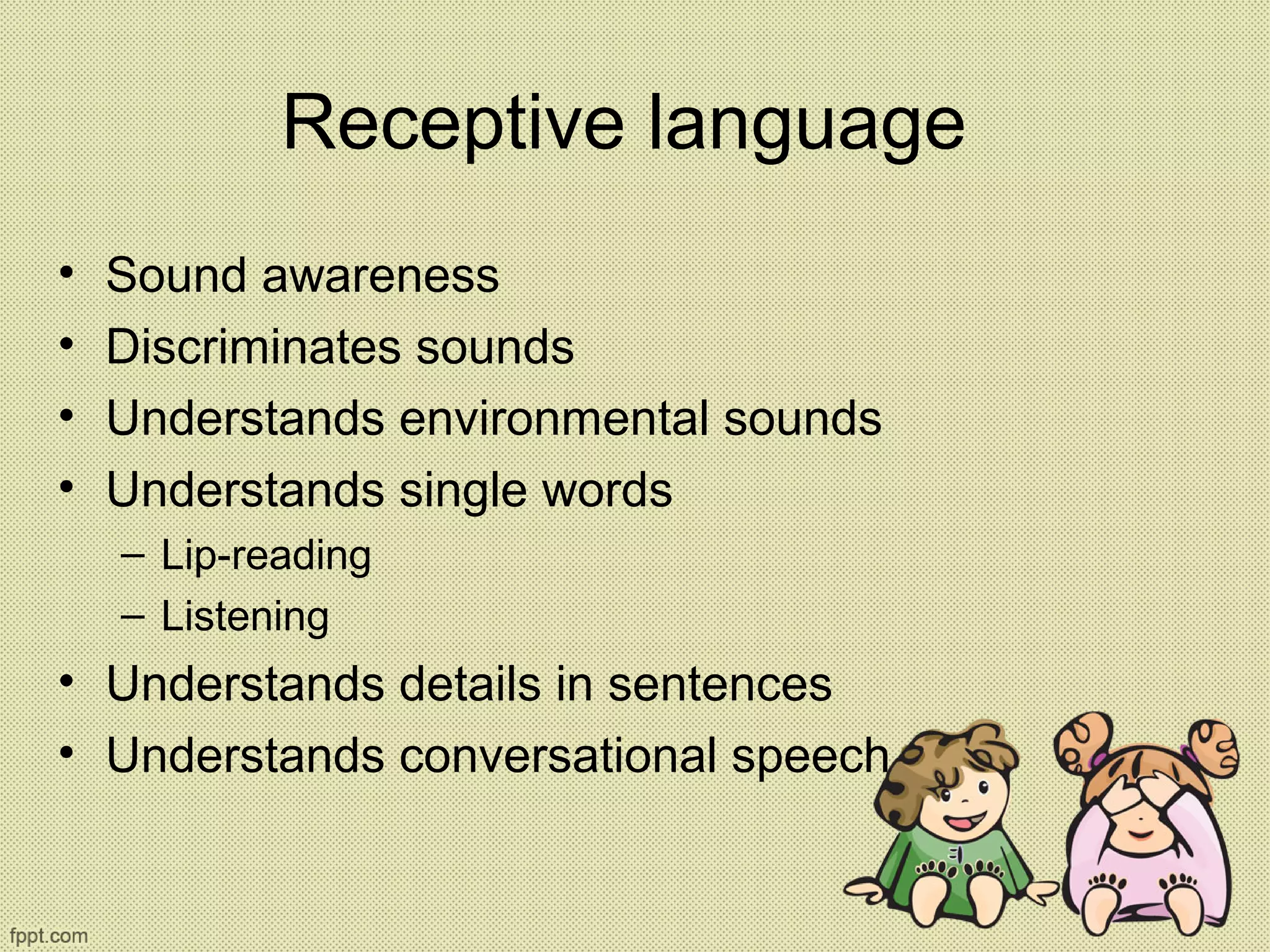
Receptive language
• Sound awareness
• Discriminates sounds
• Understands environmental sounds
• Understands single words
– Lip-reading
– Listening
• Understands details in sentences
• Understands conversational speech
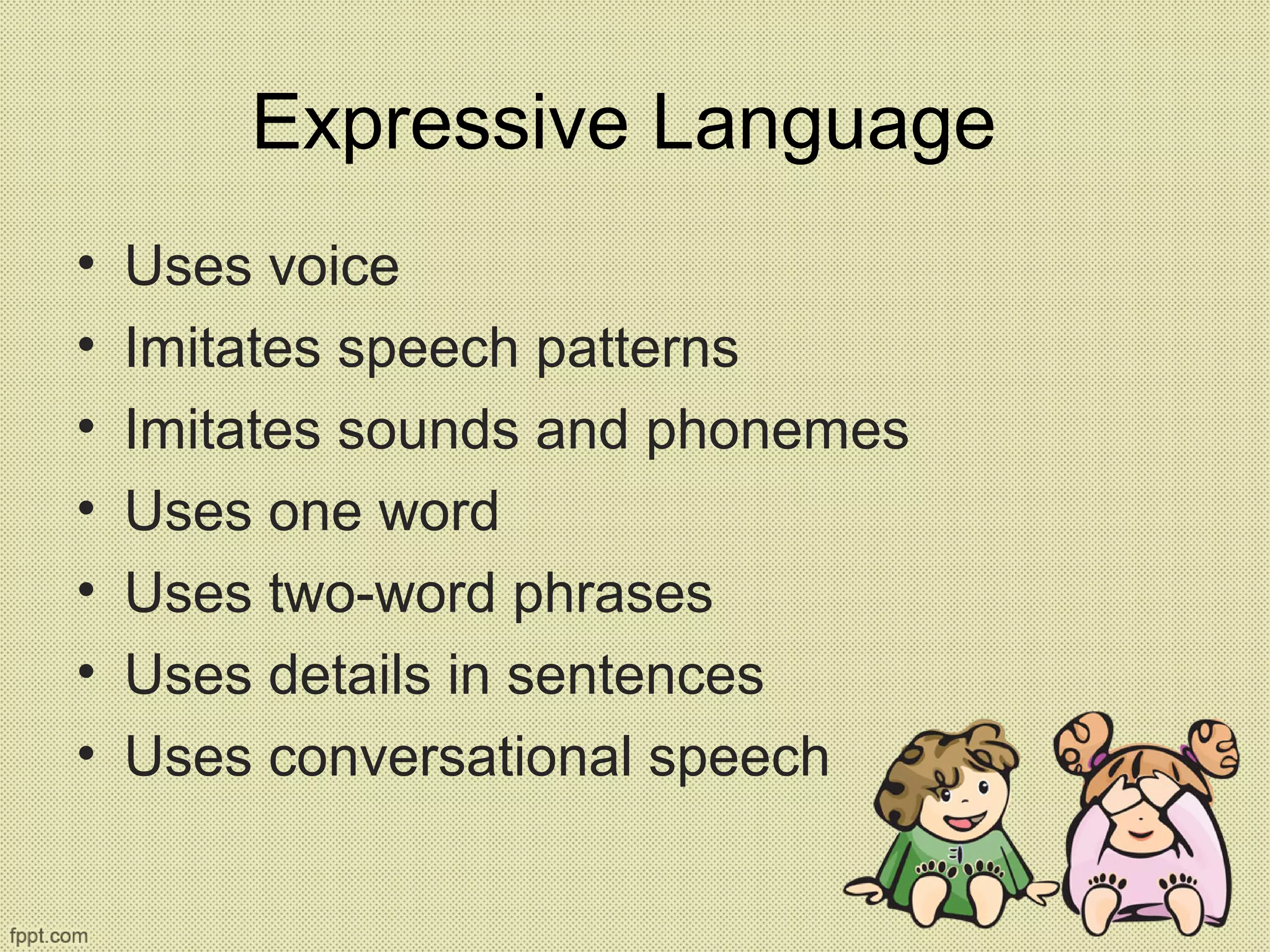
Expressive Language
• Uses voice
• Imitates speech patterns
• Imitates sounds and phonemes
• Uses one word
• Uses two-word phrases
• Uses details in sentences
• Uses conversational speech
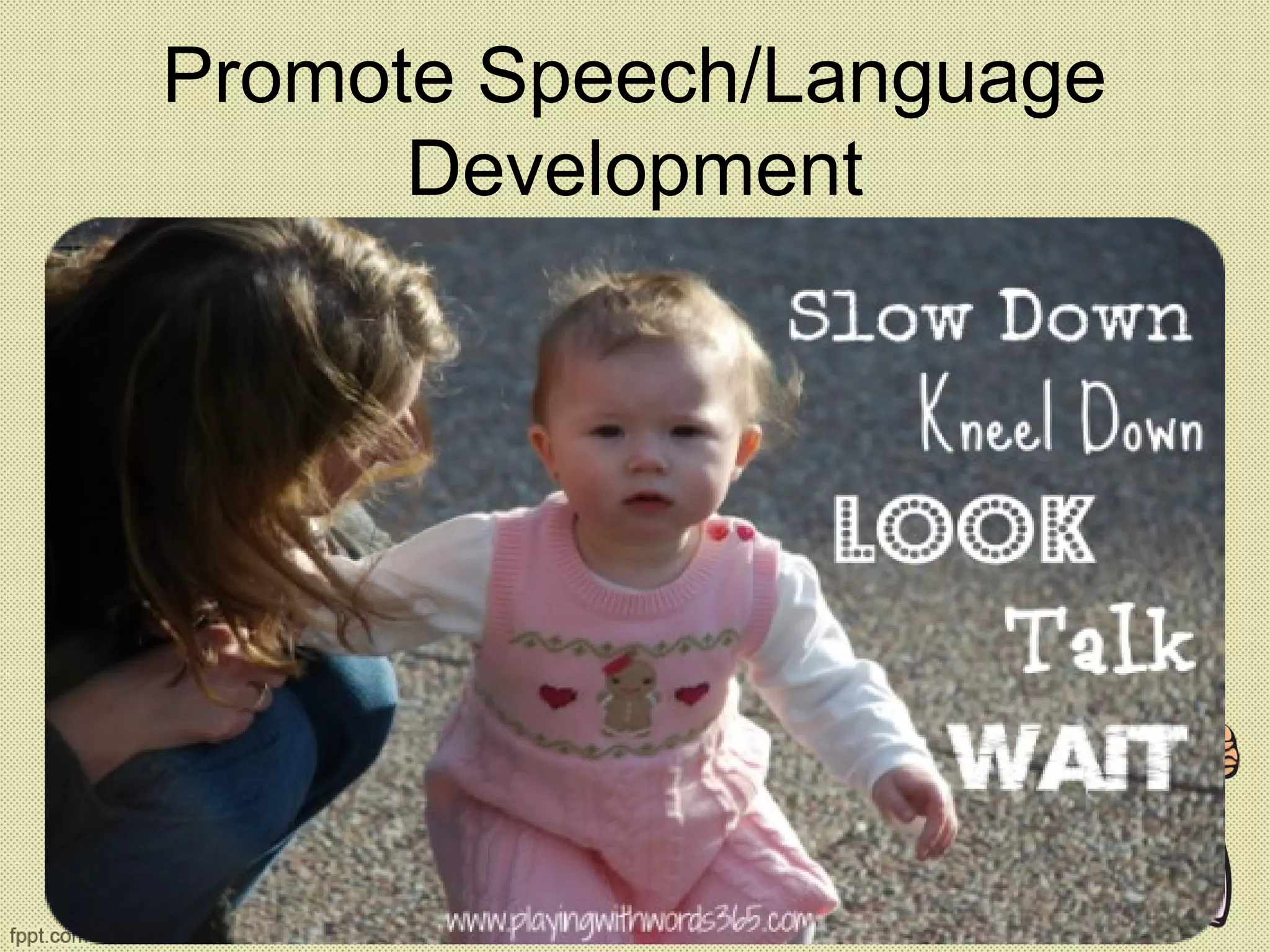
Promote Speech/Language
Development
• Slow down!
• Look at the child –eye level
• http://www.toddlerapproved.com/2012/11/f
ive-tips-to-help-your-toddler-learn.html
Promoting Speech/Language
Development
• Learning language is natural
• Help do more of what they are
already doing
Fun facts
• Development of language in children is
that it is closely related to play.
• First words emerge, around 12 to 13
months, the same time as symbolic play.
Strategies to expand language
skills
• Imitate
• Labeled praise
• Interpret
• Expanding and recasting
• Commenting and describing
• Eliminate negative talk
• Contingent responses
• Balance turn taking
• Label things
• Limit "testing"
Preventing Tantrums
• Create Key Phrases
• Help, please
• Please
• Listen!!
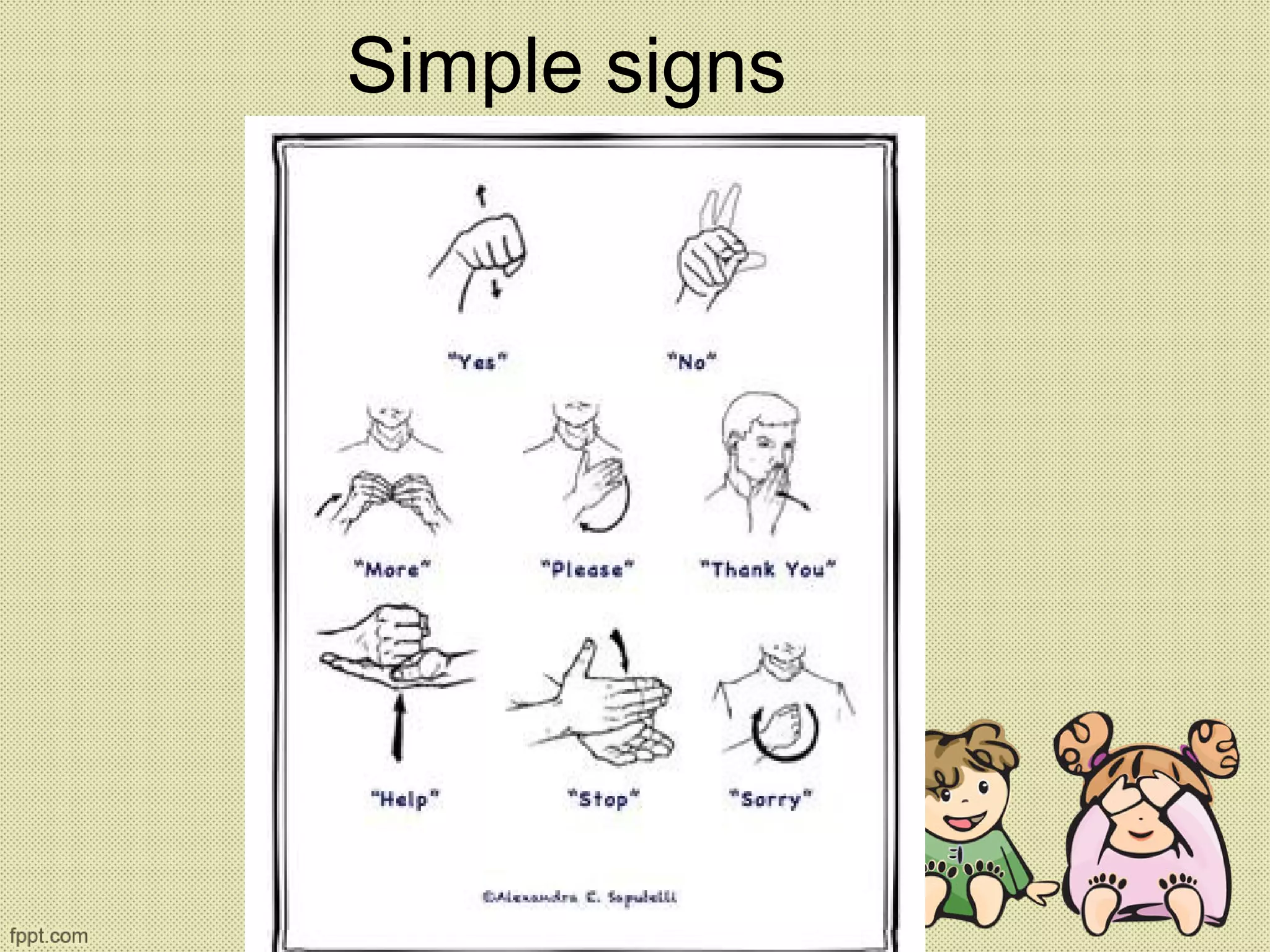
• Simple signs
• More
• Hungry/eat
• Observe!
Simple signs
Five Little Babies
• One little baby rocking in a tree (pretend to rock baby)
• Two little babies splashing in the sea. (make splash
sound with hands)
• Three little babies crawling on the floor (make 3
fingers crawl on arm)
• Four little babies banging on the door. (clap hands)
• Five little babies playing hide and seek (cover eyes)
• Keep your eyes closed tight
• Till I say PEEK!
Round and Round the Garden
• Round and round the garden
• Goes the teddy bear (circle baby's tummy)
• One step, two steps (walk fingers up chest)
• Tickle under there! (tickle baby under chin)
• Round and round the garden
• Goes the little mouse (circle baby's tummy)
• Up, up, up he creeps (walk fingers up arm)
• Up into his house (tickle baby under arm)
Tiny Tim
• There was a little turtle, (make a “turtle with one fist with the
thumb poking out)
• His name was Tiny Tim.
• I put him the bathtub to see if he could swim. (swim arms)
• He drank up all the water, (pretend to drink from a cup)
• He ate up all the soap, (open and close fingers as if they were
eating)
• And now he is in the bathtub,
• With a bubble in his throat. (touch throat)
• Bubble, bubble, bubble, (slowly open arms wider and wider)
• Bubble, bubble, bubble,
• Bubble, bubble, POP! (clap loudly)
The Joys of Language Development
REDUCING TANTRUMS BY INCREASING
COMMUNICATION

The Joys of Language Development

  • 1.
    The Joys ofLanguage Development REDUCING TANTRUMS BY INCREASING COMMUNICATION
  • 2.
    Two Little Eyes •Two little eyes to look to God. • Two little ears to hear His word. • Two little feet to walk His way. • Hands to serve Him all my days.
  • 3.
    Objectives • Learn theprecursors and stages of language development. • Learn strategies to promote communication, speech, and language. • Teaching children to communicate needs. • Make language learning fun!
  • 4.
  • 5.
  • 6.
  • 7.
    Receptive language • Soundawareness • Discriminates sounds • Understands environmental sounds • Understands single words – Lip-reading – Listening • Understands details in sentences • Understands conversational speech
  • 8.
    Expressive Language • Usesvoice • Imitates speech patterns • Imitates sounds and phonemes • Uses one word • Uses two-word phrases • Uses details in sentences • Uses conversational speech
  • 9.
    Promote Speech/Language Development • Slowdown! • Look at the child –eye level • http://www.toddlerapproved.com/2012/11/f ive-tips-to-help-your-toddler-learn.html
  • 10.
    Promoting Speech/Language Development • Learninglanguage is natural • Help do more of what they are already doing
  • 11.
    Fun facts • Developmentof language in children is that it is closely related to play. • First words emerge, around 12 to 13 months, the same time as symbolic play.
  • 12.
    Strategies to expandlanguage skills • Imitate • Labeled praise • Interpret • Expanding and recasting • Commenting and describing • Eliminate negative talk • Contingent responses • Balance turn taking • Label things • Limit "testing"
  • 13.
    Preventing Tantrums • CreateKey Phrases • Help, please • Please • Listen!! • Simple signs • More • Hungry/eat • Observe!
  • 14.
  • 15.
    Five Little Babies •One little baby rocking in a tree (pretend to rock baby) • Two little babies splashing in the sea. (make splash sound with hands) • Three little babies crawling on the floor (make 3 fingers crawl on arm) • Four little babies banging on the door. (clap hands) • Five little babies playing hide and seek (cover eyes) • Keep your eyes closed tight • Till I say PEEK!
  • 16.
    Round and Roundthe Garden • Round and round the garden • Goes the teddy bear (circle baby's tummy) • One step, two steps (walk fingers up chest) • Tickle under there! (tickle baby under chin) • Round and round the garden • Goes the little mouse (circle baby's tummy) • Up, up, up he creeps (walk fingers up arm) • Up into his house (tickle baby under arm)
  • 17.
    Tiny Tim • Therewas a little turtle, (make a “turtle with one fist with the thumb poking out) • His name was Tiny Tim. • I put him the bathtub to see if he could swim. (swim arms) • He drank up all the water, (pretend to drink from a cup) • He ate up all the soap, (open and close fingers as if they were eating) • And now he is in the bathtub, • With a bubble in his throat. (touch throat) • Bubble, bubble, bubble, (slowly open arms wider and wider) • Bubble, bubble, bubble, • Bubble, bubble, bubble, • Bubble, bubble, POP! (clap loudly)
  • 18.
    The Joys ofLanguage Development REDUCING TANTRUMS BY INCREASING COMMUNICATION

Editor's Notes

  • #11 Early language acquisition is instinctive and for most children tends to happen quite naturally. But how we as adults respond to their attempts to communicate can have an impact—accelerating or decelerating their language development.
  • #12 Developmentally speaking, it makes sense that these two things would occur at the same time because children must first learn to think symbolically in order to use language, since language is symbolic (a word represents an object, for example). So when you join your child in imaginative play, you are actually encouraging and helping to expand her new capacity to represent things mentally and symbolically. Observing and understanding your child's play skills can help you as a parent know what to expect next. For example, if your child hasn't moved past banging a spoon on the table, you shouldn't expect her to be using speech to communicate yet because, developmentally, the intent to communicate is still emerging.
  • #13 Your goal should always be to help them reach just the next level But make sure to follow your child's lead so they remain engaged and empowered to try out new words and communicate in new ways