
THE INFORMATION NEEDS
OF COMMUNITIES
The changing media landscape in a broadband age


Steven Waldman
and the Working Group on Information Needs of Communities


Federal Communications Commission
J u ly 201 1   www.fcc.gov/infoneedsreport


                                                            a
b
THE INFORMATION NEEDS
       OF COMMUNITIES


     The changing media landscape
          in a broadband age


                    Steven Waldman
 and the Working Group on Information Needs of Communities
            Federal Communications Commission
Table of Contents
    		 Executive Summary and Overview  5                                                     A Large Number of Stations Do No News at All
                                                                                              Network news
    	 Part One	       the media landscape	                                                Cable
                                                                                             Cable News Networks
    	   Section 1.	   Commercial Media  33
                                                                                              Local Cable News
    	           1.	 Newspapers  34                                                           Cable Trends
                    Early History: Cheap Paper, the Telegraph, and the Rise of            Satellite
                    the Independent Press                                                    Current State
                    The First Technological Challenges: Radio and TV
                    The Rise of the Lucrative Monopoly Newspaper                 	   4.	 Internet   116
                    The Next Technological Challenge: The Internet                       How the Internet Has Improved Journalism
                    Was the Decline of Newspapers Inevitable?                                More Diversity and Choice
                    Hamsterization                                                           Greater Depth
                    The Price of Newspaper Cuts                                              More Diversity in Commentary and Analysis
                    Going Forward                                                            Enabling Citizen Engagement
                                                                                             Speed and Ease	
    	          2.	 Radio  58                                                                 Expanding Hyperlocal Coverage
                   The Birth of Radio News                                                   Serving Highly Specific Interests
                   Deregulation                                                              Cheaper Content Distribution
                   The Current State of Radio                                                Cheaper Content Creation		
                   Local News Radio                                                          Direct Access to Community and Civic News
                   The Rise of News/Talk                                                 However, the Internet Has Not Solved Some of
                   The Changing Radio Market                                             Journalism’s Key Problems
    	                                                                                       Abundance of Voices Does Not Necessarily Mean
    	          3.	 Television  72                                                           Abundance of Journalism
                   Broadcast Television                                                      Disappointing Financial Track Record for Local, Online,
                                                                                             Labor-Intensive Accountability Journalism
                      The Changing Economics of Modern Local TV News
                                                                                         Why Has the Internet Not Filled the Reporting Gaps Left by
                      The Current State of Local TV News
                                                                                         Newspapers
                      There Is More Local TV news
                                                                                            The Great Unbundling (Consumer Choice)
                      While The Volume of News Has Risen, Staffs Have
                                                                                             Free Riding
                      Shrunk
                                                                                            The Great Unbundling (Advertiser Choice)
                      Excellence in Local TV News
                                                                                             Downward Pressure on Internet Advertising Rates
                      Local Stations Are Becoming More Creative Online
                                                                                            Advertising is Less Dependent on Content
                      A Few Are Trying Innovative Collaborations with
                      Independent Digital Ventures                                           It is Easier to Generate Page Views Without Investing
                                                                                             in Journalism
                      Mobile and Local TV
                                                                                             Fragmentation Slices the Pie Into Smaller Pieces
                      Investigative Powerhouse Stations
                                                                                 	
                      Scant Coverage of Important Local Issues
                                                                                 	   5.	 Mobile  134
                      Less Depth
                                                                                          History
                      Despite Notable Exceptions Investigative Reporting Is
                                                                                          The Mobile News Audience
                      Declining at Many Stations
                                                                                          Different Types of Mobile News Platforms
                      Bleeding Is Still Leading
                                                                                          Mobile News Sites vs. Applications
                     “One-man Bands” Are Increasing
                                                                                          Accessing News Content via Tablets and e-Readers
                      Advertisers Too Often Dictate Content Through
                     “Pay for Play” Arrangements                                          Local TV News Experiments with Hyperlocal Mobile
                      The Airing of Video News Releases                                   Mobile Radio
                      Many Stations Now Outsource Their News Operations                   Text and SMS
                      Competing Stations Increasingly Collaborate                        “MOJO”: Mobile Journalism by Citizens
                      to Save Money                                                       Revenue Models and Track Record
                      Some Stations Use Their New Digital Channels for News,              Donation Models and Mobile Technology
                      Many Do Not                                                         Mobile Industry Finances


2
Section 2.	Nonprofit Media   146                                        	        19.	 Schools   218
                                                                                          Digital Literacy
	        6.	Public Broadcasting   150                                                     Media Literacy
            History                                                                       News Literacy
            Business Models                                                               Digital and Media Literacy in the States
            Public Broadcasting’s Mission
            Education and Culture: A Record of Leadership                   	 Section 4.	   Key Cross-Cutting Issues   224 
            News and Public Affairs
                                                                            	       20.	 News Consumption   226
            Collaboration
                                                                                         Consuming More Media
            Political Pressure and Local News
                                                                                         More Americans Are Skipping the News
            Impact of the Internet and Digital Technology
                                                                                         Americans Are Spending More on Media—and the Financial
            The Problem of Streaming Costs and Digital Distribution                      Beneficiaries Have Changed
            Membership Support                                                           Polarization
            Other Challenges Facing Public Broadcasting
                                                                            	        21.	 Types of News   230
	 7.	Public, Educational, and                                                             Hyperlocal
		 Government (PEG) Access Channels   170
                                                                                          City and State
     What PEG Channels Do
                                                                                              The Advantages of Incumbency
     Factors Affecting Quality
                                                                                          National News
     PEG, Local News, Information, and Journalism
                                                                                          International News
     Government Channels
                                                                            	 22.	 The Media Food Chain and the Functions
	        8.	 C-SPAN and State Public Affairs Networks    176                		 of Journalism   242
             Lack of Support from Cable Operators                                  Functions of Journalism
             Lack of Support from Satellite Providers                              Power Shifts
             Lack of Support from the Corporation for Public Broadcasting          Consequences

	        9.	 Satellite    180                                               	       23.	Diversity   248
	        10.	Low Power FM (LPFM)    184                                                  Traditional Media
                                                                                         News Coverage
	        11.	Religious Broadcasting    186                                               Minority Journalists and Employment
                                                                                         New Media
	        12.	 Nonprofit News Websites    188

	        13.	 Foundations    192                                            	       24.	People With Disabilities   258
                                                                                        Traditional Media: Progress and Setbacks
	        14.	 Journalism Schools    194                                                 New Media: New Opportunities, New Gaps
	        15.	 The Evolving Nonprofit Media    198
                                                                            	 25.	How Big Is The Local Reporting Gap
                                                                            		 and Who Will Fill It?   262
	   Section 3.	Non-Media Players   200                                            How Big is the Gap?
                                                                                  How Fast Will Commercial Media Markets
	        16.	 Government Transparency   202                                       Evolve to Fill the Gap?
              The Three-Stage Open Government Movement                            Signs That Commercial Markets May Fill Gaps Quickly
              How Transparency Fosters an Informed Public                         Signs That Commercial Markets Will Not Fill the Gaps Soon
              The Current State of Government Transparency                        The New Relationship Between the For-Profit and
              Limitations to Transparency Strategies                              Nonprofit Sectors
                                                                                  The New Relationship Between Print, TV, and Radio
	        17.	Emergency Information   212                                          The New Relationship Between New Media and Old
              Social Media

	        18.	Libraries   216


                                                                                                                                                  3
the policy and
    	 Part two	                                                                                   FCC Rules and Public Broadcasting Business Models
    		 regulatory landscape                                                                           Underwriting
                                                                                                      Merchandizing
    	      26. 	Broadcast Radio and Television   276                                                  Retransmission Fees
                 The Fairness Doctrine                                                                Fundraising for Third Parties
                 Disclosure Rules and On-Air Deception                                                Digital Stations
                 The “Public Interest” Standard                                                   The Corporation for Public Broadcasting
                 Defining the Public Interest                                                     Technology and Infrastructure Funding
                “Ascertaining” Community Needs                                                    Fundraising via New Technologies
                 Radio Deregulation                                                               The Problem of Rising Broadband Costs
                 Television Deregulation                                                          Structural and Governance Issues
                 Enforcing “Public Interest” Rules: Theory and Practice                               Station Ownership and Governance
                 Industry Self-Inspection                                                             Consolidation
                 Reform Proposals                                                                     Diversity
                 Taking Stock of the Failure of the Public Interest Obligation                        Collaboration
                 System                                                                               The Political Firewall
                 Commercial Radio                                                                 New Funding Sources and Strategies
                 Campaign Advertising Disclosures                                              Low Power FM
                                                                                               Low Power TV
    	      27. 	 Cable Television   298                                                        Nonprofit Programming on Satellite and Cable.
                 Must Carry and Retransmission Consent                                            State Public Affairs Networks (SPANs)
                 Leased Access                                                                 Nonprofit Websites
                 Public, Educational, and Government (PEG) Channels                            Nonprofit Tax Rules
                 State Public Affairs Networks (SPANs)                                            Advertising
                                                                                                  Facilitating Donations and Assistance to Nonprofit Entities
    	      28. 	 Satellite Television and Radio   302
                                                                                                  A New 501(c) Classification?
                 Set Asides
                                                                                                  Hybrids
                 Local Programming
                 SPANs on Satellite                                              	      32. 	Advertising Policy   334
                 Digital Audio Radio Services (Satellite Radio)                              Government as Advertiser
                                                                                             Public Notices
    	      29. 	 The Internet and Mobile   304
                                                                                             Other Policies That Might Hurt Advertisers
                 Current Policy Debates
                     Access                                                      	      33. 	Print  338
                     Adoption
                     Openness                                                    	      34. 	 Copyright & Intellectual Property  340
                 Aggregation, Summarizing and Revenue Sharing                                  Opt-out versus Opt-in
                 Licensing and Regulation of Mobile Services                                   Take-Down Notices
                 FM Chips on Mobile Phones                                                    “Hot News”

    	      30. 	Ownership   310
                FCC Ownership Rules                                              Part three	
                                                                                 	             Recommendations   
                2010 Quadrennial Review
                Ownership Diversity                                              	      35. 	 REcommendations    345


    	      31. 	 Non Profit Media   314                                          	         	How this report was put together  362
                 Public Broadcasting
                    FCC Rules Governing Public TV and Radio                      	         	notes   366
                    FCC Programming Requirements
                    Religious Broadcasters


4
Executive Summary

In most ways today’s media landscape is more vibrant than ever, offering faster and cheaper
distribution networks, fewer barriers to entry, and more ways to consume information. Choice abounds.
Local TV stations, newspapers and a flood of innovative web start-ups are now using a dazzling array
of digital tools to improve the way they gather and disseminate the news—not just nationally or
internationally but block-by-block. The digital tools that have helped topple governments abroad
are providing Americans powerful new ways to consume, share and even report the news.

Yet, in part because of the digital revolution, serious problems have arisen, as well. Most significant
among them: in many communities, we now face a shortage of local, professional, accountability
reporting. This is likely to lead to the kinds of problems that are, not surprisingly, associated with a
lack of accountability—more government waste, more local corruption, less effective schools, and
other serious community problems. The independent watchdog function that the Founding Fathers
envisioned for journalism—going so far as to call it crucial to a healthy democracy—is in some cases
at risk at the local level.

As technology offered consumers new choices, it upended traditional news industry business models,
resulting in massive job losses—including roughly 13,400 newspaper newsroom positions in just the
past four years. This has created gaps in coverage that even the fast-growing digital world has yet to
fill. It is difficult to know what positive changes might be just around the corner, but at this moment
the media deficits in many communities are consequential. Newspapers are innovating rapidly and
reaching new audiences through digital platforms but most are operating with smaller reporting staffs,
and as a result are often offering less in-depth coverage of critical topics such as health, education
and local government. Many local TV news broadcasts remain excellent, and, on average, they actually
produce more hours of news than a few years ago—but too few are investing in more reporting on
critical local issues and some have cut back staff. Beyond that, a minority are exhibiting alarming
tendencies to allow advertisers to dictate content. In most communities, commercial radio, cable, and
satellite play a small role in reporting local news. Public TV does little local programming; public radio
makes an effort to contribute but has limited resources. Most important, too few Internet-native local
news operations have so far gained sufficient traction financially to make enough of an impact.
                                                                                                             5
On close inspection, some aspects of the modern media landscape may seem surprising:

      >	   An abundance of media outlets does not translate into an abundance of reporting. In many
           communities, there are now more outlets, but less local accountability reporting.

      >	   While digital technology has empowered people in many ways, the concurrent decline in
           local reporting has, in other cases, shifted power away from citizens to government and other
           powerful institutions, which can more often set the news agenda.

      >	   Far from being nearly-extinct dinosaurs, the traditional media players—TV stations and
           newspapers—have emerged as the largest providers of local news online.

      >	   The nonprofit media sector has become far more varied, and important, than ever before.
           It now includes state public affairs networks, wikis, local news websites, organizations
           producing investigative reporting, and journalism schools as well as low-power FM stations,
           traditional public radio and TV, educational shows on satellite TV, and public access channels.
           Most of the players neither receive, nor seek, government funds.

      >	   Rather than seeing themselves only as competitors, commercial and nonprofit media are
           now finding it increasingly useful to collaborate.

    This report looks not only at the changing face of media, but at the relevant policy and regulatory
    situation, including the FCC’s own track record. Our basic conclusion: with the media landscape
    shifting as fast as it has been, some current regulations are out of sync with the information needs of
    communities and the fluid nature of modern local media markets.

    In crafting recommendations, this report started with the overriding premise that the First Amendment
    circumscribes the role government can play in improving local news. Beyond that, sound policy would
    recognize that government is simply not the main player in this drama.


6
However, greater transparency by government and media companies can help reduce the cost of
reporting, empower consumers, and generally improve the functioning of media markets. And
policymakers can take other steps to remove obstacles to innovation and ensure that taxpayer
resources are well used.

Our specific recommendations follow six broad principles:

  >	   Information required by FCC policy to be disclosed to the public should, over time, be made
       available online.

  >	   Greater government transparency will enable both citizens and reporters to more effectively
       monitor powerful institutions and benefit from public services.

  >	   Existing government advertising spending should be targeted more toward local media.

  >	   Nonprofit media need to develop more sustainable business models, especially through
       private donations.

  >	   Universal broadband and an open Internet are essential prerequisites for ensuring that the
       new media landscape serves communities well.

  >	   Policymakers should take historically underserved communities into account when crafting
       strategies and rules.

It is a confusing time. Breathtaking media abundance lives side-by-side with serious shortages in
reporting. Communities benefit tremendously from many innovations brought by the Internet and
simultaneously suffer from the dislocations caused by the seismic changes in media markets. Our
conclusion: the gaps are quite important, but they are fixable. In other words, we find ourselves in
an unusual moment when ignoring the ailments of local media will mean that serious harm may be
done to our communities—but paying attention to them will enable Americans to develop, literally,
the best media system the nation has ever had.


                                                                                                       7
Overview

    Is it possible to capture how much the information revolution has changed our world? Eric Schmidt, former CEO
    of Google, certainly conveyed the gist when he estimated that humans now create as much information in two days
    as we did from the appearance of Homo sapiens through 2003.1 Or, we could consider that Facebook did not exist in
    2003—and now reaches more people than all other major U.S. media outlets combined.
              Or we might contemplate the pigeons of Paul Julius Reuter.2 In 1851, the businessman used a fleet of car-
    rier pigeons to carry stock market quotations and news between London and Paris.3 It worked well (pigeons beat
    the train-carried news by seven hours). But as technology improved, his company, Reuters, changed its approach,
    each time with techniques more mind-boggling than the last.4 In the course of its life, the company has gone from
    distributing news by attaching a little packet of information to the feet of a bird to pushing electromagnetic bursts
    through cables under the sea to cramming voice data into radio waves in the air to bouncing data off a satellite in
    outer space—to transmitting little “packets” of information in the form of ones and zeros over wireless Internet
    networks.5
              And if the company, now called Thomson Reuters, were to bring back the pigeons, each could clutch a 256-
    gigabyte flash drive holding roughly eight million6 times the amount of information that one of the original Reuters
    pigeons could comfortably haul.
              These comparisons only begin to convey a sense of the scale of changes that have occurred. The digital revo-
    lution has utterly transformed how information is created, distributed, shared, and displayed. But we are just begin-
    ning to wrestle with the implications of these changes, including what they mean for journalism, the profession that
    Paul Julius Reuter practiced and that the Founders viewed as a cornerstone of American democracy.
              Thomas Jefferson, who loathed many specific newspapers, nonetheless considered a free press so vital that
    he declared, “Were it left to me to decide whether we should have a government without newspapers or newspapers
    without a government, I should not hesitate a moment to prefer the latter.” If he were alive today, Jefferson would
    likely clarify that his dedication was not to “newspapers” per se but to their function: providing citizens the informa-
    tion they need to both pursue happiness and hold accountable government as well as other powerful institutions.7
              That sense of the vital link between informed citizens and a healthy democracy is why civic and media lead-
    ers grew alarmed a few years ago when the digital revolution began undercutting traditional media business models,
    leading to massive layoffs of journalists at newspapers, newsmagazines, and TV stations. Since then, experts in
    the media and information technology spheres have been debating whether the media is fulfilling the crucial role
    envisioned for it by the Founders. In 2008 and 2009, a group that was both bipartisan (Republicans and Demo-
    crats) and bi-generational (“new media” and “old media”) studied this issue at the behest of the John S. and James L.
    Knight Foundation. The group, the Knight Commission on the Information Needs of Communities in a Democracy,
    concluded:

            “America is at a critical juncture in the history of communications. Information technology is changing our lives in ways that
             we cannot easily foresee.
            “The digital age is creating an information and communications renaissance. But it is not serving all Americans and their local
             communities equally. It is not yet serving democracy fully. How we react, individually and collectively, to this democratic
             shortfall will affect the quality of our lives and the very nature of our communities.”8

            The Knight Commission’s findings, as well as those of other blue-ribbon reports, posed a bipartisan chal-
    lenge to the FCC, whose policies often affect the information health of communities. The chairman responded in
    December 2009 by initiating an effort at the FCC to answer two questions: 1) are citizens and communities getting

8
the news, information, and reporting they want and need? and 2) is public policy in sync with the nature of modern
media markets, especially when it comes to encouraging innovation and advancing local public interest goals?
          A working group consisting of journalists, entrepreneurs, scholars, and government officials conducted an
exploration of these questions. The group interviewed hundreds of people, reviewed scores of studies and reports,
held hearings, initiated a process for public comment, and made site visits. We looked not only at the news media
but, more broadly, at how citizens get local information in an age when the Internet has enabled consumers to access
information without intermediaries.
          This report is intended both to inform the broad public debate and help FCC Commissioners assess current
rules. It is divided into three sections.
          In Part One, we assess the “media and information landscape,” ultimately providing diagnoses on which
sectors are healthy and which are not. Part One is divided into four sections. The report looks first at commercial
media sectors (TV, radio, Internet, newspapers, etc.) and how well each medium is currently ferreting out and pre-
senting civically important information and news. It then examines nonprofit media, including public broadcasting,
nonprofit websites, state public affairs networks (SPANs), low-power FM (LPFM) radio stations, and other nonprofit
entities. Next, it looks at ways that consumers get information that are not reliant on journalistic intermediaries. We
focus particularly on libraries, emergency alert systems, digital literacy efforts in schools, and the crucially important
move by governments to become more transparent. In the final chapters of Part One, we step back from the platform-
by-platform analysis and look at key cross-cutting, cross-platform trends. When one considers both the losses of old
media and the additions from new players, which media markets are healthy and which are not?
          Throughout Part One, we attempt to make this report not only a description of problems but also a resource—
a reliable history of these industries and information sources, a non-ideological description of how things work, and
a catalogue of some of the efforts underway to improve communities. Our hope is that laying out this information in
one place will be useful and stimulating, even to those who disagree with our conclusions.
          In Part Two, we look at the current policy and regulatory landscape, considering some of the main laws and
regulations—including those issued by the FCC—that directly and indirectly shape the news media. This should be
understandable to the broad public, not just to a small group of communication law experts.
          In Part Three, we make recommendations. Some are directed to the FCC, some to the broader community of
policymakers, philanthropists, and citizens.
          We are well aware that a report crafted by staff at a government agency about the media could be met with
suspicion. The media, after all, should be examining the government—not vice versa. But we also believe that it would
be public policy malpractice for the Federal Communications Commission to simply assume that the current (volu-
minous) set of public policies about communications—some crafted before there was an Internet—are well suited for
the 21st century. It is impossible to understand the information needs of communities—a clear statutory focus of the
FCC—without taking a holistic look at all media. When the media landscape changes so rapidly and so dramatically,
the Commission must understand whether its assumptions and rules are still operating, as the Commission is legally
required to do, in service of the “public interest, convenience, and necessity” and in furtherance of “localism, competi-
tion, and diversity.” The Commission has not only the authority but the affirmative duty to look at these issues.9
          It is also important to realize that just because this report points out a particular problem does not mean that
we believe the FCC has the responsibility or authority to solve it. We do not view the government as the main player in
this drama. In some cases, the role of this report is simply to describe things—to stimulate discussion and to suggest
new paradigms for understanding local media markets.
          We started with a view that there has never been an ideal age of journalism. Reports far thicker than this
could document the failures of traditional journalism to uncover or understand important stories, sufficiently shed
its biases, emphasize the important stories over the frivolous, cover all constituencies with sufficient rigor, and live
up to the highest ideals and ethical standards of the profession. But we place those hard truths in a practical context
by also noting two other ideas: 1) just because something is imperfect does not mean it cannot get worse, and 2) for
every instance of journalistic neglect there are many more in which the media have performed exactly the functions
a democracy needs. Or, as James Madison, put it, “Some degree of abuse is inseparable from the proper use of every-
thing; and in no instance is this more true than in that of the press.” Yet despite the press’s “abuses,” Madison argued
that efforts to restrain the bad actors would hurt the good:

                                                                                                                             9
“It is better to leave a few of its noxious branches to their luxuriant growth, than, by pruning them away, to injure the vigor of
              those yielding the proper fruits. And can the wisdom of this policy be doubted by anyone who reflects that to the press alone,
              checkered as it is with abuses, the world is indebted for all the triumphs which have been gained by reason and humanity over
              error and oppression?”10


              We share Madison’s grand vision about the importance of the press. If the United States does not have
     healthy media markets, communities will suffer real harm. Yet despite the serious challenges, we are optimistic:
     while the problems are serious, they are manageable. If citizens, entrepreneurs, nonprofit groups, and businesses
     work collectively to fill the gaps and continue to benefit from a wave of media innovation, the nation will end up with
     the best media system it has ever had.


                                            Part One: The Media Landscape

     Attempting to convey a clear picture of the modern media landscape is like trying to draw a hurricane from within the
     storm. In our review of the industry’s history, we note that leaders of each medium believed that the latest new tech-
     nology would doom them, yet many survived and adapted. And yet this sense that the future is unknowable cannot
     be used as an excuse for failing to attempt to understand what is happening around us now—especially when history
     has shown that in transformative moments like this, decisions made by policymakers and industry leaders reverber-
     ate for decades. So in approaching this analysis, we faced two opposing challenges: fully describing the current media
     landscape is impossible; failing to try is irresponsible.
               Certainly there can be no doubt that the traditional media business has been significantly shaken, with po-
     tentially serious consequences for communities:

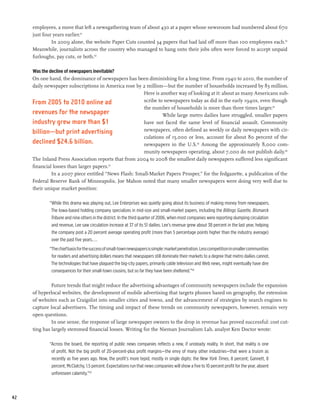
           >	 Newspaper advertising revenue dropped 47 percent from 2005 to 2009.11
           >	 Between 2006 and 2009, daily newspapers cut their annual editorial spending $1.6 billion per year, or more
              than a quarter, according to the Poynter Institute’s Rick Edmonds.12
           >	 Staff at daily newspapers has shrunk by more than 25 percent since 2006, with some major newspapers see-
              ing half their staffs disappear in a matter of a few years. There are about as many journalists working today
              as there were before Watergate.13
           >	 Television network news staffs have declined by half from the late 1980s.14
           >	 Newsmagazine reporting staffs have dropped by almost half since 1985.15
           >	 The number of all-news local radio stations has dropped from 50 in the mid-1980s to 30, which reach a third
              of the country.16
           >	 Only about 20 to 30 percent of the population has access to a local all-news cable channel.17
           >	 There are 520 local TV stations that air no local news at all (258 commercial stations and 262 noncommer-
              cial stations). Considering those, along with stations that air less than 30 minutes of local news per day, 33
              percent of commercial stations currently offer little or no local news.18


     Hyperlocal information is better than ever. Technology has allowed citizens to help create
     and share news on a very local level—by town, neighborhood, or even block. These sites
     mostly do not operate as profitable businesses, but they do not need to. This is journalism
     as voluntarism—a thousand points of news.

10
But these statistics in traditional media, alarming as they are, tell us only part of the story and leave many
unanswered questions. How significant has the impact of these cuts been? Are the effects entirely negative? Have the
losses been offset by efforts in other media?
         To get a handle on this, it is useful to recall that in a typical community, each medium has played a different
role. To oversimplify: with larger staffs, newspapers carried the heavier burden of reporting—especially of investiga-
tive, enterprise, and beat reporting—while local TV and radio “cast” the news to a “broad” audience. Thus, changes
in the health of one medium—newspapers—ripple through the entire local news economy, prompting recalibrations
among all media.

Local Newspapers
This report’s truncated history of newspapers includes an examination of how new technologies have repeatedly
forced change over the industry’s 200-plus-year lifespan. We also look at the evolving role of independent journal-
ism; the rise of corporate chains; and why, precisely, the Internet has proved so devastating to traditional newspaper
business models.
         We then turn to the key question: What are the repercussions when newspapers lay off large numbers of re-
porters? A major report commissioned by the Columbia Journalism School in 2009 concluded, “What is under threat
is independent reporting that provides information, investigation, analysis, and community knowledge, particularly in
the coverage of local affairs.” 19
         We concur. A handful of case studies conducted in U.S. cities helps quantify the effects:
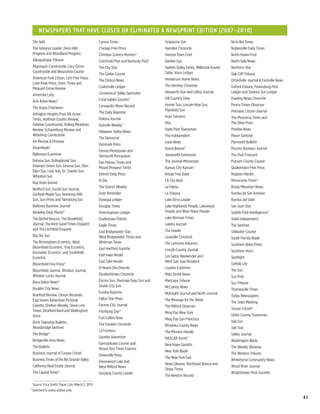
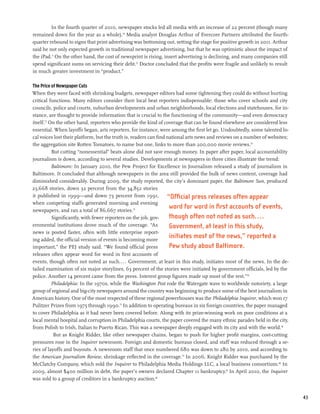
         Baltimore: The Baltimore Sun produced 32 percent fewer stories in 2009 than in 1999—and 73 percent fewer
than in 1991, according to a study by the Pew Center for Excellence in Journalism.20
         Philadelphia: A study comparing sample weeks in 2006 and 2009 found, “Available news about Philadelphia
public affairs issues has dramatically diminished over the last three years by many measures: news hole, air time,
story count, key word measurements.”21
         Raleigh-Durham, North Carolina: In 2004, the Raleigh (NC) News & Observer had 250 employees. By February
2011, the newsroom headcount was down to 103. The beats that lost reporters included: courts, schools, legal affairs,
agriculture, environment, and state education.22
         Across the country, the number of reporters covering essential beats has diminished:
         Statehouse: From 2003 to 2008, while state government spending rose substantially, the number of state-
house reporters dropped by one-third, according to the American Journalism Review.23 In New Jersey, the number of
statehouse reporters dropped from 35 to 15.24 In California it fell from 40 to 29;25 in Texas, from 28 to 18;26 and in
Georgia, from 14 to 5.27
         Investigative: There is no reliable direct count of investigative reporters, but indirect measures indicate a
decline. Membership in the Investigative Reporters and Editors association dropped from 5,391 in 2003 to 4,000 in
2010.28 From 1984 to 2010, submissions to the Pulitzer Prize “public service” category declined by 43 percent.29
         Environment: The Society of Environmental Journalists had 430 newspaper reporter members in 2004; now,
it has 256.30
         The impact of national policy on communities: Twenty-seven states have no Washington reporters, according to
Pew’s Project for Excellence in Journalism. The number of papers with bureaus covering the Capitol has dropped by
about half since the mid-1980s.31
         In other cases, hard numbers are unavailable, but experts on the ground describe distressing changes:
         Religion: “Religion news at the local level is nearly gone,” reports Debra Mason, executive director of the Re-
ligion Newswriters Association.32
         Health: The number of health reporters has declined, while interest in the topic has remained strong, leading
to fewer reporters doing more work and “a loss of in-depth, enterprise and policy-related stories,” according to a study
by the Kaiser Family Foundation.33
         Education: Schools reporters are overextended. Responsible for covering more ground than ever, they are un-
able to do so adequately. Richard Colvin, former director of the Hechinger Institute, put it this way:


                                                                                                                           11
“Local coverage has likely not dropped in volume. But it has certainly dropped in ambition.… [T]hose who [cover education]
               may not do so full time and don’t have the leeway to write much of substance. They also have very little capacity to think
               about broader issues.”34

                 Business: Andrew Lack, CEO of Bloomberg Multimedia, says that local business journalism is suffering today:
     “It’s not a market that’s well served.”35
                 The consequences of journalistic shortages can be seen in places like Bell, California, a working class suburb,
      where the city’s chief administrative officer was drawing a salary of $787,637, and the police chief, $457,000. The
      Los Angeles Times, to its credit, broke the story in June 2010—and won a Pulitzer Prize for its efforts—but the scandal
      had been unfolding since at least 2005. No reporters regularly covered the Bell city government during that period.
      Had there been even a single regular reporter, there is a reasonable chance that taxpayers would have saved much of
      the $5.6 million the officials pocketed. Such examples also help explain why David Simon, a former reporter for the
      Baltimore Sun, who went on to create the HBO show The Wire, said in a 2009 Senate hearing: “It is going to be one of
      the great times to be a corrupt politician.”36
                 Reporters and editors have told us and other researchers that they are spending more time on reactive stories
      and less on labor-intensive “enterprise” pieces. An editor in Tennessee pointed to a story list on a conference room
      white board. There was an “X” next to a story he wanted to do about the failures of a state board that regulates incom-
      petent doctors, but because the paper had laid off one of its health reporters it could not afford to let the remaining
      health reporter conduct a labor-intensive investigation.37 A reporter in another town described a tip he had received
      about local authorities being overly restrictive in issuing gun permits, but explained that he has not had time to look
      into it.38
                 It is hard to know exactly what gets lost when reporters devote less time to enterprise stories, but clues can be
      found by looking at the journalism that has occurred after recent catastrophes. Several publications brilliantly docu-
      mented that the Upper Big Branch mine in West Virginia had “1,342 safety violations in the past five years”—but it
      requires no stretch of the imagination to think that the 29 people who died in the 2010 mine explosion might have
      been spared had more journalists aggressively reported these safety problems before the accident.39
                 We were especially struck by the testimony of non-journalists who rely on good information to solve com-
      munity problems. In Michigan, coverage of juvenile courts has gotten “smaller and smaller over the years,” according
      to Vivek Sankaran of the University of Michigan, an expert on family courts; the result is “parents whose rights are
      terminated who shouldn’t be terminated. It just takes somebody to go down there to get the story, but nobody is ever
      down there.”40
                 Given that polls show the public has a low opinion of journalists, it is easy to forget that when reporters have
      less power, other institutions tend to end up with more. The Pew study of Baltimore concluded that governmental
      institutions increasingly drove the stories—not reporters:

              “As news is posted faster, often with little enterprise reporting added, the official version of events is becoming more important.
               We found official press releases often appear word for word in first accounts of events, though often not noted as such.…
               Government, at least in this study, initiates most of the news. In the detailed examination of six major storylines, 63 percent of
               the stories were initiated by government officials, led first of all by the police. Another 14 percent came from the press. Interest
               group figures made up most of the rest.”41

              Bill Girdner, owner and editor of Courthouse News Service, notes that as it has become harder for reporters to
     get information about cases, “the court bureaucracy has gotten stronger and stronger.… When journalists don’t have
     presence, others control the information process.”42
              Many newspapers have responded to the challenges with tremendous creativity, trying to use their remain-
     ing staffs as effectively as possible. Some papers actually have been placing a greater emphasis on “accountability
     journalism”—beat and investigative reporting about powerful institutions such as schools, city hall, and courts. Most
     papers are embracing new technological tools to try to maximize their remaining reporters’ impact—often making
     especially good use of data put online by local or national government. In most communities, the number one online


12
local news source is the local newspaper, an indication that despite their financial problems, newspaper newsrooms
are still adept at providing news.
          But the broader trend is undeniable: there are fewer full-time newspaper reporters today, and those who re-
main have less time to conduct interviews and in-depth investigations. In some ways, news production today is more
high tech—there is nary a reporter in America who does not know how to tweet, blog, and use a flip video camera—
but in other ways it has regressed, with more and more journalists operating like 1930s wire service reporters—or
scurrying on what the Columbia Journalism Review calls “the hamster wheel” to produce each day’s quota of increas-
ingly superficial stories.43 They can describe the landscape, but they have less time to turn over rocks. They can convey
what they see before their eyes—often better and faster than ever—but they have less time to discover the stories
lurking in the shadows or to unearth the information that powerful institutions want to conceal.
          This study starts with newspapers because traditionally they fielded the most reporters in a community and
set the agenda for the rest of the local media. But a reduction in newspaper reporters need not mean an overall shrink-
age of journalism—if the slack were to be taken up by other journalists in town, such as those on TV, radio, and the
Internet. So, we next turn to TV.

Local TV News
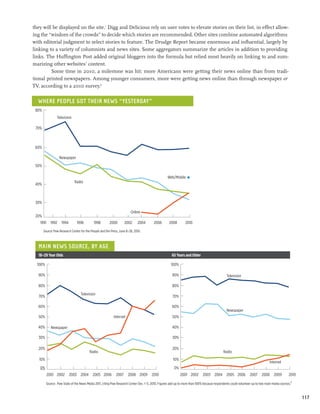
Most Americans still get their news from the local TV news team—and many stations do an extraordinary job inform-
ing their communities. Increasingly, they are offering news through multiple platforms, giving consumers more ways
to get the bread-and-butter news they need. Though local TV stations are not as financially robust as they were five
years ago, most are profitable. Indeed, for now, local TV news may have the strongest business model for providing
local news.
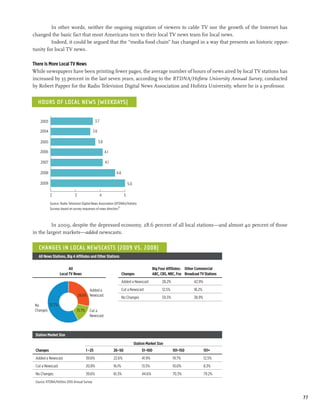
          In many cases, local TV news teams have increased productivity. Over the last seven years, the number of
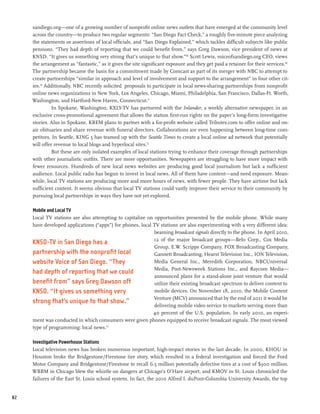
hours of local TV news has risen by 35 percent. Stations offer more newscasts, additional multicast digital channels,
mobile apps, and increasingly popular websites. Many have been creative in using new technology—from citizens’
cell phone photos to eyewitness Twitter reports—to improve the quality of their offerings. Many serve their communi-
ties with genuine passion for making the news available, for free, to an impressively broad audience. In many ways,
local TV news is more important than ever.
          Unfortunately, many stations are not where they need to be if they are going to plug the reportorial gaps left
by newspapers.
          For starters, most local TV stations have increased the volume of news production, while reducing staff—
which generally weakens a station’s capacity for depth. Matthew Zelkind, news director of WKRN in Nashville ex-
plains: “Long-form stories are dying because they’re not financially feasible.… It’s all economically driven.”44 Fred
Young, a long-time TV executive, echoed the view that investigative reporting at most stations is shrinking: “Investiga-
tive [stories], in the eyes of some of the people who looked at the bottom line of those stations, were not as productive
as the reporters turning a story a day. Investigative has suffered.”45
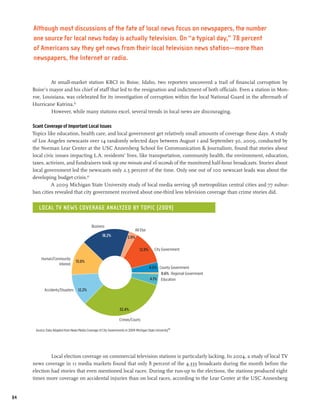
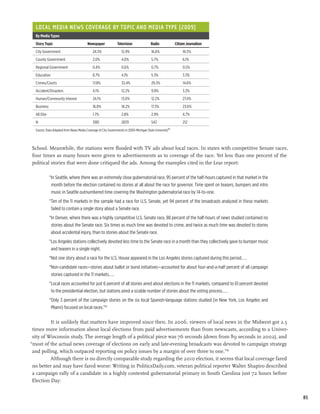
          Topics like local education, health care, and government get minimal coverage. In a 2010 study of Los Ange-
les TV news by the Annenberg School of Communications, such topics took up just a little over one minute of the 30
minute broadcast. Only one out of 100 lead stories was about the ongoing budget crisis.46 In another study—of local
broadcasters in 175 cities—coverage of city government was found to be about one-third as common as crime stories.
Other studies have discovered the same pattern.47
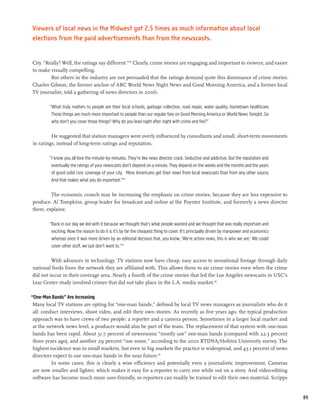
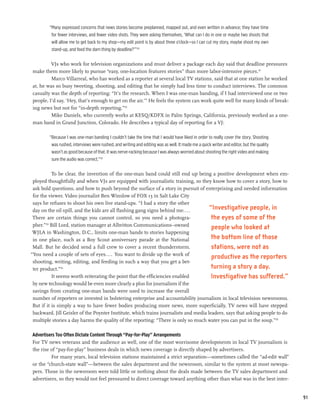
          More stations are increasingly relying on “one-man bands”—reporters who interview, shoot, and edit. In
some cases, this is a powerful and sensible efficiency that stations could use to increase the number of reporters in the

A cross-subsidy system had developed: a consumer who bought the newspaper for the box
scores was helping to pay the salary of the city hall reporter. Today, a reader can get a
mobile app that provides only box scores (with second-by-second updates!). The bundle is
broken—and so is the cross-subsidy.


                                                                                                                            13
field. But in many communities, that is not what has happened. “Let’s face it—it is what it is, and it is economic,” says
     Con Psarras, former news director at KSL in Salt Lake City. “It is an ability to cut heads and it is a full-time equivalent-
     reduction campaign. It does not make the pictures better, it does not make the stories better—it does not make the
     coverage on the web better. That’s a mythology—it just saves money.”48 One typical TV reporter said that while he was
     one-man banding, he was so busy tweeting, shooting, and editing, he had less time for interviews. “It’s the research.
     When I was one-man-banding, if I had interviewed one or two people, I’d say, hey, that’s enough to get on the air.”49
              Perhaps most disturbing is the persistence of cases in which local TV news programs have allowed advertis-
     ers to determine on-air content. In Wisconsin, a news director resigned over the station’s “pay-for-play” arrangement
     with a local hospital that had agreed to advertise in exchange for a commitment from the station to air health stories
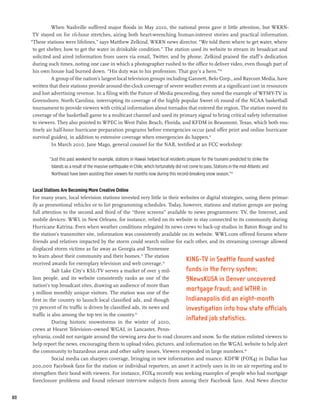
     twice a week—from a list of ideas provided by the hospital.50 A hospital in Ohio paid local TV stations $100,000 or
     more to air “medical breakthrough” segments that benefited the hospital.51 A Florida morning show was soliciting
     $2,500 fees in exchange for guest slots. 52 In other cases, stations are airing video press releases as if they were news
     stories created by news staff. Though we have no way of knowing how many stations have adopted these egregious
     practices, the trend-line is worrisome: “The evidence we’ve seen suggests that this is much more widespread than a
     few years ago,” says Tom Rosensteil, the director of the Pew Project on Excellence in Journalism.
                                                        This is not meant to be a blanket indictment of local TV news. Some
                                              stations have done more than maintain their reporting capacity; they have
     There are about as many
                                              improved it. But the evidence indicates that in many communities if local TV
     journalists working today                news continues on its current path, it will not fill the gaps in accountability
     as there were before                     reporting left by newspapers. In fact, 64 percent of broadcast news executives
                                              believe that their profession is headed in the wrong direction; they are even
     Watergate. Television                    more pessimistic than newspaper editors.53 We emphasize the word “current”
     network news staffs                      because local TV news has the capacity to play a different—more journalis-
     have declined by half                    tically significant—role in the new ecosystem. The question is whether the
                                              industry will seize that opportunity. (Chapter 3, Television.)
     from the late 1980s.
     Newsmagazine reporting                    Radio
     staffs have dropped by                   Though commercial radio offers a dazzling range of programming options,
                                               in most cities local journalism is not one of them. While the news-talk format
     almost half since 1985.                   is thriving, it has relied largely on nationally syndicated shows, rather than
                                               locally produced ones. Eighty-six percent of the news and public affairs pro-
     gramming broadcast on news-talk radio is national rather than local. Though there are still some extraordinary local
     news efforts—from WINS in New York to the Rubber City Radio group of Akron, Ohio—they are more rare than they
     used to be. The number of commercial all-news stations has dropped from 50 in the mid-1980s to 30 today—with
     only 30 to 40 percent of the population living in an area that has an all-news station.
              Low-power FM was created by Congress to provide community broadcasting, and some of the 800 LPFM
     stations provide excellent hyperlocal programming. A bill that was signed into law in January 2011 is intended to help
     spawn more stations, but it is too early to know what its effects will be. (Chapter 2, Radio.)

     Cable TV
     Financially, cable TV is thriving.54 The industry’s two-revenue-stream model—advertising and subscriber fees—has
     proved more durable than broadcast TV’s traditional reliance on advertising alone. The growth of national cable
     news networks has helped make up for some of the reportorial losses broadcast network news has suffered—but, as
     with radio, cable news is vibrant on a national level, and weaker on a local level. Some cable operators, such as Time
     Warner and Cablevision, offer excellent all-news local channels. But other cable companies view such operations as
     unprofitable and unlikely to grow. Currently, only about 20 to 30 percent of the population can watch a local or re-
     gional cable news show.
              Some cable operators offer state public affairs networks (SPANs) modeled after C-SPAN, a particularly valu-
     able service given the cutbacks in statehouse reporting. By broadcasting state legislatures and governmental bodies in


14
action, even if these state SPANs are not generating big ratings, they add a measure of accountability since politicians
know that they might be observed. But 27 states do not have them—and in only 4 states does the cable industry sup-
port them as they do C-SPAN.
         Since the early days of cable, there has also been a system of local public, educational, and governmental
access (PEG) channels. Often set up to offer citizens a way to express themselves, PEG channels—roughly 5,000 of
them—have recently been working to find a new mission in an era when self-expression opportunities abound on-
line. Some have become important venues for teaching digital literacy skills, and a few have begun to focus on citizen
journalism. At the same time, cities and states have been cutting back significantly on their funding, causing scores
of PEG channels to go dark. This is a time of both great promise and peril for PEG stations. (Chapter 3, Television;
Chapter 7, Public Access Channels; and Chapter 27, Cable Television.)

Satellite
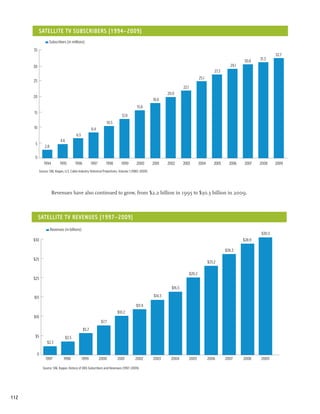
Satellite technology is not particularly conducive to local programming, but the FCC requires satellite service provid-
ers to set aside 4 percent of the channels they carry for educational programming; currently, some of these channels
focus on public affairs. Some educational channels—including those providing religious, public affairs and foreign
language programming—have had great success. But in recent years, satellite operators have been turning away
prospective channels for lack of capacity. Some educational programmers also found it too expensive: unlike the PEG
system, in which programmers get paid, nonprofit programmers must, by law, pay satellite operators significant fees.
(Chapter 9, Satellite.)

Internet and Mobile
The enormous challenges facing traditional media would be of less concern if the vibrant new digital media were
filling the gap. Is it?
          It is important to appreciate that the Internet has not only allowed for new forms of self-expression but has
improved news in many ways. Lower barriers to entry and the vast amount of available space online have led to a
greater diversity of voices, increased depth of some types of coverage, more consumer choices.
          Technology has reduced the costs of gathering, producing and distributing news, in some cases substantially.
Reporters can use computerized databases to pull together stories in hours that would have previously taken weeks.
The cost of producing and publishing images, sound, and text has fallen sharply. And most obviously, and most dra-
matically, the search-engine-driven Internet has made it infinitely easier to find a wide range of information rapidly.
          Citizens are more empowered than ever. They choose where to get their content, how to share it, and are
reporting it themselves. Billions of hours of volunteer labor have helped bring important information online and
make it accessible on a grand scale. With 76 percent of cell phone owners using their phone to take pictures, we may
conclude that, as remark­ ble as it is that most Americans now carry around a minicomputer, it is just as significant
                            a
that most now carry a camera. Indeed, it has become a staple of modern news coverage to include photos and videos
from citizens who captured images with their phones. Perhaps the most important piece of citizen journalism in
this new era was the video taken by an Iranian doctor on his cell phone of a woman named Neda Agha-Soltan being
murdered on the street in Tehran.
           Citizens can customize what news they want and when. There is not a topic that does not have aggrega-
tors providing headlines from around the world. We can get it on demand (when we’re ready to consume) or in real
time; through desktop, tablet, phone, or TV; in text, video, still images, audio or an infinite combination. Even data
has become infinitely customizable. For instance, the Texas Tribune, a news startup in Austin, Texas, offers online
readers the ability to sort through data about Texas lawmakers, prisoners, and public employees. Readers can set the
parameters as they wish, based on their particular interests—say, information about their particular town—and the
gizmo tailors the results to them. Built as one feature—a database—from a consumer perspective it actually provides
thousands of different “stories.”
          Citizens can now play a much greater role in holding institutions accountable. Whether it’s snapping photos of
potholes that the city hasn’t fixed and posting it to a website, or scouring documents to help a news website uncover a scandal,
a broad range of Americans can now more easily scrutinize government, companies and other powerful organizations.


                                                                                                                                   15
These attributes are not just enriching born-on-the-Internet websites but the digital operations of traditional
     media as well. Newspapers and TV stations are now, on their websites or other digital platforms, making use of citizen
     submissions of reporting, images, and video; statistical databases; photo galleries; crowd-sourcing; interactive maps;
     user-comment areas; aggregation of information from around the web; Twitter feeds; live video streaming; and many
     other information tools.
              Perhaps no area has been more dramatically transformed than “hyperlocal”—coverage on the neighborhood
     or block by block level. Even in the fattest-and-happiest days of traditional media, they could not regularly provide
     news on such a granular level. Professional media have been joined by a wide range of local blogs, email lists, web-
     sites and the proliferation of local groups on national websites like Facebook or Yahoo! For the most part, hyperlocally-
     oriented websites and blogs do not operate as profitable businesses, but they do not need to. This is journalism as
     voluntarism—a thousand points of news.
              The number and variety of websites, blogs, and tweets contributing to the news and information landscape is
     truly stunning. Yet this abundance can obscure a parallel trend: the shortage of full-time reporting.
              For instance, the Pew case study of Baltimore revealed a profusion of media outlets. Between new media
     (blogs and websites) and traditional media (TV, radio, newspapers), researchers counted 53 different outlets—con-
     siderably more than existed 10 years ago. But when Pew’s researchers analyzed the content they were providing,
     particularly regarding the city budget and other public affairs issues, they discovered that 95 percent of the stories—
     including those in the new media—were based on reporting done by traditional media (mostly the Baltimore Sun).55
     And those sources were doing less than they had done in the past. Several other studies have had similar findings.
              This is not a criticism of citizen media or web-based news aggregators and commentators. Even when they
     are working primarily with the reporting of others, they often add tremendous value--distributing the news through
     alternate channels or offering new interpretations of its meaning. But we are seeing a decline in the media with a
     particular strength—gathering the information—and seeing it replaced by a media that often exhibits a different set
     of strengths (for instance, distributing and interpreting it).
              This problem became evident several years ago, prompting a flood of former newspaper journalists and
     concerned citizens to start web operations dedicated to serious reporting, especially about local civic affairs. More
     than a hundred impressively creative websites—such as MinnPost in Minneapolis, voiceofsandiego.org, the Texas
                                               Tribune, the Bay Citizen in San Francisco, the Sacramento Press, and the Chi-
                                               cago News Cooperative—now populate the cyberscape. Some are nonprofits,
     Over the last seven years,                some for-profits—and many have brought new energy to the local journalism
                                               scene. Some are even becoming profitable and self-sufficient.
     the number of hours of
                                                         But so far these new websites are not large enough or self-sustaining
     local TV news has risen                   enough to fill the gaps left by newspaper layoffs. In a recent survey of 66 local
     by 35 percent. Stations                   news websites, half reported that their organizations drew in annual income
                                               of less than $50,000, and three-quarters reported annual income of less than
     offer more newscasts,
                                               $100,000. That is not a typographical error; it is annual income for the whole
     additional multicast                      website.
     digital channels, mobile                            The nonprofit online news sector may be vibrant, but it is small in
                                               scale. The Knight Foundation hosted a recent gathering of leaders from 12 of
     apps, and increasingly
                                               the most influential and well-funded websites. Together they employ 88 full-
     popular websites.                         time staffers, which seems quite encouraging until one remembers that more
                                               than 15,000 journalists have left the newspaper industry in the last decade
                                               (and 13,000 left in the last four years alone.)56 Another point of reference: while
     newspapers have been suffering an estimated $1.6 billion drop in editorial spending per year, foundations have contrib-
     uted an estimated $180 million to fund new online ventures over a period of five years. Billions out, millions in.57
              In addition to the local websites, there are a handful of national Internet companies making major efforts
     to serve local communities. Examiner.com has sites in 233 cities, deploying 67,000 “examiners” to write on local
     topics. But these part-timers focus on lifestyle topics, such as entertainment, retail, and sports—not on hard news.58
     AOL’s Patch has created local websites in 800 communities, hiring a reporter-editor in each location—meaning that


16
Patch has likely hired more reporters than any other media organization in the past two years. In the wake of the AOL
merger with HuffingtonPost, founder Arianna Huffington maintained that a major reason for her interest in this
deal was to do more for local news and information. On the other hand, AOL executives in the past have stressed that
to succeed financially, they must focus their efforts on affluent areas. And a single editor wearing many hats, even
working with volunteer contributors, will usually not have time to do full-time enterprise reporting on par with the
best of traditional urban dailies—though he or she may well match or better
the efforts of local community newspapers. In other words, Examiner, Patch,
and companies like them add tremendous value to the media ecosystem, but                   Databases created by
they also leave many crucial gaps unfilled.                                                governments provide
          Michele McLellan, who has studied the digital news scene compre-
hensively for the University of Missouri journalism school, writes, “The tired             information directly to
idea that born-on-the-Web news sites will replace traditional media is wrong-              citizens, and make it
headed, and it’s past time that academic research and news reports reflect
                                                                                           possible for reporters
that.”59
         Why has the Internet not so far spawned business models that can                  to conduct investigative
sustain large numbers of reporters? To answer that, we review some of the                  research in days that
most important ways that the digital revolution has changed the economics
                                                                                           previously would have
of news production.
         The great unbundling: During the news media’s most profitable days,               taken months.
in many towns, there was only one newspaper, leaving consumers with lim-
ited choice. And, though we may not have thought of it this way, purchasing a
paper meant having to buy a bundle of goods, even if readers only wanted certain parts. A cross-subsidy system had
developed, in which a consumer who bought the paper for the box scores was helping to pay the salary of the city hall
reporter. Today, however, a reader can get a mobile app that provides only box scores (with second-by-second updates!).
The bundle is broken—and so is the cross-subsidy.
         Advertisers have benefited from unbundling, too. Remember the saying attributed to department store ex-
ecutive John Wanamaker: “Half the money I spend on advertising is wasted; the trouble is I don’t know which half”?
On the Internet, the executive can know which half is wasted, and spend it elsewhere.
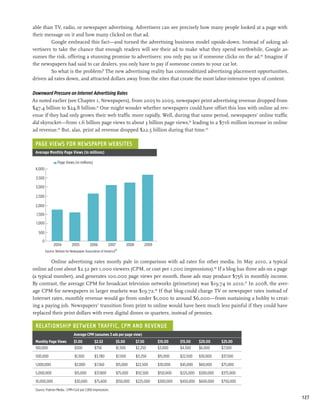
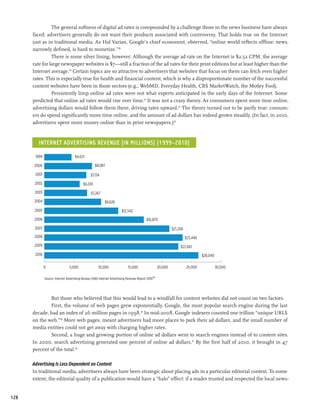
         Downward pressure on online advertising rates: It is a myth that local newspapers suffered because they did not
grow traffic online. From 2005 to 2009, newspapers’ online traffic skyrocketed—from 43.7 million unique monthly
users to 70 million, from 1.6 billion monthly page views to 3 billion page views.60 But in financial terms, that growth
was shockingly meaningless. During that period, online advertising revenue—for the entire newspaper industry—
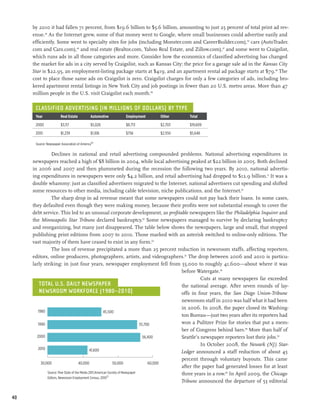
grew $716 million, while the print advertising side of the business lost $22.6 billion.61 This led to the saying in the
newspaper world that “print dollars were being replaced by digital dimes.” The constant growth of Internet page
views—fueled in part by social media—has resulted in online advertising rates that are a fraction of TV and newspa-
per ad rates.
         Advertising is increasingly disconnected from content: While billions of ad dollars have shifted from TV and news-
papers to the Internet, many of those dollars do not go to websites that produce their own content, like newspaper
and magazine sites. In 2000, one percent of online ad dollars went to the purchase of advertising units appearing in
search engine results. In 2009, 47 percent did. On mobile devices, advertisers can increasingly geo-target ads based
on where the consumer is located at a particular moment. Through social media and direct-to-consumer discount
services like Groupon, advertisers can reach consumers without having to search for an appropriate editorial context
for their ads. To reach consumers, advertisers need content less and less.
         Mobile has brought huge innovation to news distribution, but not to news media business models: The fastest grow-
ing platform for accessing news and information is the mobile device. Fifty six percent of all mobile device users, and
47 percent of the population, now use such devices to get local news via an Internet connection.62 Increasingly, the
mobile device is a news media platform—just like a newspaper or a TV set—as much as it is a two-way communica-
tion device. Publishers have expressed some optimism about the iPad and other tablets fundamentally altering the
economics of digital news, making it far more likely that consumers will pay to access content. But the jury is still out


                                                                                                                              17
regarding whether they, or other mobile devices, will have that impact. An October 2010 review of Apple’s App Store
     A May 2011 review of Apple’s App Store revealed that approximately 72 percent of iPad news apps and 71 percent of
     iPhone news apps were available for free.63
              The nature of news as a public good: To some degree, the struggles of traditional media flow from fundamental
     economic principles related to certain types of news that are essentially “public goods.” Economists say that many
     people simply will not pay for news, since they know they can “free ride” and still get the benefits of the news. If you
     want an apple, you have to pay for it, and the benefits go only to you. By contrast, education reporting can generate
     stories that benefit an entire community, and yet people get the benefits of
     better schools even if they do not subscribe to the paper. The result: lots of
     apples sold, but few education reporters employed.                                      In Los Angeles, stories
               Consider: In a three-day December 2008 series about the probation             about local civic issues
     system, the Raleigh (NC) News & Observer established that 580 North Caro-
                                                                                             like transportation,
     lina probationers had killed people since the start of 2000. The series occu-
     pied several staff over six months, costing roughly $200,000 to produce. It             community health, the
     prompted the governor to try to fix the program. In the future, there will prob-        environment, education
     ably be people walking the streets of Raleigh who were not murdered because
     of the reforms. But local residents have no way of knowing who among them
                                                                                             and taxes, took up one
     is alive due to the newspaper series. To have benefited from it, one did not            minute and 16 seconds of
     need to have read the series or subscribed to the News & Observer (which was            the half hour
     available for free on the Internet). It is a terrific deal for citizens: tremendous
     benefit, without the cost or even the bother of reading. (Chapter 4, Internet.)
               Of course the catch is that if too many people free ride, media outlets cannot pay the salaries of the reporters
     who painstakingly gather the information. One of the most famous phrases of the Internet era is “Information wants
     to be free.” There is some truth to that. People want to distribute and receive information for free. But what that leaves
     out is reality that in some cases the information will not come to the fore without the work of professional reporters.
     And while information may want to be free, labor wants to be paid.

     Nonprofit Media
     While most analysis of the new information and news landscape has focused on commercial media, it has become clear
     that nonprofit media, broadly defined, are trying to play an increasingly significant role. This is a welcome development.
     But there is much confusion about the nature of the nonprofit media sector, what it does, and what it needs to succeed.
              For starters, the nonprofit media sector has become quite diverse. On TV and radio, it includes not only pub-
     lic TV and radio but also state public affairs networks (SPANs), low-power FM (LPFM) stations, PEG channels, and
     nonprofit programming. In digital media, it includes local news websites (like those previously mentioned), national
     organizations that fund investigative journalism, programmers who code in “open source” languages, and a full range
     of blogs, wikis, and citizen journalism vehicles. It includes millions of volunteers who contribute information, exper-
     tise, and reporting to websites throughout the Internet.
              Some nonprofit media receive government subsidies; most do not. Some are one-person operations; others
     are sizeable institutions, such as Wikipedia, the Associated Press, Consumer Reports, NPR, National Geographic, and
     AARP. In this section, we look at the state of the current nonprofit media sector, which we view as a crucial element
     in the media landscape.

     Nonprofit Websites and News Services
     Hundreds of nonprofit websites have sprung up, and have made significant contributions in the realm of hyperlocal
     news, national investigative journalism, international coverage, and citizen journalism. Within its first year, ProPub-
     lica, a national group focused on investigative reporting, won a Pulitzer Prize jointly with The New York Times for a
     magazine piece about the agonizing decisions made by medical personnel at Memorial Hospital in New Orleans
     as the flood waters rose during Hurricane Katrina. The St. Petersburg Times, run by the Poynter Institute, launched
     PolitiFact.org, while the Annenberg Public Policy Center of the University of Pennsylvania launched FactCheck.org.


18
The Sunlight Foundation uses new technology to collect and disseminate government data. These organizations have
joined several long-standing nonprofits that promote investigative, or enterprise, reporting, including the Center for
Public Integrity and the Center for Investigative Reporting, which also runs California Watch. Several of these organi-
zations not only execute important journalistic projects but also maintain databases that enable other entities to create
localized versions of a story.
         Nonprofit news organizations have launched to improve coverage of a number of niche sectors, such as
health (Kaiser Health News), schools (Public School Notebook, the Hechinger Report, Education News Colorado),
and foreign coverage (Pulitzer Center on Crisis Reporting and the International Reporting Project). Many have been
created specifically to cover local affairs, sometimes launched by laid-off journalists, sometimes by citizens concerned
about information gaps in communities. The Texas Tribune has pioneered the use of government databases, NJ Spot-
light uncovered a scandal that had been costing the state millions, MinnPost has forged new business models, and
scores of others have worked tirelessly to provide what they see as crucial information their communities wouldn’t
otherwise have. The creativity in this sector is inspiring, though it is not yet clear which entities will be able to survive
and grow in the long run. (Chapter 12, Nonprofit News Websites.)

Public TV
In general, studies indicate that public television stations, which are licensed by the FCC, have offered high-quality
educational, cultural, and national news and public affairs programming. PBS is currently the most trusted and neu-
tral source for news, according to polls. However, public TV plays a minimal role in providing local programming,
including news and accountability journalism. About 94 percent of local public TV stations offer less than 30 minutes
of local news per day—a much lower percentage than the commercial market. In a 2004 survey, 79 percent of the
public television licensees indicated, “the amount of local programming they currently produce is not sufficient to
meet local community needs.”

Public Radio
Public radio in 2010 deployed more than 1,400 reporters, editors, and producers in 21 domestic and 17 foreign bu-
reaus—more than any of the broadcast TV networks.64 Public radio also has proven far more interested in supporting
local journalism than the commercial radio sector. From 2004 to 2009, the number of public radio stations reporting
that they carried local news or talk programming rose from 595 to 681, with hours aired each week increasing from
5,182 to 5,693.65 There are 185 self-described “all-news” public radio stations.66 But while public radio does more than
public TV and more than commercial radio, theirs are mostly small-scale operations.67
         Other local nonprofit institutions that may play a role in filling local journalism gaps include:
         State public affairs networks (SPANs): The best not only provide coverage of legislatures but also of candidate
debates and other public affairs issues that are not being covered elsewhere.
         Public, educational, and government (PEG) channels: The mission of PEG channels is evolving, with some
working to promote digital literacy and others to help with local news and information.
         Educational programming on satellite systems: Religious, ethnic, and some public affairs channels take advan-
tage of the set-aside requirement to expand their reach, but satellite companies also have been rejecting many such
channels due to a lack of satellite capacity.
         Low-power FM (LPFM) stations: There are already 800 in existence, and a new law has increased the likeli-
hood that hundreds more hyperlocal radio stations will be established.
         Journalism schools: There is a growing movement among J-schools to not only teach journalism, but also to
have students practice it by contributing to local websites and publications.
         The nonprofit media sector is miniscule compared with the commercial sector, but its members are focus-
ing on exactly the areas that have been abandoned by commercial media. In this sense, we can see an important new
paradigm developing in which nonprofit media plays a greater role in these specific areas—and in which nonprofit
and for-profit media work symbiotically in local communities.
         However, there are also obstacles to nonprofits expanding. A handful of foundations have been underwriting
tremendous innovation, but most others have been reluctant to support local reporting. Tax restrictions may make


                                                                                                                                19
it difficult for nonprofit websites to create sustainable business models and for newspapers to convert to nonprofit
     status. There is insufficient collaboration among nonprofit media entities, many of which view other such entities as
     competitors for scarce donor dollars. For those offering online video and audio, the cost of streaming the material is
     growing rapidly. And government funding for public broadcasting is under threat.
               In sum, the nonprofit sector has the ingenuity and spirit to fill many of the gaps left by the contraction of
     traditional commercial media but it faces many challenges.

     Non-Media Sources of Civically Important Information
     Americans have always received critical information from sources outside the media. The PTA newsletter, a flier on
     the bulletin board at work, gossip over the hedge, the Sunday sermon, the National Weather Service, campaign adver-
     tisements, public health announcements—these are just a few of the myriad ways we learn about issues that affect
     our lives. The digital revolution has opened up new channels through which Americans can access civically important
     information outside the flow of the news media. In this section, we look at four providers of such information: govern-
     ment, libraries, emergency alert systems, and schools.
              Greater government transparency is already serving to empower citizens and journalists. Databases created
     by local and national government provide information directly to citizens—and they make it possible for reporters to
     conduct investigative research in days that previously would have taken months. In this way, transparency reduces
     the cost of journalism. Indeed, having government make more information available online is a crucial ingredient to
     improving the general health of local media systems and the vitality of reporting. However, the transparency move-
     ment has a long way to go, and even at its best does not obviate the need for journalists to prod, question, and verify.
     (Chapter 16, Government Transparency.)
              Surprisingly, far from being made obsolete by the Internet, public libraries are becoming more important.
     Forty-four percent of people living in households below the federal poverty line use the library to access the Internet.
     Yet many librarians report they cannot keep up with the demand of these patrons. (Chapter 18, Libraries.)
              While the media plays a crucial role during emergencies, government entities must also establish and operate
     basic emergency communications systems. Efforts are currently underway to upgrade from outdated broadcast-based
     systems to new ones that take advantage of digital technology and social media. (Chapter 17, Emergency Information.)
              Most of this report deals with the production and supply of information, but the “demand side”—what con-
     sumers and citizens want and ask for—is tremendously important, as well. Many Americans do not know how to find
     what they need online and are not sophisticated consumers of news. A movement has developed to get America’s
     schools to teach digital literacy (how to use new technology), media literacy (how to assess online media in general),
     and news literacy (how to consume news in a sophisticated manner). (Chapter 19, Schools.)

     Key Cross-Cutting Trends
     The lines between these sectors are becoming increasingly blurred. In this world of converging media, TV is on
     the phone, the Internet is on the TV, and the newspaper is on the tablet. This section looks at the media landscape
     through different lenses. Rather than looking at individual market sectors—such as “newspapers” or “mobile”—it
     examines trends that cut across many platforms.

     Consumer Trends
     As the media systems have offered more choices, consumer behavior has changed:
             More choice, more news consumption: The contraction of some media has stimulated an expansion in the num-
     ber of media outlets available to consumers. As a result, Americans are spending more time consuming media.


     There has been an explosion of local news entrepreneurship. Sometimes started by laid off
     newspaper reporters, sometimes by concerned citizens, sometimes created as nonprofits,
     sometimes as for-profit ventures, hundreds of new local news websites have been born in
     the last few years.

20
More are going “newsless”: However, the percentage of Americans going without any news the day before they
were surveyed rose from 14 percent in 1998 to 17 percent by 2009, according to Pew. The percentage is highest—31
percent—among 18 to 24 year olds.68 One possible explanation is that while the opportunities to consume news have
grown, so too have the opportunities to consume entertainment, sports, and all manner of other content, so those
who had been only marginally interested in news have abandoned it for other alternatives.
        Spending more on media: Though we think of the 21st century as the moment the information economy
went from “paid” to “free,” in many ways the opposite is true. We pay more money to access media than ever before
—largely due to the fees we must pay for cable and Internet service in order to get to our “free” content. From 2003
to 2008, the average annual spending per person on media and information rose from $740 to $882.69 (Chapter 20,
News Consumption.)

Types of News
After looking at these broad trends, we then turn to a central question of this report: when you take into account both
the advances and setbacks in the media industry, which functions traditionally performed by “news media” are being
carried out adequately and which are not being fulfilled?
          Our assessment, categorized by region of coverage, is as follows:
          Hyperlocal (neighborhood-based) information is better than ever: Technology has allowed citizens to help create
and share news on a very local level—by small town, neighborhood, and even block.
          Local (municipal and state) information is struggling mightily—with a measurable decline in certain types of account-
ability reporting: As noted earlier, newspaper staffs have shrunk while other media have not yet been able to employ
enough reporters to make up for the loss. But there is an interesting twist: while traditional media have not been able
to support robust reporting staffs, they have made headway in expanding their online audiences. In an FCC analysis
of three cities (Toledo, Seattle, and Richmond), the local newspaper or TV station emerged as the dominant provider
of online local content.
          National news is vibrant and dynamic: There are certainly many areas of concern; for instance, we describe
the distressing gaps in coverage of regulatory agencies and the changes in the reporting capacity of newsmagazines.
But national newspapers have increased their reach, and websites operating on a national level—ranging from Huff-
ingtonPost to Politico to the Daily Caller—are showing the potential to develop business models that will sustain a
variety of types of national news, information, and journalism. The national news market is far from perfect, but it is
dynamic. (Chapter 21, Types of News)
          International is a mixed picture: The contraction of newspapers, newsmagazines, and network news severely
undercut traditional ways of getting foreign news. But other media organizations—including Bloomberg, the Wall
Street Journal, and NPR—have expanded their overseas presence, and a few nonprofit organizations are funding in-
ternational reporting. Just as important, the Internet, cable, and satellite now offer Americans access to an increasing
number of foreign news sources, such as the BBC and Al Jazeera. (Chapter 21, Types of News.)

Diversity
For ethnic minorities, it is a real best-of-times-worst-of-times story. Minority ownership of broadcast TV stations, al-
ready too low, has now declined further, as has the number of minorities employed as journalists. On the other hand,
digital media provide such low barriers to entry that minorities who have been shut out of mainstream media now
have infinitely greater potential to create content and reach audiences. Without gatekeepers, minority viewpoints are
freer to find their audiences. Also, the high usage of mobile phones among minority populations positions wireless
broadband to surpass efforts by other media to reach historically underserved communities with news and informa-
tion. (Chapter 23, Diversity.)

People With Disabilities
People with disabilities have benefited from new tech developments as well, but much more needs to be done in
that area. Digital media makes it infinitely easier to present content in multiple formats; any given text story can be
accompanied by audio, video, and captions, making it accessible to people with visual and hearing impairment. How-


                                                                                                                                  21
ever, not all content creators exercise those options, and new technologies continue to be designed without taking the
      needs of people with disabilities into consideration. (Chapter 24, People with Disabilities.)

      Will Commercial Media Markets Evolve to Fill Gaps?
     Although we acknowledge that this gap we have been referring to cannot be measured with true precision, we offer
      a rough estimate: It would take the media universe as a whole—commercial and nonprofit sectors—somewhere
      between $265 million and $1.6 billion annually to bridge the gaps we now see in the provision of civically important
      information.
                Signs that commercial markets are evolving in ways that could lead to healthier local information sectors
      include:
                Local advertising is growing; targeting is improving: Predictions are that local advertising will double to $42.5 bil-
      lion between now and 2015, which can only help local media models that rely on advertising. Ad targeting is getting
      more sophisticated which might help raise advertising rates. As broadband penetration increases, more businesses
      will go online, increasing local ad spending.
                Experimentation with pay models is growing: Scores of traditional media companies—from the The Wall Street
      Journal to the Augusta Chronicle—are experimenting with charging for digital content. Google and Apple have un-
      veiled new systems allowing publishers to sell subscriptions and charge for content in other ways. Firms, such as
      Journalism Online, have sprouted to help newspapers and other content creators figure out the right strategy to meet
      their particular goals. In addition, several small news services now cover state government, using a different kind of
      paid model: expensive subscription price with smaller circulation. As more people go online, the number of potential
      paying customers could continue to rise as well.
                New forms of bundling may arise: Although the Internet has broken up bundles, there are new ones forming.
      Netflix, Hulu, and Pandora offer bundled content—access to a variety of different types of content for a single sub-
      scription price. The Huffington Post is a general interest website in which popular entertainment content in some
      ways subsidizes less popular content. News Corp. has created a daily news publication available only on the iPad by
      paid subscription without the costs of printing and delivery trucks. In fact, many content creators are hoping that the
                                                   pleasure of consuming a print magazine or newspaper as a unit can be recre-
                                                   ated on tablets, and thereby help re-establish the bundle and cross-subsidy
      Says Esther Dyson,                           model.
     “News start-ups are                                     Technology continues to drive down the cost of many types of information
      rarely profitable and, by                    gathering and dissemination: Technology developments have made capturing
                                                   video, distributing it, researching, publishing text, transmitting photos, edit-
      and large, no thinking                       ing audio, and many other processes for gathering and disseminating infor-
      person who wanted a                          mation easier, cheaper, and more accessible to a broader range of people. The
      return on investment                         trend is continuing along those lines.
                                                             It is early: It is only in the last three years that a wave of citizens began
      would invest in a news                       experimenting with new local news models. In many cases, the first wave of
      start-up, not that they                      innovation was led by journalists, some of whom had limited business skills.
                                                   Learning by trial and error takes time.
      don’t sometimes work.”
                                                             At the same time, we found compelling evidence that while evolving
                                                   commercial markets will fill many needs, some fundamental characteristics
      of the digital news economy bode ill for the prospects of local accountability reporting quickly and sufficiently being
      supported by new commercial business models. The evidence for that view:
                Media companies will struggle to create new bundling models, because metrics are increasingly precise and corporate
      prioritization decisions will inevitably steer away from low-ROI products: In the olden days, newspaper managers had a
      general sense that they were probably losing money on their overseas coverage, but they had no way to gauge this with
      any precision. Now, managers know in agonizing detail how many page views a foreign article generates. Each piece
      of content can now be subject to return-on-investment (ROI) analysis. To be sure, companies can decide to sustain
      money-losing propositions in the service of some greater corporate goal—improving prestige or brand, for instance—


22
On the one hand, the study showed Baltimore had a booming collection of news and
information outlets. But 95 percent of the stories—including those in the new media—were
based on the reporting done by traditional media (mostly the Baltimore Sun). And those
organizations were doing fewer stories.


but each time the CEO or the finance department assesses the performance of the company’s products, the ones that
lose money will have bull’s-eye on their backs.
         Local media companies will face their own obstacles in charging for content and creating bundles that could cross-sub-
sidize expensive journalism: While there has been some limited success for national media companies charging—the
Wall Street Journal, Consumer Reports—the track record for local media is discouraging. Editor & Publisher declared:

        “2010 was supposed to be the Year of the Paywall for newspapers. But consumers overwhelmingly repudiated the efforts of the
         few publishers who dared to demand payment for access to the news, leaving newspaper content about as widely and freely
         available on the Web at year’s end as it has been for the past one-and-a-half decades.”70

           Those attempting to make it on a free, ad-supported model will face all of the aforementioned forces sup-
pressing Internet advertising rates—plus a new one: on the Internet, one does not have to be a local content creator
to be a venue for local advertising. National Internet companies can attract local advertisers with their ability to geo-
graphically target messaging to local consumers, regardless of whether the content (or context) is locally oriented.
          Most trends point to an even more challenging advertising picture in the future: Relatively few local web-native busi-
nesses that create original content have succeeded financially, in part because advertisers have less and less need to
place their ads in an editorial context. This became apparent when advertising dollars began to flood into search. And
the trend is continuing, as the most popular new ad vehicles—social media and coupons—can thrive without being
associated with content. Currently only 20 percent of digital marketing spending goes to legacy media companies (TV,
magazines, radio, billboards, etc.), and that is projected to decline to 13 percent by 2020.
          More shoes still to drop: For people without easy access to the Internet, it still may be easier today to read clas-
sifieds or clip coupons in the local newspaper than to shop or sell on Craigslist. Eventually, broadband will reach these
audiences—and the old media business models in their towns will suffer, too. Similarly, as Internet radio arrives in
cars, traditional broadcast may suffer; as IPTV (Internet TV) becomes more common form of TV watching, local
TV stations may suffer. In each case, more consumers may be reached, but traditional media’s higher ad rates will
likely be undercut by the lower ad rates on the Internet. One survey found that 58 percent of print newspaper sub-
scribers who also use their iPad a lot “said they were very likely to cancel their print subscriptions within the next six
months.”
          The shifting power of “distributors” and “content creators”: In the past, content distributors and creators were one
and the same (e.g., the newspaper company wrote the articles and hired the paperboys). They could use the profits
generated by distribution to subsidize the creation of content. In the new media universe, there is currently a greater
divide between distributors and content creators. Most Internet service providers, for instance, charge for access to
content without sharing the proceeds with the creators of that content. The separation of these functions may have
benefits but it also makes cross-subsidization between distribution and content-creation arms less likely.
          News as a public good: The free-rider problem has not gone away. If anything, technology innovations often
make it easier for consumers to get information without paying for it or even seeing advertisements.
         A shift in thinking?: Furious debates still erupt between “new media” and “old media” advocates. But in the
last two years, we have noticed a subtle shift. Traditional media leaders no longer mock the pajama-clad practitioners
of the new craft quite as much as they used to. Digital media advocates have become convinced that while the digital
revolution has improved many, if not most, types of information gathering, commercial Internet businesses may not
solve all problems.


                                                                                                                                      23
>	 Clay Shirky, a highly respected advocate for digital media, believes most of the contraction of old media will
              be replaced, and then some, by new media—yet he also believes there is an important exception: “One func-
              tion that’s hard to replace is the kind of reporting that comes from someone going down to city hall again
              today, just in case. There are some in my tribe who think the web will solve that problem on its own, but that’s
              ridiculous.”71
           >	 Hal Varian, Google’s chief economist, concluded that the “online world reflects offline: news, narrowly de-
              fined, is hard to monetize.”72
           >	 Esther Dyson, chairman of EDventure Holdings and an Internet pioneer, explains, “News start-ups are rarely
              profitable and, by and large, no thinking person who wanted a return on investment would invest in a news
              start-up.”73 She believes that when it comes to accountability journalism, the nonprofit sector will need to play
              a bigger role.74
           >	 And then there is John Hood, president of the John Locke Foundation, a market-oriented think tank in North
              Carolina. The Foundation’s Carolina Journal finances nonpartisan investigative journalism, in part because
              the number of reporters covering the statehouse had plummeted over the years. “In North Carolina, several
              TV stations [in towns outside the Capitol] had reporters. None has a bureau now. We were responding to
              changes in the market,” Hood says. He is skeptical that commercial markets will fill all the gaps in local
              accountability reporting. “When you get to the state and local level, the collapse of the traditional business
              models imperils the delivery of sufficient public interest journalism—and we do believe that donor driven
              journalism can be a very important model.”

              Given the speed and magnitude of change, anyone in the media or information technology space has to be
     pretty humble about making predictions. However, we conclude that at a minimum it is not a certainty that commer-
     cial markets alone will fill the reporting gaps—and that even if they eventually do, that transition period could be long
     and, for communities, quite painful. (Chapter 25, How Big is the Gap and Who Will Fill It?)

     The New Relationship Between the For-Profit and Nonprofit Sectors
     For-profit commercial entities are increasingly partnering with nonprofits to supplement their news operations. Ex-
     amples include: the web venture Texas Tribune providing reporting for The New York Times; a variety of journalism
     schools providing content to local newspapers; San Diego’s NBC station collaborating with voiceofsandiego.org. In
     each case, the commercial media entity benefits from a level of labor-intensive accountability reporting that the com-
     mercial model cannot sustain, and the nonprofit benefits from the massive
     distribution networks the commercial entity has built up over time. Even bet-
     ter, in some cases, the commercial media outlets pay cold, hard cash, opening       Advertising is
     up a new revenue stream—fee-for-service journalism—for the nonprofits. In           increasingly disconnected
     other words, we are beginning to see a new model arise on the local level in
                                                                                         from content. In 2000,
     which commercial media outsources certain types of labor-intensive but civi-
     cally important journalism to the nonprofit sector, and the commercial sector       one percent of online
     turbocharges the nonprofits’ distribution efforts.                                  ad dollars went to the
                                                                                            purchase of advertising
     The Relationship Between Old and New Media
     Although old and new media advocates have spent some time in the past few           units appearing in search
     years attacking one another, it is clear now that the new and old forms com-        engine results. In 2009,
     plement each other. Parents and retirees can attend the school board meeting
                                                                                         47 percent did.
     and write about what happened, and a well-sourced journalist can report what
     went on behind the scenes; then parents can spread the word through social
     media, and they can continue to pursue the issue after the reporter has moved on to other stories. Professional report-
     ers can go where volunteers do not have the time or access to go—for instance, prisons, war zones, the restricted cor-
     ridors of city hall—and citizen reporters can, through their numbers, be in more places than reporters possibly can.


24
If a community does not have a critical mass of full-time professional journalists, it will not harness the
benefits of this new system. Indeed, it will be worse off than it has been in years. Full-time journalists are not just
useful parts of this new machine—they are essential components. The digital media innovations—citizen journal-
ism, crowd-sourcing, public databases, blogs, social media—are not ancillary. They are at the heart of the new system.
Without both, a community will not get the information it needs. With both, it can thrive as never before.


                 Part Two: The Policy and Regulatory Landscape

In the second part of the report, we explore the major public policies that have shaped the news media. We pay special
attention to those policies administered by the FCC, but in order to gain a holistic understanding, we also look at
information-related laws and regulations more broadly.

FCC Rules About TV and Radio
This section reviews and offers assessments on FCC policies touching on commercial TV and radio—broadcast, cable,
and satellite:
         The Fairness Doctrine: We believe that re-instituting the Fairness Doctrine would chill debate and harm local
news. (Chapter 26, Broadcasting Rules.)
         Sponsorship Identification Rules: These rules require broadcasters to publicly disclose if elements that appear
to be news are actually content dictated or are sculpted by advertisers. The rules require stations to disclose such
relationships on air. But the penalties have not been updated in years, the FCC does not make it sufficiently easy
for whistleblowers to report infractions, and, most important, stations are not required to post the information on-
line.
         The public interest obligations of broadcasters: We focus in detail on the history of local stations’ obligations to
broadcast news and public affairs. Because when the taxpayers gave some of their limited spectrum to broadcasters,
they were promised something in return: that those broadcasters would serve the community. Originally, the FCC
established detailed rules outlining what broadcasters were required to air. Over time, court rulings, constitutional
concerns, and FCC decisions have left a system that is unclear and ineffective. The current system of public interest
obligations for broadcasters is broken: TV stations are required to maintain programming records and other such
paperwork, which FCC staff and members of the public rarely read. (Some provide detailed descriptions of substan-
tive news programming; others list the sponsorship of an America’s Next Top Model tryout as fulfilling the obligation to
provide issue-responsive programming.) Licenses are routinely renewed, regardless of whether a station is investing
huge sums in local reporting or doing no local programming at all. Over the FCC’s 75-year existence, it has renewed
more than 100,000 licenses. It has denied only four renewal applications due to the licensee’s failure to meet its pub-
lic interest programming obligation. No license renewals have been denied on those grounds in past 30 years. The
current system operates neither as a free market nor as an effectively regulated one; and it does not achieve the public
interest goals set out by Congress or the FCC.
         Enhanced disclosure: In 2007, the Commission approved an “enhanced disclosure” policy that attempted to fix
the licensing system by requiring stations to publish significant amounts of information about their programming.
Our assessment: the “enhanced disclosure” rule was overly bureaucratic and cumbersome.
          Ownership rules: The FCC’s quadrennial ownership review will come out later this year, and it will be in-
formed by new, more sophisticated academic studies commissioned specifically for the purposes of the review. Hence,
we restrict ourselves to a few broad observations:


      >	 The nature of the “diversity” calculus may have changed. In an earlier day, it was reasonable to assume that
         a diversity of “voices” indicated general media health. Now, a media market can simultaneously have a diver-
         sity of voices and opinions and yet a scarcity of journalism.


                                                                                                                                25
>	 More is not necessarily better. Another assumption of past regulatory efforts was that more choices lead to
               greater benefits for consumers. But changes in the media market can sometimes call this assumption into
               question. For instance, it might be better to have nine TV stations in a market than 10, if consolidation leads
               the remaining stations to be economically healthier and therefore more able to invest in local journalism.

             Minority and small business ownership: The Commission currently has few operating programs designed to
     encourage ownership of small businesses, including minority-owned and women-owned businesses. Moreover, the
     FCC is not collecting enough information to understand the nature of the changes in minority ownership and em-
     ployment in media.
             Leased access: Cable operators were supposed to provide up to 15 percent of their capacity to independent pro-
     grammers. Currently they provide less than one percent. The leased access system appears to be dysfunctional.
             Satellite radio: FCC regulations prohibit satellite radio operators from creating and airing locally originated
     programming. It is not clear whether this rule has diminished the likelihood of local news and public affairs program-
     ming on radio.

     Nonprofit Media
     Although, for the most part, the public broadcasting system has been a major success, we see rules and strategies that
     might be updated to fit the new times. (Chapter 31, Nonprofit Media.)
              Funding rules limit digital innovation: CPB is required by law to provide a fixed percentage of its funds to TV
     stations and a certain amount to radio. Little is left over for digital innovation, or to help fund other nonprofit media.
              Policies do not encourage local programming: The economics of public TV make it hard for stations to do much
     local programming, and neither CPB nor the FCC require stations to do local programming.
                                                          Restrictions on business models: Rules set up by the FCC, Congress, and
                                                 the Corporation for Public Broadcasting (CPB) restrict the ability of public
     A telling statistic:                        TV stations to raise revenue. There are regulations that limit advertising, the
     during the over 75-year                     extent to which stations can merchandize public TV characters, and whether
     existence of the FCC,                       they can seek payment from cable and satellite operators that air their shows.
                                                 Public broadcasters themselves have tended to agree with these restrictions,
     there have been easily                      believing that revenue generation could taint their noncommercial identity
     more than 100,000                           and undermine public support. (Chapter 32, Advertising Policy.)
     license renewals—and                                 Streaming costs loom as a potential problem: Current policies do not
                                                 address the threat that rising audio and video streaming costs pose to public
     only four cases in which                    broadcasters. (Chapter 6, Public Broadcasting.)
     a renewal application                                Policies that affect other types of nonprofit media include:
     was denied because                                   State public affairs networks get insufficient help: In 23 states cable opera-
                                                 tors provide carriage for SPANs, though they provide financial support in four
     the licensee failed to                      states. Satellite providers offer state SPAN in only one state: Alaska.
     meet its public interest                             Confusion about current tax law may hinder nonprofit media development:
     programming obligation.                     Some nonprofit media feel they get mixed signals from the IRS. Some non-
                                                 profit websites fear that publishing commentary about public affairs could
                                                 cost them their nonprofit status. The confusion may hinder the ability of non-
     profit news entities to become sustainable. There are similar concerns about accepting advertising.
              Satellite TV: Congress required the FCC to set aside between 4 and 7 percent of its carrying capacity for
     educational programming. Reluctant to put undue pressure on the fledgling satellite industry, the FCC opted for 4
     percent. Today, satellite companies, which are now profitable, provide carriage for dozens of religious and educational
     channels. But they also turn away many nonprofit programmers on the grounds that they have hit the 4 percent set-
     aside target. In other cases, nonprofit programmers end up walking away because the cost of carriage is prohibitively
     high—because, unlike PEG channels, which get paid by local governments, educational programmers on satellite pay
     fees to the operators).


26
PEG Channels: State and local changes have reduced the funding and, in some cases, the prominence on the
cable dial, of public, educational, and government channels (PEG) at a time when the need for local programming is
especially urgent.
         Religious broadcasters: Religious broadcasters feel restricted by government underwriting rules, including an
FCC rule that limits a station’s ability to raise money for charities on the air.

Other Policy Areas
Government entities other than the FCC set policies and engage in practices that affect the health and development
of media. Significant examples include:
         The federal government spends significant amounts of money on advertising but does not attempt to guide those funds
toward local media: The federal government in 2005 spent roughly $1 billion on advertising, but much of it appears to
go to national rather than local media entities. (Chapter 32, Advertising Policy.)
         U.S. Postal Service policies may inadvertently and indirectly hurt local newspapers: Because postal rates are so fa-
vorable to bulk advertisers (“junk mailers”), it is likely that they spend less money on newspaper insert ads. (Chapter
33, Print.)
         Decisions in copyright lawsuits stand to have a big impact on the media industry: Court battles on copyright and
intellectual property could affect the economics of news media. (Chapter 34, Copyright.)

Policy in an Era of Local Reporting Shortages
Due to constitutional constraints and long-standing policy decisions, most media-related regulations are not address-
ing the gaps in local programming:

       >	 Broadcast licenses are renewed whether or not a station offers coverage of the community.
       >	 Cable operators are required to carry the signals of TV broadcasters—whether or not they provide local pro-
          gramming.
       >	 Government spends billions of dollars on advertising (for military recruitment, public health messages, and
          other campaigns), but there is no requirement that any of those funds be spent on local media.
       >	 The Corporation for Public Broadcasting spends a few hundred million dollars annually, but there is no re-
          quirement that a minimum amount be spent on local programming.
       >	 Satellite TV companies are required to carry educational programming but not local programming.
       >	 Satellite radio companies are prohibited from airing locally originated programming.
       >	 Leased access rules have not succeeded in encouraging local programming.

         Neither public policy nor private philanthropic emphases are sufficiently targeted at the areas of greatest
need: local programming in general, and accountability journalism in particular.

Policy in a Digital Era
Many of the existing FCC policies were created to address issues inherent to a particular medium. But because con-
tent no longer lives within just one platform there are many policy inconsistencies. A nonprofit TV show gets funding
from the Corporation for Public Broadcasting if it is using over-the-air broadcast spectrum but not if it is using satel-
lite spectrum—and not if it is being streamed online. Broadcasters have more public interest obligations than cable
or mobile service providers, even though they compete with each other.


Ignoring the ailments of local media will mean serious harm is done to our communities—
but paying attention to them will enable citizens to develop, literally, the best media system
the nation has ever had.

                                                                                                                                27
The seemingly infinite capacity of the Internet does not negate the need for policy or regulations, but it does
     necessitate a rethinking of the best approaches.
              There is one area in which technology actually makes it easier for policymakers to offer sensible prescrip-
     tions: transparency. The FCC and other government agencies have long relied on disclosure rules to ensure the
     public’s access to information it has a right to—but often that information ends up sitting in media company files
     where it is difficult for the public to utilize. The Internet makes it easy to post such information online, where it can
     be readily found, digested, and analyzed.


                                          Part Three: Recommendations

     The following findings from Parts One and Two should inform decisions made by policymakers and philanthropists:

            >	 Government is not the main player in this drama, and the First Amendment circumscribes government ac-
               tion to improve local news.
            >	 Nonetheless, greater transparency by government and media companies can help reduce the cost of report-
               ing, empower consumers, and foster innovation.
            >	 When measuring the information health of a community, one must look not only at the number of media
               outlets, access, diversity, and competition, but also at resources invested, including the number of reporters.
            >	 Although there is tremendous innovation in the commercial sector, and it is difficult to predict what will
               come next, it is not inevitable that commercial media markets will solve all the problems we face, especially
               the provision of relatively unprofitable, labor-intensive accountability reporting.
            >	 The nonprofit media sector is increasingly diverse, and now includes nonprofit websites, state-level C-SPANS,
               public access channels, low-power FM stations, journalism schools, and public TV and radio stations. These
               entities, many of which are not government funded, need to play a bigger role and be better understood.
            >	 Collaborations among media—including between for-profit and nonprofit media—will and should be an
               important ingredient in the new system.

              With those points in mind, we believe government policy changes should focus on three primary goals: mak-
     ing better use of the public’s resources, increasing transparency, and, in the words of the National Religious Broad-
     casters, “fertiliz[ing] the conditions under which the media does its work.”75
              In Part Three, we lay out a detailed set of recommendations. What follows is a summary of some of the
     key items.

     Emphasize Online Disclosure as a Pillar of FCC Media Policy
     Actions the FCC should consider taking:

            >	 Eliminate unnecessary paperwork and move toward an online system for public disclosures. Specifically, the
               FCC should eliminate the long-standing requirement that local TV stations keep, in a paper file on the
               premises, a list of issues-responsive programming for the year. This should be replaced with a streamlined,
               web-based form through which broadcasters can provide programming information based on a composite
               or sample week. Information could include: the amount of community-related programming, news-sharing
               and partnership arrangements, how multicast channels are being used, sponsorship identification disclo-
               sures (see below) and the level of website accessibility for people with disabilities. Over time, move to an
               online system for most disclosures, while ensuring that the transition is sensitive to the needs of small
               broadcasters, focusing, for instance on TV rather than radio.


28
>	 Replace the burdensome “enhanced disclosure” rule, terminate the localism proceeding and repeal the rem-
          nants of the Fairness Doctrine still on the books.
       >	 Require that when broadcasters allow advertisers to dictate content, they disclose the “pay-for-play” arrange-
          ments online as well as on the air.
       >	 Consider allowing noncommercial broadcasters that do not receive Corporation for Public Broadcasting
          funding, including religious broadcasters, to devote up to one percent of their on-air time to fundraising for
          charities.
       >	 Require satellite operators to post their disclosure forms online.
       >	 Conduct a comprehensive study on the effectiveness of the leased access program to determine whether it is
          meeting the goals set out for it by Congress. Policymakers should consider whether to give regulatory relief
          from leased access requirements to cable operators that support local cable news networks or SPANs.

Make It Easier for Citizens to Monitor Their Government by Putting More Proceedings, Documents, and Data Online
To improve accountability and reduce the cost of reporting:

       >	 Every state should have a state public affairs network similar to C-SPAN. On a voluntary basis, multichannel
          video programming distributors (MVPDs) should do more to ensure that SPANs can thrive. Congress should
          consider regulatory relief through the leased access program for those that do.
       >	 Governments at all levels should collect and publish data in forms that make it easy for citizens, entrepre-
          neurs, software developers, and reporters to access and analyze information.
       >	 Government should aspire to make proceedings and hearings available online, and to keep them in a publicly
          accessible archive.

Consider Directing Existing Government Advertising Spending Toward Local Media

       >	 The federal government should consider targeting some of the money it already spends on advertising to lo-
          cal news media, both commercial and nonprofit, traditional and online. (That amount was roughly $1 billion
          in 2005). Such efforts must include measures to guard against political bias and manipulation and ensure
          that government marketing goals are not compromised.

Make It Easier for Nonprofit Media to Develop Sustainable Models

       >	 Tax experts and nonprofit leaders should recommend to the IRS and policymakers clarifications or changes
          in tax rules that would make it easier for nonprofit news operations to develop sustainable business models.
       >	 Local foundations, philanthropists, and ordinary Americans should consider increasing donations to organi-
          zation that provide reporting, especially at the local level.
       >	 The Corporation for Public Broadcasting should have more flexibility to fund local programming and innova-
          tion, including efforts by media entities that are not traditional broadcasters.
       >	 Journalism schools should continue to increase their role in providing local journalism through the “medical
          residency” model (practicing local journalism as they teach it).
       >	 Community media centers that run public, educational, and governmental access (PEG) channels can be
          important players in the local media ecosystem. They should consider shifting their mission toward teach-
          ing digital literacy; partnering with other institutions that provide nonprofit programming; and working to
          increase the transparency of government and other civic institutions.
       >	 The FCC should make sure that the Local Community Radio Act is implemented in a way that allows low-
          power FM stations (LPFMs) to gain traction throughout the country.


                                                                                                                           29
Ensure that Broadband Access and Use is Widespread Enough to Help Fuel Digital Media Innovation

            >	 Universal broadband and an open Internet are essential prerequisites to media innovation and will make it
               more likely that digital media will be able to develop sustainable business models.
            >	 Should Congress give the Commission authority to conduct incentive auctions, local public TV stations
               should be able to participate on the same terms as commercial stations.
            >	 If policymakers use any auction proceeds to invest in innovation, they should consider supporting the devel-
               opment of information technology that could increase government transparency, fuel local media innovation,
               stimulate entrepreneurship.

     Ensure that Modern Media Policy Works for People in Historically Underserved Communities
     Actions the FCC should consider taking:

            >	 Require stations to disclose whether and in what ways their websites are accessible to people with disabilities.
            >	 In areas where TV channels 5 and 6 are not currently utilized for TV broadcasting, there exists potential to ex-
               pand TV and radio opportunities to new small businesses, including those owned by minorities and women.
            >	 Proactively disseminate information about local LPFM broadcast opportunities to minority communities.
            >	 Continue to collect industry data on minority ownership. Resolve outstanding confidentiality issues related to
               the collection of employment data, and then resume the collection of such data.
            >	 Continue to educate would-be entrepreneurs about financing opportunities in both traditional and new media.

     Congress should consider:

            >	 Restoring the tax certificate program to encourage media ownership by small businesses and new entrants,
               including minorities and women.

     Conclusion
     Although each citizen will have a different view on which information is important—and who is failing at provid-
     ing it—Americans need to at least come together around one idea: that democracy requires, and citizens deserve, a
     healthy flow of useful information and a news and information system that holds powerful institutions accountable.
              There are many legitimate disagreements in the realm of media policy, but it is time to move past some of the
     false dichotomies. Do we need professional or citizen reporters? Obviously, we need both. Do we need old media or new
     media? Again, both. Objective or advocacy journalism? Commercial or nonprofit? Free or paid? Both, both, and both.
              Our biggest fear is a slow, steady lowering of standards and expectations regarding what kinds of information
     Americans are entitled to. It is easy to see how this could happen. A shortage of reporting manifests itself in invisible
     ways: stories not written, scandals not exposed, government waste not discovered, health dangers not identified in
     time, local elections involving candidates about whom we know little. And, at first glance, our media landscape does
     not seem barren at all. News is all around us—more than ever before. This illusion of bounty has the danger of mak-
     ing us passive. Why would we worry about shortages in the midst of such abundance?
              To switch metaphors, one can imagine an old-fashioned bucket brigade, each citizen passing water to the
     next to put out a raging fire. In many cases, we now have more citizens, more buckets, and less water. It is gratifying
     that we have more citizen involvement, and more vessels for passing along the water. But we cannot forget: if we have
     less water, the fires will burn.
              And yet, consider this: If we can figure out a way to get more water into the bucket line, the fires will not only
     be put out—they will be put out faster than ever before. That is why we are conditionally hopeful. With concerted ac-
     tion, a bad situation can be transformed into not merely a tolerable one but a great step forward.


30
31
Part one


the media
landscape
Section ONE


commercial
media


              newspapers

              Radio

              Television

              cable

              satellite

              internet

              mobile


                           33
1   Newspapers

     Newspapers across the country have experienced severe cutbacks during the past decade, which has undermined
     their ability to perform their role as the nation’s watchdog. Ad revenue dropped nearly 48 percent between 2005 and
     2010,1 and with it the industry’s annual spending on reporting and editing capacity dropped by $1.6 billion, from
     2006 to 2009, a reduction of more than 25 percent, according to the Pew Research Center’s Project for Excellence in
     Journalism and Rick Edmonds of the Poynter Institute.2 The number of full-time journalists at daily newspapers fell
     from a peak of about 56,900 in 1989 to 41,600 in 2010, a level not seen since before the Watergate era.3

     Early History: Cheap Paper, the Telegraph, and the Rise of the Independent Press
     The Founding Fathers believed newspapers to be so important to the development of the young country that they
     facilitated the creation of a robust distribution network. They provided newspapers with subsidized postal rates that
     were far below the actual costs of fielding, feeding, and caring for that day’s distribution technology: (horses).
               These policies changed the economics of newspapers, reducing publication costs and enabling publishers to
     expand beyond the confines of their hometowns. (Typical were the Mansfield Gazette and Ashtabula Sentinel in Ohio: a
     study found that in the 1820s a majority of their subscribers lived outside the central circulation area.)4 Laws also en-
     abled newspapers to swap copies with one another free of charge, which led to the frequent appropriation of content
     from other newspapers. By the 1840s the average newspaper received 4,300 exchange copies each year.5
               In the early days of the republic, newspapers were usually aligned with a political faction. This did not just
     mean that newspapers had ideological proclivities; they often received money from, and coordinated with, political
     sponsors, usually through printing contracts or the placing of “official notices” in the papers as advertisements. In
     1830 in New York State, for example, 22 editors served as postmasters.6 Under President Andrew Jackson, 59 journal-
     ists received government appointments.7 Without support from political parties, many of the partisan newspapers
     would not have survived. The one redeeming feature of this otherwise highly questionable system of partisan press
     was that both parties engaged in it, which ensured a diversity of voices.8
               By the 1830s, technology began to change newspaper economics, which in turn profoundly affected news-
     paper content. As the cost of ink and paper declined,9 some publishers dropped the price of an issue from around
     six cents to one penny, allowing them to reach a wider market. With a larger readership, they could reap greater
     advertising revenue—and influence.10 But to hold that larger audience, they needed to be independent and avoid
     political affiliation. Papers in this era, according to Paul Starr, became more focused on local news and “independent
     newsgathering.”11 In the New York Herald’s first edition in 1835, founder James Bennett wrote, “We shall support no
     party—be the organ of no faction or coterie, and care nothing for any election or any candidate from president down
     to constable.”12 (The partisan press called the independent papers’ coverage of current events, such as crimes and tri-
     als, sensational.)
               By 1844, another new technology—the telegraph—changed the business and the editorial content once again.
     Previously, because information tended to travel by horse or boat, up to 28 percent of newspaper items reported on
     events a month or more after they occurred. The telegraph allowed newspapers to be more up to date.13
               The role of advertising increased markedly from the 1870s through 1900. Railroads made it possible for
     companies to create national brands. Advertisers saved time and money dealing with a few large papers instead of a
     bevy of small ones.14
               Newspaper publishing increasingly became a big business rather than an independent trade. While a new
     press in the 1840s could cost from $4,000 to $5,000, the more sophisticated presses in the 1880s cost $80,000 each.
     The barriers to entry had risen.15


34
The First Technological Challenges: Radio and TV
As radio grew in popularity in the 1930s, newspapers lost significant audience to the airwaves. Along with readers
went advertisers. Between 1929 and 1941, newspaper ad revenue dropped 28 percent overall and national advertising
fell 42 percent.16
           Foreshadowing some of the concerns heard today, print journalists complained that radio stations often lifted
copy directly from newspapers, aired stories that didn’t go into depth, and hired inexperienced reporters. Newspaper
executives tried to undermine competition from radio. The Associated Press, created by the newspaper industry,
vowed in 1933 not to sell wire copy to radio stations. David Culbert, in his book News for Everyman, describes how the
radio networks responded:

           “The networks agreed to a humiliating 10-point program. News could not be sold commercially. There would be only two
            five-minute summaries daily, and late enough in the morning and evening so as not to interfere with newspaper sales. The
            [American Newspaper Publishers Association] would provide bulletins—which urged listeners to purchase a newspaper for
            details. Radio commentators could not present headlines. They would confine themselves to ‘generalizations and background
            of general news situations.’ In return, the newspapers promised to continue publishing daily radio schedules.”17

                                                           These efforts merely delayed the major radio networks’ use of news
 Daily Newspaper Paid
                                                  bulletins. Eventually, radio networks were able to buy news from the wire ser-
 Circulation (1940–2009)                          vices, cultivate their own reporters, and have their program listings published
 Year	            Total Paid Circulation          in newspapers.
 1940	                 41,132,000
                                                           While papers tried to resist the spread of news to radio, some com-
 1945	                  48,384,000                plained that newspapers imitated the entertainment programming offered
 1950	                  53,829,000                on radio. In the 1944 book The Disappearing Daily, Oswald Garrison Villard
 1955	                  56,147,000                saw newspapers attempting to “add to their readership by printing pages
 1960	                  58,882,000                and pages of comics, hints to the lovelorn, canned advice to parents, syndi-
 1965	                  60,358,000                cated recipes for the housewife, widely marketed cuts of coming fashions for
 1970	                  62,108,000                women young and old.”18
 1975	                  60,655,000                         With the arrival of television, Americans further split their time
 1980	                  62,202,000                among news sources. TV viewership spread rapidly, with penetration in
 1985	                  62,766,000
                                                  some markets jumping from zero to 70 percent within five years of being in-
                                                  troduced into a community.19Although raw readership numbers continued to
 1990	                  62,328,000
                                                  grow along with the population, the percentage of Americans reading news-
 1995	                  58,193,000
                                                  papers gradually declined. With a smaller percentage of households subscrib-
 2000	                  55,773,000
                                                  ing to newspapers—and fewer households buying more than one paper—the
 2005	                  53,345,000
                                                  number of newpapers being published also decreased.
 2009	                  45,653,000
 Source: Newspaper Association of America and
                                         The Rise of the Lucrative Monopoly Newspaper	
 U.S. Census20
                                         In 1920, 42.6 percent of U.S. cities had two or more newspapers competing
with each other. By 2000, only 1.4 percent did, mostly because afternoon newspapers had disappeared. The increasing
competition from early news on television, the shift away from a manufacturing work schedule of 7 a.m. to 4 p.m.,
and the flight of readers from the central city into the suburbs had made delivery of an afternoon paper less profit-
able.2
          The rise of the monopoly newspaper coincided with another development: the growth of the newspaper
chain. Large companies and Wall Street investors saw profits in local newspapers, profits that would grow through
the efficiencies of chain management. At the same time, the federal government’s imposition of inheritance taxes had
prompted some families that owned local papers to sell in order to avoid having their heirs pay substantial inheritance
taxes. In 1920, 92 percent of newspapers were independent. Eighty years later, 23.4 percent were.22
          For American journalism, the growth of the newspaper chain was a blessing and a curse. Chains introduced
efficiencies that helped newspapers thrive despite circulation declines. For example, chain newspapers could share


                                                                                                                                        35
Changes Over Time in Daily Newspaper Competition
      Percentage of Daily Newspaper Cities with Competing Dailies

      	 1920                                                                                                                 42.6%
      	 1940                                   12.7%
      	 1960                  4.2%
      	 1986           1.9%
      	 1994             2.1%
      	 1998          1.3%
      	2000/1         1.4%

                   Source: Eli M. Noam, Media Ownership and Concentration in America, 142 (Oxford University Press, 2009).


     marketing, human resource management, and distribution costs. Papers could share advertising sales and negotiate
     ads for multiple papers with clients hoping to reach regional or national audiences. Chain newspapers could also
     share content, lowering the cost of news production by using the same copy across multiple markets.
              But chains also led to the corporatization of newspapers.23 Unlike family newspaper owners, who had long
     histories with their papers and were rooted in the communities they served, newspaper chain executives oversaw
     properties in many cities and towns across the country. They often lacked a connection to their readers and to the
     journalists who reported the news, and they focused more on overall corporate financial performance.24


      Percent of Daily Newspapers Independently Owned
      Percentage of Total Dailies

      	 1920                                                                                                     92.5%
      	 1940                                                                                          83.0%
      	 1960                                                                            68.2%
      	 1986                                     30.1%
      	 1996                               24.8%
      	 2000                             23.4%

                   Source: Eli M. Noam, Media Ownership and Concentration in America 139 (Oxford University Press, 2009)25


              Newspapers managed to convert stagnant readership into increased profits—profits that far exceeded those
     of other industries. In the late 1990s, after years of circulation declines, the industry’s average cash flow margins
     were 29 percent, according to newspaper industry analyst Lauren Rich Fine.26 As competition disappeared, surviving
     newspapers raised ad rates. Between 1965 and 1975, ad rates rose 67 percent (remaining below the inflation rate); but
     between 1975 and 1990, as more newspapers became monopolies, rates skyrocketed 253 percent (compared with 141
     percent for general consumer prices).27
              Newspaper consolidation in the 1990s involved the sale of many smaller newspapers, which often were rear-
     ranged into regional clusters. “Of the 564 U.S. newspapers sold from January of 1994 through July of 2000, about
     two-thirds had circulations of less than 13,000. One hundred and eleven of these small papers were sold two, three,
     or even four times during this six-and-a-half year period.”28
              For all the controversial aspects of consolidation and profit taking, it could be argued that the high profit mar-
     gins of the late 1980s led to high employment levels for journalists. In 1989, newspapers employed more editorial
     personnel than at any time during the previous 30 years.30 However, journalism jobs began to disappear in the 1990s
     and early 2000s, as corporations, responding in part to Wall Street investors, squeezed higher profit margins out of
     newspapers. The papers themselves began to shrink in physical size (many used smaller paper and ran fewer pages)
     and in editorial scope.31

36
Cash Flow Margins of Selected Newspaper Companies
 (Newspaper Division Only) (1988–2008)
 		            Central	    Community		         Journal	Knight	Lee		                    Media 	 New York		EW	             Times		         Wash.
 Year	AH Belo	 Newspapers	 Newspapers	 Gannett	Register	Ridder	Enterprises	 McClatchy	 General	 Times	Pulitzer	 Scripps	 Mirror	 Tribune	Post

 1988	    13%	       16%	      23%	        27%	     —	        20%	     —	         20%	       —	       21%	      14%	     18%	     19%	     21%	     23%

 1990	    18%	       16%	      19%	        27%	     —	        20%	     —	         20%	       —	       16%	      9%	      18%	     13%	     16%	     22%

 1992	    19%	       18%	      19%	        26%	     29%	      20%	     36%	       22%	       12%	     12%	      15%	     16%	     12%	     26%	     20%

 1994	    24%	       21%	      20%	        28%	     33%	      21%	     35%	       24%	       16%	     17%	      17%	     26%	     15%	     28%	     21%

 1996	    26%	       23%	      21%	        27%	     34%	      21%	     31%	       22%	       19%	     20%	      18%	     26%	     20%	     27%	     18%

 1998	    29%	       27%	      25%	        31%	     34%	      23%	     29%	       28%	       30%	     25%	      22%	     30%	     23%	     31%	     23%

 2000	 29%	          —	        31%	        34%	     34%	      30%	     31%	       30%	       31%	     27%	      26%	     28%	     —	       28%	     20%

 2002	    27%	       —	        30%	        32%	     28%	      27%	     28%	       30%	       29%	     24%	      25%	     34%	     —	       26%	     18%

 2004	    18%	       —	        30%	        31%	     26%	­—	­27%	                  29%	       27%	     20%	      —	       35%	     —	       25%	     19%

 2006	    13%	       —	        24%	        27%	     22%	      —	       28%	       27%	       25%	     15%	      —	       28%	     —	       24%	     15%

 2008	    –1%	       —	        n/a	        20%	     n/a	      —	       21%	       19%	       14%	     10%	      —	       14%	     —	       n/a	     2%
                          29
 Source: Lauren Rich Fine

        Profit expectations became unrealistically high, leading to changes in newspapers’ priorities, many experts
have argued. In his 1991 book Preserving the Press: How Daily Newspapers Mobilized to Keep Their Readers, Leo Bogart,
longtime executive vice president and general manager of the Newspaper Advertising Bureau, explained:

           “During the years of the bull market on Wall Street, corporate managements were impelled to maximize current earnings as a
            way of boosting the price of the stock.... The price of the stock not only was the accepted index of management’s success, but
            also could represent a large part of its compensation. Growth targets were set and achieved in a variety of ways: by acquiring
            additional properties, expanding sales, cutting costs, and raising prices....
           “Since public companies reported their earnings quarterly, their management focus tended to be on the here and now of the
           ‘bottom line.’... Even in privately held companies, management bonuses were often based on quarterly earnings performance,
            so the short-run mentality prevailed there as well.”32

         Certainly family owners wanted to make money, too, but their timelines were different. “To preserve the
institution he could afford to think long range,” Bogart writes. “Besides, an improvement in quality might provide
the publisher with deeper, non-financial satisfactions: an awareness of accomplishment, the admiration of associates
and of the public.”33 In The Vanishing Newspaper, Philip Meyer argued that, having become fabulously wealthy already,
family-owned-newspaper moguls moved on to psychic rewards:

           “Jim McClatchy expressed such a personal sense of mission when he said his family’s newspapers were pitted against ‘the
            exploiters—the financial, political, and business powers whose goal was to deny the ordinary family their dreams and needs in
            order to divert to themselves a disproportionate share of the productive wealth of the country.’ John S. Knight showed where
            his heart was by keeping the title of editor or editor emeritus to the very end of his life. ‘There is no higher or better title than
            editor,’ he said.... Katherine Graham’s support of her editors and reporters who uncovered the Watergate crimes was not
            motivated by profit but by her sense of civic duty.”34

         During World War II, with paper rationing in place, New York Times publisher Arthur Hays Sulzberger turned
down advertising to maximize the news hole. That decision led to an increase in circulation and allowed the paper to
thrive in the long run.35
         By the 1990s, as corporate profit goals rose, editors at papers across the country became increasingly frus-
trated that editorial decisions were being made not in order to keep the papers afloat, but to propel profit levels ever
higher. The former editor of the Des Moines Register, Geneva Overholser, recalled:

                                                                                                                                                          37
“The budget process for that year had begun with a memo from Gary Watson, Gannett newspaper division president,
              saying. . . :
             “ ‘Don’t allow yourself or your team to be lulled into some false sense of reality by thinking you can plan for 1995 as if the
              newsprint price increase didn’t really exist. Newsprint prices will be going up, and we still have the responsibility to produce
              a return for our shareholders....’
             “Thus having already removed heart, soul, and giblets, we cut some more—another $63,000 in newsroom spending. Very
              shortly thereafter, by January, we learned that during the months we were engaged in these hope-withering negotiations,
              Gannett earnings were up 22 percent over the previous year’s fourth quarter.
             “The Register’s plan for 1995, the year newsprint prices were soaring, was for a 23.4 percent profit margin before taxes—
              compared to the previous year’s 21-plus percent with low newsprint prices.”36

              John Carroll, who served as editor of the Lexington (KY) Herald-Leader, the Baltimore Sun, and the Los Angeles
     Times, became convinced that owners were sacrificing the long-term financial health of their newspapers for short-
     term gain:

             “I first heard the phrase ‘harvest strategy’ in the nineties, when it was briefly mentioned in a board meeting at the Baltimore
              Sun. I was the Sun’s editor then, and merely hearing those two words gave me the willies.
             “I sensed what they meant. They meant milking a declining business for all the cash it can produce until it dies....
             “For the record, I am unaware of any formal decision to harvest the Sun or any other paper.... And yet, symptoms of harvest
              are staring us in the face. They include a low rate of investment, fewer employees, fewer readers, falling stock prices and, most
              especially, high profit margins.
             “In 2005, our troubled industry reported operating margins averaging 19.3 percent. That’s double the average among Fortune
              500 companies. These high profits were achieved by relentless cost-cutting, which is rendering newspapers less valuable to
              their readers each year, and less able to compete.”37

              Later, it also became clear that many buyers were financing consolidation and growth by taking on huge
     amounts of debt. That made newspapers extraordinarily vulnerable during the economic downturn—particularly to
     competition from the Internet and emerging technologies. Mark Contreras, senior vice president of newspapers for
     the E. W. Scripps Company, estimated that by 2010, 14.9 percent of daily newspapers were owned by lenders or pri-
     vate equity firms, and those papers accounted for 20.4 percent of daily newspaper revenue.38 (Predictions are that by
     mid-2011, seven of the 25 largest papers will be owned by private equity firms.) The 2011 Pew State of the Media report
     declared: “As a result of bankruptcies, private equity funds now own and operate a substantial portion of the industry.
     The era of newspapers being dominated by expanding publicly traded corporations is now winding down.” The im-
     pact of private equity ownership is not black-and-white, with some predicting further staff cuts and others holding out
     hope that the new owners can help newspapers reinvent themselves for the digital era. Pew concludes:

             “The firms have not made radical changes in the content or format of papers once they take over. Some cuts have followed, but
              not necessarily deeper ones than those by established companies like Gannett and McClatchy.
              While the private equity owners are undoubtedly in the newspaper business motivated by a chance to make money rather
              than for public service, they appear to be betting that these distressed properties will bounce back after several years. There
              is no market right now to strip the organizations down and sell the pieces....
             All this leaves the funds an important player in the industry’s future, but still a wild card in where they will take the newspaper
              organizations they own.”39


     About as many Americans subscribe to newspapers today as did in 1945, even though the
     number of households is three times larger.

38
Daily Newspaper Industry Figures—by Ownership Type
  Category	Percentage of	Percentage of
  	Daily Newspaper Revenue	Daily Newspapers Owned
Public	                                       44.2%	                                    24.8%
Lender-Owned	                                 18.1% 	                                   11.2%
Corporate-Group	                              18.0%	                                    21.1%
Family-Owned Group	                           7.5% 	                                    21.4%
Independent	                                  6.5% 	                                    13.8%
Private Equity	                               2.3% 	                                    3.7%
Corporate—Single Paper	                       1.8%	                                     0.4%
Nonprofit	                                    1.1% 	                                    0.4%
Entrepreneur	                                 0.5%	                                     3.3%
                              40
Source: Mark Contreras, Scripps


The Next Technological Challenge: The Internet
By 2005, the Internet had begun seriously undercutting newspaper revenue. In 2000, total newspaper print adver-
tising amounted to almost $48.7 billion. Ten years later, it had plummeted to $22.8 billion, a loss of more than 50
percent.41
         Although newspapers gained audience—and a flood of new ad dollars—on the Internet, they were unable to
make up for the loss in profits from their print products. Online traffic at newspaper websites did, indeed, skyrocket
between January 2005 and April 2010—from 43.3 million unique viewers a month to 69.1 million, from 1.6 billion
page views to 2.9 billion.42 Online ad revenue for the entire newspaper industry grew by a billion between 2005 and
2010. But print advertising lost $24.6 billion. This led to the saying in the newspaper world that “print dollars were
being replaced by digital dimes.” That turns out to be a rather cheerful way of phrasing it. More accurately: each print
dollar was being replaced by four digital pennies.
         Faced with economics like this, newspapers were reluctant to shift resources from their print editions to their
web operations. As a purely practical matter, it made great short-term sense to buck up the traditional business.


    newspaper advertising revenue (in millions) (2005–2010)
    Year	         Total	Print	Online

                                      national            retail                                                                            Online

    2005          $49,435            $2,027
                                     30,000
                                     $7,910                                  $22,187                                $17,312                  $2,027

    2006          $49,275           $7,505                                   $22,121                                $16,986                 $2,664

    2007          $45,375           $7,005                                   $21,018                                $14,186        $3,166

    2008          $37,849           $5,996                 $18,769                                        $9,975       $3,109

    2009          $27,564           $4,424                 $14,218                      $6,179      $2,743

     2010         $25,837           $4,221                 $12,926                 $5,648        $3,042

                                     $0                 $10,000                        $20,000            $30,000        $40,000            $50,000
                                                                         49
                                  Source: Newspaper Association of America


        Classified advertising was hit the hardest, as consumers and advertisers found themselves with an array of
much cheaper, faster, and more efficient alternatives. In 2000, revenue from ads for employment, real estate, vehicles,
and the sale of smaller items and services accounted for 40 percent of newspaper’s print advertising revenue, but

                                                                                                                                                      39
by 2010 it had fallen 71 percent, from $19.6 billion to $5.6 billion, amounting to just 25 percent of total print ad rev-
     enue.44 As the Internet grew, some of that money went to Google, where small businesses could advertise easily and
     efficiently. Some went to specialty sites for jobs (including Monster.com and CareerBuilder.com),45 cars (AutoTrader.
     com and Cars.com),46 and real estate (Realtor.com, Yahoo Real Estate, and Zillow.com),47 and some went to Craigslist,
     which runs ads in all those categories and more. Consider how the economics of classified advertising has changed
     the market for ads in a city served by Craigslist, such as Kansas City: the price for a garage sale ad in the Kansas City
     Star is $22.95, an employment-listing package starts at $419, and an apartment rental ad package starts at $79.48 The
     cost to place those same ads on Craigslist is zero. Craigslist charges for only a few categories of ads, including bro-
     kered apartment rental listings in New York City and job postings in fewer than 20 U.S. metro areas. More than 47
     million people in the U.S. visit Craigslist each month.49

      classified advertising (in millions of dollars) by type
      Year	Real Estate	Automotive	Employment	Other	                                      Total

      2000	             $3,117	              $5,026	   $8,713	           $2,703	         $19,609

      2010	             $1,239	              $1,106	   $756	             $2,550	         $5,648

      Source: Newspaper Association of America50

                 Declines in national and retail advertising compounded problems. National advertising expenditures in
     newspapers reached a high of $8 billion in 2004, while local advertising peaked at $22 billion in 2005. Both declined
     in 2006 and 2007 and then plummeted during the recession the following two years. By 2010, national advertis-
     ing expenditures in newspapers were only $4.2 billion, and retail advertising had dropped to $12.9 billion.51 It was a
     double whammy: just as classified advertisers migrated to the Internet, national advertisers cut spending and shifted
     some resources to other media, including cable television, niche publications, and the Internet.52
                 The sharp drop in ad revenue meant that some newspapers could not pay back their loans. In some cases,
     they defaulted even though they were making money, because their profits were not substantial enough to cover the
     debt service. This led to an unusual corporate development, as profitable newspapers like the Philadelphia Inquirer and
     the Minneapolis Star Tribune declared bankruptcy.53 Some newspapers managed to survive by declaring bankruptcy
     and reorganizing, but many just disappeared. The table below shows the newspapers, large and small, that stopped
     publishing print editions from 2007 to 2010. Those marked with an asterisk switched to online-only editions. The
     vast majority of them have ceased to exist in any form.54
                 The loss of revenue precipitated a more than 25 percent reduction in newsroom staffs, affecting reporters,
     editors, online producers, photographers, artists, and videographers.55 The drop between 2006 and 2010 is particu-
     larly striking: in just four years, newspaper employment fell from 55,000 to roughly 41,600—about where it was
                                                                                            before Watergate.56
                                                                                                      Cuts at many newspapers far exceeded
         TOTAL U.S. Daily Newspaper                                                         the national average. After seven rounds of lay-
         Newsroom workforce (1980–2010)                                                     offs in four years, the San Diego Union-Tribune
                                                                                            newsroom staff in 2010 was half what it had been
                                                                                            in 2006. In 2008, the paper closed its Washing-
        1980                                            45,500
                                                                                            ton Bureau—just two years after its reporters had
        1990                                                                    55,700      won a Pulitzer Prize for stories that put a mem-
                                                                                            ber of Congress behind bars.58 More than half of
       2000                                                                       56,400    Seattle’s newspaper reporters lost their jobs.59
                                                                                                      In October 2008, the Newark (NJ) Star-
        2010                                  41,600                                        Ledger announced a staff reduction of about 45
                                                                                            percent through voluntary buyouts. This came
          30,000                     40,000                   50,000                 60,000
                                                                                            after the paper had generated losses for at least
              Source: Pew State of the Media 2011;American Society of Newspaper             three years in a row.60 In April 2009, the Chicago
              Editors, Newsroom Employment Census, 201057
                                                                                            Tribune announced the departure of 53 editorial


40
Newspapers That Have Closed or Eliminated a Newsprint Edition (2007–2010)
 The Adit                                          Carson Times                         Grapevine Sun                          Nichi Bei Times
 The Advance Leader, Penn Hills                    Chicago Free Press                   Hamden Chronicle                       Noblesville Daily Times
 Progress and Woodland Progress                    Christian Science Monitor*           Hanson Town Crier                      North Haven Post
 Albuquerque Tribune                               Cincinnati Post and Kentucky Post*   Hardee Sun                             North Side News
 Algonquin Countryside, Cary-Grove                 The City Star                        Harlem Valley Times, Millbrook Round   Northern Star
 Countryside and Wauconda Courier                                                       Table, Voice Ledger
                                                   The Clarke Courier                                                          Oak Cliff Tribune
 American Fork Citizen, Lehi Free Press,                                                Henderson Home News
                                                   The Clinton News                                                            Orfordville Journal & Footville News
 Lone Peak Press, Orem Times and
                                                   Coatesville Ledger                   The Hershey Chronicle                  Oxford Tribune, Parkesburg Post
 Pleasant Grove Review
                                                   Connecticut Valley Spectator         Heyworth Star and LeRoy Journal        Ledger and Solanco Sun Ledger
 Americké Listy
                                                   Coral Gables Gazette*                Hill Country View                      Pawling News Chronicle
 Ann Arbor News*
                                                   Coraopolis-Moon Record               Homer Sun, Lincoln-Way Sun,            Peoria Times-Observer
 The Argus Champion
                                                                                        Plainfield Sun                         Petoskey Citizen-Journal
 Arlington Heights Post, Elk Grove                 The Daily Reporter
                                                                                        Hopi Tutuveni                          The Phoenicia Times and
 Times, Hoffman Estates Review,                    Dakota Journal
 Palatine Countryside, Rolling Meadows                                                  Hoy                                    The Olive Press
                                                   Danville Weekly*
 Review, Schaumburg Review and                                                          Hyde Park Townsman                     Pinellas News
                                                   Delaware Valley News
 Wheeling Countryside                                                                   The Independent                        Placer Sentinel
                                                   The Democrat
 Art Review & Preview                                                                   Iraan News                             Plymouth Bulletin
                                                   Denmark Press
 AsianWeek*                                                                             Island Breeze*                         Pocono Business Journal
                                                   Dennis Pennysaver and
 Baltimore Examiner                                Yarmouth Pennysaver                  Jeanerette Enterprise                  The Post-Crescent
 Batavia Sun, Bolingbrook Sun,                     Des Plaines Times and                The Journal-Messenger                  Putnam County Courier
 Downers Grove Sun, Geneva Sun, Glen               Mount Prospect Times                 Kansas City Kansan*                    Quakertown Free Press
 Ellyn Sun, Lisle Sun, St. Charles Sun,
                                                   Detroit Daily Press                  Kitsap Free Daily                      Register Herald
 Wheaton Sun
                                                   El Dia                               LA City Beat                           Rhinoceros Times*
 Bay State Banner
                                                   The District Weekly                  La Palma                               Rocky Mountain News
 Bedford Sun, Euclid Sun Journal,
 Garfield-Maple Sun, Nordonia Hills                Door Reminder                        La Tribuna                             Rumbo de San Antonio
 Sun, Sun-Press and Twinsburg Sun                  Donegal Ledger                       Lake Elmo Leader                       Rumbo del Valle
 Bellevue Business Journal                         Douglas Times                        Lake Highlands People, Lakewood        San Juan Star
 Berkeley Daily Planet*                            Downingtown Ledger                   People and West Plano People           Seattle Post-Intelligencer*
 The Bethel Beacon, The Brookfield                 Doylestown Patriot                   Lake Norman Times                      Selah Independent
 Journal, The Kent Good Times Dispatch             Eagle-Times                          Lakota Journal                         The Sentinel
 and The Litchfield Enquirer                                                            The Leader
                                                   East Bridgewater Star,                                                      Stillwater Courier
 Big Sky Sun                                       West Bridgewater Times and           Leadville Chronicle                    South Florida Blade
 The Birmingham Eccentric, West                    Whitman Times                        The Lemoore Advance                    Southern Idaho Press
 Bloomfield Eccentric, Troy Eccentric,             East Hartford Gazette                Lincoln County Journal                 Southern Voice
 Rochester Eccentric, and Southfield
                                                   East Iowa Herald                     Los Gatos Weekender and
 Eccentric                                                                                                                     Spotlight
                                                   East Side Herald                     West San Jose Resident
 Bloomfield Free Press*                                                                                                        Suffolk Life
                                                   El Nuevo Dia Orlando                 Loudon Easterner
 Bloomfield Journal, Windsor Journal,                                                                                          The Sun
 Windsor Locks Journal                             Elizabethtown Chronicle              Main Street News
                                                                                                                               Sun Post
 Boca Raton News*                                  Encino Sun, Sherman Oaks Sun and     Maricopa Tribune
                                                                                                                               Sun Tribune
                                                   Studio City Sun                      McCamey News
 Boulder City News                                                                                                             Thomasville Times
                                                   Eureka Reporter                      McKnight Journal and North Journal
 Branford Review, Clinton Recorder,                                                                                            Today Newspapers
 East Haven Advertiser, Pictorial                  Fallon Star Press                    The Message for the Week
                                                                                                                               The Town Meeting
 Gazette, Shelton Weekly, Shore Line               Farmer City Journal                  The Milford Observer
                                                                                                                               Tucson Citizen*
 Times, Stratford Bard and Wallingford             Fitchburg Star*                      Ming Pao New York
 Voice                                                                                                                         Ulster County Townsman
                                                   Fort Collins Now                     Ming Pao San Francisco
 Brick Township Bulletin,                                                                                                      Vail Sun
                                                   The Franklin Chronicle               Minidoka County News
 Woodbridge Sentinel                                                                                                           Vail Trail
                                                   La Frontera                          The Monitor-Herald
 The Bridge*                                                                                                                   Valley Journal
                                                   Gazette Advertiser                   NASCAR Scene*
 Bridgeville Area News                                                                                                         Washington Blade
                                                   Germantown Courier and               New Hope Gazette
 The Bulletin                                      Mount Airy Times Express                                                    The Weekly Almanac
                                                                                        New York Blade
 Business Journal of Corpus Christi                Greenville Press                                                            The Western Tribune
                                                                                        The New York Sun
 Business Times of the Rio Grande Valley           Greenwood Lake and                                                          Whitehorse Community News
                                                                                        News Gleaner, Northeast Breeze and
 California Real Estate Journal                    West Milford News                                                           Wood River Journal
                                                                                        Olney Times
 The Capital Times*                                Gooding County Leader                                                       Wrightstown Post-Gazette
                                                                                        The Newton Record

 Source: Erica Smith, Paper Cuts (March 3, 2011)
*Switched to online edition only
                                                                                                                                                                      41
employees, a move that left a newsgathering team of about 430 at a paper whose newsroom had numbered about 670
     just four years earlier.61
              In 2009 alone, the website Paper Cuts counted 34 papers that had laid off more than 100 employees each.62
     Meanwhile, journalists across the country who managed to hang onto their jobs often were forced to accept unpaid
     furloughs, pay cuts, or both.63

     Was the decline of newspapers inevitable?
     On one hand, the dominance of newspapers has been diminishing for a long time. From 1940 to 2010, the number of
     daily newspaper subscriptions in America rose by 2 million—but the number of households increased by 83 million.
                                                      Here is another way of looking at it: about as many Americans sub-
     From 2005 to 2010 online ad                       scribe to newspapers today as did in the early 1940s, even though
                                                       the number of households is more than three times larger.64
     revenues for the newspaper                                 While large metro dailies have struggled, smaller papers
     industry grew more than $1                        have not faced the same level of financial assault. Community
     billion—but print advertising                     newspapers, often defined as weekly or daily newspapers with cir-
                                                       culations of 15,000 or less, account for about 80 percent of the
     declined $24.6 billion.                           newspapers in the U.S.65 Among the approximately 8,000 com-
                                                       munity newspapers operating, about 7,000 do not publish daily.66
     The Inland Press Association reports that from 2004 to 2008 the smallest daily newspapers suffered less significant
     financial losses than larger papers.67
              In a 2007 piece entitled “News Flash: Small-Market Papers Prosper,” for the fedgazette, a publication of the
     Federal Reserve Bank of Minneapolis, Joe Mahon noted that many smaller newspapers were doing very well due to
     their unique market position:

            “While this drama was playing out, Lee Enterprises was quietly going about its business of making money from newspapers.
             The Iowa-based holding company specializes in mid-size and small-market papers, including the Billings Gazette, Bismarck
             Tribune and nine others in the district. In the third quarter of 2006, when most companies were reporting slumping circulation
             and revenue, Lee saw circulation increase at 37 of its 51 dailies. Lee’s revenue grew about 38 percent in the last year, helping
             the company post a 20 percent average operating profit (more than 5 percentage points higher than the industry average)
             over the past five years....
            “The chief basis for the success of small-town newspapers is simple: market penetration. Less competition in smaller communities
             for readers and advertising dollars means that newspapers still dominate their markets to a degree that metro dailies cannot.
             The technologies that have plagued the big-city papers, primarily cable television and Web news, might eventually have dire
             consequences for their small-town cousins, but so far they have been sheltered.”68

              Future trends that might reduce the advertising advantages of community newspapers include the expansion
     of hyperlocal websites, the development of mobile advertising that targets phones based on geography, the extension
     of websites such as Craigslist into smaller cities and towns, and the advancement of strategies by search engines to
     capture local advertisers. The timing and impact of these trends on community newspapers, however, remain very
     open questions.
              In one sense, the response of large newspaper owners to the drop in revenue has proved successful: cost cut-
     ting has largely stemmed financial losses. Writing for the Nieman Journalism Lab, analyst Ken Doctor wrote:

            “Across the board, the reporting of public news companies reflects a new, if unsteady reality. In short, that reality is one
             of profit. Not the big profit of 20-percent-plus profit margins—the envy of many other industries—that were a truism as
             recently as five years ago. Now, the profit’s more tepid, mostly in single digits: the New York Times, 8 percent; Gannett, 8
             percent, McClatchy, 1.5 percent. Expectations run that news companies will show a five to 10 percent profit for the year, absent
             unforeseen calamity.”69


42
In the fourth quarter of 2010, newspaper stocks led all media with an increase of 22 percent (though many
remained down for the year as a whole).70 Media analyst Douglas Arthur of Evercore Partners attributed the fourth-
quarter rebound to signs that print advertising was bottoming out, setting the stage for positive growth in 2011. Arthur
said he not only expected growth in traditional newspaper advertising, but that he was optimistic about the impact of
the iPad.71 On the other hand, the cost of newsprint is rising, insert advertising is declining, and many companies still
spend significant sums on servicing their debt.72 Doctor concluded that the profits were fragile and unlikely to result
in much greater investment in “product.”

The Price of Newspaper Cuts
When they were faced with shrinking budgets, newspaper editors had some tightening they could do without hurting
critical functions. Many editors consider their local beat reporters indispensable: those who cover schools and city
councils, police and courts, suburban developments and urban neighborhoods, local elections and statehouses, for in-
stance, are thought to provide information that is crucial to the functioning of the community—and even democracy
itself.73 On the other hand, reporters who provide the kind of coverage that can be found elsewhere are considered less
essential. When layoffs began, arts reporters, for instance, were among the first let go. Undoubtedly, some talented lo-
cal voices lost their platform, but the truth is, readers can find national arts news and reviews on a number of websites;
the aggregation site Rotten Tomatoes, to name but one, links to more than 200,000 movie reviews.74
           But cutting “nonessential” beats alone did not save enough money. In paper after paper, local accountability
journalism is down, according to several studies. Developments at newspapers in three cities illustrate the trend:
           Baltimore: In January 2010, the Pew Project for Excellence in Journalism released a study of journalism in
Baltimore. It concluded that although newspapers in the area still provided the bulk of news content, coverage had
diminished considerably. During 2009, the study reported, the city’s dominant paper, the Baltimore Sun, produced
23,668 stories, down 32 percent from the 34,852 stories
it published in 1999—and down 73 percent from 1991,                “Official press releases often appear
when competing staffs generated morning and evening
newspapers, and ran a total of 86,667 stories.75
                                                                    word for word in first accounts of events,
           Significantly, with fewer reporters on the job, gov-     though often not noted as such....
ernmental institutions drove much of the coverage. “As              Government, at least in this study,
news is posted faster, often with little enterprise report-
ing added, the official version of events is becoming more
                                                                    initiates most of the news,” reported a
important,” the PEJ study said. “We found official press            Pew study about Baltimore.
releases often appear word for word in first accounts of
events, though often not noted as such.... Government, at least in this study, initiates most of the news. In the de-
tailed examination of six major storylines, 63 percent of the stories were initiated by government officials, led by the
police. Another 14 percent came from the press. Interest group figures made up most of the rest.”76
           Philadelphia: In the 1970s, while the Washington Post rode the Watergate wave to worldwide notoriety, a large
group of regional and big-city newspapers around the country was beginning to produce some of the best journalism in
American history. One of the most respected of these regional powerhouses was the Philadelphia Inquirer, which won 17
Pulitzer Prizes from 1975 through 1990.77 In addition to operating bureaus in six foreign countries, the paper managed
to cover Philadelphia as it had never been covered before. Along with its prize-winning work on poor conditions at a
local mental hospital and corruption in Philadelphia courts, the paper covered the many ethnic parades held in the city,
from Polish to Irish, Italian to Puerto Rican. This was a newspaper deeply engaged with its city and with the world.78
            But as Knight Ridder, like other newspaper chains, began to push for higher profit margins, cost-cutting
pressures rose in the Inquirer newsroom. Foreign and domestic bureaus closed, and staff was reduced through a se-
ries of layoffs and buyouts. A newsroom staff that once numbered 680 was down to 280 by 2010, and according to
the American Journalism Review, shrinkage reflected in the coverage.79 In 2006, Knight Ridder was purchased by the
McClatchy Company, which sold the Inquirer to Philadelphia Media Holdings LLC, a local business consortium.80 In
2009, almost $400 million in debt, the paper’s owners declared Chapter 11 bankruptcy.81 In April 2010, the Inquirer
was sold to a group of creditors in a bankruptcy auction.82


                                                                                                                             43
J-Lab: the Institute for Interactive Journalism, a center that funds journalism innovation, studied the Phila-
     delphia news “ecosystem” during sample weeks in 2006 and 2009. In a report on its findings, author Jan Shaffer,
     formerly an editor at the Inquirer, concluded that “available news about Philadelphia public affairs issues has dramati-
     cally diminished over the last three years by many measures: news hole, air time, story count, key word measure-
     ments.”83 She summarized interviews she did with civic leaders: “People in Philadelphia want more public affairs
     news than they are now able to get. They don’t think their daily newspapers are as good as the newspapers used to be.
     They want news that is more connected to their city.”84
              Raleigh-Durham, North Carolina: When Leonard Downie Jr. and Robert Kaiser published the News about the
     News in 2002, they lavished special praise on the Raleigh (NC) News & Observer:

             “The News & Observer stands out from most American newspapers because of its ambition and its execution.... Raleigh, its
              region and the state of North Carolina are all better communities because the News & Observer is their paper. The paper
              challenges resident officials to confront serious issues. It creates a sense of shared experience that strengthens the connections
              among individuals and institutions in its area. Not incidentally, it enables readers to know what’s happening that could affect
              their lives.”85


               But the News & Observer is no longer the same paper. Professor James Hamilton of Duke University (a con-
     sultant to the Future of Media project) studied changes at the News & Observer and found that its newsroom of 250
     employees in 2004 had been reduced to 132 in 2009.86 By February 2011, the newsroom headcount was down to 103.87
     Among the beats the paper stopped covering full time: Durham courts, Durham schools, legal affairs, agriculture, sci-
     ence, environment, and statewide public education. And among the losses in staff were a “workplace reporter” who
     once produced stories on illegal immigrants in North Carolina,
     visa violations, and companies that evaded unemployment tax              While legacy newspapers used to lag
     payments; a full-time banking reporter who had written about
     predatory lending in the state and about Fannie Mae and Freddie
                                                                              in innovation, some have become
     Mac’s mortgage ties in the Research Triangle Park, a well-known          quite creative in their use of social
     high-tech research and development center; a full-time tech re-          media, database journalism, and
     porter who had covered the many high-tech companies in the
     Research Triangle Park; and a pharmaceutical reporter who cov-
                                                                              community engagement.
     ered local drug and health companies. “With all those full-time
     reporters gone, the odds of similar series and stories being written have declined,” Hamilton concluded.88
                Repercussions like those Hamilton observed in North Carolina are evident at newspapers throughout the
     country: Many staff cutbacks have occurred on beats that had enormous civic impact but lacked sexy, marketable
     stories. As editors prune beats to leave only those that generate buzz—or, in the case of websites, traffic—they are
     tempted to serve fewer portions of “broccoli journalism,” i.e. stories that might be both unpopular but good for you.
              “What you tend to cut is the day in, day out, beat reporting—or the city council meeting, or doing three days of
     reporting on the immigration bill instead of one,” says Mark Silverman, editor of the (Nashville) Tennessean. “There’s
     less time to invest in in-depth coverage.”89
               The cutbacks have touched many areas of coverage but experts have raised particular concerns about about
     a few crucial areas:
               State Government: States spent more than $1.2 trillion in fiscal year 2008, compared with $977 billion in
     2003—and yet the number of reporters covering statehouses has fallen sharply.90 A comprehensive survey by the
     American Journalism Review found that the number of statehouse reporters has dropped by one-third—from 524 in
     2003 to 355 in 2009.91
               The story is the same in state after state.
               During a time when New Jersey government has been beset by scandals, the number of journalists covering
     the capitol has fallen from 39 in 2003 to 15 in 2009.92
               In California, which is battling one of the nation’s worst budget crises, 29 newspaper reporters covered the
     statehouse in 2009, down from 40 six years earlier.93


44
Georgia had 14 full-time statehouse newspaper reporters in 2003; in 2009 it had five.94
          In 1989, 83 people covered the state legislature, governor, or executive agencies in Texas. In 2009, 53 did,
according to the Houston Chronicle.95
          In 2001, Albany, New York, had 51 journalists and 29 news organizations covering the statehouse. By 2008,
the numbers had fallen to 42 journalists and 27 news organizations.96 The Staten Island Advance, the Schenectady Daily
Gazette, the Troy Record, the Jamestown Post Journal, and the Ottaway News Service are among those that have elimi-
nated their statehouse bureaus entirely.
          In Pennsylvania, Jeanette Krebs, editorial page editor for the Harrisburg Patriot News, remembers more than
40 correspondents crowding the Capitol’s pressroom in 1987 when she was an intern. In 1994, when she was presi-
dent of the Pennsylvania State Legislative Correspondents Association, there were 35. Now, 19 reporters cover the
statehouse, including some who come only when the legislature is in session.97 “Our state Capitol used to be bustling
with the media,” said Matthew Brouillette, president of the Harrisburg-based Commonwealth Foundation. “Now, you
can swing a dead cat and not hit anybody in the state Capitol newsroom.”98
          Nine journalists—print and TV—covered the Nevada legislature in 2010. In better times, according to Ed
Vogel of the Las Vegas Review-Journal, more than 20 would have been there. As the coverage has shrunk by half, the
state has more than tripled in size.99 “If you’re not there, it changes how legislators look at it,” says Vogel, the lone
remaining reporter from his newspaper. “The oversight, the watchdogs won’t be there. It’s a benefit to society that
won’t exist anymore.”100
          In many cases, smaller newspapers have abandoned statehouses altogether. For years, the Champaign (IL)
News-Gazette had a reporter in the Capitol, in Springfield, to cover topics of particular importance to Champaign-
Urbana—home to the University of Illinois’ largest campus—such as higher education bills and state pension issues.
In 2010, legislative coverage was done from the Champaign newsroom. “We miss the in-depth coverage and the
perspective and nuance that having a reporter there every day provides,” editor John Beck says. “What we’re missing
more is the enterprise coverage...the investigative coverage. As newsrooms have lost staff members, which we have
like all other newsrooms, it makes it harder to do these kinds of stories.”101
          For nearly five years, Aaron Chambers was the statehouse bureau chief for the Rockford (IL) Register Star. At
one point, he broke the story that the executive branch was improperly managing government contracts, potentially
risking millions of taxpayer dollars. In 2008, his paper eliminated its statehouse bureau; Chambers went into public
relations.102
          In all, a survey by the American Journalism Review          A reader recently complained about
published in the spring of 2009 found that more than 50
newspapers and news companies nationwide had at that                  the arbitrary way concealed weapons
point stopped covering their statehouses entirely since 2003.         permits are handled, possibly denying
They include the Anniston (AL) Star, the East Valley (AZ)             gun permits to those who deserve
Tribune, the Stockton (CA) Record, the Bakersfield Californian,
Copley News Service (CA), Lehman Newspapers (CO), the                 them. Great idea, Hamlin thought—but
Daily Camera (CO), the New Haven (CT) Register, the Poca-             he no longer has time to pursue it.
tello Idaho State Journal, the Nampa Idaho Press-Tribune, the
Rockford (IL) Register, the Bloomington (IL) Pantagraph, the Champaign (IL) News-Gazette, Gannett Company Inc. (IN),
the Covington Kentucky Post, Community Newspaper Company (MA), the Lawrence (MA) Eagle Tribune, the Pontiac
(MI) Oakland Press, the Duluth (MN) News Tribune, the St. Cloud (MN) Times, the Mankato (MN) Free Press, the Cape
Girardeau Southeast Missourian, Foster’s Daily Democrat (NH), the Trenton (NJ) Times, the Trentonian (NJ), the Staten
Island (NY) Advance, the Schenectady (NY) Daily Gazette, Ottaway News Service (NY), the Troy (NY) Record, the Jame-
stown (NY) Post Journal, the Durham (NC) Herald-Sun, Wilmington (NC) Star News, Grand Forks (ND) Herald, the
Minot (ND) Daily News, Gannett Company Inc. (OH), GateHouse Media (OH), Community Newspaper Holdings Inc.
(OK), the York (PA) Daily Record, Ottaway News Service (PA), Calkins Media (PA), the Wilkes-Barre (PA) Times Leader,
the Myrtle Beach (SC) Sun News, McClatchy Newspapers (SC), the Charlotte (NC) Observer, the Argus (SD) Leader, the
Rapid City (SD) Journal, Scripps Newspapers (TX), Valley Freedom Newspapers (TX), the Danville (VA) Register Bee,
the Morgantown (WV) Dominion Post, and Lee Enterprises Inc. (WI).103


                                                                                                                            45
Recent efforts to fill these gaps have come largely from the nonprofit sector. For example, the web-based
     Texas Tribune, California Watch, and NJ Spotlight, which are financed largely by foundations, provide substantial
     coverage of their respective statehouses.104 The Associated Press has made a commitment to keep at least one reporter
     in each statehouse.105
                Municipal Government: In doing triage, many big-city newspapers have held on to their primary city hall
     reporters and cut back on coverage of neighboring towns and cities, according to Rick Edmonds, of the Poynter Insti-
     tute.106 Perhaps the most infamous and instructive case is in Bell, California. For years, residents of Bell, population
     37,000, wondered how their town officials managed to live like the rich and famous. Bell is a working-class, largely
     immigrant suburb of Los Angeles with a median household income of around $30,000. But the town manager, Rob-
     ert Rizzo, owned a mansion by the beach and a 10-acre horse ranch outside Seattle.107
               “For a long time there’s been evidence that they were paying themselves big salaries,” says Christina Garcia, a
     community activist and teacher, “but no one knew how much.”108 In July 2010, Los Angeles Times reporters gave Garcia
     and the rest of the country a shocking answer: Rizzo was earning $787,637 a year. The police chief, Randy Adams,
     was earning $457,000—about 50 percent more than the Los Angeles police chief or county sheriff, and more than
     the president of the United States.109
                In 1993, when council members hired Rizzo to be interim chief administrative officer, his starting salary was
     $72,000.110 By September 2004, he was drawing down $300,000 annually.111 Ten months later, his salary jumped an
     additional 47 percent to $442,000.112 Rizzo’s large and regular raises continued until the L.A. Times wrote about Bell,
     at which point the city council ordered a staff report on city salaries.113 In September 2010, the Los Angeles County
     district attorney filed charges against eight Bell officials, alleging that they stole $5.5 million in public funds. Rizzo
     was charged with 53 felony counts, 44 of which pertain to misappropriation of Bell’s municipal coffers.114

     “What you tend to cut is the day in, day out, beat reporting—or the city council meeting, or
      doing three days of reporting on the immigration bill instead of one,” says Mark Silverman,
      editor of the (Nashville) Tennessean. “There’s less time to invest in in-depth coverage.”

                Why did it take so long for the financial scandal to be exposed? “A lot of residents tried to get the media’s atten-
      tion, but it was impossible,” Garcia says. “The city of Bell doesn’t even have a local paper; no local media of any sort.”115
                The closest television stations are in L.A., but they rarely cover Bell. There are six newspapers operating
      within a 10-mile radius of Bell (the Los Angeles Times, the Los Angeles Daily News, the Los Angeles Downtown News, the
      Torrance Breeze, the Whittier Daily News, and the South Pasadena News); and 19 within 20 miles (including the Long
      Beach Press Telegram, the Orange County Register, and papers in Burbank and Pasadena). But the Bell, Maywood, Cudahy
      Community News, which used to be the local watchdog, was sold in 1998, just five years after Rizzo was hired, and it
      eventually went out of business.116
                The demise of smaller papers in the region has left the Los Angeles Times pretty much on its own to cover 88
      municipalities and 10 million citizens.117 Metro editor David Lauter laments that his staff is “spread thinner and there
      are fewer people on any given area.... We’re not there every day, or even every week or every month. Unfortunately,
      nobody else is either.”118
                While the Times has a policy against disclosing specifics, Lauter wrote in an email that “the metro staff is just
      slightly less than half the size it was in September 2000 and about 30 percent smaller than in January 2008.. .. largely
      as a result of eliminating separate staffs in our far-flung suburban regions.”119 Times reporters Jeff Gottlieb, Ruben
      Vives, and Catherine Salliant learned about the unusually high salaries of Bell officials while investigating possible
      wrongdoing in the nearby community of Maywood.120 Gottlieb says Bell residents have been effusive in their thanks.
     “They come to newspapers to have their wrongs overturned.”121
                Without adequate media coverage, citizens have a tough time taking on city hall. Filing documents for public
      access is expensive. Bell’s demographics added another layer of complication. Many of its residents are legal immi-
      grants, not citizens. Others are undocumented immigrants. Most do not have the language, skills, education, cash, or,
      frankly, the time to fight the system.


46
Terry Francke, Voice of OC’s (Orange County) open government consultant and general counsel for Califor-
nians Aware, summed up the problem this way:

        “In short, the Bell spectacle is what happens to communities without their own old-fashioned diligent news coverage by
         veteran newspaper reporters, or at least smart reporters led by veteran newspaper editors. The result need not be on paper,
         but it must be done with the community memory and professional savvy almost unique to newspaper-trained journalists with
         experience watching small-town politics.”122

          The shrinking coverage of municipal government around the country raises the risk of corruption and wast-
ed taxpayer dollars. And local officials know it. Garcia, the Bell activist, says, “The city has done everything they can
to suppress communication. They did the minimum they could by law.”123 They held meetings in the middle of the
workday, sometimes adjourning after one minute.
          In more rural areas, the coverage is likely to be even thinner, with citizens more dependent on government
itself to provide accurate and honest information. Jerry Black, a Republican state senator in Montana, told the Knight
Commission:

        “Local news coverage is mainly up to city and county governments, civic groups, and local organizations to contact the local
         papers and radio station with information and news they need and what those providing the information want released. This
         has an upside and a downside. Some city and county governments are better than others in providing information and unless
         they have someone in the media asking ‘hard questions’ or probing for more information, the public may never know what
         they really should or need to know.”124

          Longtime investigative reporter Mark Thompson, now of Time magazine, summarized: “Government re-
sponds to pressure, whether it be two or three reporters at the local city hall demanding a filing or reporters at the
local cop shop demanding police reports.” But someone has to be there to ask, he says.125
          Crime and Criminal Justice: Given that local TV news tends to focus on the latest murder or fire, it is tempting
to think that we will never have a shortage of crime coverage. And on a superficial level that is true. But cutbacks at
newspapers have meant that coverage of underlying issues—how well the criminal or civil justice systems work—has
suffered. In most cases, newspapers have not entirely eliminated their coverage of courts, but instead send so few
reporters to do so much that reporting has become more reactive and shallow, and less enterprising.
          Consider Vacaville, a small northern California town between mountains and farmland, 55 miles inland from
San Francisco and 33 miles southwest of Sacramento. Ten years ago, the Vacaville Reporter had 27 staffers; now it has
fewer than 14.126 Five news reporters cover the roughly 900 square miles and 400,000 people of Solano County, as
well as some neighboring counties. Brian Hamlin, who covered courts in Solano and parts of two other counties for
the Reporter and its sister paper, the Vallejo Times,127 said he had time for little besides spot news. For instance, a reader
recently complained about the arbitrary way concealed weapons permits are handled, possibly denying permits to
those who deserve them, because the local police chief has wide discretion (more than in other states). The reader
suggested investigating the process. Great idea, Hamlin said. “Firearms and weapons permits always are a hot-button
issue and are frequently misunderstood and/or misapplied.” But he could not work on it, as he was frantically busy
keeping up on coverage of ongoing trials in the various courts.
          The previous time Hamlin was able to tackle an enterprise story was about two years ago, when he inves-
tigated the problems faced by mentally incompetent criminal defendants. California had built just one new mental
health prison facility in the 1980s and 1990s, and it did not have enough space to house this growing population. As
a result, many inmates languished in county jails for weeks, and because they were not receiving state mental-health
care, their competency to stand trial could not be evaluated. “We’d like to be able to devote more time to longer, more
in-depth pieces as we once did on a regular basis,” Hamlin said. “But we have neither the time nor the staff to do
so.”128
           The problem is not limited to small suburban papers. “Trial coverage by newspapers has all but vanished,”
reports Bill Girdner, owner and editor of Courthouse News Service, a California-based wire service that publishes le-


                                                                                                                                       47
“Our state Capitol used to be bustling with the media,” said Matthew Brouillette of the
      Pennsyvlvania-based Commonwealth Foundation. “Now, you can swing a dead cat and not hit
      anybody in the state Capitol newsroom.”

     gal stories and distributes them to newspapers. At a recent Los Angeles trial in which police officers were accused of
     beating journalists covering a public protest, Girdner saw no reporters from major newspapers. “They’ve abandoned
     the pressroom. They rely on the local wire service.”129
               Ironically, while the Internet has made many reporting tasks easier, it also at times has added to the bureau-
     cracy that can make information difficult to access. In most courthouses, for instance, reporters of years past could
     find out about pending cases by rifling through boxes or baskets of paperwork and transcripts that were made avail-
     able. Girdner says that courts have tightened access to information, citing digital technology as an excuse. In the Riv-
     erside County courthouse, he explained, the old wooden box is gone, ostensibly replaced by online postings—which
     often take days to process: “You would think information would flow faster, but it’s quite the opposite.”130
               This has, in effect, led to a power shift from the public to government bureaucracies, according to Girdner:
     With fewer, and less experienced, reporters in the courts, “the court bureaucracy has gotten stronger and stronger....
     And they do what bureaucracies do: they control the process of access more and more, and they push reporters back
     in time.” If it takes two to three days to access court documents, “the press just walks away. They just give up.”131
              “When journalists don’t have presence,” Girdner says, “others control the information process.”
               Several court experts say the mere presence of reporters would change the behavior of judges and other
     court personnel. Assistant prosecuting attorney Steven Kaplan in Macomb County, Michigan, northwest of Detroit,
     says that because the Detroit News and Detroit Free Press have one reporter each covering the entire court system, they
     cannot keep tabs on incompetent judges: “Maybe you have a judge who is chronically tardy or absent, someone who
     says at 11:30, ‘All right, everyone be back at 1:30,’ and he doesn’t come back until 3 p.m. Maybe he would be more on
     time if he thought a reporter would write about it.” Kaplan equates the watchdog effect of journalists to the presence
     of patrol cars on highways: people might perform at a higher level in order to avoid embarrassment: “A reporter is a
     conscience of the community; he or she holds up a periscope for the public to see.”132
               Who suffers from the lack of court coverage? Often, those who most need someone to look out for them. Con-
     sider child welfare cases. In the 1990s and 2000s, the Detroit Free Press had a full-time beat reporter, Jack Kresnack,
     covering family courts. His pieces about the child abuse death of a boy at the hands of his parents led to changes in
     guardianship laws; his series about the murder of a child by his foster parents led to criminal charges. But Kresnack
     left in 2007 and has not been replaced.133 In Michigan, coverage of juvenile and family courts has become “smaller
     and smaller over the years,” according to Vivek Sankaran, director of the new Detroit Center for Family Advocacy.134
     Without scrutiny, he says, mistakes are made that have a life-changing impact: “Parents whose rights are terminated
     who shouldn’t be terminated,” he says. “It’s that type of story. It just takes somebody to go down there to get the story,
     but nobody is ever down there.”135
               Advocates are particularly concerned that papers are paying less attention to wrongfully convicted prisoners,
     some of whom are on death row. “Over the years, the work of investigative journalists has been extremely helpful in...
     helping to prove that people have been wrongly convicted,” says Paul Cates, communications director of the Inno-
     cence Project in New York, an organization dedicated to exonerating wrongfully convicted prisoners.136 He pointed, for
     instance, to a 14-part series in the Columbus Dispatch that uncovered flaws in Ohio’s DNA testing system. Seth Miller
     of the Innocence Project of Florida says, “Stories that were getting written three, four years ago that supplemented the
     legal work the [I]nnocence [P]rojects were working on, are just not happening.”137
               In a 2009 opinion piece in the Washington Post, David Simon, a former police reporter for the Baltimore
     Sun (who later became a screenwriter), gave this particularly vivid account of the need for journalistic persistence on
     criminal justice beats:

             “[Baltimore] was a wonderland of chaos, dirt and miscalculation, and loyal adversaries were many. Among them, I could count
              police commanders who felt it was their duty to demonstrate that crime never occurred in their precincts, desk sergeants

48
who believed that they had a right to arrest and detain citizens without reporting it and, of course, homicide detectives
         and patrolmen who, when it suited them, argued convincingly that to provide the basic details of any incident might lead
         to the escape of some heinous felon. Everyone had very good reasons for why nearly every fact about a crime should go
         unreported.
        “In response to such flummery, I had in my wallet, next to my Baltimore Sun press pass, a business card for Chief Judge Robert
         F. Sweeney of the Maryland District Court, with his home phone number on the back. When confronted with a desk sergeant
         or police spokesman convinced that the public had no right to know who had shot whom in the 1400 block of North Bentalou
         Street, I would dial the judge.
        “And then I would stand, secretly delighted, as yet another police officer learned not only the fundamentals of Maryland’s public
         information law, but the fact that as custodian of public records, he needed to kick out the face sheet of any incident report and
         open his arrest log to immediate inspection. There are civil penalties for refusing to do so, the judge would assure him. And as
         chief judge of the District Court, he would declare, I may well invoke said penalties if you go further down this path.
        “Delays of even 24 hours? Nope, not acceptable. Requiring written notification from the newspaper? No, the judge would
         explain. Even ordinary citizens have a right to those reports. And woe to any fool who tried to suggest to His Honor that he
         would need a 30-day state Public Information Act request for something as basic as a face sheet or an arrest log.
        “ ‘What do you need the thirty days for?’ the judge once asked a police spokesman on speakerphone.
        “ ‘We may need to redact sensitive information,’ the spokesman offered.
        “ ‘You can’t redact anything. Do you hear me? Everything in an initial incident report is public. If the report has been filed by the
         officer, then give it to the reporter tonight or face contempt charges tomorrow.” ’138

         In the piece, entitled “In Baltimore, No One Left to Press the Police,” Simon went on to say that his appeals
eventually became less successful, in part because the Sun and other papers had fewer reporters pressing for public
documents.
         Health: A March 2009 report, entitled The State of Health Journalism in the U.S., produced for the Kaiser Family
Foundation, found that the number of health reporters has declined even though reader interest in the topic remains
strong. Fewer reporters are doing more work, resulting in “a loss of in-depth, enterprise and policy-related stories.”139
The report, by Gary Schwitzer, an associate professor of journalism at the University of Minnesota, concluded:

        “Interest in health news is as high as it’s ever been, but because the staff and resources available to cover this news have
         been slashed, the workload on remaining reporters has gone up. Many journalists are writing for multiple platforms, adding
         multimedia tasks to their workload, having to cover more beats, file more stories, and do it all quicker, in less space, and with
         fewer resources for training or travel. Demand for ‘quick hit’ stories has gone up, along with ‘news you can use’ and ‘hyper-
         local’ stories.
        “As a result, many in the industry are worried about a loss of in-depth, enterprise and policy-related stories. And newsrooms
         with reduced staff who are facing pressure to produce are more vulnerable to public relations and advertising pressures.
         Health news may be particularly challenged by the issues of sponsored segments, purchased stories, and [video news
         releases] VNRs.”140

          While specific figures are not available to track newspapers’ reduction in health reporters, the Kaiser report
 said that, in a survey of members of the Association of Health Care Journalists, 94 percent of respondents said that
“bottom-line pressure in news organizations is seriously hurting the quality of health news.”141 Further, 40 percent of
 journalists surveyed said that the number of health reporters at their outlets had gone down during their tenure there,
 and only 16 percent said the number had increased.142 In addition, “39 percent said it was at least somewhat likely that
 their own position would be eliminated in the next few years.”143
          Losing journalists who cover such a specialized beat as health is significant. Reporters often spend years
 building up an expertise in the intricacies of medicine. They must learn how to decipher, explain, and put in context
 complex, confusing, and often controversial developments in treatment and cures, breakthroughs and disappoint-


                                                                                                                                                49
ments. They need to translate medical speak into plain English. They need to be on top of developments in such areas
     as pharmaceuticals, clinical testing, hospital care, infectious diseases, and genetics. Theirs are not the kinds of stories
     that other reporters can easily produce.
               In 2009, Ferrel Guillory, director of the University of North Carolina’s Program on Public Life, explained in a
     North Carolina Medical Journal article how the latest staff reductions had impacted health reporting at one paper. “Only
     a few years ago,” he wrote, “the News & Observer in Raleigh had as many as four reporters assigned to various health-
     related beats. They covered the big pharmaceutical industry in Research Triangle Park, Chapel Hill-based Blue Cross
     Blue Shield, the medical schools of the University of North Carolina at Chapel Hill and Duke University, and local
     hospitals. As of August 2009, the N&O has only one reporter with a primary focus on health.”144 Guillory concluded
     that, although the appetite among the public for health stories remained high, “dependable, continuous” health cov-
     erage had diminished.145 Further, he wrote, journalists (in particular, those on television), focus more on emergencies,
     public health “scares,” and the announcements of new “cures” and technologies than on important policy matters and
     major trends in health and health care.146
               Mark Silverman, editor of the (Nashville) Tennessean recalls the day he stood with a staff researcher in front
     of a blackboard listing major stories he had hoped the paper would produce in the coming months. One line listed a
     story about how the state medical board was allowing incompetent doctors to mistreat patients, be disciplined by local
     hospitals, and then continue practicing medicine at other locations. But that story idea had an “X” next to it, meaning
     it would not get done, because the paper now had one health reporter instead of two.147
               While doing research for a book, Maryn McKenna, a former health writer for the Atlanta Journal Constitution,
     made an astonishing discovery: The “flesh-eating disease”—MRSA, or methicillin-resistant Staphylococcus aureus—
                                                      was rampant at Folsom Prison in California.148 In an average year, the
                                                      highly contagious skin infection kills 19,000 Americans, puts 370,000
     27 states have no Washington                     in hospitals, and sends an estimated seven million to doctors or emer-
     reporters, reports Pew.                          gency rooms. “Some guards are getting infected, seriously infected,”
                                                      McKenna says. “When prison guards go home, they take MRSA with
     The number of Washington                         them.”149 Now, families and friends, wives and children, the convenience-
     reporters working for                            store clerk who hands over change or a lottery ticket are susceptible to
     regional papers dropped                          the infection, which easily spreads outside the prison into the general
                                                      and unwitting population. At the time, MRSA had been described in the
     from 200 in the mid-1990s to                     national and specialty press, but no one had written about the situation
     73 at the end of 2008.                           at Folsom. “I just kept thinking, ‘I can’t believe nobody’s written about
                                                      this,’ ” McKenna says. “Why hasn’t it been in the L.A. papers, in the San
                                                      Francisco papers? It’s not like those are lazy institutions.” She then real-
     ized that, as at many newspapers large and small, deep staff cuts had left them unable to cover the story. The crisis
     went unnoticed until McKenna wrote about it.
               Even when they are able to cover a medical story, time-strapped reporters often miss significant pieces of in-
     formation. In the Kaiser study, more than 75 percent of the 500 stories reviewed concerning treatments, tests, products,
     or procedures failed to adequately discuss cost.150 And more than 65 percent failed to quantify the potential benefits and
     dangers, according to HealthNewsReview.org, a website created by Schwitzer, the author of the Kaiser study.151
               In the report and on HealthNewsReview.org, complaints abound from seasoned reporters who lament the
     growth of “press release reporting” and the lack of time they have to check out the veracity of information contained in
     a press release.152 Twenty eight percent of health reporters said that they personally get story ideas from public relations
     firms or marketing outreach somewhat or very often.153 Among those who work on at least some web content, half said
     that having to work across different media has resulted in less time and attention for each story, and 59 percent said
     it meant that they work longer hours.154
               In an attempt to replace some of the health coverage that disappeared from newspapers, the Kaiser Family
     Foundation in late 2008 created a nonprofit news service that would produce in-depth coverage of the policy and
     politics of health care.155 Kaiser Health News (KHN) hires seasoned journalists to produce stories for its website, Kai-
     serHealthNews.org, and for mainstream news organizations.156 Drew Altman, president of the Kaiser Family Founda-


50
tion, explained to the New York Times why Kaiser Health News was a top priority: “I just never felt there was a bigger
need for great, in-depth journalism on health policy and to be a counterweight to all the spin and misinformation
and vested interests that dominate the health care system,” he said. “News organizations are every year becoming less
capable of producing coverage of these complex issues as their budgets are being slashed.”157 In addition to KHN, a
number of smaller nonprofits have emerged to provide health care reporting in various states.158
         Education: Coverage of schools long has been crucial to most American communities. That is why many pa-
pers, in the past, assigned several reporters to the task. That has changed. Few newspapers have eliminated education
coverage entirely, but many have assigned larger swaths of the beat to fewer people. The Brookings Institution, which
has produced three recent papers on the quality of education reporting, concluded:

        “The most basic problem is a broad decline in the number of education beat reporters. As news organizations have cut budgets,
         news rooms have seen their beat reporters’ responsibilities stretched to general assignment reporting, and their general
         assignment reporters covering stories that once constituted a beat.”159

          The News Tribune in Tacoma, Washington, is typical. “Where we once had two full-time K–12 reporters, a half-
time higher ed reporter and another handful of reporters (maybe three) who covered education in the small cities they
also covered, we now have—me,” reporter Debbie Cafazzo wrote.160 Cafazzo is responsible for covering 15 school dis-
tricts, two private liberal arts colleges, a public university, and four community colleges. Private schools are last on her
                                                  list of priorities. “I spend a lot of time putting out fires, lurching from
                                                  crisis to crisis, with little time left for deeper level reporting on broad
In Michigan, coverage of
                                                  education issues or the humanizing features on great teachers or great
juvenile and family courts has                    kids that I used to do more of in the past,” Cafazzo said in her email. “I
become “smaller and smaller                       have a strong personal philosophy that we have an obligation not just to
                                                  report on the problems in public education (and they are legion), but on
over the years,” one expert
                                                  the solutions. It’s mighty hard, most weeks, to get to the latter.”
says. “Parents whose rights                                 Ironically, Cafazzo and every other education reporter and editor
are terminated who shouldn’t                      interviewed for this report said their editors-in-chief considered educa-
                                                  tion coverage to be central to their paper’s mission. They simply do not
be terminated. . . . It just takes
                                                  have the staff to do the job the way they used to. Richard Colvin, former
somebody to go down there                         director of the Hechinger Institute, put it this way: “Local coverage has
to get the story, but nobody is                   likely not dropped in volume. But it has certainly dropped in ambition....
                                                  The beats are not being eliminated and in many places there may be
ever down there.”
                                                  more people writing about schools. But those who do may not do so full
                                                  time and don’t have the leeway to write much of substance. They also
have very little capacity to think about broader issues.”161
          The number of education editors at newspapers appears to have declined too, Colvin said. “We used to do a
seminar every year and have 30 or 40 education editors come. We abandoned that two years ago because there aren’t
enough people whose job is education editor anymore. They can’t assign more sophisticated stories because they
themselves don’t understand [educational trends].”162
          Education reporters interviewed by Education Next, a nonpartisan journal of opinion and research on educa-
tion policy and school reform, described a loss of accountability:

        “They are pushed to write shorter articles, leaving little space for in-depth reporting.... What is lost is that the superintendent
         will bring in a new program, and nobody will be there to explain to the community whether similar programs have worked or
         failed in other places.” (Richard Whitmire, past president of EWA)
        “We hear from superintendents that the coverage is worse than ever.’ All the reporters seem to want is a ‘couple of quotes’ for
         a ‘sensationalist’ story.” (Richard Colvin)
        “Those with a vested interest—the teachers unions, realtors—will continue to get their message out. But there will be no one to
         counter these self-serving opinions.” (Jim Bencivenga, former education editor of the Christian Science Monitor.)


                                                                                                                                              51
“An ill-informed public will benefit people who can push an agenda without accountability and public scrutiny.”(Education
              Week publisher Virginia Edwards)163

               On the other hand, some of the changes hitting newsrooms may have improved coverage. Although the
     Washington Post has fewer education reporters, long-time journalist Jay Matthews says that by blogging he has gotten
     closer to real-world classroom issues: “I think that on balance—and this is a very contrarian view—our education
     coverage is better in the new era than in the old, because we have more contact with readers. Blogs allow us to be in
     contact with readers—it creates a debate and a back and forth.” He mentions a local story he covered about teachers
     who no longer return graded exams to students. Parents were upset because they could not help their children learn
     from their mistakes. Matthews said the blog version of his story received about 50 comments from readers all over
     the country. “Clearly this is something teachers are doing everywhere,” he says.164
               As in other areas, the cutbacks in education reporting have spurred the establishment of a number of non-
     profits that hire seasoned journalists to cover stories that newspapers miss. Dale Mezzacappa reported on education
     for the Philadelphia Inquirer for 20 years before going to work for the Philadelphia Public School Notebook, where she
     is a contributing editor. Launched as a quarterly in 1994 to cover “underserved” communities in Philadelphia, the
     Notebook is now available on the web. It cannot begin to replace large daily newspapers, Mezzacappa says, but it can
     fill in some of the gaps.165 Alan Gottlieb, a former reporter for the Denver Post, launched Education News Colorado in
     January 2008.166 The website, financed by local foundations, started by focusing on school-related legislation in the
     state capitol, “because nobody does that anymore,” Gottlieb says.167
               Nonetheless, another Brookings survey reported that Americans still rely heavily on newspapers for school
     coverage. It concluded:

             “Americans want more media coverage of their local schools. In particular, they want more information than they now receive
              about teacher performance, student academic achievement, crime, and violence in their schools—and more as well about
              curricula, finances and reform efforts. While there is a great interest in receiving this information through new technological
              sources more so than ever before Americans however, continue to rely on traditional media, particularly newspapers, for
              information on their schools.”168

               Local Investigative: Investigative Reporters and Editors (IRE), a national nonprofit aimed at improving the
     quality of investigative journalism, had 4,000 members in 2010. In 2003, it had 5,391. “There is certainly less inves-
     tigative reporting and watchdogging occurring than there was a few years ago,” says executive director Mark Horvit.169
     Longtime journalist Mary Walton recently assessed the state of investigative journalism for the American Journalism
     Review. While citing several national newspapers that have retained, or even increased, their commitment to investi-
     gative journalism, she concluded that the norm was a decline in investigative reporting. “Kicked out, bought out or
     barely hanging on, investigative reporters are a vanishing species....” Walton wrote. “Assigned to cover multiple beats,
     multitasking backpacking reporters no longer have time to sniff out hidden stories, much less write them.”170
               One measure of the decline cited by Walton is the drop in submissions for investigative journalism awards.
     Between 1984 and 2010, submissions to the Pulitzer Prize investigative category fell 21 percent; in the “public service”
     category, entries dropped 43 percent.171 IRE contest entries dropped from 563 in 2004 to 455 in 2009, and submissions
     to the Selden Ring Award, presented by the USC Annenberg School for Communication & Journalism, fell from 88
     in 2005 to 64 in 2010.
               Gauging the level of investigative reporting can be difficult. Some papers have dedicated “investigative units,”
     while others rely more heavily on stories that develop during the course of normal beat reporting. In 2006, Arizona
     State University students surveyed the 100 largest newspapers in the country and concluded that 37 percent had no
     full-time investigative or projects reporter, the majority had two or fewer, and only 10 newspapers had four or more
     investigative or projects reporters. Of the newspapers participating in the survey, sixty-two percent did not have a
     single editor specifically designated to work on investigations.172
               Walton’s reporting for AJR suggested that a handful of papers and one chain have retained strong investiga-
     tive teams: the New York Times, the Washington Post, the Wall Street Journal, the Dallas Morning News, the Philadelphia


52
“Religion news at the local level is nearly gone,” reports Debra Mason, executive director of
 the Religion Newswriters Association.

Inquirer, the Milwaukee Journal Sentinel, the Oregonian, the Seattle Times, and Gannett. What is more, it is clear that
computer-assisted reporting techniques, combined with increased availability of government data, has enabled the
smaller cadre of investigative reporters to do valuable work (See Chapter 16, Government Transparency.)
          But the norm among local newspapers has been to cut their investigative teams, Walton concluded. She as-
sembled a depressing litany of what has been lost:

        “At the Palm Beach Post, an era of fat budgets was dissolving like lard in a hot frying pan. In a single month in 2008, the staff
         of roughly 300 was reduced to 170, greased by a buyout offer that included health benefits for life. [Tom] Dubocq’s prize-
         winning probes of local corruption had put three county commissioners and assorted others in jail. He had his eye on a fourth
         commissioner, but instead signed up for the buyout. He was, he says, making too much money. ‘I knew ultimately I would get
         laid off. It was time to make the move.’
        “What happens, I ask Dubocq, when people like him vanish from the newsrooms of America?
        “ ‘The bad guys get away with stuff.” ’173

        In truth, there is some debate within the profession about whether it is better to assign reporters to investi-
gative units or to beats where they can gather tips as part of a daily routine. When Janet Coats became editor of the
Tampa Tribune in 2005, she disbanded the investigative team. As Walton reported in AJR:

        “Coats’ solution was to pair former I-Team members with reporters who could profit from their expertise, but her plan backfired
         when the Florida housing bubble broke, the economy skidded downward and the Tribune newsroom staff shrank from 300
         to 180. ‘From a practical standpoint,’ Coats says, ‘someone would get sick, we didn’t have enough bodies, so those people got
         pulled into the breaking news.” ’174

         The dearth of investigative journalism at newspapers has spurred some foundations to finance nonprofits
intended to hold feet to the fire. In late 2006, Herb and Marion Sandler made a commitment to donate $10 million
a year to fund ProPublica, a nonprofit newsroom pursuing investigative reporting.175 Led by former Wall Street Journal
managing editor Paul Steiger, the New York–based outfit has a staff of 32 journalists who produce investigative, public
interest stories. In 2010, one of its stories, which was published in the New York Times Magazine, won a Pulitzer Prize
for Investigative Reporting.176 “Investigative journalism is at risk,” ProPublica’s website declares. “Many news organi-
zations have increasingly come to see it as a luxury.” Moreover:

        “Profit-margin expectations and short-term stock market concerns, in particular, are making it increasingly difficult for the
         public companies that control nearly all of our nation’s news organizations to afford—or at least to think they can afford—the
         sort of intensive, extensive and uncertain efforts that produce great investigative journalism.
        “More than any other journalistic form, investigative journalism can require a great deal of time and labor to do well—and
         because the ‘prospecting’ necessary for such stories inevitably yields a substantial number of ‘dry holes,’ i.e. stories that seem
         promising at first, but ultimately prove either less interesting or important than first thought, or even simply untrue and thus
         unpublishable.
        “Given these realities, many news organizations have increasingly come to see investigative journalism as a luxury that can be
         put aside in tough economic times.”177

         In Chicago, James O’Shea, former managing editor of the Chicago Tribune and former editor of the Los Ange-
les Times, created the Chicago News Cooperative. His reasons were similar to Steiger’s.178 At an FCC hearing, O’Shea
reflected on the importance of being able to pursue public service journalism over an extended period of time:


                                                                                                                                              53
“In a series of projects that lasted for more than five years, [Chicago Tribune reporters] documented numerous cases of
       misconduct by prosecutors, torture-induced confessions, violence in the Cook County Jail, defense lawyers who slept through
       court hearings and judges who were oblivious to the wobbly scales of injustice in their own courtrooms. Thanks in no small
       part to their work, state officials eventually found that 17 people on death row had been wrongly convicted. After reading the
       coverage, a Republican Illinois governor slapped a moratorium on capital punishment in Illinois.
      “I saw public service journalism in Los Angeles, too, when three reporters from the Los Angeles Times documented scandalous
       conduct in a public hospital just south of Watts. They showed that instead of caring [for] and curing the poor and the sick, the
       hospital had a long history of killing or harming those it was meant to serve. Their stories chronicled how nurses neglected
       dying patients; how hospital staffers withheld crucial drugs for patients or administered toxic ones by mistake; and how
       guards used Taser stun guns on psychiatric patients.”179


       These are not the only beats or functions being harmed. Many kinds of specialty beats have suffered:

     >	 Although there are still dozens of reporters covering the big stories about Congress, there are far fewer cover-
        ing Congressional delegations—especially their work on local issues. Twenty-seven states have no Washing-
        ton reporters, according to a study by the Pew Research Center’s Project for Excellence in Journalism. The
        number of papers with bureaus in the capital has dropped by about half since the mid-1980s; the number
        of reporters working for regional papers dropped from 200 in the mid-1990s to 73 at the end of 2008.180
        The Down East website in Maine, which has no Washington reporters, described well the implications: “In
        place of having someone on the scene, Maine news organiza-
        tions rely on interviews with delegation members to deter-
        mine what they’re up to. This method has several obvious           “I think that on balance—and
        drawbacks, the most glaring being that our elected officials
                                                                            this is a very contrarian view—
        in the nation’s capital aren’t likely to tell us anything they
        don’t want us to know. Maine voters are dependent on the            our education coverage is better
        delegation’s assessment of itself.”181
                                                                            in the new era than in the old
     >	 “Religion news at the local level is nearly gone,” reports Deb-       because we have more contact
        ra Mason, executive director of the Religion Newswriters As-
        sociation. Although religion has taken root in a few national
                                                                              with readers,” says Jay Mathews
        online venues—the Washington Post, USA Today, CNN, and                of The Washington Post.
        the Huffington Post—newspapers have mostly dropped local
        religion coverage. “At smaller papers—100,000 circulation
        or less—the religion beat, even as a half-time beat, is nearly extinct,” she says. Larger papers that used to have
        multiperson reporting teams are mostly down to one. Mason believes that nonprofits will need to step in to
        help provide local religion coverage.182
     >	 Local business reporting has offen suffered despite its importance to the local economy. “It’s not a market
        that’s well served,” says Andrew Lack, CEO of Bloomberg Multimedia.183 What is more, Lack says, the drops
        in statehouse reporting hinder the ability of private businesses to get a rich feel for economic trends and con-
        ditions: “There isn’t anyone covering the bond issue that’s destroying the state economy.” Not surprisingly,
        a study by Michigan State University found more coverage in newspapers of crime and disasters than local
        business.184
     >	 Coverage of border crime and immigration has suffered at a time when concern about both topics has risen.
        At one time, the Dallas Morning News had 13 reporters in its Mexico City bureau; now it has one. When Michel
        Marizco began covering border issues for the Arizona Daily Star in 2003, he says, there were nine border
        reporters at six newspapers in Arizona. Now there is one.185
     >	 The Society of Environmental Journalists had 430 newspaper reporters as members in 2004. Six years later,
        there were 256.186 “In a topic like environment, people spend a lot of years building up a knowledge base, and
        when you lose that, you have to rebuild it over a long time,” says Beth Parke, executive director of the Society

54
of Environmental Journalists.”187 Tim Wheeler, who reports on the environment for the Baltimore Sun, says,
        “The work cycle here has changed.... We’re much more like wire service reporters than we were before. My
         job is to feed the beast.”188


         Finally, there is an intangible factor: when a town ends up with only one reporter covering a particular beat,
the reporter no longer has the fear of being scooped by the competition. It is impossible to quantify the impact, but
there is no doubt that for some reporters competition spurs greater quality.

Hamsterization
As newsrooms have shrunk, the job of the remaining reporters has changed. They typically face rolling deadlines as
they post to their newspaper’s website before, and after, writing print stories. Some are required to blog and tweet as
well, some to produce videos. The good news is, they can write shorter, more focused stories for the print edition of the
paper and provide longer, more detailed versions online that can be enhanced and updated as events progress. However,
these additional responsibilities—and having to learn the new technologies to execute them—are time-consuming,
and come at a cost. In many newsrooms, old-fashioned, shoe-leather reporting—the kind where a reporter goes into
the streets and talks to people or probes a government official—has been sometimes replaced by Internet searches.
          Newspapers have tried to become more like the new medium—emphasizing speed and dissemination
through multiple platforms. But that drive can take a toll on quality. In an article in the Columbia Journalism Review in
the fall of 2010, Dean Starkman likened newspaper reporters to hamsters on a wheel:

        “The Hamster Wheel isn’t speed; it’s motion for motion’s sake. The Hamster Wheel is volume without thought. It is news panic,
         a lack of discipline, an inability to say no.... But it’s more than just mindless volume. It’s a recalibration of the news calculus.
         Of the factors that affect the reporting of news, an under-appreciated one is the risk/reward calculation that all professional
         reporters make when confronted with a story idea: How much time versus how much impact?
        “This informal vetting system is surprisingly ruthless and ultimately efficient for one and all. The more time invested, the bigger
         the risk, but also the greater potential glory for the reporter, and the greater value to the public (can’t forget them!). Do you
         fly to Chicago to talk to that guy about that thing? Do you read that bankruptcy examiner’s report? Or do you do three things
         that are easier?
        “Journalists will tell you that where once newsroom incentives rewarded more deeply reported stories, now incentives skew
         toward work that can be turned around quickly and generate a bump in Web traffic....
        “None of this is written down anywhere, but it’s real. The Hamster Wheel, then, is investigations you will never see, good work
         left undone, public service not performed.”189

Going Forward
Though we have spoken of “newspapers” and “the Internet” as two separate things, the distinction is becoming less
meaningful. When experts talk about the decline of “newspapers,” they really mean the decline of paper-based news-
papers and the traditional business models that enabled them to hire large staffs. In fact, from a traffic perspective,
newspapers have come to dominate the Internet on the local level. An analysis conducted in early 2010 by the Project
for Excellence in Journalism and the Pew Internet & American Life Project concluded that the websites of “legacy”
news organizations—mainly major newspapers and cable television stations—dominate online news space in both
traffic and loyalty. “Of the top 199 sites in our analysis, 67 percent are from legacy media, and they account for 66
percent of the traffic. In all, 48 percent are from newspapers, and 19 percent from all other legacy media,” the study
reported.190 The Future of Media project’s analysis of online local news sources in three cities—Toledo, Richmond, and
Seattle—came to the same conclusion. In each city, the number one online source for news was the website of the
city’s long-standing newspaper.
          The Internet has clearly increased the reach of some newspapers. In May 2010, NYTimes.com had 32 million
unique visitors, equivalent to nearly one-quarter of the 123 million individuals who visited all newspaper websites. By
contrast, daily circulation of the New York Times print edition was 876,638 in September 2010.191


                                                                                                                                                55
What is less clear is whether newspapers will be able to carry their online advantage in brand and reach into
     business models that can sustain substantial newsrooms. In the Internet section, (see Chapter 4, Internet) we explain
     why ad-only models have not gotten them there. As a result, a number of newspapers have spent much of the past
     decade experimenting with other revenue models.192 In 2010, Gannett implemented pay walls at the websites of three
     papers and announced plans for the creation of page design hubs for its community newspapers in five cities.193 The
     New York Times website, generally considered the most innovative newspaper site, erected a metered pay wall in 2011.194
     (See Chapter 5, Mobile and Chapter 25, How Big is the Gap?) The Times and the Wall Street Journal have introduced
     beefed up local editions, raising the possibility that some of the local reporting gap will be filled by national newspa-
     pers attempting to increase their circulations in certain cities. Some papers, such as the Tampa Tribune, are trying to
     recoup classified ad money by creating coupon businesses through mobile platforms.195 Many newspapers are offering
     iPad and phone apps, and News Corp. has launched TheDaily, an iPad-only newspaper.196 It is too early to say whether
     these experiments will pay off, but it is worth noting that most of the newspaper apps offered for the iPad are free.
     (See Chapter 5, Mobile.)
              What is more, while legacy newspapers used to lag in innovation, some have become quite creative in their
     use of social media, database journalism, and community engagement. For instance, the Journal Register Company
                                                  had its papers create new web operations using free, publically available
                                                  tools, enlisting community members in the news creation process.197 Many
     From a traffic perspective,
                                                  have made great strides in using web tools and reader contributions to beef
     newspapers have become                       up “hyperlocal” coverage of neighborhoods. “There is a new formula typi-
     dominant sources of online                   cally relying on some professional news staff, editing and coordinating, but
                                                  with most of the content coming from volunteer or semi-professional writ-
     local news.                                  ers based in the communities they cover,” Pew’s State of the News Media
                                                 2011 reported.198 Blogs, crime maps, user generated video and photos, social
     networking, photo galleries—many of them innovations pioneered by independent websites—can now be found on
     most newspaper sites.
              Bankrupt newspapers are expected to re-emerge soon, with less debt. Others are expected to stabilize or, at
     the very least, shrink at a slower pace. As the nation climbs out of the recession, most newspapers that have survived
     will continue to do so, at least for the time being. The real question is how much in-depth local reporting will they be
     able to sustain.

     Conclusions
     Throughout the history of this nation, newspapers have provided the bulk of the civically important functions that
     democracy requires. Good TV, radio, and web operations do this, too, but traditionally, and currently, broadcast and
     Internet media rely heavily on newspapers to provide original reporting on topics that matter.
               In this section, we reviewed the evolution of newspapers and the causes of the newspaper collapse. We noted
     a peculiar phenomenon: despite the financial collapse, many newspapers in the past decade still managed to break
     even or make profits. This raises a provocative thought: Perhaps we have not gone from an era when newspapers
     could be profitable to one in which they cannot, but rather from an era when newspapers could be wildly profitable to
     one in which they can be merely moderately profitable or break even. It is an important distinction, because it means
     that certain public policy remedies—for instance, making it easier for newspapers to reestablish themselves as non-
     profit entities—might be more fruitful than in the past. Or it may mean that wealthy individuals—entrepreneurs and
     philanthropists—will view newspaper ownership in a different light than most corporate leaders have: not as a profit-
     making venture, but as a way to provide an important civic benefit that will help to sustain democracy.
               In the second part of this section, we attempted to answer the question, “So what?”
               Compared with job-loss rates in other industries, the number of out-of-work journalists does not in itself con-
     stitute a national crisis. The real question is, what damage is their absence from newsrooms doing to communities
     and citizens? Surely, there was a great deal of duplication at these fat-and-happy newspapers. And surely some editors,
     when instructed to cut, tried to preserve their papers’ most important functions. In addition, we make no claims that
     all stories of importance were covered during the “golden age” of journalism; there always were holes in coverage,


56
important matters neglected in favor of sexier stories. But just because a system has serious problems does not mean
it cannot get worse—and that is exactly what happened.
         Proving a negative (i.e. what is not being covered now) is hard, but we believe that the material presented
above—based on a wide range of independent studies, journalistic accounts, and interviews by researchers for this
report—gives a glimpse of the severity of the problem. Although in most cases newspapers have not gone from mas-
sive coverage of a topic to no coverage of it all, now stretched reporters and editors not only have to do more with less,
they have to do it faster, with fewer checks and balances. The combination of time pressures and the influence of the
web has led a stunning 62 percent of newspaper editors to say that “the Internet” has caused “loosening standards”
for journalism.199
         Experts tell us that these days, much of reporters’ time is taken up on reactive stories, describing what hap-
pened on a more superficial level, rather than digging deep into the causes and implications of a development. They
have less time to investigate, to question, to take a story to the next level. Fewer newsrooms than ever can afford to
deploy reporters to work on labor-intensive stories. That means not only fewer investigative stories, but, more com-
monly, less daily beat reporting about municipal government, schools, the environment, local businesses, and other
topics that impact Americans’ future, their safety, their livelihood, and their everyday life.
         In very real ways, the dramatic newspaper-industry cutbacks appear to have caused genuine harm to Ameri-
can citizens and local communities.


                                                                                                                             57
2   Radio

     When radio transmission was first proposed more than 100 years ago, even Thomas Edison was skeptical.
      Upon hearing that his former assistant, Reginald A. Fessenden, thought it was possible to transmit voices wirelessly,
      Edison replied, “Fezzie, what do you say are men’s chances of jumping over the moon? I think one as likely as the
      other.”1
               For his first transmission, in December 1906 from Brant Rock, Massachusetts, Fessenden broadcast a Christ-
      mas-themed speech and music. It mainly reached radio operators aboard ships, who expressed surprise at hearing
     “angels’ voices” on their wireless radios.2 But the medium vividly demonstrated its power in 1912, when the sinking
      Titanic used radio to send out one of the first SOS signals ever sent from a ship. One nearby ship, the Carpathia, heard
      the distress call through its wireless receiver and rescued 712 passengers from the ocean. When the Titanic survivors
      arrived in New York City, they went to thank Guglielmo Marconi, regarded as the “father of radio,” for their lives.3
               But it was a boxing match in 1921 between Jack Dempsey and Frenchman George Carpentier that trans-
      formed radio from a one-to-one into a one-to-many medium. Technicians, according to one scholar, connected a
      phone with “an extremely long wire that ran out of the stadium and all the way to Hoboken, New Jersey, to a giant
      radio transmitter. To that transmitter was attached a giant antenna, some six hundred feet long, strung between a
      clock tower and a nearby building.” The blow-by-blow coverage was beamed to hundreds of thousands of listeners in
     “radio halls” in 61 cities.4 As the Wireless Age put it: “Instantly, through the ears of an expectant public, a world event
      had been ‘pictured’ in all its thrilling details... . A daring idea had become a fact.”5

     The Birth of Radio News
     Radio boomed after World War I, as department stores and manufacturers of receivers used broadcasts to promote
     radio sales. Commercial broadcasting began in 1922, and between 1922 and 1923 the number of licenses issued by
     the Department of Commerce rose from 30 to 556. The number of radios sold rose from 100,000 to over 500,000.6
               As the number of stations grew and programming became more varied, news began to play a role, initially
     with broadcasters reading newspapers aloud as filler. Then news and political coverage expanded to include emer-
                                                     gency news alerts, presidential speeches, and special news events like
                                                     the Scopes “Monkey Trial” in Tennessee.7 But in 1925, news and politi-
     Radio audiences in general                      cal coverage still made up only 2.5 percent of programs broadcast.8
     have declined little over the                            The 1930s saw the rise of broadcast networks, fueled by adver-
     last decade. But the number                     tising. This in turn increased pressure to develop new programming.9
                                                     In the fall of 1930, NBC-Blue, one of the four major radio networks
     of people who said that they                    of the period, became the first to introduce news as a regular feature
     listened to news on the radio                   in radio programming when it launched a 15-minute, five-day-a-week
     dropped from 54 percent in                      newscast by Lowell Thomas.10
                                                              At first, newspapers did not feel threatened, in part because
     1991 to 34 percent in 2010.                     they owned or were affiliated with between 50 and 100 of the nation’s
                                                     500 stations.11 Beginning around the time of the Great Depression, how-
     ever, the print media came to believe that radio news was in fact undercutting their business by using news from the
     Associated Press (AP), United Press, and International News Service—the same wire services they relied on.12
               Newspapers saw their combined ad revenue decrease from $800 million before October 1929 to $450 mil-
     lion in 1933.13 Meanwhile, radio revenues expanded despite the Depression, from $40 million in 1929 to $80 million
     in 1932.14 After the 1932 election, a survey of AP’s newspaper membership found that 70 percent opposed giving AP
     news services to any radio stations under any circumstances. These tensions were further aggravated in 1933, when

58
President-elect Franklin D. Roosevelt was nearly assassinated in Miami and a CBS radio reporter got the story first.15
          In December 1933, newspaper stakeholders banded together around what would become known as the Bilt-
more Agreement. Under pressure, the major radio networks, with their affiliates following suit, agreed to stop gath-
ering their own news, to air news bulletins no more than five minutes in length, and to air morning news only after
9:30 a.m. and evening news only after 9 p.m. so as not to impact newspaper sales.16
          But the independent stations continued to use the wire services, and newspapers became increasingly in-
terested in radio as a profitable opportunity, so within a few years the Biltmore Agreement fell apart.17 Soon after, the
number of radio stations owned by or affiliated with newspapers doubled from 15 percent to 30 percent, leaving J. R.
Knowland, publisher of the Oakland Tribune to concede, “We cannot hope to sweep back the ocean with a broom....
Radio is here to stay.”18
          During World War II, radio news took center stage as Americans sought reliable, up-to-the-minute informa-
tion on developments in Europe. In response to the demand for instantaneous updates, CBS’s news chief pioneered a
broadcasting practice in which reporters were stationed in different locations around the world to give real-time com-
mentary directly from the site of a news event.19 Both NBC and CBS set up foreign news bureaus for this purpose. In
1944, CBS scheduled 1,497 hours of news programming, and NBC aired 1,726 hours. Americans could follow the war
live from their living rooms, from events like the D-Day invasion to Japan’s final surrender.20 For those who bemoan
the role of amateur journalists in today’s Internet startups, it is worth
noting that one of that era’s big new stars of radio, Edward R. Murrow,
                                                                                 Mel Karmazin, former CBS
had little real journalism experience when he started broadcasting from
the rooftops of London for CBS radio.21                                          Station Group President:
          A national poll conducted in 1944 found that over 50 percent          “A lot of these larger
of Americans cited radio as their most accurate source of political in-
                                                                                 companies abandoned what
formation, while only 25 percent chose newspapers.22 Stations grasped
the significance of radio’s new role and dramatically increased news             had made these radio stations
programming. After World War II, one poll found that 13 percent of               enormously successful,
radio programs broadcast in 1946 included news and politics, a sharp
                                                                                 which was local, local, local.”
increase from 1932, when only 2.6 percent of radio programs did.23
          After World War II ended, consumers’ appetite for goods (such
as radio and phonograph equipment), suppressed during wartime, surged, resulting in an overwhelming demand
for new AM, FM, and television licenses. The FCC was faced with competing requests for spectrum from FM radio
inventor Edwin Armstrong, on the one hand, and television stations, on the other. The FCC ultimately decided to take
away Armstrong’s FM frequencies and give them to television broadcasters. FM was reassigned to different bands on
the VHF spectrum, rendering between 400,000 and 500,000 existing FM receivers obsolete.24 The public, advertis-
ers, and investors lost confidence in FM, and it would not be until the 1960s that FM radio would capture the public’s
interest.
          Since radio stations could no longer rely on war news to fill airtime, news directors began to focus on local
and regional stories. This trend was further encouraged by the release of an FCC report, Public Service Responsibility
of Broadcast Licensees, which stated that the FCC would consider the inclusion of local news programs to be a positive
factor when deciding whether to grant or renew licenses.25
          TV stations began to lure talent away from radio, forcing radio stations to develop new programming strate-
gies in order to better appeal to listeners—for instance, shifting emphasis from prime time to “drive time” to reach
people during their commute to and from work.26
          During the 1960s, some stations experimented with all-news formats. Radio pioneer Gordon McLendon
introduced all-news programming on Mexican station XETRA in the early 1960s and then brought it to WNUS
in Chicago in 1964. Impressed with his success, several major-market stations, including WINS-AM in New York,
converted to all-news a year later.27 At about the same time that all-news was taking off, KGO-AM in San Francisco
launched the first news/talk format, in which conversation was scheduled between lengthy news blocks. By the 1970s
this hybrid approach became more popular than its all-news predecessor, and similar stations sprang up in other cit-
ies, including KYW in Philadelphia and WMAL in Washington, D.C.28


                                                                                                                            59
Although they initially focused on national news, many all-news stations soon found a niche covering local
     events. For example, in the 1950s WMAL’s broadcasting consisted of 75 percent national news and 25 percent local
     news, but by 1960 it was 90 percent local. Andy Ockershausen, WMAL’s general manager, explained, “No one else
     was doing it and it gave us a reason to exist.... It helped us better serve the community and our advertisers loved it.”
     They were fortunate, Ockershausen said, that the Evening Star newspaper, the owner of WMAL at the time, allowed
     them to make this commitment to local news.29
              Other all-news stations, such as Chicago’s WLS-AM in the 1970s, carried news around the clock, with five-
     minute newscasts at night and two-minute casts from 6 a.m. to 6 p.m. daily. To comply with the FCC’s “ascertain-
     ment” requirements (See Chapter 26, Broadcast Radio and Television.), WLS broadcast a half-hour agricultural report
     every morning at 5 a.m. to serve farmers in rural areas of the Midwest.30
              Meanwhile, music was becoming increasingly popular on the airwaves. Largely because FM stations aired
     music with higher fidelity sound (and in part because the FCC had stopped issuing AM licenses),31 FM radio became
     the fastest-growing segment of American broadcasting.32 In 1976, FM listeners made up 40 percent of the U.S. radio
     audience, and FM stations earned 20 percent of all radio income; by 1986, FM listeners made up 70 percent of the
     audience, and FM stations earned 70 percent of radio income. As a result, many AM stations switched from music to
     more specialized formats, such as news, talk, and sports.33
              Even many stations that were not “all-news” offered some news and public affairs—typically an average of
     five minutes of news per hour, which focused heavily on local stories or the local angle of national and worldwide
     headlines.34 During this period, most radio stations producing news hired a news director to manage the news staff,
     supervise the news budget, deal with the radio technologies involved in news operations, and, in general, oversee the
     station’s news coverage.35

     Deregulation
     The FCC’s deregulatory policies reshaped the radio landscape in the 1980s. Up until that time, radio stations had
     been offering extensive news and public affairs programming, in part because that’s what was encouraged—and to
     some extent required—by regulators. While local news radio, unlike local television news, was not a guaranteed profit
     center, stations that offered news benefited from FCC guidelines that guaranteed fast-track processing of station
     license renewals if the stations offered a certain amount of non-entertainment (i.e., news and public affairs) program-
     ming. However, in 1981, the FCC eliminated the guidelines, specifying that news and public affairs should account for
     8 percent of programming for AM stations and 6 percent of programming for FM stations. Optimistically, the FCC
     concluded, “We are convinced that absent these guidelines significant amounts of non-entertainment programming
     of a variety of types will continue on radio.”36
               At least in terms of local news programming, this prediction proved to be wrong. Seventeen percent of major-
     market stations—those serving populations of one million or more—experienced cutbacks in news programming,
                                                                                                  while only 2.1 percent reported increases,
          estimated full time editorial workforce in radio                                        according to a 1987 study. Among large-
                                                                                                  market stations—those serving popu-
                                             19,583                                               lations between 250,000 and one mil-
      20,000
                                                                    17,755
                                                                                                  lion—13.5 percent said that deregulation
                                                                                                  had caused cutbacks in news program-
       15,000                                                                              13,393
                                                                                                  ming, while 3.8 percent reported gains.37
                                                                                                  Scholars, such as John Kittross of Temple
       10,000
                       7,000                                                                      University, argued that public affairs pro-
                                                                                                  gramming, including debates, documen-
        5,000
                                                                                                  taries, and discussions, had substantially
                                                                                                  declined due to deregulation.38
            0
                      Apr 1971             Nov 1982               Jun 1992              Nov 2002           Additionally, since the FCC no
              Source: David H. Weaver, Randal A. Beam, Bonnie J. Brownlee, Paul S. Voakes, and
                                                                                                  longer required stations to air news pro-
              Cleveland G. Wilhoit41
                                                                                                  gramming, many station executives de-


60
manded that news operations show profits, which made it difficult to sustain local news programming.39 At most sta-
tions, news coverage was cut to fit into a one-to-four-minute slot, in which one or two major stories were highlighted.
Some FM music stations relied on their DJs to provide commentary on current events; others outsourced news report-
ing to distribution services.40 News staff positions, which had risen from 1971 to 1982, declined by several thousand
from 1982 to 2002, as the chart at left illustrates.
           In 1989 and 1992, the FCC loosened the ownership rules.42 In 1996, Congress enacted the Telecommu¬nications
Act of 1996, which lengthened radio license terms to eight years, revised the process for reviewing license renewals,
and dramatically expanded the number of radio stations an entity could own, eliminating the nationwide cap alto-
gether and setting local limits based on the size of the market. These new ownership provisions had an immediate
impact. Rapid consolidation yielded a sharp rise in profits and station valuations as corporations like Clear Channel
combined facilities and staff under one roof. Merger and acquisition activity was intense. According to one industry
publication, 2,045 stations were sold the year the act went into effect.43 Clear Channel grew from 196 stations in 1997
to a total of 1,183 stations (AM and FM) in 2005. (The second largest radio station owner, Cumulus Broadcasting, had
297 stations.)44
           John Hogan, Clear Channel’s CEO, says that radio is not the highly consolidated industry many people be-
lieve it to be:

        “We are the largest radio company in the country—we own 857 [FM] radio stations, which sure sounds like a lot—but in fact
         radio is the least consolidated medium that I can think of. There are well over 10,000 radio stations in the country, and we own
         less than 1,000. There isn’t anybody who’s an 800-pound gorilla, despite what people have been led to believe.
        “There are enormous economic challenges, there are enormous technological and, in turn, competitive challenges, and while I
         think radio is a terrific medium and important medium, I think it is as challenged today as it has ever been.”45

         Other radio industry executives, like Jeff Smulyan, CEO of Emmis Communications, argue that consolida-
tion was necessary for firms to survive—and keep pace with the rest of the economy.46
         Whether or not consolidation was imperative, its impact has been to make the industry much more bottom-
line focused. Analyst Zemira Jones argues:

        “This new breed of group owner was much more focused on efficiency and bottom-line performance and top-line growth of
         audience and revenue. In the 1990s top-line growth was being taken for granted by many of these operators as well as their
         investors who encouraged the mind-set of leverage, expansion, and quarter-to-quarter growth.”47

The Current State of Radio                           Radio Audience 1998–2009
In many ways, radio seems sur-
                                                   Percentage Of 12+ U.S. Population Listening To Radio (Weekly Cume)
prisingly healthy. Audiences
                                                   96%
have declined very little over the                        95.3      95.1
last decade and almost 240 mil-                                              94.9      94.8
                                                   95%                                           94.6
                                                                                                           94.4
lion Americans—more than 90                                                                                          94.2
                                                                                                                              93.9
percent of the population over                     94%
                                                                                                                                                             93.1
age 12—listened to at least some                                                                                                        92.8   92.7
                                                   93%
radio during an average week in
the fall of 2010.48                                92%
          It is true that radio reve-                                                                                                                 91.0
                                                   91%
nues declined in 2008 and 2009
due to the recession, but those                    90%
declines came after growth in
                                                   89%
revenues over the prior decade,
as the chart on the next page                      88%
demonstrates.                                             1998      1999     2000      2001      2002     2003      2004      2005      2006   2007   2008   2009

                                                          Source: Arbitron. Radio Today Report: General Listening Series 1998–2010.49

                                                                                                                                                                    61
radio stations revenue (1999–2009)
        (in millions)

                        Non-Spot                             Digital                              Local/Retail             National Spot                       Network
     $25,000

                                                                                                     $21,470     $21,862   $21,394
                                                                                                                                           $21,420
                                                                                   $20,890
                                   $19,848                         $19,409                            $1,398     $1,541    $1,513                    $19,478
                                                                                                                                           $1,463
     $20,000                                                                        $1,260
                                                    $18,369
                    $17,681                                                                            $59        $250      $278            $328     $1,368
                                                                                      $28
                                                                                                                                                                   $16,029
                                                                                                                                                      $423
     $15,000                                                                                                                                                        $1,298

                                                                                                                                                                     $480


     $10,000        $13,592        $15,223         $14,552             $15,134      $15,100           $15,479    $15,634   $15,478         $15,133   $13,607        $10,842


     $5,000

                        $3,211      $3,596          $2,898             $3,275       $3,470            $3,453     $3,384    $3,553          $3,343    $2,930         $2,361

                        $878        $1,029           $919              $1,000       $1,032            $1,081     $1,053     $1,112          $1,153    $1,150        $1,048
        $0
                        1999        2000             2001               2002         2003              2004       2005      2006            2007      2008           2009

                   Source: SNL Kagan 10-Year Historical Broadcast Revenue Report: June 29, 2010


              With respect to profits, a 2007 FCC staff paper concluded that radio companies earn higher gross profits
     but lower net profits than the average S&P 500 firm, often because they carry high debt loads and pay high levels of
     interest on that debt.50 Still, radio station profits have remained over 20 percent (with a couple of exceptions) in the
     last few years.

     Local News Radio
     But while radio in general has fared reasonably well, local news radio has not. In the mid-1980s, the Radio Informa-
     tion Center reported that there were 50 commercial all-news stations throughout the United States,51 but in 2010 there
     were only 30 all-news stations.52 Commercial all-news stations serve no more than 30 to 40 percent of the nation’s
     listeners.53
              Whether this is the result of consolidation or other factors—such as the growth of the Internet or the eco-
     nomics of news versus entertainment—it is clear that fewer people are relying on radio for their news. The number
     of people who said that they listened to news on the radio dropped from 54 percent in 1991 to 34 percent in 2010,
     according to a Pew Research Center study.54
              This is a much sharper decline than that seen in overall radio listenership, which remained above 90 percent,
     during the same period.55 (Only newspaper readership suffered a greater decline, from 56 percent in 1991 to 31 percent
     in 2010; while TV news viewership fell from 68 percent to 58 percent during the same period.)56
              In a recent interview, one of the major architects of radio consolidation, former president of CBS Station
     Group, Mel Karmazin, explained how competitive pressures led to the decline in local news programming:

               “The last thing I wanted to do was commoditize radio. Every station was different, had a different audience, a different fabric,
                and by putting all these things together you’re going to homogenize and not make it successful standing alone. So, long
                story short—CBS goes in the same direction as Clear Channel, as ABC, as every other company, and in the course of that
                consolidation and the course of trying to figure out how to save money—well, gee, you don’t need this many reporters on the
                street and you don’t need as many people doing public affairs programming.... A lot of these larger companies abandoned
                what had made these radio stations enormously successful, which was local, local, local.”58

62
Where people got their news “yesterday”

    80%
                       Television

    70%


    60%


                      Newspaper

    50%


                                                                                                         Web/Mobile
                                       Radio
    40%


    30%


                                                                               Online
    20%
      1991 1992             1994           1996           1998   2000   2002            2004   2006      2008         2010
                                                     57
          Source: Pew Research Center, June 8–28, 2010


          Longtime radio consultant Paul Jacobs, a partner at Jacobs Media, says consolidation has hurt local programming:

          “You could almost measure the impact of deregulation [by] reading the trades and headlines. [The headlines about radio]
           went from content-based stories about great content and great personalities to Wall Street–based stories on radio. All of a
           sudden, the trades were filled with companies buying others, consolidation, and everything else. The conversations we had
           to have with [our clients], radio owners, changed dramatically because we had to help them figure out how to completely
           re-integrate their operations, bring competition into their buildings, and, from a programming standpoint, how to take
           advantage of owning a lot of stations.... The headcount at radio stations decreased dramatically. Local content, especially
           news, has disappeared. In a lot of cases, local programming and local focus have deteriorated and have been replaced by a
           lot of syndicated programming.”59

        The “hub-and-spoke” system enables large radio conglomerates to have their urban stations produce and
package local news stories for sister stations in distant markets. Lee Hood, an assistant professor at Loyola University
Chicago’s School of Communication, found that by 2007 more than 40 percent of all radio stations were outsourcing
news.60 When Clear Channel owned a station in Casper, Wyoming, its news was produced in Denver, more than 200
miles away, and just 4 percent of the stories related to Casper. When the station was sold, however, the news was no
longer produced remotely and 41 percent of the stories were local. Hood explained:

          “If you listened to Casper news that came out of Denver, you would have thought Casper was a very different place from what
           I was experiencing on the ground. I was there when they had a parade, and it was like a local holiday with people standing
           three deep on the sidewalk, and not a single bit got on the newscasts. In addition, there was a forest fire outside of town, and
           that did not make the local newscast produced out of Denver. I was astonished as to how different my experience in Casper
           was compared to what I was hearing on the remotely produced newscast.”61

        On the other hand, John Hogan, Clear Channel CEO, explains that radio station owners use the hub-and-
spoke system to tailor the news for local audiences.

                                                                                                                                              63
“I am not sure where the whole notion of hub-and-spoke or that nomenclature comes from, because I don’t think of it that way
              at all. What I think of is connectivity between markets.
             “What we do is gather news from any one of our markets, and we have a number of locations where we have better, more
              qualified readers of the news. We become more efficient: instead of having news gatherers and anchors in every market, we
              have news gatherers and anchors in some markets. It’s a way for us to make sure we have the highest-quality presentation of
              the news. The economy has gotten tougher and tougher and tougher, and we’ve had to stretch to be able to be as innovative
              as we can, and that’s one of the things that we use.”62

               J. P. Skelley, a reporter for KORN-AM in Mitchell, South Dakota—a station that has retained its commitment
     to locally produced news through several changes of ownership—says:

             “From what I have seen, the larger groups such as Clear Channel are focused on the bottom line, [and] when those companies
              acquire stations, the first thing they want to do is see how much they can get away with.”63

             But Clear Channel’s Hogan notes that the content that is of most interest to local listeners is not always lo-
     cal news. When it comes to radio news, he says, often the Clear Channel stations are giving the audience exactly what
     they want:

             “The way that we view local is you’ve got to give the people what is compelling or interesting for them. [A]nd sometimes it
              might be the school board and sometimes it might be something about Britney Spears and sometimes it might be something
              about what’s happening in Washington, D.C. We can’t possibly provide resources [enough to] have somebody from every
              market in D.C. or somebody from every market focused on these entertainment pieces, so we use content from our stations in
              Los Angeles, which are closer to entertainment. We use content from [our] stations in Washington, and we share those things
              that are most interesting and most compelling and those things get repurposed. So that way, we have the widest variety in
              the biggest menu of choices for our listeners. People want to be informed and entertained, and they don’t particularly care
              where it comes from as long as it connects with them—that’s what they’re really interested in.”64

              Whether driven by user interest or management preference, radio news staffing has declined sharply. Robert
     Papper, director of the Radio Television Digital News Association’s RTDNA/Hofstra University Annual Survey, says
     that the survey sample size makes it difficult to use precise numbers, but the trend is clear: “I can say this without
     a doubt—there are far fewer stations doing news than 10 years ago, there are far fewer people hired by commercial
     radio to work in the newsrooms, and the median number of people employed in a commercial radio newsroom has
     been ‘one’ for quite a few years.”65
              The latest surveys of commercial radio newsroom staffing indicate, similarly, that most radio newsrooms, if
     they exist, are small. In 2009, the typical median-size radio station had just one employee working on the news. At the
     same time, the typical radio news director was overseeing news on three stations, and more than 80 percent of news
     directors surveyed said they were stretched thinner with station responsibilities that extend well beyond the news.66
     In 2009, 30.7 percent of news directors oversaw the news on more than three stations, while in 2010, 48.5 percent
     did. In markets where more than one related station runs news, almost two-thirds (66.2 percent) share a centralized
     newsroom.67
              The decline in local news coverage is sharply evident in minority-owned radio stations, as well. As one news
     commentary noted, “Black-oriented radio journalism in the nation’s capital has plummeted from 21 reporters at three
     stations, 30 years ago, to four reporters at two stations [in 2003].”68 (See Chapter 23, Diversity.)
              In the words of one of radio’s harshest critics, Andrew Jay Schwartzman, professor of communications at
     Johns Hopkins University and senior vice president and policy director of the Media Access Project:

             “It [local radio] has largely abdicated its responsibility to generate local news coverage to public radio.”


64
The aggregate numbers would be even lower if it weren’t for a few extraordinary stations that continue to
employ larger news staffs to produce local programming, and thus skew the numbers upward. For the past ten years,
one such station, 95.9 WATD-FM in Marshfield, Massachusetts, has earned the Associated Press “Bay State Award,”
which honors the state’s best local news operation. Station owner, Ed Perry, and his dozen staffers, plus a squad of
volunteers, produce from 15 to 20 original news stories a day. Perry describes his station’s niche in the local market:

        “In certain times, we would be lucky to have 500 people listening, and that would be when we do special locally serviced things,
         say a high school football game where we are just doing one community in the area. Then, there will be times when we have
         50,000 people listening because there is a storm coming, or something has happened to cause people to turn on the radio,
         and we are one of the few local voices that has the capacity to really get people out in the field.”69

         Perry explained that he finances the radio station by renting broadcast towers on his property to cellular tele-
phone operators and other tenants.70
         Dan Dillion, news director at KFDI-AM/FM Radio in Wichita, Kansas, says each of his six full-time reporters
is expected to be a general assignment reporter and news anchor, in addition to covering particular beats (e.g. county
government, the courthouse, sports):

        “This year, more of our reporters are taking video and posting it on our website and posting still photos.... More listeners are
         going to digital devices such as Blackberries and iPhones, but we still have a number of people, especially in South Central
         Kansas, who rely on getting the newscast at the top of each hour.”71

        Dillon says the entire focus of his newsroom is local news, and it generates good ratings for the station, which
has been in business for 50 years.72
        Local ownership helps, says Edward Esposito, vice president of information media for Rubber City Radio
Group in Akron, Ohio:

        “We are owned by a local guy, who lives up the road. We have nine people full time in my news department, down from a high
         of 16, which I had last year [and] most of whom I got rid of were the part-timers. It’s still very important to [the owner] for us
         to be a creator of content so he can make those individual decisions and say, ‘ You know what, I’m good at taking less profit
         margin’ or ‘I’m willing to stomach a loss in this line item as long as I can generate revenue in another item.’ Every time Akron
         City Council meets, we are there.... We also cover the school board meetings.”73

          Esposito says it costs in the range of $600,000 to
$700,000 a year to run a middle-market-size radio newsroom in                             “The way that we view local is
America, and that in his case the highest cost is personnel.74
                                                                                          you’ve got to give the people
          Many of the successful all news station are located in the
largest markets —not surprising given the high fixed costs of cre-                         what is compelling or interesting
ating a news operation. Many of them are CBS affiliates. In big                            for them,” says Clear Channel’s
cities, “all-news radio is stronger than it has ever been, in terms
                                                                                           Hogan. “[A]nd sometimes it
of popularity,” says Harvey Nagler, vice president at CBS News
Radio.75 They often rank among the top ten radio stations in the                           might be the school board and
markets. WTOP-FM, in Washington, D.C. is the highest-billing                               sometimes it might be something
radio station in the nation even though the station services the
                                                                                           about Britney Spears and
ninth-ranked market.76 “We do this by pushing out useful news
and information on FM radio, on HD radio, on streaming audio,                              sometimes it might be something
on podcasts, text messages, email alerts, tweeters, and tweets,”                           about Washington, D.C.”
says Jim Farley, vice president of news for Bonneville Internation-
al, which owns the station.77 Other successful all-news stations


                                                                                                                                              65
“Local content, especially news, has disappeared,” says Paul Jacobs of Jacobs Media.
     “In a lot of cases, local programming and local focus have deteriorated and have been
      replaced by a lot of syndicated programming.”


      include KCBS in San Francisco, WCBS in New York, KYW in Philadelphia, WBZ in Boston, and WBBM in Chicago,78
      which draws up to a million listeners a week.79
               One big-city station, CBS-owned KRLD-AM in Dallas, announced in September 2010 that it would be aban-
      doning its news/talk format for all-news programming. The last time a Dallas station attempted all-news was in
      February 1996, but the station—94.9 KEWS-FM—dropped the format before the year’s end.80 Though the number
      of all-news stations has risen from 27 in 2009 to 30 in 2010, CBS’ Nagler said he did not believe this development
      signified future growth in the number of all-news stations beyond the large metropolitan areas. The stations that are
      currently succeeding have been building brand and audience for a long time, and starting an all news station from
      scratch would be quite difficult, says Dan Mason of CBS Radio. “Longevity is key factor,” he said. “It is not easy to
      build a news radio on day one.”81
               Radio’s defenders, like Barbara Cochran, president emeritus of RTDNA, argue that some radio stations with
      local news reporting infrastructure do make an attempt to provide information in local communities, especially
      in times of crisis, like the 2010 snowstorm in the Washington, D.C., area. “If you were one of the thousands who
      were without electric power for several hours or days, you could still keep informed with your battery-operated radio,
      thanks to all-news station WTOP,” she says.82
               According to an Arbitron study, radio played a critical role during the hurricanes that hit Florida and the Gulf
      Coast in September 2004: “In many cases, while millions of people were without electricity, radio proved to be their
      only source of information.”83
               Ham radio operators and Low Power FM (LPFM) stations also have played a major role in serving communi-
      ties during emergencies. In New Orleans, after Hurricane Katrina struck, “of the 42 radio stations in the area, only
      four of them stayed on the air during or right after the storms,” says Prometheus Radio Project founder, Pete Tridish,
     “and two were LPFM stations, providing vital local service on the power of a car battery.”84

     The Rise of News/Talk
     While the prevalence of traditional local news radio has declined, the news/talk format has exploded. “News/talk
     allowed stations to provide news around the clock without the expense,” says Zemira Jones, a former radio station
     executive. “Talk was cheaper and helps hold audiences longer than all-news did. In other words, an operator could get
     higher ratings with news/talk than all-news.”85
               This new type of programming was a boon for struggling AM stations that had been unable to compete with
     the higher-quality sound that drew listeners to FM. By 2009, an estimated 53 million people were listening every week
     to news/talk radio, which includes all-news, sports talk, and other talk shows.86 Most talk shows use news headlines
     mixed with selected details of news stories to drive discussion, and the stations broadcasting them tend to have a
     much higher proportion of formal newscasts than stations with other formats.87 Currently, as is noted in Pew’s State of
     the News Media 2010 report, “News-and-talk remains the most popular category in broadcast radio, and it [has grown]
     in both audience and number of stations.”88 As seen in the chart below, the number of news/talk stations trended
     sharply upward, increasing from 2,634 in 2009 to 3,446 in 2010—to make up 24 percent of the country’s more than
     14,000 commercial radio stations.89
               News/talk radio serves an important function in a democratic society by giving voice to millions who use the
     medium to express their support for or opposition to what the government is doing. But while the increase in news/
     talk programming means that there are now more stations broadcasting current events, there is an important caveat:
     the shows tend to be national, not local in their focus. According to a survey done for the FCC’s Localism Task Force
     in 2005, news/talk radio stations aired 67 minutes of local news and public affairs and 428 minutes of non-local


66
News-Talk Radio Station Growth (1990–2009)
                 Number of News-Talk Stations
3,500


3,000

2,500


2,000


1,500


1,000

 500
    1998           1999         2000          2001         2002      2003   2004         2005   2006     2007   2008        2009
                                                      90
        Source: Pew 2011 State of the News Media Report


news and public affairs every day.91 Because it spreads fixed costs, national programming often is more cost-effective
for stations than local.


   daily minutes of local vs. non-local news (2009)

                            Local


                                                                                                                Non-Local


        0                           100                        200                 300                 400                  500

        Source: Edison Media Research Radio Recording Data92


The Changing Radio Market

Public Radio
Public radio has stepped in to fill some of the gaps in local news left by commercial radio. As Kenneth P. Stern, former
CEO of National Public Radio, explained:

             “The consolidation of commercial radio and the very significant reductions in local news [on the radio] created an open playing
              field for NPR and local public radio. The big local news all-news stations like WCBS-AM and WTOP-AM/FM still draw very large
              audiences but there are fewer and fewer of those stations, and the demise of serious local and national radio news created a
              real opportunity and mission for NPR and public radio. We decided to go at it hard to fill this growing vacuum, because we
              saw both a marketplace and public service opportunity.”93


          Public radio now deploys more than 1,400 reporters, editors, and producers in 21 domestic and 17 foreign
bureaus, more than any of the broadcast TV networks. There are 185 self-defined all-news public radio stations. From
2004 to 2009, the number of stations carrying local news or talk programming rose from 595 to 681, and the number
of hours such programming aired each week increased from 5,182 to 5,693.94 But while public radio does more local
news and public affairs than public TV, and more than commercial radio, these are mostly small-scale operations.
Only 15 percent of local public radio stations have three or more reporters; only 4 percent have more than three edi-
tors.95 (See Chapter 6, Public Broadcasting.)


                                                                                                                                               67
Radio played a critical role during the hurricanes that hit Florida and the Gulf Coast in
     September 2004: “In many cases, while millions of people were without electricity, radio
     proved to be their only source of information.”

            Low Power FM (LPFM), a non-commercial service which beams signals short distances, has spawned several
     hundred stations, and some believe it can become a source for hyperlocal audio. (See Chapter 10, Low Power FM.)

     Satellite Radio
     Satellite radio got its start in 1997 when American Mobile Radio Corporation (the predecessor of XM Radio) paid
     $89,888,888, and Satellite CD Radio (the predecessor of Sirius Radio) paid $83,346,000, as the winning bids in an
     auction to operate a digital audio radio service in the 2320 to 2345 MHz spectrum band.96 The companies planned to
     use state-of-the-art satellite technology to provide CD-quality music and information to a nationwide audience.97 As
     a condition for authorization to use terrestrial repeaters, the licensees agreed not to use them for locally originated
     programming that was not also carried on their satellites or to seek local advertising revenue.98 In 2002, shortly after
     satellite radio’s debut, the service was seen as a niche offering that would serve long-distance truckers and music
     aficionados but not threaten the existing radio market. Soon, though, XM Satellite Radio began to install hundreds of
     terrestrial radio repeaters that could enable it to transmit local programming to local subscribers, raising fears in the
     radio industry that XM’s intention was to become more than a national service. When XM and Sirius merged in 2008,
     at the request of the broadcasters, the FCC reaffirmed the prohibition on satellite radio offering locally originated
     programming and seeking local ad revenue.99
                After years of losing subscribers and revenues, satellite radio appears to be in stronger shape: In 2010, Sirius
     XM subscriptions grew 7.5 percent to 20 million and revenues rose 12 percent to $2.8 billion.100 Increased public
     awareness of satellite radio may explain the turnaround.101
                Sirius XM CEO, Mel Karmazin, is upbeat about the future of satellite radio, noting that his company has
     long-term agreements with the automobile manufactures to put satellite radio in every car. He also cites an Arbitron
     study that found that more than 35 million people listen to Sirius XM in the car.102

     Internet Radio
     As with written content, the Internet has transformed both the user experience and business models for audio. The
     Internet nullifies one of the fundamental characteristics of terrestrial radio—its boundedness to geography. Up until
     the digital revolution, a radio station’s reach was physically constrained by the power of its transmitter. Now, the Inter-
     net makes it possible for every piece of audio content, whether created by a tiny LPFM station or a national network,
     to find a national or international audience. Listeners who have a particular passion that might be unusual in their
     community, can find audio that originates in another region. The fly fisherman who lives in a big city, the New York
     Yankees fan who lives in Iowa, the soldier from Montgomery, Alabama, the only Cambodian in a Midwestern town—
     they can all access audio on the Internet that speaks to their interests and that they cannot get through terrestrial radio.
     What is more, every local radio show has the potential to be national, to reach audiences far and wide.
               Radio critic Alan Hoffman described Internet radio’s appeal:

             “Internet radio explodes the boundaries of radio broadcasting, opening up a universe of stations offering far more diversity
              than what is available on the traditional radio dial. Once you start listening to Internet radio, the limits of AM and FM—a limited
              number of stations, within a limited geographic area—seem like a throwback to another era. Net radio provides possibilities
              for listening well beyond the advertising-soaked sameness of the commercial stations available.”103

             Although only a small number of Americans (17 percent) reported listening to online radio in 2010, the
     major shift in their listening choices is of significance. For the first time ever, more Americans (55 percent) listened
     to online-only radio (like Pandora or Slacker Radio) than to online streaming from an AM or FM radio station (40
     percent).104 And an increasing number say that they are hoping to get Internet radio in their car.105


68
“On-demand audio” has been with us—in significant volume—for quite a while, in the form of podcasts and
other types of downloadable audio. Twenty-three percent of surveyed Americans said they downloaded podcasts in 2010,
compared with 11 percent in 2006.106 However, only 4 percent said they downloaded a news podcast “yesterday.”107


  radio station digital ad revenue projections
           Radio Station Digital Ad Revenue (in millions)                                     Digital Radio Revenue as Percent of Total Radio Revenue

$1,200                                                                                                                                                  6%
                                                                                                                                               5.3%
                                                                                                                                4.9%
$1,000                                                                                                                                                  5%
                                                                                                                  4.5%

                                                                                                    4.0%
 $800                                                                                  3.6%                                                             4%

                                                                         3.2%
                                                              3.0%
 $600                                                                                                                                                   3%

                                                       2.2%                                                                                    $1,017
                                                                                                                                 $924
 $400                                                                                                              $825                                 2%
                                           1.5%                                                      $724
                           1.3%                                                       $630
           1.1%                                                           $552
                                                              $480
 $200                                                 $423                                                                                              1%
                                            $328
                           $278
           $250


   0                                                                                                                                                     0
           2005            2006            2007        2008   2009        2010         2011          2012           2013         2014           2015

         Source: Radio News, citing SNL Kagan108


         As of November 2010, there had been only 1,110 “news and politics” podcasts created—compared with 48,984
in the “general” category, 10,524 in “music,” and 2,991 in “business.”109
         Each new technology development brings more ways to listen to audio online. Pandora, the service that al-
lows users to create their own Internet-based music program, is widely used on computer desktops and newer smart-
phones, and the Pandora application is one of the five most popular on all smartphone platforms.110 Also attracting
listeners is Stitcher, which provides a similar service for online news and podcasts.111
         But while publishing text online is invariably less expensive than doing it in print, publishing audio online in
many cases is more expensive than broadcasting it. As Bill Kling of American Public Radio explained:

         “We can reach 14 million people in Los Angles with a transmitter that runs on 600 watts of power. If we tried to reach 14 million
          people with broadband...we’d be bankrupt. We spend now $500,000 a year in our company alone on broadband spectrum
          in order to serve the audiences, and I don’t think everybody realizes that every time you download a podcast or stream
          audio. . . it’s a collect call to us.”112

         Another difference between Internet audio and broadcast radio relates to local advertising. Currently, if a
local business wants to reach a local radio audience, they have little choice but to go to a local radio station. As Inter-
net radio gains popularity, they will have another option: to place ads on websites that target local listeners without
necessarily offering local content. This may be good for local businesses but could harm the business models of
local radio.
         In addition, it is not yet clear whether ads associated with online content—whether they’re presented be-
fore, during, after, or alongside the audio itself—will be able to garner comparable rates to those for broadcast ads or
whether revenue from them will be enough to make up for the increased costs of streaming.


                                                                                                                                                             69
The Internet nullifies one of the fundamental characteristics of terrestrial radio—
     its boundedness to geography.

              Internet companies have experimented with a range of business models—including advertising, per-down-
     load fees, and monthly subscriptions—to try to make the business of providing online audio content financially viable.
     As in other Internet industries, it remains to be seen which models will take hold and how they will evolve. SNL Kagan
     projects that online radio revenue will rise from $552 million in 2010 to $1 billion in 2015.113
              Perhaps journalist Peter Goodman best captured the uncertainty and hope in radio today, in this description:

             “Radio is under assault—from the sky, from the computer, even from tiny low-powered stations that threaten to sneak in under
              the radar.... It may still be called radio in 10 years, for lack of a better word, but that familiar world of transmitters, antennas,
              and frequency and amplitude modulation...appears to be going through changes that will add up to a revolution in how we
              get food for our ears.”114

               Radio, like other media platforms, is struggling to find a new revenue model ideal for the Digital Age. “The
     digital channels and the evolution of technology and how people are getting their information from so many differ-
     ent sources is the biggest challenge the industry has ever faced,” says Harvey Nagler, vice president at CBS News
     Radio.115

     Conclusions
     Given its origins as a fundamentally local medium, it is ironic that radio now excels at national programming. On the
     one hand, the industry seems economically healthier than might have been expected. On the other hand, regulatory
     and economic changes have dramatically reduced radio’s role in delivering local news. Satellite radio was blocked
     from trying locally originated programming, but far fewer commercial radio stations do homegrown local reporting,
     anyway, and the number of all-news stations has dropped sharply. It is possible that local news will, over time, become
     the province of public radio, which now has six times as many stations doing local news as the commercial broadcast-
     ers. But their resources are limited, and it is unclear whether they will be able to sufficiently fill the breach.
              In some ways, radio should have an easier time adapting to the Internet economy than TV. It is far cheaper
     and faster to transmit audio online or through a phone than video. In that sense, the question is not whether audio
     will be popular in the new media world. It already is. What is less clear is whether commercial business models will
     emerge that will once again make local “radio journalism” seem profitable.


70
71
3   Television
                                                     Broadcast TV

     The FCC began licensing experimental television stations as early as 1937, but sponsorship of programs by ad-
     vertisers was forbidden during this testing phase. Almost immediately after World War II war ended, the FCC was
     hit with 158 new applications, many of them from newspaper and radio companies trying to head off anticipated
     competition. By 1948 there were 34 stations operating in 21 different cities, broadcasting to over one million televi-
     sion sets.1 Newspaper companies owned over 33 percent of those stations, and by 1952 that figure had climbed to 45
     percent.2
              The New York Daily News applied for an ownership license in 1946, despite New York’s already having three
     stations. Its managers had hit on an idea for differentiation: feature local news instead of the 15-minute national and
     international news broadcasts shown by the network stations. “Our plan was for a people’s newscast,” explained
     Leavitt Pope, an executive of Channel 11. It aired in the form of Telepix Newsreel, two local nightly newscasts filling a
     10-minute slot at 7:30 p.m. and a 15-minute slot at 11 p.m., after the prime-time shows had finished. Channel 11 grew
     popular, particularly because it allowed viewers to see events hours after they occurred, rather than having to wait for
     national and international footage to reach stations days later.3 Successful local newscasts sprouted in Chicago and
     Los Angeles at around the same time.4
              Stations that were owned and operated by networks (O&Os)5 began to add their own local news segments:
     New York’s WNBC in 1954, followed by CBS’s WTOP in Washington, D.C., WBBM in Chicago, and WCAU in Phila-
     delphia. Initially, their coverage was limited to a “man-on-camera” format—an anchor reading telegraph announce-
     ments.6 Then New York’s WPIX began to enliven its newscast by including extensive interviews; and WBAP’sTexas
     Newsreel experimented by doing away with the anchor altogether.7
              Between 1945 and 1952, television’s audience grew from being almost nonexistent to including more than
     33 percent of American households. Advertising spending rose, too. In 1952, 6 percent of all advertising spending,
     or $454 million, went to television ads; by 1960, $1.6 billion, or 13 percent, did. During that period, advertising con-
                                                   sisted of one-minute commercials, infomercial-like programs that were
     While many newspapers have                    15 to 30 minutes in duration, and sponsorship of whole shows. National
                                                   advertising made up more than half of all television advertising between
     been printing fewer pages, the 1949 and 1952.8
     average number of hours of                             Television journalism did not truly find its stride until the 1950s
     news aired by local TV stations               when national news gained widespread popularity. NBC and CBS were
                                                   each producing 15-minute newscasts that ran once a day: Camel News
     has increased by 35% in the                   Caravan with John Cameron Swayze and Douglas Edwards with the News,
     last seven years.                             respectively. Beginning in 1951, CBS’s See It Now, hosted by Edward R.
                                                   Murrow, devoted 30 minutes to in-depth coverage of a news event or con-
     troversial public figure.9 The popularity of such programs prompted NBC and CBS to lengthen their news slot to an
     hour in 1963, devoting a half hour each to local and network news.10
     The networks began offering special events coverage, as well. Broadcasts of Queen Elizabeth II’s coronation, Soviet
     ruler Nikita Khrushchev’s 1959 visit to the United States, and other such events drew audiences fascinated by the
     chance to see history for themselves. When the networks dedicated airtime to the McCarthy hearings, their daytime
     ratings increased by about 50 percent.11 And, in an early indication of TV news’ potential influence, See It Now’s exten-
     sive coverage helped turn public opinion against McCarthy.12 During the four days of nearly nonstop coverage follow-
     ing President John F. Kennedy’s assassination in 1963, the average home had the TV on for over 13 hours a day, and
     93 percent of American homes tuned in during his burial.13 By the end of the decade, two-thirds of Americans said TV
     was their most-viewed, most-believed medium for newsgathering.14

72
TV networks valued their news operations. Why they did is open to debate, but former newsman Ted Koppel argues:

            “To the degree that broadcast news was a more virtuous operation 40 years ago, it was a function of both fear and innocence.
             Network executives were afraid that a failure to work in the ‘public interest, convenience and necessity,’ as set forth in the
             Radio Act of 1927, might cause the Federal Communications Commission to suspend or even revoke their licenses. The three
             major broadcast networks pointed to their news divisions (which operated at a loss or barely broke even) as evidence that
             they were fulfilling the FCC’s mandate. News was, in a manner of speaking, the loss leader that permitted NBC, CBS and ABC
             to justify the enormous profits made by their entertainment divisions....
            “On the innocence side of the ledger, meanwhile, it never occurred to the network brass that news programming could be
             profitable.... Until, that is, CBS News unveiled its ‘60 Minutes’ news magazine in 1968. When, after three years or so, ‘60
             Minutes’ turned a profit (something no television news program had previously achieved), a light went on, and the news
             divisions of all three networks came to be seen as profit centers, with all the expectations that entailed.”15

           At the local level, there is no dispute that news has long been profitable for TV stations. In the 1950s, local
stations would typically air their own half-hour news, weather, and sports programming directly before the network
newscast, and deliver a short local summary directly following the network news.16 By the 1960s and 1970s, many
stations were airing more of their own news programming than of that provided to them by networks.17Local news
was inexpensive to produce compared with entertainment programming, and it proved even more profitable, because
local stations could sell and retain all the revenue from advertising during their local segments, rather than having
to return a significant portion to networks, as they did during network programming.18 As local news programs be-
came more common, television stations relied on their two to three half-hour newscasts for more than half of their
profits.19

The Changing Economics of Modern Local TV News
Local TV news continued to grow and prosper over the next four decades, but by 2008 signs that the industry was
entering a new era became apparent. At first, it seemed that perhaps the only difference between the economics of
local TV news and local newspapers was a few years—that the economic forces that had devastated newspapers would
soon take a toll on the revenue of local TV stations, and therefore their newsrooms. The broadcast audience continued
its drift to cable, satellite, and the Internet.


     Broadcast vs. Ad-supported cable viewing
     Household Primetime Share Levels (percent)

          Broadcasters**                                   Ad-Supported Cable


60                                                                                                                                                 60.0%


50


40
                                                                                                                                                     36.0%


30
     2000–2001        2001–2002        2002–2003        2003–2004          2004–2005   2005–2006   2006–2007   2007–2008   2008–2009   2009–2010   2010–2011
                                                                                                                                                   STD*
      *2010–2011 Season-to-date: 09/20/10–04/03/11 (28 weeks); Live + Same Day.
      **Broadcasters included: ABC, CBS, CW, Fox, Ion, MNT & NBC.
      Source: Cable Advertising Bureau (CAB) analysis of Nielsen data.20


                                                                                                                                                               73
The economic changes from 2005 to 2008 hit local news-producing stations especially hard.


        Average Station Revenue of News-Producing Stations (1995–2009)
                Nominal (in millions)                        Adjusted for Inflation (in millions)
      $33

      $31

      $29

      $27

      $25

      $23

      $21

      $19

      $17

      $15
         1995       1996         1997         1998         1999        2000          2001         2002   2003   2004   2005   2006   2007   2008   2009
                 Source: Pew State of the News Media 2011, citing MediaAccess Pro, BIA/Kelsey Group21


               In comments filed with the Future of Media project, the National Association of Broadcasters said local TV
     news pre-tax profits declined 56.3 percent from 1998 to 2008—and that the drop was even sharper, 62.9 percent, in
     smaller cities (media markets number 150–210).22
               But many local TV stations remain highly profitable.
                                                                           Financial Performance of
     According to survey data compiled by the National Associa-
                                                                           Local TV Stations (2005–2009)
     tion of Broadcasters, a local TV station in 2009 with average
                                                                           	              National Average
     net revenues and cash flow would have a cash flow margin of
                                                                           	               Net 		Pre-Tax	
     nearly 23 percent of revenues.                                        Year	Revenues	                        Cash Flow	Profits	
               And local TV news had a strong year in 2010. While the      2005	           $15,418,056	          $5,484,728	          $3,512,208	
     rest of the economy was struggling, local TV stations’ revenue
                                                                           2006	           $16,849,704	          $6,290,389	          $4,210,359	
     rose. Ad spending on local TV in the first three quarters of 2010
                                                                           2007	           $16,147,873	          $5,258,288	          $3,320,667
     was up 27 percent from the same period in 2009, according
                                                                           2008	           $15,837,222	          $4,703,953	          $2,686,481	
     to a TVB analysis of Kantar Media data. Total local TV 2010 ad
     revenue was up 17 percent from 2009, repworted BIA/Kelsey.24          2009	           $13,453,516	          $3,071,995	          $1,125,630	

     The reasons, according to industry analyst SNL Kagan:                 Source: NAB, Television Financial Reports, various years23


                “TV station revenue has been going gangbusters in 2010 thanks to the return of auto ad spending, a strengthening of core
                 categories and influx of political dollars.”25

              Indeed, news seems to be playing an increasing role in TV stations’ overall finances. Pew’s State of the News
     Media 2010 report notes that the high percentage of income derived from news—44.7 percent in 2009—is “increas-
     ingly significant when considering the average television station that produces news airs an average of just 4 hours
     and 36 minutes of news per weekday. Advertising from the rest of the day—more than 19 hours—represents the
     remaining 56 percent of revenues.”27
              There are several reasons that the economic prospects for local broadcast stations and their news operations
     remain brighter than the outlook for local newspapers:

74
Average Percent of TV Station Revenue Produced by News

                     46.1%                                44.9%                           44.6%            44.7%
                                      42.8%                                                       43.5%
                                                                             42.0%
   39.7%


   2002              2003              2004               2005               2006          2007   2008     2009

   Sources: Pew Project for Excellent in Journalism, 2010 Report26


         People are watching as much TV as ever. The average amount of time Americans spent consuming major me-
dia rose from 10.6 hours in 2008 to 11 hours in 2010, with the portion of time devoted to TV remaining fixed at 40
percent.28
         With viewing habits more fragmented, broadcast TV has retained some clout as an effective way to reach large num-
bers—not to the extent that it has in the past but still more than most cable networks. As a result, significant ad spending on
broadcast TV will continue.


 media Share of u.s. advertising (1949–2009)
 Share of total

                Newspapers               TV and Cable                Radio           Internet


   40%

    35%

    30%

    25%

   20%

    15%

    10%

     5%

     0%
        1949                 1959                  1969                 1979               1989     1999      2009

           Source: Martin Langeveld at Nieman Journalism Lab; data from NAA, TVB, IAB, McCann


         A significant element that contributed to newspapers’ gloomy fate does not exist in the local TV drama: classified adver-
tising. While the lion’s share of newspapers’ revenue drop resulted from classified ads fleeing to free or low-cost online
venues, classifieds were never important to local TV’s bottom line. (See Chapter 1, Newspapers.)
         Political advertising is soaring and is expected to grow in the future. In January 2010, in Citizens United v. Federal
Election Commission, the U.S. Supreme Court struck down portions of a national campaign finance law, making it far
easier for corporations to spend unlimited amounts of money on political campaigns. Borrell Associates, a consult-
ing firm that focuses on local media and advertising, estimates that the court ruling generated additional political
advertising totaling $400 million in the 2010 elections.29 This created a windfall for local TV stations: in 2010, politi-


                                                                                                                                     75
cal advertisers spent an estimated $2 billion to $3 billion on local TV stations, which may be as much as 100 percent
      more than in 2008—despite that 2008 was a presidential election year and 2010 was not.30


       POLITICAL SPENDING ON LOCAL TV
                     Non-election Year                               Election Year

         2005                                  $479 million

         2006                                                                                                                     $2 billion

         2007                           $357 million

         2008                                                                                          $1.5 billion

         2009                                                          $923 million

          2010                                                                                                                                 $2.3 billion

                   Source: Pew State of the News Media 201131 citing Campaign Media Analysis Group/Television Bureau of Advertising


               Broadcasters are demanding and getting higher payments for their programming from cable operators in the form of
     “retransmission” fees. That means that the loss of local TV advertising as more viewers switch to cable will be at least
      partly offset by an increase in the fees that the highly profitable cable operators pay to local TV stations for broadcast
      programming.32


         RETRANSMISSION FEES FOR LOCAL TELEVISION SIGNALS
                    Spending (in millions)

       $2,000


       $1,500


       $1,000


        $500


          $0
                2006                  2007                    2008                    2009                    2010*                   2011*             2012*

                Source: Pew State of the News Media 201133
            *Projected for 2010–2012


     The Current State of Local TV News
     Today, the most popular source for local news is television. On “a typical day,” 78 percent of Americans say they get
     news from their local TV news station—more than from newspapers, the Internet, or the radio.34 Fifty percent of all
     Americans watch local TV news “regularly.” Viewership rates have been declining over the years—along with con-
     sumption rates for all other non-Internet news sources—but they still remain higher than those for any other single
     news source.35
              In addition, evidence is growing that, after a slow start, local TV stations are becoming important sources
     for news online. In fact, local TV news sites rank among the most popular news websites (those with at least a half a
     million monthly unique visitors), along with newspaper sites.36

76
In other words, neither the ongoing migration of viewers to cable TV nor the growth of the Internet has
changed the basic fact that most Americans turn to their local TV news team for local news.
         Indeed, it could be argued that the “media food chain” has changed in a way that presents an historic oppor-
tunity for local TV news.

There Is More Local TV News
While newspapers have been printing fewer pages, the average number of hours of news aired by local TV stations has
increased by 35 percent in the last seven years, according to the RTDNA/Hofstra University Annual Survey, conducted
by Robert Papper for the Radio Television Digital News Association and Hofstra University, where he is a professor.


  Hours of Local News (Weekdays)

    2003                                       3.7

    2004                                     3.6

    2005                                           3.8

    2006                                                 4.1

    2007                                                 4.1

    2008                                                         4.6

    2009                                                                     5.0

           2                 3                       4                   5
           Source: Radio Television Digital News Association (RTDNA)/Hofstra
           Surveys based on survey responses of news directors37


         In 2009, despite the depressed economy, 28.6 percent of all local stations—and almost 40 percent of those
in the largest markets—added newscasts.


   Changes in Local Newscasts (2009 vs. 2008)
   All News Stations, Big 4 Affiliates and Other Stations

                         All                                           	Big Four Affiliates:	Other Commercial
                   Local TV News                                       Changes	ABC, CBS, NBC, Fox	Broadcast TV Stations
                                                                       Added a Newscast	             28.2%	              42.9%

                                       Added a                         Cut a Newscast	               12.5%	              18.2%
                                 28.6% Newscast                        No Changes	                   59.3% 	             38.9%
 No      57.7%
 Changes                         13.7%     Cut a
                                           Newscast


 Station Market Size

 		                                                                                Station Market Size
 Changes	 1 –25	                                               26–50	                   51–100	               101–150	           151+
 Added a Newscast 	                      39.6%	                22.6%	                   41.9%	                19.7%	             12.5%
 Cut a Newscast	                         20.8%	                16.1%	                   13.5%	                10.0%	             8.3%
 No Changes	                             39.6% 	               61.3% 	                  44.6% 	               70.3% 	            79.2%
 Source: RTDNA/Hofstra 2010 Annual Survey


                                                                                                                                         77
In 2009, news directors said they expected to increase the amount of news they offered in the coming year.

         Amount of local News Planned in 2010
         All News Stations, Big 4 Affiliates and Other Stations

                                        All                              	Big Four Affiliates:	Other Commercial
                                   TV Local News                         Changes	ABC, CBS, NBC, Fox	Broadcast TV Stations
                                                                         Increase	                   31.6%	               50.0%

      “Not Sure” 8.2%                                                       Decrease	                1.7%	                0%
                                                 32.6% Increase
                                                                         Same	                       57.9% 	              41.7%
                                                         1.8%
                                                                        “Not Sure”	                  8.8% 	               8.3%
                                                         Decrease

                                         57.4%
                                         Same

      Station Market Size

      		                                                                           Station Market Size
      Changes	                                        1 –25	        26–50	              51–100	                101–150	           151+
      Increase 	                                      34.9%	        26.2%	              32.6%	                 34.9%	             30.6%
      Decrease	                                       1.6%	         4.8%	               1.1%	                  1.2%	              1.6%
      Same	                                           54.0% 	       59.5% 	             56.2% 	                56.6% 	            62.9%
     “Not Sure”	                                      9.5% 	        9.5% 	              10.1% 	                7.2% 	             4.8%
      Source: RTDNA/Hofstra 2010 Survey. 38


               The main reason for the increased hours: stations are adding or expanding “early-bird” morning news shows,
     beginning at 4:30 a.m. or even earlier.39 Brian Bracco, vice president of news for Hearst Television Inc.’s 29 stations,
     suggests that these shows fill useful niches for the local viewer:
             “They are starting their day earlier and are working harder and longer, and they are not at home at 5 or 6p.m.—
     so that’s where their source of news is.... [Consumers] need to know the weather, the traffic, get around the traffic
     jam.... [The mentality is] ‘I want to be smart when I go to work and want to know the latest.’”40
               Post-Newsweek Stations, the Washington Post’s broadcasting division, which added early-bird news to many of its
     stations, believes that both additions draw in more revenue and make it more likely that viewers will tune in to later broad-
     casts. Deborah Collura, vice president and managing director of news at Post-Newsweek’s seven television stations, says:

                      “Yes, it generates more revenue when you have these.... They [the sales department] need more inventory. I also think it gives
                       you a jumpstart, a head start on your other newscasts. You are setting the plate earlier.”41

                As an economic matter, adding more newscasts is often cheaper than using syndicated programming. A
     Midwestern medium-market local TV station can acquire a syndicated show like Oprah for a half a million dollars
     a year, or The Ellen DeGeneres Show or Rachael Ray for a third of that cost. But adding a newscast can involve simply
     shifting resources and adding one show producer.42 Steve Schwaid, director of news and digital content at WGCL-CBS
     in Atlanta, anticipates that adding a newscast will bring many advantages, including economic ones: “We’ll add some
     staff, it won’t be as expensive as syndication, but we’ll create a greater local footprint for ourselves on the market, and
     [it] creates more ad revenue.”43
                In addition to adding newscasts, many local TV stations have become major online sources of news. (See
     Chapter 4, Internet.) And, if they broadcast in high definition on their primary channel, they typically have several
     additional, multicast channels available to program. Some station groups are using those new digital channels to air
     less expensive programming or as a way to repurpose existing news and programming content. Some are using them
     for weather reports, Spanish-language broadcasts, or live breaking news coverage when an emergency in the station’s
     community calls for around-the-clock coverage.

78
The bottom line: while newspapers are producing less news, local TV stations are producing more newscasts
and news content.

While the Volume of News Has Risen, Staffs Have Shrunk
Rather than adding staff to sustain this increase in news, TV stations on average have actually cut personnel—“with
the median full-time staff dropping from 32 in 2006 to 29 in 2009,” according to Pew’s State of the News Media 2011
report.44 Nearly two-thirds of local TV news directors reported staff cuts in 2009, according to the RTDNA/Hofstra An-
nual Survey.45 And two-thirds of news directors said that despite the expanded number of hours of news, their budgets
had decreased.46
          Most news directors in 2009 reported that they had decreased their staff size.


   Average Local News Staff (2009 vs. 2008)
 		              Big Four Affiliates:	Other Commercial
 	 All TV News	ABC, CBS, NBC, Fox	Broadcast TV Stations
 Increased 	          11.5%	                             11.4%	                         15.2%
 Decreased 	          64.1%	                             64.0%	                         60.6%
 Same 	               24.1%	                             24.2% 	                        24.2%
“Don’t Know” 	        0.3%	                              0.3% 	                         0%
                                                                          47
 Source: RTDNA/Hofstra Surveys based on survey responses of news directors


        When asked about their planned hiring in 2010, however, news directors were optimistic, with those plan-
ning to hire outnumbering those planning to make staffing cuts.


   Planned Staff Changes in 2010
 		              Big Four Affiliates:	Other Commercial
 	 All TV News	ABC, CBS, NBC, Fox	Broadcast TV Stations
 Increase	            22.7%	                             23.0%	                         27.3%
 Decrease 	           7.1%	                              7.8%	                          3.0%
 Same 	               60.8%	                             60.8% 	                        54.5%
“Don’t Know” 	        9.4%	                              8.4% 	                         15.2%
 Source: Radio Television Digital News Association (RTDNA)/Hofstra 2010 Annual Survey
 based on survey responses of news directors48


Excellence in Local TV News
Have these productivity gains—more hours of news with fewer staff—helped or hindered quality? Of course, it is dif-
ficult to generalize. Despite the industry’s problems, the best of the local TV stations are still producing high-quality
broadcast journalism of tremendous value to the community—while reaching a far broader audience than newspa-
pers in terms of size, diversity, and socioeconomic status. It is hard to overstate the importance and value of these
broadcasts.
          During emergencies, the local TV station is often considered to be as vital a part of the local community as
the police and fire departments, and despite cutbacks most local TV reporters and managers believe they still are able
to excel in the midst of a crisis. Mike Devlin, president and general manager of WFAA-TV in Dallas, Texas, asked:

             “Does the FCC know that WWL-TV [a Belo-owned New Orleans station] stayed on for 16 days straight without a commercial
              during Hurricane Katrina? Or that KHOU in Houston stayed on for Hurricane Ike down there...for 60 hours? When I look at
              that WWL coverage, there were people that, if they didn’t have WWL, would not have had a connection to the outside world
              or have known what was going on.”49


                                                                                                                                         79
When Nashville suffered major floods in May 2010, the national press gave it little attention, but WKRN-
      TV stayed on for 16-hour stretches, airing both heart-wrenching human-interest stories and practical information.
     “These stations were lifelines,” says Matthew Zelkind, WKRN news director. “We told them where to get water, where
      to get shelter, how to get the water in drinkable condition.” The station used its website to stream its broadcast and
      solicited and aired information from users via email, Twitter, and by phone. Zelkind praised the staff’s dedication
      during such times, noting one case in which a photographer rushed to the office to deliver video, even though part of
      his own house had burned down. “His duty was to his profession. That guy’s a hero.”50
               A group of the nation’s largest local television groups including Gannett, Belo Corp., and Raycom Media, have
      written that their stations provide around-the-clock coverage of severe weather events at a significant cost in resources
      and lost advertising revenue. In a filing with the Future of Media proceeding, they noted the example of WFMY-TV in
      Greensboro, North Carolina, interrupting its coverage of the highly popular Sweet 16 round of the NCAA basketball
      tournament to provide viewers with critical information about tornados that entered the region. The station moved its
      coverage of the basketball game to a multicast channel and used its primary signal to bring critical safety information
      to viewers. They also pointed to WPEC in West Palm Beach, Florida, and KFDM in Beaumont, Texas, which both rou-
      tinely air half-hour hurricane preparation programs before emergencies occur (and offer print and online hurricane
      survival guides), in addition to extensive coverage when emergencies do happen.51
                In March 2010, Jane Mago, general counsel for the NAB, testified at an FCC workshop:

             “Just this past weekend for example, stations in Hawaii helped local residents prepare for the tsunami predicted to strike the
              Islands as a result of the massive earthquake in Chile, which fortunately did not come to pass. Stations in the mid-Atlantic and
              Northeast have been assisting their viewers for months now during this record-breaking snow season.”52


     Local Stations Are Becoming More Creative Online
     For many years, local television stations invested very little in their websites or digital strategies, using them primar-
     ily as promotional vehicles or to list programming schedules. Today, however, stations and station groups are paying
     full attention to the second and third of the “three screens” available to news programmers: TV, the Internet, and
     mobile devices. WWL in New Orleans, for instance, relied on its website to stay connected to its community during
     Hurricane Katrina. Even when weather conditions relegated its news crews to back-up studios in Baton Rouge and to
     the station’s transmitter site, information was consistently available on its website. WWL.com offered forums where
     friends and relatives impacted by the storm could search online for each other, and its streaming coverage allowed
     displaced storm victims as far away as Georgia and Tennessee
     to learn about their community and their homes.53 The station
     received awards for exemplary television and web coverage.54
                                                                               KING-TV in Seattle found wasted
                Salt Lake City’s KSL-TV serves a market of over 3 mil-         funds in the ferry system;
     lion people, and its website consistently ranks as one of the             9NewsKUSA in Denver uncovered
     nation’s top broadcast sites, drawing an audience of more than
     3 million monthly unique visitors. The station was one of the
                                                                               mortgage fraud; and WTHR in
     first in the country to launch local classified ads, and though           Indianapolis did an eight-month
     70 percent of its traffic is driven by classified ads, its news and       investigation into how state officials
     traffic is also among the top ten in the country.55
                During historic snowstorms in the winter of 2010,
                                                                               inflated job statistics.
     crews at Hearst Television–owned WGAL in Lancaster, Penn-
     sylvania, could not navigate around the viewing area due to road closures and snow. So the station enlisted viewers to
     help report the news, encouraging them to upload video, pictures, and information on the WGAL website to help alert
     the community to hazardous areas and other safety issues. Viewers responded in large numbers.56
                Social media can sharpen coverage, bringing in new information and nuance. KDFW (FOX4) in Dallas has
     200,000 Facebook fans for the station or individual reporters, an asset it actively uses in its on air reporting and to
     strengthen their bond with viewers. For instance, FOX4 recently was seeking examples of people who had mortgage
     foreclosure problems and found relevant interview subjects from among their Facebook fans. And News director


80
Maria Barrs noted that after the station recently ran a piece about drinking among some area Lockheed workers, view-
 ers pointed out that two of the workers recorded were contractors not employees—a distinction that the station then
 made in the follow-up piece. Then other Facebook fans suggested if they checked out a different parking lot, they’d
 find workers smoking drugs, a tip that also turned out to be true “Social media is a really powerful tool and we use it
 all the time,” Barrs says. “I’ve never seen our job as being a one way street. But now there are intersections all over
 the place.”57
           Perhaps the most widespread new web initiative among local stations is the development of “hyperlocal”
 community websites, which allows for more granular coverage. In Charlotte, North Carolina, alone, Raycom Me-
 dia has launched 60 community websites that will offer neighborhood-based hyperlocal websites.58 DataSphere, the
 company building the sites for Raycom, is also launching
 160 neighborhood sites for other broadcasters, including
 Fisher Communication.59 In June 2010, Gannett Broadcast-            “Does the FCC know that WWL TV [in
 ing launched hyperlocal sites in 10 markets.60 Belo Corp. has        New Orleans] stayed on for 16 days
 partnered with Broadcast Interactive Media (BIM), which
                                                                      straight without a commercial during
 has over 90 affiliates in 73 markets. BIM’s products, such
 as the user-generated content platform YouNews, allow Belo           Hurricane Katrina?” says Mike Devline
 stations’ website users to upload videos, photos, and stories        of WFAA in Dallas. “Or that KHOU in
 to local websites and also enables online contests, and con-
                                                                      Houston stayed on for Hurricane Ike
 tent exchange.61
           These efforts have been rewarded, in part, with            down there...for 60 hours?”
 increased online ad revenue. Local TV online revenue was
 $1.34 billion in 2010 compared with $1.08 billion in 2008.62
 FOX Television Stations CEO, Jack Abernathy, has beens particularly bullish on the future of local TV news on tablets:
“I think you can assume a younger generation that’s going to expect to see television on portable devices soon. If it can
 be scaled properly, it could be very, very big business.”63
           Currently, the most popular content on TV station websites is weather, followed by local newws. Some sta-
 tions have launched specialized sites, like KWCH in Wichita whose Catch it Kansas covers high school sports statewide.
 In Oklahoma, Griffin Communications’ OKBlitz.com handles sports for the entire state and was projecting profits in
 2010.64
           Although newspapers still produce the number one websites in most large markets, local TV stations lay
 claim to the top local sites in 14 markets, including Minneapolis, Pittsburgh, Raleigh-Durham, and Salt Lake City.65An
 FCC analysis of three cities—Toledo, Richmond, and Seattle—revealed that the dominant online sources of local
 news were either local TV stations or newspapers. (See Chapter 21, Types of News.)
           The 2010 RTDNA/Hofstra University Annual Survey of news directors found that staffing for television web-
 sites on average has gone up by as much as one full-time employee and one-part time employee over the last year.66
 As more stations invest meaningful dollars into building up their hyperlocal web coverage, it will be important to see
 whether they will also invest in additional reporters to help provide this more granular coverage.
           Although most of the discussion about charging for content has been driven by newspaper companies, some
 local TV executives are mulling over the idea of paid products for their stations, as well. Rich Boehne, CEO of the E.W.
 Scripps Company, says that they will experiment with charging for certain premium services in the coming year. In
 general, he believes that the cookie-cutter nature of many local TV stations hinders their ability to develop and adapt
 to successful new business models. “Turn on the local news and it all looks the same, times four,” he says. Audiences
 will therefore have no compelling reason to stick with a particular station, or that medium in general, over time. He
 argues that the contraction of newspapers creates opportunities for local TV stations, but only if they seriously invest
 in creating original content: “Our job depends on great original content and agenda setting.”67

A Few Are Trying Innovative Collaborations With Independent Digital Ventures
A small but increasing number of local TV stations have begun partnering with digital news operations to bolster
coverage of their communities. San Diego’s KNSD-TV, owned and operated by NBC, has joined forces with voiceof-


                                                                                                                            81
sandiego.org—one of a growing number of nonprofit online news outlets that have emerged at the community level
     across the country—to produce two regular segments: “San Diego Fact Check,” a roughly five-minute piece analyzing
     the statements or assertions of local officials, and “San Diego Explained,” which tackles difficult subjects like public
     pensions. “They had depth of reporting that we could benefit from,” says Greg Dawson, vice president of news at
     KNSD. “It gives us something very strong that’s unique to that show.”68 Scott Lewis, voiceofsandiego.org CEO, views
     the arrangement as “fantastic,” as it gives the site significant exposure and they get paid a retainer for their services.69
     The partnership became the basis for a commitment made by Comcast as part of its merger with NBC to attempt to
     create partnerships “similar in approach and level of involvement and support to the arrangement” in four other cit-
     ies.70 Additionally, NBC recently solicited  proposals to participate in local news-sharing partnerships from nonprofit
     online news organizations in New York, Los Angeles, Chicago, Miami, Philadelphia, San Francisco, Dallas-Ft. Worth,
     Washington, and Hartford-New Haven, Connecticut.71    
               In Spokane, Washington, KXLY-TV has partnered with the Inlander, a weekly alternative newspaper, in an
     exclusive cross-promotional agreement that allows the station first-run rights on the paper’s long-form investigative
     stories. Also in Spokane, KREM plans to partner with a for-profit website called Tributes.com to offer online and on-
     air obituaries and share revenue with funeral directors. Collaborations are even happening between long-time com-
     petitors. In Seattle, KING 5 has teamed up with the Seattle Times to create a local online ad network that potentially
     will offer revenue to local blogs and hyperlocal sites.72
               But these are only isolated examples of local stations trying to enhance their coverage through partnerships
     with other journalistic outfits. There are more opportunities. Newspapers are struggling to have more impact with
     fewer resources. Hundreds of new local news websites are producing good local journalism but lack a sufficient
     audience. Local public radio has begun to invest in local news. All of them have content—and need exposure. Mean-
     while, local TV stations are producing more and more hours of news, with fewer people. They have airtime but lack
     sufficient content. It seems obvious that local TV stations could vastly improve their service to their community by
     pursuing local partnerships in ways they have not yet explored.

     Mobile and Local TV
     Local TV stations are also attempting to capitalize on opportunities presented by the mobile phone. While many
     have developed applications (“apps”) for phones, local TV stations are also experimenting with a very different idea:
                                                            beaming broadcast signals directly to the phone. In April 2010,
                                                            12 of the major broadcast groups—Belo Corp., Cox Media
     KNSD-TV in San Diego has a
                                                            Group, E.W. Scripps Company, FOX Broadcasting Company,
     partnership with the nonprofit local                   Gannett Broadcasting, Hearst Television Inc., ION Television,
     website Voice of San Diego. “They                      Media General Inc., Meredith Corporation, NBCUniversal
                                                            Media, Post-Newsweek Stations Inc., and Raycom Media—
     had depth of reporting that we could
                                                            announced plans for a stand-alone joint venture that would
     benefit from” says Greg Dawson oft                     utilize their existing broadcast spectrum to deliver content to
     KNSD. “It gives us something very                      mobile devices. On November 18, 2010, the Mobile Content
                                                            Venture (MCV) announced that by the end of 2011 it would be
     strong that’s unique to that show.”
                                                            delivering mobile video service to markets serving more than
                                                            40 percent of the U.S. population. In early 2010, an experi-
     ment was conducted in which consumers were given phones equipped to receive broadcast signals. The most viewed
     type of programming: local news.73

     Investigative Powerhouse Stations
     Local television news has broken numerous important, high-impact stories in the last decade. In 2000, KHOU in
     Houston broke the Bridgestone/Firestone tire story, which resulted in a federal investigation and forced the Ford
     Motor Company and Bridgestone/Firestone to recall 6.5 million potentially defective tires at a cost of $300 million.
     WBBM in Chicago blew the whistle on dangers at Chicago’s O’Hare airport, and KMOV in St. Louis chronicled the
     failures of the East St. Louis school system. In fact, the 2010 Alfred I. duPont-Columbia University Awards, the top


82
honors for broadcast journalism, gave more awards to local TV than in recent years. Recipients included KING-TV in
Seattle, for its four-month investigation of wasted funds in the ferry system; 9NewsKUSA in Denver, for its six-month
investigation of mortgage fraud; WKOW in Madison, for its eight-month investigation of the Wisconsin Bureau of
Consumer Protection; and WTHR in Indianapolis, for its eight-month investigation into how state officials inflated
job statistics.74
          In comments filed with the FCC, broadcasters pointed to WHAS in Louisville, Kentucky, whose investiga-
tion of sexual conduct between prison guards and inmates led to a new state law. In explaining the role TV stations
play in promoting public health, the broadcasters cited the ways in which,
during the 2009 H1N1 flu epidemic, stations offered community-specific             Early experiments
information about vaccinations and how citizens could obtain them.75
          RTDNA, which represents news directors, declared in its written
                                                                                   conducted in mobile TV on
comments that most broadcasters are good stewards of their licenses and            phones indicate that local
go to great lengths to be reliable, dynamic sources of local news and infor-       news was the most viewed
mation.76 They cited KHOU in Houston, which won a regional Edward R.
Murrow Award for its two-year investigation of the Texas National Guard.
                                                                                   programming category.
The station’s investigation, which began with an inquiry into allegations
of harassment and discrimination against female officers, then uncovered instances of corrupt practices and misap-
propriation of funds by the Texas National Guard’s commanding officers. Ultimately, Governor Rick Perry relieved
the Texas Guard’s top officers of their command and installed new leadership, which for the first time in Texas history
included a female commander.77
          Evidence shows that, while many stations have cut back on in-depth and beat reporting, quite a few have
preserved their “investigative team.” The Pew Research Center’s Project for Excellence in Journalism found that “al-
though the substance of this enterprise reporting can vary widely by station, stations appear to have protected their
spotlight and investigative teams as important to their brand.” In some cases, this is more than merely semantics.
Schurz Communications Inc. owns six television stations, including KWCH in Wichita, Kansas, and KY3 KYTV in
Springfield, Missouri. Marci Burdick, senior vice president of news for Schurz, explains why both stations have kept
their award-winning investigative units:

       “Unless we are doing news and information that people can get nowhere else, we are nothing but a commodity. I think
        companies covering car wrecks and traffic accidents are kidding themselves if they think they are going to survive the Internet
        Age because that information can be gotten by anyone with an iPhone. So we have always preached in our company—and it
        is in our core values—serving our communities with deep information.”78

      Mike Devlin, general manager for Belo Corp.’s flagship station, WFAA in Dallas, Texas, says Belo senior
management supports the decision to keep a strong investigative operation:

       “There’s a company culture that holds great value in that for the impact it has on local communities. The cable companies are
        not going to do it, [nor are] the telephone companies, the satellite companies.... The only people who can do this type of
        reporting are local television stations or local newspapers.”79

         Several top local television groups, including Belo, Gannett, Post-Newsweek, and Raycom Media, have stated
that they understand the importance of investigative reporting. They pointed to WPLG in Miami, which broke the
news that inmates, many of whom did not have licenses to drive, were permitted to drive county vehicles while on
work release. After these TV reports, Florida enacted a new law banning the practice.80 At KHOU in Houston, the sta-
tion’s executive producer for investigations is optimistic:

       “From the standpoint of my own company and station, not only have we not reduced our investigative reporting efforts, but
        we now have an additional group of newsroom reporters selected to focus on generally shorter-turn investigations. Those
        efforts—in conjunction with the unit I have been a part of for the past 13 years (where we tend to focus on long-term, large-
        scope investigations)—has definitely increased the enterprise/investigative output of our station.”81

                                                                                                                                          83
Although most discussions of the fate of local news focus on newspapers, the number
     one source for local news today is actually television. On “a typical day,” 78 percent
     of Americans say they get news from their local television news station—more than
     newspapers, the Internet or radio.


             At small-market station KBCI in Boise, Idaho, two reporters uncovered a trail of financial corruption by
     Boise’s mayor and his chief of staff that led to the resignation and indictment of both officials. Even a station in Mon-
     roe, Louisiana, was celebrated for its investigation of corruption within the local National Guard in the aftermath of
     Hurricane Katrina.82
             However, while many stations excel, several trends in local news are discouraging.

     Scant Coverage of Important Local Issues
     Topics like education, health care, and local government get relatively small amounts of coverage these days. A study
     of Los Angeles newscasts over 14 randomly selected days between August 1 and September 30, 2009, conducted by
     the Norman Lear Center at the USC Annenberg School for Communication & Journalism, found that stories about
     local civic issues impacting L.A. residents’ lives, like transportation, community health, the environment, education,
     taxes, activism, and fundraisers took up one minute and 16 seconds of the monitored half-hour broadcasts. Stories about
     local government led the newscasts only 2.5 percent of the time. Only one out of 100 newscast leads was about the
     developing budget crisis.83
               A 2009 Michigan State University study of local media serving 98 metropolitan central cities and 77 subur-
     ban cities revealed that city government received about one-third less television coverage than crime stories did.


        Local TV News Coverage Analyzed by Topic (2009)

                                               Business
                                                                                All Else
                                                       18.2%               2.8%

                                                                                   12.9%       City Government

          Human/Community
                                    13.0%
                   Interest
                                                                                           4.0% County Government
                                                                                                 0.6% Regional Government
                                                                                           4.1% Education

            Accidents/Disasters      12.2%


                                                                    32.4%

                                                                    Crimes/Courts

      Source: Data Adapted from News Media Coverage of City Governments in 2009-Michigan State University84


              Local election coverage on commercial television stations is particularly lacking. In 2004, a study of local TV
     news coverage in 11 media markets found that only 8 percent of the 4,333 broadcasts during the month before the
     election had stories that even mentioned local races. During the run-up to the elections, the stations produced eight
     times more coverage on accidental injuries than on local races, according to the Lear Center at the USC Annenberg


84
Local Media News Coverage by Topic and media Type (2009)
  By Media Types	
  Story Topic	                          Newspaper	             Television	Radio	                          Citizen Journalism	
  City Government	                          24.5%	                12.9%	                16.6%	                 16.5%
  County Government	                        2.0%	                 4.0%	                 5.7%	                  6.1%
  Regional Government	                      0.4%	                 0.6%	                 0.7%	                  0.5%
  Education	                                8.7%	                 4.1%	                 5.3%	                  3.3%
  Crimes/Courts	                            17.8%	                32.4%	                29.3%	                 14.6%
  Accident/Disasters	                       4.1%	                 12.2%	                9.9%	                  3.3%
  Human/Community Interest	                 24.1%	                13.0%	                12.2%	                 27.4%
  Business	                                 16.8%	                18.2%	                17.3%	                 23.6%
  All Else	                                 1.7%	                 2.8%	                 2.9%	                  4.7%
  N	                                        3185	                 2870	                 543	                   212
  Source: Data Adapted from News Media Coverage of City Governments in 2009-Michigan State University84


School. Meanwhile, the stations were flooded with TV ads about local races. In states with competitive Senate races,
four times as many hours were given to advertisements as to coverage of the race. Yet less than one percent of the
political stories that were done critiqued the ads. Among the examples cited in the Lear report:

              “In Seattle, where there was an extremely close gubernatorial race, 95 percent of the half-hours captured in that market in the
               month before the election contained no stories at all about the race for governor. Time spent on teasers, bumpers and intro
               music in Seattle outnumbered time covering the Washington gubernatorial race by 14-to-one.
              “Ten of the 11 markets in the sample had a race for U.S. Senate, yet 94 percent of the broadcasts analyzed in these markets
               failed to contain a single story about a Senate race.
              “In Denver, where there was a highly competitive U.S. Senate race, 88 percent of the half-hours of news studied contained no
               stories about the Senate race. Six times as much time was devoted to crime, and twice as much time was devoted to stories
               about accidental injury, than to stories about the Senate race.
              “Los Angeles stations collectively devoted less time to the Senate race in a month than they collectively gave to bumper music
               and teasers in a single night.
              “Not one story about a race for the U.S. House appeared in the Los Angeles stories captured during this period....
              “Non-candidate races—stories about ballot or bond initiatives—accounted for about four-and-a-half percent of all campaign
               stories captured in the 11 markets....
              “Local races accounted for just 6 percent of all stories aired about elections in the 11 markets, compared to 61 percent devoted
               to the presidential election, but stations aired a sizable number of stories about the voting process....
              “Only 3 percent of the campaign stories on the six local Spanish-language stations studied (in New York, Los Angeles and
               Miami) focused on local races.”85

          It is unlikely that matters have improved since then. In 2006, viewers of local news in the Midwest got 2.5
 times more information about local elections from paid advertisements than from newscasts, according to a Univer-
 sity of Wisconsin study. The average length of a political piece was 76 seconds (down from 89 seconds in 2002), and
“most of the actual news coverage of elections on early and late-evening broadcasts was devoted to campaign strategy
 and polling, which outpaced reporting on policy issues by a margin of over three to one.”86
          Although there is no directly comparable study regarding the 2010 election, it seems that local coverage fared
 no better and may have fared worse: Writing in PoliticsDaily.com, veteran political reporter Walter Shapiro described
 a campaign rally of a candidate in a highly contested gubernatorial primary in South Carolina just 72 hours before
 Election Day:


                                                                                                                                                 85
“[T]here was one thing missing from the picturesque scene—any South Carolina newspaper, wire service, TV or radio reporters.
              What we are witnessing in this election cycle is the slow death of traditional statewide campaign journalism. I noticed the
              same pattern (and the same nearly reporter-free campaign trail) in Kentucky last month as I covered libertarian Rand Paul’s
              decisive defeat of the state Republican establishment in the GOP Senate primary.”87

             It is not only politics that gets limited coverage. So do local business and economic matters. The University of
     Wisconsin study indicated that 47 seconds out of a typical half-hour broadcast related to “business/economy,” while
     another study by Wisconsin and USC Annenberg, in 2004, of over 8,000 hours of programming on 4,082 broadcasts
     in 44 markets, also found that only 47 seconds per half hour were devoted to business and economy.88


     Less Depth
     Tom Rosenstiel, director of the Pew Research Center’s Project for Excellence in Journalism, testified at an FCC hear-
     ing that the amount of in-depth accountability journalism on many local TV newscasts has been declining for a while.
     From 1998 to 2001, Rosenstiel said, the percentage of stories generated by “enterprise reporting” (for example, dig-
     ging into the details of city, county, or state records; asking bold questions of elected officials or corporate leaders) as
     opposed to stories based on press releases, chasing the action on the police scanner, or following a story already in
     the local newspaper, fell by 30 percent. Pew researchers also found an increase in instances of cameras being sent to
     events without correspondents, a higher percentage of “tell” stories (those narrated by the anchors), and greater use
     of material from press releases and syndication. The percentage of syndicated stories (that came from a national or re-
     gional feed) rose by 62 percent during that period. “And there is every
     reason to believe that this phenomenon of stretching resources thinner
     has continued through this decade,” Rosenstiel concluded.89                       “Companies covering car
               In Washington, D.C., the Media Policy Initiative team of the             wrecks and traffic accidents
     New America Foundation has conducted reviews of several local news
     markets as part of its Information Community Case Study Project and
                                                                                        are kidding themselves if
     concluded that local television news programming—even in the na-                   they think they are going to
     tion’s capital—does not regularly address hard news subjects in the                survive the Internet age,”
     same depth as other media does.90
               One cause (and effect) of the thinning coverage over the years
                                                                                        says Marci Burdick of Schurz
     is that fewer TV newsrooms now maintain a beat system. Traditional                 Communications.
     beats in local TV newsrooms included education, health, business, re-
     ligion, government/politics, and crime/courts. Some stations have ad-
     opted hybrid models in which reporters do both general assignment and some specialties. Howard Finberg, director
     of interactive learning at the Poynter Institute says, “The basic beat reporting in a local TV newsroom is under a huge
     amount of stress. The institutional knowledge [of a beat reporter] is the ability to sort the wheat from the chaff, and
     that is disappearing.”91 Wally Dean, a longtime news executive, coauthor of We Interrupt This Newscast, and currently
     director of training for the Committee for Concerned Journalists, says he is seeing stations refer to people as “beat
     reporters” when they are more accurately described as the point person for press releases on a particular topic. “Fre-
     quently the so-called ‘health reporter’ fronts the heath news but is using hand-outs from the health industry or using
     material from one of the feeds coming into the TV station,” Dean says.92
               TV news reporters appear to have less opportunity than they once did for time-intensive journalism. Two-
     thirds of news leaders responding to the Annenberg Institutions of Democracy Media Survey in 2005 said that profit
     pressures had reduced the number of stories they could assign that take time and money to report. Fifty-six percent
     said profit pressures had in fact increased the number of “quick and dirty stories” they ran. Watchdog journalism, the
     study reported, suffered the most.93
               Many also see a growing emphasis on performance and aesthetics. “The criteria for hiring has changed,” says
     Mathew Zelkind, station manager of WKRN in Nashville. “The Walter Cronkites and John Chancellors are a dying
     a breed. In many cases, you don’t have journalists, you have performers. Aesthetics matters a lot. There are a lot of
     people on TV who wouldn’t have been 26 years ago. A lot of it is economically driven.” He added that his station has

86
about one-third fewer reporters than it did 15 years ago. “We have                            Nearly a fourth of the crime leads
fewer people, less specialization. Just fewer people on the street.”94
                                                                                              in the Los Angeles stations were
Despite Notable Exceptions, Investigative Reporting Is Declining at Many                      about crimes that did not take
Stations                                                                                      place in the LA media market.
The investigative operations mentioned earlier are important but
increasingly rare. Investigative Reporters and Editors (IRE), a non-
profit organization devoted to “improving the quality of investigative reporting,” states that submissions from local TV
stations for its top awards have fallen by more than half since 1999.95 Broadcast membership in IRE has also dropped,
from 874 broadcast members in 2000 down to 648 in 2010.96 Longtime news executive Fred Young says investigative
units have become financially hard to justify: “Investigative people, in the eyes of some of the people who looked at
the bottom line of those stations, were not as productive as the reporters turning a story a day. Investigative has suf-
fered.”97
          The Columbia Journalism Review reports that when it comes to making personnel cuts, investigative teams
often are among the first casualties:

        “Their reporters [the investigative unit] tend to be some of the newsroom’s most experienced and highly paid, and in some
         cases the unit is assigned a dedicated producer and photographer. That adds up to the kind of money that many cash-
         strapped stations well might decide to save or reallocate—no matter how prestigious the unit.”98

          Roberta Baskin, a longtime investigative reporter, won a duPont-Columbia award for a series she did for
WJLA in Washington, D.C., called “Drilling for Dollars,” about a chain of dental clinics doing unnecessary and painful
root canals on children in order to collect money from Medicaid.99 The day after she received the award, she and the
rest of the station’s I-team were laid off.100 Baskin, now working in the federal government, says:

        “There is no longer any investigative reporting to speak of in Washington, D.C. It breaks my heart to see the shift toward doing
         more crime, fires, weather stories, instead of spending the time and resources to tell the public what they really need to
         know.”101

        Bill Lord, the station manager who cut Baskin’s team, says that letting his I-team go was a painful decision
purely based on the economic downturn and the timing of contracts.

        “It really wasn’t a decision so much about the I-team as much as it was...a year and a half ago...we were, like every other station in the
         country, faced with a complete fall-off in revenues, and we had to adjust the expense line....It was the timing of contracts, which caused
         us to go that direction to save money. The investigative people tended to be higher paid than the others, but they also had contract
         windows that allowed us to do it in a timely fashion. As difficult as that was, we had to make that call.”102

         Matthew Zelkind of WKRN in Nashville offers a similar description of the financial pressures that squeeze
investigative reporting: “Investigative definitely suffers. One hundred percent. Long-form stories are dying because
they’re not financially feasible.”103 In previous years, Zelkind’s staff produced long pieces on homeless children, prob-
lems with the water treatment system, and a high school that had more than a dozen pregnant teens. He said he was
told, “not to do it anymore.”104 After a recent change in general managers, though, the station is doing more long-form
pieces again, he said.
         In some cases, critics argue that stations have continued to employ the “I-team” label while producing in-
creasingly frivolous “exposés.” Former WBZ-TV Boston investigative reporter Joe Bergantino, now director of the
New England Center for Investigative Reporting (NECIR), a nonprofit based at Boston University, laments the trend:

        “Exploding picnic tables, dangerous department store hooks, the kind of scare-tactic stories that really, I think, have cheapened
         the whole meaning of what investigative reporting is.... They are using ‘investigative reporting’ more as a label rather than


                                                                                                                                                      87
a real thing. The trend is that stations call promotable stories ‘investigative,’ while shrinking or disbanding their investigative
              units. Serious, in-depth investigative reporting happens on rare occasions in local television news.”105

               Bergantino left his 27-year career in TV news two years ago when he was told that his station would have to
     start doing fewer “in-depth projects.” He believes that these cutbacks in substantive reporting are “costing the view-
     ers, the citizens, a lot...in that they’re not getting the kind of information they need from television news to hold the
     government accountable, and the powerful accountable, and to be informed citizens in a democracy.”106 Byron Harris
     of WFAA, who broke the savings and loan crisis story in the 1980s, says “Allowing public officials, corporate leaders,
     and community leaders to go unprobed, unchallenged, and unquestioned is a big problem.”107
               One way that a number of TV stations have managed to preserve some investigative capacity is by teaming up
     with nonprofits. Such collaborations were pioneered at the network level. For instance, ProPublica, a nonprofit inves-
     tigative entity, has partnered on various projects with ABC, CNN, CNBC, and CBS’s 60 Minutes. . However, to work,
     nonprofit groups must figure out ways of earning money. New England Center for Investigative Reporting, another
                                                               nonprofit, has produced a dozen multimedia investigative piec-
                                                               es in the last 18 months. Bergantino, the group’s director, says,
     A study of local TV news coverage                        “There’s an opportunity for television stations in all the major cit-
                                                               ies where centers like ours exist, to essentially boost the quality
     in eleven media markets found that
                                                               and quantity of investigative reporting by connecting with our
     only 8 percent of broadcasts in the                       centers and paying them something for our work...to look to us
     month before an election had stories                      to help fill that void.”108 However, he noted that his organization
                                                               has had difficulty getting paid for its work. Investigative News
     even mentioning local races.                              Network (INN), an umbrella organization of 51 nonprofit news
                                                               organizations,109 has produced several series (including “Campus
                                                               Assaults,” which uncovered rapes at university fraternity houses
     that administrators were hiding or ignoring), but CEO Kevin Davis says, “Local TV and radio outlets see it as a cheap
     way to get investigative reporting, and while we want to push the content to a wide audience, we [INN members] have
     to receive money for the work.”110

     Bleeding Is Still Leading
     For several decades, a popular saying about local TV news has been “If it bleeds, it leads,” referring to the tendency
     of local stations to emphasize more sensational incidents, particularly crime stories. Recent studies show that this
     tendency is alive and well, and may even be increasing.

           >	 One out of three Los Angeles TV broadcasts led their newscast with a crime story, according to the USC An-
              nenberg study.111
           >	 In Baltimore, Maryland, crime was the number one topic on local TV news, representing 23 percent of stories,
              twice as many as other subjects, including city government, and schools, according to the Pew Project for
              Excellence in Journalism.112
           >	 More than 44 percent of all stories aired by local television stations in the Michigan State study were about
              crimes, accidents or disasters—twice the level found in newspapers serving the same area.113
           >	 An earlier Pew study of 2,400 newscasts and 30,000 stories that aired from 1998 to 2002 indicated that an
              even higher percentage of lead stories involved crime. “While crime, disasters and accidents make up 36% of
              all stories studied in our 1998–2002 study, they made up 61% of all lead stories, those given the most time
              and reporting resources on the air. And in subsequent, smaller 2005 studies crime, fires and disasters made
              up 77% of lead stories.”114

             Some news managers say that they emphasize crime because viewers want it. “If I had a penny for every
     person that says ‘I do not watch that kind of stuff,’” says Steve Hertzke, former news director of KUTV in Salt Lake


88
Viewers of local news in the Midwest got 2.5 times as much information about local
elections from the paid advertisements than from the newscasts.


City. “Really? Well, the ratings say different.”115 Clearly, crime stories are engaging and important to viewers, and easier
to make visually compelling.
         But others in the industry are not persuaded that the ratings demand quite this dominance of crime stories.
Charles Gibson, the former anchor of ABC World News Night News and Good Morning America, and a former local
TV journalist, told a gathering of news directors in 2006:

        “What truly matters to people are their local schools, garbage collection, road repair, water quality, hometown healthcare.
         Those things are much more important to people than our regular fare on Good Morning America or World News Tonight.
So
         why don’t you cover those things? Why do you lead night after night with crime and fire?”

         He suggested that station managers were overly influenced by consultants and small, short-term movements
in ratings, instead of long-term ratings and reputation.

        “I know you all love the minute-by-minutes. They’re like news director crack. Seductive and addictive. But the reputation and
         eventually the ratings of your newscasts don’t depend on a minute.
They depend on the weeks and the months and the years
         of good solid civic coverage of your city. 

More Americans get their news from local newscasts than from any other source.
         And that makes what you do important.”116

         The economic crunch may be increasing the emphasis on crime stories, because they are less expensive to
produce. Al Tompkins, group leader for broadcast and online at the Poynter Institute, and formerly a news director
there, explains:

        “Back in our day we led with it because we thought that’s what people wanted and we thought that was really important and
         exciting. Now the reason to do it is it’s by far the cheapest thing to cover. It’s principally driven by manpower and economics
         whereas once it was more driven by an editorial decision that, you know, ‘We’re action news, this is who we are.’ We could
         cover other stuff, we just don’t want to.”117

         With advances in technology, TV stations now have cheap, easy access to sensational footage through daily
national feeds from the network they are affiliated with. This allows them to air crime stories even when the crime
did not occur in their coverage area. Nearly a fourth of the crime stories that led the Los Angeles newscasts in USC’s
Lear Center study involved crimes that did not take place in the L.A. media market.118

“One-Man Bands” Are Increasing
 Many local TV stations are opting for “one-man bands,” defined by local TV news managers as journalists who do it
 all: conduct interviews, shoot video, and edit their own stories. As recently as five years ago, the typical production
 approach was to have crews of two people: a reporter and a camera person. Sometimes in a larger local market and
 at the network news level, a producer would also be part of the team. The replacement of that system with one-man
 bands has been rapid. About 31.7 percent of newsrooms “mostly use” one-man bands (compared with 22.3 percent
 three years ago), and another 29 percent “use some,” according to the 2010 RTDNA/Hofstra University survey. The
 highest incidence was in small markets, but even in big markets the practice is widespread, and 43.1 percent of news
 directors expect to use one-man bands in the near future.119
          In some cases, this is clearly a wise efficiency and potentially even a journalistic improvement. Cameras
 are now smaller and lighter, which makes it easy for a reporter to carry one while out on a story. And video-editing
 software has become much more user-friendly, so reporters can readily be trained to edit their own material. Scripps


                                                                                                                                           89
Television Station Group is requiring all their reporters and photojournalists to morph into multimedia journalists, as
     part of their “Newsroom of the Future” initiative, launched in 2009.Vice president Bob Sullivan says:

              “We have moved from one strand [of content] coming out of the stations to three: mobile, web, and broadcast. How do we
               better prepare our broadcast journalists to service these three platforms? Can we do it under the existing format? The decision
               was ‘no.’ We had to reexamine the overall structure, the editorial processes of our newsrooms, and our production processes
               internally, as well as the processes of what a journalist is when they go out on the street.”120

                Hearst Television Inc. launched one of broadcasting’s first multimedia training projects for newsroom staff,
      called the “Next Generation Newsroom Project.” Hearst’s Brian Bracco says news gatherers are equipped with laptops,
      smartphones, webcams, flip cams, and air cards. Reporters, photographers, and producers were trained in field edit-
      ing, using Skype, and other new technological innovations. During a recent tornado, a reporter from Hearst’s Omaha
      TV station, with a laptop and a web camera mounted on the dashboard of the news car, was able to chase the funnel
      cloud, broadcasting live as the tornado headed down the road.121
                Sullivan says that Scripps staffers must adapt to the changing circumstances: “It is all an ongoing process to
      get the Literal Larrys and Literal Lindas, accustomed to doing things one way, to understand that newsroom person-
                                                     nel must adapt, learn, and change with the times and technology.”122 Susan
                                                     Schuler, vice president of news at Raycom Media, which owns 31 televi-
     “Frequently the so-called                       sion stations, had a similarly blunt message: “Each person needs three to
     ‘health reporter’ fronts the                    five to six skill sets as opposed to the one or two they have now. Over the
      health news but is using                       next few years it will be a requirement to keep your employment.”123
                                                               Without question some of these changes have reduced costs and
      hand-outs from the health                      sharply increased productivity per person. “We used to assign report-
      industry,” says industry                       ers one story a day. Now, under the right circumstances, they’re doing
      veteran Wally Dean.                            more and the quality isn’t suffering,” says Andrew Vrees, news director at
                                                     WCBV in Boston. “We just need to be more efficient.”124
                                                                In theory, with the money saved from laying off no-longer-needed
      staff, stations could put more one-man bands on the ground. Multimedia journalist Ben Winslow, himself a one-man
      band in Salt Lake City, hopes that instead of a newsroom filled with 20 photographers and 20 reporters, “there will
      be 40 people who can do both. I hope we will have more resources of people to go out and practice journalism, do
      quality journalism.”125
                But at many stations, that is not what has happened. On average, most stations have not used the savings
      to hire more reporters. “Let’s face it. It is what it is, and it is economic,” says Con Psarras, former news director and
      now vice president of editorials and special projects at KSL-TV in Salt Lake City. “It is an ability to cut heads, and it is
      a full-time-equivalent-reduction campaign. It does not make the pictures better. It does not make the stories better. It
      does not make the coverage on the web better—that’s a mythology. It just saves money.”126
                The main consequence is simple: reporters who once just reported the news now have many other tasks, and
      more newscasts to feed, so they have less time to research their stories. At KREM in Spokane, Washington, a young,
      energetic reporter named Othello Richards says that on an average day he might be doing two separate packages on
      a double homicide-suicide to lead the 5:00 and 6:00 p.m. newscasts—operating his own live truck, shooting his own
      live stand-up on-camera, and shooting, writing, and editing the packages. He is also responsible for contributing to
      the station’s website.127 KREM’s news director, Noah Cooper, has the smallest staff in town with 34 employees— down
      from 48 in 1999/2000—including seven reporters, all of them multimedia journalists (one-man bands). Each re-
      porter is expected to be able to turn in two separate stories a day.128 That level of daily production leaves very little time
      for in-depth research and investigation.
                In a research study done at the Annenberg School for Communication at the University of Pennsylvania,
      Mary Angela Bock interviewed 65 video journalists (VJs) and found some subtle but important trends in how they
      cover stories. “Instead of the smaller cameras and simpler software making it easier to take chances, television VJs
      see themselves as having less freedom to take chances with their stories,” she says.129


90
“Many expressed concerns that news stories become preplanned, mapped out, and even written in advance; they have time
          for fewer interviews, and fewer video shots. They were asking themselves, ‘What can I do in one or maybe two shoots that
          will allow me to get back to my shop—my edit point is by about three o’clock—so I can cut my story, maybe shoot my own
          stand-up, and feed the darn thing by deadline?’”130

         VJs who work for television organizations and must deliver a package each day said that deadline pressures
make them more likely to pursue “easy, one-location features stories” than more labor-intensive pieces.131
         Marco Villarreal, who has worked as a reporter at several local TV stations, said that at one station he worked
at, he was so busy tweeting, shooting, and editing that he simply had less time to conduct interviews. The common
casualty was the depth of reporting: “It’s the research. When I was one-man banding, if I had interviewed one or two
people, I’d say, ‘Hey, that’s enough to get on the air.’” He feels the system can work quite well for many kinds of break-
ing news but not for “in-depth reporting.”132
         Mike Daniels, who currently works at KESQ/KDFX in Palm Springs, California, previously worked as a one-
man band in Grand Junction, Colorado. He describes a typical day of reporting for a VJ:

         “Because I was one-man banding I couldn’t take the time that I would have liked in order to really cover the story. Shooting
          was rushed, interviews were rushed, and writing and editing was as well. It made me a quick writer and editor, but the quality
          wasn’t as good because of that. It was nerve-racking because I was always worried about shooting the right video and making
          sure the audio was correct.”133

            To be clear, the invention of the one-man band could still end up being a positive development when em-
 ployed thoughtfully and when VJs are equipped with journalistic training, so they know how to cover a story, how to
 ask bold questions, and how to push beyond the surface of a story in pursuit of enterprising and needed information
 for the viewer. Video journalist Ben Winslow of FOX 13 in Salt Lake City
 says he refuses to shoot his own live stand-ups. “I had a story the other
 day on the oil spill, and the kids are all flashing gang signs behind me....         “Investigative people, in
 There are certain things you cannot control, so you need a photogra-                  the eyes of some of the
 pher.” Bill Lord, station manager at Albritton Communications–owned
        134
                                                                                       people who looked at
 WJLA in Washington, D.C., limits one-man bands to stories happening
 in one place, such as a Boy Scout anniversary parade at the National                  the bottom line of those
 Mall. But he decided send a full crew to cover a recent thunderstorm.                 stations, were not as
“You need a couple of sets of eyes.... You want to divide up the work of
                                                                                       productive as the reporters
 shooting, writing, editing, and feeding in such a way that you get a bet-
 ter product.”135                                                                      turning a story a day.
            It seems worth reiterating the point that the efficiencies enabled         Investigative has suffered.”
 by new technology would be even more clearly a plus for journalism if the
 savings from creating one-man bands were used to increase the overall
 number of reporters or invested in bolstering enterprise and accountability journalism in local television newsrooms.
 But if it is simply a way to have fewer bodies producing more news, more superficially, TV news will have stepped
 backward. Jill Geisler of the Poynter Institute, which trains journalists and media leaders, says that asking people to do
 multiple stories a day harms the quality of the reporting: “There is only so much water you can put in the soup.”136

Advertisers Too Often Dictate Content Through “Pay-for-Play” Arrangements
For TV news veterans and the audience as well, one of the most worrisome developments in local TV journalism is
the rise of “pay-for-play” business deals in which news coverage is directly shaped by advertisers.
         For many years, local television stations maintained a strict separation—sometimes called the “ad-edit wall”
or the “church-state wall”—between the sales department and the newsroom, similar to the system at most newspa-
pers. Those in the newsroom were told little or nothing about the deals made between the TV sales department and
advertisers, so they would not feel pressured to direct coverage toward anything other than what was in the best inter-


                                                                                                                                           91
est of viewers. But financial pressures have often broken down the wall, according to Stacey Woelfel, who chaired the
     RTDNA Ethics Committee for seven years and is now news director at KOMU-TV in central Missouri. “Pay-for-play
     is still an issue,” he says. “It’s the station looking for a dollar here or there where they did not have to worry about it
     before. What do they have to offer? Well...airtime.”137
                In January 2008, Glen Mabie resigned from his position as news director at WEAU in Eau Claire, Wisconsin,
     over a coverage deal in which a local hospital would pay the station to air two health stories twice a week on topics
     selected from a list provided by the hospital. The only people the reporters could interview for those stories were
     personnel at that hospital, which would also have first crack at interviews for any other health stories the station did.
     Mabie says that station management removed the exclusivity provision after he and other staffers complained.138 But
     he maintains that the executives told them to “wipe the big J for Journalism off their sweaters because that is not the
     way it is anymore.” The station later abandoned the plan, and the president of the company that owns the station
     made a personal appearance at the station to announce that they would not implement the deal.139
                Trudy Lieberman, a professor at Baruch College at the City University of New York, conducted a two-year
     study on the crumbling ad-edit wall. She reported:

             “In Austin, Texas, KTBC-TV viewers heard the morning news anchor Joe Bickett introduce a new electronic rehabilitation system
              for injured kids. Bickett then pitched to reporter Sharon Dennis who would have more on that story. Sharon Dennis presented
              a report on the computer-guided rehab program at Cleveland Clinic in Cleveland, Ohio. Dennis does not work for KTBC and
              there was no mention made of the fact that Dennis—a former veteran TV reporter—worked for the Cleveland Clinic. In fact,
              Dennis’s pre-packaged stories go out to local TV stations all over the country distributed to, among others, Fox News Edge, a
              service for Fox affiliates that in turn distributes to 140 Fox stations.”140

               According to Lieberman, “The hospital had controlled the story. In some cases the hospitals pay for the air-
     time, a sponsorship, and in others they don’t but still provide expertise and story ideas at a cost. Viewers think they are
     getting health news but they are getting a form of advertising.”141 KTBC news director, Pam Vaught, says the station has
     a policy mandating that viewers be informed when a story originated from and is reported by the Cleveland Clinic, but
     on that particular day a young producer was on duty in the KTBC newsroom and neglected to follow station policy.142
               In 2007, an award-winning story by Steph Gregor in Columbus, Ohio’s The Other Paper reported that the
     Ohio State University Medical Center was paying local TV stations $100,000 or more to air so-called “Breakthroughs
                                               in Medicine” segments that benefited the hospital—and the stations had not
                                               disclosed that the content was paid for by the Medical Center. One station vice
     Roberta Baskin won the
                                               president maintained that the segments were not ads but “vignettes,” and
     top award for a series                    that he did not see anything wrong with them.143 Ike Walker, news director
     about dental clinics doing                at WCMH-TV in Columbus, Ohio, says he was not the news director at the
                                               time and that the anchorwoman who did the spots is no longer there. He also
     unnecessary root canals
                                               says that there is now a clear wall between sales and news departments. For
     on children to collect                    instance, the station has run a special promoting good breast health that is
     Medicaid dollars. The next                paid for by a consortium of non-profit Ohio hospitals and healthcare organiza-
                                               tions, but the consortium has no editorial voice or role in selecting the content,
     day, she was laid off.
                                               Walker says.144
                                                        Pay-for-play arrangements with the health care industry have prompt-
     ed an outcry from journalists in the field. The Association of Health Care Journalists and the Society for Professional
     Journalists issued a joint statement urging local broadcast stations to avoid arrangements that improperly influence
     health coverage. The statement said that even if such deals are disclosed, handing over editorial decision making to
     hospitals violates the principles of ethical journalism and betrays the public trust.145
               These advertising relationships are not limited to the health care sector. Forest Carr, a former ethics fellow
     at the Poynter Institute and longtime local television news director, says he has seen many manifestations of what he
     calls “stealth advertising” over the years—including an incident in which one TV station curiously decided to cover a
     food special at a shopping mall during a local flood. Carr explains:


92
“It’s pretty obvious the station was getting paid to do that at the mall. It wasn’t disclosed as such, and I asked the producer
         what was that about, and I was told that it was part of a deal where the mall paid the station to do it. And it was not disclosed
         to the viewer. It had serious adverse effect on the station’s ability to serve the public when the lives of the public were in
         jeopardy from bad weather moving through, and they had their weather guy tied up doing a commercial.”146

          In many markets, shows not necessarily affiliated with the news department are being created just for the
purpose of attracting pay-for-play partnerships. Steve Hertzke, then news director at KUTV in Salt Lake City, explained
that station management came to him and wanted to create a “value-added show”—as such programs are now being
called—that would be built around the station’s noon newscast. The 90-minute show would open with 30 minutes
of news produced by the news department, which would be followed by an hour-long “value-added show” anchored
by different talent drawn from the station’s programming department. In this latter hour, pay-for-play would be wel-
come.147 But with a news show leading directly into the pay-for-play segments, how would audiences know to make
a distinction between the two? Hertzke said that the plan was to use talent from the morning show rather than the
news shows to host pay-for-play segments. Asked why the station was adding an additional show just for pay-for-play,
Hertzke responded that they “need revenue because it is revenue that hasn’t been tapped.”
          Some managers submit that pay-for-play is more acceptable if it is done on morning news shows, which
generally have less hard news, or on a morning program that is built for entertaining. In Tampa, Florida, according
to a Washington Post report, WFLA’s Daytime invited guests to pay to appear on the show, charging $2,500 for a four-
to-six-minute interview. The general manager defended the practice, saying that Daytime is not a news show nor is it
operated by the news department.148After a public outcry, Daytime began more clearly labeling sponsored interviews.
          How common are these practices? In a 2010 Pew survey, 24 percent of local TV news executives reported “a
blurring of lines between advertising and news.” Several anonymously offered examples; a Pew summary of these
comments stated:

        “Sponsored segments have in some cases become paid content that looks like news. One executive described ‘news time paid
         for by a local hospital with hospital having approval over content.’ Another station executive, similarly, mentioned a daily paid
         interview with the local hospital.
          “One broadcast executive described how ‘ask-the-expert segments’ are sold by sales people and then the news department
         is strongly encouraged to validate the expertise of these people by interviewing them for legitimate news stories. Others
         described the same thing. ‘We have an interview format newscast. Our sale staff has “sold” some interviews to our online
         experts. They don’t always offer great content, but a guest appearance is part of their sales package.’
        “Said another news executive, ‘Our sales department comes to the newsroom with story ideas they’ve already “sold.” They just
         need a reporter to do the story.’”149


         For the most part, TV station news directors and journalists dislike these arrangements, viewing them as un-
professional and harmful to quality. There is some disagreement about whether the bad situation is merely persisting
or getting worse. Stacey Woelfel, former chair of the RTDNA Ethics Committee, says, “It has not gotten any better and
it has not gotten any worse over the last five years or so.” Tom Rosensteil, director of the Pew Project on Excellence
in Journalism, states: “The evidence we’ve seen suggests that this is much more widespread than a few years ago.
That’s what I’m hearing from news directors.”150 James Rainey, media reporter for the Los Angeles Times, recently won
a prestigious press criticism award for his articles about at least three different pay-for-play cases. In an article about
a woman who appears on local TV stations as an objective expert on toys—even though she’s actually paid by the toy
manufacturers whose products she touts—Rainey concluded, “Local television news has become a hotbed for pay-to-
play promotions.” He explained why the problem seems to be growing:

        “The trend promises to continue and grow. TV news producers must fill an expanding news hole, particularly in the mornings,
         where many news programs have been extended from three to four, five and even six hours. And advertisers, fearful of being
         blocked by viewers with video recorders and mute buttons, don’t mind paying for promotional appearances that make them
         more visible and credible.”151

                                                                                                                                             93
Some news managers continue to resist pay-for-play. KSL in Salt Lake City so far has been able to hold the
     line against any pay for play invading the newsroom, but it has not been easy, according to former KSL news director,
     Con Psarras: “There was a time when our sales staff was hoping to circulate a list of our preferred vendors so if we
     had a story about consumer electronics we could go to one place over another. Whenever they give me that list it is
     guaranteed we will not go to that place.”152
               Some advertisers use pay-for-play to pit one station against another for their business. Marci Burdick, senior
     vice president of news for Schurz Communications Inc., says that some advertisers have shown her proposals from
     other stations supposedly guaranteeing that the advertiser’s experts will be interviewed in exchange for an ad sale.
     Burdick says she rejected the deals and that “it is a fireable offense in our company. Our sales manager will be the first
     to tell our advertisers our integrity is not for sale.”153
               Another more subtle form of advertiser intrusion into newscasts involves product placement of the sort rou-
     tinely accepted in movies but previously considered unethical in news operations. A 2006 survey found that out of 251
     television news directors, 12.4 percent said they were either already doing or considering doing product placements
     within their newscasts.154 Fairness and Integrity in Telecommunications Media also provided research on embedded
     advertising (including references to McDonald’s coffee being placed on local newscasts and Starbucks paying for
     product placement on an MSNBC cable newsmagazine show).155 NAB and others responded that the station provides
     disclosures through on-air announcements and on-screen graphics.156
               In 2008, the New York Times reported that KVVU Las Vegas had been paid to place cups of McDonald’s iced
     coffee on the news desk as anchors reported the news-and-lifestyle portion of the morning show.157 The six-month pro-
     motion for the fast food chain was expected to “shore up advertising revenue” for KVVU, “[and would] not influence
     content,” the station said.158 The station also noted that the cups “appeared in the 7:00–9:00 a.m. segment of the pro-
     gram, when the news was lighter, and did not affect content.”159 A May 2010 article in Broadcasting & Cable magazine,
     entitled “Your Ad Here...and Here,” revealed that “insiders say an advertiser might pay $350,000 annually to sponsor
     a leading midsize station’s sports reports. Branded props on the set of that station might go for around $300,000,
     though that sum would include traditional spots, too.”160

     The Airing of Video News Releases
     Video News Releases are video packages created by companies, governments or others hoping to influence the news.
     Sometimes they take the form of a fully-formed “news story,” sometimes they offer interview sound bites, and some-
     times provide just B-roll (generic video) for video use in a real news story. Some VNRs feature actors playing reporters
     and include a suggested script to introduce the story. Some TV stations run them as full stand-alone pieces, others
     use snippets in other stories.
               Some of the first VNRs were created by the automotive industry, which hired crews to film new model roll-
     outs and news conferences in the 1960s. The U.S. government produced VNRs, the source of some controversy in
     2005.161 By 1999, the largest VNR producer was Medialink, with $27 million worth of sales in 1997. Today VNRs can
     be distributed to local stations through satellites, the Internet, and major network news feeds, such as PR Newswire,
     CNN Newsource, CBS Newspath, and Pathfire.162
               In 2006, the media and consumer watchdog group the Center for Media and Democracy (CMD) released
     a report entitled Fake TV News: Widespread and Undisclosed, which found that over a 10-month period 77 broadcast
     stations and cable outlets ran 98 separate instances of 36 VNRs, without disclosing to viewers that these were video
     press releases rather than journalism independently created by local news teams.”163 In 2007, the FCC proposed fin-
     ing Comcast $20,000 for airing portions of VNRs without proper disclosure of the source. The VNRs in that case


     In some cases, “one man bands” improve journalism and efficiency. During a recent tornado,
     a reporter from the Omaha Hearst TV station was able to chase a tornado with a laptop and
     a web camera mounted on the dashboard of the news car, broadcasting live as the tornado
     headed down the road.

94
“Let’s face it—it is what it is and it is economic,” says Con Psarras of KSL-TV about one-man-
 bands. “It is an ability to cut heads and it is a full-time-equivalent-reduction campaign. It
 does not make the pictures better. It does not make the stories better. It does not make the
 coverage on the web better, that’s a mythology. It just saves money.”


 were produced for Nelson’s Rescue Sleep, General Mills’s Wheaties, Allstate Insurance, and Trend Micro. They were
 aired in cablecasts on a regional Comcast channel.164 Public relations executive Joe Loveland has argued that even PR
 professionals shouldn’t support the use of VNRs without proper disclosure: “The use of PR people mimicking the
 dress and conventions of news reporters without real time disclosures of their mimicry crosses the line from briefing
 reporters to impersonating reporters.”165
          In a 2005 Radio and TV Digital News Association survey of news directors, most said that they rarely used
 VNRs and that when they did they disclosed it properly to their viewers.166 But more recently Stacey Woelfel, former
 chair of the RTDNA Ethics Committee and currently news director at KOMU, said that heavy use of VNRs continues
 today: “There is a lot of time to fill and not as many people to fill it as you would like to have. Sources of video that
 show up in the newsroom that are fun or interesting...still are attractive to TV newscast producers.”167
          Indeed, on March 24, 2011, the FCC issued two Notices of Apparent Liability against TV stations for violating
 sponsorship identification rules. In one case, the FCC proposed to fine KMSP-TV $4,000 for airing a VNR produced
 for General Motors without identifying the sponsor. In the other, the FCC proposed to fine WMGM-TV $4,000 for
 airing a VNR produced for Matrixx Initiatives, the makers of Zicam Cold Remedy, without a sponsorship identifica-
 tion announcement. The piece featured medical experts talking about travelers catching colds, with one doctor adding,
“But there are some things you can do to get better. Especially in the first 48 hours. To cut down on the severity and
 duration of symptoms. You can take an intranasal zinc preparation, like Zicam.”168 The piece closed with a reporter
 saying, “To see this report again or to find out more about zinc as a treatment for the common cold, go to our website.”
 The stations argued that they should not have been fined because they did not accept payment for running the news
 releases and that the FCC action constituted an infringement on their First Amendment rights.169
          Some defend the partial use of VNRs, or at least of the footage contained in them, as long as their provenance
 is disclosed to consumers. Longtime executive Fred Young says that the demand for content—“feeding the Hoover”—
 results in producers “sweeping stuff up.” “Today if you clearly identify where [the VNR] came from,” he says, “I have
 no problem with it. It is the people who are taking it and passing it off as news that bothers me.”170
          News 8 Austin, a 24-hour local news station owned by Time Warner Cable—and the recipient of numerous
 awards for excellence in journalism, including a Walter Cronkite Award and a Regional Edward R. Murrow Award—is
 among the local cable news stations that sometimes use VNRs, under certain circumstances. News 8’s news director,
 Kevin Benz, talked about his station’s policy:

        “There are video news releases produced by the Texas Parks and Wildlife Department. They are outdoors related and related to
         hunting, fishing, enjoyment of the outdoors, camping, parks, and those kinds of things. We fully vet them. We are completely
         transparent about where we get them and who gives them to us, both on air, and online.... If there is something that we feel
         is overly promotional, or only promotional, we don’t air it.”171

         Some station managers say that attention from public interest groups, Congress, and the FCC has reduced
their usage of VNRs. The Post-Newsweek Stations Group’s six local television stations do not use VNRs at all.172 Steve
Schwaid, former senior vice president of news for all 30 NBCUniversal television stations and current director of
news and digital content at the local CBS station in Atlanta, is also leery of VNRs:

        “We don’t use VNRs. Okay, they’re not allowed on my air, period. We have no control over them. The only exception will be if
         there is a recall on a pharmaceutical drug and [this is] the only video from inside the factory and we clearly label where it came
         from. But we do not take VNR handouts, period.”173


                                                                                                                                              95
Some of the large television station groups have not banned VNR usage but, in the wake of the FCC’s Com-
     cast fine and the CMD report, they have designed and written new policies. Hearst Corporation vice president of news,
     Brian Bracco, described Hearst’s current guidelines: “We do not use VNR stories as a whole, but if we use generic
     [VNR] video we have to identify it then, and identify it at the end of the newscast, as well. And we have to be clear
     where the VNR came from.”174 Renai Bodley, news director at FOX 13 in Salt Lake City, says her station often gets VNRs
     from such places as a local radioactive waste company, which supplies the station with video and audio they choose
     rather than inviting the local station to come and shoot a story themselves. Bodley has a policy with her newsroom
     staff: a “Courtesy of” marker must be burned into the videotape before they even review it in order to prevent it from
     being used later as B-roll (generic video) for another story without being identified as a VNR.175
               The trailblazing VNR producer Medialink is now called Synaptic Digital,176 and Brian Schwartz, director of
     client solutions in its Los Angeles office, says that his company does not use the term “video news release” much any
     more. But he says that news stations continue to use the video and interviews Synaptic sends out (from clients that
     include Siemens, General Motors, KIA, Land Rover, the Gates Foundation, and UNICEF), because it is free content,
     and stations complain that they do not have the resources to gather such material themselves.177 Another big player
     in the field is DS Simon Productions Inc., credited with distributing the Rescue Sleep VNR, one of the four videos
     that led to Comcast’s being fined $20,000 in total by the FCC. When contacted for an interview, Douglas Simon, the
     company’s president, responded emphatically: “I can tell you that despite the proliferation of third-party video, and
     the near-death experience of TV news, VNRs aren’t a relevant communications tool anymore. I don’t have anything
     else to add.”178

     Many Stations Now Outsource Their News Operations
     Some stations have dealt with cost pressures by getting out of the news production business altogether—literally out-
     sourcing their entire newscast to another party.179 Nearly one-third of TV stations say they are running news produced
     by another station, according to the 2010 RTDNA)/Hofstra University Annual Survey. Professor Robert Papper, who
     conducts the study, says in his latest survey that there are 762 stations originating local news and another 224 that get
     news from one of those 762 stations. Some involve common ownership, some joint operating agreements.180
                Communications Workers of America (CWA) and Media Council Hawaii say they have identified at least 25
     television markets in the U.S. where stations have entered into “shared services agreements” (SSAs), in which one
     station effectively takes over the news operation of a second. CWA claims the SSAs reduce the diversity of local voices
     in a community by replacing independent newscasts with those of the brokering stations and invariably lead to reduc-
     tions in news personnel.181
                The Honolulu, Hawaii, market is the focus of an official complaint with the FCC by the Media Council of
     Hawaii, alleging that Raycom Media, the licensee of two Honolulu stations, entered into an SSA with a third station
     and is now operating a consolidated news service that provides programming to all three: the NBC affiliate, the CBS
     affiliate, and the MYNetworkTV affiliate. The plaintiffs charge that the SSA led to 68 layoffs—more than one-third
     the combined news staffs of the three participating stations. 182 Raycom
     has said the SSA was necessary to ensure its economic survival, no FCC
     approval was required because there was no change in ownership or
                                                                                          A local hospital paid the TV
     control of the stations, and the FCC has approved similar arrangements               stations $100,000 or more to
     in the past. The matter is pending.
                  183
                                                                                          air so-called “Breakthroughs
                 Another cost-saving strategy some stations have adapted is to
     contract out to a company that bills itself as a local news service—even
                                                                                          in Medicine” segments that
     though significant portions of the “local” news programming are creat-               benefitted the hospital,
     ed far from the markets it serves. The Independent News Network (INN;                according to one report.
     not to be confused with the Investigative News Network, mentioned
     above), produces anchored newscasts from its base in Davenport, Iowa,
     that are designed to look and feel local to viewers in its clients’ markets. As the company explains on its website, “This
     service is delivered by experienced anchor and reporter teams at a fraction of the cost to produce it internally!”184 Five
     days a week, INN produces a four-anchor news, weather, and sports program with anywhere from 26 to 28 minutes of


96
airtime. Stations can save anywhere from $40,000 to $150,000 of monthly overhead, depending on the market size
and how much local newsgathering capacity they opt to retain.185 They have the option of feeding some local elements
to Iowa to be inserted into the newscast, and INN encourages them to retain at least two reporters for that purpose.
But if locally produced pieces are not up to INN standards, INN produc-
ers discard the material, and there are no local segments that day.             “When I was one-man-banding,
          When asked if INN will grow into a company doing journalism
that includes investigative reporting, enterprise news, and beat report-        if I had interviewed one or two
ing, CEO Dave McAnally said, “That’s for somebody else to do. Frankly,          people, I’d say, ‘Hey, that’s
the margins in that stuff, they aren’t there.”186 The company outsourced
                                                                                enough to get on the air.’”
its first news show in April 2001, and it now produces newscasts for at
least a dozen stations, in locations that include Springfield, Missouri;
Cheyenne, Wyoming; Columbus, Georgia; Waterloo, Iowa; Omaha, Nebraska; Reno, Nevada, Gainesville, Florida; Jef-
fersonville, Indiana; Alexandria, Louisiana; Montgomery, Alabama; as well as for a block of Spanish-language, Azteca
America–affiliate stations in Atlanta, Las Vegas, Dallas, Houston, Denver, San Diego, and San Antonio.187
           Local stations do not always disclose to viewers that some of the seemingly local talent is actually delivering
the news from across the country. For instance, on its website, WLTZ in Columbus, Georgia, lists the INN anchors in
Iowa as part of its local news team.188

Competing Stations Increasingly Collaborate to Save Money
Another significant and controversial trend in local news involves competing stations sharing news reporting and
production resources. More than 60 percent of stations say they are involved in some sort of cooperative newsgather-
ing or coverage agreement with another station or medium.189
         A common form of cooperation is “pooling.” Stations can save money and eliminate duplication by pooling
their resources and sharing coverage of certain events. On November 13, 2008, NBC and FOX affiliates announced
a plan to begin sharing cameras crews in order to slash costs in markets like Philadelphia, Los Angeles, New York,
Washington, Dallas, and Chicago—creating what they called “a local news service (LNS).”190 CWA says it knows of 19
markets where two or more stations participate in an LNS.191
         In a typical LNS, two or more stations contribute camera crews to a jointly run assignment desk that decides
which stories to cover and feeds video back to individual newsrooms to be produced internally. FOX Television Sta-
tions CEO, Jack Abernathy, explained:

        “Four [stations] are covering the same five stories every day. We bring the same pictures back every day. This venture will just
         cover those four or five stories in a pooling situation. And it has nothing to do with homogenization. It’s, ‘Gee, why don’t we
         take our limited resources and have them focus on independent reporting?’”192

          In the Los Angeles market the FOX, NBC, and Tribune stations are members of the LNS, which is housed on
the same lot as KNBC, the local NBC station. There is an LNS managing editor, financed by the three members. Each
station donates an assignment editor and three crews in a rotating arrangement. Each morning, the LNS assignment-
editor-of-the-day informs the stations what the LNS will be covering. Often in Los Angeles, it is a sporting event or a
press conference with a local official.
          In a written submission to the FCC, a group of some of the top local television station owners, including Belo
Corp., Barrington Broadcasting Group, and Raycom Media, argued that LNS arrangements enable them to share and
reduce costs for events such as press conferences and court hearings that do not require multiple cameras to capture
almost identical feeds. The broadcasters said that the common element in all of these LNS arrangements is that they
provide creative mechanisms for local stations to redeploy journalistic resources in the most effective manner pos-
sible for service to their local communities.193
          In practice, enhanced service to local communities is not always the result. The June 2010 opening of a new
Veterans Home in California provides a typical example: Various elected officials and veterans gathered for an event
in Los Angeles, a substantial homeless veterans problem. The lone cameraman in attendance was from the LNS. He


                                                                                                                                           97
placed his camera on the platform set up for the press, recorded video of the ribbon cutting, and when the event was
     over he packed up his camera and left. There was no reporter with him to ask questions of top elected officials, to
     ask questions of the veterans, or to pursue any enterprise stories that might have come to mind in the course of the
     event.194
               Increasingly, cooperative news services are not only sharing footage from official events but also interviews, so
     stories on three different stations might feature the same newsmaker interview. And, as noted above, when a pool sends
     only a camera person, not a reporter, it is less likely to get the story behind the story—or an angle other than the one of-
     ficials choose to show the public. Marci Burdick, senior vice president of news for Schurz Communications, says:

             “What I think you lose then is what has been the value of the traditional journalism, which is...the reporter getting in there
              and finding out what the real story is and dig[ging] down beyond the spray coverage and get[ting] into the issues about what
              really affects consumers in the school and city government.”195

            Some stations have decided not to participate in pooling arrangements. Bill Lord, station manager at WJLA
     in Washington, D.C., explains:

             “I don’t want to share my coverage plans for the day with the other stations; I don’t want to give up a couple of photographers
              to go do generic things that will play on all of the news stations.”196	

              Lord says there are some stories where pool agreements do make sense and have existed among competing
     stations for years.

             “If you’re talking about a trial when the camera’s in the courtroom recording the testimony of a witness—that makes sense for
              a pool. But when it’s a story about the summer jobs program that the mayor is going to be talking about, it’s not just the head
              bite of the mayor you’re talking about, it’s all the ancillary information. It’s about going out and talking to the people who have
              the jobs. It’s about being relevant to an audience.”197

              Rebecca Campbell, former president and general manager of WABC in New York and now president of the
     ABC-owned Television Station Group, agrees: “Our crews are our ambassadors. The minute you take that away, you
     lose that voice.... The money savings should be in technology not the voices.”198
              Less controversially, increasing numbers of stations are sharing helicopters. A news helicopter costs at least
     two million dollars to buy, not even counting the expensive camera and transmission equipment. Four stations in
     Washington, D.C., now share one helicopter, an economically driven arrangement that even WJLA’s Bill Lord, who is
     not part of the pool for on-the-ground coverage, finally had to agree to:

             “We held out for a long time—we kept our own chopper, because we had an inexpensive chopper deal—but in the end, it just
              made more sense to be a part of this, because the economics are such that nobody can afford a full-time helicopter for over
              a million dollars a year per station.”199

              Even sharing helicopters can mean a compromise in coverage and diversity of information. Deborah Collura,
     vice president of news for Post-Newsweek Stations, finally sacrificed her Detroit station’s helicopter to a pooling agree-
     ment in order to maintain her investigative unit, and she spoke to this point:
             “When I was in Miami, we were the first with our chopper over the Value Jet crash. You know, you send up a
     veteran reporter, and they talk from the chopper for hours. In Houston last year we sent our chief meteorologist over
     the devastation of the hurricane and it was fabulous. He went up for a couple of days and did these tours and it looked
     like a war zone. ... When you are in a pool situation, you cannot do that.... It’s a missing element from the show.”200
              CWA argues that LNSs undermine the FCC’s long-standing public interest goals of diversity, competition,
     and localism, as well as “evade the letter or spirit” of the FCC’s local television ownership rules.201 In 2010, it called on
     the FCC to “tighten up the rules for attributing local marketing agreements and joint service agreements” and urged


98
the commission to “revise its reporting and disclosure requirements so both the Commission and the public know
about these agreements and can better assess their effect on diversity, competition, and localism.”202
         Finally, while pooling and sharing costly equipment like helicopters can be justified as a way of being able to
afford more reporters in the field, TV executives generally have continued to order staff cuts per the mandates from
station owners at the same time that they’re embracing these efficiencies. For some news directors, entering into
pooling agreements may have helped prevent deeper cuts, but there is no sign that pooling, or other economies like
shared helicopters and one-man bands, have led to an increase in investigative or enterprise reporting, particularly
not at the multitude of stations that never invested in this kind of reporting to begin with.

Some Stations Use Their New Digital Channels for News, Many Do Not
When Congress required broadcasters to switch from analog to digital spectrum, the efficiencies of digital transmis-
sion allowed each station to provide more programming streams. Typically, they could fit four channels onto their
spectrum instead of one. At the time, broadcasters suggested that many of these new channels—known as “multicast
channels”—would serve the local community with news and information. But according to the 2010 RTDNA/Hofstra
University survey, only 4.1 percent of the stations created all-news programming on these channels, whereas 22.2 per-
cent set up a 24-hour weather service, another 22.2 generated programming
that fell into the category “other”203—which includes weather radar, sports, and
                                                                                       A Raycom-owned station
other news programs—and 46.6 percent offered programming that was not
overseen by a news director at all.204                                                 in Savannah, Georgia
           NBC Local Media began rolling out new local 24/7 news channels on           broadcasts high school
formerly unused multicast spectrum; the first such broadcast was in New York
                                                                                       graduations on its digital
in 2009; Miami, Dallas, and a joint Los Angeles–San Francisco–San Diego
channel followed in May 2011;and Philadelphia, Washington, D.C., and Chi-              channels and streams
cago are slated for late 2011.205 Each of the new channels will include a nightly,     the ceremonies on the
weekday newscast “complementing and expanding” on the newscasts already
                                                                                       station website to enable
airing on the stations’ primary channels. According to local media president,
John Wallace, “These new offerings continue our ongoing effort to expand our           deployed U.S. soldiers
local news and information programming in our ten O&O markets.”          206
                                                                                       to watch their children
           Some news directors say they expect to be more involved in program-
                                                                                       graduate.
ming their stations’ multicast channels in the coming year. Plans for what
those channels may provide include more news, more weather, more sports,
and possibly some foreign-language programming—but this is no indication that stations intend to dedicate band-
width or staff time to additional in-depth reporting. The Belo Corp., which says it uses its multicast channels to en-
hance local coverage, currently operates 17 multicast channels and plans to launch more soon. Its Boise station, KTVB,
has dedicated its multicast capacity almost exclusively to local news, information, and public affairs, with one of its
channels offering 16 hours of local news on weekdays and more than 25 hours of local news on weekends.207
           Gray Television Inc., owner of 36 television stations across the country, has 39 digital channels up and run-
ning with syndicated programming from MyNetworkTV, CW, and This TV, which syndicates the film and television
archives owned by MGM. Gray stations’ digital lineup also includes several local news and weather channels. Plus,
some of its channels air local high school sports, and according to Robert Prather, chief operations officer and a direc-
tor at Gray, they’re pushing to do more:

        “When there is a natural disaster or weather in our markets, we will run 24 or 36 hours straight sometime[s] on news with no
         breaks—no commercial breaks. We did that for that Fort Hood tragedy, our Waco station did, when the guy shot all those
         people in Fort Hood—36 straight [hours of] programming. We moved our CBS programming over to our digital channel and
         ran a crawl on our regular station, ‘If you want to watch your local station turn to the digital channel.’”208


          Some stations in Texas are using their digital channels for Spanish-language broadcasting and high school
football.209 A Raycom Media–owned station in Savannah, Georgia, that serves a large military community, broadcasts


                                                                                                                                       99
“‘We have an interview format newscast. Our sales staff has ‘sold’ some interviews to our
       online experts. They don’t always offer great content, but a guest appearance is part of their
       sales package.’”


      high school graduations on its digital channels and streams the ceremonies on the station website to enable deployed
      U.S. soldiers to watch their children graduate.210 Another Raycom station in Montgomery uses its digital channel when
      the legislature is in session to air special programming on issues and candidates. Raycom vice president of news, Su-
      sanna Schuler, says sports are also big on the digital channels:

               “We have been using that to cover not only high school football and basketball—that gets a lot of coverage you know—but
                volleyball and swimming and track and things that don’t get that amount of coverage. And we partner with local colleges and
                [in] some cases those really aggressive high schools to let those kids run the cameras and let those kids field produce.”211

      A Large Number of Stations Do No News at All
      Historically, when considering the public service performance of local TV stations, the FCC highlighted local news
      and public affairs (see Chapter 26, Broadcast Radio and Television), which could lead one to assume that all or almost
      all broadcast stations carry local news. That is not the case.
               Three different studies have assessed this issue and come to similar conclusions.
               First, a 2011 FCC staff analysis of data from Tribune Media Services, found that 520 local stations air no local
      news at all—258 commercial stations and 262 noncommercial stations. Adding in those stations that air less than 30
      minutes of local news per day, 33 percent of commercial stations currently offer little or no local news. Most of those
      that do not offer local news are independent stations with no affiliation with a broadcast network. About 44 percent
      of the no-news stations are in the top 50 markets.212 For instance, Los Angeles has 27 TV licensees. Fourteen of its sta-
      tions provided 30 minutes or less of local news (including seven that provided none at all).


        Percentage of commercial Stations Airing Local News (Minutes per day)
       	All Commercial Stations	Big 4 Affiliates Only


                               30 minutes per day—32                                     an 30
                                                                                               minutes per day
                                                                                                              —9.
                          than                       .8%                             s th                        1%
                     Less                                                         Les
                              21.0%                                                           4.6% 4.5%
                                                11.8%
                           0 Minutes                                              0 Minutes              1–29 Minutes
                                                1–29 Minutes
                             per day                                                per day              per day
                                                per day


                                67.2%                                                         90.9%
                                30 Minutes                                                    30 Minutes
                                or more per day                                               or more per day


           Source: FCC analysis of Tribune Media Services data213


              Although large markets have more stations with no news, they also have more stations that do offer local
      news. Los Angeles also has 13 stations that offer at least a half hour of local news, including eight that offer more than
      two hours per day.


100
Conversely, medium and smaller markets tend to offer less news. A disproportionate number of markets
with two or fewer local newscasts are small- or medium-size.

 TV Markets Airing 30 Minutes or More of
 Local News per Day (by Market Size)
 		                                                         Number of Markets	
 Market Size Range	                 0–2 Stations	       3 or 4 Stations	 5 or more Stations	   Total
 1 to 50	                                  0	                     10	            40	             50
 51 to 100	                                0	                     32	            18	             50
 101 to 150	                               6	                     41	            3	              50
 151 to 200	                               34	                    15	            1	              50
 201 to 210	                               10	                    0	             0	              10
 Total	                                    50	                    98	            62	             210
 Source: FCC analysis of Tribune Media Services data


          In terms of the raw volume of local news, citizens in medium and small markets clearly get less than their
big-city counterparts. There were 92 markets that produced 500 minutes or less of local news (when combining all
the stations); 91 of them were from medium or small markets (markets 101–210 in the chart).

   Average Number of Local News Minutes Offered, by Market Size
                   Total Local News Minutes per Day (All Stations)

  3000


  2500


  2000


  1500


  1000


      500


       0
                           25               50               75          100           125       150   175   200   225

            Individual Top 210 Markets (in order of size)
            Source: FCC analysis of Tribune Media Services data


       The FCC’s Industry Analysis Division looked at the same question by reviewing TV listings for all stations.
The approach yielded comparable results: in the top 100 markets, 35.7 percent of commercial stations air no local
news. Among stations in all size markets, 30.6 percent do not air local news.


                                                                                                                         101
Finally, the 2010 RTDNA/Hofstra Univer-
                                                                                 Local News on Commercial TV (2010)
      sity survey found that 790 TV stations—about 44
      percent—do not air news at all. It is important to
      note that the 986 stations that do offer news include
      224 stations that are contracting for local news shows
      from other stations.215 Some involve common owner-
      ship, some joint operating agreements, and some are
                                                                                             35.7%
                                                                                                                                        45.1%
      paid—with either party paying the other depending                                      No Local
                                                                                                                                        National &
      on the arrangement. With that factored in, it appears                                  News
                                                                                                                                        Local News
      that fewer than half the local TV stations in the U.S.
      actually have local newsrooms, according to the RTD-
      NA data.
               One station that dropped its news coverage                                               19.2%
                                                                                                        Local News Only
      is WYOU in Scranton, Pennsylvania, a CBS affiliate
      owned by Mission Broadcasting. The station had been
      airing the newscast of WBRE, an NBC station owned
      by Nexstar. According to a study by the New America                                          Sources: FCC Industry Analysis Division.214

      Foundation:

              “On April 4, 2009, due to lagging ratings, Nexstar abruptly pulled its newscast from WYOU and laid off 14 news and production
               staff. Mission Broadcasting replaced the news with the syndicated programming Judge Joe Brown, Judge Judy, Access
               Hollywood and Entertainment Tonight. Representatives at Nexstar Broadcasting stated the company would save $900,000
               annually by ending the WYOU newscast. ‘By offering a broad range of popular entertainment choices to our Wilkes-Barre/
               Scranton viewers, WYOU can provide additional attractive business solutions to our advertisers and as such we believe this is
               a win-win situation for our entire community,’ Louis Abitabilo, Vice President and General Manager of WBRE, said in a press
               release on the programming changes.”216

      Network News
      At Columbia University’s May 2010 “Transitioned Media Conference,” senior vice president of NBC News, Adam
      Jones, projected a slide with the blunt sentence: “Network news viewership is in irreversible decline...[and the] tra-
      ditional network news business model is broken.”217 As is documented in greater detail in the Cable section of this
      chapter, the audience is shifting away from broadcast television to cable and the Internet, both of which are drawing
      off viewers and advertisers.
                 Given that the newcasts produced by ABC, CBS, and NBC were, for many years, the nation’s dominant
      source of news, their decline is of some significance. In its heyday, network news provided both original reporting
      and, just as important, a common “place” where much of the population got the news. During the 1970s, the three
      network evening news broadcasts enjoyed a 75 percent audience share of TV-owning households. Since audience
      numbers dictate advertising rates—the industry’s lifeblood—broadcast news aimed to appeal to the largest number
      of viewers possible. The networks’ economic motivations meshed well with long-standing journalistic principles:
      news programs aimed for the appearance of balance and objectivity. Network news divisions hired large teams of
      best-in-the-field correspondents who sought out credible sources of information, maintained bureaus around the
      world, and offered the public anchors like “the most trusted man in America,” Walter Cronkite, whose credibility
      with large numbers of viewers, for better or worse, helped establish a common cultural understanding of news
      events.218
                 At first, entertainment programming subsidized the networks’ news divisions in much the same way classi-
      fied sections of newspapers paid for the reporting on the front page. Legendary CBS owner and CEO, William Paley,
      instructed his news reporters not to worry about costs, assuring them: “I have Jack Benny to make money.”219 The
      era of news divisions oblivious to costs came to a definitive end in the 1980s, when GE bought NBC, Capital Cities
      purchased ABC, and Laurence Tisch took over CBS.220


102
With the rise of cable news 30 years ago, the audience for network news began to erode. Today the combined
audience for ABC, CBS, and NBC’s evening news broadcasts is less than 20 percent of the overall television audience—
and trends show a continuing loss of about one million viewers per year.221 Network newscasts still reach a much larger
audience than any particular cable news shows, but the abundance of choices has and will continue to erode the reach
of network news.222 As with newspapers, says TV news consultant Andrew Tyndall, “It is not the case that a single new
type of news presentation has superseded the old format. Rather, the phenomenon is fragmentation.”223


 Broadcast Network Evening News Household Ratings
                ABC                 CBS                   NBC
  20


  15


  10


   5


  0
       1980           1985             1990                1995         2000   2005   2010
                                                   224
        Source: Pew State of the News Media 2011


          Meanwhile, broadcast news’ remaining viewers are getting older. The median age watching network news-
casts is 62.3 and rising. That makes these programs less appealing to advertisers who prefer to target younger viewers
(ages 25 to 54) on the theory that they are more fluid in their consumer choices.225


 Median Age of Nightly Network News
 Viewers (2004–2009)
                ABC World News Tonight                   CBS Evening News
 63.0           NBC Nightly News
 62.5
 62.0
 61.5
 61.0
 60.5
 60.0
 59.5
 59.0
 58.5
        2004               2005                    2006              2007      2008   2009
                                                   226
        Source: Pew State of the News Media 2010


         The long-term financial trend is downward, but in 2010 news programs saw rising revenue resulting from
the overall recovery in ad spending. Pew estimates that all three were in the black, with ABC and MSNBC generating
meaningful profits.227 Tellingly, NBC News earns more from its cable channels, MSNBC and CNBC, than it does from
its national broadcast channel; almost 60 percent of NBC News’s $1.8 billion in total revenue (cable and broadcast)


                                                                                                                          103
came from the two cable channels.228 Media industry analysts have quickly come to understand that CBS News and
      ABC News cannot survive (or pay for newsgathering) on their own. The two news divisions already have alliances
      with CNN and Bloomberg News, respectively. They could substantially increase their partnerships in the future or be
      absorbed by their cable partners in order to spread the cost of newsgathering.
                Traditional network news has always been an expensive operation. In their years of media dominance, the net-
      works spent lavishly on footage that might not have added much to the story—such as expensive helicopter aerial photogra-
      phy of the White River during the Whitewater controversies of the Clinton administration. Even now, Disney, which owns
      ABC News, estimates that it takes 3.8 million labor hours to produce the network’s 1,600 hours of news annually.229
                Like their newspaper and local TV counterparts, all of the network news divisions have tried to boost their
      viability by cutting costs. Pew’s State of the News Media 2010 report estimates that network news has cut news divi-
      sion resources by more than half since their height in the late 1980s.230 But network managers argue that recent cuts
      eliminated duplication and wasteful spending and should not harm coverage. “The time has come to re-think how we
      do what we are doing,” wrote David Westin, then president of ABC News, in an internal memo in February 2010. As
      part of that rethinking, Westin said ABC would “dramatically” expand its use of “digital journalists” (one-man bands)
      who report, shoot, and edit their own pieces. He also said that the newsmagazine shows, 20/20 and Primetime, would
      replace many of their full-time employees with freelancers.231
                With the Internet’s explosion in popularity, network news divisions are devoting more of their resources
      to websites, social media, digital products, and mobile offerings. CBS News led the group with 1.62 million Twitter
      followers, followed by ABC with 1.18 million. But their website traffic has lagged behind that of the cable networks’
      websites: ABC and CBS attract 19.3 million and 15.3 million unique monthly viewers, respectively, compared with
      48.7 million for MSNBC and 67.8 million for CNN.com.232
                For all their problems, each of the network news divisions still employs more than 1,000 people, and they
      continue to do extraordinary journalism. ABC and CBS News both won 2011 duPont-Columbia awards, the former
      for a series about sexual misconduct among swim coaches and the latter for an investigation of the causes of the
      Deepwater Horizon disaster.233 And despite their declining audience, the three network evening newscasts still draw
      22 million viewers—five times the number tuning in to the three major cable networks (CNN, FOX, and MSNBC)
      during primetime.234 The truth is, network news is not a horrible business; it’s just not as robust as cable.


                                                    Cable Television

               In June 1948, John Walson Sr., a lineman for the power company, erected a 70-foot antenna on New Boston
      Mountain in Mahoney City, Pennsylvania, and brought residents up the hill to watch TV programs they had been un-
      able to receive in their homes. Because the town lay in a bowl of land surrounded by hills, they’d had no broadcast
      reception up to that point. Walson later ran a twin-lead wire down the hill, connected it to the power company poles,
      and boosted the signal into six homes at an installation charge of $100, plus a $2 monthly fee. On the other side of the
      country, in Astoria, Oregon, Ed Parsons, installed an antenna on top of a hotel to intercept the signal from a Seattle TV
      station broadcasting from across several mountain ranges and beamed it into his penthouse for the viewing pleasure of
      his wife and awestruck neighbors.235 American ingenuity found ways to overcome topographical limitations in order to
      bring the newest media craze into homes in remote hamlets. A thankful Montana state senator later said, “Until the ad-
      vent of cable TV, we in small places were isolated from many of the finer things in life. Now it is a different picture.”236
               Though in its early years, cable was a niche business—70 cable systems served 14,000 customers in 1952—pi-
      oneers like retired naval commander Bill Daniels grasped its potential to grow. Daniels rented a microwave relay from


      In 1992, CNN, CNN Headline News, and CNBC had a combined audience of approximately
      680,000 households. In 2010, Fox News’s median audience was 1.9 million, MSNBC was
      747,000, CNN was 564,000 and CNN Headline News was 434,000.

104
New England Cable Network won awards for its one-hour program on a 40-year-old
woman with advanced breast cancer who opted for home hospice care instead of radical
medical treatment.


the Bell System at $8,000 a month and transmitted a signal from Denver to Laramie, Wyoming. Customers paid $150
for the connection, plus $7.50 a month for the service, and voted to pick the programs they wanted to watch: “If more
people wanted to watch I Love Lucy than Sid Caesar, then that’s what we showed,” Daniels said.237
         By 1964, bigger investors stepped in, like Jack Kent Cooke, a retired publisher (and the future owner of the
Washington Redskins), who dropped $22 million into cable systems,238 and by 1968, the cable industry had grown to
include 3.5 million subscribers (6.4 percent of the population) and logged $240 million in annual revenues.239
         As broadcasters awakened to the threat cable posed, an alarmed official from the National Association of
Broadcasters stated the issue starkly:

        “What we have here is a completely unregulated business competing against a regulated industry, using as its major weapon
         the very product which its competitor turns out, and paying nothing for the product.”240

          Broadcasters sought to stifle competition from cable operators through regulatory means. The FCC, which
had in 1959 adopted a policy supporting the growth of cable TV, in 1966, took the side of the broadcasters. Specifically,
the FCC imposed two conditions on cable systems: (1) a cable system must carry the signals of all local stations, and
(2) a cable system was not permitted to carry the programs of a distant station when they duplicated the programs of
a local station 15 days before or after the local broadcast (the “blackout rule”).241
          Two developments in the 1970s “forever divided cable from broadcast TV in viewers’ minds,” according to
the author of a book on the cable industry’s origins.242 With the advent of Home Box Office (HBO)—the first network
to offer subscribers “uncut, uninterrupted, and commercial-free movies direct to living rooms”—city viewers, who
generally got good broadcast reception and thus had no need for cable, now had a reason to subscribe. Gerald Levin, a
former divinity student who took over HBO in 1972, advanced the ball even further in 1975 when he leased space on an
RCA satellite (six years for $7.5 million) to deliver programming faster and more efficiently than was possible through
the existing practice of using microwave towers or shipping videotape. Levin’s signature event: the “Thrilla in Manila”
heavyweight fight between Muhammad Ali and Joe Frazier, broadcast live to pay-TV viewers on September 30, 1975.243
          Satellite-delivered programming took another leap in 1977 when the Supreme Court blocked the FCC from
enforcing rules that prevented cable from offering choice programming like movies and sporting events.244 This
opened the way for entrepreneur Ted Turner to operate his Atlanta-based facility as a superstation (WTBS) with na-
tional reach that could provide desirable programming to cable operators across the country.245
          For the next 25 years, cable viewership grew, finally surpassing the broadcast TV stations’ combined total day
(24-hour) viewership in the 2001/2002 season and surpassing its prime-time viewership two years later.246

Cable News Networks
With the launch of Ted Turner’s Cable News Network (CNN) in 1980, a new era for news unfolded. Before that, major
news stories often broke on broadcast TV with a “We interrupt this program” announcement. Now news was available
24 hours a day.247
          In the early 1990s, NBC-owned CNBC and MSNBC followed CNN’s lead.248 FOX News launched in 1996,
after its owner, Rupert Murdoch, gave cable operator TCI a $200 million loan and an option to buy 20 percent of the
network in exchange for carriage to 10 million homes. Murdoch also spent $100 million to create the news network.249
Today, there are at least 13 cable news channels, including those mentioned above, plus Bloomberg TV, HD News, and
The Weather Channel.250
          These news networks have grown exponentially over the past two decades. In 1992, CNN, CNN Headline
News, and CNBC had a combined audience of approximately 680,000 television households during an average


                                                                                                                                    105
quarter-hour. In 2010, FOX News’s median audience in prime time was 1.9 million, MSNBC’s was 747,000, CNN’s
      was 564,000 and CNN Headline News’s was 434,000.251
              Unlike the broadcast networks, which depend on advertising as their sole revenue source, cable networks
      have the benefit of subscriber fees in addition to advertising dollars.

       Cable News Revenue Streams (Estimated) (2009)
                          Subscriber Revenue (in millions)             Advertising Revenue (in millions)
        $700

        $600

        $500

        $400

        $300

        $200

        $100

         $0
                                CNN                      Fox News Channel                         MSNBC

                   Source: SNL Kagan, a division of SNL Financial LLC, as discussed in The Pew Project
                   for Excellence in Journalism, The State of the News Media 2010 252


               Audience actually declined in 2010—the biggest year-over-year decline ever—with combined viewership in
      prime time dropping 16 percent to 3.2 million.253 Nonetheless, each cable news network projected increases in operat-
      ing profits, continuing a long-term trend.254


      Cable News Profitability by Channel (1997–2010)
      Total Profits (in millions)

                         CNN             MSNBC             Fox News
         $800
         $700
         $600
         $500

         $400
         $300

         $200
          $100
              $0
        –$100
        –$200
             1997 1998 1999 2000 2001 2002 2003 2004 2005 2006 2007 2008 2009 2010

                   Source: Pew State of the Media 2010 and 2011 Reports, citing SNL Kagan, a division of SNL Financial LLC 255
                   Note: All figures are estimates.

              All three cable news networks increased their investment in news. In 2010, overall spending at FOX News
      surpassed that at CNN and MSNBC, although CNN still has more staff and bureaus.
              Though not a big moneymaker, the cable industry has contributed mightily to the flow of public affairs by
      sustaining C-SPAN (See Chapter 8, C-SPAN.), which, like most commercial cable channels, receives a fee based


106
Cable News Staffing (2010)
	                                    	                                Change in
Channel	                           Total Staff	                       Total Staff

CNN	                               4,000	                             no reported change

Fox News Channel	                  1,272	                             +72

MSNBC	                             600*	                              no reported change
                                           256
Source: Pew State of the News Media 2011         *Note: MSNBC’s staff was last reported in 2007.


Cable News Bureaus (2010)
Domestic Bureaus			                                                         Foreign Bureaus
CNN	                 Fox News 	                  MSNBC 	                    CNN	               Fox News 	               MSNBC
Atlanta (HQ)	Atlanta	Atlanta	Abu Dhabi	                                                        Baghdad 	                Baghdad

Boston 	             Boston	                     Burbank	Amman	Islamabad	                                               Bangkok

Chicago	             Chicago	                    Chicago	                   Baghdad	           Jerusalem 	              Beijing

Dallas	Dallas	Dallas	                                                       Bangkok	           Kabul	                   Beirut (new)

Denver 	Denver	New York (HQ)	                                               Beijing	            London	                 Cairo

Los Angeles	Los Angeles 	Miami (new)	                                       Beirut	Moscow (closed)	                     Frankfurt (new)

Miami 	Miami	                                    Washington	                Berlin	Rome	Havana

Minneapolis	New York (HQ) 		                                                Bogotá		London

New Orleans 	        San Francisco 		                                       Buenos Aires		Islamabad

New York	            Seattle 		                                             Cairo		                                     Kabul

Orlando 	            Washington 		                                          Chennai		Moscow

San Francisco* 	     		Dubai		                                                                                          Tehran

Seattle 	            		Havana		                                                                                         Tel Aviv

Washington 	         		Hong Kong		                                                                                      Tokyo

			Islamabad

			Istanbul

			                                                                         Jakarta

			                                                                         Jerusalem

			                                                                         Johannesburg

			                                                                         Kabul

			Lagos

			London

			Madrid

			Mexico City

			Moscow

			Mumbai

			Nairobi

			New Delhi

			                                                                         Paris

			Rome

			                                                                         Santiago

			                                                                         Seoul

			                                                                         Tokyo
                                       257
Source: Pew State of the News Media 2011         *CNN transitioned its San Francisco bureau into a new Silicon Valley bureau in January 2011

                                                                                                                                               107
on the number of subscribers signed up by a local cable operator. Cable’s business model of bundling a package of
      programs for subscribers, rather than permitting them to choose individual programs a la carte, may be a factor in
      explaining how C-SPAN and the news networks were able to survive, and even thrive. As New York Times “Talking
      Business” columnist, Joe Nocera, explains:

              “[U]nmoored from the cable bundle, individual networks would have to charge vastly more money per subscriber. Under
               the current system, in which cable companies like Comcast pay the networks for carriage and then pass on the cost to their
               customers—networks get to charge on the basis of everyone who subscribes to cable television, whether they watch the
               network or not. The system has the effect of generating more money than a network ‘deserves’ based purely on viewership.
               Networks also get to charge more for advertising than they would if they were not part of the bundle.”258

      Local Cable News
      Cablevision Systems Corporation launched the first 24-hour local cable news channel on New York’s Long Island in
      1986.259 Other cable operators, including Time Warner Cable, Comcast Corporation, Bright House Networks, and Cox
      Communications, as well as television broadcast station owners Tribune Broadcasting, Hearst-Argyle Television, and
      Belo Corp., also launched local cable news channels in the 1980s and 1990s.260
                In May 2011, there were approximately 39 local and regional cable news channels originating varying amounts
      of local news content. Roughly 20 to 30 percent of the population has access to these local cable news networks.261 Of
      the 39 channels, 11 are owned by or affiliated with traditional news sources—such as a newspaper, broadcast TV sta-
      tion, or network—but typically they also have some association with a cable operator providing carriage.262 One such
      entity is Chicagoland, a Chicago-area cable news channel operated by the Tribune Company, which also owns the Chi-
      cago Tribune and Red Eye newspapers, WGN-TV, WGN-AM, and Chicago Magazine.263 On May 2, 2011, NBC announced
      the launch of new multicast 24/7 local news channels in Miami, Dallas, San Francisco, Los Angeles, and San Diego
      that would also be carried on its local cable outlets.264 An additional 28 local or regional cable news channels are owned
      and operated by cable operators themselves.265 For example, NY1, seen in 1.6 million homes, is owned by Time Warner
      Cable and provides a model for that company’s seven other news channels in New York State.266
                Offering local news to retain subscribers is a key element of the company’s business strategy. Steve Paulus, a
      Time Warner Cable official, says that a popular attraction like NY1 helps reduce the “churn factor” and keep subscrib-
      ers from switching to satellite or other telco providers.267 “Subscribers won’t leave cable if they think they’ll lose NY1,”
      he says. Time Warner launched News 8 Austin in 1999 in the hope that “News 8 would provide a community service
      and help differentiate cable from those rat bastards in satellite, who were stealing their customers at an alarming rate,”
      according to Kevin Brass at the Austin Chronicle.268 Kevin Benz, News 8’s news director, says, “These stations were not
      meant to be ad-revenue producers.”269
                There are also regional news channels, such as New England Cable News (NECN), owned by Comcast, which
      reaches 3.7 million subscribers in more than 1,050 cities and towns in six New England states.270
                By focusing on high-interest local issues, local cable news channels have driven up audience ratings. “We did
      90 hours of live, continuous coverage during 9/11, because two of the airplanes came out of Boston,” says Charles
      Kravetz, station manager and vice president of news at NECN. “When there’s major news, weather, snowstorms, bliz-
      zards, our viewership is off the charts.”271 For NY1, a big boost came from a hotly contested mayoral race between David
      Dinkins and Rudolph Giuliani in 1993. “The local papers routinely credit NY1 as a source for political information,
      much more than our broadcast competitors,” Paulus says. “Politicals acknowledge readily that NY1 is the only station
      that cares about covering politics.”272
                In a move that goes against the bare-bones norm of local 24-hour news stations, NECN has become a pro-
      ducer of award-winning documentaries. In 1997, the station won a prestigious George Foster Peabody Award for its
      one-hour program Look For Me Here: 299 Days in the Life of Nora Lenihan, the poignant story of a 40-year-old woman
      with advanced breast cancer who opted for home hospice care instead of radical medical treatment. NECN also
      conducted an 11-month investigation into the sexual abuse scandal by priests in the Boston archdiocese, airing its
      findings in December 2003 and January 2004 in an hour-long program, Who Can Fathom the Human Heart? Father
      Shanley and the Church Crisis.273


108
As local news networks have become established in their communities, they have become increasingly popu-
lar with viewers. In Florida’s Tampa Bay market, Bright House Networks’ Bay News 9 emerged as the third-most-
watched morning show in a February 2006 survey—even though it is available to only 60 percent of the local televi-
sion market. News 12 Networks has seven local cable news channels, five weather and traffic channels, interactive TV
channels, and an expanding array of online and mobile ventures.274
           Local cable news channels use the Internet in different ways. For example, on its website, News 12 Networks
(which operates in the New York metropolitan area) asks prospective users if they are cable television subscribers
before allowing them to access its news and information pages. If would-be users are not cable subscribers, the site al-
lows registration and access for a subscription fee of $4.95 a month, or $48 per year.275 By contrast, Tampa’s baynews9.
com provides immediate access to its news and information to anyone who chooses to use its website.276
           However, until NBC announced its decision in May 2011 to create new local news operations in five major met-
ropolitan areas, the overall number of local cable news networks had not grown, and may even have declined in some
areas. Most cable operators have not invested in local cable news and had no plans to do so. These stations generally set a
goal of breaking even, rather than making a profit, according to cable industry officials interviewed by FCC staff.277 Since
2003, several cable news channels affiliated with local, over-the-air broadcasters, newspapers, and cable operators have
either stopped operations, or in some cases switched from broadcasting independent newscasts created by in-house staff
to merely rebroadcasting news from an associated network channel. There are two exceptions to this general trend. One
is Time-Warner, which plans to expand its local cable news stations because the company believes that local cable chan-
nels pay off in the long run, by reducing subscriber churn. The second is NBC, which is starting new local news outlets
to fulfill promises it made to do so during the FCC’s review of its proposed merger with Comcast—although it is unclear
how much new local news reporting these entities will do. If they evolve into full-fledged local all news channels, the
percentage of the population with access to local all-news cable programming will rise to roughly 29 percent.

Cable Trends
Cable is an extraordinarily popular medium. The number of cable subscribers increased steadily for 25 years, from
9.8 million in 1975 to 66.25 million in 2000, and they declined only slightly over the next nine years, to 62 million
in 2009.278

     Cable Subscribers (1980–2009)
               Subscribers (in millions)

80

70                                                                                                                                      66.6 66.9 66.0 66.0 65.4 65.2 65.4 64.9
                                                                                                                         64.2 65.1 65.9                                         63.7 62.1
                                                                                                               61.6 63.0
                                                                                                        59.5
60                                                                                               57.2
                                                                                     53.4 55.2
                                                                              51.7
                                                                       49.3
50                                                              45.7
                                                         42.6
                                                  39.7
40                                         36.7
                                    34.2
                             31.4
30                    27.5
               23.0
        19.2
20

10


 0
       1980 1981 1982 1983 1984 1985 1986 1987 1988 1989 1990 1991 1992 1993 1994 1995 1996 1997 1998 1999 2000 2001 2002 2003 2004 2005 20062007 2008 2009

     Source: SNL Kagan, U.S. Cable Industry Historical Projections, Volume 1 (1980–2009)


       In recent years the growth story has become murkier. With the exception of a modest rebound in subscribers
in 2006, the cable industry has been losing customers since 2003.279


                                                                                                                                                                                            109
In the view of industry analysts, cable continues to face threats from the growth of satellite TV, Internet video
      services (including free video websites such as hulu.com), the broadcast resilience, and the introduction of Internet
      TVs, which give consumers the capability to watch online content on a full-size TV without a computer.280 Some analysts
      predict that pay-TV services (like cable) are likely to experience significant disruption by the end of 2015 in the form of
      4 million to 5 million customers canceling their subscriptions.281 Since this trend will inevitably increase the demand for
      broadband, cable companies are focusing on developing their broadband segments as subscribers cut the cord.282
               Cable has a strong financial engine. Even though subscriptions declined in recent years, revenues have risen
      every year, from $883 million in 1975 to $84.3 billion in 2009.283


         Cable Multiple system Operator Revenues (1980–2009)

                    Total Revenue in billions

       $90                                                                                                                                                                                                       $84.3
                                                                                                                                                                                                         $80.8
       $80                                                                                                                                                                                           $75.0
                                                                                                                                                                                                 $68.6
       $70
                                                                                                                                                                                         $62.2
       $60                                                                                                                                                                          $56.8
                                                                                                                                                                            $51.9
       $50                                                                                                                                                          $47.4
                                                                                                                                                            $41.2
       $40                                                                                                                                          $35.8
                                                                                                                                               $33.8
                                                                                                                                          $30.6
                                                                                                                                  $28.3
       $30                                                                                                                $25.7
                                                                                                    $22.0 $21.8   $23.7
                                                                                      $19.0 $20.5
       $20                                                              $15.2 $17.4
                                                                $13.2
                                                     $11.3
                                           $8.7 $9.8
       $10                       $6.4 $7.6
                         $5.0
               $2.6 $3.7

        $0
               1980 1981 1982 1983 1984 1985 1986 1987 1988 1989 1990 1991 1992 1993 1994 1995 1996 1997 1998 1999 2000 2001 2002 2003 2004 2005 20062007 2008 2009

               Source: SNL Kagan, U.S. Cable Industry Historical Projections, Volume 1 (1980–2009)


               Income per subscriber has also increased, from $5 or less in the early years to between $30 and $40 or more
      for many cable systems in the 1990s.284 Cable operators have earned profits that exceeded 30 percent in each of the
      past several years. Finally, while cable offerings have increased so have prices. The FCC’s 2011 Cable Price Survey
      notes that a typical subscriber pays $92.10, if they sign up for video, Internet access, and phone service; and $63.92
      if they get only video service.285


             Cable Rates—Average Monthly Basic Services (1980–2009)
                      Monthly Basic Rates
        $50                                                                                                                                                                   $50

        $40                                                                                                                                                                   $40

        $30                                                                                                                                                                   $30

        $20                                                                                                                                                                   $20

         $10                                                                                                                                                                   $10

         $0                                                                                                                                                                     $0
                  1981      1983      1985      1987     1989       1991      1993       1995        1997     1999          2001          2003   2005       2007       2009
                  Source: SNL Kagan, History of Cable TV Subscribers and Revenues, Broadband Cable Financial Databook, Oct 9, 2009


110
Satellite TV

           In a 1945 article in Wireless World magazine, science fiction writer Arthur C. Clarke laid out the blueprint
 for the global satellite communications industry. Clarke proposed launching space stations that would orbit Earth at
 22,300 miles above the equator. Signals would bounce from an uplink on Earth to the satellites and then down to
“small parabolas perhaps a foot in diameter.” Clarke never sought to patent this idea, which led to a multibillion-dollar
 industry. Though credited as the “Godfather of Satellite Communications,” he remained modest: “I suspect that my
 early disclosure may have advanced the cause of space communications by approximately 15 minutes. Or perhaps
 20.”286
           Twenty years later, on April 6, 1965, Clarke watched from a Washington, D.C., studio as the COMSAT Corpo-
 ration, a government-created monopoly, launched its first satellite. His idea was on its way to becoming reality.
           By 1982, the FCC concluded that DBS would provide high-quality television service to as many as 11 million
 people in rural areas who had no on-air reception or got fewer than three channels.287 The FCC authorized DBS service,
 amended the Table of Frequency Allocations to permit DBS downlink operations in the 12.2 to 12.7 GHz band and
 uplink operations in the 17.3 to 17.8 GHz band, and adopted rules to prevent harmful interference to DBS operators
 from terrestrial licensees in the 12 GHz band.288
           Despite the FCC’s push, intended to promote competition, the market was slow to follow.289 None of the initial
 licensees survived, sunk by the high cost of launching satellites (estimated at $700 million for the first year) and the
 lack of programming that differentiated DBS from on-air television. Given the prevailing rate of $300 for equipment
 and $39.95 a month for programming, few customers signed up.290 DBS, at least initially, was seen as a major flop.291
           Congress then stepped in to try to help DBS overcome obstacles it faced in getting subscribers. In 1988,
 Congress enacted the Satellite Home Viewer Act, which carved out a narrow exception to copyright laws in order to
 allow satellite carriers to deliver broadcast programming to satellite viewers without getting the copyright holder’s
 permission. This provision enabled DBS to target its service to the small number of households that did not receive
 broadcast programming (“unserved households”).292 Even more critically, in 1992 Congress went further and enacted
 the “program access” requirements (section 628), which essentially prevented cable companies from denying popular
 programming to DBS and enabled DBS to begin offering this content to its viewers.293 This boost was sufficient to get
 DBS off the ground.
           Pent-up demand for an alternative to cable was huge. On June 17, 1994, DirecTV began providing high-power
 DBS service, transmitting over 50 channels of subscription and pay-per-view programming. Within a year, DirecTV
 had sold over a million systems, “far more than the number of VCRs, CD players and TVs sold in the same time frame
 when they were introduced,” according to author Stephen Keating.294
          A satellite company has the option of providing local broadcast station programming—also known as “local-
 into-local service”—but is not required to do so. A satellite company that elects to provide local-into-local service is
 required to provide subscribers with all the local broadcast TV signals assigned to that designated market area (DMA)
 that ask to be carried on the satellite system and are otherwise eligible.295 DISH Network provides local-into-local ser-
 vice in all 210 designated markets in the U.S. and DirecTV to 175 of them.
           Local PBS stations and other noncommercial stations are generally included among the “local” stations
 offered.
           In addition, satellite operators are required to set aside 4 percent of their capacity for “educational program-
 ming.” (See Chapter 28, Satellite Television and Radio.)

Current State
DirecTV, the largest DBS provider and second largest multichannel video programming distributor (MVPD) in the
U.S., serves 19.2 million subscribers and offers over 285 channels, more than 160 of which are in high definition
(HD).296 DISH Network, the second largest DBS provider and third largest MVPD, has 14.3 million subscribers297 and
offers over 315 channels of programming.298
          From 1996 to the present, the number of DBS subscribers has risen every year.


                                                                                                                              111
Satellite TV Subscribers (1994–2009)
                  Subscribers (in millions)
      35
                                                                                                                                                                              32.7
                                                                                                                                                                      31.3
                                                                                                                                                              30.6
      30                                                                                                                                               29.1
                                                                                                                                             27.3
                                                                                                                                  25.1
      25
                                                                                                                   22.1
                                                                                                         20.0
      20
                                                                                                 18.0
                                                                                     15.6
      15
                                                                           12.8
                                                                  10.5
      10                                               8.4
                                         6.5
                            4.6
       5
               2.8

       0
              1994         1995          1996          1997       1998     1999      2000        2001    2002      2003           2004       2005     2006    2007    2008    2009
           Source: SNL Kagan, U.S. Cable Industry Historical Projections, Volume 1 (1980–2009)


                     Revenues have also continued to grow, from $2.2 billion in 1995 to $30.3 billion in 2009.


           Satellite TV revenues (1997–2009)
                     Revenues (in billions)
                                                                                                                                                                      $30.3
      $30                                                                                                                                                     $28.9

                                                                                                                                                    $26.3

      $25
                                                                                                                                         $23.2

                                                                                                                          $20.2
      $25

                                                                                                           $16.5

      $15                                                                                        $14.3

                                                                                     $11.9
                                                                         $10.2
      $10
                                                               $7.7
                                                $5.7
       $5                         $3.5
                 $2.3

       0
                1997          1998             1999           2000       2001       2002         2003      2004           2005           2006       2007      2008    2009

             Source: SNL Kagan, History of DBS Subscribers and Revenues (1997–2009)


112
In 2010, both DBS operators reported strong profits. DirecTV netted $2.198 billion, up from $942 million in
2009, and DISH Network saw a $985 million profit, up from $ 636 million in 2009.300
      299


      DBS has grown to become a significant provider of video services and a vibrant competitor to cable.

Conclusions
The decline of newspapers created an opportunity for local TV news. Has it filled the void they left?
          The best of the local TV stations prove day in and day out that local TV news can be great—not only performing
the great functions of journalism, but doing so in a way that is accessible to a broad cross-section of the community.
          Many newsrooms have begun trying to adapt creatively to the new realities, having reporters learn new skills
and digital production techniques. Many have sought ways to squeeze out what they see as inefficiencies by cooperat-
ing with other stations or forming new partnerships. And some continue to offer high-quality local news.
          Unfortunately, the evidence is strong that many local TV stations have not stepped up to meet the challenges
of the moment and in too many cases may even have moved backward. On average, local news has become thinner,
not deeper. The amount of coverage dedicated to important public issues—like education, health, or government—
remains tiny, according to several studies. The amount dedicated to crime seems as high, if not higher, than ever. In-
depth, investigative, and beat reporting are declining.
          We found instances in which local stations appeared to sell their news time, and reputation, to advertisers—
in some cases literally allowing sponsors to buy their way into news segments. Too many local TV station executives
and managers have responded to financial pressures from owners by allowing advertisers to dictate—and in some
cases to create—content, undermining long-standing journalistic standards.
          Some cost efficiencies, like resource pooling and “one-man bands,” that could have freed money to finance
more journalism—seem rarely to have led to that result. In some cases, they have instead resulted in less diversity of
reporting.
          Instead of using the money saved by new technologies and production efficiencies, and the additional money
that poured into local TV stations from the historic levels of political advertising in the 2010 election season, to
increase the pool of reporters who could cover their communities and more effectively monitor institutions and gov-
ernment agencies, many stations have opted to let those dollars simply flow to the bottom line. In today’s multitask-
ing news operations, reporters given broadened production responsibilities have less time to do the labor-intensive
reporting that can provide vital information to the local viewer and hold local institutions and leaders accountable.
          All of these factors together may help explain why, in a recent survey by the Pew Project for Excellence in
Journalism, 64 percent of TV news executives said that they believe their profession is headed in the wrong direction,
compared with 35 percent who believe it is headed in the right direction. Amazingly, despite being relatively better off
financially, TV news executives are significantly more pessimistic than even newspaper editors.301
          Finally, we note that while we offer these criticisms of some local news operations, they are at least doing
something. A study by the FCC Media Bureau found that 258 commercial stations do no local news at all. Another
study found that of those stations that do air news, a good third of them are airing the broadcasts of other stations—
meaning that as many as half the nation’s TV stations do not have a local news room.
          It would be overly alarmist to declare that these changes have crippled the ability of local TV newsrooms to
cover their communities. Some stations continue to provide extraordinary programming. And in general, local TV
news is still capable of handling, sometimes brilliantly, many types of basic news—local weather emergencies, crimes,
fires, earthquakes, and news that piggybacks off the shrinking news operation of local newspapers. What many local
TV stations seem increasingly unable to do is enterprise reporting, investigative pieces, in-depth reporting, beat cover-
age of important local institutions, and stories that require reporters to do more than a few interviews.
          The challenge to local TV news posed by the Internet will continue to be formidable. But local TV stations are
well positioned to convert their strong local brands into digital businesses. In most communities, the leading websites
for local news are those run by the TV stations and newspapers. In fact, it could be argued that local TV news is, based
purely on the numbers, the best business model currently operating for sustaining local news. Given the current local
media landscape, having the best business model may be viewed by some as akin to having the best sleeping berth on
the Titanic, but local TV news operations have great opportunities to expand their reach and influence.


                                                                                                                            113
What about cable television? Cable television is doing financially even better than broadcast TV, since cable
      operators generate revenue from subscriptions, not just advertising. But so far, this relative health has not led the
      cable industry to invest heavily in news and public affairs in their communities. Currently, only about 25–30 percent
      of the population can watch one of the 39 local or regional cable news shows. And, with a few exceptions, cable opera-
      tors view these as unprofitable and have no plans for expansion. While C-SPAN thrives, it is unclear whether state
      public affairs networks will.
                Satellite TV does carry many local TV stations but the system of providing carriage for “educational program-
      ming,” including public affairs, has shown strains. For instance, only one state SPAN has managed to get satellite
      carriage. (See Chapter 8, C-SPAN and State Public Affairs Networks.)
                Relative to the problems of local news, we feel no great concern about the quantity of national TV news. That
      is not to say that the national TV news system is fine as is. There are important ongoing debates about the quality and
      emphasis of network versus cable news. But the national news markets seem dynamic and fluid, with gaps created by
      market change currently being filled by innovation from existing or new media.
                Local TV news remains the public’s number one source of news. Even though a small percentage of people
      get local news through the original method—an over-the-air signal—these channels are all carried on cable and sat-
      ellite systems. And local TV news teams remain popular. Just as NBC radio became NBC television, which became
      MSNBC.com, we expect local news operations to have some staying power if they adapt to the changing terrain. What
      is less clear is how many will adequately perform the civic functions that their licenses require of them and their com-
      munities need.
                So far, despite many outstanding news operations, it appears that many local TV news operations have not
      seized the opportunity presented them by the changing media landscape. So far, they have not filled the gaps left by
      newspapers.


114
115
4   Internet

      From its earliest days, it was clear that the Internet would be, in some important ways, fundamentally different
      from other communication system breakthroughs. The printing press, the telegraph, and broadcasting each dramati-
      cally improved the efficiency of information distribution, but they nonetheless relied on (and allowed) a relatively
      small number of people to produce content and send it on its way.
              The Internet was created by government-financed researchers to allow for the easy sharing of information
      and resources among academics. It was designed to be decentralized, with power and control diffuse. Same with the
      World Wide Web that developed on the Internet. As Tim Berners-Lee, inventor of the World Wide Web,1 explained in
      a December 2010 Scientific American article:

             “The primary design principle underlying the Web’s usefulness and growth is universality. When you make a link, you can link
              to anything. That means people must be able to put anything on the Web, no matter what computer they have, software they
              use or human language they speak and regardless of whether they have a wired or wireless Internet connection....
             “Decentralization is another important design feature. You do not have to get approval from any central authority to add a
              page or make a link. All you have to do is use three simple, standard protocols: write a page in the HTML (hypertext markup
              language) format, name it with the URL naming convention, and serve it up on the Internet using HTTP (hypertext transfer
              protocol). Decentralization has made widespread innovation possible and will continue to do so in the future.”2

                Decentralization and universality—these principles insured that the Internet and the web would revolution-
      ize not only the dissemination of news and information but how it was gathered and packaged and by whom. This
      would radically democratize publishing, make “sharing” an essential fuel to the new media, and along the way upend
      traditional business models that had sustained journalism for years.
                Not surprisingly, news has been an important part of the Internet since its earliest days, when Usenet news-
      groups provided places for users to discuss and share news and information. Small content websites proliferated in
      the early 1990s, and toward the end of the decade venture capitalists financed the creation and expansion of a wave of
      new businesses that published original content. Venture capital investment grew from $595 million in 1995 to $15.6
      billion in 2000.3 Content companies that launched during those heady days include WebMd, MarketWatch, Salon,
      Beliefnet, and Slate.4 AOL, CompuServe, and Yahoo!—among the largest online communities at the time—expanded
      their content offerings.
                But in late 2000 and early 2001, the Internet bubble burst.5 Venture capitalists began pulling back their
      investment in existing companies that were not profitable and investing less in content firms in general. Despite a
      movement of ad dollars from print publications to the web, new-media pioneers found it challenging to cover the
      costs of content creation using traditional business and staffing models.
                A few years later, web innovation and investment began to accelerate again—this time fueled by social media,
      or what came to be known as “web 2.0.” The new generation of websites that emerged had two economic advantages
      over conventional content sites: First, since the bulk of their content was created by the users themselves, their con-
      tent-creation costs were lower. Second, although ad rates were lower on social-media sites, they could generate page
      views far more efficiently than content sites could. One reason: users tended to dive into these sites more deeply—
      often visiting them more often and staying longer. For instance, the average reader spends 20 minutes a month on
      the New York Times website, compared with seven hours on Facebook.6
                Within the universe of content-based websites, so-called news aggregators became increasingly significant.
      Google News, for instance, provides links to the most popular news stories, using computer algorithms that weigh
      factors like where and how often stories appear as text or hot-linked headlines in order to determine how prominently

116
they will be displayed on the site.7 Digg and Delicious rely on user votes to elevate stories on their list, in effect allow-
ing the “wisdom of the crowds” to decide which stories are recommended. Other sites combine automated algorithms
with editorial judgment to select stories to feature. The Drudge Report became enormous and influential, largely by
linking to a variety of columnists and news sites. Some aggregators summarize the articles in addition to providing
links. The Huffington Post added original bloggers into the formula but relied most heavily on linking to and sum-
marizing other websites’ content.
         Some time in 2010, a milestone was hit: more Americans were getting their news online than from tradi-
tional printed newspapers. Among younger consumers, more were getting news online than through newspaper or
TV, according to a 2010 survey.8

  Where people got their news “yesterday”
 80%
                 Television

 70%


 60%

                   Newspaper
 50%

                                                                                                   Web/Mobile
                              Radio
 40%


 30%

                                                                         Online
 20%
   1991 1992        1994        1996         1998        2000        2002     2004       2006        2008        2010
       Source: Pew Research Center for the People and the Press, June 8–28, 2010.


  Main News source, by age
  18–29 Year Olds                                                                                      65 Years and Older

  100%                                                                                                100%

  90%                                                                                                  90%                                      Television

  80%                                                                                                  80%
                                   Television
   70%                                                                                                 70%

  60%                                                                                                  60%
                                                                                                                                                Newspaper
  50%                                                       Internet                                   50%

  40%       Newspaper                                                                                  40%

   30%                                                                                                 30%

  20%                                                                                                  20%
                                          Radio                                                                                              Radio
   10%                                                                                                  10%
                                                                                                                                                                                 Internet
   0%                                                                                                   0%
         2001 2002         2003 2004 2005 2006                2007     2008 2009        2010                  2001 2002       2003 2004 2005 2006                2007     2008     2009       2010

         Source: Pew State of the News Media 2011, citing Pew Research Center Dec. 1–5, 2010. Figures add up to more than 100% because respondents could volunteer up to two main media sources.9


                                                                                                                                                                                                     117
Meanwhile, the advent of free, simple-to-use blogging
       Nielsen Top 25 News Websites (2010)
                                                                         software was making it possible for every American to be a
        	          	Unique Visitors
        Rank	Domain 	Annually (000s)                                     publisher, reporter, and pundit. By May 2011, one of the most
        1	Yahoo! News Websites	                                  40,459  popular blogging platforms, WordPress, was hosting 20 million
                                                                         blogs.10 Though only a few bloggers have audiences large enough
        2	        CNN Digital Network	                           35,658
                                                                         to place them among the top 100 websites, their contribution
        3	MSNBC Digital Network	                                 31,951
                                                                         to news and commentary online has been revolutionary. The
        4	AOL News	                                              20,821
                                                                        “long tail” came into view: instead of information being provided
        5 	NYTimes.com	                                          15,948  primarily by a few large players, the ecosystem now could sup-
        6	        Fox News Digital Network	                      15,502  port millions of smaller players each serving a small but targeted
        7 	ABCNEWS Digital Network	                              13,251  audience.11 The democratization of content creation caught on
        8	        TheHuffingtonPost.com	                         11,510  quickly. Wikipedia and other “wikis” enabled readers to collab-
                                                                         orate in the creation of content; YouTube allowed a full range
        9	        Google News	                                   11,382
                                                                         of users—from creative geniuses to proud parents to freaks—
        10 	      washingtonpost.com	                            10,095
                                                                         to “broadcast” their own videos; and Facebook gained national
        11 	      CBS News Network	                              9,947
                                                                         dominance as an all-purpose platform for self-expression and
        12 	      USATODAY.com	                                  9,147   communication. Millions of people became not only consumers
        13 	LA Times	                                            8,314   of information but creators, curators, and distributors. Remark-
        14 	Daily News Online Edition	                           7,247   ably, WordPress, Twitter, Wikipedia, YouTube, and Facebook of-
        15 	      BBC	                                           6,519   fered these publishing tools to users for free.
                                                                                   It is hard to overstate the significance of these changes.
        16 	      Examiner.com	                                  6,242
                                                                         In just a few years, the cost of publishing went from being rela-
        17 	      Bing News	                                     4,855
                                                                         tively expensive to almost free—at least in terms of the publish-
        18 	      The Slate Group Websites	                      4,526
                                                                         ing technology.12
        19 	      Topix	                                         4,409             The digital world continues to change by the minute.
        20 	      Boston.com	                                     4,336  Smartphone applications, tablet apps, e-Readers, and other new
        21 	New York Post Holdings	                              4,314   services now make it easy to access news and information on-the-
        22 	      Telegraph	                                     4,044   go, using the Internet as a pipeline but bypassing the need for a
                                                                         web browser to display it. As consumers increasingly gravitate to
        23 	      Guardian.co.uk	                                3,885
                                                                         applications and services that make use of the Internet through
        24 	NPR	                                                 3,835
                                                                         more closed systems, such as smartphones, some even question
        25 	      Chicago Tribune	                               3,785
                                                                         the viability of business plans built on the current search-based,
        Source: Pew State of the News Media 2011 Report, citing Nielsen  website-centric Internet.13
                   The crop of news and information players who gained prominence on the web 2.0 landscape—bloggers,
      citizen journalists, and Internet entrepreneurs—was initially mocked by traditional media leaders as being infe-
      rior, worthless, and even dangerous. Famously, Jonathan Klein, then-president of CNN, declared, “Bloggers have no
      checks and balances. [It’s] a guy sitting in his living room in his pajamas.”14
                   Hardly. It is important to appreciate the extraordinary positive effects the new media—including those con-
      tributing while in pajamas—has had, not only in the spread of freedom around the world, but specifically in the provi-
      sion of news, reporting, and civically important information.

      How the Internet has Improved News and Information

      More Diversity and Choice
      Traditional media limited the number of voices that could be heard, not (usually) for conspiratorial reasons but be-
      cause of something less sinister: space was limited. Column inches in a newspaper and minutes in a newscast are fi-
      nite. Many editors choose wisely, some do not—but they do have to choose. A local newspaper editor putting together
      a package on abortion might appear fair-minded by including one spokesperson from a pro-life group and one from
      a pro-choice group, even though there are variations of opinion within and outside those movements. Now, on the


118
Internet, an editor can provide—and a reader can search for—a much wider range of perspectives.15
           The Internet has the luxury of unlimited space and a cost-of-publication that approaches zero, which means
that it is no longer only—or primarily—editors who get to decide which voices are heard. Consider how the Internet
has transformed a staple of the traditional newspaper: the letter to the editor. On a typical recent Sunday, the New
York Times published nine letters to the editor in its print edition. By contrast, the comment area on just the home
page of The Huffington Post included 73,234 reader comments.16 Think
of those as instantaneous letters to the editor, and one can understand
                                                                                  By 2010, a historic milestone
how much more easily a typical citizen can now reach a large audience
with her viewpoint.                                                               had been hit: more Americans
          When one considers both online and offline media, most com-             got their news online than
munities have seen a rise in the number and diversity of outlets. A study
                                                                                  through newspapers.
of news outlets in Baltimore by the Pew Center for Excellence in Jour-
nalism found 53 different news and information sources, not including
occasional bloggers.17 On the national level, choice is even greater, because consumers can tap into newspapers and
publications that may have been difficult or expensive to access in the past. In 2009, only 17 percent of The Washington
Post’s print circulation went to readers outside the Washington, D.C., metro area—but 91 percent of the newspaper’s
online readers live outside the D.C. area.18 Along similar lines, a conservative living in liberal Berkeley can find refuge
online at NationalReview.com; a liberal in Orange County can join the DailyKos.com community; an African-American
in an all-white town can explore TheRoot.com; and an evangelical in a secular enclave can bond with believers on
ChristianityToday.com.
          And individuals can personalize their information flow with amazing precision. There is not a topic area that
does not have aggregators providing headlines from around the world. News about Ultimate Frisbee? USA Ultimate
provides that.19 News about Geocaching?20 Groundspeak has that.21

Greater Depth
Consider how a typical newspaper might have covered a speech by the president before the Internet. In about 750
words, a reporter could include six or seven quotes from the president, some context on the issue at hand, and two
or three quotes from people reacting to the speech. By contrast, today’s online experience might start with an article
similar to the newspaper piece. Then, the reader can examine the speech itself, in excerpts or in its entirety, through
video, audio, or transcript. And, in addition to the brief sound-bite quotes from three experts, one can now get detailed
analysis from dozens—even hundreds—within a few hours of the event, rather than the next day. After all that infor-
mation is absorbed, one can scour the web for even more, perusing instantaneous fact-checking efforts and connect-
ing with others online who share an interest in the speech.
          Traditional media companies can now offer much of this additional information themselves and in doing so
make a story more relevant to viewers and readers. In a pre-Internet age, the network news shows might have simply
reported on a problem regarding federal regulation of toxic waste dumps, for instance. But now they can also post a
list of the dumps to their website and update it as new information becomes available; viewers can see if any are near
their home, and experts can use the data to create maps of the hazards.
          The ability of websites to sort and store data easily makes large volumes of information customizable in ways
that makes it far more relevant to individuals. For instance, the Texas Tribune, a news startup in Austin, Texas, offers
online readers the ability to sort through data about Texas lawmakers, prisoners, and public employees. Readers can
set the parameters as they wish, based on their particular interests, and the gizmo tailors the results to them. Built as
one feature—a database—from a consumer perspective it actually provides thousands of different “stories.”

More Diversity in Commentary and Analysis
The commentary business is far more open to new players. In the past, there were a handful of well-worn paths to
pundit-hood, usually requiring work as a big-time newspaper reporter or a top level government official. The Inter-
net allows for more newcomers. Markos Moulitsas, a former army sergeant, was a web developer when he created
the Daily Kos, which has become the leading liberal blog. Glenn Reynolds, one of the top libertarian bloggers, is a


                                                                                                                              119
professor at University of Tennessee. Matt Drudge was a telemarketer before he created the pioneering conservative
      aggregation site, the Drudge Report, and Andrew Breitbart, a leading conservative media entrepreneur, got his start
      in the online news world while working for Drudge.
               The best web analysts have used the technology to improve the quality of their offerings. Andrew Sullivan
      was among the first to use the interactivity of the Internet to hone his argument in public, putting out an initial view-
      point and then adapting it, as new ideas or information challenged him. The best bloggers write with the knowledge
      that shoddy reporting or thinking will be caught in a matter of minutes.
               Some of these commentators perform the same function as the best newsmagazine and newspaper report-
      ers: connecting dots (recognizing the links between seemingly isolated events) and finding inconsistencies in publicly
                                                    available information. A handful of conservative bloggers, for instance,
                                                    figured out that a key document in Dan Rather’s controversial 60 Min-
      In just a few years, the cost of              utes report on George W. Bush’s military service must have been fake, in
      publishing has gone from quite                part by noticing that the typeface on an ostensibly 30-year-old letter was
      expensive to almost free.                     suspiciously similar to a modern Microsoft Word font.22
                                                              The ease of sharing content—by emailing a link or posting news
                                                    to a social network—has transformed the process of news storytelling.
      Posts on Twitter, Facebook, and Ustream, for instance, can be read in raw, flowing form or sifted through by editors
      or writers and shaped into a cohesive story. Both processes played a key role in keeping the world informed during
      the revolutions in Iran and Egypt.
               Editors or citizens can see broad national patterns far more easily. For years, local newspapers wrote occa-
      sional stories about cases of priests abusing children and being protected by church hierarchies. When the Boston
      Globe ran such a story in 2002, however, something different happened: The story was passed around via email to
      editors at other newspapers and activists around the country. The editors called on their own reporters to investigate
      whether cases of abuse existed in their towns, and before long, it became clear that this was a crisis for the entire
      Catholic Church.

      Enabling Citizen Engagement
      With 76 percent of cell phone owners using their phone to take pictures,23 we may one day conclude that, as remark-
      able as it is that most Americans now carry around a minicomputer, it is just as significant that most now carry a
      camera. News organizations can rely on not only a stable of professionals but also on a much larger corps of amateurs;
      it has become a staple of modern news coverage to include photos and videos from citizens who captured images
      with their phones. Perhaps the most important piece of citizen journalism in this new era was the video taken by an
      Iranian doctor on his cell phone of a woman named Neda Agha-Soltan being murdered on the street in Tehran.
               The term “citizen journalism” has come to include any instance when a non-professional contributes not just
      opinions but facts, sounds, or images to a developing news story. In Egypt and Iran, citizens used social media not
      only to organize each other but to report—providing real-time information that both educated citizens and fed the
      work-product of professional journalists. Shrewd reporters have come to view social-media content neither as frivo-
      lous froth nor “the truth” that should be passed on without question, but rather as comprising invaluable eyewitness
      accounts, tips, and ideas, as well as manifestations of raw emotion.
               In some cases, web journalists have enlisted their own readers to help report a story. Joshua Marshall, editor
      and publisher of the award-winning TalkingPointsMemo website, asks readers to help scour government “document
      dumps” and report to him on behavior at local polling places on Election Day.
               Citizen reporting works not only in the case of disaster but also in more pedestrian aspects of civic life. The
      website SeeClickFix.com enables citizens anywhere in the world to report and track non-emergency issues in their
      community; for instance, they can photograph a pothole and forward the geographically tagged image to other citi-
      zens and to city officials.24 Even Internet-based message boards and community forums, which many people dismiss
      as places for bloviation and social chatter, often become venues where citizens share important information with one
      another—about which schools in the area have the best principals, which clinic has the shortest line for vaccinations,
      and which hotels have bedbugs. In the words of New York University professor Jay Rosen, “When the people formerly


120
known as the audience employ the press tools they have in their possession to inform one another, that’s citizen jour-
nalism.”25
        Web scholar Clay Shirky estimates that the citizens of the world have one trillion hours of free time annual-
ly—what he refers to as a “cognitive surplus”—that could be devoted to shared projects and problem solving.26 Tech-
nology has enabled some of this time to be spent on frivolous enterprises (“lolcats,” perhaps?), but some has been
applied to civically important communal digital projects, as well. Shirky cites this example: Ory Okolloh, a blogger
in Kenya, was tracking violence in the aftermath of her country’s December 2007 elections when the government
imposed a news blackout. She appealed to her readers for updates on what was happening in their neighborhoods but
was quickly overwhelmed by the flood of information she received. Within 72 hours, two volunteer software engineers
had designed a platform called “Ushahidi” to help her sort and map the information coming in from mobile phones
and the web, so readers could see where violence was occurring and where there were peace efforts. This software has
since been used “in Mexico to track electoral fraud, it’s been deployed in Washington, D.C., to track snow cleanup and
most famously in Haiti in the aftermath of the earthquake,” Shirky says.27
         In other words, the technological revolution has not merely provided a flood of cool new gizmos. It has also
democratized access to the world’s vast storehouse of knowledge and news.

Speed and Ease
The most obvious change brought by the Internet is speed. Once an article is done being edited for a print newspaper,
it must then be laid out, printed, and physically delivered—a process that could take at least half a day. Online, that
same article can come before a reader within seconds of being edited. The Daily Show correspondent Jason Jones cap-
tured the essence of the shift when he pointed to a print edition of the New York Times and challenged an editor: “Give
me one thing in there that happened today.”28
          The new media’s fixation on getting news published quickly has its downside, as reporters and editors may
take less time to analyze and contemplate the information they have gathered. But if a hurricane is approaching, the
ability to have real-time updates can be lifesaving.

Expanding Hyperlocal Coverage
In order to maximize revenue, news operations that rely on advertising have traditionally sought to appeal to a broad
range of consumers. But the larger and more diverse the region of coverage, the more difficult it is to address the full
spectrum of issues that matter to its citizens. An individual reading a
big-city metro section or watching the local TV news will rarely see sto-
                                                                              Since everyone now can, in
ries about his or her neighborhood. Community newspapers may offer
more local content, but they are typically published weekly or monthly        effect, publish his or her own
(rather than daily) by tiny staffs covering an entire town. The new-media     opinion, it is tempting to
universe, however, is rife with ways for people to share information about
                                                                              suggest that the Internet is all
events in their community and on their block—including Listserv® and
other email groups, blogs, and social-media sites. For example: Arling-       about lowering the bar. But it
ton Virginia’s ARLNOW blog in May, 2011 had a discussion of a zoning          likely has made pontificating
debate regarding whether live music can be offered at a local outdoor
pub.29 Universal Hub, a community news and information website for
                                                                              more meritocratic.
the Boston area, features contributions from hundreds of local residents
and bloggers; in its “Boston Crime” section, crime data are plotted and made searchable by neighborhood.30 Though
many hyperlocal sites do not make much money, they do not need to, because they function more as civic organiza-
tions than businesses, relying on volunteer efforts rather than cash.
         Among businesses that aggregate news, there are some that focus specifically on hyperlocal news, such as
Topix, Outside.In, Placeblogger, and MSNBC.com’s Everyblock.31 Without the burden of the infrastructure required to
produce and distribute a newspaper, hyperlocal websites—whether run by an individual or a large corporation—can
keep costs low. Executives of Patch, a network of hyperlocal sites owned by AOL, say that a Patch site costs 4.1 percent
of what a comparable print daily community newspaper does to operate.32


                                                                                                                           121
With 76 percent of cell phone owners using their phones to take pictures, we may one day
      look back and conclude: society was changed as much by the fact that most Americans now
      carry around a camera as that they now carry around a mini-computer.


      Serving Highly Specific Interests
      The traditional mass-media model often left content providers struggling to lend expertise to a broad range of niche
      topics. A TV station might have a city hall reporter but be unable to afford to have someone cover every community
      board. Now, citizens, activists, and experts (professors, consultants, retired officials, etc.) can receive and contribute
      information through their own blogs or through any number of sites devoted to highly specialized topics. For instance,
      Irish Philadelphia focuses on music, dance, art, food, genealogy, and other local news and culture for Philadelphia’s
      Irish American community.33 Bikeportland.org collects information on biking news and personalities in Portland,
      Oregon.34

      Cheaper Content Distribution
      As costly as content creation (reporting, writing, developing expertise, etc.) can be in the traditional mass-media
      model, distribution is an even greater expense. Indeed, for newspapers, 33 percent of spending goes into distribution
      and production versus 14 percent for editorial.35
               In the new-media world, the cost of distribution is dramatically lower—not only because publishers can by-
      pass the printing process but because they can rely on informal networks to spread news from one person to another,
      through email, texting, or social media. In fact, a Pew Internet Project survey found that 32 percent of Internet us-
      ers in Philadelphia, Pennsylvania; Macon, Georgia; and San Jose, California, use social-networking sites to get local
      news.36

      Cheaper Content Creation
      Researching an investigative story often entails accessing and reading through piles of documents. Previously, only
      the biggest news organizations had the resources to sustain comprehensive reference libraries; now everyone has ac-
      cess to massive numbers of online documents and research sources, often regardless of where they are located. Bill
      Allison, a veteran investigative journalist and editor, recently recounted how he used to “spend days and days” going
      from the Securities and Exchange Commission to the Office of the Clerk of the House of Representatives to the Sen-
      ate Office of Public Records to the Justice Department to track down Freedom of Information Act records.37 “Now,” he
      says, much of that information can be obtained online “with one search,” making for huge savings of time.38
               Technology has reduced the cost of reporting in a variety of less obvious ways. Finding sources is far easier
      and less time-consuming. A reporter can supplement her Rolodex with web searches or by reaching out to people
      through social networks. Cheaper video cameras have made it possible for more people to shoot footage; cheaper edit-
      ing software has lowered the cost of pulling together video into a coherent story. In some cases, information is put
      in the public domain, and someone in the general public finds an inconsistency or error—and so contributes to the
      reporting effort, without getting paid or raising a media company’s labor costs.

      Direct Access to Community and Civic News
      Consumers can now obtain relevant information without journalistic intermediaries. Previously, residents of New
      York who wanted to know which local schools had gotten positive evaluations would hope that a local newspaper re-
      porter would ferret out the information and mention that one particular school they were interested in out of the hun-
      dreds. Now, those same New Yorkers can go to the Department of Education website and see reviews of every school
      in the city39 or go to one of several citizen-run websites that link to the government’s evaluations.40 Government offices
      now use new media to directly interact with and provide information to citizens. Legislative representatives announce
      their votes to their Facebook followers. Presidential contenders answer questions submitted on YouTube. Various new
      apps allow citizens to track issues of importance to them.(See Chapter 16, Government Transparency.)

122
However, the Internet Has Not Solved Some of Journalism’s Key Problems
Given the dazzling ways the web has improved information dissemination—and the continuing arrival of a new in-
novation seemingly every day—one might expect the Internet to have already solved all of the reporting gaps left by
the contraction of newspapers. It has not.

Abundance of Voices Does Not Necessarily Mean Abundance of Journalism
There is no question that the Internet has brought consumers a profusion of choice: It offers countless news outlets
(newspaper websites, TV news websites, web-only news sites, national and local news sites, news aggregators), a va-
riety of formats (video, audio, text) that can be accessed by computer or phone, and ever-expanding options for sharing
news (email, Twitter, Facebook, etc.).
          But how does the Internet rank when it comes to local accountability reporting?
          The Pew Center for Excellence in Journalism conducted a study in Baltimore to evaluate how the entire
media ecosystem was working in a single city.41 For one week, researchers tracked every piece of content supplied by
every local news operation—“from radio talk shows, to blogs, specialized news outlets, new-media sites, TV stations,
radio news programs, newspapers and their various legacy media websites.”42 On one hand, the study showed that
Baltimore had a booming collection of news and information outlets. But Pew did not stop there. It analyzed the
content, looking particularly at coverage of critical civic issues (e.g., the city budget), and found that 95 percent of the
stories—including those generated by new media—were based on reporting done by traditional media (mostly the
Baltimore Sun).43 Yet, at the same time, those traditional media organizations were doing less than they had in the past.
In 2009, the Baltimore Sun produced 32 percent fewer stories on any subject than it did in 1999, and 73 percent fewer
stories than in 1991.44 So, the original reportage being chewed over by these secondary outlets was likely thinner and
not as well researched as it would have been previously. (See Chapter 1, Newspapers.)
          Other studies have demonstrated the same phenomenon: the growing number of web outlets relies on a
relatively fixed, or declining, pool of original reporting provided by traditional media.

       >	 In 2009, Michigan State University researchers studied media coverage of municipal government in 98
          major metropolitan cities and 77 suburban communities.45 After evaluating 6,811 stories by 466 news outlets,
          they concluded that “citizen journalism” was doing a marginally better job covering local government than
          local cable television, but both were at the bottom of the heap—with most of the original news still being
          created by the traditional media: “For all cities, the dominant providers of news and opinion about city gov-
          ernment were daily newspapers, weekly newspapers and broadcast television.”46 Traditional media sources
          were responsible for 88.6 percent of the news about city governments and 93 percent about suburban gov-
          ernments.47 “This finding,” the researchers warned, “should give significant pause to those who believe that
          the ‘new media’ will fill any gaps left by the ‘old media.’”48
       >	 Nate Silver, a statistician and blogger at the New York Times, recently did a search in Google News and Google
          Blog Search for the phrase “reported” after the name of a news outlet—as in, “the Chicago Tribune reported”—
          to see who was providing the underlying information chewed over by the rest of the Internet. Of the top-30
          most-cited sources, 29 were traditional news-media outlets (the one exception being gossip site TMZ).49
       >	 In Philadelphia, a study by J-Lab: the Institute for Interactive Journalism, which funds innovative web jour-
          nalism start-ups, found a plethora of new blogs, hyperlocal sites, and budding collaborations—including 260
          new blogs (at least 60 with some “journalistic DNA”) and as many as 100 people working part time or full
          time to produce news about Philadelphia.50 Yet despite that explosion of news “outlets,” J-Lab researchers con-
          cluded that overall, “the available news about Philadelphia public affairs issues has dramatically diminished
          over the last three years [from 2006 to 2009] by many measures: news hole, air time, story count, key word
          measurements.”51
       >	 Researchers at Harvard’s Nieman Journalism Lab looked at 121 distinct stories listed on Google News about
          attempts to hack into Google from China. They found that only 13 “contained some amount of original report-
          ing” and only “one was produced by a primarily online outlet.”52 The other 100-plus stories were essentially
          rewrites, summaries, and links to or rehashes of reporting done by a handful of outlets.53

                                                                                                                               123
>	 The Knight Foundation’s New Voices initiative found that most of its 55 local web-based news projects were
               providing (often very useful) hyperlocal coverage that had never been offered by metropolitan dailies before.
               But a study assessing these programs concluded that, “Rarely did they replace coverage that had vanished
               from legacy news outlets—or even aspire to.”54
            >	 A snapshot of the Huffington Post home page on January 8, 2009, illustrated a similar phenomenon: of 29
               news stories, 23 were copies or summaries of journalism produced by mainstream media outlets. The others
               were based on public domain information (e.g., public press conferences, TV shows, etc.).55


      Disappointing Financial Track Record for New Local, Online, Labor-Intensive Accountability Journalism
      There has been an explosion of impressive local news websites in the last few years. Some were started by laid-off
      newspaper reporters, some by concerned citizens. Some are for-profit ventures, including the Alaska Dispatch, the
      Batavian, and the Arizona Guardian. (See Chapter 25, How Big is the Gap and Who Will Fill It?) Some are nonprofits,
      such as MinnPost in Minneapolis,56 voiceofsandiego.org,57 and the Texas Tribune. Several have broken even or appear to
      be on their way to doing so. (See Chapter 12, Nonprofit Websites.) In trying to get a head count, Michele McLellan of the
      Reynolds Journalism Institute at the University of Missouri compiled a list of more than 140 local news websites.58
                Yet while journalistically many of the local news start-ups have soared, financially most have not gained trac-
      tion. A 2010 survey of 66 of the most exciting online news start-ups—a mix of nonprofit and for-profit—delivered
      this sobering news: half of the organizations had annual revenue of less than $50,000, and three-quarters had annual
      revenue of less than $100,000.59
                Even those that are breaking even are doing so on a scale that makes them unlikely candidates to fully fill
      the reporting gaps left by newspapers. A 2010 gathering of leaders of the top 12 local nonprofit news sites revealed
      that together they employed only 88 staff reporters. (Recall, more than 13,000 jobs in newspaper newsrooms have
      disappeared in just the last four years.) While foundations have contributed more than $180 million to local news
      start-ups over five years, 60 the Poynter Institute’s Rick Edmonds estimates that budget cuts in traditional media have
      constituted a $1.6 billion drop in newspaper editorial spending per year.61 The uneven math tells the story: billions out,
      millions in.
                Part of the problem is that the new sites have not been able to generate enough page views to attract sufficient
      ad dollars. An FCC staff examination of three cities—Toledo, Ohio; Richmond, Virginia; and Seattle, Washington—
                                                                      found that not one of their local web-based start-ups cracked
      One study of 6,811 stories concluded that the top 10 websites visited by local residents. (See Chapter 21,
                                                                      Types of News.) In a paper on the economics of online news,
      most of reporting came from traditional                         the Pew Internet & American Life Project concluded that:
      media. Another study looked at 121                             “even the most established citizen sites are not in a position
                                                                      to take on the job of traditional news outlets.”62
      distinct stories about attempts to hack
                                                                                The venture capital world—which funded much
      into Google from China. They found that                         early and current Internet innovation—has been cool to lo-
      only 13 “contained some amount of                               cal news start-ups. Esther Dyson, chairman of EDventure
                                                                      Holdings and an Internet pioneer, explains, “News start-ups
      original reporting.”
                                                                      are rarely profitable and, by and large, no thinking person
                                                                      who wanted a return on investment would invest in a news
      start-up.”63 She says that investors are more interested in low-cost ways of drawing communities together: “The way
      to attract their attention is to talk about a ‘local Craigslist’—not local content. They’re looking at things that revolve
      around user reviews.”64
                What about national Internet companies attempting to offer local coverage? AOL’s Patch service has hired
      more local editor/reporters than any other media company in recent years: as of March 2011, its 800 sites employed
      about 800 reporter/editors.65 Examiner.com, founded by entrepreneur Phillip Anschutz, has sites in 233 cities, employ-
      ing 67,000 “examiners” who write on local topics. In November 2010, Examiner.com sites counted 24 million unique
      visitors and generated 68 million page views.66 Both companies have spread their technology costs across the entire
      country, so local content contributors can post material without have to bear the cost of creating a new website.

124
But while these sites offer tremendously useful content, it seems unlikely that they will fill the gaps in labor-
intensive accountability reporting at the city and state level. Examiner.com president, Rick Blair, says that to work
financially the sites tend to focus on lifestyle topics, such as entertainment, retail, and sports, not investigative report-
ing.67 And it is possible that the Patch formula is only commercially viable when it is applied to affluent towns of a
certain size, its focus so far. (An AOL marketing page boasts, “Patch & AOL Local is in 800 of the most affluent towns
across the US, where 70% of all big box stores are located.”) 68
          In fact, AOL has said that since its business model would not sustain a more varied socio-economic range of
Patch sites, it created a noncommercial adjunct, the Patch.org Foundation, “to partner with community foundations
and other organizations to fund the operation of Patch news and information sites in communities that need them
most: inner-city neighborhoods and underserved towns.”69 It remains to be seen whether AOL’s approach will change
with its acquisition of the Huffington Post, which also has been diving into the local space, using an effective formula
relying on unpaid bloggers, news links, and summaries of news from other media outlets.
          Having studied the new breed of news websites, Michele McLellan wrote that those websites often offer hy-
perlocal services that traditional media never did but, on the other hand, do not fill the gaps in reporting left by the
newspapers, “The tired idea that born-on-the-Web news sites will replace traditional media is wrong-headed, and it’s
past time that academic research and news reports reflect that.”70

Why Has the Internet Not Filled the Reporting Gaps Left by Newspapers?

The Great Unbundling (Consumer Choice)
Before the advent of the Internet, readers had limited say in how they received their news. For one thing, most of them
lived in cities or towns with only one local newspaper. And for another, although they tended not to think of it this way,
purchasing a newspaper meant buying a whole bundle of goods, even if they only wanted certain parts. Readers who
only cared about box scores got a lot more, including articles about health, education, and city hall. This was not an
onerous burden since the paper was so cheap—25 cents for a newspaper produced by hundreds of people each day was
                                                            an incredible bargain—and consumers and society alike ben-
                                                            efited from readers tripping over the occasional story about
Newspaper editorial spending dropped                        the mayor.
$1.6 billion per year. Meanwhile,                                     Most consumers were not conscious of it, but by sell-
foundations have contributed $180 million ing all types of content in a bundle, newspapers had developed
                                                            a cross-subsidy system. Readers buying the paper for the box
toward the creation of local nonprofit                      score helped pay the salary of the city hall reporter. Ann Land-
journalism startups over five years.                        ers funded the Bagdad bureau. The horoscope helped pay for
                                                            a cub reporter to attend every school board meeting.
                                                                      Today, a reader can go to a website, or get a phone
app, that only delivers box scores (and does so with the added value of pitch-by-pitch updates), never coming into con-
tact with that article about city hall—let alone being drawn inadvertently into reading it. The bundle is broken—and
so is the cross-subsidy. When people go to a sports website instead of buying a print newspaper, they have stopped
contributing to a jerry-rigged system in which profitable topics subsidize unprofitable coverage. Some cross-subsidies
still occur—websites still sometimes post articles they know will not attract much traffic (see Chapter 25, How Big is
the Gap and Who Will Fill It?)—but web editors are exquisitely sensitive to which articles draw eyeballs, and resources
typically shift toward those areas.

Free Riding
Unbundling makes apparent which articles or video clips are not carrying their own weight financially. It challenges
us to consider why consumers are not more inclined to click on or pay for a certain type of content.
          Markets usually respond to consumer demand. But what happens if consumers don’t demand something
they essentially need? Economists have long argued that certain types of goods are valuable to consumers, regardless of
whether that is reflected in their spending.71 News is one such “public good,” meaning that it has certain characteristics:


                                                                                                                                125
It is deemed “nonexclusive,” in that people can consume it, whether or not they pay for it. It is also “non-rival,” mean-
      ing that one person’s consumption of a news item does not make it unavailable for others to consume, as well. Public
      goods often confer benefits to society that are in excess of what the producer of those goods stands to gain—which
      economists refer to as “positive externalities.”72 A city hall reporter watching over budget spending may save taxpayers
      money, for instance. And a story about a school being torn down might spur citizens to act collectively to solve prob-
      lems that led to the decision. The Knight Commission on Information Needs of Communities in a Democracy sum-
      marized the public benefits of local news and information as: contributing to the coordination of community activity,
      collective problem solving, public accountability, and public connectedness.73 But, alas, economists teach us that people
      do not like to pay much for public goods. And when consumers do not pay, the market may respond by not providing.
                Why would consumers not want to pay for goods that are so beneficial? The short answer is: because they do
      not have to. They can receive the information or the benefit of the information’s creation regardless of whether they have
      paid for it, essentially getting a “free ride.” Newspaper journalism that helps prevent corruption by aggressively covering
      city hall contributes to civic health, benefiting those who do not buy a newspaper just as much as the people who do.
                Just because they have not paid for it, does not mean they do not value it. Consider a December 2008 series
      in the Raleigh (NC) News & Observer on the state’s probation system. The three-part series established that 580 North
      Carolina probationers had killed people since the start of 2000,74 which prompted the new governor to expand funding
      and fix the program.75 The series occupied several staff over six months, costing in the range of $200,000 to produce.76
      The benefits of this accountability coverage were widely distributed across the residents of the Research Triangle area—
      yet the benefits were, by their nature, mostly unrecognized. Some citizens of Raleigh are walking around today, not
      murdered, but they will never know who the lucky ones were, let alone make the connection to why they were spared.
                It has always been a struggle in American society to sustain certain types of journalism. Fear that pure
      consumer demand would not be sufficient to support a newspaper industry prompted the Founding Fathers to offer
      postal subsidies. (See Chapter 33, Print.) This is also evidenced by the fact that many American political magazines
      in the 20th century lost money, because they were unable to find enough paying customers to underwrite journalism
      about civic affairs.
                Free riding has always been possible—with minor inconveniences, like having to get your friend to Xerox that
      interesting article he mentioned and hoping your neighbor watched enough of the evening news tell you what you
      want to know. But the Internet has made free riding far easier: most news websites are free; friends can send links to
      you with a click of the mouse; news headlines appear before our eyes, unsolicited, on portals like Yahoo or AOL; free
      news apps on mobile devices find and display news from around the Internet. It should come as no surprise, then,
      when young people these days say they do not feel the need to seek out news sources, because if something important
      happens “the news will find me.”77
                The problem is that if everyone gets the news without paying for it, media outlets do not make enough money
      and are therefore less likely to employ the reporters producing the information. Among new-media mavens, one of
      the most famous phrases of the Internet era is “Information wants to be free.”78 True, people want to distribute and
      receive information for free. But what this leaves out of the equation is the small matter of what it costs to dig out
      certain types of information.
                Information may want to be free, but, it turns out, labor wants to be paid.
                Some kinds of information will be provided to the public even without paid reporters making it happen.
      Movie listings will be posted by theaters, the mayor’s ribbon cutting will be publicized by the mayor’s staff. Other
      types of information—for instance, information that the mayor does not want publicized — may only come to light as
      a result of persistent reporting by a full-time professional.
                And there’s the problem in a nutshell: civically important content often costs a lot to produce; yet relatively few read-
      ers want to consume or pay for the material. High cost, low revenue—an economic model that will excite few publishers.

      The Great Unbundling (Advertiser Choice)
      Along with consumers, advertisers have benefited from the unbundling of content. Remember the saying attributed
      to department store executive John Wanamaker: “Half [the money I spend on] advertising is wasted; [the trouble is] I
      just don’t know which half.”79 On the Internet, in most cases the executive can know which half he is wasting, and stop
      the foolishness. The media world has been transformed by the simple fact that web advertising is far more measur-

126
able than TV, radio, or newspaper advertising. Advertisers can see precisely how many people looked at a page with
their message on it and how many clicked on that ad.
         Google embraced this fact—and turned the advertising business model upside-down. Instead of asking ad-
vertisers to take the chance that enough readers will see their ad to make what they spend worthwhile, Google as-
sumes the risk, offering a stunning promise to advertisers: you only pay us if someone clicks on the ad.80 Imagine if
the newspapers had said to car dealers, you only have to pay if someone comes to your car lot.
         So what is the problem? The new advertising reality has commoditized advertising placement opportunities,
driven ad rates down, and attracted dollars away from the sites that create the most labor-intensive types of content.

Downward Pressure on Internet Advertising Rates
As noted earlier (see Chapter 1, Newspapers), from 2005 to 2009, newspaper print advertising revenue dropped from
$47.4 billion to $24.8 billion.81 One might wonder whether newspapers could have offset this loss with online ad rev-
enue if they had only grown their web traffic more rapidly. Well, during that same period, newspapers’ online traffic
did skyrocket—from 1.6 billion page views to about 3 billion page views,82 leading to a $716 million increase in online
ad revenue.83 But, alas, print ad revenue dropped $22.5 billion during that time.84

 Page Views for newspaper websites
 Average Monthly Page Views (in millions)

                      Page Views (in millions)
 4,000

 3,500

 3,000

 2,500

 2,000

     1,500

 1,000

      500

        0
                   2004         2005           2006           2007          2008         2009
             Source: Nielsen for Newspaper Association of America85

         Online advertising rates mostly pale in comparison with ad rates for other media. In May 2010, a typical
online ad cost about $2.52 per 1,000 viewers (CPM, or cost per 1,000 impressions).86 If a blog has three ads on a page
(a typical number), and generates 100,000 page views per month, those ads may produce $756 in monthly income.
By contrast, the average CPM for broadcast television networks (primetime) was $19.74 in 2010.87 In 2008, the aver-
age CPM for newspapers in larger markets was $19.72.88 If that blog could charge TV or newspaper rates instead of
Internet rates, monthly revenue would go from under $1,000 to around $6,000—from sustaining a hobby to creat-
ing a paying job. Newspapers’ transition from print to online would have been much less painful if they could have
replaced their print dollars with even digital dimes or quarters, instead of pennies.

 Relationship Between Traffic, CPM and Revenue
 	                                Average CPM (assumes 3 ads per page view)
 Monthly Page Views	              $1.00 	        $2.52 	             $5.00 	       $7.50 	      $10.00 	     $15.00 	    $20.00 	    $25.00
 100,000 	                        $300 	         $756 	              $1,500 	      $2,250 	     $3,000 	     $4,500 	    $6,000 	    $7,500

 500,000 	                         $1,500 	       $3,780 	           $7,500 	      $11,250 	    $15,000 	    $22,500 	   $30,000 	   $37,500

 1,000,000 	                       $3,000 	       $7,560 	           $15,000 	     $22,500 	    $30,000 	    $45,000 	   $60,000 	   $75,000

 5,000,000 	                       $15,000 	      $37,800 	          $75,000 	     $112,500 	   $150,000 	   $225,000 	 $300,000	    $375,000

 10,000,000 	                      $30,000 	      $75,600 	          $150,000 	    $225,000 	   $300,000 	   $450,000 	 $600,000 	   $750,000

 Source: Flatiron Media ; CPM=Cost per 1,000 impressions

                                                                                                                                                127
The general softness of digital ad rates is compounded by a challenge those in the news business have always
      faced: advertisers generally do not want their products associated with controversy. That holds true on the Internet
      just as in traditional media. As Hal Varian, Google’s chief economist, observed, “online world reflects offline: news,
      narrowly defined, is hard to monetize.”89
                There is some silver lining, however: Although the average ad rate on the Internet is $2.52 CPM, the average
      rate for large newspaper websites is $7—still a fraction of the ad rates for their print editions but at least higher than the
      Internet average.90 Certain topics are so attractive to advertisers that websites that focus on them can fetch even higher
      rates. This is especially true for health and financial content, which is why a disproportionate number of the successful
      content websites have been in those sectors (e.g., WebMD, Everyday Health, CBS MarketWatch, the Motley Fool).
                Persistently limp online ad rates were not what experts anticipated in the early days of the Internet. Some
      predicted that online ad rates would rise over time.91 It was not a crazy theory. As consumers spent more time online,
      advertising dollars would follow them there, driving rates upward.92 The theory turned out to be partly true: consum-
      ers do spend significantly more time online, and the amount of ad dollars has indeed grown steadily. (In fact, in 2010,
      advertisers spent more money online than in print newspapers.)93


         Internet Advertising Revenue (in millions) (1999–2010)

       1999                          $4,621

      2000                                          $8,087

       2001                                      $7,134
       2002                                $6,010
       2003                                      $7,267
       2004                                                $9,626

       2005                                                             $12,542

       2006                                                                                $16,879

       2007                                                                                                   $21,206
       2008                                                                                                             $23,448
       2009                                                                                                        $22,661
       2010                                                                                                                       $26,040

              0                  5,000                10,000                 15,000                  20,000             25,000              30,000

              Source: Internet Advertising Bureau (IAB) Internet Advertising Revenue Report 201094


              But those who believed that this would lead to a windfall for content websites did not count on two factors.
              First, the volume of web pages grew exponentially. Google, the most popular search engine during the last
      decade, had an index of 26 million pages in 1998.95 In mid-2008, Google indexers counted one trillion “unique URLS
      on the web.”96 More web pages, meant advertisers had more places to park their ad dollars, and the small number of
      media entities could not get away with charging higher rates.
              Second, a huge and growing portion of online ad dollars went to search engines instead of to content sites.
      In 2000, search advertising generated one percent of online ad dollars.97 By the first half of 2010, it brought in 47
      percent of the total.98

      Advertising Is Less Dependent on Content
      In traditional media, advertisers always have been strategic about placing ads in a particular editorial context. To some
      extent, the editorial quality of a publication would have a “halo” effect: if a reader trusted and respected the local news-


128
Internet Advertising by Type
  	                     2000	                                                        2010


                        77%                                                            36%
                        Display Ads                                                    Display Ads
                                                                       10%
                                                                       Classifieds

                                                         1% Search   6% Other

                                            12%
                                            Other
                                  9%
                                  Classifieds                                          47%
                                                                                       Search


Source: Internet Advertising Bureau (IAB) 2010 Revenue Report99


paper, he would trust the car dealer advertising in its pages. But mostly, advertisers wanted to appear in proximity to
certain types of editorial content in order to reach particular readers. An advertiser that wanted to market to 30-year-
old women would advertise in Glamour, Elle, or another magazine catering to that demographic. A local advertiser
would have few options but the local newspaper to reach residents of that community.
          But using content as a proxy for reach was always a rougher science than publishers wanted to admit. The
hardware store might well get its message in front of the man thinking of buying a lawnmower but it would be inad-
vertently marketing to many other people who had no interest in lawnmowers. The advent of directed search on the
Internet has removed much of the uncertainty, allowing advertisers to get directly in front of the desired consumer at
the optimal moment.100 Where, in the past, car dealers would run TV promotions, knowing that only a small fraction of
viewers were actually shopping for a car, now they can advertise on car websites or associate their ad with search
phrases like “best subcompact car.” This targeting ability is becoming more finely tuned by the day. Google places ads
next to searches not only on the basis of the exact words in the search but also on the basis of patterns in consumers’
previous behavior online—purchases made, websites visited, searches conducted.101
          Thus, advertisers now can reach consumers more expediently without placing their message in an editorial
context. Currently, only 36 percent of online advertising spending goes to display advertising (such as banner ads),
the sort most likely to benefit content creators.102 And of this relatively small amount, an even smaller portion goes
to the sites that invest in content creation: about 16 percent of online display ads run on TV station, newspaper, and
news and current events websites.103
          Search engines have had a mixed hand in the fate of news websites, making them the subject of much debate.
On the one hand, there is no question that they send significant amounts of traffic to news sites: between 35 and 40
percent of news sites’ traffic comes from search engines.104 In that way, they help news providers mightily. On the
other hand, 44 percent of online news consumers look at Google News headlines—and then do not click to read the
full stories.105 They get the gist of the news, without visiting the site that employed the people who created that gist. In
the olden days, when a consumer bought a newspaper, he or she would both scan headlines and dive deeply into a
smaller number of articles. But it was fine with the newspaper if a reader only scanned some, since they’d purchased
the whole newspaper. Hence, the paper would derive value from both scanners and deep divers. On the Internet, news
sites only capture financial value from the deep divers (i.e. those who click).
          Google has made some efforts to help newspapers and other content creators better monetize their efforts—for
instance, the company worked with newspapers to create “flip pages” that allow readers to view newspaper content in
a visually appealing bundle. On the other hand, consumers have many ways to avoid ads if they choose. For instance, a
popular third-party application on Google’s browser product Chrome strips out ads from sites that Chrome users visit,
thereby depriving the destination sites of this crucial way of monetizing the content.106 Several popular iPad apps create
virtual magazines, displaying content from a variety of publications, while stripping out the ads. (See Chapter 5, Mobile.)


                                                                                                                               129
It Is Easier to Generate Page Views Without Investing in Journalism
      Some of the ad dollars that media experts expected to shift from offline content creators to online content creators
      have instead gone to websites that repackage content but generally do not bear the main cost of its creation. Of the
      top-20 news sources online, as measured by Hitwise, a leading online metrics firm, seven are either pure aggregators
      (sites that primarily draw traffic by summarizing news unearthed by other publications or posting links to content on
      other sites) or hybrids (which summarize news and link out to stories).107
                 Consider the economics from the perspective of the newspaper: The publication might pay a reporter to
      work on a story that takes several weeks to research and write. When the story runs, it may or may not turn up as
      a top link in search engine results—most often it will not. (Items that are listed on the first page of search engine
      results, especially those at the top, get the vast majority of clicks.) At the same time, hundreds of other sites can list
      the headline, summarize the story, and comment on the original material and do quite well in search results if they
      meet other search engine criteria (such as the number of other sites linking to them). They then draw clicks and the
      associated ad revenue.
                 It is easy to see how, from a purely economic perspective, one could conclude that it is preferable to be the
      company telling others about content than the company creating it. On the web, it is extremely difficult for the compa-
      ny that invests in the creation of content to capture enough ad dollars or subscriber fees to pay for the labor-intensive
      journalism required. When Rolling Stone broke the story about General Stanley McChrystal criticizing Obama admin-
      istration officials in the summer of 2010, it was big news.108 AP ran a story about it, which was “tweeted” by NBC;
                                                          soon Politico.com and Time.com printed the entire Rolling Stone story,
      If that blog could charge TV                        prompting New York Times columnist David Carr to note, “a PDF of the
                                                          piece the magazine had lovingly commissioned, edited, fact-checked,
      rates instead of Internet rates,
                                                          printed and distributed, was posted in its entirety on not one but two
      monthly revenue would go                            web sites, for everyone to read without giving Rolling Stone a dime.”109
      from under $1000 to almost                                    Search engines, summarizers, and aggregators are not the only
                                                          operations that have managed to generate page views—and attract ad
      $6,000—from sustaining a
                                                          dollars—without investing in costly, labor-intensive journalism. “Con-
      hobby to creating a paying job.                     tent farms,” such as Associated Content and Demand Media, pay small
                                                          fees to writers who produce content on topics that appeal to advertis-
      ers—and rarely involve enterprise reporting.110 Demand Media content generates 621 million page views per month
      globally,111 and, prior to its acquisition by Yahoo! in May 2010, Associated Content (now Yahoo! ContributorNetwork)
      drew “about 16 million unique visitors per month, according to comScore numbers,” and generated “1.75 billion page
      views” between its launch in 2005 and its sale in 2010.112 Some of this content is quite useful; USA Today has begun us-
      ing Demand Media for its travel tips section.113 But it is rarely the sort of civically important reporting that newspapers
      previously did—and because writers are paid only a small stipend, the cost-per-page-view basis is a small fraction of
      what it would be for the content a newspaper produces.
                 To their credit, these companies—aggregators, summarizers, and content farms—have managed to build
      sustainable business models for at least some types of content creation. That consumers flock to their sites indicates
      that they are offering a valued service. Even when they pay writers little or no money, they are providing them other
      benefits, such as the opportunity to share their expertise and ideas with a large readership. But there may be an unin-
      tended casualty: this drives down pay rates for professional freelance writers, producers, photographers, and journal-
      ists. A Kaiser Family Foundation study about the declining coverage of global health issues reported:

              “Arthur Allen, a former AP staff writer and now an author and freelancer, said a prominent online publication recently dropped
               its rate from $1,000 to $500 a story. Another pays $300 a story. ‘I asked why they are decreasing payment and they say,
              “Some people are writing for nothing,”’ Allen said. ‘It’s a hobby for people who have other gigs...Certainly doctors and lawyers
               have a lot to say about things, but it’s difficult for people like me who are journalists.’” 114

              Allen said that although The Washington Post will pay him up to $1,000 for a piece (and some publications
      pay even more), those stories can take two or three weeks to complete, so when you break it down to a per-hour basis,


130
the higher fee still does not amount to much. So, Allen thinks hard about story selection: “My journalism has become
over the last year or two, picking low-hanging fruit and grabbing something that I feel I can do a relatively quick kill
on,” he said. Some freelancers who do not want to limit themselves to “quick kill” pieces try to supplement their in-
come with money from foundations or advocacy groups, but both are in limited supply and the latter may come with
ideological strings attached.115
         Social media will continue to generate advertising-ready page views inexpensively. Facebook’s 500 million us-
ers spend over 700 billion minutes per month on the site.116 The Internet marketing and metrics company comScore
concluded that if it were not for the sheer volume of page views on Facebook and MySpace, ad rates online would be
18 percent higher now.117 Facebook and MySpace are doing nothing wrong. They attract the audience, and the ad dollars,
because they are providing a highly desired service. But the easier it becomes for advertisers to reach online audiences
without subsidizing content created by full-time reporters and writers, the harder it will be to sustain business models
in which journalists and others involved in the content creation process actually get paid.
         Then, there is the issue of outright copyright violation. Search engines don’t automatically distinguish be-
tween a website that steals another website’s content—copies it and pastes it into a new template without attribu-
tion—and the site where it originated (unless the violation is reported to the search engine, which will then remove it
from search results). So, the site that stole the content can easily rank high in search results and monetize the content
using ad networks or Google AdSense. A recent study found that 70,101 online news articles generated 400,000
cases of articles being printed without permission118 — and, of course, none of the sites involved initially shared their
revenue with the entity that had invested in creating the content.119 In
December 2010, Google announced that it was taking measures to crack               Hal Varian, Google’s Chief
down on content farms120 and make it easier for content creators to notify
them about piracy and less likely that such content could be monetized
                                                                                   Economist, concluded that the
through AdSense.121                                                              “online world reflects offline:
         When it comes to pirated video, Google has offered an intrigu-           the news, narrowly defined, is
ing solution. If a content creator notifies YouTube (which is owned by
Google) that a pirated video appears on its service, YouTube then diverts          pretty hard to monetize.”
any ad revenue generated from the pirating company to the original con-
tent creator.122 This is even better than taking the material down, since the content creator earns some revenue. But,
implementing such a system outside of YouTube would be far more complex. So far Google has not taken such action
when it comes to pirated text-based articles that generate AdSense revenue when they come up in its search engines.
         In sum, pre-Internet, most advertising spending went to businesses that created content—newspapers, maga-
zines, radio, and TV shows. The majority of ad spending online goes to entities that do not create the content—search
engines, summarizers, and aggregators. The earlier media system rewarded both the distributors and the creators of
content; the new one primarily rewards those who find and distribute content. This does not mean that aggregators or
search engines are evil or parasitic. It simply means they have found a way to make money locating and distributing
content rather than creating it. They are not the villains of this new world; they are simply its main beneficiaries.

Fragmentation Slices the Pie into Smaller Pieces
On a local level, a handful of websites capture a majority of the traffic, and yet often they still do not attract enough
ad revenue to sustain their business. Our analysis of the local sites in Toledo, Richmond, and Seattle indicates the
difficulty of reaching a critical mass on a local level. The number-one site in Toledo, ToledoBlade.com, generated 2
million page views per month. A typical site with two million page views generates $15,000 per month, assuming
an average effective CPM of $2.52 and three ads per page.123 The number-four site, FOX Toledo, drew 73,408 page
views, which typically would generate under $1,000 per month. Even if both sites succeeded in sustaining ad rates at
double or triple the average, it would be extremely difficult to operate a newsroom on that kind of revenue. In addition,
because they don’t have the marketing clout of a traditional media company behind them, it is especially difficult for
independent web sites to reach scale.
          What is more, the ad departments of local news sites must now compete not only with each other but with
national Internet companies that run local ads—even when they do not offer local content. If someone from Toledo


                                                                                                                            131
Pre-Internet, most advertising spending went to businesses that created content—
      newspapers, magazines, radio and TV shows. Now, the majority goes to entities that do not
      create the content—search engines, summarizers and aggregators.

      visits Yahoo! News to read a national story, they may see a local ad. The ad market in Toledo is now split not only
      among the local content creators, but the national players capable of targeting local ads. Indeed, this is part of the
      reason that the lion’s share of digital ad dollars is spent on a relatively small percentage of websites. According to the
      Interactive Advertising Bureau, since at least 2001, the top-10 companies have received at least 70 percent of online
      ad revenue.124 These leaders include Google, Yahoo!, Microsoft, AOL, and Facebook.125
               Newspapers’ share of online ad revenue has actually fallen in the past few years, from 16.2 percent in 2005 to
      11.4 percent in 2009, and PricewaterhouseCooper projects that their portion will shrink to 7.9 percent in 2014.126

      Conclusions About the Internet
      We disagree with those who claim that the Internet has provided us with a world of pajama-clad bloviators and para-
      sitic aggregators as opposed to real reporters. In fact, the Internet has brought improvements to news and information
      ecosystems in a variety of ways:

            >	 Unlimited space and lower barriers to entry have led to a greater diversity of voices and more choices for
               consumers.
            >	 Links make it possible for any piece of content to point toward huge numbers of additional sources of infor-
               mation, allowing an interested reader to access a far greater depth of information.
            >	 The everyone-is-a-publisher economy has allowed for the rise of a new commentariat, and a system that is
               arguably more meritocratic than before.
            >	 Citizen contributions have enhanced the coverage of important topics, including weather events, disaster
               recovery, local zoning decisions, scheduling of community events, and the quality of public transportation.
            >	 The cost of some types of reporting has dropped dramatically.
            >	 Thanks to volunteer contributions, database-driven tools, and low-cost publishing platforms, hyperlocal re-
               porting and news is now able to thrive like never before.

               Yet it is also possible that while the Internet is doing all of the above, it is doing something else as well: un-
      dermining the business models that enabled legacy journalism firms to employ reporters, especially on beats that are
      costly to maintain. One can appreciate the incredible benefits of the web while still confronting head-on some of its
      more unfortunate repercussions:

            >	 As of now, in many cases, communities now have more news distribution outlets and, simultaneously, less
               accountability journalism.
            >	 So far, relatively few new websites have been able to create sustainable business models that would support
               significant hiring of reporters on a local level.
            >	 Revenue from advertising has, up to this moment, not been sufficient to replace losses in print advertising
               revenue or sustain news start-ups because:
               >	 Rates are low and showing no signs of rising.
               >	 Ad dollars are getting scooped up by a small group of advertising venues.
               >	 Advertisers have less and less need to advertise next to content as a way of reaching their targeted audience.
               >	 Internet companies (and would-be investors) can generate monetizable page views in far more cost-effec-
                  tive ways if they avoid hiring of large numbers of reporters and expensive freelance writers.


132
These limitations do not nullify the benefits, but it does mean that while the Internet solves many problems,
it does not solve all of them.
         This still leaves us with a crucial question: even if the new-media system has not filled all of the gaps so
far, does that mean it will not or cannot? With digital technology and business models changing rapidly, is it not
possible—even likely—that the problems existing today will be solved tomorrow? In the next chapter, on mobile plat-
forms, we look at some of the new ways that publishers are trying to charge for content and improve their advertising
businesses. And in Chapter 25 (How Big is the Gap and Who Will Fill It?), we look holistically at the likelihood of the
commercial sector evolving in ways that will lead to the gaps in accountability reporting getting filled.


                                                                                                                          133
5   Mobile

      The fastest-growing means for accessing news and information is the mobile device. Fifty-six percent of all
                                                                                                      1


      mobile device users, and 47 percent of the population, now use them to get local news via an Internet connection.2
      Increasingly, mobile phones, e-Readers and tablets are news media platforms—just like a newspaper or a TV set—as
      much as they are two-way communications tools.
               This section focuses on the ways in which mobile technology has become a major delivery mechanism for
      news—with the potential to provide consumers, including minority and low-income populations, greater access to
      digital news and information content. The section also explores the financial impact of mobile technology on the news
      industry, finding that the delivery of content over mobile devices is not yet proving to be a major source of revenue for
      news outlets, although, early returns suggest that e-Readers and tablets may offer more financial upside.
               For purposes of this report, “mobile” refers to wireless communications technologies designed to be used
      while in motion or from different fixed points, as opposed to technologies designed to be used from a single fixed
      point. In this section, we focus on news consumption over handheld devices that use mobile technologies—such as
      cell phones, smartphones, tablets (such as the iPad), and e-Readers, such as Kindle and nook.

      History
      The cellular phone was invented by Martin Cooper at Motorola in 1973 and became commercially available in the
      United States a decade later. First-generation cell phones were primarily used for voice traffic. The transition from
      analog to second-generation (2G) digital transmission technology, primarily during the 1990s, brought about better
      sound quality, increased spectral efficiency, and enhanced features like mobile voice mail.3
               From 1994 to 2000, the FCC auctioned a large number of licenses to use the Personal Communications
      Service (PCS) spectrum, more than tripling the stock of spectrum available for commercial mobile devices and vastly
      increasing the capacity to carry digital signals—including voice —over commercial cellular networks.4 The mobile
      industry responded with a new wave of innovation and investment, which brought about dramatic change. From 1994
      to 2000:5

            >	 The per-minute price of cell phone service dropped by 50 percent.
            >	 The number of mobile subscribers more than tripled.
            >	 Cumulative investment in the industry more than tripled from $19 billion to over $70 billion.
            >	 The number of wireless providers increased significantly in most markets.

               Then came the development and expansion of “mobile broadband.” Colloquially, “mobile broadband” refers
      to “high-speed, wireless Internet.” More precisely, the term “mobile broadband” refers to advanced network technolo-
      gies, usually at speeds and latencies (amount of delay in sending and receiving data packets) that allow for Internet
      access and the use of mobile applications (“apps”). The growth of the mobile broadband industry has been driven by
      a number of factors, including the development of smartphones and other mobile computing devices, the availability
      of additional suitable spectrum, and the deployment of mobile wireless broadband networks.6 In the years since the
      FCC auctioned PCS licenses, the FCC increased the total spectrum available for mobile services by threefold again—
      largely through the auction of spectrum in the 700 MHz and 1.7/2.1 GHz bands and the rebanding of spectrum at
      2.5 GHz—and this spectrum is coming online for mobile broadband deployment today.7 Most of the major mobile
      wireless service providers are currently rolling out or planning to deploy new technologies which, by supporting even
      higher data throughput rates and lower latencies, will facilitate a broader range of mobile applications, such as the


134
viewing of large volumes of video.8 Industry analysts project substantial continued growth of mobile wireless, with
data traffic forecasted to increase 35 times 2009 levels by 2014.9
         In June 2010, approximately 71.2 million mobile wireless Internet access service subscriptions were reported
to the Commission on its Form 477, an 85 percent increase from the 38.4 million reported in June 2009.10

The Mobile News Audience
A recent article described mobile as a “critical...news delivery platform.”11 According to a smartphone-user study
conducted by Google with Ipsos OTX in late 2010, 57 percent of “mobile searchers” are looking for news—a higher
percentage than that of users looking for dining (51 percent), entertainment (49 percent), or shopping (47 percent)
information.12 In addition, 95 percent of users have used their smartphone to look for local information.13
          What kind of news do people access through their mobile devices? Weather was the most popular topic ac-
cessed (42 percent), followed by local restaurants/businesses (37 percent), general local news (30 percent), local sports
scores/updates (24 percent), local traffic/transportation (22 percent), local coupons/discounts (19 percent), and news
alerts (15 percent).14
          The increase in the mobile consumption of news is fueled in part by the proliferation of smartphones. While
there is no industry standard definition of a smartphone, the distinguishing features of a smartphone generally
include: an HTML browser that allows easy access to the full Internet; an operating system that provides a standard-
ized interface and platform for application developers; and a larger screen size than on a traditional handset.15 Other
types of cell phones—sometimes referred to as “feature phones”—may offer more limited Internet access without a
standardized platform for applications.16 And there are some cell phones—sometimes referred to as “basic phones”—
that do not provide Internet access at all. Smartphones are outselling PCs worldwide—101 million to 92 million in
the fourth quarter of 2010.17 Nielsen predicted that “by the end of 2011, [there will be] more smartphones in the U.S.
market than feature phones.”18
          One study found that the top 10 mobile devices used for “news and information access” were either smart-
phones or high-end feature phones.19 This is in part because accessing news websites and applications is far easier on
smartphones.
          Significantly, low-income earners, African-Americans, and Hispanics had high cell phone use.20 Although it
is difficult to generalize, data from 2008 and 2011 indicate that these populations have relatively high rates of mobile
Internet usage and local information consumption via mobile devices,21 even though they consume print news and
news through desktop computers at lower rates than white Americans.22
          According to the Pew Internet & American Life Project study, Mobile Access 2010, an estimated 54 percent
of African-Americans and 53 percent of English-speaking Hispanics access the Internet on a handheld device.23 And
while 18 percent of African-Americans and 16 percent of English-speaking Hispanics gain access to the Internet
only through wireless mobile, only 10 percent of white Americans do.24 The study also found that mobile data ap-
plication usage is higher among African-Americans and Latinos than
whites.25 Hispanics use wireless mobile devices for news with special
frequency. Among those who go online using a handheld device, 55                 Fifty-six percent of all mobile
percent of English-speaking Hispanics do so several times a day. The26
                                                                                 device users, and 47 percent
study observed that “minority Americans lead the way when it comes
                                                                                 of the population, now use
to mobile access . . . using handheld devices”—a trend that the Pew In-
ternet & American Life Project “first identified in 2009” in its Wireless        such devices to get local news
Internet Use report.  27
                                                                                 via the Internet.
          In addition, it appears that smartphone usage is spreading
within the African-American and English-speaking Hispanic communi-
ties faster than in white communities in the U.S.28 Daily mobile Internet access by African-Americans increased by
141 percent, from 12 percent at the end of 2007 to 29 percent at the beginning of 2009, roughly double the rate of
increase among the general population.29 In addition, in Pew’s Mobile Access 2010 report, only 19 percent of white cell
phone owners said they “use a social networking site” on their device, while 33 percent of African American respon-
dents and 36 percent of English-speaking Hispanic respondents said they did.30


                                                                                                                            135
It is too early to tell the implications of the high usage of phones for news among African-Americans and
      Latinos. For instance, will heavy minority use of mobile devices lead to more news apps or services targeted at, or run
      by, members of those groups? At a minimum, since new technologies sometimes get to minorities late in the game,
      it is at least heartening that the uptake of this new technology among minorities is robust.

      Different Types of Mobile News Platforms
      Google’s former CEO Eric Schmidt predicts that “in five or 10 years, most news will be consumed on an electronic de-
      vice of some sort. Something that is mobile and personal, with a nice color screen.”31 He envisions a mobile news plat-
      form that “is smart enough to show you stories that are incremental to
      a story it showed you yesterday, rather than just repetitive”; a platform
      intertwined with social networking, that “knows who your friends are             “Minority Americans lead
      and what they’re reading and think is hot”; and one that is conscious             the way when it comes to
      of locale, that “has a GPS and a radio network and knows what is going
      on around you.”32 Schmidt expects this future to be realized financially
                                                                                        mobile Internet access using
      through a business model “involving both subscriptions and ads.”33                handheld devices.”
                 Electronics giants are already developing flexible and folding
      monitors that can be used with mobile devices34 so that accessing the
      Internet over a mobile phone will not always necessitate reading from a small screen. Some industry experts predict
      that with more powerful central processing units (CPUs) in the works for smartphones—which will allow the basic mo-
      bile unit to be supplemented with a “docking station” that includes a keyboard, full-size display, and camera35—mobile
      devices may well replace PCs.36 The mobile advertising industry, meanwhile, to further enhance revenue potential, is
      developing new software to make it easier for local businesses to geo-target advertisements in order to reach consumers
      based on where they, and their phones, stand at any given moment.37
                The market for smartphones, tablet computers, laptops, PCs, and TVs is evolving rapidly, as the distinctions
      between these devices become increasingly blurred. Right now, wireless mobile devices offer a few different ways for
      consumers to access news.

      Mobile News Sites vs. Applications
      Users can visit news sites by using a web browser on their phone, just as they might on their personal computer. Or,
      they can use special mobile applications, designed specifically for use on a phone. Despite all the buzz about “apps,”
      Americans so far still rely more on Internet browsers to access news websites, even when they are using a phone. In
      June 2010, comScore reported that over a three-month period ending in April 2010, an average of 26 million people
      consumed news content via browser access each month, while an average of approximately 9.3 million accessed news
      content via mobile applications.38
               However, use of news mobile applications is growing rapidly: that 9.3 million represented a 124 percent
      increase from a year before.39 Data from the Associated Press (AP) suggests that what mobile applications lack in
      audience share they may make up for in total usage time. For example, users of the AP mobile website spent an aver-
      age of just 2.7 minutes per month on the site, while users of the AP BlackBerry application spent 16.6 minutes per
      month on it.40
               Many news organizations offer mobile-specific Internet content, including versions of their websites opti-
      mized for mobile devices’ smaller screens and mouseless navigation. Generally, a mobile user who navigates to a
      standard website on a mobile Internet browser is routed automatically to a simplified, faster-loading mobile website
      if one exists.
               Building mobile websites can be a costly and complex process, particularly if the mobile website features
      multimedia elements. Building multiple websites for different mobile devices and operating systems is even more ex-
      pensive. While the cost of building a rudimentary mobile website might run under $10,000, corporations frequently
      spend over $25,000 building more sophisticated ones.41
               Virtually every major news organization in print, television, and radio operates a mobile website.42 A recent
      survey of newspaper publishers revealed that in mid-2010, the majority of newspapers surveyed were formatting their


136
websites for mobile devices43—among them, 58 percent of newspapers with circulations under 25,000.44
         “Mobile applications” are generally defined as software programs designed to run on a mobile device. They
provide a user-friendly window into website content, real-time alerts, and a dizzying array of other features, and they
are typically designed to be used with one or more of the mobile operating systems, including: Apple’s iOS, Google’s
Android, RIM’s BlackBerry OS, Nokia’s Symbian OS, Microsoft’s Windows Mobile, and Palm’s OS. Some apps may
be native to, or “pre-loaded” on, a device; others can be “side-loaded” from a personal computer. Many apps do not
require that a mobile device be connected to a wireless network or the Internet when used. News-related apps can
be used without an Internet connection, but, in such instances, do not contain the latest updated information. It is
expensive to develop professional-quality mobile apps. In 2009, the technology research firm Forrester Research Inc.
estimated that building a professional-quality mobile app “without frills” would cost at least $20,000.45
          Mobile apps are available—some for free, some for a fee—through the application stores of the smartphone
operating systems with which given apps are compatible. The level of control exerted over developers by Microsoft,
RIM, Apple, Nokia, Google, and other firms owning mobile operating systems varies.46
          The number of apps specifically devoted to news is relatively small. According to Morgan Stanley, in Decem-
ber 2009, news applications accounted for approximately 2 percent (or about 2,700 applications) out of a total of
more than 118,000 apps available for Apple iPhone and iTouch devices.47 News ranked 14th in a tally of the number
of applications offered by category.48 A scan of the BlackBerry App World catalog reveals a similar percentage of news
applications—1057 news applications out of 30,962 applications total, or approximately 3.4 percent—which makes
news 6th out of 20 categories.49 (The news category includes “soft” news topics such as Hollywood gossip, fashion
trends, sports, and automobiles.)
          News—with the exception of weather—rarely makes the top-10, top-50, or top-100 lists of most-downloaded
apps. According to a survey conducted in January 2011 by the Pew Research Center’s Project for Excellence in Jour-
nalism, while nearly five in 10 adults consume local news on a mobile device, only one in 10 have downloaded an
app to do so.50 Furthermore, only 10 percent of adults who use mobile apps to connect to local news and information
use apps that require a fee.51 This amounts to just one percent of the to-
tal U.S. adult population.52 In an August 2010 survey, however, Nielsen
found that 36 percent of smartphone users, and 24 percent of feature
                                                                                  Users of the AP mobile website
phone users, had used news apps in the previous 30 days.53                        spent an average of just 2.7
          Nearly every major print, television, and radio news organiza-          minutes per month on the
tion offers at least one mobile application. Some news organizations
also offer separate mobile applications for popular shows and supple-
                                                                                  website, while users of the AP
ments from their print product.                                                   BlackBerry application spent
          Increasingly, smaller and more locally oriented news organiza-          16.6 minutes per month.
tions are offering mobile applications, as well. For example, LSN Mo-
bile has created a free app that offers local breaking news, video clips,
weather, sports scores, movie show times, and school-closing notices from a network of more than 250 local media
outlets.54 Application developer DoApp reports that it has developed applications for 120-plus local media organiza-
tions, and a total of 185 local media outlets have signed up to build them.55 Alternative weeklies, such as L.A. Weekly,
Philadelphia Weekly, Charleston City Paper, and the Village Voice, offer apps, as well.56 A number of local radio stations
have created apps that facilitate consumption of radio news content, even by those using mobile devices that do not
feature tuners.57
          Some of the most innovative news-related mobile apps aggregate news produced by multiple sources. For
example, Newsy’s app58 compiles video coverage of a given story produced by many different news organizations and
offers viewers “all sides and sources of each story,” in the words of one reviewer.59 The Zen News app uses what is
known as “tag cloud navigation.”60 Such navigation “takes the most prevalent topics or keywords and organizes them
by size, with the larger words being more important.”61
          The popularity of social-media services like Twitter and Facebook on smartphones presents another impor-
tant way of disseminating news, each serving, in effect, as a customized news service that relies on the judgment of
the consumer’s network of friends or followers.


                                                                                                                             137
Are Americans more likely to consume different types of news content on a mobile device than they would
       via traditional media (newspapers, TV, radio) or on a desktop computer? Particular technologies can lend themselves
       more to certain types of content: For instance, the moving image on a TV makes it more conducive to capturing emo-
       tion and drama than print is. Mobile phones would seem particularly good at short-and-fast. Mobile’s ability to push
       content through a phone (as opposed to waiting for someone to seek out a website) makes it ideal for news bulletins
       and emergency notices.
                 Does this mean that, along with the remarkable increase in mobile news consumption taking place, ushering
       in what for the moment appears to be a move “[f ]rom 17-inch displays to 3-inch displays,”62 we should expect a cor-
       responding decline in the actual quantity and depth of news content consumed by Americans? The available data is
       inconclusive. One 2010 study asked university students, “What percentage of a news article do you typically read on
       your smartphone?” The results: 9 percent said “headline only,” 47 percent read “only three paragraphs,” 31 percent
       read “25 to 50 percent,” and 13 percent read “100 percent of the article.” 63 The Digital Media Test Kitchen at the Univer-
       sity of Colorado, which conducted the study, also observed that “the small screen of a smartphone is not ideally suited
       for lengthy reading sessions, and the majority of mobile users tend not
       to view much of long videos or listen to long sessions of audio.”64 The
       organization resists the conclusion that the results of its study establish        Advertisers spent $202 million
      “that smartphones...are not a good medium for news presentation be-                 on display ads for mobile
       yond short articles and brief snippets of video and audio,” suggesting
       that news consumption off of larger desktop screens fares no better.65
                                                                                          devices in 2010, up 122
                 An important dataset concerning desktop consumption of news,             percent from a year before.
       dating from 2007, challenges this. The Poynter Institute’s extensive
       2007 research using eyeball tracking reached the rather surprising con-
       clusion that people “read further into stories online than in print” and found that this was “true for stories of all
       lengths.”66 In the Poynter study, “[o]nline participants read an average of 77 percent of story text they chose to read,”
       in contrast to those reading from non-tabloid print newspapers, who “read an average of 62 percent of stories they
       selected.”67
                 Common sense tells us that consumers may end up using some devices for shorter bursts of content and
       others for longer pieces or clips. The Pew Internet Project’s studies indicate that mobile news consumers use a greater
       number of news platforms than other adults:68 55 percent of mobile news consumers use at least four different news
       platforms on a daily basis, and they are 50 percent more likely than other adults to read a print version of a national
       newspaper.69 That is why the Digital Media Test Kitchen envisions news consumers reading the same content over
       time on both their smartphone and on devices with larger screens, depending on whether they are in transit, at the
       office, or at home:

               “Especially for in-depth and enterprise packages, news providers can expect a portion of their audience to go back and forth
                between devices. The bus commuter might begin a compelling enterprise news package on a smartphone during the ride,
                then pick it up again later on an office PC, home laptop, or iPad tablet, for example.... Portability of content across various
                systems and interfaces increasingly will be critical for news providers seeking to reach the largest audience possible.”70

               Software facilitating cross-device bookmarking has already been developed for some devices.71
               A number of state and federal government entities offer mobile-specific Internet content, including versions
      of their websites optimized for mobile devices’ smaller screens, and mobile apps. For example, in 2010, the state of
      Rhode Island launched a free iPhone app that provides quick access to Rhode Island government news and resources,
      including photos and maps, and allows users to search for online government services.72 The Arkansas Game and Fish
      Commission’s free Game Check iPhone app allows hunters to report hunted game to the Arkansas Game and Fish
      Commission through their smartphones.73 Usage of the app rose 330 percent during 2010’s hunting season, com-
      pared with the 2009 season.74 The federal government offers optimized websites and mobile apps that allow people to,
      for example, search for a federal job,75 check for product recalls,76 search the Smithsonian’s collection,77 run the FCC’s
      mobile broadband speed and quality test,78 and view the FBI’s most-wanted lists on the FBI’s Most Wanted app.79


138
Accessing News Content via Tablets and e-Readers
Many print news organizations sell electronic versions of their content that can be downloaded wirelessly and read
on a tablet or an e-Reader.80 For example, the Amazon Kindle Store offers monthly subscriptions to more than 70 U.S.
newspapers.81 Of the 25 largest-circulation newspapers in the United States, at least 20 are available on the Kindle, in-
cluding more than 40 of the 100 most popular.82 Several smaller-market papers—including the Lewiston (ID) Tribune,
the Charlottesville (VA) Daily Progress, and the Manistee (MI) News Advocate—are available, as well.83 So are subscrip-
tions to many of the most popular blogs and U.S. newsmagazines.84
           Publishers are particularly optimistic about the potential impact of the iPad. In a May 2010 ChangeWave sur-
vey, 50 percent of iPad owners said that they read newspapers on the device (versus 14 percent of respondents using
e-Readers other than the iPad), and 38 percent of iPad owners said that they read magazines on it (versus 11 percent
on other e-Readers).85 In a December 2010 Reynolds Journalism Institute survey of iPad owners, 84.4 percent said
that the most popular use of their iPad is to follow breaking news and stay updated on current events.86 One 2010
study confirms that iPad owners are using the device to access desktop-oriented websites, rather than or in addition
to mobile websites.87
           How will tablets alter mobile news economics? Among the questions that are already arising: Are consumers
more likely to pay a subscription fee for a publication on a tablet than on a phone? Will advertisements perform bet-
ter (i.e., get noticed by consumers more) and therefore enable publishers to charge higher rates? Further discussions
about the impact of tablets and e-Readers are below, in the “Revenue Models” and “Track Records” sections.

 Local TV News Experiments with Hyperlocal Mobile
 Mobile platforms are providing local television stations with new opportunities. In 2009, TV stations made $29 mil-
 lion from mobile, about 12 percent of the year’s total local mobile advertising expenditure.88 While others are not quite
 as bullish, one analyst states: “I expect that figure to skyrocket into the billions within two years as the transition from
 desktops and laptops to hand-held devices takes off.”89
          Local television stations are seeking to develop “hyperlocalized” mobile news platforms that focus on the con-
 cerns of individual neighborhoods and even more narrowly defined communities. For example, LIN TV Corporation,
 owner of 28 local TV stations,90 is partnering with News Over Wireless “to bring local text and video updates to mobile
                                               phones,” and local NBC affiliates are partnering with “the neighborhood
 In contrast to the general                    site Outside.In to provide information about local news, events and other
                                               things.”91 More than 230 iPhone apps were offered by local TV stations in
 experience with mobile                        2010.92
 display advertising,                                    While the most common way of watching local TV news video
 prominent publishers are                      is through apps or web browsers making use of the Internet, broadcast-
                                               ers have also been promoting a different technology—one that beams a
 expressing optimism about                     traditional broadcast signal directly into the phone rather than over the
 the iPad.                                     Internet pathway. In November 2010, the Mobile Content Venture (MCV)
                                               announced its plans to “upgrade TV stations in New York, Los Angeles,
 Chicago, San Francisco, and 16 other markets to a standards-based digital TV system,” which will allow viewers to
 watch locally based programming on their mobile devices.93 Currently, there are more than 50 mobile DTV stations
 on-air, according to the Harris Corporation, which supplies equipment required for mobile DTV broadcasting.94 A
 recent test of the devices found that one of the most common ways mobile TV is being used is for news access. (See
 Chapter 3, TV.)
          Equipment for mobile DTV broadcasting typically costs a local station in excess of $100,000.95 It is not
 entirely clear whether consumers will tune in to live local broadcast news on their phone when they can access so
 many other news sources via the Internet, also on their phone. The business model has not yet been decided either.
“Broadcasters are still grappling with whether to offer free, ad-supported television or a subscription model, and the
 number of U.S. TV stations streaming a mobile digital signal has increased slowly,” the Wall Street Journal reported in
 October 2010.96 Consumers must use specialized devices to view mobile DTV.97 These devices include mobile phones
 with mobile DTV reception capability, accessory USB dongles, netbooks, portable DTV players, and in-car displays.98


                                                                                                                                139
Mobile Radio
      There are several ways that consumers can access audio online. One in three Americans say they listen to online
      radio—and this figure does not include podcasts, which are an increasingly popular way for consumers to get audio
      programs.99 Consumers essentially use the Internet as if it’s a radio tuner, listening live to audio from around the web.
      Advertising and subscription revenues associated with mobile radio could reach into the hundreds of millions within
      the next five years.100 Already the Public Radio Player—a free application, developed by Public Radio Exchange for
      iPhone and Android devices, that plays shows and stories broadcast over public radio—has had over 3 million unique
      downloads for iPhone since its December 2008 launch.101 The player has been the number-one free app in iTunes, and
      it has largely remained among the top-25 free music apps.102
                Podcasts are audio or video files downloaded via an Internet connection and enjoyed directly from a PC or
      transferred to a mobile device and listened to on-the-go. Numerous news organizations, ranging from the largest TV
      and radio networks to small-town affiliates, provide news content in the form of podcasts.
                Another technology that can be used to bring consumers news and information in an audio format is the FM
      chip—a small receiver placed in the phone that allows the headset to act as an antenna, so the phone can function as
      an FM radio. (See Chapter 29, Internet and Mobile.)

       Text and SMS
       Services utilizing SMS (short message service) text messaging provide another way for consumers to access news and
       information content on mobile devices. According to survey data from comScore, 32.4 million people—or more than
       half of the total number of mobile news and information consumers—used SMS to access news and information in
       January 2009.103 Typically, a user can sign up for “mobile alerts” by texting a brief message to a specified “short code”
       (an abbreviated phone number created for easy use). According to Pew’s Project on the Internet and American Life,
      “11% of cell phone owners have alerts sent to their phones via text or email.”104 Given the nature of SMS—messages are
       limited to roughly 160 characters—these alerts are limited to headlines.

      “MOJO”: Mobile Journalism by Citizens
       Because smartphones can capture still images—and many can record digital video footage—they are becoming criti-
       cal to the distillation of newsworthy events. Mobile phone videos, recorded by witnesses to the 2009 shooting of
       Oscar Grant in a Northern California subway station by a police officer, became a focal point of news coverage of the
       event and the later criminal trial. Major news organizations relied on mobile phone images during the early 2011 pro-
       democracy protests in Egypt, the January 2010 earthquake in Haiti, and the summer 2009 uprisings in Iran in their
                                                    coverage of events for which conventional broadcast video was unavailable.
      “Mobile Voices” is an effort                 Individuals posting social media “status updates,” with text and images,
       to allow immigrant workers                   also play a part in informing the world of events they have witnessed and
                                                    disasters they have survived. During the earthquake in Haiti, the number
       in Los Angeles to “create                    of Facebook status updates rose to 1,500 per minute.105
       stories about their lives                             There are numerous venues through which news content pro-
                                                    duced by smartphone-wielding nonprofessional journalists can be distrib-
       and communities directly
                                                    uted. CitizenTube, YouTube’s “news and politics blog,” provides a feed of
       from cell phones.”                           the latest breaking news videos on YouTube.106 Individuals with a Twitter
                                                    account who record news footage on their mobile device can “tweet” such
       footage, along with related text, to CitizenTube’s Twitter address, @citizentube. CitizenTube then posts the material
       on its feed. News outlets are increasingly offering ways for citizens to share images directly with editors, as well, and
       some use Facebook to post the images that people share.107
                Mobile phones can enable citizens to contribute to and receive news in lower-income areas that do not
       have widespread computer usage. Grocott’s Mail, based in Grahamstown, South Africa, uses SMS technology to
       distribute news and gather community opinion, which is then published in the print edition of the newspaper. The
       paper sends SMS alerts and headlines to 500 low-income subscribers; it has trained 100 citizen journalists; and it
       published 188 citizen-journalist-authored stories on its website in 2010.108 “The inspiration for the whole project is


140
trying to democratize news and information and put it into the hands of more people, give people more access to
it, and create more participation—not just one-way, top-down communication,” says professor Harry Dugmore of
Rhodes University, director of the Knight Foundation–sponsored program called “Iindaba Ziyafika” (or “The news
is coming!”).109
            Consumers in the United States are using mobile communications platforms to participate in civic life and
foster community engagement. Pew Research Center’s Project for Excellence in Journalism’s January 2011 survey
found that people who use their mobile phone or tablet to get local news
are more enthusiastic in some respects about their community and the role           Among owners of all
they play in it.110 A late 2009 survey found that 22 percent of all American
                                                                                    e-Readers (including the
adults had signed up to receive alerts about local issues—such as traffic,
school events, weather warnings, and crime alerts—via email or text mes-            iPad) 18 percent were
saging. 111
                                                                                    reading newspapers, and
            Innovative efforts have sprouted throughout the country to empow-
                                                                                    14 percent were reading
er citizens to use mobile phones to receive and help shape the news. Mobile
Voices, a collaboration between the USC Annenberg School for Commu-                 magazines.
nication & Journalism and the Institute of Popular Education of Southern
California, was designed to enable people with limited computer access to participate in digital media.112 Immigrant
workers in Los Angeles are invited to “create stories about their lives and communities directly from cell phones.”113
Some blog by sending photos with descriptive text messages to a Mobile Voices email address; users can also simply
send text messages or call a local number to leave an audio message.114
            VoteReport, another civic media project, used Twitter and eight volunteers to gather 17,000 user reports of
conditions at U.S. polling places on election day 2008.115 People could submit reports to Twitter by texting to a dedicat-
ed number through iPhone and Android apps, or by phoning a dedicated number.116 Smartphone features like cameras
and GPS have brought about new opportunities for civic engagement.117 SeeClickFix creates and distributes mobile
applications that empower citizens to report “non-emergency” events, problems, and issues in their community—for
example, a pothole or fallen power line—to government entities and interested groups and neighbors.118

Revenue Models and Track Record

Advertising
Many news outlets have tried to monetize their content through mobile advertising, which can take several forms. Ads
can be displayed on mobile websites (“display ads”), and they can be embedded in mobile applications as text, video,
or a software instruction that sends the user to their Internet browser where they can see the ad (“in-app ads”). Adver-
tisers spent $202 million on display ads for mobile devices in 2010, up 122 percent from a year before.119 According to
eMarketer, between 2009 and 2010, U.S. mobile ad spending was up 79 percent, from $416 million to $743 million.120
It hit $1.1 billion in 2011 and is projected to reach $1.5 billion in 2012.121
          However, despite the rapid rise in mobile ad spending, the Pew Project for Excellence in Journalism points
out that “the dollars here are still small relative to other online advertising—browser-based search alone is around
$12 billion.”122 And, on closer examination, this revenue increase appears to be due to the explosion of mobile sites on
which ads appear more than to an increase in mobile advertising rates. Mobile ad rates are in the $10-to-$15 CPM (cost
per 1,000 views) range123—but, factoring in all the mobile impressions that do not have ads on them would lower the
average effective CPM dramatically.
          Mobile content providers typically attract advertisers and advertising revenue through mobile advertising
networks such as AdMob (purchased by Google in 2009), Quattro Wireless (purchased by Apple in 2010), Millennial
Media, and Jumptap, which take between 15 and 50 percent of revenue.124
           Prominent publishers are expressing more optimism about advertising via the iPad than through phones.125
Gannett reports that it is currently charging Marriott a $50 CPM for Marriott ads embedded in its USA Today iPad
application, more than five times the average CPM advertisers pay for ads placed on the USA Today website.126 (Chapter
25, How Big is the Gap and Who Will Fill It?)


                                                                                                                             141
Local newspapers are attempting to reach residents through the iPad, too. A review of Apple’s App Store
      in May 2011 found more than 200 iPad apps offering local U.S. news content.127 Fifty-seven percent of newspaper
      publishers surveyed by the Audit Bureau of Circulations said that they “have plans to develop an iPad app in the next
      six months.”128 According to Pew’s State of the News Media 2011 report, local mobile advertising revenue is growing
      rapidly.129 It is quite possible that as the market matures, the cost of developing iPad apps will drop, allowing a greater
      number of smaller media companies to get in the game.
                 Just how much media companies will benefit from these revenue streams depends in part on how big a share
      ends up going to the companies that control the phones. For example, according to the Wall Street Journal, Apple
      charges advertisers one penny every time a consumer views a banner ad in an iPhone app and two dollars every time
      a person clicks on the ad.130 PC World reported that, after purchasing AdMob, Google shares 68 percent of its ad rev-
      enue.131
                 If aggregator apps that are not created by news organizations continue to grow in popularity, they too could
      have a significant impact on how news organizations fare. “Aggregator” apps pull news from a variety of sources, al-
      lowing users to customize how it is displayed on their device. Often, ads do not appear next to the content. Consumers
      can absorb much of the content without seeing an ad or clicking through to the site that created the content—which
      may make it a better experience for the user but makes it harder for media companies to monetize the experience.
      News aggregators and news readers appear in significant numbers on lists of the most-downloaded news-related apps
      (both paid and free) designed for the iPhone and Android devices.132 In June
      2010, Pulse, a relatively simple iPad app that displays RSS feeds (regularly           In the BlackBerry App
      updating news feeds) drawn from a variety of sources, was the number-one
                                                                                             World catalog, 238 of the
      paid app sold on Apple’s iTunes store when it was selling for $3.99 (it is now
      available for free).133 Pulse allows users to see headlines, chunks of text, and       269 news applications were
      in some cases the full text of articles—all without any advertising appear-            free. Approximately 62
      ing alongside it. Typically developers/owners of news reader and aggregator
                                                                                             percent of news apps for
      apps earn revenue from the sale of the app and from in-app advertising—
      without passing on any portion to the digital news producers upon whose                the iPhone were free.
      content their products rely. Because media organizations have control over
      what goes through RSS feeds, they can tailor, say, their Pulse RSS feeds to offer less content, making it somewhat
      more likely that a reader might click back to the original site for more information. The technology underpinning
      these news feeds makes it possible for publishers to insert ads to accompany their content, but so far most content
      producers have not done so. Some large news organizations have been able to strike special deals with aggregator
      app developers to get more financial value out of providing content.134 Even more controversial are products such as
      Flipboard and Zite that do not rely on RSS feeds but rather “scrape” content from the publishers’ websites, leaving
      content producers with little control over how the material is used.135 One company, Readability, drew praise when it
      announced a program to charge for its content-reading app and then share the revenue with content creators, based
      on what content consumers read.136

      Charging for Content
      When smartphones started to grow in popularity, publishers began to express optimism that they would offer a new,
      better way to charge customers and reduce reliance on advertising. But, tellingly, so far most of the news apps for
      mobile phones are free. Among the news organizations offering free mobile applications are ABC news, Associated
      Press, CBS News, FOX News, MSNBC, NPR, Reuters, Time, USA Today, and the The Wall Street Journal.137 In May, 2011,
      the BlackBerry App World catalog listed only 71 paid news applications out of a total of 1,079 news applications, which
      amounted to less than 7 percent.138 A May, 2011, review of Apple’s App Store revealed that approximately 71 percent of
      news apps for the iPhone were available for free.139
               However, some news organizations have attempted to charge for their apps . . . with varying success. Major
      news producers such as CNN, Newsweek, The Washington Post, and the L.A. Times developed “premium” apps for
      which they charged relatively low prices (in these cases, $1.99). These producers’ apps included special features not
      available on the related free mobile websites. For instance, in December, 2009, “[i]n an era where nearly everyone


142
has grown accustomed to reading news online for free, CNN made a bold move by deciding to charge $1.99 for its
 offering”, which allowed purchasers to access news, weather and traffic reports for any location they chose, and its
“iReport” feature invited and aggregated user-submitted content.140 Then in December, 2010, with the launch of its free
 iPad app, CNN made its iPhone and iPod Touch applications free as well.141 Similarly, when the L.A. Times launched its
 premium paid app in June, 2010, purchasers could save content (e.g., photos and articles) for later review and share
 stories on social-networking sites.142 As of May, 2011, however, the application is available for free with the same fea-
 tures.143 The New York Times’ smartphone and tablet apps, however, allow purchasers to access the paper’s “Top News”
 section, but other sections are only accessible if they have a digital or home-delivery subscription.144
            Although it does not necessarily offer much promise of substantial funding to local news operations, this rev-
 enue model has led to at least one modest success story. Public Radio Exchange developed an app containing content
 from a highly popular program produced by Chicago Public Media: This American Life.145 The $2.99 app allows users
 to search for and sample every episode of the program that has aired since 1995. It has earned revenue in the “low
 hundreds of thousands,” which has helped offset production costs associated with the program, whose overall budget
 is about $2 million, according to Chicago Public Media.146
            Moreover, of the 29 percent of paid news applications for the iPhone (2,719 out of 9,233), most offer little in
 the way of hard or breaking news and instead provide very soft “news”—auto news, entertainment news, and some-
 times no news at all, just cartoons and entertainment.147 Those that do charge split the revenue earned with the owners
                                               of the operating system. Apple, Google, RIM, and Nokia manage the app
 Gordon Crovitz, founder of                    purchases on devices that use their operating system and usually retain
                                               approximately 30 percent.148
 Journalism Online, believes
                                                        On the iPad, too, most news apps are free: A February 2011 survey
 subscriptions, rather than                    of Apple’s iPad App Store revealed that only about 29 percent of apps were
 one-time apps or pay walls,                   available for free149—yet nearly all of the news apps were free.150 For instance,
                                               NPR, BBC, AP, and Reuters offer free iPad apps151—as does USA Today (its
 are the most promising
                                               app ranked sixth in popularity in June 2010 among free iPad apps).152 The
 revenue source.                              537 paid iPad apps designated by Apple as “news” apps are primarily news
                                               aggregator and news reader apps, foreign news apps, and apps focusing on
 soft news items like sports, entertainment, and cartoons—but they also include apps published by the New York Post
 and 60 Minutes.153 And in our own May 2011 survey of Apple’s App Store, we found a number of U.S. newspapers,
 radio stations, and TV stations offering iPad apps for free—more than 200 at present, including the Oklahoman, the
 Virginian-Pilot, and the Boston Pilot.155
            However, publishers are constantly experimenting with new ways of making money from their apps. Several
 publishers are experimenting with a hybrid model that offers apps for free if consumers are paid subscribers to either
 the print or online editions of their publication. For example, the Wall Street Journal app, downloadable without charge,
 provides access to content for consumers who already have signed up for a $3.99 per week subscription.
            Some premium magazines have developed, or are in the process of developing, paid apps for the iPad that in-
 clude the content of a specific issue along with additional special content. Some simply put their print magazine into
 a digital format. For example, Conde Nast’s Vanity Fair offers an iPad version of its current issue each month through
 Apple’s iTunes store for $1.99 for a one-month subscription or $19.99 for the year.156 Time, Popular Science, and Wired
 also have developed publication issue apps for the iPad.157

Pay Wall/Subscription Models
For content providers hoping to generate non-advertising revenue through mobile devices, the most promise seems to
be in charging an ongoing monthly subscription fee—particularly with tablets and e-Readers (as opposed to phones).
         In March 2010, prior to the iPad launch the following month, only one major newspaper, the Wall Street
Journal, offered a digital subscription (as opposed to a paid app). Though consumers express antipathy to the idea of
paying for content, Apple’s Steve Jobs argues that consumers will be willing to pay for content that has “more value
than just a webpage.”158 In March 2011, the New York Times switched to a metered pay system in which readers who are
not home delivery subscribers get access to 20 free digital articles per month, but have to pay for a digital subscription


                                                                                                                                   143
Several publishers are experimenting with a hybrid model that offers apps for free if
      consumers are paid subscribers to either the print or online editions of the publication.


      to exceed that limit on their computers, smartphones, or tablets.159 Within the first three weeks of launch, the Times
      had 100,000 paying subscribers, but it is not yet clear how lucrative this set-up will ultimately be.160 Another closely
      watched experiment is News Corp.’s launch of The Daily, a newspaper available exclusively on the iPad with no print
      companion.161 It will test whether newspaper economics can work better when they no longer have to carry the cost of
      trucks, ink, and paper.162
                Some publications have been charging for monthly subscriptions through Kindle and nook e-Readers. News-
      papers with e-Reader subscription plans include the St. Petersburg Times (at $9.49 per month); the Orlando Sentinel
      ($5.99); the Atlanta Journal-Constitution ($5.99); the Charlottesville (VA) Daily Progress ($4.49); the Big Rapids Pioneer
      (MI) ($6.75); the Lewiston Tribune (serving counties in Washington and Idaho, $3.99); the Arizona Republic ($9.99);
      the San Jose Mercury News ($5.99); the Orange County Register ($5.99); and the Austin American-Statesman ($5.99).163
      Gordon Crovitz, founder of Journalism Online, a venture to help publishers charge for content, says that in the past
      year he has become convinced that subscriptions, rather than one-time fees for apps or pay walls, show the most
      promise as a revenue source.164
                Annual subscriptions for newspapers and magazines are beginning to be offered through iTunes. But some
      publishers have complained that because Apple is retaining all of the information about customers, their ability to
      fully monetize the subscriptions is limited. Google has entered the fray, offering a deal that it says is better for publish-
      ers.165 According to press reports, issues being discussed in the negotiations include “who controls data about users
      and how to split subscription revenue,” 166 as well as how subscriptions will be priced.167

      Donation Models and Mobile Technology
      The devastating earthquake in Haiti in early 2010 provided an opportunity to demonstrate the particular effectiveness
      of mobile fundraising. Concerned people could offer a donation by texting a designated number; the American Red
      Cross earned $800,000 within 48 hours of the earthquake this way.168 These fundraising efforts necessitated the par-
      ticipation of wireless service providers.169 As new, low-cost payment methods designed specifically for mobile devices
      are developed, opportunities for conducting more technologically sophisticated forms of mobile fundraising will no
      doubt emerge. Given the ability mobile technology provides to reach a broad range of consumers, mobile fundraising
      has the potential to benefit not only charities but also nonprofit media, such as public radio, which rely on donations
      as their primary revenue source. As mobile fundraising methods evolve, the procedures and policies adopted by vari-
      ous entities in the mobile ecosystem—including service providers, phone makers, application store operators, and
      application developers—likely will have an impact on the effectiveness of mobile donations as a revenue source for
      nonprofit media.170

      Mobile Industry Finances
      Total annual service revenues for the mobile wireless industry reached approximately $159.9 billion in 2010, up 5 percent
      from $152.6 billion in 2009.171 Earnings before interest, taxes, depreciation, and amortization (EBITDA) margins for the
      four nationwide mobile wireless service providers in 2010 (Q3) ranged from approximately 17 percent to 47 percent.172

      Conclusions
      With mobile wireless changing rapidly, predictions are difficult. Even the definition of “mobile” is evolving: when
      tablets get smaller and start to have phoning capability, will they be tablets or phones?
               But here are several trends that can be identified:
               First, mobile is becoming a major delivery mechanism for news. We see no reason that this will abate. The phone
      is a pocket-size way of getting bulletins quickly and so lends itself to news. Trends suggest that, increasingly, those
      news bursts will be personalized to individual users’ interests and locales.


144
Mobile news distribution has the potential to make digital news and information more accessible to populations
that previously lacked access to personal computers or were simply less likely to look for news and information online. Mobile
Internet usage is disproportionately high among members of those populations, including minority and low-income
consumers. (See Chapter 23, Diversity.)
         So far, mobile devices have not proved to be a major source of revenue for news outlets, neither through advertising nor
paid applications, but news organizations are still experimenting with different business models. While some news
organizations are giving away their mobile apps for free, others (e.g. the Wall Street Journal and the New York Times)
are requiring a digital or home delivery subscription for access to mobile applications. The mobile advertising market
is also changing. Advertisers spent $202 million on display ads for mobile devices in 2010, up 122 percent from a
year before.
         It is too early to determine whether content published on e-Readers and tablets like the iPad will be more lucrative
for publishers. Most news apps on the iPad are free. On the other hand, people are proving more likely to buy media
subscriptions on e-Readers than they have been on phones or websites. E-media revenue for magazines is expected to
grow by double digits next year. Annual subscriptions for newspapers and magazines via the iPad are beginning to be
offered through the Apple Store. The launch of The Daily, a newspaper available exclusively on the iPad with no print
companion, brings an opportunity to observe newspaper economics with the cost of trucks, ink, and paper removed
from the equation.


                                                                                                                                    145
Section TWO


      nonprofit
      media

                    Public Broadcasting

                    PEG

                    SPANs
                    Satellite

                    Low Power FM

                    Religious Broadcasting

                    Nonprofit News
                    Websites

                    Foundations

                    Journalism Schools

                    Evolving
                    Nonprofit media

146
Throughout American history, the vast majority of news has been provided by commercial media.
For the reasons described in Part One, the commercial sector has been uniquely situated to generate
the revenue and profits to sustain labor-intensive reporting on a massive scale. But nonprofit media
has always played an important supplementary role.

While many nonprofits are small, community-based operations, others are large and some have
developed into institutions of tremendous importance in the information sector. The Associated
Press is the nation’s largest news wire service, AARP: The Magazine is the largest circulation print
magazine in the country, NPR is the largest employer of radio journalists, and Wikipedia is one of the
largest information sites on the Internet.

Technological changes have transformed noncommercial media as much as they have commercial
media. Public TV and radio are morphing into multiplatform information providers. Even before the
Internet, nonprofit programming was emerging independent of traditional public TV and radio on
satellite, cable television, and low-power FM stations. And now, with the digital revolution, we see
an explosion of new nonprofit news websites and mobile phone applications. What is more, our
perception of the nonprofit sector must now expand to include: journalism schools that send students
into the streets to report; state-level C-SPANs; citizen journalists who contribute to other websites
or Tweet, blog and otherwise communicate their own reporting; and even sites born of or shaped by
software developers who create “open source” code, free to the public for use and open to amendment
by other developers. This has led to countless programs and software languages including Mozilla
Firefox, Linux, Drupal, and WordPress.


                                                                                                         147
Therefore, to understand the full media landscape—especially when it comes to news, journalism,
      and information—we must consider not only the still-important realm of public broadcasting and its
      digital extensions, but also the wider range of nonprofit media whose primary mission is to serve
      the public’s information needs.

      Several factors have prompted media watchers to focus more intensely on the role of nonprofit media.
      First, as noted in Chapter 4, Internet, the types of information that are in decline are those that have
      always been challenging for the commercial sector to produce profitably. Business models from the
      past that relied on more profitable types of information to subsidize the production of less profitable
      types have crumbled in the digital age, making the challenge of providing those less profitable types
      even greater. Among the products the commercial sector seems to be under-producing are local
      labor-intensive beat reporting; investigative reporting; so-called broccoli journalism (about topics
      important to individual and communal health, but not always popular); and foreign coverage.

      Commercial enterprises have struggled to find business models that would sustain such journalism,
      in part because of the “free rider” problem: many Americans find these topics important in theory,
      but figure they will find out about them without having to pay for the content. (See Chapter 4,
      Internet), The value of such “public goods” to a healthy society is not always readily apparent. And
      there is the fact that most advertisers do not like to associate their brands with controversial or less
      popular content, so they are unlikely to pay premium rates to help sustain the content production.

      Most American media outlets are now owned by publicly held corporations traded in the equity mar-
      kets. This structure has many advantages, providing operational efficiencies and drawing massive
      amounts of private capital into the media system. But it has drawbacks, too. These companies have
      a fiduciary responsibility to maximize profit, making it sometimes difficult for them to do what non-


148
profit media or some family-owned businesses did in the past: accept lower short-term profit mar-
gins in order to invest in the community, either for psychic rewards or a longer-term financial payoff.

The persistence of gaps in the markets for information has led many to wonder whether the role
of nonprofit organizations in the media ecosystem should become different or larger, especially in
regard to local news. Indeed, some nonprofits seem inclined to step up their contributions to local
information, news, and journalism, but they face many obstacles in doing so.


                                                                                                          149
6   Public Broadcasting

      The American public broadcasting system is the product of two historic moments, one in the 1930s, when spec-
      trum was first set aside for noncommercial broadcasters, and the other in 1967, when Congress created the modern
      system of public TV and radio. Many experts believe that we now sit at a third such critical juncture. This is a “1967
      moment” for public broadcasting, says Ernie Wilson, former chairman of the Corporation for Public Broadcasting
      (CPB) board of directors and current dean of the USC Annenberg School for Communications & Journalism.1
               Today’s pivotal decisions concern, in part, how public TV and radio will adapt to the same changes that are
      buffeting commercial media: the rise of the Internet and mobile, the proliferation of consumer choices, the economic
      downturn’s impact on revenue, and the disruptions of digital technology. But, the soul-searching goes further. What
      should the public media mission be? Some suggest they should increase their educational content and their work
      with schools, as districts everywhere seek to improve educational services. Others urge public media to focus more
      on local content, especially news, information, and journalism. In “The Reconstruction of American Journalism,” an
      October 2009 report for the Columbia Journalism Review, Leonard Downie Jr. and Michael Schudson recommended
      that public broadcasters increase their production of local information:

              “The CPB should declare that local news reporting is a top priority for public broadcasting and change its allocation of resources
               accordingly. Local news reporting is an essential part of the public education function that American public radio and television
               have been charged with fulfilling since their inception.”2

               Picking up on policy proposals for CPB reform,3 Steve Coll, a Pulitzer Prize–winning journalist and head of
      the New America Foundation, recommends a new “strategic direction” for CPB, which he thinks should be renamed
      the “Corporation for Public Media.” The funding regime for the restructured entity, Coll says, “should be measured
      by whether or not it will produce more serious, independent, diverse, public-minded reporting.”4 On the other hand,
      the political problems that arise whenever public broadcasters make a controversial decision with respect to program-
      ming or staffing raise questions about whether a focus on journalism would not simply exacerbate concerns about
      the use of taxpayer dollars in media.
               Whether public broadcasters (or an expanded group of public media participants) will play a more central role
      in the provision of news and information, especially at the local level, depends on many factors, including whether
      the current public broadcasting culture, structure, and rules can adapt to new realities, and how legacy and emerging
      public media entities define their missions.

      History
      Public broadcasting had its origins in American universities. In 1917, the University of Wisconsin in Madison launched
      9XM,5 the first educational radio station, which aired shows like The Friendly Giant, a precursor to Sesame Street.6 Four
      years later, the Latter-Day Saints University in Salt Lake City, Utah, received an official federal government license for
      a station7 that broadcast educational lectures, basketball games, and musical concerts.8 By the mid-1930s, there were
      202 such “educational” stations in existence.
               But in 1936, the bottom fell out. Universities discovered that their stations did not stimulate greater en-
      rollment or publicity, and that those who staffed them lacked the time and expertise to produce compelling shows.
      Struggling economically through the Depression, most universities let their licenses expire or transferred them to
      commercial enterprises.9 Meanwhile, commercial radio stations were attracting large audiences, and they coveted the
      spectrum held by educators.10
               As increasing numbers of educational stations turned their licenses over to commercial operations, a wide

150
range of organizations began to fear that their interests would be neglected under this new regime. Agrarian stations
 worried that farm extension programs would be lost; church leaders and religious broadcasters were concerned about
 programming for the disadvantaged and working class; the growing labor movement was afraid that it would be un-
 able to reach the people. Many feared that a wholly commercial system would squelch free speech by reserving the
 airwaves for majority viewpoints.11 University of Wyoming president, Arthur G. Crane, called the commercial system
“an almost incredible absurdity for a country that stakes its existence upon universal suffrage, upon the general intel-
 ligence of its citizens, upon the spread of reliable information...and then consigns a means of general communica-
 tion exclusively to private interests, making public use for general welfare subordinate and incidental.”12 A coalition of
 noncommercial stations pressed the newly created Federal Communications Commission (FCC) to reserve channels
 for educational broadcasting.13
           The commercial broadcasting industry fought back. Broadcasters feared that spectrum set-asides would de-
 prive businesses of lucrative markets and that new noncommercial entrants would siphon off audience and support.
 To address the interests of educational broadcast supporters, the National Association of Broadcasters offered instead
 to increase the amount of commercial broadcast time its members dedicated to educational programming.14
           In 1938, the FCC decided that educational programming merited a dedicated capacity, so it took the his-
 toric step of reserving spectrum for noncommercial broadcast use.15 In 1945, the Commission reserved the 88–92
 MHz band for noncommercial educational FM stations.16 By 1952, there were 90 stations, with regional networks
 developing to foster the exchange of programming among stations.17 The birth of television renewed the debate over
 noncommercial channels. Frieda B. Hennock, the FCC’s first female commissioner, argued that even though educa-
 tional institutions might not yet be equipped to create TV programming,
 spectrum should be reserved for when the capability arose.18 To do oth-
                                                                                    A 2010 Roper Survey found
 erwise, she said, would “result in a tragic waste from the standpoint of
 the public interest if, at the outset of development in this field, adequate       that PBS outranked courts
 provision were not made for the realization of almost limitless possibili-         of law as the single most
 ties of television as a medium of visual education.”19
                                                                                    trusted institution in the
           In 1952, the FCC reserved 242 television channels for noncom-
 mercial educational (NCE) television stations—and in May 1953, the                 United States.
 University of Houston’s KUHT (now HoustonPBS) became the first
 educational TV station to operate on a reserved channel.20 These early stations aired mostly instructional programs,
 such as university telecourses in psychology, how-tos on flower-arranging, and high-minded discussions of current
 events. Popular programs included in-studio concerts, Japanese brush painting (which sparked a national fad), an
 award-winning set of poetry readings by Robert Frost, and half-hour conversations with philosopher Eric Hoffer.21
           During this period, noncommercial broadcasters emphasized localism and experimentation, giving rise to
 programming that did not fit the traditional educational model. The Pacifica Radio Network, for example, aired con-
 troversial and political material, discarding educational and commercial broadcast conventions.22 Where other news-
 casters tended to air short news pieces, Pacifica offered continuing and in-depth reporting on the civil rights move-
 ment in the 1960s and took on legal cases to protect news sources in the 1970s.23 Over time, a broader community
 radio movement developed that included ethnically targeted foreign-language broadcasters, volunteer-driven radio
 networks, and stations that were financially supported by their listeners, rather than by educational institutions.24
           Despite some success stories, noncommercial stations entered the second half of the 20th century short on
 money and organizational competence—essentially failing. By the 1960s, educational radio had declined dramatically.
 When, at this time, foundation funding shifted away from general station support to directed programming grants,
 public TV stations were forced to make massive cuts.25 Some were kept afloat only by grants from the Ford Founda-
 tion.26 Leaders from educational TV stations asked that a national commission be formed to address the crisis, a goal
 President Lyndon Johnson endorsed.27
           The resulting Carnegie Commission on Educational Television (financed by the Carnegie Corporation), is-
 sued an influential report in January 1967, entitled Public Television: A Program for Action. It called for a new system of
 public television that would provide national programming, yet retain its local roots. And it called for two key changes:
 (1) an increase in federal support for noncommercial broadcasting, and (2) the establishment of a private corporation


                                                                                                                               151
that would coordinate public broadcasting operations. The report foresaw a broad mission for public television, argu-
       ing that the service had the potential to “deepen a sense of community in local life,” “be a forum for debate and con-
       troversy,” and “provide a voice for groups in the community that may otherwise be unheard.”28 Congress incorporated
       many of the recommendations into the Public Broadcasting Act, which was signed into law by President Johnson that
       same year.
                The Act established the Corporation for Public Broadcasting (CPB), an organization that would provide regu-
       lar funding through a process relatively insulated from politics.29 Though appointed by the U.S. president with the ad-
       vice and consent of Congress, CPB’s board of directors can have no more than a bare majority from one political party
       and must be composed of non-governmental officials barred from involvement in political campaigns.30 To ensure
       that it would not control public broadcasting content, CPB was prohibited from producing or distributing programs.
       Its purpose was to dispense funds to individual stations and to the independent, nonprofit national networks created
       in 1970: the Public Broadcasting Service (PBS) and National Public Radio (NPR).31
                Over the next 40 years, PBS and NPR evolved in very different ways. Unlike national commercial networks,
       PBS does not own stations or programming. It is supported and governed by its member stations, and its primary
       purpose is to aggregate and brand programming produced by local outlets and other programmers. In the early years
                                                        of the public broadcasting system, federal funding was allocated for
                                                        television alone; to the extent that radio received funds at all, it was at
       While in other countries the                     the will of television entities.
      “public” in public broadcasting                            That changed in the late 1970s through an act of Congress
       means “government,” in                           that specifically allocated funding to local public radio stations. These
                                                        stations have, like their TV brethren, formed a national network. Like
       the U.S., most of the funding                    PBS, NPR does not own stations and is governed, and largely financed,
       for public broadcasting                          by its member stations. However, because of the lower political profile
       comes from non-governmental                      of radio when the networks were established, NPR was allowed to pro-
                                                        duce its own news and cultural programming for distribution across
       sources.                                         the member stations’ network. (There is a full discussion of CPB struc-
                                                        ture, rules and policy in in Chapter 31, Nonprofit Media.) Also, in part
       because radio is cheaper to produce and in part because of legal interventions, there are competing national networks
       in public radio (e.g., Public Radio International and American Public Media) that don’t exist in public television.
                In terms of audience reach and appreciation, the Public Broadcasting Act must be deemed a success. Before
       1967, there were only 292 educational FM stations; today there are more than 900.32 Before the Act, there were 124
       educational TV stations on the air;33 today there are 365.34 Together, they reach nearly 281 million individuals.35 Public
       radio’s audience in particular is substantial and growing. NPR reached 34 million people over the airwaves of mem-
       ber stations in 2010, its best year ever, and millions more downloaded its podcasts.36 In 2010, NPR had a reported 1.8
       million followers on Twitter and 700,000 fans on Facebook;37 its smartphone applications had been downloaded 2.5
       million times since 2008, and its iPad application had been downloaded on one out of every five iPads sold.38 PBS.
       org’s iPad app hit number one in Apple’s iTunes store within 24 hours of its release.39
                Though subject to occasional controversy, public broadcasters have generally achieved a high level of respect
       among the public, according to polls. Public television in particular seems to occupy a special place of honor for a wide
       swath of Americans. A 2010 Roper Survey found that for the seventh consecutive year, PBS outranked courts of law
       as the single most trusted institution in the United States among every measured age group, ethnicity, income, and
       education level of the public.40

      Business Models
      The economics of public broadcasting are often misunderstood. While in other countries the “public” in public broad-
      casting means “government,” in the U.S. most of the funding for public broadcasting (referred to in the following
      charts as “revenue”) comes from non-governmental sources.41
               In 2008, about 60 percent of public broadcasting revenue came from private sources, including grants from
      corporations, colleges, universities, foundations, and individual subscribers.43 Individual donors comprise the largest


152
Total Public Broadcasting System Revenue by Source
    $800

    $700

    $600

    $500
    $400

    $300

    $200

    $100
     $0
	                    CPB & Federal	             State & Local				                                  Colleges &	
	                    Government	                Government	   Individuals	Businesses	 Foundations	Universities	Other Sources
n FY 2007 	          $479,759,503	              $430,650,973	               $714,557,949	            $458,359,252	             $224,031,901	           $272,812,181	   $342,518,617
n FY 2008 	          $466,729,363	              $434,466,823	               $749,764,176	            $507,881,758	             $224,832,699	           $290,825,670	   $174,755,590
n FY 2009 	          $478,791,441	              $425,583,804	               $719,974,052	            $428,492,235	             $203,868,960	           $286,710,406	   $63,558,921
Source: Corporation for Public Broadcasting Annual Financial Report, Station Activities Benchmarking Study, and Stations Activity Survey Information


    Public Broadcasting Revenue by Source (FY 2008)
    Public Radio and Public Television

                                                                               Total Revenue: $2.85 billion


                                                  Other Colleges & Universities         All Other
                                             Private Colleges & Universities 1%
                                                                                         6%
                                                                                 2%                         14%         CPB Appropriation
                                    State Colleges & Universities         8%

                                                                                                                       12%       State Governments
                                                Foundations         8%


                                                                                                                           3%     Local Governments
                                                                                                                          3%     Federal Grants
                                                    Businesses        18%                                                        and Contracts


                                                                                                          26%

                                                                                                         Subscribers


                                                                 Source: Corporation for Public Broadcasting Appropriations Request42


single source, accounting for nearly $750 million, or 26.3 percent of revenue.44 Mid-size and larger stations rely even
more heavily on individual donations. For example, individual contributions accounted for 46 percent of the revenue
of WHYY in Philadelphia in 201045 and provided 52 percent of the support for the local operations of WETA in Wash-
ington D.C. 46 For public stations overall, businesses provide 17.8 percent (about $508 million) and foundations 7.9
percent (about $225 million).47
          The broad base of public broadcasting funding is an underappreciated attribute of the system. It is what pub-
lic broadcasting systems in other countries strive for: a system rooted in local connections, civil society partnerships
(e.g., universities, local sponsors), and diverse financial support. This structure also has some of the features that com-
mercial entities seek. Indeed, in some ways the public media business model has proven more stable during the past

                                                                                                                                                                                      153
few years than existing commercial media models. For-profit entities have responded to the drop in advertising by
      searching for ways to draw more money from viewers, listeners, and readers. Public broadcasters have spent decades
      refining techniques to appeal directly to listeners and viewers for support, and they have built strong relationships in
      many communities. Public broadcasting also relies heavily on volunteers; a 2010 survey indicated that 46 percent of
      the local public broadcasting news workforce is made up of nonprofessionals.48
                But the economic recession was a blow to public broadcasting, forcing budget cuts on even the most popular
      programs and forestalling investment in new ones. For example, PBS NewsHour’s budget for June 2010 through July
      2011 was expected to fall by about $200,000 from the previous fiscal year as a result of reductions in corporate un-
      derwriting.49 From 2008 to 2009, non-federal support for public television stations declined an estimated $260 mil-
      lion. Public radio and television stations estimated that their revenue declined 14 percent between 2009 and 2010.50
      During the same period, individual donations fell by $30 million or 4.5 percent. Individual donations dropped from
      $653.6 million to $624 million from 2008 to 2009, after a steady annual growth since 2006.51 Foundation support
      dropped from about $225 million in 2008 to $204 million in 2009. And, in 2009, the stations “project[ed] a $307
      million loss in non-federal revenue through FY 2010.”52
                About 14 percent of public broadcasting revenue comes from the federal government through CPB, and
      13.6 percent more comes from other forms of government support (including state colleges, local governments, and
      federal grants and contracts). For rural and small stations, the share of federal support is significantly higher than 14
      percent. Stations that operate with less than $1 million of non-federal financial support rely on CPB funding for nearly
      half (47.5 percent) of their revenues.53 In 2009, the two-year advance federal appropriations for CPB were approxi-
      mately $400 million.54 The advanced appropriation in 2011 (for FY 2012 and 2013) is $445 million.55 The size of this
      federal allocation puts the U.S. in stark contrast to most other developed countries, which spend significantly more
      per capita of taxpayer dollars on public broadcasting. (See Chapter 15, The Evolving Nonprofit Media.)
                By law, the federal funds that pass through CPB are allocated (1) by distribution platform (radio and TV) and
      (2) by a formula that rigidly dictates how much money goes to stations themselves and how much is available for pro-
      gram producers. Almost 67 percent goes to TV and 22 percent to radio. Of the money that goes to TV, about 73 percent
      goes to stations for general station support, with the rest going directly to programming. The ratio of general station
      support to direct programming support is about the same for radio. Funding for noncommercial stations themselves
      (as opposed to national networks or programmers)—the lion’s share of the federal CPB appropriation—is distributed
      through Community Service Grants (CSG) according to formulae that consider the size of a station, the amount of
      non-federal dollars the station is able to raise, the extent to which the station provides sole service to a community,
      and other factors, including programming differentiation.56 CSG funding can be used for programming, whether for


         Public Broadcasting Support (2005–2009)
               Donations (millions of dollars)                                                                  Contributors (in millions)

      $660                                                                                                                                   6.6

      $650                                                                                                                                   6.4

                                                                                                                                             6.2
      $640
                                                                                                                                             6.0
      $630
                                                                                                                                             5.8
      $620
                                                                                                                                             5.6

      $610                                                                                                                                   5.4

      $600                                                                                                                                   5.2
                       2005                     2006                      2007                      2008                      2009

             Source: Corporation for Public Broadcasting, Public Broadcasting Membership and Donation Data, Fiscal Years 2005–2009


154
local productions or national programming, but it goes in equal part (at least for TV stations) to support broadcast
 infrastructure and ancillary station operations. It is difficult for the public to get a sense of the distribution of public
 broadcasting funds across the system. While CSG funds are allocated for seven categories of expenses (including
“programming and production,” and “broadcasting, transmission and distribution”), and stations must report expen-
 ditures in these categories annually to CPB, CPB does not make the data
 public in a way that facilitates data analysis.57                                  When it comes to news
          Over the years, in addition to the CPB appropriation, the federal         and public affairs, public
 government has provided money for basic public broadcasting infra-
 structure, such as transmitters, radio towers, studio space, production
                                                                                    television’s great strength has
 equipment, and satellite interconnection, which gives individual sta-              historically has been national,
 tions the ability to acquire and distribute national programming through           programming—from Frontline
 high-power satellites. More recently, Congress appropriated additional
 funds to help public broadcasters transition to digital TV.
                                                                                    to Firing Line with William F.
          Funds appropriated to help new noncommercial stations build               Buckley to News Hour.
 out their facilities (through the Public Telecommunications Facilities
 Program) and funds appropriated for noncommercial broadcast digital initiatives have been zeroed out.58 In March
 2011, the House of Representatives passed a bill that would have ended federal funding for NPR and for all other
 noncommercial radio programming, but it was not passed into law.59

Public Broadcasting’s Mission
The broad mission of public broadcasting has been to help promote civil discussion, take creative risks, serve the
underserved, and supply educational programming. In economic terms, the goal has been to serve the public with
media content that is not sufficiently profitable for commercial broadcasters.60 It has been left largely up to local public
broadcasters to define what this means, with each creating its own mix of educational, music, cultural, talk, and pub-
lic affairs programming.61 CPB now articulates public broadcasting objectives in terms of “the three D’s”—“diversity,
digital, and dialogue”: meeting the information needs of a diverse nation, innovating in digital media and emerging
technologies, and strengthening public media’s role as a resource and partner in the dialogue of local communities.62
Others, looking to the language of the Public Broadcasting Act and to emerging needs in the digital era, have empha-
sized the importance of creating content that is under-produced by the commercial market, curating content, and
connecting communities with content that is of use to them.63

Education and Culture: A Record of Leadership
Public television has been widely acclaimed for consistently producing high-quality educational and cultural program-
ming—from Sesame Street to Ken Burns’s documentaries (e.g., The Civil War and Baseball) to NOVA. In many cases,
public television has produced and broadcast content that never would have made it on commercial TV; in other cases,
it has provided a laboratory for experimental programs that became popular on public TV and then moved to com-
mercial networks. For example, children’s programming began on PBS with Sesame Street and the Children’s Televi-
sion Workshop, as did the first reality TV show, An American Family. Science programming, serious historical docu-
mentaries, independent films, and arts programming all began on public television. Public television was also first to
develop closed captioning for the hearing impaired, offering it initially in 1972 and as a regular service by 1980.64 And
public television was an early leader in the production of original high-definition digital programming, as well.
         PBS has received more Emmy Awards in children’s programming than all the broadcast and cable networks
combined.65 According to a recent Nielsen study, PBS KIDS had four of the top ten programs among kids 2–5. It also
had six of the top 10 shows, including five PBS KIDS shows tying for first place, among mothers aged 18–49 with chil-
dren under the age of 3.66 A study comparing 10 randomly selected PBS shows with commercial programs found that
public television episodes were, on average, higher in quality in terms of their focus on cognitive-intellectual content.67
Some of this programming emerges from PBS’s Ready to Learn initiative, funded by a grant from the Department of
Education, which seeks to promote literacy and reading skills, with an emphasis on serving the needs of children of
low-income families.68


                                                                                                                                155
Public broadcasters also have been successful in using digital platforms and tools to serve children. More
      than 9 million children visit the PBS KIDS website each month.69 It is the most popular children’s site for video, with
      more than 100 million video streams viewed per month.70
                Several PBS kids programs are notable for their appeal across a wide spectrum of family demographics. Pro-
      grams such as Clifford the Big Red Dog, for example, are as watched in households with incomes of less than $20,000
      as they are in households with incomes above $60,000 per year.71 Other programs, such as Sesame Street, have higher
      viewership among more affluent and well-educated families.72
                In addition to its work in children’s television, PBS provides voluminous materials directly to educators, and
      this is a growing focus. Eighty-five percent of its member stations offer educational content to their communities
      aligned to applicable education standards and 95 percent offer structured learning as part of their educational servic-
                                                    es.73 Public television has been one of the largest suppliers of K–12 instruc-
      PBS has received more                         tional programming for schools. PBS operates the website, TeacherLine,
                                                    which offers over 130 professional development courses for pre-K–12
      Emmy Awards in children’s                     educators and has had more than 50,000 enrollments.74 PBS is ranked
      programming than all                          among the top three sources of online K–12 content and has been ranked
      the broadcast and cable                       by teachers as a top source of video in the classroom.75
                                                              PBS Education is currently working on the Digital Learning Li-
      networks combined.                            brary (DLL), an initiative to create a repository of “purpose-built” digital
                                                    learning objects (currently nearing 10,000 and still growing) available to
      teachers nationwide. It strives to unlock the archives of data, photos, video, and other media held by potential part-
                             76


      ners, such as the Smithsonian Institution and the National Science Foundation, by putting them into digital forms
      suitable for teaching.77
                PBS also pioneered long-distance learning for adults. A study conducted over a decade ago found that more
      than two-thirds of America’s 3,000 colleges were using PBS adult learning services.78 LiteracyLink offers basic educa-
      tion and GED preparation tools, using technology for underserved and hard-to-reach adults.
                When cable television matured, there was some question as to whether new commercial, kid-oriented chan-
      nels would obviate the need for public television’s children’s programming. Few make that argument now, as it has
      become evident that commercial outlets tend to excel at entertainment programming, while public broadcasting em-
      phasizes educational content, content geared toward younger children, and content designed specifically to improve
      cognitive functioning and school performance.79
                Both public television and radio also offer significant amounts of cultural programming. Masterpiece, the
      longest-running prime-time drama program in American television; Great Performances, the only continuing prime-
      time performance showcase on American television; and the history series American Experience are all multiple
                                                    Emmy award–winning series. From the Top at Carnegie Hall, an Emmy
      PBS is ranked among the top                   Award–winning children’s series, showcases young musicians. Public
                                                    broadcasting has historically enjoyed high levels of support among rural
      three sources of online K-12                  state lawmakers, in part because PBS has offered music and other cultural
      content, and has been ranked                  programming that is otherwise unavailable in more remote regions of the
      by teachers as a top source                    country.80
                                                              PBS has tried to attract broader audiences by featuring more con-
      of video in the classroom.                    temporary programming. Austin City Limits, for example, features music
                                                    legends and innovators across all genres and is now the longest-running
      music series in American television history. 81 It is also the only TV program to receive the nation’s highest award for
      artistic excellence: the National Medal of Arts.82 Despite its efforts, PBS has been fairly criticized for failing to broaden
      its appeal further and showcase an even wider range of cultural expression.83
                Public radio has not played as prominent a role as has public TV in producing educational and children’s
      content. However, its cultural programming is probably more diverse, in part because there is beneficial competition
      among different national public radio networks, unlike in TV. In addition to NPR, there is Public Radio International
      (PRI), which distributes the enormously popular This American Life and A Prairie Home Companion, and American


156
The latest economic crisis in some cases has made a bad situation worse. WLVT–PBS 39 in
Lehigh Valley, Pennsylvania has won an Emmy for its news and public affairs programming,
but recently had to drop its documentary team, cut its production budget 70 percent, and
cancel two of three shows which focused squarely on local news and public affairs.

Public Media, which produces the syndicated program Being (formerly called Speaking of Faith) for 230 stations on

a wide range of spiritual issues. Overall, these outlets, plus Pacifica and a variety of local stations and independent
distributors, contribute to the diversity of programming available on public radio.84
         Music accounts for about one-third of all public radio listening and 8 percent of public radio formats.85 More
than 100 stations have full-time music formats.86 Public radio has helped spur efforts to preserve and enhance im-
portant American musical genres such as bluegrass and Celtic music.87 Public radio provides most of today’s classical
and jazz music programming, as well.88 The two largest NPR members are classical music stations. From the Top, a
showcase for exceptional young musicians, has over 700,000 weekly listeners via nearly 250 stations.89

News and Public Affairs
Public broadcasting advocates have long argued that noncommercial media should strengthen democracy by promot-
ing participation in the public sphere.90 The Carnegie Commission report stated:

        “Public Television can extend our knowledge and understanding of contemporary affairs. Its programming of the news should
         grow to encompass both facts and meaning, both information and interpretation. It should be historian, in addition to being
         daily journalist. Its programs should call upon the intellectual resources of the nation to give perspective and depth to
         interpretation of the news, in addition to coverage of news day by day.”91

         A 1993 report by the Century Foundation asserted that public television should “enlarge the horizons of the
American people and inform them of the issues—past, present, and future—that affect their society.”92 In more recent
years, numerous media commentators have called on public media to play a more prominent role in providing news
and information.
         To accurately assess public broadcasting’s performance in these areas, we distinguish between public TV and
radio, and between national and local activity below.

Public Television
When it comes to news and public affairs, public television’s great strength historically has been national program-
ming. A recent public survey rated PBS news and public affairs programming as the most fair and unbiased, surpass-
ing NBC, ABC, Fox, and MSNBC in the public’s trust.93 This programming has often filled a gap in the news and
information business by providing more in-depth coverage of significant issues than commercial networks do. PBS
NewsHour, for example, dedicated about two times more coverage to international news in 2009 than did average
commercial broadcast networks and more than twice the airtime on the health care debate of 2009.94
          PBS also airs some of the best journalistic documentaries on TV. Frontline has been “one of the most honored
series in television history,” 95 repeatedly receiving the rarely awarded Gold Baton from the Alfred I. duPont-Columbia
University Awards for Excellence in Broadcast Journalism. The American Experience series runs documentaries that
focus on events and figures of the recent past, providing, for example, biographies of U.S. presidents and histories of
epochal events in American life. Other national public affairs shows over the years have included Washington Week in
Review, Bill Moyers Journal, William F. Buckley Jr.’s Firing Line, and Nightly Business Report.
          But public television has placed a much smaller emphasis on local news. A 2011 FCC study of data from
Tribune Media Services found that 68 percent of noncommercial TV stations provided no local news in the course of
three weeks, and 94 percent provided 30 minutes or less per day.96
          In another study, researchers who examined 170 PBS-affiliated stations listed on PBS.org found that only 14
of them—about 8 percent—produced a local newscast five or more nights per week.98 Local commercial TV news has


                                                                                                                                       157
often been criticized for its insufficient coverage
        Percentage of Noncommercial Stations Airing
                                                                                  of serious issues—but the unfortunate reality is
        Local News (Minutes per Day)
                                                                                  that local public TV has produced even less.
                                                                                            In a 2004 survey of public TV stations
                                     an 30 minutes per day—                       conducted by the General Accounting Office, “79
                                 s th                          94%
                              Les                                                 percent of the licensees responding...indicated
                                       68.2%                                      that the amount of local programming they [were]
                                       0 Minutes per day
                                                                                  currently produc[ing was] not sufficient to meet
                                                                                  local community needs.” A majority of respond-
                                                                                  ing licensees said that it was because they lacked
                                                                25.8%
                                                                1–29
                                                                                  adequate funds, and several said that “they have
                                                                Minutes           had to ignore local issues and turn away program-
                                                                per day           ming opportunities” for lack of funding.99
                                                                                            The recent cutbacks in newspapers and
                                                                                  local TV have only heightened appeals, both
                                                                                  within and outside of public broadcasting, for
                                               6.0%
                                               30 Minutes                         public television and public radio to become
                                               or more per day                    more active locally. Serving needs for local in-
                       Source: FCC analysis of Tribune Media Services Data97      formation is particularly important for public
                                                                                  broadcasters because, according to respondents
      in a PBS survey, “public television stations are rapidly becoming the only locally owned and operated television broad-
      cast medium.”100
                William Baker, president emeritus of WNET, has argued that creating serious local news programming in the
      public interest “would be a powerful new way for public broadcasters to fulfill their ongoing commitment to public
      service.”101 Others put it more bluntly: “There’s a crying need for serious reporting at the local level,” says Jim Lehrer,
      anchor of PBS NewsHour. “Public media has a responsibility to meet that need.”102
                 Many PBS stations are experimenting with new models. CPB has recently created Local Journalism Centers,
      drawing together local public TV and radio to do original reporting.103 Some local public television stations are creating
      hyperlocal websites for neighborhoods in their markets.104 Jim Lehrer is traveling the country trying to convince local
      stations to team up with newspapers to provide local newscasts. He noted that KLRN is working with the San Anto-
      nio Express to create a local news show.105 In some cases, stations have attempted to use national content to spur local
      engagement. For example, the PBS documentary Not in Our Town, which told the story of how a small Montana town
      successfully responded to an increase in local hate crimes, launched community efforts to respond to hate crimes
      across the country.106 In Facing the Mortgage Crisis, St. Louis public station KETC provided an online social network
      and information on housing, health care, financial counseling, and emergency services for residents impacted by the
      financial crisis.107 The station then created a locally adaptable model that is now being used by public stations in “32
      of the hardest-hit [financial] markets [in] the country.”108 As part of its efforts to link with other noncommercial media
      entities, the station is also providing office space for a local nonprofit website, the Beacon.109
                 Some have focused on lower-cost public affairs shows. In St. Louis, Amy Shaw is vice president of Educa-
      tion and Community Engagement at KETC, now called “the Nine Network,” which includes four public broadcasting
      channels (some digital) in the St. Louis area. One of its programs, Donnybrook, is a live in-studio forum in which
      media pundits get together to talk about community issues and events of the week. In addition, the network produces
      a weekly public affairs show, Jeff City Journal, which is broadcast statewide and discusses issues facing the state legis-
      lature. The station has also done a series on immigration and the regional economy. Shaw says, “We are evangelizing
      to get local public stations all over the country to connect more closely with the community...and find a way to create
      local programming around the issues.”110
                There are significant financial obstacles standing in the way of more local public TV news and information
      programming. The director of Television Programming Projects for PBS, Lynda Clarke, says that producing local
      news is too expensive:


158
“Doing production, even a small production at a public television station requires space, it requires lighting, and technical
         equipment and people...especially nowadays when people are accustomed to a certain level of quality on the air. You end up
         not wanting to duplicate what is on the commercial airwaves if it is already there and...it is very expensive.”111


          In some cases, the recent economic crisis has made a bad situation worse. The experience of PBS 39/WLVT
in Lehigh Valley, Pennsylvania, an Emmy award winner for news, is illustrative. The station recently lost $1 million
in state funding. Amy Burkett, vice president of production at WLVT, reports that while local commercial television
news was doing a high volume of crime stories, her news team was covering economic development and the enor-
mous amount of unemployment in the region—giving community issues five to 30 minutes of airtime each night on
a news and public affairs show called Tempo InDepth. According to Burkett, WLVT also aired local documentaries that
showcased community issues and helped educate viewers on how to find jobs and create new businesses. Due to the
loss of funding, the station has had to drop its documentary team, cut its production budget 70 percent, and cancel
two of three shows that focused squarely on local news and public affairs. Burkett’s remaining staff of four is seeking
new reporting models. The station is attempting to partner with 10 colleges and universities in its viewing area, offer-
ing video production classes and to run some of the student work on air.112
          After a 15-year run, Life and Times, a nightly news and public affairs program in Los Angeles, went off the air
in 2007 for lack of resources. For years, Life and Times had been dispatching reporters into the field to cover topics of
interest to the local community that get little or no attention from the commercial nightly news programs in the L.A.
market—including immigration, county commissioners, and the troubled school system. The show was expensive to
produce, and over the years had gradually cut back on costly field production. 113
          Most local PBS and public radio stations do not have the money to provide more local reporting, and doubt
their capacity to raise the money, for what has typically been high-cost programming. “The economics of doing local
are beyond most local TV stations,” says Laura Walker, head of WNYC, a major New York City public radio station.114
Local broadcasters that have tried to launch a locally produced half-hour broadcast have struggled, primarily because
of an inability to attract underwriters.115 Particularly in the markets that already have several commercial local news-
casts, it may be difficult for public stations to allocate scarce resources to producing competing local news—at least
in its traditional format.116
          Generally speaking, for news and for other programming, stations have not thus far found it economical to
produce high-cost content that cannot be syndicated nationally and therefore generate revenue across a larger audi-
                                               ence base. The programming that does go national is produced by a small
94% of public TV stations                      group of stations. In 2008, the top three content producers—New York’s
offer 30 minutes or less of                    WNET, Boston’s WGBH, and Los Angeles’ KCET—generated about 60
                                               percent of all public television programming.117
local news.
                                                        The economics of local programming production may change as
new models for sourcing content are developed. One Los Angeles public TV station, KCET, is currently experimenting
with new models, having withdrawn from the PBS network in October 2010 to escape the financial burden of mem-
ber dues. It plans to replace PBS favorites like NOVA and Sesame Street with locally produced programming.118

Public Radio
Public radio’s approach to local news and information has been somewhat different.
          Unlike PBS, which is prohibited from producing its own programs, NPR produces more than 100 hours of
original programming each week—including popular news and information programs such as All Things Considered,
Morning Edition, and Talk of the Nation. American Public Media produces Marketplace. NPR’s listenership has grown
steadily, with 27.2 million weekly listeners in 2010.119 The reach of its three top shows grew from 19.9 million in the
fall of 2000 to more than 28.8 million in the fall of 2009.120 In many communities, NPR has become one of the most
listened to news sources on radio.121 News consumption accounts for four of every 10 hours of public radio listening,
with the all-news format being the most-listened-to of public radio formats.122 About 185 stations are dedicated full
time to news, and another 480 stations feature news as part of a mixed format.123 With 17 international bureaus, NPR
now has more overseas correspondents than NBC, CBS, Fox, or MSNBC. Its total editorial staff, including digital edi-


                                                                                                                                        159
tors and traditional on-air reporters, grew 8 percent in 2010, to 335 people.124 Overall, public radio deploys more than
      1,400 reporters, editors, and producers in 21 domestic and 17 foreign bureaus.125
                The investment NPR has made in establishing itself in the digital world seems to be paying off in terms of
      audience penetration.126 Its iPhone applications were downloaded 2.5 million times from 2008 to May 7, 2010, mak-
      ing them among the most popular news applications.127 According to its internal measures, NPR.org averaged 15.7
      million unique visitors across all digital platforms in 2010, up more than 5 million from 2009, putting it on par with
      CBS News, according to Nielsen figures.128
                In an attempt to deepen its newsgathering capacity, NPR recently created an investigative team that would
      work with beat and field reporters.129 It has launched partnerships with independent nonprofit reporting outfits, as
      well, including one with the Center for Public Integrity to produce a multipart series on the problem of sexual assault
      on college campuses, and another with the Center for Investigative Reporting to examine law enforcement’s use of
      confidential informants.130 This year, NPR produced Going Radical, a multipart investigative series that documented
      the life, background, and radicalization of Christmas Day bomber Umar Farouk Abdulmatallab.131
                Public radio stations often have well-staffed newsrooms in the major radio markets, but skeletal crews in the
      medium and small markets.132 From 2004 to 2009, the number of stations that carried local and regional news or talk
      programming increased from 595 to 681, with hours aired each week increasing from 5,182 to 5,693.133 In all, one-third
      of total public radio programming is locally produced.134 Similarly, 74 percent of stations now produce segments that
      air as part of the national newscasts of Morning Edition and All Things Considered.135
                The Station Resource Group is an alliance of public media organizations that operate public radio stations
      across America, many of which have built substantial local news operations.136 Its co-chief executive, Tom Thomas,
      describes the local public radio landscape:

              “About a half a dozen stations are at the apex of the pyramid and most are in the largest metropolitan areas that have
               successful, well-established, high-impact local news operations and are ambitious to make them bigger and stronger. Below
               those stations, there are probably another 15 to 20 public radio operations [whose] local newsrooms might be on the order
               of seven to 15 reporters and editors and producers, and they are in the next tier down in market size. They are in places like St.
               Louis or are part of regional services like Vermont Public Radio or Wisconsin Public Radio or New Hampshire Public Radio.”137

                Beyond those leaders, Thomas says there is a more significant drop-off in local newsgathering capacity. Most
      stations in the medium and small markets have little or no staff to produce local radio news and public affairs pro-
      gramming, even though there are often no commercial stations doing local news either.
                In the larger markets and with some of the bigger state public radio services—local news and public affairs
      programming initiatives have been around for a while. WBEZ, Chicago Public Radio, produces Eight Forty-Eight, a
      one-hour weekday program with a distinctive focus on local news, views, people, and culture.138 Wyoming Public Ra-
      dio’s Open Spaces is a weekly news magazine that provides in-depth coverage of issues affecting Wyoming residents.
      Other examples include: Charlotte Talks on WFAE in Charlotte, North Carolina; WNYC’s Peabody Award–winning
      daily program, The Brian Lehrer Show; and Minnesota Public Radio’s The UBS Forum, which hosts community discus-
      sions and public debates.139
                Although large numbers of public radio stations are involved in some kind of local news and public affairs
      programming, for most, these news efforts have been small-scale operations. Fewer than 15 percent of local radio
      stations have four or more reporters; only 4 percent have three or more editors. One-third of stations have no full-
      time reporters; 22 percent have one; 30 percent have two to three.140 Only 25 percent of stations have any full-time
      producers.141 As a result, many produce little enterprise journalism. In Colorado, for example, the single public radio
      station devoted to news airs 22 hours of national programming every weekday, but only two hours of state-specific
      news programs.142
                At the other end of the spectrum is Minnesota Public Radio (MPR), based in St. Paul and owned by American
      Public Media Group. MPR operates 41 radio stations in Minnesota and surrounding states and has a regional news
      staff of about 90. American Public Media also operates KPCC, Southern California Public Radio, in Los Angeles, with
      a news staff of 42 and an $8.5 million news and public affairs programming budget.143


160
In Facing the Mortgage Crisis, St. Louis public station KETC provided information on housing,
health care, financial counseling, and emergency services for residents impacted by the
financial crisis.


         Because public radio can produce news at less cost than TV, public radio leadership in recent years has made
a major push to bolster local news. With the help of several CPB grants, NPR has intensified its efforts to help local
stations improve their coverage on air and online. In October 2009, NPR launched Project Argo to expand the report-
ing capacity of public radio stations on environmental policy, rural economic diversification, public health, and other
issues that tend to get overlooked or under-addressed by commercial media.144 Project Argo offers support to stations
that are developing expertise on specialized subjects, relevant to their regions, and it equips them with resources to
develop in-depth original reporting and share online content.145 For instance, KPLU in Seattle focuses on the global
health industry, while WGBH in Boston focuses on global warming. KQED in San Francisco specializes in technol-
ogy in education, while WXPN in Philadelphia focuses on local music.146 The intent is to produce content that is web-
friendly first, and then to integrate it as appropriate into the broadcast.
         Public broadcasting news initiatives have attracted some foundation support. The Knight Foundation award-
ed New York City’s WNYC a $2 million grant in 2008 to create The Takeaway, a morning news program, produced
in partnership with WGBH in Boston, the BBC World Service, and the New York Times, and designed to provide an
alternative to NPR’s Morning Edition. Knight also gave NPR $1.5 million in 2007 to train 600 staff in the use of digital
media technology.147 And in October 2010, NPR announced that it had received a $1.8 million grant from the Open So-
ciety Foundation that will, if NPR is able to raise enough additional funds, place at least 100 journalists at NPR mem-
ber radio stations in all 50 state capitols to increase coverage of state government.148 Several of the largest stations in
major cities have made a move to increase their journalistic footprint dramatically. In October 2010, leaders of several
large public radio stations—led by American Public Radio founder, Bill Kling—announced a $100 million fundrais-
ing target that would allow them to triple the news staffs in New York, Chicago, Los Angeles, and Minnesota.149 As part
of that effort, Laura Walker of WNYC says she hopes to raise money to field 100 reporters, which would transform
the station into a major journalistic presence in New York. She says this is only likely to happen with foundation or
government support. “I’m not sure we can sustain the journalism from listener-supported radio,” she explains. “It
doesn’t pay. People value it but don’t value it at the level it costs.”150 So far, the $100 million campaign has not gotten
much traction with foundations.
         As public radio seeks to expand its news operations, it faces criticism for its audience composition. Some say
that public radio appeals too narrowly to the affluent, white, and well educated, and this criticism has some empirical
support. According to the Pew Project on Excellence in Journalism, the median household income of an NPR listener
in 2010 was $86,114, compared with the national median of $55,462; 40 percent of NPR listeners have a household
income of more than $100,000, compared with 22 percent of the general population.151 Educationally, 69 percent of
NPR listeners have a college degree or higher, compared with only 26 percent of the general population.152

Collaboration
Whatever the strengths (and weaknesses) of public broadcasting’s news efforts, it has become increasingly clear that
the nonprofit news sector will not thrive without a significant increase in cost-efficient collaborations among public
broadcasting outlets, and between public broadcasters and other nonprofit entities.
         CPB has taken steps to encourage multimedia collaboration among public radio and TV stations. In 2010 it
launched seven Local Journalism Centers (LJCs),153 each run jointly by television and radio stations that hire reporters,
editors, and community outreach managers to report on topics of regional interest in their area and then distribute
the content over multiple platforms, including TV, radio, mobile, and Internet.154 The LJCs are (or will be) operating in
the Southwest, the Upper Midwest, the Plains, Upstate New York, Central Florida, the Northwest, and the South.155 The
Southwest center will focus on border and immigration issues, while the Midwest center will focus on agribusiness.
WVIZ in Michigan, together with Michigan Radio and Chicago Public Radio, has already staffed its first project, Chang-


                                                                                                                              161
ing Gears: Remaking the Manufacturing Belt. And the Healthy State Collaborative Local Journalism Center, a partner-
      ship of several Florida public media stations, is operating with a dedicated staff of six focusing on issues of importance to
      the state’s large population of older residents.156 The center recently launched a website to promote its mission of “super
      serv[ing] the residents of [the] region with an intense journalistic commitment to the unifying topic of health care.”157
                CPB also is co-sponsoring NewsWorks.org, a website produced by the Philadelphia PBS- and NPR-affiliate,
      WHYY, that emphasizes hyperlocal reporting and teams community members with station editors to produce content
      for multiple platforms (TV, radio, Internet, and mobile). Focusing on seven distinct neighborhoods, the website also
      features a discussion forum, where community members can “exchange ideas around the clock.”158
                In St. Louis, a nonprofit online newspaper, the St. Louis Beacon, has partnered with local PBS-affiliate KETC
      on local reporting and “public awareness projects.” KQED News in San Francisco dramatically expanded its news cov-
      erage with a website that combines content from KQED Public Radio, KQED Public Television, and KQEDNews.org.
      These synergies have helped KQED to increase the local newscasts it broadcasts from six to 16.159 KQED represents
      one of more than 50 media outlets (online, broadcast, and print) that carry reports from the nonprofit investiga-
      tive website California Watch for a fee, and the station has ongoing partnerships with at least 25 other news outlets,
                                                     as well.160 Other stations have teamed up with local libraries, universities,
      News consumption accounts                      journalism schools, and other nonprofits to act as “anchor institutions”
                                                     within their community’s media ecosystem.161
      for 4 of every 10 hours of
                                                               New technology platforms have been instrumental in facilitat-
      public radio listening, with                   ing collaboration. A watershed moment came in July 2008, when NPR
      the all-news format the                        released an open API (Application Programming Interface)162 that allows
                                                     different public media entities and third parties to share, remix, and dis-
      most-listened-to of public                     tribute public media content.163 Individual stations can use this API easily
      radio formats.                                 to post NPR stories, audio segments, and photos on their websites. NPR
                                                     reports that the API served some 1.1 billion stories in one month alone,
      and in the first half of 2010 nearly five billion NPR stories were distributed to a host of different websites.164
                However, collaboration can be expensive and time-consuming, at least in the short term.165 Stations do their
      own fundraising and jealously guard their membership relations. CPB has made some efforts to incentivize col-
      laboration among public broadcasting stations, in part by establishing new networks, as discussed above. However,
      the funding formulas that it administers do not compel collaboration. Indeed, because funding is so significantly
      station-based, grantees may be encouraged to maintain duplicative operations within a community “(to be discussed
      in Chapter 15, The Evolving Nonprofit Media).

      Political Pressure and Local News
      Even if public broadcasters can do more local journalism, there are some who argue that they should not. There are
      two conflicting concerns: that public media will be too dependent on government and, conversely, that they will be too
      independent. If public media entities were to offer more accountability journalism, for instance, would they be able to
      withstand political pressure from those who disagree with the content? Could politicians use the leverage of tax dol-
      lars to manipulate coverage? Opponents, such as writer Adam Theirer, argue that significantly expanding government
      funding for newsgathering would “dampen the incentive for aggressive reporting on government activities or abuse,
      and invite political meddling in the news that is ultimately...disseminated to the public.”166
                 The first thing to note is that federal government contributions usually make up only a small percentage of
      station revenue, at least for stations in larger markets. At KPCC in Los Angeles, for instance, 45 percent of revenue
      comes from individual contributions, 40 percent from corporate underwriting—overwhelmingly from local hospitals,
      universities, museums, and arts institutions—and just 7 percent comes from the federal government.167 That is not to
      say that the federal contribution is unimportant. It often provides critical funding for operations—basic transmission
      and administrative costs—that members and foundations are less interested in funding. It also provides seed money
      to launch programs that stations later sustain through outside sources.168
                 With respect to federal influence, the funding structure was designed to keep legislators and the White
      House from influencing public broadcasting programming choices. CPB, as a relatively passive pass-through for fed-


162
eral dollars, should serve as a firewall between the funders and the funded. This structure has been tested with respect
to particular programming choices. In 1980, the Carter administration reportedly tried to pressure PBS to cancel the
airing of Death of a Princess, a drama-documentary “about a Saudi princess executed for an affair with a commoner.”169
Pressure also came from Mobil Oil, “a major PBS underwriter.” PBS president, Larry Grossman, refused to cancel
the program, but many PBS affiliates became unwilling to air it, anyway.170 In 2002, PBS promised to keep an HIV-
positive Muppet off Sesame Street after congressional conservatives wrote to PBS to remind the network of its financial
dependence on federal dollars. In 2005, PBS pulled an episode of Postcards from Buster that included a family with
two moms after the Bush administration called for PBS to return federal funds dedicated to the show.171 On balance,
however, the public broadcasting system structure—and the CPB firewall—has been relatively effective in protecting
programmers from program-specific political intervention. Although these examples are worrisome, they are small
in number.
         But political pressure also can impact programming and content in ways that are not easy to detect. Broad-
casters may skew coverage or avoid controversy to forestall political criticism. A condition of CPB funding is that
public stations must demonstrate “objectivity and balance” in their coverage of controversial matters172—and it is up to
CPB to ensure that this is done. This stipulation has lead public broadcasters to strive for a disciplined nonpartisan-
ship, a role that increasingly distinguishes them from the many other media entities that have grown more partisan.
On the other hand, some argue that the drive for balance has made public broadcasters more tentative when it comes
to tackling controversial issues. NPR news programs like All Things Considered, for example, have been criticized for
being too cautious and unwilling to challenge the conventions of mainstream journalism.173 Moreover, “objectivity
and balance” are inherently subjective terms, open to a variety of interpretations depending on who is managing the
organizations at any given moment.174
         Whatever the strengths and weaknesses of the CPB firewall, there is also a question as to whether it will be
adequate should local stations begin to do more aggressive journalism. In addition, the dynamics of political and
corporate pressure might be different on the local level. For instance, UNC-TV, licensed to the University of North
Carolina, recently was forced by the North Carolina General Assembly to turn over the notes and video footage from
one of its reporters on a story that cast the corporation Alcoa in a negative light. Internal emails show that station
management wanted to fight the lawmakers’ request and protect the reporters and sources, but the decision was up
to University of North Carolina.175
         Then there is the other criticism: that public media journalists already are too independent of public mores
and taxpayer inclinations. Conservative groups have argued that public radio programming espouses a liberal agenda
and does not serve the interests of the public at large.176 NPR’s autumn 2010 firing of Juan Williams reinvigorated the
accusations of liberal bias. In the aftermath of that event, FOX News Channel’s Bill O’Reilly said:

        “The news-based programming on PBS and NPR is heavily tilted to the left. In fact, as far as their news analysts are concerned,
         there are 18 liberal-leaning individuals on the air and one moderate, David Brooks. There are no conservative voices heard in
         the national public broadcasting precincts.”177

      Others have argued that this criticism of NPR is out of date. New York Times columnist and PBS NewsHour
commentator, David Brooks, says:

        “The damaging thing to me is NPR has really worked hard over the past 10, 20 years to become a straight-down-the-middle
         network. I’m not sure they were decades ago. But now they really are.”178

       Is it possible for public media to be—or be viewed as—a neutral ground? Steve Coll, president of the New
America Foundation, wrote:

        “In this time of niche publications and cable networks that thrive on ideological anger, we should be seeking to strengthen NPR’s
         role as a convener of the public square, a demagogue-free zone where all political and social groups—including conservatives
         and others opposed to federal funding of public media—should be welcome on equal terms.”179


                                                                                                                                            163
Randolph May of the conservative Free State Foundation thinks public media, by its nature, cannot play this role:

              “[G]overnment’s involvement tends to exacerbate public tensions in a way that makes civil discourse more difficult. This is
               because government content decisions are seen by many as tilting the public policy playing field in a way inconsistent with
               their beliefs.”180


      Impact of the Internet and Digital Technology
      When it comes to Internet realities, commercial and noncommercial broadcasters face similar challenges. Both com-
      pete for mindshare with the myriad other choices Americans have. And both are impacted when viewers switch from
      watching a program on TV to consuming content online. The blow to the commercial broadcaster may be worse,
      however, because advertising rates online are much lower than those on broadcast TV. While noncommercial pro-
      grammers must contend with the same circumstances regarding corporate underwriters, they also have the ability to
      solicit audience donations on either medium.
                Like commercial media, public broadcasting has had to adapt to the changing landscape. Although to date,
      only 3 percent of public broadcasting news professionals work exclusively online, public broadcasters in general have
      tried to expand their audience by offering increasing amounts of web content.181 PBS’s Frontline streams its programs
      online in their entirety, with links to relevant resources.182 The PBS KIDS’ website offers full-length episodes and edu-
      cational games.183 PBS NewsHour produces regular online webcasts, for which the audience more than doubled from
      2008 to 2010, reaching 1.4 million unique monthly views in 2010.184
      PBS also places its content on Hulu, YouTube, digital multicast chan-           Overall, public radio deploys
      nels, mobile smart phones, and social-networking sites.185
                PBS recently launched free iPad and iPhone applications,
                                                                                      more than 1400 reporters,
      which quickly became the number one downloaded applications.186                 editors, and producers in
      Public radio podcasts are downloaded by the millions each month; one            21 domestic and 17 foreign
      program, WBUR’s On Point, is downloaded as many as 500,000 times
      weekly.187 Nashville Public Television’s Next Door Neighbors uses an on-        bureaus.
      line interactive immigration data map to raise awareness of cultures
      that would otherwise be unfamiliar to local residents.188 Its programming on Nashville’s Kurdish community has re-
      portedly gone viral in Kurdistan. Public TV in Atlanta created LENS on Atlanta, an Internet destination with tools that
      allow users to create and share content, engage in online dialogue, and even connect with local government leaders.189
      KPBS in San Diego made early use of Twitter to alert community members about forest fires that affected the region
      in 2007.190
                Several PBS stations have made creative use of their digital multicast channels.191 The Orlando station uses a
      multicast signal to carry The Florida Channel, a public affairs television network covering legislative and judicial pro-
      ceedings in the state, as well as meetings of the governor, his cabinet, and other local electoral and public affairs pro-
      gramming. The South Carolina Channel, also carried on a multicast channel, provides coverage of the State House of
      Representatives, local sports, and other local programming. The Minneapolis station carries The Minnesota Channel,
      broadcasting programming created by and for Minnesota and neighboring audiences.192 Public radio stations across
      the country are also doubling and tripling their offerings by using digital subchannels to broadcast local community
      events, town hall meetings, hearings, and legislative floor sessions, in addition to using these new streams to display
      song information, weather, traffic updates, and local news.193
                The development of smartphone applications has also been a tremendous success for NPR and Public Radio
      Exchange (PRX), a nonprofit that distributes independently produced noncommercial radio programs and facilitates
      content exchanges among consumers, producers, and public radio stations. The Public Radio Player—a free applica-
      tion developed by PRX for the iPhone—has been downloaded 2.5 million times since 2008.194 After the release of the
      iPhone, iPad, and Android apps, mobile traffic rose from 5 percent to at least 27 percent of NPR’s total digital traffic.195
                Public media companies are also trying to leverage their reputations and brands in the social-media space
      in various ways. Public Insight Journalism, a project pioneered by American Public Media (APM) and funded by the
      Knight Foundation, brings together a network of nearly 100,000 sources, who contribute information to a database of


164
topics and stories in order to guide journalists and connect them with resources. This “curated crowdsourcing” is be-
ing used for national programs such as Marketplace and On Being, and by radio stations in major markets, such as New
York City and Los Angeles, as well as in smaller markets, like Charlotte, North Carolina, and St. Louis, Missouri.196

The Problem of Streaming Costs and Digital Distribution
Public broadcasters have a significant problem in the digital world that commercial broadcasters do not face. Since
many commercial broadcasters put ads on their archived clips, they make money each time a video or audio clip is
played online. The sponsorship deals of public stations are not tied to viewership in the same way, so each time some-
one watches a video clip on a public TV website it adds to the station’s broadband streaming costs—without bringing
in additional revenue. The more popular the clip, the less financially beneficial it is to the public station. For all the
justified excitement about the Internet as a means of conveying video and building audience, for public media the
Internet has thus far been a more expensive way to transmit content on a per capita basis than broadcast has been.
Bill Kling of APM puts it this way:

        “[W]e can reach 14 million people in Los Angles with a transmitter that runs on 600 watts of power. If we tried to reach 14
         million people with broadband...we’d be bankrupt. We spend now $500,000 a year in our company alone on broadband
         spectrum in order to serve the audiences and I don’t think everybody realizes that every time you download podcast or stream
         audio. . . it’s a collect call to us.”197

          He estimates that in Los Angeles, it costs the local public radio station $3,000 per year for the electricity to
run its radio transmitter but almost $300,000 to stream audio over the Internet.198 The alternative music public radio
station in Philadelphia, WXPN, spends about 2 cents per unique listener each year for ordinary radio transmission.199
But to stream to its online audience of approximately 45,000, WXPN spends about $9,000 annually on bandwidth
costs—amounting to $2 per user.200
          The costs of streaming are significantly higher when video is involved. In May 2010, PBS streamed approxi-
mately 1.3 million hours of video to users, running up a tab of roughly $20,000 for that month alone. This is all in
addition, of course, to the broadcast costs.201 PBS projects that number of hours streamed will increase by 17 to 25
percent each year over the next 10 years.202
          Another factor likely to drive up costs is consumer demand for better quality. PBS currently delivers its on-
line video at transmission speeds well below those of industry leaders like Netflix and Hulu. As access to high-speed
broadband continues to grow, PBS anticipates that it will need to put additional resources toward enhancing its
streaming quality.203
          All of these costs are expected to skyrocket as demand grows. PBS considered three different scenarios to try
to gauge just how much content delivery costs might rise over the next 10 years: Using a conservative growth model,
in which usage and quality increase while streaming prices drop, annual costs could reach $14 million. Imagining
a more moderate situation, in which prices do not drop as quickly as usage increases, the estimate was $27 million.
And, assuming a 50 percent jump in online video usage, as some industry analysts have predicted, annual costs could
reach in excess of $100 million. In other words, PBS could be looking at an eight-fold to 60-fold increase in content
delivery costs between now and 2020.204
          PBS emphasizes the speculative nature of these projections, noting that new business deals and techno-
logical advances could impact costs dramatically. As the volume of streams grows, the cost-per-stream declines. But
clearly, at this point, the potential cost burden of online streaming is cause for concern.
          What is more, these models assume that broadband providers will not begin charging some content provid-
ers more than others (sometimes referred to as “paid prioritization”). But, as demand for high-bandwidth content
(such as video or even 3-D video) increases, providers of broadband capacity may turn to content providers as well as
to consumers to pay for the “pipes,” or transmission capacity, required to serve up the content.205 As more and more
content moves to broadband, content providers could face additional access costs, as well. These concerns have led
some public broadcasters to call for policy interventions that assist noncommercial providers in establishing owner-
ship of their own broadband infrastructure and accessing third-party broadband infrastructure at low cost.206


                                                                                                                                        165
Streaming poses yet another business model challenge, in that it potentially shifts viewer allegiance from lo-
      cal stations to national public media brands. In the old system, the only way consumers could listen to NPR or watch
      PBS was through a local public TV or radio station, which would then attempt to garner revenue by asking them to
      donate. Now, people can go straight to NPR.org and PBS.org and listen to national content without developing a re-
      lationship with the local station. National and local public broadcasting leaders have worked out ways of splitting the
      revenue but that tension will likely not disappear.

      Membership Support
      The mechanics of collecting member contributions has grown more complex. If collaborations with other nonprofit
      organizations or among public media broadcasters are to thrive, public media organizations will need to be able to
      distribute funds to multiple partners. The news collaboration between a nonprofit digital media entity, the local public
      radio station, and a journalism school will flourish only if the membership donation to one can be channeled to others
      in the partnership. Some public media officials believe membership contributions would grow if Apple were to allow
      one-click donations, using the iTunes store, within iPad and iPhone applications.207

      Other Challenges Facing Public Broadcasting

      Inflexible or Inappropriate Government Funding Streams
      In Chapter 31, Nonprofit Media, we explore the Corporation for Public Broadcasting (CPB) funding system in more
      detail, but here are key points relevant to this discussion: 1) by law, about 67 percent of the total annual appropriation
      to CPB is earmarked for TV infrastructure and programming, and about 22 percent is earmarked for radio—an al-
      location that made sense before the Internet but now is overly rigid and restrictive; 2) most of this funding is allocated
      according to a formula, with CPB having little ability or inclination to tie funding to quality standards or to policy
      goals (such as increasing local programming); 3) CPB can direct only a relatively small amount of its budget to digital
      innovation. Most of the innovative digital projects funded by CPB to date were supported by a temporary allocation of
      between $30 million and $40 million dollars that was earmarked for the conversion of stations to digital broadcasting,
      as well as for content and services associated with the conversion.208 This funding stream has now ended.

      Intra-Broadcast Collaboration
      Fifteen markets in the U.S. are considered “multi-provider” markets by CPB, meaning that most of the market is
      served by more than one CPB-eligible public television station.209 This creates inefficiencies. First, stations typically
      fail to collaborate optimally on the use of spectrum capacity, infrastructure, and administrative functions, the result
      of which is duplicated effort and wasted resources. Second, these stations often provide redundant services, failing to
      give the public sufficient value for the amount of spectrum and resources allocated to them. According to CPB data
      collected from stations, the cost of merely broadcasting content (that is, getting it from the satellite out to the broad-
      cast consumer) can be as high as that of producing content. Public TV stations spend between $2.9 million and $27.3
      million each on the broadcast delivery of content annually.210 If they could consolidate broadcast distribution onto
      shared channels, share master control and other functionality, and take
                                                                                      Some have criticized public
      other steps to economize on distribution and back office functions, they
      would free up resources for content production.                                 radio for appealing too
                For example, Boston’s WGBH acquired WGBY of Springfield,              narrowly to the affluent, white,
      Massachusetts, as a sister station, and the paired PBS stations were able
                                                                                      and well-educated.
      to invest more in content with what they saved on broadcast operations.
      The national nonprofit, Public Radio Capital (PRC), provides capital to public broadcasters seeking to operate ad-
      ditional stations so that they can spread content investments and operational expenses over more platforms. PRC
      helped Denver’s Colorado Public Radio purchase a second noncommercial FM station in 2008, resulting in a revenue
      boost for the station and additional service to the public (news on one channel and classical music on the other).211
                One of the benefits of station consolidation and joint operation is better management. Direct governance,
      meaning direct oversight of media operations by a nonprofit board, plays a critical role in establishing more efficient,


166
well-run station operations (governance issues are discussed in the next section). After responsibility for the opera-
tions of Los Angeles station KPCC shifted from a university to a high-powered community board that directly oversaw
station operations, the station morphed from a failing station with a $1 million budget and a $135,000 annual deficit
                                                into one with $16 million in revenue, a balanced budget, and the largest
From 2004 to 2009, the                          news audience of any public media company in Los Angeles.212
                                                          With the current national need to ensure that spectrum is put
number of stations                              to the best use—especially by providing universal high-speed Internet—
carrying local news or talk                     tolerance for inefficient use of spectrum will decrease. For many years,
programming rose from                           CPB has tried to get multi-provider markets to consolidate as many op-
                                                erations as possible and to differentiate programming as much as pos-
595 to 681.                                     sible. It has offered financial incentives for stations to combine master
                                                control operations, which amount to $11,000 to $72,000 in monthly
expenses.213 To date, these efforts have not been terribly successful. CPB set up an incentive fund in 2010 to encourage
more collaboration among stations in and between markets.214
         Collaborations often are more difficult than it might seem. In some cases there is uncertainty about what is
legally permissible for stations with regard to joint operation.215 Different licensees may have incompatible goals and
management structures. In some cases, stations competing with each other for membership dollars are wary about
sharing information and resources. Finally, unlike in the private sphere—where there is a pool of investors to finance
roll ups—the public media world has less capital to finance such mergers.216

Institutional Licensees
Twenty-three percent of all public TV licenses and 31 percent of all radio licenses are held by colleges and universi-
ties.217 The percentages are larger for CPB grantees, with 33 percent of all television grants and 48 percent of radio
station grants in the hands of colleges or universities.218 In the early days of public radio and TV, universities played a
crucial role in providing educational programming. But there is debate today in public media circles about whether
so many stations should be operated by universities.
           The Public Broadcasting Act requires community licensees—that is, private nonprofit licensees—to have
community advisory boards to ensure high quality and responsiveness to communities. However, the 1,053 universi-
ty-owned NCE (noncommercial educational) licensees are exempt from this requirement, as are government licens-
ees. Perhaps more important, community licensees are typically governed by boards whose only responsibility is the
station’s operation. By contrast, university and government licensees are governed by institutions that typically have
many other responsibilities and are concerned with outcomes that go beyond (and may be at odds with) the public’s
interest in information.219
           Some argue that when a station lacks a governing board that is directly and exclusively responsible for the
performance of the station, performance is suboptimal.220 Oversight of the station’s operations may fall to the univer-
sity’s board of regents or board of trustees, which may have little interest in the station’s performance, little expertise
in media matters, and little desire to exercise authority over station management.221
           Despite these issues, some of the most respected public TV stations in the country are owned by universities.
Public Radio News Directors award winners in 2010 included WAMU, run by American University; WKYU, run by
Western Kentucky University; and WGCU, run by Florida Gulf Coast University.222
           The need for good governance extends, of course, beyond stations licensed to universities.223 According to
Terry Clifford, co-chief executive of Station Resources Group, “Good governance is a combination of...strong leader-
ship at the top, vision, mission, strategy, a financial model that supports that core mission, and a sense of responsibil-
ity, accountability, and transparency to the community.”224 Some “advisory boards” are merely ceremonial. “They come
together and talk about things they care about relative to programming content—and then they leave,” Clifford says,
contrasting this to “governing boards,” which have the power to hire and fire, “decide how much financial risk they
can take, open doors, raise money, approve, and contribute to strategy.”
           At least one public broadcast organization, American Public Media, has recommended that, “as a condition
of holding an FCC broadcast license, all noncommercial stations or networks that have a combined population under


                                                                                                                              167
Steve Coll: “In this time of niche publications and cable networks that thrive on ideological
      anger, we should be seeking to strengthen NPR’s role as a convener of the public square.”

      signal of more than 500,000 people be required to have a Direct or Independent Board of Directors.”225 While not dis-
      agreeing with the principle that direct governance could improve station functions, another public broadcaster notes
      that power over a station will always be wielded by the entity that holds the license.226

      Diversity
      Serving diverse audiences is a core mission of public broadcasting. CPB currently provides financial programming
      support to at least 75 stations that are minority owned.227 CPB also funds the National Minority Consortia, which
      consist of the Center for Asian American Media, National Black Programming Consortium, Native American Public
      Telecommunications, Native Public Media, Pacific Islanders in Communications, and Latino Public Broadcasting.228
      The Consortia fund, produce, and distribute radio and television programming about their ethnic communities, and
      they “award grants for program production, training, exhibition, and outreach activities.”229
                Nevertheless, public television and radio have faced sharp criticism for failing to provide programming that
      more accurately reflects the populations of the communities their stations serve.230 Station Resource Group’s Grow the
      Audience project reports that many people of color do not believe that current public radio content adequately addresses
      their daily concerns. African-Americans are about 80 percent, and Hispanics only 42 percent, as likely to listen to public
      radio as the population as a whole.231 Only 5 percent of NPR’s audience is African-American (compared with 12.2 percent
      of African-Americans in the overall U.S. population).232 The latest 2010 data shows that NPR listeners are, on average,
      older, more affluent, more likely to be male, and more likely to describe themselves as “middle of the road” politically—
      though those who describe themselves as liberal are slightly more liberal than the general U.S. population.233
                PBS, on the other hand, reports that its audience demographics increasingly align with the U.S. population.
      It says that the nearly 115 million people who watch their local PBS stations reflect “the overall U.S. population with
      respect to race/ethnicity, education and income.”234 Specifically, as of 2008, 11.8 percent of its audience was African-
      American (compared to 12.1 percent in the overall population). Similarly, 10.9 percent of its audience identified as
      Hispanic (compared to 10.8 percent in U.S).235 The demographics of PBS’s online audience are also quite diverse. Both
      PBS.org and PBSKids.org report that African-Americans, Asians, and Hispanics make up a larger share of their audi-
      ences than of the general population.236 Excluding PBSKids.org visitors, the average visitor to PBS.org is 35 years old,
      10 years younger than the national average.237
                Public broadcasting stations have struggled to employ sufficient numbers of minority staffers and manag-
      ers. By 2010, the number of minority public broadcast news professionals overall was at 20 percent,238 while the total
      minority population in the United States was approximately 28 percent.239 In comments to the FCC, the National
      Federation of Community Broadcasters, which is an alliance of stations, producers, and others committed to commu-
      nity broadcasting, encouraged the Commission to collect race and gender data about public broadcasting governing
      boards to facilitate policies to promote diversity in broadcasting.240 They also recommended that the Commission col-
      lect data about local news and cultural programming production by noncommercial radio stations and other outlets
      in order to better assess the connection between programming and the resources needed to support those efforts.241
      Commenters argued that understanding whether minority groups are being well served is consistent with the law
      creating public TV and radio, which included among its goals addressing “the needs of unserved and underserved
      audiences, particularly children and minorities.”242

      Measurement Gaps
      Public broadcasting has always had trouble measuring its value. Commercial ratings do not work for public media
      companies because they are supposed to be providing an alternative to commercial fare—an alternative that does not

      “Government’s involvement tends to exacerbate public tensions in a way that makes civil
       discourse more difficult,” says Randolph May of the conservative Free State Foundation.

168
necessarily draw large audiences. Public media entities emphasize factors such as the ability of programming to mean-
ingfully engage citizens in civic and public life, but achievement of those goals are hard to quantify.243 Ellen P. Goodman,
a law professor at Rutgers-Camden and Distinguished Visiting Scholar at the FCC, summarizes the dilemma:

        “At the same time that public broadcasting is supposed to supplement the market, it is also expected to reflect existing
         audience preferences for particular kinds of media products—the very task at which the market excels. If public broadcasting
         invests too heavily in programming that is not widely consumed, some deem it irrelevant.”244

          Members of the public service media community hunger for a more appropriate analysis of the influence,
engagement, reach, and effectiveness of public media activities.245 Researchers at the American University Center for
Social Media are working to develop common standards to assess social returns on media investments, much as has
been done in the business world with “triple bottom line” standards for socially responsible businesses.246 NPR, in
an attempt to assess the real impact of its programming, has found that two out of three NPR listeners typically do
further research after listening to a story and nearly 25 percent have become involved with a local or national political
issue.247 KETC in St. Louis has tried to define and measure the impact of its series Facing the Mortgage Crisis in terms
of whether its work causes people to “take action” about a problem or discuss it with others.248
          Better, or at least more widely shared, metrics for measuring the value of public service media would make it
easier to demand certain performance levels.

Should “Public Broadcasting” Become “Public Media”?
As media have converged across multiple platforms, public broadcasting leaders have had to wrestle with what it
means to be “public media” or “public service media” that makes use of a full range of platforms, as opposed to “pub-
lic broadcasting,” based on traditional TV or radio.
          Of course, public broadcasters are increasingly reaching their audiences through non-broadcast means, es-
pecially Internet and mobile, and as they enter new production and distribution modalities, they find that they share
the field with other nonprofits. There has been a proliferation of content creators that do not have public broadcasting
licenses but closely resemble public broadcasters in mission and spirit. Yet they do not receive funds from CPB, which
almost exclusively funds traditional broadcast licensees. For instance, there are an estimated 5,000 PEG stations
(public, educational, and governmental access channels; see Chapter 7, Public Access Channels) that operate on a
local level to provide highly localized content.249 None of them gets CPB money. There are 23 states in which cable TV
operators air state equivalents of C-SPAN (i.e., state public affairs networks or SPANs; see Chapter 8, C-SPAN and
State Public Affairs Networks), covering state government activities250—but the National Association of Public Affairs
Networks has identified only four such networks (in Alaska, Florida, Ohio, and South Carolina) that are affiliated with
a public broadcaster251 and none that directly receives CPB funding.252
          Most important, the newly created nonprofit websites provide           Five of the top ten audio
local news and journalism outside the boundaries of the traditional pub-
lic broadcasting system. As noted in in Chapter 12, Nonprofit Websites,
                                                                                 podcasts on iTunes were from
these websites are testing innovative approaches to local funding but have       public radio.
struggled mightily to develop sustainable business models.
          Some have suggested reconstituting the Corporation for Public Broadcasting (CPB) as the Corporation for Pub-
lic Media or the Corporation for Public Service Media to reflect today’s wider range of nonprofit content.253 Former CPB
board chairman Ernie Wilson argues that what should define “public service media” is not platform or funding model,
but the “embrace [of] our evergreen mission of seeking out and providing information in the public interest.”254


                                                                                                                                        169
7   Public, Educational,
           and Governmental (PEG)
           Access Channels

      In December 1968, Dale City, Virginia, launched what would be America’s first community access cable channel,
      DCTV.1 Broadcasting for one hour every Tuesday night, the station aired such programs as Ex Cons Tell It Like It Is, in
      which inmates of the nearby prison were interviewed; The Fire, an interview with the local fire chief after a devastat-
      ing fire; a Fourth of July parade and carnival; and local sporting events such as Little League baseball, Little League
      football, and a soapbox derby.2
                Around the same time, George Stoney, considered the “father” of public access television, was in Canada,
      working on a program called Challenge for Change. He filmed low-income citizens talking about their lives and then
      showed the films to local communities and government officials to raise awareness.3 Impressed by the quality and im-
      pact of this first effort, Stoney returned to New York, where he helped found the Alternate Media Center at New York
      University.4 Funded by local cable companies and the National Endowment for the Arts, the center trained “public
      access interns” from around the country and then sent them back to establish local community media access centers
      in their own neighborhoods.5
                As more cable companies began to seek local franchises to create infrastructure in a community, many local
      franchising authorities (LFAs)—most often local governments—began to require cable operators to set aside public,
      educational, and governmental (PEG) access channels.6 Today, about 75 percent of franchises charge cable operators
      franchise fees, some of which may be allocated to support one or more of the three types of PEG operations at the
      LFA’s discretion. A 1998 survey reported that only 18 percent of cable systems have public access channels; 15 per-
      cent have educational access channels; and 13 percent have governmental access channels.7 There are thought to be
      as many as 5,000 PEG channels nationwide.8 The Alliance for Community Media, which represents over 3,000 PEG
      access centers (some operating several channels) across the nation, estimates that at least 375,000 organizations use
      PEG services every year, and that local PEG programmers produce on average over 20 hours per week of local original
      programming, amounting to over 2.5 million hours a year.9
                PEG services are unevenly distributed across the country. States in the Northeast, the Midwest, and on the
      West Coast tend to have more PEG activity than states in the South or the Rocky Mountain region.10 MappingAccess.
      org, which compiles a list of PEG channels, lists none in Alabama or Mississippi.11 Massachusetts has more PEG chan-
      nels per capita than any other state.12
                The scale of PEG access center operations varies widely, with some having multimillion-dollar budgets, but
      most having a paid staff of just one or two people.13 With about a third of public access centers operating on budgets
      of less than $100,000 per year, many are staffed almost entirely by volunteers.14
                Public access channels (the “P” in PEG) are usually controlled by nonprofit groups, which must first petition
      LFAs for a contract to manage one or more channels. They must meet certain competency and eligibility require-
      ments. In many cases, the group not only runs the distribution channel itself, but also a community media or access
      center that trains local citizens in media production.15
                 If public broadcasting has historically focused on the delivery of information, nonprofit cable access chan-
      nels have focused on providing a platform for public expression. In 1984, Congress spelled out its hope for the PEG
      system:

170
“Public access channels are often the video equivalent of the speaker’s soap box or the electronic parallel to the printed leaflet.
          They provide groups and individuals who generally have not had access to the electronic media with the opportunity to
          become sources of information in the electronic marketplace of ideas. PEG channels also contribute to an informed citizenry
          by bringing local schools into the home, and by showing the public local government at work.”16

       Today, the question is whether PEGs can evolve to retain, or increase, their relevance in a digital world, in
which many other “soap boxes” now exist online.

 What PEG Channels Do
 Although there has never been a comprehensive study of PEG channel performance, anecdotal evidence suggests that
 quality varies widely. At their best, PEG channels provide essential local programming not provided by other media.17
“For many rural locales and suburban and exurban areas that are in the ‘shadow’ of larger metro areas where com-
 mercial and public broadcasters have little time and incentive to cover local events,” says the Alliance for Community
 Media, “PEG access entities are the only electronic media.”18 For instance, CCTV in Salem, Oregon, is one of the only
 local broadcast television stations serving the state’s capital city; other television stations, though licensed in Salem,
 tend to serve the larger media markets in Portland and Eugene.19 CCTV has televised more than 2,200 local govern-
 ment meetings, 2,000 programs with local public schools and colleges, and 1,000 other programs with community
 groups. The station serves 150 groups in six languages through its 9,400-square-foot nonprofit information center.20
 In Pikeville, Kentucky, the local commercial TV stations are based more than 50 miles away in Hazard or across the
 border in West Virginia, so the public access channel, PikeTV, is the one that regularly covers high school sports and
 other community events.21
          PEG channels reflect the special interests and character of each local community. For instance, a typical
 day’s programming on the PEG channel in Franklin, Tennessee, includes Army Newswatch, Today’s AirForce, Sharing
 Miracles, and Board of Mayor and Alderman meetings. In Palm Beach County, Florida, the lineup includes: Nature-
 scope, Everything Animal, Green Cay Wetlands, Positive Parenting Today, and Film Festival Review. Other examples of PEG
 channels include:

       	 Mount Prospect Television in Mount Prospect, Illinois, provided disaster coverage and assistance when an
          80-to-90-mile-per-hour wind tore through town in 2007.22
       	 Chicago Access Network television, on five PEG channels, offers coverage of town hall meetings and other
          community events, and has worked with health care organizations to disseminate basic education about
          AIDS prevention through live call-in programs.23
       	 In Minnesota, the Saint Paul Neighborhood Network (SPNN) offers eight programs for the growing Somali
          population in the area.24
       	 Cambridge Community Television (CCTV) in Cambridge, Massachusetts, has provided more than 22,000
          hours of programming on three community cable channels, including BeLive—a weekly call-in program,
          featuring artists, poets, comedians, and neighborhood activists.25
       	 In Cincinnati, more than 80 churches use the Media Bridges community access center to reach out to those
          unable to leave their homes.26
       	 Across the country, multilingual channels provide programming in Greek, Czech, Hungarian, Albanian,
          German, French, Portuguese, Vietnamese, Chinese, Korean, Hmong, Farsi, Arabic, Hebrew, and Swahili.27

         PEG advocates note that their media access centers do not just broadcast programs, but also serve as commu-
nity centers, providing training and production services. For instance, the Grand Rapids Community Media Center
(GRCMC) houses a full-power FM radio station, two PEG channels, an online citizen journalism platform, a vintage
theater, and full-service information technology (IT) services—including web design, networking, database creation,
and web hosting—to some one hundred nonprofit entities across the state and nation.28 GRCMC’s IT department
built websites for the Reentry Resource Center to help those released from incarceration integrate back into the local


                                                                                                                                               171
community.29 Through its Mobile Online Learning Lab for Information Education, GRCMC offers skilled trainers and
      digital video production equipment to schools and community organizations for special projects.30 Other examples of
      PEG community centers include:

            	 In Cincinnati, Media Bridges31 operates three public and one educational access channels, a low-power FM
               radio station (WVQC), and a community media facility. It offers space for classes (in graphic design, IT, web
               design, video and audio production) and meetings by such groups as the Genesis Men’s Program, Women
               Writing for (a) Change, the Literacy Network, and the World Piano Competition.32
            	 The Boston Neighborhood Network’s Beard Media Center offers “state-of-the-art connectivity and interactiv-
               ity,” two television studios, digital field production and editing equipment, a multimedia lab, a mobile pro-
               duction truck, and media training classes.33
            	 In Saint Paul, SPNN partnered with AmeriCorps to launch the Community Technology Empowerment Proj-
               ect, which teaches digital literacy skills, providing over 250,000 hours of community service to libraries,
               workforce centers, and media centers.34
            	 The Public Media Network in Kalamazoo, Michigan, offers “vocational courses in radio broadcasting and
               digital video production to high school students.”35
            	 Lewisboro Community Television in New York State trains volunteers from local community organizations
               and, as almost all PEG centers do, allows them to borrow equipment.36

                 In general, a medium-sized PEG access center can train anywhere from 100 to 200 community video pro-
      ducers each year.37
                 Unfortunately, because there has been no comprehensive study of the quality or audience size of PEG chan-
      nels, it is hard to tell whether these inspiring examples are the exception or the rule. The small budgets and first-come-
      first-serve ethos for programming have inevitably led to some dubious programming choices—fictionalized in the
      movie Wayne’s World, depicting two slackers with a cable access show filmed from their basement.38 An extreme real-
      life case occurred in 1989, when Kansas City attempted to shut down its public access station in order to bar the Ku
      Klux Klan from airing its program, Race and Reason.39 Proponents assert that this kind of controversial programming
      largely ended in the 1990s, and even then comprised only one percent or less of all public access programming.40
                 Where PEG channels have weak reputations, it is sometimes because they spend many hours airing elec-
      tronic bulletin boards with community information,41 often in conjunction with a local radio station or a radio reading
      service for the visually impaired.42 For instance, the public access station in Bellhaven, North Carolina, runs its bul-
      letin board most hours of most days, going live only for special events on Halloween, Christmas, and the Fourth of
      July.43 PEG supporters argue that such electronic bulletin boards provide an essential community service, informing
      residents of school closings, health screenings, job postings, and government meeting schedules, but there are no
      solid audience numbers.44

      Factors Affecting Quality
      At their best, PEG channels and community media centers help a community develop its ability to communicate. PEG
      channels can approximate a kind of hyperlocal blogging with higher production values, cable distribution, and com-
      munity connections. The community access centers can provide media production and literacy training, increasing
      the ability of community members to communicate effectively. In a recent poll conducted for PEG proponents, 74
      percent of respondents said local community programming is important and nearly 60 percent think that one dollar
      or more of their “monthly cable bill[s]” should be “set aside and used” to create this programming.45
                At their worst, however, PEG channels provide an unnecessary platform for self-expression, as it is now avail-
      able in abundance on the Internet, and thus take up cable capacity and funding that could be used for more valuable
      or worthwhile programming.
                What distinguishes the high-quality PEGs from the rest? PEG advocates often say the key is “money.” And
      they have a point. Cable operators pay fees to local franchising authorities for the use of public right-of-way facilities.


172
These franchise fees can generate huge sums for municipalities—for instance, as much as $142 million for Dallas
in 2007 and $140 million for New York in fiscal year 2010.46 While in the past, a substantial portion of these fees
were used to support PEG channels and other public communications needs, the law does not require that any of the
money go to PEG channels47—and today, very little does.48
          In California, new laws that allow cable operators to drop certain public access obligations altogether have
eliminated $590,000 in PEG support.49 In San Francisco, only about 8 percent of the roughly $10 million to $12 mil-
lion cable operators pay in franchise fees goes to public access each year.50 After the city of Dallas took over PEG fund-
ing from the cable provider in 2000, it reduced PEG allocations from $700,000 in 2001 to $246,000 in 2008, and
in 2009 it eliminated all funding.51
          The financial situation is getting worse. A variety of FCC rulings and state and local law changes—described
in greater detail in in Chapter 27, Cable Television—have left many PEG stations in dire straits.52 Many states have
adopted “state franchising,” in which the state determines franchise fees and other cable obligations and dictates how
franchise fees are spent (often after allowing local authorities to weigh in). In a survey of 165 PEG centers, half said
that their funding dropped between 2005 and 2010, and among those reporting a decline, the average loss was 40
percent. The survey stated that 100 community media centers had to shut down during that period.53 The American
Community Television Association estimates that by 2012, over 400 PEG channels could be lost across six states—
including Wisconsin, Florida, Missouri, Iowa, Georgia, and Ohio.54 In 2006, California adopted a law allowing cable
operators to drop long-standing obligations to provide free studios, equipment, and training to the public, which
led to the closure of at least 12 public access studios in Los Angeles
alone.55 At least 45 PEG access centers have shut down around Cali-              In Cincinnati, more than 80
fornia because of cable company responses to the change in the state             churches use the Media Bridges
law.56 Kansas, South Carolina, Missouri, and Nevada do not require
                                                                                 community access center to
new cable operators to provide any PEG support.57
          PEG leaders also say that cable operators are treating PEG             reach out to those unable to
channels progressively worse as the environment becomes more                     leave their homes.
competitive. ATT has placed all PEG outlets on a single channel—
channel 99.58 A drop-down menu allows viewers to select their community, and then a second drop-down menu allows
them to select channels within that community. ATT argues that “U-verse TV is based on an all-IP architecture to-
tally unlike that of traditional cable operators” and that the “[m]ethod of delivering PEG should not be frozen in time.”
59
   American Community Television, Inc. observes that Charter Cable has moved PEG channels to the 900 range, “off
the basic tier of service and into the digital stratosphere.”60 Some cable operators are moving their PEG channels from
analog to digital tiers, but not all cable subscribers have the equipment necessary to view the digital channels.61
          Reduced funding and terms of cable carriage are not PEG channels’ only problem. Media funders and others
in local journalism report that PEG operations are difficult to support and to partner with, in part because they often
lack stable leadership and staffing. They are largely volunteer-run, in keeping with the spirit of public access and also
out of financial necessity. Yet, as volunteers come and go, it is hard for PEG centers to sustain programs, engage in
long-term planning, and bring good ideas to fruition.62
          Some suggest that PEG channels are too bound to their studios and don’t source programming from a large
enough pool of contributor throughout the community. PEG operators have bristled at new laws that require them
to air a minimum number of hours of non-repeat programming per week.63 However, they might have an easier time
complying with these requirements if they expanded the types of content they used, offering sporting events, flip-cam
videos, and commentary or other shows produced in the field.
          In addition, PEG operators could improve quality, and impress state lawmakers, by collaborating with other
nonprofit entities. As a report from the Benton Foundation noted, “Perhaps the most promising trend on the hori-
zon for community media is the emergence of new highly integrated organization structures and collaborative pro-
cesses.”64 Enlightened PEG leaders realize that their industry has to innovate to remain relevant, especially given the
competition for cable channels and the ability the Internet provides for anyone to speak their mind. As Media Bridges
in Cincinnati noted in its comments to the FCC, “PEG channels have evolved over time to retain their effectiveness
and must continue to evolve to ensure effectiveness in the digital future.”65


                                                                                                                             173
Tom Glaisyer of the New America Foundation and Jessica Clark of American University’s School of Com-
      munication summarized the areas where PEG channels can have the most positive impact:

             “Digital and civic literacy training: Community media organizations can help to foster civic engagement and broadband adoption
              among underserved populations, and to serve as hubs for access to not only broadcast, but broadband and wireless.
             “Vocational training: PEG access TV stations and community media centers have traditionally provided youth and adults with
              access to vital job training skills and other educational opportunities that may not be available to them anywhere else in the
              community. In this way, they are often closely aligned to the services provided by public libraries and other trusted community
              anchors.
             “Government transparency: Community media organizations can foster oversight, broadcasting gavel-to-gavel coverage or
              hold politicians to account via interviews.
             “Making local and national connections: The organizations in which community media is created have to operate with a
              collaborative, boundary spanning approach. Community media are important in the development of digital literacy training,
              citizen journalism, hyperlocal civic agency, and collaboration with local communities and nonprofits. There is currently some
              collaboration happening between public and community media; more should be encouraged.
             “Providing open access to communications infrastructure: Historically this has been achieved through PEG channels, though
              equally important opportunities exist around radio and other community anchor institutions.”66

               Based on interviews with PEG organizations and small-market PEG operators across the country,67 and a sur-
      vey of existing research,68 it appears that, in addition to sufficient funding, the common features of high-performing
      PEG operations include:

            	 a board that reflects the community and internalizes the purpose, importance, and openness of PEG
            	 sound management practices that ensure adequate bookkeeping and accountability, reasonable openness to
               the public, and the ceding of editorial control to producers
            	 the embrace of new technologies that allow PEG production capabilities to be distributed throughout the
               community, using wireless connectivity, handheld cameras, digital networks, and mobile studios
            	 access to community fiber networks and high-speed connections to other public institutions
            	 community support through membership and other means
            	 partnerships with other nonprofits and public media that can produce high-quality content

      PEG, Local News, Information, and Journalism
      Intriguingly, some recent PEG endeavors aim to help fill gaps in local journalism. The Grand Rapids Community
      Media Center started an online newspaper, The Rapidian, a citizen journalism project “intended to increase the flow
      of local news and information in the Grand Rapids community and its neighborhoods.”69 It has 180 community-based
      reporters and 60 to 70 nonprofit contributors.70 Stories from The Rapidian have been heard on Michigan radio and
      picked up by the Grand Rapids Press.
                One of the most promising templates for the future of public access centers seems to be emerging in the San
      Francisco Bay Area. In September 2009, the Bay Area Video Coalition (BAVC)—a long-standing community media
      center—took control of San Francisco’s public access television station,71 and is now working with municipal and
      noncommercial entities to produce a neighborhood news network, called “n3,” which will link PEG channels to 15
      community sites throughout the city using an existing fiber network. Like The Rapidian, n3 is designed to be a bottom-
      up network, providing residents with the skills and equipment necessary to share “relevant, timely, and hyperlocal
      news and information with each other.” Each n3 program will be broadcast on BAVC’s cable channels, reaching up
      to 200,000 San Francisco households, and also made available online as a “channel” on BAVC’s local video website.72
      These sites can then be used to broadcast live and pre-recorded community events and programs from cultural cen-
      ters and schools around San Francisco.


174
Other local entities are enlisting PEG channels to help with local journalism. The Saint Paul Neighborhood
 Network in Minnesota has partnered with independent newspapers to produce public affairs content. It has also
 joined forces with an independent African-American newspaper, Insight News, to produce 20 hours of public affairs
 programming on important issues in the Minnesota African-American community.73 The Boston Neighborhood Net-
 work produces a nightly Neighborhood Network News program with a three-person staff and assistance from Boston
 University students.74 And the Manhattan Neighborhood Network, the oldest PEG operation, is planning to launch a
“mini-C-SPAN” to cover city elections and public affairs.75
          While the Internet has somewhat reduced the importance of PEG channels as a platform for expression, it is im-
 portant to remember that as long as there is not universal broadband, digital distribution will not match the reach of PEG.
 At the same time, the digital revolution may increase the importance of the educational function PEG can serve.
          Doing journalism was never really a primary goal of the PEG system, but in the new media climate it is not
 inconceivable to imagine that these groups could play a role, in cooperation with other entities and with improved man-
 agement. After all, public access channels have been doing “citizen journalism” since before the Internet was born.76

 Government Channels
 The “G” in PEG refers to government channels, which broadcast government or public meetings.77 According to one
 report, government access television is available in approximately 2,800 communities in at least 19 states.78
           Government access channels have been broadening their content in recent years. Many now offer field cover-
 age of public policy forums, third-party-sponsored policy events, and a range of public affairs programming, including
 call-in programs, issue discussions, interviews, neighborhood news, and news-in-review programs.79 For example, the
 Seattle government’s Seattle Channel, founded in 2002, offers cultural programs that explore the local art scene, show-
 case films from the Seattle Municipal Archive, and display the charms of Seattle’s “sister cities” around the world.80
           Government operators often act as content editors and gatekeepers, creating their own programming and
 selecting externally produced programming to air.81 These channels tend to play it safe. According to one commenta-
 tor, they broadcast little more than “safety tips from government departments such as police, fire, and transportation,”
                                                    to avoid charges of political bias.82 Even so, government channels are
 In Pikesville, Kentucky, it is the                 susceptible to charges of propaganda.83 A reporter in St. Petersburg,
 public access station that regularly Florida, has accused the local government access channel of “trying to
                                                    influence public opinion” with respect to the state budget.84
 covers high school sports and                               Other government access channels are administered by in-
 other community events.                            dependent, nonpartisan organizations, usually led by political appoin-
                                                    tees. The use of an intermediary administrative body helps to shield
 the channel from political influence, and channels that are administered in this way tend to be more likely to provide
 diverse and inquisitive coverage, according to writer J.H. Snider.85
           Whatever their management structure, most government access channels are supported by public funds.86
 This leads to two contradictory criticisms: 1) governmental bodies that control PEG funding have an economic incen-
 tive to underfund government access channels in order to decrease political accountability;87 and 2) government may
 overfund government access channels at the expense of public access channels.88 Critics have called for the creation
 of an equitable funding mechanism that would guarantee a proportion of funding to public access and ensure that
“government speakers won’t displace the public.”89
           The City of San Francisco came up with a potentially promising solution when it awarded a public access
 channel contract to an operator that is working to preserve public access services in the city. Under this contract, the
 operator, the Bay Area Video Coalition (BAVC), receives only 20 percent of what the previous operator received in
 annual operations funding, but can obtain up to three times more capital funding for equipment and facilities that
 are distributed throughout the city.90


                                                                                                                               175
8   C-Span and
          State Public Affairs Networks

      In 1979, Brian Lamb, then Cablevision Magazine’s Washington, D.C., bureau chief, pitched an idea to a cable confer-
      ence about a nonprofit network that would provide gavel-to-gavel coverage of the House of Representatives. No talking
      heads, no analysis, just the speakers on the floor, and the chance for voters to decide for themselves. One early cable
      pioneer, Bob Rosencrans, liked the idea and wrote a $25,000 check.
               The cable television industry launched C-SPAN (the “Cable-Satellite Public Affairs Network”) in 1979 as a
      private, nonprofit organization.1 The industry’s financial support for C-SPAN has always been voluntary.2 It currently
      awards C-SPAN fees of about 10 cents per subscriber. These subscriber fees make it possible for the network to avoid
      dependence on government funding, which might compromise its objectivity or reputation for fairness.3 In 1980, C-
      SPAN covered its first presidential election and pioneered the nationwide viewer call-in program. By 1982, C-SPAN’s
      schedule had expanded to 24 hours a day, seven days a week. Today, the network has a staff of 275, and its round-the-
      clock programming is available to 86 million TV households via nearly 7,900 cable systems.
               In addition to live coverage of House and Senate proceedings and local and general elections, the three
      C-SPAN channels air government hearings, full candidate speeches and debates, press conferences, space shuttle
      launches, conferences, and series such as Road to the White House, Booknotes, Washington Journal, and American Presi-
      dents. A 2009 survey found that 21 percent of cable TV households, an estimated 39 million Americans, watch C-
      SPAN “sometimes” or “regularly.”4 Another survey showed that C-SPAN’s audience is politically active, nearly equally
      liberal and conservative, and geographically diverse. Ninety percent of its viewers say they voted in 2008.5
               The channel has earned a reputation for fairness and neutrality. In granting Brian Lamb one of its highest
      awards, the American Historical Association declared, “Many Americans—including a fair share of the American
      Historical Association’s membership—rightfully value C-SPAN as an achievement of historic significance.”6
               As newspapers have pulled back on statehouse coverage, it is arguably more important than ever that the
      basic proceedings of state government be televised, just as the U.S. Congress is on C-SPAN. Currently, state public
      affairs networks (SPANs) air on cable TV systems in 23 states and the District of Columbia, delivering gavel-to-gavel
      coverage of state legislative, executive, judicial, and agency proceedings, as well as public policy events, supplemented
      with a wide variety of produced public affairs programming.7 Furthermore, the National Conference on State Legis-
      latures has found that live webcasts (audio, video, or both) of legislative proceedings are available from at least one
      chamber (House, Senate, or both) in all 50 states, the District of Columbia, Puerto Rico, and the Virgin Islands.8 Al-
      though many of these webcasts are available to the public via broadcast or online links, in 29 states or territories they
      are not carried on cable.9 To date, satellite providers have not carried SPANs in any state except Alaska.10
               In several states, SPANs have played a key role in providing statehouse and other political coverage. For example:

             During the lead-up to the 2010 elections, Connecticut’s public affairs network, CT-N, aired 96 hours of de-
              bates, which included 10 gubernatorial debates, eight between U.S. Senate candidates, and others between
              candidates for attorney general, secretary of state, and comptroller.11 In 2003, CT-N chronicled the governor’s
              entire impeachment investigation, from the legislature’s Select Committee of Inquiry to the state Supreme
              Court.12 In 2005, when the Federal Base Realignment and Closure Commission sought to close Connecticut’s
              New London Submarine Base, CT-N provided detailed coverage of public strategy sessions held by Governor
              Rell, the Connecticut Congressional Delegation, and other state leaders aimed at building a case for saving
              the base and the tens of thousands of Connecticut jobs that came with it.13

176
WisconsinEye’s 2010 election coverage included 300 programs about the elections, including interviews with
         more than 100 of the candidates for state legislature.14 During the 2009 state budget-making process, Wis-
         consin citizens had access to a verbatim record of the entire public process from WisconsinEye, including
         all legislative floor activity and all meetings of the Joint Committee on Finance, both in the Capitol and in a
         series of public field hearings the joint committee held statewide.15
        TVW in Washington State was nominated for a regional Emmy Award for a series of programs that spot-
         lighted high school and middle school students involved in the public policy process.16 As the Seattle Times
         noted, “Once expected to be the haven for policy wonks and insomniacs, TVW has emerged as a versatile
         forum for Washington citizens’ participation and monitoring of state government and other institutions,”
         allowing citizens to follow state proceedings on TV, streaming video, and podcasts.17 In the 2010 elections,
         TVW aired 15 debates, 10 of which were for congressional seats and were not covered by local broadcasters. It
         provided particular focus on the state’s 11 ballot initiatives—and even created a video voters guide about the
         substance of these initiatives.18
        Pennsylvania Cable Network (PCN) covered the 2010 elections by airing 20 gubernatorial debates, eight of
         which involved closely contested races. In the course of the year, PCN covered a grand total of 47 election-
         related events, only three of which ran on local broadcast stations.19

           “We’re a non-biased and unedited-surveillance form of journalism,” says Chris Long of WisconsinEye. News-
 papers, TV stations, and websites “don’t have enough reporters to look around the corner. Increasingly, we’re the eyes
 and ears of the people, in state Capitals.”20
            As noted earlier, national C-SPAN was set up as an independent nonprofit, financed by the cable industry
 itself, in part because Brian Lamb and other creators of C-SPAN believed it was important that the service not be gov-
 ernment funded, lest its independence and objectivity be compromised.
“I’m a huge believer that I don’t want government anywhere near me,”            “Many Americans...rightfully
 says Lamb.21                                                                    value C-SPAN as an
            In contrast, cable operators have provided significant financing
 to state SPANs in only four states: California, Michigan, Wisconsin, and
                                                                                 achievement of historic
 Pennsylvania.22 In 12 states, SPANs are funded by the state government.23       significance.”
 Washington State’s TVW, which reaches only 60 percent of the state via
 cable, receives 85 percent of its operating funds from state appropriations, and only 15 percent from private interests.
 In addition, private interests have donated space to the channel, valued at an estimated $9 million.24
            The median annual operations budget among SPANs is $953,000, although more established SPANs (e.g.,
 in Pennsylvania) may have up to $4.5 million in operating expenses.25 Each SPAN has its own operational and budget-
 ary structure.

        Founded in 1979, PCN broadcasts statewide 24/7 on cable as well as on Verizon’s FiOS service and the Inter-
         net. It has 36 full-time employees and an annual operating budget of $4.5 million derived primarily from fees
         paid by the cable operator.26 The network gets no funding from the state government; it receives “84 percent
         of its revenues from cable subscriber fees, and the remainder comes from a variety of sources including cor-
         porate underwriting, DVD sales, and paid programming.”27
        CT-N, founded in 1999, is available statewide 24/7 on expanded basic cable, ATT U-verse, and the Internet.
         It provides gavel-to-gavel coverage of the three branches of state government, in addition to other public policy
         programming, with an approximate staff of 25 and an annual operating budget of $2.2 million provided by
         the state legislature.28 CT-N is technically owned by the Connecticut General Assembly, but is managed as a
         501(c)(3) nonprofit organization and receives nearly 100 percent of its operational and capital funding through
         a revenue-intercept from the gross receipts tax assessed on cable and satellite television subscribers.29
        Michigan Government Television (MGTV), launched in 1996, is a part-time network, broadcasting 20 hours of
         state government and other public affairs programming weekly, with six full-time employees and $900,000


                                                                                                                             177
in annual operating expenses funded by the state’s cable industry.30 The cable operators carrying these 20
               hours of MGTV programming fill the remainder of their schedules with programming of their choice, in-
               cluding infomercials and public access programs.31
             The Ohio Channel, a 24/7 service operating since 1996, is offered over-the-air, as a channel multicast by Ohio
              public television stations, and on some cable systems. It is also carried on some cable television PEG chan-
              nels and has a robust website with streaming and video on demand. The Ohio Channel airs state legislature
              sessions, Supreme Court of Ohio cases, and events that take place at the State Capitol.32 The contracts with
              the state that fund this programming are administered by a public television station in Cleveland, with ad-
              ditional programming on the channel provided by Ohio’s other public broadcasting stations.33 Although CPB
              does not directly fund the Ohio Channel, it provides indirect support in the form of grants to the public TV
              stations that carry the Ohio Channel.34
             WisconsinEye, a 24/7 statewide public affairs network, is wholly privately financed. It is a 501(c)(3) organi-
              zation35 that receives neither direct nor indirect funding from the state.36 Although it is carried on Charter
              Cable’s system, Time Warner Cable’s refusal to enter into a long-term carriage agreement with the channel
              has prevented it from serving the Green Bay and Greater Milwaukee markets; as a result, its distribution rev-
              enue for 2010 was approximately half of what it expected.37 Four-fifths of its million-dollar operating revenue
              currently comes from donations and other sources, including programming sponsorships, DVD sales and
              other paid services.38
             Alaska’s public affairs network, 360 North, was launched in 1995 and has grown to become a 24/7 channel,
              multicast on three public TV stations as well as by the state’s largest cable operator and by both direct broad-
              cast satellite companies.39 The network is operated by the public television station in the state capital and
              funded by a grant from the City of Juneau and by private companies and organizations.40

                Christopher Long, president and CEO of WisconsinEye, says that “a pure-private financing model, and or-
      ganizational separation between governance and operations, is the surest way to establish editorial independence of
      SPANs from state government. For example, independent SPANs are best situated to provide unfettered coverage of
      state election campaigns, and in particular, of the platforms of those challenging incumbents, without facing pressure
      from those incumbents in the state government.”41
                Brian Lockman, president and CEO of PCN, says that PCN was well positioned to cover all aspects of Pennsyl-
      vania’s pay raise controversy in 2005:42 “[PCN’s] funding model gave [it] the editorial independence to cover the issues
      in a balanced fashion as opposed to just from the legislators’ point of view.”43 PCN is funded wholly by cable interests
      and receives no funding from the state. However, Paul Giguere, president of the National Association of Public Ac-
      cess Networks (NAPAN) and CEO of the CT-N, has said that he knows of no instances in which coverage has been
      compromised by state funding in Connecticut.44 Giguere further explains that:
               “In states where SPANs have been operational for some time, legislatures have found the experience to be
      positive. There is frequently hesitation at the outset, rooted in the concern that such a network could be made into a
      political tool by the majority party. However, in states where networks with independent and nonpartisan operating
      models (like CT-N) have launched and had the opportunity to prove themselves, those concerns quickly dissipate.”45
                The success of these independent SPANs46 raises an obvious question: why do more states not have such
      independent SPANs?

      Lack of Support from Cable Operators
      SPAN channels are not “must-carry” channels. In order to get statewide coverage, they must forge carriage agree-
      ments with each and every local operator in the state.47 Typically, there is not a statewide entity with whom a network
      can contract for carriage throughout the state. Giguere describes the difficulty CT-N had obtaining carriage:

              “In 1998, prior to CT-N’s launch, the position of the Connecticut cable television industry...was that the MSOs [cable multiple
               system operators] were all channel locked, with no capacity to spare for carriage of CT-N. Also, we were told that since CT-N
               was not defined as a must-carry, there was no compelling reason to provide us with free bandwidth to carry the channel. By

178
2005, the importance of the project both to the Connecticut General Assembly and Connecticut consumers was clear enough
         that MSOs in our state were ultimately willing to provide 24/7 channel capacity for CT-N on their expanded basic tier. But it
         took seven years of pushing the issue to get there. We would hope that since the case is now made for carrying a state public
         affairs network, it shouldn’t have to be re-made elsewhere, state-by-state.”48

         SPANs, unlike public broadcasters, are allowed to receive payment for carriage of their programming, which
offers one potential revenue stream. But only in four states do local cable operators follow the model set by the nation-
al cable operators with respect to C-SPAN, providing a portion of subscription fees to support SPAN operations.49

Lack of Support from Satellite Providers
Section 335(b) of the Communications Act,50 as implemented in section 25.701(f) of the Commission’s Rules,51 requires
direct broadcast satellite (DBS) providers to set aside 4 percent of their channel capacity for use by qualified program-
mers for noncommercial programming of an educational or informational nature.52 The nature of satellite technology
leads the service to emphasize national programming. Though satellites carry local programming, there are techno-
logical and cost limitations to the amount of local or regional programming that can be carried.
          To date, only one SPAN, Alaska’s, is carried on satellite, and none receives funding from satellite providers.
Giguere has described the difficulties in obtaining carriage via satellite:

        “The direct broadcast satellite providers would not even return our phone calls for many years and were not willing to negotiate
         carriage whatsoever until the Connecticut General Assembly began exerting pressure about the carriage of CT-N three years
         ago. Even though a bill was passed out of a legislative committee mandating carriage of CT-N on satellite, the industry
         maintained...[that it is] not subject to state jurisdiction and would offer us no consideration beyond the [federal set-aside
         requirement]. We have participated in that application process with no success to date, but the expense involved and the
         likelihood that a network designed to serve a single state would be selected for nationwide channel capacity makes this an
         untenable solution for one public affairs network, let alone 50 of them.”53

         Paying for carriage on satellite can cost as much as $10,000 per month or $120,000 per year, a figure that
SPANs find prohibitive given their small budgets.54 Because it would be difficult to replicate a C-SPAN-type model
today, most SPANs agree that some form of carriage assistance from satellite and telcos is needed if the system is to
flourish.55 Satellite carriage of all or even many SPANs is, to be sure, a heavy lift, because satellite is principally a plat-
form for national distribution. However, as discussed below, satellite operators do carry many local broadcast signals
in every market.

Lack of Support from the Corporation for Public Broadcasting
Although a few public TV stations have made deals directly with individual SPANs, the Corporation for Public Broad-
casting (CPB) does not currently provide direct funding to SPANs, nor does it have the budget to do so. As noted
above, in 12 states, the state government provides funding to support the local SPANs, but with budgets tightening
there has been little interest from lawmakers in adding a new budget line for SPANs. Furthermore, some SPAN ad-
vocates dislike the notion of state funding because of its potential to undercut broadcast independence.56
         At a time when in-depth state news coverage by newspaper and local TV is declining, expanded state public
affairs networks can play a highly important role. According to Giguere:

        “In an era of declining news coverage of state government, it is more important than ever that all citizens have direct access to
         this type of primary source ‘surveillance journalism.’ The benefit of a better educated electorate is, not to overstate, a healthier
         democracy.... State governments are where increasing amounts of public policy are set, and the arenas where much of the
         battles between the federal government and the states are fought, and we allow the current transparency vacuum to exist in
         states where these initiatives have been unable to flourish at our collective peril as a nation.”57


                                                                                                                                                179
9   Satellite

      When direct broadcast satellite (DBS) transmission became commercially available in the early 1990s, policy-
      makers wrestled with what role noncommercial programming might play. Satellite providers were using scarce spec-
      trum, so policymakers decided that, like broadcast and cable providers, they should be required to make some airtime
      available for “noncommercial programming of an educational or informational nature.”1 (Full regulatory history in
      Chapter 28, Satellite Television and Radio.)
               Congress gave the FCC the power to set aside from 4 to 7 percent of capacity for public interest programming,
      and in 1998 the FCC opted to set aside just 4 percent.2
               To qualify for carriage on this reserved capacity, programmers must be a noncommercial entity offering non-
      commercial programming of an educational or informational nature. And most must be willing and able to pick up
      half the costs incurred by the DBS operator in making the programming
      available.3 The two major DBS providers in the U.S., DirecTV and DISH               Congress gave the FCC the
      Network list the noncommercial programming offered over the DBS                     power to set aside four to
      set-aside channels in their public files. DirecTV has reserved 23 chan-
      nels based on its 2009 capacity calculations, and DISH Network has                  seven percent of capacity for
      reserved 40 channels for noncommercial programming offered over the                 public interest programming.
      DBS set-aside channels. The difference in channel numbers is due to
                                 4
                                                                                          The FCC chose to set aside
      the architecture of the networks.
               Congress designed the noncommercial satellite set-aside re-                four percent.
      quirement to mimic the obligation of cable to provide PEG channels.
      But because of technological and market differences between satellite and cable, the PEG and the satellite set-aside
      requirements were destined to function very differently. First, satellite technology—beaming to the entire country—
      meant that these set-aside channels would be national, not local.
               Second, there was no provision for the satellite operators to subsidize the programmers. Indeed, the financial
      exchange goes the other way. The channels pay the satellite operator (albeit at reduced rates) for carriage. Of the public
      interest programmers awarded capacity on DISH Network, for example, only two have zero charges per month, while
      the remaining 19 each pay $10,371 per month. Similarly, for DirecTV, five public interest programmers have zero
      charges, the three newest programmers pay $6,756 per month, and the remaining 15 each pay $6,350 per month.5
               DirecTV and DISH Network have a two-tier rate system for the set-aside channels. Most channels pay 50 per-
      cent of costs. In a limited number of cases (e.g., C-SPAN, NASA), the satellite providers carry channels at no charge,
      based on a determination that there is some “business value” in doing so.6
                Many set-aside channels are religion-based. Of DirecTV’s 23 set-aside channels, 11 are Christian and one is
      Jewish. Of DISH Network’s 40 set-aside channels, six are Christian. The Christian channels air talk shows, call-in
      shows, and youth-oriented programming from a biblical perspective.7
               Very few religion-oriented DBS public interest channels produce their own local news, but many air newscasts
      produced by the Christian Broadcasting Network, such as The 700 Club and CBN Newswatch. BYUtv produces a weekly
      program focused on the activities and interests of Brigham Young University (BYU Weekly), and EWTN produces The
      World Over, a weekly digest of interviews, investigative reports, and live coverage of special events and cultural news.8
               Some set-aside channels are educational. ONCE TV México, a university-owned channel in Mexico City that
      describes itself as the oldest public television network in Latin America,9 produces three daily news programs focused
      on Mexico, including Everything, a program for young people on politics, fashion, alternative arts and entertainment.10
      Other education-oriented channels include NASA TV, The Pentagon Channel, and The Health and Human Services
      Television Network, which offers health and emergency preparedness information.11 Through its Florida Education

180
Channel, the Panhandle Education Consortium provides educational programming for K–12 students.12 The Northern
 Arizona University House Channel does the same, and also offers accredited university courses.13
            Other multicultural and Spanish-language channels include the Hispanic Information and Telecommunica-
 tions Network (HITN) and V-me.14 Geared toward the American Latino community, V-me airs news and current af-
 fairs programming (V-me Noticias), along with educational, how-to, and lifestyle programs; telenovelas, such as Hay
 Alguien Ahi; and a nightly talk show, Viva Voz.15 CoLours TV is another multicultural channel, producing such news
 programs as The Arabic Hour, Northwest Indian News, and The White House Report.16
            Finally, several channels are dedicated solely to news and information. C-SPAN is carried on both DirecTV
 and DISH Network. Free Speech TV airs documentaries and original productions, along with such popular news and
 current affairs programs as Democracy Now, Al Jazeera English, and GRITtv with Laura Flanders.17 Other news channels
 aggregate news and information programs from a variety of international broadcasters. For instance, Link TV airs
 news and current affairs programs such as Mosaic, Global Pulse, and Pulso Latino, along with Al Jazeera English World
 News.18 MHz Worldview on DirecTV similarly offers programming from such international broadcasters as Al Jazeera
 English, Beijing Television, Deutsche Welle, euronews, France 24, NHK World, and SABC News International.19
            In general, both DISH Network and DirecTV group their public interest channels together in the channel
 lineup, and many programmers complain about their placement in the distant reaches of the program guide. For
 instance, on DISH Network, public interest channels can typically be found between channels 9400 (The Research
 Channel) and 9418 (Florida Educational Channel). There are notable exceptions, with C-SPAN occupying channel
 210, NASA TV occupying channel 212, and Trinity Broadcasting Network occupying channel 260.20 On DirecTV,
 most public interest programmers are similarly clustered between channels 348 (Free Speech TV) and 448 (Enlace
 Christian Television). As with DISH Network, there are exceptions, with NASA TV occupying channel 289 and MHz
 Worldview occupying channel 2183.21
            The satellite providers decide which channels to carry and which to reject. In 2009, DISH Network rejected
 10 out of 10 new applicants for set-aside channels on the grounds that it had insufficient capacity to carry them.22
 Among the stations rejected for lack of capacity since 2007 are numerous religious stations (including CatholicTV,
 God TV, and Almavision Hispanic Network), CT-N, The Documentary Channel, Classic Arts Showcase, Free Speech
 TV, New Abilities Television (a station for people with disabilities), TV Ja-
 pan, CoLours TV, American Public Television, and California State Uni-
 versity.23 Although satellite providers offer little local programming, they      Satellite operators argue
 do include stations that promote education, programming for minorities            that the program has been
 and the disabled, and channels providing international information.               a success: “For more than
            Noncommercial channels carried on DBS complain of a lack
 of security due to the short-term nature of their contracts, which are            10 years, the DBS Providers
 either month-to-month or annual.24 One programmer remarked that the               diligently have recruited,
“terms of DBS public interest carriage are difficult and tenuous.”25 Some
                                                                                   evaluated, and selected
 in the nonprofit media world complain that the system is inhospitable
 to the provision of consistently good noncommercial programming. Pat              qualified, noncommercial
 Aufderheide and Jessica Clark of American University’s Center for So-             programmers for carriage on
 cial Media criticize the failure to fund programming. By not providing
                                                                                   their systems.”
 support for nonprofit programmers, and indeed by charging program-
 mers for carriage, the set-aside system all but guarantees that the pro-
 gramming on these channels will be weak. The programming entities “have no funding for staff or content, have mar-
 ginal audiences, depending either on the organizations that back them or on the kindness of strangers who donate in
 response to on-air pleas, to let them limp from year to year.”26
            Nonetheless, those noncommercial programmers that have gained satellite carriage through the set-aside
 requirement say it has given them real opportunities. Jose Luis Rodriguez, founder and CEO of HITN, says that his
 network fills “a critical gap” in the video landscape by providing needed educational and instructional programming
 to the Latino community.27 The satellite industry points to examples like HITN to argue that the system “effectively
 serves the public interest.”28 Representatives of DISH Network and DirecTV say:


                                                                                                                         181
“[F]or more than 10 years, the DBS Providers diligently have recruited, evaluated, and selected qualified, noncommercial
               programmers for carriage on their systems. In doing so, each DBS Provider annually evaluates applicants for its set-aside
               channels; assesses key measures such as program quality, signal quality, and genre; and strives to ensure a diverse, non-
               repetitive mix of educational and informational programming.”29

                There is very little data available regarding the audience size of the set-aside channels or their impact. Viewer-
      ship is too low for Nielsen ratings, and DBS providers do not seem to collect audience information for these services.
                Could satellite be playing a greater role in providing local programming, including news and information?
      Since the advent of local-into-local service (providing local TV station signals via satellite), DBS operators have offered
      packages of channels consisting of nationwide programming, as well as hundreds of local television broadcast chan-
      nels. To the extent possible, the local channels are carried on “spot beams” that focus coverage on a particular region
                                                      of the country. The use of spot beams, along with channel compression,
      Jose Luis Rodriguez says                        creates capacity for the carriage of local channels. Indeed, DBS operators
                                                      must carry the signals of all local broadcasters in any market that they
      the Hispanic Information
                                                      choose to serve with any local signals.30 At last count, DISH Network of-
      and Telecommunications                          fered local-into-local service in more than 210 markets, and DirecTV of-
      Network fills “a critical gap”                  fered such service in 175 markets.31
                                                                The allocation of channel capacity and spot-beam configuration
      in programming to the Latino
                                                      for local programming is not especially dynamic, because operators must
      community.                                      make this allocation in the satellite design, before the satellite is launched
                                                      into space. As a result, changes in the relative capacity devoted to national
      and local programming take years to implement. Moreover, these changes must be synchronized to the cycle of satel-
      lite launches, which is typically once every year or two.32
                Given the difficulties of planning for and then implementing satellite carriage of local signals, the FCC has
      in the past decided that requiring satellite providers to include more local or state programming would be too bur-
      densome. (See Chapter 28, Satellite Television and Radio for full discussion.) This conclusion may well remain valid,
      though it is fair to periodically re-evaluate given that technology has changed and the industry matured.
               As noted in Chapter 29, Satellite Television and Radio, a law was enacted in 2010 that allows satellite provid-
      ers to reduce their public interest carriage obligations to 3.5 percent if they provide retransmission of SPANs in at least
      15 states.33 However, the organization representing these networks says the law will likely have no impact, because
      most satellite providers are already meeting their 4 percent set-aside requirement by carrying noncommercial educa-
      tional stations—and they are unlikely to voluntarily substitute state SPANs for any of those because of the disruption
      it would cause.34


182
183
10    Low Power FM (LPFM)

      In January 2000, the FCC created the low-power FM category of radio station that reaches only a few miles with
      power of 100 watts or less. The FCC hoped that these new stations would draw “new voices on the airwaves and to
      allow local groups, including schools, churches, and other community-based organizations, to provide programming
      responsive to local community needs and interests.”1 There are already 860 low-power FM stations (LPFMs).2 Many,
      if not most, of these stations are operated by volunteers.3 These stations have the advantage of offering an inexpensive
      way for aspiring broadcasters to get a radio station.
                Although we have no systematic data on LPFM performance, anecdotal evidence suggests that many LPFM
      stations can, and do, play an important role in reaching underserved communities.
                In many cases, LPFM provides a key source of news and information for non-English-speaking communities.4
      In Oroville, California, KRBS-LP offers programs for its Latino, Hmong, Laotian, and other Southeast Asian commu-
      nities.5 Immokalee, Florida’s WCIW-LP is part of a larger community
      center that offers one of the only public Internet access points for
                                                                                      LPFM advocates say stations
      the community’s migrant workers.6 In addition, several LPFMs offer
      public affairs programs produced by and designed for senior citizens,           are invaluable in times of
      a population segment with low digital access and adoption.7                     crisis—as when they sent
                In some cases, LPFMs emphasize religious programming.
                                                                                      emergency messages for
      Prometheus Radio, the primary organization pushing community
      radio, describes WBFC in Boyton, Georgia: “When the station first               trapped victims of severe
      went on the air, it received dozens of calls from listeners overjoyed to        snowstorms in Colorado and
      find Southern Gospel on their local airwaves. The station broadcasts
      three hours a day of Christian-oriented youth programming, as well
                                                                                      alerted Florida migrant workers
      as local Christian music provided by local churchgoers.”8 Some LPFM             of an approaching hurricane in
      stations provide media and civic training. In Spokane, Washington,              their native languages.
      law students pair with local attorneys on Radio Law to inform listen-
      ers about locally relevant legal issues, such as regulation of toxins in
      the Spokane River and Washington’s assisted-suicide laws.9 KKDS-LP in Eureka, California, runs a Teen Platform
      program that provides hands-on training for area high school students.10 Other stations train news reporters and pro-
      gram engineers. WSCA-LP in New England broadcasts more than 25 hours of locally produced arts, public affairs, and
      music per week, providing otherwise unavailable airplay to amateur local musicians.11
                LPFMs sometimes partner with other news sites, media outlets, and community organizations to share
      volunteers and other resources across platforms. In the Urbana-Champaign area, for example, WRFU-LP operates a
      Community Media and Arts Center that trains volunteers to cover and distribute news across broadcast and digital
      platforms. KDRT-LP in Davis, California, partners with Davis Media Access to share content and programming with
      public access radio and television stations.12
                Finally, the low wattage and strong local ties of LPFM stations make them particularly useful during emer-
      gencies. LPFM stations can be powered by small generators or car batteries, and since many households have battery-


      When Hurricane Katrina hit local power lines, WQRZ-LP Station Manager Bryce Phillips in
      Mississippi swam to the station with a battery pack to continue broadcasting.


184
operated radio receivers, they are able to reach residents even when power lines and cell towers fail. LPFM advocates
say that these traits have made them invaluable in times of crisis: They were used, for example, to send emergency
messages to trapped victims during severe snowstorms in Colorado, to alert Florida migrant workers in their native
languages of an approaching hurricane, and to provide critical information and reports for hurricane victims in East
Texas who lost electricity for a week. In 2005, when Hurricane Katrina knocked out local power lines, WQRZ-LP sta-
tion manager, Bryce Phillips, swam to the station with a battery pack to continue broadcasting emergency information
for the Bay St. Louis, Mississippi, area. LPFM stations have been so effective during emergencies that in several cities,
including Richmond, Virginia, and Davis, California, they serve as official emergency response outlets.13
         For a variety of reasons, LPFM stations have been limited to rural areas. (See Chapter 26, Broadcast Radio
and Television.) But the Local Community Radio Act, enacted in early 2011, is expected to significantly expand LPFM
licensing opportunities in larger markets. The FCC is currently working on rules to implement the law and allow for
the creation of hundreds of new LPFM stations.


                                                                                                                            185
11   Religious Broadcasting

      Although discussion of public broadcasting rarely focuses on religious programming, religious broadcasters
       have a significant and valuable presence on the airwaves. Approximately 42 percent of noncommercial radio stations
       have a religious format, though that may understate the number since some religious broadcasters operate mixed
       format stations, which count in a different category).1 Eighty percent of the 2,400 Christian radio stations and 100
       full-power Christian TV stations are nonprofits.2 As noted above, more than half of the channels set aside for educa-
       tional programming by DirecTV go to religious stations and almost a third of DISH Network’s educational set-aside
       capacity is used by religious stations.
                According to FCC regulations, religious broadcasting entities are permitted to hold noncommercial educa-
       tional (NCE) licenses if their station is “used primarily to serve the educational needs of the community” and “for the
       advancement of educational programs.”3 As with secular public radio programming, the FCC has traditionally let sta-
       tions determine what constitutes educational programming.4 In 1999, the FCC attempted to narrow the definitions,
       stating that “religious exhortation, proselytizing, or statements of personally-held religious views and beliefs” would
                                                     generally not qualify as general educational programming.5 Given that
       Forty percent of Christian                    such a definition could be read to eliminate much religious programming,
                                                     a firestorm of criticism arose, and the Commission returned to its earlier
       TV and radio programs are
                                                     position, saying that it would not narrow eligibility for NCE licenses.6
      “news and information,”                                 Forty percent of Christian TV and radio programs are categorized
       according to the National                     as “news and information,” according to the National Religious Broad-
                                                     casters association.7 The Christian Broadcasting Network employs inter-
       Religious Broadcasters.
                                                     national and domestic journalists to create its professional-standard news-
                                                     casts. The Total Living Network, viewed in more than 30 states, produces
       programs on current events and personal life issues, and won an Emmy for its original documentary, Acts of Mercy,
      “about the humanitarian work of mercy ships, which are floating hospitals, staffed by volunteer doctors who perform
       extreme plastic surgery for hideously deformed individuals in West Africa.”8
                Although most religious broadcasters do not focus on news in the traditional sense, many do offer public af-
       fairs programming tied to issues of concern for their audience. Generally speaking, it has been the popular national
       ministries that have had the resources for original programming, and their focus has been more on issues of national
       concern than local.
                CPB rules prohibit the provision of federal Community Service Grants to noncommercial stations that “fur-
       ther the principles of...religious philosophies.”9 Religious broadcasters have not sought to have that changed, but
       have suggested that government restrictions on fundraising and sponsorships might leave noncommercial broad-
       casters to “languish.”10 (See Chapter 31, Nonprofit Media.) The FCC prohibits all noncommercial broadcasters from
       devoting time to fundraising for third parties11 in an attempt to keep public TV from becoming too commercialized,
       but some claim this has limited religious broadcasters’ ability to fundraise for religious charities. (See Chapter 31,
       Nonprofit Media for full discussions.)


      The Total Living Network won an Emmy for its original documentary, Acts of Mercy,
      “about the humanitarian work of mercy ships, which are floating hospitals, staffed by
       volunteer doctors who perform extreme plastic surgery for hideously deformed
       individuals in West Africa.”

186
187
12   Nonprofit News Websites

      From the early days of the Internet, nonprofits have played a critical role. Most of the researchers who invented
      the Internet were working for universities, under government contracts. Many parts of the web now operate on open
      source software, often created outside the commercial realm by volunteer programmers who share code freely to
      help build applications rather than to generate profit. Most people who blog do it as a personal avocation, not as a
      commercial enterprise. Massively popular online services that are set up as nonprofits include Wikipedia, WordPress,
      Mozilla, and BBC.co.uk.
               Some significant national efforts to sustain journalism also have been set up as nonprofits. ProPublica was
      created by Paul Steiger, former managing editor of the Wall Street Journal, to finance labor-intensive investigative jour-
      nalism. In its first years, the site won two Pulitzer Prizes, including one for a collaboration with the New York Times
      on the agonizing decisions made by medical personnel at Memorial Hospital in New Orleans as the flood waters rose
      during Hurricane Katrina. The Investigative News Network, a consortium of independent publications, was formed
      to promote and distribute enterprise reporting. The St. Petersburg Times, run by the Poynter Institute, launched Politi-
      Fact.org, while the Annenberg Public Policy Center of the University of Pennsylvania launched FactCheck.org. These
      organizations joined several long-standing nonprofits that promote in-
      vestigative and enterprise reporting, including the Sunlight Foundation,
      the Center for Public Integrity, and the Center for Investigative Report-
                                                                                         California Watch ran a series
      ing, which also runs California Watch. They have shown extraordinary               about whether schools could
      commitment to labor-intensive and sometimes costly accountability ef-              withstand an earthquake—
      forts. For instance, California Watch ran a series about whether schools
      could withstand an earthquake—the sort of preventive journalism that               the sort of preventive
      could save many lives. It found 1,100 schools in need of repair. The se-           journalism that saves lives.
      ries cost $550,000 to produce.   1
                                                                                         They found 1,100 schools in
                 Nonprofit news organizations have sprung up to fill report-
      ing gaps in a number of sectors, including health (Kaiser Health News),            need of repair. The series
      schools (Public School Notebook, The Hechinger Report, Education                   cost $550,000 to produce.
      News Colorado), and foreign coverage (Pulitzer Center on Crisis Report-
      ing and the International Reporting Project), among others. The John
      Locke Foundation, a libertarian/conservative think tank in North Carolina, publishes the Carolina Journal on state and
      local policy. Advance Publications, owners of Newhouse newspapers, recently decided to convert its for-profit Religion
      News Service into a non-profit, with support from the Lilly Endowment. In its new form, RNS hopes to support local
      religion reporting.2
               Hundreds of nonprofit websites and blogs have arisen to provide local news. The creativity and spirit of these
      new efforts is inspiring. Michele McLellan, a fellow at the Missouri School of Journalism, who has done a compre-
      hensive survey of local sites, estimates that just under half of the 66 most promising sites she studied were set up as
      nonprofits. An even higher percentage of the larger sites were set up as nonprofits.3 McLellan identifies one group
      of websites as the “new traditionals,” describing them as ventures that focus predominantly on original content pro-
      duced by professional journalists.4 Her list and descriptions (paraphrased) include these nonprofits:

            	 Chicago News Cooperative, founded by the former editor of the Chicago Tribune, focuses on public policy and
               politics in the Chicago metro area.
            	 CTMirror focuses on the Connecticut statehouse.


188
Gotham Gazette, operated by New York’s Citizens Union Foundation, uses interactive games to engage view-
        ers in solving civic problems.
      The Lens, an initiative of the Center for Public Integrity, does investigative news and journalism about New
        Orleans and the Gulf Coast states.
      MinnPost, founded by refugees from struggling Minneapolis newspapers, hired a Washington correspondent
       to cover the Minnesota delegation, and offers multifaceted coverage of the state. Headlines include: “Twin
       Cities–Area Schools More Segregated Than Ever,” “The Big Question for Economic Recovery: Which Stress-
       es Are Merely Cyclical and Which Indicate a Cold, New Reality?,” “New Stadiums Raise a Big Question: Is
       Minnesota’s Sports Industry Sustainable?,” and “The Coen Brothers Talk—Reluctantly—About Talking.”5
      	 The New England Center for Investigative Reporting was founded by Boston journalists Joe Bergantino and
         Maggie Mulvihill. Based at Boston University’s College of Communication, it uses student journalists to
         develop investigative projects.
      	 The New Haven Independent is a professionally staffed local news site in Connecticut, edited by Paul Bass
         and sponsored by the Online Journalism Project.
      	 NJ Spotlight in its first week online broke a story about how an affiliate of the state’s gas company had failed
         to pay $47 million it owed the state.6
      	 The New Mexico Independent, with a small staff of five, covers news from around the state.
      	 The St. Louis Beacon was founded and is staffed by professional journalists. It is a member of the Public
         Insight Network, which solicits citizen perspectives and experiences to inform journalism.
      	 The Texas Tribune, with a staff of 25, has drawn attention to the overuse of passive restraints on disabled
         children and to the mismanagement of the workers compensation system. The site also offers databases
         of important and useful information, such as voting records, political contributions, and details of Texas’s
         sprawling prison system.
      	 voiceofsandiego.org has done exposés on San Diego’s social safety net, a major real estate swindle, and other
         civic issues.
      	 WyoFile provides public interest news about the state of Wyoming.

         McLellan identifies a second group of “community news sites,”7 which she says “often rely on professional
journalists, but they tend to be bootstrappers who also focus on community building—actively seeking user feedback
and content...and fostering civic engagement....”8 Among those nonprofits she lists:

      	 Chicago Talks is run by Columbia College and gets most of its content from Columbia students who focus on
         local stories that other outlets are not covering, including Chicago’s poorer neighborhoods.
      	 The Florida Independent, published by the American Independent News Network, covers news and politics
         in the state of Florida.
      	 Intersections: The South Los Angeles Report, publishes local news from a variety of contributors, including
         college students. It is supported by the USC Annenberg School for Communication  Journalism.
      	 NOWCastSA.com recruits community journalists to cover San Antonio, Texas.
      	 Oakland Local covers environment, food, development, identity, arts, and education and has been praised for
         its strategic use of social media to create community buzz.
      	 Open Media Boston reports local news with a small professional staff supplemented by citizen journalists.
      	 Twin Cities Daily Planet covers neighborhoods and communities, work, and economy, politics and policy,
         arts and lifestyle, and immigrants and immigration.
      	 VTDigger.org covers Vermont with “citizens contributing the news and journalists verifying it.”9


                                                                                                                            189
Nonprofit organizations have assisted journalism in other ways. At Spot.us, a journalist with an idea posts a
      description of the proposed project, and individuals are invited to donate money through the website to help finance
      the reporting. The website ensures that “the reporter is not beholden to any individual donor” by “limit[ing] how
      much an individual can donate.”10 As of March 3, 2011, Spot.us had financed about 165 stories,11 including some that
      were picked up by Wired.com, the Epoch Times, and the Texas Observer, among others.12 The Sunlight Foundation has
      created both web and mobile apps to help track data in government. Its Congress Android App allows citizens and
      journalists to read up on their representatives, follow them in the news, and even engage them on Twitter.13 Sunlight
      Foundation’s Labs have also produced a number of ongoing government data projects, including the Fifty States Proj-
      ect for tracking state legislatures and the National Data Catalog for government data across all levels.14 In some cases,
      local foundations and think tanks have actually created news operations devoted solely to covering state government.
      The John Locke Foundation in North Carolina created Carolina Journal to cover the statehouse and undertake non-
      partisan investigative journalism, in part because the number of reporters covering the statehouse had plummeted
      over the years. “In North Carolina, several TV stations had reporters. None has a bureau now. We were responding to
      changes in the market,” says president and CEO John Hood. Although politically conservative, Hood is now skeptical
      that the commercial markets will fill the gaps in certain types of local accountability journalism: “When you get to the
      state and local level, the collapse of the traditional business models imperils the delivery of sufficient public interest
      journalism—and we do believe that donor driven journalism can be a very important model.”15
                Beyond these organizations, there are hundreds if not thousands of hyperlocal bloggers covering their blocks,
      neighborhoods, and communities that can be categorized as nonprofit sources of information, even though they may
      not have formally established themselves as either a business or a nonprofit.
                Why the boom in nonprofit websites?
                First, some of the social entrepreneurs who created these organizations believed that the types of journalism
      most lacking in the commercial sector—such as accountability journalism targeted at municipal government—were
      not likely to be re-invigorated by the commercial media. These were the so-called broccoli beats—important to the
      health of the body politic, but not necessarily the first thing people choose to read nor the most likely to make money
      for commercial media. Michael Stoll, executive director of the SF Public Press explains the rationale for his venture:

              “There had been 25 reporters assigned to city hall from various different news organizations. Last year, there were five on a
               very good day who could be found in and around [the] city hall pressroom. At the same time, a lot of other topics such as
               entertainment, food, and travel have really maintained their levels of coverage, in part because those are the most lucrative
               areas and most tied into [the] advertising industry. The areas of core civics reporting, business reporting in terms of producers
               of consumer goods and retailers and [the] financial industry, people in those industries have a lot fewer eyes on them.”16

              Editor Margaret Wolf Freivogel at the St. Louis Beacon recalls:

              “The number of reporters has shrunk dramatically. The [Beacon’s] founders included several who worked at the St. Louis
               Dispatch. After we took buyouts, we said, ‘Wait a minute, overall reporting capacity is shrinking.’ That was the initial
               impulse. Just trying to increase [the] amount of reporting. We think of ourselves as [a] means for people to engage issues in
               community.”17

               Many of these websites were started with foundation support, particularly from the Knight Foundation, which
      has provided grants to 200 since 2006.18
               Although many are small operations, a few have attracted significant donations. ProPublica drew $30 mil-
      lion, mostly from philanthropists Herb and Marion Sandler.19 In 2010, MinnPost ran a surplus, in part because of an
      increase in advertising and sponsorship revenue. The revenue breakdown: $309,508 in sponsorship and advertising,
      $466,350 in foundation grants, $380,724 in individual and corporate donations, $101,466 in gross receipts from
      MinnRoast, and $20,742 in other revenue.20 The success of MinnPost likely offers lessons to all nonprofit websites:
      survival requires the development of multiple revenue streams. By December 2010, the Bay Citizen had drawn more
      than $11 million,21 five million of which was donated by Warren Hellman’s family foundation as seed funding.22 The


190
Although a free-market conservative, John Hood is skeptical that commercial markets will fill
all gaps. “When you get to the state and local level, the collapse of the traditional business
models imperils the delivery of sufficient public interest journalism—and we do believe that
donor driven journalism can be a very important model.”
Texas Tribune raised nearly four million dollars during its first year and has made significant progress in creating a
sustainable model.23
           A few websites have forged successful partnerships with traditional media companies, both commercial and
nonprofit. As part of its application to the FCC for its merger with NBC, Comcast promised to create similar models in
four other cities in which NBC owns and operates local TV stations. The Texas Tribune, the Chicago News Cooperative,
and the Bay Citizen are providing content for the New York Times. Journalists from voiceofsandiego.org regularly appear
on the local news station, NBC 7, to discuss local issues. This could be a promising model: the local TV station gets an
infusion of high-quality local journalism and the web start-up gets invaluable exposure.
           In some cases, nonprofit advocacy groups have decided to produce journalism. Both liberal groups (such as
Human Rights Watch) and conservative groups (such as the Franklin Center for Government and Public Integrity)
have financed reporting, especially on the state level. In many cases, the quality is excellent. But at the same time,
some experts worry that the advocacy missions—advancing a particular cause—could sometimes conflict with the
goal of providing the most accurate or fair-minded reporting.24
           The proliferation of nonprofit local news websites—and the success of a handful of them—has led some to
believe that the gap in journalism left by the contraction of newspapers will be filled quickly. But while there are some
notable and exciting exceptions, nonprofit websites have not fully filled the gap. First, there is a problem of scale. The
Poynter Institute estimated that cuts in traditional media constituted a $1.6 billion drop in journalism spending per
year.25 J-Lab has estimated that foundations put a little over $180 million into local nonprofit journalism outlets since
2005.26 So foundations are not funding enough new journalism to replace what has been lost from traditional media.
           A 2010 gathering of the leaders of 12 websites funded by the Knight Foundation featured perhaps the most
innovative and sophisticated new players in the field. But together these organizations employ a mere 88 full-time
journalists. That is a crucially important contribution but it is worth remembering that employment in newspaper
newsrooms dropped by almost 15,000 in the last decade (with 13,000 leaving in just the last four years).27
           A recent survey of 66 of the most exciting new online news start-ups delivered sobering news: half reported
annual income of less than $50,000, and three-quarters had annual income of less than $100,000. Asked what per-
cent of Knight Foundation journalism grantees could survive if (and when) their grants disappeared, Eric Newton of
the Knight Foundation estimated 10 percent.28
           The Knight Foundation’s New Voices initiative, which funded 55 hyperlocal projects, found that sites were
offering great content but that most relied on volunteer labor. Jan Shaffer, who studied the projects, observed, “There
is a mismatch between instilling sustainable civic demand for local news information and developing sustainable
economic models. While most of the New Voices sites are exploring hybrid models of support, none is raising enough
money to pay full salaries and benefits.”29
           Most of the existing local news websites are not large enough to generate sufficient advertising revenue.30 An
analysis for the Future of Media project of Toledo, Richmond, and Seattle indicates that no nonprofit start-ups had
broken into the top five (or even the top ten) in terms of traffic in those cities. (See Chapter 25, How Big is the Gap
and Who Will Fill It?) For instance, in mid-December 2010, the St. Louis Beacon, praised for its quality, was attracting
approximately 50,000 monthly unique visitors and generating 118,000 monthly page views.31 By one measure, that is
impressive—a larger audience than most community newspapers draw—but at an average Internet ad rate, that would
generate less than $2,000 a month in revenue. Confusion also exists as to whether nonprofits can retain their non-
profit status if they accept advertising.32 (See Chapter 31, Nonprofit Media for full discussion of this issue.)
           In all, independent nonprofit websites are providing exciting journalistic innovation on the local level—and
a handful have created sustainable business models—but most either are struggling to survive or are too small to fill
the gaps left by newspapers.


                                                                                                                             191
13    Foundations

      Foundations have traditionally been major funders of public TV and radio, both through direct support to sta-
       tions and by financing individual shows. In 2009, foundations gave $203,868,960 to public broadcasting.1
                A 2009 study conducted on behalf of Grantmakers in Film + Electronic Media (GFEM) determined that
       public and private grantmakers collectively contributed an estimated three billion dollars toward the support of media
       content, infrastructure, and policy in 2008.2 But that includes grants to filmmakers, social-networking media, games
       with a social focus, and scholarly research and writing.3
                The amount of foundation spending on local reporting and news has been growing in the last few years,
       though it still represents only a tiny percentage of foundation spending overall. As noted in Chapter 12, Nonprofit
       Websites, according to J-Lab, between January 2005 and February 2011, 272 foundations contributed more than $180
                                                      million4 to U.S. news and information projects—less than 0.1 percent
       The Knight News Challenge has                  of total foundation spending.5 And that figure includes many projects
                                                      that focus on national, not local journalism.6 “Some foundations fund
       received 10,000 applications—
                                                      only national reporting on subjects of particular interest to their donors
       and funded about 100.                          or managers—such as health, religion, or government accountability,”
                                                      Michael Schudson and Len Downie Jr. concluded in a report for the Co-
       lumbia School of Journalism. “Grants for local news reporting are much smaller and usually not high priorities for
       foundations, many of which do not make any grants for journalism.”7
                Still, the increased focus on this topic by foundations is an important development. Many of the most prom-
       ising nonprofit startups have foundation support. Among those that have financed journalism projects are the John
       S. and James L. Knight Foundation, Carnegie Corporation of New York, Gates Foundation, Atlantic Philanthropies,
       MacArthur Foundation, Ford Foundation, Open Society Institute, McCormick Foundation, Ethics and Excellence in
       Journalism Foundation, Omidyar Network, Skoll Foundation, Belo Foundation, Scripps Howard Foundation, Hewl-
       ett Foundation, William Penn Foundation, California Endowment, Annenberg Foundation, Irvine Foundation, Pew
                                                       Foundation, Kaiser Family Foundation, Arca Foundation, Herblock
      “The flow of local news is                       Foundation, Annie Casey Foundation, Benton Foundation, and Rock-
                                                       efeller Foundation.8
       as important as the flow of                               The Knight Foundation, whose money principally came from
       jobs, or the flow of traffic, or                the Knight family that built the Knight-Ridder newspaper chain, has
       electricity,” Alberto Ibarguen,                 funded 200 different community news projects, often providing9 small
                                                       grants to “innovative ideas for using digital media to deliver news and
       the Knight Foundation’s CEO.                    information to geographically defined communities.”10 Knight leaders
                                                       have said that they believe they are funding only a small fraction of what
       needs to be funded. The Knight News Challenge, for instance, has received 10,000 applications—and funded about
       100.11 When the Grantmakers in Film + Electronic Media asked, “Do you consider the amount/proportion of resources
       your organization devotes to media to be sufficient?” one executive responded, “The magnitude of the challenge—the
      ‘creative destruction’ of the media ecosystem brought about by the digital age—is much greater than anything one
       foundation can cope with. The 10,000 traditional newspaper reporters recently unemployed, for example, represents
       something along the order of magnitude of between $300 million and $400 million worth of lost journalism each
       year in the U.S. alone.”12
                Foundation leaders are also the first to point out that they provide seed money and hope not to provide ongo-
       ing operational support. Though this sounds sensible—all foundations should aspire toward creating self-sufficient
       organizations—it creates a problem for local news start-ups. Public broadcasting can combine project-by-project

192
grants from foundations with a baseline of operational funding from the Corporation for Public Broadcasting, but
local news websites do not have that option.
          One possible source of funding for local news and journalism projects is local “community foundations,”
sometimes known as “placed-based” foundations because their focus on a particular geographical locale. With com-
bined assets of $31 billion, the 650 local community foundations in the U.S. make grants of approximately $2.6 bil-
lion annually.13 In 2008, in an effort to stimulate more activity, the Knight Foundation created the Knight Community
Information Challenge, a five-year initiative that gives matching grants to local foundations that finance journalism
projects. “The flow of local news is as important as the flow of jobs, or the flow of traffic, or electricity,” Alberto Ibar-
guen, the Knight Foundation’s CEO, told a group of local foundation leaders. “It is a resource essential to a properly
functioning community—a resource we can no longer take for granted.”14
          Four years ago, after extensive consultation with local leaders, the Community Foundation for Greater New
Haven (one of the nation’s oldest and largest community foundations) reorganized to allow for greater flexibility in
the hope of spurring innovation. Subsequently, it gave the New Haven Independent news site a two-year, $21,600 grant.
After the site showed initial results, the foundation followed up with more funding, enabling the staff of three full-
time and two part-time journalists (plus a number of stringers) to further develop and sustain the site.15
          As J-Lab’s Jan Shaffer points out, given the relatively low costs
for digital media start-ups, a small amount of money can go a long way.
                                                                                 46 percent of community
NewCastleNOW.org, Westchester New York’s News and Opinion Week-
ly, serves as an example of the big impact a relatively small grant can          foundations said they have
have. Three longtime community volunteers, all empty-nesters with ex-            increased their funding for
perience in local government affairs, founded the site with a $17,000
                                                                                 media projects. So far, though,
grant from J-Lab. NewCastleNOW.org covers issues in New Castle and
the surrounding Westchester County communities, and now attracts a               a minority of the money
wide array of community funding, including advertising revenue.16                goes to developing “credible
          One cautionary note: local foundations often get their money
                                                                                 professional news sources.”
from companies and influential individuals in the area. Some may not
want the foundations associated with controversy. And what happens
when the local journalism efforts investigate some of the institutions affiliated with donors or their friends? As the
publisher of one local online news start-up put it, “Community foundations don’t get money from poor folks. Investi-
gative reporting puts the community foundation in great jeopardy if news stories offend donors.”17
          Community foundations appear to be increasing their commitment to local news. Of 154 foundations that
responded to a recent Knight Foundation survey (out of an estimated 700 nationwide), 46 percent said that their
funding of information and media projects has increased over the past three years, and 59 percent said that they ex-
pect their funding of these projects to continue to increase.18
          However, it is important to note that the local foundations were not giving the lion’s share of their funds to
efforts to develop “credible professional news sources,” such as investigative reporting and hyperlocal news. Only 33
percent reported giving in this area, while 73 percent gave instead to campaigns to create awareness about community
issues (e.g., the need to reform local education policy); 50 percent funded platforms for civic engagement and action
(e.g., online social-networking sites aimed at engaging young people in a region); 31 percent funded efforts to share
news and information, such as citizen-journalist blogs and virtual town squares; and 35 percent aided digital and
media literacy training programs.19


                                                                                                                                193
14   Journalism Schools

      Far from becoming obsolete, many journalism schools have been flooded with applicants—in part because would-
      be journalists realize that new skills are needed with each passing day. It is no longer sufficient to report and write;
      today’s journalists also need video shooting and editing skills. It is no longer sufficient to be a great news photogra-
      pher; photojournalists now have to know how to conduct interviews, and set up a website. Modern journalism schools
      not only teach the five W’s (who, what, where, when, and why) but also crowdsourcing, computer-assisted reporting,
      and a wide variety of digital-era skills.
               As the good journalism schools retool themselves, a big question has arisen: can they play a significant role
      not only by teaching journalism, but by actually doing it? Increasingly, the eyes of journalism school deans have turned
      to a model they can see across campus: teaching hospitals. In an April 2010 letter to the FCC, 13 deans of journalism
      schools explained that some schools are becoming “more like the communications equivalent of university teaching
      hospitals, by partnering with local news outlets to undertake journalistic work that also emphasizes pedagogical and
      professional best practices.”1 Columbia School of Journalism professor
      Michael Schudson elaborated: “This system has been very successful in               The Cronkite School of
      simultaneously providing real-life training for medical students, medi-
                                                                                          Journalism at Arizona State
      cal care for patients and staffing for hospitals at the center of medical
      research.”2                                                                         University produces a half-
                Commercial entities are far more open to student labor than               hour newscast that airs three
      they once were, says Chris Callahan, dean of the Cronkite School of
      Journalism at Arizona State University.3 In 2007, his school created the
                                                                                          nights a week on the local
      Cronkite News Service (CNS), which enlists students to work on stories              PBS station.
      about state issues and lawmakers. In December 2009, the students ex-
      amined the financial filings of Arizona members of Congress and discovered that seven members had paid a total of
      $300,000 in bonuses to their staff at the height of the recession in 2008.4 The story ran in newspapers throughout
      the state and appeared on websites.
                The school also produces a half-hour newscast that airs three nights a week on the local PBS station. Accord-
      ing to Callahan, his students’ 30-minute program is a “wonderful alternative” to the “cops and robbers” broadcasts
      aired by the commercial stations in Phoenix.5 Students work two days a week in the CNS newsroom. Their editor,
      Steve Elliott, says he teaches his students to “[identify] what newspapers aren’t covering” so they can offer material
      that’s non-duplicative, and to do stories that “the AP doesn’t have time to do.”6
                Some journalism schools have been using this approach for years. The University of Missouri’s journalism
      school helps runs KOMU-TV8, the NBC TV affiliate in Columbia, Missouri. Students have been reporters, producers,
      and writers for the station since 1970.7
                One of the more ambitious new partnerships began earlier this year in San Francisco. Warren Hellman pro-
      vided five million dollars in seed money to the Bay Citizen, which is partnering with the Berkeley Graduate School of
      Journalism and the New York Times, to produce two pages of content twice a week for the Times’s San Francisco edition.
      Students serve as paid interns at the Bay Citizen, and some even go on to full-time jobs there. The goal, says Berkeley
      dean, Neil Henry, is “to be front and center in figuring out a way to give news to local communities at a time when the
      industry is losing its ability to do that kind of work.”8
                Some journalism schools have focused on providing hyperlocal information and reporting. New York Uni-
      versity, City University of New York (CUNY), and the University of California–Berkeley all run websites featuring
      writing by students and neighborhood residents on hyperlocal issues. CUNY’s journalism school, for example, took
      over full-time management of The Local, a New York Times blog that covers a section of Brooklyn. 9 On a typical day, the

194
site published articles about a rally for community gardens and changes              At NYU’s journalism school,
in local bus routes that had been confusing area residents.10 The site
features an events calendar and links to relevant blogs, and also uses
                                                                                     Professor Jay Rosen created
digital-era information-gathering processes such as crowdsourcing to                 a hyperlocal site about the
collect data on, among other things, broken car windows in a particular              East Village with the New
neighborhood.11
          If these models succeed, it could be of considerable help in
                                                                                     York Times.
some communities. There are approximately 483 colleges and universi-
ties in the U.S. and Puerto Rico that have journalism and/or mass communications programs. In the fall of 2008,
U.S. journalism and mass communication programs enrolled 216,369 students (201,477 undergraduate, 14,892
graduate).12 An estimated 50,850 students earned bachelors degrees, and 4,480 students earned master’s degrees in
journalism in the 2008/09 academic year.13
          The most frequent criticism of the teaching hospital model is that student journalists are a source of cheap
labor and actually end up displacing their professional counterparts. The students are willing to work for “free,” earn-
ing course credit at a time when professional newsrooms are eliminating staff to cut costs. One former editor, Peter
Scheer, wrote, “Does it make sense for [J-schools] to be subsidizing the accelerated dislocation of one generation of
their graduates to make room for a younger generation of their graduates? In the investment world this is called a
Ponzi scheme.”14 But Nicholas Lemann, dean of the Columbia University Graduate School of Journalism, responded
that students are doing journalism that newspapers no longer can. “With the typical metro news editor looking at a
half-empty newsroom, the question isn’t whether to cover local issues with journalism students or veteran reporters,
it’s whether to cover local issues with journalism students or not at all,” Lemann says.15 CUNY’s dean, Steve Shepard,
admits that his students are “very cost effective,” but adds that without them the hyperlocal journalism in Brooklyn’s
Fort Greene and Cobble Hill neighborhoods “wouldn’t get done.”16
          These programs work only if they can maintain high quality. The managing editor of the Milwaukee Journal
Sentinel, George Stanley, says he will not use University of Wisconsin students anymore, because he had to run a
correction on the one student-produced article he published. These collaborations “are much more of a service to
                                              students than they are to the professional media,” he says.17 Quality con-
                                              trol is “a legitimate concern,” Shepard confirms. “They all need editing
“With the typical metro                       and oversight,” he says of his students.18 The Cronkite School’s Chris Cal-
  news editor looking at a                    lahan says that without a high-level editor who treats the students’ work
                                              as his or her own, these partnerships won’t work.19 The Cronkite News
  half-empty newsroom, the
                                              Service’s editor, Steve Elliott, acknowledges that he spends a lot of time
  question isn’t whether to                   rewriting student copy to bring it up to professional standards.20
  cover local issues with                               These programs’ ability to fill journalistic gaps is also constrained
                                              by the academic calendar; most cannot provide news content during the
  journalism students or
                                              summer break, and because students graduate and new ones arrive each
 veteran reporters, it’s                      year, they lack institutional knowledge about the subjects they are cover-
 whether to cover local issues                ing. It is only the full-time faculty like Elliott who can bring institutional
                                              knowledge to these journalistic efforts. With a class of approximately 50
 with journalism students or
                                              students, Berkeley’s journalism school is the biggest news operation in
  not at all,” says Columbia’s                the region according to its dean, Neil Henry. “The problem,” according
 Nick Lemann.                                 to Henry, is that the students “don’t hit the ground running and there is
                                              tremendous changeover.”21 The University of California at Berkeley pays
                                              students to work during holidays to update digital news sites in Oakland,
the Mission District, and Richmond. Henry believes that if he could finance one full-time journalist as an anchor,
he could make the schedule work. The Cronkite School’s Chris Callahan is exploring how to go from a three-night-
per-week, 30-week-per-year operation, to a year-round one. (He estimates that it would cost two million dollars over
three years—approximately $600,000 per year—to expand their public TV show to five nights a week and make it
year-round).22


                                                                                                                                195
Teaching hospitals also offer venues for medical research, and journalism schools expect the new breed of
       J-schools to offer high quality research. CUNY established a Center for Entrepreneurial Journalism initially capital-
       ized at $10 million (largely funded by foundation gifts) to train students how to create new journalism enterprises. At
       NYU’s journalism school, Professor Jay Rosen created a hyperlocal site about the East Village with the New York Times.
      “Deciding how to launch the site, how it should operate, and how to make it effective in the East Village community
       are ideal tasks for students,” Rosen says. The students are “immersed in the innovation puzzle in journalism.”23 Cli-
       ents actually pay the Cronkite School to develop media products for them. For instance, the Arizona Guardian, a web
       publication devoted to state politics and government, commissioned the school to develop an iPhone application that
       provides background material on lawmakers and allows users to immediately contact their representatives using the
       phone’s GPS.24 Several schools have created joint efforts with other divisions within their universities. A recent article
       in the Columbia Journalism Review suggested that J-schools and law schools team up to provide legal help for journal-
       ists who want to press for access to government information.25
                 Most, if not all, of the journalism (and the expense) is being shouldered by the schools, not their collaborators,
       often with the help of foundations. CUNY’s production of The Local is financed by the Carnegie Corporation of New
       York, with additional funding from the McCormick Tribune Foundation and the John S. and James L. Knight Founda-
       tion.26 The Cronkite School raised $18 million in three years from national foundations to help finance its new facility
       in downtown Phoenix.27 The Berkeley journalism school’s digital news sites have been funded by grants from the Ford
       Foundation. The two-year, $500,000 grant (which was recently renewed for another two years) has been used to hire
       two multimedia professionals to teach the students.28


196
197
15   The Evolving Nonprofit Media

      It is clear that the nonprofit sector holds great potential here to help fill the gaps in news, information, and
      journalism left by the depleted commercial media sector. It is therefore imperative that we gain a more nuanced
      understanding of what exactly is meant by nonprofit media. For instance, the biggest player in this sector is “public
      broadcasting,” which has become a confusing term. It is intended to mean “supported by the public” as opposed to
      advertisers. But since “public schools” and “public housing” receive most of their money from taxpayers, some have
      come to think of public broadcasting as largely taxpayer supported, even though only about 15 percent of public ra-
      dio’s money comes from the taxpayer-financed Corporation for Public Broadcasting (CPB). The digital age has further
      complicated the terminology. Public TV and radio stations are moving well beyond “broadcasting,” aggressively using
      mobile and digital platforms.
                Moreover, there is a large and growing world of nonprofit media unaffiliated with traditional public broad-
      casting—including state public affairs networks; low-power FM stations; public access, educational, and governmen-
      tal channels; nonprofit programmers carried by satellite TV; and, now, a burgeoning world of nonprofit websites.
                More accurate than “public broadcasting,” the term “nonprofit media” better captures the full range of not-
      for-profit news and media organizations. Some nonprofit media groups are affiliated with public broadcasting, some
      not; some receive government funds, most do not. But what these groups have in common is this: they plow excess
      revenue back into the organization, and they have public-interest missions that involve aspirations toward indepen-
      dent journalism.
                Two (contradictory) concerns have been expressed about the size of the nonprofit sector: a) that it is too
      small to have an impact and b) that it could be so big it would hurt commercial media. (Some have argued that the
      power of the BBC, underwritten by British taxpayers, has stymied commercial media there.) But in the U.S., almost
      no nonprofit media—not even NPR or PBS—receive the majority of their money from the government (as the BBC
      does). Congress would need to increase the budget of CPB by more than 600 percent to equal that of the BBC in dol-
      lar terms, and by 6,000 percent to equal it in terms of per capita contribution. The amount the federal government
      spends on public broadcasting is a small fraction of what other national governments do: U.S. taxpayers give about
      $1.35 to public broadcasting each year, compared with $22.48 in Canada, $58.86 in Japan, $80.36 in the United King-
      dom, and $101 in Denmark, based on appropriations (for the U.S.) and license fees (for the other countries) for 2007.1
      But since the American public broadcasting system receives a larger percentage of its funds from private donations, a
      more accurate comparison would be to look at private and public spending combined. Even then, total 2009 spend-
      ing for public broadcasting in the U.S. from all sources—private and government—is less than half the fiscal year
      2009/10 operating expenditure of the BBC.2 It seems unlikely that the nonprofit sector will grow enough to become
      a true threat to the commercial sector.
                That raises a different question: Is it possible that that nonprofit sector growth will never be significant
      enough to have a notable impact?
               Within the nonprofit media world, there are giants and pipsqueaks, too. While public broadcasting is a mere
      speck compared to commercial media, nonprofit websites are collectively a mere speck compared to public broadcasting.
                On the other hand, looking at the “nonprofit” sector more expansively, it is clearly possible for substantial
      institutions to take root. In addition to the Associated Press, AARP, Wikipedia and NPR, major nonprofit media orga-
      nizations include: National Geographic, C-SPAN, Consumer Reports, WordPress, and the St. Petersburg Times.
                Moreover, it is hard to overstate the importance of the noncommercial element in the development and flow-
      ering of the Internet, itself the product of government-funded research and development. The most vibrant media
      distribution networks—social media—are for-profit entities fueled by private citizens voluntarily sharing material
      with their friends, without desire for monetary gain. Any website making use of reader reviews or volunteer message

198
board moderators is employing the unpaid voluntary contributions of readers to help make commercial business
models sing. Wikipedia and other communal information ponds rely on millions of hours of volunteer labor.
          Perhaps even more important is the under-appreciated contribution of open source computer programming.
Since the beginning of the web, large numbers of software developers have written and shared programming code
freely, to be used, manipulated, improved, and shaped by anyone who chooses to. Rather than seeking patents or
protection, the open source community offers its creations, free of charge, to the rest of the world. This has led to
the development of countless programs and software languages including Mozilla Firefox, Linux, PHP, Apache, and
Drupal. WordPress, the most popular blogging software, is an open source platform. One need not be a computer
geek to realize that the open source movement—a nonprofit model—has fundamentally enhanced the digital revolu-
tion, with incalculable benefits for private enterprise as well as consumers.
          Nonprofit organizations are both hindered and aided by the tax and financial rules that govern their operations.
They can receive tax-deductible donations, but cannot raise funds by promising to provide profits or dividends in return
for investments. They compete with each other, and with for-profits. Like commercial players, they rise and fall based
on whether they can provide useful services to consumers. Most important, they can focus their energies on long-term
missions rather than short-term profits, but they may also lose the benefits of market discipline as a result.
          As in the commercial sector, the new and old media in the nonprofit sector complement one another. Col-
laboration is key. Vivian Schiller, former president of NPR, applauds the quality content produced by online news sites
and sees potential synergies: “We have a massive audience, but we never have enough content. So the notion of us
partnering is really compelling.”3 Several cross-platform collaborations have shown great promise: the Berkeley Jour-
nalism School is working with the Bay Citizen; voiceofsandiego.org collaborates with Channel 4; the Cronkite School
provides a newscast for a local PBS station; the Chicago News Cooperative offers local coverage for the New York Times.
In Oklahoma, four different foundations have teamed up with a mix of for-profit and nonprofit media organizations,
including the Tulsa World, the Oklahoman, two major state universities, and local public TV and radio stations to cre-
ate Oklahoma Watch, a statewide journalism organization.4
          But collaborations face hurdles too. Many entities seek money from the same sources, so there may be reti-
cence among them about helping a potential competitor. With more nonprofits entering the media landscape, there
will be more entities chasing what has so far been a relatively static pool of donors. The economic recession that
exacerbated the problems of the commercial media also led to a drop in donations for nonprofits. Other factors that
can deter groups from collaborating include cultural differences, concerns about quality, disparate missions, and a
more primal sense of protectiveness.
          Although the nonprofit sector offers great promise, we see several obstacles to its necessary evolution:

      	 Current tax and corporate policies restrict the ability of nonprofits to develop sustainable business models.
         (Fuller discussion in Chapter 31, Nonprofit Media.)
      	 Commercial entities are not contributing enough. By law, satellite and cable operators are supposed to be
         helping to support local nonprofit media but the ineffectiveness of the regulatory systems have meant less
         success for nonprofit media groups than there could be.
      	 The economics of online video streaming may severely impact some nonprofits. Most have neither the busi-
         ness model nor the capacity to generate per-stream advertising revenue. This means that the more people
         access audio and video online, the more the costs for nonprofits will rise.
      	 Current funding is insufficient. Foundations do not currently make local journalism a high priority. Govern-
         ment funds only one part of the nonprofit media landscape (public broadcasting).
      	 Foundations have always focused on seed funding, but to survive, nonprofits will need to develop ongoing
         sources of revenue, especially from members.

         On the other hand, the nonprofit sector has the ingenuity and spirit to fill many of the gaps left by the con-
traction of traditional media. If some of these obstacles can be removed, these organizations will likely play a crucial,
and growing, role.


                                                                                                                             199
Section Three


      non-media
      players


                      Government
                      Transparency

                      Emergency Alert
                      Systems

                      Libraries

                      Schools


200
Americans have never relied solely on the media as their source for critical information. The PTA

newsletter, a flier on the bulletin board at work, gossip over the hedge, the weekly sermon, the

National Weather Service, campaign advertisements, public health announcements—these are

among the myriad ways we learn about events that impact our lives. The digital revolution has not

only transformed traditional media but also has created new ways for Americans to get civically

important information from outside the flow of the news media. In this chapter, we look at four

areas we expect will become increasingly important sources for information: government, libraries,

emergency alert systems, and schools.


                                                                                                     201
16   Government Transparency

      Government has legitimate reasons to want to preserve secrecy when it comes to national security and other pri-
      vate matters—but when it comes to matters that directly affect the lives of citizens, transparency and accessibility are
      crucial. And the weaker the traditional journalism sector is, the more crucial these become: By making relevant data
      available online, information that previously might have taken weeks to track down can be found in hours through a
      computer-assisted search. This reduces the expense of accountability journalism, and it empowers citizens to act on
      their own behalf. Greater government transparency has been recommended by the Knight Commission in Informing
      Communities: Sustaining Democracy in a Digital Age,1 the Columbia Journalism School in The Reconstruction of American
      Journalism,2 the Federal Trade Commission, and many others.3
               In previous chapters we touched on some efforts that have enabled citizens to observe the workings of gov-
      ernment, including state public affairs networks, local governmental access channels on cable TV, and C-SPAN. In
      this section, we will take a broader look at the developing movement for government transparency, we will discuss
      ways to improve transparency in the future, and we will talk about the limitations of transparency as a strategy for
      meeting public information needs.

      The Three-Stage Open Government Movement
      The contemporary open government movement traces its roots to the 1966 enactment of the federal Freedom of
      Information Act (FOIA).4 FOIA significantly expanded the obligations of federal agencies to publish fundamental
      government information and disclose specific records upon public request.5 FOIA’s enactment also spurred a nation-
      wide revolution in open government law. Every state now has its own version, and Congress has repeatedly amended
      the federal FOIA, almost always in the direction of greater openness. In addition, Congress enacted the Electronic
      Freedom of Information Act Amendments of 1996,6 which directed agencies to use new technologies to further real-
      ize FOIA’s promise of government transparency.
               More recently, a second branch of the open government movement has blossomed, promoting the sharing of
      government databases. President Obama’s January 21, 2009, Memorandum on Transparency and Open Government
      stated: “Executive departments and agencies should harness new technologies to put information about their opera-
      tions and decisions online and readily available to the public.”7 The Office of Management and Budget then issued
      an Open Government Directive,8 requiring agencies to “identify and publish online in an open format at least three
      high-value data sets”9 and develop “an Open Government Plan that will describe how it will improve transparency and
      integrate public participation and collaboration into its activities.”10
               Perhaps the most visible national spokesperson for this trend is Vivek Kundra, the White House’s chief in-
      formation officer, who, as chief technology officer for the District of Columbia, created what many consider the gold
      standard in online data sharing by local government. Among its 29 databases,11 the DC.gov site enables citizens to
      search:

            	 Campaign Contributions—by amount, contributor, date, location, or recipient
            	 Citywide Calendar—for information on events in D.C.
            	 D.C. Parks—for information on swimming pools, basketball courts, before- and after-school care, and other
               programs at parks and recreation centers
            	 Local and Small Businesses—for listings of small, local, minority, and disadvantaged businesses in D.C.
            	 Grants—for information on current competitive federal, city, and foundation grant opportunities for local
               organizations

202
Health Professionals—to find Department of Health licenses for practitioners, including chiropractors, den-
         tists, psychologists, and social workers
      	 Property Sales—for sale prices and other information about D.C. properties
      	 Public Library Catalog—for book information and availability
      	 Reference Materials—for online access to magazines, newspapers, and reference materials on a wide variety
         of subjects
      	 Public School Demographics—for D.C. Public Schools data on racial composition, Stanford-9 scores, atten-
         dance rates, and more
      	 Free Internet Access—to find organizations offering free or low-cost Internet access
      	 Meeting Facilities—to find places to hold a convention or meeting in D.C.
      	 Property Assessments—for D.C. property tax assessments
      	 Surplus Property Auctions—for sales of surplus assets through online auctions
      	 Public Land Records—by grantor, grantee, document number, lot/square, or document type
      	 Zoning Maps—for maps of neighborhood zones

         Other impressive local efforts include San Francisco’s DataSF and NYCStat, which describes itself as “New
York City’s one-stop-shop for all essential data, reports, and statistics related to City services.” 12
         A third frontier in the drive for government openness is a growing engagement with social media. Nearly
three-quarters of local government jurisdictions around the country use Twitter to push news to citizens and the
media, especially with regard to emergency and public safety alerts. About the same number are using Facebook to
communicate with citizens, frequently targeting users demographically or by interest.13 In addition, governments are
involving residents interactively in the gathering and reporting of civic information. “Many cities and counties have
developed web-based applications that encourage citizens to submit pictures of potholes in need of repair, garbage
needing pick-up, or graffiti that needs to be erased,”14 says Alan Shark, executive director of the Public Technology
Institute, a nonprofit group that supports city and county government. Examples include:

      	 Boston developed the Citizens Connect application to allow residents and visitors to gather information
         about the physical state of the city and send that information directly to the appropriate city department
         through their iPhone. Citizens can attach a photo and capture system-generated Geographic Information
         System (GIS) coordinates. The Boston Globe reported that, “City officials say the iPhone application is being
         used mostly by younger residents who have not previously called the hot line.”15
      	 The City of Mesa, Arizona, developed a Citizen Dashboard for Bond and Capital Improvement Projects, keep-
         ing citizens apprised of public projects financed by their bond votes.16
      	 Pittsburgh’s iBurgh application for the iPhone debuted in August 2009 and reportedly had 8,000 users in
         its first five months.17
      	 San Jose launched a complaint app called the San Jose Mobile City Hall.18
      	 One private site, SeeClickFix, recently reported the posting of its 50,000th city maintenance issue to be
         resolved.19

          These apps can aid journalists, who track posts as sources for stories.20 And these records-and-data-sharing
initiatives will likely have a public impact that goes beyond stimulating information flow. Their very existence has
the potential to reduce corruption and promote accountability in the same way that publicity typically does. A team
of scholars working through the École des Hautes Études Commerciales (EDHEC) Business School examined the
disclosure practices of the national legislatures of 126 countries and compared them to corruption scores indicated
by the International Country Risk Guide. Their conclusion: greater public access to financial disclosure by public of-
ficials correlated to lower levels of corruption.21

                                                                                                                         203
Boston’s Citizens Connect application allows residents to gather information about the physical
      state of the city and send it directly to the appropriate city department through their iPhone.

      How Transparency Fosters an Informed Public
      Government transparency improves information flow three ways: directly to citizens themselves, through “informa-
      tion entrepreneurs,” and through journalists.

      Direct Access
      Many governments have found that citizens value the access they have to information, and they put it to good use.
      On the federal level, a list of Data.gov’s top-10 most downloaded datasets of all time can be found at http://www.data.
      gov/metric/visitorstats/top10datasetreport. In May 2010 (a sample month), four of the 10 most popular datasets were
      from the Geography and Environment category, among them a worldwide listing of real-time earthquakes and an
      inventory of sites subject to environmental regulation. The dataset on U.S. Overseas Loans and Grants was frequently
      accessed, too.22
                There is great variety in the city datasets that prove popular. In May 2010, San Franciscans searched most of-
      ten for traffic accident data, school dropout data, information on library books available in the San Francisco Public Li-
      brary, and information on Treasure Island development plans.23 In Seattle, neighborhood maps, crime statistics, active
      building permits, and a list of the locations of the city’s public toilets were among those most-frequently accessed.24
      The District of Columbia’s most popular datasets are those on juvenile arrests and charges, crime incidents, purchase
      orders, and public space permits.25 In Ann Arbor, Michigan, the most downloaded datasets are the city boundary data,
      records of checks or fund transfers issued to the city, and a graphic representation of land use planning parcels.26
                A 2010 study by the Pew Internet  American Life project found that 35 percent of Internet users have
      researched official government documents or statistics.27 Citizens access the information through a variety of de-
      vices. As the Pew study noted, “[Four percent] of cell phone owners who use text messaging signed up to receive
      text messages from a government agency or official.”28 Use of phones for these purposes is small but growing. In
                                                         2009, the Brookings Institution found that 2 percent of federal gov-
                                                         ernment websites and 3 percent of state government websites offer
      One study of 126 countries found
                                                         PDA (personal digital assistant—or mobile device) access. Although
      that good financial disclosure by                  these rates lag behind the corporate sector—10 percent of corporate
      public officials correlated with                   web sites offer PDA access—the numbers are slowly increasing.29 For
                                                         many Americans, mobile phones and hand-held devices provide the
      lower levels of corruption.
                                                         most attractive means of accessing the Internet—and are especially
                                                         popular among African-Americans and Latinos as primary tools for
      reaching the Web. 30 Governments can thus maximize the utility and inclusiveness of their transparency initiatives by
      making web sites compatible with mobile devices and enabling the development of free smart phone applications that
      give users easy access to government information.

      Information Entrepreneurship
      Not only do open government initiatives support direct citizen access to information, they support private sector and
      nonprofit entrepreneurs who create applications to organize and structure government data so that it can be searched
      and utilized.
               Both New York City and the District of Columbia have enhanced the value of their datasets by wooing devel-
      opers to create applications. New York held a “BigApps” competition, which selected 10 winning applications from a
      pool of more than 80 submissions that included “a resource for better navigating the City and its cultural resources,
      a guide to New York City schools, a live-feed commentary on New York City taxis, and an application that helps users
      locate books at Public Libraries.”31
               In the case of D.C., the Apps for Democracy program, “which offered a cash prize to the developer who
      could produce the most user-friendly applications based on government data—ultimately led to the development


204
of 47 different applications (with an estimated value to the city of $2.3 million) at a cost of just $50,000 in prize
money.”32 Examples include DCCrimeFinder, which uses citizens’ phone locations to inform them of crimes that have
occurred nearby; Achieve D.C., which shows both poverty and achievement rates for D.C. elementary, middle, and
high schools; and PointAbout, which allows citizens to use their iPhones to find nearby embassies, vacant properties,
banks, and a variety of other community assets, based on their location.33
          This trend shows every sign of continuing. Sunlight Labs, part of the D.C.-based nonprofit, nonpartisan
Sunlight Foundation is “an open source community of thousands dedicated to using technology to transform govern-
ment,” chiefly by advancing transparency.34 Its two “Apps for America” contests elicited the development of dozens of
open source applications designed, in one way or another, to advance government accountability through data.35 The
winner of Apps for America 1, Filibusted, aggregates data compiled by Sunlight Labs and GovTrack to reveal the rate
                                                     at which different Senators vote against cloture motions that would
DCCrimeFinder uses citizens’ phone                   cut off floor debate and permit Senate votes on pending legislation.36
                                                     A runner-up, Legistalker, aggregates all online activity by members
locations to inform them of crimes
                                                     of Congress including news stories, “tweets,” and YouTube videos.37
that have occurred nearby.                           The winner of Apps for America 2, DataMasher, enables users to
                                                     analyze data sets in tandem. For example, a user could take data
on federal spending by state and divide it by the data for each state’s population to create a data mashup of federal
spending per person per state.38 The runner-up, GovPulse, makes it possible to track the frequency of federal agency
appearances in the Federal Register and to search and digest Federal Register entries more easily.39
          In April, 2011, the John S. and James L. Knight Foundation partnered with the FCC to establish an “Apps for
Communities” competition. Its goal “is to create apps that use publicly available data to help people in communities
across the country,” even if those communities lack the big population base (or municipal budgets) of a New York or
D.C.40 The formal challenge urges programmers: “Using hyper-local government and other public data you should
develop an app that enables Americans to benefit from broadband communications—regardless of geography, race,
economic status, disability, residence on Tribal land, or degree of digital or English literacy—by providing easy access
to relevant content.”41
          Of course, nonprofit institutions may foster increased transparency through their own direct initiatives, as
well. Among national nonprofits, the Sunlight Foundation, mentioned above, has played an especially important
role in making government data available in formats useful for both journalists and the general public. For example,
RealTimeCongress, developed by its Sunlight Labs, is a mobile phone app that gives updates on live floor debates and
votes, information on key documents as they are published, and ac-
cess to “whip” notices and hearing schedules.42 An example of state-          Nearly one out of five print stories
level initiative is the Texas Tribune, a nonprofit public media organi-
zation that hosts several state government datasets.43 Its compilation        were based on public records.
of government employee salaries is the most popular. Other highly
demanded datasets include a directory of all elected officials in Texas, data on Texas prisons, education-related data
(such as school rankings, superintendent comparisons, and student demographics), a list of red-light cameras, cam-
paign finance data, and county-by-county election results.

Information Serving Journalism
Journalists have long considered access to government records central to effective journalistic practice. In December
2001, the Society of Professional Journalists, looked at 4,000 individual news stories in 20 different media outlets
and found that nearly one out of five print stories was based on public records, as were 11 percent of broadcast sto-
ries.44 Uplink is the online magazine of the National Institute for Computer-Assisted Reporting (NICAR). Reviewing
the issues of Uplink between January 2009 and June 2010, the FCC Future of Media team found that much of the
data journalists and reporters were interested in during that time fell into four distinct categories: 1) Spending and
tax-related datasets, including information on state loans, economic recovery spending, and local stimulus spend-
ing; 2) Environmental datasets, which included data tracking violations and enforcement of the Clean Air and Clean
Water Acts as well as air pollution by geographical region, logging practices, and the level of trace pharmaceuticals in


                                                                                                                              205
water supplies; 3) Crime data, including crime in schools, crime stories, and statistics on Taser usage by local police
      departments; and 4) Census data, which—when viewed in combination with other datasets—can reveal how social
      and economic trends are affecting Americans taking into account such variables as race, income, and place of resi-
      dence. NICAR’s database library, available only for investigative reporters, offers information on federal spending,
      crime, and campaign spending. Other crime-related datasets, such as airport crime statistics and data on violations of
      Federal Aviation Administration regulations, also are available.45
                To the extent that government databases reveal the behavior of private entities, they can support greater ac-
      countability in the private as well as the public sector. One of the most innovative government-initiated transparency
      efforts is the Securities and Exchange Commission requirement that corporations use XBRL (Extensible Business Re-
      porting Language) in submitting financial disclosure forms. A company’s reports (including footnotes) can be tagged
      with metadata so that facts and numbers can be searched and analyzed. The XBRL reporting requirement makes in-
      formation easy to mine and convert into structured data for rapid analysis.46 Given that government agencies routinely
      require information submissions on subjects as disparate as workplace safety, environmental compliance, and the
      finances of tax-exempt nonprofit organizations, one can see how attention to submission format on a government-
      wide basis could facilitate deeper journalistic analysis across every sector of social and economic activity.
                A comparison of two recent Pulitzer Prize–winning projects illustrates two impressive uses of records re-
      search. In 2010, Barbara Laker and Wendy Ruderman of the Philadelphia Daily News received a Pulitzer Prize for
      Investigative Reporting. Their “Tainted Justice” series exposed the corrupt practices of a police narcotics squad. Laker
      and Ruderman read through thousands of search warrants by hand and verified the addresses listed on them. Then
      they went looking for the drug dealers named in the warrants, knocking on scores of doors in the process. Through
      this painstaking effort Laker and Ruderman proved that the information contained in the warrants did not match by-
      stander and other nonpolice accounts of the drug raids. This type of work required extensive resources. Philadelphia
      Daily News editor, Gar Joseph, said that his “back of the envelope” calculation was that the series cost $164,000, an
      amount that factors in the salaries of the two reporters and the time spent editing.47
                In contrast, the Pulitzer Prize for Public Service was awarded to the Bristol (VA) Herald Courier in 2010 for
      Daniel Gilbert’s investigation of payments owed to local mineral-rights owners by gas corporations. The publisher
      of the Herald Courier sent Gilbert to a workshop on computer-assisted reporting held at the University of Missouri’s
      journalism school, where he learned how to analyze the data he had obtained. According to managing editor J. Todd
      Foster, “Gilbert used two sets of data: the monthly gas production
      numbers that companies report to the state for an online database,
                                                                                      The Sunlight Foundation created
      and the monthly escrow statements generated by Wachovia Bank,
      data obtained from the Division of Gas and Oil through a Freedom of             Congrelate, a data-rich website
      Information Act request” for his exposé.48 The Gilbert investigation            that provides information about
      could not have been done without computerized records and data-
                                                                                      legislators and their districts,
      mining techniques.49
                Journalists are receiving assistance from information en-             including voting history, top
      trepreneurs, especially in the nonprofit sector, who use government             donors, and fundraising efforts.
      datasets to create relevant, accessible databases designed to match
      likely reporter interests. For example, ProPublica, a 501(c)(3) inves-
      tigative journalism organization, has compiled government stimulus data from Recovery.gov and other sources to
      create a database journalists can use to track the distribution of economic stimulus money. This data has been used
      in reports by sources that range from the New York Times to National Public Radio to the Salt Lake Tribune to the Boze-
      man (MT) Daily Chronicle.50
                The Sunlight Foundation has created Congrelate, a data-rich website that provides information about legisla-
      tors and their districts, including their voting history, their top donors, and fundraising efforts—all in tables that can
      be manipulated to display data in the way a given researcher finds most useful.51 TransparencyData, another Sunlight
      Foundation project, allows users to explore data on federal campaign contributions, lobbying, grants, and contracts.52
      Poligraft, a third Sunlight Foundation project, enables users to cross-reference TransparencyData information with
      the text of articles (that the user can submit in a field on the site).53 The site then displays political contributions re-


206
ceived and made by organizations and individuals described in the article. For example, if an article mentions the
National Rifle Association (NRA) or the National Organization for Women (NOW) and a particular senator, Poligraft
would display the campaign contributions made by the NRA or NOW to that senator.
          The journalistic use of such tools is not limited to the employees of conventional media organizations. The
Sunlight Foundation’s PolitiWidgets allows bloggers to easily embed a wide range of information about elected of-
ficials into blog posts.54
          Computer-assisted reporting is increasingly finding its way into mainstream media through the efforts of
independent groups. Bill Buzenberg, executive director of the Center for Public Integrity (CPI), told a workshop of the
Federal Trade Commission how CPI downloaded information on 350 million mortgages from the Home Mortgage
Disclosure Act database and used it to identify the top-25 subprime lenders.55 CPI found that nine of the top-10 lend-
ers were based in California and that at least 21 of the top-25 subprime lenders were financed by banks that received
bailout money.56

 The Current State of Government Transparency
 President Obama made government transparency the central theme of several initiatives on his first full day in office.
 These included an executive order expanding access to the presidential records of prior Administrations,57 a memo-
 randum directing the Office of Management and Budget to create an Open Government Directive setting transpar-
 ency requirements for all executive departments and agencies,58 and a memorandum on Freedom of Information Act
 implementation.59 The last of these prescribed that “[a]ll agencies should adopt a presumption in favor of disclosure...
 to all decisions involving FOIA.”60 On March 19, 2009, Attorney General Holder issued a new policy,61 setting nar-
 rower grounds for defending the withholding of government records than had been adopted in 2001.62
          The Obama Defense Department lifted the prior administration’s ban on photographing the coffins of the
 war dead returning from Iraq and Afghanistan,63 and the White House agreed to post its visitor logs online, making
 public all but a few narrow categories of visitors to the president or vice president.64 In December 2009, President
 Obama created a National Declassification Center in the National Archives, whose goal is to make all properly de-
 classified records within a backlog of over 400 million pages of
 records publicly accessible by December 31, 2013.65 In January           Most websites created by local or
 2010, the Administration released the names of detainees at the
 Bagram AirBase in Afghanistan.66
                                                                          state governments did not offer the
          However, independent assessments67 still give the federal       most essential civic information,
 bureaucracy mixed reviews for achieving the President’s trans-           such as budgets, audits, contracts,
 parency goals. For example, the Federal Funding Accountability
 and Transparency Act, passed by Congress in 2006, required the           and tax documents.
 Office of Management and Budget (OMB) to create a public web-
 site with data on federal contracts, grants, loans, and spending.68 The Government Accountability Office (GAO) was
 to determine the extent of OMB’s compliance with the requirements of the Act.69 In March 2010, GAO reported that
“of nine requirements [GAO] reviewed, OMB has satisfied six, partially satisfied one, and has yet to satisfy two.” GAO
 also raised concerns about data quality.70
          Efforts to obtain information through the Freedom of Information Act also continue to be stymied by ob-
 stacles. The federal Freedom of Information Act ordinarily requires agencies to determine within 20 days how they
 will respond to records requests.71 But in 2009, only eight of the 29 largest federal agencies had an average response
 time on “simple requests” of 20 days or less; the average for all 29 was over 32 days.72 And this was an improvement
 over 2008.73 In other words, over two-thirds of federal agencies handling the overwhelming majority of FOIA requests
 do not even average a response time in compliance with the law.74
           The 2010 reports filed by the Chief FOI officers of every federal agency specify the steps taken within each
 agency to promote proactive disclosure and implement the presumption of openness that President Obama called
 for.75
          Though not required to do so by law, agencies releasing data should also include an Application Program-
 ming Interface (API) that allows the data to be shared easily with other computers and applications. These approaches


                                                                                                                            207
can not only allow citizens to participate but make the services and analysis of government more effective. For in-
      stance, the FCC recently undertook to document the broadband speeds in different parts of the country. Instead of
      sending out, say, a half dozen researchers to report on the variations, they built an application that allowed citizens to
      perform tests themselves and report the data to the FCC. Two million submissions resulted.76
                Of course, transparency at the federal level involves not only the executive branch, but also Congress. Federal
      legislation is frequently both lengthy and complex. Requiring the House and Senate, as urged by transparency advo-
      cates both within and outside Congress, to post all non-emergency bills online for 72 hours before adoption would
      enable not only legislators, but reporters and the general public to analyze and critique Congress’ handiwork more
      effectively.77
                The degree of government openness on a state and local basis varies widely. In 2009, a survey of government
      websites in 48 states revealed how many states (see numbers in parenthesis below) provide online records in various
      categories:78

            	 Department of Transportation projects and contracts (46)
            	 Statewide school test data (46)
            	 Political campaign contributions and expenses (45)
            	 Disciplinary actions against doctors (43)
            	 Audit reports (42)
            	 Disciplinary actions against attorneys (38)
            	 Environmental citations/violations (36)
            	 Teacher certifications (32)
            	 Fictitious business name registrations (29)
            	 Nursing home inspection reports (28)
            	 Database of local government expenditures (25)
            	 Consumer complaints (25)
            	 Bridge inspection and safety reports (23)
            	 Personal financial disclosure reports of elected or appointed officials (22)
            	 Child care center inspection reports (22)
            	 Hospital inspection reports (18)
            	 School inspection/safety records (9)
            	 School bus inspections (11)
            	 Death certificates (8)
            	 Gas pump overcharge records (8)


               The only state to provide online data in all 20 categories was Texas; New Jersey was right behind with 19; and
      the state with the least information online was Mississippi.79
               In a similar vein, Pew’s Center on the States grades states on how well they use data and technology to make
      decisions and communicate with the public.80 Only five states earned an A: Michigan, Missouri, Utah, Virginia, and
      Washington.81 New Hampshire and South Dakota ranked the lowest, both receiving a D+.82 The average across the
      states was a B-.83 The criteria taken into account include the state’s information technology planning, the state’s and
      state agencies’ use of cost and performance information, and the public’s ability to access information about the per-
      formance of state programs.84
               A number of states have undertaken initiatives similar to the Federal Funding Accountability and Transpar-
      ency Act of 2006, which requires OMB to post federal spending data online.85 In March 2010, Sunshine Review, an


208
independent group,86 announced the results of its evaluation of over 5,000 government websites, including those
 of 3,140 counties, 805 cities, and 1,560 school districts, through “crowdsourcing”—inviting participants around the
 country to use a “transparency checklist” to “collaboratively determine the extent to which government-managed web-
 sites contain the information people need.”87 According to the findings, in 2010 there were 41 websites created by local
 or state governments that made available the most essential civic information needed by citizens, such as budgets,
 audits, contracts, tax documents for public officials, and contact information for the person charged with fulfilling
 local FOIA requests.88 In 2011, that number had risen to 112 local and state government websites.89
           In terms of local news, the relative lack of openness regarding the courts and the criminal justice system is
 cause for special concern. According to David Cuillier, FOI chair of the Society of Professional Journalists, journalists
 commonly have a difficult time procuring records regarding law enforcement; agencies tend to be overly secretive and
 deny valid public records requests.90
           Journalists seeking court records at the federal level have the great advantage of the PACER (Public Access
 to Court Electronic Records) web site.91 PACER includes case and docket information for all district, bankruptcy, and
 appellate courts, and it currently hosts 500 million case file documents. However, only the U.S. District and Bank-
 ruptcy Courts provide searchable transcripts, and personal identifiers are removed before the records are made public.
 Transcripts from the U.S. Courts of Appeals are not made available. As of May 2010, PACER added digital audio
 recordings of court proceedings to its public offerings.
           Access to electronic state court records is uneven. The Reporters Committee for Freedom of the Press (RCFP)
 maintains an online state-by-state summary of which court records are available online, along with links to websites
 where more details can be obtained and a summary of laws governing remote electronic access to court information.92
 The RCFP found that, at the Supreme Court and appellate level, most
 states have made at least some information available online. Most
                                                                              The Center for Public Integrity
 Supreme Court and appellate court opinions are online, with calen-
 dars and docket sheet information sometimes available as well, but            downloaded information on
 briefs are less often accessible. At the trial court level, information is   350 million mortgages from the
 generally less available; some amount of docket sheet information
 is provided, but full access to filed court documents is rare. Even
                                                                               Home Mortgage Disclosure Act
 in states where the judicial system aims to make such information             database and used it to identify
 available, a lack of resources and expertise on electronic access capa-       the top-25 subprime lenders.
 bilities often limits the scope of the initiative. The following states
 charge fees for online access to court records: Colorado, Delaware,
 Florida, Kansas, Oregon, Utah, and Washington.93 Transcripts can often be obtained directly from a court, and many
 courts offer electronically viewable and searchable transcripts, though often there is a fee for transcription services.94
           Access to police records is yet more problematic. The laws governing public access to law enforcement re-
 cords differ significantly from state to state. No studies have been found that compile these differences.95 In the wake
 of recent political scandals, Illinois strengthened its Freedom of Information law, enhancing the powers of public
 access counselors (PAC). Illinois’s PAC system could easily become a model for the country.96
           Journalism professor Ira Chinoy, also a prize-winning journalist, has found that public employees are some-
 times resistant or even antagonistic to public records requests. They are often uninformed about public records laws
 and the ease with which they could actually comply with them. Agencies may have legal authority to waive fees—if
 the request is in the public interest—but may be reluctant to do so when they are obligated to pay a contractor for the
 labor entailed in responding to the request.	
           In some cases, public authorities may be wrestling with computer systems that impede easy access.97 In other
 cases, jurisdictions are working with systems designed by an outside contractor and then turned over to government
 employees not well versed in their operation.98 And some record systems make databases especially difficult to copy.
           The persistence of these problems underscores the need for a critical mass of full-time professional journal-
 ists. As the press is weakened by dwindling numbers and less experienced reporters “the court bureaucracy has gotten
 stronger and stronger,” says Bill Girdner, editor and publisher of Courthouse News Service in Pasadena, California.
“When journalists don’t have presence, others control the information process.”99


                                                                                                                              209
Girdner also points out that electronic court filings have, in some cases, made gaining access to judicial
       information more difficult. Traditionally, hard-copy filings were maintained in a wooden box in the clerk’s office in
       every court around the country. Courthouse reporters typically thumbed through the filings in the wooden box for
       good stories. When the Riverside County courthouse was renovated, however, a wall went up—literally—from floor
       to ceiling, and the wooden box disappeared in favor of electronic documents. Filing documents are now available only
       as quickly—or as slowly—as the staff uploads them, which can mean a delay of days. “The time that they take to get
       this stuff done and online...by that time, a story is old news,” Girdner says.
                                                                     Girdner’s concerns are echoed by Doug Guthrie, court re-
                                                           porter for the Detroit News:100 “As we lose resources, we lose our ability
      “As we lose resources, we lose
                                                           to fight Freedom of Information suits. We try to fake them out with
       our ability to fight Freedom of                     stern letters, but they know we don’t have it.” Girdner corroborates the
       Information suits,” says Doug                       point. He cites an instance in which Courthouse News Service (CNS)
                                                           sued the Houston court clerk for denying access to documents, in one
       Guthrie, court reporter for the
                                                           case, for nine days. CNS won an award of $253,000, but spent $1.2
       Detroit News. “We try to fake                       million in attorney’s fees last year.101
       them out with stern letters, but                              Guthrie believes that, as journalistic resources thin and ac-
                                                           cess to records is denied or withheld, stories are going untold.102 As a
       they know we don’t have it.”                        consequence, violations of citizen rights may go unchecked. He says
                                                           that crime statistics have been “spun and polished” to show that crime
       has decreased. But, meanwhile, police and courts “seem to be more busy.... Big cities need newspapers to overcome
       big problems, big issues,” he says. “We don’t do it anymore.”103
                 Even if public officials have the best of intentions, they may put forth data in a way that emphasizes a particu-
       lar story line. Kerry O’Brien, who directs the NYC school survey for the New York City Department of Education, does
       not regard the Department’s extensive survey and data-sharing initiatives as a substitute for independent reporting, as
       proud as she is of those initiatives.104 Although her office provides an annual report, its intention is to motivate friendly
       coverage; the picture presented may well be a fair one but is not necessarily balanced. “People in any organization,”
       O’Brien said, “will want to put their best foot forward in any public presentation.”105

      Limitations to Transparency Strategies
      As important as government transparency is, it is not in itself a sufficient strategy toward the goal of an informed
      citizenry.
               Ongoing Government Resistance to Disclosure. Ira Chinoy at the University of Maryland reports that his stu-
      dents almost invariably meet resistance in their first attempts to acquire digital copies of databases that are subject to
      mandatory disclosure under the Maryland Public Records Act. The reasons given for noncompliance “range from le-
      gitimate [antiquated computer systems or even high-end computer systems not designed with transparency in mind]
      to ludicrous, and a large middle of crankiness instead of helpfulness.”106 In short, despite recent efforts to improve
      government transparency, extracting significant information from the government often requires skill at framing
      questions, persistence, and significant resources of time and money.107
               Data Does Not Interpret Itself. Data requires analysis. For example, the National Highway Traffic Safety Admin-
      istration Office of Defects Investigation maintains a “safety complaints search engine,” that allows users to find all
      complaints filed with the agency based on the make, model, and model year of any vehicle sold in the United States.108
      It does not appear that anyone used this application prior to the major Toyota recalls of 2009 to sound the alarm on
      Toyota safety issues. Analysis requires some sophistication.109
               Transparency Without Reporting Can Promote Misunderstanding. In a 2009 essay, Professor Lawrence Lessig be-
      moaned the fact that certain kinds of public disclosure can unjustifiably undermine public trust by facilitating quick,
      cynical, unjustified conclusions about what influences government behavior.110 Consider, for instance, a theoretical
      example in which an “exposé” reveals that a member of Congress received contributions from a certain industry
      and also voted in support of that industry. That correlation, by itself, proves little. It may be that the House member
      is voting in the way he or she hopes will be rewarded by contributors in the future, or it may be that contributors


210
are rewarding House members whose views match those of the industry. Similarly, if a reporter should uncover a
year-to-year reduction in the number of public school students achieving math or verbal “proficiency” for a particular
jurisdiction, it would be important to investigate whether the measure of “proficiency” used by the testing agency
had changed during the relevant time span.111 If there were an increase in the number of crime reports on a university
campus, it would be important to determine whether it reflected an increase in crime or improvements in the ease
of reporting. In short, data poses questions as much as it answers them; the more data government shares, the more
questions there are to be answered.
          Data Manipulation by Government. In the hands of a skilled practitioner, data can be made to lie or mislead.
For example, if a government finds that its average rate of something puts it in a bad light, it can simply change the
quantity being averaged. Sort states by “average household income” and you will get one ranking; sort by “average
family income” and the list will be different. For this reason, it is important to have available journalists trained in
analysis to police the accuracy of data. Politicians and bureaucrats may knowingly falsify data, but even inadvertent
errors can be misleading—and are unlikely to be detected by persons unaccustomed to data-based argument.
          Corporations and Nonprofit Groups Require Monitoring, Too. Much of the data currently being disclosed shines
light on government performance. But cutbacks in the number of journalists have also affected news organizations’
ability to hold other powerful institutions accountable, such as large hospitals, major corporations, trade unions, and
universities.
          Unequal Recourse. The social divide among Americans who pay attention to government information and
those who do not is significant. The 2010 Pew study of Internet users found that people who access information on
government sites most often have substantially higher levels of income and education than those who interact with
government websites only occasionally. Compared with light users, heavy and moderate users are also slightly more
likely to be middle-aged (30 to 49 years old) and less likely to be younger than 30 or older than 65.112 There is a dan-
ger that, unaccompanied by accessible journalistic analysis, government transparency initiatives may further skew
the “informed electorate” toward a narrow slice of the wealthiest, best-educated, most technologically sophisticated
Americans.


                                                                                                                           211
17   Emergency Information

      During snowstorms, floods, earthquakes, terrorist attacks, and other emergencies, most broadcasters mobi-
      lize their news teams.1 They also, at times, turn over the airwaves to government-generated alerts.2 The government is
      currently in the middle of a major effort to transform its emergency alert systems to make them more effective and
      in line with the media platforms of the 21st century.3
                 The Emergency Alert System (EAS) was established in 1994 to provide the president a way to use broadcast,
      satellite, and cable platforms to deliver vital messages to Americans in times of national emergency,4 and to provide
      state and local emergency personnel similar tools. However, the EAS has never been used to deliver a presidential
      alert; it has been used, almost exclusively, to deliver state and local public emergency messages, such as weather bul-
      letins and AMBER alerts about missing children.5 The system’s track record for local disasters has been mixed.
                 The adequacy of the EAS was much discussed after a January 2002 freight-train crash and derailment in
      Minot, North Dakota. The derailment took place in the middle of the night. Neither news broadcasters nor the EAS
      notified those in the immediate area that a deadly cloud of anhydrous ammonia was heading their way. Local authori-
      ties had attempted, unsuccessfully, to trigger the EAS at KCJB, the radio station designated to feed the initial EAS
      signal to other stations within its coverage area.6 They then called KCJB and other radio stations in Minot, but no
      one answered the calls.7 For an hour after the train derailment, not one of the six local radio stations, all of which
      are owned by Clear Channel, reported on the event.8 Meanwhile, the local 911 system was jammed with phone calls,
      creating dispatch problems.9 The police department ultimately had to contact a local TV news director at his home to
      arrange emergency broadcasts.10
                 Subsequent investigations revealed that local government and law-enforcement officials had failed to prop-
      erly install, test, and train their personnel in the use of EAS equipment and so were unprepared for this crisis. The
      night of the incident, after emergency personnel realized that their EAS equipment was not working, they tried to use
      obsolete Emergency Broadcast System equipment. Although
      the local radio stations may be faulted for not having news              The adequacy of the Emergency Alert
      staff available, the EAS equipment at the local radio stations
      was working and could have transmitted the alert automati-
                                                                               System was much debated after a
      cally, if local officials had known what to do. The author of a          freight train crashed in Minot, North
      2005 study comparing various local emergency alert system                Dakota. Neither news broadcasters
      responses to hazardous freight derailments concluded that
      Minot’s emergency alert system failed because of a basic lack            nor the government’s alert system
      of understanding as to how the system works and poor coordi-             notified the community that a deadly
      nation between emergency communication hubs.11                           cloud of anhydrous ammonia was
                 According to one study, during three incidents simi-
      lar to the Minot derailment, emergency personnel never even              heading their way.
      attempted to activate the EAS.12 Apparently, it was not used
      effectively during Hurricane Katrina, either. According to Lieutenant Lawrence McLeary, a public information officer
      for the Louisiana State Police, the EAS was ineffective during Hurricane Katrina because it was staffed by National
      Guardsmen, who were often pulled away from the machine to deal with other pressing issues.13
                 Unlike in the case of a presidential alert, use of the system by broadcasters and other players for local inci-
      dents is voluntary. Although the FCC’s Part 11 EAS rules require periodic testing of the EAS at the state and local level,
      there is no FCC requirement that local emergency personnel be involved in that testing (although state plans may
      require such participation). Closer coordination, regular training, and drills between broadcast media and state and
      local emergency authorities could better prepare EAS participants for actual emergencies.

212
Even if the EAS had been successful in Minot, however, it only would have reached those citizens who were
listening to the radio or watching television. Those relying on mobile telephones or surfing the Internet would not have
been notified. In an attempt to overcome such limitations, the federal, state, and local governments, along with industry
groups have begun to coordinate their efforts to ensure that alerts go out by means of every communication medium
available. Presidential Executive Order 13407 of 2006 (EO)14 directs the federal government to create a comprehensive
system to warn the American people in situations of war, terrorist attack, natural disaster, and other public hazards. The
order vests overall responsibility with the Department of Homeland Security (DHS), which is tasked to establish a fully
interoperable system, capable of delivering alerts through as many communication pathways as practicable, and to en-
gage industry and government to ensure that all stakeholders are familiar with the system and trained in its use.15
          The Federal Emergency Management Administration (FEMA) is developing the Integrated Public Alert and
Warning System (IPAWS), the nation’s next-generation infrastructure of alert and warning networks.16 IPAWS is de-
signed to ensure that government emergency alert systems—whether driven by local, state, or national governments—
are able to notify the largest number of people possible, using a “system of systems” compatible with all types of
communications technologies, both current and future. While Americans still rely on radio and TV for emergency in-
formation far more than any other medium,17 today people are
connected to a much wider variety of media. The IPAWS goal              FEMA is developing the Integrated
is to alert the 85 percent of the population that is connected to
some form of media at any given moment within 10 minutes,
                                                                        Public Alert and Warning System.
whether through radio, television, mobile devices, personal             Its goal is to alert much of the
computers, or any other communications device in use.                   population within 10 minutes—
          To help, FEMA has adopted a format known as Com-
mon Alerting Protocol, or CAP.18 CAP is compatible with a               through radio, television, mobile
wide variety of devices and systems and can be used to carry            devices, personal computers, or any
voice messages, digital images, audio, and video. It will work          other communications device.
with programs that translate English messages into other lan-
guages, and it is compatible with devices used by the hear-
ing- and sight-impaired. CAP also can incorporate security features to prevent the system from being hijacked. All
emergency system participants must be able to receive CAP alerts by September 2011. On May 26, 2011 the FCC
released a Notice of Proposed Rulemaking seeking comment on proposed rules by which EAS participants can receive
CAP-based EAS alerts.19
          The widespread use of wireless devices, especially cell phones, has led to the creation of the Commercial Mo-
bile Alert System (CMAS), or, as it will be presented to consumers, the Personal Localized Alerting Network (PLAN).
The PLAN will enable mobile phone customers to receive local alerts about imminent danger (such as a tornado or
a Minot-type event), presidential alerts, and abducted child (AMBER) alerts from commercial mobile service provid-
ers that choose to provide the service.20 All major wireless carriers have elected to participate. FCC rules require that
participating CMS providers develop, test, and deploy the PLAN no later than April 7, 2012.21 On May 10, 2011, Mayor
Michael Bloomberg, FCC Chairman Julius Genachowski, FEMA Administrator W. Craig Fugate, top executives from
ATT, Sprint, T-Mobile and Verizon and others gathered at the World Trade Center site to announce that PLAN will
be available in New York City by the end of 2011.22
          On the state and local level, a number of local emergency alert systems have begun adopting CAP-based sys-
tems. In Northern California’s Contra Costa County, a map-based computer program generates a single alert message,
which in turn triggers a broad array of warning delivery systems including sirens, telephone notification, broadcast
EAS, low-power AM transmitters, Twitter and email notification, web displays, and in-building alerting systems. The
CAP format allows additional new delivery systems to be added (and obsolete ones to be removed, if necessary) with-
out affecting any of the others.23

Social Media
Social media also is becoming a more important factor during emergencies. A July 2010 opinion survey conducted for
the American Red Cross found that Americans—especially those between the ages of 18 and 34—expect government


                                                                                                                             213
agencies to use social media during emergencies.24 A 2009 DHS Advisory Council survey of constituencies who work
      with emergency warning systems25 found:

              “Warning systems for extreme events have long been designed in favor of a top-down, command and control model which
               relies heavily on experts for risk detection, decision making, and information dissemination. However, in the world of Web
               2.0, communication modes and mechanisms are changing quickly. Members of the public are no longer reliant on information
               from public authorities, nor will they wait for official communications in times of need. Instead, they utilize social networks
               and networked communications to access information, to create and produce information, and to broadcast information to
               others.”26

               The DHS report says that new media must be integrated within any new emergency advisory system, and
      that involving the public through blogs and other systems that allow for public input is crucial to the success of any
      21st-century risk communications strategy:27

              “Specific social media channels that can be utilized include wikis for collaborative information sharing about community risk,
               national risk, and protective actions; social networks such as Facebook or MySpace, using widgets linked to key protective
               action information; microblogs such as Twitter, which work as rapid or viral dissemination mechanisms for short text messages;
               and collaborative mapping for location-based information linked to key events or physical sites where help can be sought for
               evacuation, sheltering, decontamination, and other assistance. Videos or pictures demonstrating specific protective actions
               can be linked directly to alert and warning information via sites like YouTube or Flickr. Furthermore, educational campaigns
               can take advantage of multi-user online game technologies such as Second Life.
              “Now that these technologies exist, members of the public will come to expect that local, state and federal government will
               make use of them as effective means for communication.”28

               American Red Cross president and CEO Gail McGovern says, “The social web is creating a fundamental
      shift in disaster response—one that will ask emergency managers, government agencies and aid organizations to
      mix time-honored expertise with real-time input from the public.”29 The American Red Cross maintains an interactive
      presence on six social networks.30
               In 2008, as Hurricanes Gustav and Ike approached the Gulf of Mexico, volunteers used the social-networking
      platform Ning to collect and organize hurricane information. Participants brought together news feeds from Twitter,
      Facebook, and blogs, and annotated maps with information about shelters, evacuation routes, and other resources.31
      While social media may seem chaotic, experts believe it can be an effective way to reach large numbers of people
      quickly. Dr. Jeannette Sutton, senior research scientist in the Trauma Health and Hazards Center at the University of
      Colorado at Colorado Springs, has concluded: “Social media is very organized. It just isn’t organized through a central
                                                       point.” Government authorities have traditionally expressed concern
      In Contra Costa County, a                        about the reliability of reports from non-official sources, but Sutton
                                                       argues that social media tends to be self-correcting: “Those who par-
      map-based computer program
                                                       ticipate on sites like Wikipedia or are invested in a particular conversa-
      generates a single warning,                      tion have some sort of stake in making sure the information is correct.
      which in turn triggers sirens,                   So they put out information to correct misinformation.”
                                                                American nongovernmental groups are also drawing on expe-
      phone notifications, broadcast
                                                       riences in third-world countries, where residents without computers or
      alerts, Twitter and email, and                   Internet access use their mobile phones to transmit messages, and aid
      web displays.                                    organizations are developing disaster assistance programs that work
                                                       around cell phone technology. For example, Ushahidi (“testimony” in
      Swahili) is an open-source system (i.e., freely available to use or modify, without having to license the software) that
      allows users to construct a map of developments as they unfold in a given locale. Witnesses transmit information via
      text messages, tweets, and email reports, which is then placed on a map to allow aid workers and other volunteers to
      track where help is needed. Since its first use tracking post-election violence in Kenya in 2007, Ushahidi has helped


214
such diverse efforts as targeting aid after the Haitian and Chilean earthquakes, tracking Swine Flu reports, and direct-
ing snowplows to road blockages in the snowstorms that closed much of the Washington, D.C., area in early 2010.32
         Nonetheless, a 2009 American Public Health Association survey found that less than 20 percent of emer-
gency managers use social media as anything other than a traditional, one-way broadcast tool aimed at educating the
public or influencing public behavior. Most government agencies are playing catch-up with private businesses and
nonprofits in the use of digital technology in times of crisis.33
         Public broadcasters have begun to help all broadcasters use social media and other tools effectively during cri-
ses. They developed the SAFER (Station Action for Emergency Readiness) program, a set of online tools to help radio
and television stations plan for staying on the air, online, and in touch with their audiences during emergencies.
         CAP, PLAN, and IPAWS were conceived with broadband in mind. Further, the use of social media depends
on the proliferation of broadband infrastructure, particularly at the state level. As recommended by the FCC’s Na-
tional Broadband Plan, in the spring of 2011 the FCC will launch a comprehensive next-generation alert system inquiry,
exploring all issues for developing a broadband-based, next-generation alert system.34


American Red Cross CEO Gail McGovern: “The social web is creating a fundamental shift in
disaster response—one that will ask emergency managers, government agencies and aid
organizations to mix time-honored expertise with real-time input from the public.”


                                                                                                                            215
18   Libraries

      Rather than being made obsolete by new technologies, it appears that libraries are playing an increasingly im-
      portant role in making sure communities get the information they need. Their importance was highlighted by the
      Knight Commission on the Information Needs of Communities in a Democracy: There are 9,198 public libraries in
      the United States, with over 16,500 outlets. Americans use them. Visits to public libraries totaled 1.4 billion in 2005.
      The circulation of materials topped two billion items.1 Over three-quarters of all Americans used public libraries in
      the year leading up to a September 2009 survey.2 A March 2010 survey conducted by the Institute of Museum and Li-
      brary Services (IMLS) with funding from the University of Washington
      Information School and the Bill and Melinda Gates Foundation found
      that nearly half of all visitors use the Internet services at the library.3
                                                                                     44% of those in poverty used
               The IMLS survey also found that the three most common uses            public library computers and
      of library computers were to get information on education (42 percent),        Internet access.
      employment (40 percent), and health (37 percent).4 One-third of those
      surveyed used library computers to learn about politics, news, and their
      community.5 Many people turn to libraries for Internet access when their home service has been disrupted as well as
      during an emergency. In the aftermath of Hurricane Katrina, public libraries were among the last remaining places
      where people living in the Gulf region could search online for housing and FEMA aid.6
               Today an Internet connection is often needed to complete school assignments, apply for jobs or college, and
      secure government services. According to the IMLS study, public libraries have become “extensions of the nation’s
      education system. Librarians have begun serving as informal job coaches, college counselors, test monitors, and
      technology trainers.”7
               For less affluent populations, libraries have become especially important for the computer and Internet ac-
      cess they provide. Forty-four percent of people living in households below the federal poverty line used public library
      computers and Internet access, the IMLS survey found. Sixty-one percent of low-income young adults (ages 14 to 24)
      used them for educational purposes.8 Many went to the library simply to learn how to use a computer:

              “At a time when access to technology and the Internet is becoming a necessary resource for full participation in society,
               public libraries provide an especially vital service to households in need. The study found that low income households, the
               elderly and English learners, were among the groups most likely to make use of computer training opportunities at local
               libraries. For these households, public libraries may provide the only low-cost entry point into an increasingly Internet-
               dependent world.”9

               About 35 percent of libraries offer formal technology classes and 53 percent offer informal assistance for
      patrons using library computers. In high-poverty areas, 97 percent of libraries offer classes in basic computer compe-
      tencies, including mouse, keyboard, and general software use skills.10
               The IMLS study found that adult learners most often use library computers and internet access to apply
      to vocational programs—to earn a professional license or certificates or a two-year degree. For instance, the study
      found that:

              “Chloe, a 50-year-old high school graduate from Baltimore, was one such user. Currently homeless, Chloe had been frustrated
               in her ability to find work because she lacked an email address—she explained, ‘See, the jobs I used to get, you didn’t need an
               email account for.’ During her first visit to the library computer center, a librarian helped her set up an email account which she
               immediately began to use to send out job applications. Chloe eventually decided to pursue formal vocational education and


216
used the library’s computers to find a nursing program: ‘I looked it up last November for nursing on the Internet here, they told
         me everything, gave me the phone number; I called down there and started the school in November.’ ”11

          In Chicago, the public library system’s CyberNavigators program supplements staff librarians with young
adult, part-time staffers who provide assistance with everything from basic computer instruction to advanced com-
puter troubleshooting. CyberNavigators help people apply for unemployment insurance, write resumes, and set up
new email accounts.12 They also teach classes aimed at computer novices: Internet Basics, Mouse Skills, and Introduc-
tion to Email.13 Begun as an experimental summer project, the CyberNavigators program is now a year-round effort
funded through the Chicago Public Library Foundation by a grant from Bank of America.14 “I haven’t given up. I can’t,”
a 69-year-old legal secretary said in a 2010 article about the program. “I have goals. I’m constantly doing searches on
these job sites.”15 A principal at a low-income high school in Oakland, California, reported that most of his students
use the Internet connection at the public library. “We work with largely disadvantaged and at-risk youth, and they
don’t have computers at home, so they come here to the library. They get support here. The librarians help them attain
the online and print materials they need.”16
          Yet libraries are struggling to keep up with demand for Internet-based information services. Many visitors
complain about the lines at the terminals and limits on how much time an individual can spend on the computer.
More than 81 percent of libraries report that they have insuffi-
cient workstation availability some or all of the time, leading 94       “Chloe, a 50-year-old high school
percent to impose time limits on use of the workstations.17
          The workstation shortage is particularly acute in high-
                                                                           graduate from Baltimore, used
poverty areas, which experienced the greatest decline in the num-         the library’s computers to find a
ber of workstations, falling from 27.2 per library in 2007/08 to           nursing program: ‘I looked it up...
22 per library in 2008/09. In low-poverty areas, the number of
workstations did not change much, falling from 11 per library to
                                                                           on the Internet here. They told me
10.4 per library in the same time period.18                                everything, gave me the phone
          About 60 percent of libraries consider their current con-        number; I called down there and
nection speeds insufficient during at least part of the day.19 For
almost another quarter, higher speeds are just not affordable.20
                                                                           started the school in November.’ ”
          In an effort to help expand library patrons’ access to the
Internet, the 1996 Telecommunications Reform Act included a provision that created the current “E-rate” program.21
The program allocates approximately $2.25 billion a year to provide schools and libraries with discounts22 on their
purchases of Internet access, including internal connections.23 To qualify, libraries must be eligible for assistance from
a state library administrative agency under the Library Services and Technology Act, be nonprofit, and have budgets
separate and independent of any school.24
          More than 50 percent of U.S. libraries received E-rate discounts in the funding year 2008/09.25 Over the last
10 years, libraries have received on average about $70 million per year.26 The E-rate program seems to have helped
enhance libraries’ Internet access. During 2008/9, more than 44 percent of libraries reported connection speeds
greater than 1.5 Mbps (compared with 25.7 percent in 2007/8), including about 64 percent of those in high-poverty
locations.27
          The American Library Association says that public demand for library Internet access is growing and is likely
to surge with the advent of high-definition video streaming, the increasing prevalence of online job training and use
of the Internet to submit employment applications, consumers’ growing need for e-government services, and rising
numbers of computer terminals and wireless laptop computer users.28


                                                                                                                                             217
19    Schools

      The previous chapters have focused on the supply side of information—who produces it and how it is distrib-
       uted. But what about the demand side—what kind of information do consumers seek? Ultimately, what citizens de-
       mand will affect not only democracy but the dynamics of the media market. If too many Americans do not care about
       or know how to find quality information, it is less likely to be produced.
                 Experts have focused on three related educational areas that schools (and other institutions) need to teach:
      “digital literacy” (how to use new technology), “media literacy” (how to assess online media in general), and “news
       literacy” (how to consume news in a sophisticated manner).

      Digital Literacy
      Conventional wisdom asserts that Americans born during the past three decades are naturally computer savvy and
      digitally literate, innately equipped to maneuver in the digital world more easily and successfully than older genera-
      tions. In actuality, the young people who have grown up understanding how to utilize digital technology are gener-
      ally those from socioeconomic elite families, with higher incomes and more education than most Americans. But
      even those who are technologically savvy often lack the skills required to conduct research online, or to discern the
      authenticity of the texts they are reading and the sources that provided them.1 Genuine digital literacy requires more
      advanced skills and is essential to an informed citizenry’s ability to explore and fulfill its information and educational
      needs in the 21st century. Cultural historian Siva Vaidhyanathan has written:

              “As a professor, I am in the constant company of 18-to-23-year-olds. I have taught at both public and private universities... .
               The levels of comfort with, understanding of, and dexterity with digital technology varies greatly within every class. Yet it
               has not changed in the aggregate in more than 10 years. Every class has a handful of people with amazing skills and a large
               number who can’t deal with computers at all.”2

               In a recently published report for the Aspen Institute, media literacy scholar Renee Hobbs wrote:3

              “Many teens lack the ability to identify appropriate keywords for an online search activity, and many young adults cannot
               identify the author of a web page. These same children and young people often are convinced they are expert researchers
               because they can find information ‘on Google....’
              “People use a small number of research strategies in a repetitive way even when they do not get the information they are seeking.
               They don’t take the time to digest and evaluate what they encounter. In many cases, students typically use information that
               finds them, rather than deciding what information they need.”4

               There is a broad consensus that substantive Internet skills should be incorporated into basic K–12 educa-
      tional curricula. But few K–12 educational leaders are familiar with the pedagogy and core concepts of either digital
      or media literacy education.5 Although all states incorporate some elements into their public education systems,
      many teachers report that they received little training or guidance from their school systems when drawing up
      lesson plans.6
               Because of this, media scholars and education experts have begun recommending that states give greater at-
      tention to digital literacy skills. The Center for Media Literacy,7 the National Association for Media Literacy Education
      (NAMLE),8 Project New Media Literacies,9 and the Media Education Lab10 all have urged state educational systems to
      establish digital literacy curricula beginning at the primary school level, and to establish standards to ensure that their
      teaching staffs are equipped to teach these skills.

218
In the summer of 2009, U.S. Senators Rockefeller (West Virginia), Snowe (Maine), and Kerry (Massa-
chusetts) introduced S. 1029, a bipartisan bill to establish a 21st Century Skills Incentive Fund that would provide
$100 million annually in matching grants to public primary and secondary schools that establish digital and media
literacy programs. The June 2009 press release announcing the bill noted: “74% of Americans believe proficiency
in using computer technology should be a high school graduation requirement, ranking its importance just below
that of reading (94%) and writing (84%); and 76% of the public support students learning to use computers at a
young age.”11

Media Literacy
Media literacy involves adapting critical thinking skills to a multimedia age. NAMLE describes media literacy as a
system of “active inquiry and critical thinking about the messages we receive and create.”12
          More specifically, in a world in which students are constantly bombarded with messages, both negative and
positive, media literacy supplies them with the tools they need to help make sense of all that information. “People today
need sophisticated skills and competencies involving the ability to find information, comprehend it, and use it to solve
problems. The growth of the knowledge economy is dependent
upon workers who have these skills,” writes NAMLE.13 Children              “Many teens lack the ability to
need to critically analyze and evaluate the quality of both entertain-
ment and information.14 That means, for instance, not assuming
                                                                            identify appropriate keywords for
all websites that look professional are credible and knowing how            an online search activity, and many
to tell when a site about a product is created by its producer rather       young adults cannot identify the
than an independent third party.15
          Media literacy education aims to give students tools to
                                                                            author of a web page.”
learn not to take messages at face value, but to evaluate the reli-
ability of their sources; and to understand not only what the message says, but also factors that might influence the
source’s viewpoint—whether it is something as basic as the date on which the information was transmitted (e.g., be-
fore or after September 11, 2001), a different cultural perspective (e.g., many countries are not familiar with the First
Amendment values that Americans take for granted, and therefore accept censorship that would outrage Americans),
or potential bias, whether deliberate or not.
          Media literacy education also involves learning how to create effective messages, which among other things
means becoming aware that different audiences require different approaches. For example, many young people who
have grown up using the informal slang associated with text-messaging are often unprepared for and even unaware
of the need to switch gears for the more formal communication styles required in school and business.
          Media literacy can affect people’s decisions about medical treatment or nutrition. As Renee Hobbs writes, “To
get relevant health information, people need to be able to distinguish between a crackpot marketing ploy for nutritional
supplements and solid information based on research evidence.”16 Since the 1990s, when the federal Office of National
Drug Control Policy incorporated media literacy education into student substance-abuse programs targeting tobacco and
alcohol advertising, most states have included aspects of media literacy education in their health education instruction
segments, as part of an emphasis on helping students understand environmental influences on their health decisions.
          Training can also help people protect themselves from the negative aspects of media. The American Academy
of Pediatrics (AAP) has stated: “Particularly important are the effects of violent or sexual content, and movies or shows
that glamorize alcohol and tobacco use. Studies have associated high levels of media use with school problems, atten-
tion difficulties, sleep and eating disorders, and obesity. And the Internet and cell phones have become important new
sources and platforms for illicit and risky behaviors.”17 The AAP has endorsed widespread media literacy education.18
          Common Sense Media, an independent nonprofit group, offers a Digital Literacy and Citizenship Curricu-
lum to teach young children online safety and older kids “digital citizenship.”19 Components include:

        “Students reflect on how to behave ethically online.
        “Digital Life Unit: Students explore the positive and negative impact of digital media on their lives and communities, and define
         what it means to be a responsible digital citizen.


                                                                                                                                            219
“Privacy and Digital Footprints Unit (middle school only): Students learn that the Internet is a very public space, and therefore
                they must carefully manage their information and respect the privacy of others online.
               “Self-Expression and Identity Unit (middle school only): Students identify and explore different ways they can present
                themselves online while also learning to recognize when playing with identity crosses the line into deception.
               “Connected Culture Unit: Students explore the ethics of online communities—both the negative behaviors to avoid, such as
                cyberbullying and hurtful behavior, and positive behaviors that support collaboration and constructive relationships. They
                also learn about how to clearly communicate by email.
               “Respecting Creative Work Unit: Students learn about the value and responsibility of being a 21st-century creator: receiving
                credit for your own online work and giving others respect by properly citing their work.”20

       News Literacy
       News literacy, a subset of media literacy, has been defined as “the ability to use critical thinking skills to judge the reli-
       ability and credibility of news reports and news sources.”21 One recent Pew study found that 31 percent of people aged
       18 to 24 had not obtained news the day before (compared to 17 percent for the population as a whole).22 News habits
       tend to be formed early; if young people turn away from the news, it may lead to a less informed citizenry and make it
       less likely that there will be a critical mass of news consumers to sustain the high-quality journalism and information
       production crucial to a healthy democracy.
                  Several former journalists—motivated in part by the assumption that valuing quality journalism will spur
       its creation—have moved to create news literacy programs to help insure that young people become well-informed,
                                                           non-gullible adults. Rex Smith, editor of the Albany Times-Union ex-
       In one curriculum, “Students                        plained: “There needs to be an audience that recognizes good journal-
                                                           ism even when there’s no longer a reflexive trust in the vendors of
       explore the ethics of online
                                                           journalism.”23 Conversely, a public understanding of what constitutes
       communities—both the negative                       good journalism would help police the excesses of the fourth estate.
       behaviors to avoid, such as                         As explained by Howard Schneider, a former editor of Newsday and
                                                           founder of the National Center for News Literacy at the Stony Brook
       cyberbullying and hurtful
                                                           University Journalism School:
       behavior, and positive behaviors                             “The ultimate check against an inaccurate or irresponsible
       that support collaboration and                      press never would be just better-trained journalists, or more press
                                                           critics and ethical codes. It would be a generation of news consumers
       constructive relationships.”                        who would learn how to distinguish for themselves between news
                                                           and propaganda, verification and mere assertion, evidence and infer-
       ence, bias and fairness, and between media bias and audience bias—consumers who could differentiate between raw,
       unmediated information coursing through the Internet and independent, verified journalism.”24
                 News literacy efforts used to be a more common fixture in American education. According to Renee Hobbs,
      “In 1947, more than half of American high schools offered a course in Problems in Democracy that emphasized news
       and current events reading. Times have changed.... Today many K–12 educators believe it’s not good for children to
       read or view the news. Research has shown that violent news content induces more fear reactions than violent fiction,
       creating persistent worrisome thoughts.”25 Moreover, many teachers are reluctant to bring news and current events
       into the classroom due to today’s increasingly polarized political climate.26
                  Studies have shown that newspaper reading in high school contributes to reading and writing skill develop-
       ment. According to the Growing Lifelong Readers study, “more than 60 percent of young adults with high exposure
              27


       to newspapers in the classroom say they read a weekday paper regularly. Of those without exposure to newspapers in
       the classroom, the weekday readership is only 38 percent.”28
                 Fortunately, some journalism organizations and foundations associated with journalism have stepped into
       this educational breach. Founded by former investigative reporter Alan C. Miller, the Bethesda, Maryland-based News
       Literacy Project is a two-year-old national educational program that mobilizes seasoned journalists to help middle
       school and high school students sort fact from fiction in the digital age. In 2009 through 2010, the News Literacy


220
Project worked with 21 teachers of English, history, and government in seven middle schools and high schools in
New York City, Bethesda, and Chicago, reaching nearly 1,500 students. More than 75 journalists spoke to students and
worked with them on projects. Among them:29

       	 Gwen Ifill of the PBS NewsHour and Washington Week explained how she handles bias: “I hope you never
          know what I think. I’m there to provide you the information so you can decide. I have to keep open the pos-
          sibility that the other guy has a point.... I have to be an honest broker.”
       	 Sheryl Gay Stolberg of the New York Times described how she spent the entire previous day nailing down a
          single name: that of the third gate-crasher at the infamous state dinner that President Barack Obama hosted
          for the prime minister of India at the White House in November 2009.
       	 Peter Eisler of USA Today discussed accountability: “Never trust anybody who doesn’t admit they make a
          mistake. Never trust anyone in life who doesn’t admit they make a mistake.”

          In one memorable presentation, Brian Rokus, a CNN producer, showed the students video excerpts from
 a report he did with Christiane Amanpour about the New York Philharmonic’s trip to North Korea in 2008. The
 students got a glimpse of a country without First Amendment protections of free speech. They saw the minders who
 shadowed the tightly restricted American journalists. Rokus also passed
 around a copy of the Pyongyang Times with its full-page paeans to the       “In 1947, more than half of
 nation’s “Dear Leader.” He then handed out an Associated Press report
 of a speech that President Obama had made to Congress and asked the          high schools offered a course
 students to cross out everything they would censor if they were the edi-     in Problems in Democracy that
 tor of the Pyongyang Times and Obama was the “Dear Leader.”                  emphasized current events
          Another journalism organization, the American Society of News
 Editors (ASNE), focuses on assisting high school journalism programs.        reading. Today many K–12
 ASNE offers an online toolkit to introduce the topic of news literacy 30
                                                                              educators believe it’s not
 and also sponsors the High School Journalism Institute, an intensive
                                                                              good for children to read or
 two-week journalism training program for high school teachers. Since
 the Institute’s 2001 founding, it has trained 1,603 high school teach-       view the news.”
 ers, most of whom continue to teach journalism and/or advise student
 media. One-third of those most recently trained teach at schools with minority-student populations of 50 percent or
 higher. ASNE also hosts an educational site at www.hsj.org and a high-school journalism website, which it touts as
“the world’s largest host of teen-generated news, connected to more than 3,000 student news outlets.”31

Digital and Media Literacy in the States
While U.S. school systems are generally aware that their students need to learn computer competency, digital and me-
dia literacy has not been implemented into the curricula in any consistent way throughout the country. Some school
systems may offer stand-alone courses, while others incorporate aspects of digital and media literacy into various
courses, including reading and language arts, library skills, and information technology. (Those who fear that “media
literacy” curricula might be used to push a particular political agenda can be comforted that these efforts have popped
up all over the country, in red, blue, and purple voting districts.)
          The National Association of Media Literacy Education says that all 50 states include at least some components
of media literacy in their education standards for public instruction. As of 2009, only 31 had instituted standards for
media literacy curricula.32 Of the 19 states that have not done so, 13 reported that they intend to do so in the future; the
remaining six have no plans to do so.33
          In Louisiana, media literacy is incorporated into school information literacy and library media programs. The
guidelines declare:

        “Interdisciplinary by nature, media literacy is concerned with helping students acquire the skills needed to comprehend the
         messages they receive through print and non-print media outlets—e.g., TV, radio, movies, Internet—and explore the impact


                                                                                                                                      221
of media and technology in our society. To become a successful student, responsible citizen, productive worker, or competent
               and conscientious consumer, individuals need to develop expertise with the increasingly sophisticated information and
               entertainment media that address us on a multi-sensory level, affecting the way we think, feel and behave.”34

                 Missouri is one of the few states to have established specific criteria for integrating media literacy within
      the K­ 12 curriculum, setting out the following requirements for reading, listening and speaking, and information
            –
      literacy:35

             	 During Grades K–4, schools are expected to teach students, with increasing degrees of sophistication and
                detail, how to “identify, with assistance, topics of messages conveyed through oral and visual media.”
             	 During Grade 3, students are to be taught to “listen to distinguish fact from opinion.”
             	 During Grade 4, students are to be taught to “use details from text to distinguish between fact and opinion,
                to identify and explain author’s purpose,” and to “identify and explain intended messages conveyed through
                oral and visual media.”
             	 During Grade 5, students are to be taught to “analyze messages conveyed in various media (e.g., videos, pic-
                tures, websites, artwork, plays and/or news programs).”
             	 During Grade 6, students are to be taught to “use details from text to evaluate the accuracy of the informa-
                tion, to identify and interpret the author’s purpose, slant, and bias,” and to “identify and explain viewpoints
                conveyed in various media.”
             	 During Grade 7, students are to be taught to “use details from the text to evaluate the accuracy of the infor-
                mation, analyze propaganda techniques” and “locate and use multiple sources to evaluate the reliability of
                information.”
             	 During Grades 8–12, students are to be taught to incorporate appropriate media or technology into their dis-
                cussions and presentations.
             	 During Grades 9–12, students are to be taught to locate and use multiple primary and secondary sources to
                select relevant and credible information; to evaluate the reliability of information; and to evaluate the reli-
                ability of sources.”36

                Noting the wide divergence in state curricula, state education leaders around the country have made digital
       and media literacy part of their 2010 Common Core State Standards Initiative, declaring that students who are college
       and career ready must be able to “use technology and digital media strategically and capably,” employing technology
      “thoughtfully to enhance their reading, writing, speaking, listening, and language use.” Students should be able to
      “tailor their searches online to acquire useful information efficiently,” be able to “integrate what they learn using tech-
       nology with what they learn offline,” be “familiar with the strengths and limitations of various technological tools and
       mediums,” and be able to “select and use those best suited to their communication goals.”37
                The process of adopting state standards depends on the laws of each state. Some states are adopting the stan-
       dards through their state boards of education, while others are adopting them through their state legislatures.38


222
223
Section Four


      key
      cross-cutting
      issues

                     News Consumption

                     Types of News

                     The Media Food Chain
                     and Functions of
                     Journalism

                     Diversity

                     People with Disabilities

                     How big Is the Gap and
                     Who Should Fill It?


224
We have looked at the media landscape in terms of the traditional sectors that produce and/or

disseminate news, information, and journalism. But the lines between these sectors are becoming

increasingly blurred. In this world of converging media, TV is on the phone, the Internet is on the

TV, and the newspaper is on the tablet. This section looks at the media landscape through different

lenses. Rather than looking at individual market sectors—such as “newspapers” or “mobile”—it

examines trends that cut across many platforms. In some cases, we draw on material that appeared

in the first parts of this report; in others, we introduce new information. In all, we attempt to answer

these questions: Overall, which parts of the media system are healthy and which are most vulnerable?

How well is the media performing its most important functions? How have changes in the media

world affected communities that have historically been underserved by mass media, such as ethnic

minorities and people with disabilities?

If there is a vacuum in news, information, and journalism, how significant is it—and how likely is it

that commercial markets alone will fill the void?


                                                                                                           225
20     News Consumption

      Consuming More Media
      The media system has provided consumers with more choices with each passing decade. Cable and satellite TV dra-
      matically increased the number of channels available, including many dedicated to national and business news, and
      the digital revolution seems to generate new options every time we blink.
               Americans have responded to the proliferation of media choices by increasing their consumption. Looking
      at the full range—TV, radio, print, mobile devices, computers, video games, movies, recorded music—the average
      number of hours a typical American spends taking in some form of media rose from 7.4 hours per day in 1980 to
      11.8 in 2008.1
               The consumption of news has fluctuated in recent years. The average American spends 70 minutes a day
      taking in the news, according to the Pew Research Center for the People  the Press (although that number does not
      include news read on cell phones, iPads, or other digital devices).2
               Americans have not abandoned traditional media (TV, radio, newspapers); they spend 57 minutes with those
      sources, roughly the same as in 2000.3 But they spend an additional 13 minutes each day getting news online.4


       Time Spent with the News “Yesterday”
         Average minutes spent:


           35

           35                     Watching
                                  TV News
           30

           25
                               Reading a
           20                  Newspaper

            15
                        Listening to
                        News on Radio
           10                                                                     Getting News
                                                                                  Online
            5
                 1994         1996          1998          2000             2002        2004      2006   2008   2010

                 Source: Pew Research Center for the People  the Press5


      More Americans Are Skipping the News
      But that robust overall number belies a small but worrisome trend. The percentage of Americans who reported that
      they had gone “newsless” the day before they were asked in a Pew survey rose from 14 percent in 1998 to 17 percent
      in 2009—and it was highest, 31 percent, among 18 to 24 year olds.
               How can that be? After all, technology offers a stunningly wide variety of ways to get news, and young people
      are most facile with the newest technologies. It is possible that such surveys fail to include programs like the Daily
      Show that convey news but which respondents might not have thought to mention when surveyed. The most likely ex-
      planation is that while sources of news have increased, so have entertainment and sports choices. A study of 12 media
      markets in the 1980s, when cable TV was becoming more popular, showed that as consumers had more choices, they
      watched local news less frequently than those with broadcast TV only.7 In addition, scholar Markus Prior conducted an
      experiment in which participants were randomly given one of two sets of choices and asked to make a decision:

226
1	   Watch nightly broadcast network news or turn off television.
       2	   Watch broadcast network news, cable news, a comedy or sitcom, a drama, a science fiction program, a reality
            show, or a sports program, OR turn off the television.

         When given choice set number one, 79.9 percent chose to watch news instead of turning off the set. When
offered choice set number two, only 35.4 percent chose to watch broadcast network news, and an additional 8 percent
chose cable news.8


  Share of Adults Going “Newsless” on Typical Day
            1998           2008              2010

 40%

 35%                             34%
                                       31%
 30%
                           25%
 25%
                                                                            22%
                                                     21% 21%
 20%          19%
                                                                                  18%
                    17%                        17%                                            17%
       14%                                                            15%                                                            15%
 15%                                                                                    14%               14% 14%              13%
                                                                                                    12%             11%
 10%
                                                                                                                          6%
  5%

 0%
               Total             18–24               25–29                  30–34             35–49          50–64             65+
                                                                  6
       Source: The Pew Research Center for the People and the Press


        In general, the increasing possibility that consumers can more easily avoid news has led some to fear that
Americans’ “incidental” exposure to news has declined. The traditional media, including TV and newspapers, in some
ways thrust news on the unwilling and unexpecting. Sociologist Paul Starr testified at an FCC workshop:

            “Many people have bought and read their local paper primarily because of their interest in sports, stocks, the comics, or job
             opportunities, but they have nonetheless still scanned the front pages and learned something about their community. Online,
             however, anyone interested in sports, stocks, jobs, and so on can go to specialized, free sites that are typically better than
             what their local paper offers—except that those sites don’t expose them, even minimally, to the news of their community. The
             incidental learning of a bundled metropolitan paper disappears, just as much of the incidental learning from exposure to local
             radio and television news is dropping with the fragmentation of television and audio audiences.”9

        This is not a black-and-white issue. Those using Internet portals like Yahoo!, MSN, and AOL to get sports
scores may come across news headlines along the way. Facebook users will have news on various topics thrust before
them by their friends. Indeed, news is so ubiquitous that one study concluded that those with a pre-existing interest
in news are likely to stumble upon more and more of it, even when they are not trying.10
        Both trends may be true at the same time: news junkies have more ways of finding news and everyone else
has more ways of avoiding it.

Americans have not abandoned traditional media (TV, radio, newspapers). They spend 57
minutes with those sources, roughly the same as in 2000. But they spend an additional 13
minutes getting news online.
                                                                                                                                              227
Americans Are Spending More on Media—and the Financial Beneficiaries Have Changed
      From 2003 to 2008, the average annual spending per person on media and information rose from approximately
      $740 to $88211—an increase of 19 percent. This growth rate is greater than for other categories of consumer spending;
      for instance, spending on “apparel and services” rose only 9.8 percent during that period.12 In terms of dollars, most
      of the increase can be attributed to rising consumer payments to satellite and cable TV service providers: the aver-
      age spent on cable and satellite TV during this period was $294. In terms of percentage, spending on mobile phone
      service is growing the fastest.


       Annual Media Spending Per Consumer 13
       	     TV and 	 		Pure Play	Pure Play
       Year	Radio 	Entertainment 	Print	 Internet 	 Mobile	                      Total
       2003	          $234.65	        $244.20	   $193.89	   $60.39 	   $4.54	    $737.67

       2004 	         $257.58	        $249.89	   $193.85	   $60.31	    $7.54 	   $769.17

       2005	          $283.24	        $234.41	   $195.75	   $57.88 	   $9.59	    $780.87

       2006	          $313.34	        $240.27	   $193.25	   $54.06	    $12.33	   $813.25

       2007 	         $339.67	        $241.67	   $195.69	   $55.45	    $15.66	   $848.14

       2008 	         $366.72	        $239.75	   $189.17	   $57.46	    $18.55	   $871.65
                                 13
       Source: U.S. Census Bureau


               Since consumers now get some material for free that they used to pay for—many online newspapers and
      magazines, for instance—it has been tempting to think that Americans are paying less for content. In reality, how-
      ever, they are paying more than ever before. They may pay less for individual pieces of content, but they pay more
      for access to the content. The two-thirds of Americans with broadband at home, on average, pay $41 per month, and
      those with cell phones (86 percent of adults, nearly a third of whom own smartphones with online access) pay $92
      per month.14
               What has changed is not whether Americans are willing to pay—but to whom they are sending the cash.
      Much of the money Americans now spend on media goes to cable TV companies; Internet service providers (which
      often are cable companies); and mobile phone service providers. Pre-Internet and pre-cable, when most of what
      Americans spent on media went to newspapers—since TV and radio were free—the majority of the money went to
      the companies that created the content. Now, much of it goes to companies that do not create content.

      Polarization
      The Internet has given people tools to stitch together communities and connect with friends and strangers, locally
      as well as across vast distances. However, concern has grown that that the modern media landscape—specifically, its
      proliferation of media choices—has contributed to “polarization,” with consumers gravitating toward shows or net-
      works viewed by other people like themselves. The following Pew table charts ideological and partisan proclivities by
      show and network.
                Academics have documented that when presented with a wide variety of choices, many Americans choose
      media outlets more in line with their views.15 And the more people know about politics, the more likely they are to
      choose media that is also consumed by people like them. On the other hand, other studies have shown that people


      In the Internet era, it has become conventional wisdom that Americans are less willing
      to pay for media than in the past. In reality, they are paying more than ever before.


228
audience profiles: party and ideology
  Percentage of each audience who are . . .

                                Republican     Democrat             Independent                                             Conservative    Moderate    Liberal

       Rush Limbaugh            63                             10      23                                         Hannity   80                              15        3
                Hannity         62                             6       29                                Rush Limbaugh      80                              13        2
        O’Reilly Factor         54                        10           32                                     Glenn Beck    74                         19             2
            Glenn Beck          53                        9            33                                 O’Reilly Factor   72                         21             3
              Fox News          44                   21                28                                       Fox News    60                         26        9
    Wall Street Journal         36              22                     41                                     USA Today     46                  41               11
            USA Today           33              26                     35                             Wall Street Journal   45                  41               12
            News blogs          28              34                     34                                     News blogs    41                  33          24
            Daily paper         28              34                     33                                     Daily paper   40                  40          17
         Local TV news          25              35                     32                                  Local TV news    39                  41          14
                 TOTAL          25              33                     34                                 Morning shows     36                  42      16
         Sunday shows           24              37                     32                               Network evening     36                  41      15
      Network evening           24              35                     34                                          TOTAL    36                  37      19
        Morning shows           23              43                     30                                  Sunday shows     35                  40      18
      News magazines            22              40                     34                                         MSNBC     30             38           30
                   CNN          17              47                     31                               News magazines      28             42           29
                MSNBC           14              53                     30                                            CNN    26             45           23
            Daily Show          14              41                     38                                        Hardball   25             39           33
                   NPR          14              40                     41                                            NPR    22             45           29
        Colbert Report          14              39                     44                                Rachel Maddow      21             40           35
               Hardball         13              51                     29                                     Daily Show    19             42           35
       Rachel Maddow            12              50                     34                                 Colbert Report    19             41           35
       New York Times           9               49                     39                                     Countdown     12             42           43
            Countdown       3                   60                     29                                New York Times     11             47           38

  Source: “Americans Spending More Time Following the News,” by the Pew Research Center on The People  The Press (2010)


who look at their favorite ideological sites also look at other news sites.16 Whether these patterns are worrisome or not
continues to be debated widely, though it is not the focus of this report. Another question that could be studied in this
regard: do polarization patterns make it harder for news models to take root that do not cater to one ideological per-
spective or another? If increasing numbers of people tend to gravitate toward more opinionated news, does that make
it harder for more of the less-opinionated outlets to develop enough scale to create sustainable business models?


                                                                                                                                                                          229
21   Types Of News

      In the first several chapters, we saw media systems in flux. Fewer newspaper journalists but more websites,
      more hours of local TV news but fewer reporters, more “news/talk” radio but less local news radio, national cable
      news thriving, local cable news stalled.
                But what matters most is not the health of a particular sector but how these changes net out, and how the
      pieces fit together. Here we will consider the health of the news media based on the region of coverage, whether neigh-
      borhood, city, state, country, or world.

      Hyperlocal
      The term “hyperlocal” commonly refers to news coverage on a neighborhood or even block-by-block level. The tradi-
      tional media models, even in their fattest, happiest days could not field enough reporters to cover every neighborhood
      on a granular level.
                As in all areas, there are elements of progress and retreat. On one hand, metropolitan newspapers have cut
      back on regional editions, which in all likelihood means less coverage of neighborhoods in those regions.
                But the Internet has revolutionized the provision of hyperlocal information. The first wave of technology—
      LISTSERV® and other email groups—made it far easier for citizens to inform one another of what was happening
                                                  with the neighborhood crime watch or the new grocery store or the death of
      Citizens can now snap                       a beloved senior who lived on the block for 40 years. More recently, social
                                                  media tools have enabled citizens to self-organize, and connect in ever more
      picture of potholes and                     dynamic ways. Citizens can now snap pictures of potholes and send them to
      send to city hall, or share                 city hall, or share with each other via Facebook, Twitter or email. New tools
      them with each other.                       allow citizens to mine citywide information in ways that create hyperlocal
                                                  stories: a database on restaurant health violations becomes a story about a
                                                  diner down the block. Hyperlocal blogs—presenting a mix of reporting, com-
      mentary, and aggregation—are popping up throughout the country. They will not, for the most part, become success-
      ful businesses—but they do not have to. Volunteers can operate hyperlocal media just as volunteers organize clean-up
      days for the block.
                These tools not only help the purely volunteer-based media but have given opportunities to commercial Inter-
      net ventures too. Many local TV stations have added hyperlocal areas to their websites. AOL’s Patch, Examiner.com, and
      Everyblock each rely on community members to contribute content for free or for a small fee.
                Two unknowns: so far, hyperlocal print weeklies have fared reasonably well in the new media economy (See
      Chapter 1, Newspapers.) But they will likely feel increasing pressure as online classifieds services, like Craigslist, and
      sites like Examiner.com and Patch, extend their reach into smaller communities and as locally originated sites are
      launched and/or expand.
                Finally, recent legislation allowing for the growth of low-power FM may bring a wave of hyperlocal radio sta-
      tions, especially in urban areas. These stations have only enough power to broadcast on a neighborhood basis, but it
      is unclear how they will be utilized. (See Chapter 11, Low Power FM.)

      City and State
      Local metropolitan and state-level coverage represent the areas of greatest concern— especially when it comes to how
      often and how thoroughly journalists report on powerful institutions such as city hall, the school board, the state-
      house, and the local hospital. Almost every sector of media that covered these beats in the past has been shaken and
      transformed. Throughout Part One we looked at the positive and negative developments. To summarize:

230
Newspapers, which had been the main source for this kind of reporting, have cut back staff. There are strong
         signs that these cutbacks have weakened coverage of schools, health care issues, city government, state leg-
         islatures, religion, and other important topics. Although many newspapers have become quite innovative
         online in the past couple of years, it generally has resulted in an increase in the ways news is presented, but
         not in the number of reporters gathering news. Even when beats have not been eliminated entirely, beat
         reporters have become responsible for covering more territory and “feeding the beast” by tweeting and writ-
         ing blog posts in addition to their regular stories. These days, many newspapers reporters spend less time
         interviewing sources and more time producing copy. They have less time for enterprise journalism of the sort
         that anticipates problems and uncovers information that those in power want to conceal.
      	 Local radio has not stepped in to fill the void. In fact, the number of cities that had all-news radio stations
         dropped from 50 in the 1980s to 30 in 2010. Robert Papper, who surveys radio station news directors for the
         Radio Television Digital News Association, says:
       “I can say this without a doubt—there are far fewer stations doing news than 10 years ago, there are far fewer people hired by
        commercial radio to work in the newsrooms, and the median number of people employed in a commercial radio newsroom
        has been ‘one’ for quite a few years.” 1
      	 Although there are notable exceptions around the country, it’s not realistic to expect that radio will counteract
        the loss of newspaper jobs.
      	 Local TV has, in some ways, expanded its role in the local news ecosystem. The number of hours of news
         aired has grown, and increasing numbers of stations are making full use of social media to enliven and
         enhance the quality of broadcasts. For instance, many stations now incorporate user videos, photos, and
         commentary to enhance coverage of natural disasters. Some stations continue to produce high-quality in-
         vestigative journalism, as well. But on balance, stations have
         not increased their reportorial capacity, and in many cases they    “The tired idea that born-
         have cut it back. As a result, several long-standing maladies of
                                                                              on-the-web news sites will
         local news have persisted, or even worsened, including: mini-
         mal coverage of local government, insufficient in-depth report-      replace traditional media is
         ing, and a strong emphasis on crime coverage. Although they          wrong-headed, and it’s past
         are not in the majority, a disturbing number of stations have
                                                                              time that academic research
         allowed advertisers to dictate news content or in other ways
         blurred the lines between journalism and advertorial. In short,      and news reports reflect
         many stations are doing excellent work—and many more have            that,” said Michele McLellan
         the capacity to do even better—but, as yet, most stations have
         not been fielding enough reporters to fill the vacuum left by lo-
                                                                              after studying news websites.
         cal newspapers.
      	 Cable TV, like radio, is thriving nationally (financially and in terms of audience), offering more national and
         business news programming than ever. But locally focused models have stalled, with local cable news efforts
         currently reaching only about 20 to 30 percent of the population. There are some hopeful signs—for instance,
         Time Warner and NBC/Comcast have announced plans to expand their local news efforts—but most other
         cable operators seem more inclined to freeze or cut back their local operations, as they are costly to maintain.
      	 Satellite TV has technological limitations and financial disincentives that make it an unlikely platform for
         increased local public affairs programming.

         At first blush, it seems that there is more than enough exciting Internet-based activity to make up for the
aforementioned gaps. But on closer inspection, it appears that in this one area—local accountability reporting—
Internet-based properties have made insufficient progress. (See Chapter 4, Internet.)
          Several studies—of Chicago, Baltimore, Philadelphia, and other cities—have found that Internet sites have
not yet filled the gap. (See Chapter 4, Internet.)

                                                                                                                                        231
Most of these hyperlocal blogs will not become successful businesses—but they do not have
      to. Volunteers can operate hyperlocal media just like volunteers organize clean-up days for
      the block.


                 A survey of 66 local news websites found that half of them had annual income of less than $50,000, and
      three-quarters had annual income of less than $100,000.2 That is not enough to ensure these organizations’ survival,
      much less finance labor-intensive journalism.
                “The tired idea that born-on-the-web news sites will replace traditional media is wrong-headed, and it’s past
      time that academic research and news reports reflect that,”3 says Michele McLellan, who has done a comprehensive
      study of the new breed of news websites for the University of Missouri School of Journalism. While many of these
      organizations are providing services that never existed before—such as neighborhood-centric news—she makes clear
      that that does not compensate for the decrease in accountability reporting that was done by traditional newspapers.
                 What about national Internet companies that focus on local matters? These efforts are providing useful in-
      formation on a wide range of topics, but, so far, they are not coming close to filling the gaps in accountability journal-
      ism. Examiner.com has hired thousands of local contributors, but its focus is on entertainment, sports, and shopping.
      Patch has hired 800 staff but has only one editor/reporter per community, and only covers small-to-medium-size
      affluent communities. At this point, Patch is more aptly seen as an element in the rise of hyperlocal information than
      as a solution to the deficiencies in municipal and state accountability reporting.
                 Some media companies have attempted to create “converged” models that use a combined newsroom to
      produce print, digital, and TV content. The hope is that by eliminating duplication and increasing reach, these enti-
      ties will develop more robust business models. In Washington, Allbritton’s combined newsroom launched a local TV
      station, a local all-news cable network, and a local website.4 In Tampa, Media General has merged the operations of
      its newspaper and TV station. But while these efforts may have positive financial results for the companies, there is
      little evidence that they lead to the hiring of additional reporters. The merging of operations of the Deseret Morning
      News, KSL TV, and KSL Radio in Salt Lake City prompted media analyst Ken Doctor to note that both of these head-
      lines could accurately describe the situation: “Salt Lake City Paper Axes 43% of its Staff” and “Deseret News a Model
      of Growth and Innovation for the Entire Industry.” The mergers eliminate duplication, introduce efficiencies, and
      update technology—but have not necessarily led to more or better quality journalistic resources.5
                 Another collaborative model can be found in Ohio, where the eight largest newspapers joined forces to create
      the Ohio News Organization, which collectively fields reporters to cover the state. 6 They even produce some investiga-
      tive projects—including an effort that found 32,000 public employees receiving pensions while still on the payroll.7
                 Is the nonprofit sector filling the gaps? Public TV stations do not do much in the way of local news: only 8
      percent offer 30 minutes or more of local news per day. Public radio does a bit more and has tried in the past year to
      increase its investment in this area, but so far the scale is still small. (See Chapter 6, Public Broadcasting.)
                 In a handful states, state public affairs networks (SPANs) have played an important role, not only providing
      live coverage of legislative sessions but hosting candidate debates, issues forums, and other civically oriented types
      of coverage. But they exist only in 23 states. Some public, educational, and governmental access (PEG) channels have
      launched citizen journalism shows but most have not, and the PEG system in general faces funding challenges. be
      (See Chapter 7, Public Access Channels.)
                 Journalism schools have begun to have their students contribute to local reporting efforts, but their ability
      to sustain these efforts will depend greatly on whether they can raise the funds to hire additional permanent staff to
      manage the students.
                 Nonprofit websites, as noted above, have made great progress but are small in scale. For instance, the top 12
      nonprofits represented at a recent conference on local journalism field only 88 reporters in total; they are making a
      useful contribution to be sure, but it is not nearly enough to fill the void left by the roughly 15,000 journalists who lost
      their jobs at newspapers in the last decade. (See Chapter 12, Nonprofit Websites.)


232
To be clear, the shortage is not in “news” or “information,” per se, but in a very specific kind of journalism: labor-
intensive reporting on civically important topics. Two surveys found that consumers are quite satisfied with some of their
information choices while perceiving gaps in others. In a Pew Internet Project survey of residents of Philadelphia, Penn-
sylvania; Macon, Georgia; and San Jose, California, 62 percent said that they were very confident that they could find local
information about medical and health problems. But only 24 percent said they were very confident that they could find
information to “assess [whether] local politicians were doing their jobs.”8 In
another study, 79 percent of Chicagoans surveyed said that they are “pretty
well informed” about “issues affecting the Chicago area”—yet 51 percent                Among the websites in
said that they don’t know enough about candidates or issues to vote, 48 per-
                                                                                       Toledo, 56% were traditional
cent “think local media does not do a good job keeping watch on state and
local government,” and 49 percent said “nobody covers what happens in                  national media (TV,
my community very well.” The study found that the gaps affected not only               newspapers)—and none were
certain types of information but particular groups of citizens. The groups
                                                                                       local Internet-only sites.
that had the most trouble “navigating the ecosystem” were those with less
education or income and were Latino and African-American.9
          There is an enormous caveat: These are snapshots of the land-
scape at a particular moment. A tremendous amount of creative energy is going into improving local reporting
through a variety of models. There is much debate about whether the current obstacles will endure (See Chapter 25,
How Big is the Gap and Who Will Fill It?) For now, all we can say is: local accountability reporting is down, and com-
munities are likely suffering as a result. In another recent survey, while Americans reported that they were satisfied
with the amount of press coverage they were getting in many areas, there was one they felt dissatisfied with: 53 per-
cent said that they wanted more coverage of state and/or local news.10

The Advantages of Incumbency
When all of these media are assessed on a local level, something else becomes clear: for all the talk about new players,
the legacy media—the long-standing newspaper and TV companies—still enjoy tremendous advantages. This mat-
ters for several reasons. Some had hoped that the shortcomings of the old media would be made up for by vibrant,
newly created Internet companies. But as it turns out, much new media news content is being produced by the “old
media.” Staffing decisions at newspapers and TV stations no longer manifest themselves just in their print and on-air
products. At this point, newspapers and TV stations are the primary sources of online news and information too, so
their staffing decisions—not only how many people they hire but how they prioritize their time—affect not only the
old media platforms but the new as well.
           To determine the dominant sources of local news, FCC analysts studied web traffic in three randomly chosen
sample markets.11 First, we looked at Toledo, Ohio. Applying a variety of filters designed to find sites that were focused
on local topics, we homed in on the five sites that appear to be the top destinations for local Toledo news.12 Each of the
sites, it turns out, is owned by a traditional media company, and not one is an Internet-based local news site.

       	 ToledoBlade.com, the website of the largest area newspaper, is owned by Block Communications Inc.
       	 WTOL.com, the CBS affiliate, is owned by Raycom Media Inc.
       	 13ABC.com is owned by the Walt Disney Company.
       	 FOXToledo.com is owned by LIN TV Corp.
       	 lenconnect.com, run by the Daily Telegram of Adrian, Michigan, is owned by GateHouse Media Inc.

         To account for the likelihood that some Toledoans might be getting news from national websites that provide
a mix of national and local news, we also studied the full dataset of web traffic in the news and information category,
which produced a slightly different list, with Yahoo! News drawing significant local traffic. It is impossible to know
to what extent Toledoans went to Yahoo! News for national versus local news. But if they did go for local news, they
would be reading material provided by the traditional media of the area. Yahoo! lists four primary sources for its


                                                                                                                                   233
Toledo-centric content: the Toledo Blade, WTVG-TV, WTOL 11, and FOX Toledo. When it comes to news, Yahoo! is
      primarily an aggregator, relying on old media sources to provide the reporting. Thus, the reportorial health of the old
      media is determining the quality of the news consumed via the Internet.
               We considered that while the top five news sites are dominated by traditional media players, a look farther
      down the list might reveal that Toledoans are actually getting news from a wider variety of new players. But the data
      indicates that traffic was heavily concentrated among the top sites. More than half of page views were on the websites
      of only six web entities, and nearly 75 percent of page views were on the websites of just 10 web entities.


         Distribution of News and Information Web Traffic in Toledo (page views—April 2010)
                  Page Views

      4,000


      3,000


      2,000


      1,000


         0
               1 2 3 4 5 6 7 8 9 10 11 12 13 14 15 16 17 18 19 20 21 22 23 24 25 26 27 28 29 30 31 32 33 34 35 36 37 38 39 40 41 42 43 44 45 46 47 48 49 50 51 52 53 54 55 56
              Individual Websites (in order of popularity)
              Source: FCC staff analysis of ComScore, Local Market Internet Site Visitation Data, April 2010


               If one looks at a different commonly used web metric—unique visitors, rather than page views—the same
      pattern is evident. Of the 56 websites visited by Toledoans for news, only four were estimated to have received more
      than 100,000 unique visitors per month, and approximately two-thirds were estimated to have received less than
      20,000 monthly unique views. Again, traffic was concentrated among the traditional media companies’ websites.


         Distribution of News and Information Web Traffic in Toledo (Unique Visits—April 2010)
                 Unique Visits (in thousands)
       200


       150


       100


        50


         0
               1 2 3 4 5 6 7 8 9 10 11 12 13 14 15 16 17 18 19 20 21 22 23 24 25 26 27 28 29 30 31 32 33 34 35 36 37 38 39 40 41 42 43 44 45 46 47 48 49 50 51 52 53 54 55 56
              Individual Websites (in order of popularity)
              Source: FCC staff analysis of ComScore, Local Market Internet Site Visitation Data, April 2010


234
The pattern was the same in Richmond, Virginia. Most traffic observed in the local filter analysis went to just
a few sites—all of which are run by traditional media companies.

       	 TimesDispatch.com, the main local daily newspaper, is owned by Media General Inc.
       	 NBC12.com, the NBC affiliate, is owned by Raycom Media Inc.
       	 WRIC.com, the ABC affiliate, is owned by Young Broadcasting Inc.
       	 Richmond.com, a lifestyle website, is owned by Media General Inc.
       	 Progress-Index.com, the newspaper of Petersburg, Virginia, is owned by Times-Shamrock Communica-
          tions.

         What about Seattle? It would seem that a web start-up would have the best chance in a well-educated, tech-
savvy city like Seattle. Yet again our analysis found that most traffic was concentrated among a few sites, most of them
owned by traditional media companies.

       	 SeattleTimes.com, the local newspaper, is owned by the Seattle Times Company.
       	 seattlepi.com, formerly a major print newspaper, is owned by Hearst Communications Inc.
       	 KOMOnews.com, the ABC affiliate, is owned by Fisher Communications Inc.
       	 TheNewsTribune.com, the newspaper of Tacoma, Washington, is owned by the McClatchy Company.
       	 HeraldNet.com, the Everett (WA) Daily Herald website, is owned by the Washington Post Company.

         One of the top Seattle sites—seattlepi.com—is a web-only site, however, it is a bit of a special case, because
it was originally the website of the former print publication, the Seattle Post-Intelligencer, and it is owned by a national
media company, Hearst. If seattlepi.com succeeds, it could provide a model for struggling newspapers to ultimately
run sustainable (albeit far smaller) web-only operations. The site receives about 4.2 million monthly page views,
which may be enough to generate revenue to support a small reportorial staff, particularly if costs are borne by a
large media company. On the other hand, seattlepi.com clearly has benefited from the brand established by the print
paper over many years, and by being part of a large company. In other
words, the success of a web-based arm of a national corporation does
                                                                                 Newspapers and TV stations are
not necessarily offer much hope to newly created local websites.
         Our findings in these three cities gibes with those of other            the primary sources of online
studies. An analysis conducted in early 2010 by the Project for Excel-           news and information. So their
lence in Journalism and the Pew Internet  American Life Project
                                                                                 staffing decisions affect not
concluded that the websites of “legacy” news organizations—mainly
major newspapers and cable television stations—dominate online                   only the news on old media
news space in both traffic and loyalty. “Of the top 199 sites in our             platforms but the new.
analysis, 67 percent are from legacy media, and they account for 66
percent of the traffic. In all, 48 percent are from newspapers, and 19
percent from all other legacy media,” the study reported.13 A 2007 Free Press study of web traffic patterns in 11 cities
found that local newspaper websites drew more than 9.4 million monthly unique visitors and local TV station web-
sites drew 1.2 million—while and independent city-specific websites drew only 693,000.14
         Given all the struggles newspapers and TV stations are facing under their old business models, how has it come
to pass that they are dominating local online news? When there are many potential sources of news, strong brands have
an advantage over start-ups in terms of marketing their sites, building traffic, and drawing advertisers. In local markets,
TV stations and newspapers can use their existing platforms to promote their websites. They can use their standing in
the community to create preferential business deals. They can afford state-of-the-art web designs and tools by sharing
that cost with the larger corporation that runs them. They can use their capital to purchase search-based advertising.
And they can use existing reporting pools to create robust content that attracts and retains audience.


                                                                                                                               235
In part because the big regional newspapers have slashed Washington bureaus, most
      regulatory agencies—institutions whose job is to protect Americans from food poisoning,
      banking collapse and mine explosions—are receiving less coverage.


      National News
      On balance, we are more optimistic about the economic vitality of national news models than we are about local or
      international news. It is certainly not a uniformly encouraging picture—and everyone no doubt has their gripes about
      particular national news organizations and practices—but we found great dynamism in terms of innovation and busi-
      ness model development.

      National Newspapers and Websites
      Thirty years ago, there were no general interest national newspapers. USA Today didn’t exist; The New York Times and
      The Washington Post were more locally focused; and The Wall Street Journal was primarily a business publication. Now,
      each offers a broad diet of news to a national audience. In addition, Bloomberg has become an important national
      force, too, having significantly increased its Washington and overseas bureaus. And now, the Huffington Post, the
      self-described “Internet newspaper,” has reached massive scale and financial success, and the Daily Caller offers a mix
      of commentary and original reporting.
                Despite all intimations two years ago that The New York Times might be a dying dinosaur, it arguably has
      greater reach than ever. In May 2010, NYTimes.com had 32 million unique visitors, equivalent to about a quarter of
      all the visits (123 million) to newspaper websites that month. By contrast, the weekday circulation of the newspaper
      from April through September that same year was 876,638 , which means the print paper represented less than 2
      percent of overall newspaper circulation.15
                The economics may work better for national media than local, because they can operate on a large enough scale
      to generate significant revenue. This factor has also made possible the growth of websites that cover niche topics but
      reach a national audience. Scores of subject-specific blogs—such as SCOTUSBlog, which covers the U.S. Supreme Court,
      and the New England Journal of Medicine’s The Health Care Blog, which covers health care policy—have brought meaty
      analysis to the blogosphere. Politico can reach a large scale by attracting political junkies from around the country.

      National Investigative Reporting
      There are no doubt fewer national newspapers and TV stations devoting resources to investigative reporting than
      there were in the past, but that contraction has been partly offset by a combination of two factors: the biggest newspa-
      pers have maintained their commitment to investigative reporting, and nonprofit organizations have increased their
      commitment to it.
                Explaining the increase in The New York Times’s investigative staff, editor Matthew Purdy, said, “The whole
      notion is that we need to present people with stories they can’t get elsewhere.” The Times can do that, he acknowledges,
      because “we have the incredible luxury of talent, time and space.”16
                As a result of both the contraction of investigative reporting at local and regional newspapers and the renewed
      commitment of some national entities, the lion’s share of Pulitzer Prizes now goes to a handful of nationally-oriented
      newspapers. “Until about 10 years ago, the honors were spread widely among papers throughout the country,” the
      American Journalism Review reported in September 2010:

              “The New York Times or the Washington Post typically appeared only once—or not at all—as a winner or finalist for an
               investigative story each year. However, in the past decade, those two papers plus the Los Angeles Times have eclipsed
               all others combined, sometimes accounting for more than half of all investigative stories that were honored. Papers that
               once appeared with some frequency on the list seem now to have lost either the will or the wherewithal to mount major
               investigations.”17


236
Several nonprofit organizations, buoyed by foundation money, have become significant players. (See Chapter
12, Nonprofit Websites.) Launched in 2008, ProPublica has now won two Pulitzers in two years. Other significant
nonprofit investigative operations include the Center for Investigative Reporting and the Center for Public Integrity.
National Public Radio (NPR) has created a new eight-person investigative unit.18
          One of the most controversial new players is Wikileaks. While it clearly has many serious shortcomings, it
is clear that this sort of web-based vessel for leaks and disclosures has become an important part of the news system.
Media organizations of all shapes and sizes are still contemplating what role Wikileaks and organizations like it
should play in newsgathering, but there is no debating that it has had a dramatic impact.

National Radio
The flip side of the de-localization of commercial radio is that there is more national news. The news-talk format has
grown (See Chapter 2, Radio.) Meanwhile, NPR has increased its national and international bureaus, and in 2010 it
deployed more than 1,400 reporters, editors, and producers in 21 domestic and 17 foreign bureaus.19 As traditional
media have struggled, NPR’s audience has grown 56 percent since 1986, and its web audience is now a substantial 18
million visitors each month.20 (See Chapter 6, Public Broadcasting.)

          On the other hand, there are several national media areas of some concern.

Newsmagazines
Not long ago, newsmagazines helped set the agenda for national discourse and employed some of the best reporters
in the country, staffing an elaborate system of bureaus around the world. In 1989, the big three newsmagazines (Time,
Newsweek, and U.S. News and World Report) together sold almost 10 million copies a week.21 Between 1994 and 2009
Time and Newsweek cut their staffs by about half.22 In December 2010, U.S. News  World Report eliminated its regular
print edition (limiting its print product to industry ranking guides), and in August 2010 Newsweek was sold for $1 after
its corporate parent decided it no longer wanted to cover its massive financial losses.23 By 2010, the combined circula-
tion of the big three newsmagazines was down to around 6 million.24
                                                                                                     In large part, because their weekly publi-
                                                                                           cation schedule meant that newsmagazines could
    News Magazine Circulation (2000–2010)
                                                                                           not hope to be quite as current as TV or news-
    Average Circulation of Time, The Economist, The Week, The Atlantic,
                                                                                           papers, they featured some of the best in-depth
    The New Yorker and U.S. News Over Time (in thousands)
                                                                                           hard news reporting in the business. Often, their
              Time         Newsweek              U.S. News  World Report                  approach was to “flood the zone” by sending mul-
              The New Yorker        The Atlantic          The Economist        The Week    tiple correspondents into the field to cover various
   5,000                                                                                   aspects of a single story. After 9/11, Newsweek’s
                                                                                           Paris correspondent could address the exiled ter-
                                                                                           rorist factions in Europe; the Mideast correspon-
   4,000
                                                                                           dent could listen for what was being said in Tehran,
                                                                                           Jerusalem, Cairo, and Beirut; the correspondents
   3,000                                                                                   in south Asia could send in details from Afghani-
                                                                                           stan, Pakistan, and India. The final article could
                                                                                           pull together all these “threads” to show readers
   2,000
                                                                                           connections that would not necessarily be made,
                                                                                           let alone analyzed, in the daily paper.26
   1,000                                                                                             Newsweeklies often undertook labor-
                                                                                           intensive reporting projects that produced major
       0
                                                                                           scoops. In 2006, Time magazine broke the story
        2000 2001 2002 2003 2004 2005 2006 2007 2008 2009 2010                             of U.S. Marines deliberately killing 24 Iraqis in
                                                                                           the town of Haditha, contradicting the military’s
         Source: Pew Research Center’s Project for Excellence in Journalism, 2011 State of
         the News Media25
                                                                                           initial reporting that they had been the victims of


                                                                                                                                                  237
a roadside bomb. It took foreign correspondent Tim McGirk 10 weeks of reporting in Iraq and Washington to piece
      together the true story.27 Newsweek magazine’s investigative reporter Michael Isikoff is credited with breaking the
      Monica Lewinsky story, after years of relentless digging.28
               As newsmagazines’ finances have declined, the deepest cuts have impacted “correspondents,” reporters in
      the field. At Time their numbers fell from 83 in 1998 to 35 in 2008, and the number of cities with bureaus went from
      28 in 1998 to 18 in 2008.29 Time and Newsweek reduced staff in bureaus (foreign and domestic) from 710 in 1983 to
      297 in 2009.30
                Still, Time and Newsweek (now combined with the website, TheDailyBeast.com) may well survive and devise
      compelling new formulas for readers—perhaps emphasizing provocative thought-pieces, or news-of-the-week sum-
      maries, or great photography. (The magazine industry oversaw a 2.6 percent increase in revenue during the first
      three-quarters of 2010 over that period the year before.)31 But it is unlikely that these magazines will emphasize origi-
      nal reporting as much as they did in the past. “[Time magazine is] moving away from reporting and toward something
      else, something that is more commenting on the news rather than gathering it,” says Tom Rosenstiel, director of the
      Pew Project for Excellence in Journalism.32 Indeed, other print magazines that follow a similar model—some report-
      ing but more commentary or aggregation—have succeeded. The Economist, The Atlantic, and The Week actually posted
      modest gains in circulation in 2010.33 In several cases, it appears that magazines have succeeded when they have lever-
                                                   aged their brand to develop additional revenue streams rather than relying
                                                   solely on advertising. The Atlantic turned a profit in 2010 for the first time
      After an explosion killed 29                 in years, in part because it earns money by holding conferences on policy
      coal miners in West Virginia,                issues. National Journal has been hiring reporters aggressively—includ-
                                                   ing for a free website—in part, because its limited-circulation publication
      journalists found that
                                                   charges high subscription prices to lobbyists and lawyers in Washington.
      regulators had cited the mine
      for 1,342 safety violations.                 Coverage of Regulatory Agencies
                                                   Cutbacks have also led many news companies to eliminate or reduce their
      The problem: the stories                     Washington bureaus. As a result, fewer reporters cover regulatory agen-
      came after the disaster.                     cies—institutions whose job is to protect Americans from food poisoning,
                                                   banking collapse, mine explosions, and countless other hazards. In the
                                                   American Journalism Review, Jodi Enda illustrated the consequences:
              “After an explosion killed 29 coal miners in West Virginia in early April, the Washington Post and the New
      York Times quickly produced lengthy exposés detailing a plethora of safety breaches that preceded the nation’s worst
      coal mining disaster in a quarter century. The Times reported that mining companies thwarted tough federal regula-
      tions enacted after a spate of deaths four years earlier simply by appealing citations. The Post wrote that federal regu-
      lators had cited the Upper Big Branch mine for a whopping 1,342 safety violations in the past five years, 50 times in
      the previous month alone.”34
               The problem is that these stories were published after the disaster, not before—even though many of the
      records had been there for inspection.
               A similar pattern could be seen with the Toyota malfunctions that killed 19 people. After the tragedies, report-
      ers discovered that more than 1,000 Toyota and Lexus owners had complained to the government. “ ‘You simply need
      to have journalists who are willing to pull teeth,’ [Clarence Ditlow of the Center for Auto Safety] says. ‘Could Toyota
      have been discovered earlier? I think so...’ ”35 Enda stated that not one newspaper now has a reporter working in the
      newsroom of the Department of Agriculture, which is in charge of farm policy and food safety:

              “Newspaper reporters who remain in the capital tend to focus on the big issues of the moment (health care, Wall Street), their
               congressional delegations and politics. Scoops are measured in nanoseconds and posted online the moment they are secured
               (and sometimes prior to that)...
              “ ‘Dealing with agencies can be very time-consuming,’ says Bill Lambrecht, the lone reporter remaining in the once-exalted
               Washington bureau of the St. Louis Post-Dispatch, a Lee Enterprises-owned newspaper. ‘The kind of source work that you
               need to do—calling people at night, filing FOIAs [Freedom of Information Act requests]—to bird-dog the agencies that


238
invariably try to put up obstructions to giving you what you should get takes a lot of time....’ He has had to scale back on the
           type of hard-hitting stories he previously wrote about the Environmental Protection Agency, the Agriculture Department and
           the Food and Drug Administration, to name a few....
         “ ‘It’s changed dramatically, and all for the worse,’ George Condon, former Washington bureau chief for Copley News Service,
          says of Washington journalism. Condon was forced to close down the bureau in November two years after its reporters won a
          Pulitzer. ..for revealing that Rep. Randy ‘Duke’ Cunningham, a California Republican, had taken millions in bribes.”36

         Most newspapers cover the agencies only when particular issues burst to the surface but that approach leads
to a paucity of what the Washington Monthly founder Charles Peters calls “preventive journalism”37: reportage that
prevents tragedy.
         Taken together, it appears that nationally oriented news producers have had greater success developing busi-
ness models—and where they fall short, nonprofit media has stepped in and made significant contributions. That is
not to say that national media is without problems. We have pointed to a few, and no doubt readers might offer their
own concerns about the media. But compared with local news coverage, there are more reasons to be optimistic about
national news evolving in a positive direction.

International News
As the nation fights two wars and suffers from a global recession, coverage of international news by most traditional
media appears to have declined.
              For newspapers, the greatest drop in foreign coverage has been at the big regional and city dailies. The Phila-
delphia Inquirer and Newsd
The Information Needs of Communities

The Information Needs of Communities

  • 1.
    THE INFORMATION NEEDS OFCOMMUNITIES The changing media landscape in a broadband age Steven Waldman and the Working Group on Information Needs of Communities Federal Communications Commission J u ly 201 1 www.fcc.gov/infoneedsreport a
  • 2.
  • 3.
    THE INFORMATION NEEDS OF COMMUNITIES The changing media landscape in a broadband age Steven Waldman and the Working Group on Information Needs of Communities Federal Communications Commission
  • 4.
    Table of Contents Executive Summary and Overview  5 A Large Number of Stations Do No News at All Network news Part One the media landscape Cable Cable News Networks Section 1. Commercial Media  33 Local Cable News 1. Newspapers  34 Cable Trends Early History: Cheap Paper, the Telegraph, and the Rise of Satellite the Independent Press Current State The First Technological Challenges: Radio and TV The Rise of the Lucrative Monopoly Newspaper 4. Internet   116 The Next Technological Challenge: The Internet How the Internet Has Improved Journalism Was the Decline of Newspapers Inevitable? More Diversity and Choice Hamsterization Greater Depth The Price of Newspaper Cuts More Diversity in Commentary and Analysis Going Forward Enabling Citizen Engagement Speed and Ease 2. Radio  58 Expanding Hyperlocal Coverage The Birth of Radio News Serving Highly Specific Interests Deregulation Cheaper Content Distribution The Current State of Radio Cheaper Content Creation Local News Radio Direct Access to Community and Civic News The Rise of News/Talk However, the Internet Has Not Solved Some of The Changing Radio Market Journalism’s Key Problems Abundance of Voices Does Not Necessarily Mean 3. Television  72 Abundance of Journalism Broadcast Television Disappointing Financial Track Record for Local, Online, Labor-Intensive Accountability Journalism The Changing Economics of Modern Local TV News Why Has the Internet Not Filled the Reporting Gaps Left by The Current State of Local TV News Newspapers There Is More Local TV news The Great Unbundling (Consumer Choice) While The Volume of News Has Risen, Staffs Have Free Riding Shrunk The Great Unbundling (Advertiser Choice) Excellence in Local TV News Downward Pressure on Internet Advertising Rates Local Stations Are Becoming More Creative Online Advertising is Less Dependent on Content A Few Are Trying Innovative Collaborations with Independent Digital Ventures It is Easier to Generate Page Views Without Investing in Journalism Mobile and Local TV Fragmentation Slices the Pie Into Smaller Pieces Investigative Powerhouse Stations Scant Coverage of Important Local Issues 5. Mobile  134 Less Depth History Despite Notable Exceptions Investigative Reporting Is The Mobile News Audience Declining at Many Stations Different Types of Mobile News Platforms Bleeding Is Still Leading Mobile News Sites vs. Applications “One-man Bands” Are Increasing Accessing News Content via Tablets and e-Readers Advertisers Too Often Dictate Content Through “Pay for Play” Arrangements Local TV News Experiments with Hyperlocal Mobile The Airing of Video News Releases Mobile Radio Many Stations Now Outsource Their News Operations Text and SMS Competing Stations Increasingly Collaborate “MOJO”: Mobile Journalism by Citizens to Save Money Revenue Models and Track Record Some Stations Use Their New Digital Channels for News, Donation Models and Mobile Technology Many Do Not Mobile Industry Finances 2
  • 5.
    Section 2. Nonprofit Media   146 19. Schools   218 Digital Literacy 6. Public Broadcasting   150 Media Literacy History News Literacy Business Models Digital and Media Literacy in the States Public Broadcasting’s Mission Education and Culture: A Record of Leadership Section 4. Key Cross-Cutting Issues   224  News and Public Affairs 20. News Consumption   226 Collaboration Consuming More Media Political Pressure and Local News More Americans Are Skipping the News Impact of the Internet and Digital Technology Americans Are Spending More on Media—and the Financial The Problem of Streaming Costs and Digital Distribution Beneficiaries Have Changed Membership Support Polarization Other Challenges Facing Public Broadcasting 21. Types of News   230 7. Public, Educational, and Hyperlocal Government (PEG) Access Channels   170 City and State What PEG Channels Do The Advantages of Incumbency Factors Affecting Quality National News PEG, Local News, Information, and Journalism International News Government Channels 22. The Media Food Chain and the Functions 8. C-SPAN and State Public Affairs Networks    176 of Journalism   242 Lack of Support from Cable Operators Functions of Journalism Lack of Support from Satellite Providers Power Shifts Lack of Support from the Corporation for Public Broadcasting Consequences 9. Satellite    180 23. Diversity   248 10. Low Power FM (LPFM)    184 Traditional Media News Coverage 11. Religious Broadcasting    186 Minority Journalists and Employment New Media 12. Nonprofit News Websites    188 13. Foundations    192 24. People With Disabilities   258 Traditional Media: Progress and Setbacks 14. Journalism Schools    194 New Media: New Opportunities, New Gaps 15. The Evolving Nonprofit Media    198 25. How Big Is The Local Reporting Gap and Who Will Fill It?   262 Section 3. Non-Media Players   200 How Big is the Gap? How Fast Will Commercial Media Markets 16. Government Transparency   202 Evolve to Fill the Gap? The Three-Stage Open Government Movement Signs That Commercial Markets May Fill Gaps Quickly How Transparency Fosters an Informed Public Signs That Commercial Markets Will Not Fill the Gaps Soon The Current State of Government Transparency The New Relationship Between the For-Profit and Limitations to Transparency Strategies Nonprofit Sectors The New Relationship Between Print, TV, and Radio 17. Emergency Information   212 The New Relationship Between New Media and Old Social Media 18. Libraries   216 3
  • 6.
    the policy and Part two FCC Rules and Public Broadcasting Business Models regulatory landscape    Underwriting Merchandizing 26. Broadcast Radio and Television   276 Retransmission Fees The Fairness Doctrine Fundraising for Third Parties Disclosure Rules and On-Air Deception Digital Stations The “Public Interest” Standard The Corporation for Public Broadcasting Defining the Public Interest Technology and Infrastructure Funding “Ascertaining” Community Needs Fundraising via New Technologies Radio Deregulation The Problem of Rising Broadband Costs Television Deregulation Structural and Governance Issues Enforcing “Public Interest” Rules: Theory and Practice Station Ownership and Governance Industry Self-Inspection Consolidation Reform Proposals Diversity Taking Stock of the Failure of the Public Interest Obligation Collaboration System The Political Firewall Commercial Radio New Funding Sources and Strategies Campaign Advertising Disclosures Low Power FM Low Power TV 27. Cable Television   298 Nonprofit Programming on Satellite and Cable. Must Carry and Retransmission Consent State Public Affairs Networks (SPANs) Leased Access Nonprofit Websites Public, Educational, and Government (PEG) Channels Nonprofit Tax Rules State Public Affairs Networks (SPANs) Advertising Facilitating Donations and Assistance to Nonprofit Entities 28. Satellite Television and Radio   302 A New 501(c) Classification? Set Asides Hybrids Local Programming SPANs on Satellite 32. Advertising Policy   334 Digital Audio Radio Services (Satellite Radio) Government as Advertiser Public Notices 29. The Internet and Mobile   304 Other Policies That Might Hurt Advertisers Current Policy Debates Access 33. Print  338 Adoption Openness 34. Copyright & Intellectual Property  340 Aggregation, Summarizing and Revenue Sharing Opt-out versus Opt-in Licensing and Regulation of Mobile Services Take-Down Notices FM Chips on Mobile Phones “Hot News” 30. Ownership   310 FCC Ownership Rules Part three Recommendations    2010 Quadrennial Review Ownership Diversity 35. REcommendations    345 31. Non Profit Media   314 How this report was put together  362 Public Broadcasting FCC Rules Governing Public TV and Radio notes   366 FCC Programming Requirements Religious Broadcasters 4
  • 7.
    Executive Summary In mostways today’s media landscape is more vibrant than ever, offering faster and cheaper distribution networks, fewer barriers to entry, and more ways to consume information. Choice abounds. Local TV stations, newspapers and a flood of innovative web start-ups are now using a dazzling array of digital tools to improve the way they gather and disseminate the news—not just nationally or internationally but block-by-block. The digital tools that have helped topple governments abroad are providing Americans powerful new ways to consume, share and even report the news. Yet, in part because of the digital revolution, serious problems have arisen, as well. Most significant among them: in many communities, we now face a shortage of local, professional, accountability reporting. This is likely to lead to the kinds of problems that are, not surprisingly, associated with a lack of accountability—more government waste, more local corruption, less effective schools, and other serious community problems. The independent watchdog function that the Founding Fathers envisioned for journalism—going so far as to call it crucial to a healthy democracy—is in some cases at risk at the local level. As technology offered consumers new choices, it upended traditional news industry business models, resulting in massive job losses—including roughly 13,400 newspaper newsroom positions in just the past four years. This has created gaps in coverage that even the fast-growing digital world has yet to fill. It is difficult to know what positive changes might be just around the corner, but at this moment the media deficits in many communities are consequential. Newspapers are innovating rapidly and reaching new audiences through digital platforms but most are operating with smaller reporting staffs, and as a result are often offering less in-depth coverage of critical topics such as health, education and local government. Many local TV news broadcasts remain excellent, and, on average, they actually produce more hours of news than a few years ago—but too few are investing in more reporting on critical local issues and some have cut back staff. Beyond that, a minority are exhibiting alarming tendencies to allow advertisers to dictate content. In most communities, commercial radio, cable, and satellite play a small role in reporting local news. Public TV does little local programming; public radio makes an effort to contribute but has limited resources. Most important, too few Internet-native local news operations have so far gained sufficient traction financially to make enough of an impact. 5
  • 8.
    On close inspection,some aspects of the modern media landscape may seem surprising: > An abundance of media outlets does not translate into an abundance of reporting. In many communities, there are now more outlets, but less local accountability reporting. > While digital technology has empowered people in many ways, the concurrent decline in local reporting has, in other cases, shifted power away from citizens to government and other powerful institutions, which can more often set the news agenda. > Far from being nearly-extinct dinosaurs, the traditional media players—TV stations and newspapers—have emerged as the largest providers of local news online. > The nonprofit media sector has become far more varied, and important, than ever before. It now includes state public affairs networks, wikis, local news websites, organizations producing investigative reporting, and journalism schools as well as low-power FM stations, traditional public radio and TV, educational shows on satellite TV, and public access channels. Most of the players neither receive, nor seek, government funds. > Rather than seeing themselves only as competitors, commercial and nonprofit media are now finding it increasingly useful to collaborate. This report looks not only at the changing face of media, but at the relevant policy and regulatory situation, including the FCC’s own track record. Our basic conclusion: with the media landscape shifting as fast as it has been, some current regulations are out of sync with the information needs of communities and the fluid nature of modern local media markets. In crafting recommendations, this report started with the overriding premise that the First Amendment circumscribes the role government can play in improving local news. Beyond that, sound policy would recognize that government is simply not the main player in this drama. 6
  • 9.
    However, greater transparencyby government and media companies can help reduce the cost of reporting, empower consumers, and generally improve the functioning of media markets. And policymakers can take other steps to remove obstacles to innovation and ensure that taxpayer resources are well used. Our specific recommendations follow six broad principles: > Information required by FCC policy to be disclosed to the public should, over time, be made available online. > Greater government transparency will enable both citizens and reporters to more effectively monitor powerful institutions and benefit from public services. > Existing government advertising spending should be targeted more toward local media. > Nonprofit media need to develop more sustainable business models, especially through private donations. > Universal broadband and an open Internet are essential prerequisites for ensuring that the new media landscape serves communities well. > Policymakers should take historically underserved communities into account when crafting strategies and rules. It is a confusing time. Breathtaking media abundance lives side-by-side with serious shortages in reporting. Communities benefit tremendously from many innovations brought by the Internet and simultaneously suffer from the dislocations caused by the seismic changes in media markets. Our conclusion: the gaps are quite important, but they are fixable. In other words, we find ourselves in an unusual moment when ignoring the ailments of local media will mean that serious harm may be done to our communities—but paying attention to them will enable Americans to develop, literally, the best media system the nation has ever had. 7
  • 10.
    Overview Is it possible to capture how much the information revolution has changed our world? Eric Schmidt, former CEO of Google, certainly conveyed the gist when he estimated that humans now create as much information in two days as we did from the appearance of Homo sapiens through 2003.1 Or, we could consider that Facebook did not exist in 2003—and now reaches more people than all other major U.S. media outlets combined. Or we might contemplate the pigeons of Paul Julius Reuter.2 In 1851, the businessman used a fleet of car- rier pigeons to carry stock market quotations and news between London and Paris.3 It worked well (pigeons beat the train-carried news by seven hours). But as technology improved, his company, Reuters, changed its approach, each time with techniques more mind-boggling than the last.4 In the course of its life, the company has gone from distributing news by attaching a little packet of information to the feet of a bird to pushing electromagnetic bursts through cables under the sea to cramming voice data into radio waves in the air to bouncing data off a satellite in outer space—to transmitting little “packets” of information in the form of ones and zeros over wireless Internet networks.5 And if the company, now called Thomson Reuters, were to bring back the pigeons, each could clutch a 256- gigabyte flash drive holding roughly eight million6 times the amount of information that one of the original Reuters pigeons could comfortably haul. These comparisons only begin to convey a sense of the scale of changes that have occurred. The digital revo- lution has utterly transformed how information is created, distributed, shared, and displayed. But we are just begin- ning to wrestle with the implications of these changes, including what they mean for journalism, the profession that Paul Julius Reuter practiced and that the Founders viewed as a cornerstone of American democracy. Thomas Jefferson, who loathed many specific newspapers, nonetheless considered a free press so vital that he declared, “Were it left to me to decide whether we should have a government without newspapers or newspapers without a government, I should not hesitate a moment to prefer the latter.” If he were alive today, Jefferson would likely clarify that his dedication was not to “newspapers” per se but to their function: providing citizens the informa- tion they need to both pursue happiness and hold accountable government as well as other powerful institutions.7 That sense of the vital link between informed citizens and a healthy democracy is why civic and media lead- ers grew alarmed a few years ago when the digital revolution began undercutting traditional media business models, leading to massive layoffs of journalists at newspapers, newsmagazines, and TV stations. Since then, experts in the media and information technology spheres have been debating whether the media is fulfilling the crucial role envisioned for it by the Founders. In 2008 and 2009, a group that was both bipartisan (Republicans and Demo- crats) and bi-generational (“new media” and “old media”) studied this issue at the behest of the John S. and James L. Knight Foundation. The group, the Knight Commission on the Information Needs of Communities in a Democracy, concluded: “America is at a critical juncture in the history of communications. Information technology is changing our lives in ways that we cannot easily foresee. “The digital age is creating an information and communications renaissance. But it is not serving all Americans and their local communities equally. It is not yet serving democracy fully. How we react, individually and collectively, to this democratic shortfall will affect the quality of our lives and the very nature of our communities.”8 The Knight Commission’s findings, as well as those of other blue-ribbon reports, posed a bipartisan chal- lenge to the FCC, whose policies often affect the information health of communities. The chairman responded in December 2009 by initiating an effort at the FCC to answer two questions: 1) are citizens and communities getting 8
  • 11.
    the news, information,and reporting they want and need? and 2) is public policy in sync with the nature of modern media markets, especially when it comes to encouraging innovation and advancing local public interest goals? A working group consisting of journalists, entrepreneurs, scholars, and government officials conducted an exploration of these questions. The group interviewed hundreds of people, reviewed scores of studies and reports, held hearings, initiated a process for public comment, and made site visits. We looked not only at the news media but, more broadly, at how citizens get local information in an age when the Internet has enabled consumers to access information without intermediaries. This report is intended both to inform the broad public debate and help FCC Commissioners assess current rules. It is divided into three sections. In Part One, we assess the “media and information landscape,” ultimately providing diagnoses on which sectors are healthy and which are not. Part One is divided into four sections. The report looks first at commercial media sectors (TV, radio, Internet, newspapers, etc.) and how well each medium is currently ferreting out and pre- senting civically important information and news. It then examines nonprofit media, including public broadcasting, nonprofit websites, state public affairs networks (SPANs), low-power FM (LPFM) radio stations, and other nonprofit entities. Next, it looks at ways that consumers get information that are not reliant on journalistic intermediaries. We focus particularly on libraries, emergency alert systems, digital literacy efforts in schools, and the crucially important move by governments to become more transparent. In the final chapters of Part One, we step back from the platform- by-platform analysis and look at key cross-cutting, cross-platform trends. When one considers both the losses of old media and the additions from new players, which media markets are healthy and which are not? Throughout Part One, we attempt to make this report not only a description of problems but also a resource— a reliable history of these industries and information sources, a non-ideological description of how things work, and a catalogue of some of the efforts underway to improve communities. Our hope is that laying out this information in one place will be useful and stimulating, even to those who disagree with our conclusions. In Part Two, we look at the current policy and regulatory landscape, considering some of the main laws and regulations—including those issued by the FCC—that directly and indirectly shape the news media. This should be understandable to the broad public, not just to a small group of communication law experts. In Part Three, we make recommendations. Some are directed to the FCC, some to the broader community of policymakers, philanthropists, and citizens. We are well aware that a report crafted by staff at a government agency about the media could be met with suspicion. The media, after all, should be examining the government—not vice versa. But we also believe that it would be public policy malpractice for the Federal Communications Commission to simply assume that the current (volu- minous) set of public policies about communications—some crafted before there was an Internet—are well suited for the 21st century. It is impossible to understand the information needs of communities—a clear statutory focus of the FCC—without taking a holistic look at all media. When the media landscape changes so rapidly and so dramatically, the Commission must understand whether its assumptions and rules are still operating, as the Commission is legally required to do, in service of the “public interest, convenience, and necessity” and in furtherance of “localism, competi- tion, and diversity.” The Commission has not only the authority but the affirmative duty to look at these issues.9 It is also important to realize that just because this report points out a particular problem does not mean that we believe the FCC has the responsibility or authority to solve it. We do not view the government as the main player in this drama. In some cases, the role of this report is simply to describe things—to stimulate discussion and to suggest new paradigms for understanding local media markets. We started with a view that there has never been an ideal age of journalism. Reports far thicker than this could document the failures of traditional journalism to uncover or understand important stories, sufficiently shed its biases, emphasize the important stories over the frivolous, cover all constituencies with sufficient rigor, and live up to the highest ideals and ethical standards of the profession. But we place those hard truths in a practical context by also noting two other ideas: 1) just because something is imperfect does not mean it cannot get worse, and 2) for every instance of journalistic neglect there are many more in which the media have performed exactly the functions a democracy needs. Or, as James Madison, put it, “Some degree of abuse is inseparable from the proper use of every- thing; and in no instance is this more true than in that of the press.” Yet despite the press’s “abuses,” Madison argued that efforts to restrain the bad actors would hurt the good: 9
  • 12.
    “It is betterto leave a few of its noxious branches to their luxuriant growth, than, by pruning them away, to injure the vigor of those yielding the proper fruits. And can the wisdom of this policy be doubted by anyone who reflects that to the press alone, checkered as it is with abuses, the world is indebted for all the triumphs which have been gained by reason and humanity over error and oppression?”10 We share Madison’s grand vision about the importance of the press. If the United States does not have healthy media markets, communities will suffer real harm. Yet despite the serious challenges, we are optimistic: while the problems are serious, they are manageable. If citizens, entrepreneurs, nonprofit groups, and businesses work collectively to fill the gaps and continue to benefit from a wave of media innovation, the nation will end up with the best media system it has ever had. Part One: The Media Landscape Attempting to convey a clear picture of the modern media landscape is like trying to draw a hurricane from within the storm. In our review of the industry’s history, we note that leaders of each medium believed that the latest new tech- nology would doom them, yet many survived and adapted. And yet this sense that the future is unknowable cannot be used as an excuse for failing to attempt to understand what is happening around us now—especially when history has shown that in transformative moments like this, decisions made by policymakers and industry leaders reverber- ate for decades. So in approaching this analysis, we faced two opposing challenges: fully describing the current media landscape is impossible; failing to try is irresponsible. Certainly there can be no doubt that the traditional media business has been significantly shaken, with po- tentially serious consequences for communities: > Newspaper advertising revenue dropped 47 percent from 2005 to 2009.11 > Between 2006 and 2009, daily newspapers cut their annual editorial spending $1.6 billion per year, or more than a quarter, according to the Poynter Institute’s Rick Edmonds.12 > Staff at daily newspapers has shrunk by more than 25 percent since 2006, with some major newspapers see- ing half their staffs disappear in a matter of a few years. There are about as many journalists working today as there were before Watergate.13 > Television network news staffs have declined by half from the late 1980s.14 > Newsmagazine reporting staffs have dropped by almost half since 1985.15 > The number of all-news local radio stations has dropped from 50 in the mid-1980s to 30, which reach a third of the country.16 > Only about 20 to 30 percent of the population has access to a local all-news cable channel.17 > There are 520 local TV stations that air no local news at all (258 commercial stations and 262 noncommer- cial stations). Considering those, along with stations that air less than 30 minutes of local news per day, 33 percent of commercial stations currently offer little or no local news.18 Hyperlocal information is better than ever. Technology has allowed citizens to help create and share news on a very local level—by town, neighborhood, or even block. These sites mostly do not operate as profitable businesses, but they do not need to. This is journalism as voluntarism—a thousand points of news. 10
  • 13.
    But these statisticsin traditional media, alarming as they are, tell us only part of the story and leave many unanswered questions. How significant has the impact of these cuts been? Are the effects entirely negative? Have the losses been offset by efforts in other media? To get a handle on this, it is useful to recall that in a typical community, each medium has played a different role. To oversimplify: with larger staffs, newspapers carried the heavier burden of reporting—especially of investiga- tive, enterprise, and beat reporting—while local TV and radio “cast” the news to a “broad” audience. Thus, changes in the health of one medium—newspapers—ripple through the entire local news economy, prompting recalibrations among all media. Local Newspapers This report’s truncated history of newspapers includes an examination of how new technologies have repeatedly forced change over the industry’s 200-plus-year lifespan. We also look at the evolving role of independent journal- ism; the rise of corporate chains; and why, precisely, the Internet has proved so devastating to traditional newspaper business models. We then turn to the key question: What are the repercussions when newspapers lay off large numbers of re- porters? A major report commissioned by the Columbia Journalism School in 2009 concluded, “What is under threat is independent reporting that provides information, investigation, analysis, and community knowledge, particularly in the coverage of local affairs.” 19 We concur. A handful of case studies conducted in U.S. cities helps quantify the effects: Baltimore: The Baltimore Sun produced 32 percent fewer stories in 2009 than in 1999—and 73 percent fewer than in 1991, according to a study by the Pew Center for Excellence in Journalism.20 Philadelphia: A study comparing sample weeks in 2006 and 2009 found, “Available news about Philadelphia public affairs issues has dramatically diminished over the last three years by many measures: news hole, air time, story count, key word measurements.”21 Raleigh-Durham, North Carolina: In 2004, the Raleigh (NC) News & Observer had 250 employees. By February 2011, the newsroom headcount was down to 103. The beats that lost reporters included: courts, schools, legal affairs, agriculture, environment, and state education.22 Across the country, the number of reporters covering essential beats has diminished: Statehouse: From 2003 to 2008, while state government spending rose substantially, the number of state- house reporters dropped by one-third, according to the American Journalism Review.23 In New Jersey, the number of statehouse reporters dropped from 35 to 15.24 In California it fell from 40 to 29;25 in Texas, from 28 to 18;26 and in Georgia, from 14 to 5.27 Investigative: There is no reliable direct count of investigative reporters, but indirect measures indicate a decline. Membership in the Investigative Reporters and Editors association dropped from 5,391 in 2003 to 4,000 in 2010.28 From 1984 to 2010, submissions to the Pulitzer Prize “public service” category declined by 43 percent.29 Environment: The Society of Environmental Journalists had 430 newspaper reporter members in 2004; now, it has 256.30 The impact of national policy on communities: Twenty-seven states have no Washington reporters, according to Pew’s Project for Excellence in Journalism. The number of papers with bureaus covering the Capitol has dropped by about half since the mid-1980s.31 In other cases, hard numbers are unavailable, but experts on the ground describe distressing changes: Religion: “Religion news at the local level is nearly gone,” reports Debra Mason, executive director of the Re- ligion Newswriters Association.32 Health: The number of health reporters has declined, while interest in the topic has remained strong, leading to fewer reporters doing more work and “a loss of in-depth, enterprise and policy-related stories,” according to a study by the Kaiser Family Foundation.33 Education: Schools reporters are overextended. Responsible for covering more ground than ever, they are un- able to do so adequately. Richard Colvin, former director of the Hechinger Institute, put it this way: 11
  • 14.
    “Local coverage haslikely not dropped in volume. But it has certainly dropped in ambition.… [T]hose who [cover education] may not do so full time and don’t have the leeway to write much of substance. They also have very little capacity to think about broader issues.”34 Business: Andrew Lack, CEO of Bloomberg Multimedia, says that local business journalism is suffering today: “It’s not a market that’s well served.”35 The consequences of journalistic shortages can be seen in places like Bell, California, a working class suburb, where the city’s chief administrative officer was drawing a salary of $787,637, and the police chief, $457,000. The Los Angeles Times, to its credit, broke the story in June 2010—and won a Pulitzer Prize for its efforts—but the scandal had been unfolding since at least 2005. No reporters regularly covered the Bell city government during that period. Had there been even a single regular reporter, there is a reasonable chance that taxpayers would have saved much of the $5.6 million the officials pocketed. Such examples also help explain why David Simon, a former reporter for the Baltimore Sun, who went on to create the HBO show The Wire, said in a 2009 Senate hearing: “It is going to be one of the great times to be a corrupt politician.”36 Reporters and editors have told us and other researchers that they are spending more time on reactive stories and less on labor-intensive “enterprise” pieces. An editor in Tennessee pointed to a story list on a conference room white board. There was an “X” next to a story he wanted to do about the failures of a state board that regulates incom- petent doctors, but because the paper had laid off one of its health reporters it could not afford to let the remaining health reporter conduct a labor-intensive investigation.37 A reporter in another town described a tip he had received about local authorities being overly restrictive in issuing gun permits, but explained that he has not had time to look into it.38 It is hard to know exactly what gets lost when reporters devote less time to enterprise stories, but clues can be found by looking at the journalism that has occurred after recent catastrophes. Several publications brilliantly docu- mented that the Upper Big Branch mine in West Virginia had “1,342 safety violations in the past five years”—but it requires no stretch of the imagination to think that the 29 people who died in the 2010 mine explosion might have been spared had more journalists aggressively reported these safety problems before the accident.39 We were especially struck by the testimony of non-journalists who rely on good information to solve com- munity problems. In Michigan, coverage of juvenile courts has gotten “smaller and smaller over the years,” according to Vivek Sankaran of the University of Michigan, an expert on family courts; the result is “parents whose rights are terminated who shouldn’t be terminated. It just takes somebody to go down there to get the story, but nobody is ever down there.”40 Given that polls show the public has a low opinion of journalists, it is easy to forget that when reporters have less power, other institutions tend to end up with more. The Pew study of Baltimore concluded that governmental institutions increasingly drove the stories—not reporters: “As news is posted faster, often with little enterprise reporting added, the official version of events is becoming more important. We found official press releases often appear word for word in first accounts of events, though often not noted as such.… Government, at least in this study, initiates most of the news. In the detailed examination of six major storylines, 63 percent of the stories were initiated by government officials, led first of all by the police. Another 14 percent came from the press. Interest group figures made up most of the rest.”41 Bill Girdner, owner and editor of Courthouse News Service, notes that as it has become harder for reporters to get information about cases, “the court bureaucracy has gotten stronger and stronger.… When journalists don’t have presence, others control the information process.”42 Many newspapers have responded to the challenges with tremendous creativity, trying to use their remain- ing staffs as effectively as possible. Some papers actually have been placing a greater emphasis on “accountability journalism”—beat and investigative reporting about powerful institutions such as schools, city hall, and courts. Most papers are embracing new technological tools to try to maximize their remaining reporters’ impact—often making especially good use of data put online by local or national government. In most communities, the number one online 12
  • 15.
    local news sourceis the local newspaper, an indication that despite their financial problems, newspaper newsrooms are still adept at providing news. But the broader trend is undeniable: there are fewer full-time newspaper reporters today, and those who re- main have less time to conduct interviews and in-depth investigations. In some ways, news production today is more high tech—there is nary a reporter in America who does not know how to tweet, blog, and use a flip video camera— but in other ways it has regressed, with more and more journalists operating like 1930s wire service reporters—or scurrying on what the Columbia Journalism Review calls “the hamster wheel” to produce each day’s quota of increas- ingly superficial stories.43 They can describe the landscape, but they have less time to turn over rocks. They can convey what they see before their eyes—often better and faster than ever—but they have less time to discover the stories lurking in the shadows or to unearth the information that powerful institutions want to conceal. This study starts with newspapers because traditionally they fielded the most reporters in a community and set the agenda for the rest of the local media. But a reduction in newspaper reporters need not mean an overall shrink- age of journalism—if the slack were to be taken up by other journalists in town, such as those on TV, radio, and the Internet. So, we next turn to TV. Local TV News Most Americans still get their news from the local TV news team—and many stations do an extraordinary job inform- ing their communities. Increasingly, they are offering news through multiple platforms, giving consumers more ways to get the bread-and-butter news they need. Though local TV stations are not as financially robust as they were five years ago, most are profitable. Indeed, for now, local TV news may have the strongest business model for providing local news. In many cases, local TV news teams have increased productivity. Over the last seven years, the number of hours of local TV news has risen by 35 percent. Stations offer more newscasts, additional multicast digital channels, mobile apps, and increasingly popular websites. Many have been creative in using new technology—from citizens’ cell phone photos to eyewitness Twitter reports—to improve the quality of their offerings. Many serve their communi- ties with genuine passion for making the news available, for free, to an impressively broad audience. In many ways, local TV news is more important than ever. Unfortunately, many stations are not where they need to be if they are going to plug the reportorial gaps left by newspapers. For starters, most local TV stations have increased the volume of news production, while reducing staff— which generally weakens a station’s capacity for depth. Matthew Zelkind, news director of WKRN in Nashville ex- plains: “Long-form stories are dying because they’re not financially feasible.… It’s all economically driven.”44 Fred Young, a long-time TV executive, echoed the view that investigative reporting at most stations is shrinking: “Investiga- tive [stories], in the eyes of some of the people who looked at the bottom line of those stations, were not as productive as the reporters turning a story a day. Investigative has suffered.”45 Topics like local education, health care, and government get minimal coverage. In a 2010 study of Los Ange- les TV news by the Annenberg School of Communications, such topics took up just a little over one minute of the 30 minute broadcast. Only one out of 100 lead stories was about the ongoing budget crisis.46 In another study—of local broadcasters in 175 cities—coverage of city government was found to be about one-third as common as crime stories. Other studies have discovered the same pattern.47 More stations are increasingly relying on “one-man bands”—reporters who interview, shoot, and edit. In some cases, this is a powerful and sensible efficiency that stations could use to increase the number of reporters in the A cross-subsidy system had developed: a consumer who bought the newspaper for the box scores was helping to pay the salary of the city hall reporter. Today, a reader can get a mobile app that provides only box scores (with second-by-second updates!). The bundle is broken—and so is the cross-subsidy. 13
  • 16.
    field. But inmany communities, that is not what has happened. “Let’s face it—it is what it is, and it is economic,” says Con Psarras, former news director at KSL in Salt Lake City. “It is an ability to cut heads and it is a full-time equivalent- reduction campaign. It does not make the pictures better, it does not make the stories better—it does not make the coverage on the web better. That’s a mythology—it just saves money.”48 One typical TV reporter said that while he was one-man banding, he was so busy tweeting, shooting, and editing, he had less time for interviews. “It’s the research. When I was one-man-banding, if I had interviewed one or two people, I’d say, hey, that’s enough to get on the air.”49 Perhaps most disturbing is the persistence of cases in which local TV news programs have allowed advertis- ers to determine on-air content. In Wisconsin, a news director resigned over the station’s “pay-for-play” arrangement with a local hospital that had agreed to advertise in exchange for a commitment from the station to air health stories twice a week—from a list of ideas provided by the hospital.50 A hospital in Ohio paid local TV stations $100,000 or more to air “medical breakthrough” segments that benefited the hospital.51 A Florida morning show was soliciting $2,500 fees in exchange for guest slots. 52 In other cases, stations are airing video press releases as if they were news stories created by news staff. Though we have no way of knowing how many stations have adopted these egregious practices, the trend-line is worrisome: “The evidence we’ve seen suggests that this is much more widespread than a few years ago,” says Tom Rosensteil, the director of the Pew Project on Excellence in Journalism. This is not meant to be a blanket indictment of local TV news. Some stations have done more than maintain their reporting capacity; they have There are about as many improved it. But the evidence indicates that in many communities if local TV journalists working today news continues on its current path, it will not fill the gaps in accountability as there were before reporting left by newspapers. In fact, 64 percent of broadcast news executives believe that their profession is headed in the wrong direction; they are even Watergate. Television more pessimistic than newspaper editors.53 We emphasize the word “current” network news staffs because local TV news has the capacity to play a different—more journalis- have declined by half tically significant—role in the new ecosystem. The question is whether the industry will seize that opportunity. (Chapter 3, Television.) from the late 1980s. Newsmagazine reporting Radio staffs have dropped by Though commercial radio offers a dazzling range of programming options, in most cities local journalism is not one of them. While the news-talk format almost half since 1985. is thriving, it has relied largely on nationally syndicated shows, rather than locally produced ones. Eighty-six percent of the news and public affairs pro- gramming broadcast on news-talk radio is national rather than local. Though there are still some extraordinary local news efforts—from WINS in New York to the Rubber City Radio group of Akron, Ohio—they are more rare than they used to be. The number of commercial all-news stations has dropped from 50 in the mid-1980s to 30 today—with only 30 to 40 percent of the population living in an area that has an all-news station. Low-power FM was created by Congress to provide community broadcasting, and some of the 800 LPFM stations provide excellent hyperlocal programming. A bill that was signed into law in January 2011 is intended to help spawn more stations, but it is too early to know what its effects will be. (Chapter 2, Radio.) Cable TV Financially, cable TV is thriving.54 The industry’s two-revenue-stream model—advertising and subscriber fees—has proved more durable than broadcast TV’s traditional reliance on advertising alone. The growth of national cable news networks has helped make up for some of the reportorial losses broadcast network news has suffered—but, as with radio, cable news is vibrant on a national level, and weaker on a local level. Some cable operators, such as Time Warner and Cablevision, offer excellent all-news local channels. But other cable companies view such operations as unprofitable and unlikely to grow. Currently, only about 20 to 30 percent of the population can watch a local or re- gional cable news show. Some cable operators offer state public affairs networks (SPANs) modeled after C-SPAN, a particularly valu- able service given the cutbacks in statehouse reporting. By broadcasting state legislatures and governmental bodies in 14
  • 17.
    action, even ifthese state SPANs are not generating big ratings, they add a measure of accountability since politicians know that they might be observed. But 27 states do not have them—and in only 4 states does the cable industry sup- port them as they do C-SPAN. Since the early days of cable, there has also been a system of local public, educational, and governmental access (PEG) channels. Often set up to offer citizens a way to express themselves, PEG channels—roughly 5,000 of them—have recently been working to find a new mission in an era when self-expression opportunities abound on- line. Some have become important venues for teaching digital literacy skills, and a few have begun to focus on citizen journalism. At the same time, cities and states have been cutting back significantly on their funding, causing scores of PEG channels to go dark. This is a time of both great promise and peril for PEG stations. (Chapter 3, Television; Chapter 7, Public Access Channels; and Chapter 27, Cable Television.) Satellite Satellite technology is not particularly conducive to local programming, but the FCC requires satellite service provid- ers to set aside 4 percent of the channels they carry for educational programming; currently, some of these channels focus on public affairs. Some educational channels—including those providing religious, public affairs and foreign language programming—have had great success. But in recent years, satellite operators have been turning away prospective channels for lack of capacity. Some educational programmers also found it too expensive: unlike the PEG system, in which programmers get paid, nonprofit programmers must, by law, pay satellite operators significant fees. (Chapter 9, Satellite.) Internet and Mobile The enormous challenges facing traditional media would be of less concern if the vibrant new digital media were filling the gap. Is it? It is important to appreciate that the Internet has not only allowed for new forms of self-expression but has improved news in many ways. Lower barriers to entry and the vast amount of available space online have led to a greater diversity of voices, increased depth of some types of coverage, more consumer choices. Technology has reduced the costs of gathering, producing and distributing news, in some cases substantially. Reporters can use computerized databases to pull together stories in hours that would have previously taken weeks. The cost of producing and publishing images, sound, and text has fallen sharply. And most obviously, and most dra- matically, the search-engine-driven Internet has made it infinitely easier to find a wide range of information rapidly. Citizens are more empowered than ever. They choose where to get their content, how to share it, and are reporting it themselves. Billions of hours of volunteer labor have helped bring important information online and make it accessible on a grand scale. With 76 percent of cell phone owners using their phone to take pictures, we may conclude that, as remark­ ble as it is that most Americans now carry around a minicomputer, it is just as significant a that most now carry a camera. Indeed, it has become a staple of modern news coverage to include photos and videos from citizens who captured images with their phones. Perhaps the most important piece of citizen journalism in this new era was the video taken by an Iranian doctor on his cell phone of a woman named Neda Agha-Soltan being murdered on the street in Tehran. Citizens can customize what news they want and when. There is not a topic that does not have aggrega- tors providing headlines from around the world. We can get it on demand (when we’re ready to consume) or in real time; through desktop, tablet, phone, or TV; in text, video, still images, audio or an infinite combination. Even data has become infinitely customizable. For instance, the Texas Tribune, a news startup in Austin, Texas, offers online readers the ability to sort through data about Texas lawmakers, prisoners, and public employees. Readers can set the parameters as they wish, based on their particular interests—say, information about their particular town—and the gizmo tailors the results to them. Built as one feature—a database—from a consumer perspective it actually provides thousands of different “stories.” Citizens can now play a much greater role in holding institutions accountable. Whether it’s snapping photos of potholes that the city hasn’t fixed and posting it to a website, or scouring documents to help a news website uncover a scandal, a broad range of Americans can now more easily scrutinize government, companies and other powerful organizations. 15
  • 18.
    These attributes arenot just enriching born-on-the-Internet websites but the digital operations of traditional media as well. Newspapers and TV stations are now, on their websites or other digital platforms, making use of citizen submissions of reporting, images, and video; statistical databases; photo galleries; crowd-sourcing; interactive maps; user-comment areas; aggregation of information from around the web; Twitter feeds; live video streaming; and many other information tools. Perhaps no area has been more dramatically transformed than “hyperlocal”—coverage on the neighborhood or block by block level. Even in the fattest-and-happiest days of traditional media, they could not regularly provide news on such a granular level. Professional media have been joined by a wide range of local blogs, email lists, web- sites and the proliferation of local groups on national websites like Facebook or Yahoo! For the most part, hyperlocally- oriented websites and blogs do not operate as profitable businesses, but they do not need to. This is journalism as voluntarism—a thousand points of news. The number and variety of websites, blogs, and tweets contributing to the news and information landscape is truly stunning. Yet this abundance can obscure a parallel trend: the shortage of full-time reporting. For instance, the Pew case study of Baltimore revealed a profusion of media outlets. Between new media (blogs and websites) and traditional media (TV, radio, newspapers), researchers counted 53 different outlets—con- siderably more than existed 10 years ago. But when Pew’s researchers analyzed the content they were providing, particularly regarding the city budget and other public affairs issues, they discovered that 95 percent of the stories— including those in the new media—were based on reporting done by traditional media (mostly the Baltimore Sun).55 And those sources were doing less than they had done in the past. Several other studies have had similar findings. This is not a criticism of citizen media or web-based news aggregators and commentators. Even when they are working primarily with the reporting of others, they often add tremendous value--distributing the news through alternate channels or offering new interpretations of its meaning. But we are seeing a decline in the media with a particular strength—gathering the information—and seeing it replaced by a media that often exhibits a different set of strengths (for instance, distributing and interpreting it). This problem became evident several years ago, prompting a flood of former newspaper journalists and concerned citizens to start web operations dedicated to serious reporting, especially about local civic affairs. More than a hundred impressively creative websites—such as MinnPost in Minneapolis, voiceofsandiego.org, the Texas Tribune, the Bay Citizen in San Francisco, the Sacramento Press, and the Chi- cago News Cooperative—now populate the cyberscape. Some are nonprofits, Over the last seven years, some for-profits—and many have brought new energy to the local journalism scene. Some are even becoming profitable and self-sufficient. the number of hours of But so far these new websites are not large enough or self-sustaining local TV news has risen enough to fill the gaps left by newspaper layoffs. In a recent survey of 66 local by 35 percent. Stations news websites, half reported that their organizations drew in annual income of less than $50,000, and three-quarters reported annual income of less than offer more newscasts, $100,000. That is not a typographical error; it is annual income for the whole additional multicast website. digital channels, mobile The nonprofit online news sector may be vibrant, but it is small in scale. The Knight Foundation hosted a recent gathering of leaders from 12 of apps, and increasingly the most influential and well-funded websites. Together they employ 88 full- popular websites. time staffers, which seems quite encouraging until one remembers that more than 15,000 journalists have left the newspaper industry in the last decade (and 13,000 left in the last four years alone.)56 Another point of reference: while newspapers have been suffering an estimated $1.6 billion drop in editorial spending per year, foundations have contrib- uted an estimated $180 million to fund new online ventures over a period of five years. Billions out, millions in.57 In addition to the local websites, there are a handful of national Internet companies making major efforts to serve local communities. Examiner.com has sites in 233 cities, deploying 67,000 “examiners” to write on local topics. But these part-timers focus on lifestyle topics, such as entertainment, retail, and sports—not on hard news.58 AOL’s Patch has created local websites in 800 communities, hiring a reporter-editor in each location—meaning that 16
  • 19.
    Patch has likelyhired more reporters than any other media organization in the past two years. In the wake of the AOL merger with HuffingtonPost, founder Arianna Huffington maintained that a major reason for her interest in this deal was to do more for local news and information. On the other hand, AOL executives in the past have stressed that to succeed financially, they must focus their efforts on affluent areas. And a single editor wearing many hats, even working with volunteer contributors, will usually not have time to do full-time enterprise reporting on par with the best of traditional urban dailies—though he or she may well match or better the efforts of local community newspapers. In other words, Examiner, Patch, and companies like them add tremendous value to the media ecosystem, but Databases created by they also leave many crucial gaps unfilled. governments provide Michele McLellan, who has studied the digital news scene compre- hensively for the University of Missouri journalism school, writes, “The tired information directly to idea that born-on-the-Web news sites will replace traditional media is wrong- citizens, and make it headed, and it’s past time that academic research and news reports reflect possible for reporters that.”59 Why has the Internet not so far spawned business models that can to conduct investigative sustain large numbers of reporters? To answer that, we review some of the research in days that most important ways that the digital revolution has changed the economics previously would have of news production. The great unbundling: During the news media’s most profitable days, taken months. in many towns, there was only one newspaper, leaving consumers with lim- ited choice. And, though we may not have thought of it this way, purchasing a paper meant having to buy a bundle of goods, even if readers only wanted certain parts. A cross-subsidy system had developed, in which a consumer who bought the paper for the box scores was helping to pay the salary of the city hall reporter. Today, however, a reader can get a mobile app that provides only box scores (with second-by-second updates!). The bundle is broken—and so is the cross-subsidy. Advertisers have benefited from unbundling, too. Remember the saying attributed to department store ex- ecutive John Wanamaker: “Half the money I spend on advertising is wasted; the trouble is I don’t know which half”? On the Internet, the executive can know which half is wasted, and spend it elsewhere. Downward pressure on online advertising rates: It is a myth that local newspapers suffered because they did not grow traffic online. From 2005 to 2009, newspapers’ online traffic skyrocketed—from 43.7 million unique monthly users to 70 million, from 1.6 billion monthly page views to 3 billion page views.60 But in financial terms, that growth was shockingly meaningless. During that period, online advertising revenue—for the entire newspaper industry— grew $716 million, while the print advertising side of the business lost $22.6 billion.61 This led to the saying in the newspaper world that “print dollars were being replaced by digital dimes.” The constant growth of Internet page views—fueled in part by social media—has resulted in online advertising rates that are a fraction of TV and newspa- per ad rates. Advertising is increasingly disconnected from content: While billions of ad dollars have shifted from TV and news- papers to the Internet, many of those dollars do not go to websites that produce their own content, like newspaper and magazine sites. In 2000, one percent of online ad dollars went to the purchase of advertising units appearing in search engine results. In 2009, 47 percent did. On mobile devices, advertisers can increasingly geo-target ads based on where the consumer is located at a particular moment. Through social media and direct-to-consumer discount services like Groupon, advertisers can reach consumers without having to search for an appropriate editorial context for their ads. To reach consumers, advertisers need content less and less. Mobile has brought huge innovation to news distribution, but not to news media business models: The fastest grow- ing platform for accessing news and information is the mobile device. Fifty six percent of all mobile device users, and 47 percent of the population, now use such devices to get local news via an Internet connection.62 Increasingly, the mobile device is a news media platform—just like a newspaper or a TV set—as much as it is a two-way communica- tion device. Publishers have expressed some optimism about the iPad and other tablets fundamentally altering the economics of digital news, making it far more likely that consumers will pay to access content. But the jury is still out 17
  • 20.
    regarding whether they,or other mobile devices, will have that impact. An October 2010 review of Apple’s App Store A May 2011 review of Apple’s App Store revealed that approximately 72 percent of iPad news apps and 71 percent of iPhone news apps were available for free.63 The nature of news as a public good: To some degree, the struggles of traditional media flow from fundamental economic principles related to certain types of news that are essentially “public goods.” Economists say that many people simply will not pay for news, since they know they can “free ride” and still get the benefits of the news. If you want an apple, you have to pay for it, and the benefits go only to you. By contrast, education reporting can generate stories that benefit an entire community, and yet people get the benefits of better schools even if they do not subscribe to the paper. The result: lots of apples sold, but few education reporters employed. In Los Angeles, stories Consider: In a three-day December 2008 series about the probation about local civic issues system, the Raleigh (NC) News & Observer established that 580 North Caro- like transportation, lina probationers had killed people since the start of 2000. The series occu- pied several staff over six months, costing roughly $200,000 to produce. It community health, the prompted the governor to try to fix the program. In the future, there will prob- environment, education ably be people walking the streets of Raleigh who were not murdered because of the reforms. But local residents have no way of knowing who among them and taxes, took up one is alive due to the newspaper series. To have benefited from it, one did not minute and 16 seconds of need to have read the series or subscribed to the News & Observer (which was the half hour available for free on the Internet). It is a terrific deal for citizens: tremendous benefit, without the cost or even the bother of reading. (Chapter 4, Internet.) Of course the catch is that if too many people free ride, media outlets cannot pay the salaries of the reporters who painstakingly gather the information. One of the most famous phrases of the Internet era is “Information wants to be free.” There is some truth to that. People want to distribute and receive information for free. But what that leaves out is reality that in some cases the information will not come to the fore without the work of professional reporters. And while information may want to be free, labor wants to be paid. Nonprofit Media While most analysis of the new information and news landscape has focused on commercial media, it has become clear that nonprofit media, broadly defined, are trying to play an increasingly significant role. This is a welcome development. But there is much confusion about the nature of the nonprofit media sector, what it does, and what it needs to succeed. For starters, the nonprofit media sector has become quite diverse. On TV and radio, it includes not only pub- lic TV and radio but also state public affairs networks (SPANs), low-power FM (LPFM) stations, PEG channels, and nonprofit programming. In digital media, it includes local news websites (like those previously mentioned), national organizations that fund investigative journalism, programmers who code in “open source” languages, and a full range of blogs, wikis, and citizen journalism vehicles. It includes millions of volunteers who contribute information, exper- tise, and reporting to websites throughout the Internet. Some nonprofit media receive government subsidies; most do not. Some are one-person operations; others are sizeable institutions, such as Wikipedia, the Associated Press, Consumer Reports, NPR, National Geographic, and AARP. In this section, we look at the state of the current nonprofit media sector, which we view as a crucial element in the media landscape. Nonprofit Websites and News Services Hundreds of nonprofit websites have sprung up, and have made significant contributions in the realm of hyperlocal news, national investigative journalism, international coverage, and citizen journalism. Within its first year, ProPub- lica, a national group focused on investigative reporting, won a Pulitzer Prize jointly with The New York Times for a magazine piece about the agonizing decisions made by medical personnel at Memorial Hospital in New Orleans as the flood waters rose during Hurricane Katrina. The St. Petersburg Times, run by the Poynter Institute, launched PolitiFact.org, while the Annenberg Public Policy Center of the University of Pennsylvania launched FactCheck.org. 18
  • 21.
    The Sunlight Foundationuses new technology to collect and disseminate government data. These organizations have joined several long-standing nonprofits that promote investigative, or enterprise, reporting, including the Center for Public Integrity and the Center for Investigative Reporting, which also runs California Watch. Several of these organi- zations not only execute important journalistic projects but also maintain databases that enable other entities to create localized versions of a story. Nonprofit news organizations have launched to improve coverage of a number of niche sectors, such as health (Kaiser Health News), schools (Public School Notebook, the Hechinger Report, Education News Colorado), and foreign coverage (Pulitzer Center on Crisis Reporting and the International Reporting Project). Many have been created specifically to cover local affairs, sometimes launched by laid-off journalists, sometimes by citizens concerned about information gaps in communities. The Texas Tribune has pioneered the use of government databases, NJ Spot- light uncovered a scandal that had been costing the state millions, MinnPost has forged new business models, and scores of others have worked tirelessly to provide what they see as crucial information their communities wouldn’t otherwise have. The creativity in this sector is inspiring, though it is not yet clear which entities will be able to survive and grow in the long run. (Chapter 12, Nonprofit News Websites.) Public TV In general, studies indicate that public television stations, which are licensed by the FCC, have offered high-quality educational, cultural, and national news and public affairs programming. PBS is currently the most trusted and neu- tral source for news, according to polls. However, public TV plays a minimal role in providing local programming, including news and accountability journalism. About 94 percent of local public TV stations offer less than 30 minutes of local news per day—a much lower percentage than the commercial market. In a 2004 survey, 79 percent of the public television licensees indicated, “the amount of local programming they currently produce is not sufficient to meet local community needs.” Public Radio Public radio in 2010 deployed more than 1,400 reporters, editors, and producers in 21 domestic and 17 foreign bu- reaus—more than any of the broadcast TV networks.64 Public radio also has proven far more interested in supporting local journalism than the commercial radio sector. From 2004 to 2009, the number of public radio stations reporting that they carried local news or talk programming rose from 595 to 681, with hours aired each week increasing from 5,182 to 5,693.65 There are 185 self-described “all-news” public radio stations.66 But while public radio does more than public TV and more than commercial radio, theirs are mostly small-scale operations.67 Other local nonprofit institutions that may play a role in filling local journalism gaps include: State public affairs networks (SPANs): The best not only provide coverage of legislatures but also of candidate debates and other public affairs issues that are not being covered elsewhere. Public, educational, and government (PEG) channels: The mission of PEG channels is evolving, with some working to promote digital literacy and others to help with local news and information. Educational programming on satellite systems: Religious, ethnic, and some public affairs channels take advan- tage of the set-aside requirement to expand their reach, but satellite companies also have been rejecting many such channels due to a lack of satellite capacity. Low-power FM (LPFM) stations: There are already 800 in existence, and a new law has increased the likeli- hood that hundreds more hyperlocal radio stations will be established. Journalism schools: There is a growing movement among J-schools to not only teach journalism, but also to have students practice it by contributing to local websites and publications. The nonprofit media sector is miniscule compared with the commercial sector, but its members are focus- ing on exactly the areas that have been abandoned by commercial media. In this sense, we can see an important new paradigm developing in which nonprofit media plays a greater role in these specific areas—and in which nonprofit and for-profit media work symbiotically in local communities. However, there are also obstacles to nonprofits expanding. A handful of foundations have been underwriting tremendous innovation, but most others have been reluctant to support local reporting. Tax restrictions may make 19
  • 22.
    it difficult fornonprofit websites to create sustainable business models and for newspapers to convert to nonprofit status. There is insufficient collaboration among nonprofit media entities, many of which view other such entities as competitors for scarce donor dollars. For those offering online video and audio, the cost of streaming the material is growing rapidly. And government funding for public broadcasting is under threat. In sum, the nonprofit sector has the ingenuity and spirit to fill many of the gaps left by the contraction of traditional commercial media but it faces many challenges. Non-Media Sources of Civically Important Information Americans have always received critical information from sources outside the media. The PTA newsletter, a flier on the bulletin board at work, gossip over the hedge, the Sunday sermon, the National Weather Service, campaign adver- tisements, public health announcements—these are just a few of the myriad ways we learn about issues that affect our lives. The digital revolution has opened up new channels through which Americans can access civically important information outside the flow of the news media. In this section, we look at four providers of such information: govern- ment, libraries, emergency alert systems, and schools. Greater government transparency is already serving to empower citizens and journalists. Databases created by local and national government provide information directly to citizens—and they make it possible for reporters to conduct investigative research in days that previously would have taken months. In this way, transparency reduces the cost of journalism. Indeed, having government make more information available online is a crucial ingredient to improving the general health of local media systems and the vitality of reporting. However, the transparency move- ment has a long way to go, and even at its best does not obviate the need for journalists to prod, question, and verify. (Chapter 16, Government Transparency.) Surprisingly, far from being made obsolete by the Internet, public libraries are becoming more important. Forty-four percent of people living in households below the federal poverty line use the library to access the Internet. Yet many librarians report they cannot keep up with the demand of these patrons. (Chapter 18, Libraries.) While the media plays a crucial role during emergencies, government entities must also establish and operate basic emergency communications systems. Efforts are currently underway to upgrade from outdated broadcast-based systems to new ones that take advantage of digital technology and social media. (Chapter 17, Emergency Information.) Most of this report deals with the production and supply of information, but the “demand side”—what con- sumers and citizens want and ask for—is tremendously important, as well. Many Americans do not know how to find what they need online and are not sophisticated consumers of news. A movement has developed to get America’s schools to teach digital literacy (how to use new technology), media literacy (how to assess online media in general), and news literacy (how to consume news in a sophisticated manner). (Chapter 19, Schools.) Key Cross-Cutting Trends The lines between these sectors are becoming increasingly blurred. In this world of converging media, TV is on the phone, the Internet is on the TV, and the newspaper is on the tablet. This section looks at the media landscape through different lenses. Rather than looking at individual market sectors—such as “newspapers” or “mobile”—it examines trends that cut across many platforms. Consumer Trends As the media systems have offered more choices, consumer behavior has changed: More choice, more news consumption: The contraction of some media has stimulated an expansion in the num- ber of media outlets available to consumers. As a result, Americans are spending more time consuming media. There has been an explosion of local news entrepreneurship. Sometimes started by laid off newspaper reporters, sometimes by concerned citizens, sometimes created as nonprofits, sometimes as for-profit ventures, hundreds of new local news websites have been born in the last few years. 20
  • 23.
    More are going“newsless”: However, the percentage of Americans going without any news the day before they were surveyed rose from 14 percent in 1998 to 17 percent by 2009, according to Pew. The percentage is highest—31 percent—among 18 to 24 year olds.68 One possible explanation is that while the opportunities to consume news have grown, so too have the opportunities to consume entertainment, sports, and all manner of other content, so those who had been only marginally interested in news have abandoned it for other alternatives. Spending more on media: Though we think of the 21st century as the moment the information economy went from “paid” to “free,” in many ways the opposite is true. We pay more money to access media than ever before —largely due to the fees we must pay for cable and Internet service in order to get to our “free” content. From 2003 to 2008, the average annual spending per person on media and information rose from $740 to $882.69 (Chapter 20, News Consumption.) Types of News After looking at these broad trends, we then turn to a central question of this report: when you take into account both the advances and setbacks in the media industry, which functions traditionally performed by “news media” are being carried out adequately and which are not being fulfilled? Our assessment, categorized by region of coverage, is as follows: Hyperlocal (neighborhood-based) information is better than ever: Technology has allowed citizens to help create and share news on a very local level—by small town, neighborhood, and even block. Local (municipal and state) information is struggling mightily—with a measurable decline in certain types of account- ability reporting: As noted earlier, newspaper staffs have shrunk while other media have not yet been able to employ enough reporters to make up for the loss. But there is an interesting twist: while traditional media have not been able to support robust reporting staffs, they have made headway in expanding their online audiences. In an FCC analysis of three cities (Toledo, Seattle, and Richmond), the local newspaper or TV station emerged as the dominant provider of online local content. National news is vibrant and dynamic: There are certainly many areas of concern; for instance, we describe the distressing gaps in coverage of regulatory agencies and the changes in the reporting capacity of newsmagazines. But national newspapers have increased their reach, and websites operating on a national level—ranging from Huff- ingtonPost to Politico to the Daily Caller—are showing the potential to develop business models that will sustain a variety of types of national news, information, and journalism. The national news market is far from perfect, but it is dynamic. (Chapter 21, Types of News) International is a mixed picture: The contraction of newspapers, newsmagazines, and network news severely undercut traditional ways of getting foreign news. But other media organizations—including Bloomberg, the Wall Street Journal, and NPR—have expanded their overseas presence, and a few nonprofit organizations are funding in- ternational reporting. Just as important, the Internet, cable, and satellite now offer Americans access to an increasing number of foreign news sources, such as the BBC and Al Jazeera. (Chapter 21, Types of News.) Diversity For ethnic minorities, it is a real best-of-times-worst-of-times story. Minority ownership of broadcast TV stations, al- ready too low, has now declined further, as has the number of minorities employed as journalists. On the other hand, digital media provide such low barriers to entry that minorities who have been shut out of mainstream media now have infinitely greater potential to create content and reach audiences. Without gatekeepers, minority viewpoints are freer to find their audiences. Also, the high usage of mobile phones among minority populations positions wireless broadband to surpass efforts by other media to reach historically underserved communities with news and informa- tion. (Chapter 23, Diversity.) People With Disabilities People with disabilities have benefited from new tech developments as well, but much more needs to be done in that area. Digital media makes it infinitely easier to present content in multiple formats; any given text story can be accompanied by audio, video, and captions, making it accessible to people with visual and hearing impairment. How- 21
  • 24.
    ever, not allcontent creators exercise those options, and new technologies continue to be designed without taking the needs of people with disabilities into consideration. (Chapter 24, People with Disabilities.) Will Commercial Media Markets Evolve to Fill Gaps? Although we acknowledge that this gap we have been referring to cannot be measured with true precision, we offer a rough estimate: It would take the media universe as a whole—commercial and nonprofit sectors—somewhere between $265 million and $1.6 billion annually to bridge the gaps we now see in the provision of civically important information. Signs that commercial markets are evolving in ways that could lead to healthier local information sectors include: Local advertising is growing; targeting is improving: Predictions are that local advertising will double to $42.5 bil- lion between now and 2015, which can only help local media models that rely on advertising. Ad targeting is getting more sophisticated which might help raise advertising rates. As broadband penetration increases, more businesses will go online, increasing local ad spending. Experimentation with pay models is growing: Scores of traditional media companies—from the The Wall Street Journal to the Augusta Chronicle—are experimenting with charging for digital content. Google and Apple have un- veiled new systems allowing publishers to sell subscriptions and charge for content in other ways. Firms, such as Journalism Online, have sprouted to help newspapers and other content creators figure out the right strategy to meet their particular goals. In addition, several small news services now cover state government, using a different kind of paid model: expensive subscription price with smaller circulation. As more people go online, the number of potential paying customers could continue to rise as well. New forms of bundling may arise: Although the Internet has broken up bundles, there are new ones forming. Netflix, Hulu, and Pandora offer bundled content—access to a variety of different types of content for a single sub- scription price. The Huffington Post is a general interest website in which popular entertainment content in some ways subsidizes less popular content. News Corp. has created a daily news publication available only on the iPad by paid subscription without the costs of printing and delivery trucks. In fact, many content creators are hoping that the pleasure of consuming a print magazine or newspaper as a unit can be recre- ated on tablets, and thereby help re-establish the bundle and cross-subsidy Says Esther Dyson, model. “News start-ups are Technology continues to drive down the cost of many types of information rarely profitable and, by gathering and dissemination: Technology developments have made capturing video, distributing it, researching, publishing text, transmitting photos, edit- and large, no thinking ing audio, and many other processes for gathering and disseminating infor- person who wanted a mation easier, cheaper, and more accessible to a broader range of people. The return on investment trend is continuing along those lines. It is early: It is only in the last three years that a wave of citizens began would invest in a news experimenting with new local news models. In many cases, the first wave of start-up, not that they innovation was led by journalists, some of whom had limited business skills. Learning by trial and error takes time. don’t sometimes work.” At the same time, we found compelling evidence that while evolving commercial markets will fill many needs, some fundamental characteristics of the digital news economy bode ill for the prospects of local accountability reporting quickly and sufficiently being supported by new commercial business models. The evidence for that view: Media companies will struggle to create new bundling models, because metrics are increasingly precise and corporate prioritization decisions will inevitably steer away from low-ROI products: In the olden days, newspaper managers had a general sense that they were probably losing money on their overseas coverage, but they had no way to gauge this with any precision. Now, managers know in agonizing detail how many page views a foreign article generates. Each piece of content can now be subject to return-on-investment (ROI) analysis. To be sure, companies can decide to sustain money-losing propositions in the service of some greater corporate goal—improving prestige or brand, for instance— 22
  • 25.
    On the onehand, the study showed Baltimore had a booming collection of news and information outlets. But 95 percent of the stories—including those in the new media—were based on the reporting done by traditional media (mostly the Baltimore Sun). And those organizations were doing fewer stories. but each time the CEO or the finance department assesses the performance of the company’s products, the ones that lose money will have bull’s-eye on their backs. Local media companies will face their own obstacles in charging for content and creating bundles that could cross-sub- sidize expensive journalism: While there has been some limited success for national media companies charging—the Wall Street Journal, Consumer Reports—the track record for local media is discouraging. Editor & Publisher declared: “2010 was supposed to be the Year of the Paywall for newspapers. But consumers overwhelmingly repudiated the efforts of the few publishers who dared to demand payment for access to the news, leaving newspaper content about as widely and freely available on the Web at year’s end as it has been for the past one-and-a-half decades.”70 Those attempting to make it on a free, ad-supported model will face all of the aforementioned forces sup- pressing Internet advertising rates—plus a new one: on the Internet, one does not have to be a local content creator to be a venue for local advertising. National Internet companies can attract local advertisers with their ability to geo- graphically target messaging to local consumers, regardless of whether the content (or context) is locally oriented. Most trends point to an even more challenging advertising picture in the future: Relatively few local web-native busi- nesses that create original content have succeeded financially, in part because advertisers have less and less need to place their ads in an editorial context. This became apparent when advertising dollars began to flood into search. And the trend is continuing, as the most popular new ad vehicles—social media and coupons—can thrive without being associated with content. Currently only 20 percent of digital marketing spending goes to legacy media companies (TV, magazines, radio, billboards, etc.), and that is projected to decline to 13 percent by 2020. More shoes still to drop: For people without easy access to the Internet, it still may be easier today to read clas- sifieds or clip coupons in the local newspaper than to shop or sell on Craigslist. Eventually, broadband will reach these audiences—and the old media business models in their towns will suffer, too. Similarly, as Internet radio arrives in cars, traditional broadcast may suffer; as IPTV (Internet TV) becomes more common form of TV watching, local TV stations may suffer. In each case, more consumers may be reached, but traditional media’s higher ad rates will likely be undercut by the lower ad rates on the Internet. One survey found that 58 percent of print newspaper sub- scribers who also use their iPad a lot “said they were very likely to cancel their print subscriptions within the next six months.” The shifting power of “distributors” and “content creators”: In the past, content distributors and creators were one and the same (e.g., the newspaper company wrote the articles and hired the paperboys). They could use the profits generated by distribution to subsidize the creation of content. In the new media universe, there is currently a greater divide between distributors and content creators. Most Internet service providers, for instance, charge for access to content without sharing the proceeds with the creators of that content. The separation of these functions may have benefits but it also makes cross-subsidization between distribution and content-creation arms less likely. News as a public good: The free-rider problem has not gone away. If anything, technology innovations often make it easier for consumers to get information without paying for it or even seeing advertisements. A shift in thinking?: Furious debates still erupt between “new media” and “old media” advocates. But in the last two years, we have noticed a subtle shift. Traditional media leaders no longer mock the pajama-clad practitioners of the new craft quite as much as they used to. Digital media advocates have become convinced that while the digital revolution has improved many, if not most, types of information gathering, commercial Internet businesses may not solve all problems. 23
  • 26.
    > Clay Shirky,a highly respected advocate for digital media, believes most of the contraction of old media will be replaced, and then some, by new media—yet he also believes there is an important exception: “One func- tion that’s hard to replace is the kind of reporting that comes from someone going down to city hall again today, just in case. There are some in my tribe who think the web will solve that problem on its own, but that’s ridiculous.”71 > Hal Varian, Google’s chief economist, concluded that the “online world reflects offline: news, narrowly de- fined, is hard to monetize.”72 > Esther Dyson, chairman of EDventure Holdings and an Internet pioneer, explains, “News start-ups are rarely profitable and, by and large, no thinking person who wanted a return on investment would invest in a news start-up.”73 She believes that when it comes to accountability journalism, the nonprofit sector will need to play a bigger role.74 > And then there is John Hood, president of the John Locke Foundation, a market-oriented think tank in North Carolina. The Foundation’s Carolina Journal finances nonpartisan investigative journalism, in part because the number of reporters covering the statehouse had plummeted over the years. “In North Carolina, several TV stations [in towns outside the Capitol] had reporters. None has a bureau now. We were responding to changes in the market,” Hood says. He is skeptical that commercial markets will fill all the gaps in local accountability reporting. “When you get to the state and local level, the collapse of the traditional business models imperils the delivery of sufficient public interest journalism—and we do believe that donor driven journalism can be a very important model.” Given the speed and magnitude of change, anyone in the media or information technology space has to be pretty humble about making predictions. However, we conclude that at a minimum it is not a certainty that commer- cial markets alone will fill the reporting gaps—and that even if they eventually do, that transition period could be long and, for communities, quite painful. (Chapter 25, How Big is the Gap and Who Will Fill It?) The New Relationship Between the For-Profit and Nonprofit Sectors For-profit commercial entities are increasingly partnering with nonprofits to supplement their news operations. Ex- amples include: the web venture Texas Tribune providing reporting for The New York Times; a variety of journalism schools providing content to local newspapers; San Diego’s NBC station collaborating with voiceofsandiego.org. In each case, the commercial media entity benefits from a level of labor-intensive accountability reporting that the com- mercial model cannot sustain, and the nonprofit benefits from the massive distribution networks the commercial entity has built up over time. Even bet- ter, in some cases, the commercial media outlets pay cold, hard cash, opening Advertising is up a new revenue stream—fee-for-service journalism—for the nonprofits. In increasingly disconnected other words, we are beginning to see a new model arise on the local level in from content. In 2000, which commercial media outsources certain types of labor-intensive but civi- cally important journalism to the nonprofit sector, and the commercial sector one percent of online turbocharges the nonprofits’ distribution efforts. ad dollars went to the purchase of advertising The Relationship Between Old and New Media Although old and new media advocates have spent some time in the past few units appearing in search years attacking one another, it is clear now that the new and old forms com- engine results. In 2009, plement each other. Parents and retirees can attend the school board meeting 47 percent did. and write about what happened, and a well-sourced journalist can report what went on behind the scenes; then parents can spread the word through social media, and they can continue to pursue the issue after the reporter has moved on to other stories. Professional report- ers can go where volunteers do not have the time or access to go—for instance, prisons, war zones, the restricted cor- ridors of city hall—and citizen reporters can, through their numbers, be in more places than reporters possibly can. 24
  • 27.
    If a communitydoes not have a critical mass of full-time professional journalists, it will not harness the benefits of this new system. Indeed, it will be worse off than it has been in years. Full-time journalists are not just useful parts of this new machine—they are essential components. The digital media innovations—citizen journal- ism, crowd-sourcing, public databases, blogs, social media—are not ancillary. They are at the heart of the new system. Without both, a community will not get the information it needs. With both, it can thrive as never before. Part Two: The Policy and Regulatory Landscape In the second part of the report, we explore the major public policies that have shaped the news media. We pay special attention to those policies administered by the FCC, but in order to gain a holistic understanding, we also look at information-related laws and regulations more broadly. FCC Rules About TV and Radio This section reviews and offers assessments on FCC policies touching on commercial TV and radio—broadcast, cable, and satellite: The Fairness Doctrine: We believe that re-instituting the Fairness Doctrine would chill debate and harm local news. (Chapter 26, Broadcasting Rules.) Sponsorship Identification Rules: These rules require broadcasters to publicly disclose if elements that appear to be news are actually content dictated or are sculpted by advertisers. The rules require stations to disclose such relationships on air. But the penalties have not been updated in years, the FCC does not make it sufficiently easy for whistleblowers to report infractions, and, most important, stations are not required to post the information on- line. The public interest obligations of broadcasters: We focus in detail on the history of local stations’ obligations to broadcast news and public affairs. Because when the taxpayers gave some of their limited spectrum to broadcasters, they were promised something in return: that those broadcasters would serve the community. Originally, the FCC established detailed rules outlining what broadcasters were required to air. Over time, court rulings, constitutional concerns, and FCC decisions have left a system that is unclear and ineffective. The current system of public interest obligations for broadcasters is broken: TV stations are required to maintain programming records and other such paperwork, which FCC staff and members of the public rarely read. (Some provide detailed descriptions of substan- tive news programming; others list the sponsorship of an America’s Next Top Model tryout as fulfilling the obligation to provide issue-responsive programming.) Licenses are routinely renewed, regardless of whether a station is investing huge sums in local reporting or doing no local programming at all. Over the FCC’s 75-year existence, it has renewed more than 100,000 licenses. It has denied only four renewal applications due to the licensee’s failure to meet its pub- lic interest programming obligation. No license renewals have been denied on those grounds in past 30 years. The current system operates neither as a free market nor as an effectively regulated one; and it does not achieve the public interest goals set out by Congress or the FCC. Enhanced disclosure: In 2007, the Commission approved an “enhanced disclosure” policy that attempted to fix the licensing system by requiring stations to publish significant amounts of information about their programming. Our assessment: the “enhanced disclosure” rule was overly bureaucratic and cumbersome. Ownership rules: The FCC’s quadrennial ownership review will come out later this year, and it will be in- formed by new, more sophisticated academic studies commissioned specifically for the purposes of the review. Hence, we restrict ourselves to a few broad observations: > The nature of the “diversity” calculus may have changed. In an earlier day, it was reasonable to assume that a diversity of “voices” indicated general media health. Now, a media market can simultaneously have a diver- sity of voices and opinions and yet a scarcity of journalism. 25
  • 28.
    > More isnot necessarily better. Another assumption of past regulatory efforts was that more choices lead to greater benefits for consumers. But changes in the media market can sometimes call this assumption into question. For instance, it might be better to have nine TV stations in a market than 10, if consolidation leads the remaining stations to be economically healthier and therefore more able to invest in local journalism. Minority and small business ownership: The Commission currently has few operating programs designed to encourage ownership of small businesses, including minority-owned and women-owned businesses. Moreover, the FCC is not collecting enough information to understand the nature of the changes in minority ownership and em- ployment in media. Leased access: Cable operators were supposed to provide up to 15 percent of their capacity to independent pro- grammers. Currently they provide less than one percent. The leased access system appears to be dysfunctional. Satellite radio: FCC regulations prohibit satellite radio operators from creating and airing locally originated programming. It is not clear whether this rule has diminished the likelihood of local news and public affairs program- ming on radio. Nonprofit Media Although, for the most part, the public broadcasting system has been a major success, we see rules and strategies that might be updated to fit the new times. (Chapter 31, Nonprofit Media.) Funding rules limit digital innovation: CPB is required by law to provide a fixed percentage of its funds to TV stations and a certain amount to radio. Little is left over for digital innovation, or to help fund other nonprofit media. Policies do not encourage local programming: The economics of public TV make it hard for stations to do much local programming, and neither CPB nor the FCC require stations to do local programming. Restrictions on business models: Rules set up by the FCC, Congress, and the Corporation for Public Broadcasting (CPB) restrict the ability of public A telling statistic: TV stations to raise revenue. There are regulations that limit advertising, the during the over 75-year extent to which stations can merchandize public TV characters, and whether existence of the FCC, they can seek payment from cable and satellite operators that air their shows. Public broadcasters themselves have tended to agree with these restrictions, there have been easily believing that revenue generation could taint their noncommercial identity more than 100,000 and undermine public support. (Chapter 32, Advertising Policy.) license renewals—and Streaming costs loom as a potential problem: Current policies do not address the threat that rising audio and video streaming costs pose to public only four cases in which broadcasters. (Chapter 6, Public Broadcasting.) a renewal application Policies that affect other types of nonprofit media include: was denied because State public affairs networks get insufficient help: In 23 states cable opera- tors provide carriage for SPANs, though they provide financial support in four the licensee failed to states. Satellite providers offer state SPAN in only one state: Alaska. meet its public interest Confusion about current tax law may hinder nonprofit media development: programming obligation. Some nonprofit media feel they get mixed signals from the IRS. Some non- profit websites fear that publishing commentary about public affairs could cost them their nonprofit status. The confusion may hinder the ability of non- profit news entities to become sustainable. There are similar concerns about accepting advertising. Satellite TV: Congress required the FCC to set aside between 4 and 7 percent of its carrying capacity for educational programming. Reluctant to put undue pressure on the fledgling satellite industry, the FCC opted for 4 percent. Today, satellite companies, which are now profitable, provide carriage for dozens of religious and educational channels. But they also turn away many nonprofit programmers on the grounds that they have hit the 4 percent set- aside target. In other cases, nonprofit programmers end up walking away because the cost of carriage is prohibitively high—because, unlike PEG channels, which get paid by local governments, educational programmers on satellite pay fees to the operators). 26
  • 29.
    PEG Channels: Stateand local changes have reduced the funding and, in some cases, the prominence on the cable dial, of public, educational, and government channels (PEG) at a time when the need for local programming is especially urgent. Religious broadcasters: Religious broadcasters feel restricted by government underwriting rules, including an FCC rule that limits a station’s ability to raise money for charities on the air. Other Policy Areas Government entities other than the FCC set policies and engage in practices that affect the health and development of media. Significant examples include: The federal government spends significant amounts of money on advertising but does not attempt to guide those funds toward local media: The federal government in 2005 spent roughly $1 billion on advertising, but much of it appears to go to national rather than local media entities. (Chapter 32, Advertising Policy.) U.S. Postal Service policies may inadvertently and indirectly hurt local newspapers: Because postal rates are so fa- vorable to bulk advertisers (“junk mailers”), it is likely that they spend less money on newspaper insert ads. (Chapter 33, Print.) Decisions in copyright lawsuits stand to have a big impact on the media industry: Court battles on copyright and intellectual property could affect the economics of news media. (Chapter 34, Copyright.) Policy in an Era of Local Reporting Shortages Due to constitutional constraints and long-standing policy decisions, most media-related regulations are not address- ing the gaps in local programming: > Broadcast licenses are renewed whether or not a station offers coverage of the community. > Cable operators are required to carry the signals of TV broadcasters—whether or not they provide local pro- gramming. > Government spends billions of dollars on advertising (for military recruitment, public health messages, and other campaigns), but there is no requirement that any of those funds be spent on local media. > The Corporation for Public Broadcasting spends a few hundred million dollars annually, but there is no re- quirement that a minimum amount be spent on local programming. > Satellite TV companies are required to carry educational programming but not local programming. > Satellite radio companies are prohibited from airing locally originated programming. > Leased access rules have not succeeded in encouraging local programming. Neither public policy nor private philanthropic emphases are sufficiently targeted at the areas of greatest need: local programming in general, and accountability journalism in particular. Policy in a Digital Era Many of the existing FCC policies were created to address issues inherent to a particular medium. But because con- tent no longer lives within just one platform there are many policy inconsistencies. A nonprofit TV show gets funding from the Corporation for Public Broadcasting if it is using over-the-air broadcast spectrum but not if it is using satel- lite spectrum—and not if it is being streamed online. Broadcasters have more public interest obligations than cable or mobile service providers, even though they compete with each other. Ignoring the ailments of local media will mean serious harm is done to our communities— but paying attention to them will enable citizens to develop, literally, the best media system the nation has ever had. 27
  • 30.
    The seemingly infinitecapacity of the Internet does not negate the need for policy or regulations, but it does necessitate a rethinking of the best approaches. There is one area in which technology actually makes it easier for policymakers to offer sensible prescrip- tions: transparency. The FCC and other government agencies have long relied on disclosure rules to ensure the public’s access to information it has a right to—but often that information ends up sitting in media company files where it is difficult for the public to utilize. The Internet makes it easy to post such information online, where it can be readily found, digested, and analyzed. Part Three: Recommendations The following findings from Parts One and Two should inform decisions made by policymakers and philanthropists: > Government is not the main player in this drama, and the First Amendment circumscribes government ac- tion to improve local news. > Nonetheless, greater transparency by government and media companies can help reduce the cost of report- ing, empower consumers, and foster innovation. > When measuring the information health of a community, one must look not only at the number of media outlets, access, diversity, and competition, but also at resources invested, including the number of reporters. > Although there is tremendous innovation in the commercial sector, and it is difficult to predict what will come next, it is not inevitable that commercial media markets will solve all the problems we face, especially the provision of relatively unprofitable, labor-intensive accountability reporting. > The nonprofit media sector is increasingly diverse, and now includes nonprofit websites, state-level C-SPANS, public access channels, low-power FM stations, journalism schools, and public TV and radio stations. These entities, many of which are not government funded, need to play a bigger role and be better understood. > Collaborations among media—including between for-profit and nonprofit media—will and should be an important ingredient in the new system. With those points in mind, we believe government policy changes should focus on three primary goals: mak- ing better use of the public’s resources, increasing transparency, and, in the words of the National Religious Broad- casters, “fertiliz[ing] the conditions under which the media does its work.”75 In Part Three, we lay out a detailed set of recommendations. What follows is a summary of some of the key items. Emphasize Online Disclosure as a Pillar of FCC Media Policy Actions the FCC should consider taking: > Eliminate unnecessary paperwork and move toward an online system for public disclosures. Specifically, the FCC should eliminate the long-standing requirement that local TV stations keep, in a paper file on the premises, a list of issues-responsive programming for the year. This should be replaced with a streamlined, web-based form through which broadcasters can provide programming information based on a composite or sample week. Information could include: the amount of community-related programming, news-sharing and partnership arrangements, how multicast channels are being used, sponsorship identification disclo- sures (see below) and the level of website accessibility for people with disabilities. Over time, move to an online system for most disclosures, while ensuring that the transition is sensitive to the needs of small broadcasters, focusing, for instance on TV rather than radio. 28
  • 31.
    > Replace theburdensome “enhanced disclosure” rule, terminate the localism proceeding and repeal the rem- nants of the Fairness Doctrine still on the books. > Require that when broadcasters allow advertisers to dictate content, they disclose the “pay-for-play” arrange- ments online as well as on the air. > Consider allowing noncommercial broadcasters that do not receive Corporation for Public Broadcasting funding, including religious broadcasters, to devote up to one percent of their on-air time to fundraising for charities. > Require satellite operators to post their disclosure forms online. > Conduct a comprehensive study on the effectiveness of the leased access program to determine whether it is meeting the goals set out for it by Congress. Policymakers should consider whether to give regulatory relief from leased access requirements to cable operators that support local cable news networks or SPANs. Make It Easier for Citizens to Monitor Their Government by Putting More Proceedings, Documents, and Data Online To improve accountability and reduce the cost of reporting: > Every state should have a state public affairs network similar to C-SPAN. On a voluntary basis, multichannel video programming distributors (MVPDs) should do more to ensure that SPANs can thrive. Congress should consider regulatory relief through the leased access program for those that do. > Governments at all levels should collect and publish data in forms that make it easy for citizens, entrepre- neurs, software developers, and reporters to access and analyze information. > Government should aspire to make proceedings and hearings available online, and to keep them in a publicly accessible archive. Consider Directing Existing Government Advertising Spending Toward Local Media > The federal government should consider targeting some of the money it already spends on advertising to lo- cal news media, both commercial and nonprofit, traditional and online. (That amount was roughly $1 billion in 2005). Such efforts must include measures to guard against political bias and manipulation and ensure that government marketing goals are not compromised. Make It Easier for Nonprofit Media to Develop Sustainable Models > Tax experts and nonprofit leaders should recommend to the IRS and policymakers clarifications or changes in tax rules that would make it easier for nonprofit news operations to develop sustainable business models. > Local foundations, philanthropists, and ordinary Americans should consider increasing donations to organi- zation that provide reporting, especially at the local level. > The Corporation for Public Broadcasting should have more flexibility to fund local programming and innova- tion, including efforts by media entities that are not traditional broadcasters. > Journalism schools should continue to increase their role in providing local journalism through the “medical residency” model (practicing local journalism as they teach it). > Community media centers that run public, educational, and governmental access (PEG) channels can be important players in the local media ecosystem. They should consider shifting their mission toward teach- ing digital literacy; partnering with other institutions that provide nonprofit programming; and working to increase the transparency of government and other civic institutions. > The FCC should make sure that the Local Community Radio Act is implemented in a way that allows low- power FM stations (LPFMs) to gain traction throughout the country. 29
  • 32.
    Ensure that BroadbandAccess and Use is Widespread Enough to Help Fuel Digital Media Innovation > Universal broadband and an open Internet are essential prerequisites to media innovation and will make it more likely that digital media will be able to develop sustainable business models. > Should Congress give the Commission authority to conduct incentive auctions, local public TV stations should be able to participate on the same terms as commercial stations. > If policymakers use any auction proceeds to invest in innovation, they should consider supporting the devel- opment of information technology that could increase government transparency, fuel local media innovation, stimulate entrepreneurship. Ensure that Modern Media Policy Works for People in Historically Underserved Communities Actions the FCC should consider taking: > Require stations to disclose whether and in what ways their websites are accessible to people with disabilities. > In areas where TV channels 5 and 6 are not currently utilized for TV broadcasting, there exists potential to ex- pand TV and radio opportunities to new small businesses, including those owned by minorities and women. > Proactively disseminate information about local LPFM broadcast opportunities to minority communities. > Continue to collect industry data on minority ownership. Resolve outstanding confidentiality issues related to the collection of employment data, and then resume the collection of such data. > Continue to educate would-be entrepreneurs about financing opportunities in both traditional and new media. Congress should consider: > Restoring the tax certificate program to encourage media ownership by small businesses and new entrants, including minorities and women. Conclusion Although each citizen will have a different view on which information is important—and who is failing at provid- ing it—Americans need to at least come together around one idea: that democracy requires, and citizens deserve, a healthy flow of useful information and a news and information system that holds powerful institutions accountable. There are many legitimate disagreements in the realm of media policy, but it is time to move past some of the false dichotomies. Do we need professional or citizen reporters? Obviously, we need both. Do we need old media or new media? Again, both. Objective or advocacy journalism? Commercial or nonprofit? Free or paid? Both, both, and both. Our biggest fear is a slow, steady lowering of standards and expectations regarding what kinds of information Americans are entitled to. It is easy to see how this could happen. A shortage of reporting manifests itself in invisible ways: stories not written, scandals not exposed, government waste not discovered, health dangers not identified in time, local elections involving candidates about whom we know little. And, at first glance, our media landscape does not seem barren at all. News is all around us—more than ever before. This illusion of bounty has the danger of mak- ing us passive. Why would we worry about shortages in the midst of such abundance? To switch metaphors, one can imagine an old-fashioned bucket brigade, each citizen passing water to the next to put out a raging fire. In many cases, we now have more citizens, more buckets, and less water. It is gratifying that we have more citizen involvement, and more vessels for passing along the water. But we cannot forget: if we have less water, the fires will burn. And yet, consider this: If we can figure out a way to get more water into the bucket line, the fires will not only be put out—they will be put out faster than ever before. That is why we are conditionally hopeful. With concerted ac- tion, a bad situation can be transformed into not merely a tolerable one but a great step forward. 30
  • 33.
  • 34.
  • 35.
    Section ONE commercial media newspapers Radio Television cable satellite internet mobile 33
  • 36.
    1 Newspapers Newspapers across the country have experienced severe cutbacks during the past decade, which has undermined their ability to perform their role as the nation’s watchdog. Ad revenue dropped nearly 48 percent between 2005 and 2010,1 and with it the industry’s annual spending on reporting and editing capacity dropped by $1.6 billion, from 2006 to 2009, a reduction of more than 25 percent, according to the Pew Research Center’s Project for Excellence in Journalism and Rick Edmonds of the Poynter Institute.2 The number of full-time journalists at daily newspapers fell from a peak of about 56,900 in 1989 to 41,600 in 2010, a level not seen since before the Watergate era.3 Early History: Cheap Paper, the Telegraph, and the Rise of the Independent Press The Founding Fathers believed newspapers to be so important to the development of the young country that they facilitated the creation of a robust distribution network. They provided newspapers with subsidized postal rates that were far below the actual costs of fielding, feeding, and caring for that day’s distribution technology: (horses). These policies changed the economics of newspapers, reducing publication costs and enabling publishers to expand beyond the confines of their hometowns. (Typical were the Mansfield Gazette and Ashtabula Sentinel in Ohio: a study found that in the 1820s a majority of their subscribers lived outside the central circulation area.)4 Laws also en- abled newspapers to swap copies with one another free of charge, which led to the frequent appropriation of content from other newspapers. By the 1840s the average newspaper received 4,300 exchange copies each year.5 In the early days of the republic, newspapers were usually aligned with a political faction. This did not just mean that newspapers had ideological proclivities; they often received money from, and coordinated with, political sponsors, usually through printing contracts or the placing of “official notices” in the papers as advertisements. In 1830 in New York State, for example, 22 editors served as postmasters.6 Under President Andrew Jackson, 59 journal- ists received government appointments.7 Without support from political parties, many of the partisan newspapers would not have survived. The one redeeming feature of this otherwise highly questionable system of partisan press was that both parties engaged in it, which ensured a diversity of voices.8 By the 1830s, technology began to change newspaper economics, which in turn profoundly affected news- paper content. As the cost of ink and paper declined,9 some publishers dropped the price of an issue from around six cents to one penny, allowing them to reach a wider market. With a larger readership, they could reap greater advertising revenue—and influence.10 But to hold that larger audience, they needed to be independent and avoid political affiliation. Papers in this era, according to Paul Starr, became more focused on local news and “independent newsgathering.”11 In the New York Herald’s first edition in 1835, founder James Bennett wrote, “We shall support no party—be the organ of no faction or coterie, and care nothing for any election or any candidate from president down to constable.”12 (The partisan press called the independent papers’ coverage of current events, such as crimes and tri- als, sensational.) By 1844, another new technology—the telegraph—changed the business and the editorial content once again. Previously, because information tended to travel by horse or boat, up to 28 percent of newspaper items reported on events a month or more after they occurred. The telegraph allowed newspapers to be more up to date.13 The role of advertising increased markedly from the 1870s through 1900. Railroads made it possible for companies to create national brands. Advertisers saved time and money dealing with a few large papers instead of a bevy of small ones.14 Newspaper publishing increasingly became a big business rather than an independent trade. While a new press in the 1840s could cost from $4,000 to $5,000, the more sophisticated presses in the 1880s cost $80,000 each. The barriers to entry had risen.15 34
  • 37.
    The First TechnologicalChallenges: Radio and TV As radio grew in popularity in the 1930s, newspapers lost significant audience to the airwaves. Along with readers went advertisers. Between 1929 and 1941, newspaper ad revenue dropped 28 percent overall and national advertising fell 42 percent.16 Foreshadowing some of the concerns heard today, print journalists complained that radio stations often lifted copy directly from newspapers, aired stories that didn’t go into depth, and hired inexperienced reporters. Newspaper executives tried to undermine competition from radio. The Associated Press, created by the newspaper industry, vowed in 1933 not to sell wire copy to radio stations. David Culbert, in his book News for Everyman, describes how the radio networks responded: “The networks agreed to a humiliating 10-point program. News could not be sold commercially. There would be only two five-minute summaries daily, and late enough in the morning and evening so as not to interfere with newspaper sales. The [American Newspaper Publishers Association] would provide bulletins—which urged listeners to purchase a newspaper for details. Radio commentators could not present headlines. They would confine themselves to ‘generalizations and background of general news situations.’ In return, the newspapers promised to continue publishing daily radio schedules.”17 These efforts merely delayed the major radio networks’ use of news Daily Newspaper Paid bulletins. Eventually, radio networks were able to buy news from the wire ser- Circulation (1940–2009) vices, cultivate their own reporters, and have their program listings published Year Total Paid Circulation in newspapers. 1940 41,132,000 While papers tried to resist the spread of news to radio, some com- 1945 48,384,000 plained that newspapers imitated the entertainment programming offered 1950 53,829,000 on radio. In the 1944 book The Disappearing Daily, Oswald Garrison Villard 1955 56,147,000 saw newspapers attempting to “add to their readership by printing pages 1960 58,882,000 and pages of comics, hints to the lovelorn, canned advice to parents, syndi- 1965 60,358,000 cated recipes for the housewife, widely marketed cuts of coming fashions for 1970 62,108,000 women young and old.”18 1975 60,655,000 With the arrival of television, Americans further split their time 1980 62,202,000 among news sources. TV viewership spread rapidly, with penetration in 1985 62,766,000 some markets jumping from zero to 70 percent within five years of being in- troduced into a community.19Although raw readership numbers continued to 1990 62,328,000 grow along with the population, the percentage of Americans reading news- 1995 58,193,000 papers gradually declined. With a smaller percentage of households subscrib- 2000 55,773,000 ing to newspapers—and fewer households buying more than one paper—the 2005 53,345,000 number of newpapers being published also decreased. 2009 45,653,000 Source: Newspaper Association of America and The Rise of the Lucrative Monopoly Newspaper U.S. Census20 In 1920, 42.6 percent of U.S. cities had two or more newspapers competing with each other. By 2000, only 1.4 percent did, mostly because afternoon newspapers had disappeared. The increasing competition from early news on television, the shift away from a manufacturing work schedule of 7 a.m. to 4 p.m., and the flight of readers from the central city into the suburbs had made delivery of an afternoon paper less profit- able.2 The rise of the monopoly newspaper coincided with another development: the growth of the newspaper chain. Large companies and Wall Street investors saw profits in local newspapers, profits that would grow through the efficiencies of chain management. At the same time, the federal government’s imposition of inheritance taxes had prompted some families that owned local papers to sell in order to avoid having their heirs pay substantial inheritance taxes. In 1920, 92 percent of newspapers were independent. Eighty years later, 23.4 percent were.22 For American journalism, the growth of the newspaper chain was a blessing and a curse. Chains introduced efficiencies that helped newspapers thrive despite circulation declines. For example, chain newspapers could share 35
  • 38.
    Changes Over Timein Daily Newspaper Competition Percentage of Daily Newspaper Cities with Competing Dailies 1920 42.6% 1940 12.7% 1960 4.2% 1986 1.9% 1994 2.1% 1998 1.3% 2000/1 1.4% Source: Eli M. Noam, Media Ownership and Concentration in America, 142 (Oxford University Press, 2009). marketing, human resource management, and distribution costs. Papers could share advertising sales and negotiate ads for multiple papers with clients hoping to reach regional or national audiences. Chain newspapers could also share content, lowering the cost of news production by using the same copy across multiple markets. But chains also led to the corporatization of newspapers.23 Unlike family newspaper owners, who had long histories with their papers and were rooted in the communities they served, newspaper chain executives oversaw properties in many cities and towns across the country. They often lacked a connection to their readers and to the journalists who reported the news, and they focused more on overall corporate financial performance.24 Percent of Daily Newspapers Independently Owned Percentage of Total Dailies 1920 92.5% 1940 83.0% 1960 68.2% 1986 30.1% 1996 24.8% 2000 23.4% Source: Eli M. Noam, Media Ownership and Concentration in America 139 (Oxford University Press, 2009)25 Newspapers managed to convert stagnant readership into increased profits—profits that far exceeded those of other industries. In the late 1990s, after years of circulation declines, the industry’s average cash flow margins were 29 percent, according to newspaper industry analyst Lauren Rich Fine.26 As competition disappeared, surviving newspapers raised ad rates. Between 1965 and 1975, ad rates rose 67 percent (remaining below the inflation rate); but between 1975 and 1990, as more newspapers became monopolies, rates skyrocketed 253 percent (compared with 141 percent for general consumer prices).27 Newspaper consolidation in the 1990s involved the sale of many smaller newspapers, which often were rear- ranged into regional clusters. “Of the 564 U.S. newspapers sold from January of 1994 through July of 2000, about two-thirds had circulations of less than 13,000. One hundred and eleven of these small papers were sold two, three, or even four times during this six-and-a-half year period.”28 For all the controversial aspects of consolidation and profit taking, it could be argued that the high profit mar- gins of the late 1980s led to high employment levels for journalists. In 1989, newspapers employed more editorial personnel than at any time during the previous 30 years.30 However, journalism jobs began to disappear in the 1990s and early 2000s, as corporations, responding in part to Wall Street investors, squeezed higher profit margins out of newspapers. The papers themselves began to shrink in physical size (many used smaller paper and ran fewer pages) and in editorial scope.31 36
  • 39.
    Cash Flow Marginsof Selected Newspaper Companies (Newspaper Division Only) (1988–2008) Central Community Journal Knight Lee Media New York EW Times Wash. Year AH Belo Newspapers Newspapers Gannett Register Ridder Enterprises McClatchy General Times Pulitzer Scripps Mirror Tribune Post 1988 13% 16% 23% 27% — 20% — 20% — 21% 14% 18% 19% 21% 23% 1990 18% 16% 19% 27% — 20% — 20% — 16% 9% 18% 13% 16% 22% 1992 19% 18% 19% 26% 29% 20% 36% 22% 12% 12% 15% 16% 12% 26% 20% 1994 24% 21% 20% 28% 33% 21% 35% 24% 16% 17% 17% 26% 15% 28% 21% 1996 26% 23% 21% 27% 34% 21% 31% 22% 19% 20% 18% 26% 20% 27% 18% 1998 29% 27% 25% 31% 34% 23% 29% 28% 30% 25% 22% 30% 23% 31% 23% 2000 29% — 31% 34% 34% 30% 31% 30% 31% 27% 26% 28% — 28% 20% 2002 27% — 30% 32% 28% 27% 28% 30% 29% 24% 25% 34% — 26% 18% 2004 18% — 30% 31% 26% ­— ­27% 29% 27% 20% — 35% — 25% 19% 2006 13% — 24% 27% 22% — 28% 27% 25% 15% — 28% — 24% 15% 2008 –1% — n/a 20% n/a — 21% 19% 14% 10% — 14% — n/a 2% 29 Source: Lauren Rich Fine Profit expectations became unrealistically high, leading to changes in newspapers’ priorities, many experts have argued. In his 1991 book Preserving the Press: How Daily Newspapers Mobilized to Keep Their Readers, Leo Bogart, longtime executive vice president and general manager of the Newspaper Advertising Bureau, explained: “During the years of the bull market on Wall Street, corporate managements were impelled to maximize current earnings as a way of boosting the price of the stock.... The price of the stock not only was the accepted index of management’s success, but also could represent a large part of its compensation. Growth targets were set and achieved in a variety of ways: by acquiring additional properties, expanding sales, cutting costs, and raising prices.... “Since public companies reported their earnings quarterly, their management focus tended to be on the here and now of the ‘bottom line.’... Even in privately held companies, management bonuses were often based on quarterly earnings performance, so the short-run mentality prevailed there as well.”32 Certainly family owners wanted to make money, too, but their timelines were different. “To preserve the institution he could afford to think long range,” Bogart writes. “Besides, an improvement in quality might provide the publisher with deeper, non-financial satisfactions: an awareness of accomplishment, the admiration of associates and of the public.”33 In The Vanishing Newspaper, Philip Meyer argued that, having become fabulously wealthy already, family-owned-newspaper moguls moved on to psychic rewards: “Jim McClatchy expressed such a personal sense of mission when he said his family’s newspapers were pitted against ‘the exploiters—the financial, political, and business powers whose goal was to deny the ordinary family their dreams and needs in order to divert to themselves a disproportionate share of the productive wealth of the country.’ John S. Knight showed where his heart was by keeping the title of editor or editor emeritus to the very end of his life. ‘There is no higher or better title than editor,’ he said.... Katherine Graham’s support of her editors and reporters who uncovered the Watergate crimes was not motivated by profit but by her sense of civic duty.”34 During World War II, with paper rationing in place, New York Times publisher Arthur Hays Sulzberger turned down advertising to maximize the news hole. That decision led to an increase in circulation and allowed the paper to thrive in the long run.35 By the 1990s, as corporate profit goals rose, editors at papers across the country became increasingly frus- trated that editorial decisions were being made not in order to keep the papers afloat, but to propel profit levels ever higher. The former editor of the Des Moines Register, Geneva Overholser, recalled: 37
  • 40.
    “The budget processfor that year had begun with a memo from Gary Watson, Gannett newspaper division president, saying. . . : “ ‘Don’t allow yourself or your team to be lulled into some false sense of reality by thinking you can plan for 1995 as if the newsprint price increase didn’t really exist. Newsprint prices will be going up, and we still have the responsibility to produce a return for our shareholders....’ “Thus having already removed heart, soul, and giblets, we cut some more—another $63,000 in newsroom spending. Very shortly thereafter, by January, we learned that during the months we were engaged in these hope-withering negotiations, Gannett earnings were up 22 percent over the previous year’s fourth quarter. “The Register’s plan for 1995, the year newsprint prices were soaring, was for a 23.4 percent profit margin before taxes— compared to the previous year’s 21-plus percent with low newsprint prices.”36 John Carroll, who served as editor of the Lexington (KY) Herald-Leader, the Baltimore Sun, and the Los Angeles Times, became convinced that owners were sacrificing the long-term financial health of their newspapers for short- term gain: “I first heard the phrase ‘harvest strategy’ in the nineties, when it was briefly mentioned in a board meeting at the Baltimore Sun. I was the Sun’s editor then, and merely hearing those two words gave me the willies. “I sensed what they meant. They meant milking a declining business for all the cash it can produce until it dies.... “For the record, I am unaware of any formal decision to harvest the Sun or any other paper.... And yet, symptoms of harvest are staring us in the face. They include a low rate of investment, fewer employees, fewer readers, falling stock prices and, most especially, high profit margins. “In 2005, our troubled industry reported operating margins averaging 19.3 percent. That’s double the average among Fortune 500 companies. These high profits were achieved by relentless cost-cutting, which is rendering newspapers less valuable to their readers each year, and less able to compete.”37 Later, it also became clear that many buyers were financing consolidation and growth by taking on huge amounts of debt. That made newspapers extraordinarily vulnerable during the economic downturn—particularly to competition from the Internet and emerging technologies. Mark Contreras, senior vice president of newspapers for the E. W. Scripps Company, estimated that by 2010, 14.9 percent of daily newspapers were owned by lenders or pri- vate equity firms, and those papers accounted for 20.4 percent of daily newspaper revenue.38 (Predictions are that by mid-2011, seven of the 25 largest papers will be owned by private equity firms.) The 2011 Pew State of the Media report declared: “As a result of bankruptcies, private equity funds now own and operate a substantial portion of the industry. The era of newspapers being dominated by expanding publicly traded corporations is now winding down.” The im- pact of private equity ownership is not black-and-white, with some predicting further staff cuts and others holding out hope that the new owners can help newspapers reinvent themselves for the digital era. Pew concludes: “The firms have not made radical changes in the content or format of papers once they take over. Some cuts have followed, but not necessarily deeper ones than those by established companies like Gannett and McClatchy. While the private equity owners are undoubtedly in the newspaper business motivated by a chance to make money rather than for public service, they appear to be betting that these distressed properties will bounce back after several years. There is no market right now to strip the organizations down and sell the pieces.... All this leaves the funds an important player in the industry’s future, but still a wild card in where they will take the newspaper organizations they own.”39 About as many Americans subscribe to newspapers today as did in 1945, even though the number of households is three times larger. 38
  • 41.
    Daily Newspaper IndustryFigures—by Ownership Type Category Percentage of Percentage of Daily Newspaper Revenue Daily Newspapers Owned Public 44.2% 24.8% Lender-Owned 18.1% 11.2% Corporate-Group 18.0% 21.1% Family-Owned Group 7.5% 21.4% Independent 6.5% 13.8% Private Equity 2.3% 3.7% Corporate—Single Paper 1.8% 0.4% Nonprofit 1.1% 0.4% Entrepreneur 0.5% 3.3% 40 Source: Mark Contreras, Scripps The Next Technological Challenge: The Internet By 2005, the Internet had begun seriously undercutting newspaper revenue. In 2000, total newspaper print adver- tising amounted to almost $48.7 billion. Ten years later, it had plummeted to $22.8 billion, a loss of more than 50 percent.41 Although newspapers gained audience—and a flood of new ad dollars—on the Internet, they were unable to make up for the loss in profits from their print products. Online traffic at newspaper websites did, indeed, skyrocket between January 2005 and April 2010—from 43.3 million unique viewers a month to 69.1 million, from 1.6 billion page views to 2.9 billion.42 Online ad revenue for the entire newspaper industry grew by a billion between 2005 and 2010. But print advertising lost $24.6 billion. This led to the saying in the newspaper world that “print dollars were being replaced by digital dimes.” That turns out to be a rather cheerful way of phrasing it. More accurately: each print dollar was being replaced by four digital pennies. Faced with economics like this, newspapers were reluctant to shift resources from their print editions to their web operations. As a purely practical matter, it made great short-term sense to buck up the traditional business. newspaper advertising revenue (in millions) (2005–2010) Year Total Print Online national retail Online 2005 $49,435 $2,027 30,000 $7,910 $22,187 $17,312 $2,027 2006 $49,275 $7,505 $22,121 $16,986 $2,664 2007 $45,375 $7,005 $21,018 $14,186 $3,166 2008 $37,849 $5,996 $18,769 $9,975 $3,109 2009 $27,564 $4,424 $14,218 $6,179 $2,743 2010 $25,837 $4,221 $12,926 $5,648 $3,042 $0 $10,000 $20,000 $30,000 $40,000 $50,000 49 Source: Newspaper Association of America Classified advertising was hit the hardest, as consumers and advertisers found themselves with an array of much cheaper, faster, and more efficient alternatives. In 2000, revenue from ads for employment, real estate, vehicles, and the sale of smaller items and services accounted for 40 percent of newspaper’s print advertising revenue, but 39
  • 42.
    by 2010 ithad fallen 71 percent, from $19.6 billion to $5.6 billion, amounting to just 25 percent of total print ad rev- enue.44 As the Internet grew, some of that money went to Google, where small businesses could advertise easily and efficiently. Some went to specialty sites for jobs (including Monster.com and CareerBuilder.com),45 cars (AutoTrader. com and Cars.com),46 and real estate (Realtor.com, Yahoo Real Estate, and Zillow.com),47 and some went to Craigslist, which runs ads in all those categories and more. Consider how the economics of classified advertising has changed the market for ads in a city served by Craigslist, such as Kansas City: the price for a garage sale ad in the Kansas City Star is $22.95, an employment-listing package starts at $419, and an apartment rental ad package starts at $79.48 The cost to place those same ads on Craigslist is zero. Craigslist charges for only a few categories of ads, including bro- kered apartment rental listings in New York City and job postings in fewer than 20 U.S. metro areas. More than 47 million people in the U.S. visit Craigslist each month.49 classified advertising (in millions of dollars) by type Year Real Estate Automotive Employment Other Total 2000 $3,117 $5,026 $8,713 $2,703 $19,609 2010 $1,239 $1,106 $756 $2,550 $5,648 Source: Newspaper Association of America50 Declines in national and retail advertising compounded problems. National advertising expenditures in newspapers reached a high of $8 billion in 2004, while local advertising peaked at $22 billion in 2005. Both declined in 2006 and 2007 and then plummeted during the recession the following two years. By 2010, national advertis- ing expenditures in newspapers were only $4.2 billion, and retail advertising had dropped to $12.9 billion.51 It was a double whammy: just as classified advertisers migrated to the Internet, national advertisers cut spending and shifted some resources to other media, including cable television, niche publications, and the Internet.52 The sharp drop in ad revenue meant that some newspapers could not pay back their loans. In some cases, they defaulted even though they were making money, because their profits were not substantial enough to cover the debt service. This led to an unusual corporate development, as profitable newspapers like the Philadelphia Inquirer and the Minneapolis Star Tribune declared bankruptcy.53 Some newspapers managed to survive by declaring bankruptcy and reorganizing, but many just disappeared. The table below shows the newspapers, large and small, that stopped publishing print editions from 2007 to 2010. Those marked with an asterisk switched to online-only editions. The vast majority of them have ceased to exist in any form.54 The loss of revenue precipitated a more than 25 percent reduction in newsroom staffs, affecting reporters, editors, online producers, photographers, artists, and videographers.55 The drop between 2006 and 2010 is particu- larly striking: in just four years, newspaper employment fell from 55,000 to roughly 41,600—about where it was before Watergate.56 Cuts at many newspapers far exceeded TOTAL U.S. Daily Newspaper the national average. After seven rounds of lay- Newsroom workforce (1980–2010) offs in four years, the San Diego Union-Tribune newsroom staff in 2010 was half what it had been in 2006. In 2008, the paper closed its Washing- 1980 45,500 ton Bureau—just two years after its reporters had 1990 55,700 won a Pulitzer Prize for stories that put a mem- ber of Congress behind bars.58 More than half of 2000 56,400 Seattle’s newspaper reporters lost their jobs.59 In October 2008, the Newark (NJ) Star- 2010 41,600 Ledger announced a staff reduction of about 45 percent through voluntary buyouts. This came 30,000 40,000 50,000 60,000 after the paper had generated losses for at least Source: Pew State of the Media 2011;American Society of Newspaper three years in a row.60 In April 2009, the Chicago Editors, Newsroom Employment Census, 201057 Tribune announced the departure of 53 editorial 40
  • 43.
    Newspapers That HaveClosed or Eliminated a Newsprint Edition (2007–2010) The Adit Carson Times Grapevine Sun Nichi Bei Times The Advance Leader, Penn Hills Chicago Free Press Hamden Chronicle Noblesville Daily Times Progress and Woodland Progress Christian Science Monitor* Hanson Town Crier North Haven Post Albuquerque Tribune Cincinnati Post and Kentucky Post* Hardee Sun North Side News Algonquin Countryside, Cary-Grove The City Star Harlem Valley Times, Millbrook Round Northern Star Countryside and Wauconda Courier Table, Voice Ledger The Clarke Courier Oak Cliff Tribune American Fork Citizen, Lehi Free Press, Henderson Home News The Clinton News Orfordville Journal & Footville News Lone Peak Press, Orem Times and Coatesville Ledger The Hershey Chronicle Oxford Tribune, Parkesburg Post Pleasant Grove Review Connecticut Valley Spectator Heyworth Star and LeRoy Journal Ledger and Solanco Sun Ledger Americké Listy Coral Gables Gazette* Hill Country View Pawling News Chronicle Ann Arbor News* Coraopolis-Moon Record Homer Sun, Lincoln-Way Sun, Peoria Times-Observer The Argus Champion Plainfield Sun Petoskey Citizen-Journal Arlington Heights Post, Elk Grove The Daily Reporter Hopi Tutuveni The Phoenicia Times and Times, Hoffman Estates Review, Dakota Journal Palatine Countryside, Rolling Meadows Hoy The Olive Press Danville Weekly* Review, Schaumburg Review and Hyde Park Townsman Pinellas News Delaware Valley News Wheeling Countryside The Independent Placer Sentinel The Democrat Art Review & Preview Iraan News Plymouth Bulletin Denmark Press AsianWeek* Island Breeze* Pocono Business Journal Dennis Pennysaver and Baltimore Examiner Yarmouth Pennysaver Jeanerette Enterprise The Post-Crescent Batavia Sun, Bolingbrook Sun, Des Plaines Times and The Journal-Messenger Putnam County Courier Downers Grove Sun, Geneva Sun, Glen Mount Prospect Times Kansas City Kansan* Quakertown Free Press Ellyn Sun, Lisle Sun, St. Charles Sun, Detroit Daily Press Kitsap Free Daily Register Herald Wheaton Sun El Dia LA City Beat Rhinoceros Times* Bay State Banner The District Weekly La Palma Rocky Mountain News Bedford Sun, Euclid Sun Journal, Garfield-Maple Sun, Nordonia Hills Door Reminder La Tribuna Rumbo de San Antonio Sun, Sun-Press and Twinsburg Sun Donegal Ledger Lake Elmo Leader Rumbo del Valle Bellevue Business Journal Douglas Times Lake Highlands People, Lakewood San Juan Star Berkeley Daily Planet* Downingtown Ledger People and West Plano People Seattle Post-Intelligencer* The Bethel Beacon, The Brookfield Doylestown Patriot Lake Norman Times Selah Independent Journal, The Kent Good Times Dispatch Eagle-Times Lakota Journal The Sentinel and The Litchfield Enquirer The Leader East Bridgewater Star, Stillwater Courier Big Sky Sun West Bridgewater Times and Leadville Chronicle South Florida Blade The Birmingham Eccentric, West Whitman Times The Lemoore Advance Southern Idaho Press Bloomfield Eccentric, Troy Eccentric, East Hartford Gazette Lincoln County Journal Southern Voice Rochester Eccentric, and Southfield East Iowa Herald Los Gatos Weekender and Eccentric Spotlight East Side Herald West San Jose Resident Bloomfield Free Press* Suffolk Life El Nuevo Dia Orlando Loudon Easterner Bloomfield Journal, Windsor Journal, The Sun Windsor Locks Journal Elizabethtown Chronicle Main Street News Sun Post Boca Raton News* Encino Sun, Sherman Oaks Sun and Maricopa Tribune Sun Tribune Studio City Sun McCamey News Boulder City News Thomasville Times Eureka Reporter McKnight Journal and North Journal Branford Review, Clinton Recorder, Today Newspapers East Haven Advertiser, Pictorial Fallon Star Press The Message for the Week The Town Meeting Gazette, Shelton Weekly, Shore Line Farmer City Journal The Milford Observer Tucson Citizen* Times, Stratford Bard and Wallingford Fitchburg Star* Ming Pao New York Voice Ulster County Townsman Fort Collins Now Ming Pao San Francisco Brick Township Bulletin, Vail Sun The Franklin Chronicle Minidoka County News Woodbridge Sentinel Vail Trail La Frontera The Monitor-Herald The Bridge* Valley Journal Gazette Advertiser NASCAR Scene* Bridgeville Area News Washington Blade Germantown Courier and New Hope Gazette The Bulletin Mount Airy Times Express The Weekly Almanac New York Blade Business Journal of Corpus Christi Greenville Press The Western Tribune The New York Sun Business Times of the Rio Grande Valley Greenwood Lake and Whitehorse Community News News Gleaner, Northeast Breeze and California Real Estate Journal West Milford News Wood River Journal Olney Times The Capital Times* Gooding County Leader Wrightstown Post-Gazette The Newton Record Source: Erica Smith, Paper Cuts (March 3, 2011) *Switched to online edition only 41
  • 44.
    employees, a movethat left a newsgathering team of about 430 at a paper whose newsroom had numbered about 670 just four years earlier.61 In 2009 alone, the website Paper Cuts counted 34 papers that had laid off more than 100 employees each.62 Meanwhile, journalists across the country who managed to hang onto their jobs often were forced to accept unpaid furloughs, pay cuts, or both.63 Was the decline of newspapers inevitable? On one hand, the dominance of newspapers has been diminishing for a long time. From 1940 to 2010, the number of daily newspaper subscriptions in America rose by 2 million—but the number of households increased by 83 million. Here is another way of looking at it: about as many Americans sub- From 2005 to 2010 online ad scribe to newspapers today as did in the early 1940s, even though the number of households is more than three times larger.64 revenues for the newspaper While large metro dailies have struggled, smaller papers industry grew more than $1 have not faced the same level of financial assault. Community billion—but print advertising newspapers, often defined as weekly or daily newspapers with cir- culations of 15,000 or less, account for about 80 percent of the declined $24.6 billion. newspapers in the U.S.65 Among the approximately 8,000 com- munity newspapers operating, about 7,000 do not publish daily.66 The Inland Press Association reports that from 2004 to 2008 the smallest daily newspapers suffered less significant financial losses than larger papers.67 In a 2007 piece entitled “News Flash: Small-Market Papers Prosper,” for the fedgazette, a publication of the Federal Reserve Bank of Minneapolis, Joe Mahon noted that many smaller newspapers were doing very well due to their unique market position: “While this drama was playing out, Lee Enterprises was quietly going about its business of making money from newspapers. The Iowa-based holding company specializes in mid-size and small-market papers, including the Billings Gazette, Bismarck Tribune and nine others in the district. In the third quarter of 2006, when most companies were reporting slumping circulation and revenue, Lee saw circulation increase at 37 of its 51 dailies. Lee’s revenue grew about 38 percent in the last year, helping the company post a 20 percent average operating profit (more than 5 percentage points higher than the industry average) over the past five years.... “The chief basis for the success of small-town newspapers is simple: market penetration. Less competition in smaller communities for readers and advertising dollars means that newspapers still dominate their markets to a degree that metro dailies cannot. The technologies that have plagued the big-city papers, primarily cable television and Web news, might eventually have dire consequences for their small-town cousins, but so far they have been sheltered.”68 Future trends that might reduce the advertising advantages of community newspapers include the expansion of hyperlocal websites, the development of mobile advertising that targets phones based on geography, the extension of websites such as Craigslist into smaller cities and towns, and the advancement of strategies by search engines to capture local advertisers. The timing and impact of these trends on community newspapers, however, remain very open questions. In one sense, the response of large newspaper owners to the drop in revenue has proved successful: cost cut- ting has largely stemmed financial losses. Writing for the Nieman Journalism Lab, analyst Ken Doctor wrote: “Across the board, the reporting of public news companies reflects a new, if unsteady reality. In short, that reality is one of profit. Not the big profit of 20-percent-plus profit margins—the envy of many other industries—that were a truism as recently as five years ago. Now, the profit’s more tepid, mostly in single digits: the New York Times, 8 percent; Gannett, 8 percent, McClatchy, 1.5 percent. Expectations run that news companies will show a five to 10 percent profit for the year, absent unforeseen calamity.”69 42
  • 45.
    In the fourthquarter of 2010, newspaper stocks led all media with an increase of 22 percent (though many remained down for the year as a whole).70 Media analyst Douglas Arthur of Evercore Partners attributed the fourth- quarter rebound to signs that print advertising was bottoming out, setting the stage for positive growth in 2011. Arthur said he not only expected growth in traditional newspaper advertising, but that he was optimistic about the impact of the iPad.71 On the other hand, the cost of newsprint is rising, insert advertising is declining, and many companies still spend significant sums on servicing their debt.72 Doctor concluded that the profits were fragile and unlikely to result in much greater investment in “product.” The Price of Newspaper Cuts When they were faced with shrinking budgets, newspaper editors had some tightening they could do without hurting critical functions. Many editors consider their local beat reporters indispensable: those who cover schools and city councils, police and courts, suburban developments and urban neighborhoods, local elections and statehouses, for in- stance, are thought to provide information that is crucial to the functioning of the community—and even democracy itself.73 On the other hand, reporters who provide the kind of coverage that can be found elsewhere are considered less essential. When layoffs began, arts reporters, for instance, were among the first let go. Undoubtedly, some talented lo- cal voices lost their platform, but the truth is, readers can find national arts news and reviews on a number of websites; the aggregation site Rotten Tomatoes, to name but one, links to more than 200,000 movie reviews.74 But cutting “nonessential” beats alone did not save enough money. In paper after paper, local accountability journalism is down, according to several studies. Developments at newspapers in three cities illustrate the trend: Baltimore: In January 2010, the Pew Project for Excellence in Journalism released a study of journalism in Baltimore. It concluded that although newspapers in the area still provided the bulk of news content, coverage had diminished considerably. During 2009, the study reported, the city’s dominant paper, the Baltimore Sun, produced 23,668 stories, down 32 percent from the 34,852 stories it published in 1999—and down 73 percent from 1991, “Official press releases often appear when competing staffs generated morning and evening newspapers, and ran a total of 86,667 stories.75 word for word in first accounts of events, Significantly, with fewer reporters on the job, gov- though often not noted as such.... ernmental institutions drove much of the coverage. “As Government, at least in this study, news is posted faster, often with little enterprise report- ing added, the official version of events is becoming more initiates most of the news,” reported a important,” the PEJ study said. “We found official press Pew study about Baltimore. releases often appear word for word in first accounts of events, though often not noted as such.... Government, at least in this study, initiates most of the news. In the de- tailed examination of six major storylines, 63 percent of the stories were initiated by government officials, led by the police. Another 14 percent came from the press. Interest group figures made up most of the rest.”76 Philadelphia: In the 1970s, while the Washington Post rode the Watergate wave to worldwide notoriety, a large group of regional and big-city newspapers around the country was beginning to produce some of the best journalism in American history. One of the most respected of these regional powerhouses was the Philadelphia Inquirer, which won 17 Pulitzer Prizes from 1975 through 1990.77 In addition to operating bureaus in six foreign countries, the paper managed to cover Philadelphia as it had never been covered before. Along with its prize-winning work on poor conditions at a local mental hospital and corruption in Philadelphia courts, the paper covered the many ethnic parades held in the city, from Polish to Irish, Italian to Puerto Rican. This was a newspaper deeply engaged with its city and with the world.78 But as Knight Ridder, like other newspaper chains, began to push for higher profit margins, cost-cutting pressures rose in the Inquirer newsroom. Foreign and domestic bureaus closed, and staff was reduced through a se- ries of layoffs and buyouts. A newsroom staff that once numbered 680 was down to 280 by 2010, and according to the American Journalism Review, shrinkage reflected in the coverage.79 In 2006, Knight Ridder was purchased by the McClatchy Company, which sold the Inquirer to Philadelphia Media Holdings LLC, a local business consortium.80 In 2009, almost $400 million in debt, the paper’s owners declared Chapter 11 bankruptcy.81 In April 2010, the Inquirer was sold to a group of creditors in a bankruptcy auction.82 43
  • 46.
    J-Lab: the Institutefor Interactive Journalism, a center that funds journalism innovation, studied the Phila- delphia news “ecosystem” during sample weeks in 2006 and 2009. In a report on its findings, author Jan Shaffer, formerly an editor at the Inquirer, concluded that “available news about Philadelphia public affairs issues has dramati- cally diminished over the last three years by many measures: news hole, air time, story count, key word measure- ments.”83 She summarized interviews she did with civic leaders: “People in Philadelphia want more public affairs news than they are now able to get. They don’t think their daily newspapers are as good as the newspapers used to be. They want news that is more connected to their city.”84 Raleigh-Durham, North Carolina: When Leonard Downie Jr. and Robert Kaiser published the News about the News in 2002, they lavished special praise on the Raleigh (NC) News & Observer: “The News & Observer stands out from most American newspapers because of its ambition and its execution.... Raleigh, its region and the state of North Carolina are all better communities because the News & Observer is their paper. The paper challenges resident officials to confront serious issues. It creates a sense of shared experience that strengthens the connections among individuals and institutions in its area. Not incidentally, it enables readers to know what’s happening that could affect their lives.”85 But the News & Observer is no longer the same paper. Professor James Hamilton of Duke University (a con- sultant to the Future of Media project) studied changes at the News & Observer and found that its newsroom of 250 employees in 2004 had been reduced to 132 in 2009.86 By February 2011, the newsroom headcount was down to 103.87 Among the beats the paper stopped covering full time: Durham courts, Durham schools, legal affairs, agriculture, sci- ence, environment, and statewide public education. And among the losses in staff were a “workplace reporter” who once produced stories on illegal immigrants in North Carolina, visa violations, and companies that evaded unemployment tax While legacy newspapers used to lag payments; a full-time banking reporter who had written about predatory lending in the state and about Fannie Mae and Freddie in innovation, some have become Mac’s mortgage ties in the Research Triangle Park, a well-known quite creative in their use of social high-tech research and development center; a full-time tech re- media, database journalism, and porter who had covered the many high-tech companies in the Research Triangle Park; and a pharmaceutical reporter who cov- community engagement. ered local drug and health companies. “With all those full-time reporters gone, the odds of similar series and stories being written have declined,” Hamilton concluded.88 Repercussions like those Hamilton observed in North Carolina are evident at newspapers throughout the country: Many staff cutbacks have occurred on beats that had enormous civic impact but lacked sexy, marketable stories. As editors prune beats to leave only those that generate buzz—or, in the case of websites, traffic—they are tempted to serve fewer portions of “broccoli journalism,” i.e. stories that might be both unpopular but good for you. “What you tend to cut is the day in, day out, beat reporting—or the city council meeting, or doing three days of reporting on the immigration bill instead of one,” says Mark Silverman, editor of the (Nashville) Tennessean. “There’s less time to invest in in-depth coverage.”89 The cutbacks have touched many areas of coverage but experts have raised particular concerns about about a few crucial areas: State Government: States spent more than $1.2 trillion in fiscal year 2008, compared with $977 billion in 2003—and yet the number of reporters covering statehouses has fallen sharply.90 A comprehensive survey by the American Journalism Review found that the number of statehouse reporters has dropped by one-third—from 524 in 2003 to 355 in 2009.91 The story is the same in state after state. During a time when New Jersey government has been beset by scandals, the number of journalists covering the capitol has fallen from 39 in 2003 to 15 in 2009.92 In California, which is battling one of the nation’s worst budget crises, 29 newspaper reporters covered the statehouse in 2009, down from 40 six years earlier.93 44
  • 47.
    Georgia had 14full-time statehouse newspaper reporters in 2003; in 2009 it had five.94 In 1989, 83 people covered the state legislature, governor, or executive agencies in Texas. In 2009, 53 did, according to the Houston Chronicle.95 In 2001, Albany, New York, had 51 journalists and 29 news organizations covering the statehouse. By 2008, the numbers had fallen to 42 journalists and 27 news organizations.96 The Staten Island Advance, the Schenectady Daily Gazette, the Troy Record, the Jamestown Post Journal, and the Ottaway News Service are among those that have elimi- nated their statehouse bureaus entirely. In Pennsylvania, Jeanette Krebs, editorial page editor for the Harrisburg Patriot News, remembers more than 40 correspondents crowding the Capitol’s pressroom in 1987 when she was an intern. In 1994, when she was presi- dent of the Pennsylvania State Legislative Correspondents Association, there were 35. Now, 19 reporters cover the statehouse, including some who come only when the legislature is in session.97 “Our state Capitol used to be bustling with the media,” said Matthew Brouillette, president of the Harrisburg-based Commonwealth Foundation. “Now, you can swing a dead cat and not hit anybody in the state Capitol newsroom.”98 Nine journalists—print and TV—covered the Nevada legislature in 2010. In better times, according to Ed Vogel of the Las Vegas Review-Journal, more than 20 would have been there. As the coverage has shrunk by half, the state has more than tripled in size.99 “If you’re not there, it changes how legislators look at it,” says Vogel, the lone remaining reporter from his newspaper. “The oversight, the watchdogs won’t be there. It’s a benefit to society that won’t exist anymore.”100 In many cases, smaller newspapers have abandoned statehouses altogether. For years, the Champaign (IL) News-Gazette had a reporter in the Capitol, in Springfield, to cover topics of particular importance to Champaign- Urbana—home to the University of Illinois’ largest campus—such as higher education bills and state pension issues. In 2010, legislative coverage was done from the Champaign newsroom. “We miss the in-depth coverage and the perspective and nuance that having a reporter there every day provides,” editor John Beck says. “What we’re missing more is the enterprise coverage...the investigative coverage. As newsrooms have lost staff members, which we have like all other newsrooms, it makes it harder to do these kinds of stories.”101 For nearly five years, Aaron Chambers was the statehouse bureau chief for the Rockford (IL) Register Star. At one point, he broke the story that the executive branch was improperly managing government contracts, potentially risking millions of taxpayer dollars. In 2008, his paper eliminated its statehouse bureau; Chambers went into public relations.102 In all, a survey by the American Journalism Review A reader recently complained about published in the spring of 2009 found that more than 50 newspapers and news companies nationwide had at that the arbitrary way concealed weapons point stopped covering their statehouses entirely since 2003. permits are handled, possibly denying They include the Anniston (AL) Star, the East Valley (AZ) gun permits to those who deserve Tribune, the Stockton (CA) Record, the Bakersfield Californian, Copley News Service (CA), Lehman Newspapers (CO), the them. Great idea, Hamlin thought—but Daily Camera (CO), the New Haven (CT) Register, the Poca- he no longer has time to pursue it. tello Idaho State Journal, the Nampa Idaho Press-Tribune, the Rockford (IL) Register, the Bloomington (IL) Pantagraph, the Champaign (IL) News-Gazette, Gannett Company Inc. (IN), the Covington Kentucky Post, Community Newspaper Company (MA), the Lawrence (MA) Eagle Tribune, the Pontiac (MI) Oakland Press, the Duluth (MN) News Tribune, the St. Cloud (MN) Times, the Mankato (MN) Free Press, the Cape Girardeau Southeast Missourian, Foster’s Daily Democrat (NH), the Trenton (NJ) Times, the Trentonian (NJ), the Staten Island (NY) Advance, the Schenectady (NY) Daily Gazette, Ottaway News Service (NY), the Troy (NY) Record, the Jame- stown (NY) Post Journal, the Durham (NC) Herald-Sun, Wilmington (NC) Star News, Grand Forks (ND) Herald, the Minot (ND) Daily News, Gannett Company Inc. (OH), GateHouse Media (OH), Community Newspaper Holdings Inc. (OK), the York (PA) Daily Record, Ottaway News Service (PA), Calkins Media (PA), the Wilkes-Barre (PA) Times Leader, the Myrtle Beach (SC) Sun News, McClatchy Newspapers (SC), the Charlotte (NC) Observer, the Argus (SD) Leader, the Rapid City (SD) Journal, Scripps Newspapers (TX), Valley Freedom Newspapers (TX), the Danville (VA) Register Bee, the Morgantown (WV) Dominion Post, and Lee Enterprises Inc. (WI).103 45
  • 48.
    Recent efforts tofill these gaps have come largely from the nonprofit sector. For example, the web-based Texas Tribune, California Watch, and NJ Spotlight, which are financed largely by foundations, provide substantial coverage of their respective statehouses.104 The Associated Press has made a commitment to keep at least one reporter in each statehouse.105 Municipal Government: In doing triage, many big-city newspapers have held on to their primary city hall reporters and cut back on coverage of neighboring towns and cities, according to Rick Edmonds, of the Poynter Insti- tute.106 Perhaps the most infamous and instructive case is in Bell, California. For years, residents of Bell, population 37,000, wondered how their town officials managed to live like the rich and famous. Bell is a working-class, largely immigrant suburb of Los Angeles with a median household income of around $30,000. But the town manager, Rob- ert Rizzo, owned a mansion by the beach and a 10-acre horse ranch outside Seattle.107 “For a long time there’s been evidence that they were paying themselves big salaries,” says Christina Garcia, a community activist and teacher, “but no one knew how much.”108 In July 2010, Los Angeles Times reporters gave Garcia and the rest of the country a shocking answer: Rizzo was earning $787,637 a year. The police chief, Randy Adams, was earning $457,000—about 50 percent more than the Los Angeles police chief or county sheriff, and more than the president of the United States.109 In 1993, when council members hired Rizzo to be interim chief administrative officer, his starting salary was $72,000.110 By September 2004, he was drawing down $300,000 annually.111 Ten months later, his salary jumped an additional 47 percent to $442,000.112 Rizzo’s large and regular raises continued until the L.A. Times wrote about Bell, at which point the city council ordered a staff report on city salaries.113 In September 2010, the Los Angeles County district attorney filed charges against eight Bell officials, alleging that they stole $5.5 million in public funds. Rizzo was charged with 53 felony counts, 44 of which pertain to misappropriation of Bell’s municipal coffers.114 “What you tend to cut is the day in, day out, beat reporting—or the city council meeting, or doing three days of reporting on the immigration bill instead of one,” says Mark Silverman, editor of the (Nashville) Tennessean. “There’s less time to invest in in-depth coverage.” Why did it take so long for the financial scandal to be exposed? “A lot of residents tried to get the media’s atten- tion, but it was impossible,” Garcia says. “The city of Bell doesn’t even have a local paper; no local media of any sort.”115 The closest television stations are in L.A., but they rarely cover Bell. There are six newspapers operating within a 10-mile radius of Bell (the Los Angeles Times, the Los Angeles Daily News, the Los Angeles Downtown News, the Torrance Breeze, the Whittier Daily News, and the South Pasadena News); and 19 within 20 miles (including the Long Beach Press Telegram, the Orange County Register, and papers in Burbank and Pasadena). But the Bell, Maywood, Cudahy Community News, which used to be the local watchdog, was sold in 1998, just five years after Rizzo was hired, and it eventually went out of business.116 The demise of smaller papers in the region has left the Los Angeles Times pretty much on its own to cover 88 municipalities and 10 million citizens.117 Metro editor David Lauter laments that his staff is “spread thinner and there are fewer people on any given area.... We’re not there every day, or even every week or every month. Unfortunately, nobody else is either.”118 While the Times has a policy against disclosing specifics, Lauter wrote in an email that “the metro staff is just slightly less than half the size it was in September 2000 and about 30 percent smaller than in January 2008.. .. largely as a result of eliminating separate staffs in our far-flung suburban regions.”119 Times reporters Jeff Gottlieb, Ruben Vives, and Catherine Salliant learned about the unusually high salaries of Bell officials while investigating possible wrongdoing in the nearby community of Maywood.120 Gottlieb says Bell residents have been effusive in their thanks. “They come to newspapers to have their wrongs overturned.”121 Without adequate media coverage, citizens have a tough time taking on city hall. Filing documents for public access is expensive. Bell’s demographics added another layer of complication. Many of its residents are legal immi- grants, not citizens. Others are undocumented immigrants. Most do not have the language, skills, education, cash, or, frankly, the time to fight the system. 46
  • 49.
    Terry Francke, Voiceof OC’s (Orange County) open government consultant and general counsel for Califor- nians Aware, summed up the problem this way: “In short, the Bell spectacle is what happens to communities without their own old-fashioned diligent news coverage by veteran newspaper reporters, or at least smart reporters led by veteran newspaper editors. The result need not be on paper, but it must be done with the community memory and professional savvy almost unique to newspaper-trained journalists with experience watching small-town politics.”122 The shrinking coverage of municipal government around the country raises the risk of corruption and wast- ed taxpayer dollars. And local officials know it. Garcia, the Bell activist, says, “The city has done everything they can to suppress communication. They did the minimum they could by law.”123 They held meetings in the middle of the workday, sometimes adjourning after one minute. In more rural areas, the coverage is likely to be even thinner, with citizens more dependent on government itself to provide accurate and honest information. Jerry Black, a Republican state senator in Montana, told the Knight Commission: “Local news coverage is mainly up to city and county governments, civic groups, and local organizations to contact the local papers and radio station with information and news they need and what those providing the information want released. This has an upside and a downside. Some city and county governments are better than others in providing information and unless they have someone in the media asking ‘hard questions’ or probing for more information, the public may never know what they really should or need to know.”124 Longtime investigative reporter Mark Thompson, now of Time magazine, summarized: “Government re- sponds to pressure, whether it be two or three reporters at the local city hall demanding a filing or reporters at the local cop shop demanding police reports.” But someone has to be there to ask, he says.125 Crime and Criminal Justice: Given that local TV news tends to focus on the latest murder or fire, it is tempting to think that we will never have a shortage of crime coverage. And on a superficial level that is true. But cutbacks at newspapers have meant that coverage of underlying issues—how well the criminal or civil justice systems work—has suffered. In most cases, newspapers have not entirely eliminated their coverage of courts, but instead send so few reporters to do so much that reporting has become more reactive and shallow, and less enterprising. Consider Vacaville, a small northern California town between mountains and farmland, 55 miles inland from San Francisco and 33 miles southwest of Sacramento. Ten years ago, the Vacaville Reporter had 27 staffers; now it has fewer than 14.126 Five news reporters cover the roughly 900 square miles and 400,000 people of Solano County, as well as some neighboring counties. Brian Hamlin, who covered courts in Solano and parts of two other counties for the Reporter and its sister paper, the Vallejo Times,127 said he had time for little besides spot news. For instance, a reader recently complained about the arbitrary way concealed weapons permits are handled, possibly denying permits to those who deserve them, because the local police chief has wide discretion (more than in other states). The reader suggested investigating the process. Great idea, Hamlin said. “Firearms and weapons permits always are a hot-button issue and are frequently misunderstood and/or misapplied.” But he could not work on it, as he was frantically busy keeping up on coverage of ongoing trials in the various courts. The previous time Hamlin was able to tackle an enterprise story was about two years ago, when he inves- tigated the problems faced by mentally incompetent criminal defendants. California had built just one new mental health prison facility in the 1980s and 1990s, and it did not have enough space to house this growing population. As a result, many inmates languished in county jails for weeks, and because they were not receiving state mental-health care, their competency to stand trial could not be evaluated. “We’d like to be able to devote more time to longer, more in-depth pieces as we once did on a regular basis,” Hamlin said. “But we have neither the time nor the staff to do so.”128 The problem is not limited to small suburban papers. “Trial coverage by newspapers has all but vanished,” reports Bill Girdner, owner and editor of Courthouse News Service, a California-based wire service that publishes le- 47
  • 50.
    “Our state Capitolused to be bustling with the media,” said Matthew Brouillette of the Pennsyvlvania-based Commonwealth Foundation. “Now, you can swing a dead cat and not hit anybody in the state Capitol newsroom.” gal stories and distributes them to newspapers. At a recent Los Angeles trial in which police officers were accused of beating journalists covering a public protest, Girdner saw no reporters from major newspapers. “They’ve abandoned the pressroom. They rely on the local wire service.”129 Ironically, while the Internet has made many reporting tasks easier, it also at times has added to the bureau- cracy that can make information difficult to access. In most courthouses, for instance, reporters of years past could find out about pending cases by rifling through boxes or baskets of paperwork and transcripts that were made avail- able. Girdner says that courts have tightened access to information, citing digital technology as an excuse. In the Riv- erside County courthouse, he explained, the old wooden box is gone, ostensibly replaced by online postings—which often take days to process: “You would think information would flow faster, but it’s quite the opposite.”130 This has, in effect, led to a power shift from the public to government bureaucracies, according to Girdner: With fewer, and less experienced, reporters in the courts, “the court bureaucracy has gotten stronger and stronger.... And they do what bureaucracies do: they control the process of access more and more, and they push reporters back in time.” If it takes two to three days to access court documents, “the press just walks away. They just give up.”131 “When journalists don’t have presence,” Girdner says, “others control the information process.” Several court experts say the mere presence of reporters would change the behavior of judges and other court personnel. Assistant prosecuting attorney Steven Kaplan in Macomb County, Michigan, northwest of Detroit, says that because the Detroit News and Detroit Free Press have one reporter each covering the entire court system, they cannot keep tabs on incompetent judges: “Maybe you have a judge who is chronically tardy or absent, someone who says at 11:30, ‘All right, everyone be back at 1:30,’ and he doesn’t come back until 3 p.m. Maybe he would be more on time if he thought a reporter would write about it.” Kaplan equates the watchdog effect of journalists to the presence of patrol cars on highways: people might perform at a higher level in order to avoid embarrassment: “A reporter is a conscience of the community; he or she holds up a periscope for the public to see.”132 Who suffers from the lack of court coverage? Often, those who most need someone to look out for them. Con- sider child welfare cases. In the 1990s and 2000s, the Detroit Free Press had a full-time beat reporter, Jack Kresnack, covering family courts. His pieces about the child abuse death of a boy at the hands of his parents led to changes in guardianship laws; his series about the murder of a child by his foster parents led to criminal charges. But Kresnack left in 2007 and has not been replaced.133 In Michigan, coverage of juvenile and family courts has become “smaller and smaller over the years,” according to Vivek Sankaran, director of the new Detroit Center for Family Advocacy.134 Without scrutiny, he says, mistakes are made that have a life-changing impact: “Parents whose rights are terminated who shouldn’t be terminated,” he says. “It’s that type of story. It just takes somebody to go down there to get the story, but nobody is ever down there.”135 Advocates are particularly concerned that papers are paying less attention to wrongfully convicted prisoners, some of whom are on death row. “Over the years, the work of investigative journalists has been extremely helpful in... helping to prove that people have been wrongly convicted,” says Paul Cates, communications director of the Inno- cence Project in New York, an organization dedicated to exonerating wrongfully convicted prisoners.136 He pointed, for instance, to a 14-part series in the Columbus Dispatch that uncovered flaws in Ohio’s DNA testing system. Seth Miller of the Innocence Project of Florida says, “Stories that were getting written three, four years ago that supplemented the legal work the [I]nnocence [P]rojects were working on, are just not happening.”137 In a 2009 opinion piece in the Washington Post, David Simon, a former police reporter for the Baltimore Sun (who later became a screenwriter), gave this particularly vivid account of the need for journalistic persistence on criminal justice beats: “[Baltimore] was a wonderland of chaos, dirt and miscalculation, and loyal adversaries were many. Among them, I could count police commanders who felt it was their duty to demonstrate that crime never occurred in their precincts, desk sergeants 48
  • 51.
    who believed thatthey had a right to arrest and detain citizens without reporting it and, of course, homicide detectives and patrolmen who, when it suited them, argued convincingly that to provide the basic details of any incident might lead to the escape of some heinous felon. Everyone had very good reasons for why nearly every fact about a crime should go unreported. “In response to such flummery, I had in my wallet, next to my Baltimore Sun press pass, a business card for Chief Judge Robert F. Sweeney of the Maryland District Court, with his home phone number on the back. When confronted with a desk sergeant or police spokesman convinced that the public had no right to know who had shot whom in the 1400 block of North Bentalou Street, I would dial the judge. “And then I would stand, secretly delighted, as yet another police officer learned not only the fundamentals of Maryland’s public information law, but the fact that as custodian of public records, he needed to kick out the face sheet of any incident report and open his arrest log to immediate inspection. There are civil penalties for refusing to do so, the judge would assure him. And as chief judge of the District Court, he would declare, I may well invoke said penalties if you go further down this path. “Delays of even 24 hours? Nope, not acceptable. Requiring written notification from the newspaper? No, the judge would explain. Even ordinary citizens have a right to those reports. And woe to any fool who tried to suggest to His Honor that he would need a 30-day state Public Information Act request for something as basic as a face sheet or an arrest log. “ ‘What do you need the thirty days for?’ the judge once asked a police spokesman on speakerphone. “ ‘We may need to redact sensitive information,’ the spokesman offered. “ ‘You can’t redact anything. Do you hear me? Everything in an initial incident report is public. If the report has been filed by the officer, then give it to the reporter tonight or face contempt charges tomorrow.” ’138 In the piece, entitled “In Baltimore, No One Left to Press the Police,” Simon went on to say that his appeals eventually became less successful, in part because the Sun and other papers had fewer reporters pressing for public documents. Health: A March 2009 report, entitled The State of Health Journalism in the U.S., produced for the Kaiser Family Foundation, found that the number of health reporters has declined even though reader interest in the topic remains strong. Fewer reporters are doing more work, resulting in “a loss of in-depth, enterprise and policy-related stories.”139 The report, by Gary Schwitzer, an associate professor of journalism at the University of Minnesota, concluded: “Interest in health news is as high as it’s ever been, but because the staff and resources available to cover this news have been slashed, the workload on remaining reporters has gone up. Many journalists are writing for multiple platforms, adding multimedia tasks to their workload, having to cover more beats, file more stories, and do it all quicker, in less space, and with fewer resources for training or travel. Demand for ‘quick hit’ stories has gone up, along with ‘news you can use’ and ‘hyper- local’ stories. “As a result, many in the industry are worried about a loss of in-depth, enterprise and policy-related stories. And newsrooms with reduced staff who are facing pressure to produce are more vulnerable to public relations and advertising pressures. Health news may be particularly challenged by the issues of sponsored segments, purchased stories, and [video news releases] VNRs.”140 While specific figures are not available to track newspapers’ reduction in health reporters, the Kaiser report said that, in a survey of members of the Association of Health Care Journalists, 94 percent of respondents said that “bottom-line pressure in news organizations is seriously hurting the quality of health news.”141 Further, 40 percent of journalists surveyed said that the number of health reporters at their outlets had gone down during their tenure there, and only 16 percent said the number had increased.142 In addition, “39 percent said it was at least somewhat likely that their own position would be eliminated in the next few years.”143 Losing journalists who cover such a specialized beat as health is significant. Reporters often spend years building up an expertise in the intricacies of medicine. They must learn how to decipher, explain, and put in context complex, confusing, and often controversial developments in treatment and cures, breakthroughs and disappoint- 49
  • 52.
    ments. They needto translate medical speak into plain English. They need to be on top of developments in such areas as pharmaceuticals, clinical testing, hospital care, infectious diseases, and genetics. Theirs are not the kinds of stories that other reporters can easily produce. In 2009, Ferrel Guillory, director of the University of North Carolina’s Program on Public Life, explained in a North Carolina Medical Journal article how the latest staff reductions had impacted health reporting at one paper. “Only a few years ago,” he wrote, “the News & Observer in Raleigh had as many as four reporters assigned to various health- related beats. They covered the big pharmaceutical industry in Research Triangle Park, Chapel Hill-based Blue Cross Blue Shield, the medical schools of the University of North Carolina at Chapel Hill and Duke University, and local hospitals. As of August 2009, the N&O has only one reporter with a primary focus on health.”144 Guillory concluded that, although the appetite among the public for health stories remained high, “dependable, continuous” health cov- erage had diminished.145 Further, he wrote, journalists (in particular, those on television), focus more on emergencies, public health “scares,” and the announcements of new “cures” and technologies than on important policy matters and major trends in health and health care.146 Mark Silverman, editor of the (Nashville) Tennessean recalls the day he stood with a staff researcher in front of a blackboard listing major stories he had hoped the paper would produce in the coming months. One line listed a story about how the state medical board was allowing incompetent doctors to mistreat patients, be disciplined by local hospitals, and then continue practicing medicine at other locations. But that story idea had an “X” next to it, meaning it would not get done, because the paper now had one health reporter instead of two.147 While doing research for a book, Maryn McKenna, a former health writer for the Atlanta Journal Constitution, made an astonishing discovery: The “flesh-eating disease”—MRSA, or methicillin-resistant Staphylococcus aureus— was rampant at Folsom Prison in California.148 In an average year, the highly contagious skin infection kills 19,000 Americans, puts 370,000 27 states have no Washington in hospitals, and sends an estimated seven million to doctors or emer- reporters, reports Pew. gency rooms. “Some guards are getting infected, seriously infected,” McKenna says. “When prison guards go home, they take MRSA with The number of Washington them.”149 Now, families and friends, wives and children, the convenience- reporters working for store clerk who hands over change or a lottery ticket are susceptible to regional papers dropped the infection, which easily spreads outside the prison into the general and unwitting population. At the time, MRSA had been described in the from 200 in the mid-1990s to national and specialty press, but no one had written about the situation 73 at the end of 2008. at Folsom. “I just kept thinking, ‘I can’t believe nobody’s written about this,’ ” McKenna says. “Why hasn’t it been in the L.A. papers, in the San Francisco papers? It’s not like those are lazy institutions.” She then real- ized that, as at many newspapers large and small, deep staff cuts had left them unable to cover the story. The crisis went unnoticed until McKenna wrote about it. Even when they are able to cover a medical story, time-strapped reporters often miss significant pieces of in- formation. In the Kaiser study, more than 75 percent of the 500 stories reviewed concerning treatments, tests, products, or procedures failed to adequately discuss cost.150 And more than 65 percent failed to quantify the potential benefits and dangers, according to HealthNewsReview.org, a website created by Schwitzer, the author of the Kaiser study.151 In the report and on HealthNewsReview.org, complaints abound from seasoned reporters who lament the growth of “press release reporting” and the lack of time they have to check out the veracity of information contained in a press release.152 Twenty eight percent of health reporters said that they personally get story ideas from public relations firms or marketing outreach somewhat or very often.153 Among those who work on at least some web content, half said that having to work across different media has resulted in less time and attention for each story, and 59 percent said it meant that they work longer hours.154 In an attempt to replace some of the health coverage that disappeared from newspapers, the Kaiser Family Foundation in late 2008 created a nonprofit news service that would produce in-depth coverage of the policy and politics of health care.155 Kaiser Health News (KHN) hires seasoned journalists to produce stories for its website, Kai- serHealthNews.org, and for mainstream news organizations.156 Drew Altman, president of the Kaiser Family Founda- 50
  • 53.
    tion, explained tothe New York Times why Kaiser Health News was a top priority: “I just never felt there was a bigger need for great, in-depth journalism on health policy and to be a counterweight to all the spin and misinformation and vested interests that dominate the health care system,” he said. “News organizations are every year becoming less capable of producing coverage of these complex issues as their budgets are being slashed.”157 In addition to KHN, a number of smaller nonprofits have emerged to provide health care reporting in various states.158 Education: Coverage of schools long has been crucial to most American communities. That is why many pa- pers, in the past, assigned several reporters to the task. That has changed. Few newspapers have eliminated education coverage entirely, but many have assigned larger swaths of the beat to fewer people. The Brookings Institution, which has produced three recent papers on the quality of education reporting, concluded: “The most basic problem is a broad decline in the number of education beat reporters. As news organizations have cut budgets, news rooms have seen their beat reporters’ responsibilities stretched to general assignment reporting, and their general assignment reporters covering stories that once constituted a beat.”159 The News Tribune in Tacoma, Washington, is typical. “Where we once had two full-time K–12 reporters, a half- time higher ed reporter and another handful of reporters (maybe three) who covered education in the small cities they also covered, we now have—me,” reporter Debbie Cafazzo wrote.160 Cafazzo is responsible for covering 15 school dis- tricts, two private liberal arts colleges, a public university, and four community colleges. Private schools are last on her list of priorities. “I spend a lot of time putting out fires, lurching from crisis to crisis, with little time left for deeper level reporting on broad In Michigan, coverage of education issues or the humanizing features on great teachers or great juvenile and family courts has kids that I used to do more of in the past,” Cafazzo said in her email. “I become “smaller and smaller have a strong personal philosophy that we have an obligation not just to report on the problems in public education (and they are legion), but on over the years,” one expert the solutions. It’s mighty hard, most weeks, to get to the latter.” says. “Parents whose rights Ironically, Cafazzo and every other education reporter and editor are terminated who shouldn’t interviewed for this report said their editors-in-chief considered educa- tion coverage to be central to their paper’s mission. They simply do not be terminated. . . . It just takes have the staff to do the job the way they used to. Richard Colvin, former somebody to go down there director of the Hechinger Institute, put it this way: “Local coverage has to get the story, but nobody is likely not dropped in volume. But it has certainly dropped in ambition.... The beats are not being eliminated and in many places there may be ever down there.” more people writing about schools. But those who do may not do so full time and don’t have the leeway to write much of substance. They also have very little capacity to think about broader issues.”161 The number of education editors at newspapers appears to have declined too, Colvin said. “We used to do a seminar every year and have 30 or 40 education editors come. We abandoned that two years ago because there aren’t enough people whose job is education editor anymore. They can’t assign more sophisticated stories because they themselves don’t understand [educational trends].”162 Education reporters interviewed by Education Next, a nonpartisan journal of opinion and research on educa- tion policy and school reform, described a loss of accountability: “They are pushed to write shorter articles, leaving little space for in-depth reporting.... What is lost is that the superintendent will bring in a new program, and nobody will be there to explain to the community whether similar programs have worked or failed in other places.” (Richard Whitmire, past president of EWA) “We hear from superintendents that the coverage is worse than ever.’ All the reporters seem to want is a ‘couple of quotes’ for a ‘sensationalist’ story.” (Richard Colvin) “Those with a vested interest—the teachers unions, realtors—will continue to get their message out. But there will be no one to counter these self-serving opinions.” (Jim Bencivenga, former education editor of the Christian Science Monitor.) 51
  • 54.
    “An ill-informed publicwill benefit people who can push an agenda without accountability and public scrutiny.”(Education Week publisher Virginia Edwards)163 On the other hand, some of the changes hitting newsrooms may have improved coverage. Although the Washington Post has fewer education reporters, long-time journalist Jay Matthews says that by blogging he has gotten closer to real-world classroom issues: “I think that on balance—and this is a very contrarian view—our education coverage is better in the new era than in the old, because we have more contact with readers. Blogs allow us to be in contact with readers—it creates a debate and a back and forth.” He mentions a local story he covered about teachers who no longer return graded exams to students. Parents were upset because they could not help their children learn from their mistakes. Matthews said the blog version of his story received about 50 comments from readers all over the country. “Clearly this is something teachers are doing everywhere,” he says.164 As in other areas, the cutbacks in education reporting have spurred the establishment of a number of non- profits that hire seasoned journalists to cover stories that newspapers miss. Dale Mezzacappa reported on education for the Philadelphia Inquirer for 20 years before going to work for the Philadelphia Public School Notebook, where she is a contributing editor. Launched as a quarterly in 1994 to cover “underserved” communities in Philadelphia, the Notebook is now available on the web. It cannot begin to replace large daily newspapers, Mezzacappa says, but it can fill in some of the gaps.165 Alan Gottlieb, a former reporter for the Denver Post, launched Education News Colorado in January 2008.166 The website, financed by local foundations, started by focusing on school-related legislation in the state capitol, “because nobody does that anymore,” Gottlieb says.167 Nonetheless, another Brookings survey reported that Americans still rely heavily on newspapers for school coverage. It concluded: “Americans want more media coverage of their local schools. In particular, they want more information than they now receive about teacher performance, student academic achievement, crime, and violence in their schools—and more as well about curricula, finances and reform efforts. While there is a great interest in receiving this information through new technological sources more so than ever before Americans however, continue to rely on traditional media, particularly newspapers, for information on their schools.”168 Local Investigative: Investigative Reporters and Editors (IRE), a national nonprofit aimed at improving the quality of investigative journalism, had 4,000 members in 2010. In 2003, it had 5,391. “There is certainly less inves- tigative reporting and watchdogging occurring than there was a few years ago,” says executive director Mark Horvit.169 Longtime journalist Mary Walton recently assessed the state of investigative journalism for the American Journalism Review. While citing several national newspapers that have retained, or even increased, their commitment to investi- gative journalism, she concluded that the norm was a decline in investigative reporting. “Kicked out, bought out or barely hanging on, investigative reporters are a vanishing species....” Walton wrote. “Assigned to cover multiple beats, multitasking backpacking reporters no longer have time to sniff out hidden stories, much less write them.”170 One measure of the decline cited by Walton is the drop in submissions for investigative journalism awards. Between 1984 and 2010, submissions to the Pulitzer Prize investigative category fell 21 percent; in the “public service” category, entries dropped 43 percent.171 IRE contest entries dropped from 563 in 2004 to 455 in 2009, and submissions to the Selden Ring Award, presented by the USC Annenberg School for Communication & Journalism, fell from 88 in 2005 to 64 in 2010. Gauging the level of investigative reporting can be difficult. Some papers have dedicated “investigative units,” while others rely more heavily on stories that develop during the course of normal beat reporting. In 2006, Arizona State University students surveyed the 100 largest newspapers in the country and concluded that 37 percent had no full-time investigative or projects reporter, the majority had two or fewer, and only 10 newspapers had four or more investigative or projects reporters. Of the newspapers participating in the survey, sixty-two percent did not have a single editor specifically designated to work on investigations.172 Walton’s reporting for AJR suggested that a handful of papers and one chain have retained strong investiga- tive teams: the New York Times, the Washington Post, the Wall Street Journal, the Dallas Morning News, the Philadelphia 52
  • 55.
    “Religion news atthe local level is nearly gone,” reports Debra Mason, executive director of the Religion Newswriters Association. Inquirer, the Milwaukee Journal Sentinel, the Oregonian, the Seattle Times, and Gannett. What is more, it is clear that computer-assisted reporting techniques, combined with increased availability of government data, has enabled the smaller cadre of investigative reporters to do valuable work (See Chapter 16, Government Transparency.) But the norm among local newspapers has been to cut their investigative teams, Walton concluded. She as- sembled a depressing litany of what has been lost: “At the Palm Beach Post, an era of fat budgets was dissolving like lard in a hot frying pan. In a single month in 2008, the staff of roughly 300 was reduced to 170, greased by a buyout offer that included health benefits for life. [Tom] Dubocq’s prize- winning probes of local corruption had put three county commissioners and assorted others in jail. He had his eye on a fourth commissioner, but instead signed up for the buyout. He was, he says, making too much money. ‘I knew ultimately I would get laid off. It was time to make the move.’ “What happens, I ask Dubocq, when people like him vanish from the newsrooms of America? “ ‘The bad guys get away with stuff.” ’173 In truth, there is some debate within the profession about whether it is better to assign reporters to investi- gative units or to beats where they can gather tips as part of a daily routine. When Janet Coats became editor of the Tampa Tribune in 2005, she disbanded the investigative team. As Walton reported in AJR: “Coats’ solution was to pair former I-Team members with reporters who could profit from their expertise, but her plan backfired when the Florida housing bubble broke, the economy skidded downward and the Tribune newsroom staff shrank from 300 to 180. ‘From a practical standpoint,’ Coats says, ‘someone would get sick, we didn’t have enough bodies, so those people got pulled into the breaking news.” ’174 The dearth of investigative journalism at newspapers has spurred some foundations to finance nonprofits intended to hold feet to the fire. In late 2006, Herb and Marion Sandler made a commitment to donate $10 million a year to fund ProPublica, a nonprofit newsroom pursuing investigative reporting.175 Led by former Wall Street Journal managing editor Paul Steiger, the New York–based outfit has a staff of 32 journalists who produce investigative, public interest stories. In 2010, one of its stories, which was published in the New York Times Magazine, won a Pulitzer Prize for Investigative Reporting.176 “Investigative journalism is at risk,” ProPublica’s website declares. “Many news organi- zations have increasingly come to see it as a luxury.” Moreover: “Profit-margin expectations and short-term stock market concerns, in particular, are making it increasingly difficult for the public companies that control nearly all of our nation’s news organizations to afford—or at least to think they can afford—the sort of intensive, extensive and uncertain efforts that produce great investigative journalism. “More than any other journalistic form, investigative journalism can require a great deal of time and labor to do well—and because the ‘prospecting’ necessary for such stories inevitably yields a substantial number of ‘dry holes,’ i.e. stories that seem promising at first, but ultimately prove either less interesting or important than first thought, or even simply untrue and thus unpublishable. “Given these realities, many news organizations have increasingly come to see investigative journalism as a luxury that can be put aside in tough economic times.”177 In Chicago, James O’Shea, former managing editor of the Chicago Tribune and former editor of the Los Ange- les Times, created the Chicago News Cooperative. His reasons were similar to Steiger’s.178 At an FCC hearing, O’Shea reflected on the importance of being able to pursue public service journalism over an extended period of time: 53
  • 56.
    “In a seriesof projects that lasted for more than five years, [Chicago Tribune reporters] documented numerous cases of misconduct by prosecutors, torture-induced confessions, violence in the Cook County Jail, defense lawyers who slept through court hearings and judges who were oblivious to the wobbly scales of injustice in their own courtrooms. Thanks in no small part to their work, state officials eventually found that 17 people on death row had been wrongly convicted. After reading the coverage, a Republican Illinois governor slapped a moratorium on capital punishment in Illinois. “I saw public service journalism in Los Angeles, too, when three reporters from the Los Angeles Times documented scandalous conduct in a public hospital just south of Watts. They showed that instead of caring [for] and curing the poor and the sick, the hospital had a long history of killing or harming those it was meant to serve. Their stories chronicled how nurses neglected dying patients; how hospital staffers withheld crucial drugs for patients or administered toxic ones by mistake; and how guards used Taser stun guns on psychiatric patients.”179 These are not the only beats or functions being harmed. Many kinds of specialty beats have suffered: > Although there are still dozens of reporters covering the big stories about Congress, there are far fewer cover- ing Congressional delegations—especially their work on local issues. Twenty-seven states have no Washing- ton reporters, according to a study by the Pew Research Center’s Project for Excellence in Journalism. The number of papers with bureaus in the capital has dropped by about half since the mid-1980s; the number of reporters working for regional papers dropped from 200 in the mid-1990s to 73 at the end of 2008.180 The Down East website in Maine, which has no Washington reporters, described well the implications: “In place of having someone on the scene, Maine news organiza- tions rely on interviews with delegation members to deter- mine what they’re up to. This method has several obvious “I think that on balance—and drawbacks, the most glaring being that our elected officials this is a very contrarian view— in the nation’s capital aren’t likely to tell us anything they don’t want us to know. Maine voters are dependent on the our education coverage is better delegation’s assessment of itself.”181 in the new era than in the old > “Religion news at the local level is nearly gone,” reports Deb- because we have more contact ra Mason, executive director of the Religion Newswriters As- sociation. Although religion has taken root in a few national with readers,” says Jay Mathews online venues—the Washington Post, USA Today, CNN, and of The Washington Post. the Huffington Post—newspapers have mostly dropped local religion coverage. “At smaller papers—100,000 circulation or less—the religion beat, even as a half-time beat, is nearly extinct,” she says. Larger papers that used to have multiperson reporting teams are mostly down to one. Mason believes that nonprofits will need to step in to help provide local religion coverage.182 > Local business reporting has offen suffered despite its importance to the local economy. “It’s not a market that’s well served,” says Andrew Lack, CEO of Bloomberg Multimedia.183 What is more, Lack says, the drops in statehouse reporting hinder the ability of private businesses to get a rich feel for economic trends and con- ditions: “There isn’t anyone covering the bond issue that’s destroying the state economy.” Not surprisingly, a study by Michigan State University found more coverage in newspapers of crime and disasters than local business.184 > Coverage of border crime and immigration has suffered at a time when concern about both topics has risen. At one time, the Dallas Morning News had 13 reporters in its Mexico City bureau; now it has one. When Michel Marizco began covering border issues for the Arizona Daily Star in 2003, he says, there were nine border reporters at six newspapers in Arizona. Now there is one.185 > The Society of Environmental Journalists had 430 newspaper reporters as members in 2004. Six years later, there were 256.186 “In a topic like environment, people spend a lot of years building up a knowledge base, and when you lose that, you have to rebuild it over a long time,” says Beth Parke, executive director of the Society 54
  • 57.
    of Environmental Journalists.”187Tim Wheeler, who reports on the environment for the Baltimore Sun, says, “The work cycle here has changed.... We’re much more like wire service reporters than we were before. My job is to feed the beast.”188 Finally, there is an intangible factor: when a town ends up with only one reporter covering a particular beat, the reporter no longer has the fear of being scooped by the competition. It is impossible to quantify the impact, but there is no doubt that for some reporters competition spurs greater quality. Hamsterization As newsrooms have shrunk, the job of the remaining reporters has changed. They typically face rolling deadlines as they post to their newspaper’s website before, and after, writing print stories. Some are required to blog and tweet as well, some to produce videos. The good news is, they can write shorter, more focused stories for the print edition of the paper and provide longer, more detailed versions online that can be enhanced and updated as events progress. However, these additional responsibilities—and having to learn the new technologies to execute them—are time-consuming, and come at a cost. In many newsrooms, old-fashioned, shoe-leather reporting—the kind where a reporter goes into the streets and talks to people or probes a government official—has been sometimes replaced by Internet searches. Newspapers have tried to become more like the new medium—emphasizing speed and dissemination through multiple platforms. But that drive can take a toll on quality. In an article in the Columbia Journalism Review in the fall of 2010, Dean Starkman likened newspaper reporters to hamsters on a wheel: “The Hamster Wheel isn’t speed; it’s motion for motion’s sake. The Hamster Wheel is volume without thought. It is news panic, a lack of discipline, an inability to say no.... But it’s more than just mindless volume. It’s a recalibration of the news calculus. Of the factors that affect the reporting of news, an under-appreciated one is the risk/reward calculation that all professional reporters make when confronted with a story idea: How much time versus how much impact? “This informal vetting system is surprisingly ruthless and ultimately efficient for one and all. The more time invested, the bigger the risk, but also the greater potential glory for the reporter, and the greater value to the public (can’t forget them!). Do you fly to Chicago to talk to that guy about that thing? Do you read that bankruptcy examiner’s report? Or do you do three things that are easier? “Journalists will tell you that where once newsroom incentives rewarded more deeply reported stories, now incentives skew toward work that can be turned around quickly and generate a bump in Web traffic.... “None of this is written down anywhere, but it’s real. The Hamster Wheel, then, is investigations you will never see, good work left undone, public service not performed.”189 Going Forward Though we have spoken of “newspapers” and “the Internet” as two separate things, the distinction is becoming less meaningful. When experts talk about the decline of “newspapers,” they really mean the decline of paper-based news- papers and the traditional business models that enabled them to hire large staffs. In fact, from a traffic perspective, newspapers have come to dominate the Internet on the local level. An analysis conducted in early 2010 by the Project for Excellence in Journalism and the Pew Internet & American Life Project concluded that the websites of “legacy” news organizations—mainly major newspapers and cable television stations—dominate online news space in both traffic and loyalty. “Of the top 199 sites in our analysis, 67 percent are from legacy media, and they account for 66 percent of the traffic. In all, 48 percent are from newspapers, and 19 percent from all other legacy media,” the study reported.190 The Future of Media project’s analysis of online local news sources in three cities—Toledo, Richmond, and Seattle—came to the same conclusion. In each city, the number one online source for news was the website of the city’s long-standing newspaper. The Internet has clearly increased the reach of some newspapers. In May 2010, NYTimes.com had 32 million unique visitors, equivalent to nearly one-quarter of the 123 million individuals who visited all newspaper websites. By contrast, daily circulation of the New York Times print edition was 876,638 in September 2010.191 55
  • 58.
    What is lessclear is whether newspapers will be able to carry their online advantage in brand and reach into business models that can sustain substantial newsrooms. In the Internet section, (see Chapter 4, Internet) we explain why ad-only models have not gotten them there. As a result, a number of newspapers have spent much of the past decade experimenting with other revenue models.192 In 2010, Gannett implemented pay walls at the websites of three papers and announced plans for the creation of page design hubs for its community newspapers in five cities.193 The New York Times website, generally considered the most innovative newspaper site, erected a metered pay wall in 2011.194 (See Chapter 5, Mobile and Chapter 25, How Big is the Gap?) The Times and the Wall Street Journal have introduced beefed up local editions, raising the possibility that some of the local reporting gap will be filled by national newspa- pers attempting to increase their circulations in certain cities. Some papers, such as the Tampa Tribune, are trying to recoup classified ad money by creating coupon businesses through mobile platforms.195 Many newspapers are offering iPad and phone apps, and News Corp. has launched TheDaily, an iPad-only newspaper.196 It is too early to say whether these experiments will pay off, but it is worth noting that most of the newspaper apps offered for the iPad are free. (See Chapter 5, Mobile.) What is more, while legacy newspapers used to lag in innovation, some have become quite creative in their use of social media, database journalism, and community engagement. For instance, the Journal Register Company had its papers create new web operations using free, publically available tools, enlisting community members in the news creation process.197 Many From a traffic perspective, have made great strides in using web tools and reader contributions to beef newspapers have become up “hyperlocal” coverage of neighborhoods. “There is a new formula typi- dominant sources of online cally relying on some professional news staff, editing and coordinating, but with most of the content coming from volunteer or semi-professional writ- local news. ers based in the communities they cover,” Pew’s State of the News Media 2011 reported.198 Blogs, crime maps, user generated video and photos, social networking, photo galleries—many of them innovations pioneered by independent websites—can now be found on most newspaper sites. Bankrupt newspapers are expected to re-emerge soon, with less debt. Others are expected to stabilize or, at the very least, shrink at a slower pace. As the nation climbs out of the recession, most newspapers that have survived will continue to do so, at least for the time being. The real question is how much in-depth local reporting will they be able to sustain. Conclusions Throughout the history of this nation, newspapers have provided the bulk of the civically important functions that democracy requires. Good TV, radio, and web operations do this, too, but traditionally, and currently, broadcast and Internet media rely heavily on newspapers to provide original reporting on topics that matter. In this section, we reviewed the evolution of newspapers and the causes of the newspaper collapse. We noted a peculiar phenomenon: despite the financial collapse, many newspapers in the past decade still managed to break even or make profits. This raises a provocative thought: Perhaps we have not gone from an era when newspapers could be profitable to one in which they cannot, but rather from an era when newspapers could be wildly profitable to one in which they can be merely moderately profitable or break even. It is an important distinction, because it means that certain public policy remedies—for instance, making it easier for newspapers to reestablish themselves as non- profit entities—might be more fruitful than in the past. Or it may mean that wealthy individuals—entrepreneurs and philanthropists—will view newspaper ownership in a different light than most corporate leaders have: not as a profit- making venture, but as a way to provide an important civic benefit that will help to sustain democracy. In the second part of this section, we attempted to answer the question, “So what?” Compared with job-loss rates in other industries, the number of out-of-work journalists does not in itself con- stitute a national crisis. The real question is, what damage is their absence from newsrooms doing to communities and citizens? Surely, there was a great deal of duplication at these fat-and-happy newspapers. And surely some editors, when instructed to cut, tried to preserve their papers’ most important functions. In addition, we make no claims that all stories of importance were covered during the “golden age” of journalism; there always were holes in coverage, 56
  • 59.
    important matters neglectedin favor of sexier stories. But just because a system has serious problems does not mean it cannot get worse—and that is exactly what happened. Proving a negative (i.e. what is not being covered now) is hard, but we believe that the material presented above—based on a wide range of independent studies, journalistic accounts, and interviews by researchers for this report—gives a glimpse of the severity of the problem. Although in most cases newspapers have not gone from mas- sive coverage of a topic to no coverage of it all, now stretched reporters and editors not only have to do more with less, they have to do it faster, with fewer checks and balances. The combination of time pressures and the influence of the web has led a stunning 62 percent of newspaper editors to say that “the Internet” has caused “loosening standards” for journalism.199 Experts tell us that these days, much of reporters’ time is taken up on reactive stories, describing what hap- pened on a more superficial level, rather than digging deep into the causes and implications of a development. They have less time to investigate, to question, to take a story to the next level. Fewer newsrooms than ever can afford to deploy reporters to work on labor-intensive stories. That means not only fewer investigative stories, but, more com- monly, less daily beat reporting about municipal government, schools, the environment, local businesses, and other topics that impact Americans’ future, their safety, their livelihood, and their everyday life. In very real ways, the dramatic newspaper-industry cutbacks appear to have caused genuine harm to Ameri- can citizens and local communities. 57
  • 60.
    2 Radio When radio transmission was first proposed more than 100 years ago, even Thomas Edison was skeptical. Upon hearing that his former assistant, Reginald A. Fessenden, thought it was possible to transmit voices wirelessly, Edison replied, “Fezzie, what do you say are men’s chances of jumping over the moon? I think one as likely as the other.”1 For his first transmission, in December 1906 from Brant Rock, Massachusetts, Fessenden broadcast a Christ- mas-themed speech and music. It mainly reached radio operators aboard ships, who expressed surprise at hearing “angels’ voices” on their wireless radios.2 But the medium vividly demonstrated its power in 1912, when the sinking Titanic used radio to send out one of the first SOS signals ever sent from a ship. One nearby ship, the Carpathia, heard the distress call through its wireless receiver and rescued 712 passengers from the ocean. When the Titanic survivors arrived in New York City, they went to thank Guglielmo Marconi, regarded as the “father of radio,” for their lives.3 But it was a boxing match in 1921 between Jack Dempsey and Frenchman George Carpentier that trans- formed radio from a one-to-one into a one-to-many medium. Technicians, according to one scholar, connected a phone with “an extremely long wire that ran out of the stadium and all the way to Hoboken, New Jersey, to a giant radio transmitter. To that transmitter was attached a giant antenna, some six hundred feet long, strung between a clock tower and a nearby building.” The blow-by-blow coverage was beamed to hundreds of thousands of listeners in “radio halls” in 61 cities.4 As the Wireless Age put it: “Instantly, through the ears of an expectant public, a world event had been ‘pictured’ in all its thrilling details... . A daring idea had become a fact.”5 The Birth of Radio News Radio boomed after World War I, as department stores and manufacturers of receivers used broadcasts to promote radio sales. Commercial broadcasting began in 1922, and between 1922 and 1923 the number of licenses issued by the Department of Commerce rose from 30 to 556. The number of radios sold rose from 100,000 to over 500,000.6 As the number of stations grew and programming became more varied, news began to play a role, initially with broadcasters reading newspapers aloud as filler. Then news and political coverage expanded to include emer- gency news alerts, presidential speeches, and special news events like the Scopes “Monkey Trial” in Tennessee.7 But in 1925, news and politi- Radio audiences in general cal coverage still made up only 2.5 percent of programs broadcast.8 have declined little over the The 1930s saw the rise of broadcast networks, fueled by adver- last decade. But the number tising. This in turn increased pressure to develop new programming.9 In the fall of 1930, NBC-Blue, one of the four major radio networks of people who said that they of the period, became the first to introduce news as a regular feature listened to news on the radio in radio programming when it launched a 15-minute, five-day-a-week dropped from 54 percent in newscast by Lowell Thomas.10 At first, newspapers did not feel threatened, in part because 1991 to 34 percent in 2010. they owned or were affiliated with between 50 and 100 of the nation’s 500 stations.11 Beginning around the time of the Great Depression, how- ever, the print media came to believe that radio news was in fact undercutting their business by using news from the Associated Press (AP), United Press, and International News Service—the same wire services they relied on.12 Newspapers saw their combined ad revenue decrease from $800 million before October 1929 to $450 mil- lion in 1933.13 Meanwhile, radio revenues expanded despite the Depression, from $40 million in 1929 to $80 million in 1932.14 After the 1932 election, a survey of AP’s newspaper membership found that 70 percent opposed giving AP news services to any radio stations under any circumstances. These tensions were further aggravated in 1933, when 58
  • 61.
    President-elect Franklin D.Roosevelt was nearly assassinated in Miami and a CBS radio reporter got the story first.15 In December 1933, newspaper stakeholders banded together around what would become known as the Bilt- more Agreement. Under pressure, the major radio networks, with their affiliates following suit, agreed to stop gath- ering their own news, to air news bulletins no more than five minutes in length, and to air morning news only after 9:30 a.m. and evening news only after 9 p.m. so as not to impact newspaper sales.16 But the independent stations continued to use the wire services, and newspapers became increasingly in- terested in radio as a profitable opportunity, so within a few years the Biltmore Agreement fell apart.17 Soon after, the number of radio stations owned by or affiliated with newspapers doubled from 15 percent to 30 percent, leaving J. R. Knowland, publisher of the Oakland Tribune to concede, “We cannot hope to sweep back the ocean with a broom.... Radio is here to stay.”18 During World War II, radio news took center stage as Americans sought reliable, up-to-the-minute informa- tion on developments in Europe. In response to the demand for instantaneous updates, CBS’s news chief pioneered a broadcasting practice in which reporters were stationed in different locations around the world to give real-time com- mentary directly from the site of a news event.19 Both NBC and CBS set up foreign news bureaus for this purpose. In 1944, CBS scheduled 1,497 hours of news programming, and NBC aired 1,726 hours. Americans could follow the war live from their living rooms, from events like the D-Day invasion to Japan’s final surrender.20 For those who bemoan the role of amateur journalists in today’s Internet startups, it is worth noting that one of that era’s big new stars of radio, Edward R. Murrow, Mel Karmazin, former CBS had little real journalism experience when he started broadcasting from the rooftops of London for CBS radio.21 Station Group President: A national poll conducted in 1944 found that over 50 percent “A lot of these larger of Americans cited radio as their most accurate source of political in- companies abandoned what formation, while only 25 percent chose newspapers.22 Stations grasped the significance of radio’s new role and dramatically increased news had made these radio stations programming. After World War II, one poll found that 13 percent of enormously successful, radio programs broadcast in 1946 included news and politics, a sharp which was local, local, local.” increase from 1932, when only 2.6 percent of radio programs did.23 After World War II ended, consumers’ appetite for goods (such as radio and phonograph equipment), suppressed during wartime, surged, resulting in an overwhelming demand for new AM, FM, and television licenses. The FCC was faced with competing requests for spectrum from FM radio inventor Edwin Armstrong, on the one hand, and television stations, on the other. The FCC ultimately decided to take away Armstrong’s FM frequencies and give them to television broadcasters. FM was reassigned to different bands on the VHF spectrum, rendering between 400,000 and 500,000 existing FM receivers obsolete.24 The public, advertis- ers, and investors lost confidence in FM, and it would not be until the 1960s that FM radio would capture the public’s interest. Since radio stations could no longer rely on war news to fill airtime, news directors began to focus on local and regional stories. This trend was further encouraged by the release of an FCC report, Public Service Responsibility of Broadcast Licensees, which stated that the FCC would consider the inclusion of local news programs to be a positive factor when deciding whether to grant or renew licenses.25 TV stations began to lure talent away from radio, forcing radio stations to develop new programming strate- gies in order to better appeal to listeners—for instance, shifting emphasis from prime time to “drive time” to reach people during their commute to and from work.26 During the 1960s, some stations experimented with all-news formats. Radio pioneer Gordon McLendon introduced all-news programming on Mexican station XETRA in the early 1960s and then brought it to WNUS in Chicago in 1964. Impressed with his success, several major-market stations, including WINS-AM in New York, converted to all-news a year later.27 At about the same time that all-news was taking off, KGO-AM in San Francisco launched the first news/talk format, in which conversation was scheduled between lengthy news blocks. By the 1970s this hybrid approach became more popular than its all-news predecessor, and similar stations sprang up in other cit- ies, including KYW in Philadelphia and WMAL in Washington, D.C.28 59
  • 62.
    Although they initiallyfocused on national news, many all-news stations soon found a niche covering local events. For example, in the 1950s WMAL’s broadcasting consisted of 75 percent national news and 25 percent local news, but by 1960 it was 90 percent local. Andy Ockershausen, WMAL’s general manager, explained, “No one else was doing it and it gave us a reason to exist.... It helped us better serve the community and our advertisers loved it.” They were fortunate, Ockershausen said, that the Evening Star newspaper, the owner of WMAL at the time, allowed them to make this commitment to local news.29 Other all-news stations, such as Chicago’s WLS-AM in the 1970s, carried news around the clock, with five- minute newscasts at night and two-minute casts from 6 a.m. to 6 p.m. daily. To comply with the FCC’s “ascertain- ment” requirements (See Chapter 26, Broadcast Radio and Television.), WLS broadcast a half-hour agricultural report every morning at 5 a.m. to serve farmers in rural areas of the Midwest.30 Meanwhile, music was becoming increasingly popular on the airwaves. Largely because FM stations aired music with higher fidelity sound (and in part because the FCC had stopped issuing AM licenses),31 FM radio became the fastest-growing segment of American broadcasting.32 In 1976, FM listeners made up 40 percent of the U.S. radio audience, and FM stations earned 20 percent of all radio income; by 1986, FM listeners made up 70 percent of the audience, and FM stations earned 70 percent of radio income. As a result, many AM stations switched from music to more specialized formats, such as news, talk, and sports.33 Even many stations that were not “all-news” offered some news and public affairs—typically an average of five minutes of news per hour, which focused heavily on local stories or the local angle of national and worldwide headlines.34 During this period, most radio stations producing news hired a news director to manage the news staff, supervise the news budget, deal with the radio technologies involved in news operations, and, in general, oversee the station’s news coverage.35 Deregulation The FCC’s deregulatory policies reshaped the radio landscape in the 1980s. Up until that time, radio stations had been offering extensive news and public affairs programming, in part because that’s what was encouraged—and to some extent required—by regulators. While local news radio, unlike local television news, was not a guaranteed profit center, stations that offered news benefited from FCC guidelines that guaranteed fast-track processing of station license renewals if the stations offered a certain amount of non-entertainment (i.e., news and public affairs) program- ming. However, in 1981, the FCC eliminated the guidelines, specifying that news and public affairs should account for 8 percent of programming for AM stations and 6 percent of programming for FM stations. Optimistically, the FCC concluded, “We are convinced that absent these guidelines significant amounts of non-entertainment programming of a variety of types will continue on radio.”36 At least in terms of local news programming, this prediction proved to be wrong. Seventeen percent of major- market stations—those serving populations of one million or more—experienced cutbacks in news programming, while only 2.1 percent reported increases, estimated full time editorial workforce in radio according to a 1987 study. Among large- market stations—those serving popu- 19,583 lations between 250,000 and one mil- 20,000 17,755 lion—13.5 percent said that deregulation had caused cutbacks in news program- 15,000 13,393 ming, while 3.8 percent reported gains.37 Scholars, such as John Kittross of Temple 10,000 7,000 University, argued that public affairs pro- gramming, including debates, documen- 5,000 taries, and discussions, had substantially declined due to deregulation.38 0 Apr 1971 Nov 1982 Jun 1992 Nov 2002 Additionally, since the FCC no Source: David H. Weaver, Randal A. Beam, Bonnie J. Brownlee, Paul S. Voakes, and longer required stations to air news pro- Cleveland G. Wilhoit41 gramming, many station executives de- 60
  • 63.
    manded that newsoperations show profits, which made it difficult to sustain local news programming.39 At most sta- tions, news coverage was cut to fit into a one-to-four-minute slot, in which one or two major stories were highlighted. Some FM music stations relied on their DJs to provide commentary on current events; others outsourced news report- ing to distribution services.40 News staff positions, which had risen from 1971 to 1982, declined by several thousand from 1982 to 2002, as the chart at left illustrates. In 1989 and 1992, the FCC loosened the ownership rules.42 In 1996, Congress enacted the Telecommu¬nications Act of 1996, which lengthened radio license terms to eight years, revised the process for reviewing license renewals, and dramatically expanded the number of radio stations an entity could own, eliminating the nationwide cap alto- gether and setting local limits based on the size of the market. These new ownership provisions had an immediate impact. Rapid consolidation yielded a sharp rise in profits and station valuations as corporations like Clear Channel combined facilities and staff under one roof. Merger and acquisition activity was intense. According to one industry publication, 2,045 stations were sold the year the act went into effect.43 Clear Channel grew from 196 stations in 1997 to a total of 1,183 stations (AM and FM) in 2005. (The second largest radio station owner, Cumulus Broadcasting, had 297 stations.)44 John Hogan, Clear Channel’s CEO, says that radio is not the highly consolidated industry many people be- lieve it to be: “We are the largest radio company in the country—we own 857 [FM] radio stations, which sure sounds like a lot—but in fact radio is the least consolidated medium that I can think of. There are well over 10,000 radio stations in the country, and we own less than 1,000. There isn’t anybody who’s an 800-pound gorilla, despite what people have been led to believe. “There are enormous economic challenges, there are enormous technological and, in turn, competitive challenges, and while I think radio is a terrific medium and important medium, I think it is as challenged today as it has ever been.”45 Other radio industry executives, like Jeff Smulyan, CEO of Emmis Communications, argue that consolida- tion was necessary for firms to survive—and keep pace with the rest of the economy.46 Whether or not consolidation was imperative, its impact has been to make the industry much more bottom- line focused. Analyst Zemira Jones argues: “This new breed of group owner was much more focused on efficiency and bottom-line performance and top-line growth of audience and revenue. In the 1990s top-line growth was being taken for granted by many of these operators as well as their investors who encouraged the mind-set of leverage, expansion, and quarter-to-quarter growth.”47 The Current State of Radio Radio Audience 1998–2009 In many ways, radio seems sur- Percentage Of 12+ U.S. Population Listening To Radio (Weekly Cume) prisingly healthy. Audiences 96% have declined very little over the 95.3 95.1 last decade and almost 240 mil- 94.9 94.8 95% 94.6 94.4 lion Americans—more than 90 94.2 93.9 percent of the population over 94% 93.1 age 12—listened to at least some 92.8 92.7 93% radio during an average week in the fall of 2010.48 92% It is true that radio reve- 91.0 91% nues declined in 2008 and 2009 due to the recession, but those 90% declines came after growth in 89% revenues over the prior decade, as the chart on the next page 88% demonstrates. 1998 1999 2000 2001 2002 2003 2004 2005 2006 2007 2008 2009 Source: Arbitron. Radio Today Report: General Listening Series 1998–2010.49 61
  • 64.
    radio stations revenue(1999–2009) (in millions) Non-Spot Digital Local/Retail National Spot Network $25,000 $21,470 $21,862 $21,394 $21,420 $20,890 $19,848 $19,409 $1,398 $1,541 $1,513 $19,478 $1,463 $20,000 $1,260 $18,369 $17,681 $59 $250 $278 $328 $1,368 $28 $16,029 $423 $15,000 $1,298 $480 $10,000 $13,592 $15,223 $14,552 $15,134 $15,100 $15,479 $15,634 $15,478 $15,133 $13,607 $10,842 $5,000 $3,211 $3,596 $2,898 $3,275 $3,470 $3,453 $3,384 $3,553 $3,343 $2,930 $2,361 $878 $1,029 $919 $1,000 $1,032 $1,081 $1,053 $1,112 $1,153 $1,150 $1,048 $0 1999 2000 2001 2002 2003 2004 2005 2006 2007 2008 2009 Source: SNL Kagan 10-Year Historical Broadcast Revenue Report: June 29, 2010 With respect to profits, a 2007 FCC staff paper concluded that radio companies earn higher gross profits but lower net profits than the average S&P 500 firm, often because they carry high debt loads and pay high levels of interest on that debt.50 Still, radio station profits have remained over 20 percent (with a couple of exceptions) in the last few years. Local News Radio But while radio in general has fared reasonably well, local news radio has not. In the mid-1980s, the Radio Informa- tion Center reported that there were 50 commercial all-news stations throughout the United States,51 but in 2010 there were only 30 all-news stations.52 Commercial all-news stations serve no more than 30 to 40 percent of the nation’s listeners.53 Whether this is the result of consolidation or other factors—such as the growth of the Internet or the eco- nomics of news versus entertainment—it is clear that fewer people are relying on radio for their news. The number of people who said that they listened to news on the radio dropped from 54 percent in 1991 to 34 percent in 2010, according to a Pew Research Center study.54 This is a much sharper decline than that seen in overall radio listenership, which remained above 90 percent, during the same period.55 (Only newspaper readership suffered a greater decline, from 56 percent in 1991 to 31 percent in 2010; while TV news viewership fell from 68 percent to 58 percent during the same period.)56 In a recent interview, one of the major architects of radio consolidation, former president of CBS Station Group, Mel Karmazin, explained how competitive pressures led to the decline in local news programming: “The last thing I wanted to do was commoditize radio. Every station was different, had a different audience, a different fabric, and by putting all these things together you’re going to homogenize and not make it successful standing alone. So, long story short—CBS goes in the same direction as Clear Channel, as ABC, as every other company, and in the course of that consolidation and the course of trying to figure out how to save money—well, gee, you don’t need this many reporters on the street and you don’t need as many people doing public affairs programming.... A lot of these larger companies abandoned what had made these radio stations enormously successful, which was local, local, local.”58 62
  • 65.
    Where people gottheir news “yesterday” 80% Television 70% 60% Newspaper 50% Web/Mobile Radio 40% 30% Online 20% 1991 1992 1994 1996 1998 2000 2002 2004 2006 2008 2010 57 Source: Pew Research Center, June 8–28, 2010 Longtime radio consultant Paul Jacobs, a partner at Jacobs Media, says consolidation has hurt local programming: “You could almost measure the impact of deregulation [by] reading the trades and headlines. [The headlines about radio] went from content-based stories about great content and great personalities to Wall Street–based stories on radio. All of a sudden, the trades were filled with companies buying others, consolidation, and everything else. The conversations we had to have with [our clients], radio owners, changed dramatically because we had to help them figure out how to completely re-integrate their operations, bring competition into their buildings, and, from a programming standpoint, how to take advantage of owning a lot of stations.... The headcount at radio stations decreased dramatically. Local content, especially news, has disappeared. In a lot of cases, local programming and local focus have deteriorated and have been replaced by a lot of syndicated programming.”59 The “hub-and-spoke” system enables large radio conglomerates to have their urban stations produce and package local news stories for sister stations in distant markets. Lee Hood, an assistant professor at Loyola University Chicago’s School of Communication, found that by 2007 more than 40 percent of all radio stations were outsourcing news.60 When Clear Channel owned a station in Casper, Wyoming, its news was produced in Denver, more than 200 miles away, and just 4 percent of the stories related to Casper. When the station was sold, however, the news was no longer produced remotely and 41 percent of the stories were local. Hood explained: “If you listened to Casper news that came out of Denver, you would have thought Casper was a very different place from what I was experiencing on the ground. I was there when they had a parade, and it was like a local holiday with people standing three deep on the sidewalk, and not a single bit got on the newscasts. In addition, there was a forest fire outside of town, and that did not make the local newscast produced out of Denver. I was astonished as to how different my experience in Casper was compared to what I was hearing on the remotely produced newscast.”61 On the other hand, John Hogan, Clear Channel CEO, explains that radio station owners use the hub-and- spoke system to tailor the news for local audiences. 63
  • 66.
    “I am notsure where the whole notion of hub-and-spoke or that nomenclature comes from, because I don’t think of it that way at all. What I think of is connectivity between markets. “What we do is gather news from any one of our markets, and we have a number of locations where we have better, more qualified readers of the news. We become more efficient: instead of having news gatherers and anchors in every market, we have news gatherers and anchors in some markets. It’s a way for us to make sure we have the highest-quality presentation of the news. The economy has gotten tougher and tougher and tougher, and we’ve had to stretch to be able to be as innovative as we can, and that’s one of the things that we use.”62 J. P. Skelley, a reporter for KORN-AM in Mitchell, South Dakota—a station that has retained its commitment to locally produced news through several changes of ownership—says: “From what I have seen, the larger groups such as Clear Channel are focused on the bottom line, [and] when those companies acquire stations, the first thing they want to do is see how much they can get away with.”63 But Clear Channel’s Hogan notes that the content that is of most interest to local listeners is not always lo- cal news. When it comes to radio news, he says, often the Clear Channel stations are giving the audience exactly what they want: “The way that we view local is you’ve got to give the people what is compelling or interesting for them. [A]nd sometimes it might be the school board and sometimes it might be something about Britney Spears and sometimes it might be something about what’s happening in Washington, D.C. We can’t possibly provide resources [enough to] have somebody from every market in D.C. or somebody from every market focused on these entertainment pieces, so we use content from our stations in Los Angeles, which are closer to entertainment. We use content from [our] stations in Washington, and we share those things that are most interesting and most compelling and those things get repurposed. So that way, we have the widest variety in the biggest menu of choices for our listeners. People want to be informed and entertained, and they don’t particularly care where it comes from as long as it connects with them—that’s what they’re really interested in.”64 Whether driven by user interest or management preference, radio news staffing has declined sharply. Robert Papper, director of the Radio Television Digital News Association’s RTDNA/Hofstra University Annual Survey, says that the survey sample size makes it difficult to use precise numbers, but the trend is clear: “I can say this without a doubt—there are far fewer stations doing news than 10 years ago, there are far fewer people hired by commercial radio to work in the newsrooms, and the median number of people employed in a commercial radio newsroom has been ‘one’ for quite a few years.”65 The latest surveys of commercial radio newsroom staffing indicate, similarly, that most radio newsrooms, if they exist, are small. In 2009, the typical median-size radio station had just one employee working on the news. At the same time, the typical radio news director was overseeing news on three stations, and more than 80 percent of news directors surveyed said they were stretched thinner with station responsibilities that extend well beyond the news.66 In 2009, 30.7 percent of news directors oversaw the news on more than three stations, while in 2010, 48.5 percent did. In markets where more than one related station runs news, almost two-thirds (66.2 percent) share a centralized newsroom.67 The decline in local news coverage is sharply evident in minority-owned radio stations, as well. As one news commentary noted, “Black-oriented radio journalism in the nation’s capital has plummeted from 21 reporters at three stations, 30 years ago, to four reporters at two stations [in 2003].”68 (See Chapter 23, Diversity.) In the words of one of radio’s harshest critics, Andrew Jay Schwartzman, professor of communications at Johns Hopkins University and senior vice president and policy director of the Media Access Project: “It [local radio] has largely abdicated its responsibility to generate local news coverage to public radio.” 64
  • 67.
    The aggregate numberswould be even lower if it weren’t for a few extraordinary stations that continue to employ larger news staffs to produce local programming, and thus skew the numbers upward. For the past ten years, one such station, 95.9 WATD-FM in Marshfield, Massachusetts, has earned the Associated Press “Bay State Award,” which honors the state’s best local news operation. Station owner, Ed Perry, and his dozen staffers, plus a squad of volunteers, produce from 15 to 20 original news stories a day. Perry describes his station’s niche in the local market: “In certain times, we would be lucky to have 500 people listening, and that would be when we do special locally serviced things, say a high school football game where we are just doing one community in the area. Then, there will be times when we have 50,000 people listening because there is a storm coming, or something has happened to cause people to turn on the radio, and we are one of the few local voices that has the capacity to really get people out in the field.”69 Perry explained that he finances the radio station by renting broadcast towers on his property to cellular tele- phone operators and other tenants.70 Dan Dillion, news director at KFDI-AM/FM Radio in Wichita, Kansas, says each of his six full-time reporters is expected to be a general assignment reporter and news anchor, in addition to covering particular beats (e.g. county government, the courthouse, sports): “This year, more of our reporters are taking video and posting it on our website and posting still photos.... More listeners are going to digital devices such as Blackberries and iPhones, but we still have a number of people, especially in South Central Kansas, who rely on getting the newscast at the top of each hour.”71 Dillon says the entire focus of his newsroom is local news, and it generates good ratings for the station, which has been in business for 50 years.72 Local ownership helps, says Edward Esposito, vice president of information media for Rubber City Radio Group in Akron, Ohio: “We are owned by a local guy, who lives up the road. We have nine people full time in my news department, down from a high of 16, which I had last year [and] most of whom I got rid of were the part-timers. It’s still very important to [the owner] for us to be a creator of content so he can make those individual decisions and say, ‘ You know what, I’m good at taking less profit margin’ or ‘I’m willing to stomach a loss in this line item as long as I can generate revenue in another item.’ Every time Akron City Council meets, we are there.... We also cover the school board meetings.”73 Esposito says it costs in the range of $600,000 to $700,000 a year to run a middle-market-size radio newsroom in “The way that we view local is America, and that in his case the highest cost is personnel.74 you’ve got to give the people Many of the successful all news station are located in the largest markets —not surprising given the high fixed costs of cre- what is compelling or interesting ating a news operation. Many of them are CBS affiliates. In big for them,” says Clear Channel’s cities, “all-news radio is stronger than it has ever been, in terms Hogan. “[A]nd sometimes it of popularity,” says Harvey Nagler, vice president at CBS News Radio.75 They often rank among the top ten radio stations in the might be the school board and markets. WTOP-FM, in Washington, D.C. is the highest-billing sometimes it might be something radio station in the nation even though the station services the about Britney Spears and ninth-ranked market.76 “We do this by pushing out useful news and information on FM radio, on HD radio, on streaming audio, sometimes it might be something on podcasts, text messages, email alerts, tweeters, and tweets,” about Washington, D.C.” says Jim Farley, vice president of news for Bonneville Internation- al, which owns the station.77 Other successful all-news stations 65
  • 68.
    “Local content, especiallynews, has disappeared,” says Paul Jacobs of Jacobs Media. “In a lot of cases, local programming and local focus have deteriorated and have been replaced by a lot of syndicated programming.” include KCBS in San Francisco, WCBS in New York, KYW in Philadelphia, WBZ in Boston, and WBBM in Chicago,78 which draws up to a million listeners a week.79 One big-city station, CBS-owned KRLD-AM in Dallas, announced in September 2010 that it would be aban- doning its news/talk format for all-news programming. The last time a Dallas station attempted all-news was in February 1996, but the station—94.9 KEWS-FM—dropped the format before the year’s end.80 Though the number of all-news stations has risen from 27 in 2009 to 30 in 2010, CBS’ Nagler said he did not believe this development signified future growth in the number of all-news stations beyond the large metropolitan areas. The stations that are currently succeeding have been building brand and audience for a long time, and starting an all news station from scratch would be quite difficult, says Dan Mason of CBS Radio. “Longevity is key factor,” he said. “It is not easy to build a news radio on day one.”81 Radio’s defenders, like Barbara Cochran, president emeritus of RTDNA, argue that some radio stations with local news reporting infrastructure do make an attempt to provide information in local communities, especially in times of crisis, like the 2010 snowstorm in the Washington, D.C., area. “If you were one of the thousands who were without electric power for several hours or days, you could still keep informed with your battery-operated radio, thanks to all-news station WTOP,” she says.82 According to an Arbitron study, radio played a critical role during the hurricanes that hit Florida and the Gulf Coast in September 2004: “In many cases, while millions of people were without electricity, radio proved to be their only source of information.”83 Ham radio operators and Low Power FM (LPFM) stations also have played a major role in serving communi- ties during emergencies. In New Orleans, after Hurricane Katrina struck, “of the 42 radio stations in the area, only four of them stayed on the air during or right after the storms,” says Prometheus Radio Project founder, Pete Tridish, “and two were LPFM stations, providing vital local service on the power of a car battery.”84 The Rise of News/Talk While the prevalence of traditional local news radio has declined, the news/talk format has exploded. “News/talk allowed stations to provide news around the clock without the expense,” says Zemira Jones, a former radio station executive. “Talk was cheaper and helps hold audiences longer than all-news did. In other words, an operator could get higher ratings with news/talk than all-news.”85 This new type of programming was a boon for struggling AM stations that had been unable to compete with the higher-quality sound that drew listeners to FM. By 2009, an estimated 53 million people were listening every week to news/talk radio, which includes all-news, sports talk, and other talk shows.86 Most talk shows use news headlines mixed with selected details of news stories to drive discussion, and the stations broadcasting them tend to have a much higher proportion of formal newscasts than stations with other formats.87 Currently, as is noted in Pew’s State of the News Media 2010 report, “News-and-talk remains the most popular category in broadcast radio, and it [has grown] in both audience and number of stations.”88 As seen in the chart below, the number of news/talk stations trended sharply upward, increasing from 2,634 in 2009 to 3,446 in 2010—to make up 24 percent of the country’s more than 14,000 commercial radio stations.89 News/talk radio serves an important function in a democratic society by giving voice to millions who use the medium to express their support for or opposition to what the government is doing. But while the increase in news/ talk programming means that there are now more stations broadcasting current events, there is an important caveat: the shows tend to be national, not local in their focus. According to a survey done for the FCC’s Localism Task Force in 2005, news/talk radio stations aired 67 minutes of local news and public affairs and 428 minutes of non-local 66
  • 69.
    News-Talk Radio StationGrowth (1990–2009) Number of News-Talk Stations 3,500 3,000 2,500 2,000 1,500 1,000 500 1998 1999 2000 2001 2002 2003 2004 2005 2006 2007 2008 2009 90 Source: Pew 2011 State of the News Media Report news and public affairs every day.91 Because it spreads fixed costs, national programming often is more cost-effective for stations than local. daily minutes of local vs. non-local news (2009) Local Non-Local 0 100 200 300 400 500 Source: Edison Media Research Radio Recording Data92 The Changing Radio Market Public Radio Public radio has stepped in to fill some of the gaps in local news left by commercial radio. As Kenneth P. Stern, former CEO of National Public Radio, explained: “The consolidation of commercial radio and the very significant reductions in local news [on the radio] created an open playing field for NPR and local public radio. The big local news all-news stations like WCBS-AM and WTOP-AM/FM still draw very large audiences but there are fewer and fewer of those stations, and the demise of serious local and national radio news created a real opportunity and mission for NPR and public radio. We decided to go at it hard to fill this growing vacuum, because we saw both a marketplace and public service opportunity.”93 Public radio now deploys more than 1,400 reporters, editors, and producers in 21 domestic and 17 foreign bureaus, more than any of the broadcast TV networks. There are 185 self-defined all-news public radio stations. From 2004 to 2009, the number of stations carrying local news or talk programming rose from 595 to 681, and the number of hours such programming aired each week increased from 5,182 to 5,693.94 But while public radio does more local news and public affairs than public TV, and more than commercial radio, these are mostly small-scale operations. Only 15 percent of local public radio stations have three or more reporters; only 4 percent have more than three edi- tors.95 (See Chapter 6, Public Broadcasting.) 67
  • 70.
    Radio played acritical role during the hurricanes that hit Florida and the Gulf Coast in September 2004: “In many cases, while millions of people were without electricity, radio proved to be their only source of information.” Low Power FM (LPFM), a non-commercial service which beams signals short distances, has spawned several hundred stations, and some believe it can become a source for hyperlocal audio. (See Chapter 10, Low Power FM.) Satellite Radio Satellite radio got its start in 1997 when American Mobile Radio Corporation (the predecessor of XM Radio) paid $89,888,888, and Satellite CD Radio (the predecessor of Sirius Radio) paid $83,346,000, as the winning bids in an auction to operate a digital audio radio service in the 2320 to 2345 MHz spectrum band.96 The companies planned to use state-of-the-art satellite technology to provide CD-quality music and information to a nationwide audience.97 As a condition for authorization to use terrestrial repeaters, the licensees agreed not to use them for locally originated programming that was not also carried on their satellites or to seek local advertising revenue.98 In 2002, shortly after satellite radio’s debut, the service was seen as a niche offering that would serve long-distance truckers and music aficionados but not threaten the existing radio market. Soon, though, XM Satellite Radio began to install hundreds of terrestrial radio repeaters that could enable it to transmit local programming to local subscribers, raising fears in the radio industry that XM’s intention was to become more than a national service. When XM and Sirius merged in 2008, at the request of the broadcasters, the FCC reaffirmed the prohibition on satellite radio offering locally originated programming and seeking local ad revenue.99 After years of losing subscribers and revenues, satellite radio appears to be in stronger shape: In 2010, Sirius XM subscriptions grew 7.5 percent to 20 million and revenues rose 12 percent to $2.8 billion.100 Increased public awareness of satellite radio may explain the turnaround.101 Sirius XM CEO, Mel Karmazin, is upbeat about the future of satellite radio, noting that his company has long-term agreements with the automobile manufactures to put satellite radio in every car. He also cites an Arbitron study that found that more than 35 million people listen to Sirius XM in the car.102 Internet Radio As with written content, the Internet has transformed both the user experience and business models for audio. The Internet nullifies one of the fundamental characteristics of terrestrial radio—its boundedness to geography. Up until the digital revolution, a radio station’s reach was physically constrained by the power of its transmitter. Now, the Inter- net makes it possible for every piece of audio content, whether created by a tiny LPFM station or a national network, to find a national or international audience. Listeners who have a particular passion that might be unusual in their community, can find audio that originates in another region. The fly fisherman who lives in a big city, the New York Yankees fan who lives in Iowa, the soldier from Montgomery, Alabama, the only Cambodian in a Midwestern town— they can all access audio on the Internet that speaks to their interests and that they cannot get through terrestrial radio. What is more, every local radio show has the potential to be national, to reach audiences far and wide. Radio critic Alan Hoffman described Internet radio’s appeal: “Internet radio explodes the boundaries of radio broadcasting, opening up a universe of stations offering far more diversity than what is available on the traditional radio dial. Once you start listening to Internet radio, the limits of AM and FM—a limited number of stations, within a limited geographic area—seem like a throwback to another era. Net radio provides possibilities for listening well beyond the advertising-soaked sameness of the commercial stations available.”103 Although only a small number of Americans (17 percent) reported listening to online radio in 2010, the major shift in their listening choices is of significance. For the first time ever, more Americans (55 percent) listened to online-only radio (like Pandora or Slacker Radio) than to online streaming from an AM or FM radio station (40 percent).104 And an increasing number say that they are hoping to get Internet radio in their car.105 68
  • 71.
    “On-demand audio” hasbeen with us—in significant volume—for quite a while, in the form of podcasts and other types of downloadable audio. Twenty-three percent of surveyed Americans said they downloaded podcasts in 2010, compared with 11 percent in 2006.106 However, only 4 percent said they downloaded a news podcast “yesterday.”107 radio station digital ad revenue projections Radio Station Digital Ad Revenue (in millions) Digital Radio Revenue as Percent of Total Radio Revenue $1,200 6% 5.3% 4.9% $1,000 5% 4.5% 4.0% $800 3.6% 4% 3.2% 3.0% $600 3% 2.2% $1,017 $924 $400 $825 2% 1.5% $724 1.3% $630 1.1% $552 $480 $200 $423 1% $328 $278 $250 0 0 2005 2006 2007 2008 2009 2010 2011 2012 2013 2014 2015 Source: Radio News, citing SNL Kagan108 As of November 2010, there had been only 1,110 “news and politics” podcasts created—compared with 48,984 in the “general” category, 10,524 in “music,” and 2,991 in “business.”109 Each new technology development brings more ways to listen to audio online. Pandora, the service that al- lows users to create their own Internet-based music program, is widely used on computer desktops and newer smart- phones, and the Pandora application is one of the five most popular on all smartphone platforms.110 Also attracting listeners is Stitcher, which provides a similar service for online news and podcasts.111 But while publishing text online is invariably less expensive than doing it in print, publishing audio online in many cases is more expensive than broadcasting it. As Bill Kling of American Public Radio explained: “We can reach 14 million people in Los Angles with a transmitter that runs on 600 watts of power. If we tried to reach 14 million people with broadband...we’d be bankrupt. We spend now $500,000 a year in our company alone on broadband spectrum in order to serve the audiences, and I don’t think everybody realizes that every time you download a podcast or stream audio. . . it’s a collect call to us.”112 Another difference between Internet audio and broadcast radio relates to local advertising. Currently, if a local business wants to reach a local radio audience, they have little choice but to go to a local radio station. As Inter- net radio gains popularity, they will have another option: to place ads on websites that target local listeners without necessarily offering local content. This may be good for local businesses but could harm the business models of local radio. In addition, it is not yet clear whether ads associated with online content—whether they’re presented be- fore, during, after, or alongside the audio itself—will be able to garner comparable rates to those for broadcast ads or whether revenue from them will be enough to make up for the increased costs of streaming. 69
  • 72.
    The Internet nullifiesone of the fundamental characteristics of terrestrial radio— its boundedness to geography. Internet companies have experimented with a range of business models—including advertising, per-down- load fees, and monthly subscriptions—to try to make the business of providing online audio content financially viable. As in other Internet industries, it remains to be seen which models will take hold and how they will evolve. SNL Kagan projects that online radio revenue will rise from $552 million in 2010 to $1 billion in 2015.113 Perhaps journalist Peter Goodman best captured the uncertainty and hope in radio today, in this description: “Radio is under assault—from the sky, from the computer, even from tiny low-powered stations that threaten to sneak in under the radar.... It may still be called radio in 10 years, for lack of a better word, but that familiar world of transmitters, antennas, and frequency and amplitude modulation...appears to be going through changes that will add up to a revolution in how we get food for our ears.”114 Radio, like other media platforms, is struggling to find a new revenue model ideal for the Digital Age. “The digital channels and the evolution of technology and how people are getting their information from so many differ- ent sources is the biggest challenge the industry has ever faced,” says Harvey Nagler, vice president at CBS News Radio.115 Conclusions Given its origins as a fundamentally local medium, it is ironic that radio now excels at national programming. On the one hand, the industry seems economically healthier than might have been expected. On the other hand, regulatory and economic changes have dramatically reduced radio’s role in delivering local news. Satellite radio was blocked from trying locally originated programming, but far fewer commercial radio stations do homegrown local reporting, anyway, and the number of all-news stations has dropped sharply. It is possible that local news will, over time, become the province of public radio, which now has six times as many stations doing local news as the commercial broadcast- ers. But their resources are limited, and it is unclear whether they will be able to sufficiently fill the breach. In some ways, radio should have an easier time adapting to the Internet economy than TV. It is far cheaper and faster to transmit audio online or through a phone than video. In that sense, the question is not whether audio will be popular in the new media world. It already is. What is less clear is whether commercial business models will emerge that will once again make local “radio journalism” seem profitable. 70
  • 73.
  • 74.
    3 Television Broadcast TV The FCC began licensing experimental television stations as early as 1937, but sponsorship of programs by ad- vertisers was forbidden during this testing phase. Almost immediately after World War II war ended, the FCC was hit with 158 new applications, many of them from newspaper and radio companies trying to head off anticipated competition. By 1948 there were 34 stations operating in 21 different cities, broadcasting to over one million televi- sion sets.1 Newspaper companies owned over 33 percent of those stations, and by 1952 that figure had climbed to 45 percent.2 The New York Daily News applied for an ownership license in 1946, despite New York’s already having three stations. Its managers had hit on an idea for differentiation: feature local news instead of the 15-minute national and international news broadcasts shown by the network stations. “Our plan was for a people’s newscast,” explained Leavitt Pope, an executive of Channel 11. It aired in the form of Telepix Newsreel, two local nightly newscasts filling a 10-minute slot at 7:30 p.m. and a 15-minute slot at 11 p.m., after the prime-time shows had finished. Channel 11 grew popular, particularly because it allowed viewers to see events hours after they occurred, rather than having to wait for national and international footage to reach stations days later.3 Successful local newscasts sprouted in Chicago and Los Angeles at around the same time.4 Stations that were owned and operated by networks (O&Os)5 began to add their own local news segments: New York’s WNBC in 1954, followed by CBS’s WTOP in Washington, D.C., WBBM in Chicago, and WCAU in Phila- delphia. Initially, their coverage was limited to a “man-on-camera” format—an anchor reading telegraph announce- ments.6 Then New York’s WPIX began to enliven its newscast by including extensive interviews; and WBAP’sTexas Newsreel experimented by doing away with the anchor altogether.7 Between 1945 and 1952, television’s audience grew from being almost nonexistent to including more than 33 percent of American households. Advertising spending rose, too. In 1952, 6 percent of all advertising spending, or $454 million, went to television ads; by 1960, $1.6 billion, or 13 percent, did. During that period, advertising con- sisted of one-minute commercials, infomercial-like programs that were While many newspapers have 15 to 30 minutes in duration, and sponsorship of whole shows. National advertising made up more than half of all television advertising between been printing fewer pages, the 1949 and 1952.8 average number of hours of Television journalism did not truly find its stride until the 1950s news aired by local TV stations when national news gained widespread popularity. NBC and CBS were each producing 15-minute newscasts that ran once a day: Camel News has increased by 35% in the Caravan with John Cameron Swayze and Douglas Edwards with the News, last seven years. respectively. Beginning in 1951, CBS’s See It Now, hosted by Edward R. Murrow, devoted 30 minutes to in-depth coverage of a news event or con- troversial public figure.9 The popularity of such programs prompted NBC and CBS to lengthen their news slot to an hour in 1963, devoting a half hour each to local and network news.10 The networks began offering special events coverage, as well. Broadcasts of Queen Elizabeth II’s coronation, Soviet ruler Nikita Khrushchev’s 1959 visit to the United States, and other such events drew audiences fascinated by the chance to see history for themselves. When the networks dedicated airtime to the McCarthy hearings, their daytime ratings increased by about 50 percent.11 And, in an early indication of TV news’ potential influence, See It Now’s exten- sive coverage helped turn public opinion against McCarthy.12 During the four days of nearly nonstop coverage follow- ing President John F. Kennedy’s assassination in 1963, the average home had the TV on for over 13 hours a day, and 93 percent of American homes tuned in during his burial.13 By the end of the decade, two-thirds of Americans said TV was their most-viewed, most-believed medium for newsgathering.14 72
  • 75.
    TV networks valuedtheir news operations. Why they did is open to debate, but former newsman Ted Koppel argues: “To the degree that broadcast news was a more virtuous operation 40 years ago, it was a function of both fear and innocence. Network executives were afraid that a failure to work in the ‘public interest, convenience and necessity,’ as set forth in the Radio Act of 1927, might cause the Federal Communications Commission to suspend or even revoke their licenses. The three major broadcast networks pointed to their news divisions (which operated at a loss or barely broke even) as evidence that they were fulfilling the FCC’s mandate. News was, in a manner of speaking, the loss leader that permitted NBC, CBS and ABC to justify the enormous profits made by their entertainment divisions.... “On the innocence side of the ledger, meanwhile, it never occurred to the network brass that news programming could be profitable.... Until, that is, CBS News unveiled its ‘60 Minutes’ news magazine in 1968. When, after three years or so, ‘60 Minutes’ turned a profit (something no television news program had previously achieved), a light went on, and the news divisions of all three networks came to be seen as profit centers, with all the expectations that entailed.”15 At the local level, there is no dispute that news has long been profitable for TV stations. In the 1950s, local stations would typically air their own half-hour news, weather, and sports programming directly before the network newscast, and deliver a short local summary directly following the network news.16 By the 1960s and 1970s, many stations were airing more of their own news programming than of that provided to them by networks.17Local news was inexpensive to produce compared with entertainment programming, and it proved even more profitable, because local stations could sell and retain all the revenue from advertising during their local segments, rather than having to return a significant portion to networks, as they did during network programming.18 As local news programs be- came more common, television stations relied on their two to three half-hour newscasts for more than half of their profits.19 The Changing Economics of Modern Local TV News Local TV news continued to grow and prosper over the next four decades, but by 2008 signs that the industry was entering a new era became apparent. At first, it seemed that perhaps the only difference between the economics of local TV news and local newspapers was a few years—that the economic forces that had devastated newspapers would soon take a toll on the revenue of local TV stations, and therefore their newsrooms. The broadcast audience continued its drift to cable, satellite, and the Internet. Broadcast vs. Ad-supported cable viewing Household Primetime Share Levels (percent) Broadcasters** Ad-Supported Cable 60 60.0% 50 40 36.0% 30 2000–2001 2001–2002 2002–2003 2003–2004 2004–2005 2005–2006 2006–2007 2007–2008 2008–2009 2009–2010 2010–2011 STD* *2010–2011 Season-to-date: 09/20/10–04/03/11 (28 weeks); Live + Same Day. **Broadcasters included: ABC, CBS, CW, Fox, Ion, MNT & NBC. Source: Cable Advertising Bureau (CAB) analysis of Nielsen data.20 73
  • 76.
    The economic changesfrom 2005 to 2008 hit local news-producing stations especially hard. Average Station Revenue of News-Producing Stations (1995–2009) Nominal (in millions) Adjusted for Inflation (in millions) $33 $31 $29 $27 $25 $23 $21 $19 $17 $15 1995 1996 1997 1998 1999 2000 2001 2002 2003 2004 2005 2006 2007 2008 2009 Source: Pew State of the News Media 2011, citing MediaAccess Pro, BIA/Kelsey Group21 In comments filed with the Future of Media project, the National Association of Broadcasters said local TV news pre-tax profits declined 56.3 percent from 1998 to 2008—and that the drop was even sharper, 62.9 percent, in smaller cities (media markets number 150–210).22 But many local TV stations remain highly profitable. Financial Performance of According to survey data compiled by the National Associa- Local TV Stations (2005–2009) tion of Broadcasters, a local TV station in 2009 with average National Average net revenues and cash flow would have a cash flow margin of Net Pre-Tax nearly 23 percent of revenues. Year Revenues Cash Flow Profits And local TV news had a strong year in 2010. While the 2005 $15,418,056 $5,484,728 $3,512,208 rest of the economy was struggling, local TV stations’ revenue 2006 $16,849,704 $6,290,389 $4,210,359 rose. Ad spending on local TV in the first three quarters of 2010 2007 $16,147,873 $5,258,288 $3,320,667 was up 27 percent from the same period in 2009, according 2008 $15,837,222 $4,703,953 $2,686,481 to a TVB analysis of Kantar Media data. Total local TV 2010 ad revenue was up 17 percent from 2009, repworted BIA/Kelsey.24 2009 $13,453,516 $3,071,995 $1,125,630 The reasons, according to industry analyst SNL Kagan: Source: NAB, Television Financial Reports, various years23 “TV station revenue has been going gangbusters in 2010 thanks to the return of auto ad spending, a strengthening of core categories and influx of political dollars.”25 Indeed, news seems to be playing an increasing role in TV stations’ overall finances. Pew’s State of the News Media 2010 report notes that the high percentage of income derived from news—44.7 percent in 2009—is “increas- ingly significant when considering the average television station that produces news airs an average of just 4 hours and 36 minutes of news per weekday. Advertising from the rest of the day—more than 19 hours—represents the remaining 56 percent of revenues.”27 There are several reasons that the economic prospects for local broadcast stations and their news operations remain brighter than the outlook for local newspapers: 74
  • 77.
    Average Percent ofTV Station Revenue Produced by News 46.1% 44.9% 44.6% 44.7% 42.8% 43.5% 42.0% 39.7% 2002 2003 2004 2005 2006 2007 2008 2009 Sources: Pew Project for Excellent in Journalism, 2010 Report26 People are watching as much TV as ever. The average amount of time Americans spent consuming major me- dia rose from 10.6 hours in 2008 to 11 hours in 2010, with the portion of time devoted to TV remaining fixed at 40 percent.28 With viewing habits more fragmented, broadcast TV has retained some clout as an effective way to reach large num- bers—not to the extent that it has in the past but still more than most cable networks. As a result, significant ad spending on broadcast TV will continue. media Share of u.s. advertising (1949–2009) Share of total Newspapers TV and Cable Radio Internet 40% 35% 30% 25% 20% 15% 10% 5% 0% 1949 1959 1969 1979 1989 1999 2009 Source: Martin Langeveld at Nieman Journalism Lab; data from NAA, TVB, IAB, McCann A significant element that contributed to newspapers’ gloomy fate does not exist in the local TV drama: classified adver- tising. While the lion’s share of newspapers’ revenue drop resulted from classified ads fleeing to free or low-cost online venues, classifieds were never important to local TV’s bottom line. (See Chapter 1, Newspapers.) Political advertising is soaring and is expected to grow in the future. In January 2010, in Citizens United v. Federal Election Commission, the U.S. Supreme Court struck down portions of a national campaign finance law, making it far easier for corporations to spend unlimited amounts of money on political campaigns. Borrell Associates, a consult- ing firm that focuses on local media and advertising, estimates that the court ruling generated additional political advertising totaling $400 million in the 2010 elections.29 This created a windfall for local TV stations: in 2010, politi- 75
  • 78.
    cal advertisers spentan estimated $2 billion to $3 billion on local TV stations, which may be as much as 100 percent more than in 2008—despite that 2008 was a presidential election year and 2010 was not.30 POLITICAL SPENDING ON LOCAL TV Non-election Year Election Year 2005 $479 million 2006 $2 billion 2007 $357 million 2008 $1.5 billion 2009 $923 million 2010 $2.3 billion Source: Pew State of the News Media 201131 citing Campaign Media Analysis Group/Television Bureau of Advertising Broadcasters are demanding and getting higher payments for their programming from cable operators in the form of “retransmission” fees. That means that the loss of local TV advertising as more viewers switch to cable will be at least partly offset by an increase in the fees that the highly profitable cable operators pay to local TV stations for broadcast programming.32 RETRANSMISSION FEES FOR LOCAL TELEVISION SIGNALS Spending (in millions) $2,000 $1,500 $1,000 $500 $0 2006 2007 2008 2009 2010* 2011* 2012* Source: Pew State of the News Media 201133 *Projected for 2010–2012 The Current State of Local TV News Today, the most popular source for local news is television. On “a typical day,” 78 percent of Americans say they get news from their local TV news station—more than from newspapers, the Internet, or the radio.34 Fifty percent of all Americans watch local TV news “regularly.” Viewership rates have been declining over the years—along with con- sumption rates for all other non-Internet news sources—but they still remain higher than those for any other single news source.35 In addition, evidence is growing that, after a slow start, local TV stations are becoming important sources for news online. In fact, local TV news sites rank among the most popular news websites (those with at least a half a million monthly unique visitors), along with newspaper sites.36 76
  • 79.
    In other words,neither the ongoing migration of viewers to cable TV nor the growth of the Internet has changed the basic fact that most Americans turn to their local TV news team for local news. Indeed, it could be argued that the “media food chain” has changed in a way that presents an historic oppor- tunity for local TV news. There Is More Local TV News While newspapers have been printing fewer pages, the average number of hours of news aired by local TV stations has increased by 35 percent in the last seven years, according to the RTDNA/Hofstra University Annual Survey, conducted by Robert Papper for the Radio Television Digital News Association and Hofstra University, where he is a professor. Hours of Local News (Weekdays) 2003 3.7 2004 3.6 2005 3.8 2006 4.1 2007 4.1 2008 4.6 2009 5.0 2 3 4 5 Source: Radio Television Digital News Association (RTDNA)/Hofstra Surveys based on survey responses of news directors37 In 2009, despite the depressed economy, 28.6 percent of all local stations—and almost 40 percent of those in the largest markets—added newscasts. Changes in Local Newscasts (2009 vs. 2008) All News Stations, Big 4 Affiliates and Other Stations All Big Four Affiliates: Other Commercial Local TV News Changes ABC, CBS, NBC, Fox Broadcast TV Stations Added a Newscast 28.2% 42.9% Added a Cut a Newscast 12.5% 18.2% 28.6% Newscast No Changes 59.3% 38.9% No 57.7% Changes 13.7% Cut a Newscast Station Market Size Station Market Size Changes 1 –25 26–50 51–100 101–150 151+ Added a Newscast  39.6% 22.6% 41.9% 19.7% 12.5% Cut a Newscast 20.8% 16.1% 13.5% 10.0% 8.3% No Changes 39.6% 61.3% 44.6% 70.3% 79.2% Source: RTDNA/Hofstra 2010 Annual Survey 77
  • 80.
    In 2009, newsdirectors said they expected to increase the amount of news they offered in the coming year. Amount of local News Planned in 2010 All News Stations, Big 4 Affiliates and Other Stations All Big Four Affiliates: Other Commercial TV Local News Changes ABC, CBS, NBC, Fox Broadcast TV Stations Increase 31.6% 50.0% “Not Sure” 8.2% Decrease 1.7% 0% 32.6% Increase Same 57.9% 41.7% 1.8% “Not Sure” 8.8% 8.3% Decrease 57.4% Same Station Market Size Station Market Size Changes 1 –25 26–50 51–100 101–150 151+ Increase  34.9% 26.2% 32.6% 34.9% 30.6% Decrease 1.6% 4.8% 1.1% 1.2% 1.6% Same 54.0% 59.5% 56.2% 56.6% 62.9% “Not Sure” 9.5% 9.5% 10.1% 7.2% 4.8% Source: RTDNA/Hofstra 2010 Survey. 38 The main reason for the increased hours: stations are adding or expanding “early-bird” morning news shows, beginning at 4:30 a.m. or even earlier.39 Brian Bracco, vice president of news for Hearst Television Inc.’s 29 stations, suggests that these shows fill useful niches for the local viewer: “They are starting their day earlier and are working harder and longer, and they are not at home at 5 or 6p.m.— so that’s where their source of news is.... [Consumers] need to know the weather, the traffic, get around the traffic jam.... [The mentality is] ‘I want to be smart when I go to work and want to know the latest.’”40 Post-Newsweek Stations, the Washington Post’s broadcasting division, which added early-bird news to many of its stations, believes that both additions draw in more revenue and make it more likely that viewers will tune in to later broad- casts. Deborah Collura, vice president and managing director of news at Post-Newsweek’s seven television stations, says: “Yes, it generates more revenue when you have these.... They [the sales department] need more inventory. I also think it gives you a jumpstart, a head start on your other newscasts. You are setting the plate earlier.”41 As an economic matter, adding more newscasts is often cheaper than using syndicated programming. A Midwestern medium-market local TV station can acquire a syndicated show like Oprah for a half a million dollars a year, or The Ellen DeGeneres Show or Rachael Ray for a third of that cost. But adding a newscast can involve simply shifting resources and adding one show producer.42 Steve Schwaid, director of news and digital content at WGCL-CBS in Atlanta, anticipates that adding a newscast will bring many advantages, including economic ones: “We’ll add some staff, it won’t be as expensive as syndication, but we’ll create a greater local footprint for ourselves on the market, and [it] creates more ad revenue.”43 In addition to adding newscasts, many local TV stations have become major online sources of news. (See Chapter 4, Internet.) And, if they broadcast in high definition on their primary channel, they typically have several additional, multicast channels available to program. Some station groups are using those new digital channels to air less expensive programming or as a way to repurpose existing news and programming content. Some are using them for weather reports, Spanish-language broadcasts, or live breaking news coverage when an emergency in the station’s community calls for around-the-clock coverage. 78
  • 81.
    The bottom line:while newspapers are producing less news, local TV stations are producing more newscasts and news content. While the Volume of News Has Risen, Staffs Have Shrunk Rather than adding staff to sustain this increase in news, TV stations on average have actually cut personnel—“with the median full-time staff dropping from 32 in 2006 to 29 in 2009,” according to Pew’s State of the News Media 2011 report.44 Nearly two-thirds of local TV news directors reported staff cuts in 2009, according to the RTDNA/Hofstra An- nual Survey.45 And two-thirds of news directors said that despite the expanded number of hours of news, their budgets had decreased.46 Most news directors in 2009 reported that they had decreased their staff size. Average Local News Staff (2009 vs. 2008) Big Four Affiliates: Other Commercial All TV News ABC, CBS, NBC, Fox Broadcast TV Stations Increased 11.5% 11.4% 15.2% Decreased 64.1% 64.0% 60.6% Same 24.1% 24.2% 24.2% “Don’t Know” 0.3% 0.3% 0% 47 Source: RTDNA/Hofstra Surveys based on survey responses of news directors When asked about their planned hiring in 2010, however, news directors were optimistic, with those plan- ning to hire outnumbering those planning to make staffing cuts. Planned Staff Changes in 2010 Big Four Affiliates: Other Commercial All TV News ABC, CBS, NBC, Fox Broadcast TV Stations Increase 22.7% 23.0% 27.3% Decrease 7.1% 7.8% 3.0% Same 60.8% 60.8% 54.5% “Don’t Know” 9.4% 8.4% 15.2% Source: Radio Television Digital News Association (RTDNA)/Hofstra 2010 Annual Survey based on survey responses of news directors48 Excellence in Local TV News Have these productivity gains—more hours of news with fewer staff—helped or hindered quality? Of course, it is dif- ficult to generalize. Despite the industry’s problems, the best of the local TV stations are still producing high-quality broadcast journalism of tremendous value to the community—while reaching a far broader audience than newspa- pers in terms of size, diversity, and socioeconomic status. It is hard to overstate the importance and value of these broadcasts. During emergencies, the local TV station is often considered to be as vital a part of the local community as the police and fire departments, and despite cutbacks most local TV reporters and managers believe they still are able to excel in the midst of a crisis. Mike Devlin, president and general manager of WFAA-TV in Dallas, Texas, asked: “Does the FCC know that WWL-TV [a Belo-owned New Orleans station] stayed on for 16 days straight without a commercial during Hurricane Katrina? Or that KHOU in Houston stayed on for Hurricane Ike down there...for 60 hours? When I look at that WWL coverage, there were people that, if they didn’t have WWL, would not have had a connection to the outside world or have known what was going on.”49 79
  • 82.
    When Nashville sufferedmajor floods in May 2010, the national press gave it little attention, but WKRN- TV stayed on for 16-hour stretches, airing both heart-wrenching human-interest stories and practical information. “These stations were lifelines,” says Matthew Zelkind, WKRN news director. “We told them where to get water, where to get shelter, how to get the water in drinkable condition.” The station used its website to stream its broadcast and solicited and aired information from users via email, Twitter, and by phone. Zelkind praised the staff’s dedication during such times, noting one case in which a photographer rushed to the office to deliver video, even though part of his own house had burned down. “His duty was to his profession. That guy’s a hero.”50 A group of the nation’s largest local television groups including Gannett, Belo Corp., and Raycom Media, have written that their stations provide around-the-clock coverage of severe weather events at a significant cost in resources and lost advertising revenue. In a filing with the Future of Media proceeding, they noted the example of WFMY-TV in Greensboro, North Carolina, interrupting its coverage of the highly popular Sweet 16 round of the NCAA basketball tournament to provide viewers with critical information about tornados that entered the region. The station moved its coverage of the basketball game to a multicast channel and used its primary signal to bring critical safety information to viewers. They also pointed to WPEC in West Palm Beach, Florida, and KFDM in Beaumont, Texas, which both rou- tinely air half-hour hurricane preparation programs before emergencies occur (and offer print and online hurricane survival guides), in addition to extensive coverage when emergencies do happen.51 In March 2010, Jane Mago, general counsel for the NAB, testified at an FCC workshop: “Just this past weekend for example, stations in Hawaii helped local residents prepare for the tsunami predicted to strike the Islands as a result of the massive earthquake in Chile, which fortunately did not come to pass. Stations in the mid-Atlantic and Northeast have been assisting their viewers for months now during this record-breaking snow season.”52 Local Stations Are Becoming More Creative Online For many years, local television stations invested very little in their websites or digital strategies, using them primar- ily as promotional vehicles or to list programming schedules. Today, however, stations and station groups are paying full attention to the second and third of the “three screens” available to news programmers: TV, the Internet, and mobile devices. WWL in New Orleans, for instance, relied on its website to stay connected to its community during Hurricane Katrina. Even when weather conditions relegated its news crews to back-up studios in Baton Rouge and to the station’s transmitter site, information was consistently available on its website. WWL.com offered forums where friends and relatives impacted by the storm could search online for each other, and its streaming coverage allowed displaced storm victims as far away as Georgia and Tennessee to learn about their community and their homes.53 The station received awards for exemplary television and web coverage.54 KING-TV in Seattle found wasted Salt Lake City’s KSL-TV serves a market of over 3 mil- funds in the ferry system; lion people, and its website consistently ranks as one of the 9NewsKUSA in Denver uncovered nation’s top broadcast sites, drawing an audience of more than 3 million monthly unique visitors. The station was one of the mortgage fraud; and WTHR in first in the country to launch local classified ads, and though Indianapolis did an eight-month 70 percent of its traffic is driven by classified ads, its news and investigation into how state officials traffic is also among the top ten in the country.55 During historic snowstorms in the winter of 2010, inflated job statistics. crews at Hearst Television–owned WGAL in Lancaster, Penn- sylvania, could not navigate around the viewing area due to road closures and snow. So the station enlisted viewers to help report the news, encouraging them to upload video, pictures, and information on the WGAL website to help alert the community to hazardous areas and other safety issues. Viewers responded in large numbers.56 Social media can sharpen coverage, bringing in new information and nuance. KDFW (FOX4) in Dallas has 200,000 Facebook fans for the station or individual reporters, an asset it actively uses in its on air reporting and to strengthen their bond with viewers. For instance, FOX4 recently was seeking examples of people who had mortgage foreclosure problems and found relevant interview subjects from among their Facebook fans. And News director 80
  • 83.
    Maria Barrs notedthat after the station recently ran a piece about drinking among some area Lockheed workers, view- ers pointed out that two of the workers recorded were contractors not employees—a distinction that the station then made in the follow-up piece. Then other Facebook fans suggested if they checked out a different parking lot, they’d find workers smoking drugs, a tip that also turned out to be true “Social media is a really powerful tool and we use it all the time,” Barrs says. “I’ve never seen our job as being a one way street. But now there are intersections all over the place.”57 Perhaps the most widespread new web initiative among local stations is the development of “hyperlocal” community websites, which allows for more granular coverage. In Charlotte, North Carolina, alone, Raycom Me- dia has launched 60 community websites that will offer neighborhood-based hyperlocal websites.58 DataSphere, the company building the sites for Raycom, is also launching 160 neighborhood sites for other broadcasters, including Fisher Communication.59 In June 2010, Gannett Broadcast- “Does the FCC know that WWL TV [in ing launched hyperlocal sites in 10 markets.60 Belo Corp. has New Orleans] stayed on for 16 days partnered with Broadcast Interactive Media (BIM), which straight without a commercial during has over 90 affiliates in 73 markets. BIM’s products, such as the user-generated content platform YouNews, allow Belo Hurricane Katrina?” says Mike Devline stations’ website users to upload videos, photos, and stories of WFAA in Dallas. “Or that KHOU in to local websites and also enables online contests, and con- Houston stayed on for Hurricane Ike tent exchange.61 These efforts have been rewarded, in part, with down there...for 60 hours?” increased online ad revenue. Local TV online revenue was $1.34 billion in 2010 compared with $1.08 billion in 2008.62 FOX Television Stations CEO, Jack Abernathy, has beens particularly bullish on the future of local TV news on tablets: “I think you can assume a younger generation that’s going to expect to see television on portable devices soon. If it can be scaled properly, it could be very, very big business.”63 Currently, the most popular content on TV station websites is weather, followed by local newws. Some sta- tions have launched specialized sites, like KWCH in Wichita whose Catch it Kansas covers high school sports statewide. In Oklahoma, Griffin Communications’ OKBlitz.com handles sports for the entire state and was projecting profits in 2010.64 Although newspapers still produce the number one websites in most large markets, local TV stations lay claim to the top local sites in 14 markets, including Minneapolis, Pittsburgh, Raleigh-Durham, and Salt Lake City.65An FCC analysis of three cities—Toledo, Richmond, and Seattle—revealed that the dominant online sources of local news were either local TV stations or newspapers. (See Chapter 21, Types of News.) The 2010 RTDNA/Hofstra University Annual Survey of news directors found that staffing for television web- sites on average has gone up by as much as one full-time employee and one-part time employee over the last year.66 As more stations invest meaningful dollars into building up their hyperlocal web coverage, it will be important to see whether they will also invest in additional reporters to help provide this more granular coverage. Although most of the discussion about charging for content has been driven by newspaper companies, some local TV executives are mulling over the idea of paid products for their stations, as well. Rich Boehne, CEO of the E.W. Scripps Company, says that they will experiment with charging for certain premium services in the coming year. In general, he believes that the cookie-cutter nature of many local TV stations hinders their ability to develop and adapt to successful new business models. “Turn on the local news and it all looks the same, times four,” he says. Audiences will therefore have no compelling reason to stick with a particular station, or that medium in general, over time. He argues that the contraction of newspapers creates opportunities for local TV stations, but only if they seriously invest in creating original content: “Our job depends on great original content and agenda setting.”67 A Few Are Trying Innovative Collaborations With Independent Digital Ventures A small but increasing number of local TV stations have begun partnering with digital news operations to bolster coverage of their communities. San Diego’s KNSD-TV, owned and operated by NBC, has joined forces with voiceof- 81
  • 84.
    sandiego.org—one of agrowing number of nonprofit online news outlets that have emerged at the community level across the country—to produce two regular segments: “San Diego Fact Check,” a roughly five-minute piece analyzing the statements or assertions of local officials, and “San Diego Explained,” which tackles difficult subjects like public pensions. “They had depth of reporting that we could benefit from,” says Greg Dawson, vice president of news at KNSD. “It gives us something very strong that’s unique to that show.”68 Scott Lewis, voiceofsandiego.org CEO, views the arrangement as “fantastic,” as it gives the site significant exposure and they get paid a retainer for their services.69 The partnership became the basis for a commitment made by Comcast as part of its merger with NBC to attempt to create partnerships “similar in approach and level of involvement and support to the arrangement” in four other cit- ies.70 Additionally, NBC recently solicited  proposals to participate in local news-sharing partnerships from nonprofit online news organizations in New York, Los Angeles, Chicago, Miami, Philadelphia, San Francisco, Dallas-Ft. Worth, Washington, and Hartford-New Haven, Connecticut.71     In Spokane, Washington, KXLY-TV has partnered with the Inlander, a weekly alternative newspaper, in an exclusive cross-promotional agreement that allows the station first-run rights on the paper’s long-form investigative stories. Also in Spokane, KREM plans to partner with a for-profit website called Tributes.com to offer online and on- air obituaries and share revenue with funeral directors. Collaborations are even happening between long-time com- petitors. In Seattle, KING 5 has teamed up with the Seattle Times to create a local online ad network that potentially will offer revenue to local blogs and hyperlocal sites.72 But these are only isolated examples of local stations trying to enhance their coverage through partnerships with other journalistic outfits. There are more opportunities. Newspapers are struggling to have more impact with fewer resources. Hundreds of new local news websites are producing good local journalism but lack a sufficient audience. Local public radio has begun to invest in local news. All of them have content—and need exposure. Mean- while, local TV stations are producing more and more hours of news, with fewer people. They have airtime but lack sufficient content. It seems obvious that local TV stations could vastly improve their service to their community by pursuing local partnerships in ways they have not yet explored. Mobile and Local TV Local TV stations are also attempting to capitalize on opportunities presented by the mobile phone. While many have developed applications (“apps”) for phones, local TV stations are also experimenting with a very different idea: beaming broadcast signals directly to the phone. In April 2010, 12 of the major broadcast groups—Belo Corp., Cox Media KNSD-TV in San Diego has a Group, E.W. Scripps Company, FOX Broadcasting Company, partnership with the nonprofit local Gannett Broadcasting, Hearst Television Inc., ION Television, website Voice of San Diego. “They Media General Inc., Meredith Corporation, NBCUniversal Media, Post-Newsweek Stations Inc., and Raycom Media— had depth of reporting that we could announced plans for a stand-alone joint venture that would benefit from” says Greg Dawson oft utilize their existing broadcast spectrum to deliver content to KNSD. “It gives us something very mobile devices. On November 18, 2010, the Mobile Content Venture (MCV) announced that by the end of 2011 it would be strong that’s unique to that show.” delivering mobile video service to markets serving more than 40 percent of the U.S. population. In early 2010, an experi- ment was conducted in which consumers were given phones equipped to receive broadcast signals. The most viewed type of programming: local news.73 Investigative Powerhouse Stations Local television news has broken numerous important, high-impact stories in the last decade. In 2000, KHOU in Houston broke the Bridgestone/Firestone tire story, which resulted in a federal investigation and forced the Ford Motor Company and Bridgestone/Firestone to recall 6.5 million potentially defective tires at a cost of $300 million. WBBM in Chicago blew the whistle on dangers at Chicago’s O’Hare airport, and KMOV in St. Louis chronicled the failures of the East St. Louis school system. In fact, the 2010 Alfred I. duPont-Columbia University Awards, the top 82
  • 85.
    honors for broadcastjournalism, gave more awards to local TV than in recent years. Recipients included KING-TV in Seattle, for its four-month investigation of wasted funds in the ferry system; 9NewsKUSA in Denver, for its six-month investigation of mortgage fraud; WKOW in Madison, for its eight-month investigation of the Wisconsin Bureau of Consumer Protection; and WTHR in Indianapolis, for its eight-month investigation into how state officials inflated job statistics.74 In comments filed with the FCC, broadcasters pointed to WHAS in Louisville, Kentucky, whose investiga- tion of sexual conduct between prison guards and inmates led to a new state law. In explaining the role TV stations play in promoting public health, the broadcasters cited the ways in which, during the 2009 H1N1 flu epidemic, stations offered community-specific Early experiments information about vaccinations and how citizens could obtain them.75 RTDNA, which represents news directors, declared in its written conducted in mobile TV on comments that most broadcasters are good stewards of their licenses and phones indicate that local go to great lengths to be reliable, dynamic sources of local news and infor- news was the most viewed mation.76 They cited KHOU in Houston, which won a regional Edward R. Murrow Award for its two-year investigation of the Texas National Guard. programming category. The station’s investigation, which began with an inquiry into allegations of harassment and discrimination against female officers, then uncovered instances of corrupt practices and misap- propriation of funds by the Texas National Guard’s commanding officers. Ultimately, Governor Rick Perry relieved the Texas Guard’s top officers of their command and installed new leadership, which for the first time in Texas history included a female commander.77 Evidence shows that, while many stations have cut back on in-depth and beat reporting, quite a few have preserved their “investigative team.” The Pew Research Center’s Project for Excellence in Journalism found that “al- though the substance of this enterprise reporting can vary widely by station, stations appear to have protected their spotlight and investigative teams as important to their brand.” In some cases, this is more than merely semantics. Schurz Communications Inc. owns six television stations, including KWCH in Wichita, Kansas, and KY3 KYTV in Springfield, Missouri. Marci Burdick, senior vice president of news for Schurz, explains why both stations have kept their award-winning investigative units: “Unless we are doing news and information that people can get nowhere else, we are nothing but a commodity. I think companies covering car wrecks and traffic accidents are kidding themselves if they think they are going to survive the Internet Age because that information can be gotten by anyone with an iPhone. So we have always preached in our company—and it is in our core values—serving our communities with deep information.”78 Mike Devlin, general manager for Belo Corp.’s flagship station, WFAA in Dallas, Texas, says Belo senior management supports the decision to keep a strong investigative operation: “There’s a company culture that holds great value in that for the impact it has on local communities. The cable companies are not going to do it, [nor are] the telephone companies, the satellite companies.... The only people who can do this type of reporting are local television stations or local newspapers.”79 Several top local television groups, including Belo, Gannett, Post-Newsweek, and Raycom Media, have stated that they understand the importance of investigative reporting. They pointed to WPLG in Miami, which broke the news that inmates, many of whom did not have licenses to drive, were permitted to drive county vehicles while on work release. After these TV reports, Florida enacted a new law banning the practice.80 At KHOU in Houston, the sta- tion’s executive producer for investigations is optimistic: “From the standpoint of my own company and station, not only have we not reduced our investigative reporting efforts, but we now have an additional group of newsroom reporters selected to focus on generally shorter-turn investigations. Those efforts—in conjunction with the unit I have been a part of for the past 13 years (where we tend to focus on long-term, large- scope investigations)—has definitely increased the enterprise/investigative output of our station.”81 83
  • 86.
    Although most discussionsof the fate of local news focus on newspapers, the number one source for local news today is actually television. On “a typical day,” 78 percent of Americans say they get news from their local television news station—more than newspapers, the Internet or radio. At small-market station KBCI in Boise, Idaho, two reporters uncovered a trail of financial corruption by Boise’s mayor and his chief of staff that led to the resignation and indictment of both officials. Even a station in Mon- roe, Louisiana, was celebrated for its investigation of corruption within the local National Guard in the aftermath of Hurricane Katrina.82 However, while many stations excel, several trends in local news are discouraging. Scant Coverage of Important Local Issues Topics like education, health care, and local government get relatively small amounts of coverage these days. A study of Los Angeles newscasts over 14 randomly selected days between August 1 and September 30, 2009, conducted by the Norman Lear Center at the USC Annenberg School for Communication & Journalism, found that stories about local civic issues impacting L.A. residents’ lives, like transportation, community health, the environment, education, taxes, activism, and fundraisers took up one minute and 16 seconds of the monitored half-hour broadcasts. Stories about local government led the newscasts only 2.5 percent of the time. Only one out of 100 newscast leads was about the developing budget crisis.83 A 2009 Michigan State University study of local media serving 98 metropolitan central cities and 77 subur- ban cities revealed that city government received about one-third less television coverage than crime stories did. Local TV News Coverage Analyzed by Topic (2009) Business All Else 18.2% 2.8% 12.9% City Government Human/Community 13.0% Interest 4.0% County Government 0.6% Regional Government 4.1% Education Accidents/Disasters 12.2% 32.4% Crimes/Courts Source: Data Adapted from News Media Coverage of City Governments in 2009-Michigan State University84 Local election coverage on commercial television stations is particularly lacking. In 2004, a study of local TV news coverage in 11 media markets found that only 8 percent of the 4,333 broadcasts during the month before the election had stories that even mentioned local races. During the run-up to the elections, the stations produced eight times more coverage on accidental injuries than on local races, according to the Lear Center at the USC Annenberg 84
  • 87.
    Local Media NewsCoverage by Topic and media Type (2009) By Media Types Story Topic Newspaper Television Radio Citizen Journalism City Government 24.5% 12.9% 16.6% 16.5% County Government 2.0% 4.0% 5.7% 6.1% Regional Government 0.4% 0.6% 0.7% 0.5% Education 8.7% 4.1% 5.3% 3.3% Crimes/Courts 17.8% 32.4% 29.3% 14.6% Accident/Disasters 4.1% 12.2% 9.9% 3.3% Human/Community Interest 24.1% 13.0% 12.2% 27.4% Business 16.8% 18.2% 17.3% 23.6% All Else 1.7% 2.8% 2.9% 4.7% N 3185 2870 543 212 Source: Data Adapted from News Media Coverage of City Governments in 2009-Michigan State University84 School. Meanwhile, the stations were flooded with TV ads about local races. In states with competitive Senate races, four times as many hours were given to advertisements as to coverage of the race. Yet less than one percent of the political stories that were done critiqued the ads. Among the examples cited in the Lear report: “In Seattle, where there was an extremely close gubernatorial race, 95 percent of the half-hours captured in that market in the month before the election contained no stories at all about the race for governor. Time spent on teasers, bumpers and intro music in Seattle outnumbered time covering the Washington gubernatorial race by 14-to-one. “Ten of the 11 markets in the sample had a race for U.S. Senate, yet 94 percent of the broadcasts analyzed in these markets failed to contain a single story about a Senate race. “In Denver, where there was a highly competitive U.S. Senate race, 88 percent of the half-hours of news studied contained no stories about the Senate race. Six times as much time was devoted to crime, and twice as much time was devoted to stories about accidental injury, than to stories about the Senate race. “Los Angeles stations collectively devoted less time to the Senate race in a month than they collectively gave to bumper music and teasers in a single night. “Not one story about a race for the U.S. House appeared in the Los Angeles stories captured during this period.... “Non-candidate races—stories about ballot or bond initiatives—accounted for about four-and-a-half percent of all campaign stories captured in the 11 markets.... “Local races accounted for just 6 percent of all stories aired about elections in the 11 markets, compared to 61 percent devoted to the presidential election, but stations aired a sizable number of stories about the voting process.... “Only 3 percent of the campaign stories on the six local Spanish-language stations studied (in New York, Los Angeles and Miami) focused on local races.”85 It is unlikely that matters have improved since then. In 2006, viewers of local news in the Midwest got 2.5 times more information about local elections from paid advertisements than from newscasts, according to a Univer- sity of Wisconsin study. The average length of a political piece was 76 seconds (down from 89 seconds in 2002), and “most of the actual news coverage of elections on early and late-evening broadcasts was devoted to campaign strategy and polling, which outpaced reporting on policy issues by a margin of over three to one.”86 Although there is no directly comparable study regarding the 2010 election, it seems that local coverage fared no better and may have fared worse: Writing in PoliticsDaily.com, veteran political reporter Walter Shapiro described a campaign rally of a candidate in a highly contested gubernatorial primary in South Carolina just 72 hours before Election Day: 85
  • 88.
    “[T]here was onething missing from the picturesque scene—any South Carolina newspaper, wire service, TV or radio reporters. What we are witnessing in this election cycle is the slow death of traditional statewide campaign journalism. I noticed the same pattern (and the same nearly reporter-free campaign trail) in Kentucky last month as I covered libertarian Rand Paul’s decisive defeat of the state Republican establishment in the GOP Senate primary.”87 It is not only politics that gets limited coverage. So do local business and economic matters. The University of Wisconsin study indicated that 47 seconds out of a typical half-hour broadcast related to “business/economy,” while another study by Wisconsin and USC Annenberg, in 2004, of over 8,000 hours of programming on 4,082 broadcasts in 44 markets, also found that only 47 seconds per half hour were devoted to business and economy.88 Less Depth Tom Rosenstiel, director of the Pew Research Center’s Project for Excellence in Journalism, testified at an FCC hear- ing that the amount of in-depth accountability journalism on many local TV newscasts has been declining for a while. From 1998 to 2001, Rosenstiel said, the percentage of stories generated by “enterprise reporting” (for example, dig- ging into the details of city, county, or state records; asking bold questions of elected officials or corporate leaders) as opposed to stories based on press releases, chasing the action on the police scanner, or following a story already in the local newspaper, fell by 30 percent. Pew researchers also found an increase in instances of cameras being sent to events without correspondents, a higher percentage of “tell” stories (those narrated by the anchors), and greater use of material from press releases and syndication. The percentage of syndicated stories (that came from a national or re- gional feed) rose by 62 percent during that period. “And there is every reason to believe that this phenomenon of stretching resources thinner has continued through this decade,” Rosenstiel concluded.89 “Companies covering car In Washington, D.C., the Media Policy Initiative team of the wrecks and traffic accidents New America Foundation has conducted reviews of several local news markets as part of its Information Community Case Study Project and are kidding themselves if concluded that local television news programming—even in the na- they think they are going to tion’s capital—does not regularly address hard news subjects in the survive the Internet age,” same depth as other media does.90 One cause (and effect) of the thinning coverage over the years says Marci Burdick of Schurz is that fewer TV newsrooms now maintain a beat system. Traditional Communications. beats in local TV newsrooms included education, health, business, re- ligion, government/politics, and crime/courts. Some stations have ad- opted hybrid models in which reporters do both general assignment and some specialties. Howard Finberg, director of interactive learning at the Poynter Institute says, “The basic beat reporting in a local TV newsroom is under a huge amount of stress. The institutional knowledge [of a beat reporter] is the ability to sort the wheat from the chaff, and that is disappearing.”91 Wally Dean, a longtime news executive, coauthor of We Interrupt This Newscast, and currently director of training for the Committee for Concerned Journalists, says he is seeing stations refer to people as “beat reporters” when they are more accurately described as the point person for press releases on a particular topic. “Fre- quently the so-called ‘health reporter’ fronts the heath news but is using hand-outs from the health industry or using material from one of the feeds coming into the TV station,” Dean says.92 TV news reporters appear to have less opportunity than they once did for time-intensive journalism. Two- thirds of news leaders responding to the Annenberg Institutions of Democracy Media Survey in 2005 said that profit pressures had reduced the number of stories they could assign that take time and money to report. Fifty-six percent said profit pressures had in fact increased the number of “quick and dirty stories” they ran. Watchdog journalism, the study reported, suffered the most.93 Many also see a growing emphasis on performance and aesthetics. “The criteria for hiring has changed,” says Mathew Zelkind, station manager of WKRN in Nashville. “The Walter Cronkites and John Chancellors are a dying a breed. In many cases, you don’t have journalists, you have performers. Aesthetics matters a lot. There are a lot of people on TV who wouldn’t have been 26 years ago. A lot of it is economically driven.” He added that his station has 86
  • 89.
    about one-third fewerreporters than it did 15 years ago. “We have Nearly a fourth of the crime leads fewer people, less specialization. Just fewer people on the street.”94 in the Los Angeles stations were Despite Notable Exceptions, Investigative Reporting Is Declining at Many about crimes that did not take Stations place in the LA media market. The investigative operations mentioned earlier are important but increasingly rare. Investigative Reporters and Editors (IRE), a non- profit organization devoted to “improving the quality of investigative reporting,” states that submissions from local TV stations for its top awards have fallen by more than half since 1999.95 Broadcast membership in IRE has also dropped, from 874 broadcast members in 2000 down to 648 in 2010.96 Longtime news executive Fred Young says investigative units have become financially hard to justify: “Investigative people, in the eyes of some of the people who looked at the bottom line of those stations, were not as productive as the reporters turning a story a day. Investigative has suf- fered.”97 The Columbia Journalism Review reports that when it comes to making personnel cuts, investigative teams often are among the first casualties: “Their reporters [the investigative unit] tend to be some of the newsroom’s most experienced and highly paid, and in some cases the unit is assigned a dedicated producer and photographer. That adds up to the kind of money that many cash- strapped stations well might decide to save or reallocate—no matter how prestigious the unit.”98 Roberta Baskin, a longtime investigative reporter, won a duPont-Columbia award for a series she did for WJLA in Washington, D.C., called “Drilling for Dollars,” about a chain of dental clinics doing unnecessary and painful root canals on children in order to collect money from Medicaid.99 The day after she received the award, she and the rest of the station’s I-team were laid off.100 Baskin, now working in the federal government, says: “There is no longer any investigative reporting to speak of in Washington, D.C. It breaks my heart to see the shift toward doing more crime, fires, weather stories, instead of spending the time and resources to tell the public what they really need to know.”101 Bill Lord, the station manager who cut Baskin’s team, says that letting his I-team go was a painful decision purely based on the economic downturn and the timing of contracts. “It really wasn’t a decision so much about the I-team as much as it was...a year and a half ago...we were, like every other station in the country, faced with a complete fall-off in revenues, and we had to adjust the expense line....It was the timing of contracts, which caused us to go that direction to save money. The investigative people tended to be higher paid than the others, but they also had contract windows that allowed us to do it in a timely fashion. As difficult as that was, we had to make that call.”102 Matthew Zelkind of WKRN in Nashville offers a similar description of the financial pressures that squeeze investigative reporting: “Investigative definitely suffers. One hundred percent. Long-form stories are dying because they’re not financially feasible.”103 In previous years, Zelkind’s staff produced long pieces on homeless children, prob- lems with the water treatment system, and a high school that had more than a dozen pregnant teens. He said he was told, “not to do it anymore.”104 After a recent change in general managers, though, the station is doing more long-form pieces again, he said. In some cases, critics argue that stations have continued to employ the “I-team” label while producing in- creasingly frivolous “exposés.” Former WBZ-TV Boston investigative reporter Joe Bergantino, now director of the New England Center for Investigative Reporting (NECIR), a nonprofit based at Boston University, laments the trend: “Exploding picnic tables, dangerous department store hooks, the kind of scare-tactic stories that really, I think, have cheapened the whole meaning of what investigative reporting is.... They are using ‘investigative reporting’ more as a label rather than 87
  • 90.
    a real thing.The trend is that stations call promotable stories ‘investigative,’ while shrinking or disbanding their investigative units. Serious, in-depth investigative reporting happens on rare occasions in local television news.”105 Bergantino left his 27-year career in TV news two years ago when he was told that his station would have to start doing fewer “in-depth projects.” He believes that these cutbacks in substantive reporting are “costing the view- ers, the citizens, a lot...in that they’re not getting the kind of information they need from television news to hold the government accountable, and the powerful accountable, and to be informed citizens in a democracy.”106 Byron Harris of WFAA, who broke the savings and loan crisis story in the 1980s, says “Allowing public officials, corporate leaders, and community leaders to go unprobed, unchallenged, and unquestioned is a big problem.”107 One way that a number of TV stations have managed to preserve some investigative capacity is by teaming up with nonprofits. Such collaborations were pioneered at the network level. For instance, ProPublica, a nonprofit inves- tigative entity, has partnered on various projects with ABC, CNN, CNBC, and CBS’s 60 Minutes. . However, to work, nonprofit groups must figure out ways of earning money. New England Center for Investigative Reporting, another nonprofit, has produced a dozen multimedia investigative piec- es in the last 18 months. Bergantino, the group’s director, says, A study of local TV news coverage “There’s an opportunity for television stations in all the major cit- ies where centers like ours exist, to essentially boost the quality in eleven media markets found that and quantity of investigative reporting by connecting with our only 8 percent of broadcasts in the centers and paying them something for our work...to look to us month before an election had stories to help fill that void.”108 However, he noted that his organization has had difficulty getting paid for its work. Investigative News even mentioning local races. Network (INN), an umbrella organization of 51 nonprofit news organizations,109 has produced several series (including “Campus Assaults,” which uncovered rapes at university fraternity houses that administrators were hiding or ignoring), but CEO Kevin Davis says, “Local TV and radio outlets see it as a cheap way to get investigative reporting, and while we want to push the content to a wide audience, we [INN members] have to receive money for the work.”110 Bleeding Is Still Leading For several decades, a popular saying about local TV news has been “If it bleeds, it leads,” referring to the tendency of local stations to emphasize more sensational incidents, particularly crime stories. Recent studies show that this tendency is alive and well, and may even be increasing. > One out of three Los Angeles TV broadcasts led their newscast with a crime story, according to the USC An- nenberg study.111 > In Baltimore, Maryland, crime was the number one topic on local TV news, representing 23 percent of stories, twice as many as other subjects, including city government, and schools, according to the Pew Project for Excellence in Journalism.112 > More than 44 percent of all stories aired by local television stations in the Michigan State study were about crimes, accidents or disasters—twice the level found in newspapers serving the same area.113 > An earlier Pew study of 2,400 newscasts and 30,000 stories that aired from 1998 to 2002 indicated that an even higher percentage of lead stories involved crime. “While crime, disasters and accidents make up 36% of all stories studied in our 1998–2002 study, they made up 61% of all lead stories, those given the most time and reporting resources on the air. And in subsequent, smaller 2005 studies crime, fires and disasters made up 77% of lead stories.”114 Some news managers say that they emphasize crime because viewers want it. “If I had a penny for every person that says ‘I do not watch that kind of stuff,’” says Steve Hertzke, former news director of KUTV in Salt Lake 88
  • 91.
    Viewers of localnews in the Midwest got 2.5 times as much information about local elections from the paid advertisements than from the newscasts. City. “Really? Well, the ratings say different.”115 Clearly, crime stories are engaging and important to viewers, and easier to make visually compelling. But others in the industry are not persuaded that the ratings demand quite this dominance of crime stories. Charles Gibson, the former anchor of ABC World News Night News and Good Morning America, and a former local TV journalist, told a gathering of news directors in 2006: “What truly matters to people are their local schools, garbage collection, road repair, water quality, hometown healthcare. Those things are much more important to people than our regular fare on Good Morning America or World News Tonight.
So why don’t you cover those things? Why do you lead night after night with crime and fire?” He suggested that station managers were overly influenced by consultants and small, short-term movements in ratings, instead of long-term ratings and reputation. “I know you all love the minute-by-minutes. They’re like news director crack. Seductive and addictive. But the reputation and eventually the ratings of your newscasts don’t depend on a minute.
They depend on the weeks and the months and the years of good solid civic coverage of your city. 

More Americans get their news from local newscasts than from any other source. And that makes what you do important.”116 The economic crunch may be increasing the emphasis on crime stories, because they are less expensive to produce. Al Tompkins, group leader for broadcast and online at the Poynter Institute, and formerly a news director there, explains: “Back in our day we led with it because we thought that’s what people wanted and we thought that was really important and exciting. Now the reason to do it is it’s by far the cheapest thing to cover. It’s principally driven by manpower and economics whereas once it was more driven by an editorial decision that, you know, ‘We’re action news, this is who we are.’ We could cover other stuff, we just don’t want to.”117 With advances in technology, TV stations now have cheap, easy access to sensational footage through daily national feeds from the network they are affiliated with. This allows them to air crime stories even when the crime did not occur in their coverage area. Nearly a fourth of the crime stories that led the Los Angeles newscasts in USC’s Lear Center study involved crimes that did not take place in the L.A. media market.118 “One-Man Bands” Are Increasing Many local TV stations are opting for “one-man bands,” defined by local TV news managers as journalists who do it all: conduct interviews, shoot video, and edit their own stories. As recently as five years ago, the typical production approach was to have crews of two people: a reporter and a camera person. Sometimes in a larger local market and at the network news level, a producer would also be part of the team. The replacement of that system with one-man bands has been rapid. About 31.7 percent of newsrooms “mostly use” one-man bands (compared with 22.3 percent three years ago), and another 29 percent “use some,” according to the 2010 RTDNA/Hofstra University survey. The highest incidence was in small markets, but even in big markets the practice is widespread, and 43.1 percent of news directors expect to use one-man bands in the near future.119 In some cases, this is clearly a wise efficiency and potentially even a journalistic improvement. Cameras are now smaller and lighter, which makes it easy for a reporter to carry one while out on a story. And video-editing software has become much more user-friendly, so reporters can readily be trained to edit their own material. Scripps 89
  • 92.
    Television Station Groupis requiring all their reporters and photojournalists to morph into multimedia journalists, as part of their “Newsroom of the Future” initiative, launched in 2009.Vice president Bob Sullivan says: “We have moved from one strand [of content] coming out of the stations to three: mobile, web, and broadcast. How do we better prepare our broadcast journalists to service these three platforms? Can we do it under the existing format? The decision was ‘no.’ We had to reexamine the overall structure, the editorial processes of our newsrooms, and our production processes internally, as well as the processes of what a journalist is when they go out on the street.”120 Hearst Television Inc. launched one of broadcasting’s first multimedia training projects for newsroom staff, called the “Next Generation Newsroom Project.” Hearst’s Brian Bracco says news gatherers are equipped with laptops, smartphones, webcams, flip cams, and air cards. Reporters, photographers, and producers were trained in field edit- ing, using Skype, and other new technological innovations. During a recent tornado, a reporter from Hearst’s Omaha TV station, with a laptop and a web camera mounted on the dashboard of the news car, was able to chase the funnel cloud, broadcasting live as the tornado headed down the road.121 Sullivan says that Scripps staffers must adapt to the changing circumstances: “It is all an ongoing process to get the Literal Larrys and Literal Lindas, accustomed to doing things one way, to understand that newsroom person- nel must adapt, learn, and change with the times and technology.”122 Susan Schuler, vice president of news at Raycom Media, which owns 31 televi- “Frequently the so-called sion stations, had a similarly blunt message: “Each person needs three to ‘health reporter’ fronts the five to six skill sets as opposed to the one or two they have now. Over the health news but is using next few years it will be a requirement to keep your employment.”123 Without question some of these changes have reduced costs and hand-outs from the health sharply increased productivity per person. “We used to assign report- industry,” says industry ers one story a day. Now, under the right circumstances, they’re doing veteran Wally Dean. more and the quality isn’t suffering,” says Andrew Vrees, news director at WCBV in Boston. “We just need to be more efficient.”124 In theory, with the money saved from laying off no-longer-needed staff, stations could put more one-man bands on the ground. Multimedia journalist Ben Winslow, himself a one-man band in Salt Lake City, hopes that instead of a newsroom filled with 20 photographers and 20 reporters, “there will be 40 people who can do both. I hope we will have more resources of people to go out and practice journalism, do quality journalism.”125 But at many stations, that is not what has happened. On average, most stations have not used the savings to hire more reporters. “Let’s face it. It is what it is, and it is economic,” says Con Psarras, former news director and now vice president of editorials and special projects at KSL-TV in Salt Lake City. “It is an ability to cut heads, and it is a full-time-equivalent-reduction campaign. It does not make the pictures better. It does not make the stories better. It does not make the coverage on the web better—that’s a mythology. It just saves money.”126 The main consequence is simple: reporters who once just reported the news now have many other tasks, and more newscasts to feed, so they have less time to research their stories. At KREM in Spokane, Washington, a young, energetic reporter named Othello Richards says that on an average day he might be doing two separate packages on a double homicide-suicide to lead the 5:00 and 6:00 p.m. newscasts—operating his own live truck, shooting his own live stand-up on-camera, and shooting, writing, and editing the packages. He is also responsible for contributing to the station’s website.127 KREM’s news director, Noah Cooper, has the smallest staff in town with 34 employees— down from 48 in 1999/2000—including seven reporters, all of them multimedia journalists (one-man bands). Each re- porter is expected to be able to turn in two separate stories a day.128 That level of daily production leaves very little time for in-depth research and investigation. In a research study done at the Annenberg School for Communication at the University of Pennsylvania, Mary Angela Bock interviewed 65 video journalists (VJs) and found some subtle but important trends in how they cover stories. “Instead of the smaller cameras and simpler software making it easier to take chances, television VJs see themselves as having less freedom to take chances with their stories,” she says.129 90
  • 93.
    “Many expressed concernsthat news stories become preplanned, mapped out, and even written in advance; they have time for fewer interviews, and fewer video shots. They were asking themselves, ‘What can I do in one or maybe two shoots that will allow me to get back to my shop—my edit point is by about three o’clock—so I can cut my story, maybe shoot my own stand-up, and feed the darn thing by deadline?’”130 VJs who work for television organizations and must deliver a package each day said that deadline pressures make them more likely to pursue “easy, one-location features stories” than more labor-intensive pieces.131 Marco Villarreal, who has worked as a reporter at several local TV stations, said that at one station he worked at, he was so busy tweeting, shooting, and editing that he simply had less time to conduct interviews. The common casualty was the depth of reporting: “It’s the research. When I was one-man banding, if I had interviewed one or two people, I’d say, ‘Hey, that’s enough to get on the air.’” He feels the system can work quite well for many kinds of break- ing news but not for “in-depth reporting.”132 Mike Daniels, who currently works at KESQ/KDFX in Palm Springs, California, previously worked as a one- man band in Grand Junction, Colorado. He describes a typical day of reporting for a VJ: “Because I was one-man banding I couldn’t take the time that I would have liked in order to really cover the story. Shooting was rushed, interviews were rushed, and writing and editing was as well. It made me a quick writer and editor, but the quality wasn’t as good because of that. It was nerve-racking because I was always worried about shooting the right video and making sure the audio was correct.”133 To be clear, the invention of the one-man band could still end up being a positive development when em- ployed thoughtfully and when VJs are equipped with journalistic training, so they know how to cover a story, how to ask bold questions, and how to push beyond the surface of a story in pursuit of enterprising and needed information for the viewer. Video journalist Ben Winslow of FOX 13 in Salt Lake City says he refuses to shoot his own live stand-ups. “I had a story the other day on the oil spill, and the kids are all flashing gang signs behind me.... “Investigative people, in There are certain things you cannot control, so you need a photogra- the eyes of some of the pher.” Bill Lord, station manager at Albritton Communications–owned 134 people who looked at WJLA in Washington, D.C., limits one-man bands to stories happening in one place, such as a Boy Scout anniversary parade at the National the bottom line of those Mall. But he decided send a full crew to cover a recent thunderstorm. stations, were not as “You need a couple of sets of eyes.... You want to divide up the work of productive as the reporters shooting, writing, editing, and feeding in such a way that you get a bet- ter product.”135 turning a story a day. It seems worth reiterating the point that the efficiencies enabled Investigative has suffered.” by new technology would be even more clearly a plus for journalism if the savings from creating one-man bands were used to increase the overall number of reporters or invested in bolstering enterprise and accountability journalism in local television newsrooms. But if it is simply a way to have fewer bodies producing more news, more superficially, TV news will have stepped backward. Jill Geisler of the Poynter Institute, which trains journalists and media leaders, says that asking people to do multiple stories a day harms the quality of the reporting: “There is only so much water you can put in the soup.”136 Advertisers Too Often Dictate Content Through “Pay-for-Play” Arrangements For TV news veterans and the audience as well, one of the most worrisome developments in local TV journalism is the rise of “pay-for-play” business deals in which news coverage is directly shaped by advertisers. For many years, local television stations maintained a strict separation—sometimes called the “ad-edit wall” or the “church-state wall”—between the sales department and the newsroom, similar to the system at most newspa- pers. Those in the newsroom were told little or nothing about the deals made between the TV sales department and advertisers, so they would not feel pressured to direct coverage toward anything other than what was in the best inter- 91
  • 94.
    est of viewers.But financial pressures have often broken down the wall, according to Stacey Woelfel, who chaired the RTDNA Ethics Committee for seven years and is now news director at KOMU-TV in central Missouri. “Pay-for-play is still an issue,” he says. “It’s the station looking for a dollar here or there where they did not have to worry about it before. What do they have to offer? Well...airtime.”137 In January 2008, Glen Mabie resigned from his position as news director at WEAU in Eau Claire, Wisconsin, over a coverage deal in which a local hospital would pay the station to air two health stories twice a week on topics selected from a list provided by the hospital. The only people the reporters could interview for those stories were personnel at that hospital, which would also have first crack at interviews for any other health stories the station did. Mabie says that station management removed the exclusivity provision after he and other staffers complained.138 But he maintains that the executives told them to “wipe the big J for Journalism off their sweaters because that is not the way it is anymore.” The station later abandoned the plan, and the president of the company that owns the station made a personal appearance at the station to announce that they would not implement the deal.139 Trudy Lieberman, a professor at Baruch College at the City University of New York, conducted a two-year study on the crumbling ad-edit wall. She reported: “In Austin, Texas, KTBC-TV viewers heard the morning news anchor Joe Bickett introduce a new electronic rehabilitation system for injured kids. Bickett then pitched to reporter Sharon Dennis who would have more on that story. Sharon Dennis presented a report on the computer-guided rehab program at Cleveland Clinic in Cleveland, Ohio. Dennis does not work for KTBC and there was no mention made of the fact that Dennis—a former veteran TV reporter—worked for the Cleveland Clinic. In fact, Dennis’s pre-packaged stories go out to local TV stations all over the country distributed to, among others, Fox News Edge, a service for Fox affiliates that in turn distributes to 140 Fox stations.”140 According to Lieberman, “The hospital had controlled the story. In some cases the hospitals pay for the air- time, a sponsorship, and in others they don’t but still provide expertise and story ideas at a cost. Viewers think they are getting health news but they are getting a form of advertising.”141 KTBC news director, Pam Vaught, says the station has a policy mandating that viewers be informed when a story originated from and is reported by the Cleveland Clinic, but on that particular day a young producer was on duty in the KTBC newsroom and neglected to follow station policy.142 In 2007, an award-winning story by Steph Gregor in Columbus, Ohio’s The Other Paper reported that the Ohio State University Medical Center was paying local TV stations $100,000 or more to air so-called “Breakthroughs in Medicine” segments that benefited the hospital—and the stations had not disclosed that the content was paid for by the Medical Center. One station vice Roberta Baskin won the president maintained that the segments were not ads but “vignettes,” and top award for a series that he did not see anything wrong with them.143 Ike Walker, news director about dental clinics doing at WCMH-TV in Columbus, Ohio, says he was not the news director at the time and that the anchorwoman who did the spots is no longer there. He also unnecessary root canals says that there is now a clear wall between sales and news departments. For on children to collect instance, the station has run a special promoting good breast health that is Medicaid dollars. The next paid for by a consortium of non-profit Ohio hospitals and healthcare organiza- tions, but the consortium has no editorial voice or role in selecting the content, day, she was laid off. Walker says.144 Pay-for-play arrangements with the health care industry have prompt- ed an outcry from journalists in the field. The Association of Health Care Journalists and the Society for Professional Journalists issued a joint statement urging local broadcast stations to avoid arrangements that improperly influence health coverage. The statement said that even if such deals are disclosed, handing over editorial decision making to hospitals violates the principles of ethical journalism and betrays the public trust.145 These advertising relationships are not limited to the health care sector. Forest Carr, a former ethics fellow at the Poynter Institute and longtime local television news director, says he has seen many manifestations of what he calls “stealth advertising” over the years—including an incident in which one TV station curiously decided to cover a food special at a shopping mall during a local flood. Carr explains: 92
  • 95.
    “It’s pretty obviousthe station was getting paid to do that at the mall. It wasn’t disclosed as such, and I asked the producer what was that about, and I was told that it was part of a deal where the mall paid the station to do it. And it was not disclosed to the viewer. It had serious adverse effect on the station’s ability to serve the public when the lives of the public were in jeopardy from bad weather moving through, and they had their weather guy tied up doing a commercial.”146 In many markets, shows not necessarily affiliated with the news department are being created just for the purpose of attracting pay-for-play partnerships. Steve Hertzke, then news director at KUTV in Salt Lake City, explained that station management came to him and wanted to create a “value-added show”—as such programs are now being called—that would be built around the station’s noon newscast. The 90-minute show would open with 30 minutes of news produced by the news department, which would be followed by an hour-long “value-added show” anchored by different talent drawn from the station’s programming department. In this latter hour, pay-for-play would be wel- come.147 But with a news show leading directly into the pay-for-play segments, how would audiences know to make a distinction between the two? Hertzke said that the plan was to use talent from the morning show rather than the news shows to host pay-for-play segments. Asked why the station was adding an additional show just for pay-for-play, Hertzke responded that they “need revenue because it is revenue that hasn’t been tapped.” Some managers submit that pay-for-play is more acceptable if it is done on morning news shows, which generally have less hard news, or on a morning program that is built for entertaining. In Tampa, Florida, according to a Washington Post report, WFLA’s Daytime invited guests to pay to appear on the show, charging $2,500 for a four- to-six-minute interview. The general manager defended the practice, saying that Daytime is not a news show nor is it operated by the news department.148After a public outcry, Daytime began more clearly labeling sponsored interviews. How common are these practices? In a 2010 Pew survey, 24 percent of local TV news executives reported “a blurring of lines between advertising and news.” Several anonymously offered examples; a Pew summary of these comments stated: “Sponsored segments have in some cases become paid content that looks like news. One executive described ‘news time paid for by a local hospital with hospital having approval over content.’ Another station executive, similarly, mentioned a daily paid interview with the local hospital. “One broadcast executive described how ‘ask-the-expert segments’ are sold by sales people and then the news department is strongly encouraged to validate the expertise of these people by interviewing them for legitimate news stories. Others described the same thing. ‘We have an interview format newscast. Our sale staff has “sold” some interviews to our online experts. They don’t always offer great content, but a guest appearance is part of their sales package.’ “Said another news executive, ‘Our sales department comes to the newsroom with story ideas they’ve already “sold.” They just need a reporter to do the story.’”149 For the most part, TV station news directors and journalists dislike these arrangements, viewing them as un- professional and harmful to quality. There is some disagreement about whether the bad situation is merely persisting or getting worse. Stacey Woelfel, former chair of the RTDNA Ethics Committee, says, “It has not gotten any better and it has not gotten any worse over the last five years or so.” Tom Rosensteil, director of the Pew Project on Excellence in Journalism, states: “The evidence we’ve seen suggests that this is much more widespread than a few years ago. That’s what I’m hearing from news directors.”150 James Rainey, media reporter for the Los Angeles Times, recently won a prestigious press criticism award for his articles about at least three different pay-for-play cases. In an article about a woman who appears on local TV stations as an objective expert on toys—even though she’s actually paid by the toy manufacturers whose products she touts—Rainey concluded, “Local television news has become a hotbed for pay-to- play promotions.” He explained why the problem seems to be growing: “The trend promises to continue and grow. TV news producers must fill an expanding news hole, particularly in the mornings, where many news programs have been extended from three to four, five and even six hours. And advertisers, fearful of being blocked by viewers with video recorders and mute buttons, don’t mind paying for promotional appearances that make them more visible and credible.”151 93
  • 96.
    Some news managerscontinue to resist pay-for-play. KSL in Salt Lake City so far has been able to hold the line against any pay for play invading the newsroom, but it has not been easy, according to former KSL news director, Con Psarras: “There was a time when our sales staff was hoping to circulate a list of our preferred vendors so if we had a story about consumer electronics we could go to one place over another. Whenever they give me that list it is guaranteed we will not go to that place.”152 Some advertisers use pay-for-play to pit one station against another for their business. Marci Burdick, senior vice president of news for Schurz Communications Inc., says that some advertisers have shown her proposals from other stations supposedly guaranteeing that the advertiser’s experts will be interviewed in exchange for an ad sale. Burdick says she rejected the deals and that “it is a fireable offense in our company. Our sales manager will be the first to tell our advertisers our integrity is not for sale.”153 Another more subtle form of advertiser intrusion into newscasts involves product placement of the sort rou- tinely accepted in movies but previously considered unethical in news operations. A 2006 survey found that out of 251 television news directors, 12.4 percent said they were either already doing or considering doing product placements within their newscasts.154 Fairness and Integrity in Telecommunications Media also provided research on embedded advertising (including references to McDonald’s coffee being placed on local newscasts and Starbucks paying for product placement on an MSNBC cable newsmagazine show).155 NAB and others responded that the station provides disclosures through on-air announcements and on-screen graphics.156 In 2008, the New York Times reported that KVVU Las Vegas had been paid to place cups of McDonald’s iced coffee on the news desk as anchors reported the news-and-lifestyle portion of the morning show.157 The six-month pro- motion for the fast food chain was expected to “shore up advertising revenue” for KVVU, “[and would] not influence content,” the station said.158 The station also noted that the cups “appeared in the 7:00–9:00 a.m. segment of the pro- gram, when the news was lighter, and did not affect content.”159 A May 2010 article in Broadcasting & Cable magazine, entitled “Your Ad Here...and Here,” revealed that “insiders say an advertiser might pay $350,000 annually to sponsor a leading midsize station’s sports reports. Branded props on the set of that station might go for around $300,000, though that sum would include traditional spots, too.”160 The Airing of Video News Releases Video News Releases are video packages created by companies, governments or others hoping to influence the news. Sometimes they take the form of a fully-formed “news story,” sometimes they offer interview sound bites, and some- times provide just B-roll (generic video) for video use in a real news story. Some VNRs feature actors playing reporters and include a suggested script to introduce the story. Some TV stations run them as full stand-alone pieces, others use snippets in other stories. Some of the first VNRs were created by the automotive industry, which hired crews to film new model roll- outs and news conferences in the 1960s. The U.S. government produced VNRs, the source of some controversy in 2005.161 By 1999, the largest VNR producer was Medialink, with $27 million worth of sales in 1997. Today VNRs can be distributed to local stations through satellites, the Internet, and major network news feeds, such as PR Newswire, CNN Newsource, CBS Newspath, and Pathfire.162 In 2006, the media and consumer watchdog group the Center for Media and Democracy (CMD) released a report entitled Fake TV News: Widespread and Undisclosed, which found that over a 10-month period 77 broadcast stations and cable outlets ran 98 separate instances of 36 VNRs, without disclosing to viewers that these were video press releases rather than journalism independently created by local news teams.”163 In 2007, the FCC proposed fin- ing Comcast $20,000 for airing portions of VNRs without proper disclosure of the source. The VNRs in that case In some cases, “one man bands” improve journalism and efficiency. During a recent tornado, a reporter from the Omaha Hearst TV station was able to chase a tornado with a laptop and a web camera mounted on the dashboard of the news car, broadcasting live as the tornado headed down the road. 94
  • 97.
    “Let’s face it—itis what it is and it is economic,” says Con Psarras of KSL-TV about one-man- bands. “It is an ability to cut heads and it is a full-time-equivalent-reduction campaign. It does not make the pictures better. It does not make the stories better. It does not make the coverage on the web better, that’s a mythology. It just saves money.” were produced for Nelson’s Rescue Sleep, General Mills’s Wheaties, Allstate Insurance, and Trend Micro. They were aired in cablecasts on a regional Comcast channel.164 Public relations executive Joe Loveland has argued that even PR professionals shouldn’t support the use of VNRs without proper disclosure: “The use of PR people mimicking the dress and conventions of news reporters without real time disclosures of their mimicry crosses the line from briefing reporters to impersonating reporters.”165 In a 2005 Radio and TV Digital News Association survey of news directors, most said that they rarely used VNRs and that when they did they disclosed it properly to their viewers.166 But more recently Stacey Woelfel, former chair of the RTDNA Ethics Committee and currently news director at KOMU, said that heavy use of VNRs continues today: “There is a lot of time to fill and not as many people to fill it as you would like to have. Sources of video that show up in the newsroom that are fun or interesting...still are attractive to TV newscast producers.”167 Indeed, on March 24, 2011, the FCC issued two Notices of Apparent Liability against TV stations for violating sponsorship identification rules. In one case, the FCC proposed to fine KMSP-TV $4,000 for airing a VNR produced for General Motors without identifying the sponsor. In the other, the FCC proposed to fine WMGM-TV $4,000 for airing a VNR produced for Matrixx Initiatives, the makers of Zicam Cold Remedy, without a sponsorship identifica- tion announcement. The piece featured medical experts talking about travelers catching colds, with one doctor adding, “But there are some things you can do to get better. Especially in the first 48 hours. To cut down on the severity and duration of symptoms. You can take an intranasal zinc preparation, like Zicam.”168 The piece closed with a reporter saying, “To see this report again or to find out more about zinc as a treatment for the common cold, go to our website.” The stations argued that they should not have been fined because they did not accept payment for running the news releases and that the FCC action constituted an infringement on their First Amendment rights.169 Some defend the partial use of VNRs, or at least of the footage contained in them, as long as their provenance is disclosed to consumers. Longtime executive Fred Young says that the demand for content—“feeding the Hoover”— results in producers “sweeping stuff up.” “Today if you clearly identify where [the VNR] came from,” he says, “I have no problem with it. It is the people who are taking it and passing it off as news that bothers me.”170 News 8 Austin, a 24-hour local news station owned by Time Warner Cable—and the recipient of numerous awards for excellence in journalism, including a Walter Cronkite Award and a Regional Edward R. Murrow Award—is among the local cable news stations that sometimes use VNRs, under certain circumstances. News 8’s news director, Kevin Benz, talked about his station’s policy: “There are video news releases produced by the Texas Parks and Wildlife Department. They are outdoors related and related to hunting, fishing, enjoyment of the outdoors, camping, parks, and those kinds of things. We fully vet them. We are completely transparent about where we get them and who gives them to us, both on air, and online.... If there is something that we feel is overly promotional, or only promotional, we don’t air it.”171 Some station managers say that attention from public interest groups, Congress, and the FCC has reduced their usage of VNRs. The Post-Newsweek Stations Group’s six local television stations do not use VNRs at all.172 Steve Schwaid, former senior vice president of news for all 30 NBCUniversal television stations and current director of news and digital content at the local CBS station in Atlanta, is also leery of VNRs: “We don’t use VNRs. Okay, they’re not allowed on my air, period. We have no control over them. The only exception will be if there is a recall on a pharmaceutical drug and [this is] the only video from inside the factory and we clearly label where it came from. But we do not take VNR handouts, period.”173 95
  • 98.
    Some of thelarge television station groups have not banned VNR usage but, in the wake of the FCC’s Com- cast fine and the CMD report, they have designed and written new policies. Hearst Corporation vice president of news, Brian Bracco, described Hearst’s current guidelines: “We do not use VNR stories as a whole, but if we use generic [VNR] video we have to identify it then, and identify it at the end of the newscast, as well. And we have to be clear where the VNR came from.”174 Renai Bodley, news director at FOX 13 in Salt Lake City, says her station often gets VNRs from such places as a local radioactive waste company, which supplies the station with video and audio they choose rather than inviting the local station to come and shoot a story themselves. Bodley has a policy with her newsroom staff: a “Courtesy of” marker must be burned into the videotape before they even review it in order to prevent it from being used later as B-roll (generic video) for another story without being identified as a VNR.175 The trailblazing VNR producer Medialink is now called Synaptic Digital,176 and Brian Schwartz, director of client solutions in its Los Angeles office, says that his company does not use the term “video news release” much any more. But he says that news stations continue to use the video and interviews Synaptic sends out (from clients that include Siemens, General Motors, KIA, Land Rover, the Gates Foundation, and UNICEF), because it is free content, and stations complain that they do not have the resources to gather such material themselves.177 Another big player in the field is DS Simon Productions Inc., credited with distributing the Rescue Sleep VNR, one of the four videos that led to Comcast’s being fined $20,000 in total by the FCC. When contacted for an interview, Douglas Simon, the company’s president, responded emphatically: “I can tell you that despite the proliferation of third-party video, and the near-death experience of TV news, VNRs aren’t a relevant communications tool anymore. I don’t have anything else to add.”178 Many Stations Now Outsource Their News Operations Some stations have dealt with cost pressures by getting out of the news production business altogether—literally out- sourcing their entire newscast to another party.179 Nearly one-third of TV stations say they are running news produced by another station, according to the 2010 RTDNA)/Hofstra University Annual Survey. Professor Robert Papper, who conducts the study, says in his latest survey that there are 762 stations originating local news and another 224 that get news from one of those 762 stations. Some involve common ownership, some joint operating agreements.180 Communications Workers of America (CWA) and Media Council Hawaii say they have identified at least 25 television markets in the U.S. where stations have entered into “shared services agreements” (SSAs), in which one station effectively takes over the news operation of a second. CWA claims the SSAs reduce the diversity of local voices in a community by replacing independent newscasts with those of the brokering stations and invariably lead to reduc- tions in news personnel.181 The Honolulu, Hawaii, market is the focus of an official complaint with the FCC by the Media Council of Hawaii, alleging that Raycom Media, the licensee of two Honolulu stations, entered into an SSA with a third station and is now operating a consolidated news service that provides programming to all three: the NBC affiliate, the CBS affiliate, and the MYNetworkTV affiliate. The plaintiffs charge that the SSA led to 68 layoffs—more than one-third the combined news staffs of the three participating stations. 182 Raycom has said the SSA was necessary to ensure its economic survival, no FCC approval was required because there was no change in ownership or A local hospital paid the TV control of the stations, and the FCC has approved similar arrangements stations $100,000 or more to in the past. The matter is pending. 183 air so-called “Breakthroughs  Another cost-saving strategy some stations have adapted is to contract out to a company that bills itself as a local news service—even in Medicine” segments that though significant portions of the “local” news programming are creat- benefitted the hospital, ed far from the markets it serves. The Independent News Network (INN; according to one report. not to be confused with the Investigative News Network, mentioned above), produces anchored newscasts from its base in Davenport, Iowa, that are designed to look and feel local to viewers in its clients’ markets. As the company explains on its website, “This service is delivered by experienced anchor and reporter teams at a fraction of the cost to produce it internally!”184 Five days a week, INN produces a four-anchor news, weather, and sports program with anywhere from 26 to 28 minutes of 96
  • 99.
    airtime. Stations cansave anywhere from $40,000 to $150,000 of monthly overhead, depending on the market size and how much local newsgathering capacity they opt to retain.185 They have the option of feeding some local elements to Iowa to be inserted into the newscast, and INN encourages them to retain at least two reporters for that purpose. But if locally produced pieces are not up to INN standards, INN produc- ers discard the material, and there are no local segments that day. “When I was one-man-banding, When asked if INN will grow into a company doing journalism that includes investigative reporting, enterprise news, and beat report- if I had interviewed one or two ing, CEO Dave McAnally said, “That’s for somebody else to do. Frankly, people, I’d say, ‘Hey, that’s the margins in that stuff, they aren’t there.”186 The company outsourced enough to get on the air.’” its first news show in April 2001, and it now produces newscasts for at least a dozen stations, in locations that include Springfield, Missouri; Cheyenne, Wyoming; Columbus, Georgia; Waterloo, Iowa; Omaha, Nebraska; Reno, Nevada, Gainesville, Florida; Jef- fersonville, Indiana; Alexandria, Louisiana; Montgomery, Alabama; as well as for a block of Spanish-language, Azteca America–affiliate stations in Atlanta, Las Vegas, Dallas, Houston, Denver, San Diego, and San Antonio.187 Local stations do not always disclose to viewers that some of the seemingly local talent is actually delivering the news from across the country. For instance, on its website, WLTZ in Columbus, Georgia, lists the INN anchors in Iowa as part of its local news team.188 Competing Stations Increasingly Collaborate to Save Money Another significant and controversial trend in local news involves competing stations sharing news reporting and production resources. More than 60 percent of stations say they are involved in some sort of cooperative newsgather- ing or coverage agreement with another station or medium.189 A common form of cooperation is “pooling.” Stations can save money and eliminate duplication by pooling their resources and sharing coverage of certain events. On November 13, 2008, NBC and FOX affiliates announced a plan to begin sharing cameras crews in order to slash costs in markets like Philadelphia, Los Angeles, New York, Washington, Dallas, and Chicago—creating what they called “a local news service (LNS).”190 CWA says it knows of 19 markets where two or more stations participate in an LNS.191 In a typical LNS, two or more stations contribute camera crews to a jointly run assignment desk that decides which stories to cover and feeds video back to individual newsrooms to be produced internally. FOX Television Sta- tions CEO, Jack Abernathy, explained: “Four [stations] are covering the same five stories every day. We bring the same pictures back every day. This venture will just cover those four or five stories in a pooling situation. And it has nothing to do with homogenization. It’s, ‘Gee, why don’t we take our limited resources and have them focus on independent reporting?’”192 In the Los Angeles market the FOX, NBC, and Tribune stations are members of the LNS, which is housed on the same lot as KNBC, the local NBC station. There is an LNS managing editor, financed by the three members. Each station donates an assignment editor and three crews in a rotating arrangement. Each morning, the LNS assignment- editor-of-the-day informs the stations what the LNS will be covering. Often in Los Angeles, it is a sporting event or a press conference with a local official. In a written submission to the FCC, a group of some of the top local television station owners, including Belo Corp., Barrington Broadcasting Group, and Raycom Media, argued that LNS arrangements enable them to share and reduce costs for events such as press conferences and court hearings that do not require multiple cameras to capture almost identical feeds. The broadcasters said that the common element in all of these LNS arrangements is that they provide creative mechanisms for local stations to redeploy journalistic resources in the most effective manner pos- sible for service to their local communities.193 In practice, enhanced service to local communities is not always the result. The June 2010 opening of a new Veterans Home in California provides a typical example: Various elected officials and veterans gathered for an event in Los Angeles, a substantial homeless veterans problem. The lone cameraman in attendance was from the LNS. He 97
  • 100.
    placed his cameraon the platform set up for the press, recorded video of the ribbon cutting, and when the event was over he packed up his camera and left. There was no reporter with him to ask questions of top elected officials, to ask questions of the veterans, or to pursue any enterprise stories that might have come to mind in the course of the event.194 Increasingly, cooperative news services are not only sharing footage from official events but also interviews, so stories on three different stations might feature the same newsmaker interview. And, as noted above, when a pool sends only a camera person, not a reporter, it is less likely to get the story behind the story—or an angle other than the one of- ficials choose to show the public. Marci Burdick, senior vice president of news for Schurz Communications, says: “What I think you lose then is what has been the value of the traditional journalism, which is...the reporter getting in there and finding out what the real story is and dig[ging] down beyond the spray coverage and get[ting] into the issues about what really affects consumers in the school and city government.”195 Some stations have decided not to participate in pooling arrangements. Bill Lord, station manager at WJLA in Washington, D.C., explains: “I don’t want to share my coverage plans for the day with the other stations; I don’t want to give up a couple of photographers to go do generic things that will play on all of the news stations.”196 Lord says there are some stories where pool agreements do make sense and have existed among competing stations for years. “If you’re talking about a trial when the camera’s in the courtroom recording the testimony of a witness—that makes sense for a pool. But when it’s a story about the summer jobs program that the mayor is going to be talking about, it’s not just the head bite of the mayor you’re talking about, it’s all the ancillary information. It’s about going out and talking to the people who have the jobs. It’s about being relevant to an audience.”197 Rebecca Campbell, former president and general manager of WABC in New York and now president of the ABC-owned Television Station Group, agrees: “Our crews are our ambassadors. The minute you take that away, you lose that voice.... The money savings should be in technology not the voices.”198 Less controversially, increasing numbers of stations are sharing helicopters. A news helicopter costs at least two million dollars to buy, not even counting the expensive camera and transmission equipment. Four stations in Washington, D.C., now share one helicopter, an economically driven arrangement that even WJLA’s Bill Lord, who is not part of the pool for on-the-ground coverage, finally had to agree to: “We held out for a long time—we kept our own chopper, because we had an inexpensive chopper deal—but in the end, it just made more sense to be a part of this, because the economics are such that nobody can afford a full-time helicopter for over a million dollars a year per station.”199 Even sharing helicopters can mean a compromise in coverage and diversity of information. Deborah Collura, vice president of news for Post-Newsweek Stations, finally sacrificed her Detroit station’s helicopter to a pooling agree- ment in order to maintain her investigative unit, and she spoke to this point: “When I was in Miami, we were the first with our chopper over the Value Jet crash. You know, you send up a veteran reporter, and they talk from the chopper for hours. In Houston last year we sent our chief meteorologist over the devastation of the hurricane and it was fabulous. He went up for a couple of days and did these tours and it looked like a war zone. ... When you are in a pool situation, you cannot do that.... It’s a missing element from the show.”200 CWA argues that LNSs undermine the FCC’s long-standing public interest goals of diversity, competition, and localism, as well as “evade the letter or spirit” of the FCC’s local television ownership rules.201 In 2010, it called on the FCC to “tighten up the rules for attributing local marketing agreements and joint service agreements” and urged 98
  • 101.
    the commission to“revise its reporting and disclosure requirements so both the Commission and the public know about these agreements and can better assess their effect on diversity, competition, and localism.”202 Finally, while pooling and sharing costly equipment like helicopters can be justified as a way of being able to afford more reporters in the field, TV executives generally have continued to order staff cuts per the mandates from station owners at the same time that they’re embracing these efficiencies. For some news directors, entering into pooling agreements may have helped prevent deeper cuts, but there is no sign that pooling, or other economies like shared helicopters and one-man bands, have led to an increase in investigative or enterprise reporting, particularly not at the multitude of stations that never invested in this kind of reporting to begin with. Some Stations Use Their New Digital Channels for News, Many Do Not When Congress required broadcasters to switch from analog to digital spectrum, the efficiencies of digital transmis- sion allowed each station to provide more programming streams. Typically, they could fit four channels onto their spectrum instead of one. At the time, broadcasters suggested that many of these new channels—known as “multicast channels”—would serve the local community with news and information. But according to the 2010 RTDNA/Hofstra University survey, only 4.1 percent of the stations created all-news programming on these channels, whereas 22.2 per- cent set up a 24-hour weather service, another 22.2 generated programming that fell into the category “other”203—which includes weather radar, sports, and A Raycom-owned station other news programs—and 46.6 percent offered programming that was not overseen by a news director at all.204 in Savannah, Georgia NBC Local Media began rolling out new local 24/7 news channels on broadcasts high school formerly unused multicast spectrum; the first such broadcast was in New York graduations on its digital in 2009; Miami, Dallas, and a joint Los Angeles–San Francisco–San Diego channel followed in May 2011;and Philadelphia, Washington, D.C., and Chi- channels and streams cago are slated for late 2011.205 Each of the new channels will include a nightly, the ceremonies on the weekday newscast “complementing and expanding” on the newscasts already station website to enable airing on the stations’ primary channels. According to local media president, John Wallace, “These new offerings continue our ongoing effort to expand our deployed U.S. soldiers local news and information programming in our ten O&O markets.” 206 to watch their children Some news directors say they expect to be more involved in program- graduate. ming their stations’ multicast channels in the coming year. Plans for what those channels may provide include more news, more weather, more sports, and possibly some foreign-language programming—but this is no indication that stations intend to dedicate band- width or staff time to additional in-depth reporting. The Belo Corp., which says it uses its multicast channels to en- hance local coverage, currently operates 17 multicast channels and plans to launch more soon. Its Boise station, KTVB, has dedicated its multicast capacity almost exclusively to local news, information, and public affairs, with one of its channels offering 16 hours of local news on weekdays and more than 25 hours of local news on weekends.207 Gray Television Inc., owner of 36 television stations across the country, has 39 digital channels up and run- ning with syndicated programming from MyNetworkTV, CW, and This TV, which syndicates the film and television archives owned by MGM. Gray stations’ digital lineup also includes several local news and weather channels. Plus, some of its channels air local high school sports, and according to Robert Prather, chief operations officer and a direc- tor at Gray, they’re pushing to do more: “When there is a natural disaster or weather in our markets, we will run 24 or 36 hours straight sometime[s] on news with no breaks—no commercial breaks. We did that for that Fort Hood tragedy, our Waco station did, when the guy shot all those people in Fort Hood—36 straight [hours of] programming. We moved our CBS programming over to our digital channel and ran a crawl on our regular station, ‘If you want to watch your local station turn to the digital channel.’”208 Some stations in Texas are using their digital channels for Spanish-language broadcasting and high school football.209 A Raycom Media–owned station in Savannah, Georgia, that serves a large military community, broadcasts 99
  • 102.
    “‘We have aninterview format newscast. Our sales staff has ‘sold’ some interviews to our online experts. They don’t always offer great content, but a guest appearance is part of their sales package.’” high school graduations on its digital channels and streams the ceremonies on the station website to enable deployed U.S. soldiers to watch their children graduate.210 Another Raycom station in Montgomery uses its digital channel when the legislature is in session to air special programming on issues and candidates. Raycom vice president of news, Su- sanna Schuler, says sports are also big on the digital channels: “We have been using that to cover not only high school football and basketball—that gets a lot of coverage you know—but volleyball and swimming and track and things that don’t get that amount of coverage. And we partner with local colleges and [in] some cases those really aggressive high schools to let those kids run the cameras and let those kids field produce.”211 A Large Number of Stations Do No News at All Historically, when considering the public service performance of local TV stations, the FCC highlighted local news and public affairs (see Chapter 26, Broadcast Radio and Television), which could lead one to assume that all or almost all broadcast stations carry local news. That is not the case. Three different studies have assessed this issue and come to similar conclusions. First, a 2011 FCC staff analysis of data from Tribune Media Services, found that 520 local stations air no local news at all—258 commercial stations and 262 noncommercial stations. Adding in those stations that air less than 30 minutes of local news per day, 33 percent of commercial stations currently offer little or no local news. Most of those that do not offer local news are independent stations with no affiliation with a broadcast network. About 44 percent of the no-news stations are in the top 50 markets.212 For instance, Los Angeles has 27 TV licensees. Fourteen of its sta- tions provided 30 minutes or less of local news (including seven that provided none at all). Percentage of commercial Stations Airing Local News (Minutes per day) All Commercial Stations Big 4 Affiliates Only 30 minutes per day—32 an 30 minutes per day —9. than .8% s th 1% Less Les 21.0% 4.6% 4.5% 11.8% 0 Minutes 0 Minutes 1–29 Minutes 1–29 Minutes per day per day per day per day 67.2% 90.9% 30 Minutes 30 Minutes or more per day or more per day Source: FCC analysis of Tribune Media Services data213 Although large markets have more stations with no news, they also have more stations that do offer local news. Los Angeles also has 13 stations that offer at least a half hour of local news, including eight that offer more than two hours per day. 100
  • 103.
    Conversely, medium andsmaller markets tend to offer less news. A disproportionate number of markets with two or fewer local newscasts are small- or medium-size. TV Markets Airing 30 Minutes or More of Local News per Day (by Market Size) Number of Markets Market Size Range 0–2 Stations 3 or 4 Stations 5 or more Stations Total 1 to 50 0 10 40 50 51 to 100 0 32 18 50 101 to 150 6 41 3 50 151 to 200 34 15 1 50 201 to 210 10 0 0 10 Total 50 98 62 210 Source: FCC analysis of Tribune Media Services data In terms of the raw volume of local news, citizens in medium and small markets clearly get less than their big-city counterparts. There were 92 markets that produced 500 minutes or less of local news (when combining all the stations); 91 of them were from medium or small markets (markets 101–210 in the chart). Average Number of Local News Minutes Offered, by Market Size Total Local News Minutes per Day (All Stations) 3000 2500 2000 1500 1000 500 0 25 50 75 100 125 150 175 200 225 Individual Top 210 Markets (in order of size) Source: FCC analysis of Tribune Media Services data The FCC’s Industry Analysis Division looked at the same question by reviewing TV listings for all stations. The approach yielded comparable results: in the top 100 markets, 35.7 percent of commercial stations air no local news. Among stations in all size markets, 30.6 percent do not air local news. 101
  • 104.
    Finally, the 2010RTDNA/Hofstra Univer- Local News on Commercial TV (2010) sity survey found that 790 TV stations—about 44 percent—do not air news at all. It is important to note that the 986 stations that do offer news include 224 stations that are contracting for local news shows from other stations.215 Some involve common owner- ship, some joint operating agreements, and some are 35.7% 45.1% paid—with either party paying the other depending No Local National & on the arrangement. With that factored in, it appears News Local News that fewer than half the local TV stations in the U.S. actually have local newsrooms, according to the RTD- NA data. One station that dropped its news coverage 19.2% Local News Only is WYOU in Scranton, Pennsylvania, a CBS affiliate owned by Mission Broadcasting. The station had been airing the newscast of WBRE, an NBC station owned by Nexstar. According to a study by the New America Sources: FCC Industry Analysis Division.214 Foundation: “On April 4, 2009, due to lagging ratings, Nexstar abruptly pulled its newscast from WYOU and laid off 14 news and production staff. Mission Broadcasting replaced the news with the syndicated programming Judge Joe Brown, Judge Judy, Access Hollywood and Entertainment Tonight. Representatives at Nexstar Broadcasting stated the company would save $900,000 annually by ending the WYOU newscast. ‘By offering a broad range of popular entertainment choices to our Wilkes-Barre/ Scranton viewers, WYOU can provide additional attractive business solutions to our advertisers and as such we believe this is a win-win situation for our entire community,’ Louis Abitabilo, Vice President and General Manager of WBRE, said in a press release on the programming changes.”216 Network News At Columbia University’s May 2010 “Transitioned Media Conference,” senior vice president of NBC News, Adam Jones, projected a slide with the blunt sentence: “Network news viewership is in irreversible decline...[and the] tra- ditional network news business model is broken.”217 As is documented in greater detail in the Cable section of this chapter, the audience is shifting away from broadcast television to cable and the Internet, both of which are drawing off viewers and advertisers. Given that the newcasts produced by ABC, CBS, and NBC were, for many years, the nation’s dominant source of news, their decline is of some significance. In its heyday, network news provided both original reporting and, just as important, a common “place” where much of the population got the news. During the 1970s, the three network evening news broadcasts enjoyed a 75 percent audience share of TV-owning households. Since audience numbers dictate advertising rates—the industry’s lifeblood—broadcast news aimed to appeal to the largest number of viewers possible. The networks’ economic motivations meshed well with long-standing journalistic principles: news programs aimed for the appearance of balance and objectivity. Network news divisions hired large teams of best-in-the-field correspondents who sought out credible sources of information, maintained bureaus around the world, and offered the public anchors like “the most trusted man in America,” Walter Cronkite, whose credibility with large numbers of viewers, for better or worse, helped establish a common cultural understanding of news events.218 At first, entertainment programming subsidized the networks’ news divisions in much the same way classi- fied sections of newspapers paid for the reporting on the front page. Legendary CBS owner and CEO, William Paley, instructed his news reporters not to worry about costs, assuring them: “I have Jack Benny to make money.”219 The era of news divisions oblivious to costs came to a definitive end in the 1980s, when GE bought NBC, Capital Cities purchased ABC, and Laurence Tisch took over CBS.220 102
  • 105.
    With the riseof cable news 30 years ago, the audience for network news began to erode. Today the combined audience for ABC, CBS, and NBC’s evening news broadcasts is less than 20 percent of the overall television audience— and trends show a continuing loss of about one million viewers per year.221 Network newscasts still reach a much larger audience than any particular cable news shows, but the abundance of choices has and will continue to erode the reach of network news.222 As with newspapers, says TV news consultant Andrew Tyndall, “It is not the case that a single new type of news presentation has superseded the old format. Rather, the phenomenon is fragmentation.”223 Broadcast Network Evening News Household Ratings ABC CBS NBC 20 15 10 5 0 1980 1985 1990 1995 2000 2005 2010 224 Source: Pew State of the News Media 2011 Meanwhile, broadcast news’ remaining viewers are getting older. The median age watching network news- casts is 62.3 and rising. That makes these programs less appealing to advertisers who prefer to target younger viewers (ages 25 to 54) on the theory that they are more fluid in their consumer choices.225 Median Age of Nightly Network News Viewers (2004–2009) ABC World News Tonight CBS Evening News 63.0 NBC Nightly News 62.5 62.0 61.5 61.0 60.5 60.0 59.5 59.0 58.5 2004 2005 2006 2007 2008 2009 226 Source: Pew State of the News Media 2010 The long-term financial trend is downward, but in 2010 news programs saw rising revenue resulting from the overall recovery in ad spending. Pew estimates that all three were in the black, with ABC and MSNBC generating meaningful profits.227 Tellingly, NBC News earns more from its cable channels, MSNBC and CNBC, than it does from its national broadcast channel; almost 60 percent of NBC News’s $1.8 billion in total revenue (cable and broadcast) 103
  • 106.
    came from thetwo cable channels.228 Media industry analysts have quickly come to understand that CBS News and ABC News cannot survive (or pay for newsgathering) on their own. The two news divisions already have alliances with CNN and Bloomberg News, respectively. They could substantially increase their partnerships in the future or be absorbed by their cable partners in order to spread the cost of newsgathering. Traditional network news has always been an expensive operation. In their years of media dominance, the net- works spent lavishly on footage that might not have added much to the story—such as expensive helicopter aerial photogra- phy of the White River during the Whitewater controversies of the Clinton administration. Even now, Disney, which owns ABC News, estimates that it takes 3.8 million labor hours to produce the network’s 1,600 hours of news annually.229 Like their newspaper and local TV counterparts, all of the network news divisions have tried to boost their viability by cutting costs. Pew’s State of the News Media 2010 report estimates that network news has cut news divi- sion resources by more than half since their height in the late 1980s.230 But network managers argue that recent cuts eliminated duplication and wasteful spending and should not harm coverage. “The time has come to re-think how we do what we are doing,” wrote David Westin, then president of ABC News, in an internal memo in February 2010. As part of that rethinking, Westin said ABC would “dramatically” expand its use of “digital journalists” (one-man bands) who report, shoot, and edit their own pieces. He also said that the newsmagazine shows, 20/20 and Primetime, would replace many of their full-time employees with freelancers.231 With the Internet’s explosion in popularity, network news divisions are devoting more of their resources to websites, social media, digital products, and mobile offerings. CBS News led the group with 1.62 million Twitter followers, followed by ABC with 1.18 million. But their website traffic has lagged behind that of the cable networks’ websites: ABC and CBS attract 19.3 million and 15.3 million unique monthly viewers, respectively, compared with 48.7 million for MSNBC and 67.8 million for CNN.com.232 For all their problems, each of the network news divisions still employs more than 1,000 people, and they continue to do extraordinary journalism. ABC and CBS News both won 2011 duPont-Columbia awards, the former for a series about sexual misconduct among swim coaches and the latter for an investigation of the causes of the Deepwater Horizon disaster.233 And despite their declining audience, the three network evening newscasts still draw 22 million viewers—five times the number tuning in to the three major cable networks (CNN, FOX, and MSNBC) during primetime.234 The truth is, network news is not a horrible business; it’s just not as robust as cable. Cable Television In June 1948, John Walson Sr., a lineman for the power company, erected a 70-foot antenna on New Boston Mountain in Mahoney City, Pennsylvania, and brought residents up the hill to watch TV programs they had been un- able to receive in their homes. Because the town lay in a bowl of land surrounded by hills, they’d had no broadcast reception up to that point. Walson later ran a twin-lead wire down the hill, connected it to the power company poles, and boosted the signal into six homes at an installation charge of $100, plus a $2 monthly fee. On the other side of the country, in Astoria, Oregon, Ed Parsons, installed an antenna on top of a hotel to intercept the signal from a Seattle TV station broadcasting from across several mountain ranges and beamed it into his penthouse for the viewing pleasure of his wife and awestruck neighbors.235 American ingenuity found ways to overcome topographical limitations in order to bring the newest media craze into homes in remote hamlets. A thankful Montana state senator later said, “Until the ad- vent of cable TV, we in small places were isolated from many of the finer things in life. Now it is a different picture.”236 Though in its early years, cable was a niche business—70 cable systems served 14,000 customers in 1952—pi- oneers like retired naval commander Bill Daniels grasped its potential to grow. Daniels rented a microwave relay from In 1992, CNN, CNN Headline News, and CNBC had a combined audience of approximately 680,000 households. In 2010, Fox News’s median audience was 1.9 million, MSNBC was 747,000, CNN was 564,000 and CNN Headline News was 434,000. 104
  • 107.
    New England CableNetwork won awards for its one-hour program on a 40-year-old woman with advanced breast cancer who opted for home hospice care instead of radical medical treatment. the Bell System at $8,000 a month and transmitted a signal from Denver to Laramie, Wyoming. Customers paid $150 for the connection, plus $7.50 a month for the service, and voted to pick the programs they wanted to watch: “If more people wanted to watch I Love Lucy than Sid Caesar, then that’s what we showed,” Daniels said.237 By 1964, bigger investors stepped in, like Jack Kent Cooke, a retired publisher (and the future owner of the Washington Redskins), who dropped $22 million into cable systems,238 and by 1968, the cable industry had grown to include 3.5 million subscribers (6.4 percent of the population) and logged $240 million in annual revenues.239 As broadcasters awakened to the threat cable posed, an alarmed official from the National Association of Broadcasters stated the issue starkly: “What we have here is a completely unregulated business competing against a regulated industry, using as its major weapon the very product which its competitor turns out, and paying nothing for the product.”240 Broadcasters sought to stifle competition from cable operators through regulatory means. The FCC, which had in 1959 adopted a policy supporting the growth of cable TV, in 1966, took the side of the broadcasters. Specifically, the FCC imposed two conditions on cable systems: (1) a cable system must carry the signals of all local stations, and (2) a cable system was not permitted to carry the programs of a distant station when they duplicated the programs of a local station 15 days before or after the local broadcast (the “blackout rule”).241 Two developments in the 1970s “forever divided cable from broadcast TV in viewers’ minds,” according to the author of a book on the cable industry’s origins.242 With the advent of Home Box Office (HBO)—the first network to offer subscribers “uncut, uninterrupted, and commercial-free movies direct to living rooms”—city viewers, who generally got good broadcast reception and thus had no need for cable, now had a reason to subscribe. Gerald Levin, a former divinity student who took over HBO in 1972, advanced the ball even further in 1975 when he leased space on an RCA satellite (six years for $7.5 million) to deliver programming faster and more efficiently than was possible through the existing practice of using microwave towers or shipping videotape. Levin’s signature event: the “Thrilla in Manila” heavyweight fight between Muhammad Ali and Joe Frazier, broadcast live to pay-TV viewers on September 30, 1975.243 Satellite-delivered programming took another leap in 1977 when the Supreme Court blocked the FCC from enforcing rules that prevented cable from offering choice programming like movies and sporting events.244 This opened the way for entrepreneur Ted Turner to operate his Atlanta-based facility as a superstation (WTBS) with na- tional reach that could provide desirable programming to cable operators across the country.245 For the next 25 years, cable viewership grew, finally surpassing the broadcast TV stations’ combined total day (24-hour) viewership in the 2001/2002 season and surpassing its prime-time viewership two years later.246 Cable News Networks With the launch of Ted Turner’s Cable News Network (CNN) in 1980, a new era for news unfolded. Before that, major news stories often broke on broadcast TV with a “We interrupt this program” announcement. Now news was available 24 hours a day.247 In the early 1990s, NBC-owned CNBC and MSNBC followed CNN’s lead.248 FOX News launched in 1996, after its owner, Rupert Murdoch, gave cable operator TCI a $200 million loan and an option to buy 20 percent of the network in exchange for carriage to 10 million homes. Murdoch also spent $100 million to create the news network.249 Today, there are at least 13 cable news channels, including those mentioned above, plus Bloomberg TV, HD News, and The Weather Channel.250 These news networks have grown exponentially over the past two decades. In 1992, CNN, CNN Headline News, and CNBC had a combined audience of approximately 680,000 television households during an average 105
  • 108.
    quarter-hour. In 2010,FOX News’s median audience in prime time was 1.9 million, MSNBC’s was 747,000, CNN’s was 564,000 and CNN Headline News’s was 434,000.251 Unlike the broadcast networks, which depend on advertising as their sole revenue source, cable networks have the benefit of subscriber fees in addition to advertising dollars. Cable News Revenue Streams (Estimated) (2009) Subscriber Revenue (in millions) Advertising Revenue (in millions) $700 $600 $500 $400 $300 $200 $100 $0 CNN Fox News Channel MSNBC Source: SNL Kagan, a division of SNL Financial LLC, as discussed in The Pew Project for Excellence in Journalism, The State of the News Media 2010 252 Audience actually declined in 2010—the biggest year-over-year decline ever—with combined viewership in prime time dropping 16 percent to 3.2 million.253 Nonetheless, each cable news network projected increases in operat- ing profits, continuing a long-term trend.254 Cable News Profitability by Channel (1997–2010) Total Profits (in millions) CNN MSNBC Fox News $800 $700 $600 $500 $400 $300 $200 $100 $0 –$100 –$200 1997 1998 1999 2000 2001 2002 2003 2004 2005 2006 2007 2008 2009 2010 Source: Pew State of the Media 2010 and 2011 Reports, citing SNL Kagan, a division of SNL Financial LLC 255 Note: All figures are estimates. All three cable news networks increased their investment in news. In 2010, overall spending at FOX News surpassed that at CNN and MSNBC, although CNN still has more staff and bureaus. Though not a big moneymaker, the cable industry has contributed mightily to the flow of public affairs by sustaining C-SPAN (See Chapter 8, C-SPAN.), which, like most commercial cable channels, receives a fee based 106
  • 109.
    Cable News Staffing(2010) Change in Channel Total Staff Total Staff CNN 4,000 no reported change Fox News Channel 1,272 +72 MSNBC 600* no reported change 256 Source: Pew State of the News Media 2011 *Note: MSNBC’s staff was last reported in 2007. Cable News Bureaus (2010) Domestic Bureaus Foreign Bureaus CNN Fox News MSNBC CNN Fox News MSNBC Atlanta (HQ) Atlanta Atlanta Abu Dhabi Baghdad Baghdad Boston Boston Burbank Amman Islamabad Bangkok Chicago Chicago Chicago Baghdad Jerusalem Beijing Dallas Dallas Dallas Bangkok Kabul Beirut (new) Denver Denver New York (HQ) Beijing London Cairo Los Angeles Los Angeles Miami (new) Beirut Moscow (closed) Frankfurt (new) Miami Miami Washington Berlin Rome Havana Minneapolis New York (HQ) Bogotá London New Orleans San Francisco Buenos Aires Islamabad New York Seattle Cairo Kabul Orlando Washington Chennai Moscow San Francisco* Dubai Tehran Seattle Havana Tel Aviv Washington Hong Kong Tokyo Islamabad Istanbul Jakarta Jerusalem Johannesburg Kabul Lagos London Madrid Mexico City Moscow Mumbai Nairobi New Delhi Paris Rome Santiago Seoul Tokyo 257 Source: Pew State of the News Media 2011 *CNN transitioned its San Francisco bureau into a new Silicon Valley bureau in January 2011 107
  • 110.
    on the numberof subscribers signed up by a local cable operator. Cable’s business model of bundling a package of programs for subscribers, rather than permitting them to choose individual programs a la carte, may be a factor in explaining how C-SPAN and the news networks were able to survive, and even thrive. As New York Times “Talking Business” columnist, Joe Nocera, explains: “[U]nmoored from the cable bundle, individual networks would have to charge vastly more money per subscriber. Under the current system, in which cable companies like Comcast pay the networks for carriage and then pass on the cost to their customers—networks get to charge on the basis of everyone who subscribes to cable television, whether they watch the network or not. The system has the effect of generating more money than a network ‘deserves’ based purely on viewership. Networks also get to charge more for advertising than they would if they were not part of the bundle.”258 Local Cable News Cablevision Systems Corporation launched the first 24-hour local cable news channel on New York’s Long Island in 1986.259 Other cable operators, including Time Warner Cable, Comcast Corporation, Bright House Networks, and Cox Communications, as well as television broadcast station owners Tribune Broadcasting, Hearst-Argyle Television, and Belo Corp., also launched local cable news channels in the 1980s and 1990s.260 In May 2011, there were approximately 39 local and regional cable news channels originating varying amounts of local news content. Roughly 20 to 30 percent of the population has access to these local cable news networks.261 Of the 39 channels, 11 are owned by or affiliated with traditional news sources—such as a newspaper, broadcast TV sta- tion, or network—but typically they also have some association with a cable operator providing carriage.262 One such entity is Chicagoland, a Chicago-area cable news channel operated by the Tribune Company, which also owns the Chi- cago Tribune and Red Eye newspapers, WGN-TV, WGN-AM, and Chicago Magazine.263 On May 2, 2011, NBC announced the launch of new multicast 24/7 local news channels in Miami, Dallas, San Francisco, Los Angeles, and San Diego that would also be carried on its local cable outlets.264 An additional 28 local or regional cable news channels are owned and operated by cable operators themselves.265 For example, NY1, seen in 1.6 million homes, is owned by Time Warner Cable and provides a model for that company’s seven other news channels in New York State.266 Offering local news to retain subscribers is a key element of the company’s business strategy. Steve Paulus, a Time Warner Cable official, says that a popular attraction like NY1 helps reduce the “churn factor” and keep subscrib- ers from switching to satellite or other telco providers.267 “Subscribers won’t leave cable if they think they’ll lose NY1,” he says. Time Warner launched News 8 Austin in 1999 in the hope that “News 8 would provide a community service and help differentiate cable from those rat bastards in satellite, who were stealing their customers at an alarming rate,” according to Kevin Brass at the Austin Chronicle.268 Kevin Benz, News 8’s news director, says, “These stations were not meant to be ad-revenue producers.”269 There are also regional news channels, such as New England Cable News (NECN), owned by Comcast, which reaches 3.7 million subscribers in more than 1,050 cities and towns in six New England states.270 By focusing on high-interest local issues, local cable news channels have driven up audience ratings. “We did 90 hours of live, continuous coverage during 9/11, because two of the airplanes came out of Boston,” says Charles Kravetz, station manager and vice president of news at NECN. “When there’s major news, weather, snowstorms, bliz- zards, our viewership is off the charts.”271 For NY1, a big boost came from a hotly contested mayoral race between David Dinkins and Rudolph Giuliani in 1993. “The local papers routinely credit NY1 as a source for political information, much more than our broadcast competitors,” Paulus says. “Politicals acknowledge readily that NY1 is the only station that cares about covering politics.”272 In a move that goes against the bare-bones norm of local 24-hour news stations, NECN has become a pro- ducer of award-winning documentaries. In 1997, the station won a prestigious George Foster Peabody Award for its one-hour program Look For Me Here: 299 Days in the Life of Nora Lenihan, the poignant story of a 40-year-old woman with advanced breast cancer who opted for home hospice care instead of radical medical treatment. NECN also conducted an 11-month investigation into the sexual abuse scandal by priests in the Boston archdiocese, airing its findings in December 2003 and January 2004 in an hour-long program, Who Can Fathom the Human Heart? Father Shanley and the Church Crisis.273 108
  • 111.
    As local newsnetworks have become established in their communities, they have become increasingly popu- lar with viewers. In Florida’s Tampa Bay market, Bright House Networks’ Bay News 9 emerged as the third-most- watched morning show in a February 2006 survey—even though it is available to only 60 percent of the local televi- sion market. News 12 Networks has seven local cable news channels, five weather and traffic channels, interactive TV channels, and an expanding array of online and mobile ventures.274 Local cable news channels use the Internet in different ways. For example, on its website, News 12 Networks (which operates in the New York metropolitan area) asks prospective users if they are cable television subscribers before allowing them to access its news and information pages. If would-be users are not cable subscribers, the site al- lows registration and access for a subscription fee of $4.95 a month, or $48 per year.275 By contrast, Tampa’s baynews9. com provides immediate access to its news and information to anyone who chooses to use its website.276 However, until NBC announced its decision in May 2011 to create new local news operations in five major met- ropolitan areas, the overall number of local cable news networks had not grown, and may even have declined in some areas. Most cable operators have not invested in local cable news and had no plans to do so. These stations generally set a goal of breaking even, rather than making a profit, according to cable industry officials interviewed by FCC staff.277 Since 2003, several cable news channels affiliated with local, over-the-air broadcasters, newspapers, and cable operators have either stopped operations, or in some cases switched from broadcasting independent newscasts created by in-house staff to merely rebroadcasting news from an associated network channel. There are two exceptions to this general trend. One is Time-Warner, which plans to expand its local cable news stations because the company believes that local cable chan- nels pay off in the long run, by reducing subscriber churn. The second is NBC, which is starting new local news outlets to fulfill promises it made to do so during the FCC’s review of its proposed merger with Comcast—although it is unclear how much new local news reporting these entities will do. If they evolve into full-fledged local all news channels, the percentage of the population with access to local all-news cable programming will rise to roughly 29 percent. Cable Trends Cable is an extraordinarily popular medium. The number of cable subscribers increased steadily for 25 years, from 9.8 million in 1975 to 66.25 million in 2000, and they declined only slightly over the next nine years, to 62 million in 2009.278 Cable Subscribers (1980–2009) Subscribers (in millions) 80 70 66.6 66.9 66.0 66.0 65.4 65.2 65.4 64.9 64.2 65.1 65.9 63.7 62.1 61.6 63.0 59.5 60 57.2 53.4 55.2 51.7 49.3 50 45.7 42.6 39.7 40 36.7 34.2 31.4 30 27.5 23.0 19.2 20 10 0 1980 1981 1982 1983 1984 1985 1986 1987 1988 1989 1990 1991 1992 1993 1994 1995 1996 1997 1998 1999 2000 2001 2002 2003 2004 2005 20062007 2008 2009 Source: SNL Kagan, U.S. Cable Industry Historical Projections, Volume 1 (1980–2009) In recent years the growth story has become murkier. With the exception of a modest rebound in subscribers in 2006, the cable industry has been losing customers since 2003.279 109
  • 112.
    In the viewof industry analysts, cable continues to face threats from the growth of satellite TV, Internet video services (including free video websites such as hulu.com), the broadcast resilience, and the introduction of Internet TVs, which give consumers the capability to watch online content on a full-size TV without a computer.280 Some analysts predict that pay-TV services (like cable) are likely to experience significant disruption by the end of 2015 in the form of 4 million to 5 million customers canceling their subscriptions.281 Since this trend will inevitably increase the demand for broadband, cable companies are focusing on developing their broadband segments as subscribers cut the cord.282 Cable has a strong financial engine. Even though subscriptions declined in recent years, revenues have risen every year, from $883 million in 1975 to $84.3 billion in 2009.283 Cable Multiple system Operator Revenues (1980–2009) Total Revenue in billions $90 $84.3 $80.8 $80 $75.0 $68.6 $70 $62.2 $60 $56.8 $51.9 $50 $47.4 $41.2 $40 $35.8 $33.8 $30.6 $28.3 $30 $25.7 $22.0 $21.8 $23.7 $19.0 $20.5 $20 $15.2 $17.4 $13.2 $11.3 $8.7 $9.8 $10 $6.4 $7.6 $5.0 $2.6 $3.7 $0 1980 1981 1982 1983 1984 1985 1986 1987 1988 1989 1990 1991 1992 1993 1994 1995 1996 1997 1998 1999 2000 2001 2002 2003 2004 2005 20062007 2008 2009 Source: SNL Kagan, U.S. Cable Industry Historical Projections, Volume 1 (1980–2009) Income per subscriber has also increased, from $5 or less in the early years to between $30 and $40 or more for many cable systems in the 1990s.284 Cable operators have earned profits that exceeded 30 percent in each of the past several years. Finally, while cable offerings have increased so have prices. The FCC’s 2011 Cable Price Survey notes that a typical subscriber pays $92.10, if they sign up for video, Internet access, and phone service; and $63.92 if they get only video service.285 Cable Rates—Average Monthly Basic Services (1980–2009) Monthly Basic Rates $50 $50 $40 $40 $30 $30 $20 $20 $10 $10 $0 $0 1981 1983 1985 1987 1989 1991 1993 1995 1997 1999 2001 2003 2005 2007 2009 Source: SNL Kagan, History of Cable TV Subscribers and Revenues, Broadband Cable Financial Databook, Oct 9, 2009 110
  • 113.
    Satellite TV In a 1945 article in Wireless World magazine, science fiction writer Arthur C. Clarke laid out the blueprint for the global satellite communications industry. Clarke proposed launching space stations that would orbit Earth at 22,300 miles above the equator. Signals would bounce from an uplink on Earth to the satellites and then down to “small parabolas perhaps a foot in diameter.” Clarke never sought to patent this idea, which led to a multibillion-dollar industry. Though credited as the “Godfather of Satellite Communications,” he remained modest: “I suspect that my early disclosure may have advanced the cause of space communications by approximately 15 minutes. Or perhaps 20.”286 Twenty years later, on April 6, 1965, Clarke watched from a Washington, D.C., studio as the COMSAT Corpo- ration, a government-created monopoly, launched its first satellite. His idea was on its way to becoming reality. By 1982, the FCC concluded that DBS would provide high-quality television service to as many as 11 million people in rural areas who had no on-air reception or got fewer than three channels.287 The FCC authorized DBS service, amended the Table of Frequency Allocations to permit DBS downlink operations in the 12.2 to 12.7 GHz band and uplink operations in the 17.3 to 17.8 GHz band, and adopted rules to prevent harmful interference to DBS operators from terrestrial licensees in the 12 GHz band.288 Despite the FCC’s push, intended to promote competition, the market was slow to follow.289 None of the initial licensees survived, sunk by the high cost of launching satellites (estimated at $700 million for the first year) and the lack of programming that differentiated DBS from on-air television. Given the prevailing rate of $300 for equipment and $39.95 a month for programming, few customers signed up.290 DBS, at least initially, was seen as a major flop.291 Congress then stepped in to try to help DBS overcome obstacles it faced in getting subscribers. In 1988, Congress enacted the Satellite Home Viewer Act, which carved out a narrow exception to copyright laws in order to allow satellite carriers to deliver broadcast programming to satellite viewers without getting the copyright holder’s permission. This provision enabled DBS to target its service to the small number of households that did not receive broadcast programming (“unserved households”).292 Even more critically, in 1992 Congress went further and enacted the “program access” requirements (section 628), which essentially prevented cable companies from denying popular programming to DBS and enabled DBS to begin offering this content to its viewers.293 This boost was sufficient to get DBS off the ground. Pent-up demand for an alternative to cable was huge. On June 17, 1994, DirecTV began providing high-power DBS service, transmitting over 50 channels of subscription and pay-per-view programming. Within a year, DirecTV had sold over a million systems, “far more than the number of VCRs, CD players and TVs sold in the same time frame when they were introduced,” according to author Stephen Keating.294 A satellite company has the option of providing local broadcast station programming—also known as “local- into-local service”—but is not required to do so. A satellite company that elects to provide local-into-local service is required to provide subscribers with all the local broadcast TV signals assigned to that designated market area (DMA) that ask to be carried on the satellite system and are otherwise eligible.295 DISH Network provides local-into-local ser- vice in all 210 designated markets in the U.S. and DirecTV to 175 of them. Local PBS stations and other noncommercial stations are generally included among the “local” stations offered. In addition, satellite operators are required to set aside 4 percent of their capacity for “educational program- ming.” (See Chapter 28, Satellite Television and Radio.) Current State DirecTV, the largest DBS provider and second largest multichannel video programming distributor (MVPD) in the U.S., serves 19.2 million subscribers and offers over 285 channels, more than 160 of which are in high definition (HD).296 DISH Network, the second largest DBS provider and third largest MVPD, has 14.3 million subscribers297 and offers over 315 channels of programming.298 From 1996 to the present, the number of DBS subscribers has risen every year. 111
  • 114.
    Satellite TV Subscribers(1994–2009) Subscribers (in millions) 35 32.7 31.3 30.6 30 29.1 27.3 25.1 25 22.1 20.0 20 18.0 15.6 15 12.8 10.5 10 8.4 6.5 4.6 5 2.8 0 1994 1995 1996 1997 1998 1999 2000 2001 2002 2003 2004 2005 2006 2007 2008 2009 Source: SNL Kagan, U.S. Cable Industry Historical Projections, Volume 1 (1980–2009) Revenues have also continued to grow, from $2.2 billion in 1995 to $30.3 billion in 2009. Satellite TV revenues (1997–2009) Revenues (in billions) $30.3 $30 $28.9 $26.3 $25 $23.2 $20.2 $25 $16.5 $15 $14.3 $11.9 $10.2 $10 $7.7 $5.7 $5 $3.5 $2.3 0 1997 1998 1999 2000 2001 2002 2003 2004 2005 2006 2007 2008 2009 Source: SNL Kagan, History of DBS Subscribers and Revenues (1997–2009) 112
  • 115.
    In 2010, bothDBS operators reported strong profits. DirecTV netted $2.198 billion, up from $942 million in 2009, and DISH Network saw a $985 million profit, up from $ 636 million in 2009.300 299 DBS has grown to become a significant provider of video services and a vibrant competitor to cable. Conclusions The decline of newspapers created an opportunity for local TV news. Has it filled the void they left? The best of the local TV stations prove day in and day out that local TV news can be great—not only performing the great functions of journalism, but doing so in a way that is accessible to a broad cross-section of the community. Many newsrooms have begun trying to adapt creatively to the new realities, having reporters learn new skills and digital production techniques. Many have sought ways to squeeze out what they see as inefficiencies by cooperat- ing with other stations or forming new partnerships. And some continue to offer high-quality local news. Unfortunately, the evidence is strong that many local TV stations have not stepped up to meet the challenges of the moment and in too many cases may even have moved backward. On average, local news has become thinner, not deeper. The amount of coverage dedicated to important public issues—like education, health, or government— remains tiny, according to several studies. The amount dedicated to crime seems as high, if not higher, than ever. In- depth, investigative, and beat reporting are declining. We found instances in which local stations appeared to sell their news time, and reputation, to advertisers— in some cases literally allowing sponsors to buy their way into news segments. Too many local TV station executives and managers have responded to financial pressures from owners by allowing advertisers to dictate—and in some cases to create—content, undermining long-standing journalistic standards. Some cost efficiencies, like resource pooling and “one-man bands,” that could have freed money to finance more journalism—seem rarely to have led to that result. In some cases, they have instead resulted in less diversity of reporting. Instead of using the money saved by new technologies and production efficiencies, and the additional money that poured into local TV stations from the historic levels of political advertising in the 2010 election season, to increase the pool of reporters who could cover their communities and more effectively monitor institutions and gov- ernment agencies, many stations have opted to let those dollars simply flow to the bottom line. In today’s multitask- ing news operations, reporters given broadened production responsibilities have less time to do the labor-intensive reporting that can provide vital information to the local viewer and hold local institutions and leaders accountable. All of these factors together may help explain why, in a recent survey by the Pew Project for Excellence in Journalism, 64 percent of TV news executives said that they believe their profession is headed in the wrong direction, compared with 35 percent who believe it is headed in the right direction. Amazingly, despite being relatively better off financially, TV news executives are significantly more pessimistic than even newspaper editors.301 Finally, we note that while we offer these criticisms of some local news operations, they are at least doing something. A study by the FCC Media Bureau found that 258 commercial stations do no local news at all. Another study found that of those stations that do air news, a good third of them are airing the broadcasts of other stations— meaning that as many as half the nation’s TV stations do not have a local news room. It would be overly alarmist to declare that these changes have crippled the ability of local TV newsrooms to cover their communities. Some stations continue to provide extraordinary programming. And in general, local TV news is still capable of handling, sometimes brilliantly, many types of basic news—local weather emergencies, crimes, fires, earthquakes, and news that piggybacks off the shrinking news operation of local newspapers. What many local TV stations seem increasingly unable to do is enterprise reporting, investigative pieces, in-depth reporting, beat cover- age of important local institutions, and stories that require reporters to do more than a few interviews. The challenge to local TV news posed by the Internet will continue to be formidable. But local TV stations are well positioned to convert their strong local brands into digital businesses. In most communities, the leading websites for local news are those run by the TV stations and newspapers. In fact, it could be argued that local TV news is, based purely on the numbers, the best business model currently operating for sustaining local news. Given the current local media landscape, having the best business model may be viewed by some as akin to having the best sleeping berth on the Titanic, but local TV news operations have great opportunities to expand their reach and influence. 113
  • 116.
    What about cabletelevision? Cable television is doing financially even better than broadcast TV, since cable operators generate revenue from subscriptions, not just advertising. But so far, this relative health has not led the cable industry to invest heavily in news and public affairs in their communities. Currently, only about 25–30 percent of the population can watch one of the 39 local or regional cable news shows. And, with a few exceptions, cable opera- tors view these as unprofitable and have no plans for expansion. While C-SPAN thrives, it is unclear whether state public affairs networks will. Satellite TV does carry many local TV stations but the system of providing carriage for “educational program- ming,” including public affairs, has shown strains. For instance, only one state SPAN has managed to get satellite carriage. (See Chapter 8, C-SPAN and State Public Affairs Networks.) Relative to the problems of local news, we feel no great concern about the quantity of national TV news. That is not to say that the national TV news system is fine as is. There are important ongoing debates about the quality and emphasis of network versus cable news. But the national news markets seem dynamic and fluid, with gaps created by market change currently being filled by innovation from existing or new media. Local TV news remains the public’s number one source of news. Even though a small percentage of people get local news through the original method—an over-the-air signal—these channels are all carried on cable and sat- ellite systems. And local TV news teams remain popular. Just as NBC radio became NBC television, which became MSNBC.com, we expect local news operations to have some staying power if they adapt to the changing terrain. What is less clear is how many will adequately perform the civic functions that their licenses require of them and their com- munities need. So far, despite many outstanding news operations, it appears that many local TV news operations have not seized the opportunity presented them by the changing media landscape. So far, they have not filled the gaps left by newspapers. 114
  • 117.
  • 118.
    4 Internet From its earliest days, it was clear that the Internet would be, in some important ways, fundamentally different from other communication system breakthroughs. The printing press, the telegraph, and broadcasting each dramati- cally improved the efficiency of information distribution, but they nonetheless relied on (and allowed) a relatively small number of people to produce content and send it on its way. The Internet was created by government-financed researchers to allow for the easy sharing of information and resources among academics. It was designed to be decentralized, with power and control diffuse. Same with the World Wide Web that developed on the Internet. As Tim Berners-Lee, inventor of the World Wide Web,1 explained in a December 2010 Scientific American article: “The primary design principle underlying the Web’s usefulness and growth is universality. When you make a link, you can link to anything. That means people must be able to put anything on the Web, no matter what computer they have, software they use or human language they speak and regardless of whether they have a wired or wireless Internet connection.... “Decentralization is another important design feature. You do not have to get approval from any central authority to add a page or make a link. All you have to do is use three simple, standard protocols: write a page in the HTML (hypertext markup language) format, name it with the URL naming convention, and serve it up on the Internet using HTTP (hypertext transfer protocol). Decentralization has made widespread innovation possible and will continue to do so in the future.”2 Decentralization and universality—these principles insured that the Internet and the web would revolution- ize not only the dissemination of news and information but how it was gathered and packaged and by whom. This would radically democratize publishing, make “sharing” an essential fuel to the new media, and along the way upend traditional business models that had sustained journalism for years. Not surprisingly, news has been an important part of the Internet since its earliest days, when Usenet news- groups provided places for users to discuss and share news and information. Small content websites proliferated in the early 1990s, and toward the end of the decade venture capitalists financed the creation and expansion of a wave of new businesses that published original content. Venture capital investment grew from $595 million in 1995 to $15.6 billion in 2000.3 Content companies that launched during those heady days include WebMd, MarketWatch, Salon, Beliefnet, and Slate.4 AOL, CompuServe, and Yahoo!—among the largest online communities at the time—expanded their content offerings. But in late 2000 and early 2001, the Internet bubble burst.5 Venture capitalists began pulling back their investment in existing companies that were not profitable and investing less in content firms in general. Despite a movement of ad dollars from print publications to the web, new-media pioneers found it challenging to cover the costs of content creation using traditional business and staffing models. A few years later, web innovation and investment began to accelerate again—this time fueled by social media, or what came to be known as “web 2.0.” The new generation of websites that emerged had two economic advantages over conventional content sites: First, since the bulk of their content was created by the users themselves, their con- tent-creation costs were lower. Second, although ad rates were lower on social-media sites, they could generate page views far more efficiently than content sites could. One reason: users tended to dive into these sites more deeply— often visiting them more often and staying longer. For instance, the average reader spends 20 minutes a month on the New York Times website, compared with seven hours on Facebook.6 Within the universe of content-based websites, so-called news aggregators became increasingly significant. Google News, for instance, provides links to the most popular news stories, using computer algorithms that weigh factors like where and how often stories appear as text or hot-linked headlines in order to determine how prominently 116
  • 119.
    they will bedisplayed on the site.7 Digg and Delicious rely on user votes to elevate stories on their list, in effect allow- ing the “wisdom of the crowds” to decide which stories are recommended. Other sites combine automated algorithms with editorial judgment to select stories to feature. The Drudge Report became enormous and influential, largely by linking to a variety of columnists and news sites. Some aggregators summarize the articles in addition to providing links. The Huffington Post added original bloggers into the formula but relied most heavily on linking to and sum- marizing other websites’ content. Some time in 2010, a milestone was hit: more Americans were getting their news online than from tradi- tional printed newspapers. Among younger consumers, more were getting news online than through newspaper or TV, according to a 2010 survey.8 Where people got their news “yesterday” 80% Television 70% 60% Newspaper 50% Web/Mobile Radio 40% 30% Online 20% 1991 1992 1994 1996 1998 2000 2002 2004 2006 2008 2010 Source: Pew Research Center for the People and the Press, June 8–28, 2010. Main News source, by age 18–29 Year Olds 65 Years and Older 100% 100% 90% 90% Television 80% 80% Television 70% 70% 60% 60% Newspaper 50% Internet 50% 40% Newspaper 40% 30% 30% 20% 20% Radio Radio 10% 10% Internet 0% 0% 2001 2002 2003 2004 2005 2006 2007 2008 2009 2010 2001 2002 2003 2004 2005 2006 2007 2008 2009 2010 Source: Pew State of the News Media 2011, citing Pew Research Center Dec. 1–5, 2010. Figures add up to more than 100% because respondents could volunteer up to two main media sources.9 117
  • 120.
    Meanwhile, the adventof free, simple-to-use blogging Nielsen Top 25 News Websites (2010) software was making it possible for every American to be a Unique Visitors Rank Domain Annually (000s) publisher, reporter, and pundit. By May 2011, one of the most 1 Yahoo! News Websites 40,459 popular blogging platforms, WordPress, was hosting 20 million blogs.10 Though only a few bloggers have audiences large enough 2 CNN Digital Network 35,658 to place them among the top 100 websites, their contribution 3 MSNBC Digital Network 31,951 to news and commentary online has been revolutionary. The 4 AOL News 20,821 “long tail” came into view: instead of information being provided 5 NYTimes.com 15,948 primarily by a few large players, the ecosystem now could sup- 6 Fox News Digital Network 15,502 port millions of smaller players each serving a small but targeted 7 ABCNEWS Digital Network 13,251 audience.11 The democratization of content creation caught on 8 TheHuffingtonPost.com 11,510 quickly. Wikipedia and other “wikis” enabled readers to collab- orate in the creation of content; YouTube allowed a full range 9 Google News 11,382 of users—from creative geniuses to proud parents to freaks— 10 washingtonpost.com 10,095 to “broadcast” their own videos; and Facebook gained national 11 CBS News Network 9,947 dominance as an all-purpose platform for self-expression and 12 USATODAY.com 9,147 communication. Millions of people became not only consumers 13 LA Times 8,314 of information but creators, curators, and distributors. Remark- 14 Daily News Online Edition 7,247 ably, WordPress, Twitter, Wikipedia, YouTube, and Facebook of- 15 BBC 6,519 fered these publishing tools to users for free. It is hard to overstate the significance of these changes. 16 Examiner.com 6,242 In just a few years, the cost of publishing went from being rela- 17 Bing News 4,855 tively expensive to almost free—at least in terms of the publish- 18 The Slate Group Websites 4,526 ing technology.12 19 Topix 4,409 The digital world continues to change by the minute. 20 Boston.com 4,336 Smartphone applications, tablet apps, e-Readers, and other new 21 New York Post Holdings 4,314 services now make it easy to access news and information on-the- 22 Telegraph 4,044 go, using the Internet as a pipeline but bypassing the need for a web browser to display it. As consumers increasingly gravitate to 23 Guardian.co.uk 3,885 applications and services that make use of the Internet through 24 NPR 3,835 more closed systems, such as smartphones, some even question 25 Chicago Tribune 3,785 the viability of business plans built on the current search-based, Source: Pew State of the News Media 2011 Report, citing Nielsen website-centric Internet.13 The crop of news and information players who gained prominence on the web 2.0 landscape—bloggers, citizen journalists, and Internet entrepreneurs—was initially mocked by traditional media leaders as being infe- rior, worthless, and even dangerous. Famously, Jonathan Klein, then-president of CNN, declared, “Bloggers have no checks and balances. [It’s] a guy sitting in his living room in his pajamas.”14 Hardly. It is important to appreciate the extraordinary positive effects the new media—including those con- tributing while in pajamas—has had, not only in the spread of freedom around the world, but specifically in the provi- sion of news, reporting, and civically important information. How the Internet has Improved News and Information More Diversity and Choice Traditional media limited the number of voices that could be heard, not (usually) for conspiratorial reasons but be- cause of something less sinister: space was limited. Column inches in a newspaper and minutes in a newscast are fi- nite. Many editors choose wisely, some do not—but they do have to choose. A local newspaper editor putting together a package on abortion might appear fair-minded by including one spokesperson from a pro-life group and one from a pro-choice group, even though there are variations of opinion within and outside those movements. Now, on the 118
  • 121.
    Internet, an editorcan provide—and a reader can search for—a much wider range of perspectives.15 The Internet has the luxury of unlimited space and a cost-of-publication that approaches zero, which means that it is no longer only—or primarily—editors who get to decide which voices are heard. Consider how the Internet has transformed a staple of the traditional newspaper: the letter to the editor. On a typical recent Sunday, the New York Times published nine letters to the editor in its print edition. By contrast, the comment area on just the home page of The Huffington Post included 73,234 reader comments.16 Think of those as instantaneous letters to the editor, and one can understand By 2010, a historic milestone how much more easily a typical citizen can now reach a large audience with her viewpoint. had been hit: more Americans When one considers both online and offline media, most com- got their news online than munities have seen a rise in the number and diversity of outlets. A study through newspapers. of news outlets in Baltimore by the Pew Center for Excellence in Jour- nalism found 53 different news and information sources, not including occasional bloggers.17 On the national level, choice is even greater, because consumers can tap into newspapers and publications that may have been difficult or expensive to access in the past. In 2009, only 17 percent of The Washington Post’s print circulation went to readers outside the Washington, D.C., metro area—but 91 percent of the newspaper’s online readers live outside the D.C. area.18 Along similar lines, a conservative living in liberal Berkeley can find refuge online at NationalReview.com; a liberal in Orange County can join the DailyKos.com community; an African-American in an all-white town can explore TheRoot.com; and an evangelical in a secular enclave can bond with believers on ChristianityToday.com. And individuals can personalize their information flow with amazing precision. There is not a topic area that does not have aggregators providing headlines from around the world. News about Ultimate Frisbee? USA Ultimate provides that.19 News about Geocaching?20 Groundspeak has that.21 Greater Depth Consider how a typical newspaper might have covered a speech by the president before the Internet. In about 750 words, a reporter could include six or seven quotes from the president, some context on the issue at hand, and two or three quotes from people reacting to the speech. By contrast, today’s online experience might start with an article similar to the newspaper piece. Then, the reader can examine the speech itself, in excerpts or in its entirety, through video, audio, or transcript. And, in addition to the brief sound-bite quotes from three experts, one can now get detailed analysis from dozens—even hundreds—within a few hours of the event, rather than the next day. After all that infor- mation is absorbed, one can scour the web for even more, perusing instantaneous fact-checking efforts and connect- ing with others online who share an interest in the speech. Traditional media companies can now offer much of this additional information themselves and in doing so make a story more relevant to viewers and readers. In a pre-Internet age, the network news shows might have simply reported on a problem regarding federal regulation of toxic waste dumps, for instance. But now they can also post a list of the dumps to their website and update it as new information becomes available; viewers can see if any are near their home, and experts can use the data to create maps of the hazards. The ability of websites to sort and store data easily makes large volumes of information customizable in ways that makes it far more relevant to individuals. For instance, the Texas Tribune, a news startup in Austin, Texas, offers online readers the ability to sort through data about Texas lawmakers, prisoners, and public employees. Readers can set the parameters as they wish, based on their particular interests, and the gizmo tailors the results to them. Built as one feature—a database—from a consumer perspective it actually provides thousands of different “stories.” More Diversity in Commentary and Analysis The commentary business is far more open to new players. In the past, there were a handful of well-worn paths to pundit-hood, usually requiring work as a big-time newspaper reporter or a top level government official. The Inter- net allows for more newcomers. Markos Moulitsas, a former army sergeant, was a web developer when he created the Daily Kos, which has become the leading liberal blog. Glenn Reynolds, one of the top libertarian bloggers, is a 119
  • 122.
    professor at Universityof Tennessee. Matt Drudge was a telemarketer before he created the pioneering conservative aggregation site, the Drudge Report, and Andrew Breitbart, a leading conservative media entrepreneur, got his start in the online news world while working for Drudge. The best web analysts have used the technology to improve the quality of their offerings. Andrew Sullivan was among the first to use the interactivity of the Internet to hone his argument in public, putting out an initial view- point and then adapting it, as new ideas or information challenged him. The best bloggers write with the knowledge that shoddy reporting or thinking will be caught in a matter of minutes. Some of these commentators perform the same function as the best newsmagazine and newspaper report- ers: connecting dots (recognizing the links between seemingly isolated events) and finding inconsistencies in publicly available information. A handful of conservative bloggers, for instance, figured out that a key document in Dan Rather’s controversial 60 Min- In just a few years, the cost of utes report on George W. Bush’s military service must have been fake, in publishing has gone from quite part by noticing that the typeface on an ostensibly 30-year-old letter was expensive to almost free. suspiciously similar to a modern Microsoft Word font.22 The ease of sharing content—by emailing a link or posting news to a social network—has transformed the process of news storytelling. Posts on Twitter, Facebook, and Ustream, for instance, can be read in raw, flowing form or sifted through by editors or writers and shaped into a cohesive story. Both processes played a key role in keeping the world informed during the revolutions in Iran and Egypt. Editors or citizens can see broad national patterns far more easily. For years, local newspapers wrote occa- sional stories about cases of priests abusing children and being protected by church hierarchies. When the Boston Globe ran such a story in 2002, however, something different happened: The story was passed around via email to editors at other newspapers and activists around the country. The editors called on their own reporters to investigate whether cases of abuse existed in their towns, and before long, it became clear that this was a crisis for the entire Catholic Church. Enabling Citizen Engagement With 76 percent of cell phone owners using their phone to take pictures,23 we may one day conclude that, as remark- able as it is that most Americans now carry around a minicomputer, it is just as significant that most now carry a camera. News organizations can rely on not only a stable of professionals but also on a much larger corps of amateurs; it has become a staple of modern news coverage to include photos and videos from citizens who captured images with their phones. Perhaps the most important piece of citizen journalism in this new era was the video taken by an Iranian doctor on his cell phone of a woman named Neda Agha-Soltan being murdered on the street in Tehran. The term “citizen journalism” has come to include any instance when a non-professional contributes not just opinions but facts, sounds, or images to a developing news story. In Egypt and Iran, citizens used social media not only to organize each other but to report—providing real-time information that both educated citizens and fed the work-product of professional journalists. Shrewd reporters have come to view social-media content neither as frivo- lous froth nor “the truth” that should be passed on without question, but rather as comprising invaluable eyewitness accounts, tips, and ideas, as well as manifestations of raw emotion. In some cases, web journalists have enlisted their own readers to help report a story. Joshua Marshall, editor and publisher of the award-winning TalkingPointsMemo website, asks readers to help scour government “document dumps” and report to him on behavior at local polling places on Election Day. Citizen reporting works not only in the case of disaster but also in more pedestrian aspects of civic life. The website SeeClickFix.com enables citizens anywhere in the world to report and track non-emergency issues in their community; for instance, they can photograph a pothole and forward the geographically tagged image to other citi- zens and to city officials.24 Even Internet-based message boards and community forums, which many people dismiss as places for bloviation and social chatter, often become venues where citizens share important information with one another—about which schools in the area have the best principals, which clinic has the shortest line for vaccinations, and which hotels have bedbugs. In the words of New York University professor Jay Rosen, “When the people formerly 120
  • 123.
    known as theaudience employ the press tools they have in their possession to inform one another, that’s citizen jour- nalism.”25 Web scholar Clay Shirky estimates that the citizens of the world have one trillion hours of free time annual- ly—what he refers to as a “cognitive surplus”—that could be devoted to shared projects and problem solving.26 Tech- nology has enabled some of this time to be spent on frivolous enterprises (“lolcats,” perhaps?), but some has been applied to civically important communal digital projects, as well. Shirky cites this example: Ory Okolloh, a blogger in Kenya, was tracking violence in the aftermath of her country’s December 2007 elections when the government imposed a news blackout. She appealed to her readers for updates on what was happening in their neighborhoods but was quickly overwhelmed by the flood of information she received. Within 72 hours, two volunteer software engineers had designed a platform called “Ushahidi” to help her sort and map the information coming in from mobile phones and the web, so readers could see where violence was occurring and where there were peace efforts. This software has since been used “in Mexico to track electoral fraud, it’s been deployed in Washington, D.C., to track snow cleanup and most famously in Haiti in the aftermath of the earthquake,” Shirky says.27 In other words, the technological revolution has not merely provided a flood of cool new gizmos. It has also democratized access to the world’s vast storehouse of knowledge and news. Speed and Ease The most obvious change brought by the Internet is speed. Once an article is done being edited for a print newspaper, it must then be laid out, printed, and physically delivered—a process that could take at least half a day. Online, that same article can come before a reader within seconds of being edited. The Daily Show correspondent Jason Jones cap- tured the essence of the shift when he pointed to a print edition of the New York Times and challenged an editor: “Give me one thing in there that happened today.”28 The new media’s fixation on getting news published quickly has its downside, as reporters and editors may take less time to analyze and contemplate the information they have gathered. But if a hurricane is approaching, the ability to have real-time updates can be lifesaving. Expanding Hyperlocal Coverage In order to maximize revenue, news operations that rely on advertising have traditionally sought to appeal to a broad range of consumers. But the larger and more diverse the region of coverage, the more difficult it is to address the full spectrum of issues that matter to its citizens. An individual reading a big-city metro section or watching the local TV news will rarely see sto- Since everyone now can, in ries about his or her neighborhood. Community newspapers may offer more local content, but they are typically published weekly or monthly effect, publish his or her own (rather than daily) by tiny staffs covering an entire town. The new-media opinion, it is tempting to universe, however, is rife with ways for people to share information about suggest that the Internet is all events in their community and on their block—including Listserv® and other email groups, blogs, and social-media sites. For example: Arling- about lowering the bar. But it ton Virginia’s ARLNOW blog in May, 2011 had a discussion of a zoning likely has made pontificating debate regarding whether live music can be offered at a local outdoor pub.29 Universal Hub, a community news and information website for more meritocratic. the Boston area, features contributions from hundreds of local residents and bloggers; in its “Boston Crime” section, crime data are plotted and made searchable by neighborhood.30 Though many hyperlocal sites do not make much money, they do not need to, because they function more as civic organiza- tions than businesses, relying on volunteer efforts rather than cash. Among businesses that aggregate news, there are some that focus specifically on hyperlocal news, such as Topix, Outside.In, Placeblogger, and MSNBC.com’s Everyblock.31 Without the burden of the infrastructure required to produce and distribute a newspaper, hyperlocal websites—whether run by an individual or a large corporation—can keep costs low. Executives of Patch, a network of hyperlocal sites owned by AOL, say that a Patch site costs 4.1 percent of what a comparable print daily community newspaper does to operate.32 121
  • 124.
    With 76 percentof cell phone owners using their phones to take pictures, we may one day look back and conclude: society was changed as much by the fact that most Americans now carry around a camera as that they now carry around a mini-computer. Serving Highly Specific Interests The traditional mass-media model often left content providers struggling to lend expertise to a broad range of niche topics. A TV station might have a city hall reporter but be unable to afford to have someone cover every community board. Now, citizens, activists, and experts (professors, consultants, retired officials, etc.) can receive and contribute information through their own blogs or through any number of sites devoted to highly specialized topics. For instance, Irish Philadelphia focuses on music, dance, art, food, genealogy, and other local news and culture for Philadelphia’s Irish American community.33 Bikeportland.org collects information on biking news and personalities in Portland, Oregon.34 Cheaper Content Distribution As costly as content creation (reporting, writing, developing expertise, etc.) can be in the traditional mass-media model, distribution is an even greater expense. Indeed, for newspapers, 33 percent of spending goes into distribution and production versus 14 percent for editorial.35 In the new-media world, the cost of distribution is dramatically lower—not only because publishers can by- pass the printing process but because they can rely on informal networks to spread news from one person to another, through email, texting, or social media. In fact, a Pew Internet Project survey found that 32 percent of Internet us- ers in Philadelphia, Pennsylvania; Macon, Georgia; and San Jose, California, use social-networking sites to get local news.36 Cheaper Content Creation Researching an investigative story often entails accessing and reading through piles of documents. Previously, only the biggest news organizations had the resources to sustain comprehensive reference libraries; now everyone has ac- cess to massive numbers of online documents and research sources, often regardless of where they are located. Bill Allison, a veteran investigative journalist and editor, recently recounted how he used to “spend days and days” going from the Securities and Exchange Commission to the Office of the Clerk of the House of Representatives to the Sen- ate Office of Public Records to the Justice Department to track down Freedom of Information Act records.37 “Now,” he says, much of that information can be obtained online “with one search,” making for huge savings of time.38 Technology has reduced the cost of reporting in a variety of less obvious ways. Finding sources is far easier and less time-consuming. A reporter can supplement her Rolodex with web searches or by reaching out to people through social networks. Cheaper video cameras have made it possible for more people to shoot footage; cheaper edit- ing software has lowered the cost of pulling together video into a coherent story. In some cases, information is put in the public domain, and someone in the general public finds an inconsistency or error—and so contributes to the reporting effort, without getting paid or raising a media company’s labor costs. Direct Access to Community and Civic News Consumers can now obtain relevant information without journalistic intermediaries. Previously, residents of New York who wanted to know which local schools had gotten positive evaluations would hope that a local newspaper re- porter would ferret out the information and mention that one particular school they were interested in out of the hun- dreds. Now, those same New Yorkers can go to the Department of Education website and see reviews of every school in the city39 or go to one of several citizen-run websites that link to the government’s evaluations.40 Government offices now use new media to directly interact with and provide information to citizens. Legislative representatives announce their votes to their Facebook followers. Presidential contenders answer questions submitted on YouTube. Various new apps allow citizens to track issues of importance to them.(See Chapter 16, Government Transparency.) 122
  • 125.
    However, the InternetHas Not Solved Some of Journalism’s Key Problems Given the dazzling ways the web has improved information dissemination—and the continuing arrival of a new in- novation seemingly every day—one might expect the Internet to have already solved all of the reporting gaps left by the contraction of newspapers. It has not. Abundance of Voices Does Not Necessarily Mean Abundance of Journalism There is no question that the Internet has brought consumers a profusion of choice: It offers countless news outlets (newspaper websites, TV news websites, web-only news sites, national and local news sites, news aggregators), a va- riety of formats (video, audio, text) that can be accessed by computer or phone, and ever-expanding options for sharing news (email, Twitter, Facebook, etc.). But how does the Internet rank when it comes to local accountability reporting? The Pew Center for Excellence in Journalism conducted a study in Baltimore to evaluate how the entire media ecosystem was working in a single city.41 For one week, researchers tracked every piece of content supplied by every local news operation—“from radio talk shows, to blogs, specialized news outlets, new-media sites, TV stations, radio news programs, newspapers and their various legacy media websites.”42 On one hand, the study showed that Baltimore had a booming collection of news and information outlets. But Pew did not stop there. It analyzed the content, looking particularly at coverage of critical civic issues (e.g., the city budget), and found that 95 percent of the stories—including those generated by new media—were based on reporting done by traditional media (mostly the Baltimore Sun).43 Yet, at the same time, those traditional media organizations were doing less than they had in the past. In 2009, the Baltimore Sun produced 32 percent fewer stories on any subject than it did in 1999, and 73 percent fewer stories than in 1991.44 So, the original reportage being chewed over by these secondary outlets was likely thinner and not as well researched as it would have been previously. (See Chapter 1, Newspapers.) Other studies have demonstrated the same phenomenon: the growing number of web outlets relies on a relatively fixed, or declining, pool of original reporting provided by traditional media. > In 2009, Michigan State University researchers studied media coverage of municipal government in 98 major metropolitan cities and 77 suburban communities.45 After evaluating 6,811 stories by 466 news outlets, they concluded that “citizen journalism” was doing a marginally better job covering local government than local cable television, but both were at the bottom of the heap—with most of the original news still being created by the traditional media: “For all cities, the dominant providers of news and opinion about city gov- ernment were daily newspapers, weekly newspapers and broadcast television.”46 Traditional media sources were responsible for 88.6 percent of the news about city governments and 93 percent about suburban gov- ernments.47 “This finding,” the researchers warned, “should give significant pause to those who believe that the ‘new media’ will fill any gaps left by the ‘old media.’”48 > Nate Silver, a statistician and blogger at the New York Times, recently did a search in Google News and Google Blog Search for the phrase “reported” after the name of a news outlet—as in, “the Chicago Tribune reported”— to see who was providing the underlying information chewed over by the rest of the Internet. Of the top-30 most-cited sources, 29 were traditional news-media outlets (the one exception being gossip site TMZ).49 > In Philadelphia, a study by J-Lab: the Institute for Interactive Journalism, which funds innovative web jour- nalism start-ups, found a plethora of new blogs, hyperlocal sites, and budding collaborations—including 260 new blogs (at least 60 with some “journalistic DNA”) and as many as 100 people working part time or full time to produce news about Philadelphia.50 Yet despite that explosion of news “outlets,” J-Lab researchers con- cluded that overall, “the available news about Philadelphia public affairs issues has dramatically diminished over the last three years [from 2006 to 2009] by many measures: news hole, air time, story count, key word measurements.”51 > Researchers at Harvard’s Nieman Journalism Lab looked at 121 distinct stories listed on Google News about attempts to hack into Google from China. They found that only 13 “contained some amount of original report- ing” and only “one was produced by a primarily online outlet.”52 The other 100-plus stories were essentially rewrites, summaries, and links to or rehashes of reporting done by a handful of outlets.53 123
  • 126.
    > The KnightFoundation’s New Voices initiative found that most of its 55 local web-based news projects were providing (often very useful) hyperlocal coverage that had never been offered by metropolitan dailies before. But a study assessing these programs concluded that, “Rarely did they replace coverage that had vanished from legacy news outlets—or even aspire to.”54 > A snapshot of the Huffington Post home page on January 8, 2009, illustrated a similar phenomenon: of 29 news stories, 23 were copies or summaries of journalism produced by mainstream media outlets. The others were based on public domain information (e.g., public press conferences, TV shows, etc.).55 Disappointing Financial Track Record for New Local, Online, Labor-Intensive Accountability Journalism There has been an explosion of impressive local news websites in the last few years. Some were started by laid-off newspaper reporters, some by concerned citizens. Some are for-profit ventures, including the Alaska Dispatch, the Batavian, and the Arizona Guardian. (See Chapter 25, How Big is the Gap and Who Will Fill It?) Some are nonprofits, such as MinnPost in Minneapolis,56 voiceofsandiego.org,57 and the Texas Tribune. Several have broken even or appear to be on their way to doing so. (See Chapter 12, Nonprofit Websites.) In trying to get a head count, Michele McLellan of the Reynolds Journalism Institute at the University of Missouri compiled a list of more than 140 local news websites.58 Yet while journalistically many of the local news start-ups have soared, financially most have not gained trac- tion. A 2010 survey of 66 of the most exciting online news start-ups—a mix of nonprofit and for-profit—delivered this sobering news: half of the organizations had annual revenue of less than $50,000, and three-quarters had annual revenue of less than $100,000.59 Even those that are breaking even are doing so on a scale that makes them unlikely candidates to fully fill the reporting gaps left by newspapers. A 2010 gathering of leaders of the top 12 local nonprofit news sites revealed that together they employed only 88 staff reporters. (Recall, more than 13,000 jobs in newspaper newsrooms have disappeared in just the last four years.) While foundations have contributed more than $180 million to local news start-ups over five years, 60 the Poynter Institute’s Rick Edmonds estimates that budget cuts in traditional media have constituted a $1.6 billion drop in newspaper editorial spending per year.61 The uneven math tells the story: billions out, millions in. Part of the problem is that the new sites have not been able to generate enough page views to attract sufficient ad dollars. An FCC staff examination of three cities—Toledo, Ohio; Richmond, Virginia; and Seattle, Washington— found that not one of their local web-based start-ups cracked One study of 6,811 stories concluded that the top 10 websites visited by local residents. (See Chapter 21, Types of News.) In a paper on the economics of online news, most of reporting came from traditional the Pew Internet & American Life Project concluded that: media. Another study looked at 121 “even the most established citizen sites are not in a position to take on the job of traditional news outlets.”62 distinct stories about attempts to hack The venture capital world—which funded much into Google from China. They found that early and current Internet innovation—has been cool to lo- only 13 “contained some amount of cal news start-ups. Esther Dyson, chairman of EDventure Holdings and an Internet pioneer, explains, “News start-ups original reporting.” are rarely profitable and, by and large, no thinking person who wanted a return on investment would invest in a news start-up.”63 She says that investors are more interested in low-cost ways of drawing communities together: “The way to attract their attention is to talk about a ‘local Craigslist’—not local content. They’re looking at things that revolve around user reviews.”64 What about national Internet companies attempting to offer local coverage? AOL’s Patch service has hired more local editor/reporters than any other media company in recent years: as of March 2011, its 800 sites employed about 800 reporter/editors.65 Examiner.com, founded by entrepreneur Phillip Anschutz, has sites in 233 cities, employ- ing 67,000 “examiners” who write on local topics. In November 2010, Examiner.com sites counted 24 million unique visitors and generated 68 million page views.66 Both companies have spread their technology costs across the entire country, so local content contributors can post material without have to bear the cost of creating a new website. 124
  • 127.
    But while thesesites offer tremendously useful content, it seems unlikely that they will fill the gaps in labor- intensive accountability reporting at the city and state level. Examiner.com president, Rick Blair, says that to work financially the sites tend to focus on lifestyle topics, such as entertainment, retail, and sports, not investigative report- ing.67 And it is possible that the Patch formula is only commercially viable when it is applied to affluent towns of a certain size, its focus so far. (An AOL marketing page boasts, “Patch & AOL Local is in 800 of the most affluent towns across the US, where 70% of all big box stores are located.”) 68 In fact, AOL has said that since its business model would not sustain a more varied socio-economic range of Patch sites, it created a noncommercial adjunct, the Patch.org Foundation, “to partner with community foundations and other organizations to fund the operation of Patch news and information sites in communities that need them most: inner-city neighborhoods and underserved towns.”69 It remains to be seen whether AOL’s approach will change with its acquisition of the Huffington Post, which also has been diving into the local space, using an effective formula relying on unpaid bloggers, news links, and summaries of news from other media outlets. Having studied the new breed of news websites, Michele McLellan wrote that those websites often offer hy- perlocal services that traditional media never did but, on the other hand, do not fill the gaps in reporting left by the newspapers, “The tired idea that born-on-the-Web news sites will replace traditional media is wrong-headed, and it’s past time that academic research and news reports reflect that.”70 Why Has the Internet Not Filled the Reporting Gaps Left by Newspapers? The Great Unbundling (Consumer Choice) Before the advent of the Internet, readers had limited say in how they received their news. For one thing, most of them lived in cities or towns with only one local newspaper. And for another, although they tended not to think of it this way, purchasing a newspaper meant buying a whole bundle of goods, even if they only wanted certain parts. Readers who only cared about box scores got a lot more, including articles about health, education, and city hall. This was not an onerous burden since the paper was so cheap—25 cents for a newspaper produced by hundreds of people each day was an incredible bargain—and consumers and society alike ben- efited from readers tripping over the occasional story about Newspaper editorial spending dropped the mayor. $1.6 billion per year. Meanwhile, Most consumers were not conscious of it, but by sell- foundations have contributed $180 million ing all types of content in a bundle, newspapers had developed a cross-subsidy system. Readers buying the paper for the box toward the creation of local nonprofit score helped pay the salary of the city hall reporter. Ann Land- journalism startups over five years. ers funded the Bagdad bureau. The horoscope helped pay for a cub reporter to attend every school board meeting. Today, a reader can go to a website, or get a phone app, that only delivers box scores (and does so with the added value of pitch-by-pitch updates), never coming into con- tact with that article about city hall—let alone being drawn inadvertently into reading it. The bundle is broken—and so is the cross-subsidy. When people go to a sports website instead of buying a print newspaper, they have stopped contributing to a jerry-rigged system in which profitable topics subsidize unprofitable coverage. Some cross-subsidies still occur—websites still sometimes post articles they know will not attract much traffic (see Chapter 25, How Big is the Gap and Who Will Fill It?)—but web editors are exquisitely sensitive to which articles draw eyeballs, and resources typically shift toward those areas. Free Riding Unbundling makes apparent which articles or video clips are not carrying their own weight financially. It challenges us to consider why consumers are not more inclined to click on or pay for a certain type of content. Markets usually respond to consumer demand. But what happens if consumers don’t demand something they essentially need? Economists have long argued that certain types of goods are valuable to consumers, regardless of whether that is reflected in their spending.71 News is one such “public good,” meaning that it has certain characteristics: 125
  • 128.
    It is deemed“nonexclusive,” in that people can consume it, whether or not they pay for it. It is also “non-rival,” mean- ing that one person’s consumption of a news item does not make it unavailable for others to consume, as well. Public goods often confer benefits to society that are in excess of what the producer of those goods stands to gain—which economists refer to as “positive externalities.”72 A city hall reporter watching over budget spending may save taxpayers money, for instance. And a story about a school being torn down might spur citizens to act collectively to solve prob- lems that led to the decision. The Knight Commission on Information Needs of Communities in a Democracy sum- marized the public benefits of local news and information as: contributing to the coordination of community activity, collective problem solving, public accountability, and public connectedness.73 But, alas, economists teach us that people do not like to pay much for public goods. And when consumers do not pay, the market may respond by not providing. Why would consumers not want to pay for goods that are so beneficial? The short answer is: because they do not have to. They can receive the information or the benefit of the information’s creation regardless of whether they have paid for it, essentially getting a “free ride.” Newspaper journalism that helps prevent corruption by aggressively covering city hall contributes to civic health, benefiting those who do not buy a newspaper just as much as the people who do. Just because they have not paid for it, does not mean they do not value it. Consider a December 2008 series in the Raleigh (NC) News & Observer on the state’s probation system. The three-part series established that 580 North Carolina probationers had killed people since the start of 2000,74 which prompted the new governor to expand funding and fix the program.75 The series occupied several staff over six months, costing in the range of $200,000 to produce.76 The benefits of this accountability coverage were widely distributed across the residents of the Research Triangle area— yet the benefits were, by their nature, mostly unrecognized. Some citizens of Raleigh are walking around today, not murdered, but they will never know who the lucky ones were, let alone make the connection to why they were spared. It has always been a struggle in American society to sustain certain types of journalism. Fear that pure consumer demand would not be sufficient to support a newspaper industry prompted the Founding Fathers to offer postal subsidies. (See Chapter 33, Print.) This is also evidenced by the fact that many American political magazines in the 20th century lost money, because they were unable to find enough paying customers to underwrite journalism about civic affairs. Free riding has always been possible—with minor inconveniences, like having to get your friend to Xerox that interesting article he mentioned and hoping your neighbor watched enough of the evening news tell you what you want to know. But the Internet has made free riding far easier: most news websites are free; friends can send links to you with a click of the mouse; news headlines appear before our eyes, unsolicited, on portals like Yahoo or AOL; free news apps on mobile devices find and display news from around the Internet. It should come as no surprise, then, when young people these days say they do not feel the need to seek out news sources, because if something important happens “the news will find me.”77 The problem is that if everyone gets the news without paying for it, media outlets do not make enough money and are therefore less likely to employ the reporters producing the information. Among new-media mavens, one of the most famous phrases of the Internet era is “Information wants to be free.”78 True, people want to distribute and receive information for free. But what this leaves out of the equation is the small matter of what it costs to dig out certain types of information. Information may want to be free, but, it turns out, labor wants to be paid. Some kinds of information will be provided to the public even without paid reporters making it happen. Movie listings will be posted by theaters, the mayor’s ribbon cutting will be publicized by the mayor’s staff. Other types of information—for instance, information that the mayor does not want publicized — may only come to light as a result of persistent reporting by a full-time professional. And there’s the problem in a nutshell: civically important content often costs a lot to produce; yet relatively few read- ers want to consume or pay for the material. High cost, low revenue—an economic model that will excite few publishers. The Great Unbundling (Advertiser Choice) Along with consumers, advertisers have benefited from the unbundling of content. Remember the saying attributed to department store executive John Wanamaker: “Half [the money I spend on] advertising is wasted; [the trouble is] I just don’t know which half.”79 On the Internet, in most cases the executive can know which half he is wasting, and stop the foolishness. The media world has been transformed by the simple fact that web advertising is far more measur- 126
  • 129.
    able than TV,radio, or newspaper advertising. Advertisers can see precisely how many people looked at a page with their message on it and how many clicked on that ad. Google embraced this fact—and turned the advertising business model upside-down. Instead of asking ad- vertisers to take the chance that enough readers will see their ad to make what they spend worthwhile, Google as- sumes the risk, offering a stunning promise to advertisers: you only pay us if someone clicks on the ad.80 Imagine if the newspapers had said to car dealers, you only have to pay if someone comes to your car lot. So what is the problem? The new advertising reality has commoditized advertising placement opportunities, driven ad rates down, and attracted dollars away from the sites that create the most labor-intensive types of content. Downward Pressure on Internet Advertising Rates As noted earlier (see Chapter 1, Newspapers), from 2005 to 2009, newspaper print advertising revenue dropped from $47.4 billion to $24.8 billion.81 One might wonder whether newspapers could have offset this loss with online ad rev- enue if they had only grown their web traffic more rapidly. Well, during that same period, newspapers’ online traffic did skyrocket—from 1.6 billion page views to about 3 billion page views,82 leading to a $716 million increase in online ad revenue.83 But, alas, print ad revenue dropped $22.5 billion during that time.84 Page Views for newspaper websites Average Monthly Page Views (in millions) Page Views (in millions) 4,000 3,500 3,000 2,500 2,000 1,500 1,000 500 0 2004 2005 2006 2007 2008 2009 Source: Nielsen for Newspaper Association of America85 Online advertising rates mostly pale in comparison with ad rates for other media. In May 2010, a typical online ad cost about $2.52 per 1,000 viewers (CPM, or cost per 1,000 impressions).86 If a blog has three ads on a page (a typical number), and generates 100,000 page views per month, those ads may produce $756 in monthly income. By contrast, the average CPM for broadcast television networks (primetime) was $19.74 in 2010.87 In 2008, the aver- age CPM for newspapers in larger markets was $19.72.88 If that blog could charge TV or newspaper rates instead of Internet rates, monthly revenue would go from under $1,000 to around $6,000—from sustaining a hobby to creat- ing a paying job. Newspapers’ transition from print to online would have been much less painful if they could have replaced their print dollars with even digital dimes or quarters, instead of pennies. Relationship Between Traffic, CPM and Revenue Average CPM (assumes 3 ads per page view) Monthly Page Views $1.00 $2.52 $5.00 $7.50 $10.00 $15.00 $20.00 $25.00 100,000 $300 $756 $1,500 $2,250 $3,000 $4,500 $6,000 $7,500 500,000 $1,500 $3,780 $7,500 $11,250 $15,000 $22,500 $30,000 $37,500 1,000,000 $3,000 $7,560 $15,000 $22,500 $30,000 $45,000 $60,000 $75,000 5,000,000 $15,000 $37,800 $75,000 $112,500 $150,000 $225,000 $300,000 $375,000 10,000,000 $30,000 $75,600 $150,000 $225,000 $300,000 $450,000 $600,000 $750,000 Source: Flatiron Media ; CPM=Cost per 1,000 impressions 127
  • 130.
    The general softnessof digital ad rates is compounded by a challenge those in the news business have always faced: advertisers generally do not want their products associated with controversy. That holds true on the Internet just as in traditional media. As Hal Varian, Google’s chief economist, observed, “online world reflects offline: news, narrowly defined, is hard to monetize.”89 There is some silver lining, however: Although the average ad rate on the Internet is $2.52 CPM, the average rate for large newspaper websites is $7—still a fraction of the ad rates for their print editions but at least higher than the Internet average.90 Certain topics are so attractive to advertisers that websites that focus on them can fetch even higher rates. This is especially true for health and financial content, which is why a disproportionate number of the successful content websites have been in those sectors (e.g., WebMD, Everyday Health, CBS MarketWatch, the Motley Fool). Persistently limp online ad rates were not what experts anticipated in the early days of the Internet. Some predicted that online ad rates would rise over time.91 It was not a crazy theory. As consumers spent more time online, advertising dollars would follow them there, driving rates upward.92 The theory turned out to be partly true: consum- ers do spend significantly more time online, and the amount of ad dollars has indeed grown steadily. (In fact, in 2010, advertisers spent more money online than in print newspapers.)93 Internet Advertising Revenue (in millions) (1999–2010) 1999 $4,621 2000 $8,087 2001 $7,134 2002 $6,010 2003 $7,267 2004 $9,626 2005 $12,542 2006 $16,879 2007 $21,206 2008 $23,448 2009 $22,661 2010 $26,040 0 5,000 10,000 15,000 20,000 25,000 30,000 Source: Internet Advertising Bureau (IAB) Internet Advertising Revenue Report 201094 But those who believed that this would lead to a windfall for content websites did not count on two factors. First, the volume of web pages grew exponentially. Google, the most popular search engine during the last decade, had an index of 26 million pages in 1998.95 In mid-2008, Google indexers counted one trillion “unique URLS on the web.”96 More web pages, meant advertisers had more places to park their ad dollars, and the small number of media entities could not get away with charging higher rates. Second, a huge and growing portion of online ad dollars went to search engines instead of to content sites. In 2000, search advertising generated one percent of online ad dollars.97 By the first half of 2010, it brought in 47 percent of the total.98 Advertising Is Less Dependent on Content In traditional media, advertisers always have been strategic about placing ads in a particular editorial context. To some extent, the editorial quality of a publication would have a “halo” effect: if a reader trusted and respected the local news- 128
  • 131.
    Internet Advertising byType 2000 2010 77% 36% Display Ads Display Ads 10% Classifieds 1% Search 6% Other 12% Other 9% Classifieds 47% Search Source: Internet Advertising Bureau (IAB) 2010 Revenue Report99 paper, he would trust the car dealer advertising in its pages. But mostly, advertisers wanted to appear in proximity to certain types of editorial content in order to reach particular readers. An advertiser that wanted to market to 30-year- old women would advertise in Glamour, Elle, or another magazine catering to that demographic. A local advertiser would have few options but the local newspaper to reach residents of that community. But using content as a proxy for reach was always a rougher science than publishers wanted to admit. The hardware store might well get its message in front of the man thinking of buying a lawnmower but it would be inad- vertently marketing to many other people who had no interest in lawnmowers. The advent of directed search on the Internet has removed much of the uncertainty, allowing advertisers to get directly in front of the desired consumer at the optimal moment.100 Where, in the past, car dealers would run TV promotions, knowing that only a small fraction of viewers were actually shopping for a car, now they can advertise on car websites or associate their ad with search phrases like “best subcompact car.” This targeting ability is becoming more finely tuned by the day. Google places ads next to searches not only on the basis of the exact words in the search but also on the basis of patterns in consumers’ previous behavior online—purchases made, websites visited, searches conducted.101 Thus, advertisers now can reach consumers more expediently without placing their message in an editorial context. Currently, only 36 percent of online advertising spending goes to display advertising (such as banner ads), the sort most likely to benefit content creators.102 And of this relatively small amount, an even smaller portion goes to the sites that invest in content creation: about 16 percent of online display ads run on TV station, newspaper, and news and current events websites.103 Search engines have had a mixed hand in the fate of news websites, making them the subject of much debate. On the one hand, there is no question that they send significant amounts of traffic to news sites: between 35 and 40 percent of news sites’ traffic comes from search engines.104 In that way, they help news providers mightily. On the other hand, 44 percent of online news consumers look at Google News headlines—and then do not click to read the full stories.105 They get the gist of the news, without visiting the site that employed the people who created that gist. In the olden days, when a consumer bought a newspaper, he or she would both scan headlines and dive deeply into a smaller number of articles. But it was fine with the newspaper if a reader only scanned some, since they’d purchased the whole newspaper. Hence, the paper would derive value from both scanners and deep divers. On the Internet, news sites only capture financial value from the deep divers (i.e. those who click). Google has made some efforts to help newspapers and other content creators better monetize their efforts—for instance, the company worked with newspapers to create “flip pages” that allow readers to view newspaper content in a visually appealing bundle. On the other hand, consumers have many ways to avoid ads if they choose. For instance, a popular third-party application on Google’s browser product Chrome strips out ads from sites that Chrome users visit, thereby depriving the destination sites of this crucial way of monetizing the content.106 Several popular iPad apps create virtual magazines, displaying content from a variety of publications, while stripping out the ads. (See Chapter 5, Mobile.) 129
  • 132.
    It Is Easierto Generate Page Views Without Investing in Journalism Some of the ad dollars that media experts expected to shift from offline content creators to online content creators have instead gone to websites that repackage content but generally do not bear the main cost of its creation. Of the top-20 news sources online, as measured by Hitwise, a leading online metrics firm, seven are either pure aggregators (sites that primarily draw traffic by summarizing news unearthed by other publications or posting links to content on other sites) or hybrids (which summarize news and link out to stories).107 Consider the economics from the perspective of the newspaper: The publication might pay a reporter to work on a story that takes several weeks to research and write. When the story runs, it may or may not turn up as a top link in search engine results—most often it will not. (Items that are listed on the first page of search engine results, especially those at the top, get the vast majority of clicks.) At the same time, hundreds of other sites can list the headline, summarize the story, and comment on the original material and do quite well in search results if they meet other search engine criteria (such as the number of other sites linking to them). They then draw clicks and the associated ad revenue. It is easy to see how, from a purely economic perspective, one could conclude that it is preferable to be the company telling others about content than the company creating it. On the web, it is extremely difficult for the compa- ny that invests in the creation of content to capture enough ad dollars or subscriber fees to pay for the labor-intensive journalism required. When Rolling Stone broke the story about General Stanley McChrystal criticizing Obama admin- istration officials in the summer of 2010, it was big news.108 AP ran a story about it, which was “tweeted” by NBC; soon Politico.com and Time.com printed the entire Rolling Stone story, If that blog could charge TV prompting New York Times columnist David Carr to note, “a PDF of the piece the magazine had lovingly commissioned, edited, fact-checked, rates instead of Internet rates, printed and distributed, was posted in its entirety on not one but two monthly revenue would go web sites, for everyone to read without giving Rolling Stone a dime.”109 from under $1000 to almost Search engines, summarizers, and aggregators are not the only operations that have managed to generate page views—and attract ad $6,000—from sustaining a dollars—without investing in costly, labor-intensive journalism. “Con- hobby to creating a paying job. tent farms,” such as Associated Content and Demand Media, pay small fees to writers who produce content on topics that appeal to advertis- ers—and rarely involve enterprise reporting.110 Demand Media content generates 621 million page views per month globally,111 and, prior to its acquisition by Yahoo! in May 2010, Associated Content (now Yahoo! ContributorNetwork) drew “about 16 million unique visitors per month, according to comScore numbers,” and generated “1.75 billion page views” between its launch in 2005 and its sale in 2010.112 Some of this content is quite useful; USA Today has begun us- ing Demand Media for its travel tips section.113 But it is rarely the sort of civically important reporting that newspapers previously did—and because writers are paid only a small stipend, the cost-per-page-view basis is a small fraction of what it would be for the content a newspaper produces. To their credit, these companies—aggregators, summarizers, and content farms—have managed to build sustainable business models for at least some types of content creation. That consumers flock to their sites indicates that they are offering a valued service. Even when they pay writers little or no money, they are providing them other benefits, such as the opportunity to share their expertise and ideas with a large readership. But there may be an unin- tended casualty: this drives down pay rates for professional freelance writers, producers, photographers, and journal- ists. A Kaiser Family Foundation study about the declining coverage of global health issues reported: “Arthur Allen, a former AP staff writer and now an author and freelancer, said a prominent online publication recently dropped its rate from $1,000 to $500 a story. Another pays $300 a story. ‘I asked why they are decreasing payment and they say, “Some people are writing for nothing,”’ Allen said. ‘It’s a hobby for people who have other gigs...Certainly doctors and lawyers have a lot to say about things, but it’s difficult for people like me who are journalists.’” 114 Allen said that although The Washington Post will pay him up to $1,000 for a piece (and some publications pay even more), those stories can take two or three weeks to complete, so when you break it down to a per-hour basis, 130
  • 133.
    the higher feestill does not amount to much. So, Allen thinks hard about story selection: “My journalism has become over the last year or two, picking low-hanging fruit and grabbing something that I feel I can do a relatively quick kill on,” he said. Some freelancers who do not want to limit themselves to “quick kill” pieces try to supplement their in- come with money from foundations or advocacy groups, but both are in limited supply and the latter may come with ideological strings attached.115 Social media will continue to generate advertising-ready page views inexpensively. Facebook’s 500 million us- ers spend over 700 billion minutes per month on the site.116 The Internet marketing and metrics company comScore concluded that if it were not for the sheer volume of page views on Facebook and MySpace, ad rates online would be 18 percent higher now.117 Facebook and MySpace are doing nothing wrong. They attract the audience, and the ad dollars, because they are providing a highly desired service. But the easier it becomes for advertisers to reach online audiences without subsidizing content created by full-time reporters and writers, the harder it will be to sustain business models in which journalists and others involved in the content creation process actually get paid. Then, there is the issue of outright copyright violation. Search engines don’t automatically distinguish be- tween a website that steals another website’s content—copies it and pastes it into a new template without attribu- tion—and the site where it originated (unless the violation is reported to the search engine, which will then remove it from search results). So, the site that stole the content can easily rank high in search results and monetize the content using ad networks or Google AdSense. A recent study found that 70,101 online news articles generated 400,000 cases of articles being printed without permission118 — and, of course, none of the sites involved initially shared their revenue with the entity that had invested in creating the content.119 In December 2010, Google announced that it was taking measures to crack Hal Varian, Google’s Chief down on content farms120 and make it easier for content creators to notify them about piracy and less likely that such content could be monetized Economist, concluded that the through AdSense.121 “online world reflects offline: When it comes to pirated video, Google has offered an intrigu- the news, narrowly defined, is ing solution. If a content creator notifies YouTube (which is owned by Google) that a pirated video appears on its service, YouTube then diverts pretty hard to monetize.” any ad revenue generated from the pirating company to the original con- tent creator.122 This is even better than taking the material down, since the content creator earns some revenue. But, implementing such a system outside of YouTube would be far more complex. So far Google has not taken such action when it comes to pirated text-based articles that generate AdSense revenue when they come up in its search engines. In sum, pre-Internet, most advertising spending went to businesses that created content—newspapers, maga- zines, radio, and TV shows. The majority of ad spending online goes to entities that do not create the content—search engines, summarizers, and aggregators. The earlier media system rewarded both the distributors and the creators of content; the new one primarily rewards those who find and distribute content. This does not mean that aggregators or search engines are evil or parasitic. It simply means they have found a way to make money locating and distributing content rather than creating it. They are not the villains of this new world; they are simply its main beneficiaries. Fragmentation Slices the Pie into Smaller Pieces On a local level, a handful of websites capture a majority of the traffic, and yet often they still do not attract enough ad revenue to sustain their business. Our analysis of the local sites in Toledo, Richmond, and Seattle indicates the difficulty of reaching a critical mass on a local level. The number-one site in Toledo, ToledoBlade.com, generated 2 million page views per month. A typical site with two million page views generates $15,000 per month, assuming an average effective CPM of $2.52 and three ads per page.123 The number-four site, FOX Toledo, drew 73,408 page views, which typically would generate under $1,000 per month. Even if both sites succeeded in sustaining ad rates at double or triple the average, it would be extremely difficult to operate a newsroom on that kind of revenue. In addition, because they don’t have the marketing clout of a traditional media company behind them, it is especially difficult for independent web sites to reach scale. What is more, the ad departments of local news sites must now compete not only with each other but with national Internet companies that run local ads—even when they do not offer local content. If someone from Toledo 131
  • 134.
    Pre-Internet, most advertisingspending went to businesses that created content— newspapers, magazines, radio and TV shows. Now, the majority goes to entities that do not create the content—search engines, summarizers and aggregators. visits Yahoo! News to read a national story, they may see a local ad. The ad market in Toledo is now split not only among the local content creators, but the national players capable of targeting local ads. Indeed, this is part of the reason that the lion’s share of digital ad dollars is spent on a relatively small percentage of websites. According to the Interactive Advertising Bureau, since at least 2001, the top-10 companies have received at least 70 percent of online ad revenue.124 These leaders include Google, Yahoo!, Microsoft, AOL, and Facebook.125 Newspapers’ share of online ad revenue has actually fallen in the past few years, from 16.2 percent in 2005 to 11.4 percent in 2009, and PricewaterhouseCooper projects that their portion will shrink to 7.9 percent in 2014.126 Conclusions About the Internet We disagree with those who claim that the Internet has provided us with a world of pajama-clad bloviators and para- sitic aggregators as opposed to real reporters. In fact, the Internet has brought improvements to news and information ecosystems in a variety of ways: > Unlimited space and lower barriers to entry have led to a greater diversity of voices and more choices for consumers. > Links make it possible for any piece of content to point toward huge numbers of additional sources of infor- mation, allowing an interested reader to access a far greater depth of information. > The everyone-is-a-publisher economy has allowed for the rise of a new commentariat, and a system that is arguably more meritocratic than before. > Citizen contributions have enhanced the coverage of important topics, including weather events, disaster recovery, local zoning decisions, scheduling of community events, and the quality of public transportation. > The cost of some types of reporting has dropped dramatically. > Thanks to volunteer contributions, database-driven tools, and low-cost publishing platforms, hyperlocal re- porting and news is now able to thrive like never before. Yet it is also possible that while the Internet is doing all of the above, it is doing something else as well: un- dermining the business models that enabled legacy journalism firms to employ reporters, especially on beats that are costly to maintain. One can appreciate the incredible benefits of the web while still confronting head-on some of its more unfortunate repercussions: > As of now, in many cases, communities now have more news distribution outlets and, simultaneously, less accountability journalism. > So far, relatively few new websites have been able to create sustainable business models that would support significant hiring of reporters on a local level. > Revenue from advertising has, up to this moment, not been sufficient to replace losses in print advertising revenue or sustain news start-ups because: > Rates are low and showing no signs of rising. > Ad dollars are getting scooped up by a small group of advertising venues. > Advertisers have less and less need to advertise next to content as a way of reaching their targeted audience. > Internet companies (and would-be investors) can generate monetizable page views in far more cost-effec- tive ways if they avoid hiring of large numbers of reporters and expensive freelance writers. 132
  • 135.
    These limitations donot nullify the benefits, but it does mean that while the Internet solves many problems, it does not solve all of them. This still leaves us with a crucial question: even if the new-media system has not filled all of the gaps so far, does that mean it will not or cannot? With digital technology and business models changing rapidly, is it not possible—even likely—that the problems existing today will be solved tomorrow? In the next chapter, on mobile plat- forms, we look at some of the new ways that publishers are trying to charge for content and improve their advertising businesses. And in Chapter 25 (How Big is the Gap and Who Will Fill It?), we look holistically at the likelihood of the commercial sector evolving in ways that will lead to the gaps in accountability reporting getting filled. 133
  • 136.
    5 Mobile The fastest-growing means for accessing news and information is the mobile device. Fifty-six percent of all 1 mobile device users, and 47 percent of the population, now use them to get local news via an Internet connection.2 Increasingly, mobile phones, e-Readers and tablets are news media platforms—just like a newspaper or a TV set—as much as they are two-way communications tools. This section focuses on the ways in which mobile technology has become a major delivery mechanism for news—with the potential to provide consumers, including minority and low-income populations, greater access to digital news and information content. The section also explores the financial impact of mobile technology on the news industry, finding that the delivery of content over mobile devices is not yet proving to be a major source of revenue for news outlets, although, early returns suggest that e-Readers and tablets may offer more financial upside. For purposes of this report, “mobile” refers to wireless communications technologies designed to be used while in motion or from different fixed points, as opposed to technologies designed to be used from a single fixed point. In this section, we focus on news consumption over handheld devices that use mobile technologies—such as cell phones, smartphones, tablets (such as the iPad), and e-Readers, such as Kindle and nook. History The cellular phone was invented by Martin Cooper at Motorola in 1973 and became commercially available in the United States a decade later. First-generation cell phones were primarily used for voice traffic. The transition from analog to second-generation (2G) digital transmission technology, primarily during the 1990s, brought about better sound quality, increased spectral efficiency, and enhanced features like mobile voice mail.3 From 1994 to 2000, the FCC auctioned a large number of licenses to use the Personal Communications Service (PCS) spectrum, more than tripling the stock of spectrum available for commercial mobile devices and vastly increasing the capacity to carry digital signals—including voice —over commercial cellular networks.4 The mobile industry responded with a new wave of innovation and investment, which brought about dramatic change. From 1994 to 2000:5 > The per-minute price of cell phone service dropped by 50 percent. > The number of mobile subscribers more than tripled. > Cumulative investment in the industry more than tripled from $19 billion to over $70 billion. > The number of wireless providers increased significantly in most markets. Then came the development and expansion of “mobile broadband.” Colloquially, “mobile broadband” refers to “high-speed, wireless Internet.” More precisely, the term “mobile broadband” refers to advanced network technolo- gies, usually at speeds and latencies (amount of delay in sending and receiving data packets) that allow for Internet access and the use of mobile applications (“apps”). The growth of the mobile broadband industry has been driven by a number of factors, including the development of smartphones and other mobile computing devices, the availability of additional suitable spectrum, and the deployment of mobile wireless broadband networks.6 In the years since the FCC auctioned PCS licenses, the FCC increased the total spectrum available for mobile services by threefold again— largely through the auction of spectrum in the 700 MHz and 1.7/2.1 GHz bands and the rebanding of spectrum at 2.5 GHz—and this spectrum is coming online for mobile broadband deployment today.7 Most of the major mobile wireless service providers are currently rolling out or planning to deploy new technologies which, by supporting even higher data throughput rates and lower latencies, will facilitate a broader range of mobile applications, such as the 134
  • 137.
    viewing of largevolumes of video.8 Industry analysts project substantial continued growth of mobile wireless, with data traffic forecasted to increase 35 times 2009 levels by 2014.9 In June 2010, approximately 71.2 million mobile wireless Internet access service subscriptions were reported to the Commission on its Form 477, an 85 percent increase from the 38.4 million reported in June 2009.10 The Mobile News Audience A recent article described mobile as a “critical...news delivery platform.”11 According to a smartphone-user study conducted by Google with Ipsos OTX in late 2010, 57 percent of “mobile searchers” are looking for news—a higher percentage than that of users looking for dining (51 percent), entertainment (49 percent), or shopping (47 percent) information.12 In addition, 95 percent of users have used their smartphone to look for local information.13 What kind of news do people access through their mobile devices? Weather was the most popular topic ac- cessed (42 percent), followed by local restaurants/businesses (37 percent), general local news (30 percent), local sports scores/updates (24 percent), local traffic/transportation (22 percent), local coupons/discounts (19 percent), and news alerts (15 percent).14 The increase in the mobile consumption of news is fueled in part by the proliferation of smartphones. While there is no industry standard definition of a smartphone, the distinguishing features of a smartphone generally include: an HTML browser that allows easy access to the full Internet; an operating system that provides a standard- ized interface and platform for application developers; and a larger screen size than on a traditional handset.15 Other types of cell phones—sometimes referred to as “feature phones”—may offer more limited Internet access without a standardized platform for applications.16 And there are some cell phones—sometimes referred to as “basic phones”— that do not provide Internet access at all. Smartphones are outselling PCs worldwide—101 million to 92 million in the fourth quarter of 2010.17 Nielsen predicted that “by the end of 2011, [there will be] more smartphones in the U.S. market than feature phones.”18 One study found that the top 10 mobile devices used for “news and information access” were either smart- phones or high-end feature phones.19 This is in part because accessing news websites and applications is far easier on smartphones. Significantly, low-income earners, African-Americans, and Hispanics had high cell phone use.20 Although it is difficult to generalize, data from 2008 and 2011 indicate that these populations have relatively high rates of mobile Internet usage and local information consumption via mobile devices,21 even though they consume print news and news through desktop computers at lower rates than white Americans.22 According to the Pew Internet & American Life Project study, Mobile Access 2010, an estimated 54 percent of African-Americans and 53 percent of English-speaking Hispanics access the Internet on a handheld device.23 And while 18 percent of African-Americans and 16 percent of English-speaking Hispanics gain access to the Internet only through wireless mobile, only 10 percent of white Americans do.24 The study also found that mobile data ap- plication usage is higher among African-Americans and Latinos than whites.25 Hispanics use wireless mobile devices for news with special frequency. Among those who go online using a handheld device, 55 Fifty-six percent of all mobile percent of English-speaking Hispanics do so several times a day. The26 device users, and 47 percent study observed that “minority Americans lead the way when it comes of the population, now use to mobile access . . . using handheld devices”—a trend that the Pew In- ternet & American Life Project “first identified in 2009” in its Wireless such devices to get local news Internet Use report. 27 via the Internet. In addition, it appears that smartphone usage is spreading within the African-American and English-speaking Hispanic communi- ties faster than in white communities in the U.S.28 Daily mobile Internet access by African-Americans increased by 141 percent, from 12 percent at the end of 2007 to 29 percent at the beginning of 2009, roughly double the rate of increase among the general population.29 In addition, in Pew’s Mobile Access 2010 report, only 19 percent of white cell phone owners said they “use a social networking site” on their device, while 33 percent of African American respon- dents and 36 percent of English-speaking Hispanic respondents said they did.30 135
  • 138.
    It is tooearly to tell the implications of the high usage of phones for news among African-Americans and Latinos. For instance, will heavy minority use of mobile devices lead to more news apps or services targeted at, or run by, members of those groups? At a minimum, since new technologies sometimes get to minorities late in the game, it is at least heartening that the uptake of this new technology among minorities is robust. Different Types of Mobile News Platforms Google’s former CEO Eric Schmidt predicts that “in five or 10 years, most news will be consumed on an electronic de- vice of some sort. Something that is mobile and personal, with a nice color screen.”31 He envisions a mobile news plat- form that “is smart enough to show you stories that are incremental to a story it showed you yesterday, rather than just repetitive”; a platform intertwined with social networking, that “knows who your friends are “Minority Americans lead and what they’re reading and think is hot”; and one that is conscious the way when it comes to of locale, that “has a GPS and a radio network and knows what is going on around you.”32 Schmidt expects this future to be realized financially mobile Internet access using through a business model “involving both subscriptions and ads.”33 handheld devices.” Electronics giants are already developing flexible and folding monitors that can be used with mobile devices34 so that accessing the Internet over a mobile phone will not always necessitate reading from a small screen. Some industry experts predict that with more powerful central processing units (CPUs) in the works for smartphones—which will allow the basic mo- bile unit to be supplemented with a “docking station” that includes a keyboard, full-size display, and camera35—mobile devices may well replace PCs.36 The mobile advertising industry, meanwhile, to further enhance revenue potential, is developing new software to make it easier for local businesses to geo-target advertisements in order to reach consumers based on where they, and their phones, stand at any given moment.37 The market for smartphones, tablet computers, laptops, PCs, and TVs is evolving rapidly, as the distinctions between these devices become increasingly blurred. Right now, wireless mobile devices offer a few different ways for consumers to access news. Mobile News Sites vs. Applications Users can visit news sites by using a web browser on their phone, just as they might on their personal computer. Or, they can use special mobile applications, designed specifically for use on a phone. Despite all the buzz about “apps,” Americans so far still rely more on Internet browsers to access news websites, even when they are using a phone. In June 2010, comScore reported that over a three-month period ending in April 2010, an average of 26 million people consumed news content via browser access each month, while an average of approximately 9.3 million accessed news content via mobile applications.38 However, use of news mobile applications is growing rapidly: that 9.3 million represented a 124 percent increase from a year before.39 Data from the Associated Press (AP) suggests that what mobile applications lack in audience share they may make up for in total usage time. For example, users of the AP mobile website spent an aver- age of just 2.7 minutes per month on the site, while users of the AP BlackBerry application spent 16.6 minutes per month on it.40 Many news organizations offer mobile-specific Internet content, including versions of their websites opti- mized for mobile devices’ smaller screens and mouseless navigation. Generally, a mobile user who navigates to a standard website on a mobile Internet browser is routed automatically to a simplified, faster-loading mobile website if one exists. Building mobile websites can be a costly and complex process, particularly if the mobile website features multimedia elements. Building multiple websites for different mobile devices and operating systems is even more ex- pensive. While the cost of building a rudimentary mobile website might run under $10,000, corporations frequently spend over $25,000 building more sophisticated ones.41 Virtually every major news organization in print, television, and radio operates a mobile website.42 A recent survey of newspaper publishers revealed that in mid-2010, the majority of newspapers surveyed were formatting their 136
  • 139.
    websites for mobiledevices43—among them, 58 percent of newspapers with circulations under 25,000.44 “Mobile applications” are generally defined as software programs designed to run on a mobile device. They provide a user-friendly window into website content, real-time alerts, and a dizzying array of other features, and they are typically designed to be used with one or more of the mobile operating systems, including: Apple’s iOS, Google’s Android, RIM’s BlackBerry OS, Nokia’s Symbian OS, Microsoft’s Windows Mobile, and Palm’s OS. Some apps may be native to, or “pre-loaded” on, a device; others can be “side-loaded” from a personal computer. Many apps do not require that a mobile device be connected to a wireless network or the Internet when used. News-related apps can be used without an Internet connection, but, in such instances, do not contain the latest updated information. It is expensive to develop professional-quality mobile apps. In 2009, the technology research firm Forrester Research Inc. estimated that building a professional-quality mobile app “without frills” would cost at least $20,000.45 Mobile apps are available—some for free, some for a fee—through the application stores of the smartphone operating systems with which given apps are compatible. The level of control exerted over developers by Microsoft, RIM, Apple, Nokia, Google, and other firms owning mobile operating systems varies.46 The number of apps specifically devoted to news is relatively small. According to Morgan Stanley, in Decem- ber 2009, news applications accounted for approximately 2 percent (or about 2,700 applications) out of a total of more than 118,000 apps available for Apple iPhone and iTouch devices.47 News ranked 14th in a tally of the number of applications offered by category.48 A scan of the BlackBerry App World catalog reveals a similar percentage of news applications—1057 news applications out of 30,962 applications total, or approximately 3.4 percent—which makes news 6th out of 20 categories.49 (The news category includes “soft” news topics such as Hollywood gossip, fashion trends, sports, and automobiles.) News—with the exception of weather—rarely makes the top-10, top-50, or top-100 lists of most-downloaded apps. According to a survey conducted in January 2011 by the Pew Research Center’s Project for Excellence in Jour- nalism, while nearly five in 10 adults consume local news on a mobile device, only one in 10 have downloaded an app to do so.50 Furthermore, only 10 percent of adults who use mobile apps to connect to local news and information use apps that require a fee.51 This amounts to just one percent of the to- tal U.S. adult population.52 In an August 2010 survey, however, Nielsen found that 36 percent of smartphone users, and 24 percent of feature Users of the AP mobile website phone users, had used news apps in the previous 30 days.53 spent an average of just 2.7 Nearly every major print, television, and radio news organiza- minutes per month on the tion offers at least one mobile application. Some news organizations also offer separate mobile applications for popular shows and supple- website, while users of the AP ments from their print product. BlackBerry application spent Increasingly, smaller and more locally oriented news organiza- 16.6 minutes per month. tions are offering mobile applications, as well. For example, LSN Mo- bile has created a free app that offers local breaking news, video clips, weather, sports scores, movie show times, and school-closing notices from a network of more than 250 local media outlets.54 Application developer DoApp reports that it has developed applications for 120-plus local media organiza- tions, and a total of 185 local media outlets have signed up to build them.55 Alternative weeklies, such as L.A. Weekly, Philadelphia Weekly, Charleston City Paper, and the Village Voice, offer apps, as well.56 A number of local radio stations have created apps that facilitate consumption of radio news content, even by those using mobile devices that do not feature tuners.57 Some of the most innovative news-related mobile apps aggregate news produced by multiple sources. For example, Newsy’s app58 compiles video coverage of a given story produced by many different news organizations and offers viewers “all sides and sources of each story,” in the words of one reviewer.59 The Zen News app uses what is known as “tag cloud navigation.”60 Such navigation “takes the most prevalent topics or keywords and organizes them by size, with the larger words being more important.”61 The popularity of social-media services like Twitter and Facebook on smartphones presents another impor- tant way of disseminating news, each serving, in effect, as a customized news service that relies on the judgment of the consumer’s network of friends or followers. 137
  • 140.
    Are Americans morelikely to consume different types of news content on a mobile device than they would via traditional media (newspapers, TV, radio) or on a desktop computer? Particular technologies can lend themselves more to certain types of content: For instance, the moving image on a TV makes it more conducive to capturing emo- tion and drama than print is. Mobile phones would seem particularly good at short-and-fast. Mobile’s ability to push content through a phone (as opposed to waiting for someone to seek out a website) makes it ideal for news bulletins and emergency notices. Does this mean that, along with the remarkable increase in mobile news consumption taking place, ushering in what for the moment appears to be a move “[f ]rom 17-inch displays to 3-inch displays,”62 we should expect a cor- responding decline in the actual quantity and depth of news content consumed by Americans? The available data is inconclusive. One 2010 study asked university students, “What percentage of a news article do you typically read on your smartphone?” The results: 9 percent said “headline only,” 47 percent read “only three paragraphs,” 31 percent read “25 to 50 percent,” and 13 percent read “100 percent of the article.” 63 The Digital Media Test Kitchen at the Univer- sity of Colorado, which conducted the study, also observed that “the small screen of a smartphone is not ideally suited for lengthy reading sessions, and the majority of mobile users tend not to view much of long videos or listen to long sessions of audio.”64 The organization resists the conclusion that the results of its study establish Advertisers spent $202 million “that smartphones...are not a good medium for news presentation be- on display ads for mobile yond short articles and brief snippets of video and audio,” suggesting that news consumption off of larger desktop screens fares no better.65 devices in 2010, up 122 An important dataset concerning desktop consumption of news, percent from a year before. dating from 2007, challenges this. The Poynter Institute’s extensive 2007 research using eyeball tracking reached the rather surprising con- clusion that people “read further into stories online than in print” and found that this was “true for stories of all lengths.”66 In the Poynter study, “[o]nline participants read an average of 77 percent of story text they chose to read,” in contrast to those reading from non-tabloid print newspapers, who “read an average of 62 percent of stories they selected.”67 Common sense tells us that consumers may end up using some devices for shorter bursts of content and others for longer pieces or clips. The Pew Internet Project’s studies indicate that mobile news consumers use a greater number of news platforms than other adults:68 55 percent of mobile news consumers use at least four different news platforms on a daily basis, and they are 50 percent more likely than other adults to read a print version of a national newspaper.69 That is why the Digital Media Test Kitchen envisions news consumers reading the same content over time on both their smartphone and on devices with larger screens, depending on whether they are in transit, at the office, or at home: “Especially for in-depth and enterprise packages, news providers can expect a portion of their audience to go back and forth between devices. The bus commuter might begin a compelling enterprise news package on a smartphone during the ride, then pick it up again later on an office PC, home laptop, or iPad tablet, for example.... Portability of content across various systems and interfaces increasingly will be critical for news providers seeking to reach the largest audience possible.”70 Software facilitating cross-device bookmarking has already been developed for some devices.71 A number of state and federal government entities offer mobile-specific Internet content, including versions of their websites optimized for mobile devices’ smaller screens, and mobile apps. For example, in 2010, the state of Rhode Island launched a free iPhone app that provides quick access to Rhode Island government news and resources, including photos and maps, and allows users to search for online government services.72 The Arkansas Game and Fish Commission’s free Game Check iPhone app allows hunters to report hunted game to the Arkansas Game and Fish Commission through their smartphones.73 Usage of the app rose 330 percent during 2010’s hunting season, com- pared with the 2009 season.74 The federal government offers optimized websites and mobile apps that allow people to, for example, search for a federal job,75 check for product recalls,76 search the Smithsonian’s collection,77 run the FCC’s mobile broadband speed and quality test,78 and view the FBI’s most-wanted lists on the FBI’s Most Wanted app.79 138
  • 141.
    Accessing News Contentvia Tablets and e-Readers Many print news organizations sell electronic versions of their content that can be downloaded wirelessly and read on a tablet or an e-Reader.80 For example, the Amazon Kindle Store offers monthly subscriptions to more than 70 U.S. newspapers.81 Of the 25 largest-circulation newspapers in the United States, at least 20 are available on the Kindle, in- cluding more than 40 of the 100 most popular.82 Several smaller-market papers—including the Lewiston (ID) Tribune, the Charlottesville (VA) Daily Progress, and the Manistee (MI) News Advocate—are available, as well.83 So are subscrip- tions to many of the most popular blogs and U.S. newsmagazines.84 Publishers are particularly optimistic about the potential impact of the iPad. In a May 2010 ChangeWave sur- vey, 50 percent of iPad owners said that they read newspapers on the device (versus 14 percent of respondents using e-Readers other than the iPad), and 38 percent of iPad owners said that they read magazines on it (versus 11 percent on other e-Readers).85 In a December 2010 Reynolds Journalism Institute survey of iPad owners, 84.4 percent said that the most popular use of their iPad is to follow breaking news and stay updated on current events.86 One 2010 study confirms that iPad owners are using the device to access desktop-oriented websites, rather than or in addition to mobile websites.87 How will tablets alter mobile news economics? Among the questions that are already arising: Are consumers more likely to pay a subscription fee for a publication on a tablet than on a phone? Will advertisements perform bet- ter (i.e., get noticed by consumers more) and therefore enable publishers to charge higher rates? Further discussions about the impact of tablets and e-Readers are below, in the “Revenue Models” and “Track Records” sections. Local TV News Experiments with Hyperlocal Mobile Mobile platforms are providing local television stations with new opportunities. In 2009, TV stations made $29 mil- lion from mobile, about 12 percent of the year’s total local mobile advertising expenditure.88 While others are not quite as bullish, one analyst states: “I expect that figure to skyrocket into the billions within two years as the transition from desktops and laptops to hand-held devices takes off.”89 Local television stations are seeking to develop “hyperlocalized” mobile news platforms that focus on the con- cerns of individual neighborhoods and even more narrowly defined communities. For example, LIN TV Corporation, owner of 28 local TV stations,90 is partnering with News Over Wireless “to bring local text and video updates to mobile phones,” and local NBC affiliates are partnering with “the neighborhood In contrast to the general site Outside.In to provide information about local news, events and other things.”91 More than 230 iPhone apps were offered by local TV stations in experience with mobile 2010.92 display advertising, While the most common way of watching local TV news video prominent publishers are is through apps or web browsers making use of the Internet, broadcast- ers have also been promoting a different technology—one that beams a expressing optimism about traditional broadcast signal directly into the phone rather than over the the iPad. Internet pathway. In November 2010, the Mobile Content Venture (MCV) announced its plans to “upgrade TV stations in New York, Los Angeles, Chicago, San Francisco, and 16 other markets to a standards-based digital TV system,” which will allow viewers to watch locally based programming on their mobile devices.93 Currently, there are more than 50 mobile DTV stations on-air, according to the Harris Corporation, which supplies equipment required for mobile DTV broadcasting.94 A recent test of the devices found that one of the most common ways mobile TV is being used is for news access. (See Chapter 3, TV.) Equipment for mobile DTV broadcasting typically costs a local station in excess of $100,000.95 It is not entirely clear whether consumers will tune in to live local broadcast news on their phone when they can access so many other news sources via the Internet, also on their phone. The business model has not yet been decided either. “Broadcasters are still grappling with whether to offer free, ad-supported television or a subscription model, and the number of U.S. TV stations streaming a mobile digital signal has increased slowly,” the Wall Street Journal reported in October 2010.96 Consumers must use specialized devices to view mobile DTV.97 These devices include mobile phones with mobile DTV reception capability, accessory USB dongles, netbooks, portable DTV players, and in-car displays.98 139
  • 142.
    Mobile Radio There are several ways that consumers can access audio online. One in three Americans say they listen to online radio—and this figure does not include podcasts, which are an increasingly popular way for consumers to get audio programs.99 Consumers essentially use the Internet as if it’s a radio tuner, listening live to audio from around the web. Advertising and subscription revenues associated with mobile radio could reach into the hundreds of millions within the next five years.100 Already the Public Radio Player—a free application, developed by Public Radio Exchange for iPhone and Android devices, that plays shows and stories broadcast over public radio—has had over 3 million unique downloads for iPhone since its December 2008 launch.101 The player has been the number-one free app in iTunes, and it has largely remained among the top-25 free music apps.102 Podcasts are audio or video files downloaded via an Internet connection and enjoyed directly from a PC or transferred to a mobile device and listened to on-the-go. Numerous news organizations, ranging from the largest TV and radio networks to small-town affiliates, provide news content in the form of podcasts. Another technology that can be used to bring consumers news and information in an audio format is the FM chip—a small receiver placed in the phone that allows the headset to act as an antenna, so the phone can function as an FM radio. (See Chapter 29, Internet and Mobile.) Text and SMS Services utilizing SMS (short message service) text messaging provide another way for consumers to access news and information content on mobile devices. According to survey data from comScore, 32.4 million people—or more than half of the total number of mobile news and information consumers—used SMS to access news and information in January 2009.103 Typically, a user can sign up for “mobile alerts” by texting a brief message to a specified “short code” (an abbreviated phone number created for easy use). According to Pew’s Project on the Internet and American Life, “11% of cell phone owners have alerts sent to their phones via text or email.”104 Given the nature of SMS—messages are limited to roughly 160 characters—these alerts are limited to headlines. “MOJO”: Mobile Journalism by Citizens Because smartphones can capture still images—and many can record digital video footage—they are becoming criti- cal to the distillation of newsworthy events. Mobile phone videos, recorded by witnesses to the 2009 shooting of Oscar Grant in a Northern California subway station by a police officer, became a focal point of news coverage of the event and the later criminal trial. Major news organizations relied on mobile phone images during the early 2011 pro- democracy protests in Egypt, the January 2010 earthquake in Haiti, and the summer 2009 uprisings in Iran in their coverage of events for which conventional broadcast video was unavailable. “Mobile Voices” is an effort Individuals posting social media “status updates,” with text and images, to allow immigrant workers also play a part in informing the world of events they have witnessed and disasters they have survived. During the earthquake in Haiti, the number in Los Angeles to “create of Facebook status updates rose to 1,500 per minute.105 stories about their lives There are numerous venues through which news content pro- duced by smartphone-wielding nonprofessional journalists can be distrib- and communities directly uted. CitizenTube, YouTube’s “news and politics blog,” provides a feed of from cell phones.” the latest breaking news videos on YouTube.106 Individuals with a Twitter account who record news footage on their mobile device can “tweet” such footage, along with related text, to CitizenTube’s Twitter address, @citizentube. CitizenTube then posts the material on its feed. News outlets are increasingly offering ways for citizens to share images directly with editors, as well, and some use Facebook to post the images that people share.107 Mobile phones can enable citizens to contribute to and receive news in lower-income areas that do not have widespread computer usage. Grocott’s Mail, based in Grahamstown, South Africa, uses SMS technology to distribute news and gather community opinion, which is then published in the print edition of the newspaper. The paper sends SMS alerts and headlines to 500 low-income subscribers; it has trained 100 citizen journalists; and it published 188 citizen-journalist-authored stories on its website in 2010.108 “The inspiration for the whole project is 140
  • 143.
    trying to democratizenews and information and put it into the hands of more people, give people more access to it, and create more participation—not just one-way, top-down communication,” says professor Harry Dugmore of Rhodes University, director of the Knight Foundation–sponsored program called “Iindaba Ziyafika” (or “The news is coming!”).109 Consumers in the United States are using mobile communications platforms to participate in civic life and foster community engagement. Pew Research Center’s Project for Excellence in Journalism’s January 2011 survey found that people who use their mobile phone or tablet to get local news are more enthusiastic in some respects about their community and the role Among owners of all they play in it.110 A late 2009 survey found that 22 percent of all American e-Readers (including the adults had signed up to receive alerts about local issues—such as traffic, school events, weather warnings, and crime alerts—via email or text mes- iPad) 18 percent were saging. 111 reading newspapers, and Innovative efforts have sprouted throughout the country to empow- 14 percent were reading er citizens to use mobile phones to receive and help shape the news. Mobile Voices, a collaboration between the USC Annenberg School for Commu- magazines. nication & Journalism and the Institute of Popular Education of Southern California, was designed to enable people with limited computer access to participate in digital media.112 Immigrant workers in Los Angeles are invited to “create stories about their lives and communities directly from cell phones.”113 Some blog by sending photos with descriptive text messages to a Mobile Voices email address; users can also simply send text messages or call a local number to leave an audio message.114 VoteReport, another civic media project, used Twitter and eight volunteers to gather 17,000 user reports of conditions at U.S. polling places on election day 2008.115 People could submit reports to Twitter by texting to a dedicat- ed number through iPhone and Android apps, or by phoning a dedicated number.116 Smartphone features like cameras and GPS have brought about new opportunities for civic engagement.117 SeeClickFix creates and distributes mobile applications that empower citizens to report “non-emergency” events, problems, and issues in their community—for example, a pothole or fallen power line—to government entities and interested groups and neighbors.118 Revenue Models and Track Record Advertising Many news outlets have tried to monetize their content through mobile advertising, which can take several forms. Ads can be displayed on mobile websites (“display ads”), and they can be embedded in mobile applications as text, video, or a software instruction that sends the user to their Internet browser where they can see the ad (“in-app ads”). Adver- tisers spent $202 million on display ads for mobile devices in 2010, up 122 percent from a year before.119 According to eMarketer, between 2009 and 2010, U.S. mobile ad spending was up 79 percent, from $416 million to $743 million.120 It hit $1.1 billion in 2011 and is projected to reach $1.5 billion in 2012.121 However, despite the rapid rise in mobile ad spending, the Pew Project for Excellence in Journalism points out that “the dollars here are still small relative to other online advertising—browser-based search alone is around $12 billion.”122 And, on closer examination, this revenue increase appears to be due to the explosion of mobile sites on which ads appear more than to an increase in mobile advertising rates. Mobile ad rates are in the $10-to-$15 CPM (cost per 1,000 views) range123—but, factoring in all the mobile impressions that do not have ads on them would lower the average effective CPM dramatically. Mobile content providers typically attract advertisers and advertising revenue through mobile advertising networks such as AdMob (purchased by Google in 2009), Quattro Wireless (purchased by Apple in 2010), Millennial Media, and Jumptap, which take between 15 and 50 percent of revenue.124 Prominent publishers are expressing more optimism about advertising via the iPad than through phones.125 Gannett reports that it is currently charging Marriott a $50 CPM for Marriott ads embedded in its USA Today iPad application, more than five times the average CPM advertisers pay for ads placed on the USA Today website.126 (Chapter 25, How Big is the Gap and Who Will Fill It?) 141
  • 144.
    Local newspapers areattempting to reach residents through the iPad, too. A review of Apple’s App Store in May 2011 found more than 200 iPad apps offering local U.S. news content.127 Fifty-seven percent of newspaper publishers surveyed by the Audit Bureau of Circulations said that they “have plans to develop an iPad app in the next six months.”128 According to Pew’s State of the News Media 2011 report, local mobile advertising revenue is growing rapidly.129 It is quite possible that as the market matures, the cost of developing iPad apps will drop, allowing a greater number of smaller media companies to get in the game. Just how much media companies will benefit from these revenue streams depends in part on how big a share ends up going to the companies that control the phones. For example, according to the Wall Street Journal, Apple charges advertisers one penny every time a consumer views a banner ad in an iPhone app and two dollars every time a person clicks on the ad.130 PC World reported that, after purchasing AdMob, Google shares 68 percent of its ad rev- enue.131 If aggregator apps that are not created by news organizations continue to grow in popularity, they too could have a significant impact on how news organizations fare. “Aggregator” apps pull news from a variety of sources, al- lowing users to customize how it is displayed on their device. Often, ads do not appear next to the content. Consumers can absorb much of the content without seeing an ad or clicking through to the site that created the content—which may make it a better experience for the user but makes it harder for media companies to monetize the experience. News aggregators and news readers appear in significant numbers on lists of the most-downloaded news-related apps (both paid and free) designed for the iPhone and Android devices.132 In June 2010, Pulse, a relatively simple iPad app that displays RSS feeds (regularly In the BlackBerry App updating news feeds) drawn from a variety of sources, was the number-one World catalog, 238 of the paid app sold on Apple’s iTunes store when it was selling for $3.99 (it is now available for free).133 Pulse allows users to see headlines, chunks of text, and 269 news applications were in some cases the full text of articles—all without any advertising appear- free. Approximately 62 ing alongside it. Typically developers/owners of news reader and aggregator percent of news apps for apps earn revenue from the sale of the app and from in-app advertising— without passing on any portion to the digital news producers upon whose the iPhone were free. content their products rely. Because media organizations have control over what goes through RSS feeds, they can tailor, say, their Pulse RSS feeds to offer less content, making it somewhat more likely that a reader might click back to the original site for more information. The technology underpinning these news feeds makes it possible for publishers to insert ads to accompany their content, but so far most content producers have not done so. Some large news organizations have been able to strike special deals with aggregator app developers to get more financial value out of providing content.134 Even more controversial are products such as Flipboard and Zite that do not rely on RSS feeds but rather “scrape” content from the publishers’ websites, leaving content producers with little control over how the material is used.135 One company, Readability, drew praise when it announced a program to charge for its content-reading app and then share the revenue with content creators, based on what content consumers read.136 Charging for Content When smartphones started to grow in popularity, publishers began to express optimism that they would offer a new, better way to charge customers and reduce reliance on advertising. But, tellingly, so far most of the news apps for mobile phones are free. Among the news organizations offering free mobile applications are ABC news, Associated Press, CBS News, FOX News, MSNBC, NPR, Reuters, Time, USA Today, and the The Wall Street Journal.137 In May, 2011, the BlackBerry App World catalog listed only 71 paid news applications out of a total of 1,079 news applications, which amounted to less than 7 percent.138 A May, 2011, review of Apple’s App Store revealed that approximately 71 percent of news apps for the iPhone were available for free.139 However, some news organizations have attempted to charge for their apps . . . with varying success. Major news producers such as CNN, Newsweek, The Washington Post, and the L.A. Times developed “premium” apps for which they charged relatively low prices (in these cases, $1.99). These producers’ apps included special features not available on the related free mobile websites. For instance, in December, 2009, “[i]n an era where nearly everyone 142
  • 145.
    has grown accustomedto reading news online for free, CNN made a bold move by deciding to charge $1.99 for its offering”, which allowed purchasers to access news, weather and traffic reports for any location they chose, and its “iReport” feature invited and aggregated user-submitted content.140 Then in December, 2010, with the launch of its free iPad app, CNN made its iPhone and iPod Touch applications free as well.141 Similarly, when the L.A. Times launched its premium paid app in June, 2010, purchasers could save content (e.g., photos and articles) for later review and share stories on social-networking sites.142 As of May, 2011, however, the application is available for free with the same fea- tures.143 The New York Times’ smartphone and tablet apps, however, allow purchasers to access the paper’s “Top News” section, but other sections are only accessible if they have a digital or home-delivery subscription.144 Although it does not necessarily offer much promise of substantial funding to local news operations, this rev- enue model has led to at least one modest success story. Public Radio Exchange developed an app containing content from a highly popular program produced by Chicago Public Media: This American Life.145 The $2.99 app allows users to search for and sample every episode of the program that has aired since 1995. It has earned revenue in the “low hundreds of thousands,” which has helped offset production costs associated with the program, whose overall budget is about $2 million, according to Chicago Public Media.146 Moreover, of the 29 percent of paid news applications for the iPhone (2,719 out of 9,233), most offer little in the way of hard or breaking news and instead provide very soft “news”—auto news, entertainment news, and some- times no news at all, just cartoons and entertainment.147 Those that do charge split the revenue earned with the owners of the operating system. Apple, Google, RIM, and Nokia manage the app Gordon Crovitz, founder of purchases on devices that use their operating system and usually retain approximately 30 percent.148 Journalism Online, believes On the iPad, too, most news apps are free: A February 2011 survey subscriptions, rather than of Apple’s iPad App Store revealed that only about 29 percent of apps were one-time apps or pay walls, available for free149—yet nearly all of the news apps were free.150 For instance, NPR, BBC, AP, and Reuters offer free iPad apps151—as does USA Today (its are the most promising app ranked sixth in popularity in June 2010 among free iPad apps).152 The revenue source. 537 paid iPad apps designated by Apple as “news” apps are primarily news aggregator and news reader apps, foreign news apps, and apps focusing on soft news items like sports, entertainment, and cartoons—but they also include apps published by the New York Post and 60 Minutes.153 And in our own May 2011 survey of Apple’s App Store, we found a number of U.S. newspapers, radio stations, and TV stations offering iPad apps for free—more than 200 at present, including the Oklahoman, the Virginian-Pilot, and the Boston Pilot.155 However, publishers are constantly experimenting with new ways of making money from their apps. Several publishers are experimenting with a hybrid model that offers apps for free if consumers are paid subscribers to either the print or online editions of their publication. For example, the Wall Street Journal app, downloadable without charge, provides access to content for consumers who already have signed up for a $3.99 per week subscription. Some premium magazines have developed, or are in the process of developing, paid apps for the iPad that in- clude the content of a specific issue along with additional special content. Some simply put their print magazine into a digital format. For example, Conde Nast’s Vanity Fair offers an iPad version of its current issue each month through Apple’s iTunes store for $1.99 for a one-month subscription or $19.99 for the year.156 Time, Popular Science, and Wired also have developed publication issue apps for the iPad.157 Pay Wall/Subscription Models For content providers hoping to generate non-advertising revenue through mobile devices, the most promise seems to be in charging an ongoing monthly subscription fee—particularly with tablets and e-Readers (as opposed to phones). In March 2010, prior to the iPad launch the following month, only one major newspaper, the Wall Street Journal, offered a digital subscription (as opposed to a paid app). Though consumers express antipathy to the idea of paying for content, Apple’s Steve Jobs argues that consumers will be willing to pay for content that has “more value than just a webpage.”158 In March 2011, the New York Times switched to a metered pay system in which readers who are not home delivery subscribers get access to 20 free digital articles per month, but have to pay for a digital subscription 143
  • 146.
    Several publishers areexperimenting with a hybrid model that offers apps for free if consumers are paid subscribers to either the print or online editions of the publication. to exceed that limit on their computers, smartphones, or tablets.159 Within the first three weeks of launch, the Times had 100,000 paying subscribers, but it is not yet clear how lucrative this set-up will ultimately be.160 Another closely watched experiment is News Corp.’s launch of The Daily, a newspaper available exclusively on the iPad with no print companion.161 It will test whether newspaper economics can work better when they no longer have to carry the cost of trucks, ink, and paper.162 Some publications have been charging for monthly subscriptions through Kindle and nook e-Readers. News- papers with e-Reader subscription plans include the St. Petersburg Times (at $9.49 per month); the Orlando Sentinel ($5.99); the Atlanta Journal-Constitution ($5.99); the Charlottesville (VA) Daily Progress ($4.49); the Big Rapids Pioneer (MI) ($6.75); the Lewiston Tribune (serving counties in Washington and Idaho, $3.99); the Arizona Republic ($9.99); the San Jose Mercury News ($5.99); the Orange County Register ($5.99); and the Austin American-Statesman ($5.99).163 Gordon Crovitz, founder of Journalism Online, a venture to help publishers charge for content, says that in the past year he has become convinced that subscriptions, rather than one-time fees for apps or pay walls, show the most promise as a revenue source.164 Annual subscriptions for newspapers and magazines are beginning to be offered through iTunes. But some publishers have complained that because Apple is retaining all of the information about customers, their ability to fully monetize the subscriptions is limited. Google has entered the fray, offering a deal that it says is better for publish- ers.165 According to press reports, issues being discussed in the negotiations include “who controls data about users and how to split subscription revenue,” 166 as well as how subscriptions will be priced.167 Donation Models and Mobile Technology The devastating earthquake in Haiti in early 2010 provided an opportunity to demonstrate the particular effectiveness of mobile fundraising. Concerned people could offer a donation by texting a designated number; the American Red Cross earned $800,000 within 48 hours of the earthquake this way.168 These fundraising efforts necessitated the par- ticipation of wireless service providers.169 As new, low-cost payment methods designed specifically for mobile devices are developed, opportunities for conducting more technologically sophisticated forms of mobile fundraising will no doubt emerge. Given the ability mobile technology provides to reach a broad range of consumers, mobile fundraising has the potential to benefit not only charities but also nonprofit media, such as public radio, which rely on donations as their primary revenue source. As mobile fundraising methods evolve, the procedures and policies adopted by vari- ous entities in the mobile ecosystem—including service providers, phone makers, application store operators, and application developers—likely will have an impact on the effectiveness of mobile donations as a revenue source for nonprofit media.170 Mobile Industry Finances Total annual service revenues for the mobile wireless industry reached approximately $159.9 billion in 2010, up 5 percent from $152.6 billion in 2009.171 Earnings before interest, taxes, depreciation, and amortization (EBITDA) margins for the four nationwide mobile wireless service providers in 2010 (Q3) ranged from approximately 17 percent to 47 percent.172 Conclusions With mobile wireless changing rapidly, predictions are difficult. Even the definition of “mobile” is evolving: when tablets get smaller and start to have phoning capability, will they be tablets or phones? But here are several trends that can be identified: First, mobile is becoming a major delivery mechanism for news. We see no reason that this will abate. The phone is a pocket-size way of getting bulletins quickly and so lends itself to news. Trends suggest that, increasingly, those news bursts will be personalized to individual users’ interests and locales. 144
  • 147.
    Mobile news distributionhas the potential to make digital news and information more accessible to populations that previously lacked access to personal computers or were simply less likely to look for news and information online. Mobile Internet usage is disproportionately high among members of those populations, including minority and low-income consumers. (See Chapter 23, Diversity.) So far, mobile devices have not proved to be a major source of revenue for news outlets, neither through advertising nor paid applications, but news organizations are still experimenting with different business models. While some news organizations are giving away their mobile apps for free, others (e.g. the Wall Street Journal and the New York Times) are requiring a digital or home delivery subscription for access to mobile applications. The mobile advertising market is also changing. Advertisers spent $202 million on display ads for mobile devices in 2010, up 122 percent from a year before. It is too early to determine whether content published on e-Readers and tablets like the iPad will be more lucrative for publishers. Most news apps on the iPad are free. On the other hand, people are proving more likely to buy media subscriptions on e-Readers than they have been on phones or websites. E-media revenue for magazines is expected to grow by double digits next year. Annual subscriptions for newspapers and magazines via the iPad are beginning to be offered through the Apple Store. The launch of The Daily, a newspaper available exclusively on the iPad with no print companion, brings an opportunity to observe newspaper economics with the cost of trucks, ink, and paper removed from the equation. 145
  • 148.
    Section TWO nonprofit media Public Broadcasting PEG SPANs Satellite Low Power FM Religious Broadcasting Nonprofit News Websites Foundations Journalism Schools Evolving Nonprofit media 146
  • 149.
    Throughout American history,the vast majority of news has been provided by commercial media. For the reasons described in Part One, the commercial sector has been uniquely situated to generate the revenue and profits to sustain labor-intensive reporting on a massive scale. But nonprofit media has always played an important supplementary role. While many nonprofits are small, community-based operations, others are large and some have developed into institutions of tremendous importance in the information sector. The Associated Press is the nation’s largest news wire service, AARP: The Magazine is the largest circulation print magazine in the country, NPR is the largest employer of radio journalists, and Wikipedia is one of the largest information sites on the Internet. Technological changes have transformed noncommercial media as much as they have commercial media. Public TV and radio are morphing into multiplatform information providers. Even before the Internet, nonprofit programming was emerging independent of traditional public TV and radio on satellite, cable television, and low-power FM stations. And now, with the digital revolution, we see an explosion of new nonprofit news websites and mobile phone applications. What is more, our perception of the nonprofit sector must now expand to include: journalism schools that send students into the streets to report; state-level C-SPANs; citizen journalists who contribute to other websites or Tweet, blog and otherwise communicate their own reporting; and even sites born of or shaped by software developers who create “open source” code, free to the public for use and open to amendment by other developers. This has led to countless programs and software languages including Mozilla Firefox, Linux, Drupal, and WordPress. 147
  • 150.
    Therefore, to understandthe full media landscape—especially when it comes to news, journalism, and information—we must consider not only the still-important realm of public broadcasting and its digital extensions, but also the wider range of nonprofit media whose primary mission is to serve the public’s information needs. Several factors have prompted media watchers to focus more intensely on the role of nonprofit media. First, as noted in Chapter 4, Internet, the types of information that are in decline are those that have always been challenging for the commercial sector to produce profitably. Business models from the past that relied on more profitable types of information to subsidize the production of less profitable types have crumbled in the digital age, making the challenge of providing those less profitable types even greater. Among the products the commercial sector seems to be under-producing are local labor-intensive beat reporting; investigative reporting; so-called broccoli journalism (about topics important to individual and communal health, but not always popular); and foreign coverage. Commercial enterprises have struggled to find business models that would sustain such journalism, in part because of the “free rider” problem: many Americans find these topics important in theory, but figure they will find out about them without having to pay for the content. (See Chapter 4, Internet), The value of such “public goods” to a healthy society is not always readily apparent. And there is the fact that most advertisers do not like to associate their brands with controversial or less popular content, so they are unlikely to pay premium rates to help sustain the content production. Most American media outlets are now owned by publicly held corporations traded in the equity mar- kets. This structure has many advantages, providing operational efficiencies and drawing massive amounts of private capital into the media system. But it has drawbacks, too. These companies have a fiduciary responsibility to maximize profit, making it sometimes difficult for them to do what non- 148
  • 151.
    profit media orsome family-owned businesses did in the past: accept lower short-term profit mar- gins in order to invest in the community, either for psychic rewards or a longer-term financial payoff. The persistence of gaps in the markets for information has led many to wonder whether the role of nonprofit organizations in the media ecosystem should become different or larger, especially in regard to local news. Indeed, some nonprofits seem inclined to step up their contributions to local information, news, and journalism, but they face many obstacles in doing so. 149
  • 152.
    6 Public Broadcasting The American public broadcasting system is the product of two historic moments, one in the 1930s, when spec- trum was first set aside for noncommercial broadcasters, and the other in 1967, when Congress created the modern system of public TV and radio. Many experts believe that we now sit at a third such critical juncture. This is a “1967 moment” for public broadcasting, says Ernie Wilson, former chairman of the Corporation for Public Broadcasting (CPB) board of directors and current dean of the USC Annenberg School for Communications & Journalism.1 Today’s pivotal decisions concern, in part, how public TV and radio will adapt to the same changes that are buffeting commercial media: the rise of the Internet and mobile, the proliferation of consumer choices, the economic downturn’s impact on revenue, and the disruptions of digital technology. But, the soul-searching goes further. What should the public media mission be? Some suggest they should increase their educational content and their work with schools, as districts everywhere seek to improve educational services. Others urge public media to focus more on local content, especially news, information, and journalism. In “The Reconstruction of American Journalism,” an October 2009 report for the Columbia Journalism Review, Leonard Downie Jr. and Michael Schudson recommended that public broadcasters increase their production of local information: “The CPB should declare that local news reporting is a top priority for public broadcasting and change its allocation of resources accordingly. Local news reporting is an essential part of the public education function that American public radio and television have been charged with fulfilling since their inception.”2 Picking up on policy proposals for CPB reform,3 Steve Coll, a Pulitzer Prize–winning journalist and head of the New America Foundation, recommends a new “strategic direction” for CPB, which he thinks should be renamed the “Corporation for Public Media.” The funding regime for the restructured entity, Coll says, “should be measured by whether or not it will produce more serious, independent, diverse, public-minded reporting.”4 On the other hand, the political problems that arise whenever public broadcasters make a controversial decision with respect to program- ming or staffing raise questions about whether a focus on journalism would not simply exacerbate concerns about the use of taxpayer dollars in media. Whether public broadcasters (or an expanded group of public media participants) will play a more central role in the provision of news and information, especially at the local level, depends on many factors, including whether the current public broadcasting culture, structure, and rules can adapt to new realities, and how legacy and emerging public media entities define their missions. History Public broadcasting had its origins in American universities. In 1917, the University of Wisconsin in Madison launched 9XM,5 the first educational radio station, which aired shows like The Friendly Giant, a precursor to Sesame Street.6 Four years later, the Latter-Day Saints University in Salt Lake City, Utah, received an official federal government license for a station7 that broadcast educational lectures, basketball games, and musical concerts.8 By the mid-1930s, there were 202 such “educational” stations in existence. But in 1936, the bottom fell out. Universities discovered that their stations did not stimulate greater en- rollment or publicity, and that those who staffed them lacked the time and expertise to produce compelling shows. Struggling economically through the Depression, most universities let their licenses expire or transferred them to commercial enterprises.9 Meanwhile, commercial radio stations were attracting large audiences, and they coveted the spectrum held by educators.10 As increasing numbers of educational stations turned their licenses over to commercial operations, a wide 150
  • 153.
    range of organizationsbegan to fear that their interests would be neglected under this new regime. Agrarian stations worried that farm extension programs would be lost; church leaders and religious broadcasters were concerned about programming for the disadvantaged and working class; the growing labor movement was afraid that it would be un- able to reach the people. Many feared that a wholly commercial system would squelch free speech by reserving the airwaves for majority viewpoints.11 University of Wyoming president, Arthur G. Crane, called the commercial system “an almost incredible absurdity for a country that stakes its existence upon universal suffrage, upon the general intel- ligence of its citizens, upon the spread of reliable information...and then consigns a means of general communica- tion exclusively to private interests, making public use for general welfare subordinate and incidental.”12 A coalition of noncommercial stations pressed the newly created Federal Communications Commission (FCC) to reserve channels for educational broadcasting.13 The commercial broadcasting industry fought back. Broadcasters feared that spectrum set-asides would de- prive businesses of lucrative markets and that new noncommercial entrants would siphon off audience and support. To address the interests of educational broadcast supporters, the National Association of Broadcasters offered instead to increase the amount of commercial broadcast time its members dedicated to educational programming.14 In 1938, the FCC decided that educational programming merited a dedicated capacity, so it took the his- toric step of reserving spectrum for noncommercial broadcast use.15 In 1945, the Commission reserved the 88–92 MHz band for noncommercial educational FM stations.16 By 1952, there were 90 stations, with regional networks developing to foster the exchange of programming among stations.17 The birth of television renewed the debate over noncommercial channels. Frieda B. Hennock, the FCC’s first female commissioner, argued that even though educa- tional institutions might not yet be equipped to create TV programming, spectrum should be reserved for when the capability arose.18 To do oth- A 2010 Roper Survey found erwise, she said, would “result in a tragic waste from the standpoint of the public interest if, at the outset of development in this field, adequate that PBS outranked courts provision were not made for the realization of almost limitless possibili- of law as the single most ties of television as a medium of visual education.”19 trusted institution in the In 1952, the FCC reserved 242 television channels for noncom- mercial educational (NCE) television stations—and in May 1953, the United States. University of Houston’s KUHT (now HoustonPBS) became the first educational TV station to operate on a reserved channel.20 These early stations aired mostly instructional programs, such as university telecourses in psychology, how-tos on flower-arranging, and high-minded discussions of current events. Popular programs included in-studio concerts, Japanese brush painting (which sparked a national fad), an award-winning set of poetry readings by Robert Frost, and half-hour conversations with philosopher Eric Hoffer.21 During this period, noncommercial broadcasters emphasized localism and experimentation, giving rise to programming that did not fit the traditional educational model. The Pacifica Radio Network, for example, aired con- troversial and political material, discarding educational and commercial broadcast conventions.22 Where other news- casters tended to air short news pieces, Pacifica offered continuing and in-depth reporting on the civil rights move- ment in the 1960s and took on legal cases to protect news sources in the 1970s.23 Over time, a broader community radio movement developed that included ethnically targeted foreign-language broadcasters, volunteer-driven radio networks, and stations that were financially supported by their listeners, rather than by educational institutions.24 Despite some success stories, noncommercial stations entered the second half of the 20th century short on money and organizational competence—essentially failing. By the 1960s, educational radio had declined dramatically. When, at this time, foundation funding shifted away from general station support to directed programming grants, public TV stations were forced to make massive cuts.25 Some were kept afloat only by grants from the Ford Founda- tion.26 Leaders from educational TV stations asked that a national commission be formed to address the crisis, a goal President Lyndon Johnson endorsed.27 The resulting Carnegie Commission on Educational Television (financed by the Carnegie Corporation), is- sued an influential report in January 1967, entitled Public Television: A Program for Action. It called for a new system of public television that would provide national programming, yet retain its local roots. And it called for two key changes: (1) an increase in federal support for noncommercial broadcasting, and (2) the establishment of a private corporation 151
  • 154.
    that would coordinatepublic broadcasting operations. The report foresaw a broad mission for public television, argu- ing that the service had the potential to “deepen a sense of community in local life,” “be a forum for debate and con- troversy,” and “provide a voice for groups in the community that may otherwise be unheard.”28 Congress incorporated many of the recommendations into the Public Broadcasting Act, which was signed into law by President Johnson that same year. The Act established the Corporation for Public Broadcasting (CPB), an organization that would provide regu- lar funding through a process relatively insulated from politics.29 Though appointed by the U.S. president with the ad- vice and consent of Congress, CPB’s board of directors can have no more than a bare majority from one political party and must be composed of non-governmental officials barred from involvement in political campaigns.30 To ensure that it would not control public broadcasting content, CPB was prohibited from producing or distributing programs. Its purpose was to dispense funds to individual stations and to the independent, nonprofit national networks created in 1970: the Public Broadcasting Service (PBS) and National Public Radio (NPR).31 Over the next 40 years, PBS and NPR evolved in very different ways. Unlike national commercial networks, PBS does not own stations or programming. It is supported and governed by its member stations, and its primary purpose is to aggregate and brand programming produced by local outlets and other programmers. In the early years of the public broadcasting system, federal funding was allocated for television alone; to the extent that radio received funds at all, it was at While in other countries the the will of television entities. “public” in public broadcasting That changed in the late 1970s through an act of Congress means “government,” in that specifically allocated funding to local public radio stations. These stations have, like their TV brethren, formed a national network. Like the U.S., most of the funding PBS, NPR does not own stations and is governed, and largely financed, for public broadcasting by its member stations. However, because of the lower political profile comes from non-governmental of radio when the networks were established, NPR was allowed to pro- duce its own news and cultural programming for distribution across sources. the member stations’ network. (There is a full discussion of CPB struc- ture, rules and policy in in Chapter 31, Nonprofit Media.) Also, in part because radio is cheaper to produce and in part because of legal interventions, there are competing national networks in public radio (e.g., Public Radio International and American Public Media) that don’t exist in public television. In terms of audience reach and appreciation, the Public Broadcasting Act must be deemed a success. Before 1967, there were only 292 educational FM stations; today there are more than 900.32 Before the Act, there were 124 educational TV stations on the air;33 today there are 365.34 Together, they reach nearly 281 million individuals.35 Public radio’s audience in particular is substantial and growing. NPR reached 34 million people over the airwaves of mem- ber stations in 2010, its best year ever, and millions more downloaded its podcasts.36 In 2010, NPR had a reported 1.8 million followers on Twitter and 700,000 fans on Facebook;37 its smartphone applications had been downloaded 2.5 million times since 2008, and its iPad application had been downloaded on one out of every five iPads sold.38 PBS. org’s iPad app hit number one in Apple’s iTunes store within 24 hours of its release.39 Though subject to occasional controversy, public broadcasters have generally achieved a high level of respect among the public, according to polls. Public television in particular seems to occupy a special place of honor for a wide swath of Americans. A 2010 Roper Survey found that for the seventh consecutive year, PBS outranked courts of law as the single most trusted institution in the United States among every measured age group, ethnicity, income, and education level of the public.40 Business Models The economics of public broadcasting are often misunderstood. While in other countries the “public” in public broad- casting means “government,” in the U.S. most of the funding for public broadcasting (referred to in the following charts as “revenue”) comes from non-governmental sources.41 In 2008, about 60 percent of public broadcasting revenue came from private sources, including grants from corporations, colleges, universities, foundations, and individual subscribers.43 Individual donors comprise the largest 152
  • 155.
    Total Public BroadcastingSystem Revenue by Source $800 $700 $600 $500 $400 $300 $200 $100 $0 CPB & Federal State & Local Colleges & Government Government Individuals Businesses Foundations Universities Other Sources n FY 2007 $479,759,503 $430,650,973 $714,557,949 $458,359,252 $224,031,901 $272,812,181 $342,518,617 n FY 2008 $466,729,363 $434,466,823 $749,764,176 $507,881,758 $224,832,699 $290,825,670 $174,755,590 n FY 2009 $478,791,441 $425,583,804 $719,974,052 $428,492,235 $203,868,960 $286,710,406 $63,558,921 Source: Corporation for Public Broadcasting Annual Financial Report, Station Activities Benchmarking Study, and Stations Activity Survey Information Public Broadcasting Revenue by Source (FY 2008) Public Radio and Public Television Total Revenue: $2.85 billion Other Colleges & Universities All Other Private Colleges & Universities 1% 6% 2% 14% CPB Appropriation State Colleges & Universities 8% 12% State Governments Foundations 8% 3% Local Governments 3% Federal Grants Businesses 18% and Contracts 26% Subscribers Source: Corporation for Public Broadcasting Appropriations Request42 single source, accounting for nearly $750 million, or 26.3 percent of revenue.44 Mid-size and larger stations rely even more heavily on individual donations. For example, individual contributions accounted for 46 percent of the revenue of WHYY in Philadelphia in 201045 and provided 52 percent of the support for the local operations of WETA in Wash- ington D.C. 46 For public stations overall, businesses provide 17.8 percent (about $508 million) and foundations 7.9 percent (about $225 million).47 The broad base of public broadcasting funding is an underappreciated attribute of the system. It is what pub- lic broadcasting systems in other countries strive for: a system rooted in local connections, civil society partnerships (e.g., universities, local sponsors), and diverse financial support. This structure also has some of the features that com- mercial entities seek. Indeed, in some ways the public media business model has proven more stable during the past 153
  • 156.
    few years thanexisting commercial media models. For-profit entities have responded to the drop in advertising by searching for ways to draw more money from viewers, listeners, and readers. Public broadcasters have spent decades refining techniques to appeal directly to listeners and viewers for support, and they have built strong relationships in many communities. Public broadcasting also relies heavily on volunteers; a 2010 survey indicated that 46 percent of the local public broadcasting news workforce is made up of nonprofessionals.48 But the economic recession was a blow to public broadcasting, forcing budget cuts on even the most popular programs and forestalling investment in new ones. For example, PBS NewsHour’s budget for June 2010 through July 2011 was expected to fall by about $200,000 from the previous fiscal year as a result of reductions in corporate un- derwriting.49 From 2008 to 2009, non-federal support for public television stations declined an estimated $260 mil- lion. Public radio and television stations estimated that their revenue declined 14 percent between 2009 and 2010.50 During the same period, individual donations fell by $30 million or 4.5 percent. Individual donations dropped from $653.6 million to $624 million from 2008 to 2009, after a steady annual growth since 2006.51 Foundation support dropped from about $225 million in 2008 to $204 million in 2009. And, in 2009, the stations “project[ed] a $307 million loss in non-federal revenue through FY 2010.”52 About 14 percent of public broadcasting revenue comes from the federal government through CPB, and 13.6 percent more comes from other forms of government support (including state colleges, local governments, and federal grants and contracts). For rural and small stations, the share of federal support is significantly higher than 14 percent. Stations that operate with less than $1 million of non-federal financial support rely on CPB funding for nearly half (47.5 percent) of their revenues.53 In 2009, the two-year advance federal appropriations for CPB were approxi- mately $400 million.54 The advanced appropriation in 2011 (for FY 2012 and 2013) is $445 million.55 The size of this federal allocation puts the U.S. in stark contrast to most other developed countries, which spend significantly more per capita of taxpayer dollars on public broadcasting. (See Chapter 15, The Evolving Nonprofit Media.) By law, the federal funds that pass through CPB are allocated (1) by distribution platform (radio and TV) and (2) by a formula that rigidly dictates how much money goes to stations themselves and how much is available for pro- gram producers. Almost 67 percent goes to TV and 22 percent to radio. Of the money that goes to TV, about 73 percent goes to stations for general station support, with the rest going directly to programming. The ratio of general station support to direct programming support is about the same for radio. Funding for noncommercial stations themselves (as opposed to national networks or programmers)—the lion’s share of the federal CPB appropriation—is distributed through Community Service Grants (CSG) according to formulae that consider the size of a station, the amount of non-federal dollars the station is able to raise, the extent to which the station provides sole service to a community, and other factors, including programming differentiation.56 CSG funding can be used for programming, whether for Public Broadcasting Support (2005–2009) Donations (millions of dollars) Contributors (in millions) $660 6.6 $650 6.4 6.2 $640 6.0 $630 5.8 $620 5.6 $610 5.4 $600 5.2 2005 2006 2007 2008 2009 Source: Corporation for Public Broadcasting, Public Broadcasting Membership and Donation Data, Fiscal Years 2005–2009 154
  • 157.
    local productions ornational programming, but it goes in equal part (at least for TV stations) to support broadcast infrastructure and ancillary station operations. It is difficult for the public to get a sense of the distribution of public broadcasting funds across the system. While CSG funds are allocated for seven categories of expenses (including “programming and production,” and “broadcasting, transmission and distribution”), and stations must report expen- ditures in these categories annually to CPB, CPB does not make the data public in a way that facilitates data analysis.57 When it comes to news Over the years, in addition to the CPB appropriation, the federal and public affairs, public government has provided money for basic public broadcasting infra- structure, such as transmitters, radio towers, studio space, production television’s great strength has equipment, and satellite interconnection, which gives individual sta- historically has been national, tions the ability to acquire and distribute national programming through programming—from Frontline high-power satellites. More recently, Congress appropriated additional funds to help public broadcasters transition to digital TV. to Firing Line with William F. Funds appropriated to help new noncommercial stations build Buckley to News Hour. out their facilities (through the Public Telecommunications Facilities Program) and funds appropriated for noncommercial broadcast digital initiatives have been zeroed out.58 In March 2011, the House of Representatives passed a bill that would have ended federal funding for NPR and for all other noncommercial radio programming, but it was not passed into law.59 Public Broadcasting’s Mission The broad mission of public broadcasting has been to help promote civil discussion, take creative risks, serve the underserved, and supply educational programming. In economic terms, the goal has been to serve the public with media content that is not sufficiently profitable for commercial broadcasters.60 It has been left largely up to local public broadcasters to define what this means, with each creating its own mix of educational, music, cultural, talk, and pub- lic affairs programming.61 CPB now articulates public broadcasting objectives in terms of “the three D’s”—“diversity, digital, and dialogue”: meeting the information needs of a diverse nation, innovating in digital media and emerging technologies, and strengthening public media’s role as a resource and partner in the dialogue of local communities.62 Others, looking to the language of the Public Broadcasting Act and to emerging needs in the digital era, have empha- sized the importance of creating content that is under-produced by the commercial market, curating content, and connecting communities with content that is of use to them.63 Education and Culture: A Record of Leadership Public television has been widely acclaimed for consistently producing high-quality educational and cultural program- ming—from Sesame Street to Ken Burns’s documentaries (e.g., The Civil War and Baseball) to NOVA. In many cases, public television has produced and broadcast content that never would have made it on commercial TV; in other cases, it has provided a laboratory for experimental programs that became popular on public TV and then moved to com- mercial networks. For example, children’s programming began on PBS with Sesame Street and the Children’s Televi- sion Workshop, as did the first reality TV show, An American Family. Science programming, serious historical docu- mentaries, independent films, and arts programming all began on public television. Public television was also first to develop closed captioning for the hearing impaired, offering it initially in 1972 and as a regular service by 1980.64 And public television was an early leader in the production of original high-definition digital programming, as well. PBS has received more Emmy Awards in children’s programming than all the broadcast and cable networks combined.65 According to a recent Nielsen study, PBS KIDS had four of the top ten programs among kids 2–5. It also had six of the top 10 shows, including five PBS KIDS shows tying for first place, among mothers aged 18–49 with chil- dren under the age of 3.66 A study comparing 10 randomly selected PBS shows with commercial programs found that public television episodes were, on average, higher in quality in terms of their focus on cognitive-intellectual content.67 Some of this programming emerges from PBS’s Ready to Learn initiative, funded by a grant from the Department of Education, which seeks to promote literacy and reading skills, with an emphasis on serving the needs of children of low-income families.68 155
  • 158.
    Public broadcasters alsohave been successful in using digital platforms and tools to serve children. More than 9 million children visit the PBS KIDS website each month.69 It is the most popular children’s site for video, with more than 100 million video streams viewed per month.70 Several PBS kids programs are notable for their appeal across a wide spectrum of family demographics. Pro- grams such as Clifford the Big Red Dog, for example, are as watched in households with incomes of less than $20,000 as they are in households with incomes above $60,000 per year.71 Other programs, such as Sesame Street, have higher viewership among more affluent and well-educated families.72 In addition to its work in children’s television, PBS provides voluminous materials directly to educators, and this is a growing focus. Eighty-five percent of its member stations offer educational content to their communities aligned to applicable education standards and 95 percent offer structured learning as part of their educational servic- es.73 Public television has been one of the largest suppliers of K–12 instruc- PBS has received more tional programming for schools. PBS operates the website, TeacherLine, which offers over 130 professional development courses for pre-K–12 Emmy Awards in children’s educators and has had more than 50,000 enrollments.74 PBS is ranked programming than all among the top three sources of online K–12 content and has been ranked the broadcast and cable by teachers as a top source of video in the classroom.75 PBS Education is currently working on the Digital Learning Li- networks combined. brary (DLL), an initiative to create a repository of “purpose-built” digital learning objects (currently nearing 10,000 and still growing) available to teachers nationwide. It strives to unlock the archives of data, photos, video, and other media held by potential part- 76 ners, such as the Smithsonian Institution and the National Science Foundation, by putting them into digital forms suitable for teaching.77 PBS also pioneered long-distance learning for adults. A study conducted over a decade ago found that more than two-thirds of America’s 3,000 colleges were using PBS adult learning services.78 LiteracyLink offers basic educa- tion and GED preparation tools, using technology for underserved and hard-to-reach adults. When cable television matured, there was some question as to whether new commercial, kid-oriented chan- nels would obviate the need for public television’s children’s programming. Few make that argument now, as it has become evident that commercial outlets tend to excel at entertainment programming, while public broadcasting em- phasizes educational content, content geared toward younger children, and content designed specifically to improve cognitive functioning and school performance.79 Both public television and radio also offer significant amounts of cultural programming. Masterpiece, the longest-running prime-time drama program in American television; Great Performances, the only continuing prime- time performance showcase on American television; and the history series American Experience are all multiple Emmy award–winning series. From the Top at Carnegie Hall, an Emmy PBS is ranked among the top Award–winning children’s series, showcases young musicians. Public broadcasting has historically enjoyed high levels of support among rural three sources of online K-12 state lawmakers, in part because PBS has offered music and other cultural content, and has been ranked programming that is otherwise unavailable in more remote regions of the by teachers as a top source country.80 PBS has tried to attract broader audiences by featuring more con- of video in the classroom. temporary programming. Austin City Limits, for example, features music legends and innovators across all genres and is now the longest-running music series in American television history. 81 It is also the only TV program to receive the nation’s highest award for artistic excellence: the National Medal of Arts.82 Despite its efforts, PBS has been fairly criticized for failing to broaden its appeal further and showcase an even wider range of cultural expression.83 Public radio has not played as prominent a role as has public TV in producing educational and children’s content. However, its cultural programming is probably more diverse, in part because there is beneficial competition among different national public radio networks, unlike in TV. In addition to NPR, there is Public Radio International (PRI), which distributes the enormously popular This American Life and A Prairie Home Companion, and American 156
  • 159.
    The latest economiccrisis in some cases has made a bad situation worse. WLVT–PBS 39 in Lehigh Valley, Pennsylvania has won an Emmy for its news and public affairs programming, but recently had to drop its documentary team, cut its production budget 70 percent, and cancel two of three shows which focused squarely on local news and public affairs. Public Media, which produces the syndicated program Being (formerly called Speaking of Faith) for 230 stations on a wide range of spiritual issues. Overall, these outlets, plus Pacifica and a variety of local stations and independent distributors, contribute to the diversity of programming available on public radio.84 Music accounts for about one-third of all public radio listening and 8 percent of public radio formats.85 More than 100 stations have full-time music formats.86 Public radio has helped spur efforts to preserve and enhance im- portant American musical genres such as bluegrass and Celtic music.87 Public radio provides most of today’s classical and jazz music programming, as well.88 The two largest NPR members are classical music stations. From the Top, a showcase for exceptional young musicians, has over 700,000 weekly listeners via nearly 250 stations.89 News and Public Affairs Public broadcasting advocates have long argued that noncommercial media should strengthen democracy by promot- ing participation in the public sphere.90 The Carnegie Commission report stated: “Public Television can extend our knowledge and understanding of contemporary affairs. Its programming of the news should grow to encompass both facts and meaning, both information and interpretation. It should be historian, in addition to being daily journalist. Its programs should call upon the intellectual resources of the nation to give perspective and depth to interpretation of the news, in addition to coverage of news day by day.”91 A 1993 report by the Century Foundation asserted that public television should “enlarge the horizons of the American people and inform them of the issues—past, present, and future—that affect their society.”92 In more recent years, numerous media commentators have called on public media to play a more prominent role in providing news and information. To accurately assess public broadcasting’s performance in these areas, we distinguish between public TV and radio, and between national and local activity below. Public Television When it comes to news and public affairs, public television’s great strength historically has been national program- ming. A recent public survey rated PBS news and public affairs programming as the most fair and unbiased, surpass- ing NBC, ABC, Fox, and MSNBC in the public’s trust.93 This programming has often filled a gap in the news and information business by providing more in-depth coverage of significant issues than commercial networks do. PBS NewsHour, for example, dedicated about two times more coverage to international news in 2009 than did average commercial broadcast networks and more than twice the airtime on the health care debate of 2009.94 PBS also airs some of the best journalistic documentaries on TV. Frontline has been “one of the most honored series in television history,” 95 repeatedly receiving the rarely awarded Gold Baton from the Alfred I. duPont-Columbia University Awards for Excellence in Broadcast Journalism. The American Experience series runs documentaries that focus on events and figures of the recent past, providing, for example, biographies of U.S. presidents and histories of epochal events in American life. Other national public affairs shows over the years have included Washington Week in Review, Bill Moyers Journal, William F. Buckley Jr.’s Firing Line, and Nightly Business Report. But public television has placed a much smaller emphasis on local news. A 2011 FCC study of data from Tribune Media Services found that 68 percent of noncommercial TV stations provided no local news in the course of three weeks, and 94 percent provided 30 minutes or less per day.96 In another study, researchers who examined 170 PBS-affiliated stations listed on PBS.org found that only 14 of them—about 8 percent—produced a local newscast five or more nights per week.98 Local commercial TV news has 157
  • 160.
    often been criticizedfor its insufficient coverage Percentage of Noncommercial Stations Airing of serious issues—but the unfortunate reality is Local News (Minutes per Day) that local public TV has produced even less. In a 2004 survey of public TV stations an 30 minutes per day— conducted by the General Accounting Office, “79 s th 94% Les percent of the licensees responding...indicated 68.2% that the amount of local programming they [were] 0 Minutes per day currently produc[ing was] not sufficient to meet local community needs.” A majority of respond- ing licensees said that it was because they lacked 25.8% 1–29 adequate funds, and several said that “they have Minutes had to ignore local issues and turn away program- per day ming opportunities” for lack of funding.99 The recent cutbacks in newspapers and local TV have only heightened appeals, both within and outside of public broadcasting, for 6.0% 30 Minutes public television and public radio to become or more per day more active locally. Serving needs for local in- Source: FCC analysis of Tribune Media Services Data97 formation is particularly important for public broadcasters because, according to respondents in a PBS survey, “public television stations are rapidly becoming the only locally owned and operated television broad- cast medium.”100 William Baker, president emeritus of WNET, has argued that creating serious local news programming in the public interest “would be a powerful new way for public broadcasters to fulfill their ongoing commitment to public service.”101 Others put it more bluntly: “There’s a crying need for serious reporting at the local level,” says Jim Lehrer, anchor of PBS NewsHour. “Public media has a responsibility to meet that need.”102 Many PBS stations are experimenting with new models. CPB has recently created Local Journalism Centers, drawing together local public TV and radio to do original reporting.103 Some local public television stations are creating hyperlocal websites for neighborhoods in their markets.104 Jim Lehrer is traveling the country trying to convince local stations to team up with newspapers to provide local newscasts. He noted that KLRN is working with the San Anto- nio Express to create a local news show.105 In some cases, stations have attempted to use national content to spur local engagement. For example, the PBS documentary Not in Our Town, which told the story of how a small Montana town successfully responded to an increase in local hate crimes, launched community efforts to respond to hate crimes across the country.106 In Facing the Mortgage Crisis, St. Louis public station KETC provided an online social network and information on housing, health care, financial counseling, and emergency services for residents impacted by the financial crisis.107 The station then created a locally adaptable model that is now being used by public stations in “32 of the hardest-hit [financial] markets [in] the country.”108 As part of its efforts to link with other noncommercial media entities, the station is also providing office space for a local nonprofit website, the Beacon.109 Some have focused on lower-cost public affairs shows. In St. Louis, Amy Shaw is vice president of Educa- tion and Community Engagement at KETC, now called “the Nine Network,” which includes four public broadcasting channels (some digital) in the St. Louis area. One of its programs, Donnybrook, is a live in-studio forum in which media pundits get together to talk about community issues and events of the week. In addition, the network produces a weekly public affairs show, Jeff City Journal, which is broadcast statewide and discusses issues facing the state legis- lature. The station has also done a series on immigration and the regional economy. Shaw says, “We are evangelizing to get local public stations all over the country to connect more closely with the community...and find a way to create local programming around the issues.”110 There are significant financial obstacles standing in the way of more local public TV news and information programming. The director of Television Programming Projects for PBS, Lynda Clarke, says that producing local news is too expensive: 158
  • 161.
    “Doing production, evena small production at a public television station requires space, it requires lighting, and technical equipment and people...especially nowadays when people are accustomed to a certain level of quality on the air. You end up not wanting to duplicate what is on the commercial airwaves if it is already there and...it is very expensive.”111 In some cases, the recent economic crisis has made a bad situation worse. The experience of PBS 39/WLVT in Lehigh Valley, Pennsylvania, an Emmy award winner for news, is illustrative. The station recently lost $1 million in state funding. Amy Burkett, vice president of production at WLVT, reports that while local commercial television news was doing a high volume of crime stories, her news team was covering economic development and the enor- mous amount of unemployment in the region—giving community issues five to 30 minutes of airtime each night on a news and public affairs show called Tempo InDepth. According to Burkett, WLVT also aired local documentaries that showcased community issues and helped educate viewers on how to find jobs and create new businesses. Due to the loss of funding, the station has had to drop its documentary team, cut its production budget 70 percent, and cancel two of three shows that focused squarely on local news and public affairs. Burkett’s remaining staff of four is seeking new reporting models. The station is attempting to partner with 10 colleges and universities in its viewing area, offer- ing video production classes and to run some of the student work on air.112 After a 15-year run, Life and Times, a nightly news and public affairs program in Los Angeles, went off the air in 2007 for lack of resources. For years, Life and Times had been dispatching reporters into the field to cover topics of interest to the local community that get little or no attention from the commercial nightly news programs in the L.A. market—including immigration, county commissioners, and the troubled school system. The show was expensive to produce, and over the years had gradually cut back on costly field production. 113 Most local PBS and public radio stations do not have the money to provide more local reporting, and doubt their capacity to raise the money, for what has typically been high-cost programming. “The economics of doing local are beyond most local TV stations,” says Laura Walker, head of WNYC, a major New York City public radio station.114 Local broadcasters that have tried to launch a locally produced half-hour broadcast have struggled, primarily because of an inability to attract underwriters.115 Particularly in the markets that already have several commercial local news- casts, it may be difficult for public stations to allocate scarce resources to producing competing local news—at least in its traditional format.116 Generally speaking, for news and for other programming, stations have not thus far found it economical to produce high-cost content that cannot be syndicated nationally and therefore generate revenue across a larger audi- ence base. The programming that does go national is produced by a small 94% of public TV stations group of stations. In 2008, the top three content producers—New York’s offer 30 minutes or less of WNET, Boston’s WGBH, and Los Angeles’ KCET—generated about 60 percent of all public television programming.117 local news. The economics of local programming production may change as new models for sourcing content are developed. One Los Angeles public TV station, KCET, is currently experimenting with new models, having withdrawn from the PBS network in October 2010 to escape the financial burden of mem- ber dues. It plans to replace PBS favorites like NOVA and Sesame Street with locally produced programming.118 Public Radio Public radio’s approach to local news and information has been somewhat different. Unlike PBS, which is prohibited from producing its own programs, NPR produces more than 100 hours of original programming each week—including popular news and information programs such as All Things Considered, Morning Edition, and Talk of the Nation. American Public Media produces Marketplace. NPR’s listenership has grown steadily, with 27.2 million weekly listeners in 2010.119 The reach of its three top shows grew from 19.9 million in the fall of 2000 to more than 28.8 million in the fall of 2009.120 In many communities, NPR has become one of the most listened to news sources on radio.121 News consumption accounts for four of every 10 hours of public radio listening, with the all-news format being the most-listened-to of public radio formats.122 About 185 stations are dedicated full time to news, and another 480 stations feature news as part of a mixed format.123 With 17 international bureaus, NPR now has more overseas correspondents than NBC, CBS, Fox, or MSNBC. Its total editorial staff, including digital edi- 159
  • 162.
    tors and traditionalon-air reporters, grew 8 percent in 2010, to 335 people.124 Overall, public radio deploys more than 1,400 reporters, editors, and producers in 21 domestic and 17 foreign bureaus.125 The investment NPR has made in establishing itself in the digital world seems to be paying off in terms of audience penetration.126 Its iPhone applications were downloaded 2.5 million times from 2008 to May 7, 2010, mak- ing them among the most popular news applications.127 According to its internal measures, NPR.org averaged 15.7 million unique visitors across all digital platforms in 2010, up more than 5 million from 2009, putting it on par with CBS News, according to Nielsen figures.128 In an attempt to deepen its newsgathering capacity, NPR recently created an investigative team that would work with beat and field reporters.129 It has launched partnerships with independent nonprofit reporting outfits, as well, including one with the Center for Public Integrity to produce a multipart series on the problem of sexual assault on college campuses, and another with the Center for Investigative Reporting to examine law enforcement’s use of confidential informants.130 This year, NPR produced Going Radical, a multipart investigative series that documented the life, background, and radicalization of Christmas Day bomber Umar Farouk Abdulmatallab.131 Public radio stations often have well-staffed newsrooms in the major radio markets, but skeletal crews in the medium and small markets.132 From 2004 to 2009, the number of stations that carried local and regional news or talk programming increased from 595 to 681, with hours aired each week increasing from 5,182 to 5,693.133 In all, one-third of total public radio programming is locally produced.134 Similarly, 74 percent of stations now produce segments that air as part of the national newscasts of Morning Edition and All Things Considered.135 The Station Resource Group is an alliance of public media organizations that operate public radio stations across America, many of which have built substantial local news operations.136 Its co-chief executive, Tom Thomas, describes the local public radio landscape: “About a half a dozen stations are at the apex of the pyramid and most are in the largest metropolitan areas that have successful, well-established, high-impact local news operations and are ambitious to make them bigger and stronger. Below those stations, there are probably another 15 to 20 public radio operations [whose] local newsrooms might be on the order of seven to 15 reporters and editors and producers, and they are in the next tier down in market size. They are in places like St. Louis or are part of regional services like Vermont Public Radio or Wisconsin Public Radio or New Hampshire Public Radio.”137 Beyond those leaders, Thomas says there is a more significant drop-off in local newsgathering capacity. Most stations in the medium and small markets have little or no staff to produce local radio news and public affairs pro- gramming, even though there are often no commercial stations doing local news either. In the larger markets and with some of the bigger state public radio services—local news and public affairs programming initiatives have been around for a while. WBEZ, Chicago Public Radio, produces Eight Forty-Eight, a one-hour weekday program with a distinctive focus on local news, views, people, and culture.138 Wyoming Public Ra- dio’s Open Spaces is a weekly news magazine that provides in-depth coverage of issues affecting Wyoming residents. Other examples include: Charlotte Talks on WFAE in Charlotte, North Carolina; WNYC’s Peabody Award–winning daily program, The Brian Lehrer Show; and Minnesota Public Radio’s The UBS Forum, which hosts community discus- sions and public debates.139 Although large numbers of public radio stations are involved in some kind of local news and public affairs programming, for most, these news efforts have been small-scale operations. Fewer than 15 percent of local radio stations have four or more reporters; only 4 percent have three or more editors. One-third of stations have no full- time reporters; 22 percent have one; 30 percent have two to three.140 Only 25 percent of stations have any full-time producers.141 As a result, many produce little enterprise journalism. In Colorado, for example, the single public radio station devoted to news airs 22 hours of national programming every weekday, but only two hours of state-specific news programs.142 At the other end of the spectrum is Minnesota Public Radio (MPR), based in St. Paul and owned by American Public Media Group. MPR operates 41 radio stations in Minnesota and surrounding states and has a regional news staff of about 90. American Public Media also operates KPCC, Southern California Public Radio, in Los Angeles, with a news staff of 42 and an $8.5 million news and public affairs programming budget.143 160
  • 163.
    In Facing theMortgage Crisis, St. Louis public station KETC provided information on housing, health care, financial counseling, and emergency services for residents impacted by the financial crisis. Because public radio can produce news at less cost than TV, public radio leadership in recent years has made a major push to bolster local news. With the help of several CPB grants, NPR has intensified its efforts to help local stations improve their coverage on air and online. In October 2009, NPR launched Project Argo to expand the report- ing capacity of public radio stations on environmental policy, rural economic diversification, public health, and other issues that tend to get overlooked or under-addressed by commercial media.144 Project Argo offers support to stations that are developing expertise on specialized subjects, relevant to their regions, and it equips them with resources to develop in-depth original reporting and share online content.145 For instance, KPLU in Seattle focuses on the global health industry, while WGBH in Boston focuses on global warming. KQED in San Francisco specializes in technol- ogy in education, while WXPN in Philadelphia focuses on local music.146 The intent is to produce content that is web- friendly first, and then to integrate it as appropriate into the broadcast. Public broadcasting news initiatives have attracted some foundation support. The Knight Foundation award- ed New York City’s WNYC a $2 million grant in 2008 to create The Takeaway, a morning news program, produced in partnership with WGBH in Boston, the BBC World Service, and the New York Times, and designed to provide an alternative to NPR’s Morning Edition. Knight also gave NPR $1.5 million in 2007 to train 600 staff in the use of digital media technology.147 And in October 2010, NPR announced that it had received a $1.8 million grant from the Open So- ciety Foundation that will, if NPR is able to raise enough additional funds, place at least 100 journalists at NPR mem- ber radio stations in all 50 state capitols to increase coverage of state government.148 Several of the largest stations in major cities have made a move to increase their journalistic footprint dramatically. In October 2010, leaders of several large public radio stations—led by American Public Radio founder, Bill Kling—announced a $100 million fundrais- ing target that would allow them to triple the news staffs in New York, Chicago, Los Angeles, and Minnesota.149 As part of that effort, Laura Walker of WNYC says she hopes to raise money to field 100 reporters, which would transform the station into a major journalistic presence in New York. She says this is only likely to happen with foundation or government support. “I’m not sure we can sustain the journalism from listener-supported radio,” she explains. “It doesn’t pay. People value it but don’t value it at the level it costs.”150 So far, the $100 million campaign has not gotten much traction with foundations. As public radio seeks to expand its news operations, it faces criticism for its audience composition. Some say that public radio appeals too narrowly to the affluent, white, and well educated, and this criticism has some empirical support. According to the Pew Project on Excellence in Journalism, the median household income of an NPR listener in 2010 was $86,114, compared with the national median of $55,462; 40 percent of NPR listeners have a household income of more than $100,000, compared with 22 percent of the general population.151 Educationally, 69 percent of NPR listeners have a college degree or higher, compared with only 26 percent of the general population.152 Collaboration Whatever the strengths (and weaknesses) of public broadcasting’s news efforts, it has become increasingly clear that the nonprofit news sector will not thrive without a significant increase in cost-efficient collaborations among public broadcasting outlets, and between public broadcasters and other nonprofit entities. CPB has taken steps to encourage multimedia collaboration among public radio and TV stations. In 2010 it launched seven Local Journalism Centers (LJCs),153 each run jointly by television and radio stations that hire reporters, editors, and community outreach managers to report on topics of regional interest in their area and then distribute the content over multiple platforms, including TV, radio, mobile, and Internet.154 The LJCs are (or will be) operating in the Southwest, the Upper Midwest, the Plains, Upstate New York, Central Florida, the Northwest, and the South.155 The Southwest center will focus on border and immigration issues, while the Midwest center will focus on agribusiness. WVIZ in Michigan, together with Michigan Radio and Chicago Public Radio, has already staffed its first project, Chang- 161
  • 164.
    ing Gears: Remakingthe Manufacturing Belt. And the Healthy State Collaborative Local Journalism Center, a partner- ship of several Florida public media stations, is operating with a dedicated staff of six focusing on issues of importance to the state’s large population of older residents.156 The center recently launched a website to promote its mission of “super serv[ing] the residents of [the] region with an intense journalistic commitment to the unifying topic of health care.”157 CPB also is co-sponsoring NewsWorks.org, a website produced by the Philadelphia PBS- and NPR-affiliate, WHYY, that emphasizes hyperlocal reporting and teams community members with station editors to produce content for multiple platforms (TV, radio, Internet, and mobile). Focusing on seven distinct neighborhoods, the website also features a discussion forum, where community members can “exchange ideas around the clock.”158 In St. Louis, a nonprofit online newspaper, the St. Louis Beacon, has partnered with local PBS-affiliate KETC on local reporting and “public awareness projects.” KQED News in San Francisco dramatically expanded its news cov- erage with a website that combines content from KQED Public Radio, KQED Public Television, and KQEDNews.org. These synergies have helped KQED to increase the local newscasts it broadcasts from six to 16.159 KQED represents one of more than 50 media outlets (online, broadcast, and print) that carry reports from the nonprofit investiga- tive website California Watch for a fee, and the station has ongoing partnerships with at least 25 other news outlets, as well.160 Other stations have teamed up with local libraries, universities, News consumption accounts journalism schools, and other nonprofits to act as “anchor institutions” within their community’s media ecosystem.161 for 4 of every 10 hours of New technology platforms have been instrumental in facilitat- public radio listening, with ing collaboration. A watershed moment came in July 2008, when NPR the all-news format the released an open API (Application Programming Interface)162 that allows different public media entities and third parties to share, remix, and dis- most-listened-to of public tribute public media content.163 Individual stations can use this API easily radio formats. to post NPR stories, audio segments, and photos on their websites. NPR reports that the API served some 1.1 billion stories in one month alone, and in the first half of 2010 nearly five billion NPR stories were distributed to a host of different websites.164 However, collaboration can be expensive and time-consuming, at least in the short term.165 Stations do their own fundraising and jealously guard their membership relations. CPB has made some efforts to incentivize col- laboration among public broadcasting stations, in part by establishing new networks, as discussed above. However, the funding formulas that it administers do not compel collaboration. Indeed, because funding is so significantly station-based, grantees may be encouraged to maintain duplicative operations within a community “(to be discussed in Chapter 15, The Evolving Nonprofit Media). Political Pressure and Local News Even if public broadcasters can do more local journalism, there are some who argue that they should not. There are two conflicting concerns: that public media will be too dependent on government and, conversely, that they will be too independent. If public media entities were to offer more accountability journalism, for instance, would they be able to withstand political pressure from those who disagree with the content? Could politicians use the leverage of tax dol- lars to manipulate coverage? Opponents, such as writer Adam Theirer, argue that significantly expanding government funding for newsgathering would “dampen the incentive for aggressive reporting on government activities or abuse, and invite political meddling in the news that is ultimately...disseminated to the public.”166 The first thing to note is that federal government contributions usually make up only a small percentage of station revenue, at least for stations in larger markets. At KPCC in Los Angeles, for instance, 45 percent of revenue comes from individual contributions, 40 percent from corporate underwriting—overwhelmingly from local hospitals, universities, museums, and arts institutions—and just 7 percent comes from the federal government.167 That is not to say that the federal contribution is unimportant. It often provides critical funding for operations—basic transmission and administrative costs—that members and foundations are less interested in funding. It also provides seed money to launch programs that stations later sustain through outside sources.168 With respect to federal influence, the funding structure was designed to keep legislators and the White House from influencing public broadcasting programming choices. CPB, as a relatively passive pass-through for fed- 162
  • 165.
    eral dollars, shouldserve as a firewall between the funders and the funded. This structure has been tested with respect to particular programming choices. In 1980, the Carter administration reportedly tried to pressure PBS to cancel the airing of Death of a Princess, a drama-documentary “about a Saudi princess executed for an affair with a commoner.”169 Pressure also came from Mobil Oil, “a major PBS underwriter.” PBS president, Larry Grossman, refused to cancel the program, but many PBS affiliates became unwilling to air it, anyway.170 In 2002, PBS promised to keep an HIV- positive Muppet off Sesame Street after congressional conservatives wrote to PBS to remind the network of its financial dependence on federal dollars. In 2005, PBS pulled an episode of Postcards from Buster that included a family with two moms after the Bush administration called for PBS to return federal funds dedicated to the show.171 On balance, however, the public broadcasting system structure—and the CPB firewall—has been relatively effective in protecting programmers from program-specific political intervention. Although these examples are worrisome, they are small in number. But political pressure also can impact programming and content in ways that are not easy to detect. Broad- casters may skew coverage or avoid controversy to forestall political criticism. A condition of CPB funding is that public stations must demonstrate “objectivity and balance” in their coverage of controversial matters172—and it is up to CPB to ensure that this is done. This stipulation has lead public broadcasters to strive for a disciplined nonpartisan- ship, a role that increasingly distinguishes them from the many other media entities that have grown more partisan. On the other hand, some argue that the drive for balance has made public broadcasters more tentative when it comes to tackling controversial issues. NPR news programs like All Things Considered, for example, have been criticized for being too cautious and unwilling to challenge the conventions of mainstream journalism.173 Moreover, “objectivity and balance” are inherently subjective terms, open to a variety of interpretations depending on who is managing the organizations at any given moment.174 Whatever the strengths and weaknesses of the CPB firewall, there is also a question as to whether it will be adequate should local stations begin to do more aggressive journalism. In addition, the dynamics of political and corporate pressure might be different on the local level. For instance, UNC-TV, licensed to the University of North Carolina, recently was forced by the North Carolina General Assembly to turn over the notes and video footage from one of its reporters on a story that cast the corporation Alcoa in a negative light. Internal emails show that station management wanted to fight the lawmakers’ request and protect the reporters and sources, but the decision was up to University of North Carolina.175 Then there is the other criticism: that public media journalists already are too independent of public mores and taxpayer inclinations. Conservative groups have argued that public radio programming espouses a liberal agenda and does not serve the interests of the public at large.176 NPR’s autumn 2010 firing of Juan Williams reinvigorated the accusations of liberal bias. In the aftermath of that event, FOX News Channel’s Bill O’Reilly said: “The news-based programming on PBS and NPR is heavily tilted to the left. In fact, as far as their news analysts are concerned, there are 18 liberal-leaning individuals on the air and one moderate, David Brooks. There are no conservative voices heard in the national public broadcasting precincts.”177 Others have argued that this criticism of NPR is out of date. New York Times columnist and PBS NewsHour commentator, David Brooks, says: “The damaging thing to me is NPR has really worked hard over the past 10, 20 years to become a straight-down-the-middle network. I’m not sure they were decades ago. But now they really are.”178 Is it possible for public media to be—or be viewed as—a neutral ground? Steve Coll, president of the New America Foundation, wrote: “In this time of niche publications and cable networks that thrive on ideological anger, we should be seeking to strengthen NPR’s role as a convener of the public square, a demagogue-free zone where all political and social groups—including conservatives and others opposed to federal funding of public media—should be welcome on equal terms.”179 163
  • 166.
    Randolph May ofthe conservative Free State Foundation thinks public media, by its nature, cannot play this role: “[G]overnment’s involvement tends to exacerbate public tensions in a way that makes civil discourse more difficult. This is because government content decisions are seen by many as tilting the public policy playing field in a way inconsistent with their beliefs.”180 Impact of the Internet and Digital Technology When it comes to Internet realities, commercial and noncommercial broadcasters face similar challenges. Both com- pete for mindshare with the myriad other choices Americans have. And both are impacted when viewers switch from watching a program on TV to consuming content online. The blow to the commercial broadcaster may be worse, however, because advertising rates online are much lower than those on broadcast TV. While noncommercial pro- grammers must contend with the same circumstances regarding corporate underwriters, they also have the ability to solicit audience donations on either medium. Like commercial media, public broadcasting has had to adapt to the changing landscape. Although to date, only 3 percent of public broadcasting news professionals work exclusively online, public broadcasters in general have tried to expand their audience by offering increasing amounts of web content.181 PBS’s Frontline streams its programs online in their entirety, with links to relevant resources.182 The PBS KIDS’ website offers full-length episodes and edu- cational games.183 PBS NewsHour produces regular online webcasts, for which the audience more than doubled from 2008 to 2010, reaching 1.4 million unique monthly views in 2010.184 PBS also places its content on Hulu, YouTube, digital multicast chan- Overall, public radio deploys nels, mobile smart phones, and social-networking sites.185 PBS recently launched free iPad and iPhone applications, more than 1400 reporters, which quickly became the number one downloaded applications.186 editors, and producers in Public radio podcasts are downloaded by the millions each month; one 21 domestic and 17 foreign program, WBUR’s On Point, is downloaded as many as 500,000 times weekly.187 Nashville Public Television’s Next Door Neighbors uses an on- bureaus. line interactive immigration data map to raise awareness of cultures that would otherwise be unfamiliar to local residents.188 Its programming on Nashville’s Kurdish community has re- portedly gone viral in Kurdistan. Public TV in Atlanta created LENS on Atlanta, an Internet destination with tools that allow users to create and share content, engage in online dialogue, and even connect with local government leaders.189 KPBS in San Diego made early use of Twitter to alert community members about forest fires that affected the region in 2007.190 Several PBS stations have made creative use of their digital multicast channels.191 The Orlando station uses a multicast signal to carry The Florida Channel, a public affairs television network covering legislative and judicial pro- ceedings in the state, as well as meetings of the governor, his cabinet, and other local electoral and public affairs pro- gramming. The South Carolina Channel, also carried on a multicast channel, provides coverage of the State House of Representatives, local sports, and other local programming. The Minneapolis station carries The Minnesota Channel, broadcasting programming created by and for Minnesota and neighboring audiences.192 Public radio stations across the country are also doubling and tripling their offerings by using digital subchannels to broadcast local community events, town hall meetings, hearings, and legislative floor sessions, in addition to using these new streams to display song information, weather, traffic updates, and local news.193 The development of smartphone applications has also been a tremendous success for NPR and Public Radio Exchange (PRX), a nonprofit that distributes independently produced noncommercial radio programs and facilitates content exchanges among consumers, producers, and public radio stations. The Public Radio Player—a free applica- tion developed by PRX for the iPhone—has been downloaded 2.5 million times since 2008.194 After the release of the iPhone, iPad, and Android apps, mobile traffic rose from 5 percent to at least 27 percent of NPR’s total digital traffic.195 Public media companies are also trying to leverage their reputations and brands in the social-media space in various ways. Public Insight Journalism, a project pioneered by American Public Media (APM) and funded by the Knight Foundation, brings together a network of nearly 100,000 sources, who contribute information to a database of 164
  • 167.
    topics and storiesin order to guide journalists and connect them with resources. This “curated crowdsourcing” is be- ing used for national programs such as Marketplace and On Being, and by radio stations in major markets, such as New York City and Los Angeles, as well as in smaller markets, like Charlotte, North Carolina, and St. Louis, Missouri.196 The Problem of Streaming Costs and Digital Distribution Public broadcasters have a significant problem in the digital world that commercial broadcasters do not face. Since many commercial broadcasters put ads on their archived clips, they make money each time a video or audio clip is played online. The sponsorship deals of public stations are not tied to viewership in the same way, so each time some- one watches a video clip on a public TV website it adds to the station’s broadband streaming costs—without bringing in additional revenue. The more popular the clip, the less financially beneficial it is to the public station. For all the justified excitement about the Internet as a means of conveying video and building audience, for public media the Internet has thus far been a more expensive way to transmit content on a per capita basis than broadcast has been. Bill Kling of APM puts it this way: “[W]e can reach 14 million people in Los Angles with a transmitter that runs on 600 watts of power. If we tried to reach 14 million people with broadband...we’d be bankrupt. We spend now $500,000 a year in our company alone on broadband spectrum in order to serve the audiences and I don’t think everybody realizes that every time you download podcast or stream audio. . . it’s a collect call to us.”197 He estimates that in Los Angeles, it costs the local public radio station $3,000 per year for the electricity to run its radio transmitter but almost $300,000 to stream audio over the Internet.198 The alternative music public radio station in Philadelphia, WXPN, spends about 2 cents per unique listener each year for ordinary radio transmission.199 But to stream to its online audience of approximately 45,000, WXPN spends about $9,000 annually on bandwidth costs—amounting to $2 per user.200 The costs of streaming are significantly higher when video is involved. In May 2010, PBS streamed approxi- mately 1.3 million hours of video to users, running up a tab of roughly $20,000 for that month alone. This is all in addition, of course, to the broadcast costs.201 PBS projects that number of hours streamed will increase by 17 to 25 percent each year over the next 10 years.202 Another factor likely to drive up costs is consumer demand for better quality. PBS currently delivers its on- line video at transmission speeds well below those of industry leaders like Netflix and Hulu. As access to high-speed broadband continues to grow, PBS anticipates that it will need to put additional resources toward enhancing its streaming quality.203 All of these costs are expected to skyrocket as demand grows. PBS considered three different scenarios to try to gauge just how much content delivery costs might rise over the next 10 years: Using a conservative growth model, in which usage and quality increase while streaming prices drop, annual costs could reach $14 million. Imagining a more moderate situation, in which prices do not drop as quickly as usage increases, the estimate was $27 million. And, assuming a 50 percent jump in online video usage, as some industry analysts have predicted, annual costs could reach in excess of $100 million. In other words, PBS could be looking at an eight-fold to 60-fold increase in content delivery costs between now and 2020.204 PBS emphasizes the speculative nature of these projections, noting that new business deals and techno- logical advances could impact costs dramatically. As the volume of streams grows, the cost-per-stream declines. But clearly, at this point, the potential cost burden of online streaming is cause for concern. What is more, these models assume that broadband providers will not begin charging some content provid- ers more than others (sometimes referred to as “paid prioritization”). But, as demand for high-bandwidth content (such as video or even 3-D video) increases, providers of broadband capacity may turn to content providers as well as to consumers to pay for the “pipes,” or transmission capacity, required to serve up the content.205 As more and more content moves to broadband, content providers could face additional access costs, as well. These concerns have led some public broadcasters to call for policy interventions that assist noncommercial providers in establishing owner- ship of their own broadband infrastructure and accessing third-party broadband infrastructure at low cost.206 165
  • 168.
    Streaming poses yetanother business model challenge, in that it potentially shifts viewer allegiance from lo- cal stations to national public media brands. In the old system, the only way consumers could listen to NPR or watch PBS was through a local public TV or radio station, which would then attempt to garner revenue by asking them to donate. Now, people can go straight to NPR.org and PBS.org and listen to national content without developing a re- lationship with the local station. National and local public broadcasting leaders have worked out ways of splitting the revenue but that tension will likely not disappear. Membership Support The mechanics of collecting member contributions has grown more complex. If collaborations with other nonprofit organizations or among public media broadcasters are to thrive, public media organizations will need to be able to distribute funds to multiple partners. The news collaboration between a nonprofit digital media entity, the local public radio station, and a journalism school will flourish only if the membership donation to one can be channeled to others in the partnership. Some public media officials believe membership contributions would grow if Apple were to allow one-click donations, using the iTunes store, within iPad and iPhone applications.207 Other Challenges Facing Public Broadcasting Inflexible or Inappropriate Government Funding Streams In Chapter 31, Nonprofit Media, we explore the Corporation for Public Broadcasting (CPB) funding system in more detail, but here are key points relevant to this discussion: 1) by law, about 67 percent of the total annual appropriation to CPB is earmarked for TV infrastructure and programming, and about 22 percent is earmarked for radio—an al- location that made sense before the Internet but now is overly rigid and restrictive; 2) most of this funding is allocated according to a formula, with CPB having little ability or inclination to tie funding to quality standards or to policy goals (such as increasing local programming); 3) CPB can direct only a relatively small amount of its budget to digital innovation. Most of the innovative digital projects funded by CPB to date were supported by a temporary allocation of between $30 million and $40 million dollars that was earmarked for the conversion of stations to digital broadcasting, as well as for content and services associated with the conversion.208 This funding stream has now ended. Intra-Broadcast Collaboration Fifteen markets in the U.S. are considered “multi-provider” markets by CPB, meaning that most of the market is served by more than one CPB-eligible public television station.209 This creates inefficiencies. First, stations typically fail to collaborate optimally on the use of spectrum capacity, infrastructure, and administrative functions, the result of which is duplicated effort and wasted resources. Second, these stations often provide redundant services, failing to give the public sufficient value for the amount of spectrum and resources allocated to them. According to CPB data collected from stations, the cost of merely broadcasting content (that is, getting it from the satellite out to the broad- cast consumer) can be as high as that of producing content. Public TV stations spend between $2.9 million and $27.3 million each on the broadcast delivery of content annually.210 If they could consolidate broadcast distribution onto shared channels, share master control and other functionality, and take Some have criticized public other steps to economize on distribution and back office functions, they would free up resources for content production. radio for appealing too For example, Boston’s WGBH acquired WGBY of Springfield, narrowly to the affluent, white, Massachusetts, as a sister station, and the paired PBS stations were able and well-educated. to invest more in content with what they saved on broadcast operations. The national nonprofit, Public Radio Capital (PRC), provides capital to public broadcasters seeking to operate ad- ditional stations so that they can spread content investments and operational expenses over more platforms. PRC helped Denver’s Colorado Public Radio purchase a second noncommercial FM station in 2008, resulting in a revenue boost for the station and additional service to the public (news on one channel and classical music on the other).211 One of the benefits of station consolidation and joint operation is better management. Direct governance, meaning direct oversight of media operations by a nonprofit board, plays a critical role in establishing more efficient, 166
  • 169.
    well-run station operations(governance issues are discussed in the next section). After responsibility for the opera- tions of Los Angeles station KPCC shifted from a university to a high-powered community board that directly oversaw station operations, the station morphed from a failing station with a $1 million budget and a $135,000 annual deficit into one with $16 million in revenue, a balanced budget, and the largest From 2004 to 2009, the news audience of any public media company in Los Angeles.212 With the current national need to ensure that spectrum is put number of stations to the best use—especially by providing universal high-speed Internet— carrying local news or talk tolerance for inefficient use of spectrum will decrease. For many years, programming rose from CPB has tried to get multi-provider markets to consolidate as many op- erations as possible and to differentiate programming as much as pos- 595 to 681. sible. It has offered financial incentives for stations to combine master control operations, which amount to $11,000 to $72,000 in monthly expenses.213 To date, these efforts have not been terribly successful. CPB set up an incentive fund in 2010 to encourage more collaboration among stations in and between markets.214 Collaborations often are more difficult than it might seem. In some cases there is uncertainty about what is legally permissible for stations with regard to joint operation.215 Different licensees may have incompatible goals and management structures. In some cases, stations competing with each other for membership dollars are wary about sharing information and resources. Finally, unlike in the private sphere—where there is a pool of investors to finance roll ups—the public media world has less capital to finance such mergers.216 Institutional Licensees Twenty-three percent of all public TV licenses and 31 percent of all radio licenses are held by colleges and universi- ties.217 The percentages are larger for CPB grantees, with 33 percent of all television grants and 48 percent of radio station grants in the hands of colleges or universities.218 In the early days of public radio and TV, universities played a crucial role in providing educational programming. But there is debate today in public media circles about whether so many stations should be operated by universities. The Public Broadcasting Act requires community licensees—that is, private nonprofit licensees—to have community advisory boards to ensure high quality and responsiveness to communities. However, the 1,053 universi- ty-owned NCE (noncommercial educational) licensees are exempt from this requirement, as are government licens- ees. Perhaps more important, community licensees are typically governed by boards whose only responsibility is the station’s operation. By contrast, university and government licensees are governed by institutions that typically have many other responsibilities and are concerned with outcomes that go beyond (and may be at odds with) the public’s interest in information.219 Some argue that when a station lacks a governing board that is directly and exclusively responsible for the performance of the station, performance is suboptimal.220 Oversight of the station’s operations may fall to the univer- sity’s board of regents or board of trustees, which may have little interest in the station’s performance, little expertise in media matters, and little desire to exercise authority over station management.221 Despite these issues, some of the most respected public TV stations in the country are owned by universities. Public Radio News Directors award winners in 2010 included WAMU, run by American University; WKYU, run by Western Kentucky University; and WGCU, run by Florida Gulf Coast University.222 The need for good governance extends, of course, beyond stations licensed to universities.223 According to Terry Clifford, co-chief executive of Station Resources Group, “Good governance is a combination of...strong leader- ship at the top, vision, mission, strategy, a financial model that supports that core mission, and a sense of responsibil- ity, accountability, and transparency to the community.”224 Some “advisory boards” are merely ceremonial. “They come together and talk about things they care about relative to programming content—and then they leave,” Clifford says, contrasting this to “governing boards,” which have the power to hire and fire, “decide how much financial risk they can take, open doors, raise money, approve, and contribute to strategy.” At least one public broadcast organization, American Public Media, has recommended that, “as a condition of holding an FCC broadcast license, all noncommercial stations or networks that have a combined population under 167
  • 170.
    Steve Coll: “Inthis time of niche publications and cable networks that thrive on ideological anger, we should be seeking to strengthen NPR’s role as a convener of the public square.” signal of more than 500,000 people be required to have a Direct or Independent Board of Directors.”225 While not dis- agreeing with the principle that direct governance could improve station functions, another public broadcaster notes that power over a station will always be wielded by the entity that holds the license.226 Diversity Serving diverse audiences is a core mission of public broadcasting. CPB currently provides financial programming support to at least 75 stations that are minority owned.227 CPB also funds the National Minority Consortia, which consist of the Center for Asian American Media, National Black Programming Consortium, Native American Public Telecommunications, Native Public Media, Pacific Islanders in Communications, and Latino Public Broadcasting.228 The Consortia fund, produce, and distribute radio and television programming about their ethnic communities, and they “award grants for program production, training, exhibition, and outreach activities.”229 Nevertheless, public television and radio have faced sharp criticism for failing to provide programming that more accurately reflects the populations of the communities their stations serve.230 Station Resource Group’s Grow the Audience project reports that many people of color do not believe that current public radio content adequately addresses their daily concerns. African-Americans are about 80 percent, and Hispanics only 42 percent, as likely to listen to public radio as the population as a whole.231 Only 5 percent of NPR’s audience is African-American (compared with 12.2 percent of African-Americans in the overall U.S. population).232 The latest 2010 data shows that NPR listeners are, on average, older, more affluent, more likely to be male, and more likely to describe themselves as “middle of the road” politically— though those who describe themselves as liberal are slightly more liberal than the general U.S. population.233 PBS, on the other hand, reports that its audience demographics increasingly align with the U.S. population. It says that the nearly 115 million people who watch their local PBS stations reflect “the overall U.S. population with respect to race/ethnicity, education and income.”234 Specifically, as of 2008, 11.8 percent of its audience was African- American (compared to 12.1 percent in the overall population). Similarly, 10.9 percent of its audience identified as Hispanic (compared to 10.8 percent in U.S).235 The demographics of PBS’s online audience are also quite diverse. Both PBS.org and PBSKids.org report that African-Americans, Asians, and Hispanics make up a larger share of their audi- ences than of the general population.236 Excluding PBSKids.org visitors, the average visitor to PBS.org is 35 years old, 10 years younger than the national average.237 Public broadcasting stations have struggled to employ sufficient numbers of minority staffers and manag- ers. By 2010, the number of minority public broadcast news professionals overall was at 20 percent,238 while the total minority population in the United States was approximately 28 percent.239 In comments to the FCC, the National Federation of Community Broadcasters, which is an alliance of stations, producers, and others committed to commu- nity broadcasting, encouraged the Commission to collect race and gender data about public broadcasting governing boards to facilitate policies to promote diversity in broadcasting.240 They also recommended that the Commission col- lect data about local news and cultural programming production by noncommercial radio stations and other outlets in order to better assess the connection between programming and the resources needed to support those efforts.241 Commenters argued that understanding whether minority groups are being well served is consistent with the law creating public TV and radio, which included among its goals addressing “the needs of unserved and underserved audiences, particularly children and minorities.”242 Measurement Gaps Public broadcasting has always had trouble measuring its value. Commercial ratings do not work for public media companies because they are supposed to be providing an alternative to commercial fare—an alternative that does not “Government’s involvement tends to exacerbate public tensions in a way that makes civil discourse more difficult,” says Randolph May of the conservative Free State Foundation. 168
  • 171.
    necessarily draw largeaudiences. Public media entities emphasize factors such as the ability of programming to mean- ingfully engage citizens in civic and public life, but achievement of those goals are hard to quantify.243 Ellen P. Goodman, a law professor at Rutgers-Camden and Distinguished Visiting Scholar at the FCC, summarizes the dilemma: “At the same time that public broadcasting is supposed to supplement the market, it is also expected to reflect existing audience preferences for particular kinds of media products—the very task at which the market excels. If public broadcasting invests too heavily in programming that is not widely consumed, some deem it irrelevant.”244 Members of the public service media community hunger for a more appropriate analysis of the influence, engagement, reach, and effectiveness of public media activities.245 Researchers at the American University Center for Social Media are working to develop common standards to assess social returns on media investments, much as has been done in the business world with “triple bottom line” standards for socially responsible businesses.246 NPR, in an attempt to assess the real impact of its programming, has found that two out of three NPR listeners typically do further research after listening to a story and nearly 25 percent have become involved with a local or national political issue.247 KETC in St. Louis has tried to define and measure the impact of its series Facing the Mortgage Crisis in terms of whether its work causes people to “take action” about a problem or discuss it with others.248 Better, or at least more widely shared, metrics for measuring the value of public service media would make it easier to demand certain performance levels. Should “Public Broadcasting” Become “Public Media”? As media have converged across multiple platforms, public broadcasting leaders have had to wrestle with what it means to be “public media” or “public service media” that makes use of a full range of platforms, as opposed to “pub- lic broadcasting,” based on traditional TV or radio. Of course, public broadcasters are increasingly reaching their audiences through non-broadcast means, es- pecially Internet and mobile, and as they enter new production and distribution modalities, they find that they share the field with other nonprofits. There has been a proliferation of content creators that do not have public broadcasting licenses but closely resemble public broadcasters in mission and spirit. Yet they do not receive funds from CPB, which almost exclusively funds traditional broadcast licensees. For instance, there are an estimated 5,000 PEG stations (public, educational, and governmental access channels; see Chapter 7, Public Access Channels) that operate on a local level to provide highly localized content.249 None of them gets CPB money. There are 23 states in which cable TV operators air state equivalents of C-SPAN (i.e., state public affairs networks or SPANs; see Chapter 8, C-SPAN and State Public Affairs Networks), covering state government activities250—but the National Association of Public Affairs Networks has identified only four such networks (in Alaska, Florida, Ohio, and South Carolina) that are affiliated with a public broadcaster251 and none that directly receives CPB funding.252 Most important, the newly created nonprofit websites provide Five of the top ten audio local news and journalism outside the boundaries of the traditional pub- lic broadcasting system. As noted in in Chapter 12, Nonprofit Websites, podcasts on iTunes were from these websites are testing innovative approaches to local funding but have public radio. struggled mightily to develop sustainable business models. Some have suggested reconstituting the Corporation for Public Broadcasting (CPB) as the Corporation for Pub- lic Media or the Corporation for Public Service Media to reflect today’s wider range of nonprofit content.253 Former CPB board chairman Ernie Wilson argues that what should define “public service media” is not platform or funding model, but the “embrace [of] our evergreen mission of seeking out and providing information in the public interest.”254 169
  • 172.
    7 Public, Educational, and Governmental (PEG) Access Channels In December 1968, Dale City, Virginia, launched what would be America’s first community access cable channel, DCTV.1 Broadcasting for one hour every Tuesday night, the station aired such programs as Ex Cons Tell It Like It Is, in which inmates of the nearby prison were interviewed; The Fire, an interview with the local fire chief after a devastat- ing fire; a Fourth of July parade and carnival; and local sporting events such as Little League baseball, Little League football, and a soapbox derby.2 Around the same time, George Stoney, considered the “father” of public access television, was in Canada, working on a program called Challenge for Change. He filmed low-income citizens talking about their lives and then showed the films to local communities and government officials to raise awareness.3 Impressed by the quality and im- pact of this first effort, Stoney returned to New York, where he helped found the Alternate Media Center at New York University.4 Funded by local cable companies and the National Endowment for the Arts, the center trained “public access interns” from around the country and then sent them back to establish local community media access centers in their own neighborhoods.5 As more cable companies began to seek local franchises to create infrastructure in a community, many local franchising authorities (LFAs)—most often local governments—began to require cable operators to set aside public, educational, and governmental (PEG) access channels.6 Today, about 75 percent of franchises charge cable operators franchise fees, some of which may be allocated to support one or more of the three types of PEG operations at the LFA’s discretion. A 1998 survey reported that only 18 percent of cable systems have public access channels; 15 per- cent have educational access channels; and 13 percent have governmental access channels.7 There are thought to be as many as 5,000 PEG channels nationwide.8 The Alliance for Community Media, which represents over 3,000 PEG access centers (some operating several channels) across the nation, estimates that at least 375,000 organizations use PEG services every year, and that local PEG programmers produce on average over 20 hours per week of local original programming, amounting to over 2.5 million hours a year.9 PEG services are unevenly distributed across the country. States in the Northeast, the Midwest, and on the West Coast tend to have more PEG activity than states in the South or the Rocky Mountain region.10 MappingAccess. org, which compiles a list of PEG channels, lists none in Alabama or Mississippi.11 Massachusetts has more PEG chan- nels per capita than any other state.12 The scale of PEG access center operations varies widely, with some having multimillion-dollar budgets, but most having a paid staff of just one or two people.13 With about a third of public access centers operating on budgets of less than $100,000 per year, many are staffed almost entirely by volunteers.14 Public access channels (the “P” in PEG) are usually controlled by nonprofit groups, which must first petition LFAs for a contract to manage one or more channels. They must meet certain competency and eligibility require- ments. In many cases, the group not only runs the distribution channel itself, but also a community media or access center that trains local citizens in media production.15 If public broadcasting has historically focused on the delivery of information, nonprofit cable access chan- nels have focused on providing a platform for public expression. In 1984, Congress spelled out its hope for the PEG system: 170
  • 173.
    “Public access channelsare often the video equivalent of the speaker’s soap box or the electronic parallel to the printed leaflet. They provide groups and individuals who generally have not had access to the electronic media with the opportunity to become sources of information in the electronic marketplace of ideas. PEG channels also contribute to an informed citizenry by bringing local schools into the home, and by showing the public local government at work.”16 Today, the question is whether PEGs can evolve to retain, or increase, their relevance in a digital world, in which many other “soap boxes” now exist online. What PEG Channels Do Although there has never been a comprehensive study of PEG channel performance, anecdotal evidence suggests that quality varies widely. At their best, PEG channels provide essential local programming not provided by other media.17 “For many rural locales and suburban and exurban areas that are in the ‘shadow’ of larger metro areas where com- mercial and public broadcasters have little time and incentive to cover local events,” says the Alliance for Community Media, “PEG access entities are the only electronic media.”18 For instance, CCTV in Salem, Oregon, is one of the only local broadcast television stations serving the state’s capital city; other television stations, though licensed in Salem, tend to serve the larger media markets in Portland and Eugene.19 CCTV has televised more than 2,200 local govern- ment meetings, 2,000 programs with local public schools and colleges, and 1,000 other programs with community groups. The station serves 150 groups in six languages through its 9,400-square-foot nonprofit information center.20 In Pikeville, Kentucky, the local commercial TV stations are based more than 50 miles away in Hazard or across the border in West Virginia, so the public access channel, PikeTV, is the one that regularly covers high school sports and other community events.21 PEG channels reflect the special interests and character of each local community. For instance, a typical day’s programming on the PEG channel in Franklin, Tennessee, includes Army Newswatch, Today’s AirForce, Sharing Miracles, and Board of Mayor and Alderman meetings. In Palm Beach County, Florida, the lineup includes: Nature- scope, Everything Animal, Green Cay Wetlands, Positive Parenting Today, and Film Festival Review. Other examples of PEG channels include: Mount Prospect Television in Mount Prospect, Illinois, provided disaster coverage and assistance when an 80-to-90-mile-per-hour wind tore through town in 2007.22 Chicago Access Network television, on five PEG channels, offers coverage of town hall meetings and other community events, and has worked with health care organizations to disseminate basic education about AIDS prevention through live call-in programs.23 In Minnesota, the Saint Paul Neighborhood Network (SPNN) offers eight programs for the growing Somali population in the area.24 Cambridge Community Television (CCTV) in Cambridge, Massachusetts, has provided more than 22,000 hours of programming on three community cable channels, including BeLive—a weekly call-in program, featuring artists, poets, comedians, and neighborhood activists.25 In Cincinnati, more than 80 churches use the Media Bridges community access center to reach out to those unable to leave their homes.26 Across the country, multilingual channels provide programming in Greek, Czech, Hungarian, Albanian, German, French, Portuguese, Vietnamese, Chinese, Korean, Hmong, Farsi, Arabic, Hebrew, and Swahili.27 PEG advocates note that their media access centers do not just broadcast programs, but also serve as commu- nity centers, providing training and production services. For instance, the Grand Rapids Community Media Center (GRCMC) houses a full-power FM radio station, two PEG channels, an online citizen journalism platform, a vintage theater, and full-service information technology (IT) services—including web design, networking, database creation, and web hosting—to some one hundred nonprofit entities across the state and nation.28 GRCMC’s IT department built websites for the Reentry Resource Center to help those released from incarceration integrate back into the local 171
  • 174.
    community.29 Through itsMobile Online Learning Lab for Information Education, GRCMC offers skilled trainers and digital video production equipment to schools and community organizations for special projects.30 Other examples of PEG community centers include: In Cincinnati, Media Bridges31 operates three public and one educational access channels, a low-power FM radio station (WVQC), and a community media facility. It offers space for classes (in graphic design, IT, web design, video and audio production) and meetings by such groups as the Genesis Men’s Program, Women Writing for (a) Change, the Literacy Network, and the World Piano Competition.32 The Boston Neighborhood Network’s Beard Media Center offers “state-of-the-art connectivity and interactiv- ity,” two television studios, digital field production and editing equipment, a multimedia lab, a mobile pro- duction truck, and media training classes.33 In Saint Paul, SPNN partnered with AmeriCorps to launch the Community Technology Empowerment Proj- ect, which teaches digital literacy skills, providing over 250,000 hours of community service to libraries, workforce centers, and media centers.34 The Public Media Network in Kalamazoo, Michigan, offers “vocational courses in radio broadcasting and digital video production to high school students.”35 Lewisboro Community Television in New York State trains volunteers from local community organizations and, as almost all PEG centers do, allows them to borrow equipment.36 In general, a medium-sized PEG access center can train anywhere from 100 to 200 community video pro- ducers each year.37 Unfortunately, because there has been no comprehensive study of the quality or audience size of PEG chan- nels, it is hard to tell whether these inspiring examples are the exception or the rule. The small budgets and first-come- first-serve ethos for programming have inevitably led to some dubious programming choices—fictionalized in the movie Wayne’s World, depicting two slackers with a cable access show filmed from their basement.38 An extreme real- life case occurred in 1989, when Kansas City attempted to shut down its public access station in order to bar the Ku Klux Klan from airing its program, Race and Reason.39 Proponents assert that this kind of controversial programming largely ended in the 1990s, and even then comprised only one percent or less of all public access programming.40 Where PEG channels have weak reputations, it is sometimes because they spend many hours airing elec- tronic bulletin boards with community information,41 often in conjunction with a local radio station or a radio reading service for the visually impaired.42 For instance, the public access station in Bellhaven, North Carolina, runs its bul- letin board most hours of most days, going live only for special events on Halloween, Christmas, and the Fourth of July.43 PEG supporters argue that such electronic bulletin boards provide an essential community service, informing residents of school closings, health screenings, job postings, and government meeting schedules, but there are no solid audience numbers.44 Factors Affecting Quality At their best, PEG channels and community media centers help a community develop its ability to communicate. PEG channels can approximate a kind of hyperlocal blogging with higher production values, cable distribution, and com- munity connections. The community access centers can provide media production and literacy training, increasing the ability of community members to communicate effectively. In a recent poll conducted for PEG proponents, 74 percent of respondents said local community programming is important and nearly 60 percent think that one dollar or more of their “monthly cable bill[s]” should be “set aside and used” to create this programming.45 At their worst, however, PEG channels provide an unnecessary platform for self-expression, as it is now avail- able in abundance on the Internet, and thus take up cable capacity and funding that could be used for more valuable or worthwhile programming. What distinguishes the high-quality PEGs from the rest? PEG advocates often say the key is “money.” And they have a point. Cable operators pay fees to local franchising authorities for the use of public right-of-way facilities. 172
  • 175.
    These franchise feescan generate huge sums for municipalities—for instance, as much as $142 million for Dallas in 2007 and $140 million for New York in fiscal year 2010.46 While in the past, a substantial portion of these fees were used to support PEG channels and other public communications needs, the law does not require that any of the money go to PEG channels47—and today, very little does.48 In California, new laws that allow cable operators to drop certain public access obligations altogether have eliminated $590,000 in PEG support.49 In San Francisco, only about 8 percent of the roughly $10 million to $12 mil- lion cable operators pay in franchise fees goes to public access each year.50 After the city of Dallas took over PEG fund- ing from the cable provider in 2000, it reduced PEG allocations from $700,000 in 2001 to $246,000 in 2008, and in 2009 it eliminated all funding.51 The financial situation is getting worse. A variety of FCC rulings and state and local law changes—described in greater detail in in Chapter 27, Cable Television—have left many PEG stations in dire straits.52 Many states have adopted “state franchising,” in which the state determines franchise fees and other cable obligations and dictates how franchise fees are spent (often after allowing local authorities to weigh in). In a survey of 165 PEG centers, half said that their funding dropped between 2005 and 2010, and among those reporting a decline, the average loss was 40 percent. The survey stated that 100 community media centers had to shut down during that period.53 The American Community Television Association estimates that by 2012, over 400 PEG channels could be lost across six states— including Wisconsin, Florida, Missouri, Iowa, Georgia, and Ohio.54 In 2006, California adopted a law allowing cable operators to drop long-standing obligations to provide free studios, equipment, and training to the public, which led to the closure of at least 12 public access studios in Los Angeles alone.55 At least 45 PEG access centers have shut down around Cali- In Cincinnati, more than 80 fornia because of cable company responses to the change in the state churches use the Media Bridges law.56 Kansas, South Carolina, Missouri, and Nevada do not require community access center to new cable operators to provide any PEG support.57 PEG leaders also say that cable operators are treating PEG reach out to those unable to channels progressively worse as the environment becomes more leave their homes. competitive. ATT has placed all PEG outlets on a single channel— channel 99.58 A drop-down menu allows viewers to select their community, and then a second drop-down menu allows them to select channels within that community. ATT argues that “U-verse TV is based on an all-IP architecture to- tally unlike that of traditional cable operators” and that the “[m]ethod of delivering PEG should not be frozen in time.” 59 American Community Television, Inc. observes that Charter Cable has moved PEG channels to the 900 range, “off the basic tier of service and into the digital stratosphere.”60 Some cable operators are moving their PEG channels from analog to digital tiers, but not all cable subscribers have the equipment necessary to view the digital channels.61 Reduced funding and terms of cable carriage are not PEG channels’ only problem. Media funders and others in local journalism report that PEG operations are difficult to support and to partner with, in part because they often lack stable leadership and staffing. They are largely volunteer-run, in keeping with the spirit of public access and also out of financial necessity. Yet, as volunteers come and go, it is hard for PEG centers to sustain programs, engage in long-term planning, and bring good ideas to fruition.62 Some suggest that PEG channels are too bound to their studios and don’t source programming from a large enough pool of contributor throughout the community. PEG operators have bristled at new laws that require them to air a minimum number of hours of non-repeat programming per week.63 However, they might have an easier time complying with these requirements if they expanded the types of content they used, offering sporting events, flip-cam videos, and commentary or other shows produced in the field. In addition, PEG operators could improve quality, and impress state lawmakers, by collaborating with other nonprofit entities. As a report from the Benton Foundation noted, “Perhaps the most promising trend on the hori- zon for community media is the emergence of new highly integrated organization structures and collaborative pro- cesses.”64 Enlightened PEG leaders realize that their industry has to innovate to remain relevant, especially given the competition for cable channels and the ability the Internet provides for anyone to speak their mind. As Media Bridges in Cincinnati noted in its comments to the FCC, “PEG channels have evolved over time to retain their effectiveness and must continue to evolve to ensure effectiveness in the digital future.”65 173
  • 176.
    Tom Glaisyer ofthe New America Foundation and Jessica Clark of American University’s School of Com- munication summarized the areas where PEG channels can have the most positive impact: “Digital and civic literacy training: Community media organizations can help to foster civic engagement and broadband adoption among underserved populations, and to serve as hubs for access to not only broadcast, but broadband and wireless. “Vocational training: PEG access TV stations and community media centers have traditionally provided youth and adults with access to vital job training skills and other educational opportunities that may not be available to them anywhere else in the community. In this way, they are often closely aligned to the services provided by public libraries and other trusted community anchors. “Government transparency: Community media organizations can foster oversight, broadcasting gavel-to-gavel coverage or hold politicians to account via interviews. “Making local and national connections: The organizations in which community media is created have to operate with a collaborative, boundary spanning approach. Community media are important in the development of digital literacy training, citizen journalism, hyperlocal civic agency, and collaboration with local communities and nonprofits. There is currently some collaboration happening between public and community media; more should be encouraged. “Providing open access to communications infrastructure: Historically this has been achieved through PEG channels, though equally important opportunities exist around radio and other community anchor institutions.”66 Based on interviews with PEG organizations and small-market PEG operators across the country,67 and a sur- vey of existing research,68 it appears that, in addition to sufficient funding, the common features of high-performing PEG operations include: a board that reflects the community and internalizes the purpose, importance, and openness of PEG sound management practices that ensure adequate bookkeeping and accountability, reasonable openness to the public, and the ceding of editorial control to producers the embrace of new technologies that allow PEG production capabilities to be distributed throughout the community, using wireless connectivity, handheld cameras, digital networks, and mobile studios access to community fiber networks and high-speed connections to other public institutions community support through membership and other means partnerships with other nonprofits and public media that can produce high-quality content PEG, Local News, Information, and Journalism Intriguingly, some recent PEG endeavors aim to help fill gaps in local journalism. The Grand Rapids Community Media Center started an online newspaper, The Rapidian, a citizen journalism project “intended to increase the flow of local news and information in the Grand Rapids community and its neighborhoods.”69 It has 180 community-based reporters and 60 to 70 nonprofit contributors.70 Stories from The Rapidian have been heard on Michigan radio and picked up by the Grand Rapids Press. One of the most promising templates for the future of public access centers seems to be emerging in the San Francisco Bay Area. In September 2009, the Bay Area Video Coalition (BAVC)—a long-standing community media center—took control of San Francisco’s public access television station,71 and is now working with municipal and noncommercial entities to produce a neighborhood news network, called “n3,” which will link PEG channels to 15 community sites throughout the city using an existing fiber network. Like The Rapidian, n3 is designed to be a bottom- up network, providing residents with the skills and equipment necessary to share “relevant, timely, and hyperlocal news and information with each other.” Each n3 program will be broadcast on BAVC’s cable channels, reaching up to 200,000 San Francisco households, and also made available online as a “channel” on BAVC’s local video website.72 These sites can then be used to broadcast live and pre-recorded community events and programs from cultural cen- ters and schools around San Francisco. 174
  • 177.
    Other local entitiesare enlisting PEG channels to help with local journalism. The Saint Paul Neighborhood Network in Minnesota has partnered with independent newspapers to produce public affairs content. It has also joined forces with an independent African-American newspaper, Insight News, to produce 20 hours of public affairs programming on important issues in the Minnesota African-American community.73 The Boston Neighborhood Net- work produces a nightly Neighborhood Network News program with a three-person staff and assistance from Boston University students.74 And the Manhattan Neighborhood Network, the oldest PEG operation, is planning to launch a “mini-C-SPAN” to cover city elections and public affairs.75 While the Internet has somewhat reduced the importance of PEG channels as a platform for expression, it is im- portant to remember that as long as there is not universal broadband, digital distribution will not match the reach of PEG. At the same time, the digital revolution may increase the importance of the educational function PEG can serve. Doing journalism was never really a primary goal of the PEG system, but in the new media climate it is not inconceivable to imagine that these groups could play a role, in cooperation with other entities and with improved man- agement. After all, public access channels have been doing “citizen journalism” since before the Internet was born.76 Government Channels The “G” in PEG refers to government channels, which broadcast government or public meetings.77 According to one report, government access television is available in approximately 2,800 communities in at least 19 states.78 Government access channels have been broadening their content in recent years. Many now offer field cover- age of public policy forums, third-party-sponsored policy events, and a range of public affairs programming, including call-in programs, issue discussions, interviews, neighborhood news, and news-in-review programs.79 For example, the Seattle government’s Seattle Channel, founded in 2002, offers cultural programs that explore the local art scene, show- case films from the Seattle Municipal Archive, and display the charms of Seattle’s “sister cities” around the world.80 Government operators often act as content editors and gatekeepers, creating their own programming and selecting externally produced programming to air.81 These channels tend to play it safe. According to one commenta- tor, they broadcast little more than “safety tips from government departments such as police, fire, and transportation,” to avoid charges of political bias.82 Even so, government channels are In Pikesville, Kentucky, it is the susceptible to charges of propaganda.83 A reporter in St. Petersburg, public access station that regularly Florida, has accused the local government access channel of “trying to influence public opinion” with respect to the state budget.84 covers high school sports and Other government access channels are administered by in- other community events. dependent, nonpartisan organizations, usually led by political appoin- tees. The use of an intermediary administrative body helps to shield the channel from political influence, and channels that are administered in this way tend to be more likely to provide diverse and inquisitive coverage, according to writer J.H. Snider.85 Whatever their management structure, most government access channels are supported by public funds.86 This leads to two contradictory criticisms: 1) governmental bodies that control PEG funding have an economic incen- tive to underfund government access channels in order to decrease political accountability;87 and 2) government may overfund government access channels at the expense of public access channels.88 Critics have called for the creation of an equitable funding mechanism that would guarantee a proportion of funding to public access and ensure that “government speakers won’t displace the public.”89 The City of San Francisco came up with a potentially promising solution when it awarded a public access channel contract to an operator that is working to preserve public access services in the city. Under this contract, the operator, the Bay Area Video Coalition (BAVC), receives only 20 percent of what the previous operator received in annual operations funding, but can obtain up to three times more capital funding for equipment and facilities that are distributed throughout the city.90 175
  • 178.
    8 C-Span and State Public Affairs Networks In 1979, Brian Lamb, then Cablevision Magazine’s Washington, D.C., bureau chief, pitched an idea to a cable confer- ence about a nonprofit network that would provide gavel-to-gavel coverage of the House of Representatives. No talking heads, no analysis, just the speakers on the floor, and the chance for voters to decide for themselves. One early cable pioneer, Bob Rosencrans, liked the idea and wrote a $25,000 check. The cable television industry launched C-SPAN (the “Cable-Satellite Public Affairs Network”) in 1979 as a private, nonprofit organization.1 The industry’s financial support for C-SPAN has always been voluntary.2 It currently awards C-SPAN fees of about 10 cents per subscriber. These subscriber fees make it possible for the network to avoid dependence on government funding, which might compromise its objectivity or reputation for fairness.3 In 1980, C- SPAN covered its first presidential election and pioneered the nationwide viewer call-in program. By 1982, C-SPAN’s schedule had expanded to 24 hours a day, seven days a week. Today, the network has a staff of 275, and its round-the- clock programming is available to 86 million TV households via nearly 7,900 cable systems. In addition to live coverage of House and Senate proceedings and local and general elections, the three C-SPAN channels air government hearings, full candidate speeches and debates, press conferences, space shuttle launches, conferences, and series such as Road to the White House, Booknotes, Washington Journal, and American Presi- dents. A 2009 survey found that 21 percent of cable TV households, an estimated 39 million Americans, watch C- SPAN “sometimes” or “regularly.”4 Another survey showed that C-SPAN’s audience is politically active, nearly equally liberal and conservative, and geographically diverse. Ninety percent of its viewers say they voted in 2008.5 The channel has earned a reputation for fairness and neutrality. In granting Brian Lamb one of its highest awards, the American Historical Association declared, “Many Americans—including a fair share of the American Historical Association’s membership—rightfully value C-SPAN as an achievement of historic significance.”6 As newspapers have pulled back on statehouse coverage, it is arguably more important than ever that the basic proceedings of state government be televised, just as the U.S. Congress is on C-SPAN. Currently, state public affairs networks (SPANs) air on cable TV systems in 23 states and the District of Columbia, delivering gavel-to-gavel coverage of state legislative, executive, judicial, and agency proceedings, as well as public policy events, supplemented with a wide variety of produced public affairs programming.7 Furthermore, the National Conference on State Legis- latures has found that live webcasts (audio, video, or both) of legislative proceedings are available from at least one chamber (House, Senate, or both) in all 50 states, the District of Columbia, Puerto Rico, and the Virgin Islands.8 Al- though many of these webcasts are available to the public via broadcast or online links, in 29 states or territories they are not carried on cable.9 To date, satellite providers have not carried SPANs in any state except Alaska.10 In several states, SPANs have played a key role in providing statehouse and other political coverage. For example: During the lead-up to the 2010 elections, Connecticut’s public affairs network, CT-N, aired 96 hours of de- bates, which included 10 gubernatorial debates, eight between U.S. Senate candidates, and others between candidates for attorney general, secretary of state, and comptroller.11 In 2003, CT-N chronicled the governor’s entire impeachment investigation, from the legislature’s Select Committee of Inquiry to the state Supreme Court.12 In 2005, when the Federal Base Realignment and Closure Commission sought to close Connecticut’s New London Submarine Base, CT-N provided detailed coverage of public strategy sessions held by Governor Rell, the Connecticut Congressional Delegation, and other state leaders aimed at building a case for saving the base and the tens of thousands of Connecticut jobs that came with it.13 176
  • 179.
    WisconsinEye’s 2010 electioncoverage included 300 programs about the elections, including interviews with more than 100 of the candidates for state legislature.14 During the 2009 state budget-making process, Wis- consin citizens had access to a verbatim record of the entire public process from WisconsinEye, including all legislative floor activity and all meetings of the Joint Committee on Finance, both in the Capitol and in a series of public field hearings the joint committee held statewide.15 TVW in Washington State was nominated for a regional Emmy Award for a series of programs that spot- lighted high school and middle school students involved in the public policy process.16 As the Seattle Times noted, “Once expected to be the haven for policy wonks and insomniacs, TVW has emerged as a versatile forum for Washington citizens’ participation and monitoring of state government and other institutions,” allowing citizens to follow state proceedings on TV, streaming video, and podcasts.17 In the 2010 elections, TVW aired 15 debates, 10 of which were for congressional seats and were not covered by local broadcasters. It provided particular focus on the state’s 11 ballot initiatives—and even created a video voters guide about the substance of these initiatives.18 Pennsylvania Cable Network (PCN) covered the 2010 elections by airing 20 gubernatorial debates, eight of which involved closely contested races. In the course of the year, PCN covered a grand total of 47 election- related events, only three of which ran on local broadcast stations.19 “We’re a non-biased and unedited-surveillance form of journalism,” says Chris Long of WisconsinEye. News- papers, TV stations, and websites “don’t have enough reporters to look around the corner. Increasingly, we’re the eyes and ears of the people, in state Capitals.”20 As noted earlier, national C-SPAN was set up as an independent nonprofit, financed by the cable industry itself, in part because Brian Lamb and other creators of C-SPAN believed it was important that the service not be gov- ernment funded, lest its independence and objectivity be compromised. “I’m a huge believer that I don’t want government anywhere near me,” “Many Americans...rightfully says Lamb.21 value C-SPAN as an In contrast, cable operators have provided significant financing to state SPANs in only four states: California, Michigan, Wisconsin, and achievement of historic Pennsylvania.22 In 12 states, SPANs are funded by the state government.23 significance.” Washington State’s TVW, which reaches only 60 percent of the state via cable, receives 85 percent of its operating funds from state appropriations, and only 15 percent from private interests. In addition, private interests have donated space to the channel, valued at an estimated $9 million.24 The median annual operations budget among SPANs is $953,000, although more established SPANs (e.g., in Pennsylvania) may have up to $4.5 million in operating expenses.25 Each SPAN has its own operational and budget- ary structure. Founded in 1979, PCN broadcasts statewide 24/7 on cable as well as on Verizon’s FiOS service and the Inter- net. It has 36 full-time employees and an annual operating budget of $4.5 million derived primarily from fees paid by the cable operator.26 The network gets no funding from the state government; it receives “84 percent of its revenues from cable subscriber fees, and the remainder comes from a variety of sources including cor- porate underwriting, DVD sales, and paid programming.”27 CT-N, founded in 1999, is available statewide 24/7 on expanded basic cable, ATT U-verse, and the Internet. It provides gavel-to-gavel coverage of the three branches of state government, in addition to other public policy programming, with an approximate staff of 25 and an annual operating budget of $2.2 million provided by the state legislature.28 CT-N is technically owned by the Connecticut General Assembly, but is managed as a 501(c)(3) nonprofit organization and receives nearly 100 percent of its operational and capital funding through a revenue-intercept from the gross receipts tax assessed on cable and satellite television subscribers.29 Michigan Government Television (MGTV), launched in 1996, is a part-time network, broadcasting 20 hours of state government and other public affairs programming weekly, with six full-time employees and $900,000 177
  • 180.
    in annual operatingexpenses funded by the state’s cable industry.30 The cable operators carrying these 20 hours of MGTV programming fill the remainder of their schedules with programming of their choice, in- cluding infomercials and public access programs.31 The Ohio Channel, a 24/7 service operating since 1996, is offered over-the-air, as a channel multicast by Ohio public television stations, and on some cable systems. It is also carried on some cable television PEG chan- nels and has a robust website with streaming and video on demand. The Ohio Channel airs state legislature sessions, Supreme Court of Ohio cases, and events that take place at the State Capitol.32 The contracts with the state that fund this programming are administered by a public television station in Cleveland, with ad- ditional programming on the channel provided by Ohio’s other public broadcasting stations.33 Although CPB does not directly fund the Ohio Channel, it provides indirect support in the form of grants to the public TV stations that carry the Ohio Channel.34 WisconsinEye, a 24/7 statewide public affairs network, is wholly privately financed. It is a 501(c)(3) organi- zation35 that receives neither direct nor indirect funding from the state.36 Although it is carried on Charter Cable’s system, Time Warner Cable’s refusal to enter into a long-term carriage agreement with the channel has prevented it from serving the Green Bay and Greater Milwaukee markets; as a result, its distribution rev- enue for 2010 was approximately half of what it expected.37 Four-fifths of its million-dollar operating revenue currently comes from donations and other sources, including programming sponsorships, DVD sales and other paid services.38 Alaska’s public affairs network, 360 North, was launched in 1995 and has grown to become a 24/7 channel, multicast on three public TV stations as well as by the state’s largest cable operator and by both direct broad- cast satellite companies.39 The network is operated by the public television station in the state capital and funded by a grant from the City of Juneau and by private companies and organizations.40 Christopher Long, president and CEO of WisconsinEye, says that “a pure-private financing model, and or- ganizational separation between governance and operations, is the surest way to establish editorial independence of SPANs from state government. For example, independent SPANs are best situated to provide unfettered coverage of state election campaigns, and in particular, of the platforms of those challenging incumbents, without facing pressure from those incumbents in the state government.”41 Brian Lockman, president and CEO of PCN, says that PCN was well positioned to cover all aspects of Pennsyl- vania’s pay raise controversy in 2005:42 “[PCN’s] funding model gave [it] the editorial independence to cover the issues in a balanced fashion as opposed to just from the legislators’ point of view.”43 PCN is funded wholly by cable interests and receives no funding from the state. However, Paul Giguere, president of the National Association of Public Ac- cess Networks (NAPAN) and CEO of the CT-N, has said that he knows of no instances in which coverage has been compromised by state funding in Connecticut.44 Giguere further explains that: “In states where SPANs have been operational for some time, legislatures have found the experience to be positive. There is frequently hesitation at the outset, rooted in the concern that such a network could be made into a political tool by the majority party. However, in states where networks with independent and nonpartisan operating models (like CT-N) have launched and had the opportunity to prove themselves, those concerns quickly dissipate.”45 The success of these independent SPANs46 raises an obvious question: why do more states not have such independent SPANs? Lack of Support from Cable Operators SPAN channels are not “must-carry” channels. In order to get statewide coverage, they must forge carriage agree- ments with each and every local operator in the state.47 Typically, there is not a statewide entity with whom a network can contract for carriage throughout the state. Giguere describes the difficulty CT-N had obtaining carriage: “In 1998, prior to CT-N’s launch, the position of the Connecticut cable television industry...was that the MSOs [cable multiple system operators] were all channel locked, with no capacity to spare for carriage of CT-N. Also, we were told that since CT-N was not defined as a must-carry, there was no compelling reason to provide us with free bandwidth to carry the channel. By 178
  • 181.
    2005, the importanceof the project both to the Connecticut General Assembly and Connecticut consumers was clear enough that MSOs in our state were ultimately willing to provide 24/7 channel capacity for CT-N on their expanded basic tier. But it took seven years of pushing the issue to get there. We would hope that since the case is now made for carrying a state public affairs network, it shouldn’t have to be re-made elsewhere, state-by-state.”48 SPANs, unlike public broadcasters, are allowed to receive payment for carriage of their programming, which offers one potential revenue stream. But only in four states do local cable operators follow the model set by the nation- al cable operators with respect to C-SPAN, providing a portion of subscription fees to support SPAN operations.49 Lack of Support from Satellite Providers Section 335(b) of the Communications Act,50 as implemented in section 25.701(f) of the Commission’s Rules,51 requires direct broadcast satellite (DBS) providers to set aside 4 percent of their channel capacity for use by qualified program- mers for noncommercial programming of an educational or informational nature.52 The nature of satellite technology leads the service to emphasize national programming. Though satellites carry local programming, there are techno- logical and cost limitations to the amount of local or regional programming that can be carried. To date, only one SPAN, Alaska’s, is carried on satellite, and none receives funding from satellite providers. Giguere has described the difficulties in obtaining carriage via satellite: “The direct broadcast satellite providers would not even return our phone calls for many years and were not willing to negotiate carriage whatsoever until the Connecticut General Assembly began exerting pressure about the carriage of CT-N three years ago. Even though a bill was passed out of a legislative committee mandating carriage of CT-N on satellite, the industry maintained...[that it is] not subject to state jurisdiction and would offer us no consideration beyond the [federal set-aside requirement]. We have participated in that application process with no success to date, but the expense involved and the likelihood that a network designed to serve a single state would be selected for nationwide channel capacity makes this an untenable solution for one public affairs network, let alone 50 of them.”53 Paying for carriage on satellite can cost as much as $10,000 per month or $120,000 per year, a figure that SPANs find prohibitive given their small budgets.54 Because it would be difficult to replicate a C-SPAN-type model today, most SPANs agree that some form of carriage assistance from satellite and telcos is needed if the system is to flourish.55 Satellite carriage of all or even many SPANs is, to be sure, a heavy lift, because satellite is principally a plat- form for national distribution. However, as discussed below, satellite operators do carry many local broadcast signals in every market. Lack of Support from the Corporation for Public Broadcasting Although a few public TV stations have made deals directly with individual SPANs, the Corporation for Public Broad- casting (CPB) does not currently provide direct funding to SPANs, nor does it have the budget to do so. As noted above, in 12 states, the state government provides funding to support the local SPANs, but with budgets tightening there has been little interest from lawmakers in adding a new budget line for SPANs. Furthermore, some SPAN ad- vocates dislike the notion of state funding because of its potential to undercut broadcast independence.56 At a time when in-depth state news coverage by newspaper and local TV is declining, expanded state public affairs networks can play a highly important role. According to Giguere: “In an era of declining news coverage of state government, it is more important than ever that all citizens have direct access to this type of primary source ‘surveillance journalism.’ The benefit of a better educated electorate is, not to overstate, a healthier democracy.... State governments are where increasing amounts of public policy are set, and the arenas where much of the battles between the federal government and the states are fought, and we allow the current transparency vacuum to exist in states where these initiatives have been unable to flourish at our collective peril as a nation.”57 179
  • 182.
    9 Satellite When direct broadcast satellite (DBS) transmission became commercially available in the early 1990s, policy- makers wrestled with what role noncommercial programming might play. Satellite providers were using scarce spec- trum, so policymakers decided that, like broadcast and cable providers, they should be required to make some airtime available for “noncommercial programming of an educational or informational nature.”1 (Full regulatory history in Chapter 28, Satellite Television and Radio.) Congress gave the FCC the power to set aside from 4 to 7 percent of capacity for public interest programming, and in 1998 the FCC opted to set aside just 4 percent.2 To qualify for carriage on this reserved capacity, programmers must be a noncommercial entity offering non- commercial programming of an educational or informational nature. And most must be willing and able to pick up half the costs incurred by the DBS operator in making the programming available.3 The two major DBS providers in the U.S., DirecTV and DISH Congress gave the FCC the Network list the noncommercial programming offered over the DBS power to set aside four to set-aside channels in their public files. DirecTV has reserved 23 chan- nels based on its 2009 capacity calculations, and DISH Network has seven percent of capacity for reserved 40 channels for noncommercial programming offered over the public interest programming. DBS set-aside channels. The difference in channel numbers is due to 4 The FCC chose to set aside the architecture of the networks. Congress designed the noncommercial satellite set-aside re- four percent. quirement to mimic the obligation of cable to provide PEG channels. But because of technological and market differences between satellite and cable, the PEG and the satellite set-aside requirements were destined to function very differently. First, satellite technology—beaming to the entire country— meant that these set-aside channels would be national, not local. Second, there was no provision for the satellite operators to subsidize the programmers. Indeed, the financial exchange goes the other way. The channels pay the satellite operator (albeit at reduced rates) for carriage. Of the public interest programmers awarded capacity on DISH Network, for example, only two have zero charges per month, while the remaining 19 each pay $10,371 per month. Similarly, for DirecTV, five public interest programmers have zero charges, the three newest programmers pay $6,756 per month, and the remaining 15 each pay $6,350 per month.5 DirecTV and DISH Network have a two-tier rate system for the set-aside channels. Most channels pay 50 per- cent of costs. In a limited number of cases (e.g., C-SPAN, NASA), the satellite providers carry channels at no charge, based on a determination that there is some “business value” in doing so.6 Many set-aside channels are religion-based. Of DirecTV’s 23 set-aside channels, 11 are Christian and one is Jewish. Of DISH Network’s 40 set-aside channels, six are Christian. The Christian channels air talk shows, call-in shows, and youth-oriented programming from a biblical perspective.7 Very few religion-oriented DBS public interest channels produce their own local news, but many air newscasts produced by the Christian Broadcasting Network, such as The 700 Club and CBN Newswatch. BYUtv produces a weekly program focused on the activities and interests of Brigham Young University (BYU Weekly), and EWTN produces The World Over, a weekly digest of interviews, investigative reports, and live coverage of special events and cultural news.8 Some set-aside channels are educational. ONCE TV México, a university-owned channel in Mexico City that describes itself as the oldest public television network in Latin America,9 produces three daily news programs focused on Mexico, including Everything, a program for young people on politics, fashion, alternative arts and entertainment.10 Other education-oriented channels include NASA TV, The Pentagon Channel, and The Health and Human Services Television Network, which offers health and emergency preparedness information.11 Through its Florida Education 180
  • 183.
    Channel, the PanhandleEducation Consortium provides educational programming for K–12 students.12 The Northern Arizona University House Channel does the same, and also offers accredited university courses.13 Other multicultural and Spanish-language channels include the Hispanic Information and Telecommunica- tions Network (HITN) and V-me.14 Geared toward the American Latino community, V-me airs news and current af- fairs programming (V-me Noticias), along with educational, how-to, and lifestyle programs; telenovelas, such as Hay Alguien Ahi; and a nightly talk show, Viva Voz.15 CoLours TV is another multicultural channel, producing such news programs as The Arabic Hour, Northwest Indian News, and The White House Report.16 Finally, several channels are dedicated solely to news and information. C-SPAN is carried on both DirecTV and DISH Network. Free Speech TV airs documentaries and original productions, along with such popular news and current affairs programs as Democracy Now, Al Jazeera English, and GRITtv with Laura Flanders.17 Other news channels aggregate news and information programs from a variety of international broadcasters. For instance, Link TV airs news and current affairs programs such as Mosaic, Global Pulse, and Pulso Latino, along with Al Jazeera English World News.18 MHz Worldview on DirecTV similarly offers programming from such international broadcasters as Al Jazeera English, Beijing Television, Deutsche Welle, euronews, France 24, NHK World, and SABC News International.19 In general, both DISH Network and DirecTV group their public interest channels together in the channel lineup, and many programmers complain about their placement in the distant reaches of the program guide. For instance, on DISH Network, public interest channels can typically be found between channels 9400 (The Research Channel) and 9418 (Florida Educational Channel). There are notable exceptions, with C-SPAN occupying channel 210, NASA TV occupying channel 212, and Trinity Broadcasting Network occupying channel 260.20 On DirecTV, most public interest programmers are similarly clustered between channels 348 (Free Speech TV) and 448 (Enlace Christian Television). As with DISH Network, there are exceptions, with NASA TV occupying channel 289 and MHz Worldview occupying channel 2183.21 The satellite providers decide which channels to carry and which to reject. In 2009, DISH Network rejected 10 out of 10 new applicants for set-aside channels on the grounds that it had insufficient capacity to carry them.22 Among the stations rejected for lack of capacity since 2007 are numerous religious stations (including CatholicTV, God TV, and Almavision Hispanic Network), CT-N, The Documentary Channel, Classic Arts Showcase, Free Speech TV, New Abilities Television (a station for people with disabilities), TV Ja- pan, CoLours TV, American Public Television, and California State Uni- versity.23 Although satellite providers offer little local programming, they Satellite operators argue do include stations that promote education, programming for minorities that the program has been and the disabled, and channels providing international information. a success: “For more than Noncommercial channels carried on DBS complain of a lack of security due to the short-term nature of their contracts, which are 10 years, the DBS Providers either month-to-month or annual.24 One programmer remarked that the diligently have recruited, “terms of DBS public interest carriage are difficult and tenuous.”25 Some evaluated, and selected in the nonprofit media world complain that the system is inhospitable to the provision of consistently good noncommercial programming. Pat qualified, noncommercial Aufderheide and Jessica Clark of American University’s Center for So- programmers for carriage on cial Media criticize the failure to fund programming. By not providing their systems.” support for nonprofit programmers, and indeed by charging program- mers for carriage, the set-aside system all but guarantees that the pro- gramming on these channels will be weak. The programming entities “have no funding for staff or content, have mar- ginal audiences, depending either on the organizations that back them or on the kindness of strangers who donate in response to on-air pleas, to let them limp from year to year.”26 Nonetheless, those noncommercial programmers that have gained satellite carriage through the set-aside requirement say it has given them real opportunities. Jose Luis Rodriguez, founder and CEO of HITN, says that his network fills “a critical gap” in the video landscape by providing needed educational and instructional programming to the Latino community.27 The satellite industry points to examples like HITN to argue that the system “effectively serves the public interest.”28 Representatives of DISH Network and DirecTV say: 181
  • 184.
    “[F]or more than10 years, the DBS Providers diligently have recruited, evaluated, and selected qualified, noncommercial programmers for carriage on their systems. In doing so, each DBS Provider annually evaluates applicants for its set-aside channels; assesses key measures such as program quality, signal quality, and genre; and strives to ensure a diverse, non- repetitive mix of educational and informational programming.”29 There is very little data available regarding the audience size of the set-aside channels or their impact. Viewer- ship is too low for Nielsen ratings, and DBS providers do not seem to collect audience information for these services. Could satellite be playing a greater role in providing local programming, including news and information? Since the advent of local-into-local service (providing local TV station signals via satellite), DBS operators have offered packages of channels consisting of nationwide programming, as well as hundreds of local television broadcast chan- nels. To the extent possible, the local channels are carried on “spot beams” that focus coverage on a particular region of the country. The use of spot beams, along with channel compression, Jose Luis Rodriguez says creates capacity for the carriage of local channels. Indeed, DBS operators must carry the signals of all local broadcasters in any market that they the Hispanic Information choose to serve with any local signals.30 At last count, DISH Network of- and Telecommunications fered local-into-local service in more than 210 markets, and DirecTV of- Network fills “a critical gap” fered such service in 175 markets.31 The allocation of channel capacity and spot-beam configuration in programming to the Latino for local programming is not especially dynamic, because operators must community. make this allocation in the satellite design, before the satellite is launched into space. As a result, changes in the relative capacity devoted to national and local programming take years to implement. Moreover, these changes must be synchronized to the cycle of satel- lite launches, which is typically once every year or two.32 Given the difficulties of planning for and then implementing satellite carriage of local signals, the FCC has in the past decided that requiring satellite providers to include more local or state programming would be too bur- densome. (See Chapter 28, Satellite Television and Radio for full discussion.) This conclusion may well remain valid, though it is fair to periodically re-evaluate given that technology has changed and the industry matured. As noted in Chapter 29, Satellite Television and Radio, a law was enacted in 2010 that allows satellite provid- ers to reduce their public interest carriage obligations to 3.5 percent if they provide retransmission of SPANs in at least 15 states.33 However, the organization representing these networks says the law will likely have no impact, because most satellite providers are already meeting their 4 percent set-aside requirement by carrying noncommercial educa- tional stations—and they are unlikely to voluntarily substitute state SPANs for any of those because of the disruption it would cause.34 182
  • 185.
  • 186.
    10 Low Power FM (LPFM) In January 2000, the FCC created the low-power FM category of radio station that reaches only a few miles with power of 100 watts or less. The FCC hoped that these new stations would draw “new voices on the airwaves and to allow local groups, including schools, churches, and other community-based organizations, to provide programming responsive to local community needs and interests.”1 There are already 860 low-power FM stations (LPFMs).2 Many, if not most, of these stations are operated by volunteers.3 These stations have the advantage of offering an inexpensive way for aspiring broadcasters to get a radio station. Although we have no systematic data on LPFM performance, anecdotal evidence suggests that many LPFM stations can, and do, play an important role in reaching underserved communities. In many cases, LPFM provides a key source of news and information for non-English-speaking communities.4 In Oroville, California, KRBS-LP offers programs for its Latino, Hmong, Laotian, and other Southeast Asian commu- nities.5 Immokalee, Florida’s WCIW-LP is part of a larger community center that offers one of the only public Internet access points for LPFM advocates say stations the community’s migrant workers.6 In addition, several LPFMs offer public affairs programs produced by and designed for senior citizens, are invaluable in times of a population segment with low digital access and adoption.7 crisis—as when they sent In some cases, LPFMs emphasize religious programming. emergency messages for Prometheus Radio, the primary organization pushing community radio, describes WBFC in Boyton, Georgia: “When the station first trapped victims of severe went on the air, it received dozens of calls from listeners overjoyed to snowstorms in Colorado and find Southern Gospel on their local airwaves. The station broadcasts three hours a day of Christian-oriented youth programming, as well alerted Florida migrant workers as local Christian music provided by local churchgoers.”8 Some LPFM of an approaching hurricane in stations provide media and civic training. In Spokane, Washington, their native languages. law students pair with local attorneys on Radio Law to inform listen- ers about locally relevant legal issues, such as regulation of toxins in the Spokane River and Washington’s assisted-suicide laws.9 KKDS-LP in Eureka, California, runs a Teen Platform program that provides hands-on training for area high school students.10 Other stations train news reporters and pro- gram engineers. WSCA-LP in New England broadcasts more than 25 hours of locally produced arts, public affairs, and music per week, providing otherwise unavailable airplay to amateur local musicians.11 LPFMs sometimes partner with other news sites, media outlets, and community organizations to share volunteers and other resources across platforms. In the Urbana-Champaign area, for example, WRFU-LP operates a Community Media and Arts Center that trains volunteers to cover and distribute news across broadcast and digital platforms. KDRT-LP in Davis, California, partners with Davis Media Access to share content and programming with public access radio and television stations.12 Finally, the low wattage and strong local ties of LPFM stations make them particularly useful during emer- gencies. LPFM stations can be powered by small generators or car batteries, and since many households have battery- When Hurricane Katrina hit local power lines, WQRZ-LP Station Manager Bryce Phillips in Mississippi swam to the station with a battery pack to continue broadcasting. 184
  • 187.
    operated radio receivers,they are able to reach residents even when power lines and cell towers fail. LPFM advocates say that these traits have made them invaluable in times of crisis: They were used, for example, to send emergency messages to trapped victims during severe snowstorms in Colorado, to alert Florida migrant workers in their native languages of an approaching hurricane, and to provide critical information and reports for hurricane victims in East Texas who lost electricity for a week. In 2005, when Hurricane Katrina knocked out local power lines, WQRZ-LP sta- tion manager, Bryce Phillips, swam to the station with a battery pack to continue broadcasting emergency information for the Bay St. Louis, Mississippi, area. LPFM stations have been so effective during emergencies that in several cities, including Richmond, Virginia, and Davis, California, they serve as official emergency response outlets.13 For a variety of reasons, LPFM stations have been limited to rural areas. (See Chapter 26, Broadcast Radio and Television.) But the Local Community Radio Act, enacted in early 2011, is expected to significantly expand LPFM licensing opportunities in larger markets. The FCC is currently working on rules to implement the law and allow for the creation of hundreds of new LPFM stations. 185
  • 188.
    11 Religious Broadcasting Although discussion of public broadcasting rarely focuses on religious programming, religious broadcasters have a significant and valuable presence on the airwaves. Approximately 42 percent of noncommercial radio stations have a religious format, though that may understate the number since some religious broadcasters operate mixed format stations, which count in a different category).1 Eighty percent of the 2,400 Christian radio stations and 100 full-power Christian TV stations are nonprofits.2 As noted above, more than half of the channels set aside for educa- tional programming by DirecTV go to religious stations and almost a third of DISH Network’s educational set-aside capacity is used by religious stations. According to FCC regulations, religious broadcasting entities are permitted to hold noncommercial educa- tional (NCE) licenses if their station is “used primarily to serve the educational needs of the community” and “for the advancement of educational programs.”3 As with secular public radio programming, the FCC has traditionally let sta- tions determine what constitutes educational programming.4 In 1999, the FCC attempted to narrow the definitions, stating that “religious exhortation, proselytizing, or statements of personally-held religious views and beliefs” would generally not qualify as general educational programming.5 Given that Forty percent of Christian such a definition could be read to eliminate much religious programming, a firestorm of criticism arose, and the Commission returned to its earlier TV and radio programs are position, saying that it would not narrow eligibility for NCE licenses.6 “news and information,” Forty percent of Christian TV and radio programs are categorized according to the National as “news and information,” according to the National Religious Broad- casters association.7 The Christian Broadcasting Network employs inter- Religious Broadcasters. national and domestic journalists to create its professional-standard news- casts. The Total Living Network, viewed in more than 30 states, produces programs on current events and personal life issues, and won an Emmy for its original documentary, Acts of Mercy, “about the humanitarian work of mercy ships, which are floating hospitals, staffed by volunteer doctors who perform extreme plastic surgery for hideously deformed individuals in West Africa.”8 Although most religious broadcasters do not focus on news in the traditional sense, many do offer public af- fairs programming tied to issues of concern for their audience. Generally speaking, it has been the popular national ministries that have had the resources for original programming, and their focus has been more on issues of national concern than local. CPB rules prohibit the provision of federal Community Service Grants to noncommercial stations that “fur- ther the principles of...religious philosophies.”9 Religious broadcasters have not sought to have that changed, but have suggested that government restrictions on fundraising and sponsorships might leave noncommercial broad- casters to “languish.”10 (See Chapter 31, Nonprofit Media.) The FCC prohibits all noncommercial broadcasters from devoting time to fundraising for third parties11 in an attempt to keep public TV from becoming too commercialized, but some claim this has limited religious broadcasters’ ability to fundraise for religious charities. (See Chapter 31, Nonprofit Media for full discussions.) The Total Living Network won an Emmy for its original documentary, Acts of Mercy, “about the humanitarian work of mercy ships, which are floating hospitals, staffed by volunteer doctors who perform extreme plastic surgery for hideously deformed individuals in West Africa.” 186
  • 189.
  • 190.
    12 Nonprofit News Websites From the early days of the Internet, nonprofits have played a critical role. Most of the researchers who invented the Internet were working for universities, under government contracts. Many parts of the web now operate on open source software, often created outside the commercial realm by volunteer programmers who share code freely to help build applications rather than to generate profit. Most people who blog do it as a personal avocation, not as a commercial enterprise. Massively popular online services that are set up as nonprofits include Wikipedia, WordPress, Mozilla, and BBC.co.uk. Some significant national efforts to sustain journalism also have been set up as nonprofits. ProPublica was created by Paul Steiger, former managing editor of the Wall Street Journal, to finance labor-intensive investigative jour- nalism. In its first years, the site won two Pulitzer Prizes, including one for a collaboration with the New York Times on the agonizing decisions made by medical personnel at Memorial Hospital in New Orleans as the flood waters rose during Hurricane Katrina. The Investigative News Network, a consortium of independent publications, was formed to promote and distribute enterprise reporting. The St. Petersburg Times, run by the Poynter Institute, launched Politi- Fact.org, while the Annenberg Public Policy Center of the University of Pennsylvania launched FactCheck.org. These organizations joined several long-standing nonprofits that promote in- vestigative and enterprise reporting, including the Sunlight Foundation, the Center for Public Integrity, and the Center for Investigative Report- California Watch ran a series ing, which also runs California Watch. They have shown extraordinary about whether schools could commitment to labor-intensive and sometimes costly accountability ef- withstand an earthquake— forts. For instance, California Watch ran a series about whether schools could withstand an earthquake—the sort of preventive journalism that the sort of preventive could save many lives. It found 1,100 schools in need of repair. The se- journalism that saves lives. ries cost $550,000 to produce. 1 They found 1,100 schools in Nonprofit news organizations have sprung up to fill report- ing gaps in a number of sectors, including health (Kaiser Health News), need of repair. The series schools (Public School Notebook, The Hechinger Report, Education cost $550,000 to produce. News Colorado), and foreign coverage (Pulitzer Center on Crisis Report- ing and the International Reporting Project), among others. The John Locke Foundation, a libertarian/conservative think tank in North Carolina, publishes the Carolina Journal on state and local policy. Advance Publications, owners of Newhouse newspapers, recently decided to convert its for-profit Religion News Service into a non-profit, with support from the Lilly Endowment. In its new form, RNS hopes to support local religion reporting.2 Hundreds of nonprofit websites and blogs have arisen to provide local news. The creativity and spirit of these new efforts is inspiring. Michele McLellan, a fellow at the Missouri School of Journalism, who has done a compre- hensive survey of local sites, estimates that just under half of the 66 most promising sites she studied were set up as nonprofits. An even higher percentage of the larger sites were set up as nonprofits.3 McLellan identifies one group of websites as the “new traditionals,” describing them as ventures that focus predominantly on original content pro- duced by professional journalists.4 Her list and descriptions (paraphrased) include these nonprofits: Chicago News Cooperative, founded by the former editor of the Chicago Tribune, focuses on public policy and politics in the Chicago metro area. CTMirror focuses on the Connecticut statehouse. 188
  • 191.
    Gotham Gazette, operatedby New York’s Citizens Union Foundation, uses interactive games to engage view- ers in solving civic problems. The Lens, an initiative of the Center for Public Integrity, does investigative news and journalism about New Orleans and the Gulf Coast states. MinnPost, founded by refugees from struggling Minneapolis newspapers, hired a Washington correspondent to cover the Minnesota delegation, and offers multifaceted coverage of the state. Headlines include: “Twin Cities–Area Schools More Segregated Than Ever,” “The Big Question for Economic Recovery: Which Stress- es Are Merely Cyclical and Which Indicate a Cold, New Reality?,” “New Stadiums Raise a Big Question: Is Minnesota’s Sports Industry Sustainable?,” and “The Coen Brothers Talk—Reluctantly—About Talking.”5 The New England Center for Investigative Reporting was founded by Boston journalists Joe Bergantino and Maggie Mulvihill. Based at Boston University’s College of Communication, it uses student journalists to develop investigative projects. The New Haven Independent is a professionally staffed local news site in Connecticut, edited by Paul Bass and sponsored by the Online Journalism Project. NJ Spotlight in its first week online broke a story about how an affiliate of the state’s gas company had failed to pay $47 million it owed the state.6 The New Mexico Independent, with a small staff of five, covers news from around the state. The St. Louis Beacon was founded and is staffed by professional journalists. It is a member of the Public Insight Network, which solicits citizen perspectives and experiences to inform journalism. The Texas Tribune, with a staff of 25, has drawn attention to the overuse of passive restraints on disabled children and to the mismanagement of the workers compensation system. The site also offers databases of important and useful information, such as voting records, political contributions, and details of Texas’s sprawling prison system. voiceofsandiego.org has done exposés on San Diego’s social safety net, a major real estate swindle, and other civic issues. WyoFile provides public interest news about the state of Wyoming. McLellan identifies a second group of “community news sites,”7 which she says “often rely on professional journalists, but they tend to be bootstrappers who also focus on community building—actively seeking user feedback and content...and fostering civic engagement....”8 Among those nonprofits she lists: Chicago Talks is run by Columbia College and gets most of its content from Columbia students who focus on local stories that other outlets are not covering, including Chicago’s poorer neighborhoods. The Florida Independent, published by the American Independent News Network, covers news and politics in the state of Florida. Intersections: The South Los Angeles Report, publishes local news from a variety of contributors, including college students. It is supported by the USC Annenberg School for Communication Journalism. NOWCastSA.com recruits community journalists to cover San Antonio, Texas. Oakland Local covers environment, food, development, identity, arts, and education and has been praised for its strategic use of social media to create community buzz. Open Media Boston reports local news with a small professional staff supplemented by citizen journalists. Twin Cities Daily Planet covers neighborhoods and communities, work, and economy, politics and policy, arts and lifestyle, and immigrants and immigration. VTDigger.org covers Vermont with “citizens contributing the news and journalists verifying it.”9 189
  • 192.
    Nonprofit organizations haveassisted journalism in other ways. At Spot.us, a journalist with an idea posts a description of the proposed project, and individuals are invited to donate money through the website to help finance the reporting. The website ensures that “the reporter is not beholden to any individual donor” by “limit[ing] how much an individual can donate.”10 As of March 3, 2011, Spot.us had financed about 165 stories,11 including some that were picked up by Wired.com, the Epoch Times, and the Texas Observer, among others.12 The Sunlight Foundation has created both web and mobile apps to help track data in government. Its Congress Android App allows citizens and journalists to read up on their representatives, follow them in the news, and even engage them on Twitter.13 Sunlight Foundation’s Labs have also produced a number of ongoing government data projects, including the Fifty States Proj- ect for tracking state legislatures and the National Data Catalog for government data across all levels.14 In some cases, local foundations and think tanks have actually created news operations devoted solely to covering state government. The John Locke Foundation in North Carolina created Carolina Journal to cover the statehouse and undertake non- partisan investigative journalism, in part because the number of reporters covering the statehouse had plummeted over the years. “In North Carolina, several TV stations had reporters. None has a bureau now. We were responding to changes in the market,” says president and CEO John Hood. Although politically conservative, Hood is now skeptical that the commercial markets will fill the gaps in certain types of local accountability journalism: “When you get to the state and local level, the collapse of the traditional business models imperils the delivery of sufficient public interest journalism—and we do believe that donor driven journalism can be a very important model.”15 Beyond these organizations, there are hundreds if not thousands of hyperlocal bloggers covering their blocks, neighborhoods, and communities that can be categorized as nonprofit sources of information, even though they may not have formally established themselves as either a business or a nonprofit. Why the boom in nonprofit websites? First, some of the social entrepreneurs who created these organizations believed that the types of journalism most lacking in the commercial sector—such as accountability journalism targeted at municipal government—were not likely to be re-invigorated by the commercial media. These were the so-called broccoli beats—important to the health of the body politic, but not necessarily the first thing people choose to read nor the most likely to make money for commercial media. Michael Stoll, executive director of the SF Public Press explains the rationale for his venture: “There had been 25 reporters assigned to city hall from various different news organizations. Last year, there were five on a very good day who could be found in and around [the] city hall pressroom. At the same time, a lot of other topics such as entertainment, food, and travel have really maintained their levels of coverage, in part because those are the most lucrative areas and most tied into [the] advertising industry. The areas of core civics reporting, business reporting in terms of producers of consumer goods and retailers and [the] financial industry, people in those industries have a lot fewer eyes on them.”16 Editor Margaret Wolf Freivogel at the St. Louis Beacon recalls: “The number of reporters has shrunk dramatically. The [Beacon’s] founders included several who worked at the St. Louis Dispatch. After we took buyouts, we said, ‘Wait a minute, overall reporting capacity is shrinking.’ That was the initial impulse. Just trying to increase [the] amount of reporting. We think of ourselves as [a] means for people to engage issues in community.”17 Many of these websites were started with foundation support, particularly from the Knight Foundation, which has provided grants to 200 since 2006.18 Although many are small operations, a few have attracted significant donations. ProPublica drew $30 mil- lion, mostly from philanthropists Herb and Marion Sandler.19 In 2010, MinnPost ran a surplus, in part because of an increase in advertising and sponsorship revenue. The revenue breakdown: $309,508 in sponsorship and advertising, $466,350 in foundation grants, $380,724 in individual and corporate donations, $101,466 in gross receipts from MinnRoast, and $20,742 in other revenue.20 The success of MinnPost likely offers lessons to all nonprofit websites: survival requires the development of multiple revenue streams. By December 2010, the Bay Citizen had drawn more than $11 million,21 five million of which was donated by Warren Hellman’s family foundation as seed funding.22 The 190
  • 193.
    Although a free-marketconservative, John Hood is skeptical that commercial markets will fill all gaps. “When you get to the state and local level, the collapse of the traditional business models imperils the delivery of sufficient public interest journalism—and we do believe that donor driven journalism can be a very important model.” Texas Tribune raised nearly four million dollars during its first year and has made significant progress in creating a sustainable model.23 A few websites have forged successful partnerships with traditional media companies, both commercial and nonprofit. As part of its application to the FCC for its merger with NBC, Comcast promised to create similar models in four other cities in which NBC owns and operates local TV stations. The Texas Tribune, the Chicago News Cooperative, and the Bay Citizen are providing content for the New York Times. Journalists from voiceofsandiego.org regularly appear on the local news station, NBC 7, to discuss local issues. This could be a promising model: the local TV station gets an infusion of high-quality local journalism and the web start-up gets invaluable exposure. In some cases, nonprofit advocacy groups have decided to produce journalism. Both liberal groups (such as Human Rights Watch) and conservative groups (such as the Franklin Center for Government and Public Integrity) have financed reporting, especially on the state level. In many cases, the quality is excellent. But at the same time, some experts worry that the advocacy missions—advancing a particular cause—could sometimes conflict with the goal of providing the most accurate or fair-minded reporting.24 The proliferation of nonprofit local news websites—and the success of a handful of them—has led some to believe that the gap in journalism left by the contraction of newspapers will be filled quickly. But while there are some notable and exciting exceptions, nonprofit websites have not fully filled the gap. First, there is a problem of scale. The Poynter Institute estimated that cuts in traditional media constituted a $1.6 billion drop in journalism spending per year.25 J-Lab has estimated that foundations put a little over $180 million into local nonprofit journalism outlets since 2005.26 So foundations are not funding enough new journalism to replace what has been lost from traditional media. A 2010 gathering of the leaders of 12 websites funded by the Knight Foundation featured perhaps the most innovative and sophisticated new players in the field. But together these organizations employ a mere 88 full-time journalists. That is a crucially important contribution but it is worth remembering that employment in newspaper newsrooms dropped by almost 15,000 in the last decade (with 13,000 leaving in just the last four years).27 A recent survey of 66 of the most exciting new online news start-ups delivered sobering news: half reported annual income of less than $50,000, and three-quarters had annual income of less than $100,000. Asked what per- cent of Knight Foundation journalism grantees could survive if (and when) their grants disappeared, Eric Newton of the Knight Foundation estimated 10 percent.28 The Knight Foundation’s New Voices initiative, which funded 55 hyperlocal projects, found that sites were offering great content but that most relied on volunteer labor. Jan Shaffer, who studied the projects, observed, “There is a mismatch between instilling sustainable civic demand for local news information and developing sustainable economic models. While most of the New Voices sites are exploring hybrid models of support, none is raising enough money to pay full salaries and benefits.”29 Most of the existing local news websites are not large enough to generate sufficient advertising revenue.30 An analysis for the Future of Media project of Toledo, Richmond, and Seattle indicates that no nonprofit start-ups had broken into the top five (or even the top ten) in terms of traffic in those cities. (See Chapter 25, How Big is the Gap and Who Will Fill It?) For instance, in mid-December 2010, the St. Louis Beacon, praised for its quality, was attracting approximately 50,000 monthly unique visitors and generating 118,000 monthly page views.31 By one measure, that is impressive—a larger audience than most community newspapers draw—but at an average Internet ad rate, that would generate less than $2,000 a month in revenue. Confusion also exists as to whether nonprofits can retain their non- profit status if they accept advertising.32 (See Chapter 31, Nonprofit Media for full discussion of this issue.) In all, independent nonprofit websites are providing exciting journalistic innovation on the local level—and a handful have created sustainable business models—but most either are struggling to survive or are too small to fill the gaps left by newspapers. 191
  • 194.
    13 Foundations Foundations have traditionally been major funders of public TV and radio, both through direct support to sta- tions and by financing individual shows. In 2009, foundations gave $203,868,960 to public broadcasting.1 A 2009 study conducted on behalf of Grantmakers in Film + Electronic Media (GFEM) determined that public and private grantmakers collectively contributed an estimated three billion dollars toward the support of media content, infrastructure, and policy in 2008.2 But that includes grants to filmmakers, social-networking media, games with a social focus, and scholarly research and writing.3 The amount of foundation spending on local reporting and news has been growing in the last few years, though it still represents only a tiny percentage of foundation spending overall. As noted in Chapter 12, Nonprofit Websites, according to J-Lab, between January 2005 and February 2011, 272 foundations contributed more than $180 million4 to U.S. news and information projects—less than 0.1 percent The Knight News Challenge has of total foundation spending.5 And that figure includes many projects that focus on national, not local journalism.6 “Some foundations fund received 10,000 applications— only national reporting on subjects of particular interest to their donors and funded about 100. or managers—such as health, religion, or government accountability,” Michael Schudson and Len Downie Jr. concluded in a report for the Co- lumbia School of Journalism. “Grants for local news reporting are much smaller and usually not high priorities for foundations, many of which do not make any grants for journalism.”7 Still, the increased focus on this topic by foundations is an important development. Many of the most prom- ising nonprofit startups have foundation support. Among those that have financed journalism projects are the John S. and James L. Knight Foundation, Carnegie Corporation of New York, Gates Foundation, Atlantic Philanthropies, MacArthur Foundation, Ford Foundation, Open Society Institute, McCormick Foundation, Ethics and Excellence in Journalism Foundation, Omidyar Network, Skoll Foundation, Belo Foundation, Scripps Howard Foundation, Hewl- ett Foundation, William Penn Foundation, California Endowment, Annenberg Foundation, Irvine Foundation, Pew Foundation, Kaiser Family Foundation, Arca Foundation, Herblock “The flow of local news is Foundation, Annie Casey Foundation, Benton Foundation, and Rock- efeller Foundation.8 as important as the flow of The Knight Foundation, whose money principally came from jobs, or the flow of traffic, or the Knight family that built the Knight-Ridder newspaper chain, has electricity,” Alberto Ibarguen, funded 200 different community news projects, often providing9 small grants to “innovative ideas for using digital media to deliver news and the Knight Foundation’s CEO. information to geographically defined communities.”10 Knight leaders have said that they believe they are funding only a small fraction of what needs to be funded. The Knight News Challenge, for instance, has received 10,000 applications—and funded about 100.11 When the Grantmakers in Film + Electronic Media asked, “Do you consider the amount/proportion of resources your organization devotes to media to be sufficient?” one executive responded, “The magnitude of the challenge—the ‘creative destruction’ of the media ecosystem brought about by the digital age—is much greater than anything one foundation can cope with. The 10,000 traditional newspaper reporters recently unemployed, for example, represents something along the order of magnitude of between $300 million and $400 million worth of lost journalism each year in the U.S. alone.”12 Foundation leaders are also the first to point out that they provide seed money and hope not to provide ongo- ing operational support. Though this sounds sensible—all foundations should aspire toward creating self-sufficient organizations—it creates a problem for local news start-ups. Public broadcasting can combine project-by-project 192
  • 195.
    grants from foundationswith a baseline of operational funding from the Corporation for Public Broadcasting, but local news websites do not have that option. One possible source of funding for local news and journalism projects is local “community foundations,” sometimes known as “placed-based” foundations because their focus on a particular geographical locale. With com- bined assets of $31 billion, the 650 local community foundations in the U.S. make grants of approximately $2.6 bil- lion annually.13 In 2008, in an effort to stimulate more activity, the Knight Foundation created the Knight Community Information Challenge, a five-year initiative that gives matching grants to local foundations that finance journalism projects. “The flow of local news is as important as the flow of jobs, or the flow of traffic, or electricity,” Alberto Ibar- guen, the Knight Foundation’s CEO, told a group of local foundation leaders. “It is a resource essential to a properly functioning community—a resource we can no longer take for granted.”14 Four years ago, after extensive consultation with local leaders, the Community Foundation for Greater New Haven (one of the nation’s oldest and largest community foundations) reorganized to allow for greater flexibility in the hope of spurring innovation. Subsequently, it gave the New Haven Independent news site a two-year, $21,600 grant. After the site showed initial results, the foundation followed up with more funding, enabling the staff of three full- time and two part-time journalists (plus a number of stringers) to further develop and sustain the site.15 As J-Lab’s Jan Shaffer points out, given the relatively low costs for digital media start-ups, a small amount of money can go a long way. 46 percent of community NewCastleNOW.org, Westchester New York’s News and Opinion Week- ly, serves as an example of the big impact a relatively small grant can foundations said they have have. Three longtime community volunteers, all empty-nesters with ex- increased their funding for perience in local government affairs, founded the site with a $17,000 media projects. So far, though, grant from J-Lab. NewCastleNOW.org covers issues in New Castle and the surrounding Westchester County communities, and now attracts a a minority of the money wide array of community funding, including advertising revenue.16 goes to developing “credible One cautionary note: local foundations often get their money professional news sources.” from companies and influential individuals in the area. Some may not want the foundations associated with controversy. And what happens when the local journalism efforts investigate some of the institutions affiliated with donors or their friends? As the publisher of one local online news start-up put it, “Community foundations don’t get money from poor folks. Investi- gative reporting puts the community foundation in great jeopardy if news stories offend donors.”17 Community foundations appear to be increasing their commitment to local news. Of 154 foundations that responded to a recent Knight Foundation survey (out of an estimated 700 nationwide), 46 percent said that their funding of information and media projects has increased over the past three years, and 59 percent said that they ex- pect their funding of these projects to continue to increase.18 However, it is important to note that the local foundations were not giving the lion’s share of their funds to efforts to develop “credible professional news sources,” such as investigative reporting and hyperlocal news. Only 33 percent reported giving in this area, while 73 percent gave instead to campaigns to create awareness about community issues (e.g., the need to reform local education policy); 50 percent funded platforms for civic engagement and action (e.g., online social-networking sites aimed at engaging young people in a region); 31 percent funded efforts to share news and information, such as citizen-journalist blogs and virtual town squares; and 35 percent aided digital and media literacy training programs.19 193
  • 196.
    14 Journalism Schools Far from becoming obsolete, many journalism schools have been flooded with applicants—in part because would- be journalists realize that new skills are needed with each passing day. It is no longer sufficient to report and write; today’s journalists also need video shooting and editing skills. It is no longer sufficient to be a great news photogra- pher; photojournalists now have to know how to conduct interviews, and set up a website. Modern journalism schools not only teach the five W’s (who, what, where, when, and why) but also crowdsourcing, computer-assisted reporting, and a wide variety of digital-era skills. As the good journalism schools retool themselves, a big question has arisen: can they play a significant role not only by teaching journalism, but by actually doing it? Increasingly, the eyes of journalism school deans have turned to a model they can see across campus: teaching hospitals. In an April 2010 letter to the FCC, 13 deans of journalism schools explained that some schools are becoming “more like the communications equivalent of university teaching hospitals, by partnering with local news outlets to undertake journalistic work that also emphasizes pedagogical and professional best practices.”1 Columbia School of Journalism professor Michael Schudson elaborated: “This system has been very successful in The Cronkite School of simultaneously providing real-life training for medical students, medi- Journalism at Arizona State cal care for patients and staffing for hospitals at the center of medical research.”2 University produces a half- Commercial entities are far more open to student labor than hour newscast that airs three they once were, says Chris Callahan, dean of the Cronkite School of Journalism at Arizona State University.3 In 2007, his school created the nights a week on the local Cronkite News Service (CNS), which enlists students to work on stories PBS station. about state issues and lawmakers. In December 2009, the students ex- amined the financial filings of Arizona members of Congress and discovered that seven members had paid a total of $300,000 in bonuses to their staff at the height of the recession in 2008.4 The story ran in newspapers throughout the state and appeared on websites. The school also produces a half-hour newscast that airs three nights a week on the local PBS station. Accord- ing to Callahan, his students’ 30-minute program is a “wonderful alternative” to the “cops and robbers” broadcasts aired by the commercial stations in Phoenix.5 Students work two days a week in the CNS newsroom. Their editor, Steve Elliott, says he teaches his students to “[identify] what newspapers aren’t covering” so they can offer material that’s non-duplicative, and to do stories that “the AP doesn’t have time to do.”6 Some journalism schools have been using this approach for years. The University of Missouri’s journalism school helps runs KOMU-TV8, the NBC TV affiliate in Columbia, Missouri. Students have been reporters, producers, and writers for the station since 1970.7 One of the more ambitious new partnerships began earlier this year in San Francisco. Warren Hellman pro- vided five million dollars in seed money to the Bay Citizen, which is partnering with the Berkeley Graduate School of Journalism and the New York Times, to produce two pages of content twice a week for the Times’s San Francisco edition. Students serve as paid interns at the Bay Citizen, and some even go on to full-time jobs there. The goal, says Berkeley dean, Neil Henry, is “to be front and center in figuring out a way to give news to local communities at a time when the industry is losing its ability to do that kind of work.”8 Some journalism schools have focused on providing hyperlocal information and reporting. New York Uni- versity, City University of New York (CUNY), and the University of California–Berkeley all run websites featuring writing by students and neighborhood residents on hyperlocal issues. CUNY’s journalism school, for example, took over full-time management of The Local, a New York Times blog that covers a section of Brooklyn. 9 On a typical day, the 194
  • 197.
    site published articlesabout a rally for community gardens and changes At NYU’s journalism school, in local bus routes that had been confusing area residents.10 The site features an events calendar and links to relevant blogs, and also uses Professor Jay Rosen created digital-era information-gathering processes such as crowdsourcing to a hyperlocal site about the collect data on, among other things, broken car windows in a particular East Village with the New neighborhood.11 If these models succeed, it could be of considerable help in York Times. some communities. There are approximately 483 colleges and universi- ties in the U.S. and Puerto Rico that have journalism and/or mass communications programs. In the fall of 2008, U.S. journalism and mass communication programs enrolled 216,369 students (201,477 undergraduate, 14,892 graduate).12 An estimated 50,850 students earned bachelors degrees, and 4,480 students earned master’s degrees in journalism in the 2008/09 academic year.13 The most frequent criticism of the teaching hospital model is that student journalists are a source of cheap labor and actually end up displacing their professional counterparts. The students are willing to work for “free,” earn- ing course credit at a time when professional newsrooms are eliminating staff to cut costs. One former editor, Peter Scheer, wrote, “Does it make sense for [J-schools] to be subsidizing the accelerated dislocation of one generation of their graduates to make room for a younger generation of their graduates? In the investment world this is called a Ponzi scheme.”14 But Nicholas Lemann, dean of the Columbia University Graduate School of Journalism, responded that students are doing journalism that newspapers no longer can. “With the typical metro news editor looking at a half-empty newsroom, the question isn’t whether to cover local issues with journalism students or veteran reporters, it’s whether to cover local issues with journalism students or not at all,” Lemann says.15 CUNY’s dean, Steve Shepard, admits that his students are “very cost effective,” but adds that without them the hyperlocal journalism in Brooklyn’s Fort Greene and Cobble Hill neighborhoods “wouldn’t get done.”16 These programs work only if they can maintain high quality. The managing editor of the Milwaukee Journal Sentinel, George Stanley, says he will not use University of Wisconsin students anymore, because he had to run a correction on the one student-produced article he published. These collaborations “are much more of a service to students than they are to the professional media,” he says.17 Quality con- trol is “a legitimate concern,” Shepard confirms. “They all need editing “With the typical metro and oversight,” he says of his students.18 The Cronkite School’s Chris Cal- news editor looking at a lahan says that without a high-level editor who treats the students’ work as his or her own, these partnerships won’t work.19 The Cronkite News half-empty newsroom, the Service’s editor, Steve Elliott, acknowledges that he spends a lot of time question isn’t whether to rewriting student copy to bring it up to professional standards.20 cover local issues with These programs’ ability to fill journalistic gaps is also constrained by the academic calendar; most cannot provide news content during the journalism students or summer break, and because students graduate and new ones arrive each veteran reporters, it’s year, they lack institutional knowledge about the subjects they are cover- whether to cover local issues ing. It is only the full-time faculty like Elliott who can bring institutional knowledge to these journalistic efforts. With a class of approximately 50 with journalism students or students, Berkeley’s journalism school is the biggest news operation in not at all,” says Columbia’s the region according to its dean, Neil Henry. “The problem,” according Nick Lemann. to Henry, is that the students “don’t hit the ground running and there is tremendous changeover.”21 The University of California at Berkeley pays students to work during holidays to update digital news sites in Oakland, the Mission District, and Richmond. Henry believes that if he could finance one full-time journalist as an anchor, he could make the schedule work. The Cronkite School’s Chris Callahan is exploring how to go from a three-night- per-week, 30-week-per-year operation, to a year-round one. (He estimates that it would cost two million dollars over three years—approximately $600,000 per year—to expand their public TV show to five nights a week and make it year-round).22 195
  • 198.
    Teaching hospitals alsooffer venues for medical research, and journalism schools expect the new breed of J-schools to offer high quality research. CUNY established a Center for Entrepreneurial Journalism initially capital- ized at $10 million (largely funded by foundation gifts) to train students how to create new journalism enterprises. At NYU’s journalism school, Professor Jay Rosen created a hyperlocal site about the East Village with the New York Times. “Deciding how to launch the site, how it should operate, and how to make it effective in the East Village community are ideal tasks for students,” Rosen says. The students are “immersed in the innovation puzzle in journalism.”23 Cli- ents actually pay the Cronkite School to develop media products for them. For instance, the Arizona Guardian, a web publication devoted to state politics and government, commissioned the school to develop an iPhone application that provides background material on lawmakers and allows users to immediately contact their representatives using the phone’s GPS.24 Several schools have created joint efforts with other divisions within their universities. A recent article in the Columbia Journalism Review suggested that J-schools and law schools team up to provide legal help for journal- ists who want to press for access to government information.25 Most, if not all, of the journalism (and the expense) is being shouldered by the schools, not their collaborators, often with the help of foundations. CUNY’s production of The Local is financed by the Carnegie Corporation of New York, with additional funding from the McCormick Tribune Foundation and the John S. and James L. Knight Founda- tion.26 The Cronkite School raised $18 million in three years from national foundations to help finance its new facility in downtown Phoenix.27 The Berkeley journalism school’s digital news sites have been funded by grants from the Ford Foundation. The two-year, $500,000 grant (which was recently renewed for another two years) has been used to hire two multimedia professionals to teach the students.28 196
  • 199.
  • 200.
    15 The Evolving Nonprofit Media It is clear that the nonprofit sector holds great potential here to help fill the gaps in news, information, and journalism left by the depleted commercial media sector. It is therefore imperative that we gain a more nuanced understanding of what exactly is meant by nonprofit media. For instance, the biggest player in this sector is “public broadcasting,” which has become a confusing term. It is intended to mean “supported by the public” as opposed to advertisers. But since “public schools” and “public housing” receive most of their money from taxpayers, some have come to think of public broadcasting as largely taxpayer supported, even though only about 15 percent of public ra- dio’s money comes from the taxpayer-financed Corporation for Public Broadcasting (CPB). The digital age has further complicated the terminology. Public TV and radio stations are moving well beyond “broadcasting,” aggressively using mobile and digital platforms. Moreover, there is a large and growing world of nonprofit media unaffiliated with traditional public broad- casting—including state public affairs networks; low-power FM stations; public access, educational, and governmen- tal channels; nonprofit programmers carried by satellite TV; and, now, a burgeoning world of nonprofit websites. More accurate than “public broadcasting,” the term “nonprofit media” better captures the full range of not- for-profit news and media organizations. Some nonprofit media groups are affiliated with public broadcasting, some not; some receive government funds, most do not. But what these groups have in common is this: they plow excess revenue back into the organization, and they have public-interest missions that involve aspirations toward indepen- dent journalism. Two (contradictory) concerns have been expressed about the size of the nonprofit sector: a) that it is too small to have an impact and b) that it could be so big it would hurt commercial media. (Some have argued that the power of the BBC, underwritten by British taxpayers, has stymied commercial media there.) But in the U.S., almost no nonprofit media—not even NPR or PBS—receive the majority of their money from the government (as the BBC does). Congress would need to increase the budget of CPB by more than 600 percent to equal that of the BBC in dol- lar terms, and by 6,000 percent to equal it in terms of per capita contribution. The amount the federal government spends on public broadcasting is a small fraction of what other national governments do: U.S. taxpayers give about $1.35 to public broadcasting each year, compared with $22.48 in Canada, $58.86 in Japan, $80.36 in the United King- dom, and $101 in Denmark, based on appropriations (for the U.S.) and license fees (for the other countries) for 2007.1 But since the American public broadcasting system receives a larger percentage of its funds from private donations, a more accurate comparison would be to look at private and public spending combined. Even then, total 2009 spend- ing for public broadcasting in the U.S. from all sources—private and government—is less than half the fiscal year 2009/10 operating expenditure of the BBC.2 It seems unlikely that the nonprofit sector will grow enough to become a true threat to the commercial sector. That raises a different question: Is it possible that that nonprofit sector growth will never be significant enough to have a notable impact? Within the nonprofit media world, there are giants and pipsqueaks, too. While public broadcasting is a mere speck compared to commercial media, nonprofit websites are collectively a mere speck compared to public broadcasting. On the other hand, looking at the “nonprofit” sector more expansively, it is clearly possible for substantial institutions to take root. In addition to the Associated Press, AARP, Wikipedia and NPR, major nonprofit media orga- nizations include: National Geographic, C-SPAN, Consumer Reports, WordPress, and the St. Petersburg Times. Moreover, it is hard to overstate the importance of the noncommercial element in the development and flow- ering of the Internet, itself the product of government-funded research and development. The most vibrant media distribution networks—social media—are for-profit entities fueled by private citizens voluntarily sharing material with their friends, without desire for monetary gain. Any website making use of reader reviews or volunteer message 198
  • 201.
    board moderators isemploying the unpaid voluntary contributions of readers to help make commercial business models sing. Wikipedia and other communal information ponds rely on millions of hours of volunteer labor. Perhaps even more important is the under-appreciated contribution of open source computer programming. Since the beginning of the web, large numbers of software developers have written and shared programming code freely, to be used, manipulated, improved, and shaped by anyone who chooses to. Rather than seeking patents or protection, the open source community offers its creations, free of charge, to the rest of the world. This has led to the development of countless programs and software languages including Mozilla Firefox, Linux, PHP, Apache, and Drupal. WordPress, the most popular blogging software, is an open source platform. One need not be a computer geek to realize that the open source movement—a nonprofit model—has fundamentally enhanced the digital revolu- tion, with incalculable benefits for private enterprise as well as consumers. Nonprofit organizations are both hindered and aided by the tax and financial rules that govern their operations. They can receive tax-deductible donations, but cannot raise funds by promising to provide profits or dividends in return for investments. They compete with each other, and with for-profits. Like commercial players, they rise and fall based on whether they can provide useful services to consumers. Most important, they can focus their energies on long-term missions rather than short-term profits, but they may also lose the benefits of market discipline as a result. As in the commercial sector, the new and old media in the nonprofit sector complement one another. Col- laboration is key. Vivian Schiller, former president of NPR, applauds the quality content produced by online news sites and sees potential synergies: “We have a massive audience, but we never have enough content. So the notion of us partnering is really compelling.”3 Several cross-platform collaborations have shown great promise: the Berkeley Jour- nalism School is working with the Bay Citizen; voiceofsandiego.org collaborates with Channel 4; the Cronkite School provides a newscast for a local PBS station; the Chicago News Cooperative offers local coverage for the New York Times. In Oklahoma, four different foundations have teamed up with a mix of for-profit and nonprofit media organizations, including the Tulsa World, the Oklahoman, two major state universities, and local public TV and radio stations to cre- ate Oklahoma Watch, a statewide journalism organization.4 But collaborations face hurdles too. Many entities seek money from the same sources, so there may be reti- cence among them about helping a potential competitor. With more nonprofits entering the media landscape, there will be more entities chasing what has so far been a relatively static pool of donors. The economic recession that exacerbated the problems of the commercial media also led to a drop in donations for nonprofits. Other factors that can deter groups from collaborating include cultural differences, concerns about quality, disparate missions, and a more primal sense of protectiveness. Although the nonprofit sector offers great promise, we see several obstacles to its necessary evolution: Current tax and corporate policies restrict the ability of nonprofits to develop sustainable business models. (Fuller discussion in Chapter 31, Nonprofit Media.) Commercial entities are not contributing enough. By law, satellite and cable operators are supposed to be helping to support local nonprofit media but the ineffectiveness of the regulatory systems have meant less success for nonprofit media groups than there could be. The economics of online video streaming may severely impact some nonprofits. Most have neither the busi- ness model nor the capacity to generate per-stream advertising revenue. This means that the more people access audio and video online, the more the costs for nonprofits will rise. Current funding is insufficient. Foundations do not currently make local journalism a high priority. Govern- ment funds only one part of the nonprofit media landscape (public broadcasting). Foundations have always focused on seed funding, but to survive, nonprofits will need to develop ongoing sources of revenue, especially from members. On the other hand, the nonprofit sector has the ingenuity and spirit to fill many of the gaps left by the con- traction of traditional media. If some of these obstacles can be removed, these organizations will likely play a crucial, and growing, role. 199
  • 202.
    Section Three non-media players Government Transparency Emergency Alert Systems Libraries Schools 200
  • 203.
    Americans have neverrelied solely on the media as their source for critical information. The PTA newsletter, a flier on the bulletin board at work, gossip over the hedge, the weekly sermon, the National Weather Service, campaign advertisements, public health announcements—these are among the myriad ways we learn about events that impact our lives. The digital revolution has not only transformed traditional media but also has created new ways for Americans to get civically important information from outside the flow of the news media. In this chapter, we look at four areas we expect will become increasingly important sources for information: government, libraries, emergency alert systems, and schools. 201
  • 204.
    16 Government Transparency Government has legitimate reasons to want to preserve secrecy when it comes to national security and other pri- vate matters—but when it comes to matters that directly affect the lives of citizens, transparency and accessibility are crucial. And the weaker the traditional journalism sector is, the more crucial these become: By making relevant data available online, information that previously might have taken weeks to track down can be found in hours through a computer-assisted search. This reduces the expense of accountability journalism, and it empowers citizens to act on their own behalf. Greater government transparency has been recommended by the Knight Commission in Informing Communities: Sustaining Democracy in a Digital Age,1 the Columbia Journalism School in The Reconstruction of American Journalism,2 the Federal Trade Commission, and many others.3 In previous chapters we touched on some efforts that have enabled citizens to observe the workings of gov- ernment, including state public affairs networks, local governmental access channels on cable TV, and C-SPAN. In this section, we will take a broader look at the developing movement for government transparency, we will discuss ways to improve transparency in the future, and we will talk about the limitations of transparency as a strategy for meeting public information needs. The Three-Stage Open Government Movement The contemporary open government movement traces its roots to the 1966 enactment of the federal Freedom of Information Act (FOIA).4 FOIA significantly expanded the obligations of federal agencies to publish fundamental government information and disclose specific records upon public request.5 FOIA’s enactment also spurred a nation- wide revolution in open government law. Every state now has its own version, and Congress has repeatedly amended the federal FOIA, almost always in the direction of greater openness. In addition, Congress enacted the Electronic Freedom of Information Act Amendments of 1996,6 which directed agencies to use new technologies to further real- ize FOIA’s promise of government transparency. More recently, a second branch of the open government movement has blossomed, promoting the sharing of government databases. President Obama’s January 21, 2009, Memorandum on Transparency and Open Government stated: “Executive departments and agencies should harness new technologies to put information about their opera- tions and decisions online and readily available to the public.”7 The Office of Management and Budget then issued an Open Government Directive,8 requiring agencies to “identify and publish online in an open format at least three high-value data sets”9 and develop “an Open Government Plan that will describe how it will improve transparency and integrate public participation and collaboration into its activities.”10 Perhaps the most visible national spokesperson for this trend is Vivek Kundra, the White House’s chief in- formation officer, who, as chief technology officer for the District of Columbia, created what many consider the gold standard in online data sharing by local government. Among its 29 databases,11 the DC.gov site enables citizens to search: Campaign Contributions—by amount, contributor, date, location, or recipient Citywide Calendar—for information on events in D.C. D.C. Parks—for information on swimming pools, basketball courts, before- and after-school care, and other programs at parks and recreation centers Local and Small Businesses—for listings of small, local, minority, and disadvantaged businesses in D.C. Grants—for information on current competitive federal, city, and foundation grant opportunities for local organizations 202
  • 205.
    Health Professionals—to findDepartment of Health licenses for practitioners, including chiropractors, den- tists, psychologists, and social workers Property Sales—for sale prices and other information about D.C. properties Public Library Catalog—for book information and availability Reference Materials—for online access to magazines, newspapers, and reference materials on a wide variety of subjects Public School Demographics—for D.C. Public Schools data on racial composition, Stanford-9 scores, atten- dance rates, and more Free Internet Access—to find organizations offering free or low-cost Internet access Meeting Facilities—to find places to hold a convention or meeting in D.C. Property Assessments—for D.C. property tax assessments Surplus Property Auctions—for sales of surplus assets through online auctions Public Land Records—by grantor, grantee, document number, lot/square, or document type Zoning Maps—for maps of neighborhood zones Other impressive local efforts include San Francisco’s DataSF and NYCStat, which describes itself as “New York City’s one-stop-shop for all essential data, reports, and statistics related to City services.” 12 A third frontier in the drive for government openness is a growing engagement with social media. Nearly three-quarters of local government jurisdictions around the country use Twitter to push news to citizens and the media, especially with regard to emergency and public safety alerts. About the same number are using Facebook to communicate with citizens, frequently targeting users demographically or by interest.13 In addition, governments are involving residents interactively in the gathering and reporting of civic information. “Many cities and counties have developed web-based applications that encourage citizens to submit pictures of potholes in need of repair, garbage needing pick-up, or graffiti that needs to be erased,”14 says Alan Shark, executive director of the Public Technology Institute, a nonprofit group that supports city and county government. Examples include: Boston developed the Citizens Connect application to allow residents and visitors to gather information about the physical state of the city and send that information directly to the appropriate city department through their iPhone. Citizens can attach a photo and capture system-generated Geographic Information System (GIS) coordinates. The Boston Globe reported that, “City officials say the iPhone application is being used mostly by younger residents who have not previously called the hot line.”15 The City of Mesa, Arizona, developed a Citizen Dashboard for Bond and Capital Improvement Projects, keep- ing citizens apprised of public projects financed by their bond votes.16 Pittsburgh’s iBurgh application for the iPhone debuted in August 2009 and reportedly had 8,000 users in its first five months.17 San Jose launched a complaint app called the San Jose Mobile City Hall.18 One private site, SeeClickFix, recently reported the posting of its 50,000th city maintenance issue to be resolved.19 These apps can aid journalists, who track posts as sources for stories.20 And these records-and-data-sharing initiatives will likely have a public impact that goes beyond stimulating information flow. Their very existence has the potential to reduce corruption and promote accountability in the same way that publicity typically does. A team of scholars working through the École des Hautes Études Commerciales (EDHEC) Business School examined the disclosure practices of the national legislatures of 126 countries and compared them to corruption scores indicated by the International Country Risk Guide. Their conclusion: greater public access to financial disclosure by public of- ficials correlated to lower levels of corruption.21 203
  • 206.
    Boston’s Citizens Connectapplication allows residents to gather information about the physical state of the city and send it directly to the appropriate city department through their iPhone. How Transparency Fosters an Informed Public Government transparency improves information flow three ways: directly to citizens themselves, through “informa- tion entrepreneurs,” and through journalists. Direct Access Many governments have found that citizens value the access they have to information, and they put it to good use. On the federal level, a list of Data.gov’s top-10 most downloaded datasets of all time can be found at http://www.data. gov/metric/visitorstats/top10datasetreport. In May 2010 (a sample month), four of the 10 most popular datasets were from the Geography and Environment category, among them a worldwide listing of real-time earthquakes and an inventory of sites subject to environmental regulation. The dataset on U.S. Overseas Loans and Grants was frequently accessed, too.22 There is great variety in the city datasets that prove popular. In May 2010, San Franciscans searched most of- ten for traffic accident data, school dropout data, information on library books available in the San Francisco Public Li- brary, and information on Treasure Island development plans.23 In Seattle, neighborhood maps, crime statistics, active building permits, and a list of the locations of the city’s public toilets were among those most-frequently accessed.24 The District of Columbia’s most popular datasets are those on juvenile arrests and charges, crime incidents, purchase orders, and public space permits.25 In Ann Arbor, Michigan, the most downloaded datasets are the city boundary data, records of checks or fund transfers issued to the city, and a graphic representation of land use planning parcels.26 A 2010 study by the Pew Internet American Life project found that 35 percent of Internet users have researched official government documents or statistics.27 Citizens access the information through a variety of de- vices. As the Pew study noted, “[Four percent] of cell phone owners who use text messaging signed up to receive text messages from a government agency or official.”28 Use of phones for these purposes is small but growing. In 2009, the Brookings Institution found that 2 percent of federal gov- ernment websites and 3 percent of state government websites offer One study of 126 countries found PDA (personal digital assistant—or mobile device) access. Although that good financial disclosure by these rates lag behind the corporate sector—10 percent of corporate public officials correlated with web sites offer PDA access—the numbers are slowly increasing.29 For many Americans, mobile phones and hand-held devices provide the lower levels of corruption. most attractive means of accessing the Internet—and are especially popular among African-Americans and Latinos as primary tools for reaching the Web. 30 Governments can thus maximize the utility and inclusiveness of their transparency initiatives by making web sites compatible with mobile devices and enabling the development of free smart phone applications that give users easy access to government information. Information Entrepreneurship Not only do open government initiatives support direct citizen access to information, they support private sector and nonprofit entrepreneurs who create applications to organize and structure government data so that it can be searched and utilized. Both New York City and the District of Columbia have enhanced the value of their datasets by wooing devel- opers to create applications. New York held a “BigApps” competition, which selected 10 winning applications from a pool of more than 80 submissions that included “a resource for better navigating the City and its cultural resources, a guide to New York City schools, a live-feed commentary on New York City taxis, and an application that helps users locate books at Public Libraries.”31 In the case of D.C., the Apps for Democracy program, “which offered a cash prize to the developer who could produce the most user-friendly applications based on government data—ultimately led to the development 204
  • 207.
    of 47 differentapplications (with an estimated value to the city of $2.3 million) at a cost of just $50,000 in prize money.”32 Examples include DCCrimeFinder, which uses citizens’ phone locations to inform them of crimes that have occurred nearby; Achieve D.C., which shows both poverty and achievement rates for D.C. elementary, middle, and high schools; and PointAbout, which allows citizens to use their iPhones to find nearby embassies, vacant properties, banks, and a variety of other community assets, based on their location.33 This trend shows every sign of continuing. Sunlight Labs, part of the D.C.-based nonprofit, nonpartisan Sunlight Foundation is “an open source community of thousands dedicated to using technology to transform govern- ment,” chiefly by advancing transparency.34 Its two “Apps for America” contests elicited the development of dozens of open source applications designed, in one way or another, to advance government accountability through data.35 The winner of Apps for America 1, Filibusted, aggregates data compiled by Sunlight Labs and GovTrack to reveal the rate at which different Senators vote against cloture motions that would DCCrimeFinder uses citizens’ phone cut off floor debate and permit Senate votes on pending legislation.36 A runner-up, Legistalker, aggregates all online activity by members locations to inform them of crimes of Congress including news stories, “tweets,” and YouTube videos.37 that have occurred nearby. The winner of Apps for America 2, DataMasher, enables users to analyze data sets in tandem. For example, a user could take data on federal spending by state and divide it by the data for each state’s population to create a data mashup of federal spending per person per state.38 The runner-up, GovPulse, makes it possible to track the frequency of federal agency appearances in the Federal Register and to search and digest Federal Register entries more easily.39 In April, 2011, the John S. and James L. Knight Foundation partnered with the FCC to establish an “Apps for Communities” competition. Its goal “is to create apps that use publicly available data to help people in communities across the country,” even if those communities lack the big population base (or municipal budgets) of a New York or D.C.40 The formal challenge urges programmers: “Using hyper-local government and other public data you should develop an app that enables Americans to benefit from broadband communications—regardless of geography, race, economic status, disability, residence on Tribal land, or degree of digital or English literacy—by providing easy access to relevant content.”41 Of course, nonprofit institutions may foster increased transparency through their own direct initiatives, as well. Among national nonprofits, the Sunlight Foundation, mentioned above, has played an especially important role in making government data available in formats useful for both journalists and the general public. For example, RealTimeCongress, developed by its Sunlight Labs, is a mobile phone app that gives updates on live floor debates and votes, information on key documents as they are published, and ac- cess to “whip” notices and hearing schedules.42 An example of state- Nearly one out of five print stories level initiative is the Texas Tribune, a nonprofit public media organi- zation that hosts several state government datasets.43 Its compilation were based on public records. of government employee salaries is the most popular. Other highly demanded datasets include a directory of all elected officials in Texas, data on Texas prisons, education-related data (such as school rankings, superintendent comparisons, and student demographics), a list of red-light cameras, cam- paign finance data, and county-by-county election results. Information Serving Journalism Journalists have long considered access to government records central to effective journalistic practice. In December 2001, the Society of Professional Journalists, looked at 4,000 individual news stories in 20 different media outlets and found that nearly one out of five print stories was based on public records, as were 11 percent of broadcast sto- ries.44 Uplink is the online magazine of the National Institute for Computer-Assisted Reporting (NICAR). Reviewing the issues of Uplink between January 2009 and June 2010, the FCC Future of Media team found that much of the data journalists and reporters were interested in during that time fell into four distinct categories: 1) Spending and tax-related datasets, including information on state loans, economic recovery spending, and local stimulus spend- ing; 2) Environmental datasets, which included data tracking violations and enforcement of the Clean Air and Clean Water Acts as well as air pollution by geographical region, logging practices, and the level of trace pharmaceuticals in 205
  • 208.
    water supplies; 3)Crime data, including crime in schools, crime stories, and statistics on Taser usage by local police departments; and 4) Census data, which—when viewed in combination with other datasets—can reveal how social and economic trends are affecting Americans taking into account such variables as race, income, and place of resi- dence. NICAR’s database library, available only for investigative reporters, offers information on federal spending, crime, and campaign spending. Other crime-related datasets, such as airport crime statistics and data on violations of Federal Aviation Administration regulations, also are available.45 To the extent that government databases reveal the behavior of private entities, they can support greater ac- countability in the private as well as the public sector. One of the most innovative government-initiated transparency efforts is the Securities and Exchange Commission requirement that corporations use XBRL (Extensible Business Re- porting Language) in submitting financial disclosure forms. A company’s reports (including footnotes) can be tagged with metadata so that facts and numbers can be searched and analyzed. The XBRL reporting requirement makes in- formation easy to mine and convert into structured data for rapid analysis.46 Given that government agencies routinely require information submissions on subjects as disparate as workplace safety, environmental compliance, and the finances of tax-exempt nonprofit organizations, one can see how attention to submission format on a government- wide basis could facilitate deeper journalistic analysis across every sector of social and economic activity. A comparison of two recent Pulitzer Prize–winning projects illustrates two impressive uses of records re- search. In 2010, Barbara Laker and Wendy Ruderman of the Philadelphia Daily News received a Pulitzer Prize for Investigative Reporting. Their “Tainted Justice” series exposed the corrupt practices of a police narcotics squad. Laker and Ruderman read through thousands of search warrants by hand and verified the addresses listed on them. Then they went looking for the drug dealers named in the warrants, knocking on scores of doors in the process. Through this painstaking effort Laker and Ruderman proved that the information contained in the warrants did not match by- stander and other nonpolice accounts of the drug raids. This type of work required extensive resources. Philadelphia Daily News editor, Gar Joseph, said that his “back of the envelope” calculation was that the series cost $164,000, an amount that factors in the salaries of the two reporters and the time spent editing.47 In contrast, the Pulitzer Prize for Public Service was awarded to the Bristol (VA) Herald Courier in 2010 for Daniel Gilbert’s investigation of payments owed to local mineral-rights owners by gas corporations. The publisher of the Herald Courier sent Gilbert to a workshop on computer-assisted reporting held at the University of Missouri’s journalism school, where he learned how to analyze the data he had obtained. According to managing editor J. Todd Foster, “Gilbert used two sets of data: the monthly gas production numbers that companies report to the state for an online database, The Sunlight Foundation created and the monthly escrow statements generated by Wachovia Bank, data obtained from the Division of Gas and Oil through a Freedom of Congrelate, a data-rich website Information Act request” for his exposé.48 The Gilbert investigation that provides information about could not have been done without computerized records and data- legislators and their districts, mining techniques.49 Journalists are receiving assistance from information en- including voting history, top trepreneurs, especially in the nonprofit sector, who use government donors, and fundraising efforts. datasets to create relevant, accessible databases designed to match likely reporter interests. For example, ProPublica, a 501(c)(3) inves- tigative journalism organization, has compiled government stimulus data from Recovery.gov and other sources to create a database journalists can use to track the distribution of economic stimulus money. This data has been used in reports by sources that range from the New York Times to National Public Radio to the Salt Lake Tribune to the Boze- man (MT) Daily Chronicle.50 The Sunlight Foundation has created Congrelate, a data-rich website that provides information about legisla- tors and their districts, including their voting history, their top donors, and fundraising efforts—all in tables that can be manipulated to display data in the way a given researcher finds most useful.51 TransparencyData, another Sunlight Foundation project, allows users to explore data on federal campaign contributions, lobbying, grants, and contracts.52 Poligraft, a third Sunlight Foundation project, enables users to cross-reference TransparencyData information with the text of articles (that the user can submit in a field on the site).53 The site then displays political contributions re- 206
  • 209.
    ceived and madeby organizations and individuals described in the article. For example, if an article mentions the National Rifle Association (NRA) or the National Organization for Women (NOW) and a particular senator, Poligraft would display the campaign contributions made by the NRA or NOW to that senator. The journalistic use of such tools is not limited to the employees of conventional media organizations. The Sunlight Foundation’s PolitiWidgets allows bloggers to easily embed a wide range of information about elected of- ficials into blog posts.54 Computer-assisted reporting is increasingly finding its way into mainstream media through the efforts of independent groups. Bill Buzenberg, executive director of the Center for Public Integrity (CPI), told a workshop of the Federal Trade Commission how CPI downloaded information on 350 million mortgages from the Home Mortgage Disclosure Act database and used it to identify the top-25 subprime lenders.55 CPI found that nine of the top-10 lend- ers were based in California and that at least 21 of the top-25 subprime lenders were financed by banks that received bailout money.56 The Current State of Government Transparency President Obama made government transparency the central theme of several initiatives on his first full day in office. These included an executive order expanding access to the presidential records of prior Administrations,57 a memo- randum directing the Office of Management and Budget to create an Open Government Directive setting transpar- ency requirements for all executive departments and agencies,58 and a memorandum on Freedom of Information Act implementation.59 The last of these prescribed that “[a]ll agencies should adopt a presumption in favor of disclosure... to all decisions involving FOIA.”60 On March 19, 2009, Attorney General Holder issued a new policy,61 setting nar- rower grounds for defending the withholding of government records than had been adopted in 2001.62 The Obama Defense Department lifted the prior administration’s ban on photographing the coffins of the war dead returning from Iraq and Afghanistan,63 and the White House agreed to post its visitor logs online, making public all but a few narrow categories of visitors to the president or vice president.64 In December 2009, President Obama created a National Declassification Center in the National Archives, whose goal is to make all properly de- classified records within a backlog of over 400 million pages of records publicly accessible by December 31, 2013.65 In January Most websites created by local or 2010, the Administration released the names of detainees at the Bagram AirBase in Afghanistan.66 state governments did not offer the However, independent assessments67 still give the federal most essential civic information, bureaucracy mixed reviews for achieving the President’s trans- such as budgets, audits, contracts, parency goals. For example, the Federal Funding Accountability and Transparency Act, passed by Congress in 2006, required the and tax documents. Office of Management and Budget (OMB) to create a public web- site with data on federal contracts, grants, loans, and spending.68 The Government Accountability Office (GAO) was to determine the extent of OMB’s compliance with the requirements of the Act.69 In March 2010, GAO reported that “of nine requirements [GAO] reviewed, OMB has satisfied six, partially satisfied one, and has yet to satisfy two.” GAO also raised concerns about data quality.70 Efforts to obtain information through the Freedom of Information Act also continue to be stymied by ob- stacles. The federal Freedom of Information Act ordinarily requires agencies to determine within 20 days how they will respond to records requests.71 But in 2009, only eight of the 29 largest federal agencies had an average response time on “simple requests” of 20 days or less; the average for all 29 was over 32 days.72 And this was an improvement over 2008.73 In other words, over two-thirds of federal agencies handling the overwhelming majority of FOIA requests do not even average a response time in compliance with the law.74 The 2010 reports filed by the Chief FOI officers of every federal agency specify the steps taken within each agency to promote proactive disclosure and implement the presumption of openness that President Obama called for.75 Though not required to do so by law, agencies releasing data should also include an Application Program- ming Interface (API) that allows the data to be shared easily with other computers and applications. These approaches 207
  • 210.
    can not onlyallow citizens to participate but make the services and analysis of government more effective. For in- stance, the FCC recently undertook to document the broadband speeds in different parts of the country. Instead of sending out, say, a half dozen researchers to report on the variations, they built an application that allowed citizens to perform tests themselves and report the data to the FCC. Two million submissions resulted.76 Of course, transparency at the federal level involves not only the executive branch, but also Congress. Federal legislation is frequently both lengthy and complex. Requiring the House and Senate, as urged by transparency advo- cates both within and outside Congress, to post all non-emergency bills online for 72 hours before adoption would enable not only legislators, but reporters and the general public to analyze and critique Congress’ handiwork more effectively.77 The degree of government openness on a state and local basis varies widely. In 2009, a survey of government websites in 48 states revealed how many states (see numbers in parenthesis below) provide online records in various categories:78 Department of Transportation projects and contracts (46) Statewide school test data (46) Political campaign contributions and expenses (45) Disciplinary actions against doctors (43) Audit reports (42) Disciplinary actions against attorneys (38) Environmental citations/violations (36) Teacher certifications (32) Fictitious business name registrations (29) Nursing home inspection reports (28) Database of local government expenditures (25) Consumer complaints (25) Bridge inspection and safety reports (23) Personal financial disclosure reports of elected or appointed officials (22) Child care center inspection reports (22) Hospital inspection reports (18) School inspection/safety records (9) School bus inspections (11) Death certificates (8) Gas pump overcharge records (8) The only state to provide online data in all 20 categories was Texas; New Jersey was right behind with 19; and the state with the least information online was Mississippi.79 In a similar vein, Pew’s Center on the States grades states on how well they use data and technology to make decisions and communicate with the public.80 Only five states earned an A: Michigan, Missouri, Utah, Virginia, and Washington.81 New Hampshire and South Dakota ranked the lowest, both receiving a D+.82 The average across the states was a B-.83 The criteria taken into account include the state’s information technology planning, the state’s and state agencies’ use of cost and performance information, and the public’s ability to access information about the per- formance of state programs.84 A number of states have undertaken initiatives similar to the Federal Funding Accountability and Transpar- ency Act of 2006, which requires OMB to post federal spending data online.85 In March 2010, Sunshine Review, an 208
  • 211.
    independent group,86 announcedthe results of its evaluation of over 5,000 government websites, including those of 3,140 counties, 805 cities, and 1,560 school districts, through “crowdsourcing”—inviting participants around the country to use a “transparency checklist” to “collaboratively determine the extent to which government-managed web- sites contain the information people need.”87 According to the findings, in 2010 there were 41 websites created by local or state governments that made available the most essential civic information needed by citizens, such as budgets, audits, contracts, tax documents for public officials, and contact information for the person charged with fulfilling local FOIA requests.88 In 2011, that number had risen to 112 local and state government websites.89 In terms of local news, the relative lack of openness regarding the courts and the criminal justice system is cause for special concern. According to David Cuillier, FOI chair of the Society of Professional Journalists, journalists commonly have a difficult time procuring records regarding law enforcement; agencies tend to be overly secretive and deny valid public records requests.90 Journalists seeking court records at the federal level have the great advantage of the PACER (Public Access to Court Electronic Records) web site.91 PACER includes case and docket information for all district, bankruptcy, and appellate courts, and it currently hosts 500 million case file documents. However, only the U.S. District and Bank- ruptcy Courts provide searchable transcripts, and personal identifiers are removed before the records are made public. Transcripts from the U.S. Courts of Appeals are not made available. As of May 2010, PACER added digital audio recordings of court proceedings to its public offerings. Access to electronic state court records is uneven. The Reporters Committee for Freedom of the Press (RCFP) maintains an online state-by-state summary of which court records are available online, along with links to websites where more details can be obtained and a summary of laws governing remote electronic access to court information.92 The RCFP found that, at the Supreme Court and appellate level, most states have made at least some information available online. Most The Center for Public Integrity Supreme Court and appellate court opinions are online, with calen- dars and docket sheet information sometimes available as well, but downloaded information on briefs are less often accessible. At the trial court level, information is 350 million mortgages from the generally less available; some amount of docket sheet information is provided, but full access to filed court documents is rare. Even Home Mortgage Disclosure Act in states where the judicial system aims to make such information database and used it to identify available, a lack of resources and expertise on electronic access capa- the top-25 subprime lenders. bilities often limits the scope of the initiative. The following states charge fees for online access to court records: Colorado, Delaware, Florida, Kansas, Oregon, Utah, and Washington.93 Transcripts can often be obtained directly from a court, and many courts offer electronically viewable and searchable transcripts, though often there is a fee for transcription services.94 Access to police records is yet more problematic. The laws governing public access to law enforcement re- cords differ significantly from state to state. No studies have been found that compile these differences.95 In the wake of recent political scandals, Illinois strengthened its Freedom of Information law, enhancing the powers of public access counselors (PAC). Illinois’s PAC system could easily become a model for the country.96 Journalism professor Ira Chinoy, also a prize-winning journalist, has found that public employees are some- times resistant or even antagonistic to public records requests. They are often uninformed about public records laws and the ease with which they could actually comply with them. Agencies may have legal authority to waive fees—if the request is in the public interest—but may be reluctant to do so when they are obligated to pay a contractor for the labor entailed in responding to the request. In some cases, public authorities may be wrestling with computer systems that impede easy access.97 In other cases, jurisdictions are working with systems designed by an outside contractor and then turned over to government employees not well versed in their operation.98 And some record systems make databases especially difficult to copy. The persistence of these problems underscores the need for a critical mass of full-time professional journal- ists. As the press is weakened by dwindling numbers and less experienced reporters “the court bureaucracy has gotten stronger and stronger,” says Bill Girdner, editor and publisher of Courthouse News Service in Pasadena, California. “When journalists don’t have presence, others control the information process.”99 209
  • 212.
    Girdner also pointsout that electronic court filings have, in some cases, made gaining access to judicial information more difficult. Traditionally, hard-copy filings were maintained in a wooden box in the clerk’s office in every court around the country. Courthouse reporters typically thumbed through the filings in the wooden box for good stories. When the Riverside County courthouse was renovated, however, a wall went up—literally—from floor to ceiling, and the wooden box disappeared in favor of electronic documents. Filing documents are now available only as quickly—or as slowly—as the staff uploads them, which can mean a delay of days. “The time that they take to get this stuff done and online...by that time, a story is old news,” Girdner says. Girdner’s concerns are echoed by Doug Guthrie, court re- porter for the Detroit News:100 “As we lose resources, we lose our ability “As we lose resources, we lose to fight Freedom of Information suits. We try to fake them out with our ability to fight Freedom of stern letters, but they know we don’t have it.” Girdner corroborates the Information suits,” says Doug point. He cites an instance in which Courthouse News Service (CNS) sued the Houston court clerk for denying access to documents, in one Guthrie, court reporter for the case, for nine days. CNS won an award of $253,000, but spent $1.2 Detroit News. “We try to fake million in attorney’s fees last year.101 them out with stern letters, but Guthrie believes that, as journalistic resources thin and ac- cess to records is denied or withheld, stories are going untold.102 As a they know we don’t have it.” consequence, violations of citizen rights may go unchecked. He says that crime statistics have been “spun and polished” to show that crime has decreased. But, meanwhile, police and courts “seem to be more busy.... Big cities need newspapers to overcome big problems, big issues,” he says. “We don’t do it anymore.”103 Even if public officials have the best of intentions, they may put forth data in a way that emphasizes a particu- lar story line. Kerry O’Brien, who directs the NYC school survey for the New York City Department of Education, does not regard the Department’s extensive survey and data-sharing initiatives as a substitute for independent reporting, as proud as she is of those initiatives.104 Although her office provides an annual report, its intention is to motivate friendly coverage; the picture presented may well be a fair one but is not necessarily balanced. “People in any organization,” O’Brien said, “will want to put their best foot forward in any public presentation.”105 Limitations to Transparency Strategies As important as government transparency is, it is not in itself a sufficient strategy toward the goal of an informed citizenry. Ongoing Government Resistance to Disclosure. Ira Chinoy at the University of Maryland reports that his stu- dents almost invariably meet resistance in their first attempts to acquire digital copies of databases that are subject to mandatory disclosure under the Maryland Public Records Act. The reasons given for noncompliance “range from le- gitimate [antiquated computer systems or even high-end computer systems not designed with transparency in mind] to ludicrous, and a large middle of crankiness instead of helpfulness.”106 In short, despite recent efforts to improve government transparency, extracting significant information from the government often requires skill at framing questions, persistence, and significant resources of time and money.107 Data Does Not Interpret Itself. Data requires analysis. For example, the National Highway Traffic Safety Admin- istration Office of Defects Investigation maintains a “safety complaints search engine,” that allows users to find all complaints filed with the agency based on the make, model, and model year of any vehicle sold in the United States.108 It does not appear that anyone used this application prior to the major Toyota recalls of 2009 to sound the alarm on Toyota safety issues. Analysis requires some sophistication.109 Transparency Without Reporting Can Promote Misunderstanding. In a 2009 essay, Professor Lawrence Lessig be- moaned the fact that certain kinds of public disclosure can unjustifiably undermine public trust by facilitating quick, cynical, unjustified conclusions about what influences government behavior.110 Consider, for instance, a theoretical example in which an “exposé” reveals that a member of Congress received contributions from a certain industry and also voted in support of that industry. That correlation, by itself, proves little. It may be that the House member is voting in the way he or she hopes will be rewarded by contributors in the future, or it may be that contributors 210
  • 213.
    are rewarding Housemembers whose views match those of the industry. Similarly, if a reporter should uncover a year-to-year reduction in the number of public school students achieving math or verbal “proficiency” for a particular jurisdiction, it would be important to investigate whether the measure of “proficiency” used by the testing agency had changed during the relevant time span.111 If there were an increase in the number of crime reports on a university campus, it would be important to determine whether it reflected an increase in crime or improvements in the ease of reporting. In short, data poses questions as much as it answers them; the more data government shares, the more questions there are to be answered. Data Manipulation by Government. In the hands of a skilled practitioner, data can be made to lie or mislead. For example, if a government finds that its average rate of something puts it in a bad light, it can simply change the quantity being averaged. Sort states by “average household income” and you will get one ranking; sort by “average family income” and the list will be different. For this reason, it is important to have available journalists trained in analysis to police the accuracy of data. Politicians and bureaucrats may knowingly falsify data, but even inadvertent errors can be misleading—and are unlikely to be detected by persons unaccustomed to data-based argument. Corporations and Nonprofit Groups Require Monitoring, Too. Much of the data currently being disclosed shines light on government performance. But cutbacks in the number of journalists have also affected news organizations’ ability to hold other powerful institutions accountable, such as large hospitals, major corporations, trade unions, and universities. Unequal Recourse. The social divide among Americans who pay attention to government information and those who do not is significant. The 2010 Pew study of Internet users found that people who access information on government sites most often have substantially higher levels of income and education than those who interact with government websites only occasionally. Compared with light users, heavy and moderate users are also slightly more likely to be middle-aged (30 to 49 years old) and less likely to be younger than 30 or older than 65.112 There is a dan- ger that, unaccompanied by accessible journalistic analysis, government transparency initiatives may further skew the “informed electorate” toward a narrow slice of the wealthiest, best-educated, most technologically sophisticated Americans. 211
  • 214.
    17 Emergency Information During snowstorms, floods, earthquakes, terrorist attacks, and other emergencies, most broadcasters mobi- lize their news teams.1 They also, at times, turn over the airwaves to government-generated alerts.2 The government is currently in the middle of a major effort to transform its emergency alert systems to make them more effective and in line with the media platforms of the 21st century.3 The Emergency Alert System (EAS) was established in 1994 to provide the president a way to use broadcast, satellite, and cable platforms to deliver vital messages to Americans in times of national emergency,4 and to provide state and local emergency personnel similar tools. However, the EAS has never been used to deliver a presidential alert; it has been used, almost exclusively, to deliver state and local public emergency messages, such as weather bul- letins and AMBER alerts about missing children.5 The system’s track record for local disasters has been mixed. The adequacy of the EAS was much discussed after a January 2002 freight-train crash and derailment in Minot, North Dakota. The derailment took place in the middle of the night. Neither news broadcasters nor the EAS notified those in the immediate area that a deadly cloud of anhydrous ammonia was heading their way. Local authori- ties had attempted, unsuccessfully, to trigger the EAS at KCJB, the radio station designated to feed the initial EAS signal to other stations within its coverage area.6 They then called KCJB and other radio stations in Minot, but no one answered the calls.7 For an hour after the train derailment, not one of the six local radio stations, all of which are owned by Clear Channel, reported on the event.8 Meanwhile, the local 911 system was jammed with phone calls, creating dispatch problems.9 The police department ultimately had to contact a local TV news director at his home to arrange emergency broadcasts.10 Subsequent investigations revealed that local government and law-enforcement officials had failed to prop- erly install, test, and train their personnel in the use of EAS equipment and so were unprepared for this crisis. The night of the incident, after emergency personnel realized that their EAS equipment was not working, they tried to use obsolete Emergency Broadcast System equipment. Although the local radio stations may be faulted for not having news The adequacy of the Emergency Alert staff available, the EAS equipment at the local radio stations was working and could have transmitted the alert automati- System was much debated after a cally, if local officials had known what to do. The author of a freight train crashed in Minot, North 2005 study comparing various local emergency alert system Dakota. Neither news broadcasters responses to hazardous freight derailments concluded that Minot’s emergency alert system failed because of a basic lack nor the government’s alert system of understanding as to how the system works and poor coordi- notified the community that a deadly nation between emergency communication hubs.11 cloud of anhydrous ammonia was According to one study, during three incidents simi- lar to the Minot derailment, emergency personnel never even heading their way. attempted to activate the EAS.12 Apparently, it was not used effectively during Hurricane Katrina, either. According to Lieutenant Lawrence McLeary, a public information officer for the Louisiana State Police, the EAS was ineffective during Hurricane Katrina because it was staffed by National Guardsmen, who were often pulled away from the machine to deal with other pressing issues.13 Unlike in the case of a presidential alert, use of the system by broadcasters and other players for local inci- dents is voluntary. Although the FCC’s Part 11 EAS rules require periodic testing of the EAS at the state and local level, there is no FCC requirement that local emergency personnel be involved in that testing (although state plans may require such participation). Closer coordination, regular training, and drills between broadcast media and state and local emergency authorities could better prepare EAS participants for actual emergencies. 212
  • 215.
    Even if theEAS had been successful in Minot, however, it only would have reached those citizens who were listening to the radio or watching television. Those relying on mobile telephones or surfing the Internet would not have been notified. In an attempt to overcome such limitations, the federal, state, and local governments, along with industry groups have begun to coordinate their efforts to ensure that alerts go out by means of every communication medium available. Presidential Executive Order 13407 of 2006 (EO)14 directs the federal government to create a comprehensive system to warn the American people in situations of war, terrorist attack, natural disaster, and other public hazards. The order vests overall responsibility with the Department of Homeland Security (DHS), which is tasked to establish a fully interoperable system, capable of delivering alerts through as many communication pathways as practicable, and to en- gage industry and government to ensure that all stakeholders are familiar with the system and trained in its use.15 The Federal Emergency Management Administration (FEMA) is developing the Integrated Public Alert and Warning System (IPAWS), the nation’s next-generation infrastructure of alert and warning networks.16 IPAWS is de- signed to ensure that government emergency alert systems—whether driven by local, state, or national governments— are able to notify the largest number of people possible, using a “system of systems” compatible with all types of communications technologies, both current and future. While Americans still rely on radio and TV for emergency in- formation far more than any other medium,17 today people are connected to a much wider variety of media. The IPAWS goal FEMA is developing the Integrated is to alert the 85 percent of the population that is connected to some form of media at any given moment within 10 minutes, Public Alert and Warning System. whether through radio, television, mobile devices, personal Its goal is to alert much of the computers, or any other communications device in use. population within 10 minutes— To help, FEMA has adopted a format known as Com- mon Alerting Protocol, or CAP.18 CAP is compatible with a through radio, television, mobile wide variety of devices and systems and can be used to carry devices, personal computers, or any voice messages, digital images, audio, and video. It will work other communications device. with programs that translate English messages into other lan- guages, and it is compatible with devices used by the hear- ing- and sight-impaired. CAP also can incorporate security features to prevent the system from being hijacked. All emergency system participants must be able to receive CAP alerts by September 2011. On May 26, 2011 the FCC released a Notice of Proposed Rulemaking seeking comment on proposed rules by which EAS participants can receive CAP-based EAS alerts.19 The widespread use of wireless devices, especially cell phones, has led to the creation of the Commercial Mo- bile Alert System (CMAS), or, as it will be presented to consumers, the Personal Localized Alerting Network (PLAN). The PLAN will enable mobile phone customers to receive local alerts about imminent danger (such as a tornado or a Minot-type event), presidential alerts, and abducted child (AMBER) alerts from commercial mobile service provid- ers that choose to provide the service.20 All major wireless carriers have elected to participate. FCC rules require that participating CMS providers develop, test, and deploy the PLAN no later than April 7, 2012.21 On May 10, 2011, Mayor Michael Bloomberg, FCC Chairman Julius Genachowski, FEMA Administrator W. Craig Fugate, top executives from ATT, Sprint, T-Mobile and Verizon and others gathered at the World Trade Center site to announce that PLAN will be available in New York City by the end of 2011.22 On the state and local level, a number of local emergency alert systems have begun adopting CAP-based sys- tems. In Northern California’s Contra Costa County, a map-based computer program generates a single alert message, which in turn triggers a broad array of warning delivery systems including sirens, telephone notification, broadcast EAS, low-power AM transmitters, Twitter and email notification, web displays, and in-building alerting systems. The CAP format allows additional new delivery systems to be added (and obsolete ones to be removed, if necessary) with- out affecting any of the others.23 Social Media Social media also is becoming a more important factor during emergencies. A July 2010 opinion survey conducted for the American Red Cross found that Americans—especially those between the ages of 18 and 34—expect government 213
  • 216.
    agencies to usesocial media during emergencies.24 A 2009 DHS Advisory Council survey of constituencies who work with emergency warning systems25 found: “Warning systems for extreme events have long been designed in favor of a top-down, command and control model which relies heavily on experts for risk detection, decision making, and information dissemination. However, in the world of Web 2.0, communication modes and mechanisms are changing quickly. Members of the public are no longer reliant on information from public authorities, nor will they wait for official communications in times of need. Instead, they utilize social networks and networked communications to access information, to create and produce information, and to broadcast information to others.”26 The DHS report says that new media must be integrated within any new emergency advisory system, and that involving the public through blogs and other systems that allow for public input is crucial to the success of any 21st-century risk communications strategy:27 “Specific social media channels that can be utilized include wikis for collaborative information sharing about community risk, national risk, and protective actions; social networks such as Facebook or MySpace, using widgets linked to key protective action information; microblogs such as Twitter, which work as rapid or viral dissemination mechanisms for short text messages; and collaborative mapping for location-based information linked to key events or physical sites where help can be sought for evacuation, sheltering, decontamination, and other assistance. Videos or pictures demonstrating specific protective actions can be linked directly to alert and warning information via sites like YouTube or Flickr. Furthermore, educational campaigns can take advantage of multi-user online game technologies such as Second Life. “Now that these technologies exist, members of the public will come to expect that local, state and federal government will make use of them as effective means for communication.”28 American Red Cross president and CEO Gail McGovern says, “The social web is creating a fundamental shift in disaster response—one that will ask emergency managers, government agencies and aid organizations to mix time-honored expertise with real-time input from the public.”29 The American Red Cross maintains an interactive presence on six social networks.30 In 2008, as Hurricanes Gustav and Ike approached the Gulf of Mexico, volunteers used the social-networking platform Ning to collect and organize hurricane information. Participants brought together news feeds from Twitter, Facebook, and blogs, and annotated maps with information about shelters, evacuation routes, and other resources.31 While social media may seem chaotic, experts believe it can be an effective way to reach large numbers of people quickly. Dr. Jeannette Sutton, senior research scientist in the Trauma Health and Hazards Center at the University of Colorado at Colorado Springs, has concluded: “Social media is very organized. It just isn’t organized through a central point.” Government authorities have traditionally expressed concern In Contra Costa County, a about the reliability of reports from non-official sources, but Sutton argues that social media tends to be self-correcting: “Those who par- map-based computer program ticipate on sites like Wikipedia or are invested in a particular conversa- generates a single warning, tion have some sort of stake in making sure the information is correct. which in turn triggers sirens, So they put out information to correct misinformation.” American nongovernmental groups are also drawing on expe- phone notifications, broadcast riences in third-world countries, where residents without computers or alerts, Twitter and email, and Internet access use their mobile phones to transmit messages, and aid web displays. organizations are developing disaster assistance programs that work around cell phone technology. For example, Ushahidi (“testimony” in Swahili) is an open-source system (i.e., freely available to use or modify, without having to license the software) that allows users to construct a map of developments as they unfold in a given locale. Witnesses transmit information via text messages, tweets, and email reports, which is then placed on a map to allow aid workers and other volunteers to track where help is needed. Since its first use tracking post-election violence in Kenya in 2007, Ushahidi has helped 214
  • 217.
    such diverse effortsas targeting aid after the Haitian and Chilean earthquakes, tracking Swine Flu reports, and direct- ing snowplows to road blockages in the snowstorms that closed much of the Washington, D.C., area in early 2010.32 Nonetheless, a 2009 American Public Health Association survey found that less than 20 percent of emer- gency managers use social media as anything other than a traditional, one-way broadcast tool aimed at educating the public or influencing public behavior. Most government agencies are playing catch-up with private businesses and nonprofits in the use of digital technology in times of crisis.33 Public broadcasters have begun to help all broadcasters use social media and other tools effectively during cri- ses. They developed the SAFER (Station Action for Emergency Readiness) program, a set of online tools to help radio and television stations plan for staying on the air, online, and in touch with their audiences during emergencies. CAP, PLAN, and IPAWS were conceived with broadband in mind. Further, the use of social media depends on the proliferation of broadband infrastructure, particularly at the state level. As recommended by the FCC’s Na- tional Broadband Plan, in the spring of 2011 the FCC will launch a comprehensive next-generation alert system inquiry, exploring all issues for developing a broadband-based, next-generation alert system.34 American Red Cross CEO Gail McGovern: “The social web is creating a fundamental shift in disaster response—one that will ask emergency managers, government agencies and aid organizations to mix time-honored expertise with real-time input from the public.” 215
  • 218.
    18 Libraries Rather than being made obsolete by new technologies, it appears that libraries are playing an increasingly im- portant role in making sure communities get the information they need. Their importance was highlighted by the Knight Commission on the Information Needs of Communities in a Democracy: There are 9,198 public libraries in the United States, with over 16,500 outlets. Americans use them. Visits to public libraries totaled 1.4 billion in 2005. The circulation of materials topped two billion items.1 Over three-quarters of all Americans used public libraries in the year leading up to a September 2009 survey.2 A March 2010 survey conducted by the Institute of Museum and Li- brary Services (IMLS) with funding from the University of Washington Information School and the Bill and Melinda Gates Foundation found that nearly half of all visitors use the Internet services at the library.3 44% of those in poverty used The IMLS survey also found that the three most common uses public library computers and of library computers were to get information on education (42 percent), Internet access. employment (40 percent), and health (37 percent).4 One-third of those surveyed used library computers to learn about politics, news, and their community.5 Many people turn to libraries for Internet access when their home service has been disrupted as well as during an emergency. In the aftermath of Hurricane Katrina, public libraries were among the last remaining places where people living in the Gulf region could search online for housing and FEMA aid.6 Today an Internet connection is often needed to complete school assignments, apply for jobs or college, and secure government services. According to the IMLS study, public libraries have become “extensions of the nation’s education system. Librarians have begun serving as informal job coaches, college counselors, test monitors, and technology trainers.”7 For less affluent populations, libraries have become especially important for the computer and Internet ac- cess they provide. Forty-four percent of people living in households below the federal poverty line used public library computers and Internet access, the IMLS survey found. Sixty-one percent of low-income young adults (ages 14 to 24) used them for educational purposes.8 Many went to the library simply to learn how to use a computer: “At a time when access to technology and the Internet is becoming a necessary resource for full participation in society, public libraries provide an especially vital service to households in need. The study found that low income households, the elderly and English learners, were among the groups most likely to make use of computer training opportunities at local libraries. For these households, public libraries may provide the only low-cost entry point into an increasingly Internet- dependent world.”9 About 35 percent of libraries offer formal technology classes and 53 percent offer informal assistance for patrons using library computers. In high-poverty areas, 97 percent of libraries offer classes in basic computer compe- tencies, including mouse, keyboard, and general software use skills.10 The IMLS study found that adult learners most often use library computers and internet access to apply to vocational programs—to earn a professional license or certificates or a two-year degree. For instance, the study found that: “Chloe, a 50-year-old high school graduate from Baltimore, was one such user. Currently homeless, Chloe had been frustrated in her ability to find work because she lacked an email address—she explained, ‘See, the jobs I used to get, you didn’t need an email account for.’ During her first visit to the library computer center, a librarian helped her set up an email account which she immediately began to use to send out job applications. Chloe eventually decided to pursue formal vocational education and 216
  • 219.
    used the library’scomputers to find a nursing program: ‘I looked it up last November for nursing on the Internet here, they told me everything, gave me the phone number; I called down there and started the school in November.’ ”11 In Chicago, the public library system’s CyberNavigators program supplements staff librarians with young adult, part-time staffers who provide assistance with everything from basic computer instruction to advanced com- puter troubleshooting. CyberNavigators help people apply for unemployment insurance, write resumes, and set up new email accounts.12 They also teach classes aimed at computer novices: Internet Basics, Mouse Skills, and Introduc- tion to Email.13 Begun as an experimental summer project, the CyberNavigators program is now a year-round effort funded through the Chicago Public Library Foundation by a grant from Bank of America.14 “I haven’t given up. I can’t,” a 69-year-old legal secretary said in a 2010 article about the program. “I have goals. I’m constantly doing searches on these job sites.”15 A principal at a low-income high school in Oakland, California, reported that most of his students use the Internet connection at the public library. “We work with largely disadvantaged and at-risk youth, and they don’t have computers at home, so they come here to the library. They get support here. The librarians help them attain the online and print materials they need.”16 Yet libraries are struggling to keep up with demand for Internet-based information services. Many visitors complain about the lines at the terminals and limits on how much time an individual can spend on the computer. More than 81 percent of libraries report that they have insuffi- cient workstation availability some or all of the time, leading 94 “Chloe, a 50-year-old high school percent to impose time limits on use of the workstations.17 The workstation shortage is particularly acute in high- graduate from Baltimore, used poverty areas, which experienced the greatest decline in the num- the library’s computers to find a ber of workstations, falling from 27.2 per library in 2007/08 to nursing program: ‘I looked it up... 22 per library in 2008/09. In low-poverty areas, the number of workstations did not change much, falling from 11 per library to on the Internet here. They told me 10.4 per library in the same time period.18 everything, gave me the phone About 60 percent of libraries consider their current con- number; I called down there and nection speeds insufficient during at least part of the day.19 For almost another quarter, higher speeds are just not affordable.20 started the school in November.’ ” In an effort to help expand library patrons’ access to the Internet, the 1996 Telecommunications Reform Act included a provision that created the current “E-rate” program.21 The program allocates approximately $2.25 billion a year to provide schools and libraries with discounts22 on their purchases of Internet access, including internal connections.23 To qualify, libraries must be eligible for assistance from a state library administrative agency under the Library Services and Technology Act, be nonprofit, and have budgets separate and independent of any school.24 More than 50 percent of U.S. libraries received E-rate discounts in the funding year 2008/09.25 Over the last 10 years, libraries have received on average about $70 million per year.26 The E-rate program seems to have helped enhance libraries’ Internet access. During 2008/9, more than 44 percent of libraries reported connection speeds greater than 1.5 Mbps (compared with 25.7 percent in 2007/8), including about 64 percent of those in high-poverty locations.27 The American Library Association says that public demand for library Internet access is growing and is likely to surge with the advent of high-definition video streaming, the increasing prevalence of online job training and use of the Internet to submit employment applications, consumers’ growing need for e-government services, and rising numbers of computer terminals and wireless laptop computer users.28 217
  • 220.
    19 Schools The previous chapters have focused on the supply side of information—who produces it and how it is distrib- uted. But what about the demand side—what kind of information do consumers seek? Ultimately, what citizens de- mand will affect not only democracy but the dynamics of the media market. If too many Americans do not care about or know how to find quality information, it is less likely to be produced. Experts have focused on three related educational areas that schools (and other institutions) need to teach: “digital literacy” (how to use new technology), “media literacy” (how to assess online media in general), and “news literacy” (how to consume news in a sophisticated manner). Digital Literacy Conventional wisdom asserts that Americans born during the past three decades are naturally computer savvy and digitally literate, innately equipped to maneuver in the digital world more easily and successfully than older genera- tions. In actuality, the young people who have grown up understanding how to utilize digital technology are gener- ally those from socioeconomic elite families, with higher incomes and more education than most Americans. But even those who are technologically savvy often lack the skills required to conduct research online, or to discern the authenticity of the texts they are reading and the sources that provided them.1 Genuine digital literacy requires more advanced skills and is essential to an informed citizenry’s ability to explore and fulfill its information and educational needs in the 21st century. Cultural historian Siva Vaidhyanathan has written: “As a professor, I am in the constant company of 18-to-23-year-olds. I have taught at both public and private universities... . The levels of comfort with, understanding of, and dexterity with digital technology varies greatly within every class. Yet it has not changed in the aggregate in more than 10 years. Every class has a handful of people with amazing skills and a large number who can’t deal with computers at all.”2 In a recently published report for the Aspen Institute, media literacy scholar Renee Hobbs wrote:3 “Many teens lack the ability to identify appropriate keywords for an online search activity, and many young adults cannot identify the author of a web page. These same children and young people often are convinced they are expert researchers because they can find information ‘on Google....’ “People use a small number of research strategies in a repetitive way even when they do not get the information they are seeking. They don’t take the time to digest and evaluate what they encounter. In many cases, students typically use information that finds them, rather than deciding what information they need.”4 There is a broad consensus that substantive Internet skills should be incorporated into basic K–12 educa- tional curricula. But few K–12 educational leaders are familiar with the pedagogy and core concepts of either digital or media literacy education.5 Although all states incorporate some elements into their public education systems, many teachers report that they received little training or guidance from their school systems when drawing up lesson plans.6 Because of this, media scholars and education experts have begun recommending that states give greater at- tention to digital literacy skills. The Center for Media Literacy,7 the National Association for Media Literacy Education (NAMLE),8 Project New Media Literacies,9 and the Media Education Lab10 all have urged state educational systems to establish digital literacy curricula beginning at the primary school level, and to establish standards to ensure that their teaching staffs are equipped to teach these skills. 218
  • 221.
    In the summerof 2009, U.S. Senators Rockefeller (West Virginia), Snowe (Maine), and Kerry (Massa- chusetts) introduced S. 1029, a bipartisan bill to establish a 21st Century Skills Incentive Fund that would provide $100 million annually in matching grants to public primary and secondary schools that establish digital and media literacy programs. The June 2009 press release announcing the bill noted: “74% of Americans believe proficiency in using computer technology should be a high school graduation requirement, ranking its importance just below that of reading (94%) and writing (84%); and 76% of the public support students learning to use computers at a young age.”11 Media Literacy Media literacy involves adapting critical thinking skills to a multimedia age. NAMLE describes media literacy as a system of “active inquiry and critical thinking about the messages we receive and create.”12 More specifically, in a world in which students are constantly bombarded with messages, both negative and positive, media literacy supplies them with the tools they need to help make sense of all that information. “People today need sophisticated skills and competencies involving the ability to find information, comprehend it, and use it to solve problems. The growth of the knowledge economy is dependent upon workers who have these skills,” writes NAMLE.13 Children “Many teens lack the ability to need to critically analyze and evaluate the quality of both entertain- ment and information.14 That means, for instance, not assuming identify appropriate keywords for all websites that look professional are credible and knowing how an online search activity, and many to tell when a site about a product is created by its producer rather young adults cannot identify the than an independent third party.15 Media literacy education aims to give students tools to author of a web page.” learn not to take messages at face value, but to evaluate the reli- ability of their sources; and to understand not only what the message says, but also factors that might influence the source’s viewpoint—whether it is something as basic as the date on which the information was transmitted (e.g., be- fore or after September 11, 2001), a different cultural perspective (e.g., many countries are not familiar with the First Amendment values that Americans take for granted, and therefore accept censorship that would outrage Americans), or potential bias, whether deliberate or not. Media literacy education also involves learning how to create effective messages, which among other things means becoming aware that different audiences require different approaches. For example, many young people who have grown up using the informal slang associated with text-messaging are often unprepared for and even unaware of the need to switch gears for the more formal communication styles required in school and business. Media literacy can affect people’s decisions about medical treatment or nutrition. As Renee Hobbs writes, “To get relevant health information, people need to be able to distinguish between a crackpot marketing ploy for nutritional supplements and solid information based on research evidence.”16 Since the 1990s, when the federal Office of National Drug Control Policy incorporated media literacy education into student substance-abuse programs targeting tobacco and alcohol advertising, most states have included aspects of media literacy education in their health education instruction segments, as part of an emphasis on helping students understand environmental influences on their health decisions. Training can also help people protect themselves from the negative aspects of media. The American Academy of Pediatrics (AAP) has stated: “Particularly important are the effects of violent or sexual content, and movies or shows that glamorize alcohol and tobacco use. Studies have associated high levels of media use with school problems, atten- tion difficulties, sleep and eating disorders, and obesity. And the Internet and cell phones have become important new sources and platforms for illicit and risky behaviors.”17 The AAP has endorsed widespread media literacy education.18 Common Sense Media, an independent nonprofit group, offers a Digital Literacy and Citizenship Curricu- lum to teach young children online safety and older kids “digital citizenship.”19 Components include: “Students reflect on how to behave ethically online. “Digital Life Unit: Students explore the positive and negative impact of digital media on their lives and communities, and define what it means to be a responsible digital citizen. 219
  • 222.
    “Privacy and DigitalFootprints Unit (middle school only): Students learn that the Internet is a very public space, and therefore they must carefully manage their information and respect the privacy of others online. “Self-Expression and Identity Unit (middle school only): Students identify and explore different ways they can present themselves online while also learning to recognize when playing with identity crosses the line into deception. “Connected Culture Unit: Students explore the ethics of online communities—both the negative behaviors to avoid, such as cyberbullying and hurtful behavior, and positive behaviors that support collaboration and constructive relationships. They also learn about how to clearly communicate by email. “Respecting Creative Work Unit: Students learn about the value and responsibility of being a 21st-century creator: receiving credit for your own online work and giving others respect by properly citing their work.”20 News Literacy News literacy, a subset of media literacy, has been defined as “the ability to use critical thinking skills to judge the reli- ability and credibility of news reports and news sources.”21 One recent Pew study found that 31 percent of people aged 18 to 24 had not obtained news the day before (compared to 17 percent for the population as a whole).22 News habits tend to be formed early; if young people turn away from the news, it may lead to a less informed citizenry and make it less likely that there will be a critical mass of news consumers to sustain the high-quality journalism and information production crucial to a healthy democracy. Several former journalists—motivated in part by the assumption that valuing quality journalism will spur its creation—have moved to create news literacy programs to help insure that young people become well-informed, non-gullible adults. Rex Smith, editor of the Albany Times-Union ex- In one curriculum, “Students plained: “There needs to be an audience that recognizes good journal- ism even when there’s no longer a reflexive trust in the vendors of explore the ethics of online journalism.”23 Conversely, a public understanding of what constitutes communities—both the negative good journalism would help police the excesses of the fourth estate. behaviors to avoid, such as As explained by Howard Schneider, a former editor of Newsday and founder of the National Center for News Literacy at the Stony Brook cyberbullying and hurtful University Journalism School: behavior, and positive behaviors “The ultimate check against an inaccurate or irresponsible that support collaboration and press never would be just better-trained journalists, or more press critics and ethical codes. It would be a generation of news consumers constructive relationships.” who would learn how to distinguish for themselves between news and propaganda, verification and mere assertion, evidence and infer- ence, bias and fairness, and between media bias and audience bias—consumers who could differentiate between raw, unmediated information coursing through the Internet and independent, verified journalism.”24 News literacy efforts used to be a more common fixture in American education. According to Renee Hobbs, “In 1947, more than half of American high schools offered a course in Problems in Democracy that emphasized news and current events reading. Times have changed.... Today many K–12 educators believe it’s not good for children to read or view the news. Research has shown that violent news content induces more fear reactions than violent fiction, creating persistent worrisome thoughts.”25 Moreover, many teachers are reluctant to bring news and current events into the classroom due to today’s increasingly polarized political climate.26 Studies have shown that newspaper reading in high school contributes to reading and writing skill develop- ment. According to the Growing Lifelong Readers study, “more than 60 percent of young adults with high exposure 27 to newspapers in the classroom say they read a weekday paper regularly. Of those without exposure to newspapers in the classroom, the weekday readership is only 38 percent.”28 Fortunately, some journalism organizations and foundations associated with journalism have stepped into this educational breach. Founded by former investigative reporter Alan C. Miller, the Bethesda, Maryland-based News Literacy Project is a two-year-old national educational program that mobilizes seasoned journalists to help middle school and high school students sort fact from fiction in the digital age. In 2009 through 2010, the News Literacy 220
  • 223.
    Project worked with21 teachers of English, history, and government in seven middle schools and high schools in New York City, Bethesda, and Chicago, reaching nearly 1,500 students. More than 75 journalists spoke to students and worked with them on projects. Among them:29 Gwen Ifill of the PBS NewsHour and Washington Week explained how she handles bias: “I hope you never know what I think. I’m there to provide you the information so you can decide. I have to keep open the pos- sibility that the other guy has a point.... I have to be an honest broker.” Sheryl Gay Stolberg of the New York Times described how she spent the entire previous day nailing down a single name: that of the third gate-crasher at the infamous state dinner that President Barack Obama hosted for the prime minister of India at the White House in November 2009. Peter Eisler of USA Today discussed accountability: “Never trust anybody who doesn’t admit they make a mistake. Never trust anyone in life who doesn’t admit they make a mistake.” In one memorable presentation, Brian Rokus, a CNN producer, showed the students video excerpts from a report he did with Christiane Amanpour about the New York Philharmonic’s trip to North Korea in 2008. The students got a glimpse of a country without First Amendment protections of free speech. They saw the minders who shadowed the tightly restricted American journalists. Rokus also passed around a copy of the Pyongyang Times with its full-page paeans to the “In 1947, more than half of nation’s “Dear Leader.” He then handed out an Associated Press report of a speech that President Obama had made to Congress and asked the high schools offered a course students to cross out everything they would censor if they were the edi- in Problems in Democracy that tor of the Pyongyang Times and Obama was the “Dear Leader.” emphasized current events Another journalism organization, the American Society of News Editors (ASNE), focuses on assisting high school journalism programs. reading. Today many K–12 ASNE offers an online toolkit to introduce the topic of news literacy 30 educators believe it’s not and also sponsors the High School Journalism Institute, an intensive good for children to read or two-week journalism training program for high school teachers. Since the Institute’s 2001 founding, it has trained 1,603 high school teach- view the news.” ers, most of whom continue to teach journalism and/or advise student media. One-third of those most recently trained teach at schools with minority-student populations of 50 percent or higher. ASNE also hosts an educational site at www.hsj.org and a high-school journalism website, which it touts as “the world’s largest host of teen-generated news, connected to more than 3,000 student news outlets.”31 Digital and Media Literacy in the States While U.S. school systems are generally aware that their students need to learn computer competency, digital and me- dia literacy has not been implemented into the curricula in any consistent way throughout the country. Some school systems may offer stand-alone courses, while others incorporate aspects of digital and media literacy into various courses, including reading and language arts, library skills, and information technology. (Those who fear that “media literacy” curricula might be used to push a particular political agenda can be comforted that these efforts have popped up all over the country, in red, blue, and purple voting districts.) The National Association of Media Literacy Education says that all 50 states include at least some components of media literacy in their education standards for public instruction. As of 2009, only 31 had instituted standards for media literacy curricula.32 Of the 19 states that have not done so, 13 reported that they intend to do so in the future; the remaining six have no plans to do so.33 In Louisiana, media literacy is incorporated into school information literacy and library media programs. The guidelines declare: “Interdisciplinary by nature, media literacy is concerned with helping students acquire the skills needed to comprehend the messages they receive through print and non-print media outlets—e.g., TV, radio, movies, Internet—and explore the impact 221
  • 224.
    of media andtechnology in our society. To become a successful student, responsible citizen, productive worker, or competent and conscientious consumer, individuals need to develop expertise with the increasingly sophisticated information and entertainment media that address us on a multi-sensory level, affecting the way we think, feel and behave.”34 Missouri is one of the few states to have established specific criteria for integrating media literacy within the K­ 12 curriculum, setting out the following requirements for reading, listening and speaking, and information – literacy:35 During Grades K–4, schools are expected to teach students, with increasing degrees of sophistication and detail, how to “identify, with assistance, topics of messages conveyed through oral and visual media.” During Grade 3, students are to be taught to “listen to distinguish fact from opinion.” During Grade 4, students are to be taught to “use details from text to distinguish between fact and opinion, to identify and explain author’s purpose,” and to “identify and explain intended messages conveyed through oral and visual media.” During Grade 5, students are to be taught to “analyze messages conveyed in various media (e.g., videos, pic- tures, websites, artwork, plays and/or news programs).” During Grade 6, students are to be taught to “use details from text to evaluate the accuracy of the informa- tion, to identify and interpret the author’s purpose, slant, and bias,” and to “identify and explain viewpoints conveyed in various media.” During Grade 7, students are to be taught to “use details from the text to evaluate the accuracy of the infor- mation, analyze propaganda techniques” and “locate and use multiple sources to evaluate the reliability of information.” During Grades 8–12, students are to be taught to incorporate appropriate media or technology into their dis- cussions and presentations. During Grades 9–12, students are to be taught to locate and use multiple primary and secondary sources to select relevant and credible information; to evaluate the reliability of information; and to evaluate the reli- ability of sources.”36 Noting the wide divergence in state curricula, state education leaders around the country have made digital and media literacy part of their 2010 Common Core State Standards Initiative, declaring that students who are college and career ready must be able to “use technology and digital media strategically and capably,” employing technology “thoughtfully to enhance their reading, writing, speaking, listening, and language use.” Students should be able to “tailor their searches online to acquire useful information efficiently,” be able to “integrate what they learn using tech- nology with what they learn offline,” be “familiar with the strengths and limitations of various technological tools and mediums,” and be able to “select and use those best suited to their communication goals.”37 The process of adopting state standards depends on the laws of each state. Some states are adopting the stan- dards through their state boards of education, while others are adopting them through their state legislatures.38 222
  • 225.
  • 226.
    Section Four key cross-cutting issues News Consumption Types of News The Media Food Chain and Functions of Journalism Diversity People with Disabilities How big Is the Gap and Who Should Fill It? 224
  • 227.
    We have lookedat the media landscape in terms of the traditional sectors that produce and/or disseminate news, information, and journalism. But the lines between these sectors are becoming increasingly blurred. In this world of converging media, TV is on the phone, the Internet is on the TV, and the newspaper is on the tablet. This section looks at the media landscape through different lenses. Rather than looking at individual market sectors—such as “newspapers” or “mobile”—it examines trends that cut across many platforms. In some cases, we draw on material that appeared in the first parts of this report; in others, we introduce new information. In all, we attempt to answer these questions: Overall, which parts of the media system are healthy and which are most vulnerable? How well is the media performing its most important functions? How have changes in the media world affected communities that have historically been underserved by mass media, such as ethnic minorities and people with disabilities? If there is a vacuum in news, information, and journalism, how significant is it—and how likely is it that commercial markets alone will fill the void? 225
  • 228.
    20 News Consumption Consuming More Media The media system has provided consumers with more choices with each passing decade. Cable and satellite TV dra- matically increased the number of channels available, including many dedicated to national and business news, and the digital revolution seems to generate new options every time we blink. Americans have responded to the proliferation of media choices by increasing their consumption. Looking at the full range—TV, radio, print, mobile devices, computers, video games, movies, recorded music—the average number of hours a typical American spends taking in some form of media rose from 7.4 hours per day in 1980 to 11.8 in 2008.1 The consumption of news has fluctuated in recent years. The average American spends 70 minutes a day taking in the news, according to the Pew Research Center for the People the Press (although that number does not include news read on cell phones, iPads, or other digital devices).2 Americans have not abandoned traditional media (TV, radio, newspapers); they spend 57 minutes with those sources, roughly the same as in 2000.3 But they spend an additional 13 minutes each day getting news online.4 Time Spent with the News “Yesterday” Average minutes spent: 35 35 Watching TV News 30 25 Reading a 20 Newspaper 15 Listening to News on Radio 10 Getting News Online 5 1994 1996 1998 2000 2002 2004 2006 2008 2010 Source: Pew Research Center for the People the Press5 More Americans Are Skipping the News But that robust overall number belies a small but worrisome trend. The percentage of Americans who reported that they had gone “newsless” the day before they were asked in a Pew survey rose from 14 percent in 1998 to 17 percent in 2009—and it was highest, 31 percent, among 18 to 24 year olds. How can that be? After all, technology offers a stunningly wide variety of ways to get news, and young people are most facile with the newest technologies. It is possible that such surveys fail to include programs like the Daily Show that convey news but which respondents might not have thought to mention when surveyed. The most likely ex- planation is that while sources of news have increased, so have entertainment and sports choices. A study of 12 media markets in the 1980s, when cable TV was becoming more popular, showed that as consumers had more choices, they watched local news less frequently than those with broadcast TV only.7 In addition, scholar Markus Prior conducted an experiment in which participants were randomly given one of two sets of choices and asked to make a decision: 226
  • 229.
    1 Watch nightly broadcast network news or turn off television. 2 Watch broadcast network news, cable news, a comedy or sitcom, a drama, a science fiction program, a reality show, or a sports program, OR turn off the television. When given choice set number one, 79.9 percent chose to watch news instead of turning off the set. When offered choice set number two, only 35.4 percent chose to watch broadcast network news, and an additional 8 percent chose cable news.8 Share of Adults Going “Newsless” on Typical Day 1998 2008 2010 40% 35% 34% 31% 30% 25% 25% 22% 21% 21% 20% 19% 18% 17% 17% 17% 14% 15% 15% 15% 14% 14% 14% 13% 12% 11% 10% 6% 5% 0% Total 18–24 25–29 30–34 35–49 50–64 65+ 6 Source: The Pew Research Center for the People and the Press In general, the increasing possibility that consumers can more easily avoid news has led some to fear that Americans’ “incidental” exposure to news has declined. The traditional media, including TV and newspapers, in some ways thrust news on the unwilling and unexpecting. Sociologist Paul Starr testified at an FCC workshop: “Many people have bought and read their local paper primarily because of their interest in sports, stocks, the comics, or job opportunities, but they have nonetheless still scanned the front pages and learned something about their community. Online, however, anyone interested in sports, stocks, jobs, and so on can go to specialized, free sites that are typically better than what their local paper offers—except that those sites don’t expose them, even minimally, to the news of their community. The incidental learning of a bundled metropolitan paper disappears, just as much of the incidental learning from exposure to local radio and television news is dropping with the fragmentation of television and audio audiences.”9 This is not a black-and-white issue. Those using Internet portals like Yahoo!, MSN, and AOL to get sports scores may come across news headlines along the way. Facebook users will have news on various topics thrust before them by their friends. Indeed, news is so ubiquitous that one study concluded that those with a pre-existing interest in news are likely to stumble upon more and more of it, even when they are not trying.10 Both trends may be true at the same time: news junkies have more ways of finding news and everyone else has more ways of avoiding it. Americans have not abandoned traditional media (TV, radio, newspapers). They spend 57 minutes with those sources, roughly the same as in 2000. But they spend an additional 13 minutes getting news online. 227
  • 230.
    Americans Are SpendingMore on Media—and the Financial Beneficiaries Have Changed From 2003 to 2008, the average annual spending per person on media and information rose from approximately $740 to $88211—an increase of 19 percent. This growth rate is greater than for other categories of consumer spending; for instance, spending on “apparel and services” rose only 9.8 percent during that period.12 In terms of dollars, most of the increase can be attributed to rising consumer payments to satellite and cable TV service providers: the aver- age spent on cable and satellite TV during this period was $294. In terms of percentage, spending on mobile phone service is growing the fastest. Annual Media Spending Per Consumer 13 TV and Pure Play Pure Play Year Radio Entertainment Print Internet Mobile Total 2003 $234.65 $244.20 $193.89 $60.39 $4.54 $737.67 2004 $257.58 $249.89 $193.85 $60.31 $7.54 $769.17 2005 $283.24 $234.41 $195.75 $57.88 $9.59 $780.87 2006 $313.34 $240.27 $193.25 $54.06 $12.33 $813.25 2007 $339.67 $241.67 $195.69 $55.45 $15.66 $848.14 2008 $366.72 $239.75 $189.17 $57.46 $18.55 $871.65 13 Source: U.S. Census Bureau Since consumers now get some material for free that they used to pay for—many online newspapers and magazines, for instance—it has been tempting to think that Americans are paying less for content. In reality, how- ever, they are paying more than ever before. They may pay less for individual pieces of content, but they pay more for access to the content. The two-thirds of Americans with broadband at home, on average, pay $41 per month, and those with cell phones (86 percent of adults, nearly a third of whom own smartphones with online access) pay $92 per month.14 What has changed is not whether Americans are willing to pay—but to whom they are sending the cash. Much of the money Americans now spend on media goes to cable TV companies; Internet service providers (which often are cable companies); and mobile phone service providers. Pre-Internet and pre-cable, when most of what Americans spent on media went to newspapers—since TV and radio were free—the majority of the money went to the companies that created the content. Now, much of it goes to companies that do not create content. Polarization The Internet has given people tools to stitch together communities and connect with friends and strangers, locally as well as across vast distances. However, concern has grown that that the modern media landscape—specifically, its proliferation of media choices—has contributed to “polarization,” with consumers gravitating toward shows or net- works viewed by other people like themselves. The following Pew table charts ideological and partisan proclivities by show and network. Academics have documented that when presented with a wide variety of choices, many Americans choose media outlets more in line with their views.15 And the more people know about politics, the more likely they are to choose media that is also consumed by people like them. On the other hand, other studies have shown that people In the Internet era, it has become conventional wisdom that Americans are less willing to pay for media than in the past. In reality, they are paying more than ever before. 228
  • 231.
    audience profiles: partyand ideology Percentage of each audience who are . . . Republican Democrat Independent Conservative Moderate Liberal Rush Limbaugh 63 10 23 Hannity 80 15 3 Hannity 62 6 29 Rush Limbaugh 80 13 2 O’Reilly Factor 54 10 32 Glenn Beck 74 19 2 Glenn Beck 53 9 33 O’Reilly Factor 72 21 3 Fox News 44 21 28 Fox News 60 26 9 Wall Street Journal 36 22 41 USA Today 46 41 11 USA Today 33 26 35 Wall Street Journal 45 41 12 News blogs 28 34 34 News blogs 41 33 24 Daily paper 28 34 33 Daily paper 40 40 17 Local TV news 25 35 32 Local TV news 39 41 14 TOTAL 25 33 34 Morning shows 36 42 16 Sunday shows 24 37 32 Network evening 36 41 15 Network evening 24 35 34 TOTAL 36 37 19 Morning shows 23 43 30 Sunday shows 35 40 18 News magazines 22 40 34 MSNBC 30 38 30 CNN 17 47 31 News magazines 28 42 29 MSNBC 14 53 30 CNN 26 45 23 Daily Show 14 41 38 Hardball 25 39 33 NPR 14 40 41 NPR 22 45 29 Colbert Report 14 39 44 Rachel Maddow 21 40 35 Hardball 13 51 29 Daily Show 19 42 35 Rachel Maddow 12 50 34 Colbert Report 19 41 35 New York Times 9 49 39 Countdown 12 42 43 Countdown 3 60 29 New York Times 11 47 38 Source: “Americans Spending More Time Following the News,” by the Pew Research Center on The People The Press (2010) who look at their favorite ideological sites also look at other news sites.16 Whether these patterns are worrisome or not continues to be debated widely, though it is not the focus of this report. Another question that could be studied in this regard: do polarization patterns make it harder for news models to take root that do not cater to one ideological per- spective or another? If increasing numbers of people tend to gravitate toward more opinionated news, does that make it harder for more of the less-opinionated outlets to develop enough scale to create sustainable business models? 229
  • 232.
    21 Types Of News In the first several chapters, we saw media systems in flux. Fewer newspaper journalists but more websites, more hours of local TV news but fewer reporters, more “news/talk” radio but less local news radio, national cable news thriving, local cable news stalled. But what matters most is not the health of a particular sector but how these changes net out, and how the pieces fit together. Here we will consider the health of the news media based on the region of coverage, whether neigh- borhood, city, state, country, or world. Hyperlocal The term “hyperlocal” commonly refers to news coverage on a neighborhood or even block-by-block level. The tradi- tional media models, even in their fattest, happiest days could not field enough reporters to cover every neighborhood on a granular level. As in all areas, there are elements of progress and retreat. On one hand, metropolitan newspapers have cut back on regional editions, which in all likelihood means less coverage of neighborhoods in those regions. But the Internet has revolutionized the provision of hyperlocal information. The first wave of technology— LISTSERV® and other email groups—made it far easier for citizens to inform one another of what was happening with the neighborhood crime watch or the new grocery store or the death of Citizens can now snap a beloved senior who lived on the block for 40 years. More recently, social media tools have enabled citizens to self-organize, and connect in ever more picture of potholes and dynamic ways. Citizens can now snap pictures of potholes and send them to send to city hall, or share city hall, or share with each other via Facebook, Twitter or email. New tools them with each other. allow citizens to mine citywide information in ways that create hyperlocal stories: a database on restaurant health violations becomes a story about a diner down the block. Hyperlocal blogs—presenting a mix of reporting, com- mentary, and aggregation—are popping up throughout the country. They will not, for the most part, become success- ful businesses—but they do not have to. Volunteers can operate hyperlocal media just as volunteers organize clean-up days for the block. These tools not only help the purely volunteer-based media but have given opportunities to commercial Inter- net ventures too. Many local TV stations have added hyperlocal areas to their websites. AOL’s Patch, Examiner.com, and Everyblock each rely on community members to contribute content for free or for a small fee. Two unknowns: so far, hyperlocal print weeklies have fared reasonably well in the new media economy (See Chapter 1, Newspapers.) But they will likely feel increasing pressure as online classifieds services, like Craigslist, and sites like Examiner.com and Patch, extend their reach into smaller communities and as locally originated sites are launched and/or expand. Finally, recent legislation allowing for the growth of low-power FM may bring a wave of hyperlocal radio sta- tions, especially in urban areas. These stations have only enough power to broadcast on a neighborhood basis, but it is unclear how they will be utilized. (See Chapter 11, Low Power FM.) City and State Local metropolitan and state-level coverage represent the areas of greatest concern— especially when it comes to how often and how thoroughly journalists report on powerful institutions such as city hall, the school board, the state- house, and the local hospital. Almost every sector of media that covered these beats in the past has been shaken and transformed. Throughout Part One we looked at the positive and negative developments. To summarize: 230
  • 233.
    Newspapers, which hadbeen the main source for this kind of reporting, have cut back staff. There are strong signs that these cutbacks have weakened coverage of schools, health care issues, city government, state leg- islatures, religion, and other important topics. Although many newspapers have become quite innovative online in the past couple of years, it generally has resulted in an increase in the ways news is presented, but not in the number of reporters gathering news. Even when beats have not been eliminated entirely, beat reporters have become responsible for covering more territory and “feeding the beast” by tweeting and writ- ing blog posts in addition to their regular stories. These days, many newspapers reporters spend less time interviewing sources and more time producing copy. They have less time for enterprise journalism of the sort that anticipates problems and uncovers information that those in power want to conceal. Local radio has not stepped in to fill the void. In fact, the number of cities that had all-news radio stations dropped from 50 in the 1980s to 30 in 2010. Robert Papper, who surveys radio station news directors for the Radio Television Digital News Association, says: “I can say this without a doubt—there are far fewer stations doing news than 10 years ago, there are far fewer people hired by commercial radio to work in the newsrooms, and the median number of people employed in a commercial radio newsroom has been ‘one’ for quite a few years.” 1 Although there are notable exceptions around the country, it’s not realistic to expect that radio will counteract the loss of newspaper jobs. Local TV has, in some ways, expanded its role in the local news ecosystem. The number of hours of news aired has grown, and increasing numbers of stations are making full use of social media to enliven and enhance the quality of broadcasts. For instance, many stations now incorporate user videos, photos, and commentary to enhance coverage of natural disasters. Some stations continue to produce high-quality in- vestigative journalism, as well. But on balance, stations have not increased their reportorial capacity, and in many cases they “The tired idea that born- have cut it back. As a result, several long-standing maladies of on-the-web news sites will local news have persisted, or even worsened, including: mini- mal coverage of local government, insufficient in-depth report- replace traditional media is ing, and a strong emphasis on crime coverage. Although they wrong-headed, and it’s past are not in the majority, a disturbing number of stations have time that academic research allowed advertisers to dictate news content or in other ways blurred the lines between journalism and advertorial. In short, and news reports reflect many stations are doing excellent work—and many more have that,” said Michele McLellan the capacity to do even better—but, as yet, most stations have not been fielding enough reporters to fill the vacuum left by lo- after studying news websites. cal newspapers. Cable TV, like radio, is thriving nationally (financially and in terms of audience), offering more national and business news programming than ever. But locally focused models have stalled, with local cable news efforts currently reaching only about 20 to 30 percent of the population. There are some hopeful signs—for instance, Time Warner and NBC/Comcast have announced plans to expand their local news efforts—but most other cable operators seem more inclined to freeze or cut back their local operations, as they are costly to maintain. Satellite TV has technological limitations and financial disincentives that make it an unlikely platform for increased local public affairs programming. At first blush, it seems that there is more than enough exciting Internet-based activity to make up for the aforementioned gaps. But on closer inspection, it appears that in this one area—local accountability reporting— Internet-based properties have made insufficient progress. (See Chapter 4, Internet.) Several studies—of Chicago, Baltimore, Philadelphia, and other cities—have found that Internet sites have not yet filled the gap. (See Chapter 4, Internet.) 231
  • 234.
    Most of thesehyperlocal blogs will not become successful businesses—but they do not have to. Volunteers can operate hyperlocal media just like volunteers organize clean-up days for the block. A survey of 66 local news websites found that half of them had annual income of less than $50,000, and three-quarters had annual income of less than $100,000.2 That is not enough to ensure these organizations’ survival, much less finance labor-intensive journalism. “The tired idea that born-on-the-web news sites will replace traditional media is wrong-headed, and it’s past time that academic research and news reports reflect that,”3 says Michele McLellan, who has done a comprehensive study of the new breed of news websites for the University of Missouri School of Journalism. While many of these organizations are providing services that never existed before—such as neighborhood-centric news—she makes clear that that does not compensate for the decrease in accountability reporting that was done by traditional newspapers. What about national Internet companies that focus on local matters? These efforts are providing useful in- formation on a wide range of topics, but, so far, they are not coming close to filling the gaps in accountability journal- ism. Examiner.com has hired thousands of local contributors, but its focus is on entertainment, sports, and shopping. Patch has hired 800 staff but has only one editor/reporter per community, and only covers small-to-medium-size affluent communities. At this point, Patch is more aptly seen as an element in the rise of hyperlocal information than as a solution to the deficiencies in municipal and state accountability reporting. Some media companies have attempted to create “converged” models that use a combined newsroom to produce print, digital, and TV content. The hope is that by eliminating duplication and increasing reach, these enti- ties will develop more robust business models. In Washington, Allbritton’s combined newsroom launched a local TV station, a local all-news cable network, and a local website.4 In Tampa, Media General has merged the operations of its newspaper and TV station. But while these efforts may have positive financial results for the companies, there is little evidence that they lead to the hiring of additional reporters. The merging of operations of the Deseret Morning News, KSL TV, and KSL Radio in Salt Lake City prompted media analyst Ken Doctor to note that both of these head- lines could accurately describe the situation: “Salt Lake City Paper Axes 43% of its Staff” and “Deseret News a Model of Growth and Innovation for the Entire Industry.” The mergers eliminate duplication, introduce efficiencies, and update technology—but have not necessarily led to more or better quality journalistic resources.5 Another collaborative model can be found in Ohio, where the eight largest newspapers joined forces to create the Ohio News Organization, which collectively fields reporters to cover the state. 6 They even produce some investiga- tive projects—including an effort that found 32,000 public employees receiving pensions while still on the payroll.7 Is the nonprofit sector filling the gaps? Public TV stations do not do much in the way of local news: only 8 percent offer 30 minutes or more of local news per day. Public radio does a bit more and has tried in the past year to increase its investment in this area, but so far the scale is still small. (See Chapter 6, Public Broadcasting.) In a handful states, state public affairs networks (SPANs) have played an important role, not only providing live coverage of legislative sessions but hosting candidate debates, issues forums, and other civically oriented types of coverage. But they exist only in 23 states. Some public, educational, and governmental access (PEG) channels have launched citizen journalism shows but most have not, and the PEG system in general faces funding challenges. be (See Chapter 7, Public Access Channels.) Journalism schools have begun to have their students contribute to local reporting efforts, but their ability to sustain these efforts will depend greatly on whether they can raise the funds to hire additional permanent staff to manage the students. Nonprofit websites, as noted above, have made great progress but are small in scale. For instance, the top 12 nonprofits represented at a recent conference on local journalism field only 88 reporters in total; they are making a useful contribution to be sure, but it is not nearly enough to fill the void left by the roughly 15,000 journalists who lost their jobs at newspapers in the last decade. (See Chapter 12, Nonprofit Websites.) 232
  • 235.
    To be clear,the shortage is not in “news” or “information,” per se, but in a very specific kind of journalism: labor- intensive reporting on civically important topics. Two surveys found that consumers are quite satisfied with some of their information choices while perceiving gaps in others. In a Pew Internet Project survey of residents of Philadelphia, Penn- sylvania; Macon, Georgia; and San Jose, California, 62 percent said that they were very confident that they could find local information about medical and health problems. But only 24 percent said they were very confident that they could find information to “assess [whether] local politicians were doing their jobs.”8 In another study, 79 percent of Chicagoans surveyed said that they are “pretty well informed” about “issues affecting the Chicago area”—yet 51 percent Among the websites in said that they don’t know enough about candidates or issues to vote, 48 per- Toledo, 56% were traditional cent “think local media does not do a good job keeping watch on state and local government,” and 49 percent said “nobody covers what happens in national media (TV, my community very well.” The study found that the gaps affected not only newspapers)—and none were certain types of information but particular groups of citizens. The groups local Internet-only sites. that had the most trouble “navigating the ecosystem” were those with less education or income and were Latino and African-American.9 There is an enormous caveat: These are snapshots of the land- scape at a particular moment. A tremendous amount of creative energy is going into improving local reporting through a variety of models. There is much debate about whether the current obstacles will endure (See Chapter 25, How Big is the Gap and Who Will Fill It?) For now, all we can say is: local accountability reporting is down, and com- munities are likely suffering as a result. In another recent survey, while Americans reported that they were satisfied with the amount of press coverage they were getting in many areas, there was one they felt dissatisfied with: 53 per- cent said that they wanted more coverage of state and/or local news.10 The Advantages of Incumbency When all of these media are assessed on a local level, something else becomes clear: for all the talk about new players, the legacy media—the long-standing newspaper and TV companies—still enjoy tremendous advantages. This mat- ters for several reasons. Some had hoped that the shortcomings of the old media would be made up for by vibrant, newly created Internet companies. But as it turns out, much new media news content is being produced by the “old media.” Staffing decisions at newspapers and TV stations no longer manifest themselves just in their print and on-air products. At this point, newspapers and TV stations are the primary sources of online news and information too, so their staffing decisions—not only how many people they hire but how they prioritize their time—affect not only the old media platforms but the new as well. To determine the dominant sources of local news, FCC analysts studied web traffic in three randomly chosen sample markets.11 First, we looked at Toledo, Ohio. Applying a variety of filters designed to find sites that were focused on local topics, we homed in on the five sites that appear to be the top destinations for local Toledo news.12 Each of the sites, it turns out, is owned by a traditional media company, and not one is an Internet-based local news site. ToledoBlade.com, the website of the largest area newspaper, is owned by Block Communications Inc. WTOL.com, the CBS affiliate, is owned by Raycom Media Inc. 13ABC.com is owned by the Walt Disney Company. FOXToledo.com is owned by LIN TV Corp. lenconnect.com, run by the Daily Telegram of Adrian, Michigan, is owned by GateHouse Media Inc. To account for the likelihood that some Toledoans might be getting news from national websites that provide a mix of national and local news, we also studied the full dataset of web traffic in the news and information category, which produced a slightly different list, with Yahoo! News drawing significant local traffic. It is impossible to know to what extent Toledoans went to Yahoo! News for national versus local news. But if they did go for local news, they would be reading material provided by the traditional media of the area. Yahoo! lists four primary sources for its 233
  • 236.
    Toledo-centric content: theToledo Blade, WTVG-TV, WTOL 11, and FOX Toledo. When it comes to news, Yahoo! is primarily an aggregator, relying on old media sources to provide the reporting. Thus, the reportorial health of the old media is determining the quality of the news consumed via the Internet. We considered that while the top five news sites are dominated by traditional media players, a look farther down the list might reveal that Toledoans are actually getting news from a wider variety of new players. But the data indicates that traffic was heavily concentrated among the top sites. More than half of page views were on the websites of only six web entities, and nearly 75 percent of page views were on the websites of just 10 web entities. Distribution of News and Information Web Traffic in Toledo (page views—April 2010) Page Views 4,000 3,000 2,000 1,000 0 1 2 3 4 5 6 7 8 9 10 11 12 13 14 15 16 17 18 19 20 21 22 23 24 25 26 27 28 29 30 31 32 33 34 35 36 37 38 39 40 41 42 43 44 45 46 47 48 49 50 51 52 53 54 55 56 Individual Websites (in order of popularity) Source: FCC staff analysis of ComScore, Local Market Internet Site Visitation Data, April 2010 If one looks at a different commonly used web metric—unique visitors, rather than page views—the same pattern is evident. Of the 56 websites visited by Toledoans for news, only four were estimated to have received more than 100,000 unique visitors per month, and approximately two-thirds were estimated to have received less than 20,000 monthly unique views. Again, traffic was concentrated among the traditional media companies’ websites. Distribution of News and Information Web Traffic in Toledo (Unique Visits—April 2010) Unique Visits (in thousands) 200 150 100 50 0 1 2 3 4 5 6 7 8 9 10 11 12 13 14 15 16 17 18 19 20 21 22 23 24 25 26 27 28 29 30 31 32 33 34 35 36 37 38 39 40 41 42 43 44 45 46 47 48 49 50 51 52 53 54 55 56 Individual Websites (in order of popularity) Source: FCC staff analysis of ComScore, Local Market Internet Site Visitation Data, April 2010 234
  • 237.
    The pattern wasthe same in Richmond, Virginia. Most traffic observed in the local filter analysis went to just a few sites—all of which are run by traditional media companies. TimesDispatch.com, the main local daily newspaper, is owned by Media General Inc. NBC12.com, the NBC affiliate, is owned by Raycom Media Inc. WRIC.com, the ABC affiliate, is owned by Young Broadcasting Inc. Richmond.com, a lifestyle website, is owned by Media General Inc. Progress-Index.com, the newspaper of Petersburg, Virginia, is owned by Times-Shamrock Communica- tions. What about Seattle? It would seem that a web start-up would have the best chance in a well-educated, tech- savvy city like Seattle. Yet again our analysis found that most traffic was concentrated among a few sites, most of them owned by traditional media companies. SeattleTimes.com, the local newspaper, is owned by the Seattle Times Company. seattlepi.com, formerly a major print newspaper, is owned by Hearst Communications Inc. KOMOnews.com, the ABC affiliate, is owned by Fisher Communications Inc. TheNewsTribune.com, the newspaper of Tacoma, Washington, is owned by the McClatchy Company. HeraldNet.com, the Everett (WA) Daily Herald website, is owned by the Washington Post Company. One of the top Seattle sites—seattlepi.com—is a web-only site, however, it is a bit of a special case, because it was originally the website of the former print publication, the Seattle Post-Intelligencer, and it is owned by a national media company, Hearst. If seattlepi.com succeeds, it could provide a model for struggling newspapers to ultimately run sustainable (albeit far smaller) web-only operations. The site receives about 4.2 million monthly page views, which may be enough to generate revenue to support a small reportorial staff, particularly if costs are borne by a large media company. On the other hand, seattlepi.com clearly has benefited from the brand established by the print paper over many years, and by being part of a large company. In other words, the success of a web-based arm of a national corporation does Newspapers and TV stations are not necessarily offer much hope to newly created local websites. Our findings in these three cities gibes with those of other the primary sources of online studies. An analysis conducted in early 2010 by the Project for Excel- news and information. So their lence in Journalism and the Pew Internet American Life Project staffing decisions affect not concluded that the websites of “legacy” news organizations—mainly major newspapers and cable television stations—dominate online only the news on old media news space in both traffic and loyalty. “Of the top 199 sites in our platforms but the new. analysis, 67 percent are from legacy media, and they account for 66 percent of the traffic. In all, 48 percent are from newspapers, and 19 percent from all other legacy media,” the study reported.13 A 2007 Free Press study of web traffic patterns in 11 cities found that local newspaper websites drew more than 9.4 million monthly unique visitors and local TV station web- sites drew 1.2 million—while and independent city-specific websites drew only 693,000.14 Given all the struggles newspapers and TV stations are facing under their old business models, how has it come to pass that they are dominating local online news? When there are many potential sources of news, strong brands have an advantage over start-ups in terms of marketing their sites, building traffic, and drawing advertisers. In local markets, TV stations and newspapers can use their existing platforms to promote their websites. They can use their standing in the community to create preferential business deals. They can afford state-of-the-art web designs and tools by sharing that cost with the larger corporation that runs them. They can use their capital to purchase search-based advertising. And they can use existing reporting pools to create robust content that attracts and retains audience. 235
  • 238.
    In part becausethe big regional newspapers have slashed Washington bureaus, most regulatory agencies—institutions whose job is to protect Americans from food poisoning, banking collapse and mine explosions—are receiving less coverage. National News On balance, we are more optimistic about the economic vitality of national news models than we are about local or international news. It is certainly not a uniformly encouraging picture—and everyone no doubt has their gripes about particular national news organizations and practices—but we found great dynamism in terms of innovation and busi- ness model development. National Newspapers and Websites Thirty years ago, there were no general interest national newspapers. USA Today didn’t exist; The New York Times and The Washington Post were more locally focused; and The Wall Street Journal was primarily a business publication. Now, each offers a broad diet of news to a national audience. In addition, Bloomberg has become an important national force, too, having significantly increased its Washington and overseas bureaus. And now, the Huffington Post, the self-described “Internet newspaper,” has reached massive scale and financial success, and the Daily Caller offers a mix of commentary and original reporting. Despite all intimations two years ago that The New York Times might be a dying dinosaur, it arguably has greater reach than ever. In May 2010, NYTimes.com had 32 million unique visitors, equivalent to about a quarter of all the visits (123 million) to newspaper websites that month. By contrast, the weekday circulation of the newspaper from April through September that same year was 876,638 , which means the print paper represented less than 2 percent of overall newspaper circulation.15 The economics may work better for national media than local, because they can operate on a large enough scale to generate significant revenue. This factor has also made possible the growth of websites that cover niche topics but reach a national audience. Scores of subject-specific blogs—such as SCOTUSBlog, which covers the U.S. Supreme Court, and the New England Journal of Medicine’s The Health Care Blog, which covers health care policy—have brought meaty analysis to the blogosphere. Politico can reach a large scale by attracting political junkies from around the country. National Investigative Reporting There are no doubt fewer national newspapers and TV stations devoting resources to investigative reporting than there were in the past, but that contraction has been partly offset by a combination of two factors: the biggest newspa- pers have maintained their commitment to investigative reporting, and nonprofit organizations have increased their commitment to it. Explaining the increase in The New York Times’s investigative staff, editor Matthew Purdy, said, “The whole notion is that we need to present people with stories they can’t get elsewhere.” The Times can do that, he acknowledges, because “we have the incredible luxury of talent, time and space.”16 As a result of both the contraction of investigative reporting at local and regional newspapers and the renewed commitment of some national entities, the lion’s share of Pulitzer Prizes now goes to a handful of nationally-oriented newspapers. “Until about 10 years ago, the honors were spread widely among papers throughout the country,” the American Journalism Review reported in September 2010: “The New York Times or the Washington Post typically appeared only once—or not at all—as a winner or finalist for an investigative story each year. However, in the past decade, those two papers plus the Los Angeles Times have eclipsed all others combined, sometimes accounting for more than half of all investigative stories that were honored. Papers that once appeared with some frequency on the list seem now to have lost either the will or the wherewithal to mount major investigations.”17 236
  • 239.
    Several nonprofit organizations,buoyed by foundation money, have become significant players. (See Chapter 12, Nonprofit Websites.) Launched in 2008, ProPublica has now won two Pulitzers in two years. Other significant nonprofit investigative operations include the Center for Investigative Reporting and the Center for Public Integrity. National Public Radio (NPR) has created a new eight-person investigative unit.18 One of the most controversial new players is Wikileaks. While it clearly has many serious shortcomings, it is clear that this sort of web-based vessel for leaks and disclosures has become an important part of the news system. Media organizations of all shapes and sizes are still contemplating what role Wikileaks and organizations like it should play in newsgathering, but there is no debating that it has had a dramatic impact. National Radio The flip side of the de-localization of commercial radio is that there is more national news. The news-talk format has grown (See Chapter 2, Radio.) Meanwhile, NPR has increased its national and international bureaus, and in 2010 it deployed more than 1,400 reporters, editors, and producers in 21 domestic and 17 foreign bureaus.19 As traditional media have struggled, NPR’s audience has grown 56 percent since 1986, and its web audience is now a substantial 18 million visitors each month.20 (See Chapter 6, Public Broadcasting.) On the other hand, there are several national media areas of some concern. Newsmagazines Not long ago, newsmagazines helped set the agenda for national discourse and employed some of the best reporters in the country, staffing an elaborate system of bureaus around the world. In 1989, the big three newsmagazines (Time, Newsweek, and U.S. News and World Report) together sold almost 10 million copies a week.21 Between 1994 and 2009 Time and Newsweek cut their staffs by about half.22 In December 2010, U.S. News World Report eliminated its regular print edition (limiting its print product to industry ranking guides), and in August 2010 Newsweek was sold for $1 after its corporate parent decided it no longer wanted to cover its massive financial losses.23 By 2010, the combined circula- tion of the big three newsmagazines was down to around 6 million.24 In large part, because their weekly publi- cation schedule meant that newsmagazines could News Magazine Circulation (2000–2010) not hope to be quite as current as TV or news- Average Circulation of Time, The Economist, The Week, The Atlantic, papers, they featured some of the best in-depth The New Yorker and U.S. News Over Time (in thousands) hard news reporting in the business. Often, their Time Newsweek U.S. News World Report approach was to “flood the zone” by sending mul- The New Yorker The Atlantic The Economist The Week tiple correspondents into the field to cover various 5,000 aspects of a single story. After 9/11, Newsweek’s Paris correspondent could address the exiled ter- rorist factions in Europe; the Mideast correspon- 4,000 dent could listen for what was being said in Tehran, Jerusalem, Cairo, and Beirut; the correspondents 3,000 in south Asia could send in details from Afghani- stan, Pakistan, and India. The final article could pull together all these “threads” to show readers 2,000 connections that would not necessarily be made, let alone analyzed, in the daily paper.26 1,000 Newsweeklies often undertook labor- intensive reporting projects that produced major 0 scoops. In 2006, Time magazine broke the story 2000 2001 2002 2003 2004 2005 2006 2007 2008 2009 2010 of U.S. Marines deliberately killing 24 Iraqis in the town of Haditha, contradicting the military’s Source: Pew Research Center’s Project for Excellence in Journalism, 2011 State of the News Media25 initial reporting that they had been the victims of 237
  • 240.
    a roadside bomb.It took foreign correspondent Tim McGirk 10 weeks of reporting in Iraq and Washington to piece together the true story.27 Newsweek magazine’s investigative reporter Michael Isikoff is credited with breaking the Monica Lewinsky story, after years of relentless digging.28 As newsmagazines’ finances have declined, the deepest cuts have impacted “correspondents,” reporters in the field. At Time their numbers fell from 83 in 1998 to 35 in 2008, and the number of cities with bureaus went from 28 in 1998 to 18 in 2008.29 Time and Newsweek reduced staff in bureaus (foreign and domestic) from 710 in 1983 to 297 in 2009.30 Still, Time and Newsweek (now combined with the website, TheDailyBeast.com) may well survive and devise compelling new formulas for readers—perhaps emphasizing provocative thought-pieces, or news-of-the-week sum- maries, or great photography. (The magazine industry oversaw a 2.6 percent increase in revenue during the first three-quarters of 2010 over that period the year before.)31 But it is unlikely that these magazines will emphasize origi- nal reporting as much as they did in the past. “[Time magazine is] moving away from reporting and toward something else, something that is more commenting on the news rather than gathering it,” says Tom Rosenstiel, director of the Pew Project for Excellence in Journalism.32 Indeed, other print magazines that follow a similar model—some report- ing but more commentary or aggregation—have succeeded. The Economist, The Atlantic, and The Week actually posted modest gains in circulation in 2010.33 In several cases, it appears that magazines have succeeded when they have lever- aged their brand to develop additional revenue streams rather than relying solely on advertising. The Atlantic turned a profit in 2010 for the first time After an explosion killed 29 in years, in part because it earns money by holding conferences on policy coal miners in West Virginia, issues. National Journal has been hiring reporters aggressively—includ- ing for a free website—in part, because its limited-circulation publication journalists found that charges high subscription prices to lobbyists and lawyers in Washington. regulators had cited the mine for 1,342 safety violations. Coverage of Regulatory Agencies Cutbacks have also led many news companies to eliminate or reduce their The problem: the stories Washington bureaus. As a result, fewer reporters cover regulatory agen- came after the disaster. cies—institutions whose job is to protect Americans from food poisoning, banking collapse, mine explosions, and countless other hazards. In the American Journalism Review, Jodi Enda illustrated the consequences: “After an explosion killed 29 coal miners in West Virginia in early April, the Washington Post and the New York Times quickly produced lengthy exposés detailing a plethora of safety breaches that preceded the nation’s worst coal mining disaster in a quarter century. The Times reported that mining companies thwarted tough federal regula- tions enacted after a spate of deaths four years earlier simply by appealing citations. The Post wrote that federal regu- lators had cited the Upper Big Branch mine for a whopping 1,342 safety violations in the past five years, 50 times in the previous month alone.”34 The problem is that these stories were published after the disaster, not before—even though many of the records had been there for inspection. A similar pattern could be seen with the Toyota malfunctions that killed 19 people. After the tragedies, report- ers discovered that more than 1,000 Toyota and Lexus owners had complained to the government. “ ‘You simply need to have journalists who are willing to pull teeth,’ [Clarence Ditlow of the Center for Auto Safety] says. ‘Could Toyota have been discovered earlier? I think so...’ ”35 Enda stated that not one newspaper now has a reporter working in the newsroom of the Department of Agriculture, which is in charge of farm policy and food safety: “Newspaper reporters who remain in the capital tend to focus on the big issues of the moment (health care, Wall Street), their congressional delegations and politics. Scoops are measured in nanoseconds and posted online the moment they are secured (and sometimes prior to that)... “ ‘Dealing with agencies can be very time-consuming,’ says Bill Lambrecht, the lone reporter remaining in the once-exalted Washington bureau of the St. Louis Post-Dispatch, a Lee Enterprises-owned newspaper. ‘The kind of source work that you need to do—calling people at night, filing FOIAs [Freedom of Information Act requests]—to bird-dog the agencies that 238
  • 241.
    invariably try toput up obstructions to giving you what you should get takes a lot of time....’ He has had to scale back on the type of hard-hitting stories he previously wrote about the Environmental Protection Agency, the Agriculture Department and the Food and Drug Administration, to name a few.... “ ‘It’s changed dramatically, and all for the worse,’ George Condon, former Washington bureau chief for Copley News Service, says of Washington journalism. Condon was forced to close down the bureau in November two years after its reporters won a Pulitzer. ..for revealing that Rep. Randy ‘Duke’ Cunningham, a California Republican, had taken millions in bribes.”36 Most newspapers cover the agencies only when particular issues burst to the surface but that approach leads to a paucity of what the Washington Monthly founder Charles Peters calls “preventive journalism”37: reportage that prevents tragedy. Taken together, it appears that nationally oriented news producers have had greater success developing busi- ness models—and where they fall short, nonprofit media has stepped in and made significant contributions. That is not to say that national media is without problems. We have pointed to a few, and no doubt readers might offer their own concerns about the media. But compared with local news coverage, there are more reasons to be optimistic about national news evolving in a positive direction. International News As the nation fights two wars and suffers from a global recession, coverage of international news by most traditional media appears to have declined. For newspapers, the greatest drop in foreign coverage has been at the big regional and city dailies. The Phila- delphia Inquirer and Newsd