Implications forPhilippine Education
<-Historical Perspective->
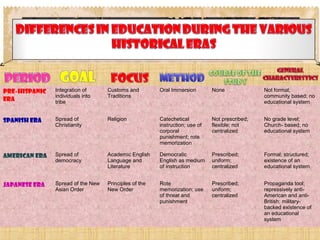
Pre-Hispanic
Era
Integration of
individuals into
tribe
Customs and
Traditions
Oral Immersion None Not formal;
community based; no
educational system
Spanish Era Spread of
Christianity
Religion Catechetical
instruction; use of
corporal
punishment; rote
memorization
Not prescribed;
flexible; not
centralized
No grade level;
Church- based; no
educational system
American Era Spread of
democracy
Academic English
Language and
Literature
Democratic
English as medium
of instruction
Prescribed;
uniform;
centralized
Formal; structured;
existence of an
educational system
Japanese Era Spread of the New
Asian Order
Principles of the
New Order
Rote
memorization; use
of threat and
punishment
Prescribed;
uniform;
centralized
Propaganda tool;
repressively anti-
American and anti-
British; military-
backed existence of
an educational
system
- Since 1946
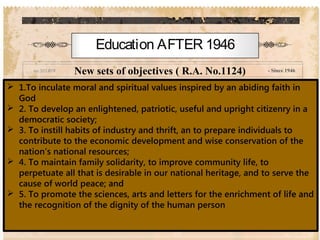
Education AFTER 1946
New sets of objectives ( R.A. No.1124)
 1.To inculate moral and spiritual values inspired by an abiding faith in
God
 2. To develop an enlightened, patriotic, useful and upright citizenry in a
democratic society;
 3. To instill habits of industry and thrift, an to prepare individuals to
contribute to the economic development and wise conservation of the
nation’s national resources;
 4. To maintain family solidarity, to improve community life, to
perpetuate all that is desirable in our national heritage, and to serve the
cause of world peace; and
 5. To promote the sciences, arts and letters for the enrichment of life and
the recognition of the dignity of the human person
- Since 1953
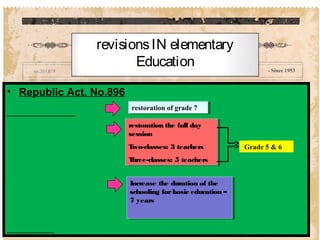
• Republic Act. No.896
restoration of grade 7restoration of grade 7
revisionsIN elementary
Education
restoration the full day
session
Two-classes: 3 teachers
Three-classes: 5 teachers
restoration the full day
session
Two-classes: 3 teachers
Three-classes: 5 teachers
Grade 5 & 6
Increase the duration of the
schooling forbasic education –
7 years
Increase the duration of the
schooling forbasic education –
7 years
- Since 1953
revisionsIN elementary
Education
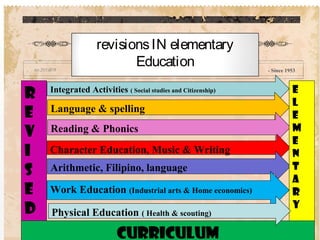
Integrated Activities ( Social studies and Citizenship)
Language & spelling
Reading & Phonics
Character Education, Music & Writing
Arithmetic, Filipino, language
R
E
V
I
S
E
D
E
L
E
M
E
N
T
A
R
Y
CURRICULUM
Work Education (Industrial arts & Home economics)
Physical Education ( Health & scouting)
- Since 1953
Revised elementary curriculum
Objectives
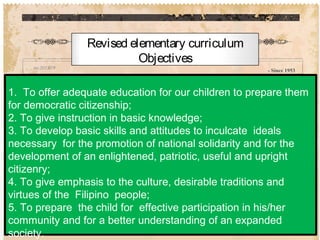
1. To offer adequate education for our children to prepare them
for democratic citizenship;
2. To give instruction in basic knowledge;
3. To develop basic skills and attitudes to inculcate ideals
necessary for the promotion of national solidarity and for the
development of an enlightened, patriotic, useful and upright
citizenry;
4. To give emphasis to the culture, desirable traditions and
virtues of the Filipino people;
5. To prepare the child for effective participation in his/her
community and for a better understanding of an expanded
society.
- Since 1953
• Department order No.1, Series of 1957
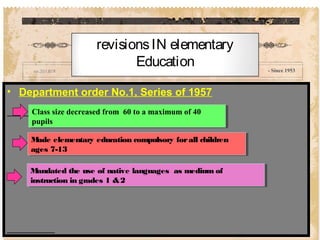
Class size decreased from 60 to a maximum of 40
pupils
Class size decreased from 60 to a maximum of 40
pupils
revisionsIN elementary
Education
Made elementary education compulsory forall children
ages 7-13
Made elementary education compulsory forall children
ages 7-13
Mandated the use of native languages as medium of
instruction in grades 1 &2
Mandated the use of native languages as medium of
instruction in grades 1 &2
- Since 1953
• February 7, 1970
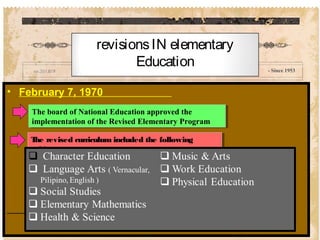
The board of National Education approved the
implementation of the Revised Elementary Program
The board of National Education approved the
implementation of the Revised Elementary Program
revisionsIN elementary
Education
The revised curriculum included the following
subjects:
The revised curriculum included the following
subjects:
- Since 1953
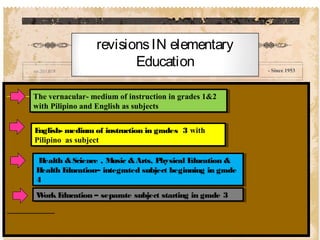
The vernacular- medium of instruction in grades 1&2
with Pilipino and English as subjects
The vernacular- medium of instruction in grades 1&2
with Pilipino and English as subjects
revisionsIN elementary
Education
English- medium of instruction in grades 3 with
Pilipino as subject
English- medium of instruction in grades 3 with
Pilipino as subject
Health &Science , Music &Arts, Physical Education &
Health Education– integrated subject beginning in grade
4
Health &Science , Music &Arts, Physical Education &
Health Education– integrated subject beginning in grade
4
Work Education – separate subject starting in grade 3Work Education – separate subject starting in grade 3
- Since 1953
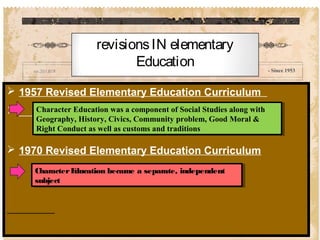
 1957 Revised Elementary Education Curriculum

 1970 Revised Elementary Education Curriculum
Character Education was a component of Social Studies along with
Geography, History, Civics, Community problem, Good Moral &
Right Conduct as well as customs and traditions
Character Education was a component of Social Studies along with
Geography, History, Civics, Community problem, Good Moral &
Right Conduct as well as customs and traditions
revisionsIN elementary
Education
CharacterEducation became a separate, independent
subject
CharacterEducation became a separate, independent
subject
- Since 1970
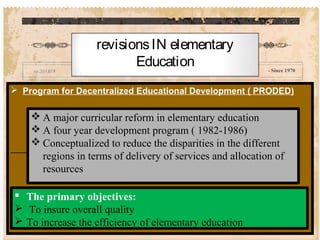
 Program for Decentralized Educational Development ( PRODED)
revisionsIN elementary
Education
 A major curricular reform in elementary education
 A four year development program ( 1982-1986)
 Conceptualized to reduce the disparities in the different
regions in terms of delivery of services and allocation of
resources
 The primary objectives:
 To insure overall quality
 To increase the efficiency of elementary education

The Implication of Philippine Education

  • 1.
  • 2.
    Pre-Hispanic Era Integration of individuals into tribe Customsand Traditions Oral Immersion None Not formal; community based; no educational system Spanish Era Spread of Christianity Religion Catechetical instruction; use of corporal punishment; rote memorization Not prescribed; flexible; not centralized No grade level; Church- based; no educational system American Era Spread of democracy Academic English Language and Literature Democratic English as medium of instruction Prescribed; uniform; centralized Formal; structured; existence of an educational system Japanese Era Spread of the New Asian Order Principles of the New Order Rote memorization; use of threat and punishment Prescribed; uniform; centralized Propaganda tool; repressively anti- American and anti- British; military- backed existence of an educational system
  • 3.
    - Since 1946 EducationAFTER 1946 New sets of objectives ( R.A. No.1124)  1.To inculate moral and spiritual values inspired by an abiding faith in God  2. To develop an enlightened, patriotic, useful and upright citizenry in a democratic society;  3. To instill habits of industry and thrift, an to prepare individuals to contribute to the economic development and wise conservation of the nation’s national resources;  4. To maintain family solidarity, to improve community life, to perpetuate all that is desirable in our national heritage, and to serve the cause of world peace; and  5. To promote the sciences, arts and letters for the enrichment of life and the recognition of the dignity of the human person
  • 4.
    - Since 1953 •Republic Act. No.896 restoration of grade 7restoration of grade 7 revisionsIN elementary Education restoration the full day session Two-classes: 3 teachers Three-classes: 5 teachers restoration the full day session Two-classes: 3 teachers Three-classes: 5 teachers Grade 5 & 6 Increase the duration of the schooling forbasic education – 7 years Increase the duration of the schooling forbasic education – 7 years
  • 5.
    - Since 1953 revisionsINelementary Education Integrated Activities ( Social studies and Citizenship) Language & spelling Reading & Phonics Character Education, Music & Writing Arithmetic, Filipino, language R E V I S E D E L E M E N T A R Y CURRICULUM Work Education (Industrial arts & Home economics) Physical Education ( Health & scouting)
  • 6.
    - Since 1953 Revisedelementary curriculum Objectives 1. To offer adequate education for our children to prepare them for democratic citizenship; 2. To give instruction in basic knowledge; 3. To develop basic skills and attitudes to inculcate ideals necessary for the promotion of national solidarity and for the development of an enlightened, patriotic, useful and upright citizenry; 4. To give emphasis to the culture, desirable traditions and virtues of the Filipino people; 5. To prepare the child for effective participation in his/her community and for a better understanding of an expanded society.
  • 7.
    - Since 1953 •Department order No.1, Series of 1957 Class size decreased from 60 to a maximum of 40 pupils Class size decreased from 60 to a maximum of 40 pupils revisionsIN elementary Education Made elementary education compulsory forall children ages 7-13 Made elementary education compulsory forall children ages 7-13 Mandated the use of native languages as medium of instruction in grades 1 &2 Mandated the use of native languages as medium of instruction in grades 1 &2
  • 8.
    - Since 1953 •February 7, 1970 The board of National Education approved the implementation of the Revised Elementary Program The board of National Education approved the implementation of the Revised Elementary Program revisionsIN elementary Education The revised curriculum included the following subjects: The revised curriculum included the following subjects:
  • 9.
    - Since 1953 Thevernacular- medium of instruction in grades 1&2 with Pilipino and English as subjects The vernacular- medium of instruction in grades 1&2 with Pilipino and English as subjects revisionsIN elementary Education English- medium of instruction in grades 3 with Pilipino as subject English- medium of instruction in grades 3 with Pilipino as subject Health &Science , Music &Arts, Physical Education & Health Education– integrated subject beginning in grade 4 Health &Science , Music &Arts, Physical Education & Health Education– integrated subject beginning in grade 4 Work Education – separate subject starting in grade 3Work Education – separate subject starting in grade 3
  • 10.
    - Since 1953 1957 Revised Elementary Education Curriculum   1970 Revised Elementary Education Curriculum Character Education was a component of Social Studies along with Geography, History, Civics, Community problem, Good Moral & Right Conduct as well as customs and traditions Character Education was a component of Social Studies along with Geography, History, Civics, Community problem, Good Moral & Right Conduct as well as customs and traditions revisionsIN elementary Education CharacterEducation became a separate, independent subject CharacterEducation became a separate, independent subject
  • 11.
    - Since 1970 Program for Decentralized Educational Development ( PRODED) revisionsIN elementary Education  A major curricular reform in elementary education  A four year development program ( 1982-1986)  Conceptualized to reduce the disparities in the different regions in terms of delivery of services and allocation of resources  The primary objectives:  To insure overall quality  To increase the efficiency of elementary education