THE HONEST TRUTH
ABOUT GETTING
VALUE FROM IT

Rob Eddowes | Enterprise Architect
www.robeddowes.com.au | mail@robeddowes.com.au | 0417 963 269 | ……………..

October 2013 copyright Rob Eddowes
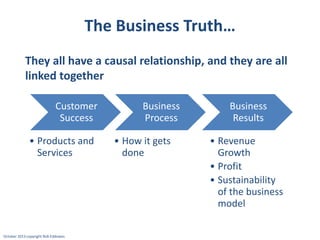
The Business Truth…
They all have a causal relationship, and they are all
linked together
Customer
Success
• Products and
Services

October 2013 copyright Rob Eddowes

Business
Process
• How it gets
done

Business
Results
• Revenue
Growth
• Profit
• Sustainability
of the business
model
The Business Operating Model
Inside every company is a core set of business processes
that execute thousands of daily transactions that keep a
company in business
Top performing companies define how they will do
business by creating an operating model
It’s a commitment of how the business will operate
If you want to make IT a strategic asset you have to
define an operating model

October 2013 copyright Rob Eddowes
The Business Operating Model
Top performing companies drive the choice of operating
model by how they want to profit and grow
Top performing companies design the business processes
critical to their current and future operations using
enterprise business architecture
Top-performing companies embed technology into their
core business processes so they can reliably execute the
critical operations of their company, and continuously
optimise and pull costs out of their core processes

October 2013 copyright Rob Eddowes
Shaping Strategic Opportunities
The operating model shapes the strategic opportunities
a business can respond to, preparing for future strategic
initiatives, without knowing what they are yet
The business operating model requires that executive
management make two decisions about a firm’s ongoing
operations
1. How much to standardise business processes
Performing the same processes the same way, creates efficiencies within and across business units

2. How much to integrate business processes
Sharing data within and between business units, linking the efforts of business units

October 2013 copyright Rob Eddowes
The IT Truth…
Top-performing companies create a low cost, highquality strategic core foundation which makes a firm
both more efficient and more agile than its competitors
If you want value from IT, you have to stop thinking of IT
as a set of solutions and start thinking about business
process integration and standardisation

October 2013 copyright Rob Eddowes
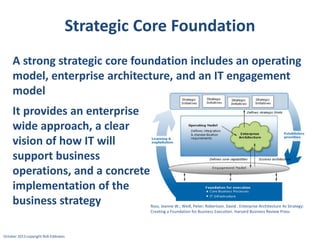
Strategic Core Foundation
A strong strategic core foundation includes an operating
model, enterprise architecture, and an IT engagement
model
It provides an enterprise
wide approach, a clear
vision of how IT will
support business
operations, and a concrete
implementation of the
business strategy
October 2013 copyright Rob Eddowes

Ross, Jeanne W.; Weill, Peter; Robertson, David . Enterprise Architecture As Strategy:
Creating a Foundation for Business Execution. Harvard Business Review Press.
Strategic Core Foundation Benefits
Top performing companies with a strong strategic core
foundation experience
• Higher profitability
• Faster time to market

• More value from their IT investments
• Better access to shared customer data
• Lower risk of mission-critical system failures
• Higher senior management satisfaction with
technology

• Lower IT costs
October 2013 copyright Rob Eddowes

Ross, Jeanne W.; Weill, Peter; Robertson, David . Enterprise Architecture As Strategy:
Creating a Foundation for Business Execution. Harvard Business Review Press.
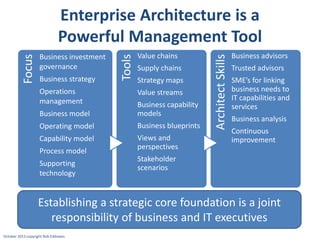
Business strategy
Operations
management

Value chains

Supply chains
Strategy maps
Value streams

Business model

Business capability
models

Operating model

Business blueprints

Capability model

Views and
perspectives

Process model
Supporting
technology

Architect Skills

Business investment
governance

Tools

Focus

Enterprise Architecture is a
Powerful Management Tool
Business advisors

Trusted advisors
SME’s for linking
business needs to
IT capabilities and
services
Business analysis
Continuous
improvement

Stakeholder
scenarios

Establishing a strategic core foundation is a joint
responsibility of business and IT executives
October 2013 copyright Rob Eddowes
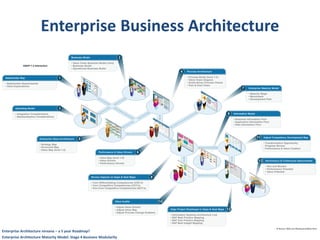
Enterprise Business Architecture

Enterprise Architecture nirvana – a 5 year Roadmap?
Enterprise Architecture Maturity Model: Stage 4 Business Modularity
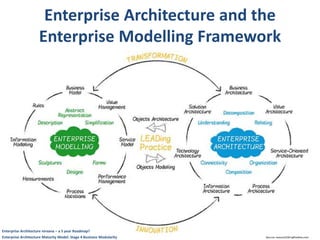
Enterprise Architecture and the
Enterprise Modelling Framework

Enterprise Architecture nirvana – a 5 year Roadmap?
Enterprise Architecture Maturity Model: Stage 4 Business Modularity
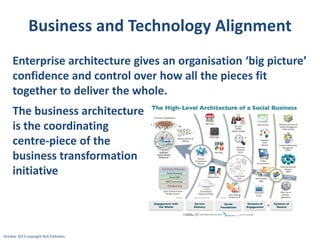
Business and Technology Alignment
Enterprise architecture gives an organisation ‘big picture’
confidence and control over how all the pieces fit
together to deliver the whole.
The business architecture
is the coordinating
centre-piece of the
business transformation
initiative

October 2013 copyright Rob Eddowes
Delivering Strategic Opportunities
ERP’s do not automatically create a strategic core
foundation, executive management must champion the
business operating model and endorse the core business
processes and drive into delivery

Many ERP projects are driven by business unit managers
focused on tactical initiatives with direct benefit and
often do not include end-to-end core business processes
ERP’s do not provide business process standardisation
and integration out of the box

October 2013 copyright Rob Eddowes
Delivering Strategic Opportunities
The average company spends over two thirds of its IT
budget just running and maintaining its existing systems,
often, its the sustaining and maintaining part of the
budget that leads executive management to claim they
are not getting good value from IT
Reducing these costs requires a change to the IT project
methodology which continues to include solution
architecture driven by the business units specific needs
This is a leftover from the business silo culture where IT
developed vertical (silo) solutions by project
Delivering Strategic Opportunities
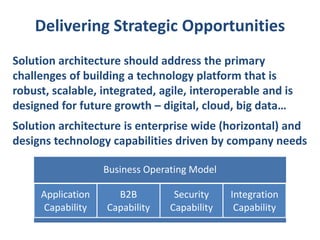
Solution architecture should address the primary
challenges of building a technology platform that is
robust, scalable, integrated, agile, interoperable and is
designed for future growth – digital, cloud, big data…

Solution architecture is enterprise wide (horizontal) and
designs technology capabilities driven by company needs
Business Operating Model
Application
Capability

B2B
Capability

Security
Capability

Integration
Capability
Delivering Strategic Opportunities
Enterprise architecture specifies the principles and
standards (building codes) to design and build a
powerful technology platform not the project portfolio
A business operating model provides the opportunity to
embed technology into business processes using IT
services (a solution to a process) from the technology
capabilities, these can be offered from a service
catalogue and can include price, SLA…
Bringing technology platform design and product
selection under the control of IT management
The IT Engagement Model
A good engagement model ensures that business and IT
projects achieve both business unit and company-wide
strategic objectives
It allows you to build the strategic core foundation one
project at a time, by spending smarter rather than more,
companies can use ongoing projects to steadily build
their foundation for execution.

As the strategic core foundation gets built, IT costs
decrease and business efficiencies increase, paying
dividends on the original investment
October 2013 copyright Rob Eddowes
The IT Engagement Model
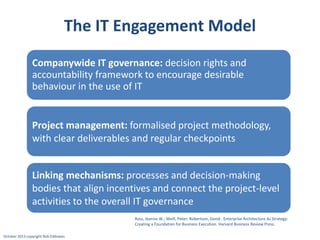
Companywide IT governance: decision rights and
accountability framework to encourage desirable
behaviour in the use of IT

Project management: formalised project methodology,
with clear deliverables and regular checkpoints
Linking mechanisms: processes and decision-making
bodies that align incentives and connect the project-level
activities to the overall IT governance
Ross, Jeanne W.; Weill, Peter; Robertson, David . Enterprise Architecture As Strategy:
Creating a Foundation for Business Execution. Harvard Business Review Press.
October 2013 copyright Rob Eddowes
The IT Engagement Model
In large companies, the IT engagement model contains
six key stakeholder groups: the executive management,
business unit management, and project management,
each of which exists on both the IT and business sides of
the company
Based on the vision of how the company will operate,
(the operating model), business and IT leaders define
key architectural requirements of the strategic core
foundation found in the enterprise architecture

October 2013 copyright Rob Eddowes
The IT Engagement Model
Then, as business unit managers identify business
initiatives, the IT engagement model specifies how each
project benefits from, and contributes to, the strategic
core foundation

The IT engagement model ensures business and IT
projects achieve both business unit and company-wide
objectives
The IT engagement model influences project decisions so
that individual solutions are guided by the enterprise
architecture
October 2013 copyright Rob Eddowes
The IT Engagement Model
The engagement model provides for alignment between
the IT objectives and business objectives of projects, and
coordinates the IT and business process decisions made
at multiple organisational levels (company-wide,
business unit, project)
To do so, the model establishes linkages between seniorlevel IT decisions, such as project prioritisation and
company-wide process design, and project level
implementation decisions.

October 2013 copyright Rob Eddowes
Frankly, if IT isn’t helping you operate
your business, the way you want to
operate your business,
you are wasting money!

You need to be IT savvy!
Think a little, change a lot

October 2013 copyright Rob Eddowes
For further discussion,
please contact me.

Rob Eddowes | Enterprise Architect
www.robeddowes.com.au | mail@robeddowes.com.au | 0417 963 269 | ……………..

October 2013 copyright Rob Eddowes

The honest truth about getting value from IT

  • 1.
    THE HONEST TRUTH ABOUTGETTING VALUE FROM IT Rob Eddowes | Enterprise Architect www.robeddowes.com.au | mail@robeddowes.com.au | 0417 963 269 | …………….. October 2013 copyright Rob Eddowes
  • 2.
    The Business Truth… Theyall have a causal relationship, and they are all linked together Customer Success • Products and Services October 2013 copyright Rob Eddowes Business Process • How it gets done Business Results • Revenue Growth • Profit • Sustainability of the business model
  • 3.
    The Business OperatingModel Inside every company is a core set of business processes that execute thousands of daily transactions that keep a company in business Top performing companies define how they will do business by creating an operating model It’s a commitment of how the business will operate If you want to make IT a strategic asset you have to define an operating model October 2013 copyright Rob Eddowes
  • 4.
    The Business OperatingModel Top performing companies drive the choice of operating model by how they want to profit and grow Top performing companies design the business processes critical to their current and future operations using enterprise business architecture Top-performing companies embed technology into their core business processes so they can reliably execute the critical operations of their company, and continuously optimise and pull costs out of their core processes October 2013 copyright Rob Eddowes
  • 5.
    Shaping Strategic Opportunities Theoperating model shapes the strategic opportunities a business can respond to, preparing for future strategic initiatives, without knowing what they are yet The business operating model requires that executive management make two decisions about a firm’s ongoing operations 1. How much to standardise business processes Performing the same processes the same way, creates efficiencies within and across business units 2. How much to integrate business processes Sharing data within and between business units, linking the efforts of business units October 2013 copyright Rob Eddowes
  • 6.
    The IT Truth… Top-performingcompanies create a low cost, highquality strategic core foundation which makes a firm both more efficient and more agile than its competitors If you want value from IT, you have to stop thinking of IT as a set of solutions and start thinking about business process integration and standardisation October 2013 copyright Rob Eddowes
  • 7.
    Strategic Core Foundation Astrong strategic core foundation includes an operating model, enterprise architecture, and an IT engagement model It provides an enterprise wide approach, a clear vision of how IT will support business operations, and a concrete implementation of the business strategy October 2013 copyright Rob Eddowes Ross, Jeanne W.; Weill, Peter; Robertson, David . Enterprise Architecture As Strategy: Creating a Foundation for Business Execution. Harvard Business Review Press.
  • 8.
    Strategic Core FoundationBenefits Top performing companies with a strong strategic core foundation experience • Higher profitability • Faster time to market • More value from their IT investments • Better access to shared customer data • Lower risk of mission-critical system failures • Higher senior management satisfaction with technology • Lower IT costs October 2013 copyright Rob Eddowes Ross, Jeanne W.; Weill, Peter; Robertson, David . Enterprise Architecture As Strategy: Creating a Foundation for Business Execution. Harvard Business Review Press.
  • 9.
    Business strategy Operations management Value chains Supplychains Strategy maps Value streams Business model Business capability models Operating model Business blueprints Capability model Views and perspectives Process model Supporting technology Architect Skills Business investment governance Tools Focus Enterprise Architecture is a Powerful Management Tool Business advisors Trusted advisors SME’s for linking business needs to IT capabilities and services Business analysis Continuous improvement Stakeholder scenarios Establishing a strategic core foundation is a joint responsibility of business and IT executives October 2013 copyright Rob Eddowes
  • 10.
    Enterprise Business Architecture EnterpriseArchitecture nirvana – a 5 year Roadmap? Enterprise Architecture Maturity Model: Stage 4 Business Modularity
  • 11.
    Enterprise Architecture andthe Enterprise Modelling Framework Enterprise Architecture nirvana – a 5 year Roadmap? Enterprise Architecture Maturity Model: Stage 4 Business Modularity
  • 12.
    Business and TechnologyAlignment Enterprise architecture gives an organisation ‘big picture’ confidence and control over how all the pieces fit together to deliver the whole. The business architecture is the coordinating centre-piece of the business transformation initiative October 2013 copyright Rob Eddowes
  • 13.
    Delivering Strategic Opportunities ERP’sdo not automatically create a strategic core foundation, executive management must champion the business operating model and endorse the core business processes and drive into delivery Many ERP projects are driven by business unit managers focused on tactical initiatives with direct benefit and often do not include end-to-end core business processes ERP’s do not provide business process standardisation and integration out of the box October 2013 copyright Rob Eddowes
  • 14.
    Delivering Strategic Opportunities Theaverage company spends over two thirds of its IT budget just running and maintaining its existing systems, often, its the sustaining and maintaining part of the budget that leads executive management to claim they are not getting good value from IT Reducing these costs requires a change to the IT project methodology which continues to include solution architecture driven by the business units specific needs This is a leftover from the business silo culture where IT developed vertical (silo) solutions by project
  • 15.
    Delivering Strategic Opportunities Solutionarchitecture should address the primary challenges of building a technology platform that is robust, scalable, integrated, agile, interoperable and is designed for future growth – digital, cloud, big data… Solution architecture is enterprise wide (horizontal) and designs technology capabilities driven by company needs Business Operating Model Application Capability B2B Capability Security Capability Integration Capability
  • 16.
    Delivering Strategic Opportunities Enterprisearchitecture specifies the principles and standards (building codes) to design and build a powerful technology platform not the project portfolio A business operating model provides the opportunity to embed technology into business processes using IT services (a solution to a process) from the technology capabilities, these can be offered from a service catalogue and can include price, SLA… Bringing technology platform design and product selection under the control of IT management
  • 17.
    The IT EngagementModel A good engagement model ensures that business and IT projects achieve both business unit and company-wide strategic objectives It allows you to build the strategic core foundation one project at a time, by spending smarter rather than more, companies can use ongoing projects to steadily build their foundation for execution. As the strategic core foundation gets built, IT costs decrease and business efficiencies increase, paying dividends on the original investment October 2013 copyright Rob Eddowes
  • 18.
    The IT EngagementModel Companywide IT governance: decision rights and accountability framework to encourage desirable behaviour in the use of IT Project management: formalised project methodology, with clear deliverables and regular checkpoints Linking mechanisms: processes and decision-making bodies that align incentives and connect the project-level activities to the overall IT governance Ross, Jeanne W.; Weill, Peter; Robertson, David . Enterprise Architecture As Strategy: Creating a Foundation for Business Execution. Harvard Business Review Press. October 2013 copyright Rob Eddowes
  • 19.
    The IT EngagementModel In large companies, the IT engagement model contains six key stakeholder groups: the executive management, business unit management, and project management, each of which exists on both the IT and business sides of the company Based on the vision of how the company will operate, (the operating model), business and IT leaders define key architectural requirements of the strategic core foundation found in the enterprise architecture October 2013 copyright Rob Eddowes
  • 20.
    The IT EngagementModel Then, as business unit managers identify business initiatives, the IT engagement model specifies how each project benefits from, and contributes to, the strategic core foundation The IT engagement model ensures business and IT projects achieve both business unit and company-wide objectives The IT engagement model influences project decisions so that individual solutions are guided by the enterprise architecture October 2013 copyright Rob Eddowes
  • 21.
    The IT EngagementModel The engagement model provides for alignment between the IT objectives and business objectives of projects, and coordinates the IT and business process decisions made at multiple organisational levels (company-wide, business unit, project) To do so, the model establishes linkages between seniorlevel IT decisions, such as project prioritisation and company-wide process design, and project level implementation decisions. October 2013 copyright Rob Eddowes
  • 22.
    Frankly, if ITisn’t helping you operate your business, the way you want to operate your business, you are wasting money! You need to be IT savvy! Think a little, change a lot October 2013 copyright Rob Eddowes
  • 23.
    For further discussion, pleasecontact me. Rob Eddowes | Enterprise Architect www.robeddowes.com.au | mail@robeddowes.com.au | 0417 963 269 | …………….. October 2013 copyright Rob Eddowes