THE HISTORY AND DEVELOPMENT OF PLC
HISTORY OF PLC
•PLCs were first introduced in the 1960s.
•The main reason for designing PLC is to
eliminate the burden of maintenance costs and
replacement of relay-based engine control
systems.
•Bedford Associates (Bedford, MA) put forward
a proposal called MODICON (Modular Digital
Controller) for car companies in America.
•Meanwhile, other companies propose a
computer-based system.
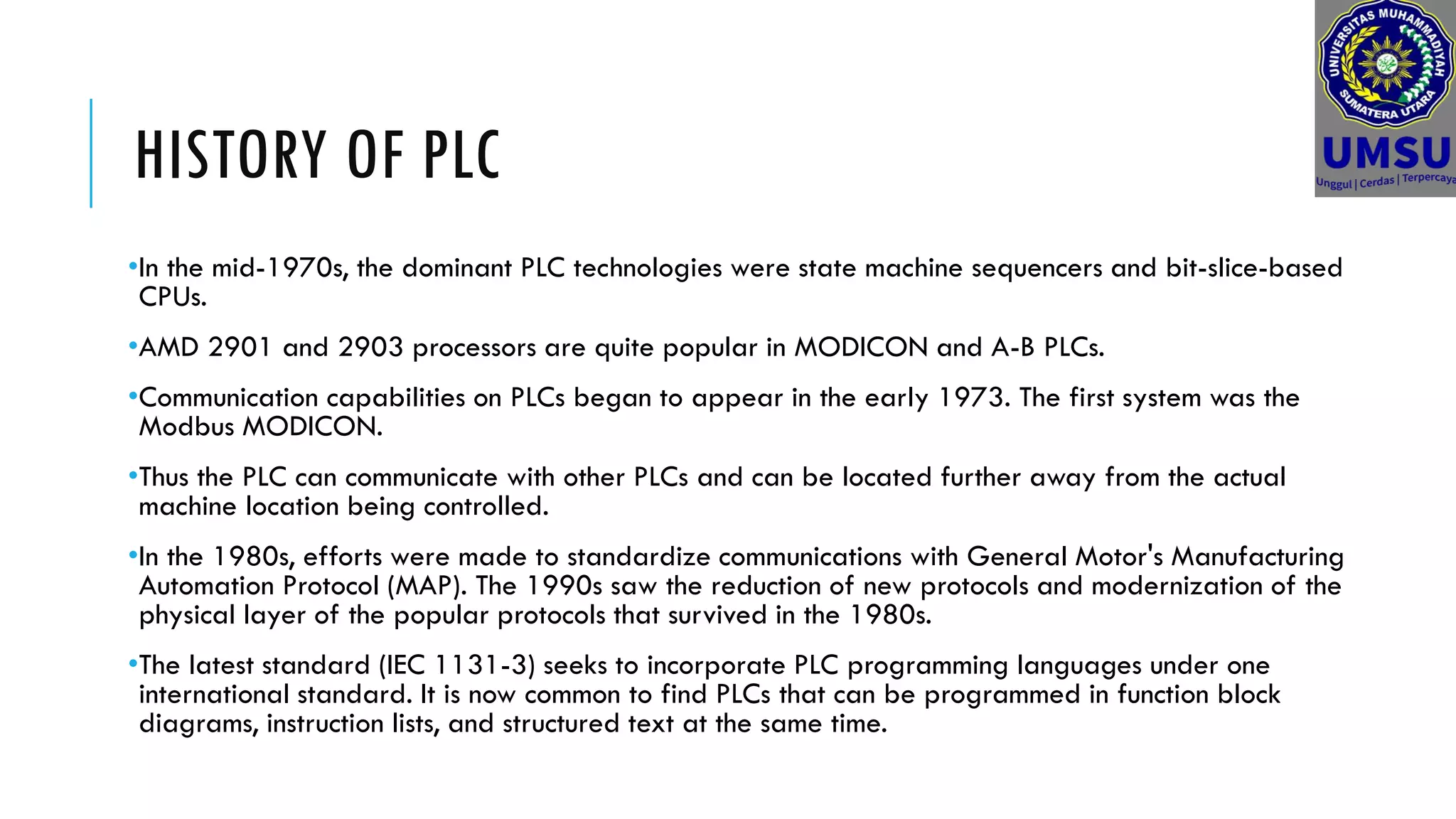
•Modicon 084 is the world's first PLC used in
commercial products. PLC Modicon 084
HISTORY OF PLC
•In the mid-1970s, the dominant PLC technologies were state machine sequencers and bit-slice-based
CPUs.
•AMD 2901 and 2903 processors are quite popular in MODICON and A-B PLCs.
•Communication capabilities on PLCs began to appear in the early 1973. The first system was the
Modbus MODICON.
•Thus the PLC can communicate with other PLCs and can be located further away from the actual
machine location being controlled.
•In the 1980s, efforts were made to standardize communications with General Motor's Manufacturing
Automation Protocol (MAP). The 1990s saw the reduction of new protocols and modernization of the
physical layer of the popular protocols that survived in the 1980s.
•The latest standard (IEC 1131-3) seeks to incorporate PLC programming languages under one
international standard. It is now common to find PLCs that can be programmed in function block
diagrams, instruction lists, and structured text at the same time.
DEVELOPMENT OF PLC
Along with technological developments, currently PLCs have experienced extraordinary
developments, both in terms of size, component density and in terms of functionality. Some of these
hardware and software upgrades include:
1. The size is getting smaller and more compact.
2. The number of inputs/outputs is getting more and more dense.
3. Several types and types of PLCs are equipped with modules for the purpose of continuous
control, for example ADC/DAC modules, PIDs, Fuzzy modules, and others.
4. Programming is relatively easy. This is related to programming software that is increasingly user
friendly.
5. Have better communication skills and documentation system.
6. The types of instructions/functions are getting more and more complete.
7. Program execution time is getting faster.
DEVELOPMENT OF PLC
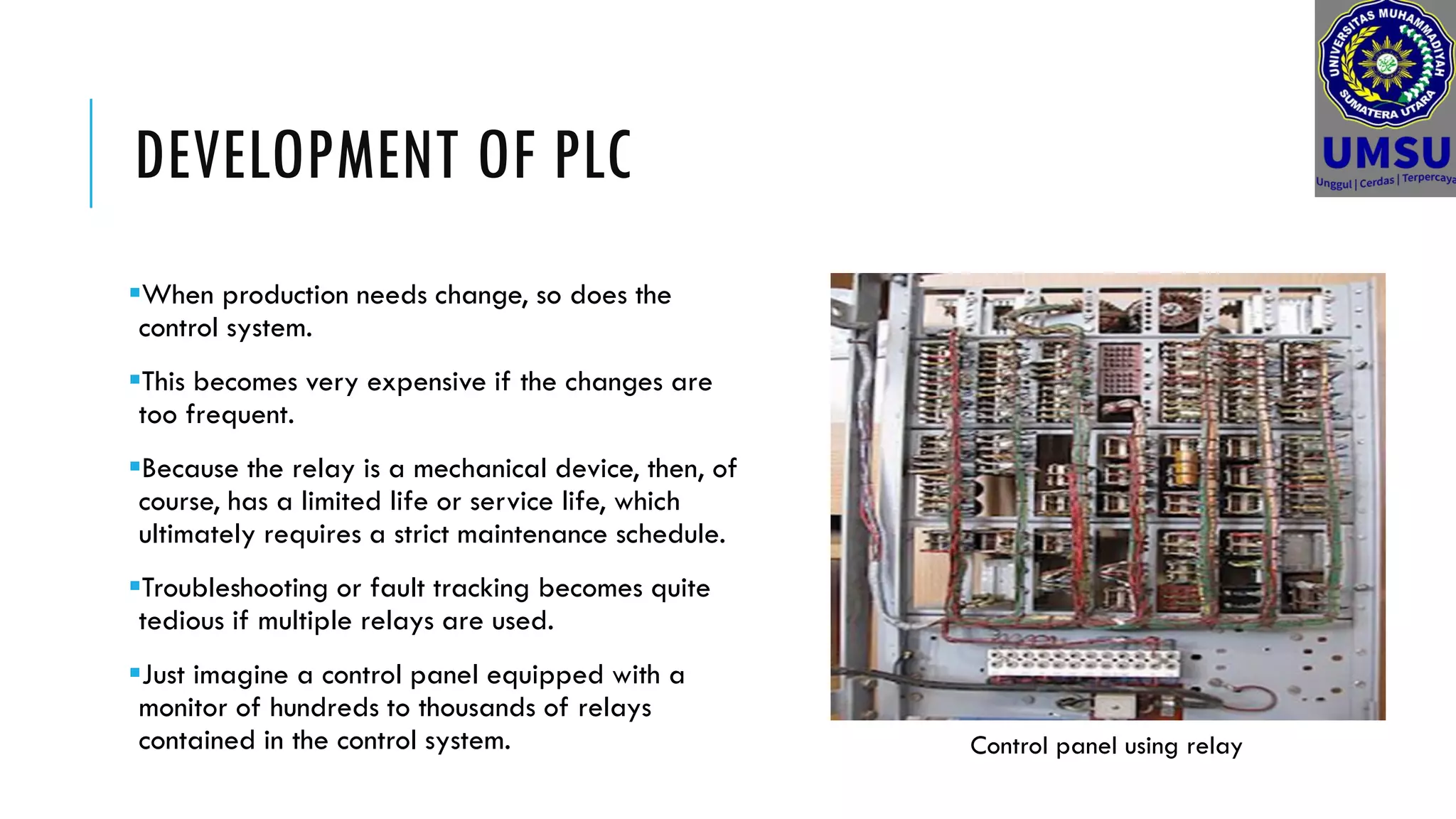
When production needs change, so does the
control system.
This becomes very expensive if the changes are
too frequent.
Because the relay is a mechanical device, then, of
course, has a limited life or service life, which
ultimately requires a strict maintenance schedule.
Troubleshooting or fault tracking becomes quite
tedious if multiple relays are used.
Just imagine a control panel equipped with a
monitor of hundreds to thousands of relays
contained in the control system. Control panel using relay
PLC TYPES
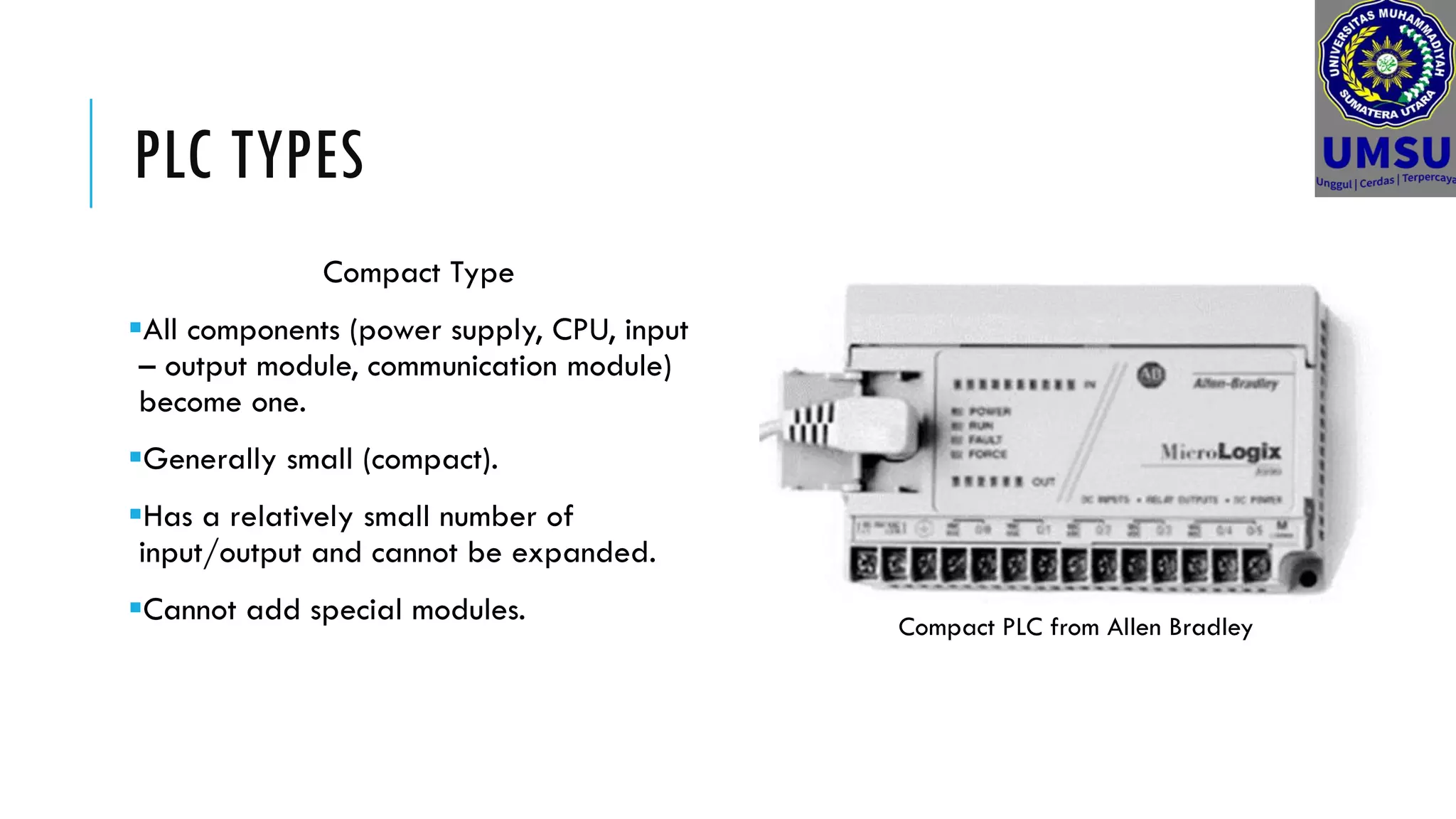
Compact Type
All components (power supply, CPU, input
– output module, communication module)
become one.
Generally small (compact).
Has a relatively small number of
input/output and cannot be expanded.
Cannot add special modules. Compact PLC from Allen Bradley
PLC TYPES
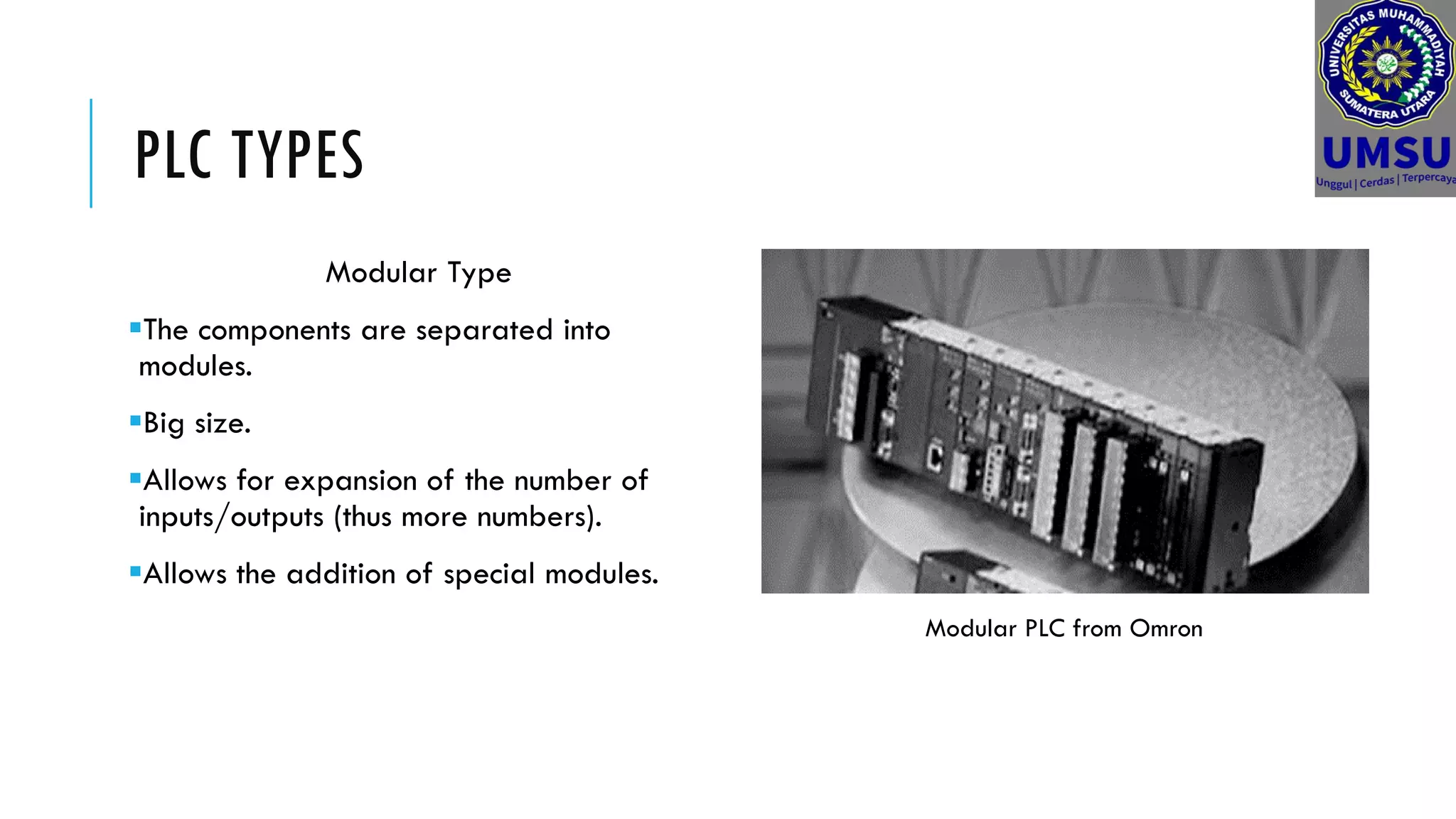
Modular Type
The components are separated into
modules.
Big size.
Allows for expansion of the number of
inputs/outputs (thus more numbers).
Allows the addition of special modules.
Modular PLC from Omron
THANK YOU FOR YOUR ATTENTION

The history and development of PLC.pdf

  • 1.
    THE HISTORY ANDDEVELOPMENT OF PLC
  • 2.
    HISTORY OF PLC •PLCswere first introduced in the 1960s. •The main reason for designing PLC is to eliminate the burden of maintenance costs and replacement of relay-based engine control systems. •Bedford Associates (Bedford, MA) put forward a proposal called MODICON (Modular Digital Controller) for car companies in America. •Meanwhile, other companies propose a computer-based system. •Modicon 084 is the world's first PLC used in commercial products. PLC Modicon 084
  • 3.
    HISTORY OF PLC •Inthe mid-1970s, the dominant PLC technologies were state machine sequencers and bit-slice-based CPUs. •AMD 2901 and 2903 processors are quite popular in MODICON and A-B PLCs. •Communication capabilities on PLCs began to appear in the early 1973. The first system was the Modbus MODICON. •Thus the PLC can communicate with other PLCs and can be located further away from the actual machine location being controlled. •In the 1980s, efforts were made to standardize communications with General Motor's Manufacturing Automation Protocol (MAP). The 1990s saw the reduction of new protocols and modernization of the physical layer of the popular protocols that survived in the 1980s. •The latest standard (IEC 1131-3) seeks to incorporate PLC programming languages under one international standard. It is now common to find PLCs that can be programmed in function block diagrams, instruction lists, and structured text at the same time.
  • 4.
    DEVELOPMENT OF PLC Alongwith technological developments, currently PLCs have experienced extraordinary developments, both in terms of size, component density and in terms of functionality. Some of these hardware and software upgrades include: 1. The size is getting smaller and more compact. 2. The number of inputs/outputs is getting more and more dense. 3. Several types and types of PLCs are equipped with modules for the purpose of continuous control, for example ADC/DAC modules, PIDs, Fuzzy modules, and others. 4. Programming is relatively easy. This is related to programming software that is increasingly user friendly. 5. Have better communication skills and documentation system. 6. The types of instructions/functions are getting more and more complete. 7. Program execution time is getting faster.
  • 5.
    DEVELOPMENT OF PLC Whenproduction needs change, so does the control system. This becomes very expensive if the changes are too frequent. Because the relay is a mechanical device, then, of course, has a limited life or service life, which ultimately requires a strict maintenance schedule. Troubleshooting or fault tracking becomes quite tedious if multiple relays are used. Just imagine a control panel equipped with a monitor of hundreds to thousands of relays contained in the control system. Control panel using relay
  • 6.
    PLC TYPES Compact Type Allcomponents (power supply, CPU, input – output module, communication module) become one. Generally small (compact). Has a relatively small number of input/output and cannot be expanded. Cannot add special modules. Compact PLC from Allen Bradley
  • 7.
    PLC TYPES Modular Type Thecomponents are separated into modules. Big size. Allows for expansion of the number of inputs/outputs (thus more numbers). Allows the addition of special modules. Modular PLC from Omron
  • 8.
    THANK YOU FORYOUR ATTENTION