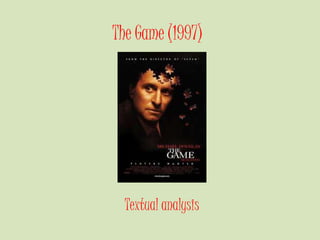
The Game (1997) 
Textual analysis
1. Title shot- “Polygram Films”, production 
company. The colours are dark which implies 
this is a dark film. 
2. “Polygram Filmed Entertainment Presents”- 
white title on black background attracts 
attention and is fairly neutral- can be used in 
many genres without being attached to any 
particular one. Plain titles are usually used 
with Horrors to compliment the low key 
lighting in the shots and indicate a plainness in 
life- which most horrors show before 
introducing the antagonist.
3. “A Propaganda Films Production”, another 
production company involved in the project. 
The title is, again, fairly plain, but contrasted to 
draw all attention to the screen. The transition 
of the 3D jigsaw pieces breaking apart is clever 
as jigsaws are often associated with mystery 
and suspense, so by using this imagery- with 
the dark colours of the pieces indicates the 
film will be dark in tone and have a mystery be 
the plot focus. 
4. Title Card- “The Game”, The positioning of 
the title card is centred but not in the middle 
of the screen. This may be used to show how 
this film is different to the others as there’s 
something “off” about the mystery. This 
uncomfortable feeling the montage provokes 
later on (in my opinion) adds to this feeling of 
uneasiness which thrillers and horrors make 
the audience feel.
5. Mid Shot- A father and his son centred in 
the shot. The father’s suit suggest he has an 
important job and the son’s matching clothes 
imply they are either middle or upper class. 
The father’s hand on the son’s shoulder shows 
his fatherly, yet detached bond with his son as 
he seems to just be posing for the camera. His 
facial expressions are fairly blank in this shot, 
and his character appears to be more than 
what meets the eye as shots of him 
throughout the montage present him as there 
one minute and gone another. 
6. Mid Shot- A large house’s kitchen full of 
staff making food for a large event (looking at 
the busy atmosphere). The décor is very 
1950’s and the camera film effect and changed 
aspect ration shows the shot through a home 
movie style sequence. The lighting is low key 
and the main colours are mostly whites and 
creams on the walls and furniture. The 
costumes are fairly old fashioned (50’s) and the 
body language is natural which doesn’t create 
much tension- but the use of seemingly 
insignificant home movie footage is peculiar 
for a title sequence, which invokes curiosity in 
the audience.
7. Close Up- a woman’s hands (presumably) 
are briefly seen dipping in a dish, to 
presumably taste test it. The shot has an 
orange tint to it which makes the shot seem 
low quality- like an old home film which links 
with the tint as the orange could be associated 
with sepia, old films and perhaps nostalgia. 
Pairing the shot of preparing food and the tint 
implies this is a nostalgic time for the story’s 
narrator (the protagonist). 
8. Close Up- another shot of kitchen 
preparation, this time the arms look male and 
he is measuring out an ingredient by putting it 
into a container. The white shirt and the clear 
container both have connotations of science to 
some, which could suggest that there is more 
to explore in the main character’s past than 
what meets the conventional eye. The décor 
shows various kitchen utensils which gives a 
vibe of homeliness, and the shot is jumpy-emphasising 
the home-video style of the 
opening sequence.
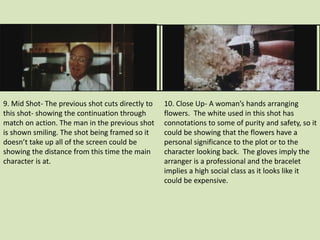
9. Mid Shot- The previous shot cuts directly to 
this shot- showing the continuation through 
match on action. The man in the previous shot 
is shown smiling. The shot being framed so it 
doesn’t take up all of the screen could be 
showing the distance from this time the main 
character is at. 
10. Close Up- A woman’s hands arranging 
flowers. The white used in this shot has 
connotations to some of purity and safety, so it 
could be showing that the flowers have a 
personal significance to the plot or to the 
character looking back. The gloves imply the 
arranger is a professional and the bracelet 
implies a high social class as it looks like it 
could be expensive.
11. Mid Shot- Match on Action, the shot is 
continued and we can see the woman’s face as 
she continues to arrange the flowers. Her 
facial expressions suggest she is concentrating 
on this event, showing its importance in the 
sequence. 
12. Long Shot- A group of people walking 
down a path. The path looks like it may be 
part of a garden or park- and the clothes worn 
by the characters on screen are mostly white in 
colour which could be associated with 
innocence and purity- suggesting these people 
are ignorant to any sinister elements hinted at 
in the sequence. The characters are centred, 
which draws all attention to them.
13. Mid Shot/Long Shot- This shot shows a 
waiter in the foreground looking at his tray 
before moving towards the left side of the 
screen. The movement is cut off quickly which 
implies this shot is an insignificant moment. 
The lighting is high key which shows the shot 
as light- though the light piano music adds a 
creepy vibe which adds a suppressed intensity 
to the sequence nonetheless. 
14. Long Shot- Parasols are seen in a garden 
setting (presumably a garden party) and the 
characters are seen carrying a cake to 
somewhere. The music used is a classical piano 
piece- but the sound is repressed, which 
makes the track sound vintage- and eerie 
when paired with the seemingly random 
montage of home video clips.
15. Long Shot- A group of children watching a 
puppet show in a classical puppet theatre 
reiterates the time in which these moments 
were cast- likely the 1950’s or 60’s. Puppets 
could be associated with mystery as behind 
each puppet is the puppetmaster- the 
architect of the crime, which could be a subtle 
nod to a criminal element to the plot. 
16. Long Shot- Match on action, shows the 
children watching the show and applauding. 
They’re mostly dressed in white shirts and 
blazers which indicate a high social class-further 
extended by the large garden which 
could be presumed to be owned by the 
wealthy family of one of the children.
17. Mid Shot- the previous shot cuts to the last 
few children leaving their seats after the show 
has finished. The sharp edit could be 
representative of how sharp the film will be in 
terms of plot twists, and the quickness of it 
may show how childhood disappears relatively 
quickly. The aspect ratio is associated with old 
televisions which further places this sequence 
in the past of the protagonist. The children’s 
facial expressions are exaggerated and full of 
innocence, the world is much simpler at this 
time. 
18. Mid Shot- a mother is shown with her 
child. The blue she is wearing has 
connotations to some of tranquillity and 
peace- which shows her as a positive character, 
and a responsible mother as she is rigid in 
body language to protect her child. The 
background of the shot shows various stalls 
that look like a village fete or fair- with people 
walking around.
19. Extreme Long Shot- shows children playing 
in a field with an adult walking towards them. 
The adult’s body language is open, and he 
walks with determination, presumably being 
sent to retrieve the children from play. The 
lighting is high key which shows the scene as 
light and emphasises the characters we can 
see in the background. 
20. Long Shot- shows the characters in the 
previous shot running towards and behind the 
camera. The lighting and resolution makes 
their faces difficult to see, which adds to the 
mystery of the sequence.
21. Mid Shot- a person’s silhouette (which 
could be male) in front of a window with open 
curtains). The low key lighting adds a tension 
to the shot which implies that the person in 
the shot has dark intentions. Body language is 
still, which shows the seriousness of the 
moment. The black could have connotations 
of funerals, so the shot could be of someone 
mourning after a deceased relation or friend. 
22. Mid Shot- a cut away to the cake from 
earlier on in the sequence. It is white which is 
often associated with weddings or formal 
celebrations- implying this sequence is a 
garden party or a birthday. The wine and table 
décor create an upper class feel to the shot as 
the set up looks like it could be expensive. The 
jerky quality of the shot continues the regular 
home-video tone.
23. Mid Shot- a shot of two children sitting at a 
table outside. Their facial expressions show 
slight boredom- which could imply this is a 
formal celebration, or that it’s been happening 
for a while by now. The lighting is high key, 
which emphasises the characters without 
creating any tension and the music continues, 
adding the classical vibe to the sequence. 
24. Mid Shot- A closer shot of the little girl 
from shot 23. She is presented as innocent as 
her body language imply the naivety which 
many children have- and her facial expression 
is blank as she eats a piece of cake, showing 
she’s tuned out of the situation.
25. Mid Shot- the shot now shows a group of 
adults, two women and a man on the right in 
the foreground- and a few others in the 
background. The three are seen conversing 
with each other before looking to a point 
behind the camera. The costumes are formal 
and classical as the dresses and suit both look 
like a fashion style from the 1950’s with the 
frilly material and sharp suit jacket. The colour 
grey on the jacket has connotations of 
formality and business- which suggest the man 
could be a businessman of a relatively high 
social class. 
26. Extreme Long Shot- The father from the 
start of the sequence is seen walking across a 
patch of grass towards an old house. The white 
of his suit could have connotations of 
innocence. He then hesitates and turns back, 
walking back towards the camera. The 
weather in the shot is sunny, implying this is a 
celebration held in the summer- and this hot 
weather usually has positive connotations. This 
sequence could be fond memories being 
looked back on.
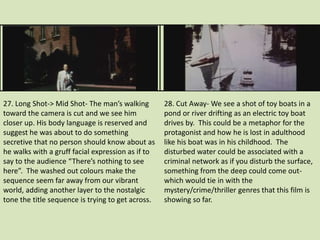
27. Long Shot-> Mid Shot- The man’s walking 
toward the camera is cut and we see him 
closer up. His body language is reserved and 
suggest he was about to do something 
secretive that no person should know about as 
he walks with a gruff facial expression as if to 
say to the audience “There’s nothing to see 
here”. The washed out colours make the 
sequence seem far away from our vibrant 
world, adding another layer to the nostalgic 
tone the title sequence is trying to get across. 
28. Cut Away- We see a shot of toy boats in a 
pond or river drifting as an electric toy boat 
drives by. This could be a metaphor for the 
protagonist and how he is lost in adulthood 
like his boat was in his childhood. The 
disturbed water could be associated with a 
criminal network as if you disturb the surface, 
something from the deep could come out-which 
would tie in with the 
mystery/crime/thriller genres that this film is 
showing so far.
29. Mid Shot- a group of people smiling at the 
camera then conversing. The fact that they 
briefly smile at the camera establishes that the 
shots were taken by an object the characters 
can see- it creates a realism that this is a real 
event as the camera exists, and adds to the 
idea of looking back. The colours are washed 
and the lighting high key which again, gives a 
nostalgic tone. 
30. Long Shot- Two boys push another boy into 
a swimming pool. More children gather and a 
woman (the pool boy’s mother?) tells the boys 
off- shown by her waving finger and stance 
over the boys. It could be thought that the 
boy in the pool is a significant character (he 
could be the protagonist) as the attention is 
drawn to him in this shot.
31. Extreme Long Shot- The stalls and people 
are seen from a distance to perhaps give the 
audience the scale of the celebration. 
32. Mid Shot- a boy smiling at the camera as 
he sits at a table. His costume could be seen 
as old fashioned but the yellow colour makes it 
look more modern and updated. The 
background shows a river or pond behind the 
boy and several white stalls and chairs- which 
infer he is innocent of mind and is unaware of 
any sinister subplot happening in the 
sequence.
33. Mid Shot- In the foreground we can see a 
boy seemingly in thought as implied by his 
facial expressions and lack of movement. 
Another boy behind him moves so the camera 
can see him and makes a silly smile face- which 
further emphasises that these children are 
normal. The others are seen conversing and all 
are sat at a table, 
34. Long Shot- the sequence returns to the 
presumed father and son shot from the start. 
The look upwards the son gives to his father 
shows his admiration- and the hand on 
shoulder implies a good, but formal, 
relationship. The lighting of the background in 
comparison to the objects in question draws 
attention to the characters as they are the 
lightest elements on screen.
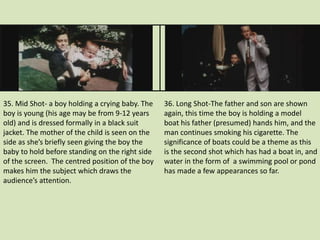
35. Mid Shot- a boy holding a crying baby. The 
boy is young (his age may be from 9-12 years 
old) and is dressed formally in a black suit 
jacket. The mother of the child is seen on the 
side as she’s briefly seen giving the boy the 
baby to hold before standing on the right side 
of the screen. The centred position of the boy 
makes him the subject which draws the 
audience’s attention. 
36. Long Shot-The father and son are shown 
again, this time the boy is holding a model 
boat his father (presumed) hands him, and the 
man continues smoking his cigarette. The 
significance of boats could be a theme as this 
is the second shot which has had a boat in, and 
water in the form of a swimming pool or pond 
has made a few appearances so far.
37. Long Shot- four clowns in front of a group 
of sitting children bow and leave, it’s 
presumed they are party entertainers who 
have just finished their show. Clowns have 
connotations of laughter and the circus, but 
could also be linked to childhood fears as they 
can be presented as sinister. The old video 
style of the footage paired with the piano 
music and the clowns could be seen as creepy 
or eerie to some. The colours the clowns wear 
are bright, but look washed out- which may 
imply they are not what they seem. 
38. Mid Shot- the sequence cuts back to the 
father and son. The father lingers for a few 
moments before putting his hand on the boy’s 
shoulder and leaving. The boy is left alone 
looking confused and vulnerable- as he has the 
man by his side for most of the title sequence. 
The slow motion movement of the father into 
the darkness of the background adds to the 
mysterious and uneasy tone- which could be 
seen as intriguing to the audience.
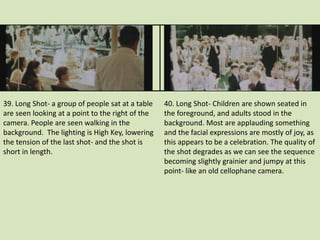
39. Long Shot- a group of people sat at a table 
are seen looking at a point to the right of the 
camera. People are seen walking in the 
background. The lighting is High Key, lowering 
the tension of the last shot- and the shot is 
short in length. 
40. Long Shot- Children are shown seated in 
the foreground, and adults stood in the 
background. Most are applauding something 
and the facial expressions are mostly of joy, as 
this appears to be a celebration. The quality of 
the shot degrades as we can see the sequence 
becoming slightly grainier and jumpy at this 
point- like an old cellophane camera.
41. Long Shot- Match on action with the 
previous shot. The people continue to applaud. 
The costumes and décor are all mostly white in 
colour, which has connotations of purity and 
innocence, but also weddings- so this could be 
a wedding, despite the sequence not showing 
a bride and groom or any of the ceremony. 
42. Close Up- The boy is seen close up, with a 
serene facial expression. A woman’s hand is 
shown on his shoulder. The shot is tinted 
orange with a grainy quality which could be 
seen as representing his tranquil emotional 
state. This state is further emphasised with the 
piano music which is slow in pace and classical 
in style- hinting this is the protagonist from 
when he was a child.
43. Close Up- the previous shot is interrupted 
by the splashing sound of water as the 
protagonist is seen for the first time in the 
present- in a bath robe and with a forlorn facial 
expression. The camera quality change 
indicates heavily that this is the present, and 
the interruption of the music with the water 
could represent a “snap” back into reality, like 
a loud noise interrupting a daydream. 
2. Text.

The Game (1997) textual analysis

  • 1.
    The Game (1997) Textual analysis
  • 2.
    1. Title shot-“Polygram Films”, production company. The colours are dark which implies this is a dark film. 2. “Polygram Filmed Entertainment Presents”- white title on black background attracts attention and is fairly neutral- can be used in many genres without being attached to any particular one. Plain titles are usually used with Horrors to compliment the low key lighting in the shots and indicate a plainness in life- which most horrors show before introducing the antagonist.
  • 3.
    3. “A PropagandaFilms Production”, another production company involved in the project. The title is, again, fairly plain, but contrasted to draw all attention to the screen. The transition of the 3D jigsaw pieces breaking apart is clever as jigsaws are often associated with mystery and suspense, so by using this imagery- with the dark colours of the pieces indicates the film will be dark in tone and have a mystery be the plot focus. 4. Title Card- “The Game”, The positioning of the title card is centred but not in the middle of the screen. This may be used to show how this film is different to the others as there’s something “off” about the mystery. This uncomfortable feeling the montage provokes later on (in my opinion) adds to this feeling of uneasiness which thrillers and horrors make the audience feel.
  • 4.
    5. Mid Shot-A father and his son centred in the shot. The father’s suit suggest he has an important job and the son’s matching clothes imply they are either middle or upper class. The father’s hand on the son’s shoulder shows his fatherly, yet detached bond with his son as he seems to just be posing for the camera. His facial expressions are fairly blank in this shot, and his character appears to be more than what meets the eye as shots of him throughout the montage present him as there one minute and gone another. 6. Mid Shot- A large house’s kitchen full of staff making food for a large event (looking at the busy atmosphere). The décor is very 1950’s and the camera film effect and changed aspect ration shows the shot through a home movie style sequence. The lighting is low key and the main colours are mostly whites and creams on the walls and furniture. The costumes are fairly old fashioned (50’s) and the body language is natural which doesn’t create much tension- but the use of seemingly insignificant home movie footage is peculiar for a title sequence, which invokes curiosity in the audience.
  • 5.
    7. Close Up-a woman’s hands (presumably) are briefly seen dipping in a dish, to presumably taste test it. The shot has an orange tint to it which makes the shot seem low quality- like an old home film which links with the tint as the orange could be associated with sepia, old films and perhaps nostalgia. Pairing the shot of preparing food and the tint implies this is a nostalgic time for the story’s narrator (the protagonist). 8. Close Up- another shot of kitchen preparation, this time the arms look male and he is measuring out an ingredient by putting it into a container. The white shirt and the clear container both have connotations of science to some, which could suggest that there is more to explore in the main character’s past than what meets the conventional eye. The décor shows various kitchen utensils which gives a vibe of homeliness, and the shot is jumpy-emphasising the home-video style of the opening sequence.
  • 6.
    9. Mid Shot-The previous shot cuts directly to this shot- showing the continuation through match on action. The man in the previous shot is shown smiling. The shot being framed so it doesn’t take up all of the screen could be showing the distance from this time the main character is at. 10. Close Up- A woman’s hands arranging flowers. The white used in this shot has connotations to some of purity and safety, so it could be showing that the flowers have a personal significance to the plot or to the character looking back. The gloves imply the arranger is a professional and the bracelet implies a high social class as it looks like it could be expensive.
  • 7.
    11. Mid Shot-Match on Action, the shot is continued and we can see the woman’s face as she continues to arrange the flowers. Her facial expressions suggest she is concentrating on this event, showing its importance in the sequence. 12. Long Shot- A group of people walking down a path. The path looks like it may be part of a garden or park- and the clothes worn by the characters on screen are mostly white in colour which could be associated with innocence and purity- suggesting these people are ignorant to any sinister elements hinted at in the sequence. The characters are centred, which draws all attention to them.
  • 8.
    13. Mid Shot/LongShot- This shot shows a waiter in the foreground looking at his tray before moving towards the left side of the screen. The movement is cut off quickly which implies this shot is an insignificant moment. The lighting is high key which shows the shot as light- though the light piano music adds a creepy vibe which adds a suppressed intensity to the sequence nonetheless. 14. Long Shot- Parasols are seen in a garden setting (presumably a garden party) and the characters are seen carrying a cake to somewhere. The music used is a classical piano piece- but the sound is repressed, which makes the track sound vintage- and eerie when paired with the seemingly random montage of home video clips.
  • 9.
    15. Long Shot-A group of children watching a puppet show in a classical puppet theatre reiterates the time in which these moments were cast- likely the 1950’s or 60’s. Puppets could be associated with mystery as behind each puppet is the puppetmaster- the architect of the crime, which could be a subtle nod to a criminal element to the plot. 16. Long Shot- Match on action, shows the children watching the show and applauding. They’re mostly dressed in white shirts and blazers which indicate a high social class-further extended by the large garden which could be presumed to be owned by the wealthy family of one of the children.
  • 10.
    17. Mid Shot-the previous shot cuts to the last few children leaving their seats after the show has finished. The sharp edit could be representative of how sharp the film will be in terms of plot twists, and the quickness of it may show how childhood disappears relatively quickly. The aspect ratio is associated with old televisions which further places this sequence in the past of the protagonist. The children’s facial expressions are exaggerated and full of innocence, the world is much simpler at this time. 18. Mid Shot- a mother is shown with her child. The blue she is wearing has connotations to some of tranquillity and peace- which shows her as a positive character, and a responsible mother as she is rigid in body language to protect her child. The background of the shot shows various stalls that look like a village fete or fair- with people walking around.
  • 11.
    19. Extreme LongShot- shows children playing in a field with an adult walking towards them. The adult’s body language is open, and he walks with determination, presumably being sent to retrieve the children from play. The lighting is high key which shows the scene as light and emphasises the characters we can see in the background. 20. Long Shot- shows the characters in the previous shot running towards and behind the camera. The lighting and resolution makes their faces difficult to see, which adds to the mystery of the sequence.
  • 12.
    21. Mid Shot-a person’s silhouette (which could be male) in front of a window with open curtains). The low key lighting adds a tension to the shot which implies that the person in the shot has dark intentions. Body language is still, which shows the seriousness of the moment. The black could have connotations of funerals, so the shot could be of someone mourning after a deceased relation or friend. 22. Mid Shot- a cut away to the cake from earlier on in the sequence. It is white which is often associated with weddings or formal celebrations- implying this sequence is a garden party or a birthday. The wine and table décor create an upper class feel to the shot as the set up looks like it could be expensive. The jerky quality of the shot continues the regular home-video tone.
  • 13.
    23. Mid Shot-a shot of two children sitting at a table outside. Their facial expressions show slight boredom- which could imply this is a formal celebration, or that it’s been happening for a while by now. The lighting is high key, which emphasises the characters without creating any tension and the music continues, adding the classical vibe to the sequence. 24. Mid Shot- A closer shot of the little girl from shot 23. She is presented as innocent as her body language imply the naivety which many children have- and her facial expression is blank as she eats a piece of cake, showing she’s tuned out of the situation.
  • 14.
    25. Mid Shot-the shot now shows a group of adults, two women and a man on the right in the foreground- and a few others in the background. The three are seen conversing with each other before looking to a point behind the camera. The costumes are formal and classical as the dresses and suit both look like a fashion style from the 1950’s with the frilly material and sharp suit jacket. The colour grey on the jacket has connotations of formality and business- which suggest the man could be a businessman of a relatively high social class. 26. Extreme Long Shot- The father from the start of the sequence is seen walking across a patch of grass towards an old house. The white of his suit could have connotations of innocence. He then hesitates and turns back, walking back towards the camera. The weather in the shot is sunny, implying this is a celebration held in the summer- and this hot weather usually has positive connotations. This sequence could be fond memories being looked back on.
  • 15.
    27. Long Shot->Mid Shot- The man’s walking toward the camera is cut and we see him closer up. His body language is reserved and suggest he was about to do something secretive that no person should know about as he walks with a gruff facial expression as if to say to the audience “There’s nothing to see here”. The washed out colours make the sequence seem far away from our vibrant world, adding another layer to the nostalgic tone the title sequence is trying to get across. 28. Cut Away- We see a shot of toy boats in a pond or river drifting as an electric toy boat drives by. This could be a metaphor for the protagonist and how he is lost in adulthood like his boat was in his childhood. The disturbed water could be associated with a criminal network as if you disturb the surface, something from the deep could come out-which would tie in with the mystery/crime/thriller genres that this film is showing so far.
  • 16.
    29. Mid Shot-a group of people smiling at the camera then conversing. The fact that they briefly smile at the camera establishes that the shots were taken by an object the characters can see- it creates a realism that this is a real event as the camera exists, and adds to the idea of looking back. The colours are washed and the lighting high key which again, gives a nostalgic tone. 30. Long Shot- Two boys push another boy into a swimming pool. More children gather and a woman (the pool boy’s mother?) tells the boys off- shown by her waving finger and stance over the boys. It could be thought that the boy in the pool is a significant character (he could be the protagonist) as the attention is drawn to him in this shot.
  • 17.
    31. Extreme LongShot- The stalls and people are seen from a distance to perhaps give the audience the scale of the celebration. 32. Mid Shot- a boy smiling at the camera as he sits at a table. His costume could be seen as old fashioned but the yellow colour makes it look more modern and updated. The background shows a river or pond behind the boy and several white stalls and chairs- which infer he is innocent of mind and is unaware of any sinister subplot happening in the sequence.
  • 18.
    33. Mid Shot-In the foreground we can see a boy seemingly in thought as implied by his facial expressions and lack of movement. Another boy behind him moves so the camera can see him and makes a silly smile face- which further emphasises that these children are normal. The others are seen conversing and all are sat at a table, 34. Long Shot- the sequence returns to the presumed father and son shot from the start. The look upwards the son gives to his father shows his admiration- and the hand on shoulder implies a good, but formal, relationship. The lighting of the background in comparison to the objects in question draws attention to the characters as they are the lightest elements on screen.
  • 19.
    35. Mid Shot-a boy holding a crying baby. The boy is young (his age may be from 9-12 years old) and is dressed formally in a black suit jacket. The mother of the child is seen on the side as she’s briefly seen giving the boy the baby to hold before standing on the right side of the screen. The centred position of the boy makes him the subject which draws the audience’s attention. 36. Long Shot-The father and son are shown again, this time the boy is holding a model boat his father (presumed) hands him, and the man continues smoking his cigarette. The significance of boats could be a theme as this is the second shot which has had a boat in, and water in the form of a swimming pool or pond has made a few appearances so far.
  • 20.
    37. Long Shot-four clowns in front of a group of sitting children bow and leave, it’s presumed they are party entertainers who have just finished their show. Clowns have connotations of laughter and the circus, but could also be linked to childhood fears as they can be presented as sinister. The old video style of the footage paired with the piano music and the clowns could be seen as creepy or eerie to some. The colours the clowns wear are bright, but look washed out- which may imply they are not what they seem. 38. Mid Shot- the sequence cuts back to the father and son. The father lingers for a few moments before putting his hand on the boy’s shoulder and leaving. The boy is left alone looking confused and vulnerable- as he has the man by his side for most of the title sequence. The slow motion movement of the father into the darkness of the background adds to the mysterious and uneasy tone- which could be seen as intriguing to the audience.
  • 21.
    39. Long Shot-a group of people sat at a table are seen looking at a point to the right of the camera. People are seen walking in the background. The lighting is High Key, lowering the tension of the last shot- and the shot is short in length. 40. Long Shot- Children are shown seated in the foreground, and adults stood in the background. Most are applauding something and the facial expressions are mostly of joy, as this appears to be a celebration. The quality of the shot degrades as we can see the sequence becoming slightly grainier and jumpy at this point- like an old cellophane camera.
  • 22.
    41. Long Shot-Match on action with the previous shot. The people continue to applaud. The costumes and décor are all mostly white in colour, which has connotations of purity and innocence, but also weddings- so this could be a wedding, despite the sequence not showing a bride and groom or any of the ceremony. 42. Close Up- The boy is seen close up, with a serene facial expression. A woman’s hand is shown on his shoulder. The shot is tinted orange with a grainy quality which could be seen as representing his tranquil emotional state. This state is further emphasised with the piano music which is slow in pace and classical in style- hinting this is the protagonist from when he was a child.
  • 23.
    43. Close Up-the previous shot is interrupted by the splashing sound of water as the protagonist is seen for the first time in the present- in a bath robe and with a forlorn facial expression. The camera quality change indicates heavily that this is the present, and the interruption of the music with the water could represent a “snap” back into reality, like a loud noise interrupting a daydream. 2. Text.