The future of server side JavaScript @olegpodsechin #froscon 20.08.2011
Why use JavaScript on the server? Language of the browser Competition amongst browser vendors means increased performance Code reuse between the server and client, no need for context switching Dynamic language No unnecessary constraints, allows one to mix procedural, object oriented and functional styles Allows for meta programing Data in JSON, no marshalling reduces amount of code
Why use JavaScript on the server? Lingua franca of the web Widely accessible, even to beginning developers Widely available in terms of platforms Decent IDE support Closures work well with asynchronous, real time web Diverse, active,  growing community – http://communityjs.org We are stuck with it for the foreseeable future
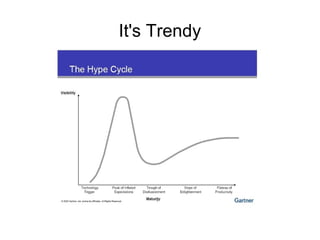
It's Trendy
ServerJS != Node Engines Environments Platforms Frameworks
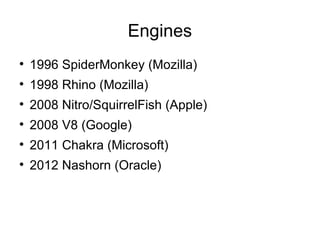
Engines 1996 SpiderMonkey (Mozilla) 1998 Rhino (Mozilla) 2008 Nitro/SquirrelFish (Apple) 2008 V8 (Google) 2011 Chakra (Microsoft) 2012 Nashorn (Oracle)
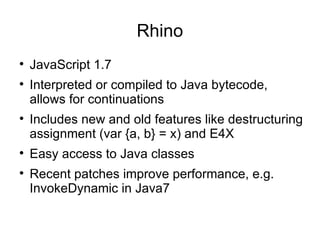
Rhino JavaScript 1.7 Interpreted or compiled to Java bytecode, allows for continuations Includes new and old features like destructuring assignment (var {a, b} = x) and E4X Easy access to Java classes Recent patches improve performance, e.g. InvokeDynamic in Java7
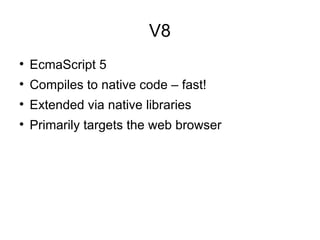
V8 EcmaScript 5 Compiles to native code – fast! Extended via native libraries Primarily targets the web browser
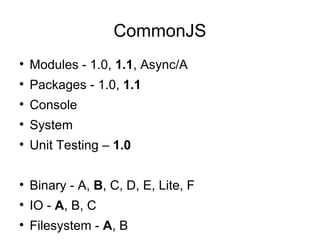
CommonJS Modules - 1.0,  1.1 , Async/A Packages - 1.0,  1.1 Console System Unit Testing –  1.0 Binary - A,  B , C, D, E, Lite, F IO -  A , B, C Filesystem -  A , B JSGI - 0.2,  0.3 HttpClient –  A , B
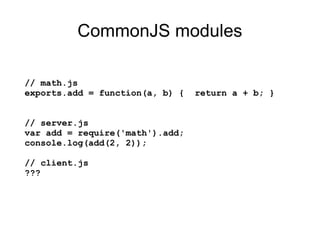
CommonJS modules // math.js exports.add = function(a, b) {  return a + b; } // server.js var add = require('math').add; console.log(add(2, 2)); // client.js ???
CommonJS packages // package.json { &quot;name&quot;: &quot;hello&quot;, &quot;version&quot;: &quot;0.1.0&quot;, &quot;description&quot;: &quot;Hello world package&quot;, &quot;keywords&quot;: [&quot;hello&quot;, &quot;world&quot;], &quot;author&quot;: &quot;John Smith <john@smith.com>&quot;, &quot;main&quot;: &quot;./lib/hello.js&quot;, &quot;dependencies&quot;: {&quot;whatever&quot; : &quot;1&quot;}, &quot;engines&quot; : [&quot;v8&quot;, &quot;node&quot;, &quot;rhino&quot;], }
Future of CommonJS http://groups.google.com/group/commonjs Node mostly ignored CommonJS AMD split out into separate mailing list UncommonJS https://github.com/kriskowal/uncommonjs
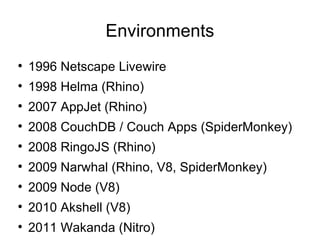
Environments 1996 Netscape Livewire  1998 Helma (Rhino) 2007 AppJet (Rhino) 2008 CouchDB / Couch Apps (SpiderMonkey) 2008 RingoJS (Rhino) 2009 Narwhal (Rhino, V8, SpiderMonkey) 2009 Node (V8) 2010 Akshell (V8) 2011 Wakanda (Nitro) Over 30 in total http://wiki.commonjs.org/wiki/Implementations
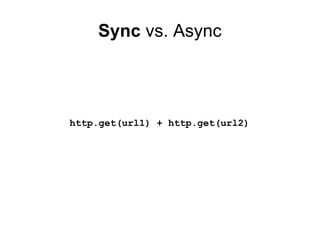
Sync  vs. Async http.get(url1) + http.get(url2)
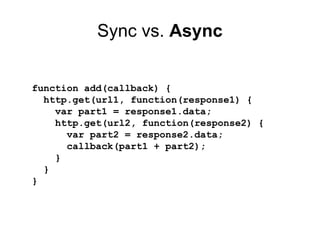
Sync vs.  Async function add(callback) { http.get(url1, function(response1) { var part1 = response1.data; http.get(url2, function(response2) { var part2 = response2.data; callback(part1 + part2); } } }
Interoperability Pure JavaScript CommonJS modules can run in any environment Templating, parsing, formatting, encoding – what else? Anything that does I/O must expose either a synchronous or an asynchronous API Dictates the style of interface exposed by higher level packages, e.g. database driver, ORM
API vs. Implementation Asynchronous, implement Node API Node RhiNodeII - https://github.com/lhofhansl/RhiNodeII SpiderNode - https://github.com/zpao/spidernode Node.NET - https://github.com/dnewcome/Node.net Synchronous, implement CommonJS API Ringo - https://github.com/ringo/ringojs Narwhal - https://github.com/280north/narwhal Common Node – https://github.com/olegp/common-node
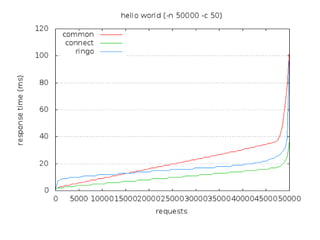
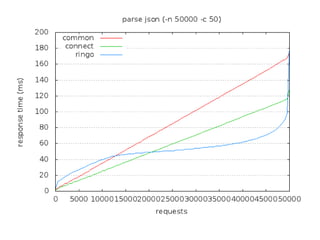
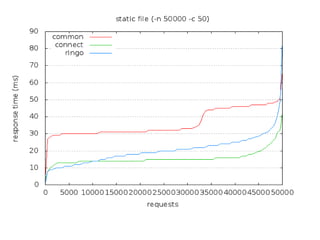
Common Node Implements a number of  synchronous  CommonJS specifications on top of Node Uses node-fibers  Uses co routines or multiple stacks within the same process not a fork or a hack Google's Traceur to support latest language features Bridges the gap between Ringo and Node, sync and async Fibers, HTTP proxy code examples & benchmarks


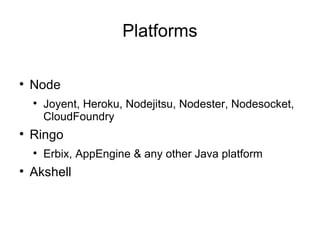
Platforms Node Joyent, Heroku, Nodejitsu, Nodester, Nodesocket, CloudFoundry Ringo Erbix, AppEngine & any other Java platform Akshell
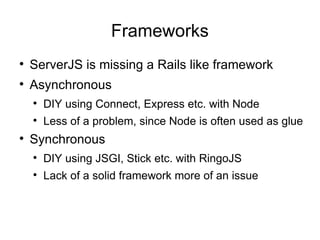
Frameworks ServerJS is missing a Rails like framework Asynchronous DIY using Connect, Express etc. with Node Less of a problem, since Node is often used as glue  Synchronous DIY using JSGI, Stick etc. with RingoJS Lack of a solid framework more of an issue
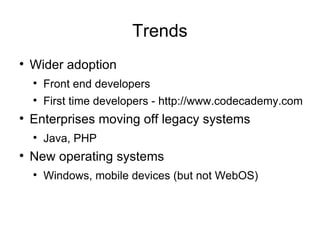
Trends Wider adoption Front end developers First time developers - http://www.codecademy.com Enterprises moving off legacy systems Java, PHP New operating systems Windows, mobile devices (but not WebOS)
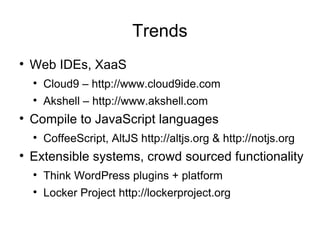
Trends Web IDEs, XaaS Cloud9 – http://www.cloud9ide.com Akshell – http://www.akshell.com Compile to JavaScript languages CoffeeScript, AltJS http://altjs.org & http://notjs.org Extensible systems, crowd sourced functionality Think WordPress plugins + platform Locker Project http://lockerproject.org
Thank you! Questions? @olegpodsechin

The future of server side JavaScript

  • 1.
    The future ofserver side JavaScript @olegpodsechin #froscon 20.08.2011
  • 2.
    Why use JavaScripton the server? Language of the browser Competition amongst browser vendors means increased performance Code reuse between the server and client, no need for context switching Dynamic language No unnecessary constraints, allows one to mix procedural, object oriented and functional styles Allows for meta programing Data in JSON, no marshalling reduces amount of code
  • 3.
    Why use JavaScripton the server? Lingua franca of the web Widely accessible, even to beginning developers Widely available in terms of platforms Decent IDE support Closures work well with asynchronous, real time web Diverse, active, growing community – http://communityjs.org We are stuck with it for the foreseeable future
  • 4.
  • 5.
    ServerJS != NodeEngines Environments Platforms Frameworks
  • 6.
    Engines 1996 SpiderMonkey(Mozilla) 1998 Rhino (Mozilla) 2008 Nitro/SquirrelFish (Apple) 2008 V8 (Google) 2011 Chakra (Microsoft) 2012 Nashorn (Oracle)
  • 7.
    Rhino JavaScript 1.7Interpreted or compiled to Java bytecode, allows for continuations Includes new and old features like destructuring assignment (var {a, b} = x) and E4X Easy access to Java classes Recent patches improve performance, e.g. InvokeDynamic in Java7
  • 8.
    V8 EcmaScript 5Compiles to native code – fast! Extended via native libraries Primarily targets the web browser
  • 9.
    CommonJS Modules -1.0, 1.1 , Async/A Packages - 1.0, 1.1 Console System Unit Testing – 1.0 Binary - A, B , C, D, E, Lite, F IO - A , B, C Filesystem - A , B JSGI - 0.2, 0.3 HttpClient – A , B
  • 10.
    CommonJS modules //math.js exports.add = function(a, b) { return a + b; } // server.js var add = require('math').add; console.log(add(2, 2)); // client.js ???
  • 11.
    CommonJS packages //package.json { &quot;name&quot;: &quot;hello&quot;, &quot;version&quot;: &quot;0.1.0&quot;, &quot;description&quot;: &quot;Hello world package&quot;, &quot;keywords&quot;: [&quot;hello&quot;, &quot;world&quot;], &quot;author&quot;: &quot;John Smith <john@smith.com>&quot;, &quot;main&quot;: &quot;./lib/hello.js&quot;, &quot;dependencies&quot;: {&quot;whatever&quot; : &quot;1&quot;}, &quot;engines&quot; : [&quot;v8&quot;, &quot;node&quot;, &quot;rhino&quot;], }
  • 12.
    Future of CommonJShttp://groups.google.com/group/commonjs Node mostly ignored CommonJS AMD split out into separate mailing list UncommonJS https://github.com/kriskowal/uncommonjs
  • 13.
    Environments 1996 NetscapeLivewire 1998 Helma (Rhino) 2007 AppJet (Rhino) 2008 CouchDB / Couch Apps (SpiderMonkey) 2008 RingoJS (Rhino) 2009 Narwhal (Rhino, V8, SpiderMonkey) 2009 Node (V8) 2010 Akshell (V8) 2011 Wakanda (Nitro) Over 30 in total http://wiki.commonjs.org/wiki/Implementations
  • 14.
    Sync vs.Async http.get(url1) + http.get(url2)
  • 15.
    Sync vs. Async function add(callback) { http.get(url1, function(response1) { var part1 = response1.data; http.get(url2, function(response2) { var part2 = response2.data; callback(part1 + part2); } } }
  • 16.
    Interoperability Pure JavaScriptCommonJS modules can run in any environment Templating, parsing, formatting, encoding – what else? Anything that does I/O must expose either a synchronous or an asynchronous API Dictates the style of interface exposed by higher level packages, e.g. database driver, ORM
  • 17.
    API vs. ImplementationAsynchronous, implement Node API Node RhiNodeII - https://github.com/lhofhansl/RhiNodeII SpiderNode - https://github.com/zpao/spidernode Node.NET - https://github.com/dnewcome/Node.net Synchronous, implement CommonJS API Ringo - https://github.com/ringo/ringojs Narwhal - https://github.com/280north/narwhal Common Node – https://github.com/olegp/common-node
  • 18.
    Common Node Implementsa number of synchronous CommonJS specifications on top of Node Uses node-fibers Uses co routines or multiple stacks within the same process not a fork or a hack Google's Traceur to support latest language features Bridges the gap between Ringo and Node, sync and async Fibers, HTTP proxy code examples & benchmarks
  • 19.
  • 20.
  • 21.
  • 22.
    Platforms Node Joyent,Heroku, Nodejitsu, Nodester, Nodesocket, CloudFoundry Ringo Erbix, AppEngine & any other Java platform Akshell
  • 23.
    Frameworks ServerJS ismissing a Rails like framework Asynchronous DIY using Connect, Express etc. with Node Less of a problem, since Node is often used as glue Synchronous DIY using JSGI, Stick etc. with RingoJS Lack of a solid framework more of an issue
  • 24.
    Trends Wider adoptionFront end developers First time developers - http://www.codecademy.com Enterprises moving off legacy systems Java, PHP New operating systems Windows, mobile devices (but not WebOS)
  • 25.
    Trends Web IDEs,XaaS Cloud9 – http://www.cloud9ide.com Akshell – http://www.akshell.com Compile to JavaScript languages CoffeeScript, AltJS http://altjs.org & http://notjs.org Extensible systems, crowd sourced functionality Think WordPress plugins + platform Locker Project http://lockerproject.org
  • 26.
    Thank you! Questions?@olegpodsechin