The future UH Managed Learning
Environment consultation
• The background to the consultation
• Consider the draft principles underpinning the next
Managed Learning Environment (MLE)
• Gather your views and ideas
Context
• StudyNet is one of the most well used MLEs in the
country – it supports much of our core Learning and
Teaching activity
• Student feedback is generally very good – though not
universally so. This is partly dependent on how it is used
• Other universities are also doing well nowadays – with
pockets of functionality probably ahead of StudyNet
• This review will help specify the next generation MLE to
keep us at the forefront of the sector for the next 5-10
years
Background
• The feedback from this workshop will be collated with
feedback from other Schools and inform the next stage of
the specification process. This will be shared for comment
and further consultation
• Following feedback, a pilot system will be developed,
user tested and trialled by UH Online
• A wider scale roll out will be informed by an evaluation of
the UH Online pilot (wider roll-out anticipated in 2015/16)
Development overview
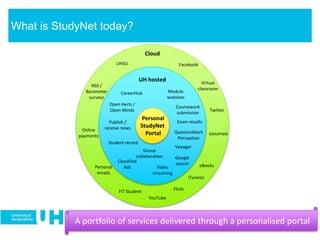
What is StudyNet today?
Module
websites
UH hosted
Cloud
Flickr
Virtual
classroom
Video
streaming
Google
search
CareerHub
Coursework
submission
QuestionMark
Perception
Voyager
Student record
FIT Student
Online
payments
NSS /
Barometer
surveys
Personal
emails
eBooks
eJournals
UHSU
Classified
Ads
Open Herts /
Open Minds
Group
collaboration
Publish /
receive news
YouTube
iTunesU
Facebook
Exam results
Twitter
A portfolio of services delivered through a personalised portal
Personal
StudyNet
Portal
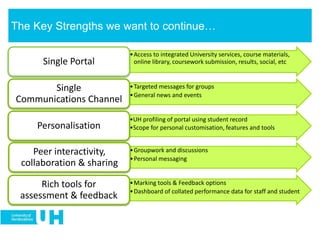
•Access to integrated University services, course materials,
online library, coursework submission, results, social, etcSingle Portal
•Targeted messages for groups
•General news and events
Single
Communications Channel
•UH profiling of portal using student record
•Scope for personal customisation, features and toolsPersonalisation
•Groupwork and discussions
•Personal messaging
Peer interactivity,
collaboration & sharing
•Marking tools & Feedback options
•Dashboard of collated performance data for staff and student
Rich tools for
assessment & feedback
The Key Strengths we want to continue…
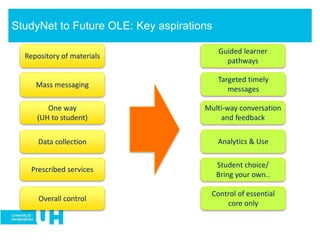
StudyNet to Future OLE: Key aspirations
Repository of materials
Overall control
Prescribed services
Mass messaging
One way
(UH to student)
Data collection
Guided learner
pathways
Targeted timely
messages
Multi-way conversation
and feedback
Analytics & Use
Student choice/
Bring your own..
Control of essential
core only
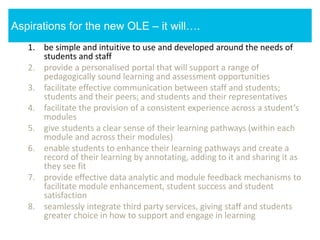
1. be simple and intuitive to use and developed around the needs of
students and staff
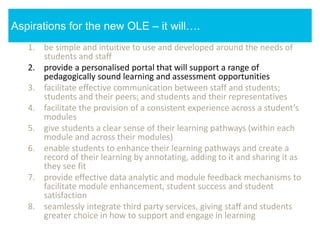
2. provide a personalised portal that will support a range of
pedagogically sound learning and assessment opportunities
3. facilitate effective communication between staff and students;
students and their peers; and students and their representatives
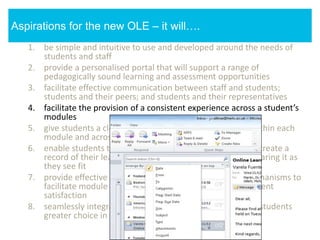
4. facilitate the provision of a consistent experience across a student’s
modules
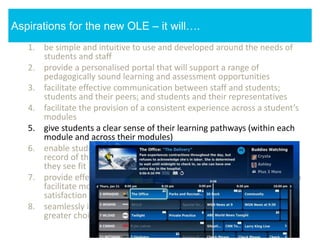
5. give students a clear sense of their learning pathways (within each
module and across their modules)
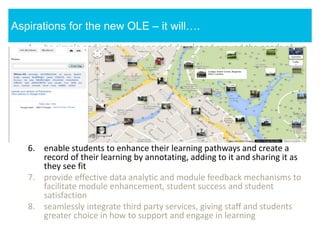
6. enable students to enhance their learning pathways and create a
record of their learning by annotating, adding to it and sharing it as
they see fit
7. provide effective data analytic and module feedback mechanisms to
facilitate module enhancement, student success and student
satisfaction
8. seamlessly integrate third party services, giving staff and students
greater choice in how to support and engage in learning
Aspirations for the new OLE – it will….
1. be simple and intuitive to use and developed around the needs of
students and staff
2. provide a personalised portal that will support a range of
pedagogically sound learning and assessment opportunities
3. facilitate effective communication between staff and students;
students and their peers; and students and their representatives
4. facilitate the provision of a consistent experience across a student’s
modules
5. give students a clear sense of their learning pathways (within each
module and across their modules)
6. enable students to enhance their learning pathways and create a
record of their learning by annotating, adding to it and sharing it as
they see fit
7. provide effective data analytic and module feedback mechanisms to
facilitate module enhancement, student success and student
satisfaction
8. seamlessly integrate third party services, giving staff and students
greater choice in how to support and engage in learning
Aspirations for the new OLE – it will….
1. be simple and intuitive to use and developed around the needs of
students and staff
2. provide a personalised portal that will support a range of
pedagogically sound learning and assessment opportunities
3. facilitate effective communication between staff and students;
students and their peers; and students and their representatives
4. facilitate the provision of a consistent experience across a student’s
modules
5. give students a clear sense of their learning pathways (within each
module and across their modules)
6. enable students to enhance their learning pathways and create a
record of their learning by annotating, adding to it and sharing it as
they see fit
7. provide effective data analytic and module feedback mechanisms to
facilitate module enhancement, student success and student
satisfaction
8. seamlessly integrate third party services, giving staff and students
greater choice in how to support and engage in learning
Aspirations for the new OLE – it will….
1. be simple and intuitive to use and developed around the needs of
students and staff
2. provide a personalised portal that will support a range of
pedagogically sound learning and assessment opportunities
3. facilitate effective communication between staff and students;
students and their peers; and students and their representatives
4. facilitate the provision of a consistent experience across a student’s
modules
5. give students a clear sense of their learning pathways (within each
module and across their modules)
6. enable students to enhance their learning pathways and create a
record of their learning by annotating, adding to it and sharing it as
they see fit
7. provide effective data analytic and module feedback mechanisms to
facilitate module enhancement, student success and student
satisfaction
8. seamlessly integrate third party services, giving staff and students
greater choice in how to support and engage in learning
Aspirations for the new OLE – it will….
1. be simple and intuitive to use and developed around the needs of
students and staff
2. provide a personalised portal that will support a range of
pedagogically sound learning and assessment opportunities
3. facilitate effective communication between staff and students;
students and their peers; and students and their representatives
4. facilitate the provision of a consistent experience across a student’s
modules
5. give students a clear sense of their learning pathways (within each
module and across their modules)
6. enable students to enhance their learning pathways and create a
record of their learning by annotating, adding to it and sharing it as
they see fit
7. provide effective data analytic and module feedback mechanisms to
facilitate module enhancement, student success and student
satisfaction
8. seamlessly integrate third party services, giving staff and students
greater choice in how to support and engage in learning
Aspirations for the new OLE – it will….
1. be simple and intuitive to use and developed around the needs of
students and staff
2. provide a personalised portal that will support a range of
pedagogically sound learning and assessment opportunities
3. facilitate effective communication between staff and students;
students and their peers; and students and their representatives
4. facilitate the provision of a consistent experience across a student’s
modules
5. give students a clear sense of their learning pathways (within each
module and across their modules)
6. enable students to enhance their learning pathways and create a
record of their learning by annotating, adding to it and sharing it as
they see fit
7. provide effective data analytic and module feedback mechanisms to
facilitate module enhancement, student success and student
satisfaction
8. seamlessly integrate third party services, giving staff and students
greater choice in how to support and engage in learning
Aspirations for the new OLE – it will….
1. be simple and intuitive to use and developed around the needs of
students and staff
2. provide a personalised portal that will support a range of
pedagogically sound learning and assessment opportunities
3. facilitate effective communication between staff and students;
students and their peers; and students and their representatives
4. facilitate the provision of a consistent experience across a student’s
modules
5. give students a clear sense of their learning pathways (within each
module and across their modules)
6. enable students to enhance their learning pathways and create a
record of their learning by annotating, adding to it and sharing it as
they see fit
7. provide effective data analytic and module feedback mechanisms to
facilitate module enhancement, student success and student
satisfaction
8. seamlessly integrate third party services, giving staff and students
greater choice in how to support and engage in learning
Aspirations for the new OLE – it will….
1. be simple and intuitive to use and developed around the needs of
students and staff
2. provide a personalised portal that will support a range of
pedagogically sound learning and assessment opportunities
3. facilitate effective communication between staff and students;
students and their peers; and students and their representatives
4. facilitate the provision of a consistent experience across a student’s
modules
5. give students a clear sense of their learning pathways (within each
module and across their modules)
6. enable students to enhance their learning pathways and create a
record of their learning by annotating, adding to it and sharing it as
they see fit
7. provide effective data analytic and module feedback mechanisms to
facilitate module enhancement, student success and student
satisfaction
8. seamlessly integrate third party services, giving staff and students
greater choice in how to support and engage in learning
Aspirations for the new OLE – it will….
• What would you like from the Future MLE?
Task One:
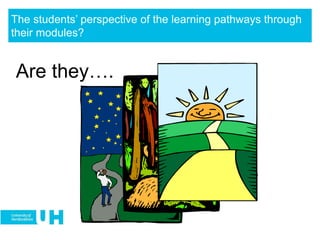
Are they….
The students’ perspective of the learning pathways through
their modules?
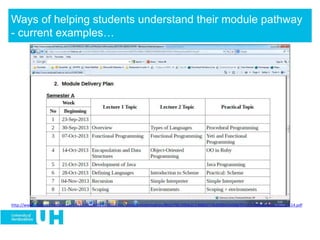
Ways of helping students understand their module pathway
- current examples…
http://www.studynet.herts.ac.uk/crs/13/6COM0252-0901.nsf/Module+Information/80257BC20061C2308025764D00424506/$FILE/CSModuleGuide2013-14.pdf
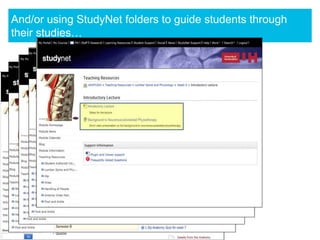
And/or using StudyNet folders to guide students through
their studies…
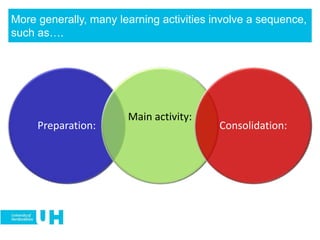
Preparation:
Main activity:
Consolidation:
More generally, many learning activities involve a sequence,
such as….
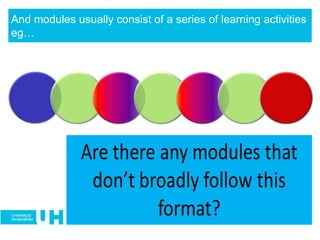
And modules usually consist of a series of learning activities
eg…
• Draw a diagram (or diagrams) to show the typical
path(s)/structure(s) of your current modules?
• Are there other paths/structures that you would like to see
supported by the future MLE?
Task two - we wish to understand the range of paths/structures
the future OLE will need to support
THANK YOU

The Future Managed Learning Environment Initial Consultation

  • 1.
    The future UHManaged Learning Environment consultation
  • 2.
    • The backgroundto the consultation • Consider the draft principles underpinning the next Managed Learning Environment (MLE) • Gather your views and ideas Context
  • 3.
    • StudyNet isone of the most well used MLEs in the country – it supports much of our core Learning and Teaching activity • Student feedback is generally very good – though not universally so. This is partly dependent on how it is used • Other universities are also doing well nowadays – with pockets of functionality probably ahead of StudyNet • This review will help specify the next generation MLE to keep us at the forefront of the sector for the next 5-10 years Background
  • 4.
    • The feedbackfrom this workshop will be collated with feedback from other Schools and inform the next stage of the specification process. This will be shared for comment and further consultation • Following feedback, a pilot system will be developed, user tested and trialled by UH Online • A wider scale roll out will be informed by an evaluation of the UH Online pilot (wider roll-out anticipated in 2015/16) Development overview
  • 5.
    What is StudyNettoday? Module websites UH hosted Cloud Flickr Virtual classroom Video streaming Google search CareerHub Coursework submission QuestionMark Perception Voyager Student record FIT Student Online payments NSS / Barometer surveys Personal emails eBooks eJournals UHSU Classified Ads Open Herts / Open Minds Group collaboration Publish / receive news YouTube iTunesU Facebook Exam results Twitter A portfolio of services delivered through a personalised portal Personal StudyNet Portal
  • 6.
    •Access to integratedUniversity services, course materials, online library, coursework submission, results, social, etcSingle Portal •Targeted messages for groups •General news and events Single Communications Channel •UH profiling of portal using student record •Scope for personal customisation, features and toolsPersonalisation •Groupwork and discussions •Personal messaging Peer interactivity, collaboration & sharing •Marking tools & Feedback options •Dashboard of collated performance data for staff and student Rich tools for assessment & feedback The Key Strengths we want to continue…
  • 7.
    StudyNet to FutureOLE: Key aspirations Repository of materials Overall control Prescribed services Mass messaging One way (UH to student) Data collection Guided learner pathways Targeted timely messages Multi-way conversation and feedback Analytics & Use Student choice/ Bring your own.. Control of essential core only
  • 8.
    1. be simpleand intuitive to use and developed around the needs of students and staff 2. provide a personalised portal that will support a range of pedagogically sound learning and assessment opportunities 3. facilitate effective communication between staff and students; students and their peers; and students and their representatives 4. facilitate the provision of a consistent experience across a student’s modules 5. give students a clear sense of their learning pathways (within each module and across their modules) 6. enable students to enhance their learning pathways and create a record of their learning by annotating, adding to it and sharing it as they see fit 7. provide effective data analytic and module feedback mechanisms to facilitate module enhancement, student success and student satisfaction 8. seamlessly integrate third party services, giving staff and students greater choice in how to support and engage in learning Aspirations for the new OLE – it will….
  • 9.
    1. be simpleand intuitive to use and developed around the needs of students and staff 2. provide a personalised portal that will support a range of pedagogically sound learning and assessment opportunities 3. facilitate effective communication between staff and students; students and their peers; and students and their representatives 4. facilitate the provision of a consistent experience across a student’s modules 5. give students a clear sense of their learning pathways (within each module and across their modules) 6. enable students to enhance their learning pathways and create a record of their learning by annotating, adding to it and sharing it as they see fit 7. provide effective data analytic and module feedback mechanisms to facilitate module enhancement, student success and student satisfaction 8. seamlessly integrate third party services, giving staff and students greater choice in how to support and engage in learning Aspirations for the new OLE – it will….
  • 10.
    1. be simpleand intuitive to use and developed around the needs of students and staff 2. provide a personalised portal that will support a range of pedagogically sound learning and assessment opportunities 3. facilitate effective communication between staff and students; students and their peers; and students and their representatives 4. facilitate the provision of a consistent experience across a student’s modules 5. give students a clear sense of their learning pathways (within each module and across their modules) 6. enable students to enhance their learning pathways and create a record of their learning by annotating, adding to it and sharing it as they see fit 7. provide effective data analytic and module feedback mechanisms to facilitate module enhancement, student success and student satisfaction 8. seamlessly integrate third party services, giving staff and students greater choice in how to support and engage in learning Aspirations for the new OLE – it will….
  • 11.
    1. be simpleand intuitive to use and developed around the needs of students and staff 2. provide a personalised portal that will support a range of pedagogically sound learning and assessment opportunities 3. facilitate effective communication between staff and students; students and their peers; and students and their representatives 4. facilitate the provision of a consistent experience across a student’s modules 5. give students a clear sense of their learning pathways (within each module and across their modules) 6. enable students to enhance their learning pathways and create a record of their learning by annotating, adding to it and sharing it as they see fit 7. provide effective data analytic and module feedback mechanisms to facilitate module enhancement, student success and student satisfaction 8. seamlessly integrate third party services, giving staff and students greater choice in how to support and engage in learning Aspirations for the new OLE – it will….
  • 12.
    1. be simpleand intuitive to use and developed around the needs of students and staff 2. provide a personalised portal that will support a range of pedagogically sound learning and assessment opportunities 3. facilitate effective communication between staff and students; students and their peers; and students and their representatives 4. facilitate the provision of a consistent experience across a student’s modules 5. give students a clear sense of their learning pathways (within each module and across their modules) 6. enable students to enhance their learning pathways and create a record of their learning by annotating, adding to it and sharing it as they see fit 7. provide effective data analytic and module feedback mechanisms to facilitate module enhancement, student success and student satisfaction 8. seamlessly integrate third party services, giving staff and students greater choice in how to support and engage in learning Aspirations for the new OLE – it will….
  • 13.
    1. be simpleand intuitive to use and developed around the needs of students and staff 2. provide a personalised portal that will support a range of pedagogically sound learning and assessment opportunities 3. facilitate effective communication between staff and students; students and their peers; and students and their representatives 4. facilitate the provision of a consistent experience across a student’s modules 5. give students a clear sense of their learning pathways (within each module and across their modules) 6. enable students to enhance their learning pathways and create a record of their learning by annotating, adding to it and sharing it as they see fit 7. provide effective data analytic and module feedback mechanisms to facilitate module enhancement, student success and student satisfaction 8. seamlessly integrate third party services, giving staff and students greater choice in how to support and engage in learning Aspirations for the new OLE – it will….
  • 14.
    1. be simpleand intuitive to use and developed around the needs of students and staff 2. provide a personalised portal that will support a range of pedagogically sound learning and assessment opportunities 3. facilitate effective communication between staff and students; students and their peers; and students and their representatives 4. facilitate the provision of a consistent experience across a student’s modules 5. give students a clear sense of their learning pathways (within each module and across their modules) 6. enable students to enhance their learning pathways and create a record of their learning by annotating, adding to it and sharing it as they see fit 7. provide effective data analytic and module feedback mechanisms to facilitate module enhancement, student success and student satisfaction 8. seamlessly integrate third party services, giving staff and students greater choice in how to support and engage in learning Aspirations for the new OLE – it will….
  • 15.
    1. be simpleand intuitive to use and developed around the needs of students and staff 2. provide a personalised portal that will support a range of pedagogically sound learning and assessment opportunities 3. facilitate effective communication between staff and students; students and their peers; and students and their representatives 4. facilitate the provision of a consistent experience across a student’s modules 5. give students a clear sense of their learning pathways (within each module and across their modules) 6. enable students to enhance their learning pathways and create a record of their learning by annotating, adding to it and sharing it as they see fit 7. provide effective data analytic and module feedback mechanisms to facilitate module enhancement, student success and student satisfaction 8. seamlessly integrate third party services, giving staff and students greater choice in how to support and engage in learning Aspirations for the new OLE – it will….
  • 16.
    • What wouldyou like from the Future MLE? Task One:
  • 17.
    Are they…. The students’perspective of the learning pathways through their modules?
  • 18.
    Ways of helpingstudents understand their module pathway - current examples… http://www.studynet.herts.ac.uk/crs/13/6COM0252-0901.nsf/Module+Information/80257BC20061C2308025764D00424506/$FILE/CSModuleGuide2013-14.pdf
  • 19.
    And/or using StudyNetfolders to guide students through their studies…
  • 20.
    Preparation: Main activity: Consolidation: More generally,many learning activities involve a sequence, such as….
  • 21.
    And modules usuallyconsist of a series of learning activities eg…
  • 22.
    • Draw adiagram (or diagrams) to show the typical path(s)/structure(s) of your current modules? • Are there other paths/structures that you would like to see supported by the future MLE? Task two - we wish to understand the range of paths/structures the future OLE will need to support
  • 23.

Editor's Notes

  • #6 Reminder
  • #7 Existing strengths identified as recognised good and leading practice and rated by students
  • #8 Reminder of key principles for next generation future OLE Yellow = current culture and main StudyNet use by staff Green = shift for the future Green underpins the strands of the project plan
  • #12 Students have called for a more standardised approach to the use of StudyNet since its inception (and students elsewhere for their OLEs) The sorts of different approach that can cause confusion include where module resources (eg lecture notes) are housed, different folder structures (eg by topic, week, lecturer or a combination), where information about assessments is located (eg Assessments, module information) . Whilst each module team may have a perfectly reasonable rationale for doing things their way, it is important to locate the overall student experience at the centre of module design. Equally, because students may need to explore a site in different ways at different times (eg contrast planning this week’s work , when a chronological structure is important versus trying to find something particular, when a topic based structure may help – perhaps the future LOE should permit students to reconfigure their websites according to need at the time? Maybe we can learn from the sort feature in outlook?
  • #13 Some module websites are very good at giving students a sense of the path they are on - how the module is structured, what is expected of them - what to do when, (eg how to go about their studies, how much time to spend, how various activities fit within the module – even how they fit in the programme or wider still) Staff have this picture, but not everyone makes this explicit. Generally speaking it is in the students’ interest to have some clarity about what they need to do, when and why. Can we learn from Sat Nav in terms of making a pathway very clear and guiding the student along it. Also giving a sense of where their studies sit within the wider picture? Can we learn from EPGs and they way they can help plan when several activities are happening simultaneously - and the sense of presence of others?
  • #14 Eg adding resources, linking to resources, comments and reflecting on resources and activities – both to assist their studies and to reflect on their studies as part of their personal and professional development How much more useful are maps with bits of additional detail added …
  • #15 Making good use of the huge amount of data available (eg the Student Dashboard) Ensuring that the mechanisms for student engagement in quality/feedback processes are well supported and effective Can we learn from F1 tracking ideas – seeing how students are progressing on their pathways If you can look past the customer reference, many staff (used to) conduct an informal module evaluation, often asking about individual lectures or topics etc
  • #16 Ideally single sign in across platforms Use commercial solutions (free and paid for) if they offer suitable solutions (eg Youtube and Vimeo for video, rather than an in-house server) Also recognise how students are using the cloud to support aspects of their personal and professional development and enhancing their employability – eg Linkedin is widely used by our students for recoding milestones and presenting their professional persona
  • #18 Making good decisions about what to do to get the best out of learning opportunities may be unclear – the path ahead may be daunting Tutors have a good understanding of where the module is heading and usually have a good idea of the path students need to follow to learn what they need in order to be successful on the module.
  • #20 A number of modules use the folder structure to give a sense of the path the students are on
  • #21 This is a fairly typical sequence whether an online course or a campus based study –eg the main activity could be a F2F lecture or an online ‘Connect’ lecture or a video – the before activity could include reading, a worksheet or a video – the consolidation activities could include a discussion, a tutorial, a worksheet…
  • #22 As far as we can tell, most modules follow some sort of oragnised progression with come fixed points (eg start date, end dates, scheduled contact. assessment submission deadlines) – there is a sense of a timeline – are there any exceptions currently being delivered? Eg how well do Block delivery, PBL, research supervision fit ?
  • #23 Our intention is to understand the range of paths/structures/learning modalities the new OLE will need to support