Living free from racism in a racially divided world
The Force of
Anthropology
What is Anthropology?
• Anthropology is literally the study of human
beings.
• It differs from other disciplines concerned with
people in that it is broader in scope.
• It is concerned with humans in all places of the
world (not simply those places close to us) and it
considers humans of all historical periods,
beginning with the creation of the first humans and
tracing human development to the present day.
• Another distinguishing feature of anthropology is
its holistic approach to the study of human beings.
• Not only do anthropologists study all varieties of
people, they also study all aspects of those
people’s experiences.
• Anthropologists are concerned with identifying and
explaining typical characteristics shared by
particular human populations. Such a characteristic
might be any human trait or custom.
• Physical anthropology is one of the broad
classifications of subject matter included in the
discipline.
• Physical anthropology studies the emergence of
humans and their later physical evolution (a
subject area called human paleontology).
• The second broad area of concern to anthropology
is cultural anthropology, its three sub-fields:
archaeology, anthropological linguistics, and
ethnology - all deal with aspects of human culture
that is, with the customary ways of thinking and
behaving characteristic of a particular society.
• Anthropological studies can show us why other
peoples are the way they are both culturally and
physically.
• Customs or actions of theirs that appear improper
or offensive to us may be adaptations to particular
environmental and social conditions.
• Anthropology is also valuable in that knowledge of
our past may bring us both a feeling of humility and
a sense of accomplishment.
Race and biology
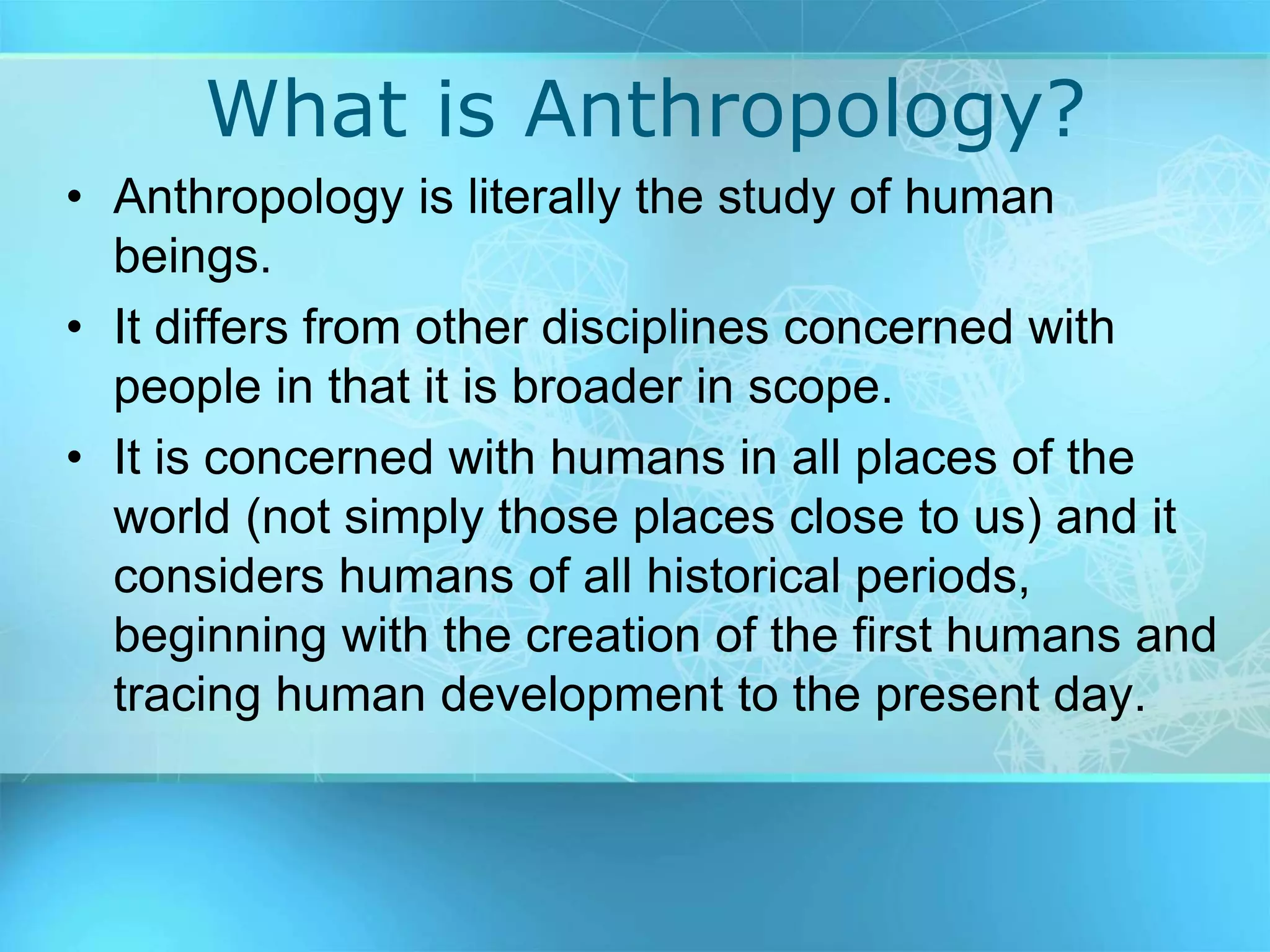
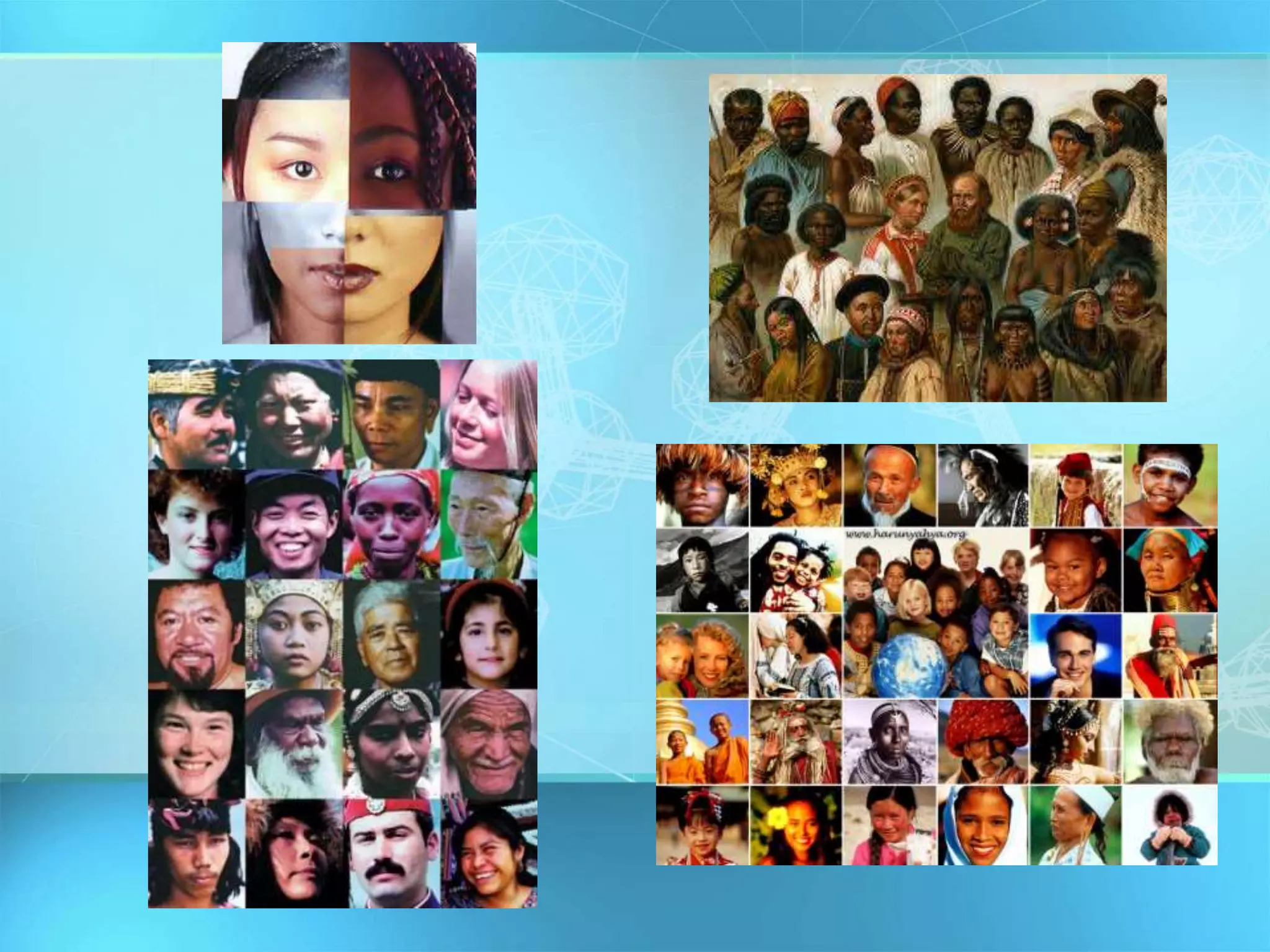
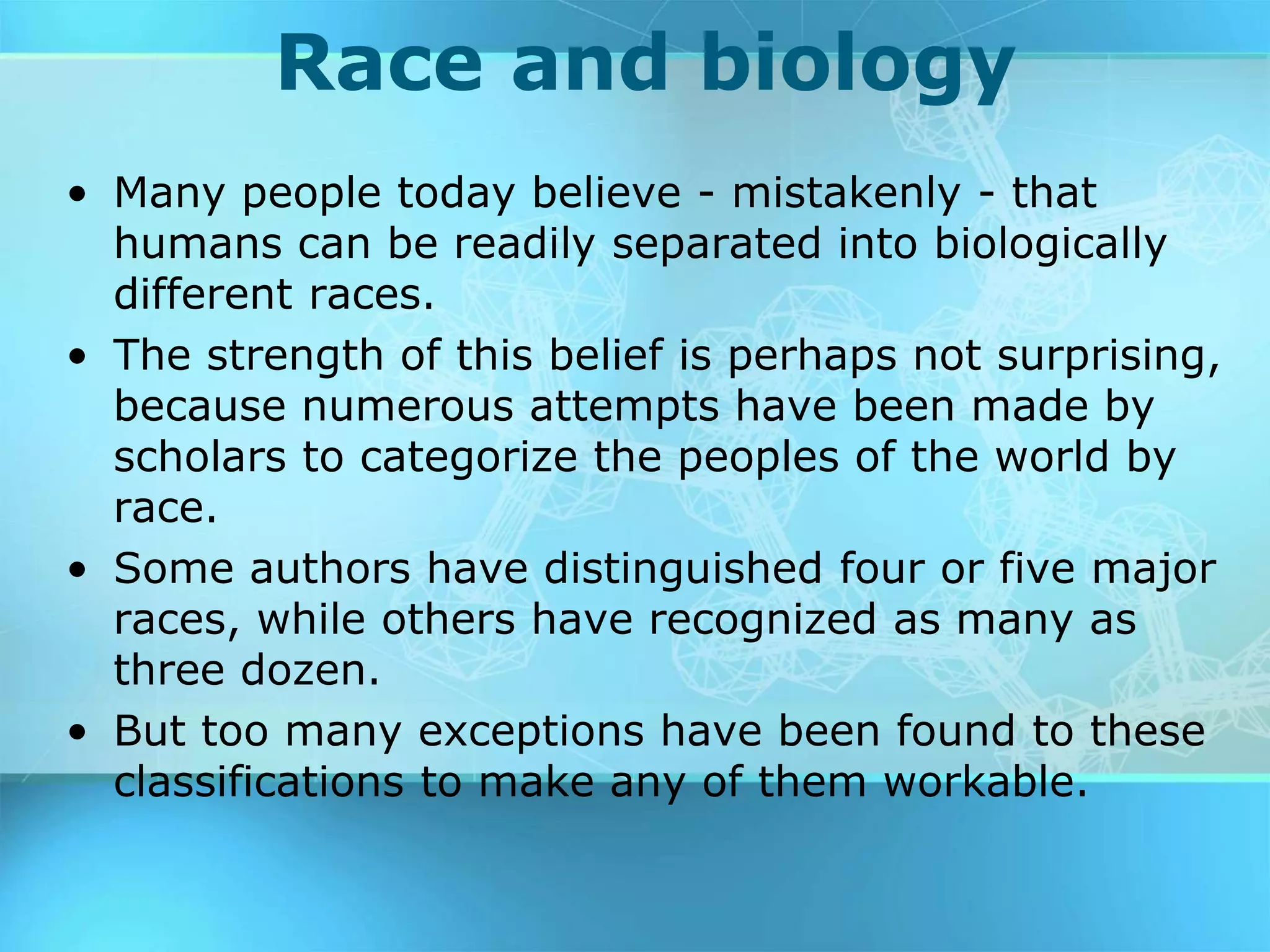
• Many people today believe - mistakenly - that
humans can be readily separated into biologically
different races.
• The strength of this belief is perhaps not surprising,
because numerous attempts have been made by
scholars to categorize the peoples of the world by
race.
• Some authors have distinguished four or five major
races, while others have recognized as many as
three dozen.
• But too many exceptions have been found to these
classifications to make any of them workable.
• A commonly used type, for example, that of
“Negroid”, is supposed to involve dark skin, tightly
curled black hair and certain other physical
characteristics.
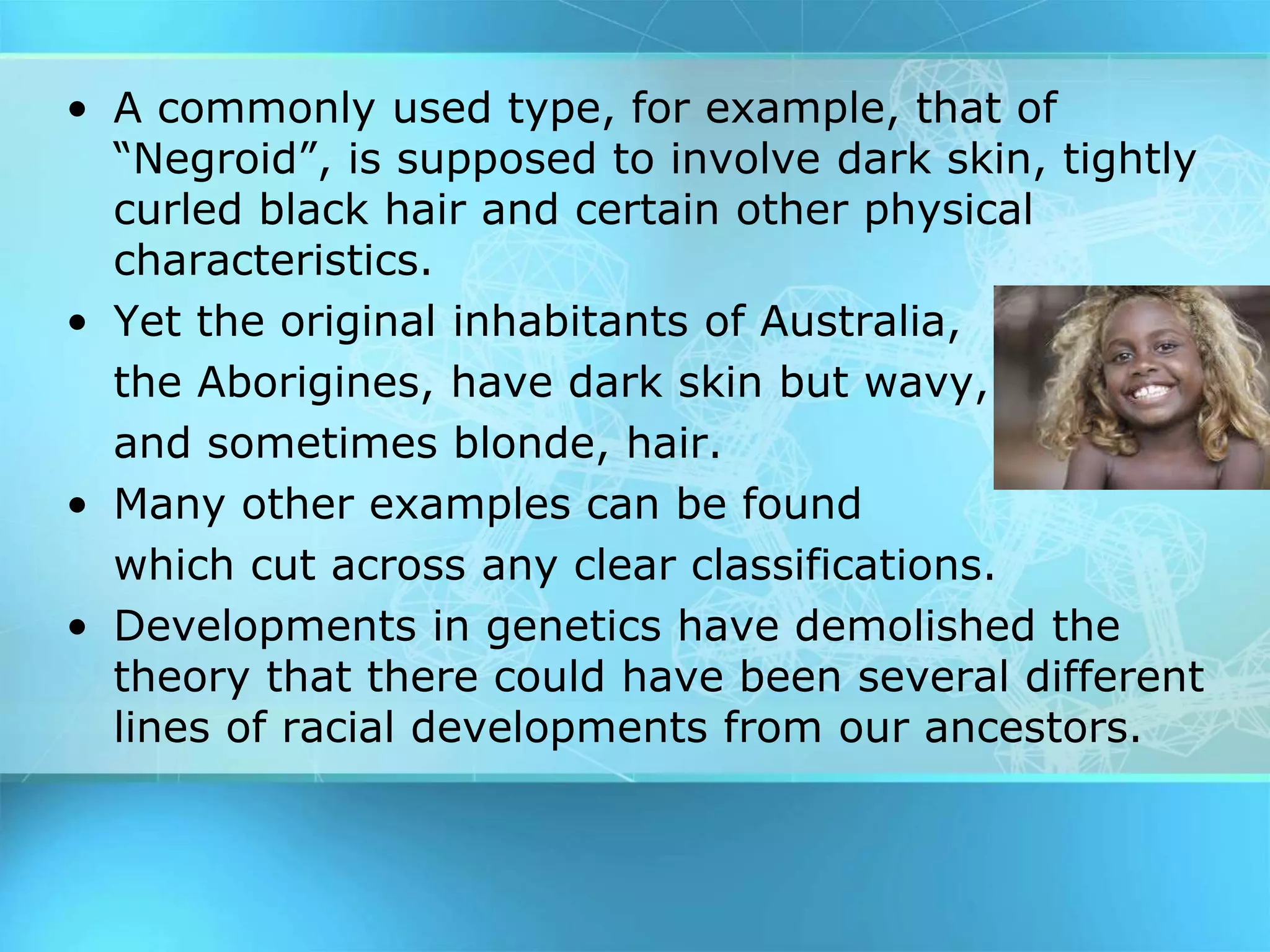
• Yet the original inhabitants of Australia,
the Aborigines, have dark skin but wavy,
and sometimes blonde, hair.
• Many other examples can be found
which cut across any clear classifications.
• Developments in genetics have demolished the
theory that there could have been several different
lines of racial developments from our ancestors.
• The contrasting appearance of a person with a very
dark skin, tightly curled hair and thick lips and one
with pale skin, straight or wavy hair and thin lips
might suggest basic constitutional differences.
• The physical divergences are in fact almost
completely confined to such aspects of appearance.
• Differences in physical types between human beings
derive from population inbreeding, which varies
according to the degree of contact between
different social or cultural units.
• A scientist examining a blood sample in the
laboratory will not be able to determine its
racial origin.
• There are clear physical differences between human
beings and some of these differences are inherited, but
the question of why some physical differences, and not
others, become matters for social discrimination and
prejudice has nothing to do with biology.
• Racial differences, therefore, should be understood as
physical variations singled out by the members of a
community or society as ethnically significant.
• Differences in skin color, for example, are often treated
as significant in this way, whereas differences in color of
hair are not.
• Racism means falsely attributing inherited characteristics
of personality or behavior to individuals of a particular
physical appearance.
• A racist is someone who believes that a biological
explanation can be given for characteristics of superiority
or inferiority supposedly possessed by people of a given
physical stock.
Ethnic antagonism, prejudice and
discrimination
• Although the concept of “race” is modern, prejudice
and ethnic antagonism have been widespread in
human history.
• In attempting to explain this, we need to look to
psychology, as well as sociology.
• But first, we must clearly distinguish between
prejudice and discrimination.
• Prejudice involves holding preconceived views about
an individual or group, often based upon hearsay
rather than direct evidence, views that are resistant
to change even in the face of new information.
• People may have favorable prejudices against others.
• Someone who is prejudiced against a particular
grouping will refuse to give them “a fair hearing”.
• Discrimination refers to activities which serve to
disqualify the members of one grouping from opportunities
open to others - as when someone of Indian background is
refused a job made available to a “black”.
• Although prejudice is very often the basis of discrimination,
the two may exist separately.
• People may have prejudiced attitudes, which they do not
act on.
• Equally, important discrimination does not necessarily
derive directly from prejudice.
• For example, white house-buyers might steer away from
purchasing properties in certain predominantly black
neighborhoods of a city, not because of attitudes of
hostility they might feel toward blacks, but because of
worries about declining property values in such areas.
• Prejudiced attitudes here influence discrimination, but in
an indirect fashion.
Stereotypes and scapegoats
• Prejudice operates mainly using stereotypical
thinking.
• All thought involves categories by means of which
we classify our experience.
• Sometimes, however, these categories are both ill
informed and rigid.
• A person may have a view of blacks or Jews, for
example, which if based upon a few firmly held
ideas in terms of which information about, or
encounters with, they are interpreted.
• Stereotypical thinking may be harmless if it is
“neutral” in terms of emotional content and distant
from the interests of the individual concerned.
• The British may have stereotypical views of what the
Americans are like, for example, but this might be of
little consequence for most people of either
nationality.
• Where stereotypes are associated with anxiety or
fear, the situation is likely to be quite different.
• Stereotypes in such circumstances are commonly
infused with attitudes of hostility or hatred toward
the group in question.
• A white person may believe, for example, that all
blacks are lazy and stupid, using this belief to justify
attitudes of contempt towards them.
• A black person may believe, for example that all
white people are wealthy, using this belief to justify
attitudes to prioritize the BEE program above general
personal development.
Some differences that can be seen
among people today
• All existing people belong to the same species
Homo sapiens.
• But if we look around the world, we can see a wide
range of physical differences.
• These differences are the result of Natural
Selection or Random Genetic Drift.
• Natural selection has been described as being
comprised of three critical elements: First, in
nature individuals differ among themselves.
• This is self-evident as no two individuals are
precisely the same whether they are people, dogs,
or trees.
• Secondly, genetic factors that can be passed on
from one generation to the next are to some extent
responsible for these naturally occurring differences.
• And thirdly, whenever these genetically determined
differences affect “fitness”, the individuals who are
genetically fit will be increasingly represented in
succeeding generations.
• The process is completely automatic and
impersonal. The fittest individuals are not
necessarily the best fighters or the most aggressive;
they are merely those who are constructed in such a
fashion that they tend to have a higher probability
of reproducing and rearing their young to
reproductive age.
• This ability has been determined by their genetic
inheritance.
Skin Color - Physical adaptation our
bodies made in the past
• Few factors are as important in determining the
selection pressures of an environment as the
quantity and quality of sunlight it receives.
• Solar intensity varies with latitude, being highest
around the equator and diminishing as one move
out of the tropics toward the poles.
• At any time of the year, the amount of sunlight a
particular environment receives is fixed.
• The amount of sunlight an individual productively
absorbs has a profound influence on his nutrition
and health.
• Skin color, which can vary in populations, provides
a means of regulating the amount of sunlight
productively absorbed.
• Primarily, it is what we know about Vitamin D and
the role of sunlight in its production that lead us to
emphasize the importance of skin color.
• Vitamin D maintains proper calcium metabolism.
• Severe disease results when there is too much or
too little Vitamin D. Too little Vitamin D results in an
inadequate deposition of calcium and the bones
soften.
• Until very recently man depended on his own body
chemistry and the sun to produce just the amount
of Vitamin D he needed.
• Vitamin D is synthesized in a layer of cells just
under the skin when they are illuminated with
ultraviolet light from the sun.
• One’s ability to make it in the proper amounts depends
on the ability of the activating light of the sun to
penetrate the outer layer of skin and reach the under
layer of cells that is capable of using this light to produce
Vitamin D.
• If the sunlight is dim and the skin is dark, little of this
energy source necessary for the production of this
indispensable vitamin can penetrate and the individual
will not make enough to meet the requirements of his
system.
• On the other hand, if the sunlight is intense and the skin
is very fair, then too much ultraviolet light will reach the
vitamin D-synthesis layer and an overproduction will
result
• So, in the state of nature, natural selection will favor
those individuals whose coloration best enables them to
use the available sunlight to produce enough, but not too
much vitamin D.
• At latitudes as far as London, the sunlight is pale
and much less intense than at locations in the
tropics.
• The pale, thin, fair skin of the Swede is
magnificently adapted to filter out as little as
possible of the weak sunlight that is characteristic
of the northern latitudes.
• Indeed, an area of white skin comparable to that
comprising the cheeks of a baby admits enough
light to produce something like 400 units of vitamin
D. This is equivalent to the minimum daily
requirement.
• The heavily pigmented black skin is so impermeable
to sunlight that even if a larger area of the body
were exposed to the pale northern rays, it could not
synthesize the minimum daily requirement of
vitamin D.
• Man arose in the warm, sunny even climates of
Africa and Asia.
• He later spread into the northern latitudes of Asia
and throughout Europe.
• He thus came to occupy a number of environments
where the sun was less intense than in the cradling
homelands.
• These movements, and consequently the
adjustments to the new environments, took place in
a relatively pre-cultural period of man’s history.
• Thus we expect of his adjustments to the new
environments had to be constitutional rather than
technological.
• In his long-past, pre-cultural period of man’s early
history, human populations experienced a powerful
selection for appropriateness of skin color.
Adaptation to Cold and Heat
• Different populations of man show different
constitutional adaptations to temperature. These are
expressed in body form, circulatory patterns, basal
metabolic rates, and group differences in tolerance to
heat stress.
• One of the most powerful environmental stresses man
has faced is cold.
• Body architecture is an adaptation of crucial importance.
• A thin, gangling body with a high surface-to-mass ratio
is ill adapted to conserve heat. A heavy body with short
arms and legs is much better adapted; it exposes far
less surface and consequently loses less heat to the
surroundings.
• But the body structure must not only conserve body
heat, those portions of the anatomy, the hands and the
face, which must function even when they are exposed
to the cold, should be appropriately designed.
• A flat face with low nasal silhouette, narrow eye slits, and
padding on insulating fat would serve its bearer well in the
cold.
• The Eskimos are biologically as well as culturally adapted
for survival in the Arctic cold. Collectively, they form a
group that embodies all the cold adaptations we have
mentioned.
• The human body had to make an equally effective
adaptation to extremes of heat. Here a lean body with long
heat-exchanging extremities is a highly desirable model.
• In addition to this body type found with high frequency in
people with a darker coloration, some studies have
suggested other physiological differences in heat tolerance.
These groups appear to show a greater tolerance for
humid heat than other groups.
• It was observed that African American soldiers suffered
more cold-related injuries in the Korean War than white
soldiers.
Culture and the Contemporary
Worlds
• The acquired knowledge that people use to interpret their world
and generate social behavior is called Culture. Culture is not
behavior itself, but knowledge used to construct and understand
behavior.
• It is learned as children grow up in society and discover how
their parents, and others around them, interpret the world.
• In our society, we learn to distinguish objects such as cars,
windows, houses, children, and food; to recognize attributes like
sharp, hot, beautiful, and humid; to classify and perform
different kinds of acts; to evaluate what is good and bad and to
judge when an unusual action is appropriate or inappropriate.
• How often have you heard parents explain something about life
to a child? Why do you think children are forever asking why?
• During socialization, children learn a culture, and because they
learn it from others, they share it with others, a fact that makes
human social existence possible.
• Culture is thus the system of knowledge by which people
design their own actions and interpret the behavior of
others.
• It tells an American that eating with one’s mouth closed
is proper, while an Indian knows that to be polite one
must chew with one’s mouth open.
• There is nothing preordained about cultural categories;
they are arbitrary. The same act can have different
meanings in various cultures.
• For example, when adolescent Hindu boys walk holding
hands, it signifies friendship, while to some other cultures
the same act may suggest homosexuality.
• We tend to think that the norms we follow represent the
“natural” way human beings do things. Those who
behave otherwise are judged morally wrong.
• This viewpoint is ethnocentric, which means that people
think their own culture represents the best, or at least
the most appropriate, way for human beings to live.
Culture and values
• It is easy for people to feel that their own way of life
is natural and God-given.
• One’s culture is not like a suit of clothing that can be
discarded easily or exchanged for each new life-style
that comes along.
• It is rather like a security blanket, and though to
some it may appear worn and tattered, outmoded
and ridiculous, it has great meaning to its owner.
• Although there are many reasons for this fact, one
of the most important is the value-laden nature of
what we learn as members of society.
• Whether it is acquired in a tribal band, a peasant
village, or an urban neighborhood, each culture is
like a giant iceberg.
• Beneath the surface of rules, norms, and behavioral
patterns there is a system of values. Some of these
premises are easily stated by members of a society, while
others are outside their awareness. Because many
difficulties in the modern world involve values, we must
look at this concept in some detail.
• A value is an arbitrary conception of what is desirable in
human experience. During socialization, all children are
exposed to a constant barrage of evaluations - the
arbitrary “rating system” of their culture. Nearly
everything they learn is labeled in terms of its desirability.
• The value attached to each bit of information may result
from the pain of a hot stove, the look of disapproval from
a parent, the smile of appreciation from a teacher, or
some specific verbal instruction. When parents tell a child,
“You should go to college, and get a good education”,
they are expressing a value.
• Those who do not conform to society’s rating system are
identified with derogatory labels or are punished in a
more severe way.
• When a Tlingit Indian says to his nephew, “You should
marry your father’s sister”, he is expressing one of the
core values of his culture.
• When a tramp urinates in an alley, he is violating the
value attached to privacy.
• All these concepts of what is desirable combine cognitive
and affective meanings.
• Individuals internalize their ideas about right and wrong,
good and bad, and invest them with strong feelings.
• Why do values constitute an inevitable part of all human
experience?
• That human potential is at odds with the requirements of
social life is well known. Behavior within the realm of
possibility is often outside the realm of necessity.
• There are numerous ways to resolve the conflict between
what people can do by themselves, and what they must
do as members of society.
• It is a popular notion that prisons and other correctional
institutions are primary means by which our society
enforces conformity, but this is not the case.
• Socialization may be ineffective for a few who require
such drastic action, but for the vast majority in any
society, conformity results from the internalization of
values.
• As we learn through imitation, identification, and
instruction, values are internalized. They provide security
and contribute to a sense of personal and societal
identity.
• For this reason, individuals in every society cling
tenaciously to the values they have acquired and feel
threatened when confronted with others who live
according to different conceptions of what are desirable.
Cultural Relativism
• Cultural relativism rests on the premise that it is
possible to remain aloof and free from making value
judgments.
• Put simply, this doctrine is based on four interrelated
propositions:
1. Each person’s value system is a result of his or her own
experience, that is, it is learned.
2. The values that individuals learn differ from one society to
another because of different learning experiences.
3. Values, therefore, are relative to the society in which they
occur.
4. There are no universal values, but we should respect the
values of each of the world’s cultures.
Toward a Multicultural Society
• How do anthropologists discover and map another
culture? They learn the culture by observing, asking
questions, and participating in daily activities - a process
resembling childhood socialization or enculturation.
• What must the church do to successfully build
cross-cultural relationships?
• What is required? In the first place, instead of
suppressing cultural diversity by stressing assimilation
into the mainstream of church life, we must recognize
the extent to which our culture is pluralistic.
• We must accept the fact that groups within our society
are committed to disparate and sometimes conflicting
values.
• The second requirement for a truly multicultural society
is that we continuously examine the consequences of
each value system.
• What is the long-range effect of our commitment to a “gospel
of exclusive numeric growth”?
• What are the results of a belief in male superiority?
• How do our values of privacy affect those without homes?
• What is the consequence for some groups when all students
are taught to use “Standard English”?
• In the efforts to assimilate ethnic groups, we can destroy their
pride and self-identity.
• In the attempt to offer the advantages of education to all the
different groups in South Africa, we can induce them to
become failures because the schools are not able to educate
for diversity.
• We have only begun to understand some of the consequences
of our values, and during the next few decades, our survival
will demand that the study of values be given top priority.
• The most difficult task for the contemporary world is to induce
people to relinquish those values with destructive
consequences.
• This will not be simple, and it probably will not occur
without a better understanding of the nature and the
function of the worlds many value systems.
• In every society, children learn to shift from egocentric
behavior to ethnocentric behavior.
• In deference to desirable community standards,
individuals give up those things they desire, and life in a
particular society becomes secure and meaningful.
• Can we learn to shift from ethnocentric to homocentric
behavior?
• Can we relinquish values desirable from the standpoint
of a single community but destructive to the wider
world?
• This change will necessitate a morality that can
articulate conflicting value systems and create a climate
of tolerance, respect, and co-operation.
• Only then can we begin to create a culture that will be
truly adaptive in today’s world and in the church.

The force of anthropology

  • 1.
    Living free fromracism in a racially divided world The Force of Anthropology
  • 2.
    What is Anthropology? •Anthropology is literally the study of human beings. • It differs from other disciplines concerned with people in that it is broader in scope. • It is concerned with humans in all places of the world (not simply those places close to us) and it considers humans of all historical periods, beginning with the creation of the first humans and tracing human development to the present day.
  • 3.
    • Another distinguishingfeature of anthropology is its holistic approach to the study of human beings. • Not only do anthropologists study all varieties of people, they also study all aspects of those people’s experiences. • Anthropologists are concerned with identifying and explaining typical characteristics shared by particular human populations. Such a characteristic might be any human trait or custom. • Physical anthropology is one of the broad classifications of subject matter included in the discipline. • Physical anthropology studies the emergence of humans and their later physical evolution (a subject area called human paleontology).
  • 4.
    • The secondbroad area of concern to anthropology is cultural anthropology, its three sub-fields: archaeology, anthropological linguistics, and ethnology - all deal with aspects of human culture that is, with the customary ways of thinking and behaving characteristic of a particular society. • Anthropological studies can show us why other peoples are the way they are both culturally and physically. • Customs or actions of theirs that appear improper or offensive to us may be adaptations to particular environmental and social conditions. • Anthropology is also valuable in that knowledge of our past may bring us both a feeling of humility and a sense of accomplishment.
  • 6.
    Race and biology •Many people today believe - mistakenly - that humans can be readily separated into biologically different races. • The strength of this belief is perhaps not surprising, because numerous attempts have been made by scholars to categorize the peoples of the world by race. • Some authors have distinguished four or five major races, while others have recognized as many as three dozen. • But too many exceptions have been found to these classifications to make any of them workable.
  • 7.
    • A commonlyused type, for example, that of “Negroid”, is supposed to involve dark skin, tightly curled black hair and certain other physical characteristics. • Yet the original inhabitants of Australia, the Aborigines, have dark skin but wavy, and sometimes blonde, hair. • Many other examples can be found which cut across any clear classifications. • Developments in genetics have demolished the theory that there could have been several different lines of racial developments from our ancestors.
  • 8.
    • The contrastingappearance of a person with a very dark skin, tightly curled hair and thick lips and one with pale skin, straight or wavy hair and thin lips might suggest basic constitutional differences. • The physical divergences are in fact almost completely confined to such aspects of appearance. • Differences in physical types between human beings derive from population inbreeding, which varies according to the degree of contact between different social or cultural units. • A scientist examining a blood sample in the laboratory will not be able to determine its racial origin.
  • 9.
    • There areclear physical differences between human beings and some of these differences are inherited, but the question of why some physical differences, and not others, become matters for social discrimination and prejudice has nothing to do with biology. • Racial differences, therefore, should be understood as physical variations singled out by the members of a community or society as ethnically significant. • Differences in skin color, for example, are often treated as significant in this way, whereas differences in color of hair are not. • Racism means falsely attributing inherited characteristics of personality or behavior to individuals of a particular physical appearance. • A racist is someone who believes that a biological explanation can be given for characteristics of superiority or inferiority supposedly possessed by people of a given physical stock.
  • 10.
    Ethnic antagonism, prejudiceand discrimination • Although the concept of “race” is modern, prejudice and ethnic antagonism have been widespread in human history. • In attempting to explain this, we need to look to psychology, as well as sociology. • But first, we must clearly distinguish between prejudice and discrimination. • Prejudice involves holding preconceived views about an individual or group, often based upon hearsay rather than direct evidence, views that are resistant to change even in the face of new information. • People may have favorable prejudices against others. • Someone who is prejudiced against a particular grouping will refuse to give them “a fair hearing”.
  • 11.
    • Discrimination refersto activities which serve to disqualify the members of one grouping from opportunities open to others - as when someone of Indian background is refused a job made available to a “black”. • Although prejudice is very often the basis of discrimination, the two may exist separately. • People may have prejudiced attitudes, which they do not act on. • Equally, important discrimination does not necessarily derive directly from prejudice. • For example, white house-buyers might steer away from purchasing properties in certain predominantly black neighborhoods of a city, not because of attitudes of hostility they might feel toward blacks, but because of worries about declining property values in such areas. • Prejudiced attitudes here influence discrimination, but in an indirect fashion.
  • 12.
    Stereotypes and scapegoats •Prejudice operates mainly using stereotypical thinking. • All thought involves categories by means of which we classify our experience. • Sometimes, however, these categories are both ill informed and rigid. • A person may have a view of blacks or Jews, for example, which if based upon a few firmly held ideas in terms of which information about, or encounters with, they are interpreted. • Stereotypical thinking may be harmless if it is “neutral” in terms of emotional content and distant from the interests of the individual concerned.
  • 13.
    • The Britishmay have stereotypical views of what the Americans are like, for example, but this might be of little consequence for most people of either nationality. • Where stereotypes are associated with anxiety or fear, the situation is likely to be quite different. • Stereotypes in such circumstances are commonly infused with attitudes of hostility or hatred toward the group in question. • A white person may believe, for example, that all blacks are lazy and stupid, using this belief to justify attitudes of contempt towards them. • A black person may believe, for example that all white people are wealthy, using this belief to justify attitudes to prioritize the BEE program above general personal development.
  • 14.
    Some differences thatcan be seen among people today • All existing people belong to the same species Homo sapiens. • But if we look around the world, we can see a wide range of physical differences. • These differences are the result of Natural Selection or Random Genetic Drift. • Natural selection has been described as being comprised of three critical elements: First, in nature individuals differ among themselves. • This is self-evident as no two individuals are precisely the same whether they are people, dogs, or trees.
  • 15.
    • Secondly, geneticfactors that can be passed on from one generation to the next are to some extent responsible for these naturally occurring differences. • And thirdly, whenever these genetically determined differences affect “fitness”, the individuals who are genetically fit will be increasingly represented in succeeding generations. • The process is completely automatic and impersonal. The fittest individuals are not necessarily the best fighters or the most aggressive; they are merely those who are constructed in such a fashion that they tend to have a higher probability of reproducing and rearing their young to reproductive age. • This ability has been determined by their genetic inheritance.
  • 16.
    Skin Color -Physical adaptation our bodies made in the past • Few factors are as important in determining the selection pressures of an environment as the quantity and quality of sunlight it receives. • Solar intensity varies with latitude, being highest around the equator and diminishing as one move out of the tropics toward the poles. • At any time of the year, the amount of sunlight a particular environment receives is fixed. • The amount of sunlight an individual productively absorbs has a profound influence on his nutrition and health. • Skin color, which can vary in populations, provides a means of regulating the amount of sunlight productively absorbed.
  • 17.
    • Primarily, itis what we know about Vitamin D and the role of sunlight in its production that lead us to emphasize the importance of skin color. • Vitamin D maintains proper calcium metabolism. • Severe disease results when there is too much or too little Vitamin D. Too little Vitamin D results in an inadequate deposition of calcium and the bones soften. • Until very recently man depended on his own body chemistry and the sun to produce just the amount of Vitamin D he needed. • Vitamin D is synthesized in a layer of cells just under the skin when they are illuminated with ultraviolet light from the sun.
  • 18.
    • One’s abilityto make it in the proper amounts depends on the ability of the activating light of the sun to penetrate the outer layer of skin and reach the under layer of cells that is capable of using this light to produce Vitamin D. • If the sunlight is dim and the skin is dark, little of this energy source necessary for the production of this indispensable vitamin can penetrate and the individual will not make enough to meet the requirements of his system. • On the other hand, if the sunlight is intense and the skin is very fair, then too much ultraviolet light will reach the vitamin D-synthesis layer and an overproduction will result • So, in the state of nature, natural selection will favor those individuals whose coloration best enables them to use the available sunlight to produce enough, but not too much vitamin D.
  • 19.
    • At latitudesas far as London, the sunlight is pale and much less intense than at locations in the tropics. • The pale, thin, fair skin of the Swede is magnificently adapted to filter out as little as possible of the weak sunlight that is characteristic of the northern latitudes. • Indeed, an area of white skin comparable to that comprising the cheeks of a baby admits enough light to produce something like 400 units of vitamin D. This is equivalent to the minimum daily requirement. • The heavily pigmented black skin is so impermeable to sunlight that even if a larger area of the body were exposed to the pale northern rays, it could not synthesize the minimum daily requirement of vitamin D.
  • 20.
    • Man arosein the warm, sunny even climates of Africa and Asia. • He later spread into the northern latitudes of Asia and throughout Europe. • He thus came to occupy a number of environments where the sun was less intense than in the cradling homelands. • These movements, and consequently the adjustments to the new environments, took place in a relatively pre-cultural period of man’s history. • Thus we expect of his adjustments to the new environments had to be constitutional rather than technological. • In his long-past, pre-cultural period of man’s early history, human populations experienced a powerful selection for appropriateness of skin color.
  • 21.
    Adaptation to Coldand Heat • Different populations of man show different constitutional adaptations to temperature. These are expressed in body form, circulatory patterns, basal metabolic rates, and group differences in tolerance to heat stress. • One of the most powerful environmental stresses man has faced is cold. • Body architecture is an adaptation of crucial importance. • A thin, gangling body with a high surface-to-mass ratio is ill adapted to conserve heat. A heavy body with short arms and legs is much better adapted; it exposes far less surface and consequently loses less heat to the surroundings. • But the body structure must not only conserve body heat, those portions of the anatomy, the hands and the face, which must function even when they are exposed to the cold, should be appropriately designed.
  • 22.
    • A flatface with low nasal silhouette, narrow eye slits, and padding on insulating fat would serve its bearer well in the cold. • The Eskimos are biologically as well as culturally adapted for survival in the Arctic cold. Collectively, they form a group that embodies all the cold adaptations we have mentioned. • The human body had to make an equally effective adaptation to extremes of heat. Here a lean body with long heat-exchanging extremities is a highly desirable model. • In addition to this body type found with high frequency in people with a darker coloration, some studies have suggested other physiological differences in heat tolerance. These groups appear to show a greater tolerance for humid heat than other groups. • It was observed that African American soldiers suffered more cold-related injuries in the Korean War than white soldiers.
  • 23.
    Culture and theContemporary Worlds • The acquired knowledge that people use to interpret their world and generate social behavior is called Culture. Culture is not behavior itself, but knowledge used to construct and understand behavior. • It is learned as children grow up in society and discover how their parents, and others around them, interpret the world. • In our society, we learn to distinguish objects such as cars, windows, houses, children, and food; to recognize attributes like sharp, hot, beautiful, and humid; to classify and perform different kinds of acts; to evaluate what is good and bad and to judge when an unusual action is appropriate or inappropriate. • How often have you heard parents explain something about life to a child? Why do you think children are forever asking why? • During socialization, children learn a culture, and because they learn it from others, they share it with others, a fact that makes human social existence possible.
  • 24.
    • Culture isthus the system of knowledge by which people design their own actions and interpret the behavior of others. • It tells an American that eating with one’s mouth closed is proper, while an Indian knows that to be polite one must chew with one’s mouth open. • There is nothing preordained about cultural categories; they are arbitrary. The same act can have different meanings in various cultures. • For example, when adolescent Hindu boys walk holding hands, it signifies friendship, while to some other cultures the same act may suggest homosexuality. • We tend to think that the norms we follow represent the “natural” way human beings do things. Those who behave otherwise are judged morally wrong. • This viewpoint is ethnocentric, which means that people think their own culture represents the best, or at least the most appropriate, way for human beings to live.
  • 25.
    Culture and values •It is easy for people to feel that their own way of life is natural and God-given. • One’s culture is not like a suit of clothing that can be discarded easily or exchanged for each new life-style that comes along. • It is rather like a security blanket, and though to some it may appear worn and tattered, outmoded and ridiculous, it has great meaning to its owner. • Although there are many reasons for this fact, one of the most important is the value-laden nature of what we learn as members of society. • Whether it is acquired in a tribal band, a peasant village, or an urban neighborhood, each culture is like a giant iceberg.
  • 26.
    • Beneath thesurface of rules, norms, and behavioral patterns there is a system of values. Some of these premises are easily stated by members of a society, while others are outside their awareness. Because many difficulties in the modern world involve values, we must look at this concept in some detail. • A value is an arbitrary conception of what is desirable in human experience. During socialization, all children are exposed to a constant barrage of evaluations - the arbitrary “rating system” of their culture. Nearly everything they learn is labeled in terms of its desirability. • The value attached to each bit of information may result from the pain of a hot stove, the look of disapproval from a parent, the smile of appreciation from a teacher, or some specific verbal instruction. When parents tell a child, “You should go to college, and get a good education”, they are expressing a value.
  • 27.
    • Those whodo not conform to society’s rating system are identified with derogatory labels or are punished in a more severe way. • When a Tlingit Indian says to his nephew, “You should marry your father’s sister”, he is expressing one of the core values of his culture. • When a tramp urinates in an alley, he is violating the value attached to privacy. • All these concepts of what is desirable combine cognitive and affective meanings. • Individuals internalize their ideas about right and wrong, good and bad, and invest them with strong feelings. • Why do values constitute an inevitable part of all human experience? • That human potential is at odds with the requirements of social life is well known. Behavior within the realm of possibility is often outside the realm of necessity.
  • 28.
    • There arenumerous ways to resolve the conflict between what people can do by themselves, and what they must do as members of society. • It is a popular notion that prisons and other correctional institutions are primary means by which our society enforces conformity, but this is not the case. • Socialization may be ineffective for a few who require such drastic action, but for the vast majority in any society, conformity results from the internalization of values. • As we learn through imitation, identification, and instruction, values are internalized. They provide security and contribute to a sense of personal and societal identity. • For this reason, individuals in every society cling tenaciously to the values they have acquired and feel threatened when confronted with others who live according to different conceptions of what are desirable.
  • 29.
    Cultural Relativism • Culturalrelativism rests on the premise that it is possible to remain aloof and free from making value judgments. • Put simply, this doctrine is based on four interrelated propositions: 1. Each person’s value system is a result of his or her own experience, that is, it is learned. 2. The values that individuals learn differ from one society to another because of different learning experiences. 3. Values, therefore, are relative to the society in which they occur. 4. There are no universal values, but we should respect the values of each of the world’s cultures.
  • 30.
    Toward a MulticulturalSociety • How do anthropologists discover and map another culture? They learn the culture by observing, asking questions, and participating in daily activities - a process resembling childhood socialization or enculturation. • What must the church do to successfully build cross-cultural relationships? • What is required? In the first place, instead of suppressing cultural diversity by stressing assimilation into the mainstream of church life, we must recognize the extent to which our culture is pluralistic. • We must accept the fact that groups within our society are committed to disparate and sometimes conflicting values. • The second requirement for a truly multicultural society is that we continuously examine the consequences of each value system.
  • 31.
    • What isthe long-range effect of our commitment to a “gospel of exclusive numeric growth”? • What are the results of a belief in male superiority? • How do our values of privacy affect those without homes? • What is the consequence for some groups when all students are taught to use “Standard English”? • In the efforts to assimilate ethnic groups, we can destroy their pride and self-identity. • In the attempt to offer the advantages of education to all the different groups in South Africa, we can induce them to become failures because the schools are not able to educate for diversity. • We have only begun to understand some of the consequences of our values, and during the next few decades, our survival will demand that the study of values be given top priority. • The most difficult task for the contemporary world is to induce people to relinquish those values with destructive consequences.
  • 32.
    • This willnot be simple, and it probably will not occur without a better understanding of the nature and the function of the worlds many value systems. • In every society, children learn to shift from egocentric behavior to ethnocentric behavior. • In deference to desirable community standards, individuals give up those things they desire, and life in a particular society becomes secure and meaningful. • Can we learn to shift from ethnocentric to homocentric behavior? • Can we relinquish values desirable from the standpoint of a single community but destructive to the wider world? • This change will necessitate a morality that can articulate conflicting value systems and create a climate of tolerance, respect, and co-operation. • Only then can we begin to create a culture that will be truly adaptive in today’s world and in the church.