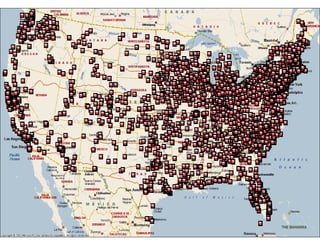
Carol Haraden, PhD

Vice President, Institute for Healthcare


Improvement

Madrid, 26 November, 2008
Defects Abound!

• 45% of needed care is not received
•	 22% of chronically ill adults report a “serious
error” in their care
• 74% of chronically ill adults say the system needs

“fundamental change” or “complete rebuilding”

•	 Case-mix adjusted hospital death rates vary
400%
• Resource use in the last six months of life varies
>500% among 77 top-rated US hospitals
•	 Per capita annual health care costs:
─ US: ~$7000
─ Sweden: ~$2800
2
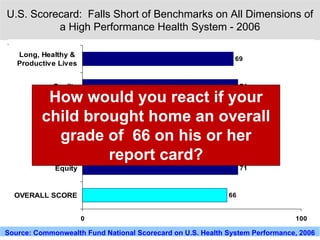
U.S. Scorecard: Falls Short of Benchmarks on All Dimensions of


a High Performance Health System - 2006

69
71
71
66
0 100
Long, Healthy &
Productive Lives
Q lit
Equity
OVERALL SCORE
Source: Commonwealth Fund National Scorecard on U.S. Health System Performance, 2006
How would you react if your
child brought home an overall
grade of 66 on his or her
report card?
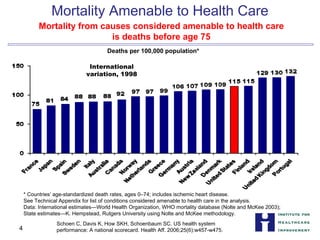
Mortality Amenable to Health Care

Mortality from causes considered amenable to health care
is deaths before age 75
Deaths per 100,000 population*
International
variation, 1998
* Countries’ age-standardized death rates, ages 0–74; includes ischemic heart disease.

See Technical Appendix for list of conditions considered amenable to health care in the analysis.

Data: International estimates—World Health Organization, WHO mortality database (Nolte and McKee 2003);

State estimates—K. Hempstead, Rutgers University using Nolte and McKee methodology.
Schoen C, Davis K, How SKH, Schoenbaum SC. US health system
performance: A national scorecard. Health Aff. 2006;25(6):w457-w475.4
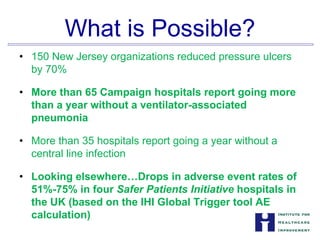
What is Possible?


•	 150 New Jersey organizations reduced pressure ulcers
by 70%
•	 More than 65 Campaign hospitals report going more
than a year without a ventilator-associated
pneumonia
•	 More than 35 hospitals report going a year without a
central line infection
•	 Looking elsewhere…Drops in adverse event rates of
51%-75% in four Safer Patients Initiative hospitals in
the UK (based on the IHI Global Trigger tool AE
calculation)
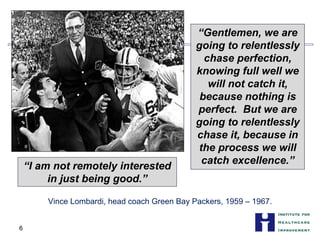
“Gentlemen, we are
going to relentlessly
chase perfection,
knowing full well we
will not catch it,
because nothing is
perfect. But we are
going to relentlessly
chase it, because in
the process we will
catch excellence.”
“I am not remotely interested
in just being good.”
Vince Lombardi, head coach Green Bay Packers, 1959 – 1967.
6
Campaign Objectives
─ Avoid five million incidents of harm over the next 24
months
─ Enroll more than 4,000 hospitals and their


communities in this work

─ Strengthen the Campaign’s national infrastructure for
change and transform it into a national asset
─ Raise the profile of the problem - and hospitals’
proactive response - with a larger, public audience
The 100,000 Lives Campaign “Planks”

1.	 Deployment of Rapid Response


Teams

2.	 Delivery of Reliable, Evidence-Based
Care for Acute Myocardial Infarction
3. Medication Reconciliation
4. Prevention of Central Line Infections
5. Prevention of Surgical Site Infections
6.	 Prevention of Ventilator-Associated
Pneumonias
8
Six Additional Planks
7.Prevent Pressure Ulcers
8.Reduce Methicillin-Resistant Staphylococcus
Aureus (MRSA) Infection
9.Prevent Harm from High-Alert Medications
10.Reduce Surgical Complications (the Surgical
Care Improvement Project (SCIP))
11.Deliver Reliable, Evidence-Based Care for
Congestive Heart Failure
12.Get Boards on Board
9
The 5 Million Lives Campaign

Campaign Objectives
─ Avoid five million incidents of harm over the next 24
months
─ Enroll more than 4,000 hospitals and their


communities in this work

─ Strengthen the Campaign’s national infrastructure


for change and transform it into a national asset

─ Raise the profile of the problem - and hospitals’
proactive response - with a larger, public audience
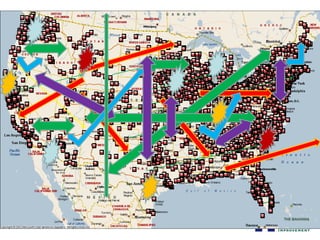
The 5 Million Lives Campaign

Campaign Objectives
─ Avoid five million incidents of harm over the next 24
months
─ Enroll more than 4,000 hospitals and their


communities in this work

─ Strengthen the Campaign’s national infrastructure for
change and transform it into a national asset
─ Raise the profile of the problem - and hospitals’
proactive response - with a larger, public
audience
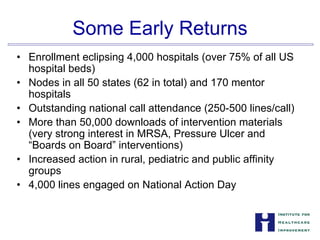
Some Early Returns

•	 Enrollment eclipsing 4,000 hospitals (over 75% of all US
hospital beds)
•	 Nodes in all 50 states (62 in total) and 170 mentor
hospitals
•	 Outstanding national call attendance (250-500 lines/call)

•	 More than 50,000 downloads of intervention materials
(very strong interest in MRSA, Pressure Ulcer and
“Boards on Board” interventions)
•	 Increased action in rural, pediatric and public affinity
groups
•	 4,000 lines engaged on National Action Day
The Big Question!

Will we collectively
be able to drive a
massive national
transformation to
reduce harm?
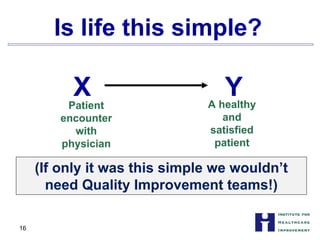
Is life this simple?

X YPatient A healthy
encounter and
with satisfied
physician patient
(If only it was this simple we wouldn’t
need Quality Improvement teams!)
16
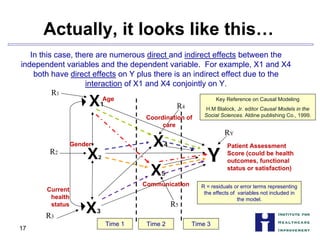
Actually, it looks like this…

In this case, there are numerous direct and indirect effects between the
independent variables and the dependent variable. For example, X1 and X4
both have direct effects on Y plus there is an indirect effect due to the
interaction of X1 and X4 conjointly on Y.
17
Y
X3
X2
X1
X5
X4
Time 1 Time 3Time 2
R3
R2
R1
R5
R4
RY
Key Reference on Causal Modeling
H.M Blalock, Jr. editor Causal Models in the
Social Sciences. Aldine publishing Co., 1999.
R = residuals or error terms representing
the effects of variables not included in
the model.
Coordination of
care
Age
Gender
Communication
Patient Assessment
Score (could be health
outcomes, functional
status or satisfaction)
Current
health
status
Does Improving Safety Save Money?

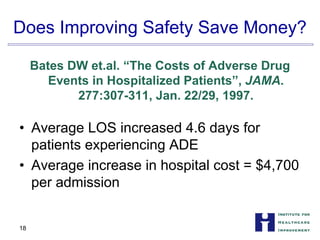
Bates DW et.al. “The Costs of Adverse Drug
Events in Hospitalized Patients”, JAMA.
277:307-311, Jan. 22/29, 1997.
• Average LOS increased 4.6 days for


patients experiencing ADE

• Average increase in hospital cost = $4,700
per admission
18
Does Improving Safety Save Money?

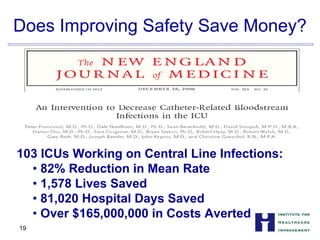
103 ICUs Working on Central Line Infections:


• 82% Reduction in Mean Rate
• 1,578 Lives Saved
• 81,020 Hospital Days Saved
• Over $165,000,000 in Costs Averted
19
Does Improving Safety Save Money?

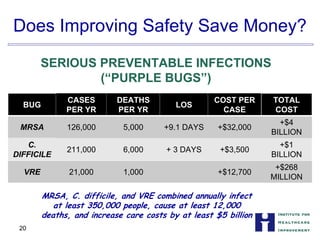
SERIOUS PREVENTABLE INFECTIONS

(“PURPLE BUGS”)

BUG
CASES
PER YR
DEATHS
PER YR
LOS
COST PER
CASE
TOTAL
COST
MRSA 126,000 5,000 +9.1 DAYS +$32,000
+$4
BILLION
C.
DIFFICILE
211,000 6,000 + 3 DAYS +$3,500
+$1
BILLION
VRE 21,000 1,000 +$12,700
+$268
MILLION
MRSA, C. difficile, and VRE combined annually infect


at least 350,000 people, cause at least 12,000


deaths, and increase care costs by at least $5 billion


20
What are the Key Elements of Success


in an Individual Facility?

Will
• Board and executive take responsibility for
quality and set crisp, public aims
• Leadership removes barriers to progress and
celebrates success
• Clear understanding of the relationship between
cost and quality
• Honest, regular review of data
• Clinician leadership
• Frontline ownership (“hearts and minds”)
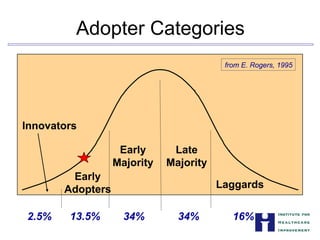
Adopter Categories

Early
Adopters
Innovators
Early
Majority
Late
Majority
Laggards
from E. Rogers, 1995
2.5% 13.5% 34% 34% 16%
What are the Key Elements of Success in


an Individual Facility?
Ideas
• Active scan of the evidence-base
• Transparent, data-driven analysis of
outcomes
• Vibrant sharing and networking


(ecosystems not hierarchies)

• Best-in-class knowledge management
What are the Key Elements of Success in


an Individual Facility?

Execution
• Prioritization
• Proper resourcing and structures
• Effective system for iterative learning and
review (i.e., building organizational capacity)
• Project management skill (skill in statistics,
systems analysis and group process
management)
What are the Key Elements of Success


in a Nation?

•	 Leadership attention and fidelity to crisp aims

•	 Optimism
•	 Joy and “heart”
•	 Frontline ownership
•	 Simplicity and practical direction
•	 Sophisticated coordination among all
stakeholders
•	 Vibrant sharing and networking
• Understanding the “messiness of life”
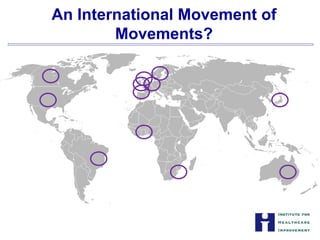
An International Movement of


Movements?
gue goal-
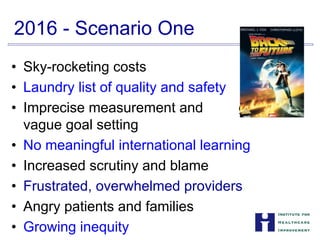
2016 - Scenario One
• Sky-rocketing costs
• Laundry list of quality and safety
• Imprecise measurement and
vague goal setting
• No meaningful international learning
• Increased scrutiny and blame
• Frustrated, overwhelmed providers
• Angry patients and families
• Growing inequity
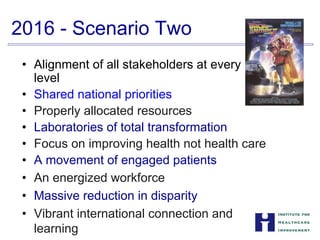
2016 - Scenario Two
• Alignment of all stakeholders at every


level

• Shared national priorities
• Properly allocated resources
• Laboratories of total transformation
• Focus on improving health not health care
• A movement of engaged patients
• An energized workforce
• Massive reduction in disparity
•	 Vibrant international connection and


learning
Why Optimism?

• We need a detailed, hopeful vision.
• Incredible care-givers and innovators across the
nation and world.
• Our families are aging, getting sick, managing
chronic disease (this is very personal…)
• It is hard work but it is possible.
• “I dwell in Possibility…” – Emily Dickinson

The Five Million Lives Campaign

  • 1.
    Carol Haraden, PhD VicePresident, Institute for Healthcare Improvement Madrid, 26 November, 2008
  • 2.
    Defects Abound! • 45%of needed care is not received • 22% of chronically ill adults report a “serious error” in their care • 74% of chronically ill adults say the system needs “fundamental change” or “complete rebuilding” • Case-mix adjusted hospital death rates vary 400% • Resource use in the last six months of life varies >500% among 77 top-rated US hospitals • Per capita annual health care costs: ─ US: ~$7000 ─ Sweden: ~$2800 2
  • 3.
    U.S. Scorecard: FallsShort of Benchmarks on All Dimensions of a High Performance Health System - 2006 69 71 71 66 0 100 Long, Healthy & Productive Lives Q lit Equity OVERALL SCORE Source: Commonwealth Fund National Scorecard on U.S. Health System Performance, 2006 How would you react if your child brought home an overall grade of 66 on his or her report card?
  • 4.
    Mortality Amenable toHealth Care Mortality from causes considered amenable to health care is deaths before age 75 Deaths per 100,000 population* International variation, 1998 * Countries’ age-standardized death rates, ages 0–74; includes ischemic heart disease. See Technical Appendix for list of conditions considered amenable to health care in the analysis. Data: International estimates—World Health Organization, WHO mortality database (Nolte and McKee 2003); State estimates—K. Hempstead, Rutgers University using Nolte and McKee methodology. Schoen C, Davis K, How SKH, Schoenbaum SC. US health system performance: A national scorecard. Health Aff. 2006;25(6):w457-w475.4
  • 5.
    What is Possible? • 150 New Jersey organizations reduced pressure ulcers by 70% • More than 65 Campaign hospitals report going more than a year without a ventilator-associated pneumonia • More than 35 hospitals report going a year without a central line infection • Looking elsewhere…Drops in adverse event rates of 51%-75% in four Safer Patients Initiative hospitals in the UK (based on the IHI Global Trigger tool AE calculation)
  • 6.
    “Gentlemen, we are goingto relentlessly chase perfection, knowing full well we will not catch it, because nothing is perfect. But we are going to relentlessly chase it, because in the process we will catch excellence.” “I am not remotely interested in just being good.” Vince Lombardi, head coach Green Bay Packers, 1959 – 1967. 6
  • 7.
    Campaign Objectives ─ Avoidfive million incidents of harm over the next 24 months ─ Enroll more than 4,000 hospitals and their communities in this work ─ Strengthen the Campaign’s national infrastructure for change and transform it into a national asset ─ Raise the profile of the problem - and hospitals’ proactive response - with a larger, public audience
  • 8.
    The 100,000 LivesCampaign “Planks” 1. Deployment of Rapid Response Teams 2. Delivery of Reliable, Evidence-Based Care for Acute Myocardial Infarction 3. Medication Reconciliation 4. Prevention of Central Line Infections 5. Prevention of Surgical Site Infections 6. Prevention of Ventilator-Associated Pneumonias 8
  • 9.
    Six Additional Planks 7.PreventPressure Ulcers 8.Reduce Methicillin-Resistant Staphylococcus Aureus (MRSA) Infection 9.Prevent Harm from High-Alert Medications 10.Reduce Surgical Complications (the Surgical Care Improvement Project (SCIP)) 11.Deliver Reliable, Evidence-Based Care for Congestive Heart Failure 12.Get Boards on Board 9
  • 11.
    The 5 MillionLives Campaign Campaign Objectives ─ Avoid five million incidents of harm over the next 24 months ─ Enroll more than 4,000 hospitals and their communities in this work ─ Strengthen the Campaign’s national infrastructure for change and transform it into a national asset ─ Raise the profile of the problem - and hospitals’ proactive response - with a larger, public audience
  • 13.
    The 5 MillionLives Campaign Campaign Objectives ─ Avoid five million incidents of harm over the next 24 months ─ Enroll more than 4,000 hospitals and their communities in this work ─ Strengthen the Campaign’s national infrastructure for change and transform it into a national asset ─ Raise the profile of the problem - and hospitals’ proactive response - with a larger, public audience
  • 14.
    Some Early Returns • Enrollment eclipsing 4,000 hospitals (over 75% of all US hospital beds) • Nodes in all 50 states (62 in total) and 170 mentor hospitals • Outstanding national call attendance (250-500 lines/call) • More than 50,000 downloads of intervention materials (very strong interest in MRSA, Pressure Ulcer and “Boards on Board” interventions) • Increased action in rural, pediatric and public affinity groups • 4,000 lines engaged on National Action Day
  • 15.
    The Big Question! Willwe collectively be able to drive a massive national transformation to reduce harm?
  • 16.
    Is life thissimple? X YPatient A healthy encounter and with satisfied physician patient (If only it was this simple we wouldn’t need Quality Improvement teams!) 16
  • 17.
    Actually, it lookslike this… In this case, there are numerous direct and indirect effects between the independent variables and the dependent variable. For example, X1 and X4 both have direct effects on Y plus there is an indirect effect due to the interaction of X1 and X4 conjointly on Y. 17 Y X3 X2 X1 X5 X4 Time 1 Time 3Time 2 R3 R2 R1 R5 R4 RY Key Reference on Causal Modeling H.M Blalock, Jr. editor Causal Models in the Social Sciences. Aldine publishing Co., 1999. R = residuals or error terms representing the effects of variables not included in the model. Coordination of care Age Gender Communication Patient Assessment Score (could be health outcomes, functional status or satisfaction) Current health status
  • 18.
    Does Improving SafetySave Money? Bates DW et.al. “The Costs of Adverse Drug Events in Hospitalized Patients”, JAMA. 277:307-311, Jan. 22/29, 1997. • Average LOS increased 4.6 days for patients experiencing ADE • Average increase in hospital cost = $4,700 per admission 18
  • 19.
    Does Improving SafetySave Money? 103 ICUs Working on Central Line Infections: • 82% Reduction in Mean Rate • 1,578 Lives Saved • 81,020 Hospital Days Saved • Over $165,000,000 in Costs Averted 19
  • 20.
    Does Improving SafetySave Money? SERIOUS PREVENTABLE INFECTIONS (“PURPLE BUGS”) BUG CASES PER YR DEATHS PER YR LOS COST PER CASE TOTAL COST MRSA 126,000 5,000 +9.1 DAYS +$32,000 +$4 BILLION C. DIFFICILE 211,000 6,000 + 3 DAYS +$3,500 +$1 BILLION VRE 21,000 1,000 +$12,700 +$268 MILLION MRSA, C. difficile, and VRE combined annually infect at least 350,000 people, cause at least 12,000 deaths, and increase care costs by at least $5 billion 20
  • 21.
    What are theKey Elements of Success in an Individual Facility? Will • Board and executive take responsibility for quality and set crisp, public aims • Leadership removes barriers to progress and celebrates success • Clear understanding of the relationship between cost and quality • Honest, regular review of data • Clinician leadership • Frontline ownership (“hearts and minds”)
  • 22.
  • 23.
    What are theKey Elements of Success in an Individual Facility? Ideas • Active scan of the evidence-base • Transparent, data-driven analysis of outcomes • Vibrant sharing and networking (ecosystems not hierarchies) • Best-in-class knowledge management
  • 24.
    What are theKey Elements of Success in an Individual Facility? Execution • Prioritization • Proper resourcing and structures • Effective system for iterative learning and review (i.e., building organizational capacity) • Project management skill (skill in statistics, systems analysis and group process management)
  • 25.
    What are theKey Elements of Success in a Nation? • Leadership attention and fidelity to crisp aims • Optimism • Joy and “heart” • Frontline ownership • Simplicity and practical direction • Sophisticated coordination among all stakeholders • Vibrant sharing and networking • Understanding the “messiness of life”
  • 26.
  • 27.
    gue goal- 2016 -Scenario One • Sky-rocketing costs • Laundry list of quality and safety • Imprecise measurement and vague goal setting • No meaningful international learning • Increased scrutiny and blame • Frustrated, overwhelmed providers • Angry patients and families • Growing inequity
  • 28.
    2016 - ScenarioTwo • Alignment of all stakeholders at every level • Shared national priorities • Properly allocated resources • Laboratories of total transformation • Focus on improving health not health care • A movement of engaged patients • An energized workforce • Massive reduction in disparity • Vibrant international connection and learning
  • 29.
    Why Optimism? • Weneed a detailed, hopeful vision. • Incredible care-givers and innovators across the nation and world. • Our families are aging, getting sick, managing chronic disease (this is very personal…) • It is hard work but it is possible. • “I dwell in Possibility…” – Emily Dickinson