Getting Started At the
National Level:
From Demonstration
to Spread
1st Symposium IHI-Einstein: Implementation and
Scale Up of Patient Safety Programs
November 4, 2013
São Paulo, Brazil
Derek Feeley
Executive Vice
President
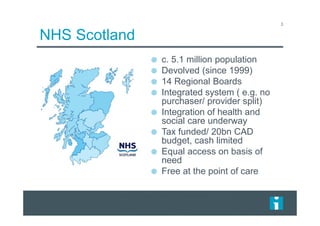
NHS Scotland
3
c. 5.1 million population
Devolved (since 1999)
14 Regional Boards
Integrated system ( e.g. no
purchaser/ provider split)
Integration of health and
social care underway
Tax funded/ 20bn CAD
budget, cash limited
Equal access on basis of
need
Free at the point of care
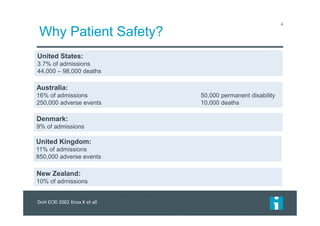
Why Patient Safety?
4
United States:
3.7% of admissions
44,000 – 98,000 deaths
United States:
3.7% of admissions
44,000 – 98,000 deaths
Australia:
16% of admissions 50,000 permanent disability
250,000 adverse events 10,000 deaths
Australia:
16% of admissions 50,000 permanent disability
250,000 adverse events 10,000 deaths
Denmark:
9% of admissions
Denmark:
9% of admissions
New Zealand:
10% of admissions
New Zealand:
10% of admissions
United Kingdom:
11% of admissions
850,000 adverse events
United Kingdom:
11% of admissions
850,000 adverse events
DoH ECRI 2002 Knox K et all
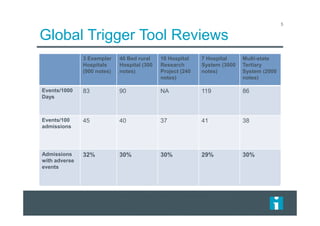
Global Trigger Tool Reviews
5
3 Exemplar
Hospitals
(900 notes)
40 Bed rural
Hospital (300
notes)
10 Hospital
Research
Project (240
notes)
7 Hospital
System (3000
notes)
Multi-state
Tertiary
System (2000
notes)
Events/1000
Days
83 90 NA 119 86
Events/100
admissions
45 40 37 41 38
Admissions
with adverse
events
32% 30% 30% 29% 30%
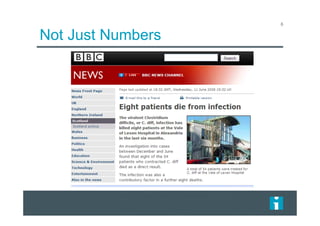
Not Just Numbers
6
So what do we know?
At least 10% of patients admitted to hospital suffer harm
Traditional incident reporting – tip of the iceberg
Variation in mortality rates
Human beings will always make mistakes
Lack of standardisation – clinician preference
Best known science is not reliably applied
Lack of Reliable Processes Create….
Islands of great care in a sea of variation
Inconsistent performance & outcomes
Chaos as clinicians create ‘work-arounds’ just to get the
work done
A culture where it is difficult to learn and improve
Care that is more complex and often more unsafe
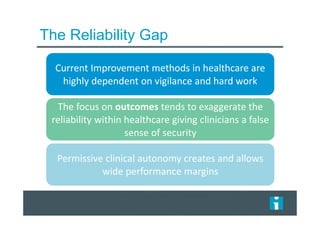
Current Improvement methods in healthcare are
highly dependent on vigilance and hard work
The focus on outcomes tends to exaggerate the
reliability within healthcare giving clinicians a false
sense of security
Permissive clinical autonomy creates and allows
wide performance margins
The Reliability Gap
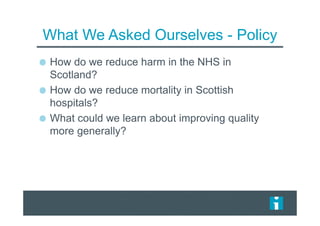
What We Asked Ourselves - Policy
How do we reduce harm in the NHS in
Scotland?
How do we reduce mortality in Scottish
hospitals?
What could we learn about improving quality
more generally?
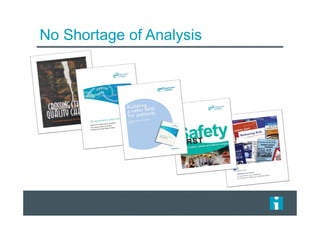
No Shortage of Analysis
It’s complicated……
12
“Too bad all the people who know how to run the country
are busy driving cabs and cutting hair.”
- George Burns
Updated for 2013:
“It's too bad that everyone who has a solution for
everything is at home commenting on the internet.”
- Twitter user Rasta Pasta (@rastahipsta)
Policy Options
Do what we’ve always done
Let’s get more data
Run a pilot project
Run a campaign
Let Boards and hospitals decide what to do
Run a mandatory national improvement
program
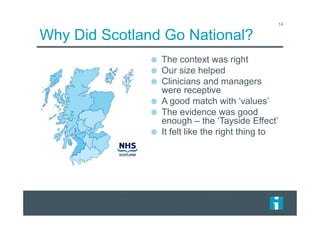
Why Did Scotland Go National?
14
The context was right
Our size helped
Clinicians and managers
were receptive
A good match with ‘values’
The evidence was good
enough – the ‘Tayside Effect’
It felt like the right thing to
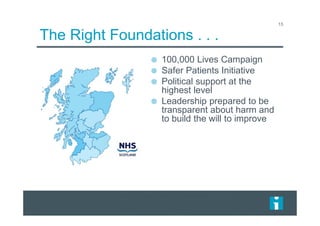
The Right Foundations . . .
15
100,000 Lives Campaign
Safer Patients Initiative
Political support at the
highest level
Leadership prepared to be
transparent about harm and
to build the will to improve
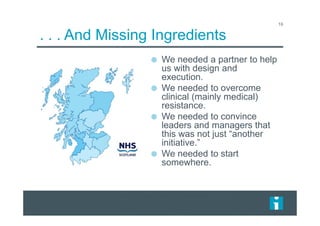
. . . And Missing Ingredients
16
We needed a partner to help
us with design and
execution.
We needed to overcome
clinical (mainly medical)
resistance.
We needed to convince
leaders and managers that
this was not just “another
initiative.”
We needed to start
somewhere.
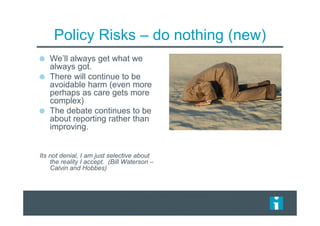
Policy Risks – do nothing (new)
We’ll always get what we
always got.
There will continue to be
avoidable harm (even more
perhaps as care gets more
complex)
The debate continues to be
about reporting rather than
improving.
Its not denial, I am just selective about
the reality I accept. (Bill Waterson –
Calvin and Hobbes)
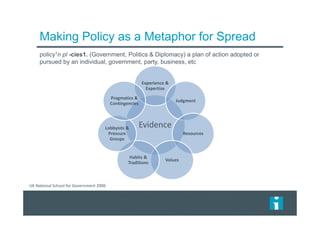
Making Policy as a Metaphor for Spread
policy1n pl -cies1. (Government, Politics & Diplomacy) a plan of action adopted or
pursued by an individual, government, party, business, etc
UK National School for Government 2006
Evidence
Experience &
Expertise
Judgment
Resources
Values
Habits &
Traditions
Lobbyists &
Pressure
Groups
Pragmatics &
Contingencies
Spread and Sustainability
Spread = The process through which new working
methods developed in one setting are adopted, perhaps
with appropriate modifications, in other organizational
contexts
Sustainability = The process through which new working
methods, performance enhancement, and continuous
improvements are maintained for a period appropriate to a
given context
Buchanan D, Fitzgerald L, Ketley D. The Sustainability and Spread of Organizational Change:
Modernizing healthcare. Abingdon, Oxon: Routledge; 2007.
“Up to 70% of improvement
projects never spread.”
Eccles R, Miller Perkins K, Serafeim G. How to
Become a Sustainable Company. MIT Sloan
Management Review 2012;
53(4): 43-50.
Planning for Spread
Preparing for spread
Establishing an aim for spread
Developing an initial spread plan
Executing and refining the spread plan
In Scotland the spread plan was to start with all, just not
with everything, everywhere. We told hospitals to start
where they were good and to get to complete coverage in 2
years.
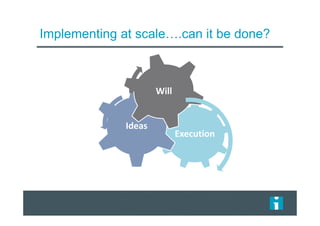
Implementing at scale….can it be done?
Execution
Ideas
Will
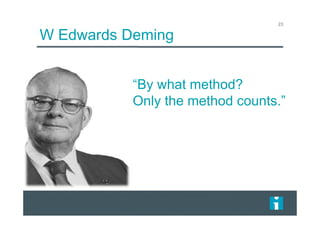
W Edwards Deming
“By what method?
Only the method counts.”
23
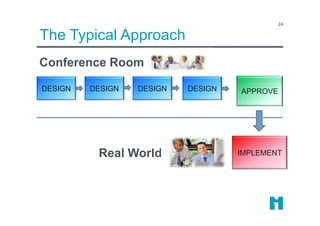
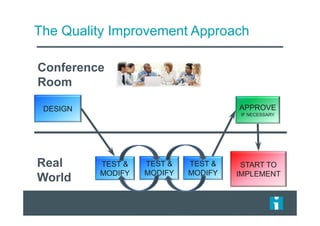
The Typical Approach
24
Conference RoomConference Room
DESIGN DESIGN DESIGN DESIGN APPROVE
IMPLEMENTReal WorldReal World
DESIGN
TEST &
MODIFY
TEST &
MODIFY
APPROVE
IF NECESSARY
Conference
Room
Conference
Room
Real
World
Real
World
TEST &
MODIFY
The Quality Improvement Approach
START TO
IMPLEMENT
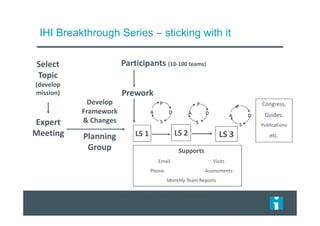
IHI Breakthrough Series – sticking with it
Select
Topic
(develop
mission)
Planning
Group
Develop
Framework
& Changes
Participants (10-100 teams)
Prework
LS 1
P
S
A D
P
S
A D
LS 3LS 2
Supports
Email Visits
Phone Assessments
Monthly Team Reports
Congress,
Guides,
Publications
etc.
A D
P
SExpert
Meeting
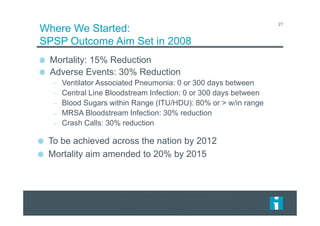
Where We Started:
SPSP Outcome Aim Set in 2008
Mortality: 15% Reduction
Adverse Events: 30% Reduction
– Ventilator Associated Pneumonia: 0 or 300 days between
– Central Line Bloodstream Infection: 0 or 300 days between
– Blood Sugars within Range (ITU/HDU): 80% or > w/in range
– MRSA Bloodstream Infection: 30% reduction
– Crash Calls: 30% reduction
27
To be achieved across the nation by 2012
Mortality aim amended to 20% by 2015
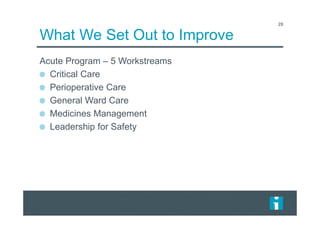
What We Set Out to Improve
Acute Program – 5 Workstreams
Critical Care
Perioperative Care
General Ward Care
Medicines Management
Leadership for Safety
28
0,8
0,9
1,0
1,1
Oct-Dec
2006
Apr-Jun
2007
Oct-Dec
2007
Apr-Jun
2008
Oct-Dec
2008
Apr-Jun
2009
Oct-Dec
2009
Apr-Jun
2010
Oct-Dec
2010
Apr-Jun
2011
Oct-Dec
2011
Apr-Jun
2012
StandardisedMortalityRatio
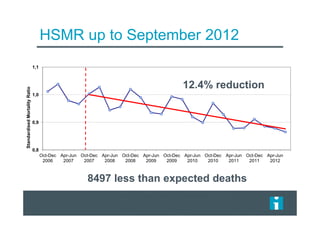
HSMR up to September 2012
8497 less than expected deaths
12.4% reduction
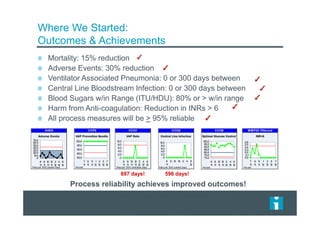
Mortality: 15% reduction
Adverse Events: 30% reduction
Ventilator Associated Pneumonia: 0 or 300 days between
Central Line Bloodstream Infection: 0 or 300 days between
Blood Sugars w/in Range (ITU/HDU): 80% or > w/in range
Harm from Anti-coagulation: Reduction in INRs > 6
All process measures will be > 95% reliable
AHO3
Adverse Events
Rate per 1000 patient days
.0
10.0
20.0
30.0
40.0
50.0
60.0
70.0
6
11
8
11
10
11
12
11
2
12
4
12
6
12
AHO3
Adverse Events
Rate per 1000 patient days
.0
10.0
20.0
30.0
40.0
50.0
60.0
70.0
6
11
8
11
10
11
12
11
2
12
4
12
6
12
CCP2
VAP Prevention Bundle
Percent
80.0
85.0
90.0
95.0
100.0
7
11
9
11
11
11
1
12
3
12
5
12
7
12
CCP2
VAP Prevention Bundle
Percent
80.0
85.0
90.0
95.0
100.0
7
11
9
11
11
11
1
12
3
12
5
12
7
12
CCO1
VAP Rate
Rate per 1000 ventilated days
.0
2.0
4.0
6.0
8.0
10.0
6
11
8
11
10
11
12
11
2
12
4
12
6
12
CCO1
VAP Rate
Rate per 1000 ventilated days
.0
2.0
4.0
6.0
8.0
10.0
6
11
8
11
10
11
12
11
2
12
4
12
6
12
CCO2
Central Line Infection
Rate per 1000 patient days
.0
2.0
4.0
6.0
8.0
10.0
6
11
8 10 12 2 4 6
12
CCO2
Central Line Infection
Rate per 1000 patient days
.0
2.0
4.0
6.0
8.0
10.0
6
11
8 10 12 2 4 6
12
CCO6
Optimal Glucose Control
Percent
70.0
75.0
80.0
85.0
90.0
95.0
100.0
6
11
8
11
10
11
12
11
2
12
4
12
6
12
CCO6
Optimal Glucose Control
Percent
70.0
75.0
80.0
85.0
90.0
95.0
100.0
6
11
8
11
10
11
12
11
2
12
4
12
6
12
MMP3C Filtered
INR>6
Percent
0.0
0.1
0.2
0.3
0.4
0.5
0.6
7
11
9
11
11
11
1
12
3
12
5
12
7
12
MMP3C Filtered
INR>6
Percent
0.0
0.1
0.2
0.3
0.4
0.5
0.6
7
11
9
11
11
11
1
12
3
12
5
12
7
12
Process reliability achieves improved outcomes!
697 days! 596 days!
Where We Started:
Outcomes & Achievements
Safety is Contagious – In A Good Way
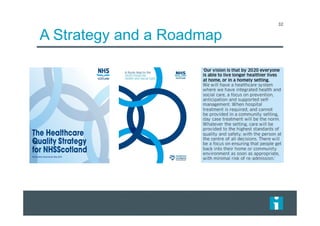
A Strategy and a Roadmap
32
33
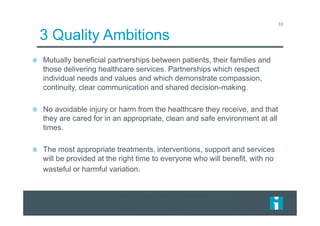
3 Quality Ambitions
Mutually beneficial partnerships between patients, their families and
those delivering healthcare services. Partnerships which respect
individual needs and values and which demonstrate compassion,
continuity, clear communication and shared decision-making.
No avoidable injury or harm from the healthcare they receive, and that
they are cared for in an appropriate, clean and safe environment at all
times.
The most appropriate treatments, interventions, support and services
will be provided at the right time to everyone who will benefit, with no
wasteful or harmful variation.
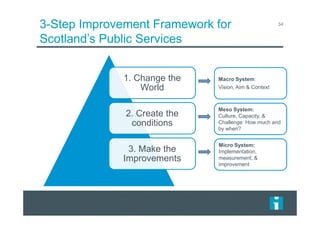
3-Step Improvement Framework for
Scotland’s Public Services
34
1. Change the
World
2. Create the
conditions
3. Make the
Improvements
Macro System:
Vision, Aim & Context
Meso System:
Culture, Capacity, &
Challenge: How much and
by when?
Micro System:
Implementation,
measurement, &
improvement
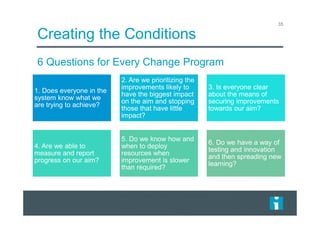
Creating the Conditions
6 Questions for Every Change Program
35
1. Does everyone in the
system know what we
are trying to achieve?
2. Are we prioritizing the
improvements likely to
have the biggest impact
on the aim and stopping
those that have little
impact?
3. Is everyone clear
about the means of
securing improvements
towards our aim?
4. Are we able to
measure and report
progress on our aim?
5. Do we know how and
when to deploy
resources when
improvement is slower
than required?
6. Do we have a way of
testing and innovation
and then spreading new
learning?
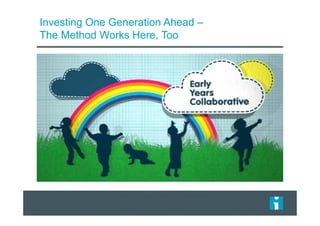
Investing One Generation Ahead –
The Method Works Here, Too
The Early Years Collaborative - Ambition
To make Scotland the best place in the world to grow up in
by improving outcomes, and reducing inequalities, for all
babies, children, mothers, fathers and families across
Scotland to ensure that all children have the best start in
life and are ready to succeed.
The Early Years Collaborative - Aims
1. To ensure that women experience positive pregnancies which result in the
birth of more healthy babies as evidence by a reduction of 15% in the rates
of stillbirths (from 4.9 per 1,000 births in 2010 to 4.3 per 1,000 births in 2015)
and infant mortality (from 3.7 per 1,000 live births in 2010 to 3.1 per 1,000 live
births in 2015).
2. To ensure that 85% of all children with each Community Planning
Partnership have reached all of the expected development milestones at
the time of the child’s 27-30 month child health review, by end-2016.
3. To ensure that 90% of all children within each Community Planning
Partnership have reached all of the expected development milestones at
the time the child starts primary school, by end-2017.
Front Line Staff – How Did They Do It?
Get goals
Get bold
Get together
Get a method (and
stick with it)
Get patients and
families
Get the facts
Get to the field
Get a clock
Get the numbers
Get the stories
1941, William A. Foster
"Quality is never an accident; it
is always the result of high
intention, sincere effort,
intelligent direction and skillful
execution; it represents the wise
choice of many alternatives.”

Getting started at the national level from demonstration to spread

  • 1.
    Getting Started Atthe National Level: From Demonstration to Spread 1st Symposium IHI-Einstein: Implementation and Scale Up of Patient Safety Programs November 4, 2013 São Paulo, Brazil Derek Feeley Executive Vice President
  • 3.
    NHS Scotland 3 c. 5.1million population Devolved (since 1999) 14 Regional Boards Integrated system ( e.g. no purchaser/ provider split) Integration of health and social care underway Tax funded/ 20bn CAD budget, cash limited Equal access on basis of need Free at the point of care
  • 4.
    Why Patient Safety? 4 UnitedStates: 3.7% of admissions 44,000 – 98,000 deaths United States: 3.7% of admissions 44,000 – 98,000 deaths Australia: 16% of admissions 50,000 permanent disability 250,000 adverse events 10,000 deaths Australia: 16% of admissions 50,000 permanent disability 250,000 adverse events 10,000 deaths Denmark: 9% of admissions Denmark: 9% of admissions New Zealand: 10% of admissions New Zealand: 10% of admissions United Kingdom: 11% of admissions 850,000 adverse events United Kingdom: 11% of admissions 850,000 adverse events DoH ECRI 2002 Knox K et all
  • 5.
    Global Trigger ToolReviews 5 3 Exemplar Hospitals (900 notes) 40 Bed rural Hospital (300 notes) 10 Hospital Research Project (240 notes) 7 Hospital System (3000 notes) Multi-state Tertiary System (2000 notes) Events/1000 Days 83 90 NA 119 86 Events/100 admissions 45 40 37 41 38 Admissions with adverse events 32% 30% 30% 29% 30%
  • 6.
  • 7.
    So what dowe know? At least 10% of patients admitted to hospital suffer harm Traditional incident reporting – tip of the iceberg Variation in mortality rates Human beings will always make mistakes Lack of standardisation – clinician preference Best known science is not reliably applied
  • 8.
    Lack of ReliableProcesses Create…. Islands of great care in a sea of variation Inconsistent performance & outcomes Chaos as clinicians create ‘work-arounds’ just to get the work done A culture where it is difficult to learn and improve Care that is more complex and often more unsafe
  • 9.
    Current Improvement methodsin healthcare are highly dependent on vigilance and hard work The focus on outcomes tends to exaggerate the reliability within healthcare giving clinicians a false sense of security Permissive clinical autonomy creates and allows wide performance margins The Reliability Gap
  • 10.
    What We AskedOurselves - Policy How do we reduce harm in the NHS in Scotland? How do we reduce mortality in Scottish hospitals? What could we learn about improving quality more generally?
  • 11.
  • 12.
    It’s complicated…… 12 “Too badall the people who know how to run the country are busy driving cabs and cutting hair.” - George Burns Updated for 2013: “It's too bad that everyone who has a solution for everything is at home commenting on the internet.” - Twitter user Rasta Pasta (@rastahipsta)
  • 13.
    Policy Options Do whatwe’ve always done Let’s get more data Run a pilot project Run a campaign Let Boards and hospitals decide what to do Run a mandatory national improvement program
  • 14.
    Why Did ScotlandGo National? 14 The context was right Our size helped Clinicians and managers were receptive A good match with ‘values’ The evidence was good enough – the ‘Tayside Effect’ It felt like the right thing to
  • 15.
    The Right Foundations. . . 15 100,000 Lives Campaign Safer Patients Initiative Political support at the highest level Leadership prepared to be transparent about harm and to build the will to improve
  • 16.
    . . .And Missing Ingredients 16 We needed a partner to help us with design and execution. We needed to overcome clinical (mainly medical) resistance. We needed to convince leaders and managers that this was not just “another initiative.” We needed to start somewhere.
  • 17.
    Policy Risks –do nothing (new) We’ll always get what we always got. There will continue to be avoidable harm (even more perhaps as care gets more complex) The debate continues to be about reporting rather than improving. Its not denial, I am just selective about the reality I accept. (Bill Waterson – Calvin and Hobbes)
  • 18.
    Making Policy asa Metaphor for Spread policy1n pl -cies1. (Government, Politics & Diplomacy) a plan of action adopted or pursued by an individual, government, party, business, etc UK National School for Government 2006 Evidence Experience & Expertise Judgment Resources Values Habits & Traditions Lobbyists & Pressure Groups Pragmatics & Contingencies
  • 19.
    Spread and Sustainability Spread= The process through which new working methods developed in one setting are adopted, perhaps with appropriate modifications, in other organizational contexts Sustainability = The process through which new working methods, performance enhancement, and continuous improvements are maintained for a period appropriate to a given context Buchanan D, Fitzgerald L, Ketley D. The Sustainability and Spread of Organizational Change: Modernizing healthcare. Abingdon, Oxon: Routledge; 2007.
  • 20.
    “Up to 70%of improvement projects never spread.” Eccles R, Miller Perkins K, Serafeim G. How to Become a Sustainable Company. MIT Sloan Management Review 2012; 53(4): 43-50.
  • 21.
    Planning for Spread Preparingfor spread Establishing an aim for spread Developing an initial spread plan Executing and refining the spread plan In Scotland the spread plan was to start with all, just not with everything, everywhere. We told hospitals to start where they were good and to get to complete coverage in 2 years.
  • 22.
    Implementing at scale….canit be done? Execution Ideas Will
  • 23.
    W Edwards Deming “Bywhat method? Only the method counts.” 23
  • 24.
    The Typical Approach 24 ConferenceRoomConference Room DESIGN DESIGN DESIGN DESIGN APPROVE IMPLEMENTReal WorldReal World
  • 25.
    DESIGN TEST & MODIFY TEST & MODIFY APPROVE IFNECESSARY Conference Room Conference Room Real World Real World TEST & MODIFY The Quality Improvement Approach START TO IMPLEMENT
  • 26.
    IHI Breakthrough Series– sticking with it Select Topic (develop mission) Planning Group Develop Framework & Changes Participants (10-100 teams) Prework LS 1 P S A D P S A D LS 3LS 2 Supports Email Visits Phone Assessments Monthly Team Reports Congress, Guides, Publications etc. A D P SExpert Meeting
  • 27.
    Where We Started: SPSPOutcome Aim Set in 2008 Mortality: 15% Reduction Adverse Events: 30% Reduction – Ventilator Associated Pneumonia: 0 or 300 days between – Central Line Bloodstream Infection: 0 or 300 days between – Blood Sugars within Range (ITU/HDU): 80% or > w/in range – MRSA Bloodstream Infection: 30% reduction – Crash Calls: 30% reduction 27 To be achieved across the nation by 2012 Mortality aim amended to 20% by 2015
  • 28.
    What We SetOut to Improve Acute Program – 5 Workstreams Critical Care Perioperative Care General Ward Care Medicines Management Leadership for Safety 28
  • 29.
  • 30.
    Mortality: 15% reduction AdverseEvents: 30% reduction Ventilator Associated Pneumonia: 0 or 300 days between Central Line Bloodstream Infection: 0 or 300 days between Blood Sugars w/in Range (ITU/HDU): 80% or > w/in range Harm from Anti-coagulation: Reduction in INRs > 6 All process measures will be > 95% reliable AHO3 Adverse Events Rate per 1000 patient days .0 10.0 20.0 30.0 40.0 50.0 60.0 70.0 6 11 8 11 10 11 12 11 2 12 4 12 6 12 AHO3 Adverse Events Rate per 1000 patient days .0 10.0 20.0 30.0 40.0 50.0 60.0 70.0 6 11 8 11 10 11 12 11 2 12 4 12 6 12 CCP2 VAP Prevention Bundle Percent 80.0 85.0 90.0 95.0 100.0 7 11 9 11 11 11 1 12 3 12 5 12 7 12 CCP2 VAP Prevention Bundle Percent 80.0 85.0 90.0 95.0 100.0 7 11 9 11 11 11 1 12 3 12 5 12 7 12 CCO1 VAP Rate Rate per 1000 ventilated days .0 2.0 4.0 6.0 8.0 10.0 6 11 8 11 10 11 12 11 2 12 4 12 6 12 CCO1 VAP Rate Rate per 1000 ventilated days .0 2.0 4.0 6.0 8.0 10.0 6 11 8 11 10 11 12 11 2 12 4 12 6 12 CCO2 Central Line Infection Rate per 1000 patient days .0 2.0 4.0 6.0 8.0 10.0 6 11 8 10 12 2 4 6 12 CCO2 Central Line Infection Rate per 1000 patient days .0 2.0 4.0 6.0 8.0 10.0 6 11 8 10 12 2 4 6 12 CCO6 Optimal Glucose Control Percent 70.0 75.0 80.0 85.0 90.0 95.0 100.0 6 11 8 11 10 11 12 11 2 12 4 12 6 12 CCO6 Optimal Glucose Control Percent 70.0 75.0 80.0 85.0 90.0 95.0 100.0 6 11 8 11 10 11 12 11 2 12 4 12 6 12 MMP3C Filtered INR>6 Percent 0.0 0.1 0.2 0.3 0.4 0.5 0.6 7 11 9 11 11 11 1 12 3 12 5 12 7 12 MMP3C Filtered INR>6 Percent 0.0 0.1 0.2 0.3 0.4 0.5 0.6 7 11 9 11 11 11 1 12 3 12 5 12 7 12 Process reliability achieves improved outcomes! 697 days! 596 days! Where We Started: Outcomes & Achievements
  • 31.
    Safety is Contagious– In A Good Way
  • 32.
    A Strategy anda Roadmap 32
  • 33.
    33 3 Quality Ambitions Mutuallybeneficial partnerships between patients, their families and those delivering healthcare services. Partnerships which respect individual needs and values and which demonstrate compassion, continuity, clear communication and shared decision-making. No avoidable injury or harm from the healthcare they receive, and that they are cared for in an appropriate, clean and safe environment at all times. The most appropriate treatments, interventions, support and services will be provided at the right time to everyone who will benefit, with no wasteful or harmful variation.
  • 34.
    3-Step Improvement Frameworkfor Scotland’s Public Services 34 1. Change the World 2. Create the conditions 3. Make the Improvements Macro System: Vision, Aim & Context Meso System: Culture, Capacity, & Challenge: How much and by when? Micro System: Implementation, measurement, & improvement
  • 35.
    Creating the Conditions 6Questions for Every Change Program 35 1. Does everyone in the system know what we are trying to achieve? 2. Are we prioritizing the improvements likely to have the biggest impact on the aim and stopping those that have little impact? 3. Is everyone clear about the means of securing improvements towards our aim? 4. Are we able to measure and report progress on our aim? 5. Do we know how and when to deploy resources when improvement is slower than required? 6. Do we have a way of testing and innovation and then spreading new learning?
  • 36.
    Investing One GenerationAhead – The Method Works Here, Too
  • 37.
    The Early YearsCollaborative - Ambition To make Scotland the best place in the world to grow up in by improving outcomes, and reducing inequalities, for all babies, children, mothers, fathers and families across Scotland to ensure that all children have the best start in life and are ready to succeed.
  • 38.
    The Early YearsCollaborative - Aims 1. To ensure that women experience positive pregnancies which result in the birth of more healthy babies as evidence by a reduction of 15% in the rates of stillbirths (from 4.9 per 1,000 births in 2010 to 4.3 per 1,000 births in 2015) and infant mortality (from 3.7 per 1,000 live births in 2010 to 3.1 per 1,000 live births in 2015). 2. To ensure that 85% of all children with each Community Planning Partnership have reached all of the expected development milestones at the time of the child’s 27-30 month child health review, by end-2016. 3. To ensure that 90% of all children within each Community Planning Partnership have reached all of the expected development milestones at the time the child starts primary school, by end-2017.
  • 39.
    Front Line Staff– How Did They Do It? Get goals Get bold Get together Get a method (and stick with it) Get patients and families Get the facts Get to the field Get a clock Get the numbers Get the stories
  • 40.
    1941, William A.Foster "Quality is never an accident; it is always the result of high intention, sincere effort, intelligent direction and skillful execution; it represents the wise choice of many alternatives.”