INTRODUCTION TO
EUCLID’S GEOMETRY
POSTULATE 5
EUCLID
His works and contributions~
Euclid also known as ‘Father
of geometry’ was a Greek
mathematician. He wrote
many books such as Euclid’s
Elements, Euclid’s
phaenomena etc. these
books influenced the whole
world’ understanding of
geometry for generations to
come.
POSTULATES
A postulate is a statement
that is assumed true without
proof. A theorem is a true
statement that can be proven.
In this presentation we are
going to briefly Euclid’s
postulate 5.
POSTULATE 5
If a straight line falling on two
straight lines makes the interior
angles on the same side of it taken
together less than two right angles,
the two straight lines, if produced
indefinitely, meet on that side on
which the sum of angles is less than
the two right angles.
EXAMPLE :
• /_1+/_2 is less
than180 degree
• BA and DC
appear to meet.
The parallel postulate is historically the most
interesting postulate. Geometers throughout
the ages have tried to show that it could be
proved from the remaining postulates so that
it wasn’t necessary to assume it. The process
tried was to assume its falsehood, then
derive a contradiction. Many strange
conclusions follow from denying the parallel
postulate, and several geometers found such
great absurdities that they concluded that
the parallel postulate did follow from the
rest.
EQUIVALENT VERSIONS OF EUCLID’S
FIFTH POSTULATE
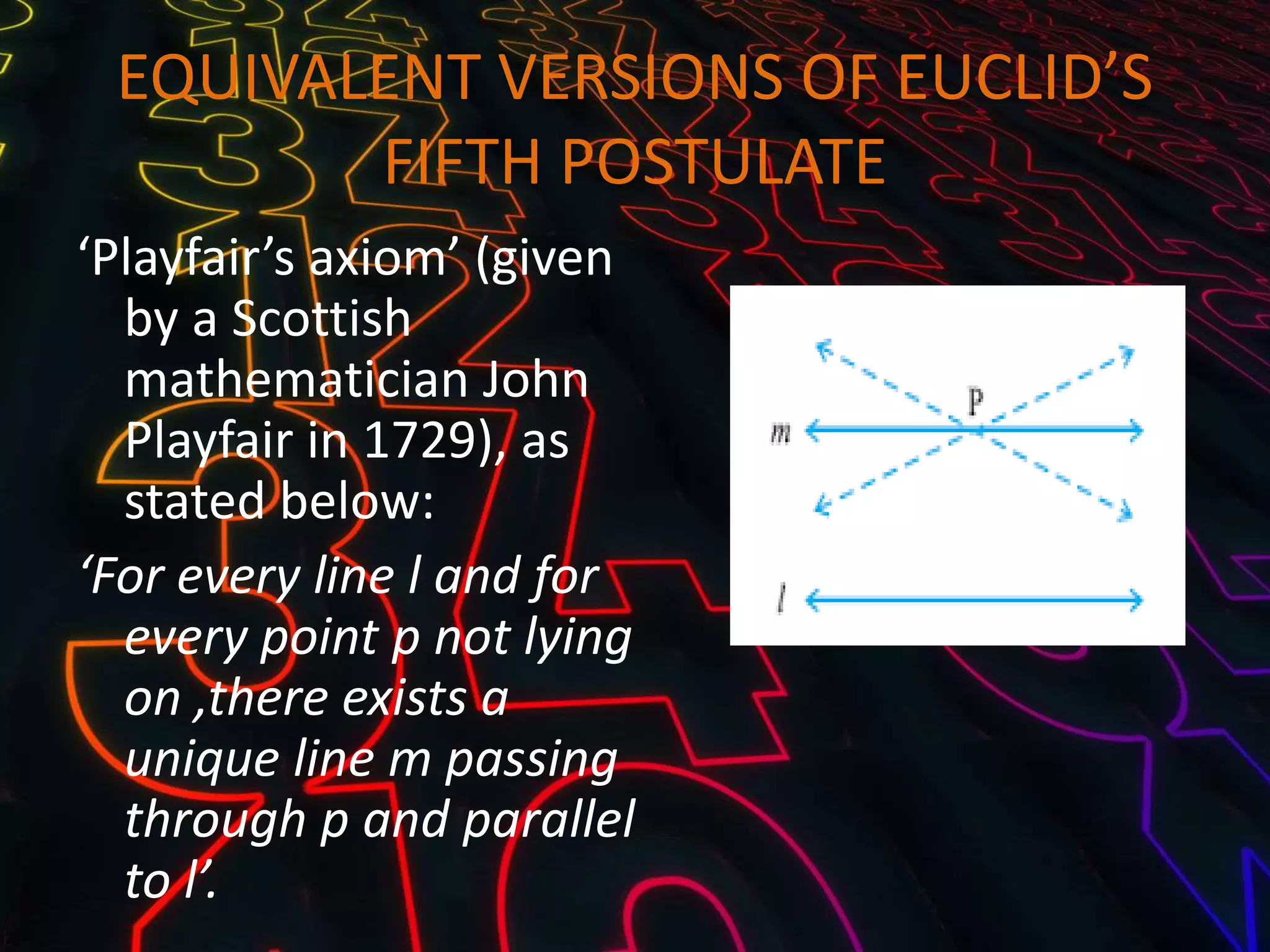
‘Playfair’s axiom’ (given
by a Scottish
mathematician John
Playfair in 1729), as
stated below:
‘For every line l and for
every point p not lying
on ,there exists a
unique line m passing
through p and parallel
to l’.
This result can also be stated
in the following form:
Two distinct intersecting
lines cannot be parallel
to the same line.
Consider the following statement :
There exists a pair of straight
lines that are everywhere
equidistant from one another.
Is this statement a direct
consequence of Euclid’s fifth
postulate? Explain.
SOLUTION :
Take any line l and a point P not on l. Then, by
playfair’s axiom, which is equivalent to the
fifth postulate, we know that there is unique
line m through P which is parallel to l.
Now, the distance of a point from a line is the
length of the perpendicular from the point to
the line. This distance will be the same for any
point on l from m. So, these two lines are
everywhere equidistant from one another.
Euclid's geometry

Euclid's geometry

  • 1.
  • 2.
    EUCLID His works andcontributions~ Euclid also known as ‘Father of geometry’ was a Greek mathematician. He wrote many books such as Euclid’s Elements, Euclid’s phaenomena etc. these books influenced the whole world’ understanding of geometry for generations to come.
  • 3.
    POSTULATES A postulate isa statement that is assumed true without proof. A theorem is a true statement that can be proven. In this presentation we are going to briefly Euclid’s postulate 5.
  • 4.
    POSTULATE 5 If astraight line falling on two straight lines makes the interior angles on the same side of it taken together less than two right angles, the two straight lines, if produced indefinitely, meet on that side on which the sum of angles is less than the two right angles.
  • 5.
    EXAMPLE : • /_1+/_2is less than180 degree • BA and DC appear to meet.
  • 6.
    The parallel postulateis historically the most interesting postulate. Geometers throughout the ages have tried to show that it could be proved from the remaining postulates so that it wasn’t necessary to assume it. The process tried was to assume its falsehood, then derive a contradiction. Many strange conclusions follow from denying the parallel postulate, and several geometers found such great absurdities that they concluded that the parallel postulate did follow from the rest.
  • 7.
    EQUIVALENT VERSIONS OFEUCLID’S FIFTH POSTULATE ‘Playfair’s axiom’ (given by a Scottish mathematician John Playfair in 1729), as stated below: ‘For every line l and for every point p not lying on ,there exists a unique line m passing through p and parallel to l’.
  • 8.
    This result canalso be stated in the following form: Two distinct intersecting lines cannot be parallel to the same line.
  • 9.
    Consider the followingstatement : There exists a pair of straight lines that are everywhere equidistant from one another. Is this statement a direct consequence of Euclid’s fifth postulate? Explain.
  • 10.
    SOLUTION : Take anyline l and a point P not on l. Then, by playfair’s axiom, which is equivalent to the fifth postulate, we know that there is unique line m through P which is parallel to l. Now, the distance of a point from a line is the length of the perpendicular from the point to the line. This distance will be the same for any point on l from m. So, these two lines are everywhere equidistant from one another.