The Ethics of Teaching
Kenneth A. Strike
Jonas F. Soltis
Code of Ethics of the
Education Profession
• Preamble: belief in the
worth/dignity of each
human, dedication to the
pursuit of truth, freedom to
teach/learn, equal
educational opportunity for
all; the code provides
something to live up to and
standards for judgement
This Photo by Unknown Author is licensed under CC BY-SA
Adopted by the 1975 NEA Representative
Assembly
Principle 1
• Commitment to the Student
• Stimulate Inquiry
• Encourage Acquisition of
Knowledge and Understanding
• Provide for Independent Action,
Exposure to Various Points of
View
• Protecting Students from
Embarrassment or Unjust
Treatment
Principle 2
• Commitment to the Profession
• Recognize the Direct Influence
Education has on Our Nation
• Raise Professional Standards
• Exercise Professional Judgement
• Create a Climate that Attracts
the Best and Brightest to
Education
What’s the Difference?
Norms
Definition:
Examples:
Morals
Definition:
Examples:
Ethics
Definition:
Examples
What’s the Difference?
Norms
Definition:
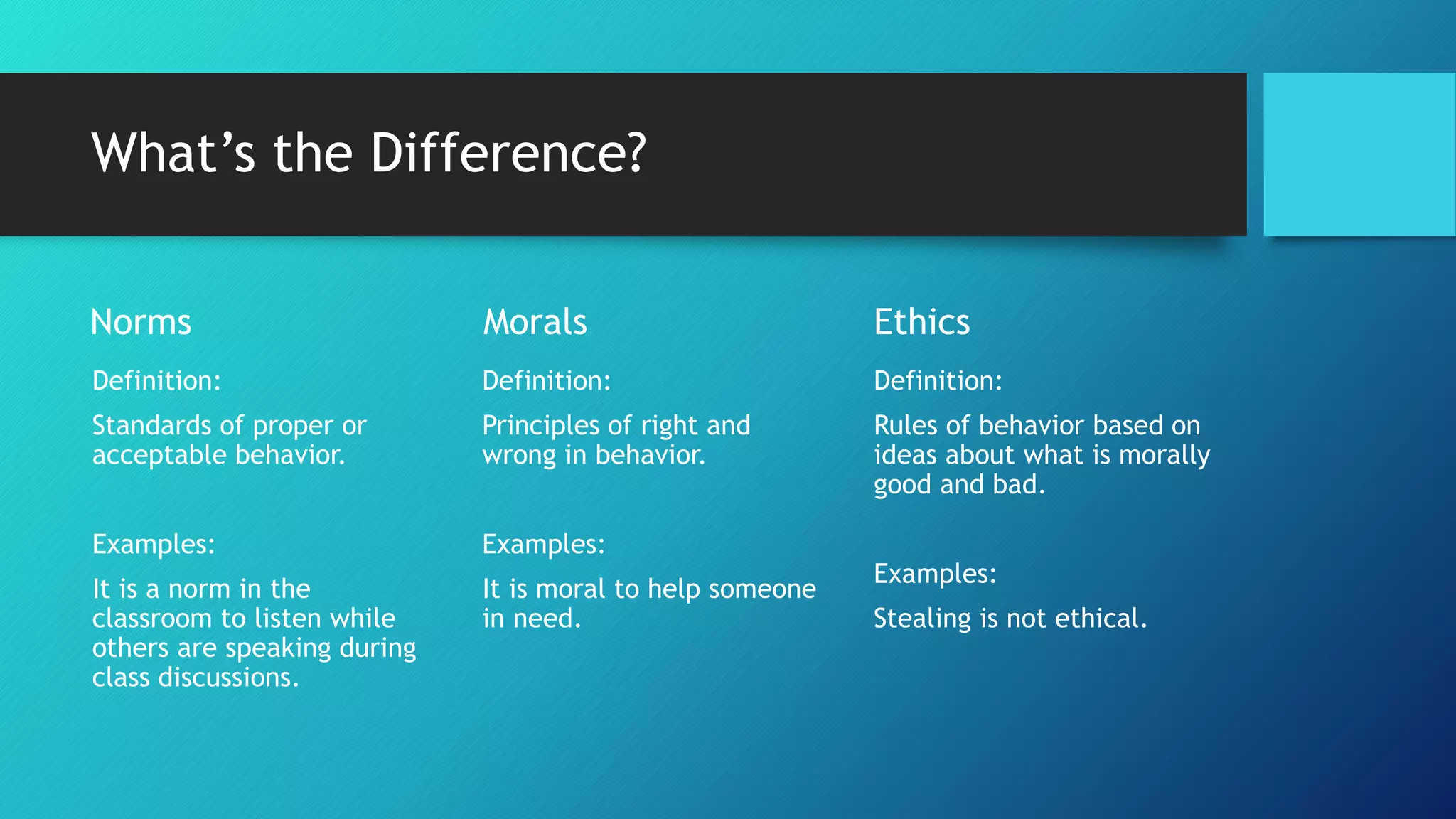
Standards of proper or
acceptable behavior.
Examples:
Morals
Definition:
Principles of right and
wrong in behavior.
Examples:
Ethics
Definition:
Rules of behavior based on
ideas about what is morally
good and bad.
Examples:
What’s the Difference?
Norms
Definition:
Standards of proper or
acceptable behavior.
Examples:
It is a norm in the
classroom to listen while
others are speaking during
class discussions.
Morals
Definition:
Principles of right and
wrong in behavior.
Examples:
It is moral to help someone
in need.
Ethics
Definition:
Rules of behavior based on
ideas about what is morally
good and bad.
Examples:
Stealing is not ethical.
Norms, Morals, and Ethics
• Norms deal with standards of appropriate behavior. There is no
value judgement by the individual as there is with morals. Instead
society dictates what is acceptable.
• Morals involve value judgements and principles about right and
wrong behavior. They can be decided by individuals or society.
• Ethics are based upon rules of what is morally good or bad
behavior. Since ethics are rules, they are generally determined by
society.
Norms, Morals, and Ethics
• The terms are all similar in that they deal with right and wrong
behavior. They are different in that norms deal with societal
standards, morals involve value judgements by individuals or
society, and ethics are based upon rules (usually dictated by
society).
• Morals are the basis for the definition of ethics (rules based upon
morally good or bad behavior) and norms (appropriate behavior is
arguably, generally moral).
The Significance of Ethics and Ethics
Education in Everyday Life
Chapter 1: What is this book about?
“Develop better or worse answers to challenging
circumstances…cultivate ethical awareness…develop skills
needed to act ethically.”
Plagiarism Scenario
• Plagiarism: the practice of taking someone
else's work or ideas and passing them off as
one's own
• Consequences:
• Middle/High School – Failed Assignment,
Opportunity for Reassessment, Saturday
School, Detention
• College – Failed Class, Expulsion
This Photo by Unknown Author is licensed under CC BY-SA
Let’s Go Back to the NEA Code of Ethics:
Commitment to Student & Commitment to Profession
Consequentialist
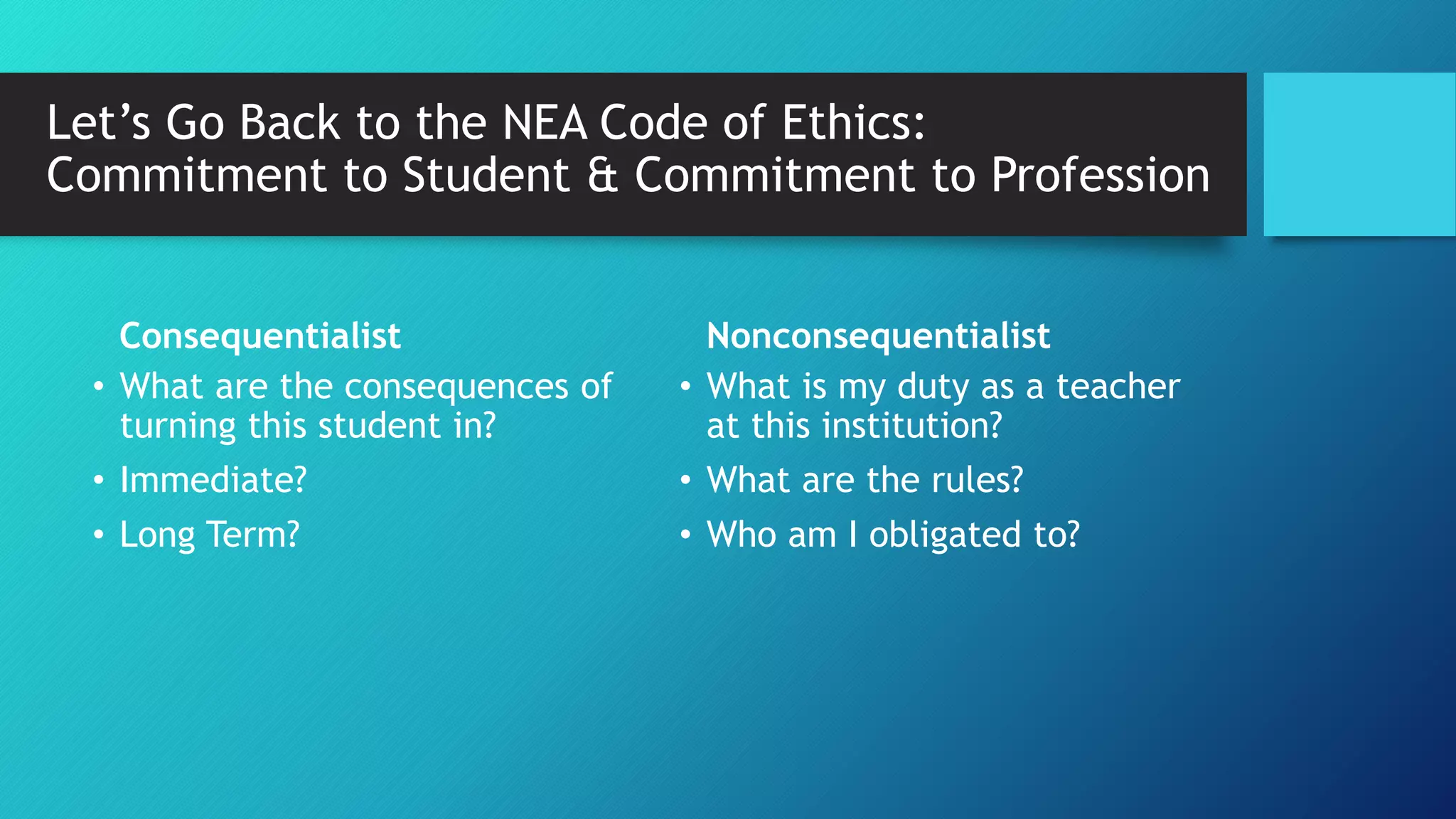
• What are the consequences of
turning this student in?
• Immediate?
• Long Term?
Nonconsequentialist
• What is my duty as a teacher
at this institution?
• What are the rules?
• Who am I obligated to?
More to Consider…
•How does Respect
for Persons apply
to this scenario?
More to Consider…
•Can we achieve
Benefit
Maximization?
More to Consider…
• Facts (Describe) vs.
Ethics (Prescribe)
• So with all of this
in mind, what
would you do?
What should you
do? Are they
different?
This Photo by Unknown Author is licensed under CC BY-NC-SA
Lying Scenario
• A student routinely
initiates fights at school
and their parent comes in
for a conference. At the
conference, the parent
displays extreme agitation
and smells of alcohol.
Fearing for the student,
the teacher lies about the
context of the fighting.
• What would you do? What
should you do?
This Photo by Unknown Author is licensed under CC BY-SA
Is It Ever Okay To Lie?
This Photo by Unknown Author is licensed under CC BY-NC-SA
This Photo by Unknown Author is licensed
under CC BY-SA
What Do You Think?
• Follow This Link To Let
Us Know When You
Think It’s Okay To Lie:
• Mentimeter Poll
• Follow This Link To Let
Us Know What You
Would Do In This
Situation:
• Padlet Response

The Ethics of Teaching - Chapter 1

  • 1.
    The Ethics ofTeaching Kenneth A. Strike Jonas F. Soltis
  • 2.
    Code of Ethicsof the Education Profession • Preamble: belief in the worth/dignity of each human, dedication to the pursuit of truth, freedom to teach/learn, equal educational opportunity for all; the code provides something to live up to and standards for judgement This Photo by Unknown Author is licensed under CC BY-SA
  • 3.
    Adopted by the1975 NEA Representative Assembly Principle 1 • Commitment to the Student • Stimulate Inquiry • Encourage Acquisition of Knowledge and Understanding • Provide for Independent Action, Exposure to Various Points of View • Protecting Students from Embarrassment or Unjust Treatment Principle 2 • Commitment to the Profession • Recognize the Direct Influence Education has on Our Nation • Raise Professional Standards • Exercise Professional Judgement • Create a Climate that Attracts the Best and Brightest to Education
  • 4.
  • 5.
  • 6.
    What’s the Difference? Norms Definition: Standardsof proper or acceptable behavior. Examples: Morals Definition: Principles of right and wrong in behavior. Examples: Ethics Definition: Rules of behavior based on ideas about what is morally good and bad. Examples:
  • 7.
    What’s the Difference? Norms Definition: Standardsof proper or acceptable behavior. Examples: It is a norm in the classroom to listen while others are speaking during class discussions. Morals Definition: Principles of right and wrong in behavior. Examples: It is moral to help someone in need. Ethics Definition: Rules of behavior based on ideas about what is morally good and bad. Examples: Stealing is not ethical.
  • 8.
    Norms, Morals, andEthics • Norms deal with standards of appropriate behavior. There is no value judgement by the individual as there is with morals. Instead society dictates what is acceptable. • Morals involve value judgements and principles about right and wrong behavior. They can be decided by individuals or society. • Ethics are based upon rules of what is morally good or bad behavior. Since ethics are rules, they are generally determined by society.
  • 9.
    Norms, Morals, andEthics • The terms are all similar in that they deal with right and wrong behavior. They are different in that norms deal with societal standards, morals involve value judgements by individuals or society, and ethics are based upon rules (usually dictated by society). • Morals are the basis for the definition of ethics (rules based upon morally good or bad behavior) and norms (appropriate behavior is arguably, generally moral).
  • 10.
    The Significance ofEthics and Ethics Education in Everyday Life
  • 11.
    Chapter 1: Whatis this book about? “Develop better or worse answers to challenging circumstances…cultivate ethical awareness…develop skills needed to act ethically.”
  • 12.
    Plagiarism Scenario • Plagiarism:the practice of taking someone else's work or ideas and passing them off as one's own • Consequences: • Middle/High School – Failed Assignment, Opportunity for Reassessment, Saturday School, Detention • College – Failed Class, Expulsion This Photo by Unknown Author is licensed under CC BY-SA This Photo by Unknown Author is licensed under CC BY-SA
  • 13.
    Let’s Go Backto the NEA Code of Ethics: Commitment to Student & Commitment to Profession Consequentialist • What are the consequences of turning this student in? • Immediate? • Long Term? Nonconsequentialist • What is my duty as a teacher at this institution? • What are the rules? • Who am I obligated to?
  • 14.
    More to Consider… •Howdoes Respect for Persons apply to this scenario?
  • 15.
    More to Consider… •Canwe achieve Benefit Maximization?
  • 16.
    More to Consider… •Facts (Describe) vs. Ethics (Prescribe) • So with all of this in mind, what would you do? What should you do? Are they different? This Photo by Unknown Author is licensed under CC BY-NC-SA
  • 17.
    Lying Scenario • Astudent routinely initiates fights at school and their parent comes in for a conference. At the conference, the parent displays extreme agitation and smells of alcohol. Fearing for the student, the teacher lies about the context of the fighting. • What would you do? What should you do? This Photo by Unknown Author is licensed under CC BY-SA
  • 18.
    Is It EverOkay To Lie? This Photo by Unknown Author is licensed under CC BY-NC-SA This Photo by Unknown Author is licensed under CC BY-SA
  • 19.
    What Do YouThink? • Follow This Link To Let Us Know When You Think It’s Okay To Lie: • Mentimeter Poll • Follow This Link To Let Us Know What You Would Do In This Situation: • Padlet Response