Character Education:
Values, Ethics & Morals
PGD-Education & Montessori-2020
Instructor: Nabeela Aslam
16-11-2021
Warm Up
Read a quote & reflect on it. 10 min
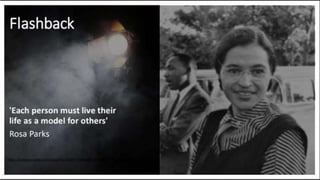
“Each person must live their life as a model for
others”
Q. What does it mean to be MODEL?
Q. What characteristics does someone who is a
MODEL have?
Objectives: Participants will be able to (PWABT):
● Define ‘character education 10
● Understand the importance of character education 10
● Identify their own character strenghts 25
● Understand and list the difference between values, morals and ethics 10
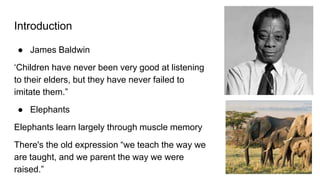
Introduction
● James Baldwin
‘Children have never been very good at listening
to their elders, but they have never failed to
imitate them.”
● Elephants
Elephants learn largely through muscle memory
There's the old expression “we teach the way we
are taught, and we parent the way we were
raised.”
Why to incorporate Character Education in the Class
● Increase student cooperation.
● Improve school safety.
● Boost academic achievement.
● Reduce disciplinary problems.
● Heighten staff unity.
● Improve family harmony.
● Resolve conflict successfully.
Discussion Point
Can character strengths be taught?
Activity 2: Three Good Things Exercise
We’re gonna try this activity this week
You’re gonna jot down THREE GOOD THINGS that happened to you
You can do it on your journal, you can do it on your computer, you can do it on
your phone, etc.
Everyday, you’re gonna jot down three good things that happened and here’s the
important part, you’re gonna explain what they happened
At the end of the week, as the week goes on, you track how you feel. Do you feel
more optimistic? Do you feel more hopeful?
Values
Values - Morals
● Values are the foundation of a person's ability to judge between right and wrong. Values
include a deep-rooted system of beliefs. They have intrinsic worth, but are not universally
accepted. This system allows each individual to determine what should and shouldn't be.
● For example, if someone's value system is founded upon honesty, they would probably
make a proper judgment between cheating on a college entrance exam (wrong) and
studying hard to ace a college entrance exam (right).
● A person’s idea of morals tends to be shaped by their surrounding environment (and
sometimes their belief system). Moral values shape a person’s ideas about right and
wrong.
● People's values define what they want personally, but morals define what the society
around those people want for them.
● Morals have a greater social element to values and tend to have a very broad
acceptance. Morals are far more about good and bad than other values. We thus judge
others more strongly on morals than values. A person can be described as immoral, yet
there is no word for them not following values.
The Definitions in Action — Sample Story: “The Bully”
You are a kid in the schoolyard. You see a bully. He thinks he is the “top dog.” That is fine.
That perception is a relative value. But when his relative value replace the life value of another
kid – in other words, when the bully picks on and/or punches the other kid – this is wrong and
must be stopped. Here is the rule: relative values, no matter how “great,” cannot supersede
the life value.
You see the bully picking on the other kid. You feel – in your gut – that this is wrong.
Congratulations, you are moral. (By the way, most people are moral – they know the
difference between right and wrong)
Now…you see the bully picking on the other kid. You overcome the “freeze,” you overcome the
embarrassment, and you go tell a teacher. Congratulations! You are ethical. (Ethics are moral
values in action).
Now…you see the bully picking on the other kid. You overcome the “freeze,” you overcome the
fear, and you go to the aid of the kid being bullied. You put yourself at risk. Congratulations!
You have the makings of an Ethical Warrior.
And it doesn’t end in the schoolyard. Almost all problems in our society and the world are
caused by bullies – those who would supersede the life value of others with their own relative
values.
Ethics aren’t always moral … and vice versa
It’s important to know that what’s ethical isn’t always what’s moral, and vice
versa. Omerta, for example, is a code of silence that developed among
members of the Mafia. It was used to protect criminals from the police. This
follows the rules of ethically-correct behavior for the organization, but it can also
be viewed as wrong from a moral standpoint.
A moral action can also be unethical. A lawyer who tells the court that his client
is guilty may be acting out of a moral desire to see justice done, but this is
deeply unethical because it violates the attorney-client privilege.
charactor building.pptx

charactor building.pptx

  • 1.
    Character Education: Values, Ethics& Morals PGD-Education & Montessori-2020 Instructor: Nabeela Aslam 16-11-2021
  • 2.
    Warm Up Read aquote & reflect on it. 10 min “Each person must live their life as a model for others” Q. What does it mean to be MODEL? Q. What characteristics does someone who is a MODEL have?
  • 5.
    Objectives: Participants willbe able to (PWABT): ● Define ‘character education 10 ● Understand the importance of character education 10 ● Identify their own character strenghts 25 ● Understand and list the difference between values, morals and ethics 10
  • 6.
    Introduction ● James Baldwin ‘Childrenhave never been very good at listening to their elders, but they have never failed to imitate them.” ● Elephants Elephants learn largely through muscle memory There's the old expression “we teach the way we are taught, and we parent the way we were raised.”
  • 7.
    Why to incorporateCharacter Education in the Class ● Increase student cooperation. ● Improve school safety. ● Boost academic achievement. ● Reduce disciplinary problems. ● Heighten staff unity. ● Improve family harmony. ● Resolve conflict successfully.
  • 9.
    Discussion Point Can characterstrengths be taught?
  • 10.
    Activity 2: ThreeGood Things Exercise We’re gonna try this activity this week You’re gonna jot down THREE GOOD THINGS that happened to you You can do it on your journal, you can do it on your computer, you can do it on your phone, etc. Everyday, you’re gonna jot down three good things that happened and here’s the important part, you’re gonna explain what they happened At the end of the week, as the week goes on, you track how you feel. Do you feel more optimistic? Do you feel more hopeful?
  • 11.
  • 12.
    Values - Morals ●Values are the foundation of a person's ability to judge between right and wrong. Values include a deep-rooted system of beliefs. They have intrinsic worth, but are not universally accepted. This system allows each individual to determine what should and shouldn't be. ● For example, if someone's value system is founded upon honesty, they would probably make a proper judgment between cheating on a college entrance exam (wrong) and studying hard to ace a college entrance exam (right). ● A person’s idea of morals tends to be shaped by their surrounding environment (and sometimes their belief system). Moral values shape a person’s ideas about right and wrong. ● People's values define what they want personally, but morals define what the society around those people want for them. ● Morals have a greater social element to values and tend to have a very broad acceptance. Morals are far more about good and bad than other values. We thus judge others more strongly on morals than values. A person can be described as immoral, yet there is no word for them not following values.
  • 13.
    The Definitions inAction — Sample Story: “The Bully” You are a kid in the schoolyard. You see a bully. He thinks he is the “top dog.” That is fine. That perception is a relative value. But when his relative value replace the life value of another kid – in other words, when the bully picks on and/or punches the other kid – this is wrong and must be stopped. Here is the rule: relative values, no matter how “great,” cannot supersede the life value. You see the bully picking on the other kid. You feel – in your gut – that this is wrong. Congratulations, you are moral. (By the way, most people are moral – they know the difference between right and wrong) Now…you see the bully picking on the other kid. You overcome the “freeze,” you overcome the embarrassment, and you go tell a teacher. Congratulations! You are ethical. (Ethics are moral values in action). Now…you see the bully picking on the other kid. You overcome the “freeze,” you overcome the fear, and you go to the aid of the kid being bullied. You put yourself at risk. Congratulations! You have the makings of an Ethical Warrior. And it doesn’t end in the schoolyard. Almost all problems in our society and the world are caused by bullies – those who would supersede the life value of others with their own relative values.
  • 14.
    Ethics aren’t alwaysmoral … and vice versa It’s important to know that what’s ethical isn’t always what’s moral, and vice versa. Omerta, for example, is a code of silence that developed among members of the Mafia. It was used to protect criminals from the police. This follows the rules of ethically-correct behavior for the organization, but it can also be viewed as wrong from a moral standpoint. A moral action can also be unethical. A lawyer who tells the court that his client is guilty may be acting out of a moral desire to see justice done, but this is deeply unethical because it violates the attorney-client privilege.

Editor's Notes

  • #13 Conversely, if someone valued achievement and success over honesty, that person may opt to cheat on the exam in order to achieve the desired result. This relates to which value is "worth more" to the individual.