“Practicing leadership is like
      growing older--It's not for the
             faint at heart!"
You don’t have to
be the “Big Boss”
to be an effective
      leader!         Gary Floss


         University of Minnesota Quality Fair –
                      04 Feb 2010
                                                  1
Topics Covered
1.   Leadership vs. Management
        What are the attributes?
        What are importance levels?
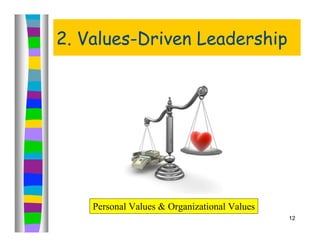
2.   Values-driven Leadership
        What part does “understanding culture” play?
3.   Concept of the “Right Questions to Ask”
        What are the questions that leaders need to ask?
4.   Leadership companion to
     Plan/Do/Check/Act: “Start, Stop,
     Keep”
                                                            2
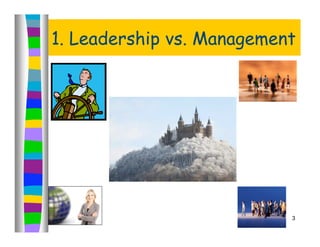
1. Leadership vs. Management


                           3
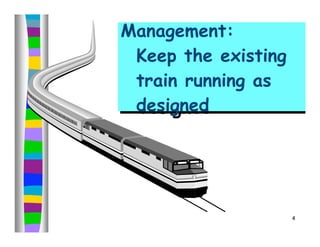
Management:
Management:
 Keep the existing
 Keep the existing
 train running as
 train running as
 designed
 designed


                     4
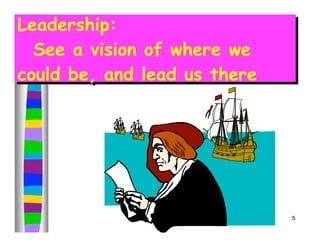
Leadership:
Leadership:
  See a vision of where we
  See a vision of where we
could be, and lead us there


                              5
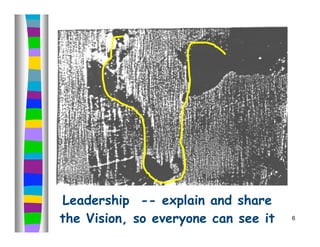
Leadership -- explain and share
the Vision, so everyone can see it   6
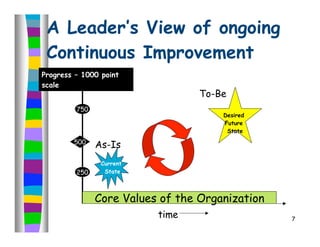
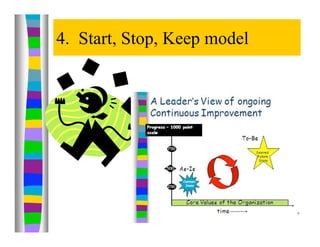
A Leader’s View of ongoing
 Continuous Improvement
Progress – 1000 point
scale
                                  To-Be
         750
                                      Desired
                                      Future
                                       State

        500
               As-Is
                Current
         250     State


               Core Values of the Organization
                          time                   7
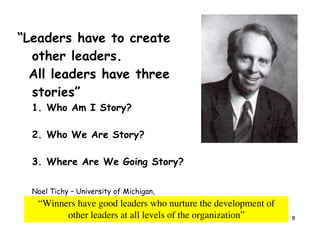
“Leaders have to create
  other leaders.
  All leaders have three
  stories”
  1. Who Am I Story?

  2. Who We Are Story?

  3. Where Are We Going Story?

  Noel Tichy – University of Michigan,
  author of The Leadership leaders who
    “Winners have good Engine          nurture the development of
           other leaders at all levels of the organization”         8
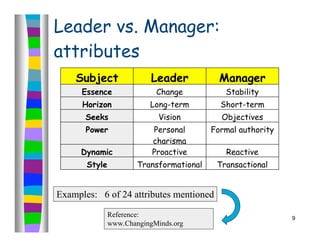
Leader vs. Manager:
attributes
    Subject                Leader           Manager
      Essence               Change           Stability
      Horizon             Long-term         Short-term
       Seeks                 Vision         Objectives
       Power               Personal       Formal authority
                           charisma
     Dynamic               Proactive         Reactive
       Style           Transformational    Transactional


Examples: 6 of 24 attributes mentioned

               Reference:                                    9
               www.ChangingMinds.org
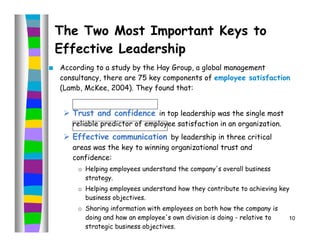
The Two Most Important Keys to
    Effective Leadership
   According to a study by the Hay Group, a global management
    consultancy, there are 75 key components of employee satisfaction
    (Lamb, McKee, 2004). They found that:


      Trust and confidence in top leadership was the single most
       reliable predictor of employee satisfaction in an organization.
      Effective communication by leadership in three critical
       areas was the key to winning organizational trust and
       confidence:
         o Helping employees understand the company's overall business
           strategy.
         o Helping employees understand how they contribute to achieving key
           business objectives.
         o Sharing information with employees on both how the company is
           doing and how an employee's own division is doing - relative to   10
           strategic business objectives.
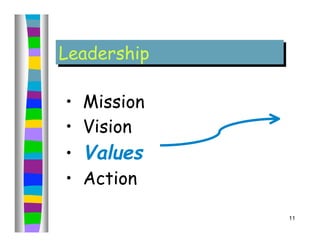
Leadership
Leadership

•   Mission
•   Vision
•   Values
•   Action

              11
2. Values-Driven Leadership


    Personal Values & Organizational Values
                                              12
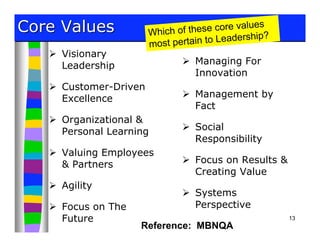
Core Values            Which of th ese core values
                       most pertain  to Leadership?
    Visionary
     Leadership                Managing For
                                Innovation
    Customer-Driven
     Excellence                Management by
                                Fact
    Organizational &
     Personal Learning         Social
                                Responsibility
    Valuing Employees
     & Partners                Focus on Results &
                                Creating Value
    Agility
                               Systems
    Focus on The               Perspective
     Future                                           13
                    Reference: MBNQA
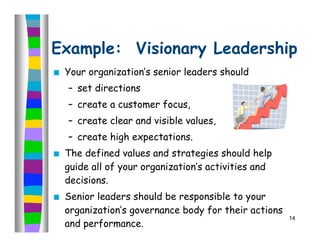
Example: Visionary Leadership
   Your organization’s senior leaders should
    – set directions
    – create a customer focus,
    – create clear and visible values,
    – create high expectations.
   The defined values and strategies should help
    guide all of your organization’s activities and
    decisions.
   Senior leaders should be responsible to your
    organization’s governance body for their actions
                                                       14
    and performance.
   Senior leaders should serve as role models.
Why Pay Attention to
Culture?
“Culture eats                    “The culture of
strategic plans                  an organization
for lunch every                  lives in its
time.”                           language.”


Dr. Bill Rupp, M.D. & CEO,
Jacksonville, FL Clinic Campus   Martin Heidegger
Mayo Health System               “On Time and Being”   15
High Achiever

     “One who never sees
himself or herself as a finished
            product”
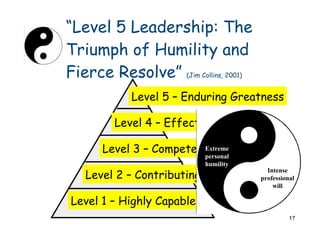
“Level 5 Leadership: The
Triumph of Humility and
Fierce Resolve” (Jim Collins, 2001)
            Level 5 – Enduring Greatness

         Level 4 – Effective Leader

      Level 3 – Competent Manager
                        Extreme
                          personal
                          humility
   Level 2 – Contributing Team Member
                                        Intense
                                      professional
                                          will

Level 1 – Highly Capable Individual
                                                17
3. The “Right Questions to Ask”


                              18
Need to be a Systems Thinker:
Baldrige Core Value of “Systems Perspective”

 Successful management of overall
performance requires organization-specific
synthesis, alignment, and integration.

 Synthesis means looking at your organization
as a whole and builds on key business attributes,
including your core competencies, strategic
objectives, action plans, and work systems.


                                                    19
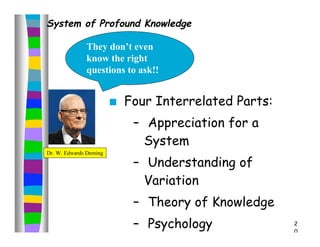
System of Profound Knowledge

              They don’t even
              know the right
              questions to ask!!


                           Four Interrelated Parts:
                             – Appreciation for a
                               System
Dr. W. Edwards Deming

                             – Understanding of
                               Variation
                             – Theory of Knowledge
                             – Psychology              2
                                                       0
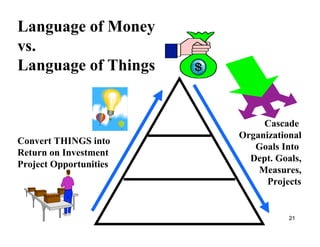
Language of Money
vs.
Language of Things


                             Cascade
                        Organizational
Convert THINGS into
                           Goals Into
Return on Investment
                          Dept. Goals,
Project Opportunities
                            Measures,
                              Projects


                                   21
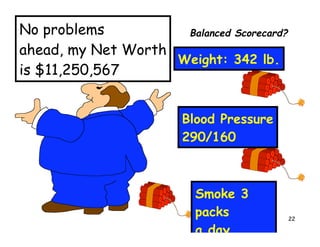
No problems          Balanced Scorecard?
ahead, my Net Worth
                    Weight: 342 lb.
is $11,250,567


                        Blood Pressure
                        290/160


                          Smoke 3
                          packs            22

                          a day
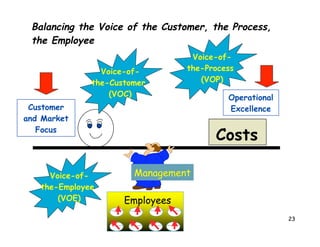
Balancing the Voice of the Customer, the Process,
 the Employee
                                  Voice-of-
                Voice-of-        the-Process
              the-Customer          (VOP)
                  (VOC)                   Operational
 Customer                                 Excellence
and Market
   Focus
                                       Costs

     Voice-of-         Management
   the-Employee
       (VOE)         Employees
                                                        23
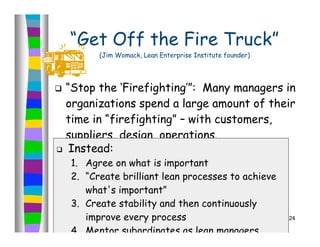
“Get Off the Fire Truck”
          (Jim Womack, Lean Enterprise Institute founder)


 “Stop the ‘Firefighting’”: Many managers in
  organizations spend a large amount of their
  time in “firefighting” – with customers,
  suppliers, design, operations.
 Instead:

    1. Agree on what is important
    2. “Create brilliant lean processes to achieve
       what's important”
    3. Create stability and then continuously
       improve every process                                24

    4. Mentor subordinates as lean managers
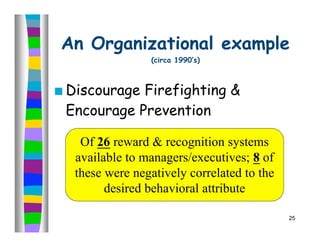
An Organizational example
                   (circa 1990’s)


   Discourage Firefighting &
    Encourage Prevention

      Of 26 reward & recognition systems
     available to managers/executives; 8 of
     these were negatively correlated to the
           desired behavioral attribute

                                               25
4. Start, Stop, Keep model


                             26
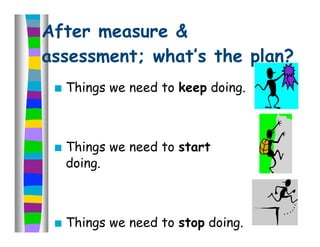
After measure &
assessment; what’s the plan?
    Things we need to keep doing.


    Things we need to start
     doing.


    Things we need to stop doing.
Arnie Weimerskirch, retired
VP, Quality, Honeywell

     10 PRINCIPLES OF CHANGE


#2 Use a credible management model


                                     28
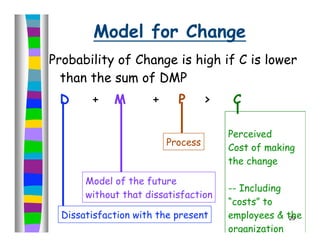
Model for Change
Probability of Change is high if C is lower
  than the sum of DMP
 D      +    M       +     P       >    C

                                       Perceived
                         Process
                                       Cost of making
                                       the change

       Model of the future
                                       -- Including
       without that dissatisfaction
                                       “costs” to
  Dissatisfaction with the present     employees & the
                                                    29

                                       organization
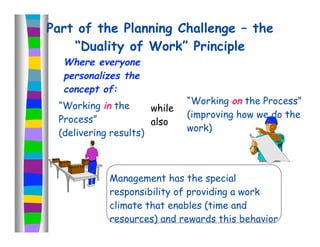
Part of the Planning Challenge – the
    “Duality of Work” Principle
  Where everyone
  personalizes the
  concept of:
 “Working in the              “Working on the Process”
                      while
                              (improving how we do the
 Process”             also
                              work)
 (delivering results)


            Management has the special
            responsibility of providing a work
            climate that enables (time and
            resources) and rewards this behavior
Summary


          31
A Fundamental Truth! of
Strategic Quality Management
 Quality
        begins at the top and
 succeeds only through top-
 management leadership . . .
 and constancy of purpose.

     And: Yes, leadership can
        occur at any level
                                32
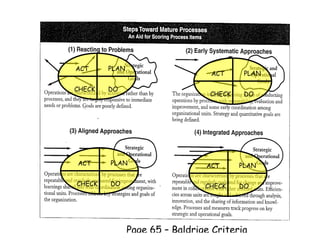
ACT     PLAN
                                 ACT      PLAN

CHECK   DO
                                 CHECK    DO


ACT     PLAN                    ACT      PLAN

CHECK   DO                      CHECK    DO


               Page 65 – Baldrige Criteria
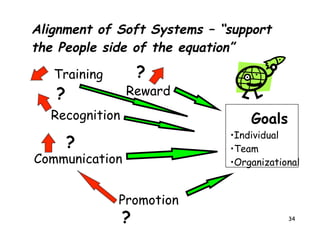
Alignment of Soft Systems – “support
the People side of the equation”

   Training         ?
   ?            Reward
  Recognition                    Goals
                             •Individual
       ?                     •Team
Communication                •Organizational


              Promotion
                ?                        34
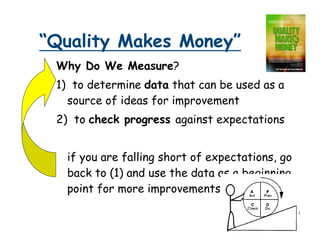
“Quality Makes Money”
 Why Do We Measure?
 1) to determine data that can be used as a
   source of ideas for improvement
 2) to check progress against expectations


   if you are falling short of expectations, go
   back to (1) and use the data as a beginning
   point for more improvements
Any Questions

                36

Practicing Leadership

  • 1.
    “Practicing leadership islike growing older--It's not for the faint at heart!" You don’t have to be the “Big Boss” to be an effective leader! Gary Floss University of Minnesota Quality Fair – 04 Feb 2010 1
  • 2.
    Topics Covered 1. Leadership vs. Management  What are the attributes?  What are importance levels? 2. Values-driven Leadership  What part does “understanding culture” play? 3. Concept of the “Right Questions to Ask”  What are the questions that leaders need to ask? 4. Leadership companion to Plan/Do/Check/Act: “Start, Stop, Keep” 2
  • 3.
    1. Leadership vs.Management 3
  • 4.
    Management: Management: Keep theexisting Keep the existing train running as train running as designed designed 4
  • 5.
    Leadership: Leadership: Seea vision of where we See a vision of where we could be, and lead us there could be, and lead us there 5
  • 6.
    Leadership -- explainand share the Vision, so everyone can see it 6
  • 7.
    A Leader’s Viewof ongoing Continuous Improvement Progress – 1000 point scale To-Be 750 Desired Future State 500 As-Is Current 250 State Core Values of the Organization time 7
  • 8.
    “Leaders have tocreate other leaders. All leaders have three stories” 1. Who Am I Story? 2. Who We Are Story? 3. Where Are We Going Story? Noel Tichy – University of Michigan, author of The Leadership leaders who “Winners have good Engine nurture the development of other leaders at all levels of the organization” 8
  • 9.
    Leader vs. Manager: attributes Subject Leader Manager Essence Change Stability Horizon Long-term Short-term Seeks Vision Objectives Power Personal Formal authority charisma Dynamic Proactive Reactive Style Transformational Transactional Examples: 6 of 24 attributes mentioned Reference: 9 www.ChangingMinds.org
  • 10.
    The Two MostImportant Keys to Effective Leadership  According to a study by the Hay Group, a global management consultancy, there are 75 key components of employee satisfaction (Lamb, McKee, 2004). They found that:  Trust and confidence in top leadership was the single most reliable predictor of employee satisfaction in an organization.  Effective communication by leadership in three critical areas was the key to winning organizational trust and confidence: o Helping employees understand the company's overall business strategy. o Helping employees understand how they contribute to achieving key business objectives. o Sharing information with employees on both how the company is doing and how an employee's own division is doing - relative to 10 strategic business objectives.
  • 11.
    Leadership Leadership • Mission • Vision • Values • Action 11
  • 12.
    2. Values-Driven Leadership Personal Values & Organizational Values 12
  • 13.
    Core Values Which of th ese core values most pertain to Leadership?  Visionary Leadership  Managing For Innovation  Customer-Driven Excellence  Management by Fact  Organizational & Personal Learning  Social Responsibility  Valuing Employees & Partners  Focus on Results & Creating Value  Agility  Systems  Focus on The Perspective Future 13 Reference: MBNQA
  • 14.
    Example: Visionary Leadership  Your organization’s senior leaders should – set directions – create a customer focus, – create clear and visible values, – create high expectations.  The defined values and strategies should help guide all of your organization’s activities and decisions.  Senior leaders should be responsible to your organization’s governance body for their actions 14 and performance.  Senior leaders should serve as role models.
  • 15.
    Why Pay Attentionto Culture? “Culture eats “The culture of strategic plans an organization for lunch every lives in its time.” language.” Dr. Bill Rupp, M.D. & CEO, Jacksonville, FL Clinic Campus Martin Heidegger Mayo Health System “On Time and Being” 15
  • 16.
    High Achiever “One who never sees himself or herself as a finished product”
  • 17.
    “Level 5 Leadership:The Triumph of Humility and Fierce Resolve” (Jim Collins, 2001) Level 5 – Enduring Greatness Level 4 – Effective Leader Level 3 – Competent Manager Extreme personal humility Level 2 – Contributing Team Member Intense professional will Level 1 – Highly Capable Individual 17
  • 18.
    3. The “RightQuestions to Ask” 18
  • 19.
    Need to bea Systems Thinker: Baldrige Core Value of “Systems Perspective”  Successful management of overall performance requires organization-specific synthesis, alignment, and integration.  Synthesis means looking at your organization as a whole and builds on key business attributes, including your core competencies, strategic objectives, action plans, and work systems. 19
  • 20.
    System of ProfoundKnowledge They don’t even know the right questions to ask!!  Four Interrelated Parts: – Appreciation for a System Dr. W. Edwards Deming – Understanding of Variation – Theory of Knowledge – Psychology 2 0
  • 21.
    Language of Money vs. Languageof Things Cascade Organizational Convert THINGS into Goals Into Return on Investment Dept. Goals, Project Opportunities Measures, Projects 21
  • 22.
    No problems Balanced Scorecard? ahead, my Net Worth Weight: 342 lb. is $11,250,567 Blood Pressure 290/160 Smoke 3 packs 22 a day
  • 23.
    Balancing the Voiceof the Customer, the Process, the Employee Voice-of- Voice-of- the-Process the-Customer (VOP) (VOC) Operational Customer Excellence and Market Focus Costs Voice-of- Management the-Employee (VOE) Employees 23
  • 24.
    “Get Off theFire Truck” (Jim Womack, Lean Enterprise Institute founder)  “Stop the ‘Firefighting’”: Many managers in organizations spend a large amount of their time in “firefighting” – with customers, suppliers, design, operations.  Instead: 1. Agree on what is important 2. “Create brilliant lean processes to achieve what's important” 3. Create stability and then continuously improve every process 24 4. Mentor subordinates as lean managers
  • 25.
    An Organizational example (circa 1990’s)  Discourage Firefighting & Encourage Prevention Of 26 reward & recognition systems available to managers/executives; 8 of these were negatively correlated to the desired behavioral attribute 25
  • 26.
    4. Start, Stop,Keep model 26
  • 27.
    After measure & assessment;what’s the plan?  Things we need to keep doing.  Things we need to start doing.  Things we need to stop doing.
  • 28.
    Arnie Weimerskirch, retired VP,Quality, Honeywell  10 PRINCIPLES OF CHANGE #2 Use a credible management model 28
  • 29.
    Model for Change Probabilityof Change is high if C is lower than the sum of DMP D + M + P > C Perceived Process Cost of making the change Model of the future -- Including without that dissatisfaction “costs” to Dissatisfaction with the present employees & the 29 organization
  • 30.
    Part of thePlanning Challenge – the “Duality of Work” Principle Where everyone personalizes the concept of: “Working in the “Working on the Process” while (improving how we do the Process” also work) (delivering results) Management has the special responsibility of providing a work climate that enables (time and resources) and rewards this behavior
  • 31.
  • 32.
    A Fundamental Truth!of Strategic Quality Management  Quality begins at the top and succeeds only through top- management leadership . . . and constancy of purpose. And: Yes, leadership can occur at any level 32
  • 33.
    ACT PLAN ACT PLAN CHECK DO CHECK DO ACT PLAN ACT PLAN CHECK DO CHECK DO Page 65 – Baldrige Criteria
  • 34.
    Alignment of SoftSystems – “support the People side of the equation” Training ? ? Reward Recognition Goals •Individual ? •Team Communication •Organizational Promotion ? 34
  • 35.
    “Quality Makes Money” Why Do We Measure? 1) to determine data that can be used as a source of ideas for improvement 2) to check progress against expectations if you are falling short of expectations, go back to (1) and use the data as a beginning point for more improvements
  • 36.