
Building successful long
term customer relationships

           Paul Overton, PhD
 Group Director, Corporate Development

    Outsourcing Preclinical Development
         Berlin 2nd December 2010
Presentation overview:

   Defining value
   Defining the relationship
       Factors for creating successful relationships
       Setting mutual expectations
   Governance structures
   Utilising KPIs effectively
   Open relationships
          Building   a “banking mentality”
   Creating long term value for both parties
Defining value:


       What is value?
Defining value:


  Value = benefits – costs


 (Neil Rackham, Malcolm MacDonald and other
                    gurus)
Defining the relationship:

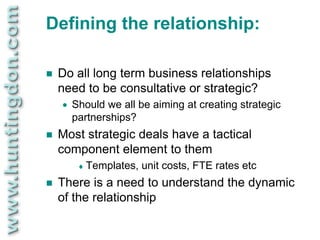
   Do all long term business relationships
    need to be consultative or strategic?
       Should we all be aiming at creating strategic
        partnerships?
   Most strategic deals have a tactical
    component element to them
          Templates,   unit costs, FTE rates etc
   There is a need to understand the dynamic
    of the relationship
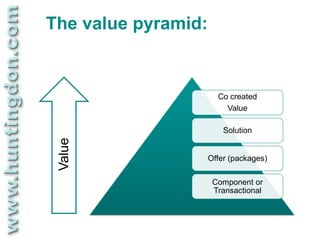
The value pyramid:


                       Co created
                         Value

                         Solution
 Value


                     Offer (packages)

                      Component or
                      Transactional
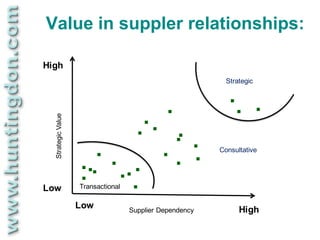
Value in suppler relationships:

High
                                                            Strategic


                              .                             .. .
                           ... .
  Strategic Value


                       . . . .. ..
                    ... ..
                                                          Consultative


Low
                    . .
                    Transactional

                    Low             Supplier Dependency         High
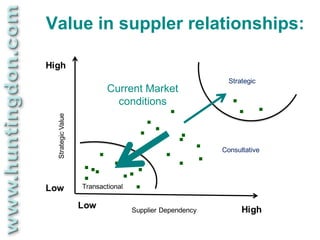
Value in suppler relationships:

High
                                                            Strategic
                           Current Market
                              .
                             conditions                     .. .
                           ... .
  Strategic Value


                       . . . .. ..
                    ... ..
                                                          Consultative


Low
                    . .
                    Transactional

                    Low             Supplier Dependency         High
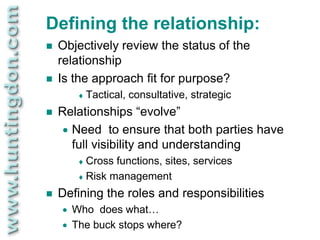
Defining the relationship:
   Objectively review the status of the
    relationship
   Is the approach fit for purpose?
          Tactical,   consultative, strategic
   Relationships “evolve”
     Need to ensure that both parties have

      full visibility and understanding
          Cross functions, sites, services
          Risk management

   Defining the roles and responsibilities
       Who does what…
       The buck stops where?
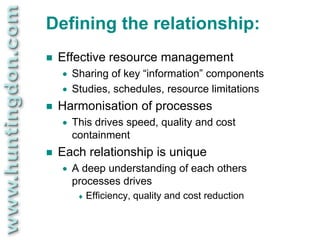
Defining the relationship:
   Effective resource management
       Sharing of key “information” components
       Studies, schedules, resource limitations
   Harmonisation of processes
       This drives speed, quality and cost
        containment
   Each relationship is unique
       A deep understanding of each others
        processes drives
            Efficiency, quality and cost reduction
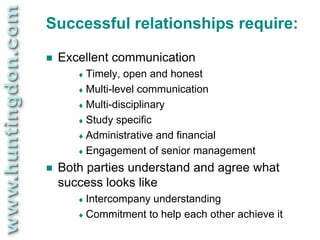
Successful relationships require:

   Excellent communication
        Timely,  open and honest
        Multi-level communication
        Multi-disciplinary
        Study specific
        Administrative and financial
        Engagement of senior management

   Both parties understand and agree what
    success looks like
        Intercompanyunderstanding
        Commitment to help each other achieve it
Successful relationships require:


   Investment in time…
     Relationships take time and effort
     High level of commitment from both

      parties
     Focus on continual improvement

      (evolution)
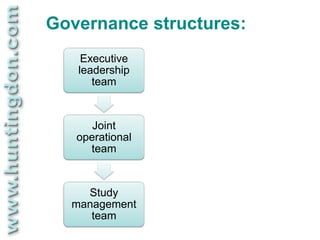
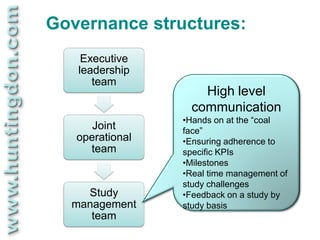
Governance structures:
    Executive
   leadership
      team


      Joint
   operational
     team


    Study
  management
     team
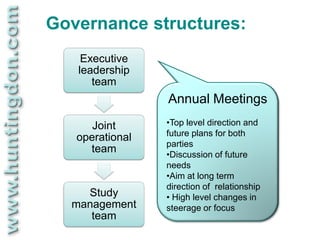
Governance structures:
    Executive
   leadership
      team
                 Annual Meetings
      Joint      •Top level direction and
                 future plans for both
   operational
                 parties
     team        •Discussion of future
                 needs
                 •Aim at long term
                 direction of relationship
    Study        • High level changes in
  management     steerage or focus
     team
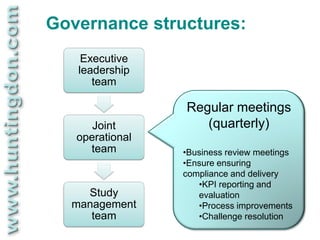
Governance structures:
    Executive
   leadership
      team

                 Regular meetings
      Joint         (quarterly)
   operational
     team        •Business review meetings
                 •Ensure ensuring
                 compliance and delivery
                    •KPI reporting and
    Study           evaluation
  management        •Process improvements
     team           •Challenge resolution
Governance structures:
    Executive
   leadership
      team
                     High level
                   communication
                 •Hands on at the “coal
      Joint      face”
   operational   •Ensuring adherence to
     team        specific KPIs
                 •Milestones
                 •Real time management of
                 study challenges
    Study        •Feedback on a study by
  management     study basis
     team
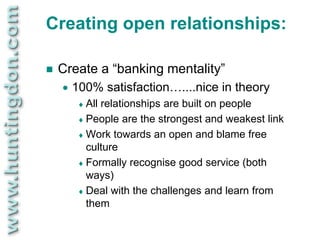
Creating open relationships:

   Create a “banking mentality”
       100% satisfaction…....nice in theory
          Allrelationships are built on people
          People are the strongest and weakest link
          Work towards an open and blame free
           culture
          Formally recognise good service (both
           ways)
          Deal with the challenges and learn from
           them
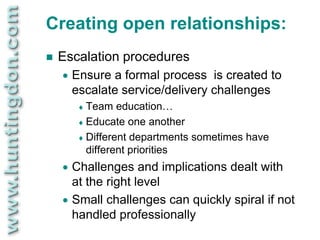
Creating open relationships:
   Escalation procedures
       Ensure a formal process is created to
        escalate service/delivery challenges
          Team   education…
          Educate one another
          Different departments sometimes have
           different priorities
     Challenges and implications dealt with
      at the right level
     Small challenges can quickly spiral if not

      handled professionally
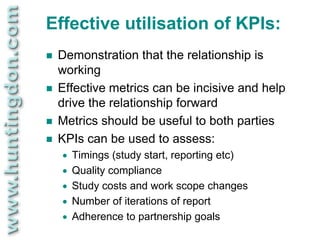
Effective utilisation of KPIs:
   Demonstration that the relationship is
    working
   Effective metrics can be incisive and help
    drive the relationship forward
   Metrics should be useful to both parties
   KPIs can be used to assess:
       Timings (study start, reporting etc)
       Quality compliance
       Study costs and work scope changes
       Number of iterations of report
       Adherence to partnership goals
Example 1: KPIs linked to
costs
   Library of defined study designs with fixed
    delivery times mutually agreed
   Study prices negotiated annually and fixed
   Study modifications or amendments are
    recorded, priced and fed back to
    procurement
   Work scope changes expressed as a
    percentage of benchmark study design
    cost
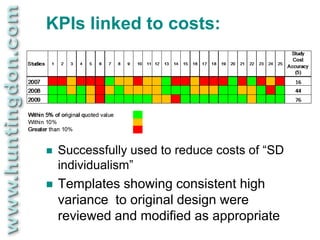
KPIs linked to costs:


   Successfully used to reduce costs of “SD
    individualism”
   Templates showing consistent high
    variance to original design were
    reviewed and modified as appropriate
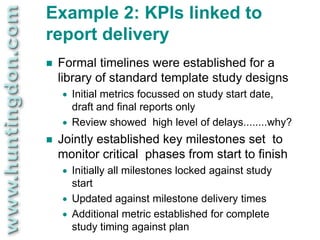
Example 2: KPIs linked to
report delivery
   Formal timelines were established for a
    library of standard template study designs
       Initial metrics focussed on study start date,
        draft and final reports only
       Review showed high level of delays........why?
   Jointly established key milestones set to
    monitor critical phases from start to finish
       Initially all milestones locked against study
        start
       Updated against milestone delivery times
       Additional metric established for complete
        study timing against plan
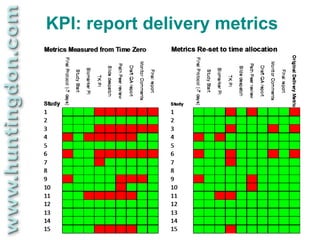
KPI: report delivery metrics
Example 3: KPIs linked to on
time payment


   MSA agreement had a volume discount
    built in that rewarded on time payment
    of invoices
       Work was outsourced form 4 locations with
        differing approaches to invoicing
       Metrics were collected for on time payment
        and were expressed as percentage
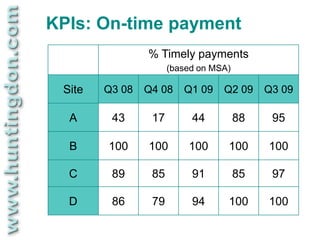
KPIs: On-time payment
                % Timely payments
                      (based on MSA)

 Site   Q3 08   Q4 08    Q1 09    Q2 09     Q3 09

  A      43      17        44          88    95

  B     100     100       100      100      100

  C      89      85        91          85    97

  D      86      79        94      100      100
Creating value:


              Value = benefits – cost

   Creating value.....
       Tactical relationships...focus on streamlining
        costs and process
       Strategic relationships...look for mutual
        benefits and working for a co-developed
        solution
Creating value:

   Cost reduction
       Make the buying and selling process efficient
        and clear
       Standardise, standardise and harmonise
            Study designs, terminology, report formats
       Ensure all studies are visible and readily
        identifiable in scheduling
       Reduce re-processing and re-scheduling
       Delays cost money
Creating value:
   Increasing mutual benefits
       Rewarding performance based on KPIs
            Report quality, on time delivery etc
            Link to the volume discount
       Sharing best scientific practice
          UtiliseCRO expertise and approach study
           challenges
          Joint scientific workshops to share
           experience and best practice
          Joint R&D projects
          Creating dedicated teams of “customer
           educated” staff to keep corporate learning
Creating value:
   Sharing the benefits of process
    improvements
          LEAN   and 6 sigma
          CROs and the pharmaceutical industry
          Joint process mapping
          KPIs on continual process improvement

   Joint “value chain mapping”
       Question the unquestionable
          Pathology  peer review...
          Bioanalytical peer review
          In-house v external
          Integration rather than “Lego building
           blocks approach”
Summary:
   Establish and define the relationship
       both parties expectations
       define roles and responsibilities
   Ensure that service and delivery is
    measureable and honest
       Establish and utilise KPIs
       Collect real time feedback
   Manage the relationship openly
       share your outsourcing plans and schedules
       share the sales plan and capacity challenges
Summary

   Long term non-clinical partnering is
    becoming a critical component in
    successful drug development strategies

   Always look ways to improve the
    relationship
       It just takes teamwork and commitment
Many thanks for your listening!
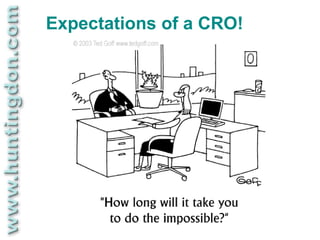
Expectations of a CRO!

Building successful long term customer relationships

  • 1.
    Building successful long termcustomer relationships Paul Overton, PhD Group Director, Corporate Development Outsourcing Preclinical Development Berlin 2nd December 2010
  • 2.
    Presentation overview:  Defining value  Defining the relationship  Factors for creating successful relationships  Setting mutual expectations  Governance structures  Utilising KPIs effectively  Open relationships  Building a “banking mentality”  Creating long term value for both parties
  • 3.
    Defining value: What is value?
  • 4.
    Defining value: Value = benefits – costs (Neil Rackham, Malcolm MacDonald and other gurus)
  • 5.
    Defining the relationship:  Do all long term business relationships need to be consultative or strategic?  Should we all be aiming at creating strategic partnerships?  Most strategic deals have a tactical component element to them  Templates, unit costs, FTE rates etc  There is a need to understand the dynamic of the relationship
  • 6.
    The value pyramid: Co created Value Solution Value Offer (packages) Component or Transactional
  • 7.
    Value in supplerrelationships: High Strategic . .. . ... . Strategic Value . . . .. .. ... .. Consultative Low . . Transactional Low Supplier Dependency High
  • 8.
    Value in supplerrelationships: High Strategic Current Market . conditions .. . ... . Strategic Value . . . .. .. ... .. Consultative Low . . Transactional Low Supplier Dependency High
  • 9.
    Defining the relationship:  Objectively review the status of the relationship  Is the approach fit for purpose?  Tactical, consultative, strategic  Relationships “evolve”  Need to ensure that both parties have full visibility and understanding  Cross functions, sites, services  Risk management  Defining the roles and responsibilities  Who does what…  The buck stops where?
  • 10.
    Defining the relationship:  Effective resource management  Sharing of key “information” components  Studies, schedules, resource limitations  Harmonisation of processes  This drives speed, quality and cost containment  Each relationship is unique  A deep understanding of each others processes drives  Efficiency, quality and cost reduction
  • 11.
    Successful relationships require:  Excellent communication  Timely, open and honest  Multi-level communication  Multi-disciplinary  Study specific  Administrative and financial  Engagement of senior management  Both parties understand and agree what success looks like  Intercompanyunderstanding  Commitment to help each other achieve it
  • 12.
    Successful relationships require:  Investment in time…  Relationships take time and effort  High level of commitment from both parties  Focus on continual improvement (evolution)
  • 13.
    Governance structures: Executive leadership team Joint operational team Study management team
  • 14.
    Governance structures: Executive leadership team Annual Meetings Joint •Top level direction and future plans for both operational parties team •Discussion of future needs •Aim at long term direction of relationship Study • High level changes in management steerage or focus team
  • 15.
    Governance structures: Executive leadership team Regular meetings Joint (quarterly) operational team •Business review meetings •Ensure ensuring compliance and delivery •KPI reporting and Study evaluation management •Process improvements team •Challenge resolution
  • 16.
    Governance structures: Executive leadership team High level communication •Hands on at the “coal Joint face” operational •Ensuring adherence to team specific KPIs •Milestones •Real time management of study challenges Study •Feedback on a study by management study basis team
  • 17.
    Creating open relationships:  Create a “banking mentality”  100% satisfaction…....nice in theory  Allrelationships are built on people  People are the strongest and weakest link  Work towards an open and blame free culture  Formally recognise good service (both ways)  Deal with the challenges and learn from them
  • 18.
    Creating open relationships:  Escalation procedures  Ensure a formal process is created to escalate service/delivery challenges  Team education…  Educate one another  Different departments sometimes have different priorities  Challenges and implications dealt with at the right level  Small challenges can quickly spiral if not handled professionally
  • 19.
    Effective utilisation ofKPIs:  Demonstration that the relationship is working  Effective metrics can be incisive and help drive the relationship forward  Metrics should be useful to both parties  KPIs can be used to assess:  Timings (study start, reporting etc)  Quality compliance  Study costs and work scope changes  Number of iterations of report  Adherence to partnership goals
  • 20.
    Example 1: KPIslinked to costs  Library of defined study designs with fixed delivery times mutually agreed  Study prices negotiated annually and fixed  Study modifications or amendments are recorded, priced and fed back to procurement  Work scope changes expressed as a percentage of benchmark study design cost
  • 21.
    KPIs linked tocosts:  Successfully used to reduce costs of “SD individualism”  Templates showing consistent high variance to original design were reviewed and modified as appropriate
  • 22.
    Example 2: KPIslinked to report delivery  Formal timelines were established for a library of standard template study designs  Initial metrics focussed on study start date, draft and final reports only  Review showed high level of delays........why?  Jointly established key milestones set to monitor critical phases from start to finish  Initially all milestones locked against study start  Updated against milestone delivery times  Additional metric established for complete study timing against plan
  • 23.
  • 24.
    Example 3: KPIslinked to on time payment  MSA agreement had a volume discount built in that rewarded on time payment of invoices  Work was outsourced form 4 locations with differing approaches to invoicing  Metrics were collected for on time payment and were expressed as percentage
  • 25.
    KPIs: On-time payment % Timely payments (based on MSA) Site Q3 08 Q4 08 Q1 09 Q2 09 Q3 09 A 43 17 44 88 95 B 100 100 100 100 100 C 89 85 91 85 97 D 86 79 94 100 100
  • 26.
    Creating value: Value = benefits – cost  Creating value.....  Tactical relationships...focus on streamlining costs and process  Strategic relationships...look for mutual benefits and working for a co-developed solution
  • 27.
    Creating value:  Cost reduction  Make the buying and selling process efficient and clear  Standardise, standardise and harmonise  Study designs, terminology, report formats  Ensure all studies are visible and readily identifiable in scheduling  Reduce re-processing and re-scheduling  Delays cost money
  • 28.
    Creating value:  Increasing mutual benefits  Rewarding performance based on KPIs  Report quality, on time delivery etc  Link to the volume discount  Sharing best scientific practice  UtiliseCRO expertise and approach study challenges  Joint scientific workshops to share experience and best practice  Joint R&D projects  Creating dedicated teams of “customer educated” staff to keep corporate learning
  • 29.
    Creating value:  Sharing the benefits of process improvements  LEAN and 6 sigma  CROs and the pharmaceutical industry  Joint process mapping  KPIs on continual process improvement  Joint “value chain mapping”  Question the unquestionable  Pathology peer review...  Bioanalytical peer review  In-house v external  Integration rather than “Lego building blocks approach”
  • 30.
    Summary:  Establish and define the relationship  both parties expectations  define roles and responsibilities  Ensure that service and delivery is measureable and honest  Establish and utilise KPIs  Collect real time feedback  Manage the relationship openly  share your outsourcing plans and schedules  share the sales plan and capacity challenges
  • 31.
    Summary  Long term non-clinical partnering is becoming a critical component in successful drug development strategies  Always look ways to improve the relationship  It just takes teamwork and commitment
  • 32.
    Many thanks foryour listening!
  • 33.