
Ken Sandy
LEADING
THROUGH
INFLUENCE
How do you influence
your organization?
Conceiving of a business opportunity vs. Understanding customer problems
Generating your own product ideas vs. Embracing cross-organizational ideation
Defining solution requirements vs. Validating possible solutions
Driving project execution vs. Building a motivated team
Shipping a product vs. Ensuring customer adoption
“Build the right
product”
not
“Build the product
right”.
CONTEXT
COLLABORATION
CLARITY
Use creative
thinking
to discover
opportunities
and potential
solutions
Understand
your
customer
and their
unmet needs
Shine a light
on contrary
data, flaws,
hidden
assumptions
to preempt
issues
Motivate a
team and
build
company-
wide support
Evaluate your “go-to-strength” and
that of your key stakeholder
Write them both together in the
chat window (yours first, theirs next)
HOW TO APPLY GIVEN…
• The product lifecycle?
• Product maturity?
• Stakeholder comfort
zones?
• Organization size and
culture?
• Your comfort zone?
DRIVE INNOVATION WITH AN EXPLORER MINDSET
1. Define your target customer, problem statement,
and a product vision.
2. Canvas broadly for opportunities and ideas.
3. Prototype potential solutions —and gather
feedback throughout the lifecycle.
Who is your target customer?
“For whom you are solving a problem?”
You likely have multiple, complementary
customers.
Sub-segment target customers and define their
attributes.
Create a persona to bring them to life. Validate with
existing and prospective customers.
What problem are you solving for your customer?
“The benefits you promise to deliver – in your
customer’s terms”
Start with a Problem Statement – make it
meaningful.
Define about three value proposition statements
per target customer.
Value propositions are the reasons people buy –
your features and functions make it possible.
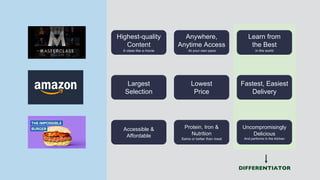
Given these testimonials, what problem does Masterclass uniquely solve?
Highest-quality
Content
A class like a movie
Anywhere,
Anytime Access
At your own pace
Largest
Selection
Lowest
Price
Fastest, Easiest
Delivery
Learn from
the Best
in the world
Accessible &
Affordable
Protein, Iron &
Nutrition
Same or better than meat
Uncompromisingly
Delicious
And performs in the kitchen
DIFFERENTIATOR
Stuck? Abstract Your Features to Value Propositions
1. Imagine you are Airbnb before it was
created. List features you would include
Airbnb’s service.
2. Group the features into buckets that
represent three key value propositions
of Airbnb.
DEVELOP CUSTOMER UNDERSTANDING WITH AN ANALYST MINDSET
1. Set and monitor quantitative performance metrics
for your product.
2. Develop a rich qualitative perspective by observing
and interviewing customers.
3. Become your own analyst.
Measure What Matters
Vanity metrics are distractions, irrelevant to your
product – and can mask severe fundamental issues.
What demonstrates customers value your product?
Viability: Customer-lifetime value > Revenue
Your responsibility to define, gather, analyze,
report
Vanity KPIs vs. Value KPIs
• 5 million registered users
• Sales have grown by 400%
• #1 download on AppStore
• Distribution deals with 4 out of the top 6
retailers
• Grew traffic to 5 million advertising
impressions per month
• 150,000 twitter followers
• 90% product launches are on-time
• Billions and billions served
• Repeat users are 70% of all visitors to the Website
• Successful transaction completion at 78%
• 15 minutes time spent per unique user per month
• YoY contract renewals at 93%
• Monthly active users use application 7 times per
month
• Average ”half-life” per customer is 10 months
• We grew conversion rate last month from 1.0% to
1.5%
• Monthly returns are down from 0.7% to 0.5% of
units sold
• 3 Likes/Shares/Comments per follower per month
Attributes of SMART Value KPIs
Value KPIs pinpoint and
measure specific behaviors
customers exhibit within,
about or in response to
your product.
These demonstrate
customers find sustained,
substantial value from
using your service.
Simple, clearly defined, concise,
shared and focused.
Actionable. Moves fast enough to
establish a feedback loop.
Trackable, quantifiable, accurate
and repeatable. Comparable
period to period.
Meaningful to your product and
customer goals. Mitigates the
effects of externalities.
Motivating. Obtainable but
challenging.
List metrics that you
are – or would like to
be – held accountable
to…
Choosing Metrics
How will we measure success?
State the desired business benefits
Choose one ‘north-star’ long-term customer outcome
to guide and inspire
Augment with SMART product KPIs
Metrics
KPIs
OKRs
Values that are important to track and evaluate over time.
Key Performance Indicators are metrics with which
we’ve established a correlate with success
Initiative for a specific time horizon (typically
quarterly) intended to improve one or more KPIs
Metrics, KPIs and OKRs
North Star
% of Students who start their own Small Business
KPI 1
Course Graduation
Rate
KPI 3
LTV / CAC
ratio
KPI 2
# of Interactions
per student
Conversion rate increases 10% over baseline
with 80% confidence (for an A|B test)
Onboarding of new customers takes half the
time over current baseline
80% of Monthly Active Users utilize feature
Y at least once per month
The proportion of customer service tickets
triggered by issue Z are reduced by 50%
SUCCESS
CRITERIA
EXAMPLES
Understand Customers, First-hand
Don’t outsource the most important part of your
role.
Build empathy and discover new opportunities
Frequent, informal and lightweight engagement
Partner with research and insight teams
IDENTIFY AND MITIGATE RISKS WITH A CHALLENGER MINDSET
1. Approach all opportunities as hypotheses requiring
validation.
2. Embrace dissenting voices and constructive conflict.
3. Focus, prioritize, cut – say no nicely.
https://itamargilad.com/the-tool-that-will-help-you-choose-better-product-ideas/
Developing Hypotheses
“What risks and assumptions do we need to test,
evaluate and mitigate?”
Focus on those not readily in your control.
Prioritize critical risks and have a mitigation or
response plan.
Revisit infrequently to see whether things have
changed.
Ø Will consumers be interested in classes taught by celebrities?
Ø Can we charge consumers enough to make the business
sustainable?
Ø Will instructors agree to teach?
Ø Will instructors be any good at teaching?
Ø Will instructors be able to commit to timelines and schedules?
Ø Can we produce high-quality classes cost effectively?
Ø Can we produce and release enough regular content to keep
consumers engaged?
Ø Will competitors with deeper pockets overtake us once we
validate the market opportunity?
Who is this for?
What is the underlying pain-point, unmet need or opportunity?
What do we know today?
What benefit will the customer receive?
What benefit will the business receive?
Collaborate to Set Priorities
Prioritization: the processes is the easy bit;
the people are the hard bit.
Saying “no” is unpleasant – but “yes” can be worse
Align on user and business goals/criteria first
Use available best-data, and revisit periodically
saying
NICELY
What are some
creative ways you use
to say no to
demanding
stakeholders?
Stakeholder #1 – No-nonsense Nancy
Strategy
1. Respect their authority
2. Bring the conversation back to desired outcomes
3. Commit to a discovery data gathering exercise
4. Articulate the impact and resulting trade-offs
required
Habitat
Often found with senior executive
titles in corner offices
Diagnosis
• Sets deadlines or scope, or both
• Presents issues in terms of solutions
• May see PM as a service organization
“I can see this is important to you. Help me
understand the underlying data and drivers
that have led you to this conclusion – so I can
efficiently guide the team.”
Stakeholder #2 – Likeable Larry
Strategy
1. Listen and acknowledge their needs
2. Describe the impact on others in the organization
when you miss goals (appeal to their empathy)
3. If appropriate, put their need in the idea backlog
4. Recruit them to cheerlead existing goals
Habitat
A long-term, well-respected resident
of many departments
Diagnosis
• Approaches team directly (lacks process)
• Team desires or feels responsible to help
• Distractions lead to missed milestones
“The team has been pretty hammered lately
striving for Goal X. Can you drop-by and
acknowledge their hard work?”
Stakeholder #3 – Recency Ralph
Strategy
1. Understand context - use 5-whys to determine
root-issues
2. Evaluate potential workarounds – if possible,
suggest an alternative course with lower effort
3. Reiterate the value of the work already
prioritized and the outcomes on their behalf
4. Show them how work is prioritized and say-no as
nicely as you can
Habitat
Rarely sighted sales executive,
except immediately after an
important customer meeting
Diagnosis
• Left-field, urgent feature requests
• A big deal or newly identified problem
• Ignoring leads to escalation and more work
“Can you tell me about a time that you (or
your customer) wanted that and what did
you (they) do instead?”
BUILD MOMENTUM WITH AN EVANGELIST MINDSET
1. Communicate with your stakeholders proactively
and regularly.
2. Set context rather than prescribing solutions—lose
ownership to your team.
3. Carefully manage cross-functional collaboration
before, throughout, and immediately after launch.
Evangelism isn’t just just
presenting ideas and updates
How do you evangelize
your product and
priorities?
Invest in Relationships Before You Need Them
Trust is frequency of quality interaction plus
follow-through… minus self-interest.
Define your stakeholder group broadly
Meet with each one-on-one. Listen more, talk less.
Determine your stakeholder management strategy
Seek Buy-in and a No-Surprises Policy
“Prewire” group consensus by previewing
key points individually with stakeholders.
Time to digest and get onside
Forewarn you of issues might derail you later
Share the uncomfortable early – it’s inevitable
Deliver Proactive Concise Updates
No news might be bad news.
Build confidence, affirm alignment, engage them
Establish a cadence and structure
Bottom-line upfront – don’t keep them guessing
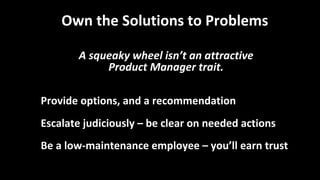
Own the Solutions to Problems
A squeaky wheel isn’t an attractive
Product Manager trait.
Provide options, and a recommendation
Escalate judiciously – be clear on needed actions
Be a low-maintenance employee – you’ll earn trust
Partner with, don’t Drive, Engineering
Engineering Doesn’t Work For You.
Focus on why – encourage ownership of what & how
Involve Engineering early during discovery
Hold kick-offs to share context and retrospectives to
improve process and ways of working
Proactively, Decisively Manage Trade-offs
Be ready to make tough calls early and throughout
execution to keep the team on-track.
No nice-to-haves – do the hard work to scope tightly
Sensitively navigate estimation and date-setting
Respect quality lest you set off a techdebt
timebomb
Own Outcomes, Not Projects
A product release is not the finish-line,
it’s the start of the marathon.
Communicate and engage across stakeholder group
Disciplined management of post-launch issues
Iterate and optimize until delivery of outcomes
KEY
TAKEAWAYS 1. Explorer drives innovation. Analyst builds
understanding. Challenger mitigates risks
and creates focus. Evangelist provides a path
to delivery.
2. Deploy the mindsets to create the context and
environment to motivate a high-performing
cross-functional team.
3. Play to your "go-to" strengths but recognize
and balance your own and stakeholders’
weaknesses.
linkedin/in/kensandy
kenjsandy@gmail.com
influentialpm.com
BOOK DEAL
eBook / pbk / kindle / audible:
amzn.to/39kie8i
APPENDIX
... ...
...
... ...
…
...
Reading and Instructions: https://www.metabeta.com/articles/process/problem-statement-canvas/
https://www.brainmates.com.au/wordpress/wp-content/uploads/2013/09/Brainmates-Idea-Pad-English.pdf
Collaboratively Identifying Big Rocks: The KJ-Method
PRO TIP: Have your contributors fill out a
worksheet ahead of time including:
1. Their version of the vision and
strategic pillars
2. Interview their stakeholders
3. Prepare a stack of “post-its” of
strategic pillar candidates ready to go
1. Recruit a stakeholder group
2. Pose the focus question for each strategic pillar in turn –
“What can we do to achieve…”
3. Individual brainstorm – write but don’t share ideas (yet)
4. Take in turns to share and place on the strategy board
5. Group and name similar items
6. Vote for groups (not items) and invite debate
7. Rank groups and observe emerging themes (themes
become the big rocks)
Hypothetical Photo Community Product Vision:
We motivate aspiring professional photographers to collaborate and learn new skills
from each other. We’re interesting because unlike alternatives our platform enables
real-time, credible, specific and actionable feedback on each piece of work.
North Star: # photographers who regularly provide or receive
feedback resulting in them becoming a better creator
TIPS
FOR
STAKEHOLDER
MANAGEMENT

Ken sandy- Productized Masterclasses

  • 2.
  • 3.
  • 4.
    How do youinfluence your organization?
  • 6.
    Conceiving of abusiness opportunity vs. Understanding customer problems Generating your own product ideas vs. Embracing cross-organizational ideation Defining solution requirements vs. Validating possible solutions Driving project execution vs. Building a motivated team Shipping a product vs. Ensuring customer adoption
  • 7.
  • 8.
  • 9.
  • 10.
  • 11.
    Shine a light oncontrary data, flaws, hidden assumptions to preempt issues
  • 12.
  • 13.
    Evaluate your “go-to-strength”and that of your key stakeholder Write them both together in the chat window (yours first, theirs next)
  • 14.
    HOW TO APPLYGIVEN… • The product lifecycle? • Product maturity? • Stakeholder comfort zones? • Organization size and culture? • Your comfort zone?
  • 16.
    DRIVE INNOVATION WITHAN EXPLORER MINDSET 1. Define your target customer, problem statement, and a product vision. 2. Canvas broadly for opportunities and ideas. 3. Prototype potential solutions —and gather feedback throughout the lifecycle.
  • 17.
    Who is yourtarget customer? “For whom you are solving a problem?” You likely have multiple, complementary customers. Sub-segment target customers and define their attributes. Create a persona to bring them to life. Validate with existing and prospective customers.
  • 20.
    What problem areyou solving for your customer? “The benefits you promise to deliver – in your customer’s terms” Start with a Problem Statement – make it meaningful. Define about three value proposition statements per target customer. Value propositions are the reasons people buy – your features and functions make it possible.
  • 22.
    Given these testimonials,what problem does Masterclass uniquely solve?
  • 23.
    Highest-quality Content A class likea movie Anywhere, Anytime Access At your own pace Largest Selection Lowest Price Fastest, Easiest Delivery Learn from the Best in the world Accessible & Affordable Protein, Iron & Nutrition Same or better than meat Uncompromisingly Delicious And performs in the kitchen DIFFERENTIATOR
  • 24.
    Stuck? Abstract YourFeatures to Value Propositions
  • 25.
    1. Imagine youare Airbnb before it was created. List features you would include Airbnb’s service. 2. Group the features into buckets that represent three key value propositions of Airbnb.
  • 29.
    DEVELOP CUSTOMER UNDERSTANDINGWITH AN ANALYST MINDSET 1. Set and monitor quantitative performance metrics for your product. 2. Develop a rich qualitative perspective by observing and interviewing customers. 3. Become your own analyst.
  • 30.
    Measure What Matters Vanitymetrics are distractions, irrelevant to your product – and can mask severe fundamental issues. What demonstrates customers value your product? Viability: Customer-lifetime value > Revenue Your responsibility to define, gather, analyze, report
  • 31.
    Vanity KPIs vs.Value KPIs • 5 million registered users • Sales have grown by 400% • #1 download on AppStore • Distribution deals with 4 out of the top 6 retailers • Grew traffic to 5 million advertising impressions per month • 150,000 twitter followers • 90% product launches are on-time • Billions and billions served • Repeat users are 70% of all visitors to the Website • Successful transaction completion at 78% • 15 minutes time spent per unique user per month • YoY contract renewals at 93% • Monthly active users use application 7 times per month • Average ”half-life” per customer is 10 months • We grew conversion rate last month from 1.0% to 1.5% • Monthly returns are down from 0.7% to 0.5% of units sold • 3 Likes/Shares/Comments per follower per month
  • 32.
    Attributes of SMARTValue KPIs Value KPIs pinpoint and measure specific behaviors customers exhibit within, about or in response to your product. These demonstrate customers find sustained, substantial value from using your service. Simple, clearly defined, concise, shared and focused. Actionable. Moves fast enough to establish a feedback loop. Trackable, quantifiable, accurate and repeatable. Comparable period to period. Meaningful to your product and customer goals. Mitigates the effects of externalities. Motivating. Obtainable but challenging.
  • 33.
    List metrics thatyou are – or would like to be – held accountable to…
  • 34.
    Choosing Metrics How willwe measure success? State the desired business benefits Choose one ‘north-star’ long-term customer outcome to guide and inspire Augment with SMART product KPIs
  • 35.
    Metrics KPIs OKRs Values that areimportant to track and evaluate over time. Key Performance Indicators are metrics with which we’ve established a correlate with success Initiative for a specific time horizon (typically quarterly) intended to improve one or more KPIs Metrics, KPIs and OKRs
  • 36.
    North Star % ofStudents who start their own Small Business KPI 1 Course Graduation Rate KPI 3 LTV / CAC ratio KPI 2 # of Interactions per student
  • 37.
    Conversion rate increases10% over baseline with 80% confidence (for an A|B test) Onboarding of new customers takes half the time over current baseline 80% of Monthly Active Users utilize feature Y at least once per month The proportion of customer service tickets triggered by issue Z are reduced by 50% SUCCESS CRITERIA EXAMPLES
  • 38.
    Understand Customers, First-hand Don’toutsource the most important part of your role. Build empathy and discover new opportunities Frequent, informal and lightweight engagement Partner with research and insight teams
  • 41.
    IDENTIFY AND MITIGATERISKS WITH A CHALLENGER MINDSET 1. Approach all opportunities as hypotheses requiring validation. 2. Embrace dissenting voices and constructive conflict. 3. Focus, prioritize, cut – say no nicely.
  • 42.
  • 43.
    Developing Hypotheses “What risksand assumptions do we need to test, evaluate and mitigate?” Focus on those not readily in your control. Prioritize critical risks and have a mitigation or response plan. Revisit infrequently to see whether things have changed.
  • 44.
    Ø Will consumersbe interested in classes taught by celebrities? Ø Can we charge consumers enough to make the business sustainable? Ø Will instructors agree to teach? Ø Will instructors be any good at teaching? Ø Will instructors be able to commit to timelines and schedules? Ø Can we produce high-quality classes cost effectively? Ø Can we produce and release enough regular content to keep consumers engaged? Ø Will competitors with deeper pockets overtake us once we validate the market opportunity?
  • 45.
    Who is thisfor? What is the underlying pain-point, unmet need or opportunity? What do we know today? What benefit will the customer receive? What benefit will the business receive?
  • 46.
    Collaborate to SetPriorities Prioritization: the processes is the easy bit; the people are the hard bit. Saying “no” is unpleasant – but “yes” can be worse Align on user and business goals/criteria first Use available best-data, and revisit periodically
  • 47.
  • 48.
    What are some creativeways you use to say no to demanding stakeholders?
  • 49.
    Stakeholder #1 –No-nonsense Nancy Strategy 1. Respect their authority 2. Bring the conversation back to desired outcomes 3. Commit to a discovery data gathering exercise 4. Articulate the impact and resulting trade-offs required Habitat Often found with senior executive titles in corner offices Diagnosis • Sets deadlines or scope, or both • Presents issues in terms of solutions • May see PM as a service organization “I can see this is important to you. Help me understand the underlying data and drivers that have led you to this conclusion – so I can efficiently guide the team.”
  • 50.
    Stakeholder #2 –Likeable Larry Strategy 1. Listen and acknowledge their needs 2. Describe the impact on others in the organization when you miss goals (appeal to their empathy) 3. If appropriate, put their need in the idea backlog 4. Recruit them to cheerlead existing goals Habitat A long-term, well-respected resident of many departments Diagnosis • Approaches team directly (lacks process) • Team desires or feels responsible to help • Distractions lead to missed milestones “The team has been pretty hammered lately striving for Goal X. Can you drop-by and acknowledge their hard work?”
  • 51.
    Stakeholder #3 –Recency Ralph Strategy 1. Understand context - use 5-whys to determine root-issues 2. Evaluate potential workarounds – if possible, suggest an alternative course with lower effort 3. Reiterate the value of the work already prioritized and the outcomes on their behalf 4. Show them how work is prioritized and say-no as nicely as you can Habitat Rarely sighted sales executive, except immediately after an important customer meeting Diagnosis • Left-field, urgent feature requests • A big deal or newly identified problem • Ignoring leads to escalation and more work “Can you tell me about a time that you (or your customer) wanted that and what did you (they) do instead?”
  • 53.
    BUILD MOMENTUM WITHAN EVANGELIST MINDSET 1. Communicate with your stakeholders proactively and regularly. 2. Set context rather than prescribing solutions—lose ownership to your team. 3. Carefully manage cross-functional collaboration before, throughout, and immediately after launch.
  • 54.
    Evangelism isn’t justjust presenting ideas and updates How do you evangelize your product and priorities?
  • 55.
    Invest in RelationshipsBefore You Need Them Trust is frequency of quality interaction plus follow-through… minus self-interest. Define your stakeholder group broadly Meet with each one-on-one. Listen more, talk less. Determine your stakeholder management strategy
  • 56.
    Seek Buy-in anda No-Surprises Policy “Prewire” group consensus by previewing key points individually with stakeholders. Time to digest and get onside Forewarn you of issues might derail you later Share the uncomfortable early – it’s inevitable
  • 57.
    Deliver Proactive ConciseUpdates No news might be bad news. Build confidence, affirm alignment, engage them Establish a cadence and structure Bottom-line upfront – don’t keep them guessing
  • 58.
    Own the Solutionsto Problems A squeaky wheel isn’t an attractive Product Manager trait. Provide options, and a recommendation Escalate judiciously – be clear on needed actions Be a low-maintenance employee – you’ll earn trust
  • 59.
    Partner with, don’tDrive, Engineering Engineering Doesn’t Work For You. Focus on why – encourage ownership of what & how Involve Engineering early during discovery Hold kick-offs to share context and retrospectives to improve process and ways of working
  • 61.
    Proactively, Decisively ManageTrade-offs Be ready to make tough calls early and throughout execution to keep the team on-track. No nice-to-haves – do the hard work to scope tightly Sensitively navigate estimation and date-setting Respect quality lest you set off a techdebt timebomb
  • 62.
    Own Outcomes, NotProjects A product release is not the finish-line, it’s the start of the marathon. Communicate and engage across stakeholder group Disciplined management of post-launch issues Iterate and optimize until delivery of outcomes
  • 63.
    KEY TAKEAWAYS 1. Explorerdrives innovation. Analyst builds understanding. Challenger mitigates risks and creates focus. Evangelist provides a path to delivery. 2. Deploy the mindsets to create the context and environment to motivate a high-performing cross-functional team. 3. Play to your "go-to" strengths but recognize and balance your own and stakeholders’ weaknesses.
  • 64.
  • 65.
  • 67.
    ... ... ... ... ... … ... Readingand Instructions: https://www.metabeta.com/articles/process/problem-statement-canvas/
  • 68.
  • 69.
    Collaboratively Identifying BigRocks: The KJ-Method PRO TIP: Have your contributors fill out a worksheet ahead of time including: 1. Their version of the vision and strategic pillars 2. Interview their stakeholders 3. Prepare a stack of “post-its” of strategic pillar candidates ready to go 1. Recruit a stakeholder group 2. Pose the focus question for each strategic pillar in turn – “What can we do to achieve…” 3. Individual brainstorm – write but don’t share ideas (yet) 4. Take in turns to share and place on the strategy board 5. Group and name similar items 6. Vote for groups (not items) and invite debate 7. Rank groups and observe emerging themes (themes become the big rocks)
  • 70.
    Hypothetical Photo CommunityProduct Vision: We motivate aspiring professional photographers to collaborate and learn new skills from each other. We’re interesting because unlike alternatives our platform enables real-time, credible, specific and actionable feedback on each piece of work. North Star: # photographers who regularly provide or receive feedback resulting in them becoming a better creator
  • 72.