The Effect of Direct- and Cross-Rolling on Mechanical
Properties and Microstructure of Severely Deformed
Aluminum
K.Rahimi Mamaghani and M. Kazeminezhad
(Submitted October 14, 2012; in revised form October 2, 2013; published online October 17, 2013)
Severely deformed commercial pure aluminum sheets by constrained groove pressing are direct and cross-
rolled. The grain size evolution and dislocation density during rolling are studied using Williamson-Hall
analysis on x-ray diffraction patterns of the deformed samples. These results and optical microscopy
observations show that subsequent direct or cross-rolling of constrained groove pressed aluminum can
produce elongated fine grains. The minimum crystallite size is achieved after cross-rolling of constrained
groove pressed samples. By direct-rolling or cross-rolling of annealed sheet, the maximum intensity in x-ray
diffraction patterns remains on (200) like annealed aluminum but direct-rolling or cross-rolling of con-
strained groove pressed sheets changes the maximum intensity from (111) for constrained groove pressed
sheets to (220). Also, mechanical properties are studied using tensile test and hardness measurement. The
results show that cross-rolling on constrained groove pressed samples is more effective than direct-rolling in
mechanical properties improvement.
Keywords cross-rolling, direct-rolling, microstructure, severe
plastic deformation, x-ray diffraction
1. Introduction
Ultrafine-grained materials are attended during recent years.
They have unique combination of physical and mechanical
properties compared with those of coarse-grained materials
(Ref 1, 2). Also, obtaining nanostructure is a very effective way
of increasing material strength; especially the case of light
alloys such as aluminum is of great interest as the strength is
significantly increased with grain refinement. This leads to an
improvement in the strength to weight ratio, which is a
desirable property for transportation and aerospace industries
(Ref 3). Several methods of producing nanostructured materials
by severe plastic deformation (SPD) have been developed.
In 2002, Shin et al. Ref 4 invented a SPD process of sheet;
constrained groove pressing (CGP) process consists of repet-
itive shear deformation under plane strain deformation condi-
tion by utilizing alternate pressings with grooved and flat dies
(Ref 4-7). In this study, CGP method is used for imposing the
SPD to the aluminum sheets. Since this method has been
recently invented, there are no further works on it and it seems
that more works should be carried out. To produce severely
deformed thin sheets, the severely deformed ones should be
rolled, because, during SPD of thin sheets, the sheets may be
ruptured due to large loads. Thus, one of the possible ways of
treatments is sheet rolling. Sheets can be used in different
industries. This treatment is reasonable in case of preservation
and improving nanostructures and related physical and
mechanical properties in the sheets.
The effects of rolling after SPD on properties and micro-
structure have been studied for copper, steel, aluminum alloy,
titanium, and titanium alloy (Ref 8-14). It was shown that
rolling after equal channel angular pressing (ECAP) results in
further grain refinement and improving strength. In particular,
the effects of direct and cross-rolling strains on microstructure
and mechanical properties of CGPed samples have not yet been
studied. Thus, understanding the correlation between micro-
structure and properties of material after CGP and, after direct
and cross-rolling of CGPed samples with different reductions in
cross-section is an interesting subject.
The aim of current research is on investigation of micro-
structure and mechanical properties of aluminum after different
strains of CGP and subsequent direct and cross-rolling with
different reductions in cross-section. Also, the effects of rolling
and cross-rolling on annealed and CGPed materials are studied.
2. Experimental Procedure
In the present study, annealed (at 623 K for 3 h) commercial
pure aluminum sheets (AA1100) with dimension of 84 mm 9
60 mm 9 3 mm were used to study the effectiveness of CGP+
rolling processes for grain refining and strengthening of
aluminum sheets. The details of process procedure can be
found in Ref 15-17 consisting of pressings in corrugated and
flattened dies.
However, it should be noted that the width of corrugating
dents of grooving dies is equal to the sheet thickness that
reveals pure shear deformation condition through the process.
K.Rahimi Mamaghani and M. Kazeminezhad, Department of
Materials Science and Engineering, Sharif University of Technology,
Azadi Avenue, Tehran, Iran. Contact e-mail: mkazemi@sharif.edu.
JMEPEG (2014) 23:115–124 ÓASM International
DOI: 10.1007/s11665-013-0742-5 1059-9495/$19.00
Journal of Materials Engineering and Performance Volume 23(1) January 2014—115
In this study, Teflon layers between aluminum sheet and dies
were used as lubricant. The pressing force of process was
supplied using a 1000 kN hydraulic pressing machine at a ram
speed of 0.05 mm/s. The applied load in this process was
around 30-40 KN. The CGPed aluminum sheets with different
strains were rolled at room temperature using different rolling
reductions with rolls speed of 30 rpm. A laboratory 20 tons
capacity rolling machine with two cylindrical rolls of 150 mm
diameter was utilized. The CGPed sheet thickness was 3 mm,
in each rolling pass its thickness was reduced 0.5 mm and this
reduction continued until the sheet thickness of 0.5 mm was
achieved. The mechanical and microstructural examinations
were performed on 1.5 mm (rolling strain of 0.8), 1 mm
(rolling strain of 1.27), and 0.5 mm (rolling strain of 2.07)
thickness sheets. Direct-rolling was carried out in longitudinal
direction of CGPed aluminum and cross-rolling was performed
with 90° rotation.
To investigate the microstructure evolution of sheets during
process, x-ray diffraction (XRD) measurements were carried
out on a Philips x-ray diffractometer equipped with a graphite
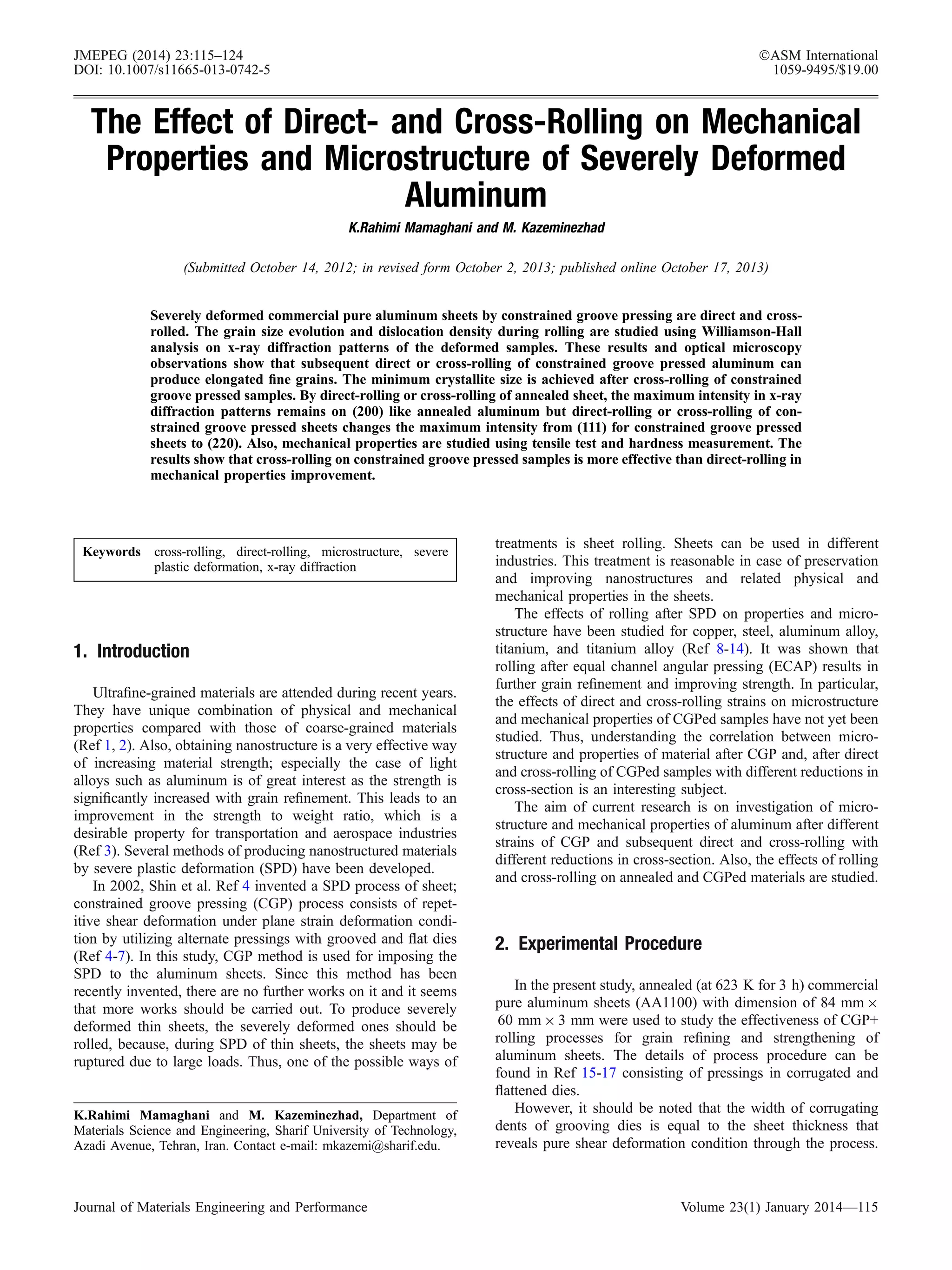
Fig. 1 Metallographic images of (a) annealed Al sheet, (b) 2 passes CGPed Al
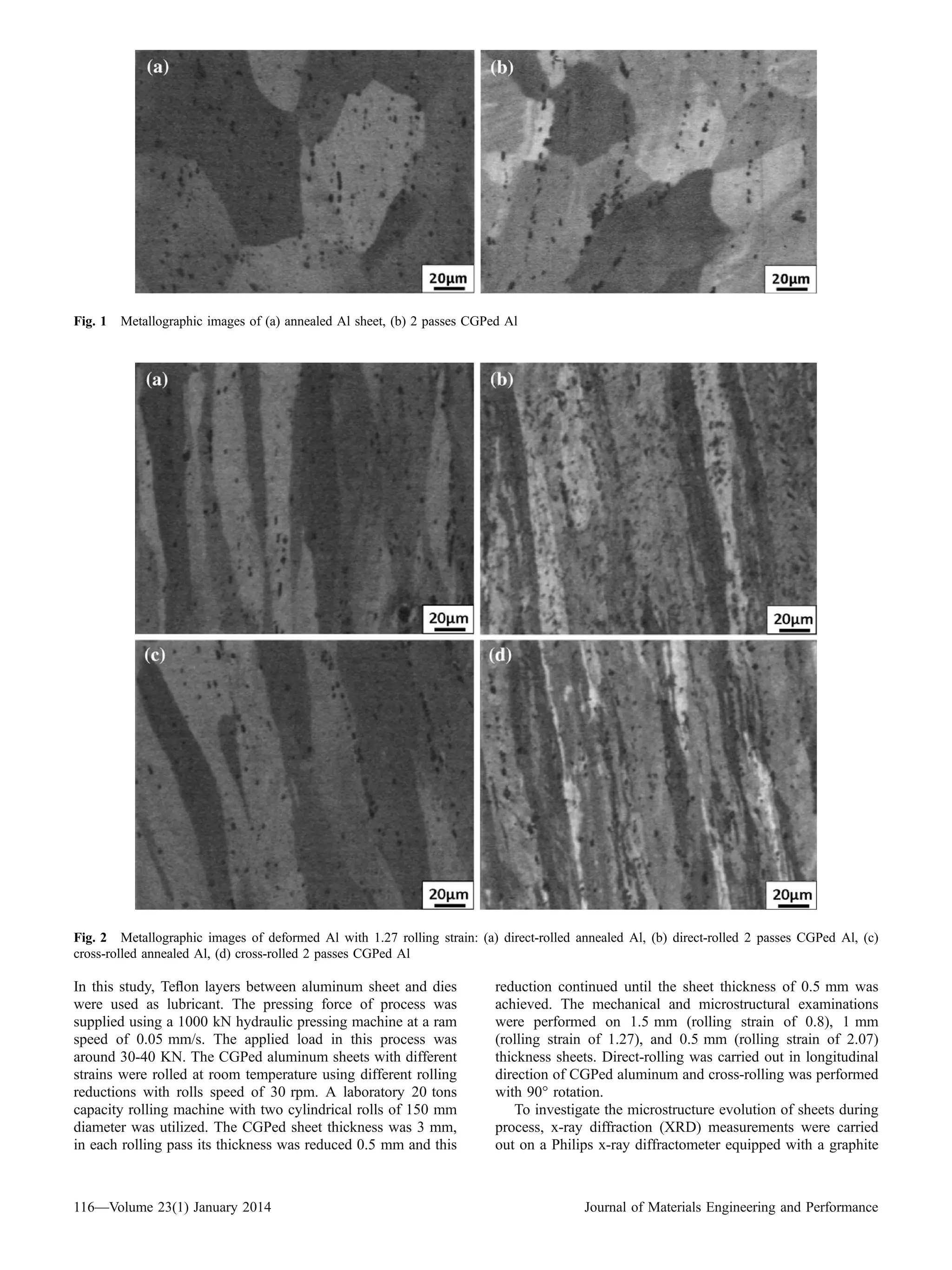
Fig. 2 Metallographic images of deformed Al with 1.27 rolling strain: (a) direct-rolled annealed Al, (b) direct-rolled 2 passes CGPed Al, (c)
cross-rolled annealed Al, (d) cross-rolled 2 passes CGPed Al
116—Volume 23(1) January 2014 Journal of Materials Engineering and Performance
monochromator using Cu Ka radiation. The x-ray patterns of
samples were obtained in the range of 10°-80° and in the step
width of 0.02°. For calibration of the instrumental line
broadening, SiC powder was examined in the same condition.
Resolving full-width at half-maximum (FWHM) for all peaks
was carried out using the software configured with the XRD
system. The XRD patterns were achieved from center of the
samples. An approved reliable based-model approach of XRD
line profile analysis that utilized in this study was Williamson-
Hall method (Ref 18, 19). Correspondingly, crystallite size and
lattice equivalent strain can be resolved by measuring the
deviation of line profile from perfect crystal diffraction. In the
Williamson-Hall method, there is a relation between FWHM
(b), crystallite size (t), and the distortion function (f(e))
(explained in Ref 19, 20), by the following equation (Ref 20):
bcosh ¼
kk
t
þ f eð Þsinh ðEq 1Þ
where h is the Bragg angle, k is the wavelength, and k is the
Scherer constant (%0.9). Considering Eq 1, the intercept of
the plot b cos h versus sin h gives the cell size and the slope
gives the crystal strain.
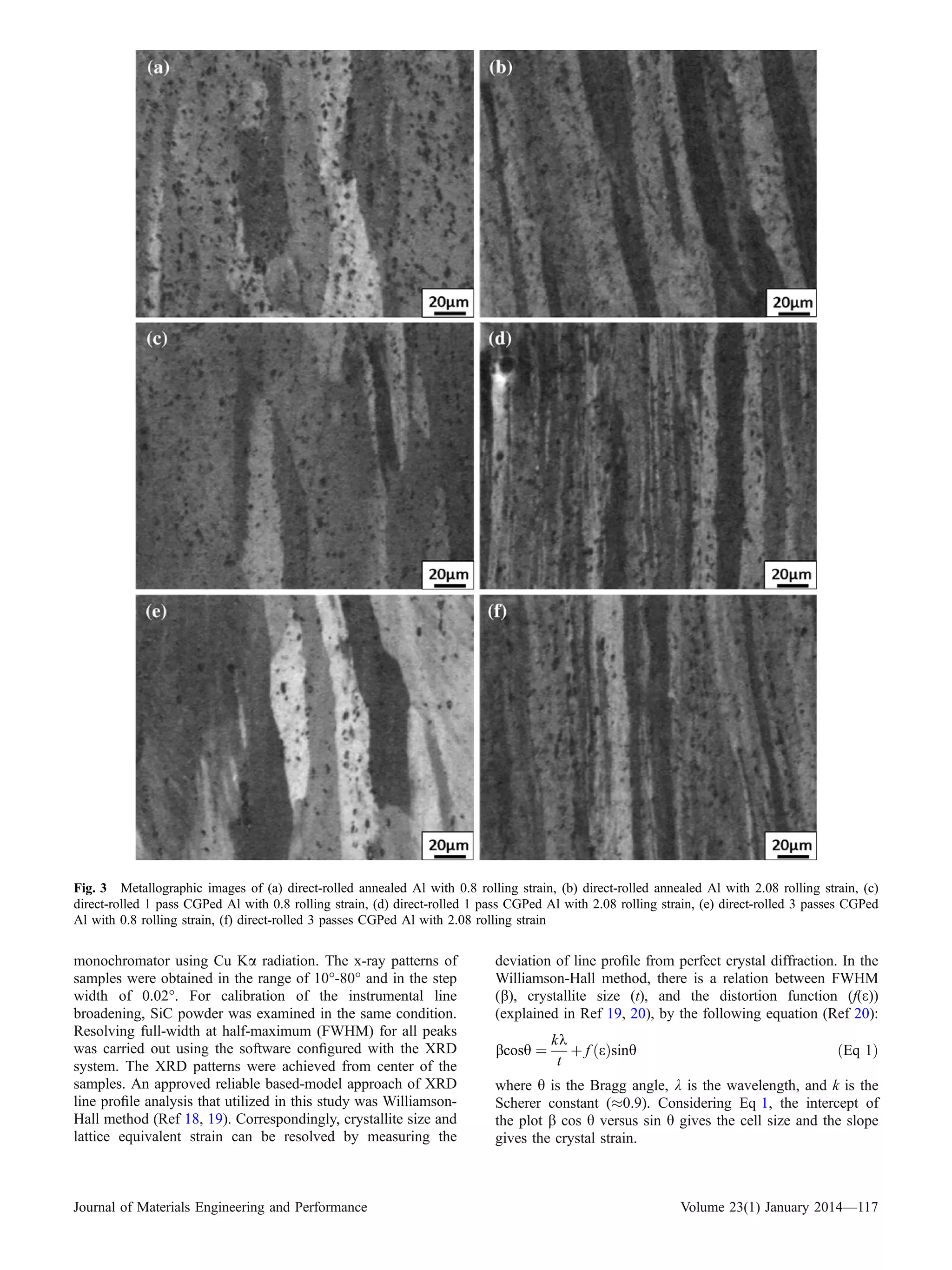
Fig. 3 Metallographic images of (a) direct-rolled annealed Al with 0.8 rolling strain, (b) direct-rolled annealed Al with 2.08 rolling strain, (c)
direct-rolled 1 pass CGPed Al with 0.8 rolling strain, (d) direct-rolled 1 pass CGPed Al with 2.08 rolling strain, (e) direct-rolled 3 passes CGPed
Al with 0.8 rolling strain, (f) direct-rolled 3 passes CGPed Al with 2.08 rolling strain
Journal of Materials Engineering and Performance Volume 23(1) January 2014—117
Commercial diffractometer contains the instrumental
profile besides the intrinsic profile (pure diffraction profile).
In this regard, the Gaussian-Gaussian function can be
employed to correct the integral breadths of intrinsic profile
(Ref 19).
b2
exp ffi b2
þ b2
ins ðEq 2Þ
where b, bexp, and bins are the integral breadth of the intrin-
sic, experimental and instrumental profiles, respectively. The
value of the dislocation density was calculated (Ref 21, 22)
from the average values of the crystallite size (t) and micro-
strain (eL) by the following equations:
q ¼
ffiffiffiffiffiffiffiffiffiffiffiffiffiffiffi
qt  qS
p
ðEq 3Þ
qt ¼
3
t
ðEq 4Þ
qS ¼
K < e2
L >
b2
ðEq 5Þ
where K = 6p and b is the Burgers vector ( b ¼ a=
ffiffiffi
2
p
for
FCC structure and a is the lattice parameter, which can be
considered 4.097 A˚ for aluminum).
Optical microscope observations were carried out on the
processed specimens. Samples in thickness direction were
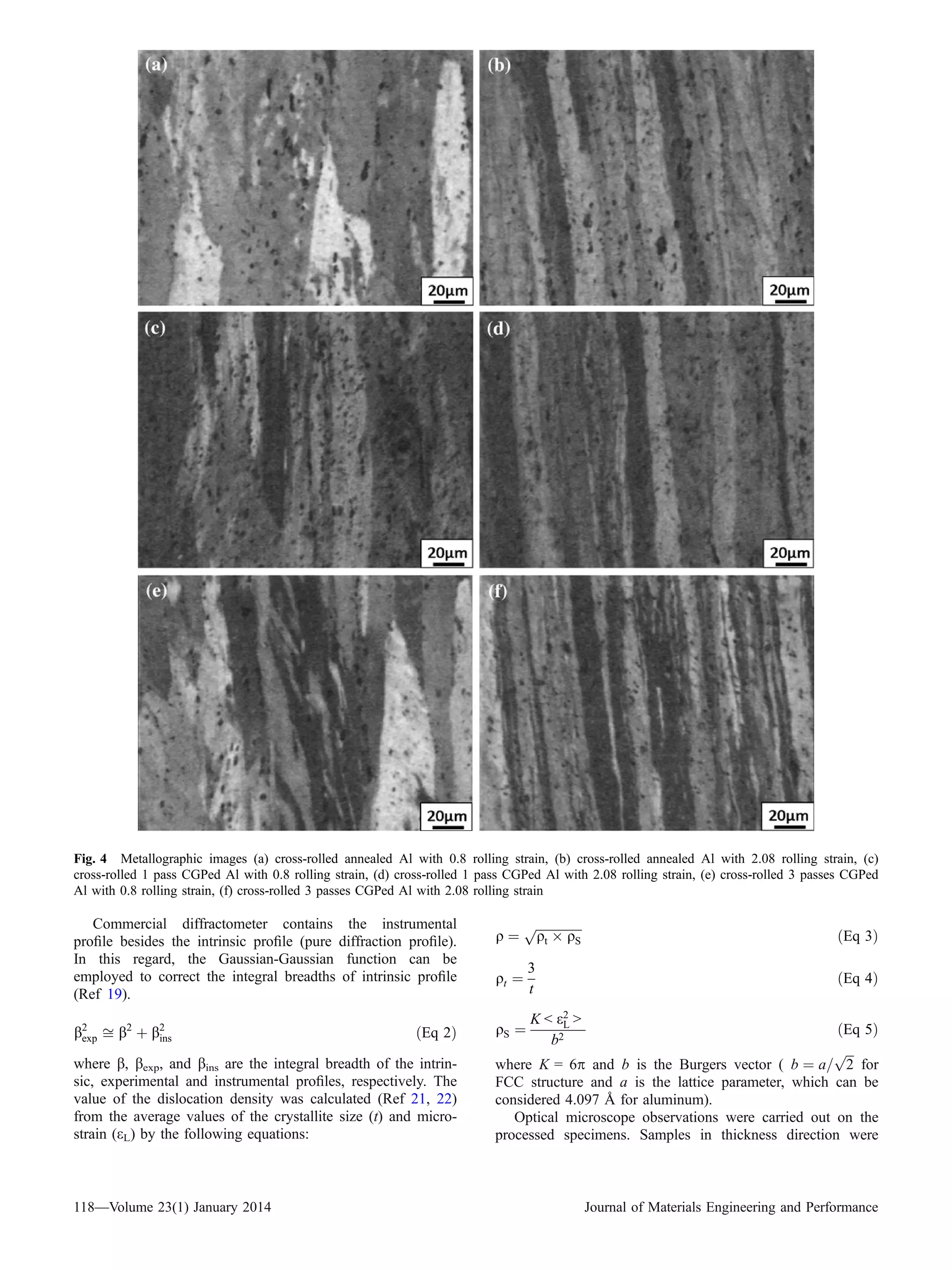
Fig. 4 Metallographic images (a) cross-rolled annealed Al with 0.8 rolling strain, (b) cross-rolled annealed Al with 2.08 rolling strain, (c)
cross-rolled 1 pass CGPed Al with 0.8 rolling strain, (d) cross-rolled 1 pass CGPed Al with 2.08 rolling strain, (e) cross-rolled 3 passes CGPed
Al with 0.8 rolling strain, (f) cross-rolled 3 passes CGPed Al with 2.08 rolling strain
118—Volume 23(1) January 2014 Journal of Materials Engineering and Performance
polished then electro-chemically etched with BarkerÕs etchant
(2.5% HBF4 solution, and a voltage of 20 V DC applied for
duration of 2 min) and then viewed under polarized light
illumination (Ref 23). The optical microscopy of annealed
sample showed extremely large average grain size of 100 lm.
Also, to investigate the mechanical behavior of aluminum
sheets after CGP and rolling in different directions, tensile, and
hardness tests were carried out. Tensile test specimens were
machined according to the ASTM E8M standard that the gage
length was aligned along the longitudinal direction of the
pressed sheet. Room temperature tensile tests were performed on
an Instron machine operating at an initial strain rate of 5 9 10À3
/
s. Also, Vickers hardness measurements were carried out on the
longitudinal sections along the length of the specimen. A 5 kg
load applied for 30 s was utilized for these measurements in all
samples. The hardness values were achieved from the average of
10 measurements on each specimen.
3. Results and Discussion
3.1 Microstructure
3.1.1 Optical Microscope Observations. The micro-
structure of annealed sample shows equiaxed grains (Fig. 1a).
Figure 1(b) shows the microstructure of the groove-pressed
aluminum after two CGP passes. CGP changes the microstruc-
ture of material by imposing shear force; however, as shown in
Fig. 1(b), deformed microstructure of CGPed sample approx-
imately preserves its initial equiaxed grain structure. There is a
noticeable reduction in grain size after CGP (Ref 4-7).
The microstructures of the cold-rolled annealed and CGPed
aluminum sheets are shown in Fig. 2. In both CGPed and
annealed aluminum sheets, lamellar microstructures are
observed after direct and cross-rolling. The cold rolling process
of CGPed sheets leads to the elongated finer grains than those
of annealed ones (Ref 24). After rolling, the grains of CGPed
samples become narrower than those of annealed ones because
of initial strain and grain refinement.
There is not a lot of difference in microstructures of direct-
rolled and cross-rolled annealed sheets as can be seen in
Fig. 2(a) and (c). But, the narrower and finer microstructure is
observed in cross-rolled CGPed sheet than that in direct-rolled
one, Fig. 2(b) and (d).
Figure 3(a) and (b) show the effect of rolling strain on the
microstructures of annealed aluminum. With increasing the
deformation amount in cold-rolling, the microstructure be-
comes more laminate and the grains are elongated along the
rolling direction (Ref 25, 26). More information about the
structure and properties of cold-rolled commercial purity
aluminum in rolling strain of 2 can be found in Ref 27-30.
Figure 3 (c), (d), (e), and (f) show the effect of rolling strain
on the microstructures of CGPed aluminum. In both rolling
directions (Fig. 3 and 4) the structures show the space between
the lamellar boundaries has decreased with increasing rolling
strain. Comparing these images represent that increase in the
pass number of CGP makes more laminar and finer micro-
structure. This is more obvious in less CGP pass or low rolling
strain.
3.1.2 Crystallite Size. During severe plastic deformation,
subgrain boundaries evolve in the grains structures (Ref 31).
Subsequently, these boundaries develop areas with coherent
crystalline domain size (Ref 32). After analyzing the XRD
pattern of each sample using Williamson-Hall method, evolu-
tion of cell/crystallite size during rolling of CGPed aluminum
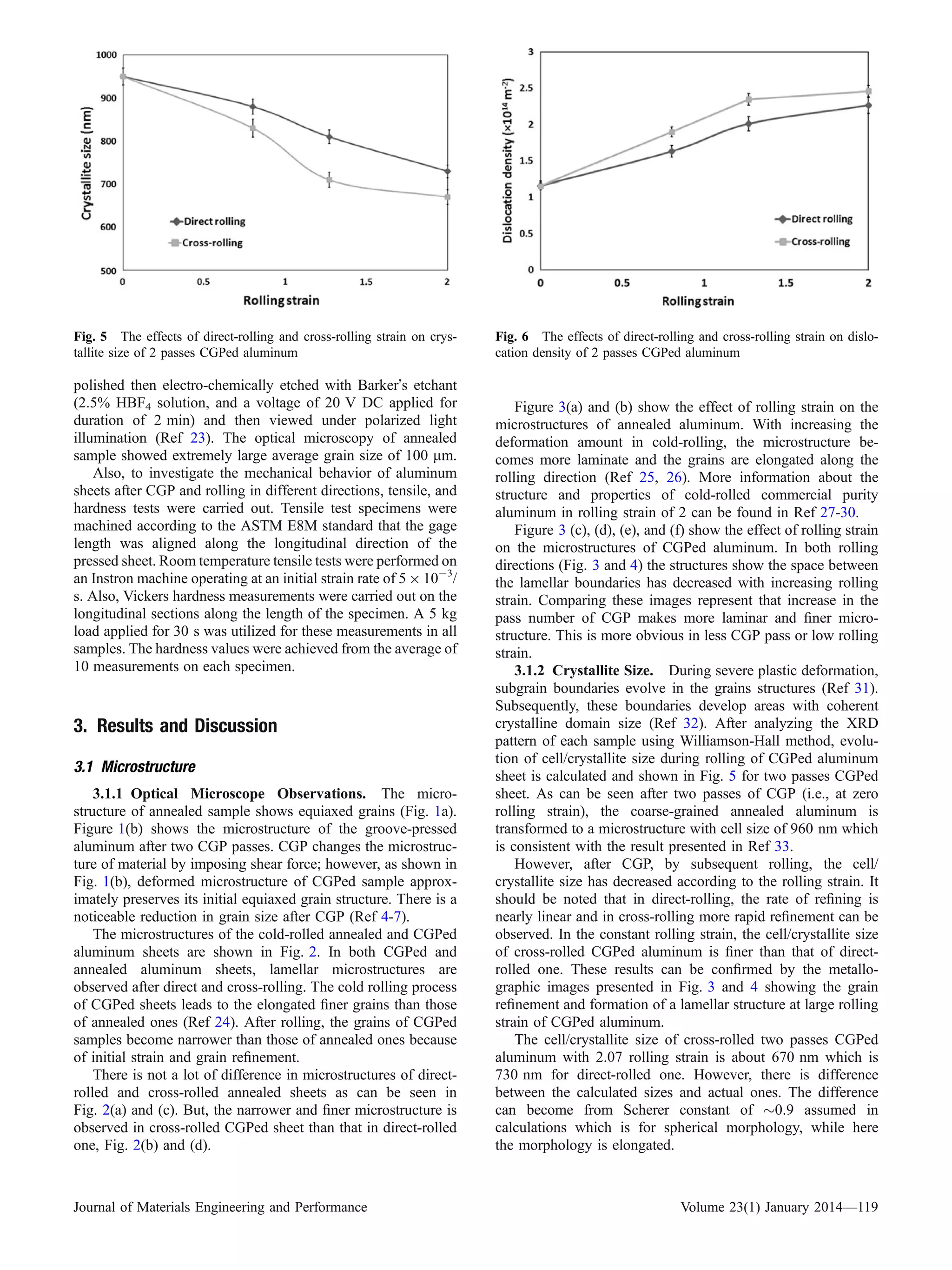
sheet is calculated and shown in Fig. 5 for two passes CGPed
sheet. As can be seen after two passes of CGP (i.e., at zero
rolling strain), the coarse-grained annealed aluminum is
transformed to a microstructure with cell size of 960 nm which
is consistent with the result presented in Ref 33.
However, after CGP, by subsequent rolling, the cell/
crystallite size has decreased according to the rolling strain. It
should be noted that in direct-rolling, the rate of refining is
nearly linear and in cross-rolling more rapid refinement can be
observed. In the constant rolling strain, the cell/crystallite size
of cross-rolled CGPed aluminum is finer than that of direct-
rolled one. These results can be confirmed by the metallo-
graphic images presented in Fig. 3 and 4 showing the grain
refinement and formation of a lamellar structure at large rolling
strain of CGPed aluminum.
The cell/crystallite size of cross-rolled two passes CGPed
aluminum with 2.07 rolling strain is about 670 nm which is
730 nm for direct-rolled one. However, there is difference
between the calculated sizes and actual ones. The difference
can become from Scherer constant of $0.9 assumed in
calculations which is for spherical morphology, while here
the morphology is elongated.
Fig. 5 The effects of direct-rolling and cross-rolling strain on crys-
tallite size of 2 passes CGPed aluminum
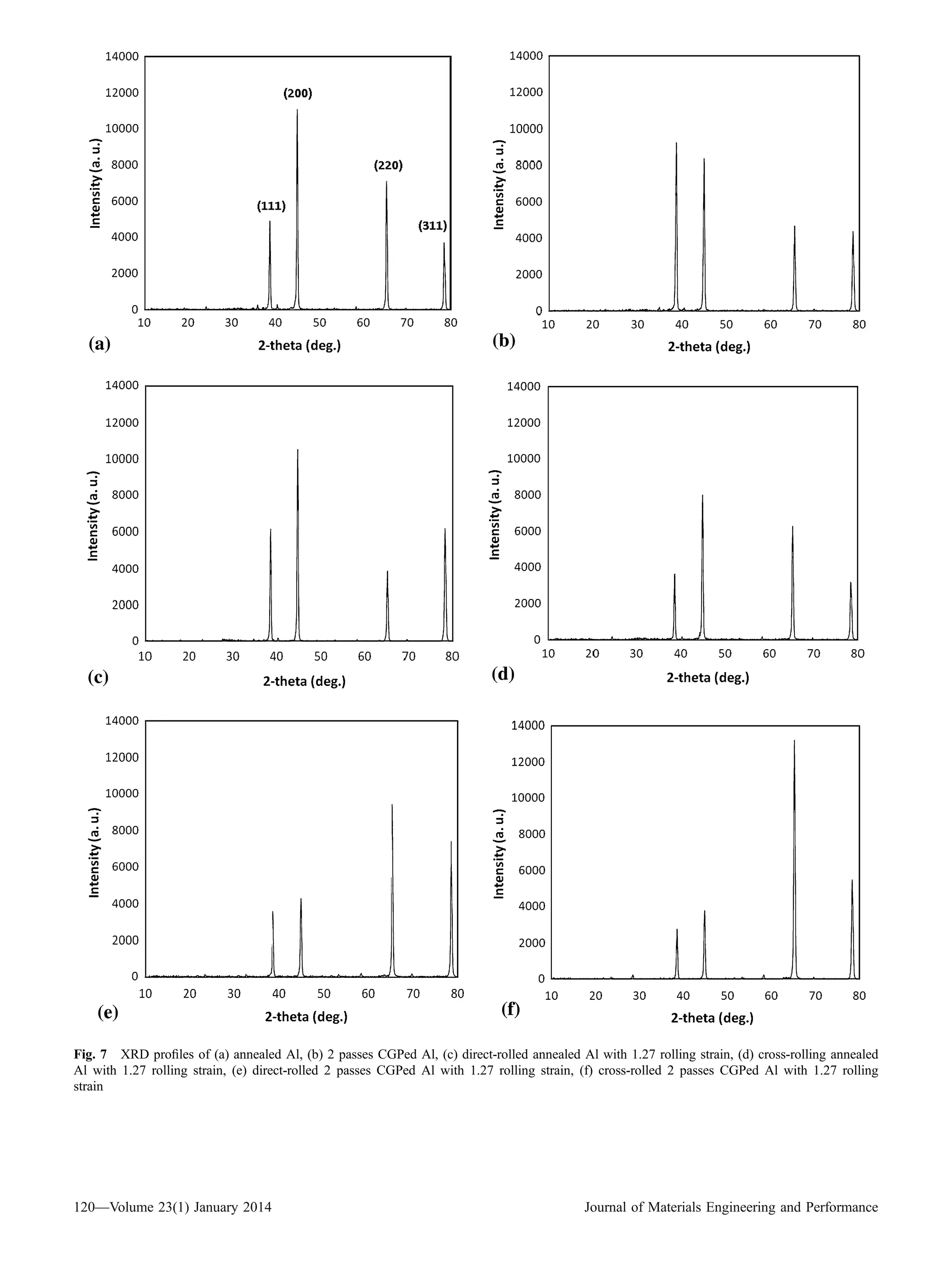
Fig. 6 The effects of direct-rolling and cross-rolling strain on dislo-
cation density of 2 passes CGPed aluminum
Journal of Materials Engineering and Performance Volume 23(1) January 2014—119
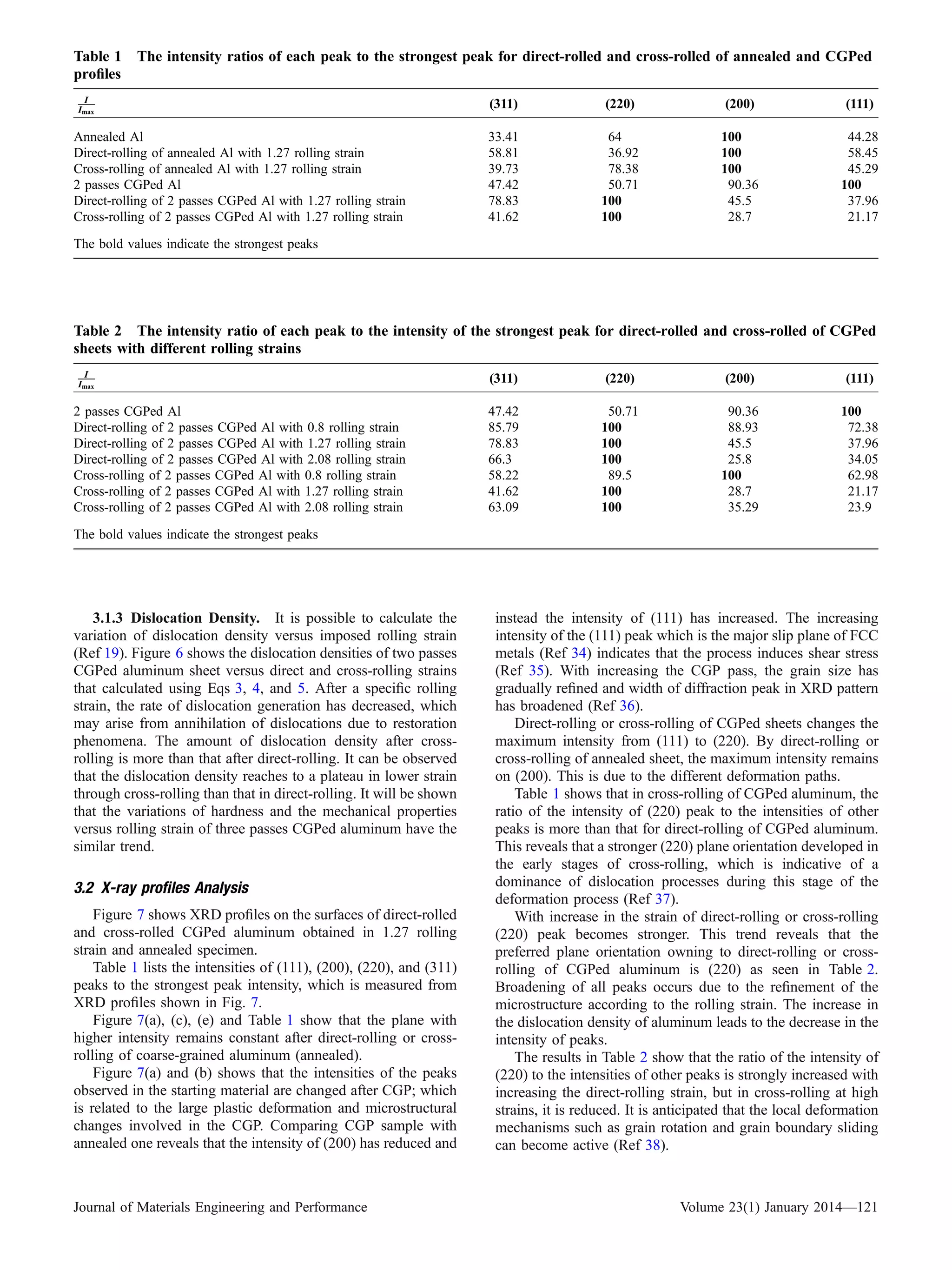
Fig. 7 XRD profiles of (a) annealed Al, (b) 2 passes CGPed Al, (c) direct-rolled annealed Al with 1.27 rolling strain, (d) cross-rolling annealed
Al with 1.27 rolling strain, (e) direct-rolled 2 passes CGPed Al with 1.27 rolling strain, (f) cross-rolled 2 passes CGPed Al with 1.27 rolling
strain
120—Volume 23(1) January 2014 Journal of Materials Engineering and Performance
3.1.3 Dislocation Density. It is possible to calculate the
variation of dislocation density versus imposed rolling strain
(Ref 19). Figure 6 shows the dislocation densities of two passes
CGPed aluminum sheet versus direct and cross-rolling strains
that calculated using Eqs 3, 4, and 5. After a specific rolling
strain, the rate of dislocation generation has decreased, which
may arise from annihilation of dislocations due to restoration
phenomena. The amount of dislocation density after cross-
rolling is more than that after direct-rolling. It can be observed
that the dislocation density reaches to a plateau in lower strain
through cross-rolling than that in direct-rolling. It will be shown
that the variations of hardness and the mechanical properties
versus rolling strain of three passes CGPed aluminum have the
similar trend.
3.2 X-ray profiles Analysis
Figure 7 shows XRD profiles on the surfaces of direct-rolled
and cross-rolled CGPed aluminum obtained in 1.27 rolling
strain and annealed specimen.
Table 1 lists the intensities of (111), (200), (220), and (311)
peaks to the strongest peak intensity, which is measured from
XRD profiles shown in Fig. 7.
Figure 7(a), (c), (e) and Table 1 show that the plane with
higher intensity remains constant after direct-rolling or cross-
rolling of coarse-grained aluminum (annealed).
Figure 7(a) and (b) shows that the intensities of the peaks
observed in the starting material are changed after CGP; which
is related to the large plastic deformation and microstructural
changes involved in the CGP. Comparing CGP sample with
annealed one reveals that the intensity of (200) has reduced and
instead the intensity of (111) has increased. The increasing
intensity of the (111) peak which is the major slip plane of FCC
metals (Ref 34) indicates that the process induces shear stress
(Ref 35). With increasing the CGP pass, the grain size has
gradually refined and width of diffraction peak in XRD pattern
has broadened (Ref 36).
Direct-rolling or cross-rolling of CGPed sheets changes the
maximum intensity from (111) to (220). By direct-rolling or
cross-rolling of annealed sheet, the maximum intensity remains
on (200). This is due to the different deformation paths.
Table 1 shows that in cross-rolling of CGPed aluminum, the
ratio of the intensity of (220) peak to the intensities of other
peaks is more than that for direct-rolling of CGPed aluminum.
This reveals that a stronger (220) plane orientation developed in
the early stages of cross-rolling, which is indicative of a
dominance of dislocation processes during this stage of the
deformation process (Ref 37).
With increase in the strain of direct-rolling or cross-rolling
(220) peak becomes stronger. This trend reveals that the
preferred plane orientation owning to direct-rolling or cross-
rolling of CGPed aluminum is (220) as seen in Table 2.
Broadening of all peaks occurs due to the refinement of the
microstructure according to the rolling strain. The increase in
the dislocation density of aluminum leads to the decrease in the
intensity of peaks.
The results in Table 2 show that the ratio of the intensity of
(220) to the intensities of other peaks is strongly increased with
increasing the direct-rolling strain, but in cross-rolling at high
strains, it is reduced. It is anticipated that the local deformation
mechanisms such as grain rotation and grain boundary sliding
can become active (Ref 38).
Table 1 The intensity ratios of each peak to the strongest peak for direct-rolled and cross-rolled of annealed and CGPed
profiles
I
Imax
(311) (220) (200) (111)
Annealed Al 33.41 64 100 44.28
Direct-rolling of annealed Al with 1.27 rolling strain 58.81 36.92 100 58.45
Cross-rolling of annealed Al with 1.27 rolling strain 39.73 78.38 100 45.29
2 passes CGPed Al 47.42 50.71 90.36 100
Direct-rolling of 2 passes CGPed Al with 1.27 rolling strain 78.83 100 45.5 37.96
Cross-rolling of 2 passes CGPed Al with 1.27 rolling strain 41.62 100 28.7 21.17
The bold values indicate the strongest peaks
Table 2 The intensity ratio of each peak to the intensity of the strongest peak for direct-rolled and cross-rolled of CGPed
sheets with different rolling strains
I
Imax
(311) (220) (200) (111)
2 passes CGPed Al 47.42 50.71 90.36 100
Direct-rolling of 2 passes CGPed Al with 0.8 rolling strain 85.79 100 88.93 72.38
Direct-rolling of 2 passes CGPed Al with 1.27 rolling strain 78.83 100 45.5 37.96
Direct-rolling of 2 passes CGPed Al with 2.08 rolling strain 66.3 100 25.8 34.05
Cross-rolling of 2 passes CGPed Al with 0.8 rolling strain 58.22 89.5 100 62.98
Cross-rolling of 2 passes CGPed Al with 1.27 rolling strain 41.62 100 28.7 21.17
Cross-rolling of 2 passes CGPed Al with 2.08 rolling strain 63.09 100 35.29 23.9
The bold values indicate the strongest peaks
Journal of Materials Engineering and Performance Volume 23(1) January 2014—121
3.3 Mechanical Properties
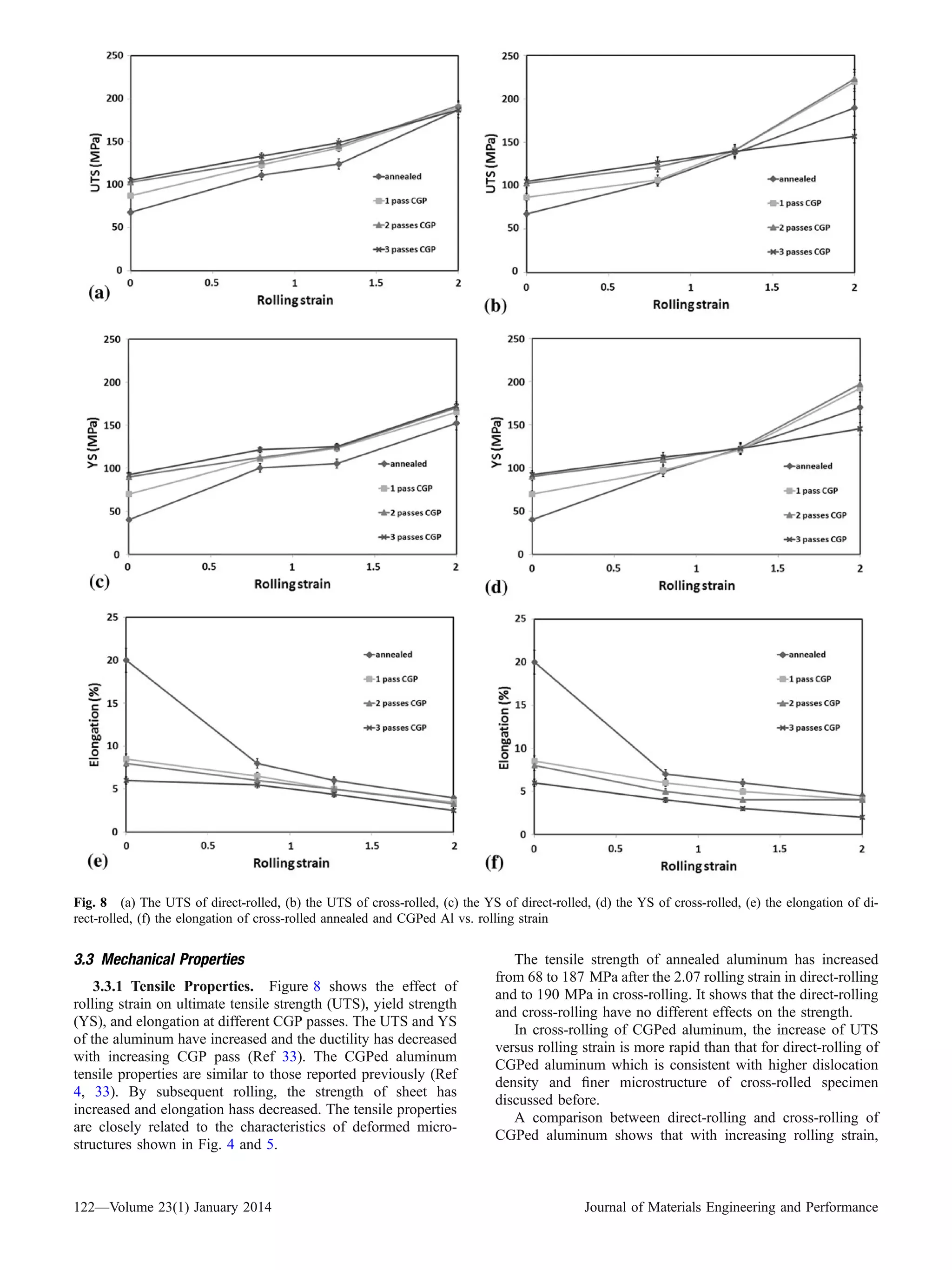
3.3.1 Tensile Properties. Figure 8 shows the effect of
rolling strain on ultimate tensile strength (UTS), yield strength
(YS), and elongation at different CGP passes. The UTS and YS
of the aluminum have increased and the ductility has decreased
with increasing CGP pass (Ref 33). The CGPed aluminum
tensile properties are similar to those reported previously (Ref
4, 33). By subsequent rolling, the strength of sheet has
increased and elongation hass decreased. The tensile properties
are closely related to the characteristics of deformed micro-
structures shown in Fig. 4 and 5.
The tensile strength of annealed aluminum has increased
from 68 to 187 MPa after the 2.07 rolling strain in direct-rolling
and to 190 MPa in cross-rolling. It shows that the direct-rolling
and cross-rolling have no different effects on the strength.
In cross-rolling of CGPed aluminum, the increase of UTS
versus rolling strain is more rapid than that for direct-rolling of
CGPed aluminum which is consistent with higher dislocation
density and finer microstructure of cross-rolled specimen
discussed before.
A comparison between direct-rolling and cross-rolling of
CGPed aluminum shows that with increasing rolling strain,
Fig. 8 (a) The UTS of direct-rolled, (b) the UTS of cross-rolled, (c) the YS of direct-rolled, (d) the YS of cross-rolled, (e) the elongation of di-
rect-rolled, (f) the elongation of cross-rolled annealed and CGPed Al vs. rolling strain
122—Volume 23(1) January 2014 Journal of Materials Engineering and Performance
cross-rolling is more effective in improving the mechanical
properties of CGPed aluminum that it is not seen for direct-
rolling and cross-rolling of annealed aluminum. This is in good
accordance with microstructure and XRD results. In direct-
rolling of two passes CGPed aluminum, the UTS has increased
to 192 MPa in 2.07 rolling strain and for cross-rolling with the
same condition UTS has increased to 223 MPa that which is
3.3 times greater than UTS of the starting annealed aluminum
(68 MPa).
The elongation of annealed aluminum has decreased from
48 to 8% after the first pass of CGP. With subsequent direct-
rolling or cross-rolling, it has decreased with increasing rolling
strain. By cross-rolling of three passes, CGPed aluminum to
2.07 rolling strain, the elongation reaches to 2%.
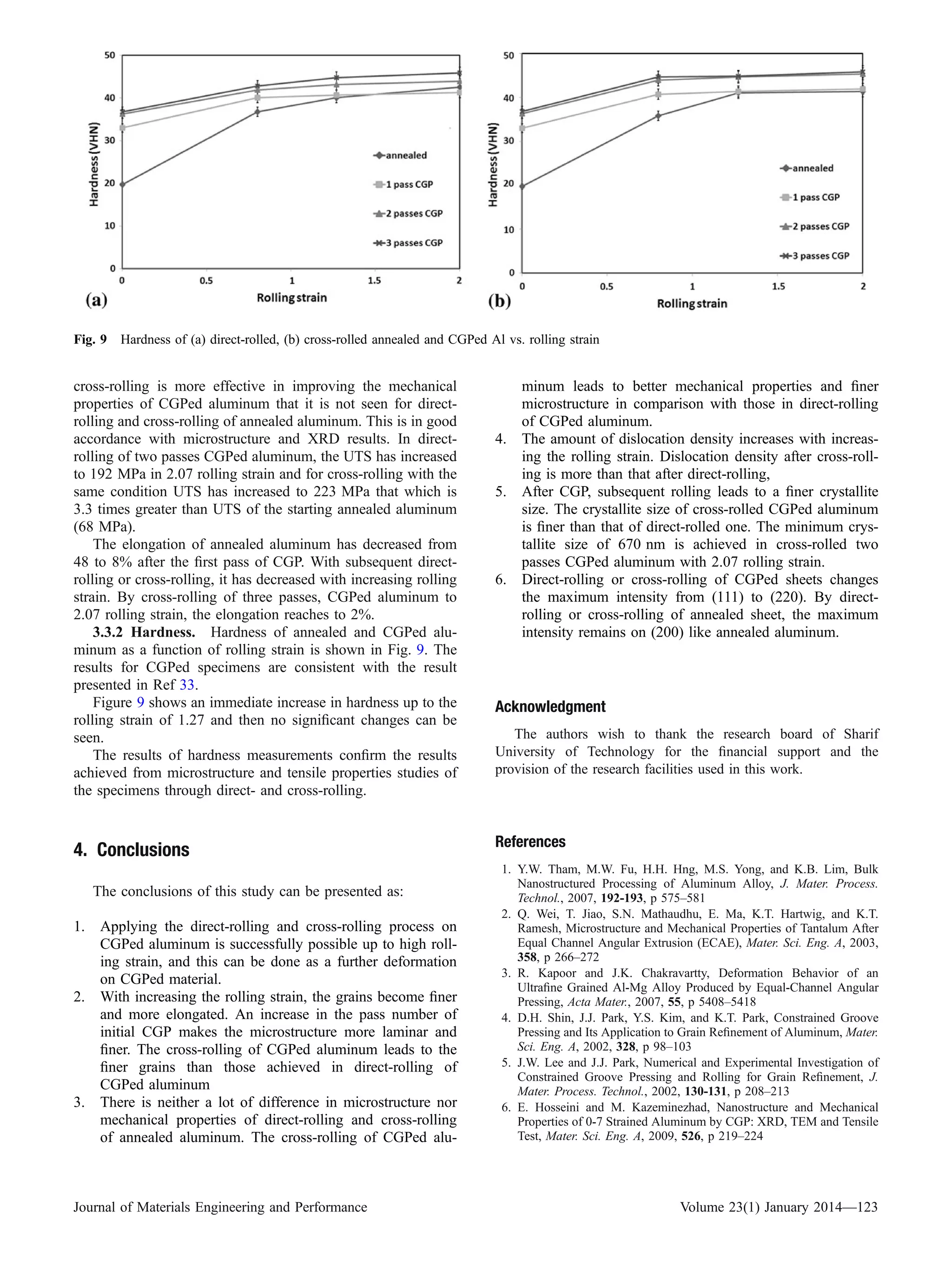
3.3.2 Hardness. Hardness of annealed and CGPed alu-
minum as a function of rolling strain is shown in Fig. 9. The
results for CGPed specimens are consistent with the result
presented in Ref 33.
Figure 9 shows an immediate increase in hardness up to the
rolling strain of 1.27 and then no significant changes can be
seen.
The results of hardness measurements confirm the results
achieved from microstructure and tensile properties studies of
the specimens through direct- and cross-rolling.
4. Conclusions
The conclusions of this study can be presented as:
1. Applying the direct-rolling and cross-rolling process on
CGPed aluminum is successfully possible up to high roll-
ing strain, and this can be done as a further deformation
on CGPed material.
2. With increasing the rolling strain, the grains become finer
and more elongated. An increase in the pass number of
initial CGP makes the microstructure more laminar and
finer. The cross-rolling of CGPed aluminum leads to the
finer grains than those achieved in direct-rolling of
CGPed aluminum
3. There is neither a lot of difference in microstructure nor
mechanical properties of direct-rolling and cross-rolling
of annealed aluminum. The cross-rolling of CGPed alu-
minum leads to better mechanical properties and finer
microstructure in comparison with those in direct-rolling
of CGPed aluminum.
4. The amount of dislocation density increases with increas-
ing the rolling strain. Dislocation density after cross-roll-
ing is more than that after direct-rolling,
5. After CGP, subsequent rolling leads to a finer crystallite
size. The crystallite size of cross-rolled CGPed aluminum
is finer than that of direct-rolled one. The minimum crys-
tallite size of 670 nm is achieved in cross-rolled two
passes CGPed aluminum with 2.07 rolling strain.
6. Direct-rolling or cross-rolling of CGPed sheets changes
the maximum intensity from (111) to (220). By direct-
rolling or cross-rolling of annealed sheet, the maximum
intensity remains on (200) like annealed aluminum.
Acknowledgment
The authors wish to thank the research board of Sharif
University of Technology for the financial support and the
provision of the research facilities used in this work.
References
1. Y.W. Tham, M.W. Fu, H.H. Hng, M.S. Yong, and K.B. Lim, Bulk
Nanostructured Processing of Aluminum Alloy, J. Mater. Process.
Technol., 2007, 192-193, p 575–581
2. Q. Wei, T. Jiao, S.N. Mathaudhu, E. Ma, K.T. Hartwig, and K.T.
Ramesh, Microstructure and Mechanical Properties of Tantalum After
Equal Channel Angular Extrusion (ECAE), Mater. Sci. Eng. A, 2003,
358, p 266–272
3. R. Kapoor and J.K. Chakravartty, Deformation Behavior of an
Ultrafine Grained Al-Mg Alloy Produced by Equal-Channel Angular
Pressing, Acta Mater., 2007, 55, p 5408–5418
4. D.H. Shin, J.J. Park, Y.S. Kim, and K.T. Park, Constrained Groove
Pressing and Its Application to Grain Refinement of Aluminum, Mater.
Sci. Eng. A, 2002, 328, p 98–103
5. J.W. Lee and J.J. Park, Numerical and Experimental Investigation of
Constrained Groove Pressing and Rolling for Grain Refinement, J.
Mater. Process. Technol., 2002, 130-131, p 208–213
6. E. Hosseini and M. Kazeminezhad, Nanostructure and Mechanical
Properties of 0-7 Strained Aluminum by CGP: XRD, TEM and Tensile
Test, Mater. Sci. Eng. A, 2009, 526, p 219–224
Fig. 9 Hardness of (a) direct-rolled, (b) cross-rolled annealed and CGPed Al vs. rolling strain
Journal of Materials Engineering and Performance Volume 23(1) January 2014—123
7. E. Hosseini, M. Kazeminezhad, A. Mani, and E. Rafizadeh, On the
Evolution of Flow Stress During Constrained Groove Pressing of Pure
Copper Sheet, Comput. Mater. Sci., 2009, 45, p 855–859
8. O.V. Mishin and G. Gottstein, Microstructural Aspects of Rolling
Deformation in Ultrafine-Grained Copper, Philos. Mag. A, 1998, 78, p
337–338
9. S.S. Hazra, A.A. Gazder, A. Carman, and E.V. Pereloma, Effect of
Cold Rolling on as—ECAP Interstitial Free Steel, Metall. Mater. Trans.
A, 2011, 42, p 1334–1348
10. V.V. Stolyarov, Y.T. Zhu, I.V. Alexandrov, T.C. Lowe, and R.Z. Valiev,
Grain Refinement and Properties of Pure Ti Processed by Warm ECAP
and Cold Rolling, Mater. Sci. Eng. A, 2003, 343, p 43–50
11. S.L. Demakov, O.A. Elkina, A.G. Illarionov, M.S. Karabanalov, A.A.
Popov, I.P. Semenova, L.R. Saitova, and N.V. Shchetnikov, Effect of
Rolling-Assisted Deformation on the Formation of an Ultrafine-
Grained Structure in a Two-Phase Titanium Alloy Subjected to Severe
Plastic Deformation, Phys. Met. Metallogr., 2008, 105(6), p 602–610
12. H. Akamatsu, T. Fujinami, Z. Horita, and T.G. Langdon, Influence of
Rolling on the Superplastic Behavior of an Al-Mg-Sc Alloy After
ECAP, Scr. Mater., 2001, 44, p 759–764
13. K.T. Park, H.J. Lee, C.S. Lee, W.J. Nam, and D.H. Shin, Enhancement
of High Strain Rate Superplastic Elongation of a Modified 5154 Al by
Subsequent Rolling After Equal Channel Angular Pressing, Scr. Mater.,
2004, 51, p 479–483
14. F.N. Yunusova, R.K. Islamgaliev, M.A. Bardinova, A.R. KilÕmametov,
and R.Z. Valiev, Microstructure and Mechanical Properties of Alumi-
num Alloy 1421 After ECAP and Warm Rolling, Met. Sci. Heat. Treat.,
2007, 49(3-4), p 135–140
15. A. Sajadi, M. Ebrahimi, and F. Djavanroodi, Experimental and
Numerical Investigation of Al Properties Fabricated by CGP Process,
Mater. Sci. Eng. A, 2012, 552, p 97–103
16. E. Hosseini and M. Kazeminezhad, Optimum Groove Pressing Die
Design to Achieve Desirable Severely Plastic Deformed Sheets, Mater.
Des., 2010, 31, p 94–103
17. A. Krishnaiah, U. Chakkingal, and P. Venugopal, Applicability of the
Groove Pressing Technique for Grain Refinement in Commercial
Purity Copper, Mater. Sci. Eng. A, 2005, 410-411, p 337–340
18. M.R. Rezaei, M.R. Toroghinejad, and F. Ashrafizadeh, Production of
Nano-Grained Structure in 6061 Aluminum Alloy Strip by Accumu-
lative Roll Bonding, Mater. Sci. Eng. A, 2011, 529, p 442–446
19. Z. Zhang, F. Zhou, and E.J. Lavernia, On the Analysis of Grain Size in
Bulk Nanocrystalline Materials Via X-ray Diffraction, Metall. Mater.
Trans. A, 2003, 34, p 1349–1355
20. P. Mukherjee, A. Sarkar, P. Barat, S.K. Bandyopadhyay, P. Sen, S.K.
Chattopadhyay, P. Chatterjee, S.K. Chatterjee, and M.K. Mitra, Defor-
mation Characteristics of Rolled Zirconium Alloys: A Study by X-ray
Diffraction Line Profile Analysis, Acta Mater., 2004, 52, p 5687–5696
21. P. Sahu, M. De, and S. Kajiwara, Microstructural Characterization of
Stress-Induced Martensites Evolved at Low Temperature in Deformed
Powders of Fe-Mn-C Alloys by the Rietveld Method, J. Alloys
Compd., 2002, 346, p 158–169
22. H. Pal, A. Chanda, and M. De, Characterization of Microstructure of
Isothermal Martensite in Fe-23Ni-3.8Mn by Rietveld Method, J. Alloys
Compd., 1998, 278, p 209–215
23. R.K. Roy and S. Das, New Combination of Polishing and Etching
Technique for Revealing Grain Structure of an Annealed Aluminum
(AA 1235) Alloy, J. Mater. Sci., 2006, 41, p 289–292
24. N.D Stepanov, A.V. Kuznetsov, G.A. Salishchev, G.L. Raab, and R.Z.
Valiev, Effect of Cold Rolling on Structure and Mechanical Properties
of Copper Subjected to Different Numbers of Passes of ECAP, Mater.
Sci. Forum., 2011, 667-669, p 295–300
25. O.V. Mishin, D.J. Jensn, and N. Hansen, Evolution of Microstructure
and Texture During Annealing of Aluminum AA1050 Cold Rolled to
High and Ultrahigh Strains, Metall. Mater. Trans. A, 2010, 41, p 2936–
2948
26. H. Liao, M. Cai, Q. Jing, and K. Ding, Effect of Cold-Rolling on
Mechanical Properties and Microstructure of an Al-12%Si-0.2%Mg
Alloy, J. Mater. Eng. Perform, 2011, 20, p 1364–1369
27. B. Bay and N. Hansen, Recrystallization in Commercially Pure
Aluminum, Metall. Mater. Trans. A, 1984, 15, p 287–299
28. T. Furu, R. Orsund, and E. Nes, Subgrain Growth in Heavily Deformed
Aluminium—Experimental Investigation and Modelling Treatment,
Acta Metall. Mater., 1995, 43, p 2209–2232
29. Q. Liu, X. Huang, D.J. Lloyd, and N. Hansen, Microstructure and
Strength of Commercial Purity Aluminum (AA 1200) Cold-Rolled to
Large Strains, Acta Mater., 2002, 50, p 3789–3802
30. G.L. Wu and D.J. Jensen, Recrystallisation Kinetics of Aluminium
AA1200 Cold Rolled to True Strain of 2, Mater. Sci. Technol., 2005,
21, p 1407–1411
31. T. Ungar, The Meaning of Size Obtained from Broadened X-ray
Diffraction Peaks, Adv. Eng. Mater., 2003, 3, p 323–329
32. R.Z. Valiev, R.K. Islamgaliev, and I.V. Alexandrov, Bulk Nanostruc-
tured Materials from Severe Plastic Deformation, Prog. Mater. Sci.,
2000, 45, p 103–189
33. A. Krishnaiah, U. Chakkingal, and P. Venugopal, Production of
Ultrafine Grain Sizes in Aluminum Sheets by Severe Plastic Defor-
mation Using the Technique of Groove Pressing, Scr. Mater., 2005, 52,
p 1229–1233
34. J.C. Lee, H.K. Seok, J.H. Han, and Y.H. Chung, Controlling the
Textures of the Metal Strips Via the Continuous Confined Strip
Shearing (C2S2) Process, Mater. Res. Bull., 2001, 36, p 997–1004
35. G.G. Niranjan and U. Chakkingal, Deep Drawability of Commercial
Purity Aluminum Sheets Processed by Groove Pressing, J. Mater.
Process. Technol., 2010, 210, p 1511–1516
36. F. Khodabakhshi and M. Kazeminezhad, The Effect of Constrained
Groove Pressing on Grain Size, Dislocation Density and Electrical
Resistivity of Low Carbon Steel, Mater. Des., 2011, 32, p 3280–
3286
37. D.A. Hughes and N. Hansen, Microstructure and Strength of Nickel at
Large Strains, Acta Mater., 2000, 48, p 2985–3004
38. H. Hahn, P. Mondal, and K.A. Padmanabhan, Plastic Deformation of
Nanocrystalline Materials, Nanostruct. Mater., 1997, 9, p 603–606
124—Volume 23(1) January 2014 Journal of Materials Engineering and Performance

The Effect of Direct- and Cross-Rolling on Mechanical Properties and Microstructure of Severely Deformed Aluminum

  • 1.
    The Effect ofDirect- and Cross-Rolling on Mechanical Properties and Microstructure of Severely Deformed Aluminum K.Rahimi Mamaghani and M. Kazeminezhad (Submitted October 14, 2012; in revised form October 2, 2013; published online October 17, 2013) Severely deformed commercial pure aluminum sheets by constrained groove pressing are direct and cross- rolled. The grain size evolution and dislocation density during rolling are studied using Williamson-Hall analysis on x-ray diffraction patterns of the deformed samples. These results and optical microscopy observations show that subsequent direct or cross-rolling of constrained groove pressed aluminum can produce elongated fine grains. The minimum crystallite size is achieved after cross-rolling of constrained groove pressed samples. By direct-rolling or cross-rolling of annealed sheet, the maximum intensity in x-ray diffraction patterns remains on (200) like annealed aluminum but direct-rolling or cross-rolling of con- strained groove pressed sheets changes the maximum intensity from (111) for constrained groove pressed sheets to (220). Also, mechanical properties are studied using tensile test and hardness measurement. The results show that cross-rolling on constrained groove pressed samples is more effective than direct-rolling in mechanical properties improvement. Keywords cross-rolling, direct-rolling, microstructure, severe plastic deformation, x-ray diffraction 1. Introduction Ultrafine-grained materials are attended during recent years. They have unique combination of physical and mechanical properties compared with those of coarse-grained materials (Ref 1, 2). Also, obtaining nanostructure is a very effective way of increasing material strength; especially the case of light alloys such as aluminum is of great interest as the strength is significantly increased with grain refinement. This leads to an improvement in the strength to weight ratio, which is a desirable property for transportation and aerospace industries (Ref 3). Several methods of producing nanostructured materials by severe plastic deformation (SPD) have been developed. In 2002, Shin et al. Ref 4 invented a SPD process of sheet; constrained groove pressing (CGP) process consists of repet- itive shear deformation under plane strain deformation condi- tion by utilizing alternate pressings with grooved and flat dies (Ref 4-7). In this study, CGP method is used for imposing the SPD to the aluminum sheets. Since this method has been recently invented, there are no further works on it and it seems that more works should be carried out. To produce severely deformed thin sheets, the severely deformed ones should be rolled, because, during SPD of thin sheets, the sheets may be ruptured due to large loads. Thus, one of the possible ways of treatments is sheet rolling. Sheets can be used in different industries. This treatment is reasonable in case of preservation and improving nanostructures and related physical and mechanical properties in the sheets. The effects of rolling after SPD on properties and micro- structure have been studied for copper, steel, aluminum alloy, titanium, and titanium alloy (Ref 8-14). It was shown that rolling after equal channel angular pressing (ECAP) results in further grain refinement and improving strength. In particular, the effects of direct and cross-rolling strains on microstructure and mechanical properties of CGPed samples have not yet been studied. Thus, understanding the correlation between micro- structure and properties of material after CGP and, after direct and cross-rolling of CGPed samples with different reductions in cross-section is an interesting subject. The aim of current research is on investigation of micro- structure and mechanical properties of aluminum after different strains of CGP and subsequent direct and cross-rolling with different reductions in cross-section. Also, the effects of rolling and cross-rolling on annealed and CGPed materials are studied. 2. Experimental Procedure In the present study, annealed (at 623 K for 3 h) commercial pure aluminum sheets (AA1100) with dimension of 84 mm 9 60 mm 9 3 mm were used to study the effectiveness of CGP+ rolling processes for grain refining and strengthening of aluminum sheets. The details of process procedure can be found in Ref 15-17 consisting of pressings in corrugated and flattened dies. However, it should be noted that the width of corrugating dents of grooving dies is equal to the sheet thickness that reveals pure shear deformation condition through the process. K.Rahimi Mamaghani and M. Kazeminezhad, Department of Materials Science and Engineering, Sharif University of Technology, Azadi Avenue, Tehran, Iran. Contact e-mail: mkazemi@sharif.edu. JMEPEG (2014) 23:115–124 ÓASM International DOI: 10.1007/s11665-013-0742-5 1059-9495/$19.00 Journal of Materials Engineering and Performance Volume 23(1) January 2014—115
  • 2.
    In this study,Teflon layers between aluminum sheet and dies were used as lubricant. The pressing force of process was supplied using a 1000 kN hydraulic pressing machine at a ram speed of 0.05 mm/s. The applied load in this process was around 30-40 KN. The CGPed aluminum sheets with different strains were rolled at room temperature using different rolling reductions with rolls speed of 30 rpm. A laboratory 20 tons capacity rolling machine with two cylindrical rolls of 150 mm diameter was utilized. The CGPed sheet thickness was 3 mm, in each rolling pass its thickness was reduced 0.5 mm and this reduction continued until the sheet thickness of 0.5 mm was achieved. The mechanical and microstructural examinations were performed on 1.5 mm (rolling strain of 0.8), 1 mm (rolling strain of 1.27), and 0.5 mm (rolling strain of 2.07) thickness sheets. Direct-rolling was carried out in longitudinal direction of CGPed aluminum and cross-rolling was performed with 90° rotation. To investigate the microstructure evolution of sheets during process, x-ray diffraction (XRD) measurements were carried out on a Philips x-ray diffractometer equipped with a graphite Fig. 1 Metallographic images of (a) annealed Al sheet, (b) 2 passes CGPed Al Fig. 2 Metallographic images of deformed Al with 1.27 rolling strain: (a) direct-rolled annealed Al, (b) direct-rolled 2 passes CGPed Al, (c) cross-rolled annealed Al, (d) cross-rolled 2 passes CGPed Al 116—Volume 23(1) January 2014 Journal of Materials Engineering and Performance
  • 3.
    monochromator using CuKa radiation. The x-ray patterns of samples were obtained in the range of 10°-80° and in the step width of 0.02°. For calibration of the instrumental line broadening, SiC powder was examined in the same condition. Resolving full-width at half-maximum (FWHM) for all peaks was carried out using the software configured with the XRD system. The XRD patterns were achieved from center of the samples. An approved reliable based-model approach of XRD line profile analysis that utilized in this study was Williamson- Hall method (Ref 18, 19). Correspondingly, crystallite size and lattice equivalent strain can be resolved by measuring the deviation of line profile from perfect crystal diffraction. In the Williamson-Hall method, there is a relation between FWHM (b), crystallite size (t), and the distortion function (f(e)) (explained in Ref 19, 20), by the following equation (Ref 20): bcosh ¼ kk t þ f eð Þsinh ðEq 1Þ where h is the Bragg angle, k is the wavelength, and k is the Scherer constant (%0.9). Considering Eq 1, the intercept of the plot b cos h versus sin h gives the cell size and the slope gives the crystal strain. Fig. 3 Metallographic images of (a) direct-rolled annealed Al with 0.8 rolling strain, (b) direct-rolled annealed Al with 2.08 rolling strain, (c) direct-rolled 1 pass CGPed Al with 0.8 rolling strain, (d) direct-rolled 1 pass CGPed Al with 2.08 rolling strain, (e) direct-rolled 3 passes CGPed Al with 0.8 rolling strain, (f) direct-rolled 3 passes CGPed Al with 2.08 rolling strain Journal of Materials Engineering and Performance Volume 23(1) January 2014—117
  • 4.
    Commercial diffractometer containsthe instrumental profile besides the intrinsic profile (pure diffraction profile). In this regard, the Gaussian-Gaussian function can be employed to correct the integral breadths of intrinsic profile (Ref 19). b2 exp ffi b2 þ b2 ins ðEq 2Þ where b, bexp, and bins are the integral breadth of the intrin- sic, experimental and instrumental profiles, respectively. The value of the dislocation density was calculated (Ref 21, 22) from the average values of the crystallite size (t) and micro- strain (eL) by the following equations: q ¼ ffiffiffiffiffiffiffiffiffiffiffiffiffiffiffi qt  qS p ðEq 3Þ qt ¼ 3 t ðEq 4Þ qS ¼ K < e2 L > b2 ðEq 5Þ where K = 6p and b is the Burgers vector ( b ¼ a= ffiffiffi 2 p for FCC structure and a is the lattice parameter, which can be considered 4.097 A˚ for aluminum). Optical microscope observations were carried out on the processed specimens. Samples in thickness direction were Fig. 4 Metallographic images (a) cross-rolled annealed Al with 0.8 rolling strain, (b) cross-rolled annealed Al with 2.08 rolling strain, (c) cross-rolled 1 pass CGPed Al with 0.8 rolling strain, (d) cross-rolled 1 pass CGPed Al with 2.08 rolling strain, (e) cross-rolled 3 passes CGPed Al with 0.8 rolling strain, (f) cross-rolled 3 passes CGPed Al with 2.08 rolling strain 118—Volume 23(1) January 2014 Journal of Materials Engineering and Performance
  • 5.
    polished then electro-chemicallyetched with BarkerÕs etchant (2.5% HBF4 solution, and a voltage of 20 V DC applied for duration of 2 min) and then viewed under polarized light illumination (Ref 23). The optical microscopy of annealed sample showed extremely large average grain size of 100 lm. Also, to investigate the mechanical behavior of aluminum sheets after CGP and rolling in different directions, tensile, and hardness tests were carried out. Tensile test specimens were machined according to the ASTM E8M standard that the gage length was aligned along the longitudinal direction of the pressed sheet. Room temperature tensile tests were performed on an Instron machine operating at an initial strain rate of 5 9 10À3 / s. Also, Vickers hardness measurements were carried out on the longitudinal sections along the length of the specimen. A 5 kg load applied for 30 s was utilized for these measurements in all samples. The hardness values were achieved from the average of 10 measurements on each specimen. 3. Results and Discussion 3.1 Microstructure 3.1.1 Optical Microscope Observations. The micro- structure of annealed sample shows equiaxed grains (Fig. 1a). Figure 1(b) shows the microstructure of the groove-pressed aluminum after two CGP passes. CGP changes the microstruc- ture of material by imposing shear force; however, as shown in Fig. 1(b), deformed microstructure of CGPed sample approx- imately preserves its initial equiaxed grain structure. There is a noticeable reduction in grain size after CGP (Ref 4-7). The microstructures of the cold-rolled annealed and CGPed aluminum sheets are shown in Fig. 2. In both CGPed and annealed aluminum sheets, lamellar microstructures are observed after direct and cross-rolling. The cold rolling process of CGPed sheets leads to the elongated finer grains than those of annealed ones (Ref 24). After rolling, the grains of CGPed samples become narrower than those of annealed ones because of initial strain and grain refinement. There is not a lot of difference in microstructures of direct- rolled and cross-rolled annealed sheets as can be seen in Fig. 2(a) and (c). But, the narrower and finer microstructure is observed in cross-rolled CGPed sheet than that in direct-rolled one, Fig. 2(b) and (d). Figure 3(a) and (b) show the effect of rolling strain on the microstructures of annealed aluminum. With increasing the deformation amount in cold-rolling, the microstructure be- comes more laminate and the grains are elongated along the rolling direction (Ref 25, 26). More information about the structure and properties of cold-rolled commercial purity aluminum in rolling strain of 2 can be found in Ref 27-30. Figure 3 (c), (d), (e), and (f) show the effect of rolling strain on the microstructures of CGPed aluminum. In both rolling directions (Fig. 3 and 4) the structures show the space between the lamellar boundaries has decreased with increasing rolling strain. Comparing these images represent that increase in the pass number of CGP makes more laminar and finer micro- structure. This is more obvious in less CGP pass or low rolling strain. 3.1.2 Crystallite Size. During severe plastic deformation, subgrain boundaries evolve in the grains structures (Ref 31). Subsequently, these boundaries develop areas with coherent crystalline domain size (Ref 32). After analyzing the XRD pattern of each sample using Williamson-Hall method, evolu- tion of cell/crystallite size during rolling of CGPed aluminum sheet is calculated and shown in Fig. 5 for two passes CGPed sheet. As can be seen after two passes of CGP (i.e., at zero rolling strain), the coarse-grained annealed aluminum is transformed to a microstructure with cell size of 960 nm which is consistent with the result presented in Ref 33. However, after CGP, by subsequent rolling, the cell/ crystallite size has decreased according to the rolling strain. It should be noted that in direct-rolling, the rate of refining is nearly linear and in cross-rolling more rapid refinement can be observed. In the constant rolling strain, the cell/crystallite size of cross-rolled CGPed aluminum is finer than that of direct- rolled one. These results can be confirmed by the metallo- graphic images presented in Fig. 3 and 4 showing the grain refinement and formation of a lamellar structure at large rolling strain of CGPed aluminum. The cell/crystallite size of cross-rolled two passes CGPed aluminum with 2.07 rolling strain is about 670 nm which is 730 nm for direct-rolled one. However, there is difference between the calculated sizes and actual ones. The difference can become from Scherer constant of $0.9 assumed in calculations which is for spherical morphology, while here the morphology is elongated. Fig. 5 The effects of direct-rolling and cross-rolling strain on crys- tallite size of 2 passes CGPed aluminum Fig. 6 The effects of direct-rolling and cross-rolling strain on dislo- cation density of 2 passes CGPed aluminum Journal of Materials Engineering and Performance Volume 23(1) January 2014—119
  • 6.
    Fig. 7 XRDprofiles of (a) annealed Al, (b) 2 passes CGPed Al, (c) direct-rolled annealed Al with 1.27 rolling strain, (d) cross-rolling annealed Al with 1.27 rolling strain, (e) direct-rolled 2 passes CGPed Al with 1.27 rolling strain, (f) cross-rolled 2 passes CGPed Al with 1.27 rolling strain 120—Volume 23(1) January 2014 Journal of Materials Engineering and Performance
  • 7.
    3.1.3 Dislocation Density.It is possible to calculate the variation of dislocation density versus imposed rolling strain (Ref 19). Figure 6 shows the dislocation densities of two passes CGPed aluminum sheet versus direct and cross-rolling strains that calculated using Eqs 3, 4, and 5. After a specific rolling strain, the rate of dislocation generation has decreased, which may arise from annihilation of dislocations due to restoration phenomena. The amount of dislocation density after cross- rolling is more than that after direct-rolling. It can be observed that the dislocation density reaches to a plateau in lower strain through cross-rolling than that in direct-rolling. It will be shown that the variations of hardness and the mechanical properties versus rolling strain of three passes CGPed aluminum have the similar trend. 3.2 X-ray profiles Analysis Figure 7 shows XRD profiles on the surfaces of direct-rolled and cross-rolled CGPed aluminum obtained in 1.27 rolling strain and annealed specimen. Table 1 lists the intensities of (111), (200), (220), and (311) peaks to the strongest peak intensity, which is measured from XRD profiles shown in Fig. 7. Figure 7(a), (c), (e) and Table 1 show that the plane with higher intensity remains constant after direct-rolling or cross- rolling of coarse-grained aluminum (annealed). Figure 7(a) and (b) shows that the intensities of the peaks observed in the starting material are changed after CGP; which is related to the large plastic deformation and microstructural changes involved in the CGP. Comparing CGP sample with annealed one reveals that the intensity of (200) has reduced and instead the intensity of (111) has increased. The increasing intensity of the (111) peak which is the major slip plane of FCC metals (Ref 34) indicates that the process induces shear stress (Ref 35). With increasing the CGP pass, the grain size has gradually refined and width of diffraction peak in XRD pattern has broadened (Ref 36). Direct-rolling or cross-rolling of CGPed sheets changes the maximum intensity from (111) to (220). By direct-rolling or cross-rolling of annealed sheet, the maximum intensity remains on (200). This is due to the different deformation paths. Table 1 shows that in cross-rolling of CGPed aluminum, the ratio of the intensity of (220) peak to the intensities of other peaks is more than that for direct-rolling of CGPed aluminum. This reveals that a stronger (220) plane orientation developed in the early stages of cross-rolling, which is indicative of a dominance of dislocation processes during this stage of the deformation process (Ref 37). With increase in the strain of direct-rolling or cross-rolling (220) peak becomes stronger. This trend reveals that the preferred plane orientation owning to direct-rolling or cross- rolling of CGPed aluminum is (220) as seen in Table 2. Broadening of all peaks occurs due to the refinement of the microstructure according to the rolling strain. The increase in the dislocation density of aluminum leads to the decrease in the intensity of peaks. The results in Table 2 show that the ratio of the intensity of (220) to the intensities of other peaks is strongly increased with increasing the direct-rolling strain, but in cross-rolling at high strains, it is reduced. It is anticipated that the local deformation mechanisms such as grain rotation and grain boundary sliding can become active (Ref 38). Table 1 The intensity ratios of each peak to the strongest peak for direct-rolled and cross-rolled of annealed and CGPed profiles I Imax (311) (220) (200) (111) Annealed Al 33.41 64 100 44.28 Direct-rolling of annealed Al with 1.27 rolling strain 58.81 36.92 100 58.45 Cross-rolling of annealed Al with 1.27 rolling strain 39.73 78.38 100 45.29 2 passes CGPed Al 47.42 50.71 90.36 100 Direct-rolling of 2 passes CGPed Al with 1.27 rolling strain 78.83 100 45.5 37.96 Cross-rolling of 2 passes CGPed Al with 1.27 rolling strain 41.62 100 28.7 21.17 The bold values indicate the strongest peaks Table 2 The intensity ratio of each peak to the intensity of the strongest peak for direct-rolled and cross-rolled of CGPed sheets with different rolling strains I Imax (311) (220) (200) (111) 2 passes CGPed Al 47.42 50.71 90.36 100 Direct-rolling of 2 passes CGPed Al with 0.8 rolling strain 85.79 100 88.93 72.38 Direct-rolling of 2 passes CGPed Al with 1.27 rolling strain 78.83 100 45.5 37.96 Direct-rolling of 2 passes CGPed Al with 2.08 rolling strain 66.3 100 25.8 34.05 Cross-rolling of 2 passes CGPed Al with 0.8 rolling strain 58.22 89.5 100 62.98 Cross-rolling of 2 passes CGPed Al with 1.27 rolling strain 41.62 100 28.7 21.17 Cross-rolling of 2 passes CGPed Al with 2.08 rolling strain 63.09 100 35.29 23.9 The bold values indicate the strongest peaks Journal of Materials Engineering and Performance Volume 23(1) January 2014—121
  • 8.
    3.3 Mechanical Properties 3.3.1Tensile Properties. Figure 8 shows the effect of rolling strain on ultimate tensile strength (UTS), yield strength (YS), and elongation at different CGP passes. The UTS and YS of the aluminum have increased and the ductility has decreased with increasing CGP pass (Ref 33). The CGPed aluminum tensile properties are similar to those reported previously (Ref 4, 33). By subsequent rolling, the strength of sheet has increased and elongation hass decreased. The tensile properties are closely related to the characteristics of deformed micro- structures shown in Fig. 4 and 5. The tensile strength of annealed aluminum has increased from 68 to 187 MPa after the 2.07 rolling strain in direct-rolling and to 190 MPa in cross-rolling. It shows that the direct-rolling and cross-rolling have no different effects on the strength. In cross-rolling of CGPed aluminum, the increase of UTS versus rolling strain is more rapid than that for direct-rolling of CGPed aluminum which is consistent with higher dislocation density and finer microstructure of cross-rolled specimen discussed before. A comparison between direct-rolling and cross-rolling of CGPed aluminum shows that with increasing rolling strain, Fig. 8 (a) The UTS of direct-rolled, (b) the UTS of cross-rolled, (c) the YS of direct-rolled, (d) the YS of cross-rolled, (e) the elongation of di- rect-rolled, (f) the elongation of cross-rolled annealed and CGPed Al vs. rolling strain 122—Volume 23(1) January 2014 Journal of Materials Engineering and Performance
  • 9.
    cross-rolling is moreeffective in improving the mechanical properties of CGPed aluminum that it is not seen for direct- rolling and cross-rolling of annealed aluminum. This is in good accordance with microstructure and XRD results. In direct- rolling of two passes CGPed aluminum, the UTS has increased to 192 MPa in 2.07 rolling strain and for cross-rolling with the same condition UTS has increased to 223 MPa that which is 3.3 times greater than UTS of the starting annealed aluminum (68 MPa). The elongation of annealed aluminum has decreased from 48 to 8% after the first pass of CGP. With subsequent direct- rolling or cross-rolling, it has decreased with increasing rolling strain. By cross-rolling of three passes, CGPed aluminum to 2.07 rolling strain, the elongation reaches to 2%. 3.3.2 Hardness. Hardness of annealed and CGPed alu- minum as a function of rolling strain is shown in Fig. 9. The results for CGPed specimens are consistent with the result presented in Ref 33. Figure 9 shows an immediate increase in hardness up to the rolling strain of 1.27 and then no significant changes can be seen. The results of hardness measurements confirm the results achieved from microstructure and tensile properties studies of the specimens through direct- and cross-rolling. 4. Conclusions The conclusions of this study can be presented as: 1. Applying the direct-rolling and cross-rolling process on CGPed aluminum is successfully possible up to high roll- ing strain, and this can be done as a further deformation on CGPed material. 2. With increasing the rolling strain, the grains become finer and more elongated. An increase in the pass number of initial CGP makes the microstructure more laminar and finer. The cross-rolling of CGPed aluminum leads to the finer grains than those achieved in direct-rolling of CGPed aluminum 3. There is neither a lot of difference in microstructure nor mechanical properties of direct-rolling and cross-rolling of annealed aluminum. The cross-rolling of CGPed alu- minum leads to better mechanical properties and finer microstructure in comparison with those in direct-rolling of CGPed aluminum. 4. The amount of dislocation density increases with increas- ing the rolling strain. Dislocation density after cross-roll- ing is more than that after direct-rolling, 5. After CGP, subsequent rolling leads to a finer crystallite size. The crystallite size of cross-rolled CGPed aluminum is finer than that of direct-rolled one. The minimum crys- tallite size of 670 nm is achieved in cross-rolled two passes CGPed aluminum with 2.07 rolling strain. 6. Direct-rolling or cross-rolling of CGPed sheets changes the maximum intensity from (111) to (220). By direct- rolling or cross-rolling of annealed sheet, the maximum intensity remains on (200) like annealed aluminum. Acknowledgment The authors wish to thank the research board of Sharif University of Technology for the financial support and the provision of the research facilities used in this work. References 1. Y.W. Tham, M.W. Fu, H.H. Hng, M.S. Yong, and K.B. Lim, Bulk Nanostructured Processing of Aluminum Alloy, J. Mater. Process. Technol., 2007, 192-193, p 575–581 2. Q. Wei, T. Jiao, S.N. Mathaudhu, E. Ma, K.T. Hartwig, and K.T. Ramesh, Microstructure and Mechanical Properties of Tantalum After Equal Channel Angular Extrusion (ECAE), Mater. Sci. Eng. A, 2003, 358, p 266–272 3. R. Kapoor and J.K. Chakravartty, Deformation Behavior of an Ultrafine Grained Al-Mg Alloy Produced by Equal-Channel Angular Pressing, Acta Mater., 2007, 55, p 5408–5418 4. D.H. Shin, J.J. Park, Y.S. Kim, and K.T. Park, Constrained Groove Pressing and Its Application to Grain Refinement of Aluminum, Mater. Sci. Eng. A, 2002, 328, p 98–103 5. J.W. Lee and J.J. Park, Numerical and Experimental Investigation of Constrained Groove Pressing and Rolling for Grain Refinement, J. Mater. Process. Technol., 2002, 130-131, p 208–213 6. E. Hosseini and M. Kazeminezhad, Nanostructure and Mechanical Properties of 0-7 Strained Aluminum by CGP: XRD, TEM and Tensile Test, Mater. Sci. Eng. A, 2009, 526, p 219–224 Fig. 9 Hardness of (a) direct-rolled, (b) cross-rolled annealed and CGPed Al vs. rolling strain Journal of Materials Engineering and Performance Volume 23(1) January 2014—123
  • 10.
    7. E. Hosseini,M. Kazeminezhad, A. Mani, and E. Rafizadeh, On the Evolution of Flow Stress During Constrained Groove Pressing of Pure Copper Sheet, Comput. Mater. Sci., 2009, 45, p 855–859 8. O.V. Mishin and G. Gottstein, Microstructural Aspects of Rolling Deformation in Ultrafine-Grained Copper, Philos. Mag. A, 1998, 78, p 337–338 9. S.S. Hazra, A.A. Gazder, A. Carman, and E.V. Pereloma, Effect of Cold Rolling on as—ECAP Interstitial Free Steel, Metall. Mater. Trans. A, 2011, 42, p 1334–1348 10. V.V. Stolyarov, Y.T. Zhu, I.V. Alexandrov, T.C. Lowe, and R.Z. Valiev, Grain Refinement and Properties of Pure Ti Processed by Warm ECAP and Cold Rolling, Mater. Sci. Eng. A, 2003, 343, p 43–50 11. S.L. Demakov, O.A. Elkina, A.G. Illarionov, M.S. Karabanalov, A.A. Popov, I.P. Semenova, L.R. Saitova, and N.V. Shchetnikov, Effect of Rolling-Assisted Deformation on the Formation of an Ultrafine- Grained Structure in a Two-Phase Titanium Alloy Subjected to Severe Plastic Deformation, Phys. Met. Metallogr., 2008, 105(6), p 602–610 12. H. Akamatsu, T. Fujinami, Z. Horita, and T.G. Langdon, Influence of Rolling on the Superplastic Behavior of an Al-Mg-Sc Alloy After ECAP, Scr. Mater., 2001, 44, p 759–764 13. K.T. Park, H.J. Lee, C.S. Lee, W.J. Nam, and D.H. Shin, Enhancement of High Strain Rate Superplastic Elongation of a Modified 5154 Al by Subsequent Rolling After Equal Channel Angular Pressing, Scr. Mater., 2004, 51, p 479–483 14. F.N. Yunusova, R.K. Islamgaliev, M.A. Bardinova, A.R. KilÕmametov, and R.Z. Valiev, Microstructure and Mechanical Properties of Alumi- num Alloy 1421 After ECAP and Warm Rolling, Met. Sci. Heat. Treat., 2007, 49(3-4), p 135–140 15. A. Sajadi, M. Ebrahimi, and F. Djavanroodi, Experimental and Numerical Investigation of Al Properties Fabricated by CGP Process, Mater. Sci. Eng. A, 2012, 552, p 97–103 16. E. Hosseini and M. Kazeminezhad, Optimum Groove Pressing Die Design to Achieve Desirable Severely Plastic Deformed Sheets, Mater. Des., 2010, 31, p 94–103 17. A. Krishnaiah, U. Chakkingal, and P. Venugopal, Applicability of the Groove Pressing Technique for Grain Refinement in Commercial Purity Copper, Mater. Sci. Eng. A, 2005, 410-411, p 337–340 18. M.R. Rezaei, M.R. Toroghinejad, and F. Ashrafizadeh, Production of Nano-Grained Structure in 6061 Aluminum Alloy Strip by Accumu- lative Roll Bonding, Mater. Sci. Eng. A, 2011, 529, p 442–446 19. Z. Zhang, F. Zhou, and E.J. Lavernia, On the Analysis of Grain Size in Bulk Nanocrystalline Materials Via X-ray Diffraction, Metall. Mater. Trans. A, 2003, 34, p 1349–1355 20. P. Mukherjee, A. Sarkar, P. Barat, S.K. Bandyopadhyay, P. Sen, S.K. Chattopadhyay, P. Chatterjee, S.K. Chatterjee, and M.K. Mitra, Defor- mation Characteristics of Rolled Zirconium Alloys: A Study by X-ray Diffraction Line Profile Analysis, Acta Mater., 2004, 52, p 5687–5696 21. P. Sahu, M. De, and S. Kajiwara, Microstructural Characterization of Stress-Induced Martensites Evolved at Low Temperature in Deformed Powders of Fe-Mn-C Alloys by the Rietveld Method, J. Alloys Compd., 2002, 346, p 158–169 22. H. Pal, A. Chanda, and M. De, Characterization of Microstructure of Isothermal Martensite in Fe-23Ni-3.8Mn by Rietveld Method, J. Alloys Compd., 1998, 278, p 209–215 23. R.K. Roy and S. Das, New Combination of Polishing and Etching Technique for Revealing Grain Structure of an Annealed Aluminum (AA 1235) Alloy, J. Mater. Sci., 2006, 41, p 289–292 24. N.D Stepanov, A.V. Kuznetsov, G.A. Salishchev, G.L. Raab, and R.Z. Valiev, Effect of Cold Rolling on Structure and Mechanical Properties of Copper Subjected to Different Numbers of Passes of ECAP, Mater. Sci. Forum., 2011, 667-669, p 295–300 25. O.V. Mishin, D.J. Jensn, and N. Hansen, Evolution of Microstructure and Texture During Annealing of Aluminum AA1050 Cold Rolled to High and Ultrahigh Strains, Metall. Mater. Trans. A, 2010, 41, p 2936– 2948 26. H. Liao, M. Cai, Q. Jing, and K. Ding, Effect of Cold-Rolling on Mechanical Properties and Microstructure of an Al-12%Si-0.2%Mg Alloy, J. Mater. Eng. Perform, 2011, 20, p 1364–1369 27. B. Bay and N. Hansen, Recrystallization in Commercially Pure Aluminum, Metall. Mater. Trans. A, 1984, 15, p 287–299 28. T. Furu, R. Orsund, and E. Nes, Subgrain Growth in Heavily Deformed Aluminium—Experimental Investigation and Modelling Treatment, Acta Metall. Mater., 1995, 43, p 2209–2232 29. Q. Liu, X. Huang, D.J. Lloyd, and N. Hansen, Microstructure and Strength of Commercial Purity Aluminum (AA 1200) Cold-Rolled to Large Strains, Acta Mater., 2002, 50, p 3789–3802 30. G.L. Wu and D.J. Jensen, Recrystallisation Kinetics of Aluminium AA1200 Cold Rolled to True Strain of 2, Mater. Sci. Technol., 2005, 21, p 1407–1411 31. T. Ungar, The Meaning of Size Obtained from Broadened X-ray Diffraction Peaks, Adv. Eng. Mater., 2003, 3, p 323–329 32. R.Z. Valiev, R.K. Islamgaliev, and I.V. Alexandrov, Bulk Nanostruc- tured Materials from Severe Plastic Deformation, Prog. Mater. Sci., 2000, 45, p 103–189 33. A. Krishnaiah, U. Chakkingal, and P. Venugopal, Production of Ultrafine Grain Sizes in Aluminum Sheets by Severe Plastic Defor- mation Using the Technique of Groove Pressing, Scr. Mater., 2005, 52, p 1229–1233 34. J.C. Lee, H.K. Seok, J.H. Han, and Y.H. Chung, Controlling the Textures of the Metal Strips Via the Continuous Confined Strip Shearing (C2S2) Process, Mater. Res. Bull., 2001, 36, p 997–1004 35. G.G. Niranjan and U. Chakkingal, Deep Drawability of Commercial Purity Aluminum Sheets Processed by Groove Pressing, J. Mater. Process. Technol., 2010, 210, p 1511–1516 36. F. Khodabakhshi and M. Kazeminezhad, The Effect of Constrained Groove Pressing on Grain Size, Dislocation Density and Electrical Resistivity of Low Carbon Steel, Mater. Des., 2011, 32, p 3280– 3286 37. D.A. Hughes and N. Hansen, Microstructure and Strength of Nickel at Large Strains, Acta Mater., 2000, 48, p 2985–3004 38. H. Hahn, P. Mondal, and K.A. Padmanabhan, Plastic Deformation of Nanocrystalline Materials, Nanostruct. Mater., 1997, 9, p 603–606 124—Volume 23(1) January 2014 Journal of Materials Engineering and Performance