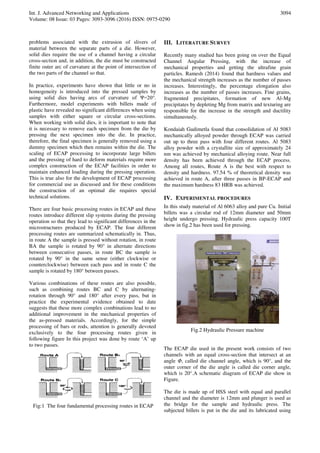
Download to read offline
![Int. J. Advanced Networking and Applications
Volume: 08 Issue: 03 Pages: 3093-3096 (2016) ISSN: 0975-0290
3093
Microstructure Analysis Evolution for Channel
Angular Pressing
RP Prasad
School of Feature Sciences, Venkateswara Engineering College, India
Email: ramk235@gmail.com
-------------------------------------------------------------------ABSTRACT---------------------------------------------------------------
Recently new methodology SPD technique is developed for equal channel angular pressing with parallel channels.
Present paper addresses the ECAP, that is applied to the Al alloys 6063 and pure Cu. The Al6063 alloy and pure
Cu is subjected to ECAP at room temperature for 2 passes to study the effect on the microstructure and
mechanical properties after processing. .To investigates the ECAP processed billets. CAP was done using a 90°
die.
Keywords - Channel angular pressing, alloy and pure Copper, Mechanical properties, Fracture and
Hardness.
--------------------------------------------------------------------------------------------------------------------------------------------------
Date of Submission: Nov 21, 2016 Date of Acceptance: Dec 01, 2016
--------------------------------------------------------------------------------------------------------------------------------------------------
I. INTRODUCTION
Equal channel angular pressing is a severe plastic
deformation technique capable of introducing severe
plastic strain in bulk metals, leading to significant grain
refinement. Although the mechanical and physical
properties of all crystalline materials are determined by
several factors, the average grain size of the material
generally plays a very significant and often a dominant,
role. Thus, the strength of all polycrystalline materials is
related to the grain size. The grain sizes of commercial
alloys [1-4] are generally tailored for specific applications
by making use of pre-determined thermo-mechanical
treatments in which the alloys are subjected to specified
regimes[5,6] of temperature and mechanical testing.
However, these procedures cannot be used to produce
materials with sub-micrometer grain sizes because there is
invariably a lower limit, of the order of a few micrometers,
which represents essentially the minimum grain size
readily, attained using these procedures. Accordingly,
attention has been directed towards the development of
new and different techniques that may be used to fabricate
ultrafine-grained materials with grain sizes in the sub-
micrometer and the nanometer range.
To place this review in perspective, it is first necessary to
provide a formal definition of ultrafine-grained materials
(UFG). With reference to the characteristics of
polycrystalline materials, UFG materials are defined as
poly-crystals, having very small grains with average grain
sizes less than ~1µm. For bulk UFG materials[7,8,12],
there are the additional requirements of fairly
homogeneous and reasonably equiaxed microstructures
and with a majority of grain boundaries having high
angles of misorientation. The presence of a high fraction
of high-angle grain boundaries is important in order to
achieve advanced and unique properties Two basic and
complementary approaches have been developed for the
synthesis of UFG materials and these are known as the
‘‘bottom-up’’ and ‘‘top-down’’ approach[9,10,11] is
different because it is dependent upon taking a bulk solid
with a relatively coarse grain size and processing the solid
to produce a UFG microstructure through heavy straining
or shock loading. This approach avoids the small product
sizes and the contamination which are inherent features of
materials produced using the ‘‘bottom-up’’ approach and
it has the additional advantage that it can be readily
applied to a wide range of pre-selected alloys.
The first observations of the production of UFG
microstructures using the ‘‘top-down’’ approach appeared
in the scientific literature in the early 1990s in several
publications dealing with pure metals and alloys. It is
important to note these early publications provided a direct
demonstration of the ability to employ heavy plastic
straining in the production of bulk materials having fairly
homogeneous[13] and equi-axed microstructures with
grain sizes in the sub-micrometer range and with a high
fraction of high-angle grain boundaries. In order to convert
a coarse-grained solid into a material with ultrafine
grains[14], it is necessary both to impose an exceptionally
high strain in order to introduce a high density of
dislocations and for these dislocations to subsequently re-
arrange to form an array of grain boundaries.
II. DEVELOPMENT OF PROCESSING USING ECAP
It is a relatively simple task to establish a facility for
conventional ECAP by two-piece split die consisting of a
highly polished smooth plate bolted to a second polished
plate containing a square-sided channel. This type of die
works well in the laboratory and can be used for multiple
passes provided care is taken to manually tighten the bolts
between each separate pass. A suitable lubricant such as
MoS2 is generally used to minimize frictional effects at
the die walls. However, an alternative approach for
minimizing friction[15] is to make use of more complex
configurations incorporating moving die walls. An
alternative approach is to construct a solid die from tool
steel. Solid dies have an advantage because they avoid any](https://image.slidesharecdn.com/v8i3-5-161230103329/85/Malicious-spam-social-network-sites-security-1-320.jpg)
![Int. J. Advanced Networking and Applications
Volume: 08 Issue: 03 Pages: 3093-3096 (2016) ISSN: 0975-0290
3093
Microstructure Analysis Evolution for Channel
Angular Pressing
RP Prasad
School of Feature Sciences, Venkateswara Engineering College, India
Email: ramk235@gmail.com
-------------------------------------------------------------------ABSTRACT---------------------------------------------------------------
Recently new methodology SPD technique is developed for equal channel angular pressing with parallel channels.
Present paper addresses the ECAP, that is applied to the Al alloys 6063 and pure Cu. The Al6063 alloy and pure
Cu is subjected to ECAP at room temperature for 2 passes to study the effect on the microstructure and
mechanical properties after processing. .To investigates the ECAP processed billets. CAP was done using a 90°
die.
Keywords - Channel angular pressing, alloy and pure Copper, Mechanical properties, Fracture and
Hardness.
--------------------------------------------------------------------------------------------------------------------------------------------------
Date of Submission: Nov 21, 2016 Date of Acceptance: Dec 01, 2016
--------------------------------------------------------------------------------------------------------------------------------------------------
I. INTRODUCTION
Equal channel angular pressing is a severe plastic
deformation technique capable of introducing severe
plastic strain in bulk metals, leading to significant grain
refinement. Although the mechanical and physical
properties of all crystalline materials are determined by
several factors, the average grain size of the material
generally plays a very significant and often a dominant,
role. Thus, the strength of all polycrystalline materials is
related to the grain size. The grain sizes of commercial
alloys [1-4] are generally tailored for specific applications
by making use of pre-determined thermo-mechanical
treatments in which the alloys are subjected to specified
regimes[5,6] of temperature and mechanical testing.
However, these procedures cannot be used to produce
materials with sub-micrometer grain sizes because there is
invariably a lower limit, of the order of a few micrometers,
which represents essentially the minimum grain size
readily, attained using these procedures. Accordingly,
attention has been directed towards the development of
new and different techniques that may be used to fabricate
ultrafine-grained materials with grain sizes in the sub-
micrometer and the nanometer range.
To place this review in perspective, it is first necessary to
provide a formal definition of ultrafine-grained materials
(UFG). With reference to the characteristics of
polycrystalline materials, UFG materials are defined as
poly-crystals, having very small grains with average grain
sizes less than ~1µm. For bulk UFG materials[7,8,12],
there are the additional requirements of fairly
homogeneous and reasonably equiaxed microstructures
and with a majority of grain boundaries having high
angles of misorientation. The presence of a high fraction
of high-angle grain boundaries is important in order to
achieve advanced and unique properties Two basic and
complementary approaches have been developed for the
synthesis of UFG materials and these are known as the
‘‘bottom-up’’ and ‘‘top-down’’ approach[9,10,11] is
different because it is dependent upon taking a bulk solid
with a relatively coarse grain size and processing the solid
to produce a UFG microstructure through heavy straining
or shock loading. This approach avoids the small product
sizes and the contamination which are inherent features of
materials produced using the ‘‘bottom-up’’ approach and
it has the additional advantage that it can be readily
applied to a wide range of pre-selected alloys.
The first observations of the production of UFG
microstructures using the ‘‘top-down’’ approach appeared
in the scientific literature in the early 1990s in several
publications dealing with pure metals and alloys. It is
important to note these early publications provided a direct
demonstration of the ability to employ heavy plastic
straining in the production of bulk materials having fairly
homogeneous[13] and equi-axed microstructures with
grain sizes in the sub-micrometer range and with a high
fraction of high-angle grain boundaries. In order to convert
a coarse-grained solid into a material with ultrafine
grains[14], it is necessary both to impose an exceptionally
high strain in order to introduce a high density of
dislocations and for these dislocations to subsequently re-
arrange to form an array of grain boundaries.
II. DEVELOPMENT OF PROCESSING USING ECAP
It is a relatively simple task to establish a facility for
conventional ECAP by two-piece split die consisting of a
highly polished smooth plate bolted to a second polished
plate containing a square-sided channel. This type of die
works well in the laboratory and can be used for multiple
passes provided care is taken to manually tighten the bolts
between each separate pass. A suitable lubricant such as
MoS2 is generally used to minimize frictional effects at
the die walls. However, an alternative approach for
minimizing friction[15] is to make use of more complex
configurations incorporating moving die walls. An
alternative approach is to construct a solid die from tool
steel. Solid dies have an advantage because they avoid any](https://image.slidesharecdn.com/v8i3-5-161230103329/75/Malicious-spam-social-network-sites-security-1-2048.jpg)
![Int. J. Advanced Networking and Applications
Volume: 08 Issue: 03 Pages: 3093-3096 (2016) ISSN: 0975-0290
3095
MoS2 and the die has been clamped and then tighten the
screws After that die has been placed in the hydraulic
press and applied load of press is 570 psi. Once the
pressing was done the load have to reduced and then the
die has been taken out from the hydraulic press and
remove the clamping and the billets has been taken out.
The processed billets called 1st
pass. After that billets
undergo lathe for second pass. Same procedure is followed
for both Al 6063 alloy and Cu. Fig 4 shows the Die used
in this work.
Al-Aluminum As-Arsenic Bi-Bismuth C- Carbon Ca-
calcium Co-Cobalt Cr-Chromium Cu-Copper Fe-Iron Mg-
Magnesium Mn-Manganese Mo-Molybdenum Nb-
Niobium Ni-Nickel P-Phosphorus Pb-Lead S-Sculpture Si-
Silicon Sn-Tin Ti-Titanium V-Vanadium W-Tungsten Zn-
zinc. The composition of the material was tested by using
the spectrometer.
Table.1 Al6063 alloy composition
Material Composition
Al 98.56
Si 0.365
Fe 0.207
Cu 0.029
Mn 0.026
Mg 0.581
Cr 0.041
Ni 0.055
Zn 0.015
Sn 0.018
Ti 0.005
Pb 0.046
Ca 0.002
Sr 0.001
Zr 0.002
Bi 0.041
Ga 0.018
Cd 0.016
V. TENSILE TESTING:
Tensile testing was carried out as per ASTM E8 standard
using TENSO-METER. Both Copper and Al 6063 alloy
are taken in to tensile testing. Specimen from after ECAP
undergo machined using lathe to get material as described
size given below.
Fig.3 Tensile Specimen nomenclature
A tensile specimen is a standardized sample cross-section.
It has two shoulders and a gauge (section) in between. The
shoulders are large so they can be readily gripped, whereas
the gauge section has a smaller cross-section so that the
deformation and failure can occur in this area, tensile
specimen of Al6063 alloy and Copper.
VI. RESULTS AND DISCUSSION
The characteristics of the microstructures introduced by
ECAP have been evaluated in numerous investigations.
However, almost all of these investigations employ
transmission electron microscopy for determinations of the
grain sizes produced by ECAP and the nature of any
dislocation interactions occurring within the grains. An
alternative approach is to employ optical microscopy to
study the shearing of the original grains as they pass
through the shearing plane within the die. An initial
examination of shearing at the macroscopic level provides
an opportunity to make direct comparisons with the
theoretical predictions both for the three-dimensional
shearing behavior of large solid bodies and for the slip
systems visible on orthogonal sections after ECAP
processing. Experiments were conducted at the
macroscopic level using Al 6063alloy and pure Copper as
a model material with an initial annealed equiaxed with
microscopic level of 5x and 10x where x=10.
Al 6063 base material: The following image shows the
microstructure Al6063 alloy without doing ECAP process.
REFERENCES
[1] Ramesh Kumar S, Gudimetla K, Ravisankar B, and
Jayasankar K, Grain Refinement of Al powder by
equal channel Angular Pressing. Mater Science Eng
(2012)](https://image.slidesharecdn.com/v8i3-5-161230103329/85/Malicious-spam-social-network-sites-security-3-320.jpg)
![Int. J. Advanced Networking and Applications
Volume: 08 Issue: 03 Pages: 3093-3096 (2016) ISSN: 0975-0290
3096
[2] Thermal conductivity of Aluminium fabricated by
Equal Channel Angular Pressing. S. Lee/Presenter,
S. Kwon.(2012).
[3] CS Reddy, et al. "Focal point computation and
homogeneous geometrical transformation for linear
curves." Perspectives in Science (2016).
[4] Micro structural and texture changes during equal
channel angular pressing of an Al-Mg-Sc alloy-
Oleg Sitdikov(2015).
[5] Reddy, C. S., et al. Obtaining Description for Simple
Images using Surface Realization Techniques and
Natural Language Processing, Indian Journal of
Science and Technology 9.22 (2016).
[6] Microstructure evolution and mechanical properties
of Al–6% Mg al- loys processed by ECAP. R.
Haghayeghi (2015) .
[7] CS Reddy, et al, An Efficient Line Clipping
Algorithm in 2D Space, In press, International Arab
Journal of Information Technology, 2017.
[8] Equal channel angular pressing technique for the
formation of ultra-fine grained structures- Kazeem
O. Sanusi(2012).
[9] Mamatha, E., C. S. Reddy, and K. R. Prasad.
"Antialiased Digital Pixel Plotting for Raster Scan
Lines Using Area Evaluation." Emerging Research
in Computing, Information, Communication and
Applications. Springer Singapore, 2016. 461-468.
[10] Mamatha, E., C. S. Reddy, and Ramakrishna Prasad.
"Mathematical Modeling of Markovian Queuing
Network with Repairs, Breakdown and fixed
Buffer." i-Manager's Journal on Software
Engineering 6.3 (2012): 21.
[11] Reddy, C. Chandra Sekhar, et al. "Performance
evaluation of homogeneous parallel processor
system of Markov modeled queue." i-Manager's
Journal on Software Engineering 3.2 (2008): 58.
[12] Reddy, P. Sudarsan, et al. "Finite Element Analysis
of Thermo-Diffusion and Diffusion-Thermo Effects
on Convective Heat and Mass Transfer Flow
through a Porous Medium in Cylindrical Annulus in
the Presence of Constant Heat Source." International
journal of applied mathematics and mechanics 6.7
(2010): 43-62.
[13] Reddy, C., and K. Ramakrishna Prasad. "The Study
State Analysis of Tandem Queue with Blocking and
Feedback." arXiv preprint arXiv:1006.2693(2010).
[14] Densification of Al-Y2O3 composite powder by
equal channel angular pressing. by Ramu Yarra, et
al (2010).
[15] Mamatha, E., S. Saritha, and C. S. Reddy.
"Stochastic Scheduling Algorithm for Distributed
Cloud Networks using Heuristic
Approach." International Journal of Advanced
Networking and Applications 8.1 (2016): 3009.](https://image.slidesharecdn.com/v8i3-5-161230103329/85/Malicious-spam-social-network-sites-security-4-320.jpg)

This document discusses the application of the equal channel angular pressing (ECAP) technique to aluminum alloys (6063) and pure copper, focusing on microstructure and mechanical properties after processing. The study involves a two-pass ECAP method at room temperature and explores various processing routes, ultimately demonstrating improvements in mechanical strength and grain refinement. Experimental results show enhanced properties, including increased hardness and tensile strength, linked to the reduction of grain sizes in the processed materials.


