The Case Analysis of Enron
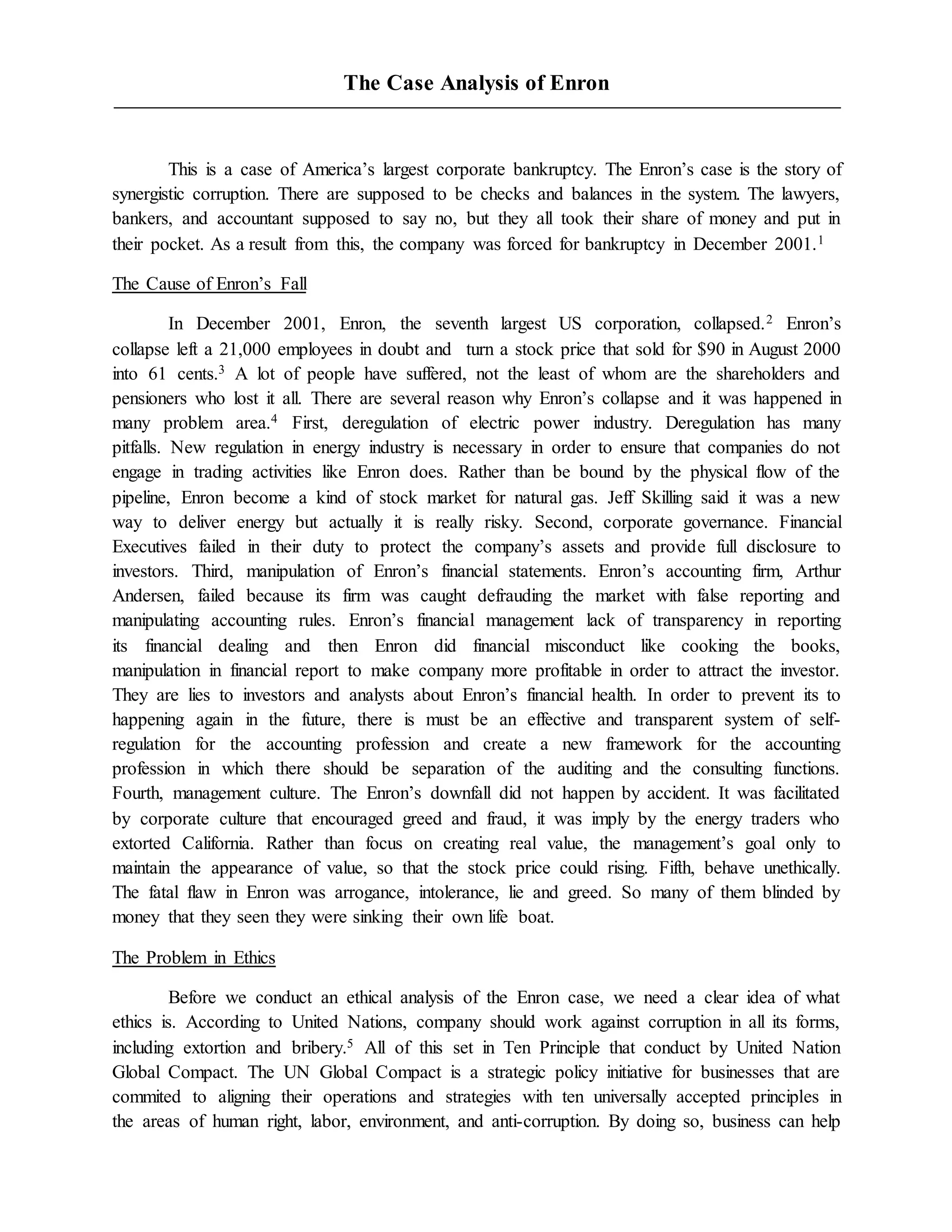
This is a case of America’s largest corporate bankruptcy. The Enron’s case is the story of
synergistic corruption. There are supposed to be checks and balances in the system. The lawyers,
bankers, and accountant supposed to say no, but they all took their share of money and put in
their pocket. As a result from this, the company was forced for bankruptcy in December 2001.1
The Cause of Enron’s Fall
In December 2001, Enron, the seventh largest US corporation, collapsed.2 Enron’s
collapse left a 21,000 employees in doubt and turn a stock price that sold for $90 in August 2000
into 61 cents.3 A lot of people have suffered, not the least of whom are the shareholders and
pensioners who lost it all. There are several reason why Enron’s collapse and it was happened in
many problem area.4 First, deregulation of electric power industry. Deregulation has many
pitfalls. New regulation in energy industry is necessary in order to ensure that companies do not
engage in trading activities like Enron does. Rather than be bound by the physical flow of the
pipeline, Enron become a kind of stock market for natural gas. Jeff Skilling said it was a new
way to deliver energy but actually it is really risky. Second, corporate governance. Financial
Executives failed in their duty to protect the company’s assets and provide full disclosure to
investors. Third, manipulation of Enron’s financial statements. Enron’s accounting firm, Arthur
Andersen, failed because its firm was caught defrauding the market with false reporting and
manipulating accounting rules. Enron’s financial management lack of transparency in reporting
its financial dealing and then Enron did financial misconduct like cooking the books,
manipulation in financial report to make company more profitable in order to attract the investor.
They are lies to investors and analysts about Enron’s financial health. In order to prevent its to
happening again in the future, there is must be an effective and transparent system of self-
regulation for the accounting profession and create a new framework for the accounting
profession in which there should be separation of the auditing and the consulting functions.
Fourth, management culture. The Enron’s downfall did not happen by accident. It was facilitated
by corporate culture that encouraged greed and fraud, it was imply by the energy traders who
extorted California. Rather than focus on creating real value, the management’s goal only to
maintain the appearance of value, so that the stock price could rising. Fifth, behave unethically.
The fatal flaw in Enron was arrogance, intolerance, lie and greed. So many of them blinded by
money that they seen they were sinking their own life boat.
The Problem in Ethics
Before we conduct an ethical analysis of the Enron case, we need a clear idea of what
ethics is. According to United Nations, company should work against corruption in all its forms,
including extortion and bribery.5 All of this set in Ten Principle that conduct by United Nation
Global Compact. The UN Global Compact is a strategic policy initiative for businesses that are
commited to aligning their operations and strategies with ten universally accepted principles in
the areas of human right, labor, environment, and anti-corruption. By doing so, business can help
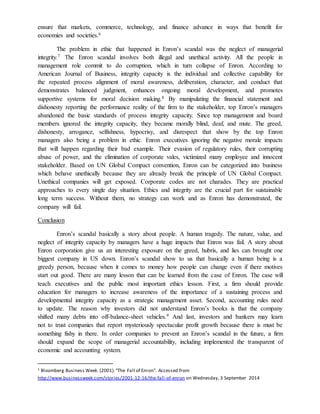
ensure that markets, commerce, technology, and finance advance in ways that benefit for
economies and societies.6
The problem in ethic that happened in Enron’s scandal was the neglect of managerial
integrity.7 The Enron scandal involves both illegal and unethical activity. All the people in
management role commit to do corruption, which in turn collapse of Enron. According to
American Journal of Business, integrity capacity is the individual and collective capability for
the repeated process alignment of moral awareness, deliberation, character, and conduct that
demonstrates balanced judgment, enhances ongoing moral development, and promotes
supportive systems for moral decision making.8 By manipulating the financial statement and
dishonesty reporting the performance reality of the firm to the stakeholder, top Enron’s managers
abandoned the basic standards of process integrity capacity. Since top management and board
members ignored the integrity capacity, they became morally blind, deaf, and mute. The greed,
dishonesty, arrogance, selfishness, hypocrisy, and disrespect that show by the top Enron
managers also being a problem in ethic. Enron executives ignoring the negative morale impacts
that will happen regarding their bad example. Their evasion of regulatory rules, their corrupting
abuse of power, and the elimination of corporate vales, victimized many employee and innocent
stakeholder. Based on UN Global Compact convention, Enron can be categorized into business
which behave unethically because they are already break the principle of UN Global Compact.
Unethical companies will get exposed. Corporate codes are not charades. They are practical
approaches to every single day situation. Ethics and integrity are the crucial part for suistainable
long term success. Without them, no strategy can work and as Enron has demonstrated, the
company will fail.
Conclusion
Enron’s scandal basically a story about people. A human tragedy. The nature, value, and
neglect of integrity capacity by managers have a huge impacts that Enron was fail. A story about
Enron corporation give us an interesting exposure on the greed, hubris, and lies can brought one
biggest company in US down. Enron’s scandal show to us that basically a human being is a
greedy person, because when it comes to money how people can change even if there motives
start out good. There are many lesson that can be learned from the case of Enron. The case will
teach executives and the public most important ethics lesson. First, a firm should provide
education for managers to increase awareness of the importance of a sustaining process and
developmental integrity capacity as a strategic management asset. Second, accounting rules need
to update. The reason why investors did not understand Enron’s books is that the company
shifted many debts into off-balance-sheet vehicles.9 And last, investors and bankers may learn
not to trust companies that report mysteriously spectacular profit growth because there is must be
something fishy in there. In order companies to prevent an Enron’s scandal in the future, a firm
should expand the scope of managerial accountability, including implemented the transparent of
economic and accounting system.
1 Bloomberg Business Week. (2001).“The Fall of Enron”. Accessed from
http://www.businessweek.com/stories/2001-12-16/the-fall-of-enron on Wednesday, 3 September 2014
2 Ibid.
3 Richard A. Oppel. (2001). “Enron’s Collapse:The Overview; Enron CollapseAs Suitor Cancels Plans For Merger”
accessed from http://www.nytimes.com/2001/11/29/business/enron-s-collapse-the-overview-enron-collapses-as-
suitor-cancels-plans-for-merger.html on Wednesday, 3 September 2014
4Elisa S.Moncarz, et. All.(2006). “The Rise and Collapseof Enron”. Accessed from
http://www.ejournal.unam.mx/rca/218/RCA21802.pdf on Wednesday, 3 September 2014
5 United Nations Global Compact.(2014). “The Ten Principles”.accessed from
https://www.unglobalcompact.org/AboutTheGC/TheTenPrinciples/index.html on Thursday,4 September 2014
6 Ibid.
7 Ken Silverstein.(2013).“Enron, Ethics And Today’s Corporate Values”accessed from
http://www.forbes.com/sites/kensilverstein/2013/05/14/enron-ethics-and-todays-corporate-values/ on Thursday,
4 September 2014
8 Joseph A. Petrick, et. all.(2003). “The Enron Scandal and the Neglect of Management Integrity Capacity”.
accessed from http://www.bsu.edu/mcobwin/ajb/?p=126 on Thursday,4 September 2014
9 The Economist. (2001). “Enron’s Bankruptcy: Wasted Energy” accessed from
http://www.economist.com/node/895651 on Thursday,4 September 2014.

The Downfall of Enron

  • 1.
    The Case Analysisof Enron This is a case of America’s largest corporate bankruptcy. The Enron’s case is the story of synergistic corruption. There are supposed to be checks and balances in the system. The lawyers, bankers, and accountant supposed to say no, but they all took their share of money and put in their pocket. As a result from this, the company was forced for bankruptcy in December 2001.1 The Cause of Enron’s Fall In December 2001, Enron, the seventh largest US corporation, collapsed.2 Enron’s collapse left a 21,000 employees in doubt and turn a stock price that sold for $90 in August 2000 into 61 cents.3 A lot of people have suffered, not the least of whom are the shareholders and pensioners who lost it all. There are several reason why Enron’s collapse and it was happened in many problem area.4 First, deregulation of electric power industry. Deregulation has many pitfalls. New regulation in energy industry is necessary in order to ensure that companies do not engage in trading activities like Enron does. Rather than be bound by the physical flow of the pipeline, Enron become a kind of stock market for natural gas. Jeff Skilling said it was a new way to deliver energy but actually it is really risky. Second, corporate governance. Financial Executives failed in their duty to protect the company’s assets and provide full disclosure to investors. Third, manipulation of Enron’s financial statements. Enron’s accounting firm, Arthur Andersen, failed because its firm was caught defrauding the market with false reporting and manipulating accounting rules. Enron’s financial management lack of transparency in reporting its financial dealing and then Enron did financial misconduct like cooking the books, manipulation in financial report to make company more profitable in order to attract the investor. They are lies to investors and analysts about Enron’s financial health. In order to prevent its to happening again in the future, there is must be an effective and transparent system of self- regulation for the accounting profession and create a new framework for the accounting profession in which there should be separation of the auditing and the consulting functions. Fourth, management culture. The Enron’s downfall did not happen by accident. It was facilitated by corporate culture that encouraged greed and fraud, it was imply by the energy traders who extorted California. Rather than focus on creating real value, the management’s goal only to maintain the appearance of value, so that the stock price could rising. Fifth, behave unethically. The fatal flaw in Enron was arrogance, intolerance, lie and greed. So many of them blinded by money that they seen they were sinking their own life boat. The Problem in Ethics Before we conduct an ethical analysis of the Enron case, we need a clear idea of what ethics is. According to United Nations, company should work against corruption in all its forms, including extortion and bribery.5 All of this set in Ten Principle that conduct by United Nation Global Compact. The UN Global Compact is a strategic policy initiative for businesses that are commited to aligning their operations and strategies with ten universally accepted principles in the areas of human right, labor, environment, and anti-corruption. By doing so, business can help
  • 2.
    ensure that markets,commerce, technology, and finance advance in ways that benefit for economies and societies.6 The problem in ethic that happened in Enron’s scandal was the neglect of managerial integrity.7 The Enron scandal involves both illegal and unethical activity. All the people in management role commit to do corruption, which in turn collapse of Enron. According to American Journal of Business, integrity capacity is the individual and collective capability for the repeated process alignment of moral awareness, deliberation, character, and conduct that demonstrates balanced judgment, enhances ongoing moral development, and promotes supportive systems for moral decision making.8 By manipulating the financial statement and dishonesty reporting the performance reality of the firm to the stakeholder, top Enron’s managers abandoned the basic standards of process integrity capacity. Since top management and board members ignored the integrity capacity, they became morally blind, deaf, and mute. The greed, dishonesty, arrogance, selfishness, hypocrisy, and disrespect that show by the top Enron managers also being a problem in ethic. Enron executives ignoring the negative morale impacts that will happen regarding their bad example. Their evasion of regulatory rules, their corrupting abuse of power, and the elimination of corporate vales, victimized many employee and innocent stakeholder. Based on UN Global Compact convention, Enron can be categorized into business which behave unethically because they are already break the principle of UN Global Compact. Unethical companies will get exposed. Corporate codes are not charades. They are practical approaches to every single day situation. Ethics and integrity are the crucial part for suistainable long term success. Without them, no strategy can work and as Enron has demonstrated, the company will fail. Conclusion Enron’s scandal basically a story about people. A human tragedy. The nature, value, and neglect of integrity capacity by managers have a huge impacts that Enron was fail. A story about Enron corporation give us an interesting exposure on the greed, hubris, and lies can brought one biggest company in US down. Enron’s scandal show to us that basically a human being is a greedy person, because when it comes to money how people can change even if there motives start out good. There are many lesson that can be learned from the case of Enron. The case will teach executives and the public most important ethics lesson. First, a firm should provide education for managers to increase awareness of the importance of a sustaining process and developmental integrity capacity as a strategic management asset. Second, accounting rules need to update. The reason why investors did not understand Enron’s books is that the company shifted many debts into off-balance-sheet vehicles.9 And last, investors and bankers may learn not to trust companies that report mysteriously spectacular profit growth because there is must be something fishy in there. In order companies to prevent an Enron’s scandal in the future, a firm should expand the scope of managerial accountability, including implemented the transparent of economic and accounting system. 1 Bloomberg Business Week. (2001).“The Fall of Enron”. Accessed from http://www.businessweek.com/stories/2001-12-16/the-fall-of-enron on Wednesday, 3 September 2014
  • 3.
    2 Ibid. 3 RichardA. Oppel. (2001). “Enron’s Collapse:The Overview; Enron CollapseAs Suitor Cancels Plans For Merger” accessed from http://www.nytimes.com/2001/11/29/business/enron-s-collapse-the-overview-enron-collapses-as- suitor-cancels-plans-for-merger.html on Wednesday, 3 September 2014 4Elisa S.Moncarz, et. All.(2006). “The Rise and Collapseof Enron”. Accessed from http://www.ejournal.unam.mx/rca/218/RCA21802.pdf on Wednesday, 3 September 2014 5 United Nations Global Compact.(2014). “The Ten Principles”.accessed from https://www.unglobalcompact.org/AboutTheGC/TheTenPrinciples/index.html on Thursday,4 September 2014 6 Ibid. 7 Ken Silverstein.(2013).“Enron, Ethics And Today’s Corporate Values”accessed from http://www.forbes.com/sites/kensilverstein/2013/05/14/enron-ethics-and-todays-corporate-values/ on Thursday, 4 September 2014 8 Joseph A. Petrick, et. all.(2003). “The Enron Scandal and the Neglect of Management Integrity Capacity”. accessed from http://www.bsu.edu/mcobwin/ajb/?p=126 on Thursday,4 September 2014 9 The Economist. (2001). “Enron’s Bankruptcy: Wasted Energy” accessed from http://www.economist.com/node/895651 on Thursday,4 September 2014.