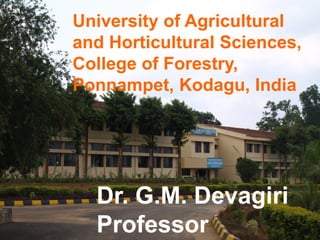
University of Agricultural
and Horticultural Sciences,
College of Forestry,
Ponnampet, Kodagu, India
Dr. G.M. Devagiri
Professor
• 1985: B. Sc (Forestry) programme started at GKVK,
Bangalore
• 1995: Established as independent
College of Forestry at Ponnampet
• 1995: Creation of Five Specialized
Departments
• 2001: M. Sc (Forestry) programme
• Presently we have four Depts.
SAF
NRM
FB&TI
FPU
Genesis of the Institution
• Amidst Western Ghats : One of the 32 Hot
Spots and one of the 8 of the hottest hot
spots of Biodiversity in the world which
harbors rich flora and fauna
• Kodagu district comprises 1342 species of
flowering plants which constitutes 8 % of
India’s and 32 % of floristic diversity of
Karnataka state
4
Western Ghats
• 1600 km long mountain
range.
• Hotspot of Biodiversity
• UNSECO World Héritage site
• Socio-cultural Diversity
Source:www.atlapedia.com
28 mars 2014 5
Kodagu District
• Total area: 4106 km2
• Population : 540 000 hab.
• Agriculture is the way of life
• Unique Land Tenure Systems
• Unique Socio Cultural Systems
• Micro Hot Spot of Biodiversity
One of the densely wooded district in India
.
 Highest density of sacred forests in the world
Kodagu has 8% of India’s plant wealth
Largest shade coffee growing region in India (38% )
Coorg Honey, Coorg Orange, Coorg Cardamom,
Ecosystem Services – Water, Carbon, Tourism
GREEN LANDSCAPE –EVERGREEN DEVLOPMENT-LINK
BETWEEN GREEN COVER AND ECONOMIC DEVELOPMENT.
Kodagu – A Green Landscape
Coffee
Orange
PepperHoney
Cardamom
Our natural
treasures
Dynamic Landscape
• Changes in Land use
• Impacts on Biodiversity
• Impact on Ecosystem Services
• Impact on Socio Cultural Services
CAFNET Presentation 9
History
British
1834
Independance1947 Liberalisation
1992
British Companies
and owners
COFFEE/ PEPPER
Traditional farmers
PADDY/CARDAMOM
Family farm
COFFEE / PEPPER
PADDY/CARDAMOM
Worker / Fam. Farm
< 2 acres
Cardamom or
COFFEE / PEPPER +
self consumption
Development of
Coffee area
Market prices
Arabica =>
Robusta
Today
Landscape Changes in the last century
 Loss of Forest Cover
 Loss of Native Trees from Coffee Plantations
and replacements with Silver Oak
 Loss of Community lands like sacred groves
 Conversion of Paddy Lands to other land
uses and habitation
CAF 12
19771997
Landscape dynamics
Coffee -100%
Forest -30%
Evergreen Forests
Coffee Plantations
Deciduous Forests
2007
• Traditional socio cultural farming
• Food , Fodder and water security
• Local evolved farming practices
• Habitat for biodiversity
• Hydrological Services- Current water crisis
can be linked to reduction in paddy
cultivation.
Paddy cultivation for economic and ecological security
Why Paddy is not needy ?
• Lower Economic returns compared to coffee
• Lower productivity
• Lesser farm farmers and farm labour
• Crop Loss due Wild Animals
• Lack of grazing land and farm animals
• From Collective to Individual ownership
• Urbanization and tourism
• Shift from Rice from Farm to Rice from shop
Sacred Groves (Devakad)
Bio-Cultural Heritage sites of Kodagu
Very high number of 1214 groves covering an
area of 2550 ha.
Highest density in the world – One grove for
every 300 acres.
Every village has at least one and there are 24
villages with > 10 groves.
They represent all the vegetational and
microhabitat conditions of the district.
 Diversity of Communities
28 different native communities including
native muslims called ‘Jamma mapillas’ are
part of this worship.
Traditional heads ‘Devathakkas’ or
‘Mukyastha’ and traditional management of
the temples.
Mechanism for Communal and social
integration.
Biological Diversity
The physical, religious, cultural diversity has
contributed to a unique set of biological
diversity…
Though sacred groves occupy on an average 1.22% of the
village landscape they contain 47.34% of woody plant,
44.91% of bird families and 21.11% of fungal families
that could be potentially found in wet evergreen forests
of Kodagu.
(Shonil Bhagwat and Kushalappa 2000).
 Biotic interference
 Loss of affinity towards the Sacred Groves
 Enchrochment
 Lack of awareness
 Non involvement of local people in conservation

From To
Nature worship Temple worship
Annual worship Daily worship
Forest Temples Temple Forest
Threats to the Sacred Forest of Kodagu
Ecological Implications
• Private Forest – Cardamom- coffee
• Arabica-shaded Robusta-Open Robusta
• Native to Exotic
• Loss of Biodiversity
• Loss in Ecosystem Services
• Increase in Human Animal conflicts
• Increase in farm income
Major ES offered by CBAF
Coffee
ecosystems
Humans
Ecosystem services
•Carbon
sequestration
•Pollination
•Soil enrichment
•Air and water
quality
•Ecotourism
Biodiversity
conservatio
n
Coffee and Biodiversity
• Tree diversity- 280
• Birds 109 species
• Elephants, Tigers, Civet Cat
• Microorganisms
• Honey Bees
One of the most diverse
Agro Forest systems in the world
Cafnet Final report 2011
Most frequent species in CBAF
20%
10%
5%
4%
4%
57%
Grevillea robusta
Erythrina lithosperma
Acrocarpus fraxinifolius
Areca catechu
Artocarpus heterophyllus
Others
Bird Diversity
Impact of Silver Oak on bird diversity
Total carbon sequestered in forest and CBAF
Carbon(t/ha)
system Tree Coffee Soil Litter Total
Forest 97 - 97 2,4 196
Arabica
native
88 4,8 112 1,6 206
Arabica
exotic
73 3,3 105 2,2 183
Robusta
native
78 13,0 90 1,8 182
Robusta
exotic
47 10,1 78 1,9 138
Phillipe et al, 2009
Carbon Sequestration
• Arabica AFS, particularly with native species, sequestered
comparable amount of C as reference forest
• Decline in C sequestered in Robusta AFS shaded with the
exotic species Grevillea robusta is quite noticeable
• Contribution to Wood energy needs of community and
maintain integrity of natural forests
• Coffee plantations provide
ideal habitats
• Coffee plantations adjoining
National park and WLS
provide ideal corridors.
• In 2013 64 elephants
residing in plantations
Elephants like coffee
Social Issues related to Land Use Change
• Population dynamics
Growth in recent years due to immigration from
outside and Emigration of locals
• Lack of Second generation farmers and labour
• From Joint to Nuclear families
Money brings many things-Economic drivers
• Additional income from Intensification
• Tourism and its impacts
• Increase in value of land
Political
• Regulations for products and resource use
 Wildlife Act 1972
 Forest Conservation Act 1980
 Biodiversity Act 2002
 Tribal Act 2003
 UNSECO World Heritage Label
 Gadgil and Kasturiangan report –ESA
• Land Tenure and Tree rights- Jamma Issue
Dynamics and challenges
• Declining tree cover in natural forests
• Decline in density and diversity of trees in
coffee plantations
• Reduction in area under paddy cultivation
• Encroachment of Sacred groves
• Lack of Second generation farmers and
labour
• How to sustain the productivity and
profitability of farming system without
the losing biodiversity??
Link between ES, Biodiversity and livelihood improvement
How to address these dynamics and continue
to produce economically and ecologically
sustainable farm products?
• From Productivity to quality productivity.
• From Regulation to Certification.
• From Subsidies to Incentives.
• From Agriculture to Agri- Business.
Ecosystem Service Valuation and Incentive
Based Mechanisms for Sustainable
farming
Payment for Ecosystem Services (PES) in Kodagu,
Western Ghats of India- A Win Win Approach of
Development?
1. Eco-certification – Bird Friendly, Elephant Coffee
2. Geographic Indications –Coorg Mandarin
3. Forest Certification
4. Eco-tourism
5. Involvement of Corporate
Possible PES Mechanisms for Kodagu
Eco-Certification -CANET Initiative
 Ecom Gill , Ned commodities and Coffee
Board partnership.
 Eight farmer groups and 89 farmers certified
under project for RAF and UTZ
 Additionally Corporate and 90 individual
farmers
Coffee and Honey-Win Win formula.
Honey from Coorg what is special?
• Multi floral and Seasonal variation in quality
• Traditional knowledge of apiculturist
• Tradition of using honey as food
• First district to take up scientific bee farming
• Establishment of cooperative -1936 and 1954
• Proposed Honey park to promote apiculture
Landscape labeling
Promoting Paddy cultivation
• Productivity increase
• Mechanization
• Collective farming
• Financial Incentives for cultivation- PES
• Enhancement of Support Price
• Regulation and Legislation on conversion
Integrated Farming for Sustainability
• Bamboo cultivation
• Vegetable farming
• Medicinal and Aromatic plants
• Floriculture
• Apiculture
• Animal integration
• Value addition for plantation crops
Initiative in Conservation of Sacred Forest
Revival of Devakad (Sacred Forest ) tradition through
stake holder participation- JFPM
Formation of Sacred Forest Management Committees
Incentives for communities in conservation.
Role of Government
Developmental department- Agriculture, Horticulture,
Watershed, Forestry.
 Inputs-RKVY, NHM, Organic farming
Price- MSP, RMC
Credit- NABARD, DCCBank,
 Self Help groups
• Coffee Board- Subsides and Incentives
• Spices Board – Subsidies and Incentives
RESEARCH And EXTENSION
• Agricultural Universities-ARS and EEU
• Indian Institute of Horticultural Research-KVK
• Indian Institute of Spices Research
• Coffee Board
• Agriculture and Horticulture Department
NGO’s Promoting Sustainable development
• ASFK-Agricultural Sciences Forum of Kodgu
• KMFT- Kodagu Model Forest Trust
• CWS- Coorg Wildlife Society
• CEE-Centre for Environment Education
• CORD-Coorg Organisation for Rural
Development
• Rotary ,Lions, JCI Clubs
KODAGU - KAVERI - KRISHI
49

Lessons Western Ghats

  • 1.
    University of Agricultural andHorticultural Sciences, College of Forestry, Ponnampet, Kodagu, India Dr. G.M. Devagiri Professor
  • 2.
    • 1985: B.Sc (Forestry) programme started at GKVK, Bangalore • 1995: Established as independent College of Forestry at Ponnampet • 1995: Creation of Five Specialized Departments • 2001: M. Sc (Forestry) programme • Presently we have four Depts. SAF NRM FB&TI FPU Genesis of the Institution
  • 3.
    • Amidst WesternGhats : One of the 32 Hot Spots and one of the 8 of the hottest hot spots of Biodiversity in the world which harbors rich flora and fauna • Kodagu district comprises 1342 species of flowering plants which constitutes 8 % of India’s and 32 % of floristic diversity of Karnataka state
  • 4.
    4 Western Ghats • 1600km long mountain range. • Hotspot of Biodiversity • UNSECO World Héritage site • Socio-cultural Diversity Source:www.atlapedia.com
  • 5.
    28 mars 20145 Kodagu District • Total area: 4106 km2 • Population : 540 000 hab. • Agriculture is the way of life • Unique Land Tenure Systems • Unique Socio Cultural Systems • Micro Hot Spot of Biodiversity
  • 6.
    One of thedensely wooded district in India .  Highest density of sacred forests in the world Kodagu has 8% of India’s plant wealth Largest shade coffee growing region in India (38% ) Coorg Honey, Coorg Orange, Coorg Cardamom, Ecosystem Services – Water, Carbon, Tourism GREEN LANDSCAPE –EVERGREEN DEVLOPMENT-LINK BETWEEN GREEN COVER AND ECONOMIC DEVELOPMENT. Kodagu – A Green Landscape
  • 7.
  • 8.
    Dynamic Landscape • Changesin Land use • Impacts on Biodiversity • Impact on Ecosystem Services • Impact on Socio Cultural Services
  • 9.
    CAFNET Presentation 9 History British 1834 Independance1947Liberalisation 1992 British Companies and owners COFFEE/ PEPPER Traditional farmers PADDY/CARDAMOM Family farm COFFEE / PEPPER PADDY/CARDAMOM Worker / Fam. Farm < 2 acres Cardamom or COFFEE / PEPPER + self consumption Development of Coffee area Market prices Arabica => Robusta Today
  • 10.
    Landscape Changes inthe last century  Loss of Forest Cover  Loss of Native Trees from Coffee Plantations and replacements with Silver Oak  Loss of Community lands like sacred groves  Conversion of Paddy Lands to other land uses and habitation
  • 12.
    CAF 12 19771997 Landscape dynamics Coffee-100% Forest -30% Evergreen Forests Coffee Plantations Deciduous Forests 2007
  • 14.
    • Traditional sociocultural farming • Food , Fodder and water security • Local evolved farming practices • Habitat for biodiversity • Hydrological Services- Current water crisis can be linked to reduction in paddy cultivation. Paddy cultivation for economic and ecological security
  • 15.
    Why Paddy isnot needy ? • Lower Economic returns compared to coffee • Lower productivity • Lesser farm farmers and farm labour • Crop Loss due Wild Animals • Lack of grazing land and farm animals • From Collective to Individual ownership • Urbanization and tourism • Shift from Rice from Farm to Rice from shop
  • 16.
    Sacred Groves (Devakad) Bio-CulturalHeritage sites of Kodagu
  • 17.
    Very high numberof 1214 groves covering an area of 2550 ha. Highest density in the world – One grove for every 300 acres. Every village has at least one and there are 24 villages with > 10 groves. They represent all the vegetational and microhabitat conditions of the district.
  • 18.
     Diversity ofCommunities 28 different native communities including native muslims called ‘Jamma mapillas’ are part of this worship. Traditional heads ‘Devathakkas’ or ‘Mukyastha’ and traditional management of the temples. Mechanism for Communal and social integration.
  • 19.
    Biological Diversity The physical,religious, cultural diversity has contributed to a unique set of biological diversity… Though sacred groves occupy on an average 1.22% of the village landscape they contain 47.34% of woody plant, 44.91% of bird families and 21.11% of fungal families that could be potentially found in wet evergreen forests of Kodagu. (Shonil Bhagwat and Kushalappa 2000).
  • 20.
     Biotic interference Loss of affinity towards the Sacred Groves  Enchrochment  Lack of awareness  Non involvement of local people in conservation  From To Nature worship Temple worship Annual worship Daily worship Forest Temples Temple Forest Threats to the Sacred Forest of Kodagu
  • 21.
    Ecological Implications • PrivateForest – Cardamom- coffee • Arabica-shaded Robusta-Open Robusta • Native to Exotic • Loss of Biodiversity • Loss in Ecosystem Services • Increase in Human Animal conflicts • Increase in farm income
  • 22.
    Major ES offeredby CBAF Coffee ecosystems Humans Ecosystem services •Carbon sequestration •Pollination •Soil enrichment •Air and water quality •Ecotourism Biodiversity conservatio n
  • 23.
    Coffee and Biodiversity •Tree diversity- 280 • Birds 109 species • Elephants, Tigers, Civet Cat • Microorganisms • Honey Bees One of the most diverse Agro Forest systems in the world
  • 24.
    Cafnet Final report2011 Most frequent species in CBAF 20% 10% 5% 4% 4% 57% Grevillea robusta Erythrina lithosperma Acrocarpus fraxinifolius Areca catechu Artocarpus heterophyllus Others
  • 25.
    Bird Diversity Impact ofSilver Oak on bird diversity
  • 27.
    Total carbon sequesteredin forest and CBAF Carbon(t/ha) system Tree Coffee Soil Litter Total Forest 97 - 97 2,4 196 Arabica native 88 4,8 112 1,6 206 Arabica exotic 73 3,3 105 2,2 183 Robusta native 78 13,0 90 1,8 182 Robusta exotic 47 10,1 78 1,9 138 Phillipe et al, 2009
  • 28.
    Carbon Sequestration • ArabicaAFS, particularly with native species, sequestered comparable amount of C as reference forest • Decline in C sequestered in Robusta AFS shaded with the exotic species Grevillea robusta is quite noticeable • Contribution to Wood energy needs of community and maintain integrity of natural forests
  • 29.
    • Coffee plantationsprovide ideal habitats • Coffee plantations adjoining National park and WLS provide ideal corridors. • In 2013 64 elephants residing in plantations Elephants like coffee
  • 30.
    Social Issues relatedto Land Use Change • Population dynamics Growth in recent years due to immigration from outside and Emigration of locals • Lack of Second generation farmers and labour • From Joint to Nuclear families
  • 31.
    Money brings manythings-Economic drivers • Additional income from Intensification • Tourism and its impacts • Increase in value of land
  • 32.
    Political • Regulations forproducts and resource use  Wildlife Act 1972  Forest Conservation Act 1980  Biodiversity Act 2002  Tribal Act 2003  UNSECO World Heritage Label  Gadgil and Kasturiangan report –ESA • Land Tenure and Tree rights- Jamma Issue
  • 33.
    Dynamics and challenges •Declining tree cover in natural forests • Decline in density and diversity of trees in coffee plantations • Reduction in area under paddy cultivation • Encroachment of Sacred groves • Lack of Second generation farmers and labour • How to sustain the productivity and profitability of farming system without the losing biodiversity??
  • 34.
    Link between ES,Biodiversity and livelihood improvement
  • 35.
    How to addressthese dynamics and continue to produce economically and ecologically sustainable farm products? • From Productivity to quality productivity. • From Regulation to Certification. • From Subsidies to Incentives. • From Agriculture to Agri- Business. Ecosystem Service Valuation and Incentive Based Mechanisms for Sustainable farming
  • 36.
    Payment for EcosystemServices (PES) in Kodagu, Western Ghats of India- A Win Win Approach of Development?
  • 37.
    1. Eco-certification –Bird Friendly, Elephant Coffee 2. Geographic Indications –Coorg Mandarin 3. Forest Certification 4. Eco-tourism 5. Involvement of Corporate Possible PES Mechanisms for Kodagu
  • 38.
    Eco-Certification -CANET Initiative Ecom Gill , Ned commodities and Coffee Board partnership.  Eight farmer groups and 89 farmers certified under project for RAF and UTZ  Additionally Corporate and 90 individual farmers
  • 39.
  • 40.
    Honey from Coorgwhat is special? • Multi floral and Seasonal variation in quality • Traditional knowledge of apiculturist • Tradition of using honey as food • First district to take up scientific bee farming • Establishment of cooperative -1936 and 1954 • Proposed Honey park to promote apiculture
  • 41.
  • 42.
    Promoting Paddy cultivation •Productivity increase • Mechanization • Collective farming • Financial Incentives for cultivation- PES • Enhancement of Support Price • Regulation and Legislation on conversion
  • 43.
    Integrated Farming forSustainability • Bamboo cultivation • Vegetable farming • Medicinal and Aromatic plants • Floriculture • Apiculture • Animal integration • Value addition for plantation crops
  • 44.
    Initiative in Conservationof Sacred Forest Revival of Devakad (Sacred Forest ) tradition through stake holder participation- JFPM Formation of Sacred Forest Management Committees Incentives for communities in conservation.
  • 45.
    Role of Government Developmentaldepartment- Agriculture, Horticulture, Watershed, Forestry.  Inputs-RKVY, NHM, Organic farming Price- MSP, RMC Credit- NABARD, DCCBank,  Self Help groups • Coffee Board- Subsides and Incentives • Spices Board – Subsidies and Incentives
  • 46.
    RESEARCH And EXTENSION •Agricultural Universities-ARS and EEU • Indian Institute of Horticultural Research-KVK • Indian Institute of Spices Research • Coffee Board • Agriculture and Horticulture Department
  • 47.
    NGO’s Promoting Sustainabledevelopment • ASFK-Agricultural Sciences Forum of Kodgu • KMFT- Kodagu Model Forest Trust • CWS- Coorg Wildlife Society • CEE-Centre for Environment Education • CORD-Coorg Organisation for Rural Development • Rotary ,Lions, JCI Clubs
  • 48.
  • 49.