International Journal of Trend in Scientific Research and Development (IJTSRD)
Volume 5 Issue 5, July-August 2021 Available Online: www.ijtsrd.com e-ISSN: 2456 – 6470
@ IJTSRD | Unique Paper ID – IJTSRD44944 | Volume – 5 | Issue – 5 | Jul-Aug 2021 Page 734
The Digital Infrastructure for Knowledge Based Tourism:
Building Ontology Concept by XML Schema
Definition and Extensible Markup Language
Khamida Tulaeva1
, Detty Purnamasari2
1
Digital Transformation for Digital Tourism,
Bukhara State University and Universitas Gunadarma, Bukhara, Uzbekistan
2
Information Technology, Universitas Gunadarma, Bukhara, Uzbekistan
ABSTRACT
Tourism is a strategy for country to increase its income. Digital
technologies are currently used to help improve tourism, for example with
information about tourist areas through the website or Mobile Apps.
Database is required as the basic infrastructure for implementing system
when to support tourism In this research, we discussed about the database
model that can stored tourism data. Tourism databases such as warehouses
are rich in information about tourism. Tourism information can be in the
structured or unstructured form. Database development is an important part
of enhancing development supported by digital technology. In this research,
ontology is applied for database development and it produce the ontologies
that could be utilized for tourism. In this research, ontology is applied for
database development and it produces the ontologies that could be utilized
for gastronomic tourism.
KEYWORDS: database, digital technology, ontology, tourism, XML Schema
Definition, Extensible Markup Language
How to cite this paper: Khamida
Tulaeva | Detty Purnamasari "The
Digital Infrastructure for Knowledge
Based Tourism: Building Ontology
Concept by XML Schema Definition
and Extensible Markup Language"
Published in
International Journal
of Trend in
Scientific Research
and Development
(ijtsrd), ISSN: 2456-
6470, Volume-5 |
Issue-5, August
2021, pp.734-742, URL:
www.ijtsrd.com/papers/ijtsrd44944.pdf
Copyright © 2021 by author (s) and
International Journal of Trend in
Scientific Research and Development
Journal. This is an
Open Access article
distributed under the
terms of the Creative Commons
Attribution License (CC BY 4.0)
(http://creativecommons.org/licenses/by/4.0)
INTRODUCTION
Tourism has historically been dependent on the
character of the destination, including attractions,
beaches and resorts. It is a complex activity that
requires the availability of certain parameters (e.g.
accessible road networks, standard accommodation
facilities, attractions etc) and information on potential
and existing attraction sites. Information on these
parameters and attraction sites can be gathered,
processed, organized and stored using tools such as
Global Positioning System (GPS), Geographic
Information System (GIS) coupled with remote
sensing. After gathering the needed data about a
destination, the data must be stored in a retrievable
form to enhance tourism, and this can be achieved
with the aid of GIS.
To reach the rapidly changing technology speed in
21st
century is a big issue of today in any country's
government system. Tourism is a sector where
millions of people exchange their money to get high
quality service and the number of tourists depends on
how the service will be delivered. The tourism sector
is one sector that provides income for the country.
According to Popescu et.al. (2015) many countries
make the tourism sector to be their main income [1].
Tourism is what involves every human being in the
world. Tourists need detailed information about each
place that they want to visit. These information needs
include: [2]
Location of tourist attractions, and also the
weather
Transportation, lodging, restaurants, souvenir
shops
Local customs
Good season to make a visit
IJTSRD44944
International Journal of Trend in Scientific Research and Development @ www.ijtsrd.com eISSN: 2456-6470
@ IJTSRD | Unique Paper ID – IJTSRD44944 | Volume – 5 | Issue – 5 | Jul-Aug 2021 Page 735
Types of objects that can be visited
The beauty of the tourist attractions
Today we can see hundreds of digital resources which
provide huge range of data in order to inform people
about the place, the way, the service and the prices of
a place where they will visit and spend their money.
The global importance of tourism is steadily rising,
creating new job opportunities in many countries.
Today’s information management solutions for the
complex tasks of tourism intermediaries are still at an
early stage from a semantic point of view. The
tourism product has an intangible nature in that a
prospective traveler cannot touch the product before
the trip. This is one major reason why information
about tourism and travel services (e.g. destination,
hotel, restaurants, events, transportation etc.) must be
accurate and credible, one that fosters users’
confidence.[2] One way to achieve this level of
credibility is to engage knowledge representation
formalisms that can sufficiently capture all relevant
facts about tourism objects in a domain on which
approaches to rendering tourism information services
can be based. An ideal approach to achieve this is the
use of ontologies which provide the platform on
which recommendation formalisms that exploit deep
knowledge of the user, tourism objects, and other
relevant contextual information that closely model
reality can be built. [2]
As competition between tourism destinations
increases, local culture is becoming an increasingly
important source of new products and activities to
attract and amuse tourists. Gastronomy has a
particularly important role to play in this, not only
because food is central to the tourist experience, but
also because gastronomy has become an important
source of identity formation in postmodern societies.
More and more, ‘we are what we eat’, not just in the
physical sense, but also because we identify with
certain types of cuisine that we encounter on holiday.
As tourists become more mobile, so does the food
they eat. The comfortable association of certain foods
with certain regions is being challenged by the
growing mobility of food, culinary styles and the
increasing de-differentiation of dishes and cuisines.
Far from producing an homogenized gastronomic
landscape, the tension between globalization and
localization is producing ever more variations. [3]
The aim of this research is to build database based on
ontology for gastronomic tourism in Uzbekistan,
especially in Bukhara region.
The research objectives are as follow:
Develop ontology for database of gastronomic
tourism of Bukhara region
Create XML Schema Definition (XSD)
Create Extensible Markup Language (XML)
Database with ontology concept is a start point of any
issue whether economic or technological sphere.
Touristic product is a thing which cannot be
touchable or seen till you receive all services and feel
the real quality of that. In 2019 near the 5 million
people visit Uzbekistan in terms of travel and
business including local and international tourists.
Depending upon the potential of country this number
is not high.
LITERATURE REVIEW
Over recent decades, gastronomy tourism has gone
beyond the table setting and now includes all sectors
of a destination’s food and tourism chain – producers
(agriculture, fishing, etc.), processing firms (dairies,
olive mills, canning plants, wineries, etc.), the tourism
and hospitality sector (restaurants, specialised
accommodation, gastronomic activity firms, etc.), the
retail sector, the commerce sector (sale of products)
and even the knowledge sector.
With a view to the publication of the Global Report
on Food Tourism, a survey was conducted among the
UNWTO AFFILIATE Members in order to know
their opinion about current situation of Food Tourism.
Responses form Affiliate Members, working in
diverse sectors around the world, were received in
this regard.[4]
According to the results this survey, 88.2% of
respondents consider that gastronomy is a strategic
element in defining the brand and image of their
destination. Only 11.8% were of the opinion that
gastronomy plays a minor role
Digital technologies have brought significant
transformation to the tourism industry,
revolutionising tourism enterprises, products and
experiences, business ecosystems, and destinations.
Digitalisation has also transformed the traditional
roles of tourism producers and consumers, with new
roles, relationships, business models, and
competencies emerging. The rise of digital platforms
has increased the variety and volume of tourism
products, services and experiences, with on-demand
functionality accelerating the speed of economic
transactions, market awareness and feedback.
Digitalisation leverages digital technologies and data
to transform businesses and business ecosystems. It
transforms markets and production processes, and has
significant implications for economic and social
organisation, innovation, and competitiveness. [5]
Tourism cannot thrive without accurate and reliable
information about a destination which will be the
International Journal of Trend in Scientific Research and Development @ www.ijtsrd.com eISSN: 2456-6470
@ IJTSRD | Unique Paper ID – IJTSRD44944 | Volume – 5 | Issue – 5 | Jul-Aug 2021 Page 736
main element that will draw tourists/visitors. A visitor
cannot visit a place without information about.
In 2018 more than 5 million people visited
Uzbekistan, and this number is twice as much than
2016 from 2 690. million. 6 748. Million tourists
came to the republic during 2019 and it was more
than 26.2 % comparing to 2018. [6]
Figure 1. Number of tourists in Uzbekistan during 2017-2019 (mln people).
The most number of visitors from Russian Federation and European countries hold the last places according to
Figure 3.
Table 1. List of countries people come from
The State Committee for the Development of Tourism and the Association of Cooks of Uzbekistan jointly
implement several projects in this direction. On December 12, in the framework of the project “Gastronomic
Tours of Uzbekistan”, courses on “Hospitality Schools” were held in several districts of Tashkent.
Management data of tourism can be done by developed database and using ontology concept. The use of
ontology is able to integrate heterogeneous schemes in various domains. A number of frameworks designed
using an ontology-based integration approach have developed in recent years and provide many benefits.
In building ontology concept there are 7 main steps, which are:
Step 1. Determine the domain and scope of the ontology
Step 2. Consider reusing existing ontologies
Step 3. Enumerate important terms in the ontology
Step 4. Define the classes and the class hierarchy
Step 5. Define the properties of classes—slots
Step 6. Define the facets of the slots
Step 7. Create instances [7]
Tourism has historically been dependent on the character of the destination, including attractions, beaches and
resorts. It is a complex activity that requires the availability of certain parameters (e.g. accessible road networks,
standard accommodation facilities, attractions etc) and information on potential and existing attraction sites.
Information on these parameters and attraction sites can be gathered, processed, organized and stored using tools
such as Global Positioning System (GPS), Geographic Information System (GIS) coupled with remote sensing.
International Journal of Trend in Scientific Research and Development @ www.ijtsrd.com eISSN: 2456-6470
@ IJTSRD | Unique Paper ID – IJTSRD44944 | Volume – 5 | Issue – 5 | Jul-Aug 2021 Page 737
After gathering the needed data about a destination, the data must be stored in a retrievable form to enhance
tourism, and this can be achieved with the aid of GIS.
Figure 2. Ontology development process
The problem with information aggregation is that the information is not structured in the same manner. Each
data source, or application, has a different data representation and provides different data formats for integration.
HTML, XML, flat files, relational model are some of examples that we can find in an aggregation problem.
Another problem is the semantic differences between data sources. We can find the same word with different
meanings. For example, in one data source, customer can refer to the tourists in others it can refer to the travel
agencies. [8]
Ontology provides a rich and predetermined vocabulary that functions as a conceptual interface that is stable and
does not depend on data schemes; knowledge represented by ontology is comprehensive enough to support the
translation of all relevant information sources; ontology supports consistent management and recognizes
inconsistent data. [7]
Tourism has historically been dependent on the character of the destination, including attractions, beaches and
resorts. It is a complex activity that requires the availability of certain parameters (e.g. accessible road networks,
standard accommodation facilities, attractions etc) and information on potential and existing attraction sites.
Information on these parameters and attraction sites can be gathered, processed, organized and stored using tools
such as Global Positioning System (GPS), Geographic Information System (GIS) coupled with remote sensing.
After gathering the needed data about a destination, the data must be stored in a retrievable form to enhance
tourism, and this can be achieved with the aid of GIS.
Tourism has historically been dependent on the character of the destination, including attractions, beaches and
resorts. It is a complex activity that requires the availability of certain parameters (e.g. accessible road networks,
standard accommodation facilities, attractions etc) and information on potential and existing attraction sites.
Information on these parameters and attraction sites can be gathered, processed, organized and stored using tools
such as Global Positioning System (GPS), Geographic Information System (GIS) coupled with remote sensing.
After gathering the needed data about a destination, the data must be stored in a retrievable form to enhance
tourism, and this can be achieved with the aid of GIS.
RESEARCH METHODOLOGY
This research discusses the concept to build database based on ontology for data of tourism in Uzbekistan. Five
steps in this research are:
International Journal of Trend in Scientific Research and Development @ www.ijtsrd.com eISSN: 2456-6470
@ IJTSRD | Unique Paper ID – IJTSRD44944 | Volume – 5 | Issue – 5 | Jul-Aug 2021 Page 738
1. State of the art, this step includes the way of building ontology concept and the articles which were used to
make this research.
2. Data Collection, contains what types of data we collected in this research and the ways to collect number of
tables.
3. Develop the Ontology, this step shows building ontologies for gastronomy.
4. Develop XSD, this step is also known as the framework, schema, or the table is usually referred to as a field.
Develop XSD is made to make visible the connection between the data and to define the block structure of
XML documents.
5. Develop XML, this step is based on a framework XSD document that has been done, using special tags to
declaring the version of XML, the attribute that contains information of the object, and elements that
describe the object.
ANALYSIS AND RESULTS
The country of Uzbekistan is a country rich in culture which makes it a beautiful country as a tourist destination.
Many ways are carried out by the government of Uzbekistan to improve the tourism sector, such as establishing
collaboration with other countries, provide information in websites about Uzbekistan, promoting the tourism
sector through online media.
Data Collection In order to build the ontology in this research we collected the data from the website from
Google browser and official telegram page of the restaurants, which included to the tables.
The steps are:
1. Define how many tables we need.
2. Identify the fields and columns we need and clarify the names and data in this columns. After the headers of
the data table are clear, we started entering the data just below the respective column headings. In this
database terminology, we called the rows Records, and columns called Fields.
When entering records we took into consideration these regulations:
Do not leave any blank rows in the table. This includes not leaving a blank row between the column
headings and the first row of data.
A record must contain data about only one specific item.
A record must also contain all the data in the database about that item. There cannot be information about an
item in more than one row.
3. While rows in an Excel database are referred to as records, the columns are known as fields. Each column
needs a heading to identify the data it contains. These headings are called field names. We used field names
to ensure that the data for each record was entered in the same sequence. We entered the data in a column
using the same format. Data collection done by collect data from website about gastronomic in Uzbekistan.
Data collection contains:
How many tables related with gastronomic
Data for each tables
In this research, gastronomic tourism data has 4 (four) tables, are:
1. Table of Country
2. Table of City
3. Table of Restaurant
4. Table of Menu
Ontology for Gastronomic tourism
Ontology for gastronomic tourism database has a superclass, the name of superclass is “Gastronomic”. Based on
data collection, we define subclasses are:
1. Country
2. City
3. Restaurant
4. Menu
Each subclass has an attributes, are:
5. Country: Country Code, Country Name
International Journal of Trend in Scientific Research and Development @ www.ijtsrd.com eISSN: 2456-6470
@ IJTSRD | Unique Paper ID – IJTSRD44944 | Volume – 5 | Issue – 5 | Jul-Aug 2021 Page 739
6. City: City Code, City Name
7. Restaurant: Restaurant Code, Restaurant Name, Address, Phone Number, Webpage, Opening Time, Closing
Time
8. Menu: Menu Code, Menu Name, Price
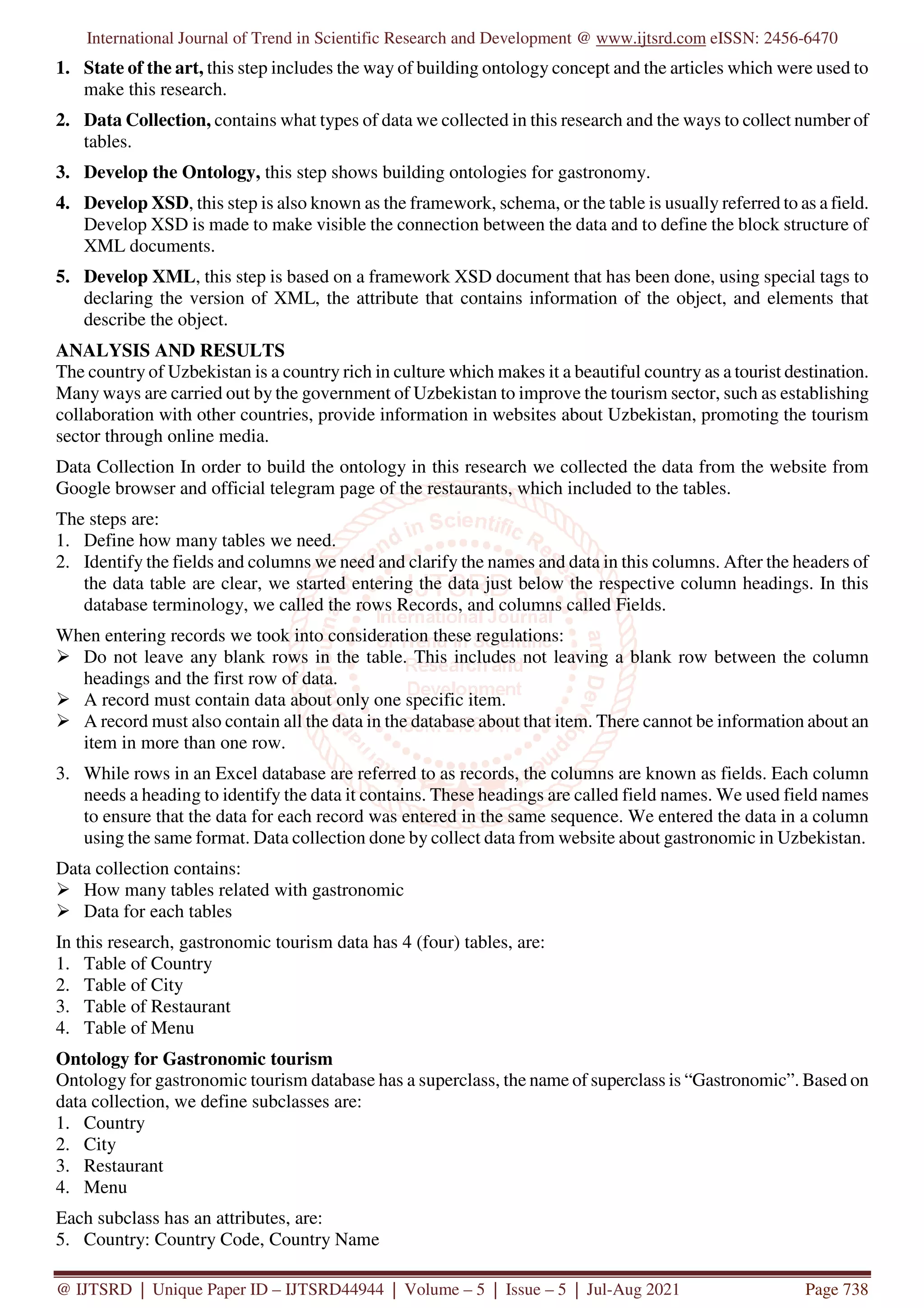
Figure 3 shows the ontology for gastronomic tourism.
Figure 3. Ontology for Gastronomic tourism
XSD for Gastronomic tourism Ontology
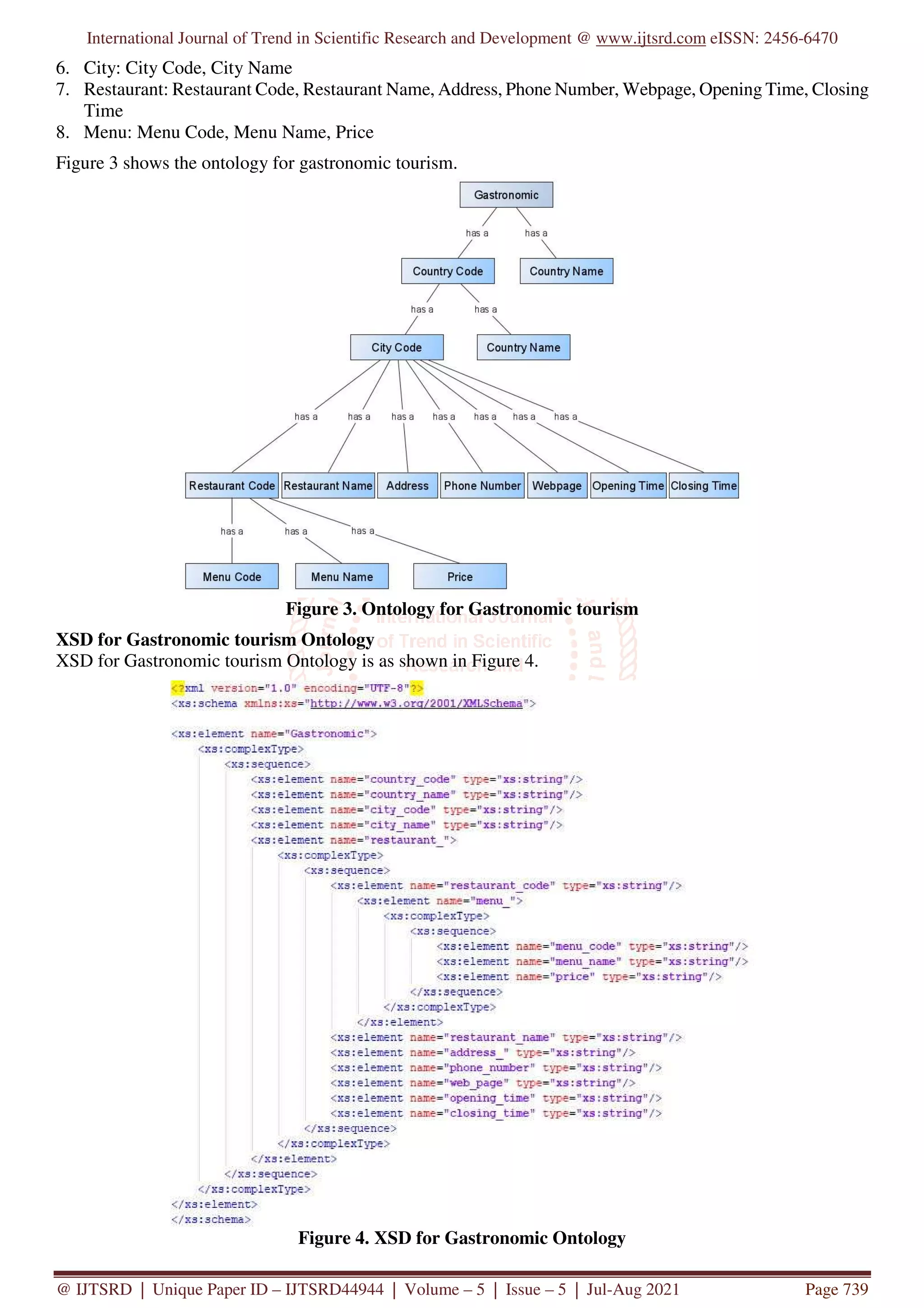
XSD for Gastronomic tourism Ontology is as shown in Figure 4.
Figure 4. XSD for Gastronomic Ontology
International Journal of Trend in Scientific Research and Development @ www.ijtsrd.com eISSN: 2456-6470
@ IJTSRD | Unique Paper ID – IJTSRD44944 | Volume – 5 | Issue – 5 | Jul-Aug 2021 Page 740
Figure 4.2 is an XSD script for gastronomic ontology. There are several elements that consist of parent elements
and child elements. The <xs: element name = “Gastronomic”> element is the root element or parent element.
After that, there are other elements that define the contents of the “Gastronomic” element, such as <xs: element
name = “country_code”>, <xs: element name = “country_name”>, <xs: element name = “city_code”>, and <xs:
element name = “city_name”> which has a string data type.
The <xs: element name = “restaurant _”> element is a derived element from the “Gastronomic” element.
Derivative elements occur because the amount of data that has the same object in the “Gastronomic” element is
more than one, so we need derived elements so that all data on these elements can be read completely. Other
elements in the “restaurant_” element are <xs:element name = “restaurant_code”>, <xs:element name =
“restaurant_name”>, <xs:element name = “address _”>, <xs:element name = “phone_number”>, <xs:element
name = “web_page”>, <xs:element name = “opening_time”>, and <xs:element name = “closing_time”> which
also have string data types.
In the “restaurant_” element there are also derived elements, namely <xs:element name = “menu _”>. This
element must exist because in a restaurant there are usually various types of menu choices. So it is necessary to
create derived elements so that all data on these elements can be read completely. Other elements in the “menu_”
element are <xs:element name = “menu_code”>, <xs:element name = “menu_name”>, and <xs:element name =
“price”> with the string data type.
XML for Gastronomic tourism Ontology
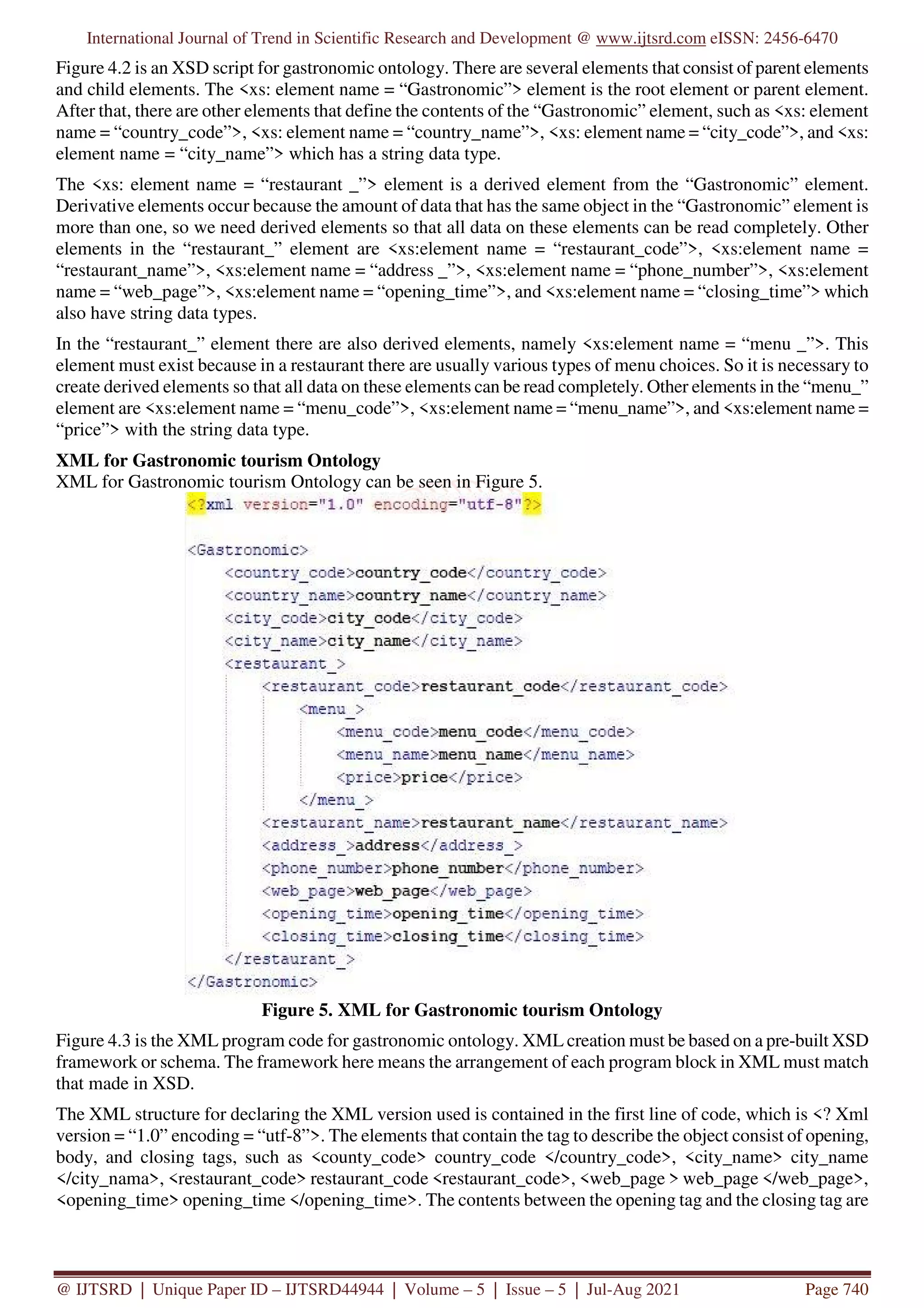
XML for Gastronomic tourism Ontology can be seen in Figure 5.
Figure 5. XML for Gastronomic tourism Ontology
Figure 4.3 is the XML program code for gastronomic ontology. XML creation must be based on a pre-built XSD
framework or schema. The framework here means the arrangement of each program block in XML must match
that made in XSD.
The XML structure for declaring the XML version used is contained in the first line of code, which is <? Xml
version = “1.0” encoding = “utf-8”>. The elements that contain the tag to describe the object consist of opening,
body, and closing tags, such as <county_code> country_code </country_code>, <city_name> city_name
</city_nama>, <restaurant_code> restaurant_code <restaurant_code>, <web_page > web_page </web_page>,
<opening_time> opening_time </opening_time>. The contents between the opening tag and the closing tag are
International Journal of Trend in Scientific Research and Development @ www.ijtsrd.com eISSN: 2456-6470
@ IJTSRD | Unique Paper ID – IJTSRD44944 | Volume – 5 | Issue – 5 | Jul-Aug 2021 Page 741
filled in according to the data held and the program block code is repeated until all existing data have been
entered.
It is clear that the XML program block for the gastronomic ontology follows the preconceived framework or
schema in the XSD, with the same indent for each element. This XML schema has been validated through the
web page http://www.utilities-online.info/, with the result of its validity being “XML Document is Well
Formed”.
XML Schema Definitions provide a rich set of predefined primitive types along with a mechanism to customize
these types to create an accurate specification of XML documents.
The predefined types can be classified into several groups.
Numeric
Date and time
XML types
String
Boolean
URIs
Binary data
CONCLUSION
The discussion in this research is about developing a
database by designing ontology in tourism data. This
study aims to answer the objectives of the research
that has been carried out, after several series of
analysis were carried out, three conclusions were
obtained based on the method used, as follows:
1. The formation of a corpus scheme is done by
creating XML Schema Definition (XSD) which
produces an XSD documents. The resulting XML
Schema Definitions (XSD) document was
declared valid after testing the XSD scheme has
been validated through the web page
http://www.utilities-online.info/, with the result of
its validity being “XSD Document is Well
Formed and Valid”.
2. Then, making Extensible Markup Language
(XML) is done with the help of programs written
using the Python programming language to
produce XML documents. The Extensible
Markup Language (XML) document produced
has been declared valid after testing the validity
of the document schema has been validated
through the web page http://www.utilities-
online.info/, with the result of its validity being
“XML Document is Well Formed”.
Suggestions
Based on the description of the research results and
conclusions, there are several things that are
recommended to the parties related to this research as
follows:
XSD can be used by programmers to verify each
part of the item’s content in the document; in this
research XSD and XML documents were created
for future researchers who will have desire for
programming of Gastronomic tourism
applications;
The ontology concept created in this research is
an example to prepare database for gastronomic
tourism sector.
REFERENCES
[1] Popescu, M.A., Nicolae, F.V., Pavel, M.I.
(2015). Tourism and hospitality industry in
digital era: General overview. Proceedings of
the 9th International Management Conference,
Bucharest, Romania, 163-168.
[2] Vidyullata Shekhar Jadhav, Shivaji D. Mundhe.
2011. Information Technology in Tourism.
International Journal of Computer Science and
Information technologies, Vol. 2 (6). ISSN:
0975-9646.
[3] Widom, J. (1995). Research problems in data
warehousing. In Proceedings of the fourth
international conference on Information and
knowledge management, pages 25–30. ACM.
[4] https://www.unwto.org/
[5] Sanya Khruahong, Xiaoying Kong, Doan
Hoang. 2015. Ontology Design for Thailand
Travel Industry. International Journal of
Knowledge Engineering, Vol. 1 No. 3.
[6] https://uzbektourism.uz/research/statistics
[7] Sinéad Boyce, Claus Pahl, “Developing
Domain Ontologies for Course Content”
Boyce, S., & Pahl, C. (2007). Developing
Domain Ontologies for Course Content.
Educational Technology & Society, 10 (3),
275-288.
[8] Boyce, S. (2004). Investigation of Ontology
Relationships used for the Modelling and
International Journal of Trend in Scientific Research and Development @ www.ijtsrd.com eISSN: 2456-6470
@ IJTSRD | Unique Paper ID – IJTSRD44944 | Volume – 5 | Issue – 5 | Jul-Aug 2021 Page 742
Generation of Educational Content, M.Sc.
Dissertation, School of Computing, Dublin City
University.
[9] Olawande Daramola, Mathew Adigun, Charles
Ayo 2009: Building an Ontology-based
Framework for Tourism Recommendation
Services, 6-9.
[10] Suárez-Figueroa, M. C. (2010), “NeOn
Methodology for building ontology networks:
specification, scheduling and reuse”, Doctoral
dissertation, Informatica.
[11] K U Tulaeva, An ontology concept: database
for gastronomic tourism, building xml schema
definition and extensible markup language,
Economics and Innovative Technologies 2021
(2), 10.
[12] TK Umedovna, AS Oktyamovna, PLANNING
AND MANAGEMENT OF GASTRONOMY
TOURISM IN THE TERRITORY, ResearchJet
Journal of Analysis and Inventions 2 (04), 237-
242.
[13] AS Oktyamovna, TS Atoevna, BS Kodirovna,
The role of animator to the development of
tourism animation activities, Academy, 2020.
[14] AS Oktyamovna, TS Atoevna, BS Kodirovna,
Features and methods of formation of the cost
of tour packages, Academy, 2020.
[15] Tazhibayev MB, Dushanova YF, Umirov JT,
THE ROLE OF NATIONAL TOURISM
RESOURCES IN THE DEVELOPMENT OF
DOMESTIC TOURISM, Economics, 2020.

The Digital Infrastructure for Knowledge Based Tourism Building Ontology Concept by XML Schema Definition and Extensible Markup Language

  • 1.
    International Journal ofTrend in Scientific Research and Development (IJTSRD) Volume 5 Issue 5, July-August 2021 Available Online: www.ijtsrd.com e-ISSN: 2456 – 6470 @ IJTSRD | Unique Paper ID – IJTSRD44944 | Volume – 5 | Issue – 5 | Jul-Aug 2021 Page 734 The Digital Infrastructure for Knowledge Based Tourism: Building Ontology Concept by XML Schema Definition and Extensible Markup Language Khamida Tulaeva1 , Detty Purnamasari2 1 Digital Transformation for Digital Tourism, Bukhara State University and Universitas Gunadarma, Bukhara, Uzbekistan 2 Information Technology, Universitas Gunadarma, Bukhara, Uzbekistan ABSTRACT Tourism is a strategy for country to increase its income. Digital technologies are currently used to help improve tourism, for example with information about tourist areas through the website or Mobile Apps. Database is required as the basic infrastructure for implementing system when to support tourism In this research, we discussed about the database model that can stored tourism data. Tourism databases such as warehouses are rich in information about tourism. Tourism information can be in the structured or unstructured form. Database development is an important part of enhancing development supported by digital technology. In this research, ontology is applied for database development and it produce the ontologies that could be utilized for tourism. In this research, ontology is applied for database development and it produces the ontologies that could be utilized for gastronomic tourism. KEYWORDS: database, digital technology, ontology, tourism, XML Schema Definition, Extensible Markup Language How to cite this paper: Khamida Tulaeva | Detty Purnamasari "The Digital Infrastructure for Knowledge Based Tourism: Building Ontology Concept by XML Schema Definition and Extensible Markup Language" Published in International Journal of Trend in Scientific Research and Development (ijtsrd), ISSN: 2456- 6470, Volume-5 | Issue-5, August 2021, pp.734-742, URL: www.ijtsrd.com/papers/ijtsrd44944.pdf Copyright © 2021 by author (s) and International Journal of Trend in Scientific Research and Development Journal. This is an Open Access article distributed under the terms of the Creative Commons Attribution License (CC BY 4.0) (http://creativecommons.org/licenses/by/4.0) INTRODUCTION Tourism has historically been dependent on the character of the destination, including attractions, beaches and resorts. It is a complex activity that requires the availability of certain parameters (e.g. accessible road networks, standard accommodation facilities, attractions etc) and information on potential and existing attraction sites. Information on these parameters and attraction sites can be gathered, processed, organized and stored using tools such as Global Positioning System (GPS), Geographic Information System (GIS) coupled with remote sensing. After gathering the needed data about a destination, the data must be stored in a retrievable form to enhance tourism, and this can be achieved with the aid of GIS. To reach the rapidly changing technology speed in 21st century is a big issue of today in any country's government system. Tourism is a sector where millions of people exchange their money to get high quality service and the number of tourists depends on how the service will be delivered. The tourism sector is one sector that provides income for the country. According to Popescu et.al. (2015) many countries make the tourism sector to be their main income [1]. Tourism is what involves every human being in the world. Tourists need detailed information about each place that they want to visit. These information needs include: [2] Location of tourist attractions, and also the weather Transportation, lodging, restaurants, souvenir shops Local customs Good season to make a visit IJTSRD44944
  • 2.
    International Journal ofTrend in Scientific Research and Development @ www.ijtsrd.com eISSN: 2456-6470 @ IJTSRD | Unique Paper ID – IJTSRD44944 | Volume – 5 | Issue – 5 | Jul-Aug 2021 Page 735 Types of objects that can be visited The beauty of the tourist attractions Today we can see hundreds of digital resources which provide huge range of data in order to inform people about the place, the way, the service and the prices of a place where they will visit and spend their money. The global importance of tourism is steadily rising, creating new job opportunities in many countries. Today’s information management solutions for the complex tasks of tourism intermediaries are still at an early stage from a semantic point of view. The tourism product has an intangible nature in that a prospective traveler cannot touch the product before the trip. This is one major reason why information about tourism and travel services (e.g. destination, hotel, restaurants, events, transportation etc.) must be accurate and credible, one that fosters users’ confidence.[2] One way to achieve this level of credibility is to engage knowledge representation formalisms that can sufficiently capture all relevant facts about tourism objects in a domain on which approaches to rendering tourism information services can be based. An ideal approach to achieve this is the use of ontologies which provide the platform on which recommendation formalisms that exploit deep knowledge of the user, tourism objects, and other relevant contextual information that closely model reality can be built. [2] As competition between tourism destinations increases, local culture is becoming an increasingly important source of new products and activities to attract and amuse tourists. Gastronomy has a particularly important role to play in this, not only because food is central to the tourist experience, but also because gastronomy has become an important source of identity formation in postmodern societies. More and more, ‘we are what we eat’, not just in the physical sense, but also because we identify with certain types of cuisine that we encounter on holiday. As tourists become more mobile, so does the food they eat. The comfortable association of certain foods with certain regions is being challenged by the growing mobility of food, culinary styles and the increasing de-differentiation of dishes and cuisines. Far from producing an homogenized gastronomic landscape, the tension between globalization and localization is producing ever more variations. [3] The aim of this research is to build database based on ontology for gastronomic tourism in Uzbekistan, especially in Bukhara region. The research objectives are as follow: Develop ontology for database of gastronomic tourism of Bukhara region Create XML Schema Definition (XSD) Create Extensible Markup Language (XML) Database with ontology concept is a start point of any issue whether economic or technological sphere. Touristic product is a thing which cannot be touchable or seen till you receive all services and feel the real quality of that. In 2019 near the 5 million people visit Uzbekistan in terms of travel and business including local and international tourists. Depending upon the potential of country this number is not high. LITERATURE REVIEW Over recent decades, gastronomy tourism has gone beyond the table setting and now includes all sectors of a destination’s food and tourism chain – producers (agriculture, fishing, etc.), processing firms (dairies, olive mills, canning plants, wineries, etc.), the tourism and hospitality sector (restaurants, specialised accommodation, gastronomic activity firms, etc.), the retail sector, the commerce sector (sale of products) and even the knowledge sector. With a view to the publication of the Global Report on Food Tourism, a survey was conducted among the UNWTO AFFILIATE Members in order to know their opinion about current situation of Food Tourism. Responses form Affiliate Members, working in diverse sectors around the world, were received in this regard.[4] According to the results this survey, 88.2% of respondents consider that gastronomy is a strategic element in defining the brand and image of their destination. Only 11.8% were of the opinion that gastronomy plays a minor role Digital technologies have brought significant transformation to the tourism industry, revolutionising tourism enterprises, products and experiences, business ecosystems, and destinations. Digitalisation has also transformed the traditional roles of tourism producers and consumers, with new roles, relationships, business models, and competencies emerging. The rise of digital platforms has increased the variety and volume of tourism products, services and experiences, with on-demand functionality accelerating the speed of economic transactions, market awareness and feedback. Digitalisation leverages digital technologies and data to transform businesses and business ecosystems. It transforms markets and production processes, and has significant implications for economic and social organisation, innovation, and competitiveness. [5] Tourism cannot thrive without accurate and reliable information about a destination which will be the
  • 3.
    International Journal ofTrend in Scientific Research and Development @ www.ijtsrd.com eISSN: 2456-6470 @ IJTSRD | Unique Paper ID – IJTSRD44944 | Volume – 5 | Issue – 5 | Jul-Aug 2021 Page 736 main element that will draw tourists/visitors. A visitor cannot visit a place without information about. In 2018 more than 5 million people visited Uzbekistan, and this number is twice as much than 2016 from 2 690. million. 6 748. Million tourists came to the republic during 2019 and it was more than 26.2 % comparing to 2018. [6] Figure 1. Number of tourists in Uzbekistan during 2017-2019 (mln people). The most number of visitors from Russian Federation and European countries hold the last places according to Figure 3. Table 1. List of countries people come from The State Committee for the Development of Tourism and the Association of Cooks of Uzbekistan jointly implement several projects in this direction. On December 12, in the framework of the project “Gastronomic Tours of Uzbekistan”, courses on “Hospitality Schools” were held in several districts of Tashkent. Management data of tourism can be done by developed database and using ontology concept. The use of ontology is able to integrate heterogeneous schemes in various domains. A number of frameworks designed using an ontology-based integration approach have developed in recent years and provide many benefits. In building ontology concept there are 7 main steps, which are: Step 1. Determine the domain and scope of the ontology Step 2. Consider reusing existing ontologies Step 3. Enumerate important terms in the ontology Step 4. Define the classes and the class hierarchy Step 5. Define the properties of classes—slots Step 6. Define the facets of the slots Step 7. Create instances [7] Tourism has historically been dependent on the character of the destination, including attractions, beaches and resorts. It is a complex activity that requires the availability of certain parameters (e.g. accessible road networks, standard accommodation facilities, attractions etc) and information on potential and existing attraction sites. Information on these parameters and attraction sites can be gathered, processed, organized and stored using tools such as Global Positioning System (GPS), Geographic Information System (GIS) coupled with remote sensing.
  • 4.
    International Journal ofTrend in Scientific Research and Development @ www.ijtsrd.com eISSN: 2456-6470 @ IJTSRD | Unique Paper ID – IJTSRD44944 | Volume – 5 | Issue – 5 | Jul-Aug 2021 Page 737 After gathering the needed data about a destination, the data must be stored in a retrievable form to enhance tourism, and this can be achieved with the aid of GIS. Figure 2. Ontology development process The problem with information aggregation is that the information is not structured in the same manner. Each data source, or application, has a different data representation and provides different data formats for integration. HTML, XML, flat files, relational model are some of examples that we can find in an aggregation problem. Another problem is the semantic differences between data sources. We can find the same word with different meanings. For example, in one data source, customer can refer to the tourists in others it can refer to the travel agencies. [8] Ontology provides a rich and predetermined vocabulary that functions as a conceptual interface that is stable and does not depend on data schemes; knowledge represented by ontology is comprehensive enough to support the translation of all relevant information sources; ontology supports consistent management and recognizes inconsistent data. [7] Tourism has historically been dependent on the character of the destination, including attractions, beaches and resorts. It is a complex activity that requires the availability of certain parameters (e.g. accessible road networks, standard accommodation facilities, attractions etc) and information on potential and existing attraction sites. Information on these parameters and attraction sites can be gathered, processed, organized and stored using tools such as Global Positioning System (GPS), Geographic Information System (GIS) coupled with remote sensing. After gathering the needed data about a destination, the data must be stored in a retrievable form to enhance tourism, and this can be achieved with the aid of GIS. Tourism has historically been dependent on the character of the destination, including attractions, beaches and resorts. It is a complex activity that requires the availability of certain parameters (e.g. accessible road networks, standard accommodation facilities, attractions etc) and information on potential and existing attraction sites. Information on these parameters and attraction sites can be gathered, processed, organized and stored using tools such as Global Positioning System (GPS), Geographic Information System (GIS) coupled with remote sensing. After gathering the needed data about a destination, the data must be stored in a retrievable form to enhance tourism, and this can be achieved with the aid of GIS. RESEARCH METHODOLOGY This research discusses the concept to build database based on ontology for data of tourism in Uzbekistan. Five steps in this research are:
  • 5.
    International Journal ofTrend in Scientific Research and Development @ www.ijtsrd.com eISSN: 2456-6470 @ IJTSRD | Unique Paper ID – IJTSRD44944 | Volume – 5 | Issue – 5 | Jul-Aug 2021 Page 738 1. State of the art, this step includes the way of building ontology concept and the articles which were used to make this research. 2. Data Collection, contains what types of data we collected in this research and the ways to collect number of tables. 3. Develop the Ontology, this step shows building ontologies for gastronomy. 4. Develop XSD, this step is also known as the framework, schema, or the table is usually referred to as a field. Develop XSD is made to make visible the connection between the data and to define the block structure of XML documents. 5. Develop XML, this step is based on a framework XSD document that has been done, using special tags to declaring the version of XML, the attribute that contains information of the object, and elements that describe the object. ANALYSIS AND RESULTS The country of Uzbekistan is a country rich in culture which makes it a beautiful country as a tourist destination. Many ways are carried out by the government of Uzbekistan to improve the tourism sector, such as establishing collaboration with other countries, provide information in websites about Uzbekistan, promoting the tourism sector through online media. Data Collection In order to build the ontology in this research we collected the data from the website from Google browser and official telegram page of the restaurants, which included to the tables. The steps are: 1. Define how many tables we need. 2. Identify the fields and columns we need and clarify the names and data in this columns. After the headers of the data table are clear, we started entering the data just below the respective column headings. In this database terminology, we called the rows Records, and columns called Fields. When entering records we took into consideration these regulations: Do not leave any blank rows in the table. This includes not leaving a blank row between the column headings and the first row of data. A record must contain data about only one specific item. A record must also contain all the data in the database about that item. There cannot be information about an item in more than one row. 3. While rows in an Excel database are referred to as records, the columns are known as fields. Each column needs a heading to identify the data it contains. These headings are called field names. We used field names to ensure that the data for each record was entered in the same sequence. We entered the data in a column using the same format. Data collection done by collect data from website about gastronomic in Uzbekistan. Data collection contains: How many tables related with gastronomic Data for each tables In this research, gastronomic tourism data has 4 (four) tables, are: 1. Table of Country 2. Table of City 3. Table of Restaurant 4. Table of Menu Ontology for Gastronomic tourism Ontology for gastronomic tourism database has a superclass, the name of superclass is “Gastronomic”. Based on data collection, we define subclasses are: 1. Country 2. City 3. Restaurant 4. Menu Each subclass has an attributes, are: 5. Country: Country Code, Country Name
  • 6.
    International Journal ofTrend in Scientific Research and Development @ www.ijtsrd.com eISSN: 2456-6470 @ IJTSRD | Unique Paper ID – IJTSRD44944 | Volume – 5 | Issue – 5 | Jul-Aug 2021 Page 739 6. City: City Code, City Name 7. Restaurant: Restaurant Code, Restaurant Name, Address, Phone Number, Webpage, Opening Time, Closing Time 8. Menu: Menu Code, Menu Name, Price Figure 3 shows the ontology for gastronomic tourism. Figure 3. Ontology for Gastronomic tourism XSD for Gastronomic tourism Ontology XSD for Gastronomic tourism Ontology is as shown in Figure 4. Figure 4. XSD for Gastronomic Ontology
  • 7.
    International Journal ofTrend in Scientific Research and Development @ www.ijtsrd.com eISSN: 2456-6470 @ IJTSRD | Unique Paper ID – IJTSRD44944 | Volume – 5 | Issue – 5 | Jul-Aug 2021 Page 740 Figure 4.2 is an XSD script for gastronomic ontology. There are several elements that consist of parent elements and child elements. The <xs: element name = “Gastronomic”> element is the root element or parent element. After that, there are other elements that define the contents of the “Gastronomic” element, such as <xs: element name = “country_code”>, <xs: element name = “country_name”>, <xs: element name = “city_code”>, and <xs: element name = “city_name”> which has a string data type. The <xs: element name = “restaurant _”> element is a derived element from the “Gastronomic” element. Derivative elements occur because the amount of data that has the same object in the “Gastronomic” element is more than one, so we need derived elements so that all data on these elements can be read completely. Other elements in the “restaurant_” element are <xs:element name = “restaurant_code”>, <xs:element name = “restaurant_name”>, <xs:element name = “address _”>, <xs:element name = “phone_number”>, <xs:element name = “web_page”>, <xs:element name = “opening_time”>, and <xs:element name = “closing_time”> which also have string data types. In the “restaurant_” element there are also derived elements, namely <xs:element name = “menu _”>. This element must exist because in a restaurant there are usually various types of menu choices. So it is necessary to create derived elements so that all data on these elements can be read completely. Other elements in the “menu_” element are <xs:element name = “menu_code”>, <xs:element name = “menu_name”>, and <xs:element name = “price”> with the string data type. XML for Gastronomic tourism Ontology XML for Gastronomic tourism Ontology can be seen in Figure 5. Figure 5. XML for Gastronomic tourism Ontology Figure 4.3 is the XML program code for gastronomic ontology. XML creation must be based on a pre-built XSD framework or schema. The framework here means the arrangement of each program block in XML must match that made in XSD. The XML structure for declaring the XML version used is contained in the first line of code, which is <? Xml version = “1.0” encoding = “utf-8”>. The elements that contain the tag to describe the object consist of opening, body, and closing tags, such as <county_code> country_code </country_code>, <city_name> city_name </city_nama>, <restaurant_code> restaurant_code <restaurant_code>, <web_page > web_page </web_page>, <opening_time> opening_time </opening_time>. The contents between the opening tag and the closing tag are
  • 8.
    International Journal ofTrend in Scientific Research and Development @ www.ijtsrd.com eISSN: 2456-6470 @ IJTSRD | Unique Paper ID – IJTSRD44944 | Volume – 5 | Issue – 5 | Jul-Aug 2021 Page 741 filled in according to the data held and the program block code is repeated until all existing data have been entered. It is clear that the XML program block for the gastronomic ontology follows the preconceived framework or schema in the XSD, with the same indent for each element. This XML schema has been validated through the web page http://www.utilities-online.info/, with the result of its validity being “XML Document is Well Formed”. XML Schema Definitions provide a rich set of predefined primitive types along with a mechanism to customize these types to create an accurate specification of XML documents. The predefined types can be classified into several groups. Numeric Date and time XML types String Boolean URIs Binary data CONCLUSION The discussion in this research is about developing a database by designing ontology in tourism data. This study aims to answer the objectives of the research that has been carried out, after several series of analysis were carried out, three conclusions were obtained based on the method used, as follows: 1. The formation of a corpus scheme is done by creating XML Schema Definition (XSD) which produces an XSD documents. The resulting XML Schema Definitions (XSD) document was declared valid after testing the XSD scheme has been validated through the web page http://www.utilities-online.info/, with the result of its validity being “XSD Document is Well Formed and Valid”. 2. Then, making Extensible Markup Language (XML) is done with the help of programs written using the Python programming language to produce XML documents. The Extensible Markup Language (XML) document produced has been declared valid after testing the validity of the document schema has been validated through the web page http://www.utilities- online.info/, with the result of its validity being “XML Document is Well Formed”. Suggestions Based on the description of the research results and conclusions, there are several things that are recommended to the parties related to this research as follows: XSD can be used by programmers to verify each part of the item’s content in the document; in this research XSD and XML documents were created for future researchers who will have desire for programming of Gastronomic tourism applications; The ontology concept created in this research is an example to prepare database for gastronomic tourism sector. REFERENCES [1] Popescu, M.A., Nicolae, F.V., Pavel, M.I. (2015). Tourism and hospitality industry in digital era: General overview. Proceedings of the 9th International Management Conference, Bucharest, Romania, 163-168. [2] Vidyullata Shekhar Jadhav, Shivaji D. Mundhe. 2011. Information Technology in Tourism. International Journal of Computer Science and Information technologies, Vol. 2 (6). ISSN: 0975-9646. [3] Widom, J. (1995). Research problems in data warehousing. In Proceedings of the fourth international conference on Information and knowledge management, pages 25–30. ACM. [4] https://www.unwto.org/ [5] Sanya Khruahong, Xiaoying Kong, Doan Hoang. 2015. Ontology Design for Thailand Travel Industry. International Journal of Knowledge Engineering, Vol. 1 No. 3. [6] https://uzbektourism.uz/research/statistics [7] Sinéad Boyce, Claus Pahl, “Developing Domain Ontologies for Course Content” Boyce, S., & Pahl, C. (2007). Developing Domain Ontologies for Course Content. Educational Technology & Society, 10 (3), 275-288. [8] Boyce, S. (2004). Investigation of Ontology Relationships used for the Modelling and
  • 9.
    International Journal ofTrend in Scientific Research and Development @ www.ijtsrd.com eISSN: 2456-6470 @ IJTSRD | Unique Paper ID – IJTSRD44944 | Volume – 5 | Issue – 5 | Jul-Aug 2021 Page 742 Generation of Educational Content, M.Sc. Dissertation, School of Computing, Dublin City University. [9] Olawande Daramola, Mathew Adigun, Charles Ayo 2009: Building an Ontology-based Framework for Tourism Recommendation Services, 6-9. [10] Suárez-Figueroa, M. C. (2010), “NeOn Methodology for building ontology networks: specification, scheduling and reuse”, Doctoral dissertation, Informatica. [11] K U Tulaeva, An ontology concept: database for gastronomic tourism, building xml schema definition and extensible markup language, Economics and Innovative Technologies 2021 (2), 10. [12] TK Umedovna, AS Oktyamovna, PLANNING AND MANAGEMENT OF GASTRONOMY TOURISM IN THE TERRITORY, ResearchJet Journal of Analysis and Inventions 2 (04), 237- 242. [13] AS Oktyamovna, TS Atoevna, BS Kodirovna, The role of animator to the development of tourism animation activities, Academy, 2020. [14] AS Oktyamovna, TS Atoevna, BS Kodirovna, Features and methods of formation of the cost of tour packages, Academy, 2020. [15] Tazhibayev MB, Dushanova YF, Umirov JT, THE ROLE OF NATIONAL TOURISM RESOURCES IN THE DEVELOPMENT OF DOMESTIC TOURISM, Economics, 2020.