http://www.meetup.com/blockchain-product-design-development/
The Design of Blockchain-Based Apps
Product, Design and Development
January 16, 2019
#blockchainonramp
Blockchain Product Design and Development
What do users care about?
2
Solving their problems right now
with as little thought and cost as
possible.
...not blockchain.
Blockchain Product Design and Development
Why this is important: the bigger picture
3
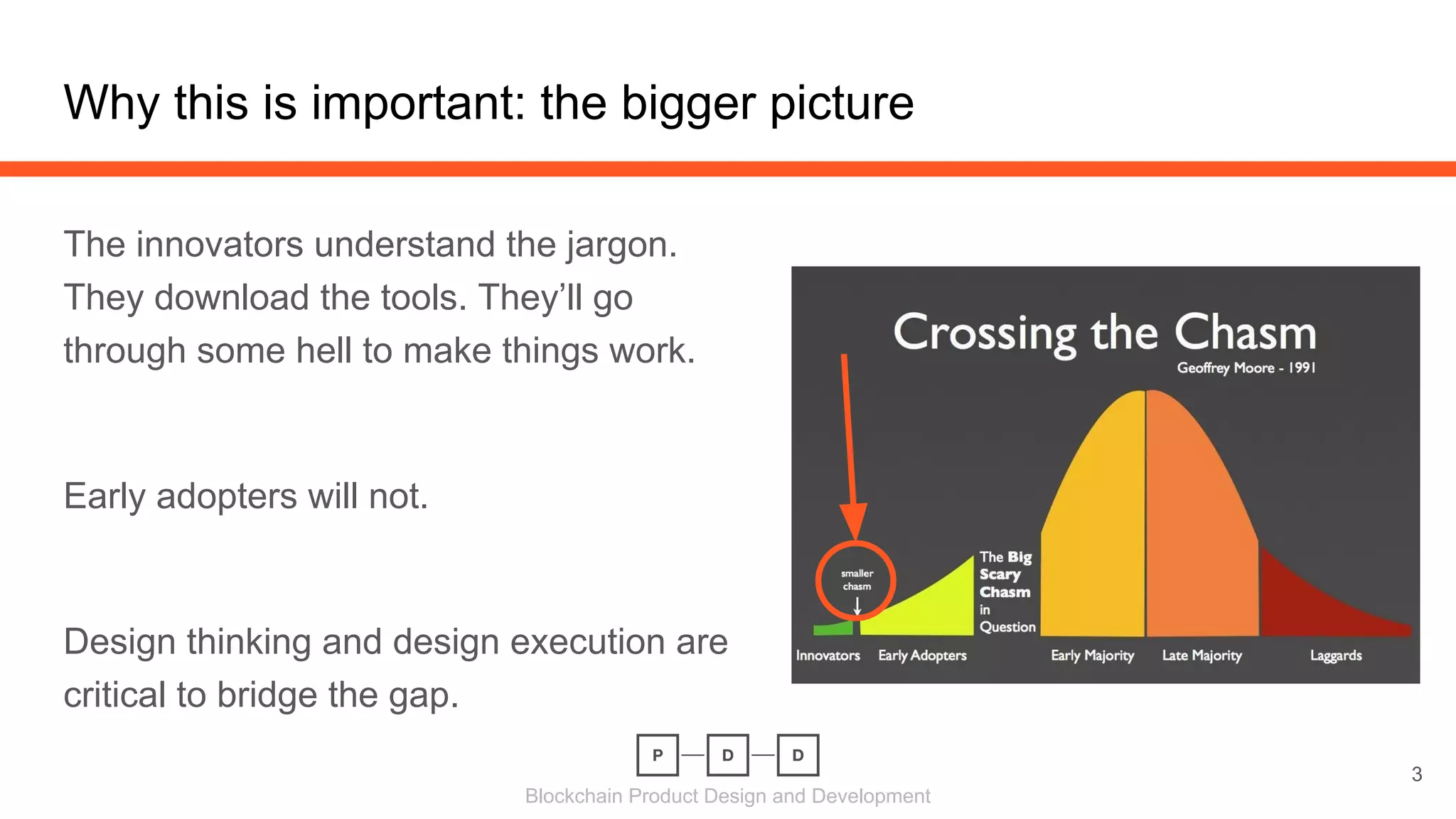
The innovators understand the jargon.
They download the tools. They’ll go
through some hell to make things work.
Early adopters will not.
Design thinking and design execution are
critical to bridge the gap.
Blockchain Product Design and Development
Why this is important: the human picture
4
“Blockchain affects the most intimate parts
of people’s lives -- like money, identity and
health.”
-- Sarah Baker Mills, Consensys
Let’s define our design scope
5
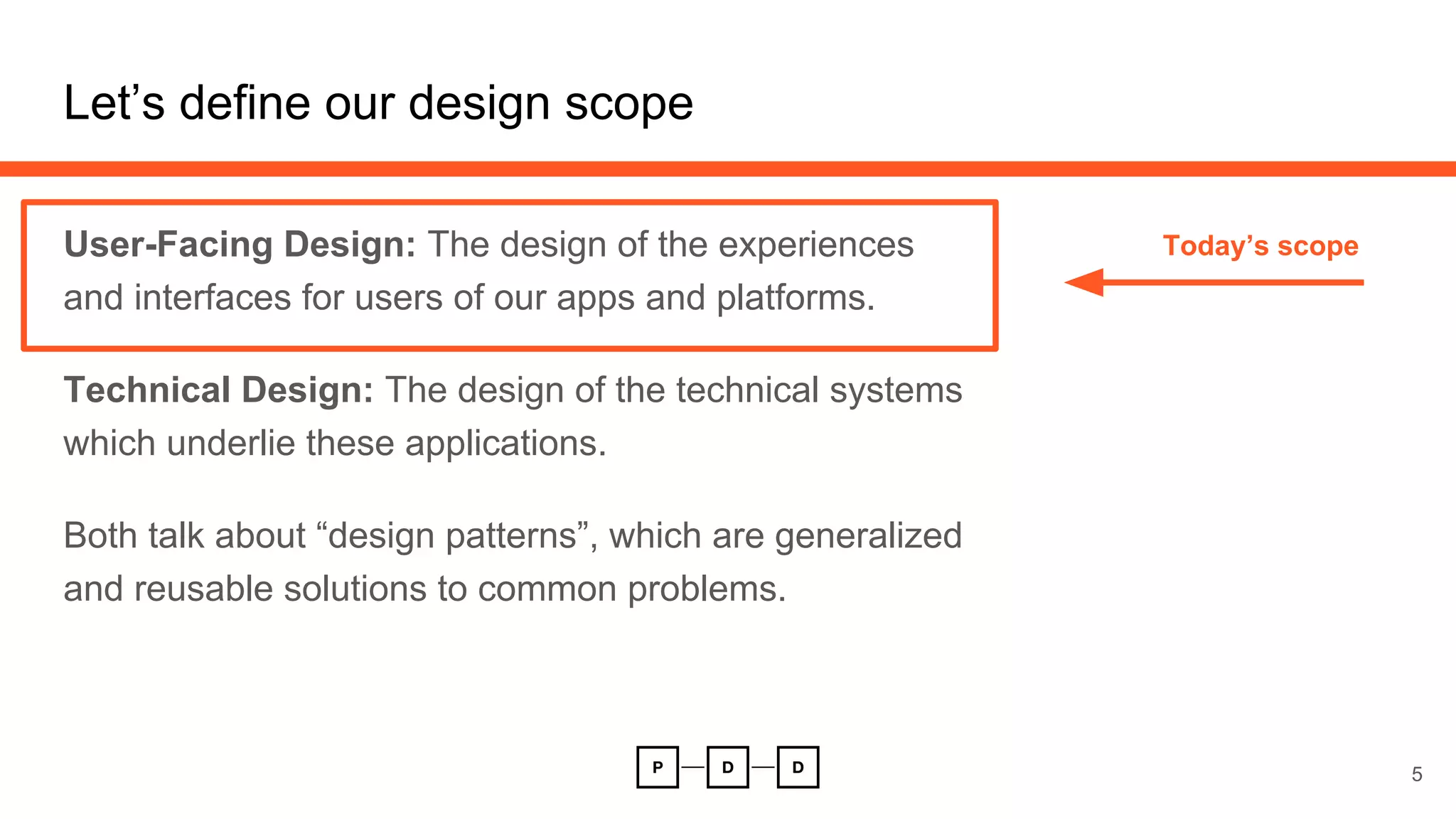
User-Facing Design: The design of the experiences
and interfaces for users of our apps and platforms.
Technical Design: The design of the technical systems
which underlie these applications.
Both talk about “design patterns”, which are generalized
and reusable solutions to common problems.
Today’s scope
Blockchain Product Design and Development
They are not entirely independent!
6
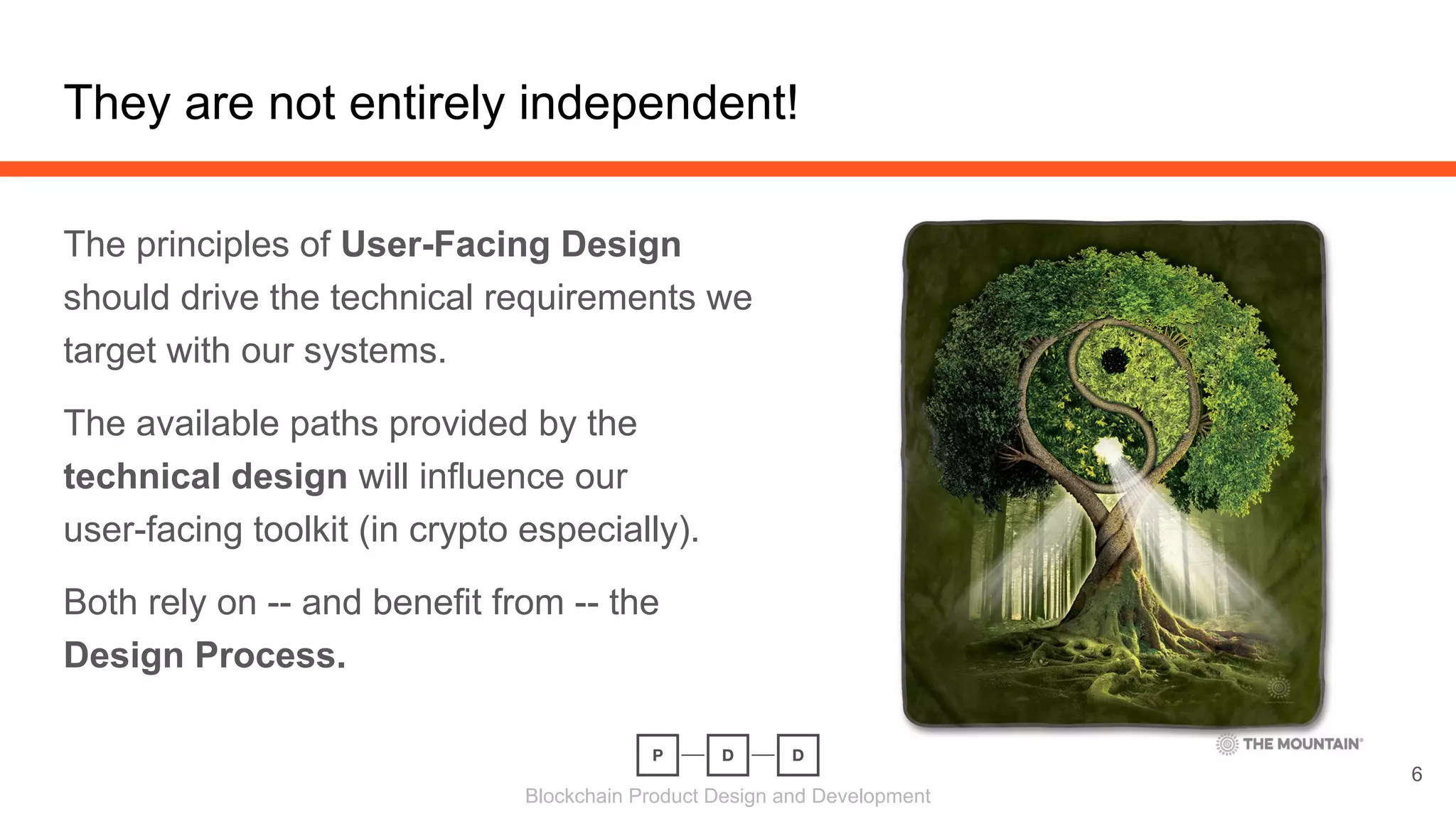
The principles of User-Facing Design
should drive the technical requirements we
target with our systems.
The available paths provided by the
technical design will influence our
user-facing toolkit (in crypto especially).
Both rely on -- and benefit from -- the
Design Process.
Step 1: The platform’s customers are developers.
Step 2: The developer’s customers are end-users.
To be effective, platforms have to win them both.
Platforms have 2-step product/market fit
7
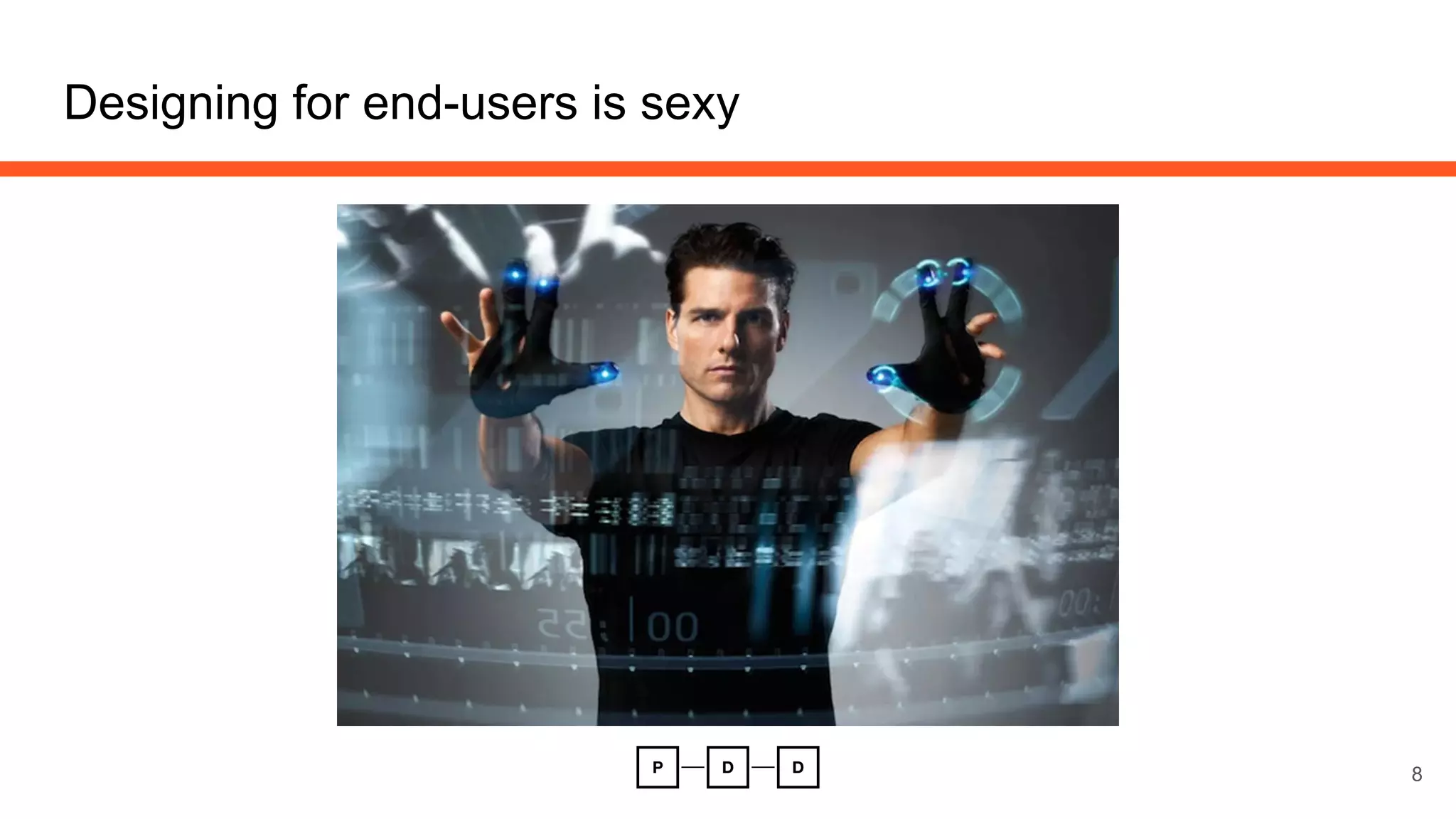
Designing for end-users is sexy
8
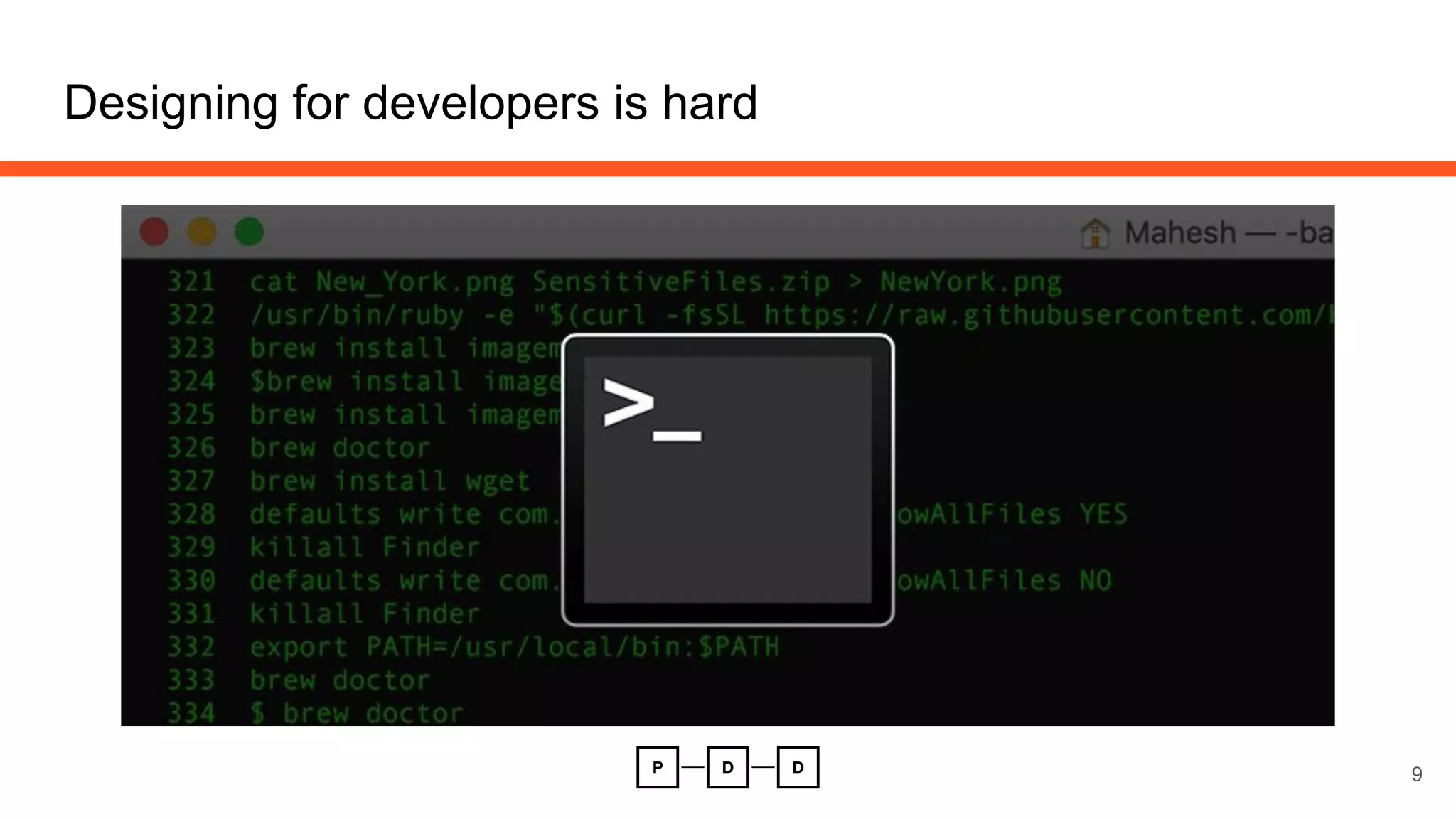
Designing for developers is hard
9
Blockchain Product Design and Development
Today we’ll stick with the sexy stuff
10
We’ll focus on End-User Design and User
Experience. Specifically, for the end-users
of apps built on blockchains.
We’ll skip the discussion of Developer
Experience (DevX) but remember that
developers are potentially your users too!
...and we will have to get a *bit* technical.
User Experience (UX)
“The overall experience of a person using a
product such as a website or computer application,
especially in terms of how easy or pleasing it is to
use.”
11
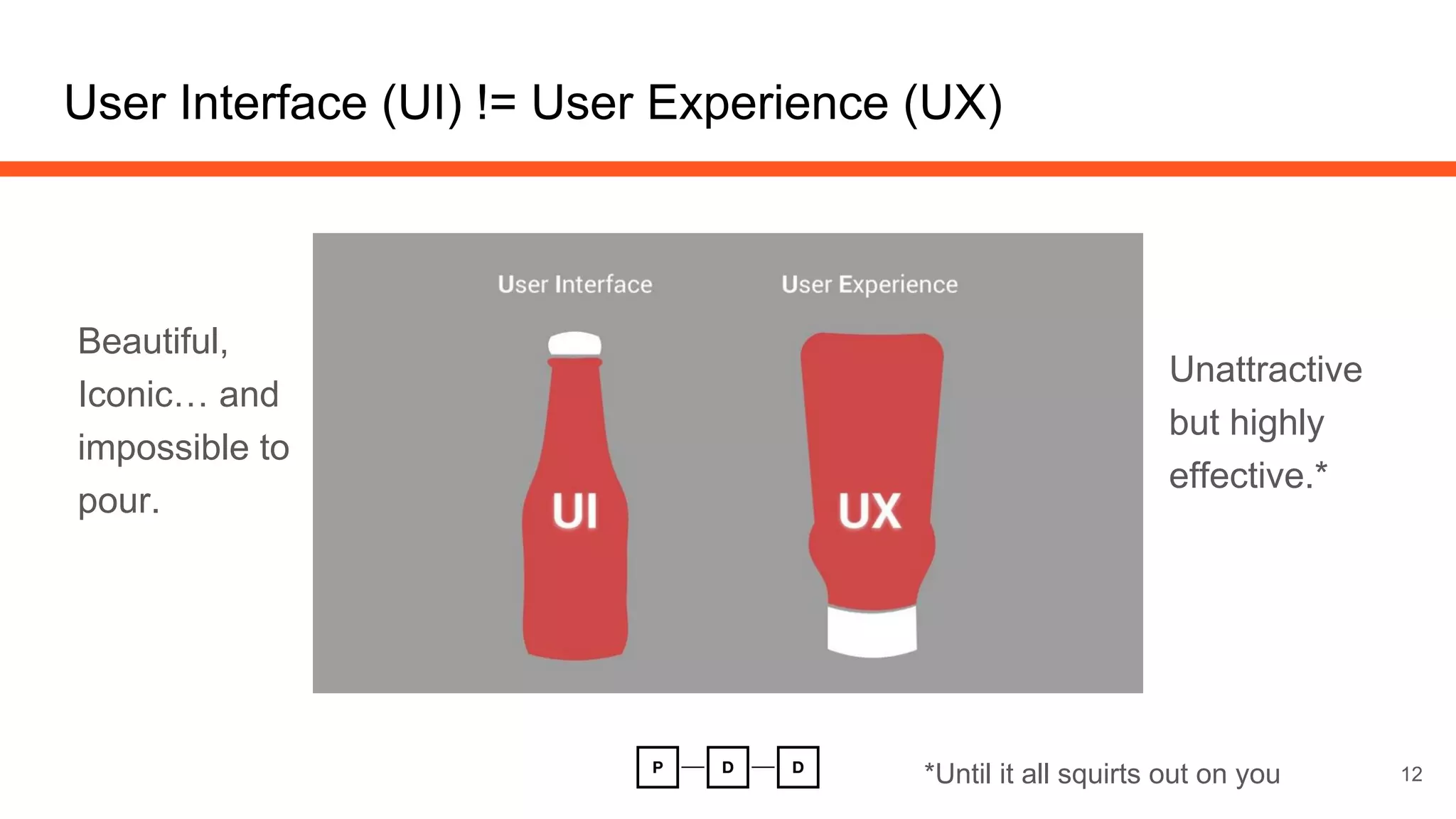
User Interface (UI) != User Experience (UX)
12
Unattractive
but highly
effective.*
Beautiful,
Iconic… and
impossible to
pour.
*Until it all squirts out on you
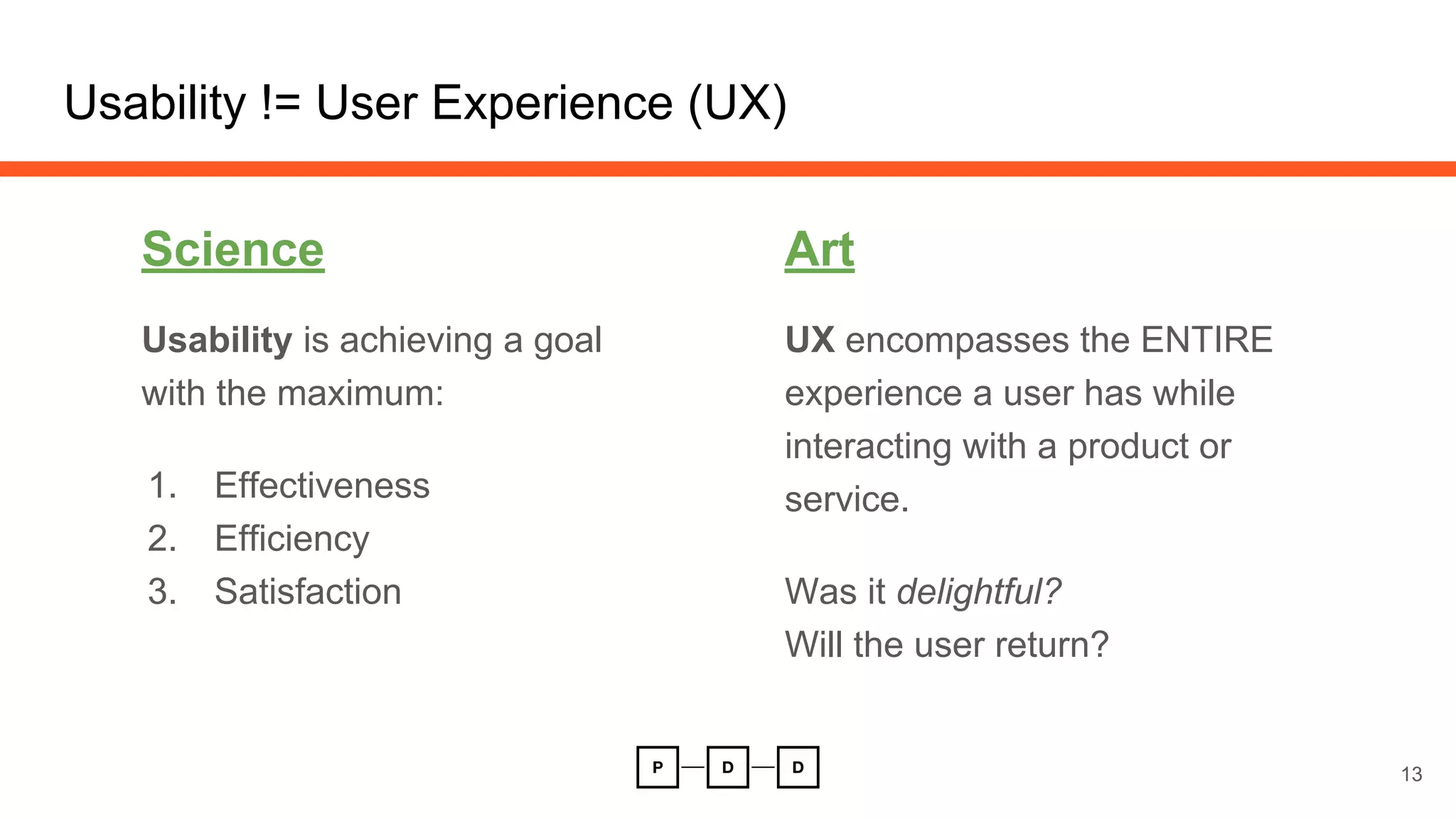
Usability != User Experience (UX)
13
Usability is achieving a goal
with the maximum:
1. Effectiveness
2. Efficiency
3. Satisfaction
UX encompasses the ENTIRE
experience a user has while
interacting with a product or
service.
Was it delightful?
Will the user return?
Science Art
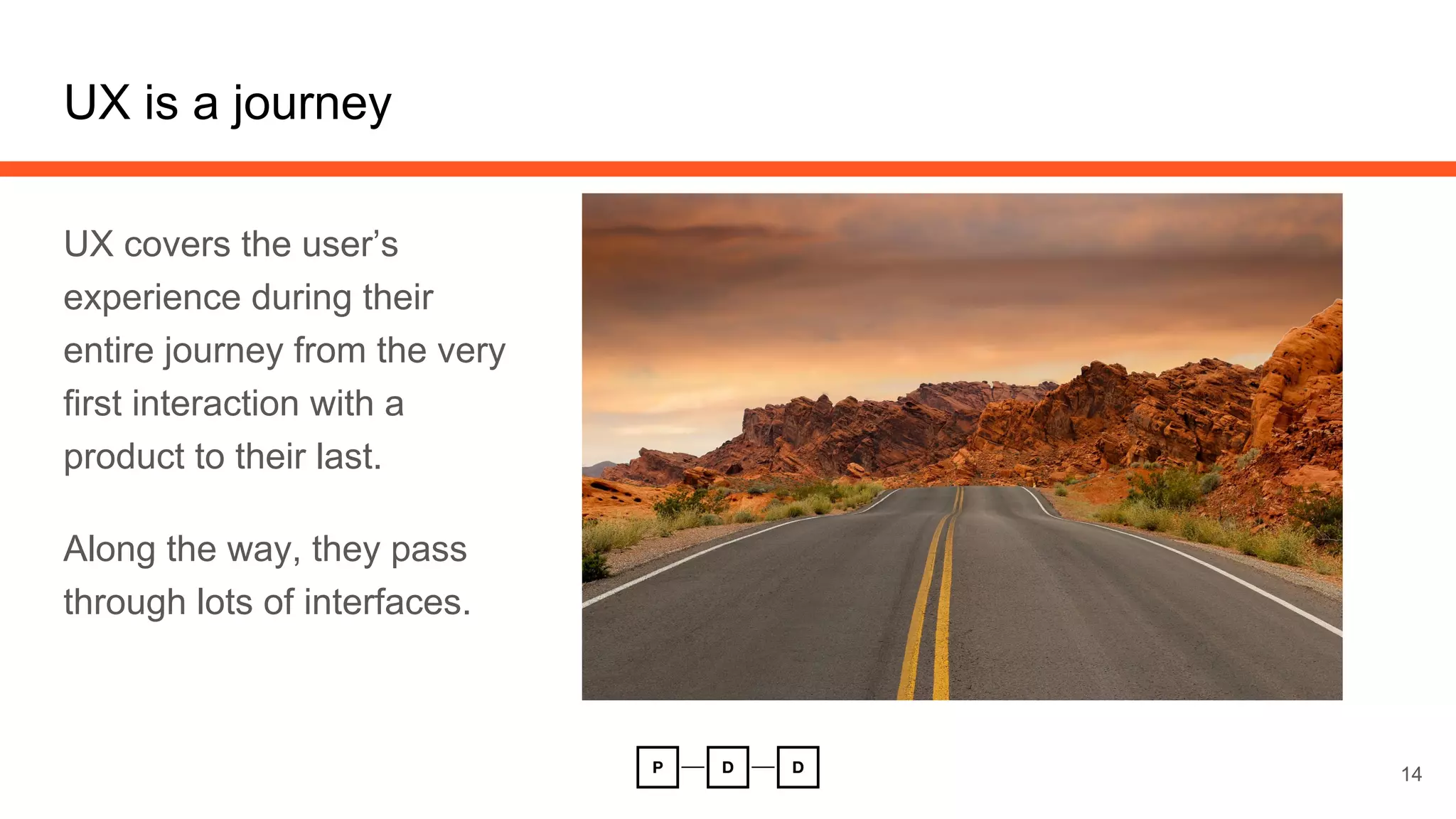
UX is a journey
UX covers the user’s
experience during their
entire journey from the very
first interaction with a
product to their last.
Along the way, they pass
through lots of interfaces.
14
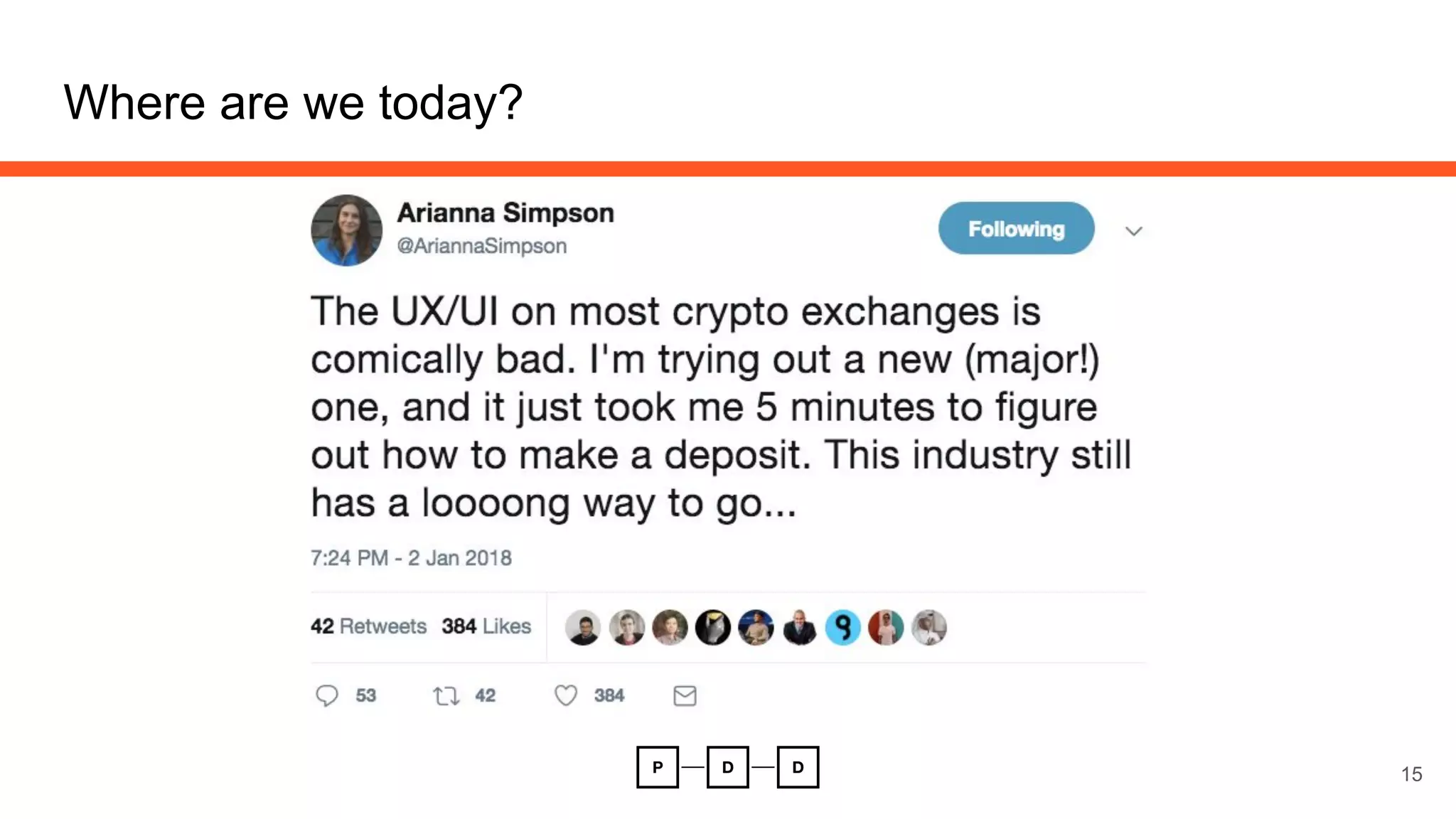
Where are we today?
15
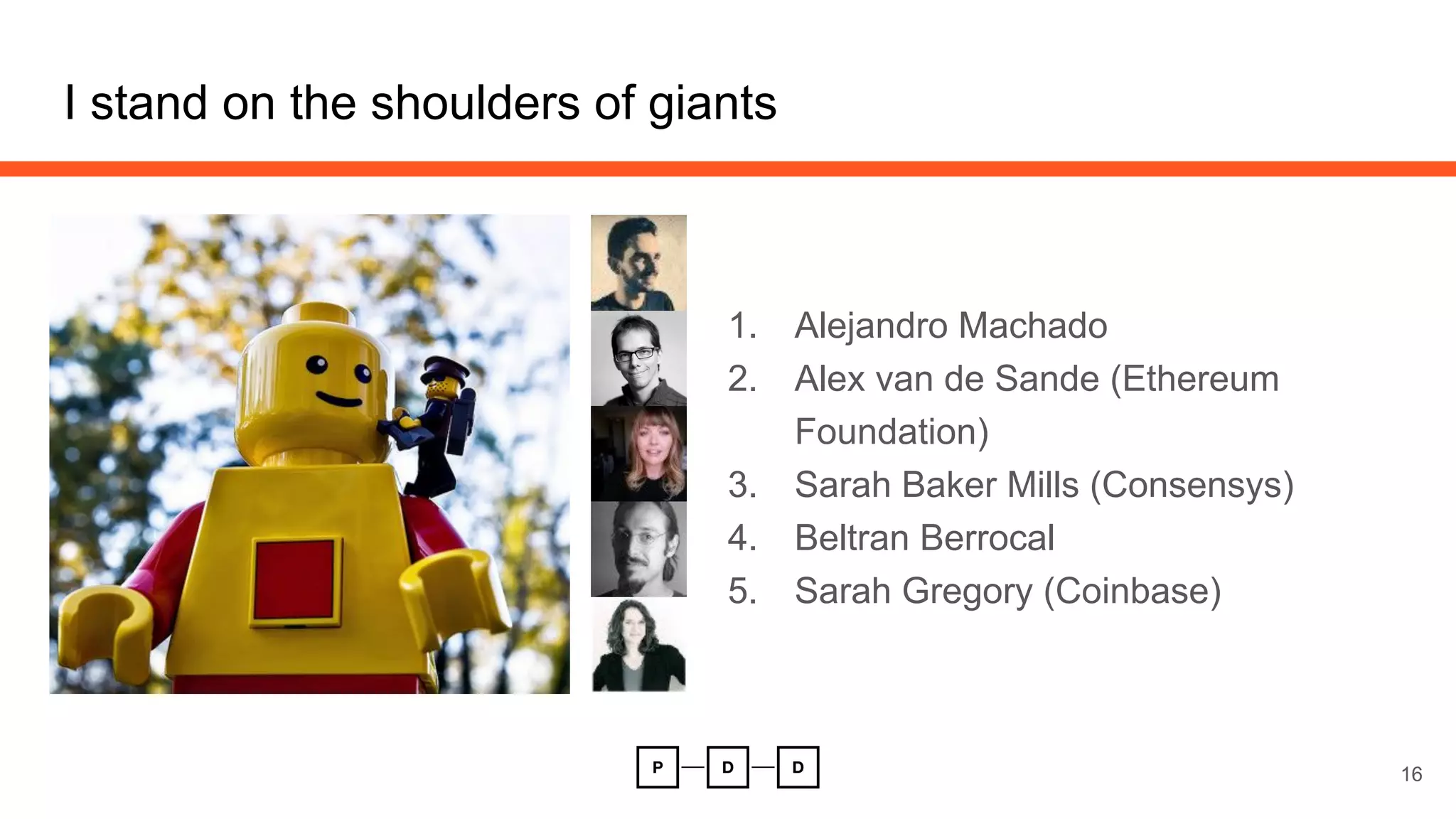
I stand on the shoulders of giants
16
1. Alejandro Machado
2. Alex van de Sande (Ethereum
Foundation)
3. Sarah Baker Mills (Consensys)
4. Beltran Berrocal
5. Sarah Gregory (Coinbase)
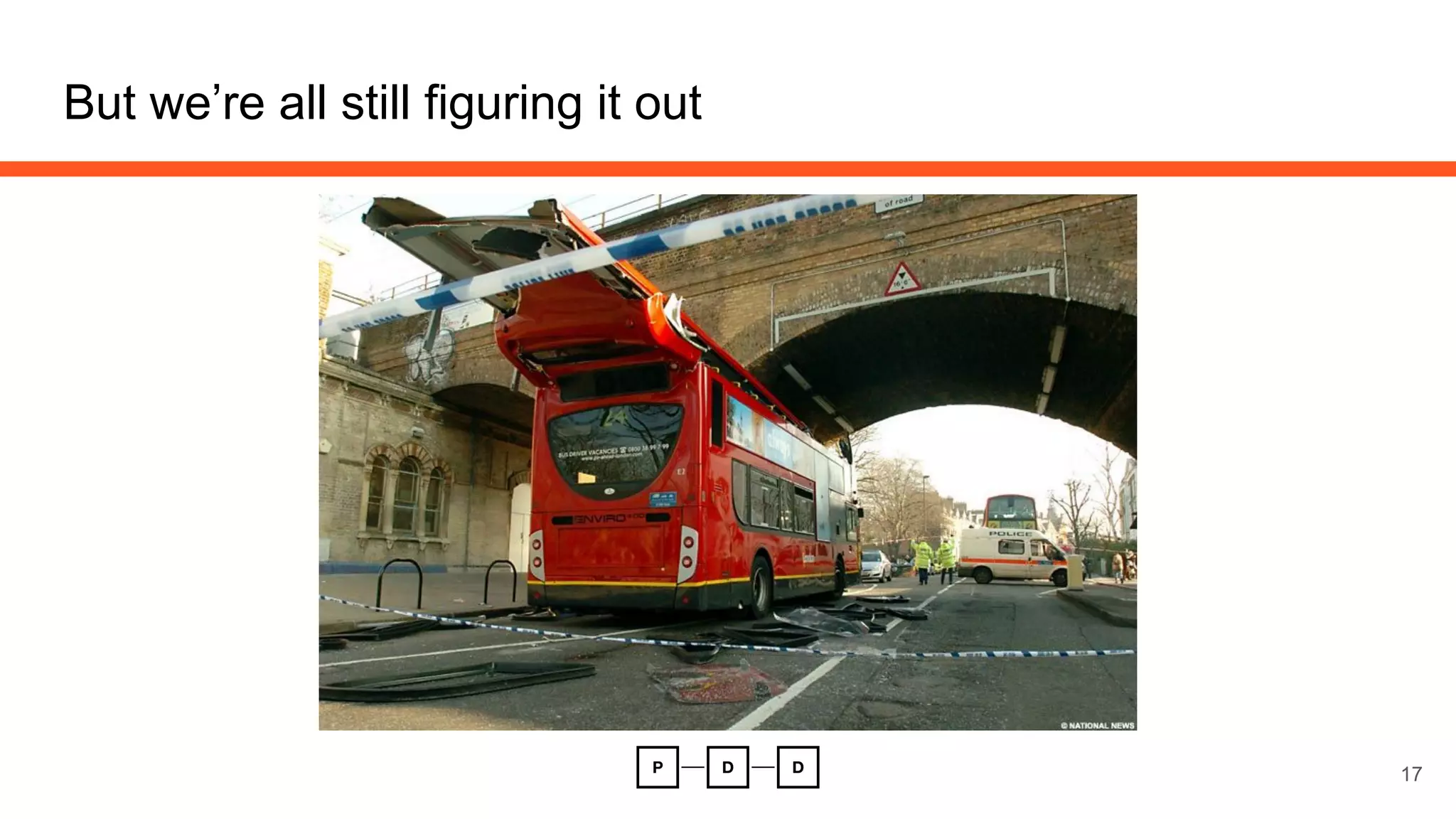
But we’re all still figuring it out
17
Blockchain Product Design and Development
About Me
I’m Erik Trautman and I run operations at NEAR Protocol, a
scalable, developer-friendly blockchain on a mission to bring the
technology to a billion devices around the world.
I also care deeply about creating great products, educating people
and building rich ecosystems.
My background is in markets, open-source software development,
startup leadership and education. And general nerdery.
Learn more about NEAR at http://www.nearprotocol.com
18
Blockchain Product Design and Development
Roadmap
19
1. The Space We Operate Within
2. General Principles of Design
3. Designing on Blockchain
4. Designing for Trust
5. Conclusion
Blockchain Product Design and Development
Roadmap
20
1. The Space We Operate Within
2. General Principles of Design
3. Designing on Blockchain
4. Designing for Trust
5. Conclusion
Blockchain Product Design and Development
What is a “regular” app?
21
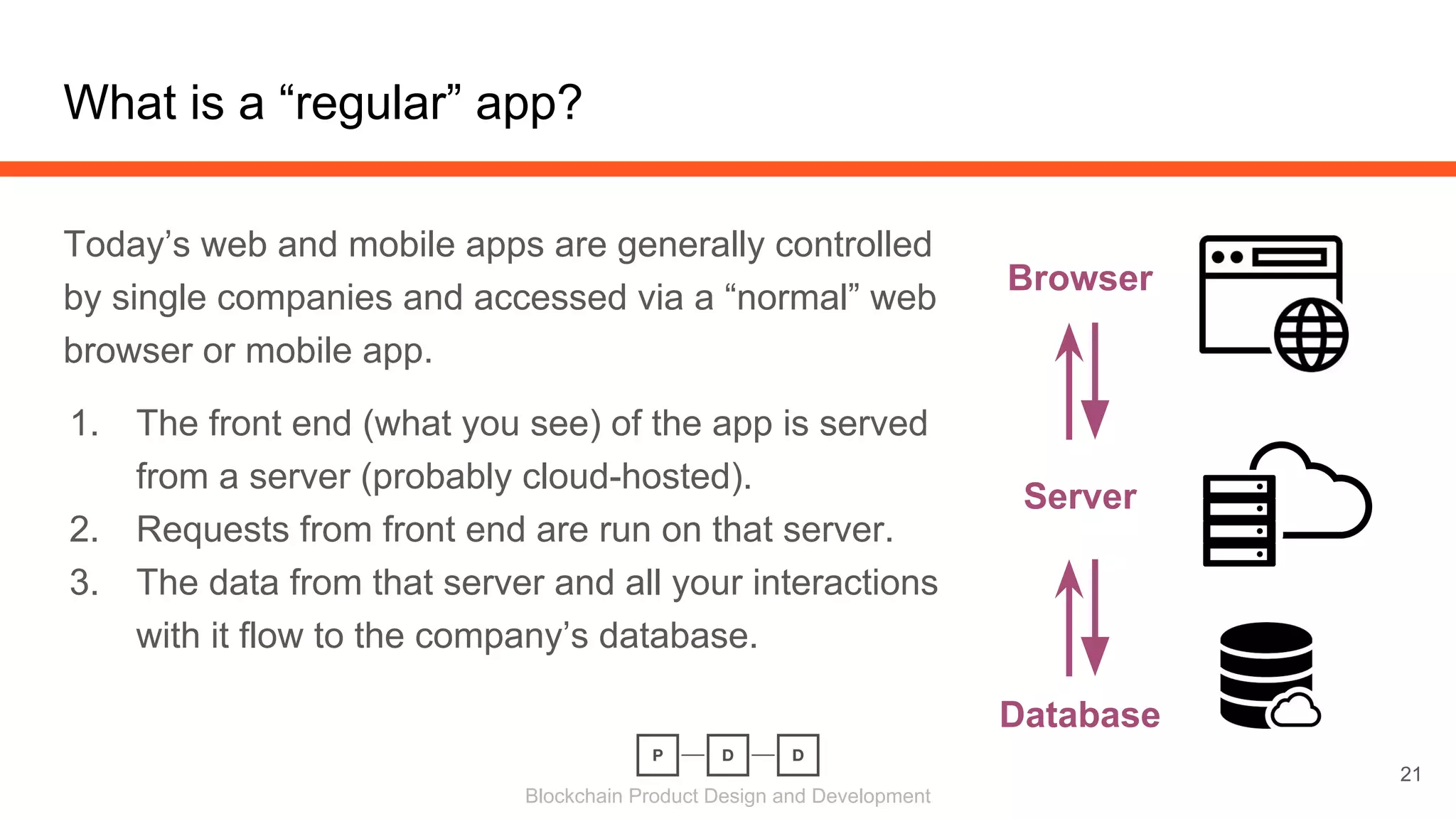
Today’s web and mobile apps are generally controlled
by single companies and accessed via a “normal” web
browser or mobile app.
1. The front end (what you see) of the app is served
from a server (probably cloud-hosted).
2. Requests from front end are run on that server.
3. The data from that server and all your interactions
with it flow to the company’s database.
Browser
Server
Database
Blockchain Product Design and Development
What is a “decentralized” app?
22
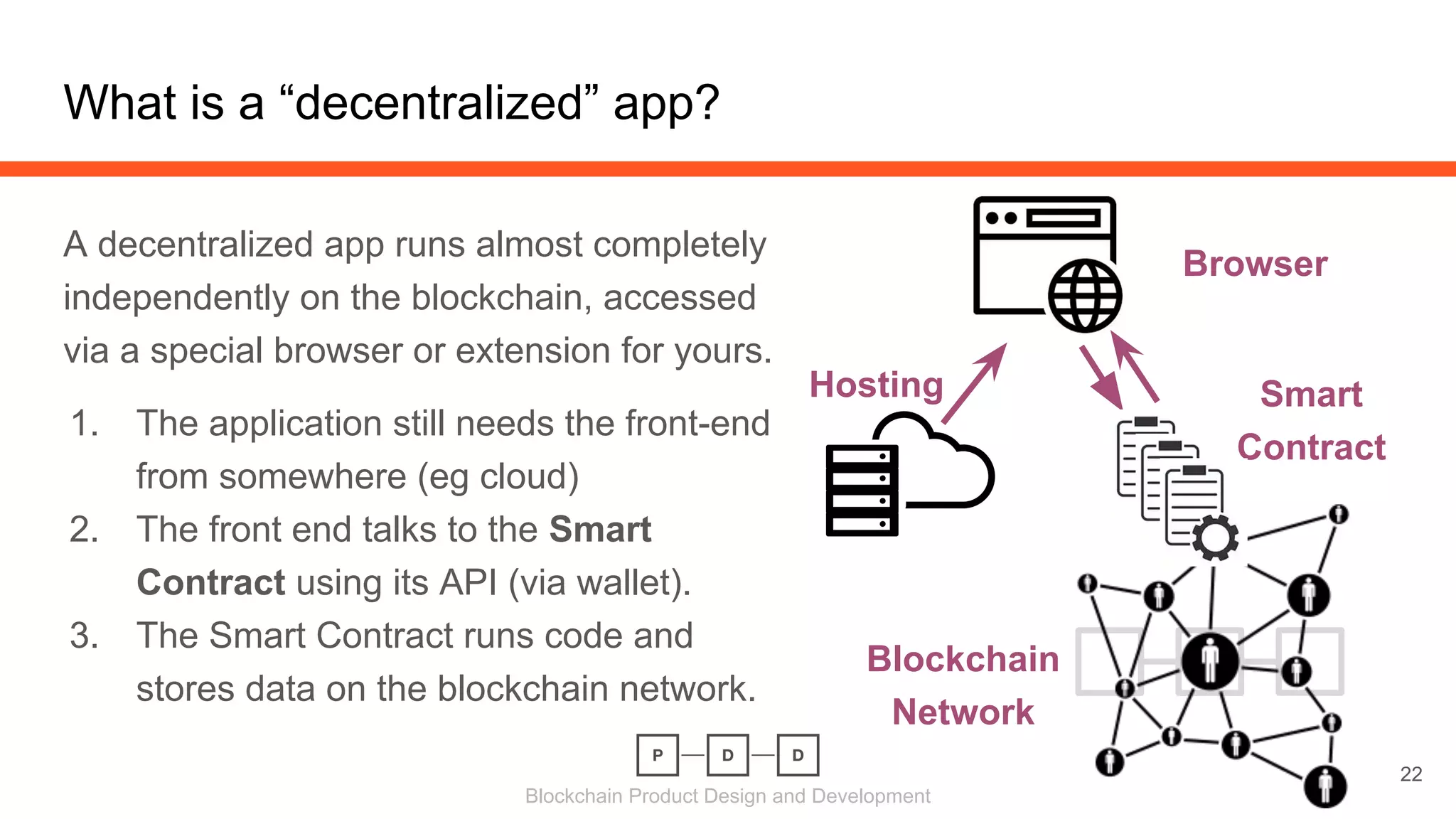
A decentralized app runs almost completely
independently on the blockchain, accessed
via a special browser or extension for yours.
1. The application still needs the front-end
from somewhere (eg cloud)
2. The front end talks to the Smart
Contract using its API (via wallet).
3. The Smart Contract runs code and
stores data on the blockchain network.
Browser
Hosting
Blockchain
Network
Smart
Contract
Blockchain Product Design and Development
Centralized
+ Facebook
+ Google
+ Uber
+ Amazon
+ Etc...
Decentralization is a spectrum
...and most “decentralized” apps aren’t fully decentralized anyway [Infura!]
23
Decentralized
+ Augur
+ CryptoKitties
+ FOMO
+ Dexes
+ Etc...
Blockchain Product Design and Development
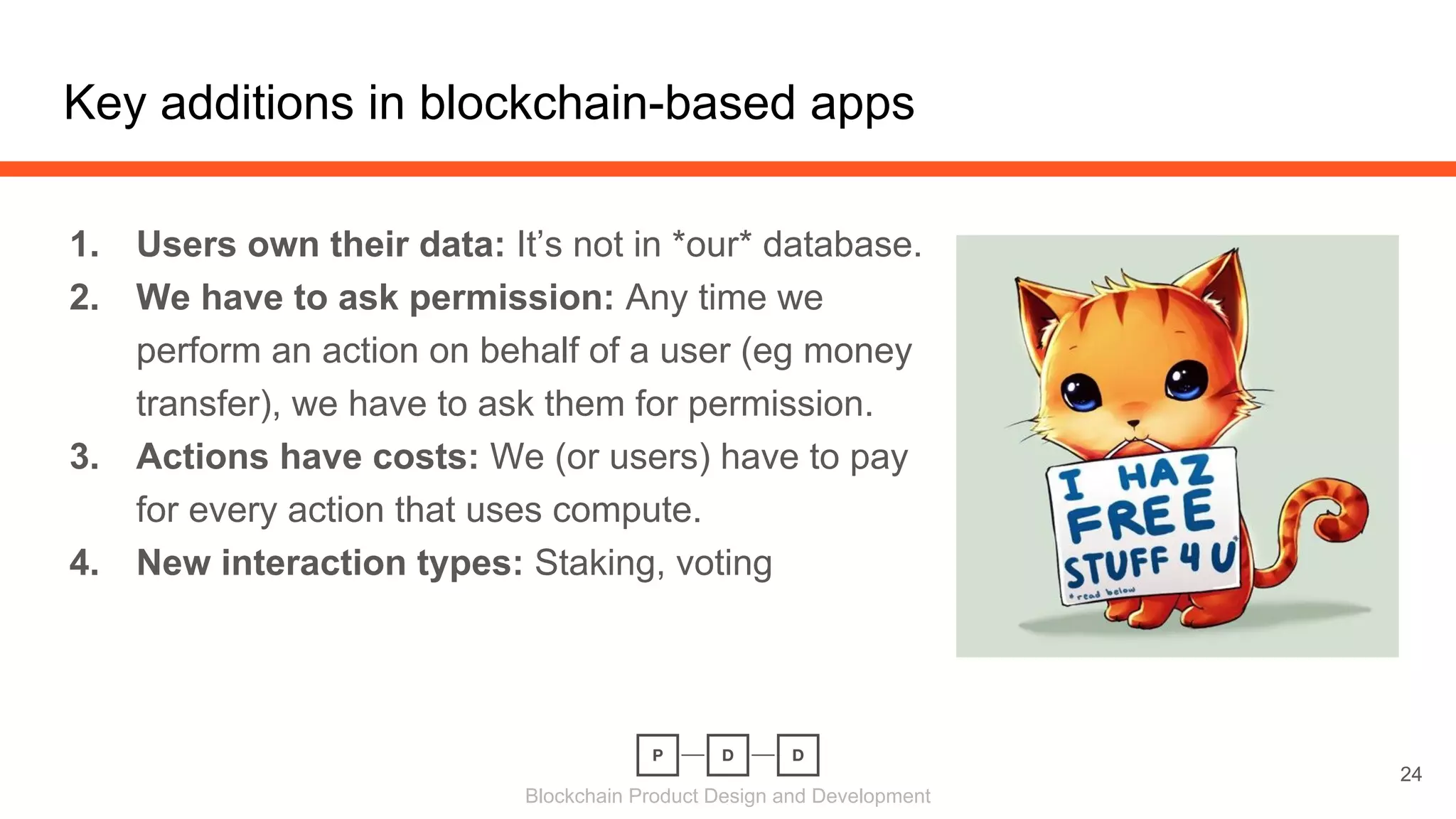
1. Users own their data: It’s not in *our* database.
2. We have to ask permission: Any time we
perform an action on behalf of a user (eg money
transfer), we have to ask them for permission.
3. Actions have costs: We (or users) have to pay
for every action that uses compute.
4. New interaction types: Staking, voting
Key additions in blockchain-based apps
24
Blockchain Product Design and Development
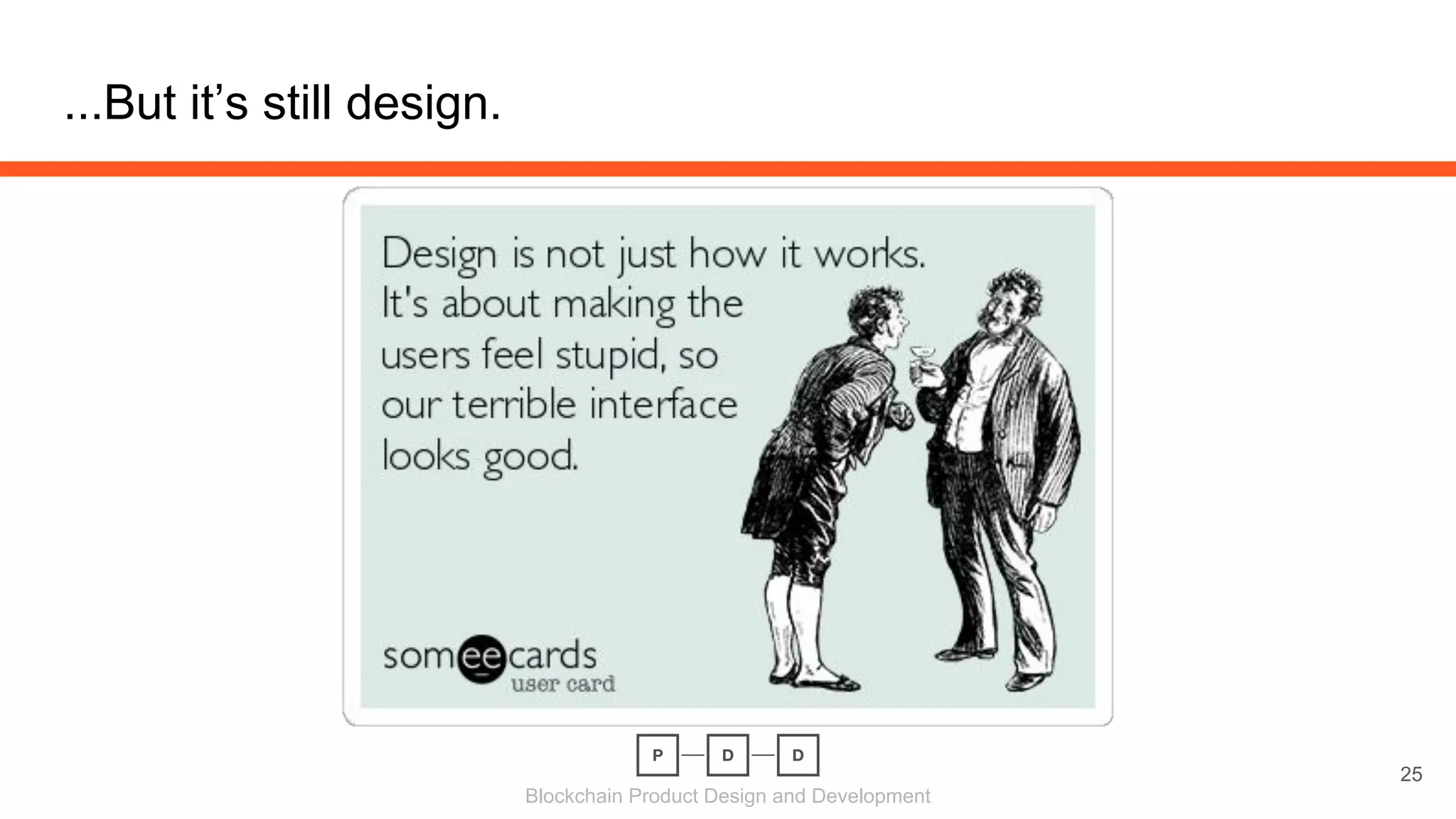
...But it’s still design.
25
Blockchain Product Design and Development
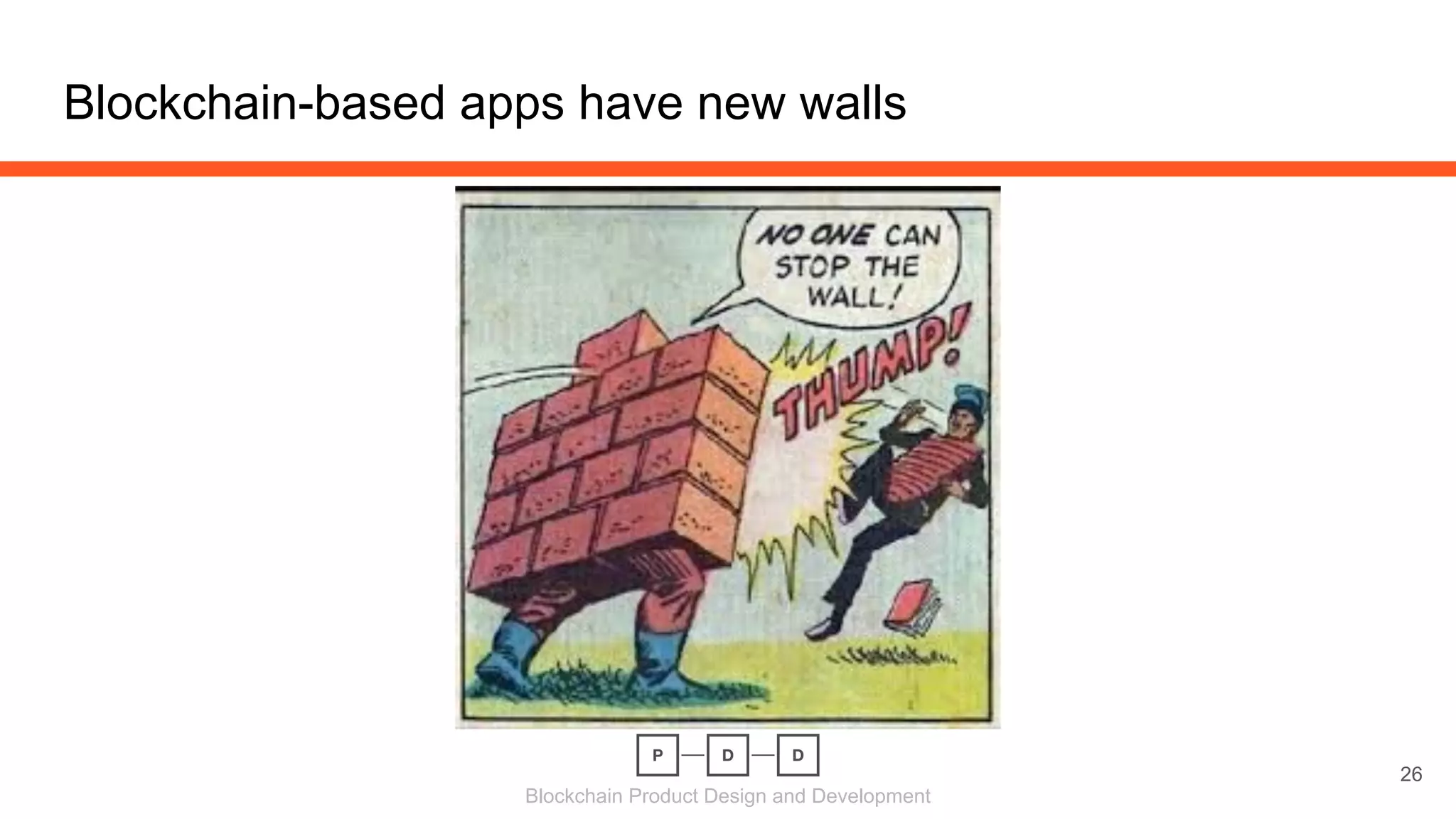
Blockchain-based apps have new walls
26
Blockchain Product Design and Development
Wall 1: Knowledge
Problem 1: Too much education
about blockchain.
Problem 2: Too little education
about blockchain.
It’s a tricky middle ground.
27
Blockchain Product Design and Development
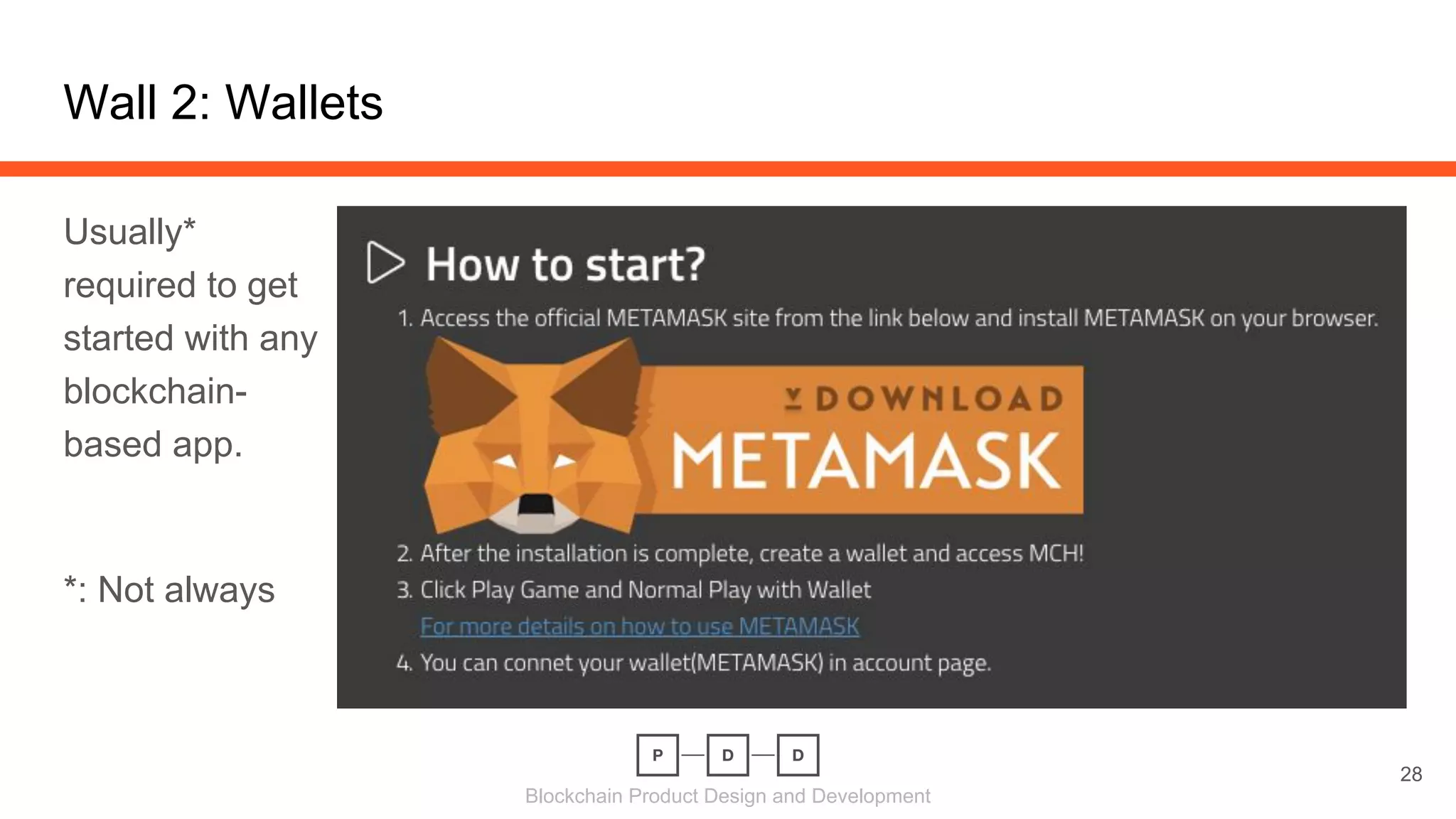
Wall 2: Wallets
Usually*
required to get
started with any
blockchain-
based app.
*: Not always
28
Blockchain Product Design and Development
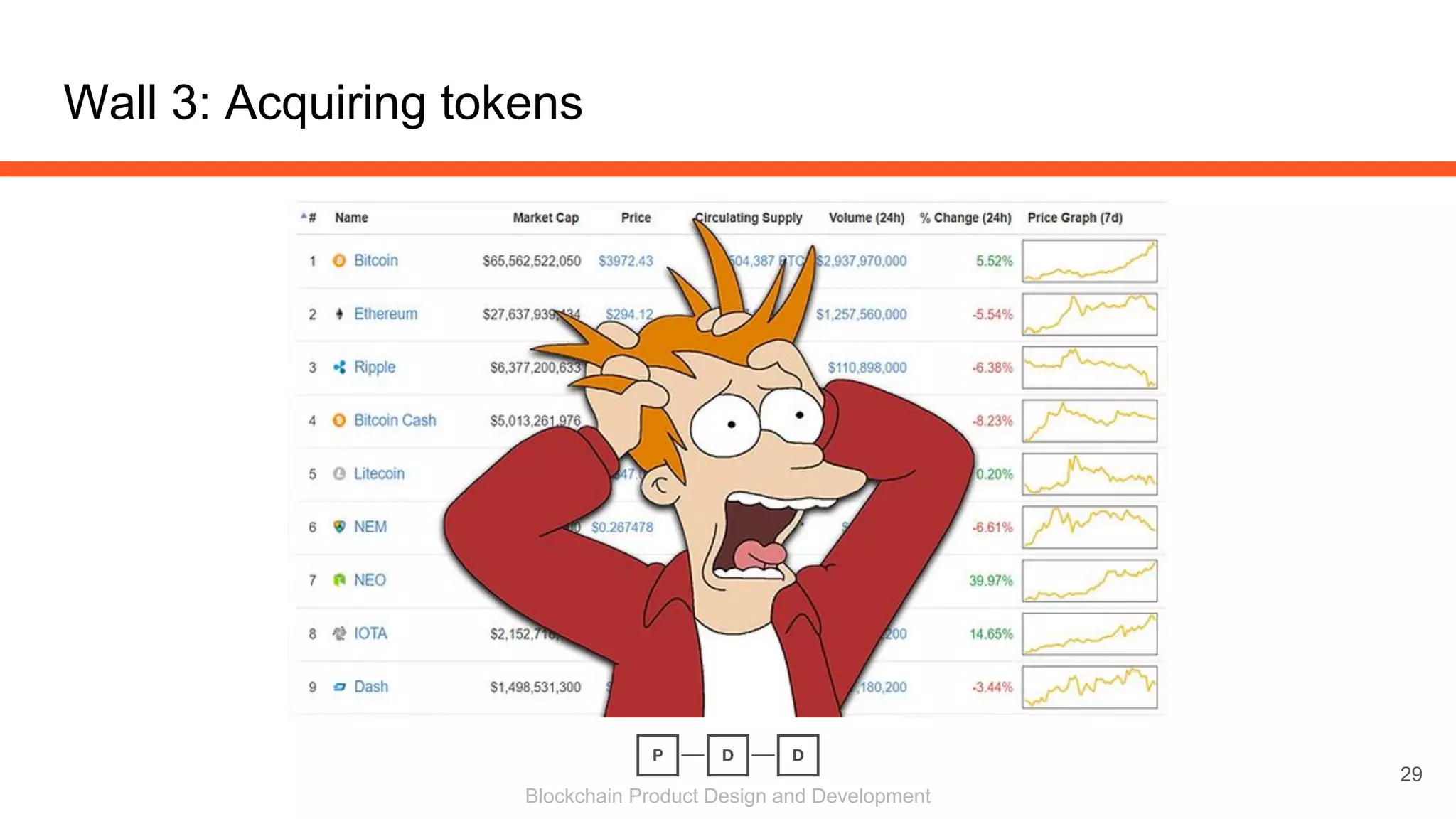
Wall 3: Acquiring tokens
29
Blockchain Product Design and Development
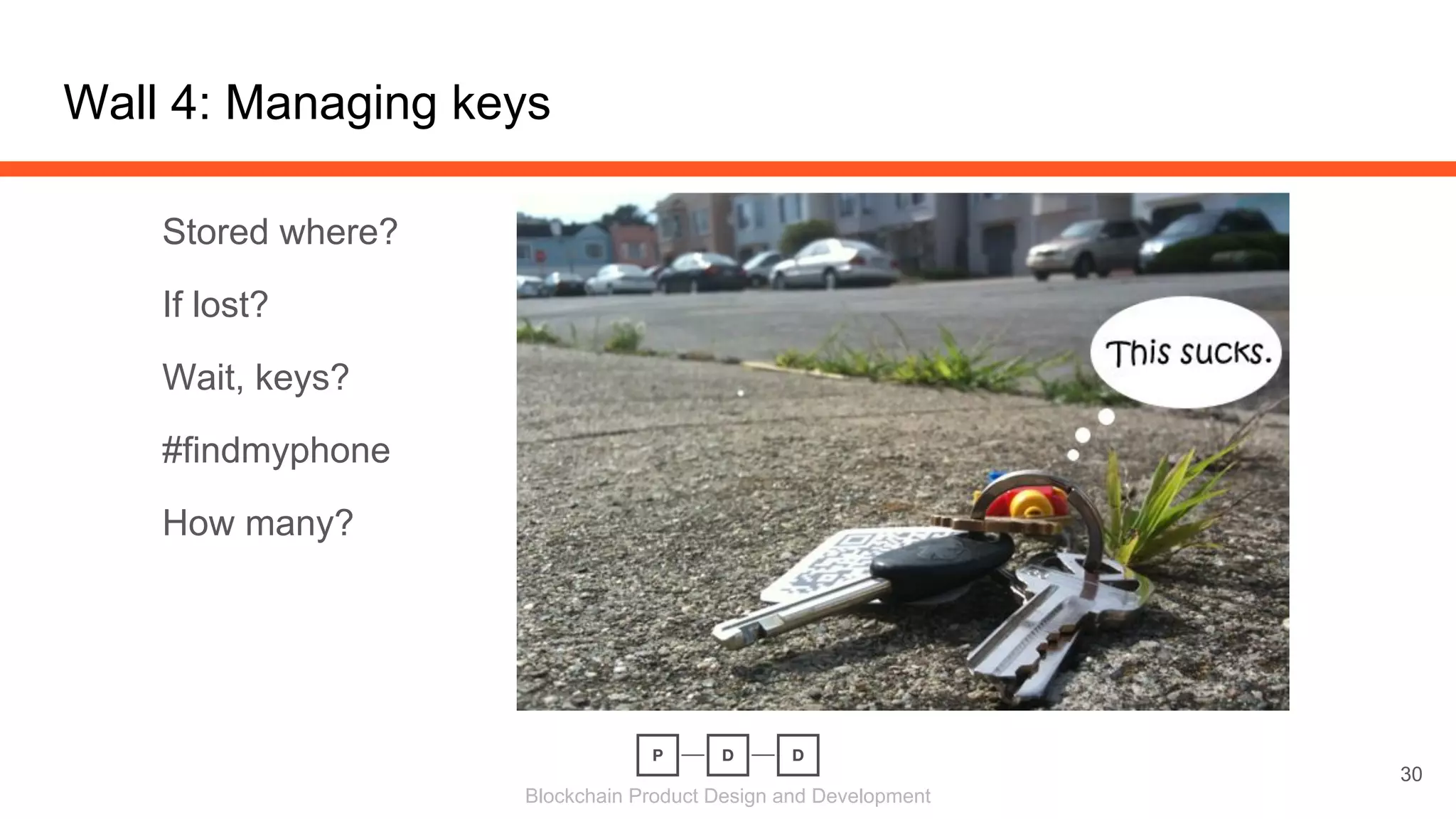
Wall 4: Managing keys
30
Stored where?
If lost?
Wait, keys?
#findmyphone
How many?
Blockchain Product Design and Development
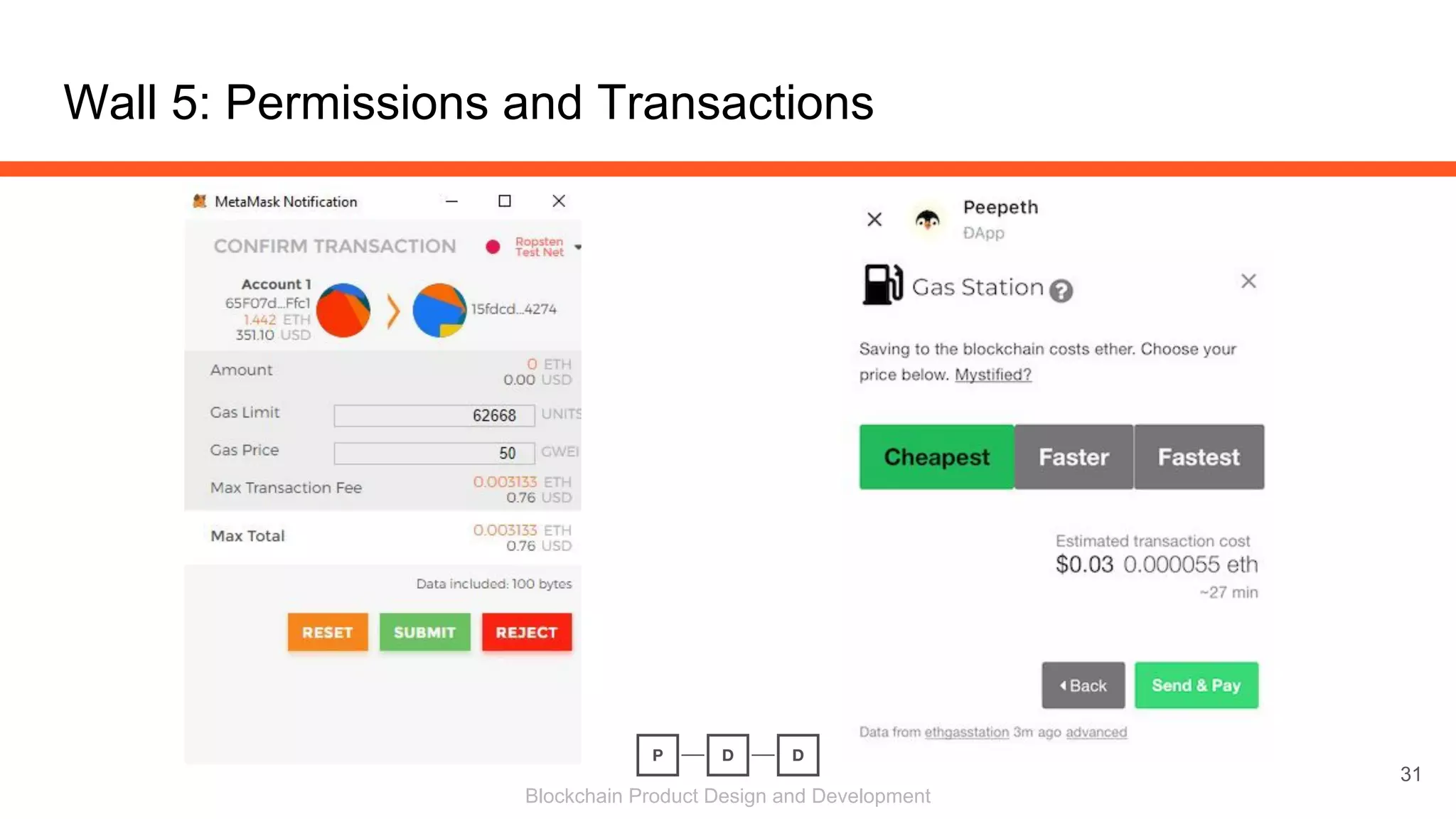
Wall 5: Permissions and Transactions
31
Blockchain Product Design and Development
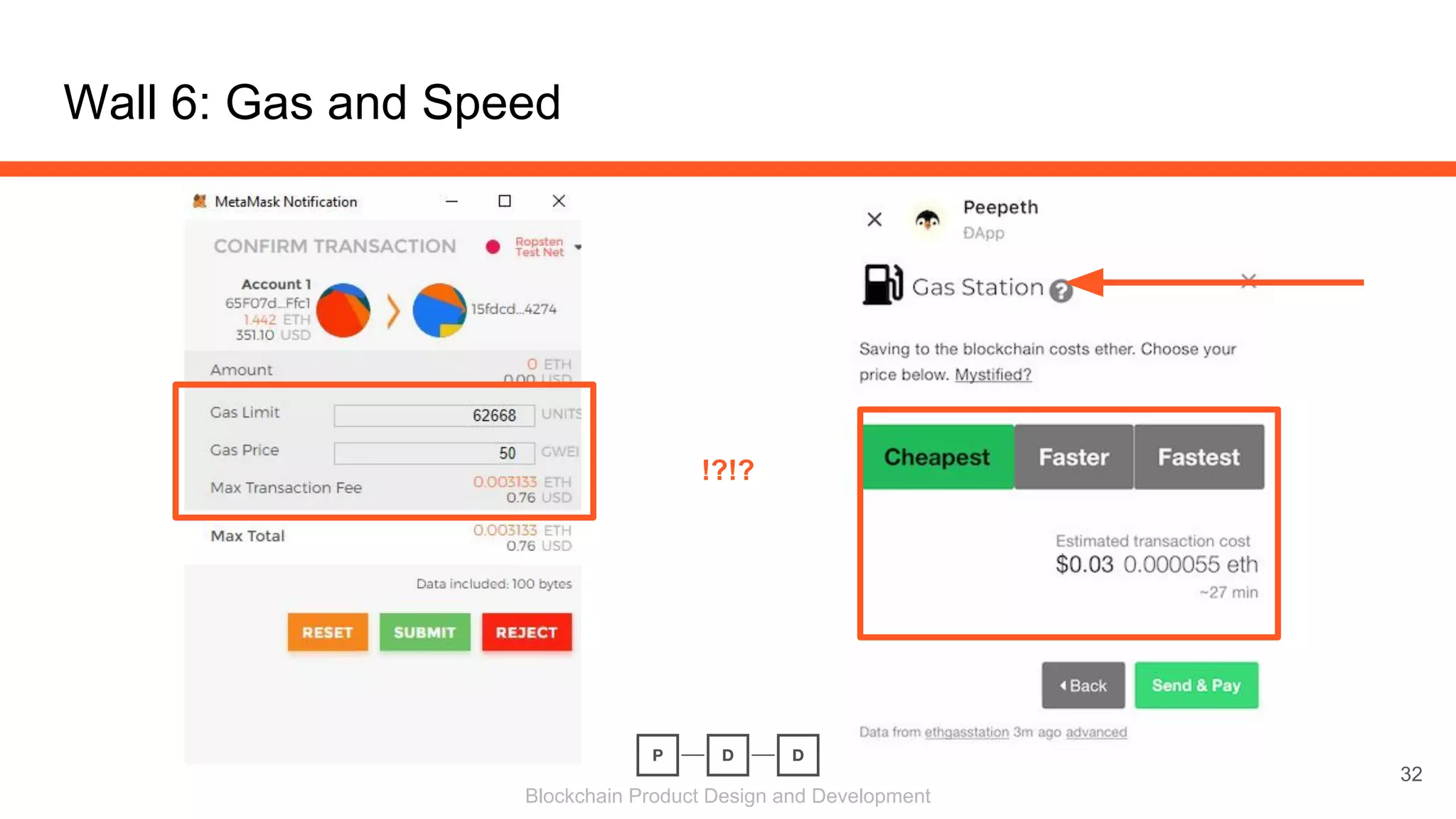
Wall 6: Gas and Speed
32
!?!?
Blockchain Product Design and Development
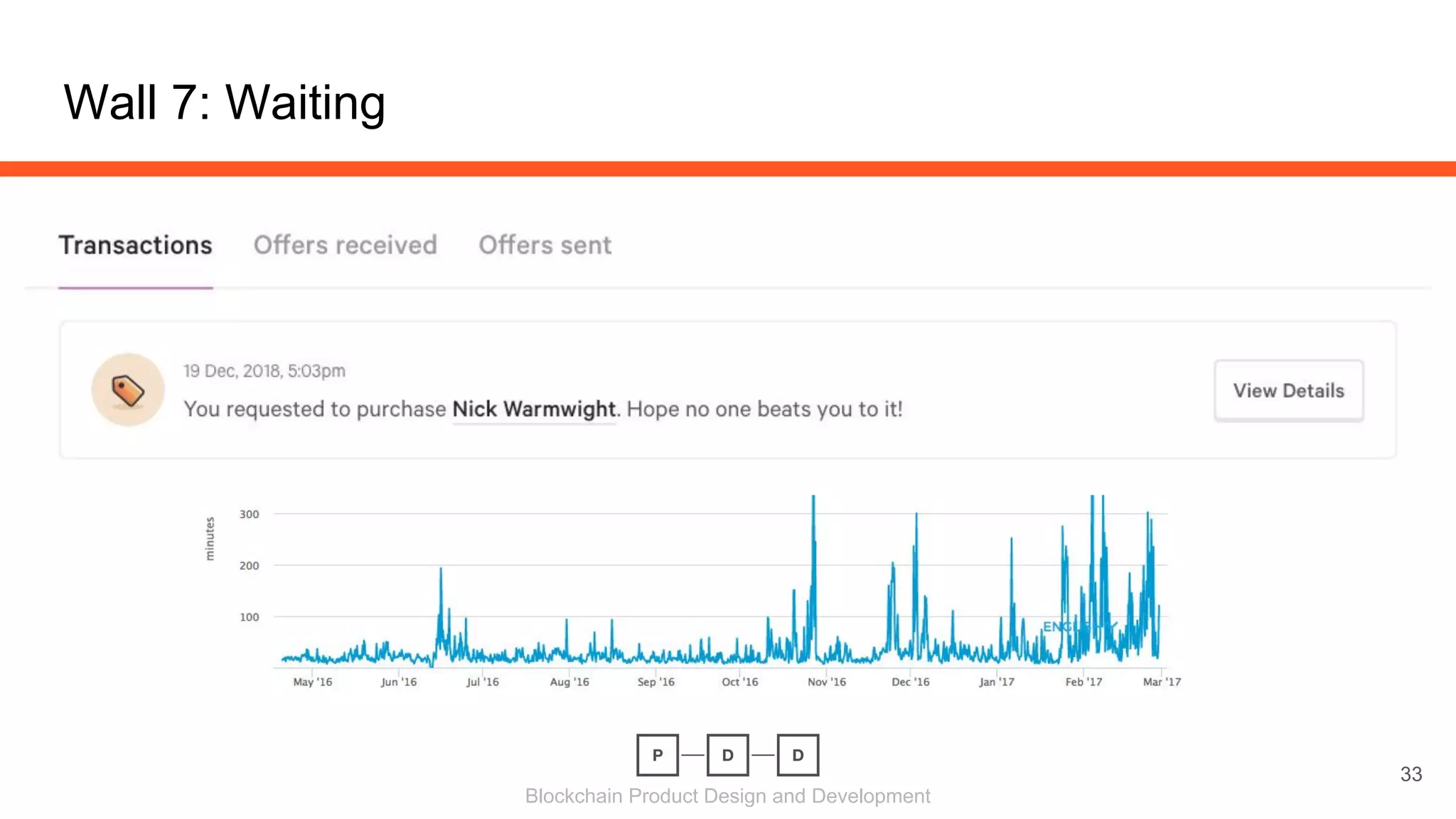
Wall 7: Waiting
33
Blockchain Product Design and Development
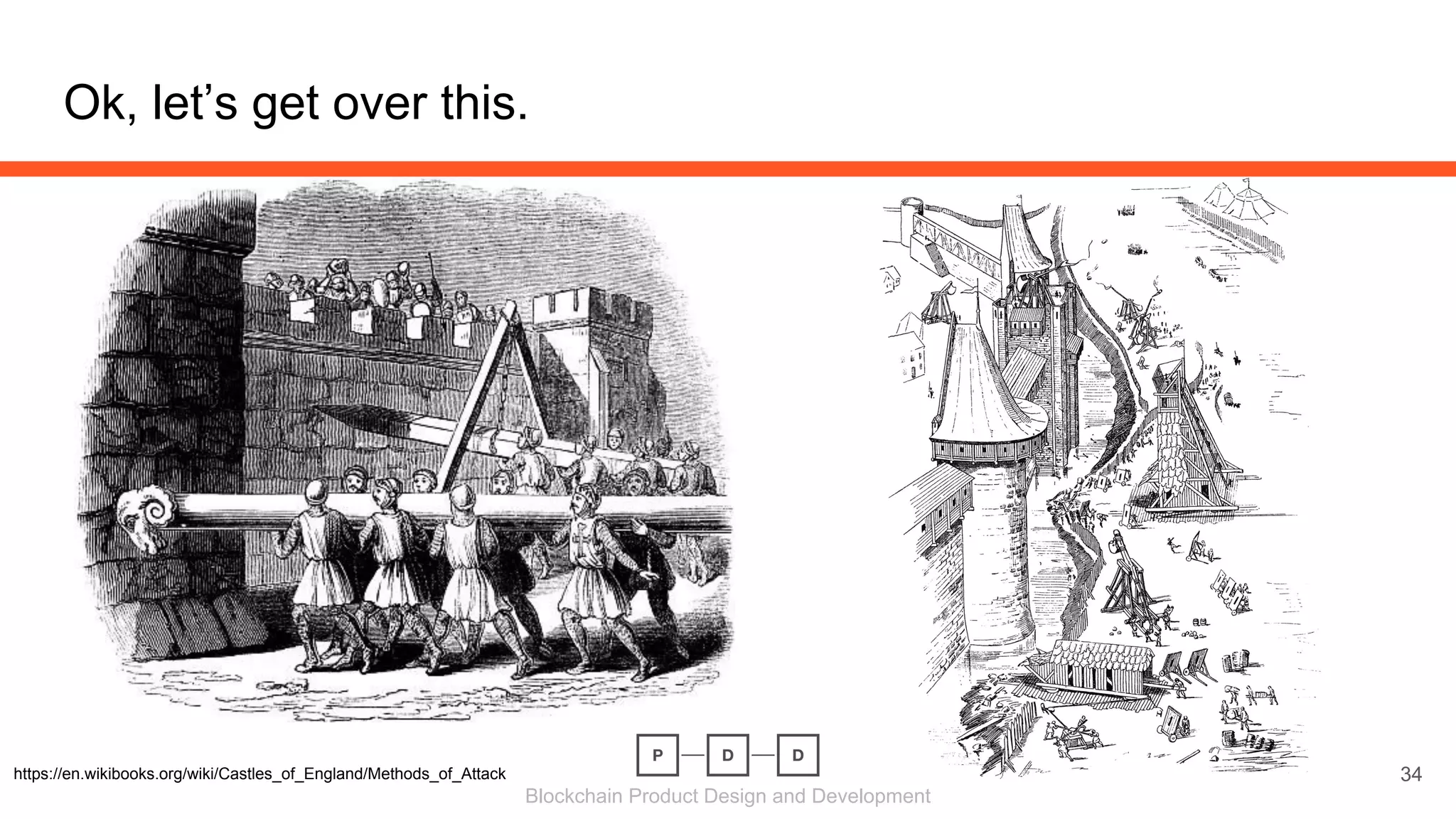
Ok, let’s get over this.
34https://en.wikibooks.org/wiki/Castles_of_England/Methods_of_Attack
Blockchain Product Design and Development
Roadmap
35
1. The Space We Operate Within
2. General Principles of Design
3. Designing on Blockchain
4. Designing for Trust
5. Conclusion
Blockchain Product Design and Development
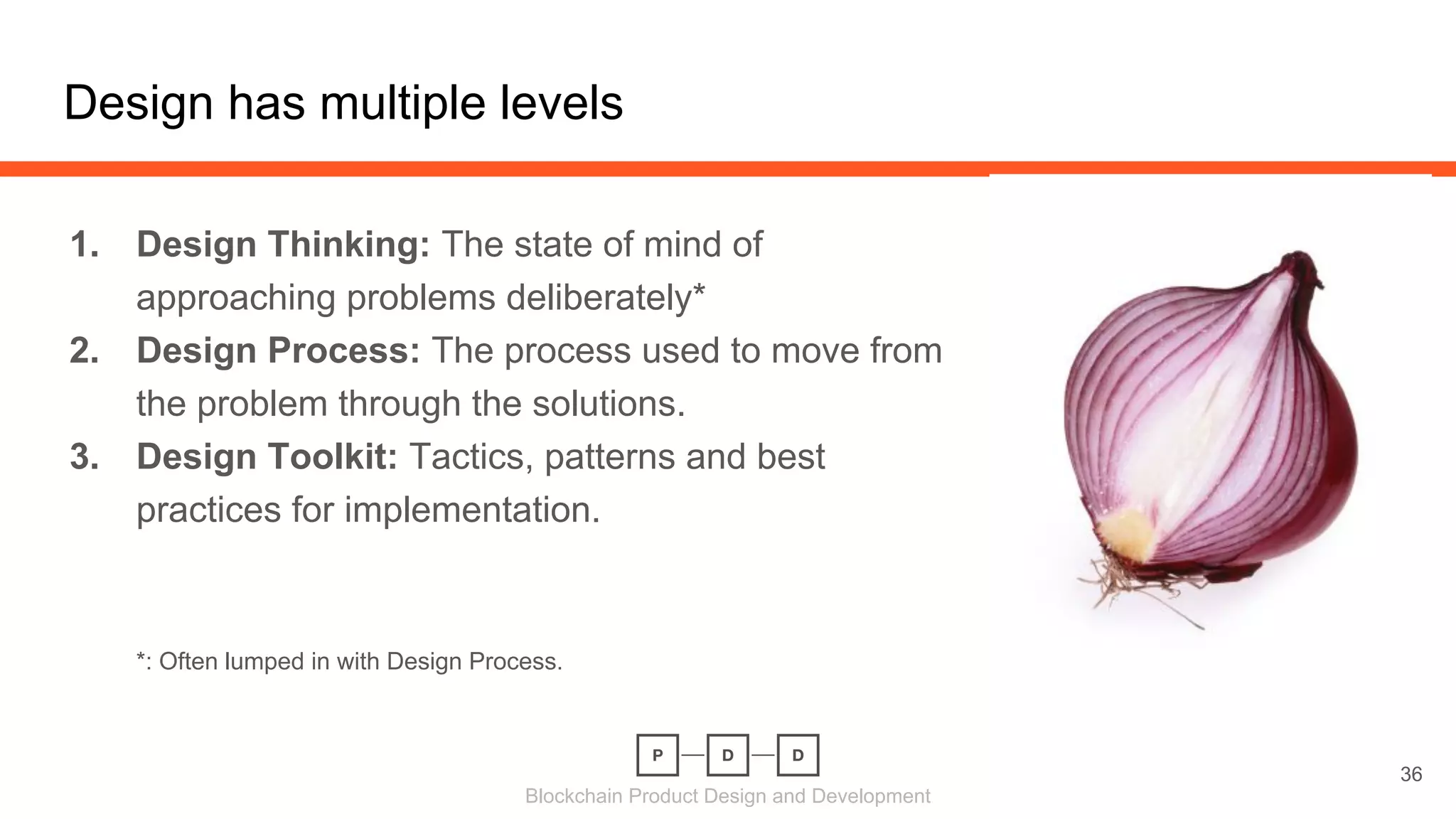
1. Design Thinking: The state of mind of
approaching problems deliberately*
2. Design Process: The process used to move from
the problem through the solutions.
3. Design Toolkit: Tactics, patterns and best
practices for implementation.
*: Often lumped in with Design Process.
Design has multiple levels
36
Blockchain Product Design and Development
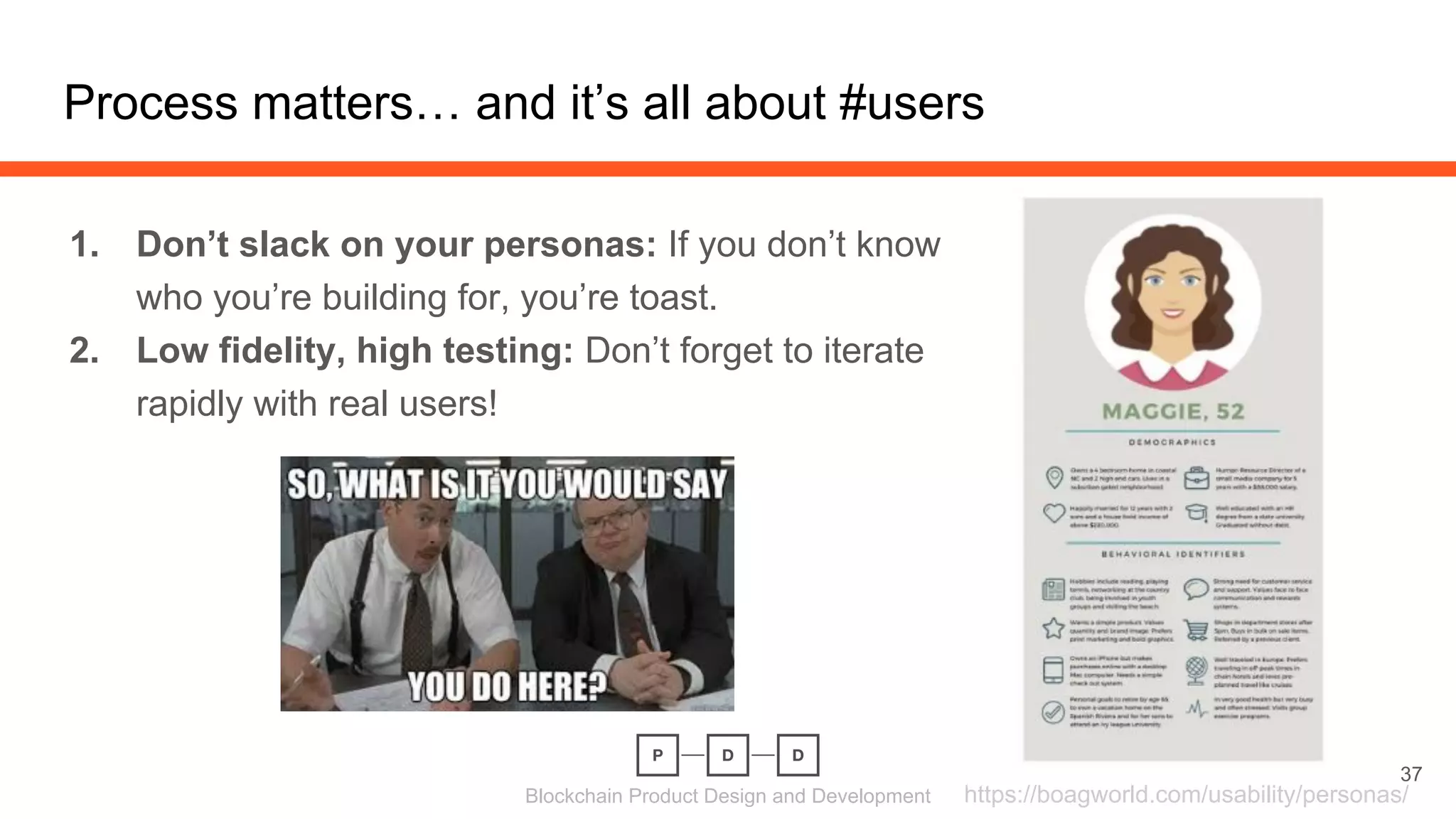
1. Don’t slack on your personas: If you don’t know
who you’re building for, you’re toast.
2. Low fidelity, high testing: Don’t forget to iterate
rapidly with real users!
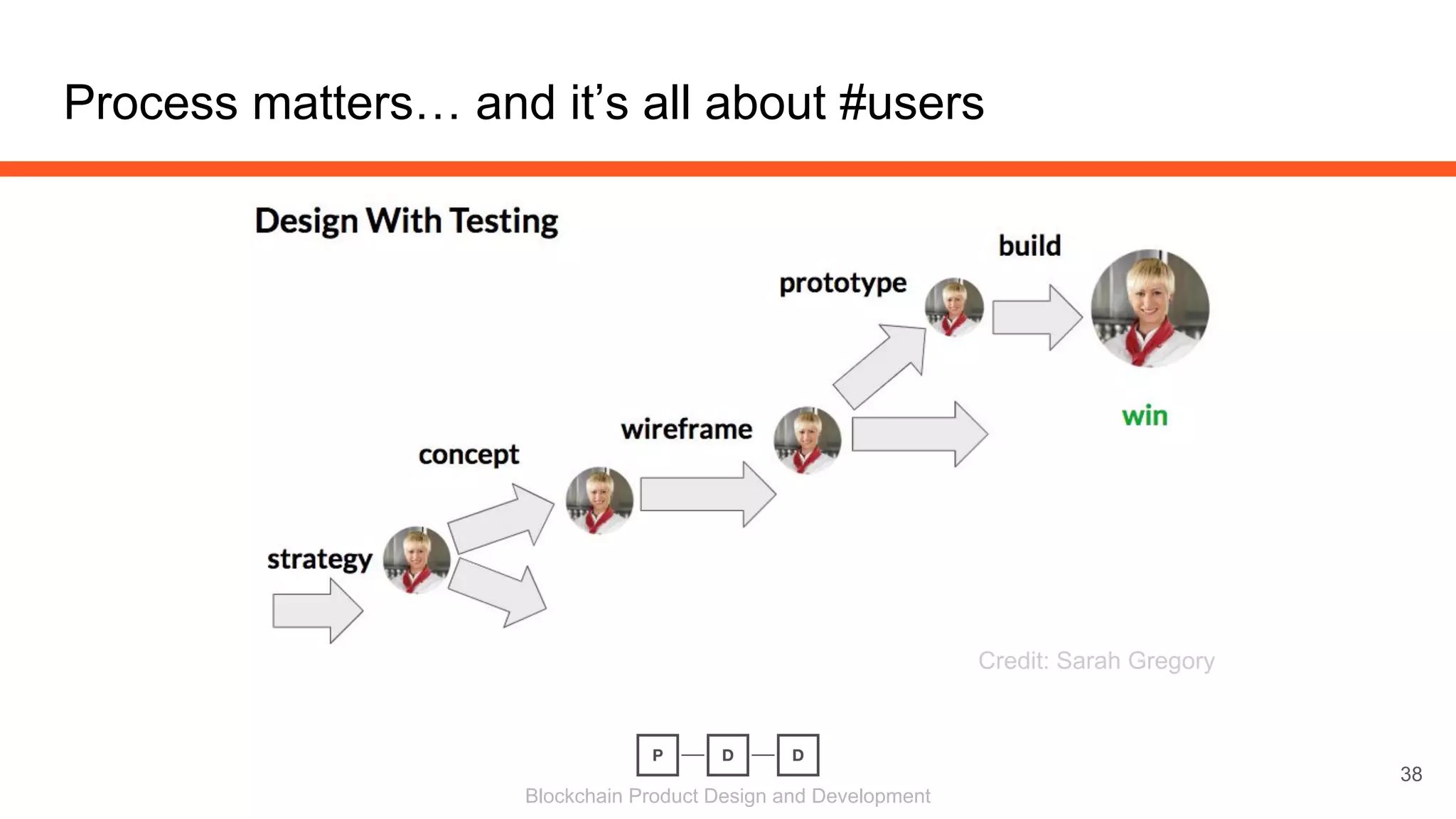
Process matters… and it’s all about #users
37
https://boagworld.com/usability/personas/
Blockchain Product Design and Development
Process matters… and it’s all about #users
38
Credit: Sarah Gregory
Blockchain Product Design and Development
● The Noob
● The Hardcore
Cypherpunk
● The Technologist
● …
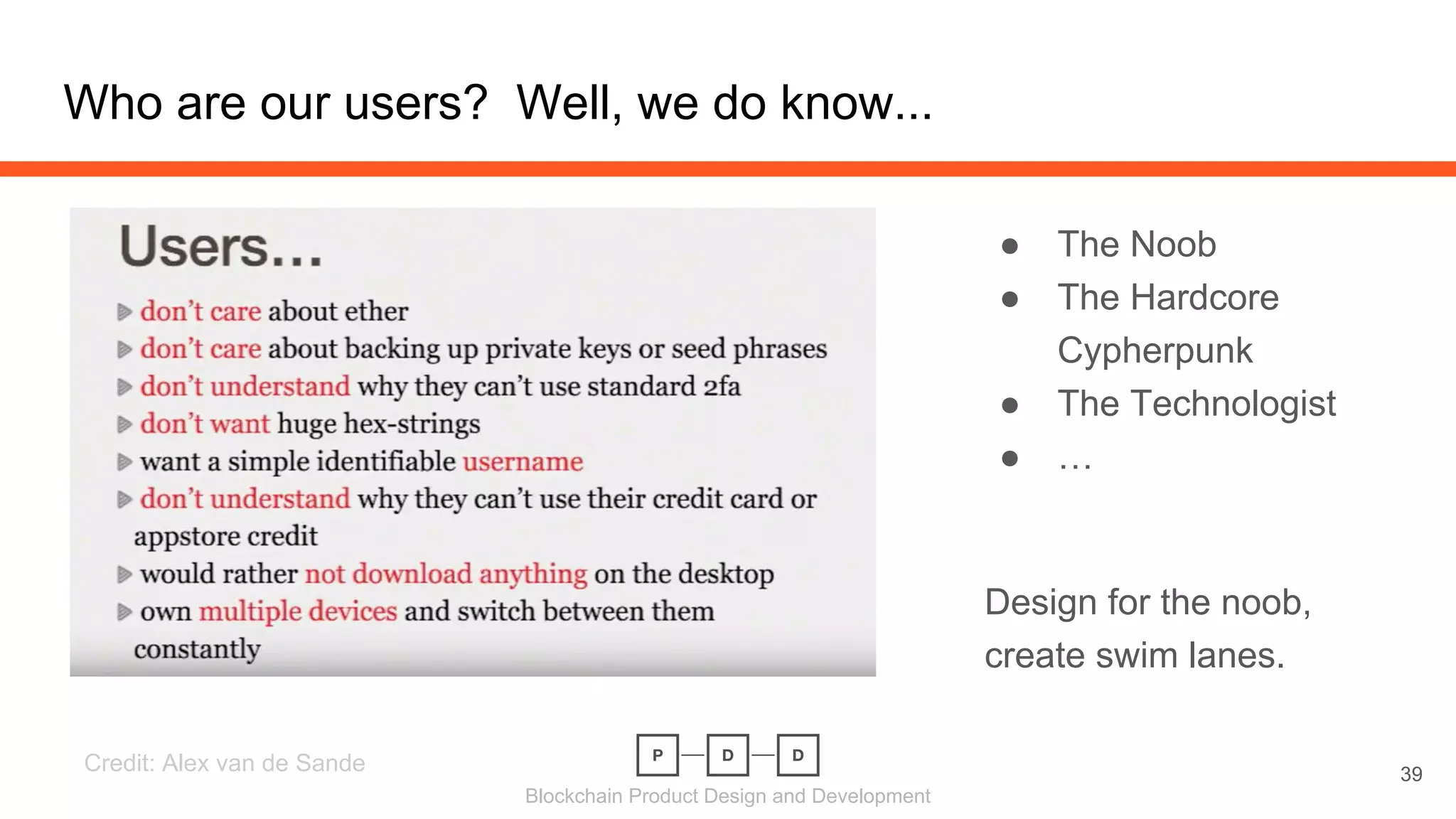
Design for the noob,
create swim lanes.
Who are our users? Well, we do know...
39Credit: Alex van de Sande
Blockchain Product Design and Development
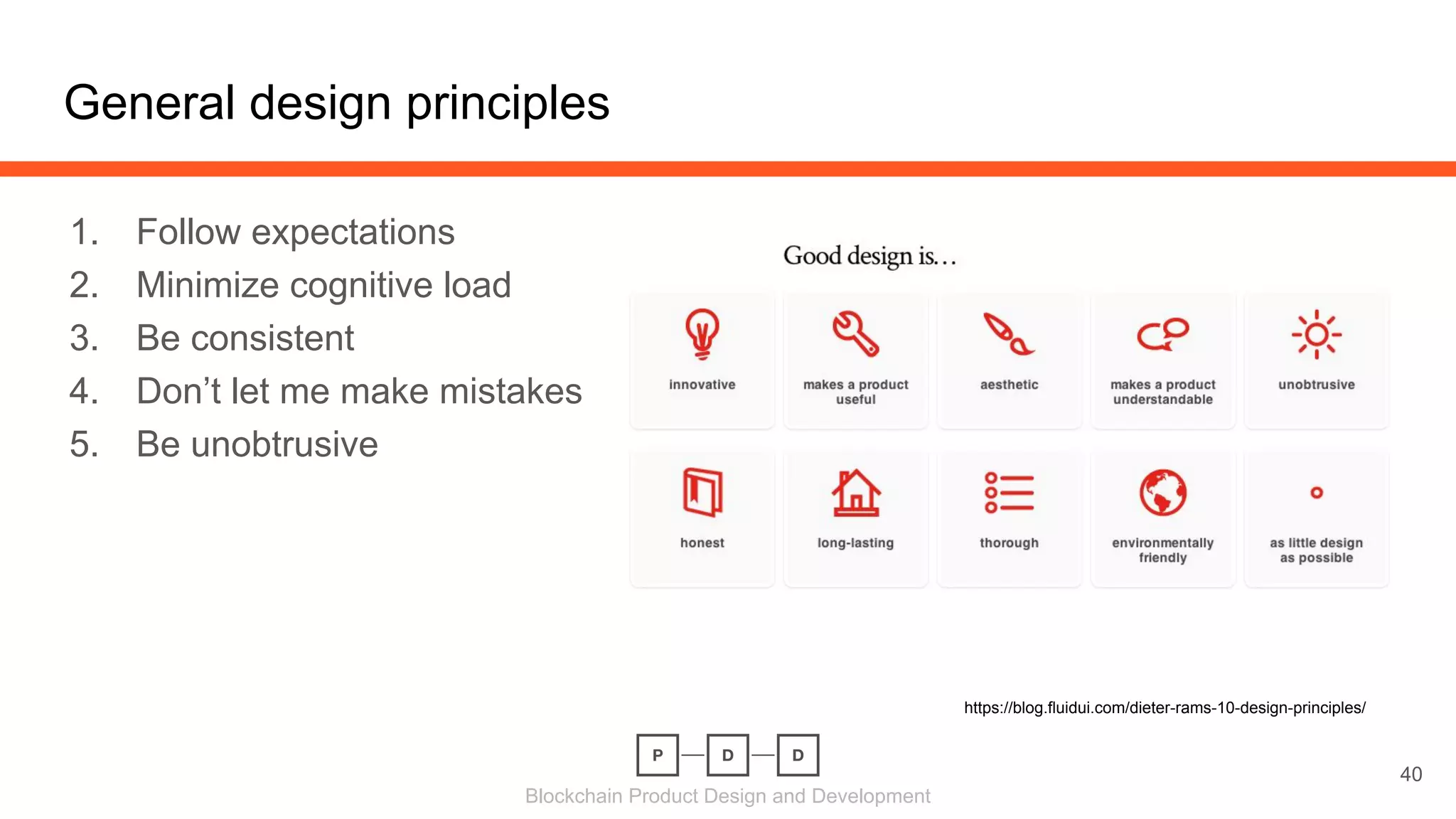
General design principles
40
1. Follow expectations
2. Minimize cognitive load
3. Be consistent
4. Don’t let me make mistakes
5. Be unobtrusive
https://blog.fluidui.com/dieter-rams-10-design-principles/
Blockchain Product Design and Development
Affordances
41
An Affordance in human-computer interaction is
generally considered to be those “action
possibilities” that are readily perceivable by a user.
Extensions:
1. Make sure there is an obvious choice with
intuitive results… and ideally it is the only one.
2. Don’t explain to people what they shouldn’t
do… don’t let them do it in the first place.
We need protection :/
Blockchain Product Design and Development
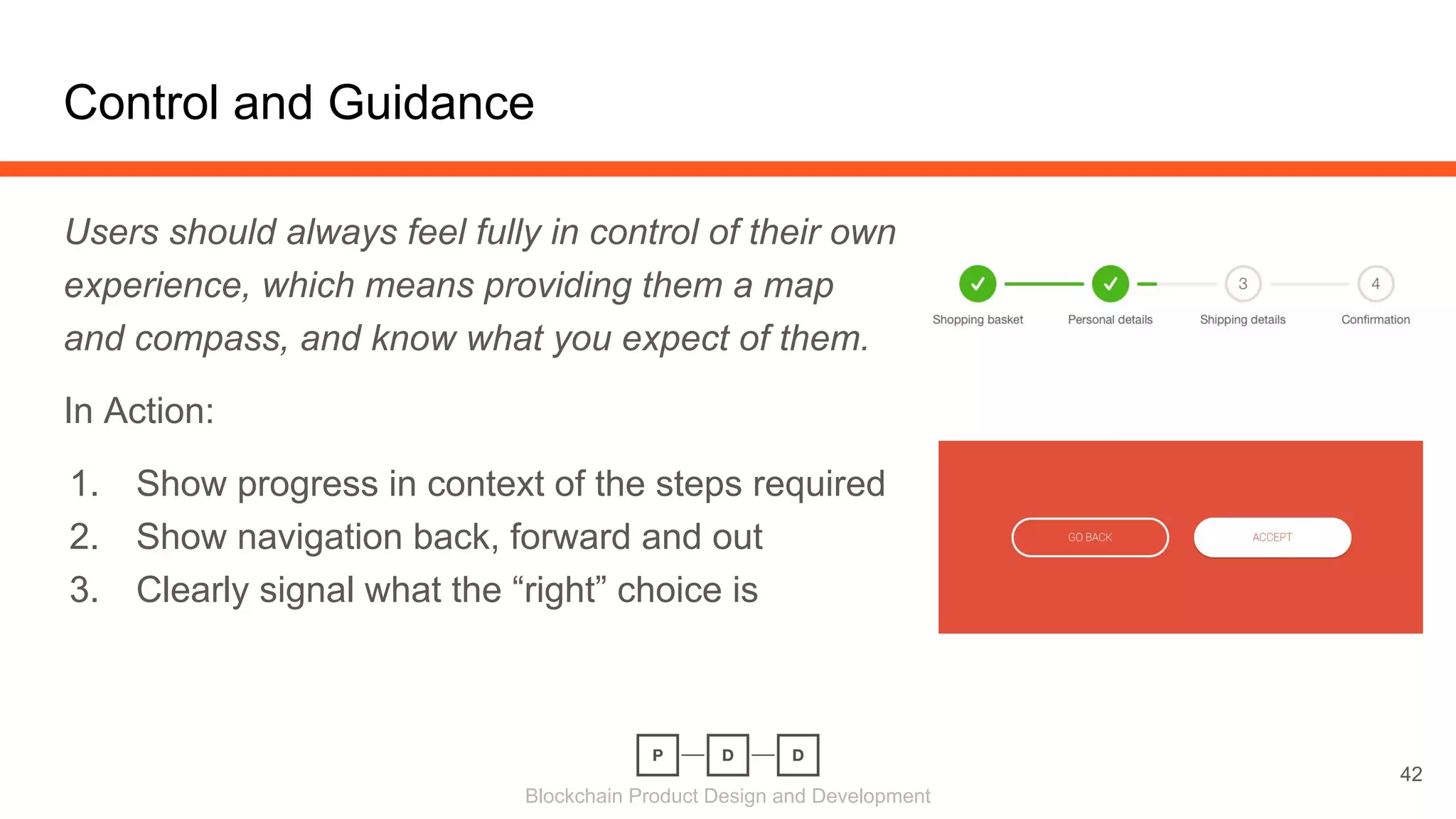
Users should always feel fully in control of their own
experience, which means providing them a map
and compass, and know what you expect of them.
In Action:
1. Show progress in context of the steps required
2. Show navigation back, forward and out
3. Clearly signal what the “right” choice is
Control and Guidance
42
Blockchain Product Design and Development
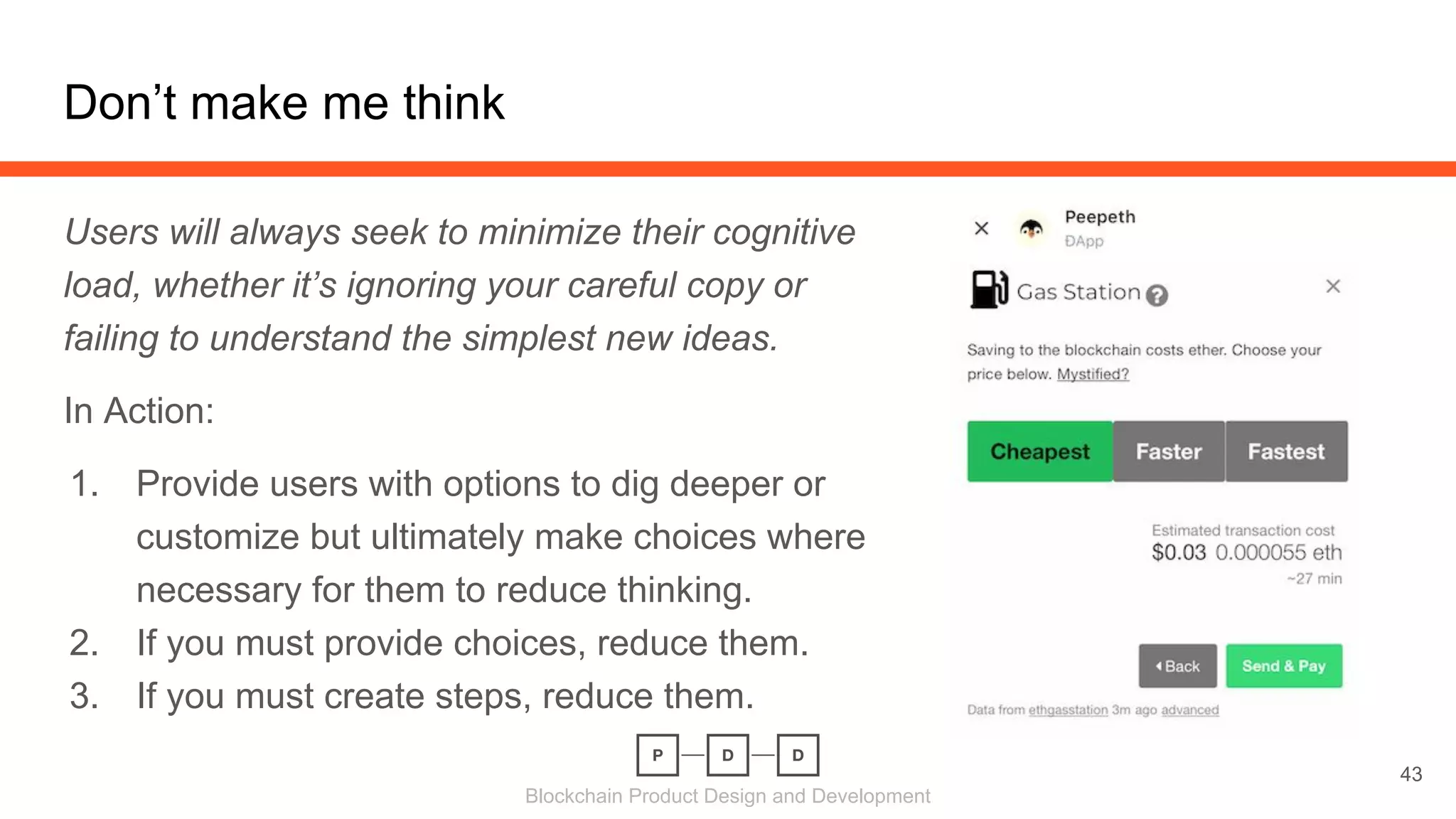
Users will always seek to minimize their cognitive
load, whether it’s ignoring your careful copy or
failing to understand the simplest new ideas.
In Action:
1. Provide users with options to dig deeper or
customize but ultimately make choices where
necessary for them to reduce thinking.
2. If you must provide choices, reduce them.
3. If you must create steps, reduce them.
Don’t make me think
43
Blockchain Product Design and Development
Roadmap
44
1. The Space We Operate Within
2. General Principles of Design
3. Designing on Blockchain
4. Designing for Trust
5. Conclusion
Blockchain Product Design and Development
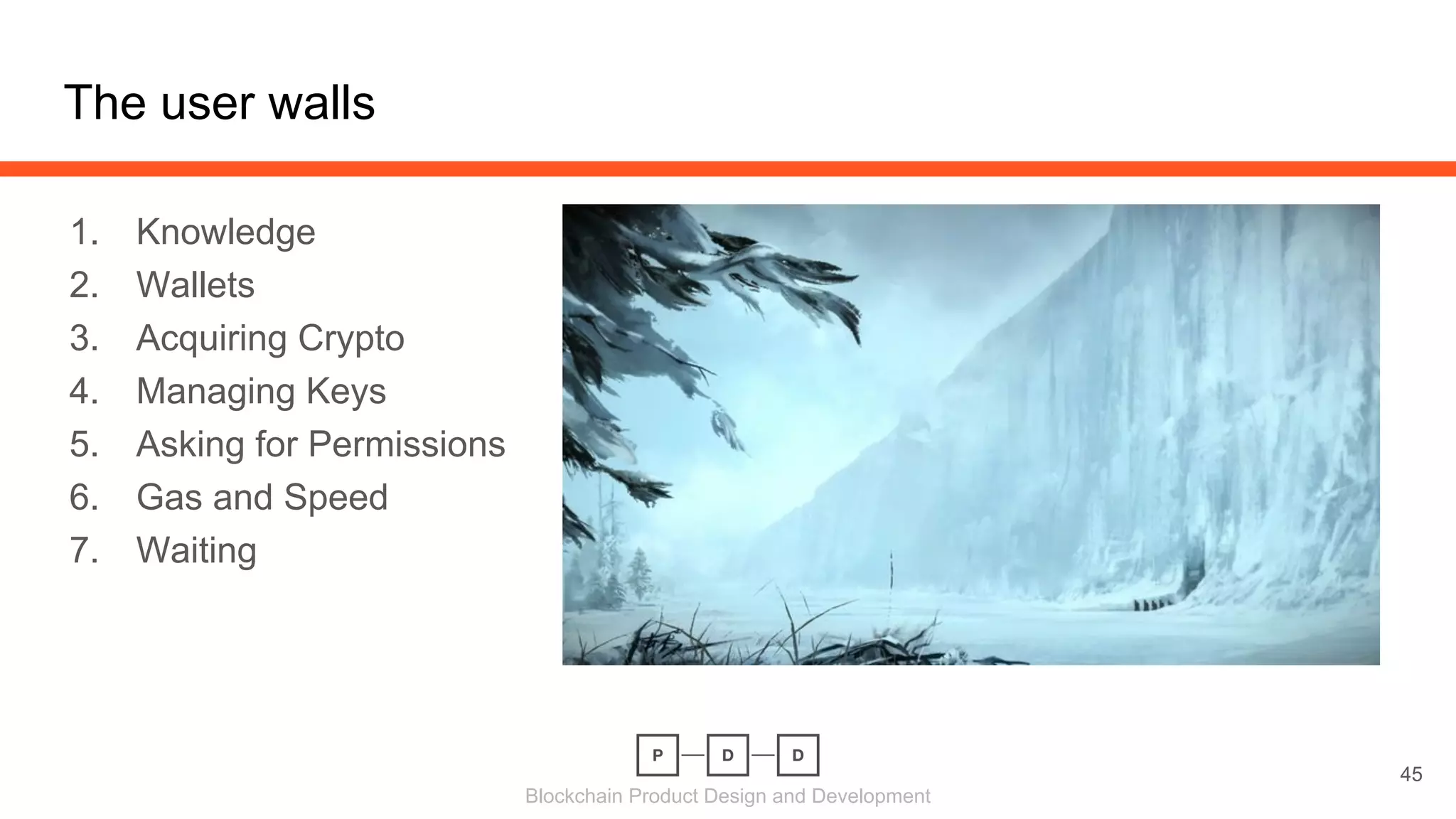
The user walls
45
1. Knowledge
2. Wallets
3. Acquiring Crypto
4. Managing Keys
5. Asking for Permissions
6. Gas and Speed
7. Waiting
Blockchain Product Design and Development
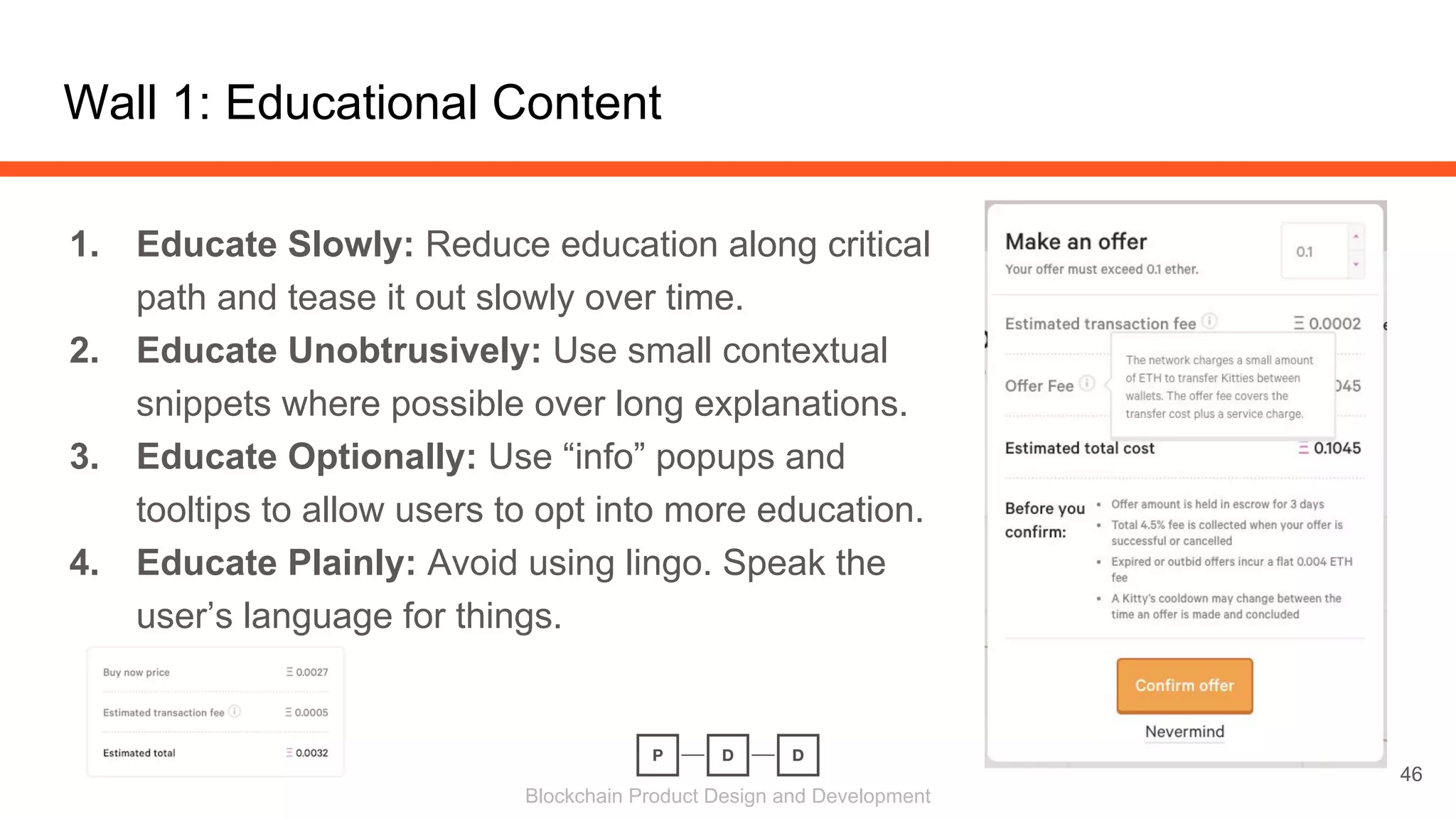
1. Educate Slowly: Reduce education along critical
path and tease it out slowly over time.
2. Educate Unobtrusively: Use small contextual
snippets where possible over long explanations.
3. Educate Optionally: Use “info” popups and
tooltips to allow users to opt into more education.
4. Educate Plainly: Avoid using lingo. Speak the
user’s language for things.
Wall 1: Educational Content
46
Blockchain Product Design and Development
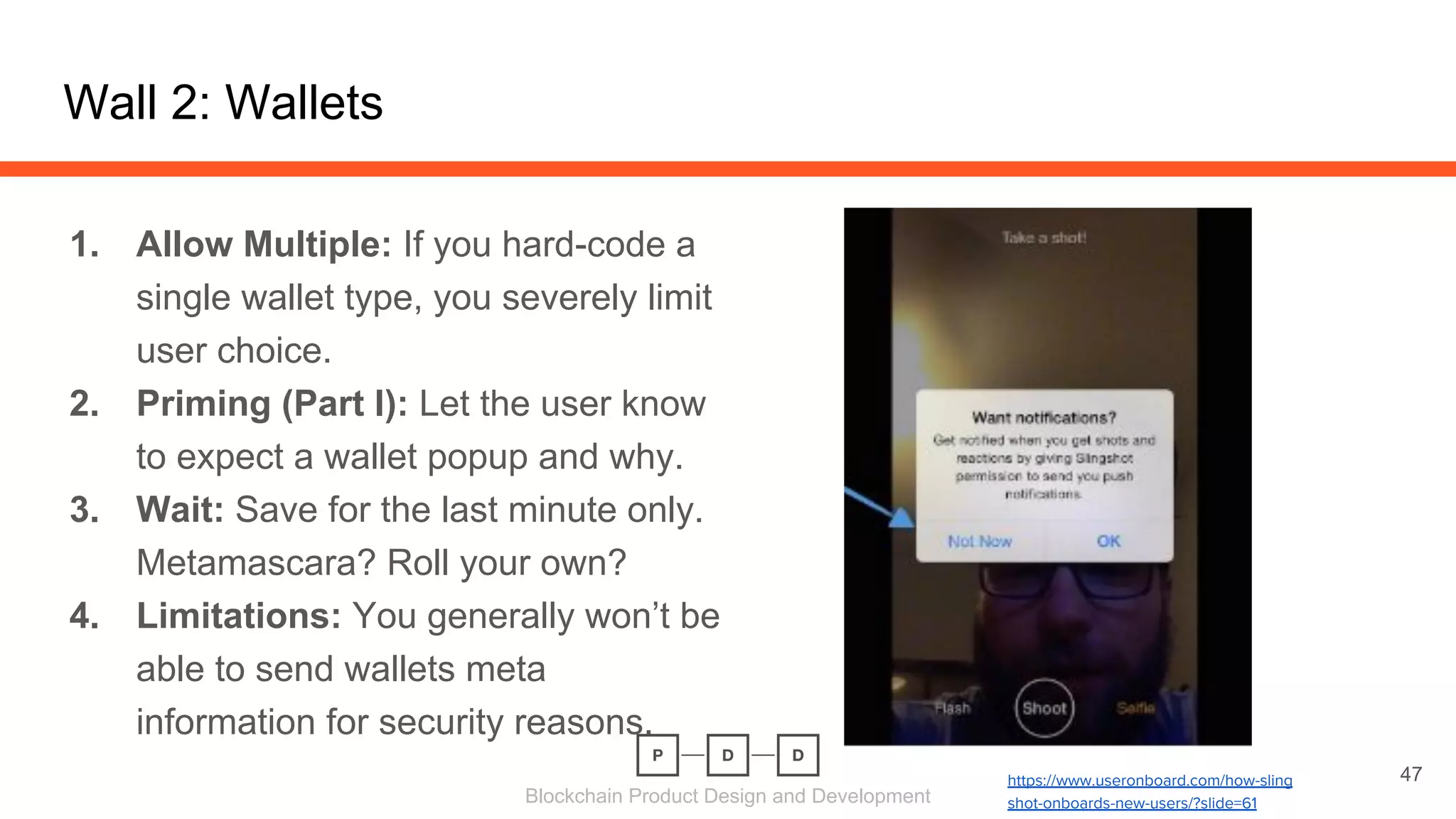
1. Allow Multiple: If you hard-code a
single wallet type, you severely limit
user choice.
2. Priming (Part I): Let the user know
to expect a wallet popup and why.
3. Wait: Save for the last minute only.
Metamascara? Roll your own?
4. Limitations: You generally won’t be
able to send wallets meta
information for security reasons.
Wall 2: Wallets
47https://www.useronboard.com/how-sling
shot-onboards-new-users/?slide=61
Blockchain Product Design and Development
1. Allow Multiple: Can you allow multiple
currencies to be used?
2. Prime Expectations: You’re giving up
their UX to a partner… preflight their
confirmation or acknowledgement.
3. Wait/Hide: Can your app foot the bill?
Charge in other ways? Security…
Services like Wyre are getting into the fray.
Wall 3: Acquiring crypto
48
Blockchain Product Design and Development
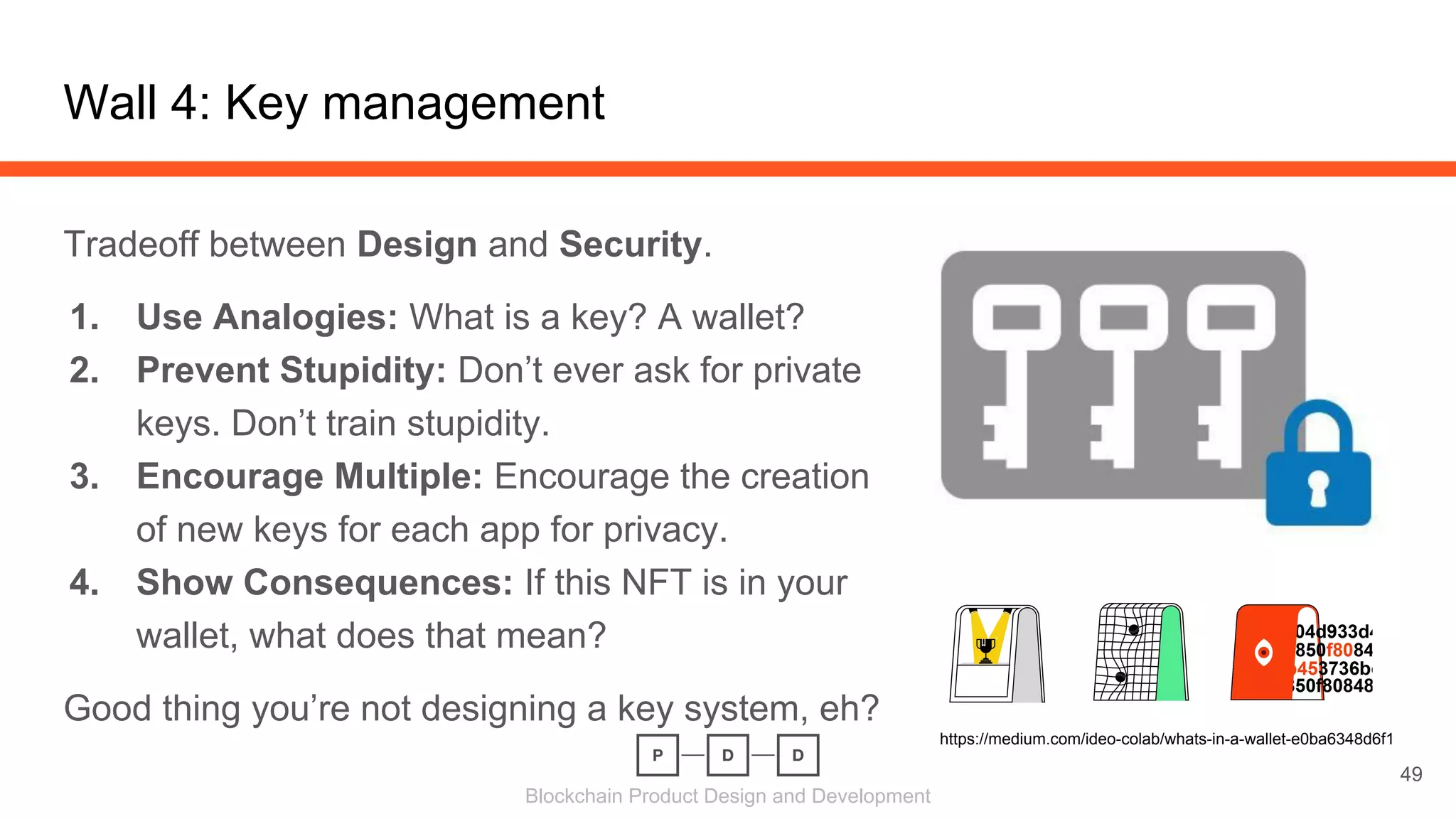
Tradeoff between Design and Security.
1. Use Analogies: What is a key? A wallet?
2. Prevent Stupidity: Don’t ever ask for private
keys. Don’t train stupidity.
3. Encourage Multiple: Encourage the creation
of new keys for each app for privacy.
4. Show Consequences: If this NFT is in your
wallet, what does that mean?
Good thing you’re not designing a key system, eh?
Wall 4: Key management
49
https://medium.com/ideo-colab/whats-in-a-wallet-e0ba6348d6f1
Blockchain Product Design and Development
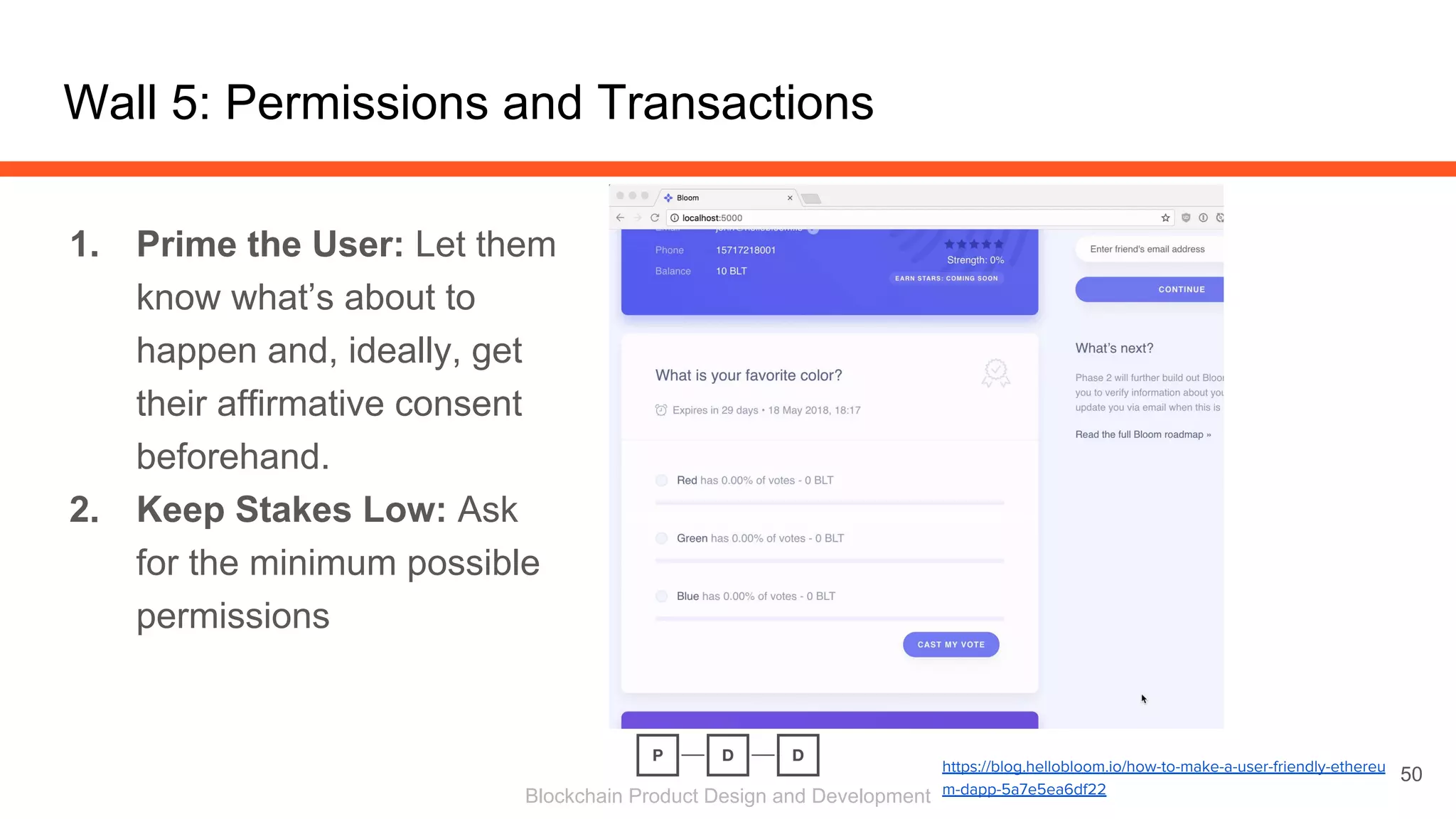
1. Prime the User: Let them
know what’s about to
happen and, ideally, get
their affirmative consent
beforehand.
2. Keep Stakes Low: Ask
for the minimum possible
permissions
Wall 5: Permissions and Transactions
50https://blog.hellobloom.io/how-to-make-a-user-friendly-ethereu
m-dapp-5a7e5ea6df22
Blockchain Product Design and Development
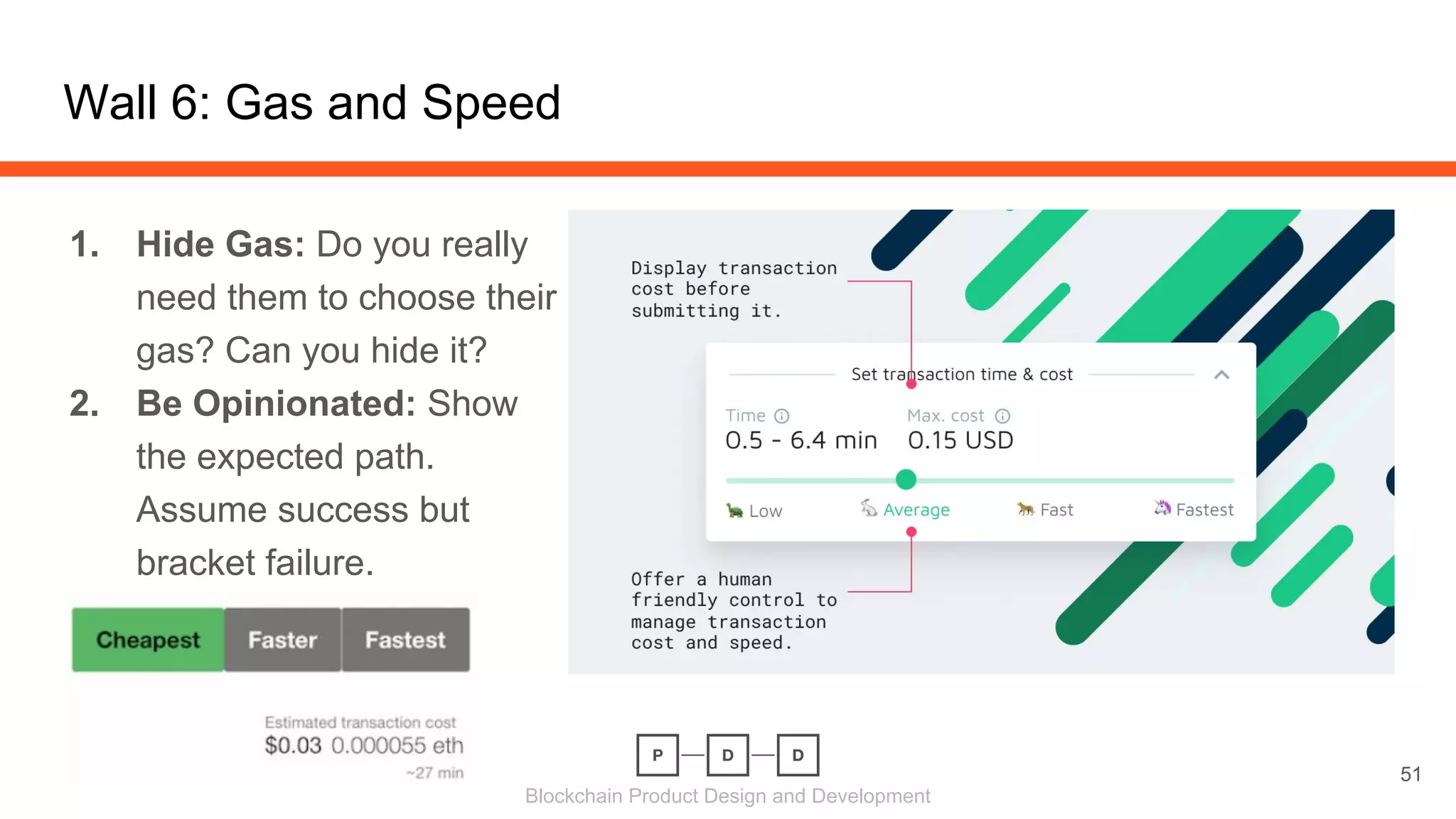
1. Hide Gas: Do you really
need them to choose their
gas? Can you hide it?
2. Be Opinionated: Show
the expected path.
Assume success but
bracket failure.
Wall 6: Gas and Speed
51
Blockchain Product Design and Development
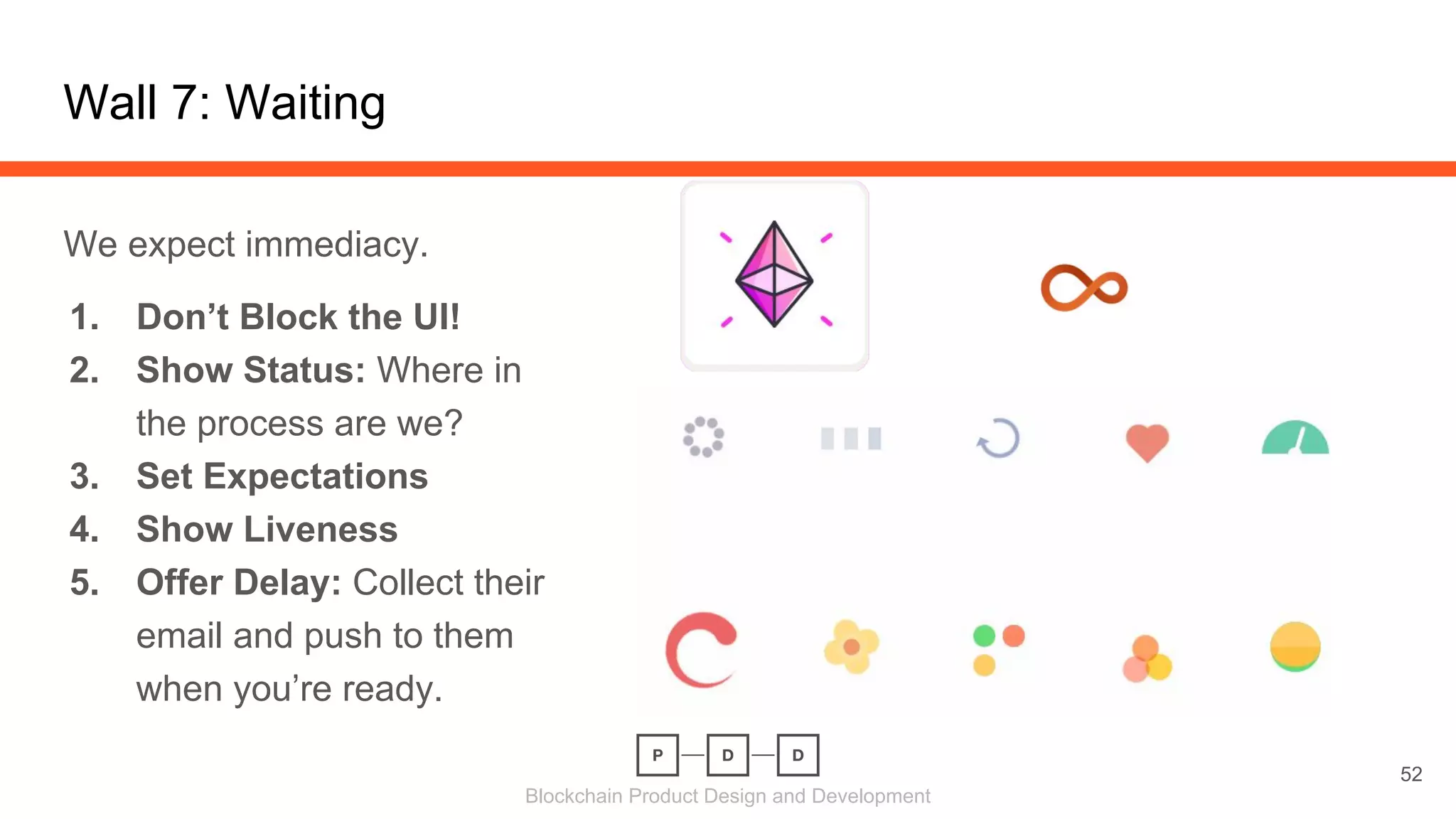
We expect immediacy.
1. Don’t Block the UI!
2. Show Status: Where in
the process are we?
3. Set Expectations
4. Show Liveness
5. Offer Delay: Collect their
email and push to them
when you’re ready.
Wall 7: Waiting
52
Blockchain Product Design and Development
Roadmap
53
1. The Space We Operate Within
2. General Principles of Design
3. Designing on Blockchain
4. Designing for Trust
5. Conclusion
Blockchain Product Design and Development
Why this is important: the human picture
54
“Blockchain affects the most intimate parts
of people’s lives -- like money, identity and
health.”
-- Sarah Baker Mills, Consensys
Blockchain Product Design and Development
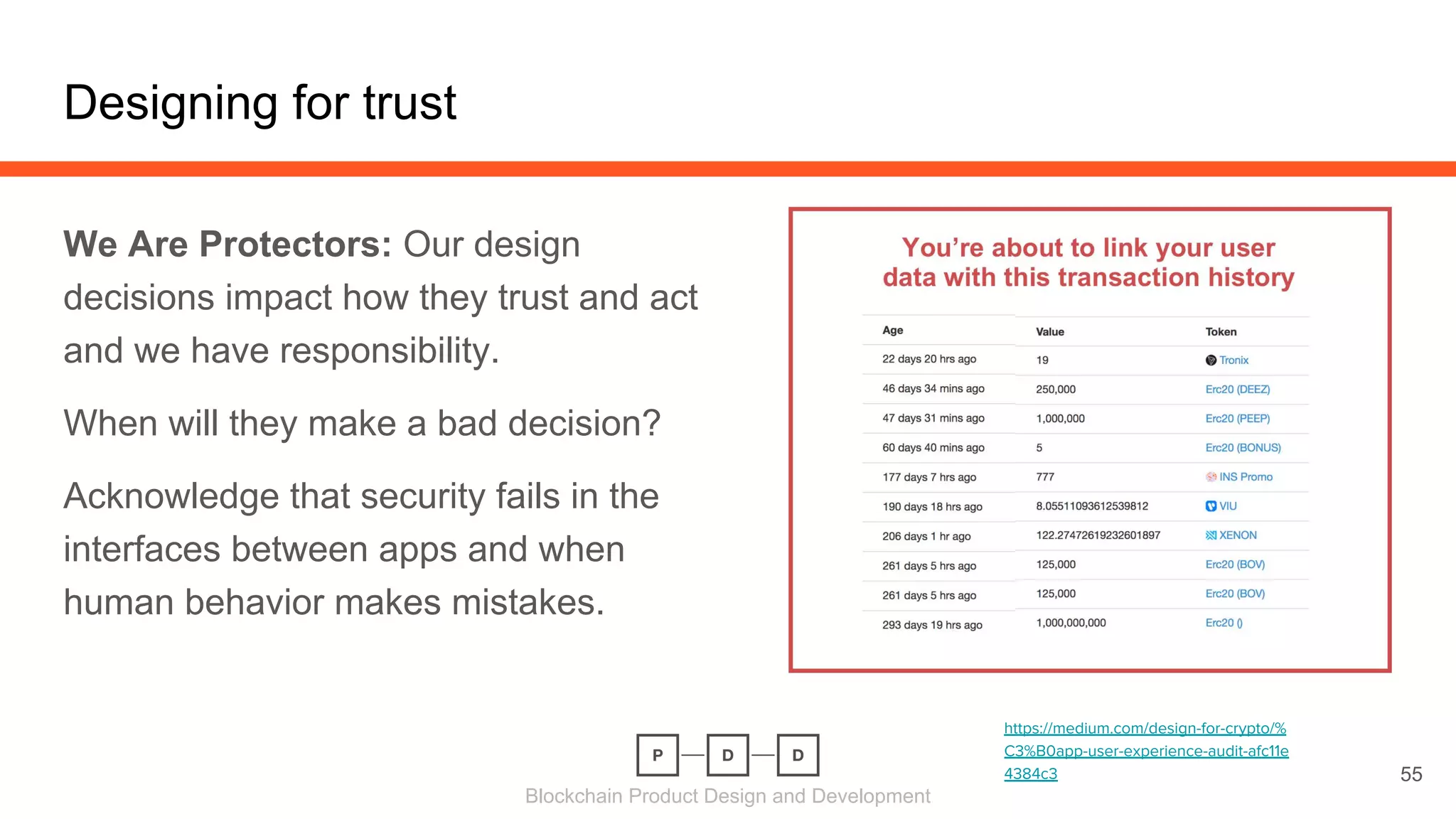
We Are Protectors: Our design
decisions impact how they trust and act
and we have responsibility.
When will they make a bad decision?
Acknowledge that security fails in the
interfaces between apps and when
human behavior makes mistakes.
Designing for trust
55
https://medium.com/design-for-crypto/%
C3%B0app-user-experience-audit-afc11e
4384c3
Blockchain Product Design and Development
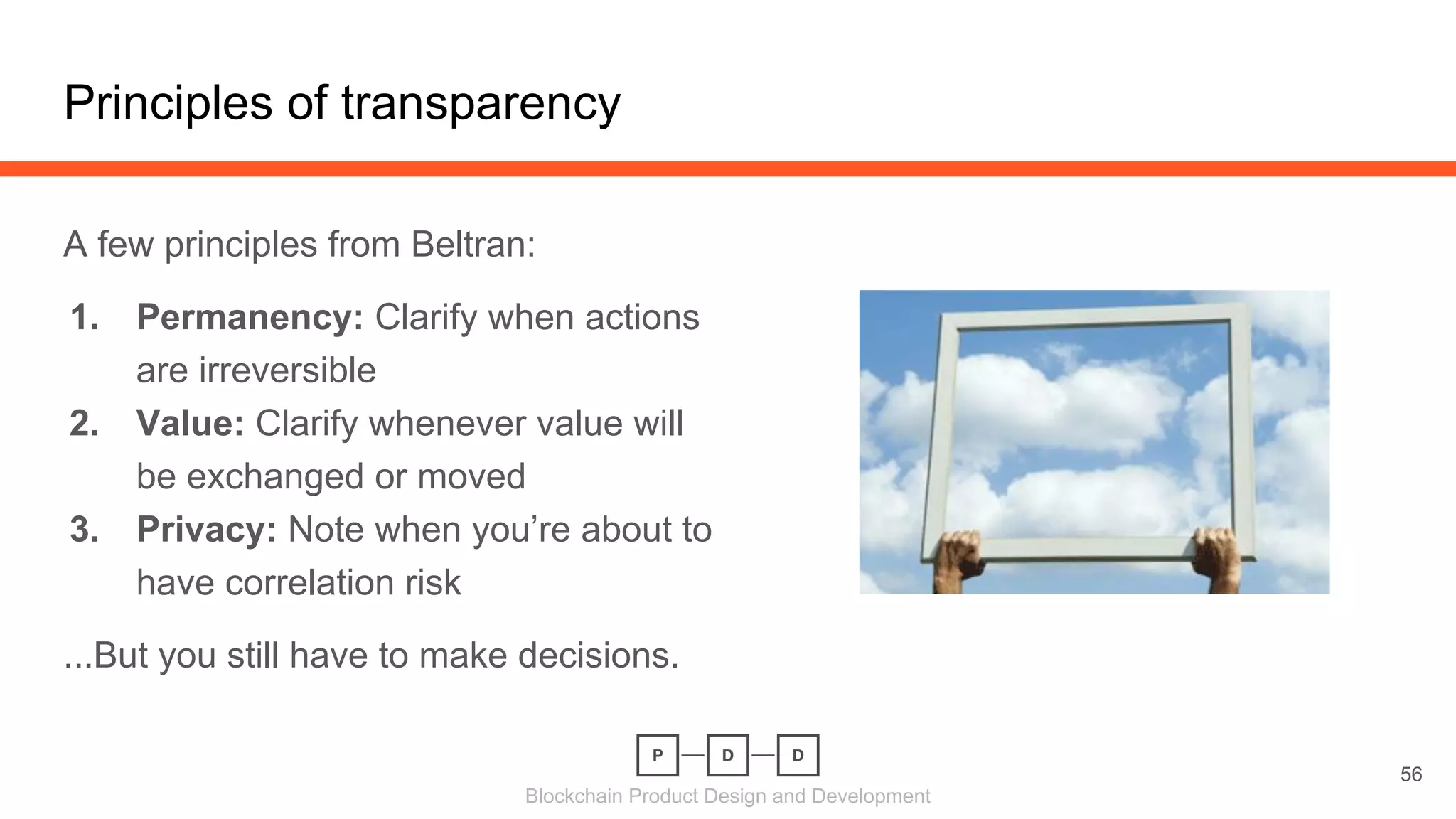
A few principles from Beltran:
1. Permanency: Clarify when actions
are irreversible
2. Value: Clarify whenever value will
be exchanged or moved
3. Privacy: Note when you’re about to
have correlation risk
...But you still have to make decisions.
Principles of transparency
56
Blockchain Product Design and Development
Roadmap
57
1. The Space We Operate Within
2. General Principles of Design
3. Designing on Blockchain
4. Designing for Trust
5. Conclusion
Blockchain Product Design and Development
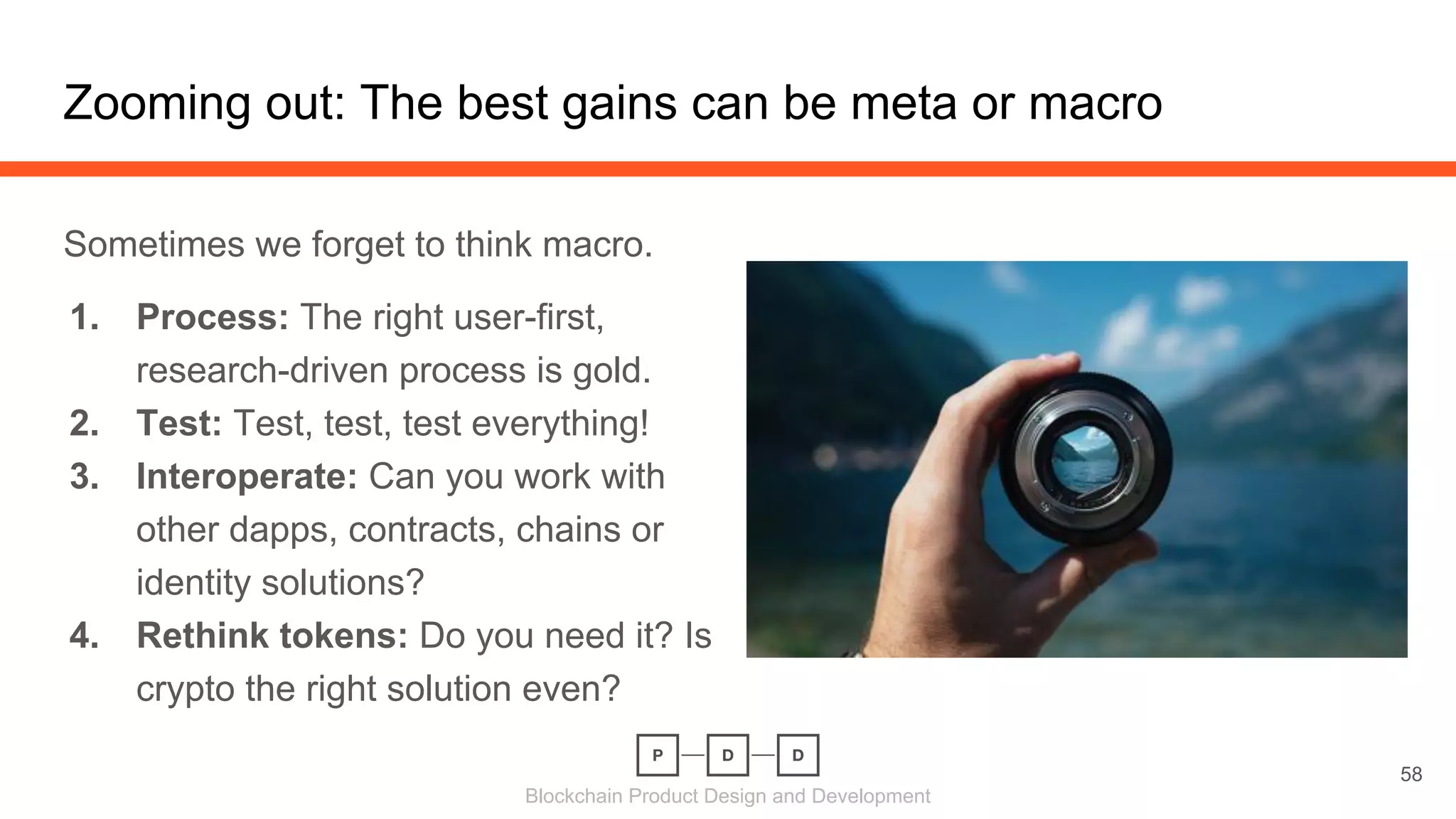
Sometimes we forget to think macro.
1. Process: The right user-first,
research-driven process is gold.
2. Test: Test, test, test everything!
3. Interoperate: Can you work with
other dapps, contracts, chains or
identity solutions?
4. Rethink tokens: Do you need it? Is
crypto the right solution even?
Zooming out: The best gains can be meta or macro
58
Blockchain Product Design and Development
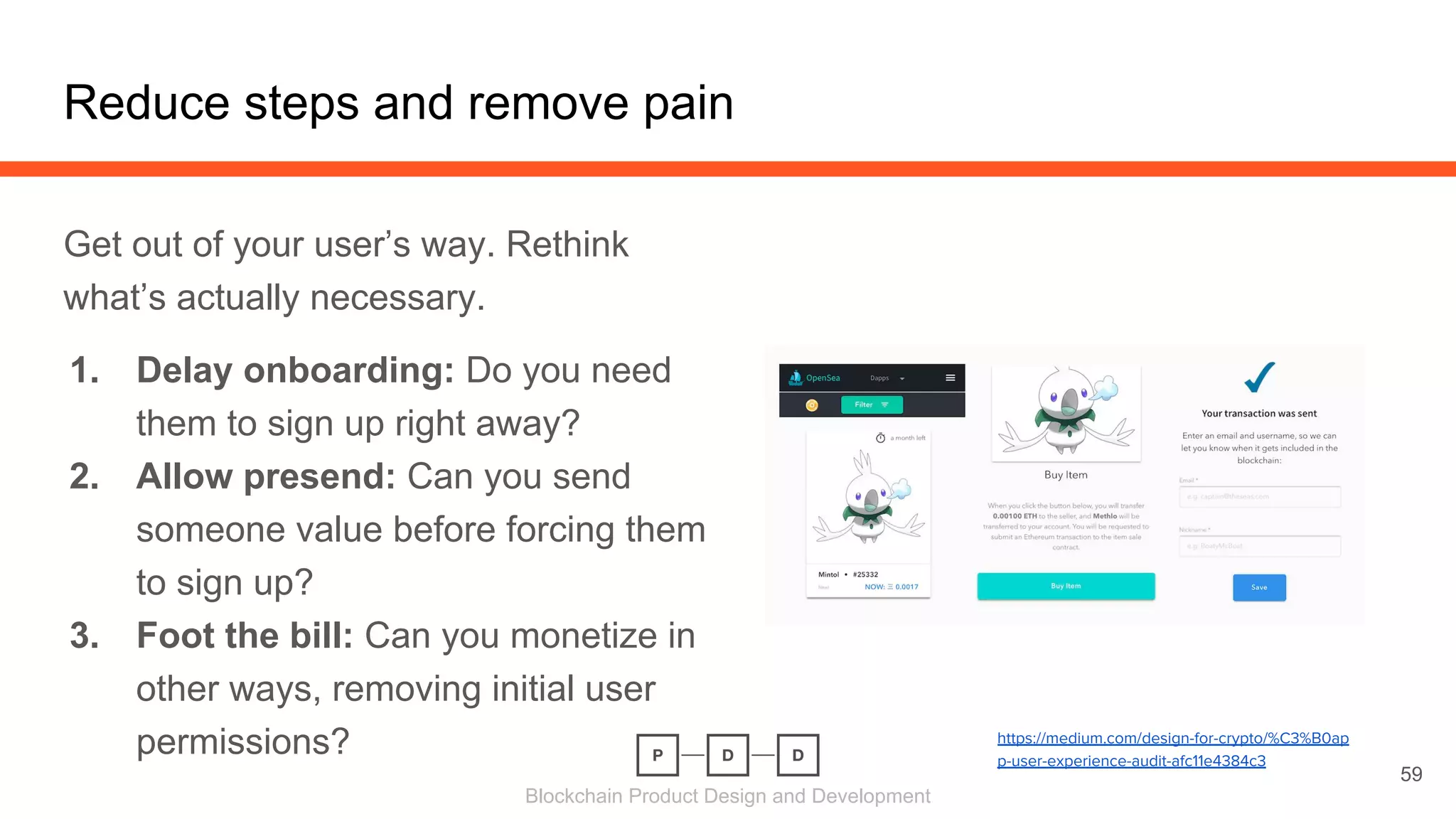
Get out of your user’s way. Rethink
what’s actually necessary.
1. Delay onboarding: Do you need
them to sign up right away?
2. Allow presend: Can you send
someone value before forcing them
to sign up?
3. Foot the bill: Can you monetize in
other ways, removing initial user
permissions?
Reduce steps and remove pain
59
https://medium.com/design-for-crypto/%C3%B0ap
p-user-experience-audit-afc11e4384c3
Blockchain Product Design and Development
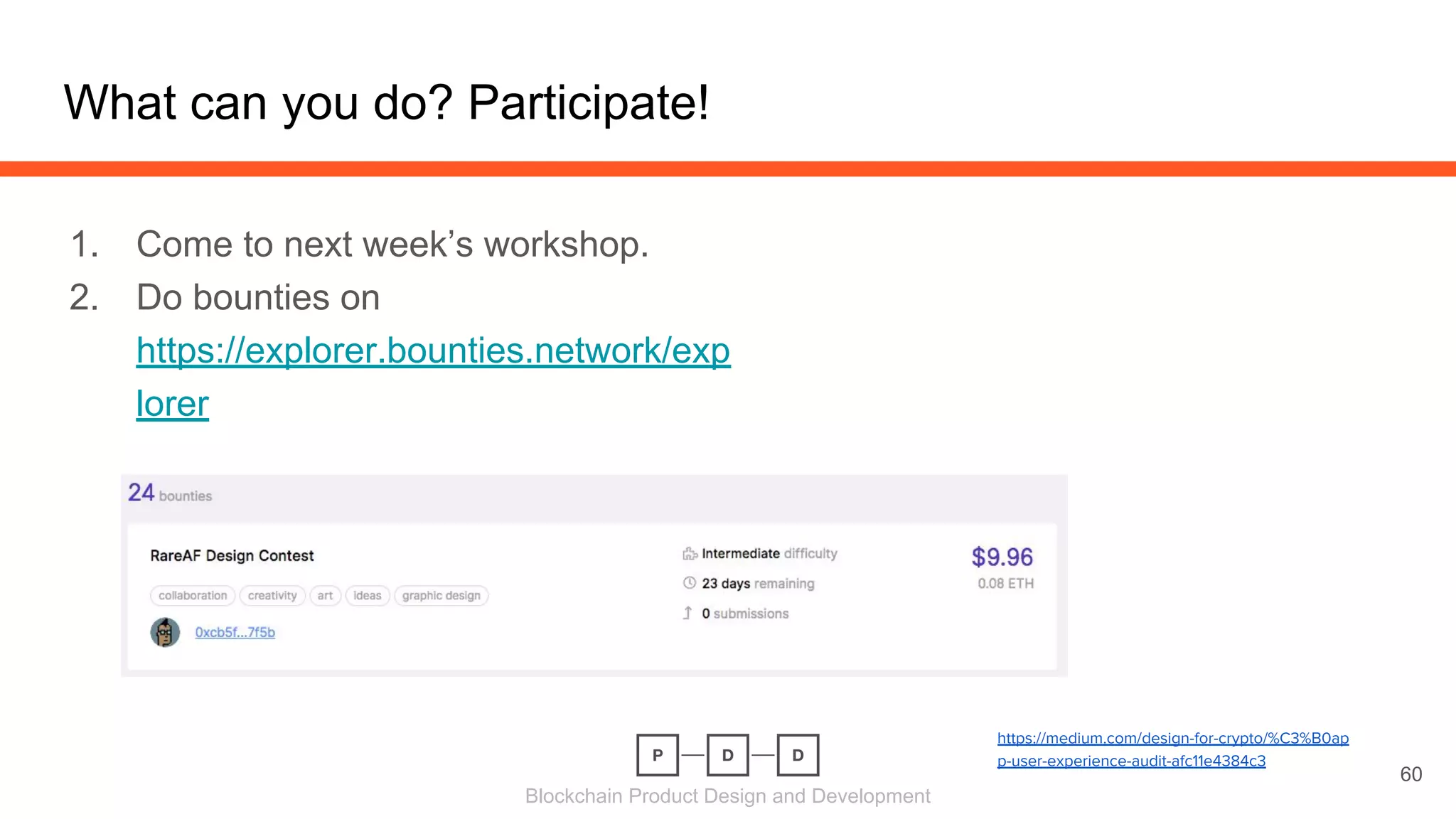
1. Come to next week’s workshop.
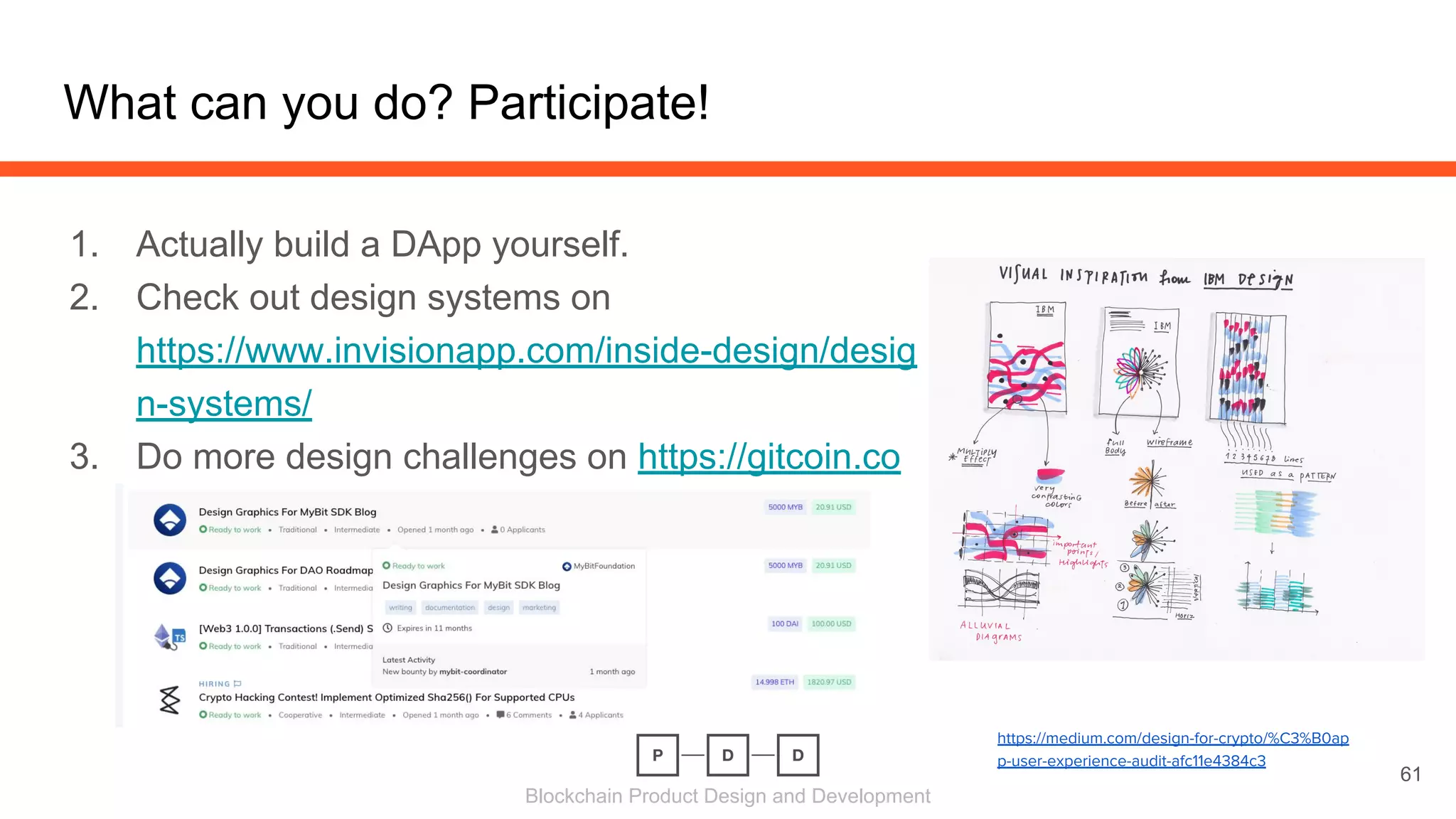
2. Do bounties on
https://explorer.bounties.network/exp
lorer
What can you do? Participate!
60
https://medium.com/design-for-crypto/%C3%B0ap
p-user-experience-audit-afc11e4384c3
Blockchain Product Design and Development
1. Actually build a DApp yourself.
2. Check out design systems on
https://www.invisionapp.com/inside-design/desig
n-systems/
3. Do more design challenges on https://gitcoin.co
What can you do? Participate!
61
https://medium.com/design-for-crypto/%C3%B0ap
p-user-experience-audit-afc11e4384c3
Blockchain Product Design and Development
People
1. Alejandro Machado
2. Alex van de Sande (Ethereum Foundation)
3. Sarah Baker Mills (Consensys)
4. Beltran Berrocal
5. Sarah Gregory (Coinbase)
Organizations
Consensys (https://consensys.design), IDEO Colab, Coinbase
What can you do? Follow...
62
https://medium.com/design-for-crypto/%C3%B0ap
p-user-experience-audit-afc11e4384c3
Blockchain Product Design and Development
Thank you!
63
Blockchain Product Design and Development
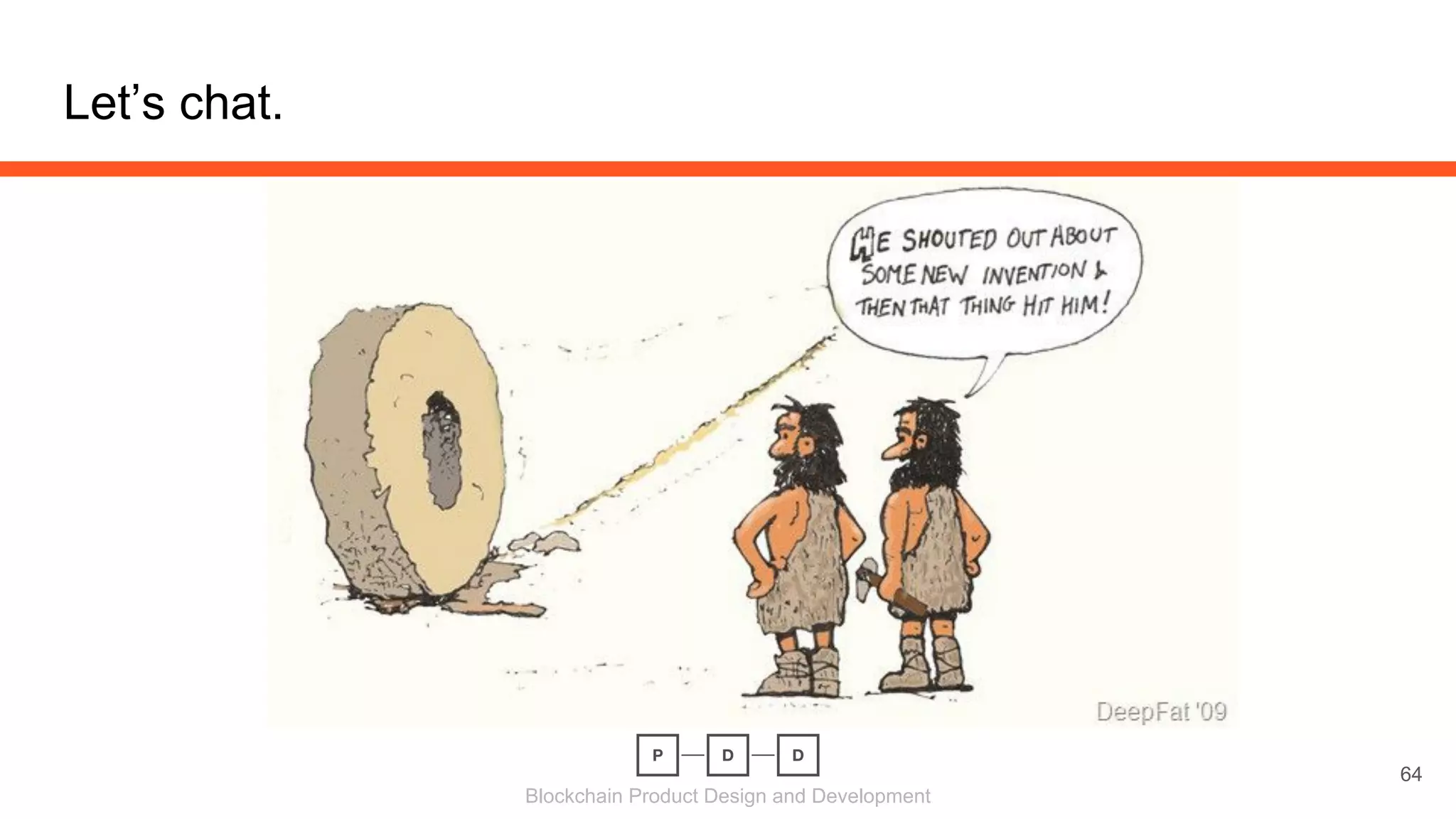
Let’s chat.
64
Blockchain Product Design and Development
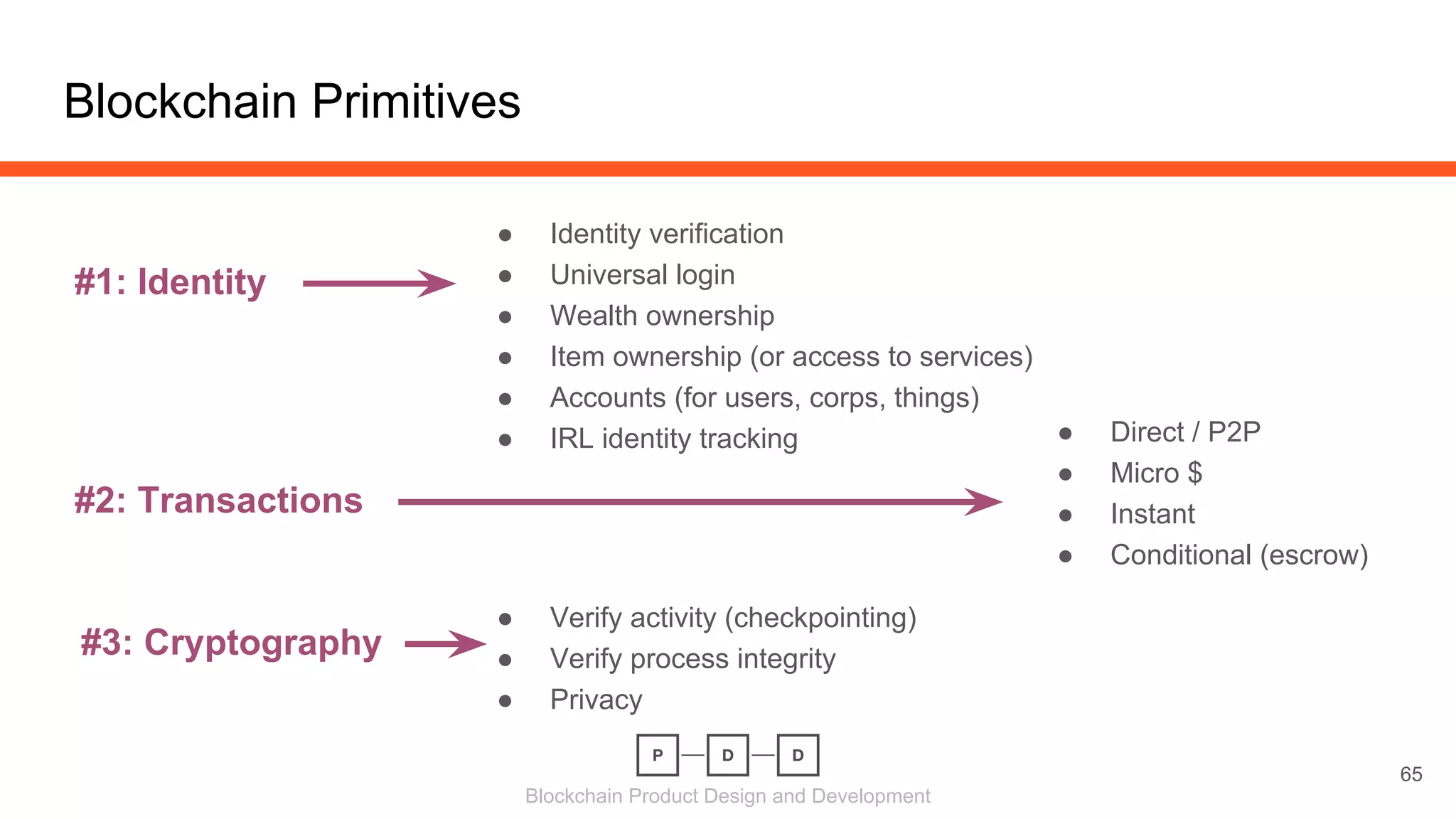
Blockchain Primitives
65
#1: Identity
#2: Transactions
#3: Cryptography
● Identity verification
● Universal login
● Wealth ownership
● Item ownership (or access to services)
● Accounts (for users, corps, things)
● IRL identity tracking ● Direct / P2P
● Micro $
● Instant
● Conditional (escrow)
● Verify activity (checkpointing)
● Verify process integrity
● Privacy
Blockchain Product Design and Development
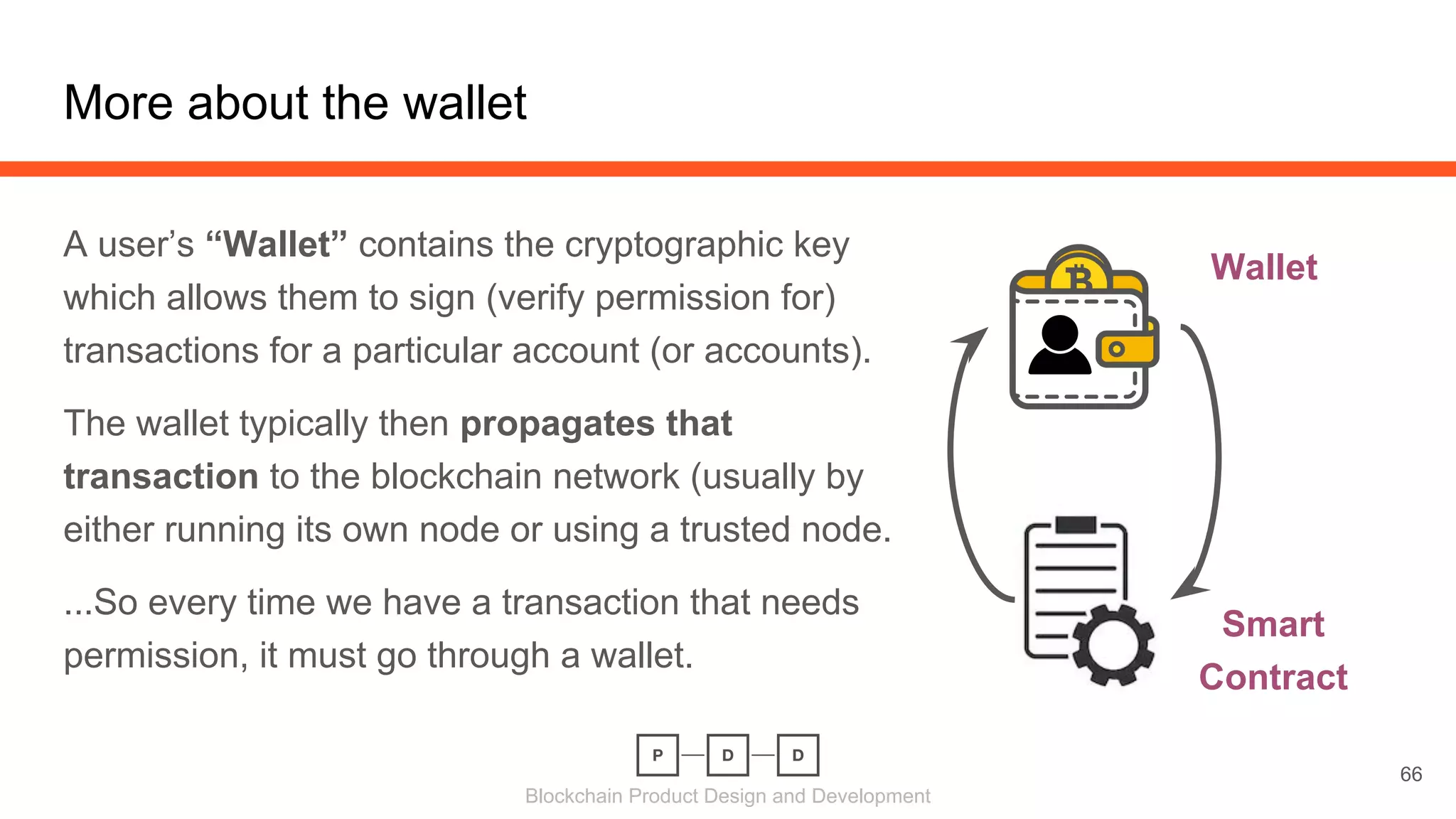
More about the wallet
66
A user’s “Wallet” contains the cryptographic key
which allows them to sign (verify permission for)
transactions for a particular account (or accounts).
The wallet typically then propagates that
transaction to the blockchain network (usually by
either running its own node or using a trusted node.
...So every time we have a transaction that needs
permission, it must go through a wallet.
Wallet
Smart
Contract
Blockchain Product Design and Development
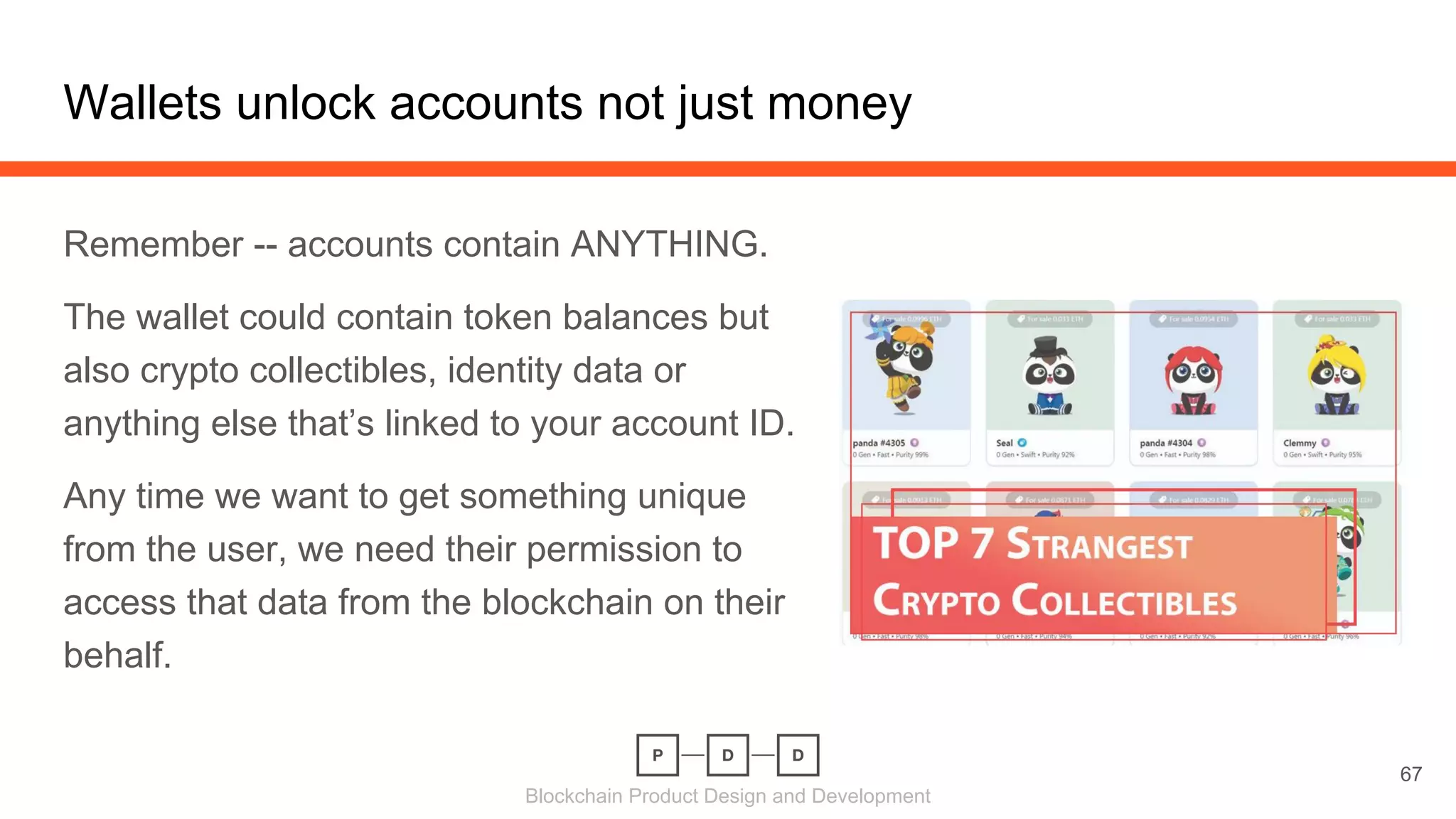
Wallets unlock accounts not just money
67
Remember -- accounts contain ANYTHING.
The wallet could contain token balances but
also crypto collectibles, identity data or
anything else that’s linked to your account ID.
Any time we want to get something unique
from the user, we need their permission to
access that data from the blockchain on their
behalf.

The Design of Blockchain-Based Apps (DApps)

  • 1.
    http://www.meetup.com/blockchain-product-design-development/ The Design ofBlockchain-Based Apps Product, Design and Development January 16, 2019 #blockchainonramp
  • 2.
    Blockchain Product Designand Development What do users care about? 2 Solving their problems right now with as little thought and cost as possible. ...not blockchain.
  • 3.
    Blockchain Product Designand Development Why this is important: the bigger picture 3 The innovators understand the jargon. They download the tools. They’ll go through some hell to make things work. Early adopters will not. Design thinking and design execution are critical to bridge the gap.
  • 4.
    Blockchain Product Designand Development Why this is important: the human picture 4 “Blockchain affects the most intimate parts of people’s lives -- like money, identity and health.” -- Sarah Baker Mills, Consensys
  • 5.
    Let’s define ourdesign scope 5 User-Facing Design: The design of the experiences and interfaces for users of our apps and platforms. Technical Design: The design of the technical systems which underlie these applications. Both talk about “design patterns”, which are generalized and reusable solutions to common problems. Today’s scope
  • 6.
    Blockchain Product Designand Development They are not entirely independent! 6 The principles of User-Facing Design should drive the technical requirements we target with our systems. The available paths provided by the technical design will influence our user-facing toolkit (in crypto especially). Both rely on -- and benefit from -- the Design Process.
  • 7.
    Step 1: Theplatform’s customers are developers. Step 2: The developer’s customers are end-users. To be effective, platforms have to win them both. Platforms have 2-step product/market fit 7
  • 8.
  • 9.
  • 10.
    Blockchain Product Designand Development Today we’ll stick with the sexy stuff 10 We’ll focus on End-User Design and User Experience. Specifically, for the end-users of apps built on blockchains. We’ll skip the discussion of Developer Experience (DevX) but remember that developers are potentially your users too! ...and we will have to get a *bit* technical.
  • 11.
    User Experience (UX) “Theoverall experience of a person using a product such as a website or computer application, especially in terms of how easy or pleasing it is to use.” 11
  • 12.
    User Interface (UI)!= User Experience (UX) 12 Unattractive but highly effective.* Beautiful, Iconic… and impossible to pour. *Until it all squirts out on you
  • 13.
    Usability != UserExperience (UX) 13 Usability is achieving a goal with the maximum: 1. Effectiveness 2. Efficiency 3. Satisfaction UX encompasses the ENTIRE experience a user has while interacting with a product or service. Was it delightful? Will the user return? Science Art
  • 14.
    UX is ajourney UX covers the user’s experience during their entire journey from the very first interaction with a product to their last. Along the way, they pass through lots of interfaces. 14
  • 15.
    Where are wetoday? 15
  • 16.
    I stand onthe shoulders of giants 16 1. Alejandro Machado 2. Alex van de Sande (Ethereum Foundation) 3. Sarah Baker Mills (Consensys) 4. Beltran Berrocal 5. Sarah Gregory (Coinbase)
  • 17.
    But we’re allstill figuring it out 17
  • 18.
    Blockchain Product Designand Development About Me I’m Erik Trautman and I run operations at NEAR Protocol, a scalable, developer-friendly blockchain on a mission to bring the technology to a billion devices around the world. I also care deeply about creating great products, educating people and building rich ecosystems. My background is in markets, open-source software development, startup leadership and education. And general nerdery. Learn more about NEAR at http://www.nearprotocol.com 18
  • 19.
    Blockchain Product Designand Development Roadmap 19 1. The Space We Operate Within 2. General Principles of Design 3. Designing on Blockchain 4. Designing for Trust 5. Conclusion
  • 20.
    Blockchain Product Designand Development Roadmap 20 1. The Space We Operate Within 2. General Principles of Design 3. Designing on Blockchain 4. Designing for Trust 5. Conclusion
  • 21.
    Blockchain Product Designand Development What is a “regular” app? 21 Today’s web and mobile apps are generally controlled by single companies and accessed via a “normal” web browser or mobile app. 1. The front end (what you see) of the app is served from a server (probably cloud-hosted). 2. Requests from front end are run on that server. 3. The data from that server and all your interactions with it flow to the company’s database. Browser Server Database
  • 22.
    Blockchain Product Designand Development What is a “decentralized” app? 22 A decentralized app runs almost completely independently on the blockchain, accessed via a special browser or extension for yours. 1. The application still needs the front-end from somewhere (eg cloud) 2. The front end talks to the Smart Contract using its API (via wallet). 3. The Smart Contract runs code and stores data on the blockchain network. Browser Hosting Blockchain Network Smart Contract
  • 23.
    Blockchain Product Designand Development Centralized + Facebook + Google + Uber + Amazon + Etc... Decentralization is a spectrum ...and most “decentralized” apps aren’t fully decentralized anyway [Infura!] 23 Decentralized + Augur + CryptoKitties + FOMO + Dexes + Etc...
  • 24.
    Blockchain Product Designand Development 1. Users own their data: It’s not in *our* database. 2. We have to ask permission: Any time we perform an action on behalf of a user (eg money transfer), we have to ask them for permission. 3. Actions have costs: We (or users) have to pay for every action that uses compute. 4. New interaction types: Staking, voting Key additions in blockchain-based apps 24
  • 25.
    Blockchain Product Designand Development ...But it’s still design. 25
  • 26.
    Blockchain Product Designand Development Blockchain-based apps have new walls 26
  • 27.
    Blockchain Product Designand Development Wall 1: Knowledge Problem 1: Too much education about blockchain. Problem 2: Too little education about blockchain. It’s a tricky middle ground. 27
  • 28.
    Blockchain Product Designand Development Wall 2: Wallets Usually* required to get started with any blockchain- based app. *: Not always 28
  • 29.
    Blockchain Product Designand Development Wall 3: Acquiring tokens 29
  • 30.
    Blockchain Product Designand Development Wall 4: Managing keys 30 Stored where? If lost? Wait, keys? #findmyphone How many?
  • 31.
    Blockchain Product Designand Development Wall 5: Permissions and Transactions 31
  • 32.
    Blockchain Product Designand Development Wall 6: Gas and Speed 32 !?!?
  • 33.
    Blockchain Product Designand Development Wall 7: Waiting 33
  • 34.
    Blockchain Product Designand Development Ok, let’s get over this. 34https://en.wikibooks.org/wiki/Castles_of_England/Methods_of_Attack
  • 35.
    Blockchain Product Designand Development Roadmap 35 1. The Space We Operate Within 2. General Principles of Design 3. Designing on Blockchain 4. Designing for Trust 5. Conclusion
  • 36.
    Blockchain Product Designand Development 1. Design Thinking: The state of mind of approaching problems deliberately* 2. Design Process: The process used to move from the problem through the solutions. 3. Design Toolkit: Tactics, patterns and best practices for implementation. *: Often lumped in with Design Process. Design has multiple levels 36
  • 37.
    Blockchain Product Designand Development 1. Don’t slack on your personas: If you don’t know who you’re building for, you’re toast. 2. Low fidelity, high testing: Don’t forget to iterate rapidly with real users! Process matters… and it’s all about #users 37 https://boagworld.com/usability/personas/
  • 38.
    Blockchain Product Designand Development Process matters… and it’s all about #users 38 Credit: Sarah Gregory
  • 39.
    Blockchain Product Designand Development ● The Noob ● The Hardcore Cypherpunk ● The Technologist ● … Design for the noob, create swim lanes. Who are our users? Well, we do know... 39Credit: Alex van de Sande
  • 40.
    Blockchain Product Designand Development General design principles 40 1. Follow expectations 2. Minimize cognitive load 3. Be consistent 4. Don’t let me make mistakes 5. Be unobtrusive https://blog.fluidui.com/dieter-rams-10-design-principles/
  • 41.
    Blockchain Product Designand Development Affordances 41 An Affordance in human-computer interaction is generally considered to be those “action possibilities” that are readily perceivable by a user. Extensions: 1. Make sure there is an obvious choice with intuitive results… and ideally it is the only one. 2. Don’t explain to people what they shouldn’t do… don’t let them do it in the first place. We need protection :/
  • 42.
    Blockchain Product Designand Development Users should always feel fully in control of their own experience, which means providing them a map and compass, and know what you expect of them. In Action: 1. Show progress in context of the steps required 2. Show navigation back, forward and out 3. Clearly signal what the “right” choice is Control and Guidance 42
  • 43.
    Blockchain Product Designand Development Users will always seek to minimize their cognitive load, whether it’s ignoring your careful copy or failing to understand the simplest new ideas. In Action: 1. Provide users with options to dig deeper or customize but ultimately make choices where necessary for them to reduce thinking. 2. If you must provide choices, reduce them. 3. If you must create steps, reduce them. Don’t make me think 43
  • 44.
    Blockchain Product Designand Development Roadmap 44 1. The Space We Operate Within 2. General Principles of Design 3. Designing on Blockchain 4. Designing for Trust 5. Conclusion
  • 45.
    Blockchain Product Designand Development The user walls 45 1. Knowledge 2. Wallets 3. Acquiring Crypto 4. Managing Keys 5. Asking for Permissions 6. Gas and Speed 7. Waiting
  • 46.
    Blockchain Product Designand Development 1. Educate Slowly: Reduce education along critical path and tease it out slowly over time. 2. Educate Unobtrusively: Use small contextual snippets where possible over long explanations. 3. Educate Optionally: Use “info” popups and tooltips to allow users to opt into more education. 4. Educate Plainly: Avoid using lingo. Speak the user’s language for things. Wall 1: Educational Content 46
  • 47.
    Blockchain Product Designand Development 1. Allow Multiple: If you hard-code a single wallet type, you severely limit user choice. 2. Priming (Part I): Let the user know to expect a wallet popup and why. 3. Wait: Save for the last minute only. Metamascara? Roll your own? 4. Limitations: You generally won’t be able to send wallets meta information for security reasons. Wall 2: Wallets 47https://www.useronboard.com/how-sling shot-onboards-new-users/?slide=61
  • 48.
    Blockchain Product Designand Development 1. Allow Multiple: Can you allow multiple currencies to be used? 2. Prime Expectations: You’re giving up their UX to a partner… preflight their confirmation or acknowledgement. 3. Wait/Hide: Can your app foot the bill? Charge in other ways? Security… Services like Wyre are getting into the fray. Wall 3: Acquiring crypto 48
  • 49.
    Blockchain Product Designand Development Tradeoff between Design and Security. 1. Use Analogies: What is a key? A wallet? 2. Prevent Stupidity: Don’t ever ask for private keys. Don’t train stupidity. 3. Encourage Multiple: Encourage the creation of new keys for each app for privacy. 4. Show Consequences: If this NFT is in your wallet, what does that mean? Good thing you’re not designing a key system, eh? Wall 4: Key management 49 https://medium.com/ideo-colab/whats-in-a-wallet-e0ba6348d6f1
  • 50.
    Blockchain Product Designand Development 1. Prime the User: Let them know what’s about to happen and, ideally, get their affirmative consent beforehand. 2. Keep Stakes Low: Ask for the minimum possible permissions Wall 5: Permissions and Transactions 50https://blog.hellobloom.io/how-to-make-a-user-friendly-ethereu m-dapp-5a7e5ea6df22
  • 51.
    Blockchain Product Designand Development 1. Hide Gas: Do you really need them to choose their gas? Can you hide it? 2. Be Opinionated: Show the expected path. Assume success but bracket failure. Wall 6: Gas and Speed 51
  • 52.
    Blockchain Product Designand Development We expect immediacy. 1. Don’t Block the UI! 2. Show Status: Where in the process are we? 3. Set Expectations 4. Show Liveness 5. Offer Delay: Collect their email and push to them when you’re ready. Wall 7: Waiting 52
  • 53.
    Blockchain Product Designand Development Roadmap 53 1. The Space We Operate Within 2. General Principles of Design 3. Designing on Blockchain 4. Designing for Trust 5. Conclusion
  • 54.
    Blockchain Product Designand Development Why this is important: the human picture 54 “Blockchain affects the most intimate parts of people’s lives -- like money, identity and health.” -- Sarah Baker Mills, Consensys
  • 55.
    Blockchain Product Designand Development We Are Protectors: Our design decisions impact how they trust and act and we have responsibility. When will they make a bad decision? Acknowledge that security fails in the interfaces between apps and when human behavior makes mistakes. Designing for trust 55 https://medium.com/design-for-crypto/% C3%B0app-user-experience-audit-afc11e 4384c3
  • 56.
    Blockchain Product Designand Development A few principles from Beltran: 1. Permanency: Clarify when actions are irreversible 2. Value: Clarify whenever value will be exchanged or moved 3. Privacy: Note when you’re about to have correlation risk ...But you still have to make decisions. Principles of transparency 56
  • 57.
    Blockchain Product Designand Development Roadmap 57 1. The Space We Operate Within 2. General Principles of Design 3. Designing on Blockchain 4. Designing for Trust 5. Conclusion
  • 58.
    Blockchain Product Designand Development Sometimes we forget to think macro. 1. Process: The right user-first, research-driven process is gold. 2. Test: Test, test, test everything! 3. Interoperate: Can you work with other dapps, contracts, chains or identity solutions? 4. Rethink tokens: Do you need it? Is crypto the right solution even? Zooming out: The best gains can be meta or macro 58
  • 59.
    Blockchain Product Designand Development Get out of your user’s way. Rethink what’s actually necessary. 1. Delay onboarding: Do you need them to sign up right away? 2. Allow presend: Can you send someone value before forcing them to sign up? 3. Foot the bill: Can you monetize in other ways, removing initial user permissions? Reduce steps and remove pain 59 https://medium.com/design-for-crypto/%C3%B0ap p-user-experience-audit-afc11e4384c3
  • 60.
    Blockchain Product Designand Development 1. Come to next week’s workshop. 2. Do bounties on https://explorer.bounties.network/exp lorer What can you do? Participate! 60 https://medium.com/design-for-crypto/%C3%B0ap p-user-experience-audit-afc11e4384c3
  • 61.
    Blockchain Product Designand Development 1. Actually build a DApp yourself. 2. Check out design systems on https://www.invisionapp.com/inside-design/desig n-systems/ 3. Do more design challenges on https://gitcoin.co What can you do? Participate! 61 https://medium.com/design-for-crypto/%C3%B0ap p-user-experience-audit-afc11e4384c3
  • 62.
    Blockchain Product Designand Development People 1. Alejandro Machado 2. Alex van de Sande (Ethereum Foundation) 3. Sarah Baker Mills (Consensys) 4. Beltran Berrocal 5. Sarah Gregory (Coinbase) Organizations Consensys (https://consensys.design), IDEO Colab, Coinbase What can you do? Follow... 62 https://medium.com/design-for-crypto/%C3%B0ap p-user-experience-audit-afc11e4384c3
  • 63.
    Blockchain Product Designand Development Thank you! 63
  • 64.
    Blockchain Product Designand Development Let’s chat. 64
  • 65.
    Blockchain Product Designand Development Blockchain Primitives 65 #1: Identity #2: Transactions #3: Cryptography ● Identity verification ● Universal login ● Wealth ownership ● Item ownership (or access to services) ● Accounts (for users, corps, things) ● IRL identity tracking ● Direct / P2P ● Micro $ ● Instant ● Conditional (escrow) ● Verify activity (checkpointing) ● Verify process integrity ● Privacy
  • 66.
    Blockchain Product Designand Development More about the wallet 66 A user’s “Wallet” contains the cryptographic key which allows them to sign (verify permission for) transactions for a particular account (or accounts). The wallet typically then propagates that transaction to the blockchain network (usually by either running its own node or using a trusted node. ...So every time we have a transaction that needs permission, it must go through a wallet. Wallet Smart Contract
  • 67.
    Blockchain Product Designand Development Wallets unlock accounts not just money 67 Remember -- accounts contain ANYTHING. The wallet could contain token balances but also crypto collectibles, identity data or anything else that’s linked to your account ID. Any time we want to get something unique from the user, we need their permission to access that data from the blockchain on their behalf.