http://www.meetup.com/blockchain-product-design-development/
Decentralized Applications 101
Product, Design and Development
December 19, 2018
Blockchain Product Design and Development
When you’re peering curiously into blockchain...
“I think I want to build a decentralized app but can’t
figure out WHY I actually should or HOW to do it.”
2
Blockchain Product Design and Development
2 problems
1. It’s really hard to find information on what the
heck a “DApp” actually is and why anyone
should really care. Just a bunch of crap about
writing your ICO whitepaper.
2. Anything more detailed gets super technical
and still doesn’t provide concepts.
I’ll address both of these today.
3
Blockchain Product Design and Development
About Me
I’m Erik Trautman and I run operations at NEAR Protocol, a
scalable blockchain and smart contract platform on a mission to
bring the technology to a billion devices around the world.
I also care deeply about creating great products, educating people
and building rich ecosystems.
My background is in markets, open-source software development,
startup leadership and education. And general nerdery.
Learn more about NEAR at http://www.nearprotocol.com
4
Blockchain Product Design and Development
Roadmap
5
1. About Decentralized Apps
2. Blockchain Primitives
3. DApp Interactions
4. Case Study: CryptoKitties
5. DApp Technical Architecture
6. Further Considerations
Blockchain Product Design and Development
Roadmap
6
1. About Decentralized Apps
2. Blockchain Primitives
3. DApp Interactions
4. Case Study: CryptoKitties
5. DApp Technical Architecture
6. Further Considerations
Blockchain Product Design and Development
What is a decentralized app (DApp)?
7
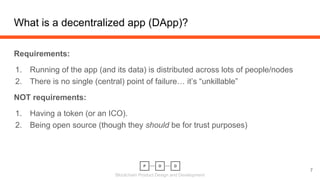
Requirements:
1. Running of the app (and its data) is distributed across lots of people/nodes
2. There is no single (central) point of failure… it’s “unkillable”
NOT requirements:
1. Having a token (or an ICO).
2. Being open source (though they should be for trust purposes)
Blockchain Product Design and Development
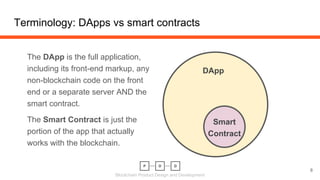
The DApp is the full application,
including its front-end markup, any
non-blockchain code on the front
end or a separate server AND the
smart contract.
The Smart Contract is just the
portion of the app that actually
works with the blockchain.
Terminology: DApps vs smart contracts
8
DApp
Smart
Contract
Blockchain Product Design and Development
Centralized applications of “Web 2.0” (today)
9
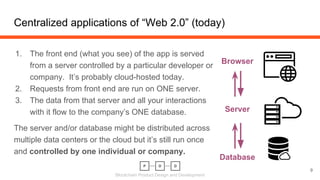
1. The front end (what you see) of the app is served
from a server controlled by a particular developer or
company. It’s probably cloud-hosted today.
2. Requests from front end are run on ONE server.
3. The data from that server and all your interactions
with it flow to the company’s ONE database.
The server and/or database might be distributed across
multiple data centers or the cloud but it’s still run once
and controlled by one individual or company.
Browser
Server
Database
Blockchain Product Design and Development
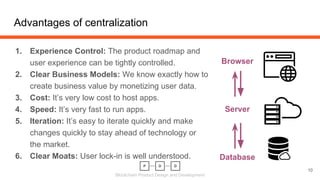
1. Experience Control: The product roadmap and
user experience can be tightly controlled.
2. Clear Business Models: We know exactly how to
create business value by monetizing user data.
3. Cost: It’s very low cost to host apps.
4. Speed: It’s very fast to run apps.
5. Iteration: It’s easy to iterate quickly and make
changes quickly to stay ahead of technology or
the market.
6. Clear Moats: User lock-in is well understood.
Advantages of centralization
10
Browser
Server
Database
Blockchain Product Design and Development
Downsides of centralization
11
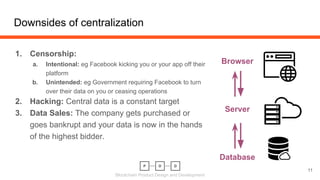
1. Censorship:
a. Intentional: eg Facebook kicking you or your app off their
platform
b. Unintended: eg Government requiring Facebook to turn
over their data on you or ceasing operations
2. Hacking: Central data is a constant target
3. Data Sales: The company gets purchased or
goes bankrupt and your data is now in the hands
of the highest bidder.
Browser
Server
Database
Blockchain Product Design and Development
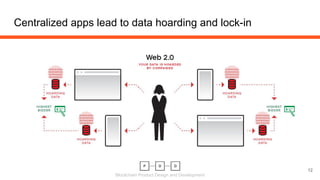
Centralized apps lead to data hoarding and lock-in
12
Blockchain Product Design and Development
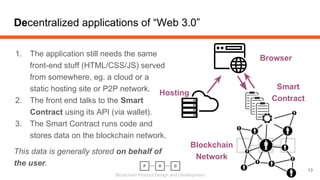
Decentralized applications of “Web 3.0”
13
1. The application still needs the same
front-end stuff (HTML/CSS/JS) served
from somewhere, eg. a cloud or a
static hosting site or P2P network.
2. The front end talks to the Smart
Contract using its API (via wallet).
3. The Smart Contract runs code and
stores data on the blockchain network.
This data is generally stored on behalf of
the user.
Browser
Hosting
Blockchain
Network
Smart
Contract
Blockchain Product Design and Development
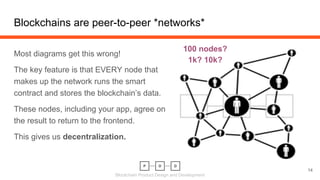
Most diagrams get this wrong!
The key feature is that EVERY node that
makes up the network runs the smart
contract and stores the blockchain’s data.
These nodes, including your app, agree on
the result to return to the frontend.
This gives us decentralization.
Blockchains are peer-to-peer *networks*
14
100 nodes?
1k? 10k?
Blockchain Product Design and Development
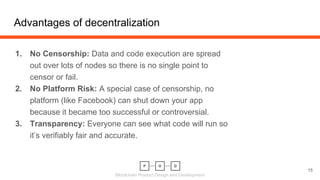
1. No Censorship: Data and code execution are spread
out over lots of nodes so there is no single point to
censor or fail.
2. No Platform Risk: A special case of censorship, no
platform (like Facebook) can shut down your app
because it became too successful or controversial.
3. Transparency: Everyone can see what code will run so
it’s verifiably fair and accurate.
Advantages of decentralization
15
Blockchain Product Design and Development
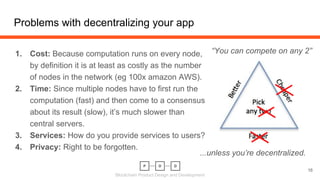
1. Cost: Because computation runs on every node,
by definition it is at least as costly as the number
of nodes in the network (eg 100x amazon AWS).
2. Time: Since multiple nodes have to first run the
computation (fast) and then come to a consensus
about its result (slow), it’s much slower than
central servers.
3. Services: How do you provide services to users?
4. Privacy: Right to be forgotten.
Problems with decentralizing your app
16
“You can compete on any 2”
...unless you’re decentralized.
Blockchain Product Design and Development
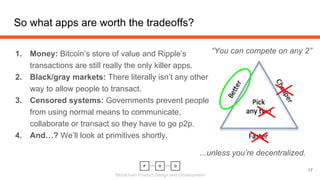
1. Money: Bitcoin’s store of value and Ripple’s
transactions are still really the only killer apps.
2. Black/gray markets: There literally isn’t any other
way to allow people to transact.
3. Censored systems: Governments prevent people
from using normal means to communicate,
collaborate or transact so they have to go p2p.
4. And…? We’ll look at primitives shortly.
So what apps are worth the tradeoffs?
17
“You can compete on any 2”
...unless you’re decentralized.
Blockchain Product Design and Development
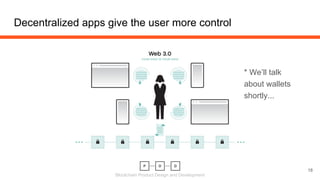
Decentralized apps give the user more control
18
* We’ll talk
about wallets
shortly...
Blockchain Product Design and Development
Blockchain DApps are getting more sophisticated
19
1. Money Transfer: Bitcoin is the decentralized
network and its transfers act like a basic DApp.
2. Programmable Money: Adding logic to the
transfers and executing basic code is a DApp.
3. Turing Complete Smart Contracts: The
blockchain runs a virtual computer that can
process anything.
Blockchain Product Design and Development
Roadmap
20
1. About Decentralized Apps
2. Blockchain Primitives
3. DApp Interactions
4. Case Study: CryptoKitties
5. DApp Technical Architecture
6. Further Considerations
Blockchain Product Design and Development
1. Identity: Everyone gets an account which gives
them a bucket of stuff to hold onto, sort of like a
safety deposit box that lives on the chain.
2. Transactions: The idea of transferring tangible
and intangible goods is fundamental to
blockchains.
3. Cryptography: Chains only exist because of
cryptography and they expose it to anyone’s use.
Blockchain primitives (aka “what it gives you for free”)
21
Blockchain Product Design and Development
Why should I build on blockchain?
22
“So decentralized apps have a sort of abstract
protection against censorship but are slower and
more expensive than centralized ones... how do
they help me as a developer?”
Blockchain Product Design and Development
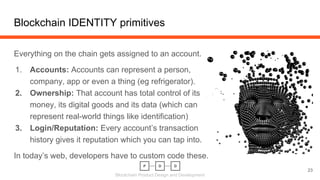
Everything on the chain gets assigned to an account.
1. Accounts: Accounts can represent a person,
company, app or even a thing (eg refrigerator).
2. Ownership: That account has total control of its
money, its digital goods and its data (which can
represent real-world things like identification)
3. Login/Reputation: Every account’s transaction
history gives it reputation which you can tap into.
In today’s web, developers have to custom code these.
Blockchain IDENTITY primitives
23
Blockchain Product Design and Development
Everything on the chain gets assigned to an account.
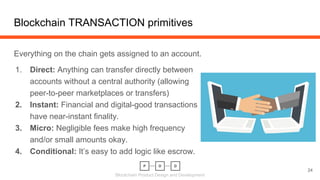
1. Direct: Anything can transfer directly between
accounts without a central authority (allowing
peer-to-peer marketplaces or transfers)
2. Instant: Financial and digital-good transactions
have near-instant finality.
3. Micro: Negligible fees make high frequency
and/or small amounts okay.
4. Conditional: It’s easy to add logic like escrow.
Blockchain TRANSACTION primitives
24
Blockchain Product Design and Development
Cryptographic primitives give anyone easy ability to:
1. Verify Activity: Did you do a specific thing or
have specific data on a specific date? Eg supply
chains, ad activity, transfers.
2. Verify Process Integrity: Is this “random”
algorithm actually fair?
This is because it’s easy for anyone to use their
account’s private key to “sign” transactions or data.
Blockchain CRYPTOGRAPHY primitives
25
Blockchain Product Design and Development
✓ Need P2P transactions?
✓ Need to handle money transfers?
✓ Need simple verifiability of actions?
✓ Need to give users digital stuff?
Instant transactions? Escrow?
...and so on.
Blockchain makes a number of things easy… sort of.
26
Blockchain Product Design and Development
Roadmap
27
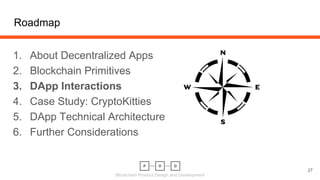
1. About Decentralized Apps
2. Blockchain Primitives
3. DApp Interactions
4. Case Study: CryptoKitties
5. DApp Technical Architecture
6. Further Considerations
Blockchain Product Design and Development
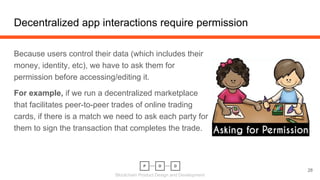
Decentralized app interactions require permission
28
Because users control their data (which includes their
money, identity, etc), we have to ask them for
permission before accessing/editing it.
For example, if we run a decentralized marketplace
that facilitates peer-to-peer trades of online trading
cards, if there is a match we need to ask each party for
them to sign the transaction that completes the trade.
Blockchain Product Design and Development
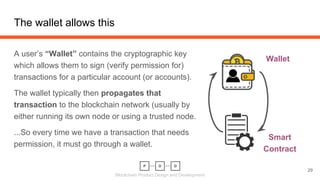
The wallet allows this
29
A user’s “Wallet” contains the cryptographic key
which allows them to sign (verify permission for)
transactions for a particular account (or accounts).
The wallet typically then propagates that
transaction to the blockchain network (usually by
either running its own node or using a trusted node.
...So every time we have a transaction that needs
permission, it must go through a wallet.
Wallet
Smart
Contract
Blockchain Product Design and Development
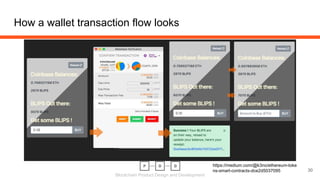
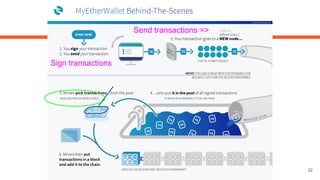
How a wallet transaction flow looks
30
https://medium.com/@k3no/ethereum-toke
ns-smart-contracts-dce2d5037095
Blockchain Product Design and Development
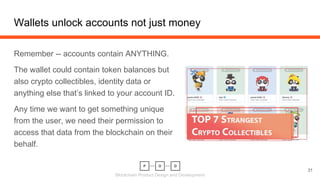
Wallets unlock accounts not just money
31
Remember -- accounts contain ANYTHING.
The wallet could contain token balances but
also crypto collectibles, identity data or
anything else that’s linked to your account ID.
Any time we want to get something unique
from the user, we need their permission to
access that data from the blockchain on their
behalf.
Blockchain Product Design and Development
32
Sign transactions
Send transactions =>
Blockchain Product Design and Development
Roadmap
33
1. About Decentralized Apps
2. Blockchain Primitives
3. DApp Interactions
4. Case Study: CryptoKitties
5. DApp Technical Architecture
6. Further Considerations
Blockchain Product Design and Development
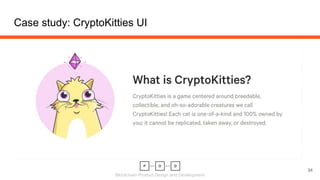
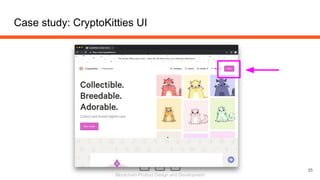
Case study: CryptoKitties UI
34
Blockchain Product Design and Development
Case study: CryptoKitties UI
35
Blockchain Product Design and Development
Case study: CryptoKitties UI
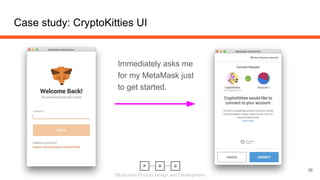
36
Immediately asks me
for my MetaMask just
to get started.
Blockchain Product Design and Development
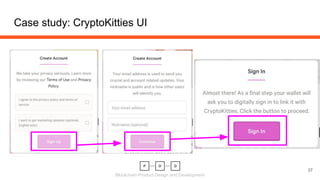
Case study: CryptoKitties UI
37
Blockchain Product Design and Development
Case study: CryptoKitties UI
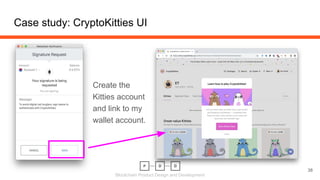
38
Create the
Kitties account
and link to my
wallet account.
Blockchain Product Design and Development
Case study: CryptoKitties UI
39
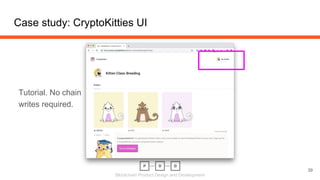
Tutorial. No chain
writes required.
Blockchain Product Design and Development
Case study: CryptoKitties UI
40
Blockchain Product Design and Development
Case study: CryptoKitties UI
41
Blockchain Product Design and Development
Case study: CryptoKitties UI
42
Details
Blockchain Product Design and Development
Case study: CryptoKitties UI
43
And we wait until the seller
approves the sale…
Moving on.
Blockchain Product Design and Development
Roadmap
44
1. About Decentralized Apps
2. Blockchain Primitives
3. DApp Interactions
4. Case Study: CryptoKitties
5. DApp Technical Architecture
6. Further Considerations
Blockchain Product Design and Development
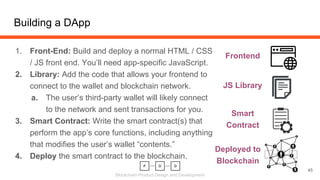
1. Front-End: Build and deploy a normal HTML / CSS
/ JS front end. You’ll need app-specific JavaScript.
2. Library: Add the code that allows your frontend to
connect to the wallet and blockchain network.
a. The user’s third-party wallet will likely connect
to the network and sent transactions for you.
3. Smart Contract: Write the smart contract(s) that
perform the app’s core functions, including anything
that modifies the user’s wallet “contents.”
4. Deploy the smart contract to the blockchain.
Building a DApp
45
Frontend
Smart
Contract
Deployed to
Blockchain
JS Library
Blockchain Product Design and Development
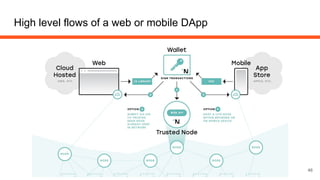
High level flows of a web or mobile DApp
46
Blockchain Product Design and Development
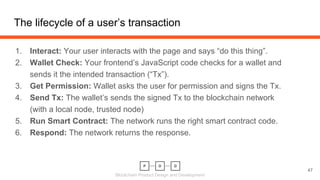
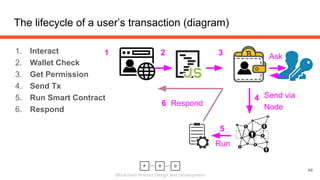
The lifecycle of a user’s transaction
47
1. Interact: Your user interacts with the page and says “do this thing”.
2. Wallet Check: Your frontend’s JavaScript code checks for a wallet and
sends it the intended transaction (“Tx”).
3. Get Permission: Wallet asks the user for permission and signs the Tx.
4. Send Tx: The wallet’s sends the signed Tx to the blockchain network
(with a local node, trusted node)
5. Run Smart Contract: The network runs the right smart contract code.
6. Respond: The network returns the response.
Blockchain Product Design and Development
The lifecycle of a user’s transaction (diagram)
48
1. Interact
2. Wallet Check
3. Get Permission
4. Send Tx
5. Run Smart Contract
6. Respond
1 2 3
4
5
Send via
Node
Ask
Run
6 Respond
Blockchain Product Design and Development
What you’ll pay attention to
49
As a DApp developer, you’ll probably pay most of your attention to:
1. Smart Contract: Writing the smart contract in a secure fashion can be
very challenging.
2. JavaScript: The code on your front end needs to understand what
requests can be sent to the smart contract and how to do so. Once
you’ve defined your smart contract interface you can code against it in
your frontend (eg React) app.
3. User Interface: The user flows can be challenging to get right.
Blockchain Product Design and Development
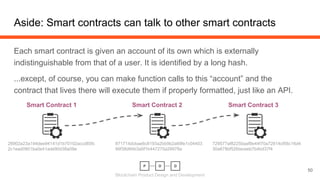
Each smart contract is given an account of its own which is externally
indistinguishable from that of a user. It is identified by a long hash.
...except, of course, you can make function calls to this “account” and the
contract that lives there will execute them if properly formatted, just like an API.
Aside: Smart contracts can talk to other smart contracts
50
28902a23a194dee94141d1b70102accd85fc
2c1ead0901ba0e41ade90d38a08e
871714dcbae6c8193a2bb9b2a69fe1c04403
99f38d94b3a0f1b447275a29978a
729577af82250aaf9e44f70a72814cf56c16d4
30a878bf52fdaceeb7b4bd37f4
Smart Contract 1 Smart Contract 2 Smart Contract 3
Blockchain Product Design and Development
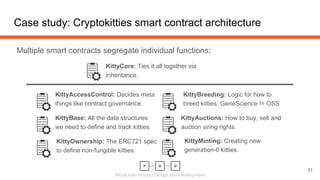
Case study: Cryptokitties smart contract architecture
Multiple smart contracts segregate individual functions:
51
KittyAccessControl: Decides meta
things like contract governance.
KittyBase: All the data structures
we need to define and track kitties.
KittyOwnership: The ERC721 spec
to define non-fungible kitties.
KittyBreeding: Logic for how to
breed kitties. GeneScience != OSS
KittyAuctions: How to buy, sell and
auction siring rights.
KittyMinting: Creating new
generation-0 kitties.
KittyCore: Ties it all together via
inheritance.
Blockchain Product Design and Development
Case study: Cryptokitties architectural notes
1. The display logic for kitties is on their server. Kitties are defined
by a genetic code which you own but the UI is theirs.
2. Their website is served from some sort of static host, not the
blockchain.
3. They have essentially hard-coded the use of MetaMask, which
is a third-party wallet provider for Ethereum.
4. Their code is available at: https://ethfiddle.com/09YbyJRfiI
52
Blockchain Product Design and Development
Roadmap
53
1. About Decentralized Apps
2. Blockchain Primitives
3. DApp Interactions
4. Case Study: CryptoKitties
5. DApp Technical Architecture
6. Further Considerations
Blockchain Product Design and Development
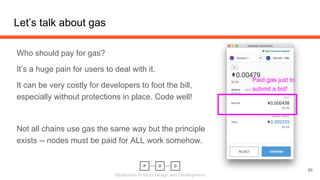
Let’s talk about gas
In Bitcoin, each block has a maximum size which is determined in
bytes to allow fast propagation. That determines how many
transactions each block can fit.
In smart contract platforms, a more appropriate measure is how
much computation a given transaction actually requires the miner to
perform.
Gas is the accounting measure used to decide how complex a
particular transaction is.
54
Blockchain Product Design and Development
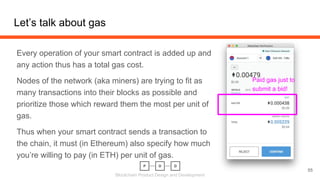
Let’s talk about gas
Every operation of your smart contract is added up and
any action thus has a total gas cost.
Nodes of the network (aka miners) are trying to fit as
many transactions into their blocks as possible and
prioritize those which reward them the most per unit of
gas.
Thus when your smart contract sends a transaction to
the chain, it must (in Ethereum) also specify how much
you’re willing to pay (in ETH) per unit of gas.
55
Paid gas just to
submit a bid!
Blockchain Product Design and Development
Let’s talk about gas
Who should pay for gas?
It’s a huge pain for users to deal with it.
It can be very costly for developers to foot the bill,
especially without protections in place. Code well!
Not all chains use gas the same way but the principle
exists -- nodes must be paid for ALL work somehow.
56
Paid gas just to
submit a bid!
Blockchain Product Design and Development
Diving deeper
Data Storage: Storage is very expensive to do on-chain because you’re
storing in every node! Offload as much as you can. If you need
decentralization, check out IPFS, a decentralized file storage using
peer-to-peer principles similar to BitTorrent.
Naming: Human-readable IDs (instead of long hashes) are a big problem.
The project Namecoin is one of many projects trying to provide a single
decentralized place to register and look up names.
57
Blockchain Product Design and Development
Issues to think about
1. Open Source: DApp culture is all about
transparency so open-source is the way to go.
2. Governance: Who actually decides what happens
when you need to upgrade the contract? Who has
control over its treasury balances?
3. Decentralization: What exactly do you let users
control? Eg. CryptoKitties DNA or display?
4. Oracles: Where do we get third-party information
from for smart contracts to use?
58
Blockchain Product Design and Development
Thank you!
59

Decentralized applications 101: How and why to build a DApp

  • 1.
  • 2.
    Blockchain Product Designand Development When you’re peering curiously into blockchain... “I think I want to build a decentralized app but can’t figure out WHY I actually should or HOW to do it.” 2
  • 3.
    Blockchain Product Designand Development 2 problems 1. It’s really hard to find information on what the heck a “DApp” actually is and why anyone should really care. Just a bunch of crap about writing your ICO whitepaper. 2. Anything more detailed gets super technical and still doesn’t provide concepts. I’ll address both of these today. 3
  • 4.
    Blockchain Product Designand Development About Me I’m Erik Trautman and I run operations at NEAR Protocol, a scalable blockchain and smart contract platform on a mission to bring the technology to a billion devices around the world. I also care deeply about creating great products, educating people and building rich ecosystems. My background is in markets, open-source software development, startup leadership and education. And general nerdery. Learn more about NEAR at http://www.nearprotocol.com 4
  • 5.
    Blockchain Product Designand Development Roadmap 5 1. About Decentralized Apps 2. Blockchain Primitives 3. DApp Interactions 4. Case Study: CryptoKitties 5. DApp Technical Architecture 6. Further Considerations
  • 6.
    Blockchain Product Designand Development Roadmap 6 1. About Decentralized Apps 2. Blockchain Primitives 3. DApp Interactions 4. Case Study: CryptoKitties 5. DApp Technical Architecture 6. Further Considerations
  • 7.
    Blockchain Product Designand Development What is a decentralized app (DApp)? 7 Requirements: 1. Running of the app (and its data) is distributed across lots of people/nodes 2. There is no single (central) point of failure… it’s “unkillable” NOT requirements: 1. Having a token (or an ICO). 2. Being open source (though they should be for trust purposes)
  • 8.
    Blockchain Product Designand Development The DApp is the full application, including its front-end markup, any non-blockchain code on the front end or a separate server AND the smart contract. The Smart Contract is just the portion of the app that actually works with the blockchain. Terminology: DApps vs smart contracts 8 DApp Smart Contract
  • 9.
    Blockchain Product Designand Development Centralized applications of “Web 2.0” (today) 9 1. The front end (what you see) of the app is served from a server controlled by a particular developer or company. It’s probably cloud-hosted today. 2. Requests from front end are run on ONE server. 3. The data from that server and all your interactions with it flow to the company’s ONE database. The server and/or database might be distributed across multiple data centers or the cloud but it’s still run once and controlled by one individual or company. Browser Server Database
  • 10.
    Blockchain Product Designand Development 1. Experience Control: The product roadmap and user experience can be tightly controlled. 2. Clear Business Models: We know exactly how to create business value by monetizing user data. 3. Cost: It’s very low cost to host apps. 4. Speed: It’s very fast to run apps. 5. Iteration: It’s easy to iterate quickly and make changes quickly to stay ahead of technology or the market. 6. Clear Moats: User lock-in is well understood. Advantages of centralization 10 Browser Server Database
  • 11.
    Blockchain Product Designand Development Downsides of centralization 11 1. Censorship: a. Intentional: eg Facebook kicking you or your app off their platform b. Unintended: eg Government requiring Facebook to turn over their data on you or ceasing operations 2. Hacking: Central data is a constant target 3. Data Sales: The company gets purchased or goes bankrupt and your data is now in the hands of the highest bidder. Browser Server Database
  • 12.
    Blockchain Product Designand Development Centralized apps lead to data hoarding and lock-in 12
  • 13.
    Blockchain Product Designand Development Decentralized applications of “Web 3.0” 13 1. The application still needs the same front-end stuff (HTML/CSS/JS) served from somewhere, eg. a cloud or a static hosting site or P2P network. 2. The front end talks to the Smart Contract using its API (via wallet). 3. The Smart Contract runs code and stores data on the blockchain network. This data is generally stored on behalf of the user. Browser Hosting Blockchain Network Smart Contract
  • 14.
    Blockchain Product Designand Development Most diagrams get this wrong! The key feature is that EVERY node that makes up the network runs the smart contract and stores the blockchain’s data. These nodes, including your app, agree on the result to return to the frontend. This gives us decentralization. Blockchains are peer-to-peer *networks* 14 100 nodes? 1k? 10k?
  • 15.
    Blockchain Product Designand Development 1. No Censorship: Data and code execution are spread out over lots of nodes so there is no single point to censor or fail. 2. No Platform Risk: A special case of censorship, no platform (like Facebook) can shut down your app because it became too successful or controversial. 3. Transparency: Everyone can see what code will run so it’s verifiably fair and accurate. Advantages of decentralization 15
  • 16.
    Blockchain Product Designand Development 1. Cost: Because computation runs on every node, by definition it is at least as costly as the number of nodes in the network (eg 100x amazon AWS). 2. Time: Since multiple nodes have to first run the computation (fast) and then come to a consensus about its result (slow), it’s much slower than central servers. 3. Services: How do you provide services to users? 4. Privacy: Right to be forgotten. Problems with decentralizing your app 16 “You can compete on any 2” ...unless you’re decentralized.
  • 17.
    Blockchain Product Designand Development 1. Money: Bitcoin’s store of value and Ripple’s transactions are still really the only killer apps. 2. Black/gray markets: There literally isn’t any other way to allow people to transact. 3. Censored systems: Governments prevent people from using normal means to communicate, collaborate or transact so they have to go p2p. 4. And…? We’ll look at primitives shortly. So what apps are worth the tradeoffs? 17 “You can compete on any 2” ...unless you’re decentralized.
  • 18.
    Blockchain Product Designand Development Decentralized apps give the user more control 18 * We’ll talk about wallets shortly...
  • 19.
    Blockchain Product Designand Development Blockchain DApps are getting more sophisticated 19 1. Money Transfer: Bitcoin is the decentralized network and its transfers act like a basic DApp. 2. Programmable Money: Adding logic to the transfers and executing basic code is a DApp. 3. Turing Complete Smart Contracts: The blockchain runs a virtual computer that can process anything.
  • 20.
    Blockchain Product Designand Development Roadmap 20 1. About Decentralized Apps 2. Blockchain Primitives 3. DApp Interactions 4. Case Study: CryptoKitties 5. DApp Technical Architecture 6. Further Considerations
  • 21.
    Blockchain Product Designand Development 1. Identity: Everyone gets an account which gives them a bucket of stuff to hold onto, sort of like a safety deposit box that lives on the chain. 2. Transactions: The idea of transferring tangible and intangible goods is fundamental to blockchains. 3. Cryptography: Chains only exist because of cryptography and they expose it to anyone’s use. Blockchain primitives (aka “what it gives you for free”) 21
  • 22.
    Blockchain Product Designand Development Why should I build on blockchain? 22 “So decentralized apps have a sort of abstract protection against censorship but are slower and more expensive than centralized ones... how do they help me as a developer?”
  • 23.
    Blockchain Product Designand Development Everything on the chain gets assigned to an account. 1. Accounts: Accounts can represent a person, company, app or even a thing (eg refrigerator). 2. Ownership: That account has total control of its money, its digital goods and its data (which can represent real-world things like identification) 3. Login/Reputation: Every account’s transaction history gives it reputation which you can tap into. In today’s web, developers have to custom code these. Blockchain IDENTITY primitives 23
  • 24.
    Blockchain Product Designand Development Everything on the chain gets assigned to an account. 1. Direct: Anything can transfer directly between accounts without a central authority (allowing peer-to-peer marketplaces or transfers) 2. Instant: Financial and digital-good transactions have near-instant finality. 3. Micro: Negligible fees make high frequency and/or small amounts okay. 4. Conditional: It’s easy to add logic like escrow. Blockchain TRANSACTION primitives 24
  • 25.
    Blockchain Product Designand Development Cryptographic primitives give anyone easy ability to: 1. Verify Activity: Did you do a specific thing or have specific data on a specific date? Eg supply chains, ad activity, transfers. 2. Verify Process Integrity: Is this “random” algorithm actually fair? This is because it’s easy for anyone to use their account’s private key to “sign” transactions or data. Blockchain CRYPTOGRAPHY primitives 25
  • 26.
    Blockchain Product Designand Development ✓ Need P2P transactions? ✓ Need to handle money transfers? ✓ Need simple verifiability of actions? ✓ Need to give users digital stuff? Instant transactions? Escrow? ...and so on. Blockchain makes a number of things easy… sort of. 26
  • 27.
    Blockchain Product Designand Development Roadmap 27 1. About Decentralized Apps 2. Blockchain Primitives 3. DApp Interactions 4. Case Study: CryptoKitties 5. DApp Technical Architecture 6. Further Considerations
  • 28.
    Blockchain Product Designand Development Decentralized app interactions require permission 28 Because users control their data (which includes their money, identity, etc), we have to ask them for permission before accessing/editing it. For example, if we run a decentralized marketplace that facilitates peer-to-peer trades of online trading cards, if there is a match we need to ask each party for them to sign the transaction that completes the trade.
  • 29.
    Blockchain Product Designand Development The wallet allows this 29 A user’s “Wallet” contains the cryptographic key which allows them to sign (verify permission for) transactions for a particular account (or accounts). The wallet typically then propagates that transaction to the blockchain network (usually by either running its own node or using a trusted node. ...So every time we have a transaction that needs permission, it must go through a wallet. Wallet Smart Contract
  • 30.
    Blockchain Product Designand Development How a wallet transaction flow looks 30 https://medium.com/@k3no/ethereum-toke ns-smart-contracts-dce2d5037095
  • 31.
    Blockchain Product Designand Development Wallets unlock accounts not just money 31 Remember -- accounts contain ANYTHING. The wallet could contain token balances but also crypto collectibles, identity data or anything else that’s linked to your account ID. Any time we want to get something unique from the user, we need their permission to access that data from the blockchain on their behalf.
  • 32.
    Blockchain Product Designand Development 32 Sign transactions Send transactions =>
  • 33.
    Blockchain Product Designand Development Roadmap 33 1. About Decentralized Apps 2. Blockchain Primitives 3. DApp Interactions 4. Case Study: CryptoKitties 5. DApp Technical Architecture 6. Further Considerations
  • 34.
    Blockchain Product Designand Development Case study: CryptoKitties UI 34
  • 35.
    Blockchain Product Designand Development Case study: CryptoKitties UI 35
  • 36.
    Blockchain Product Designand Development Case study: CryptoKitties UI 36 Immediately asks me for my MetaMask just to get started.
  • 37.
    Blockchain Product Designand Development Case study: CryptoKitties UI 37
  • 38.
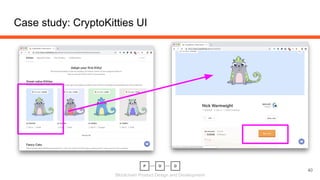
    Blockchain Product Designand Development Case study: CryptoKitties UI 38 Create the Kitties account and link to my wallet account.
  • 39.
    Blockchain Product Designand Development Case study: CryptoKitties UI 39 Tutorial. No chain writes required.
  • 40.
    Blockchain Product Designand Development Case study: CryptoKitties UI 40
  • 41.
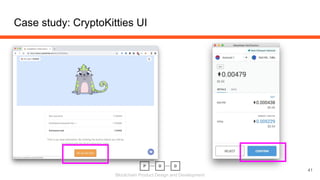
    Blockchain Product Designand Development Case study: CryptoKitties UI 41
  • 42.
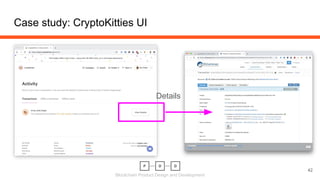
    Blockchain Product Designand Development Case study: CryptoKitties UI 42 Details
  • 43.
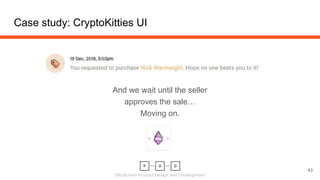
    Blockchain Product Designand Development Case study: CryptoKitties UI 43 And we wait until the seller approves the sale… Moving on.
  • 44.
    Blockchain Product Designand Development Roadmap 44 1. About Decentralized Apps 2. Blockchain Primitives 3. DApp Interactions 4. Case Study: CryptoKitties 5. DApp Technical Architecture 6. Further Considerations
  • 45.
    Blockchain Product Designand Development 1. Front-End: Build and deploy a normal HTML / CSS / JS front end. You’ll need app-specific JavaScript. 2. Library: Add the code that allows your frontend to connect to the wallet and blockchain network. a. The user’s third-party wallet will likely connect to the network and sent transactions for you. 3. Smart Contract: Write the smart contract(s) that perform the app’s core functions, including anything that modifies the user’s wallet “contents.” 4. Deploy the smart contract to the blockchain. Building a DApp 45 Frontend Smart Contract Deployed to Blockchain JS Library
  • 46.
    Blockchain Product Designand Development High level flows of a web or mobile DApp 46
  • 47.
    Blockchain Product Designand Development The lifecycle of a user’s transaction 47 1. Interact: Your user interacts with the page and says “do this thing”. 2. Wallet Check: Your frontend’s JavaScript code checks for a wallet and sends it the intended transaction (“Tx”). 3. Get Permission: Wallet asks the user for permission and signs the Tx. 4. Send Tx: The wallet’s sends the signed Tx to the blockchain network (with a local node, trusted node) 5. Run Smart Contract: The network runs the right smart contract code. 6. Respond: The network returns the response.
  • 48.
    Blockchain Product Designand Development The lifecycle of a user’s transaction (diagram) 48 1. Interact 2. Wallet Check 3. Get Permission 4. Send Tx 5. Run Smart Contract 6. Respond 1 2 3 4 5 Send via Node Ask Run 6 Respond
  • 49.
    Blockchain Product Designand Development What you’ll pay attention to 49 As a DApp developer, you’ll probably pay most of your attention to: 1. Smart Contract: Writing the smart contract in a secure fashion can be very challenging. 2. JavaScript: The code on your front end needs to understand what requests can be sent to the smart contract and how to do so. Once you’ve defined your smart contract interface you can code against it in your frontend (eg React) app. 3. User Interface: The user flows can be challenging to get right.
  • 50.
    Blockchain Product Designand Development Each smart contract is given an account of its own which is externally indistinguishable from that of a user. It is identified by a long hash. ...except, of course, you can make function calls to this “account” and the contract that lives there will execute them if properly formatted, just like an API. Aside: Smart contracts can talk to other smart contracts 50 28902a23a194dee94141d1b70102accd85fc 2c1ead0901ba0e41ade90d38a08e 871714dcbae6c8193a2bb9b2a69fe1c04403 99f38d94b3a0f1b447275a29978a 729577af82250aaf9e44f70a72814cf56c16d4 30a878bf52fdaceeb7b4bd37f4 Smart Contract 1 Smart Contract 2 Smart Contract 3
  • 51.
    Blockchain Product Designand Development Case study: Cryptokitties smart contract architecture Multiple smart contracts segregate individual functions: 51 KittyAccessControl: Decides meta things like contract governance. KittyBase: All the data structures we need to define and track kitties. KittyOwnership: The ERC721 spec to define non-fungible kitties. KittyBreeding: Logic for how to breed kitties. GeneScience != OSS KittyAuctions: How to buy, sell and auction siring rights. KittyMinting: Creating new generation-0 kitties. KittyCore: Ties it all together via inheritance.
  • 52.
    Blockchain Product Designand Development Case study: Cryptokitties architectural notes 1. The display logic for kitties is on their server. Kitties are defined by a genetic code which you own but the UI is theirs. 2. Their website is served from some sort of static host, not the blockchain. 3. They have essentially hard-coded the use of MetaMask, which is a third-party wallet provider for Ethereum. 4. Their code is available at: https://ethfiddle.com/09YbyJRfiI 52
  • 53.
    Blockchain Product Designand Development Roadmap 53 1. About Decentralized Apps 2. Blockchain Primitives 3. DApp Interactions 4. Case Study: CryptoKitties 5. DApp Technical Architecture 6. Further Considerations
  • 54.
    Blockchain Product Designand Development Let’s talk about gas In Bitcoin, each block has a maximum size which is determined in bytes to allow fast propagation. That determines how many transactions each block can fit. In smart contract platforms, a more appropriate measure is how much computation a given transaction actually requires the miner to perform. Gas is the accounting measure used to decide how complex a particular transaction is. 54
  • 55.
    Blockchain Product Designand Development Let’s talk about gas Every operation of your smart contract is added up and any action thus has a total gas cost. Nodes of the network (aka miners) are trying to fit as many transactions into their blocks as possible and prioritize those which reward them the most per unit of gas. Thus when your smart contract sends a transaction to the chain, it must (in Ethereum) also specify how much you’re willing to pay (in ETH) per unit of gas. 55 Paid gas just to submit a bid!
  • 56.
    Blockchain Product Designand Development Let’s talk about gas Who should pay for gas? It’s a huge pain for users to deal with it. It can be very costly for developers to foot the bill, especially without protections in place. Code well! Not all chains use gas the same way but the principle exists -- nodes must be paid for ALL work somehow. 56 Paid gas just to submit a bid!
  • 57.
    Blockchain Product Designand Development Diving deeper Data Storage: Storage is very expensive to do on-chain because you’re storing in every node! Offload as much as you can. If you need decentralization, check out IPFS, a decentralized file storage using peer-to-peer principles similar to BitTorrent. Naming: Human-readable IDs (instead of long hashes) are a big problem. The project Namecoin is one of many projects trying to provide a single decentralized place to register and look up names. 57
  • 58.
    Blockchain Product Designand Development Issues to think about 1. Open Source: DApp culture is all about transparency so open-source is the way to go. 2. Governance: Who actually decides what happens when you need to upgrade the contract? Who has control over its treasury balances? 3. Decentralization: What exactly do you let users control? Eg. CryptoKitties DNA or display? 4. Oracles: Where do we get third-party information from for smart contracts to use? 58
  • 59.
    Blockchain Product Designand Development Thank you! 59