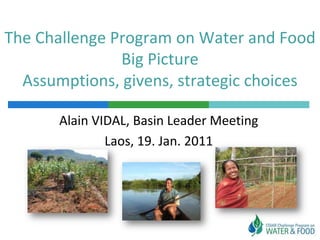
The Challenge Program on Water and Food
               Big Picture
  Assumptions, givens, strategic choices

       Alain VIDAL, Basin Leader Meeting
               Laos, 19. Jan. 2011
Global food crisis:
a poverty “countdown”
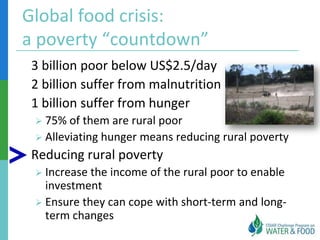
 3 billion poor below US$2.5/day
 2 billion suffer from malnutrition
 1 billion suffer from hunger
  75%  of them are rural poor
  Alleviating hunger means reducing rural poverty
 Reducing rural poverty
  Increase the income of the rural poor to enable
   investment
  Ensure they can cope with short-term and long-
   term changes
The resilience challenge
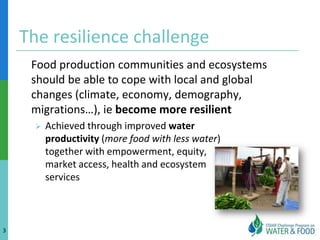
     Food production communities and ecosystems
     should be able to cope with local and global
     changes (climate, economy, demography,
     migrations…), ie become more resilient
         Achieved through improved water
          productivity (more food with less water)
          together with empowerment, equity,
          market access, health and ecosystem
          services


3
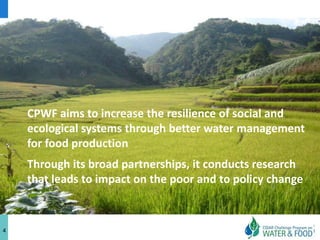
CPWF aims to increase the resilience of social and
    ecological systems through better water management
    for food production
    Through its broad partnerships, it conducts research
    that leads to impact on the poor and to policy change


4
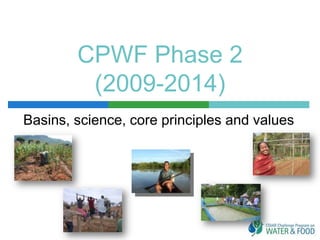
CPWF Phase 2
         (2009-2014)
Basins, science, core principles and values
Focusing our strategy – a quizz

 Why, where and on what do we focus?
 How long are we supposed to live?
 What does one basin development program cost?
 How many partners does it include?
Six basin development challenges
 Andes – Benefit-sharing mechanisms
 Ganges – Floods and salt in the Delta
 Limpopo – Small reservoirs, rainwater and livelihoods
 Mekong – Dams and livelihoods
 Nile – Rainwater management in Ethiopia
 Volta – Small reservoirs, rainwater and livelihoods
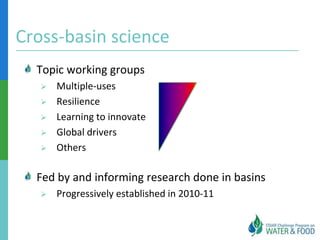
Cross-basin science
  Topic working groups
      Multiple-uses
      Resilience
      Learning to innovate
      Global drivers
      Others

  Fed by and informing research done in basins
      Progressively established in 2010-11
How we work
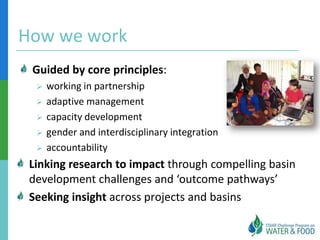
 Guided by core principles:
     working in partnership
     adaptive management
     capacity development
     gender and interdisciplinary integration
     accountability
 Linking research to impact through compelling basin
 development challenges and ‘outcome pathways’
 Seeking insight across projects and basins
In other words…
      Projects contribute to achieving the BDC - hence
      should adhere to core principles
      Basin focus but mechanisms in place to ensure cross
      basin learning - TWGs
      Our whole Program Team in place to make
      integrated process work
      Ability to scale up, replicate, influence and
      contribute to policy change


10
Where do we stand?
   Assets and opportunities
Engaging decision-makers and
marketing Phase 1 outcomes
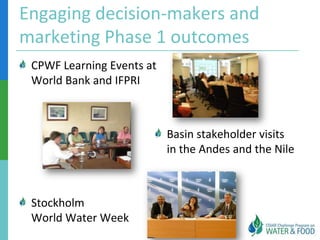
 CPWF Learning Events at
 World Bank and IFPRI


                           Basin stakeholder visits
                           in the Andes and the Nile


 Stockholm
 World Water Week
Marketing outcomes from Phase 1
The major effort to utilize Phase 1 outcomes is
through Phase 2
Continuous flow of Phase 1 legacy outputs
BFP special issues, book and high-level science paper
Science synthesis and evidence-based papers
Strategic engagement with the media (films, print)
Sourcebook for development professionals

Joint IFAD-CPWF initiative on
  Research into Use (5 Phase 1 projects)
  Mainstreaming innovation (19 Phase 1 projects)
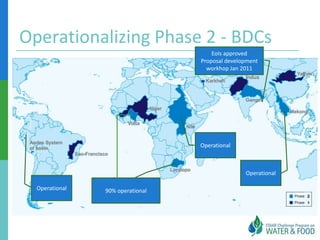
Operationalizing Phase 2 - BDCs
                                      EoIs approved
                                  Proposal development
                                    workhop Jan 2011


                                  Operational


                                                 Operational

  Operational   90% operational
                                                               2
                                                               1
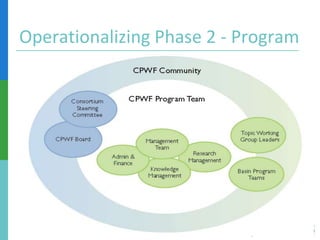
Operationalizing Phase 2 - Program
Basins to engage with
decision-makers and donors
 World Bank and other major global players to be invited
 to basin key events
    Link with program-level
 Fund raising at basin level
    Basin- or activity-specific
    Not for a 2nd BDC
    Any fund raised by CPWF is supposed to benefit CRP5
    Needs to be reflected upon from 2012 with the perspective of
     a basin exit strategy
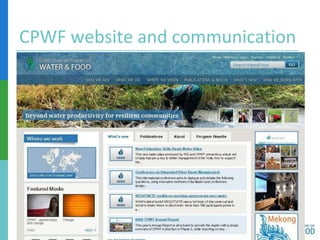
CPWF website and communication
MT responsibilities and
communications rules
 MT basin lead persons
    Boru: Ganges, Limpopo and Nile
    Larry: Andes, Mekong
    Sophie (AD): Volta – plus TWG
 Full responsibilities of budget envelopes
    Boru – Innovation and Impact (incl. KM & publications)
    Larry – Science
    Sophie (AD) - Topic Working Groups
 Program internal communications
    MT skype e-meeting every other Thursday
    E-mail: 1 idea – 1 title – 1 screen
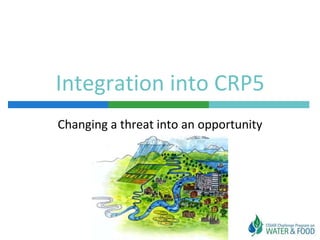
Integration into CRP5
Changing a threat into an opportunity
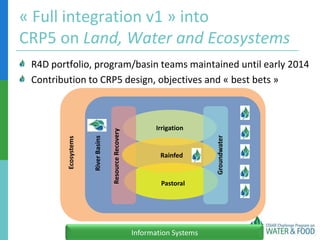
« Full integration v1 » into
CRP5 on Land, Water and Ecosystems
 R4D portfolio, program/basin teams maintained until early 2014
 Contribution to CRP5 design, objectives and « best bets »


                                                                Irrigation
                                     Resource Recovery
                      River Basins
         Ecosystems


                                                                 Rainfed


                                                                 Pastoral


                                                         Information Systems
A science integration learning from
CPWF
 A new Advisory Committee taking over CSC
 functions, guiding our science and being the core of
 the future CRP5’s AC
 CPWF role to better articulated in CRP5
 Start from present writing and build the justification
 for effective integration as a way of strengthening
 CRP5 - in practice test our BDC approach on 1-2
 regional hubs
A governance integration
serving the program’s continuity
 CPWF, its teams and its brand will continue to exist
 until 2014
 CPWF’s interests protected by AC
 Once CRP5 is approved and launched
    IWMI and CPWF board amalgamated
    JVA dissolved
    CPWF Director member of CRP5 Steering Committee,
     Management Committee and IWMI MT
An important reminder

      As a partnership program aiming at alleviating
      poverty, we should constantly look for
       Increasing  our efficiency – be firm on decisions
        and avoid ineffective debates on processes and
        detail issues
       Building alliances rather than walls


23

The CPWF Big Picture

  • 1.
    The Challenge Programon Water and Food Big Picture Assumptions, givens, strategic choices Alain VIDAL, Basin Leader Meeting Laos, 19. Jan. 2011
  • 2.
    Global food crisis: apoverty “countdown” 3 billion poor below US$2.5/day 2 billion suffer from malnutrition 1 billion suffer from hunger  75% of them are rural poor  Alleviating hunger means reducing rural poverty Reducing rural poverty  Increase the income of the rural poor to enable investment  Ensure they can cope with short-term and long- term changes
  • 3.
    The resilience challenge Food production communities and ecosystems should be able to cope with local and global changes (climate, economy, demography, migrations…), ie become more resilient  Achieved through improved water productivity (more food with less water) together with empowerment, equity, market access, health and ecosystem services 3
  • 4.
    CPWF aims toincrease the resilience of social and ecological systems through better water management for food production Through its broad partnerships, it conducts research that leads to impact on the poor and to policy change 4
  • 5.
    CPWF Phase 2 (2009-2014) Basins, science, core principles and values
  • 6.
    Focusing our strategy– a quizz Why, where and on what do we focus? How long are we supposed to live? What does one basin development program cost? How many partners does it include?
  • 7.
    Six basin developmentchallenges Andes – Benefit-sharing mechanisms Ganges – Floods and salt in the Delta Limpopo – Small reservoirs, rainwater and livelihoods Mekong – Dams and livelihoods Nile – Rainwater management in Ethiopia Volta – Small reservoirs, rainwater and livelihoods
  • 8.
    Cross-basin science Topic working groups  Multiple-uses  Resilience  Learning to innovate  Global drivers  Others Fed by and informing research done in basins  Progressively established in 2010-11
  • 9.
    How we work Guided by core principles:  working in partnership  adaptive management  capacity development  gender and interdisciplinary integration  accountability Linking research to impact through compelling basin development challenges and ‘outcome pathways’ Seeking insight across projects and basins
  • 10.
    In other words… Projects contribute to achieving the BDC - hence should adhere to core principles Basin focus but mechanisms in place to ensure cross basin learning - TWGs Our whole Program Team in place to make integrated process work Ability to scale up, replicate, influence and contribute to policy change 10
  • 11.
    Where do westand? Assets and opportunities
  • 12.
    Engaging decision-makers and marketingPhase 1 outcomes CPWF Learning Events at World Bank and IFPRI Basin stakeholder visits in the Andes and the Nile Stockholm World Water Week
  • 13.
    Marketing outcomes fromPhase 1 The major effort to utilize Phase 1 outcomes is through Phase 2 Continuous flow of Phase 1 legacy outputs BFP special issues, book and high-level science paper Science synthesis and evidence-based papers Strategic engagement with the media (films, print) Sourcebook for development professionals Joint IFAD-CPWF initiative on  Research into Use (5 Phase 1 projects)  Mainstreaming innovation (19 Phase 1 projects)
  • 14.
    Operationalizing Phase 2- BDCs EoIs approved Proposal development workhop Jan 2011 Operational Operational Operational 90% operational 2 1
  • 15.
  • 16.
    Basins to engagewith decision-makers and donors World Bank and other major global players to be invited to basin key events  Link with program-level Fund raising at basin level  Basin- or activity-specific  Not for a 2nd BDC  Any fund raised by CPWF is supposed to benefit CRP5  Needs to be reflected upon from 2012 with the perspective of a basin exit strategy
  • 17.
    CPWF website andcommunication
  • 18.
    MT responsibilities and communicationsrules MT basin lead persons  Boru: Ganges, Limpopo and Nile  Larry: Andes, Mekong  Sophie (AD): Volta – plus TWG Full responsibilities of budget envelopes  Boru – Innovation and Impact (incl. KM & publications)  Larry – Science  Sophie (AD) - Topic Working Groups Program internal communications  MT skype e-meeting every other Thursday  E-mail: 1 idea – 1 title – 1 screen
  • 19.
    Integration into CRP5 Changinga threat into an opportunity
  • 20.
    « Full integrationv1 » into CRP5 on Land, Water and Ecosystems R4D portfolio, program/basin teams maintained until early 2014 Contribution to CRP5 design, objectives and « best bets » Irrigation Resource Recovery River Basins Ecosystems Rainfed Pastoral Information Systems
  • 21.
    A science integrationlearning from CPWF A new Advisory Committee taking over CSC functions, guiding our science and being the core of the future CRP5’s AC CPWF role to better articulated in CRP5 Start from present writing and build the justification for effective integration as a way of strengthening CRP5 - in practice test our BDC approach on 1-2 regional hubs
  • 22.
    A governance integration servingthe program’s continuity CPWF, its teams and its brand will continue to exist until 2014 CPWF’s interests protected by AC Once CRP5 is approved and launched  IWMI and CPWF board amalgamated  JVA dissolved  CPWF Director member of CRP5 Steering Committee, Management Committee and IWMI MT
  • 23.
    An important reminder As a partnership program aiming at alleviating poverty, we should constantly look for  Increasing our efficiency – be firm on decisions and avoid ineffective debates on processes and detail issues  Building alliances rather than walls 23

Editor's Notes

  • #9 Optional slide (hidden), to be used as a resource.The sunrise triangle shows how far we stand and the progressivity of TWGs’ establishment
  • #10 Points to make (from Boru):Why our core principles? Learned from experience that:Partnership -- Research won’t be relevant nor research outputs put into use without partnership; networkingCapacity development -- Making change happen often requires changes in peoples’ knowledge, attitudes and skills, through capacity developmentAdaptive management -- Real world problems are complex and dynamic, goal post shift, opportunities emerge. Projects, BDCs and the Program must be able to learn, spot opportunity and take advantage of it to really make a differenceGender and diversity -- We work to benefit women, youth, socially excludedInterdisciplinary integration -- Real world problems are complex and multifaceted and unlikely to fall to single disciplinary researchAccountability – we ensure our accountability to our stakeholders while also working to improve accountability systems impacting on water productivity and livelihoods[Suggest don’t go through all, pick your top two]Linking research to impact:We carefully chose compelling basin development challenges to motivate people to get on the busWe then invest early-on in mapping out pathways to the desired outcomes and impact. These pathways, or road maps (for the bus) link the research we do, how we do it (guided by core principles) to changes in next user and end user knowledge, attitude, skills and practice. Agreeing these outcome pathways, and who needs to do what, when, helps ensure programmatic coherence and helps set priorities. The road map can change, indeed we expect it to change, once the journey begins (adaptive management). We manage our program to allow that to happen (part of what makes us different).We systematically seek insight across our projects and basins by:Being guided by conceptual frameworks the CPWF sees useful to guide practice and to which it seeks to help develop (e.g., Resilience, MUS, Innovation Systems)Setting up and supporting Topic Working Groups as a mechanism for doing 1)Setting up our 28 projects as experiments into how research does (and does not) foster innovation and developmental changeOther key elements to add (left in from Amanda) here by speaking to the slide (if not mentioned before)Projects contribute to achieving the BDC (hence should adhere to core principles)Basin focus but mechanisms in place to ensure cross basin learning (covered by the previous slide if needed)Team in place to make integrated process workAbility to scale up, replicate, influence and contribute to policy change
  • #19 MV: Do we have running points for the MT meetings?Yes, agenda items are the following:BDCs DEVELOPMENT, COMMISSIONING AND CONTRACTINGTOPIC WORKING GROUPSBUDGETSCOMMUNICATIONSCRP5 STRATEGY AND WORKSHOPMT CALENDAR