Richer river environments through
 restoration: policy opportunities and
              challenges


Chris Baker, Head of 
Strategy and programme 
Wetlands and Water 
Resources
22nd May 2012
Restoration


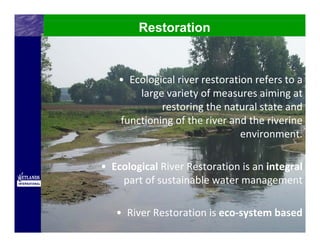
    • Ecological river restoration refers to a 
        large variety of measures aiming at 
             restoring the natural state and 
    functioning of the river and the riverine 
                                environment. 

• Ecological River Restoration is an integral 
    part of sustainable water management 

   • River Restoration is eco‐system based 
Why is river restoration relevant and
            important now?
• Increased pollution
• Water shortages
• Increased disaster risk

• Ecosystem services provide options

• River Restoration is a cross‐cutting tool 
   – Sustainable
   – Cost effective
   – Multiple benefits are possible
Existing policy environment
Restoration drivers
• Water Framework Directive and Flood Risk Management Directive
    – WFD Programme of measures 
    – Flood risk management planning 
    – But, limited use of River restoration as a tool

• Habitats Directive
   – Conservation and restoration of ecosystems
   – Focus on biodiversity rich areas
   – Important driver of restoration 

Restoration Delivery
• Supporting delivery of river restoration
    – E.g. Nitrates Directive, CAP
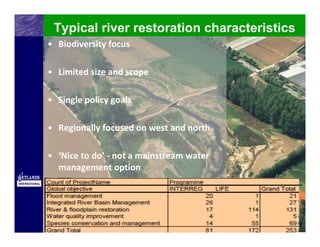
Typical river restoration characteristics
• Biodiversity focus

• Limited size and scope

• Single policy goals

• Regionally focused on west and north

• ‘Nice to do’ ‐ not a mainstream water 
  management option
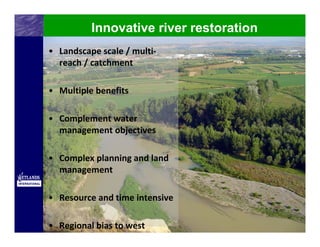
Innovative river restoration
• Landscape scale / multi‐
  reach / catchment

• Multiple benefits

• Complement water 
  management objectives

• Complex planning and land 
  management

• Resource and time intensive

• Regional bias to west
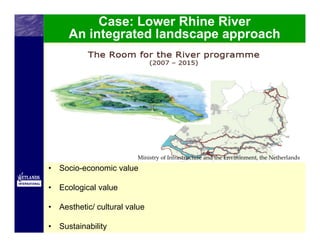
Case: Lower Rhine River
      An integrated landscape approach


                          Ministry of Infrastructure and the Environment, the Netherlands

•   Socio-economic value

•   Ecological value

•   Aesthetic/ cultural value

•   Sustainability
Agri-Environment review
• Agricultural policy can be a means to deliver river 
  restoration. E.g. 
   – Buffer zones 
   – Re‐flooding floodplains

• Greening of farmer payments – link to 
  environmental outcomes

• Cross compliance to the WFD
EU 2020 Biodiversity Strategy
• 2020 headline target
• “Halting the loss of biodiversity and the degradation 
  of ecosystem services in the EU by 2020, and 
  restoring them…”

• TARGET 2: MAINTAIN AND RESTORE ECOSYSTEMS 
  AND THEIR SERVICES
   – By 2020, ecosystems and their services are maintained 
     and enhanced by establishing green infrastructure and 
     restoring at least 15 % of degraded ecosystems
   – Action 6: Set priorities to restore and promote the use of 
     green infrastructure
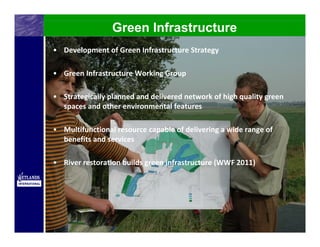
Green Infrastructure
• Development of Green Infrastructure Strategy

• Green Infrastructure Working Group

• Strategically planned and delivered network of high quality green 
  spaces and other environmental features

• Multifunctional resource capable of delivering a wide range of 
  benefits and services

• River restoration builds green infrastructure (WWF 2011)
Blueprint to safeguard Europe’s Water
               Resources
• Problem 3: Land use impacts and in particular agriculture's 
  impacts threaten water  quality and quantity across much 
  of Europe and deregulate water flow increasing water 
  scarcity and flood risks. 
   – Guidance clearly defining a EU framework for green infrastructures
   – Develop guidance for integrated water – land‐use management
   – Enhance scope of SEA


• Problem 9: Costs and benefits of inaction and of water 
  related measures are not properly understood or 
  quantified
   – A methodology for the calculation of costs and benefits that 
     includes environmental resource and ecosystem services costs
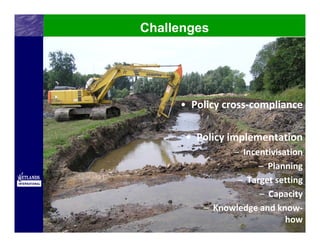
Challenges


     • Policy cross‐compliance

      • Policy implementation
               – Incentivisation
                     – Planning 
                – Target setting
                     – Capacity
         – Knowledge and know‐
                            how
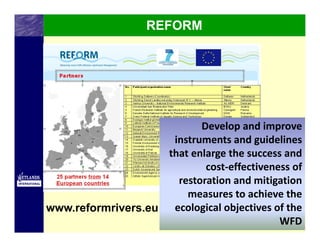
REFORM


                           Develop and improve 
                     instruments and guidelines 
                    that enlarge the success and 
                            cost‐effectiveness of 
                      restoration and mitigation 
                        measures to achieve the 
www.reformrivers.eu ecological objectives of the 
                                            WFD
RESTORE and ECRR
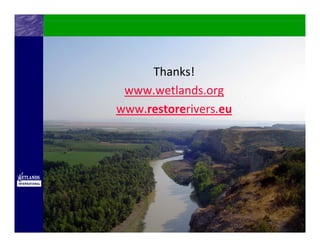
Thanks!
 www.wetlands.org
www.restorerivers.eu

Green week presentation eu rivers - Chris Baker

  • 1.
    Richer river environmentsthrough restoration: policy opportunities and challenges Chris Baker, Head of  Strategy and programme  Wetlands and Water  Resources 22nd May 2012
  • 2.
    Restoration • Ecological river restoration refers to a  large variety of measures aiming at  restoring the natural state and  functioning of the river and the riverine  environment.  • Ecological River Restoration is an integral  part of sustainable water management  • River Restoration is eco‐system based 
  • 3.
    Why is riverrestoration relevant and important now? • Increased pollution • Water shortages • Increased disaster risk • Ecosystem services provide options • River Restoration is a cross‐cutting tool  – Sustainable – Cost effective – Multiple benefits are possible
  • 4.
    Existing policy environment Restoration drivers •Water Framework Directive and Flood Risk Management Directive – WFD Programme of measures  – Flood risk management planning  – But, limited use of River restoration as a tool • Habitats Directive – Conservation and restoration of ecosystems – Focus on biodiversity rich areas – Important driver of restoration  Restoration Delivery • Supporting delivery of river restoration – E.g. Nitrates Directive, CAP
  • 5.
    Typical river restorationcharacteristics • Biodiversity focus • Limited size and scope • Single policy goals • Regionally focused on west and north • ‘Nice to do’ ‐ not a mainstream water  management option
  • 6.
    Innovative river restoration •Landscape scale / multi‐ reach / catchment • Multiple benefits • Complement water  management objectives • Complex planning and land  management • Resource and time intensive • Regional bias to west
  • 7.
    Case: Lower RhineRiver An integrated landscape approach Ministry of Infrastructure and the Environment, the Netherlands • Socio-economic value • Ecological value • Aesthetic/ cultural value • Sustainability
  • 8.
    Agri-Environment review • Agricultural policy can be a means to deliver river  restoration. E.g.  – Buffer zones  – Re‐flooding floodplains • Greening of farmer payments – link to  environmental outcomes • Cross compliance to the WFD
  • 9.
    EU 2020 BiodiversityStrategy • 2020 headline target • “Halting the loss of biodiversity and the degradation  of ecosystem services in the EU by 2020, and  restoring them…” • TARGET 2: MAINTAIN AND RESTORE ECOSYSTEMS  AND THEIR SERVICES – By 2020, ecosystems and their services are maintained  and enhanced by establishing green infrastructure and  restoring at least 15 % of degraded ecosystems – Action 6: Set priorities to restore and promote the use of  green infrastructure
  • 10.
    Green Infrastructure • Development of Green Infrastructure Strategy •Green Infrastructure Working Group • Strategically planned and delivered network of high quality green  spaces and other environmental features • Multifunctional resource capable of delivering a wide range of  benefits and services • River restoration builds green infrastructure (WWF 2011)
  • 11.
    Blueprint to safeguardEurope’s Water Resources • Problem 3: Land use impacts and in particular agriculture's  impacts threaten water  quality and quantity across much  of Europe and deregulate water flow increasing water  scarcity and flood risks.  – Guidance clearly defining a EU framework for green infrastructures – Develop guidance for integrated water – land‐use management – Enhance scope of SEA • Problem 9: Costs and benefits of inaction and of water  related measures are not properly understood or  quantified – A methodology for the calculation of costs and benefits that  includes environmental resource and ecosystem services costs
  • 12.
    Challenges • Policy cross‐compliance • Policy implementation – Incentivisation – Planning  – Target setting – Capacity – Knowledge and know‐ how
  • 13.
    REFORM Develop and improve  instruments and guidelines  that enlarge the success and  cost‐effectiveness of  restoration and mitigation  measures to achieve the  www.reformrivers.eu ecological objectives of the  WFD
  • 14.
  • 15.