THE CONCEPT OF
UTILITY
BY : FARNAZ SHA
What Is Utility?
▷ Within economics the concept of utility is used to model worth or
value, but its usage has evolved significantly over time.
▷ Utility is an economic term introduced by the noted 18th century
Swiss mathematician Daniel Bernoulli referring to the total
satisfaction received from consuming a good or service
▷ A consumer's utility is hard to measure, however, but it can be
determined indirectly with consumer behavior theories, which
assume that consumers will strive to maximize their utility.
Example Of Utility
▷ If an individual judges that a piece of pizza will yield 10 utils and that a bowl of
pasta will yield 12 utils, that individual will know that eating the pasta will be
more satisfying.
▷ For the producers of pizza and pasta, knowing that the average bowl of pasta will
yield 2 additional utils will help them price pasta slightly higher than pizza.
▷ Utils can decrease as the number of products or services as consumption increases.
▷ The first slice of pizza may yield 10 utils, but as more pizza is consumed, the utils
may decrease as people become full.
▷ This will help consumers understand how to maximize their utility by allocating
their money between multiple types of goods and services as well as help
companies understand how to structure tiered pricing.
3
Types Of Utility
▷ TOTAL UTILITY
Is defined as the total amount of satisfaction that a person can receive from the
consumption of all units of a specific product or service.
▷ MARGINAL UTILITY
▷ Is defined as the additional utility gained from the consumption of one
additional unit of a good or service.
4
Example Of TU And MU
▷ Take, for example, a chocolate bar. Let's say that after eating one chocolate bar
your sweet tooth has been satisfied.
▷ Your marginal utility (and total utility) after eating one chocolate bar will be
quite high.
▷ But if you eat more chocolate bars, the pleasure of each additional chocolate bar
will be less than the pleasure you received from eating the one before probably
because you are starting to feel full or you have had too many sweets for one
day.
5
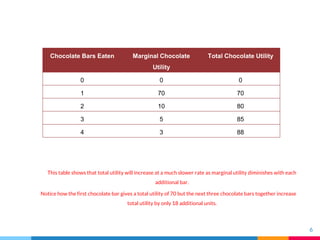
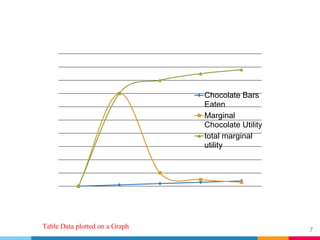
This table shows that total utility will increase at a much slower rate as marginal utility diminishes with each
additional bar.
Notice how the first chocolate bar gives a total utility of 70 but the next three chocolate bars together increase
total utility by only 18 additional units.
6
Chocolate Bars Eaten Marginal Chocolate
Utility
Total Chocolate Utility
0 0 0
1 70 70
2 10 80
3 5 85
4 3 88
Table Data plotted on a Graph 7
Chocolate Bars
Eaten
Marginal
Chocolate Utility
total marginal
utility
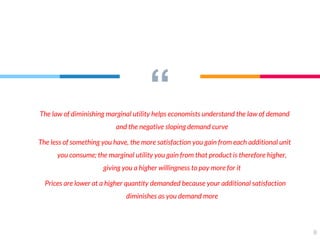
“The law of diminishing marginal utility helps economists understand the law of demand
and the negative sloping demand curve
The less of something you have, the more satisfaction you gain from each additional unit
you consume; the marginal utility you gain from that product is therefore higher,
giving you a higher willingness to pay more for it
Prices are lower at a higher quantity demanded because your additional satisfaction
diminishes as you demand more
8
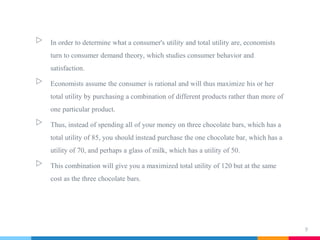
▷ In order to determine what a consumer's utility and total utility are, economists
turn to consumer demand theory, which studies consumer behavior and
satisfaction.
▷ Economists assume the consumer is rational and will thus maximize his or her
total utility by purchasing a combination of different products rather than more of
one particular product.
▷ Thus, instead of spending all of your money on three chocolate bars, which has a
total utility of 85, you should instead purchase the one chocolate bar, which has a
utility of 70, and perhaps a glass of milk, which has a utility of 50.
▷ This combination will give you a maximized total utility of 120 but at the same
cost as the three chocolate bars.
9

The Concept of Utility

  • 1.
  • 2.
    What Is Utility? ▷Within economics the concept of utility is used to model worth or value, but its usage has evolved significantly over time. ▷ Utility is an economic term introduced by the noted 18th century Swiss mathematician Daniel Bernoulli referring to the total satisfaction received from consuming a good or service ▷ A consumer's utility is hard to measure, however, but it can be determined indirectly with consumer behavior theories, which assume that consumers will strive to maximize their utility.
  • 3.
    Example Of Utility ▷If an individual judges that a piece of pizza will yield 10 utils and that a bowl of pasta will yield 12 utils, that individual will know that eating the pasta will be more satisfying. ▷ For the producers of pizza and pasta, knowing that the average bowl of pasta will yield 2 additional utils will help them price pasta slightly higher than pizza. ▷ Utils can decrease as the number of products or services as consumption increases. ▷ The first slice of pizza may yield 10 utils, but as more pizza is consumed, the utils may decrease as people become full. ▷ This will help consumers understand how to maximize their utility by allocating their money between multiple types of goods and services as well as help companies understand how to structure tiered pricing. 3
  • 4.
    Types Of Utility ▷TOTAL UTILITY Is defined as the total amount of satisfaction that a person can receive from the consumption of all units of a specific product or service. ▷ MARGINAL UTILITY ▷ Is defined as the additional utility gained from the consumption of one additional unit of a good or service. 4
  • 5.
    Example Of TUAnd MU ▷ Take, for example, a chocolate bar. Let's say that after eating one chocolate bar your sweet tooth has been satisfied. ▷ Your marginal utility (and total utility) after eating one chocolate bar will be quite high. ▷ But if you eat more chocolate bars, the pleasure of each additional chocolate bar will be less than the pleasure you received from eating the one before probably because you are starting to feel full or you have had too many sweets for one day. 5
  • 6.
    This table showsthat total utility will increase at a much slower rate as marginal utility diminishes with each additional bar. Notice how the first chocolate bar gives a total utility of 70 but the next three chocolate bars together increase total utility by only 18 additional units. 6 Chocolate Bars Eaten Marginal Chocolate Utility Total Chocolate Utility 0 0 0 1 70 70 2 10 80 3 5 85 4 3 88
  • 7.
    Table Data plottedon a Graph 7 Chocolate Bars Eaten Marginal Chocolate Utility total marginal utility
  • 8.
    “The law ofdiminishing marginal utility helps economists understand the law of demand and the negative sloping demand curve The less of something you have, the more satisfaction you gain from each additional unit you consume; the marginal utility you gain from that product is therefore higher, giving you a higher willingness to pay more for it Prices are lower at a higher quantity demanded because your additional satisfaction diminishes as you demand more 8
  • 9.
    ▷ In orderto determine what a consumer's utility and total utility are, economists turn to consumer demand theory, which studies consumer behavior and satisfaction. ▷ Economists assume the consumer is rational and will thus maximize his or her total utility by purchasing a combination of different products rather than more of one particular product. ▷ Thus, instead of spending all of your money on three chocolate bars, which has a total utility of 85, you should instead purchase the one chocolate bar, which has a utility of 70, and perhaps a glass of milk, which has a utility of 50. ▷ This combination will give you a maximized total utility of 120 but at the same cost as the three chocolate bars. 9