Week 8:
Alternatives to Lecture
       The College Classroom
         February 27, 2013
2


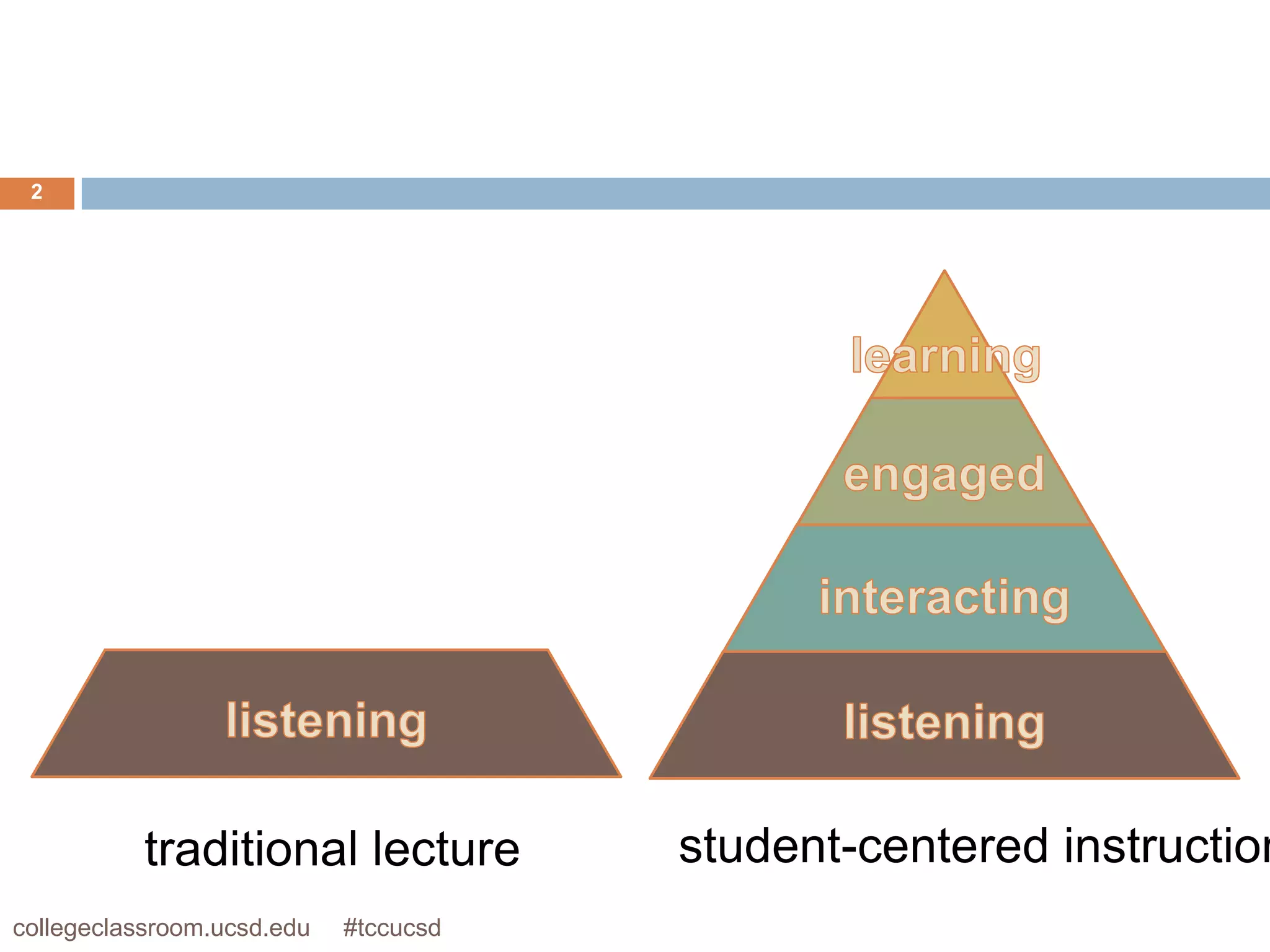
           traditional lecture         student-centered instruction
collegeclassroom.ucsd.edu   #tccucsd
Key Finding 3
 3


       A “metacognitive” approach to instruction can help
       students learn to take control of their own learning
       by defining learning goals and monitoring their
       progress in achieving them. (How People Learn [1], p. 18)

                     Instructors need to provide
                    opportunities for students to
                    practice being metacognitive
                                   –
                       thinking about their own
                               thinking
collegeclassroom.ucsd.edu   #tccucsd
Key Finding 2
 4


       To develop competence in an area, students must:
           a) have a deep foundation of factual
              knowledge,
           b) understand facts and ideas in the context
              of a conceptual framework, and
           c) organize knowledge in ways that facilitate
                                      (How People Learn [1], p. 16)
              retrieval and application.
              These are characteristics
                    of expertize
                     (together with
                    metacognition)

collegeclassroom.ucsd.edu   #tccucsd
Key Finding 1
 5


       Students come to the classroom with
       preconceptions about how the world works. If their
       initial understanding is not engaged, they may fail
       to grasp the new concepts and information that
       are taught, or they may learn them for the
       purposes of a test but revert Learn [1], their
                                      (How People  to p. 14)
       preconceptions outside of the classroom.
                Instructors must
                    draw out               Instruction must
                 students’ pre-               be student-
                     existing                  centered.
                understandings.

collegeclassroom.ucsd.edu   #tccucsd
Learning requires interaction [2]
 6


collegeclassroom.ucsd.edu   #tccucsd
Learning requires interaction [2]
 7


                              Learning gain:
                              100%


                                                             0.50
                                           % of class
                                           time NOT
                                       0    lecturing
                                            pre-test   post-test


collegeclassroom.ucsd.edu   #tccucsd
Learning requires interaction [2]
 8


                    1                  2


                    3                  4
collegeclassroom.ucsd.edu   #tccucsd
9


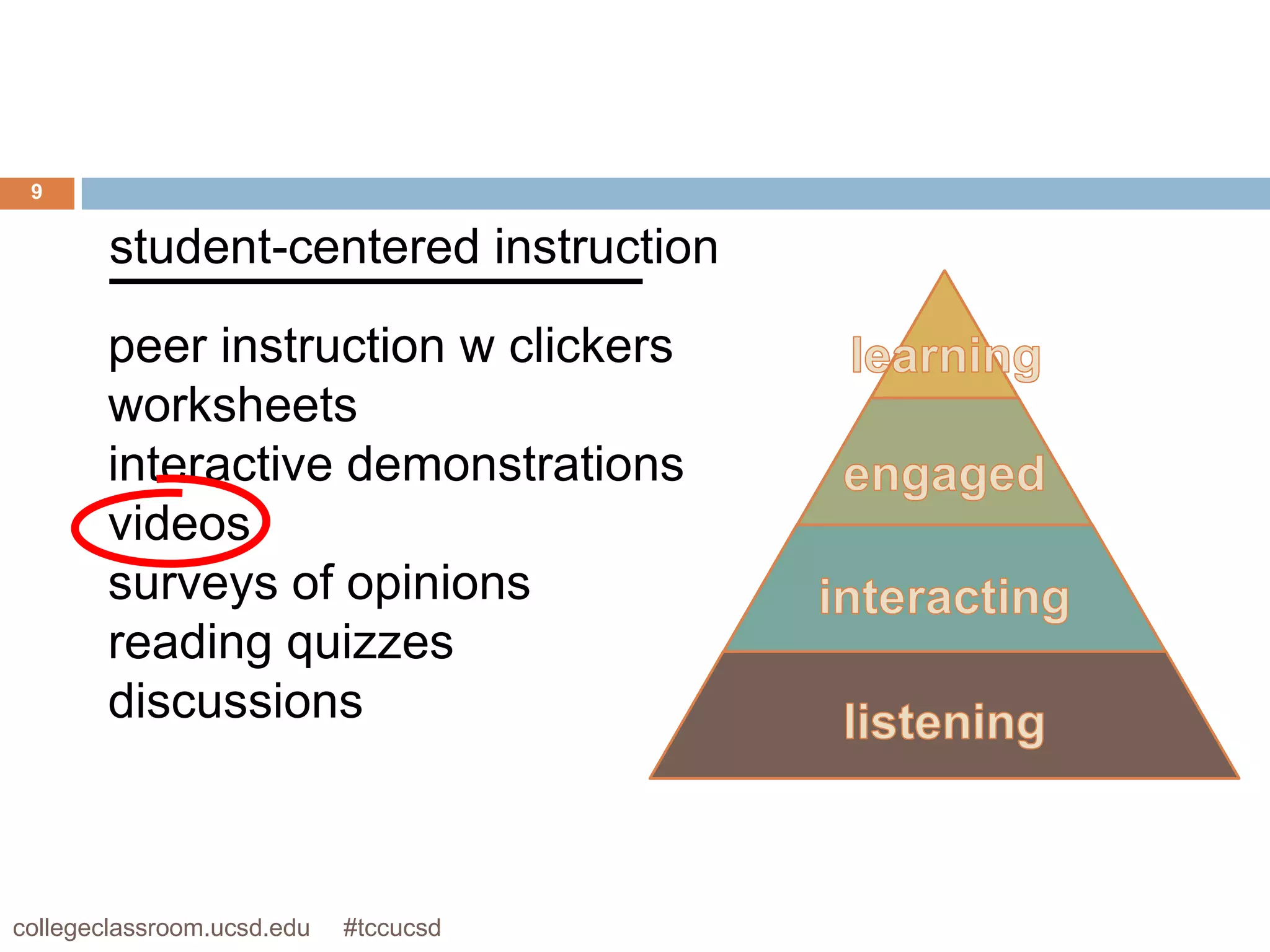
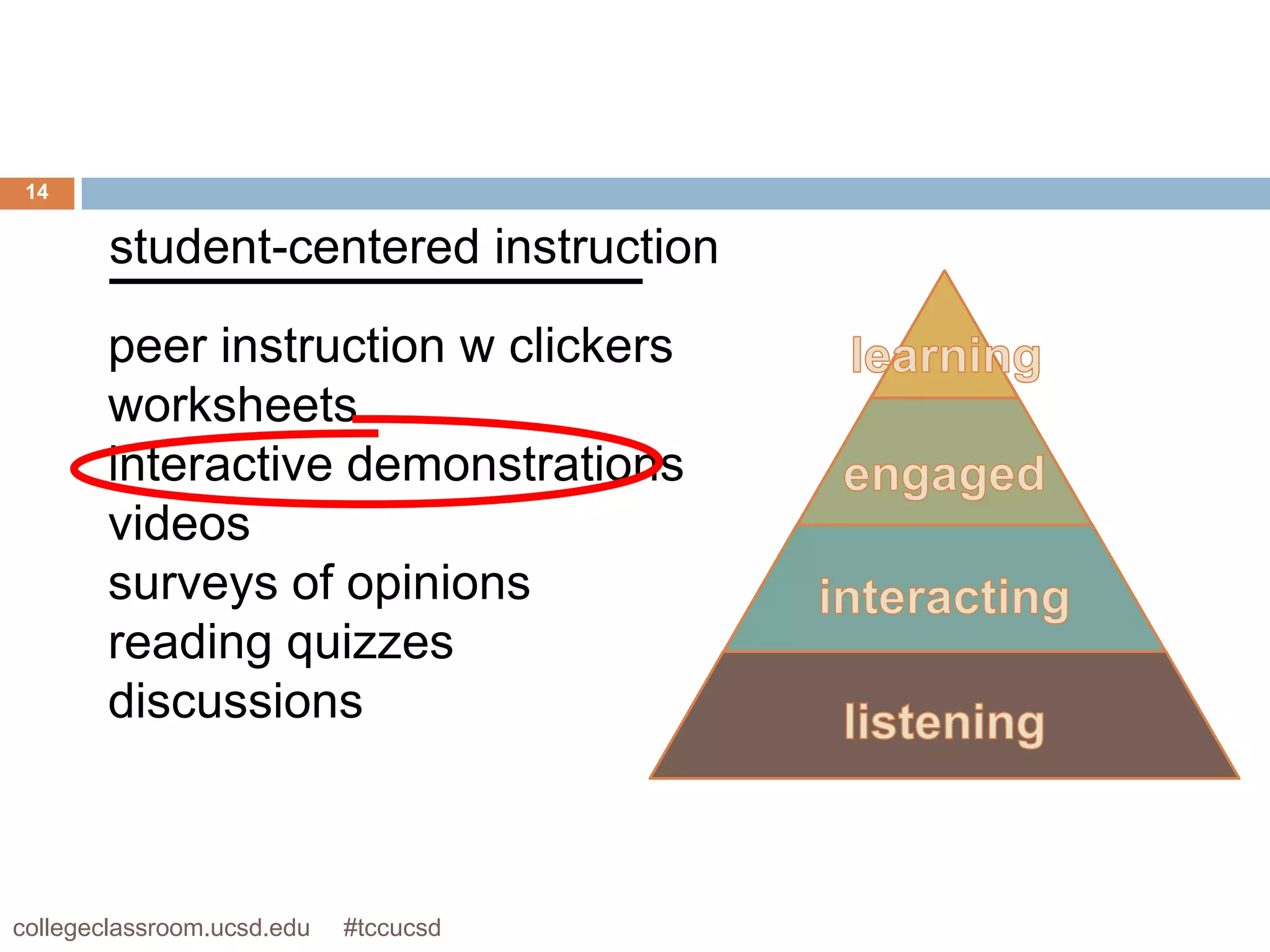
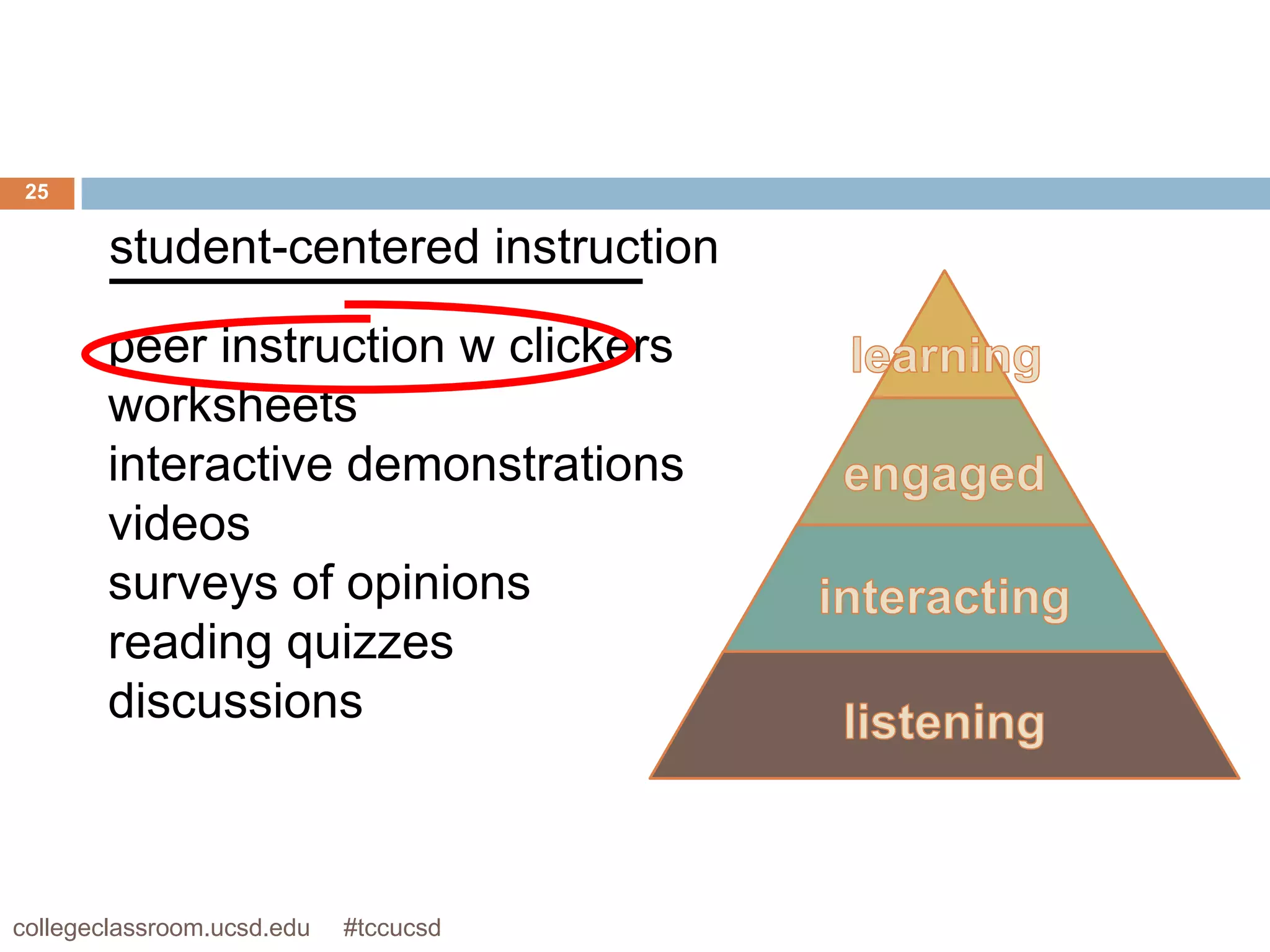
        student-centered instruction

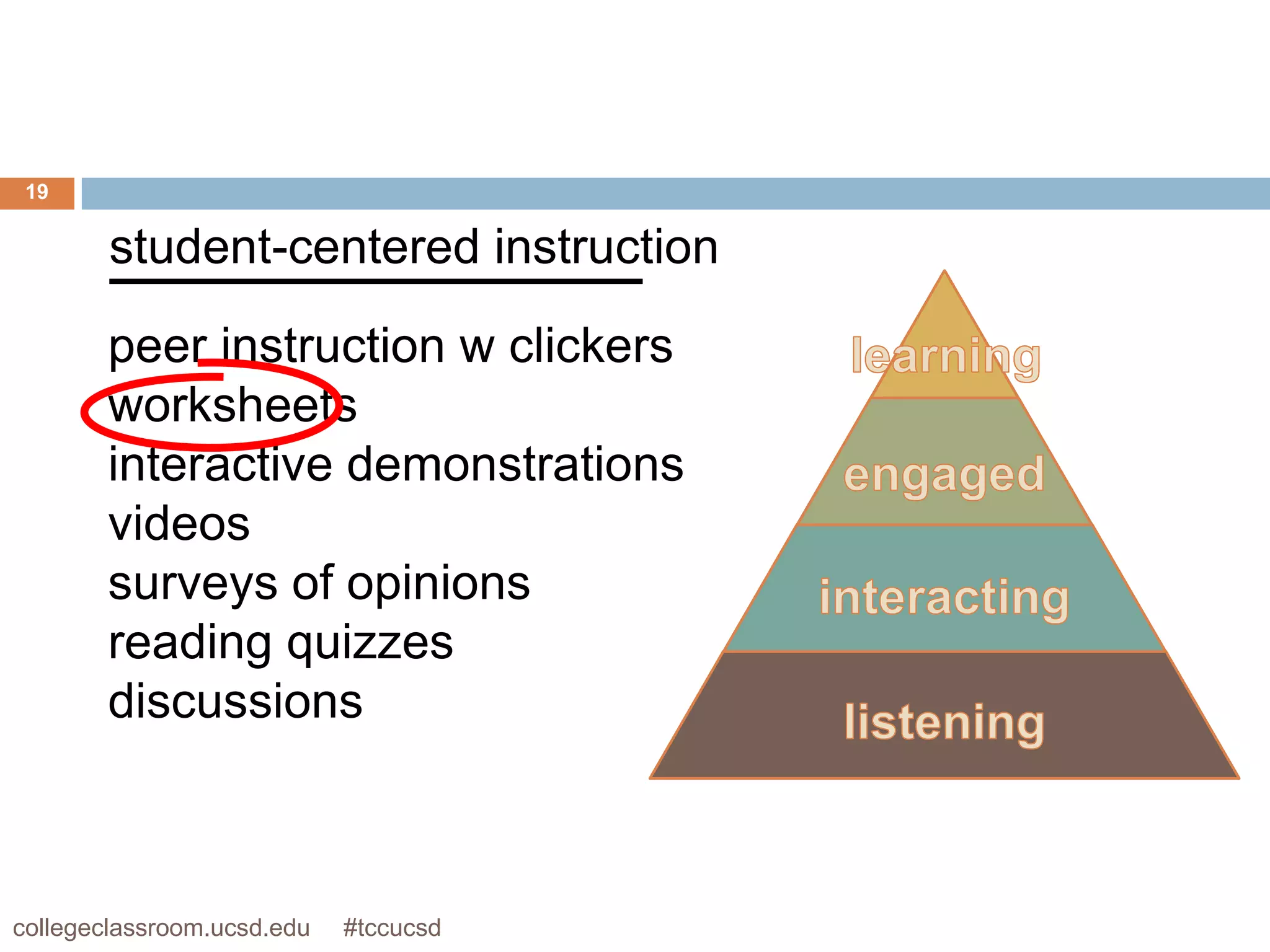
       peer instruction w clickers
       worksheets
       interactive demonstrations
       videos
       surveys of opinions
       reading quizzes
       discussions


collegeclassroom.ucsd.edu   #tccucsd
Archimedes’ Principle
 10


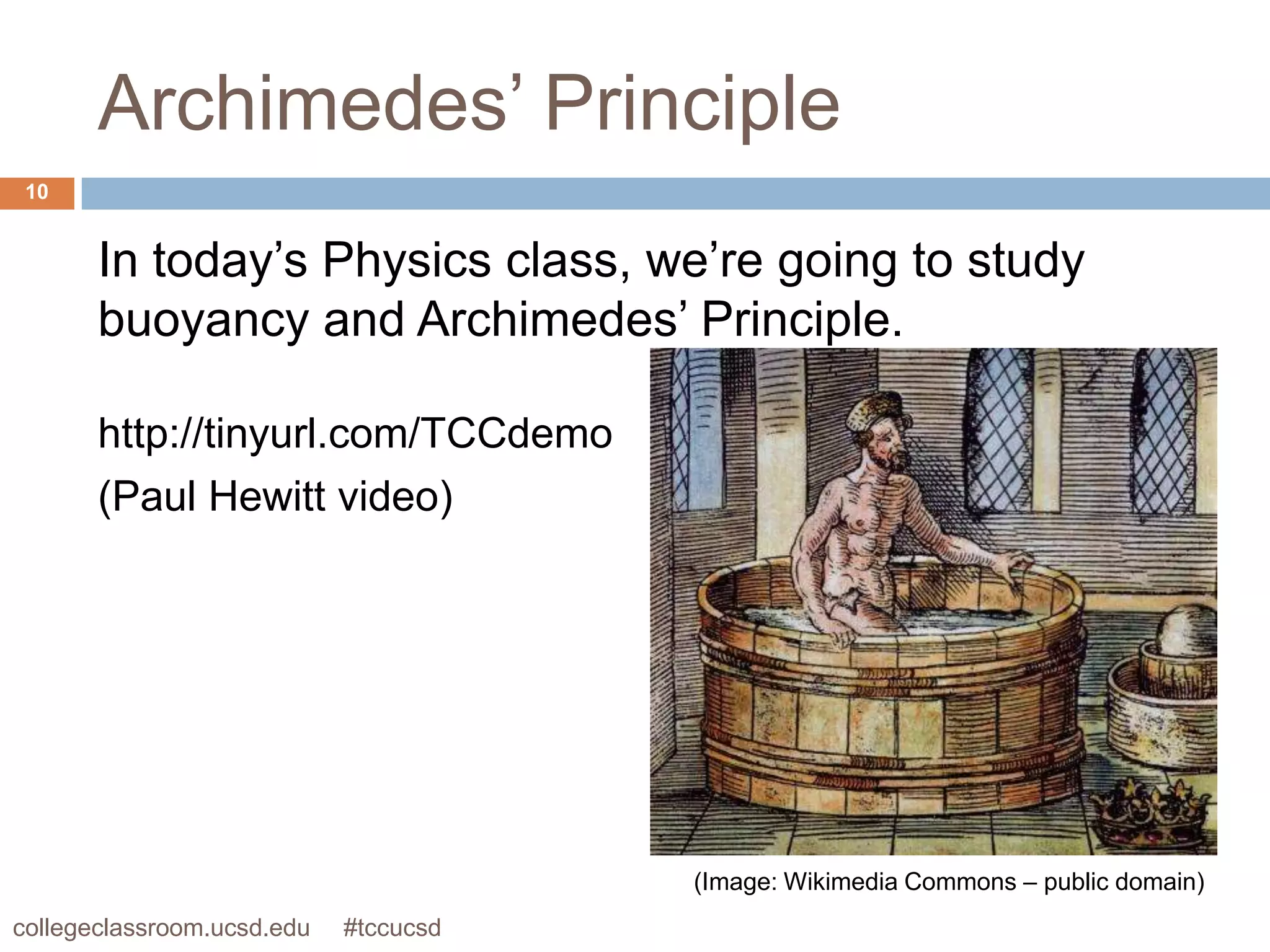
       In today’s Physics class, we’re going to study
       buoyancy and Archimedes’ Principle.

       http://tinyurl.com/TCCdemo
       (Paul Hewitt video)


                                       (Image: Wikimedia Commons – public domain)
collegeclassroom.ucsd.edu   #tccucsd
Opinion: Videos in class
 11


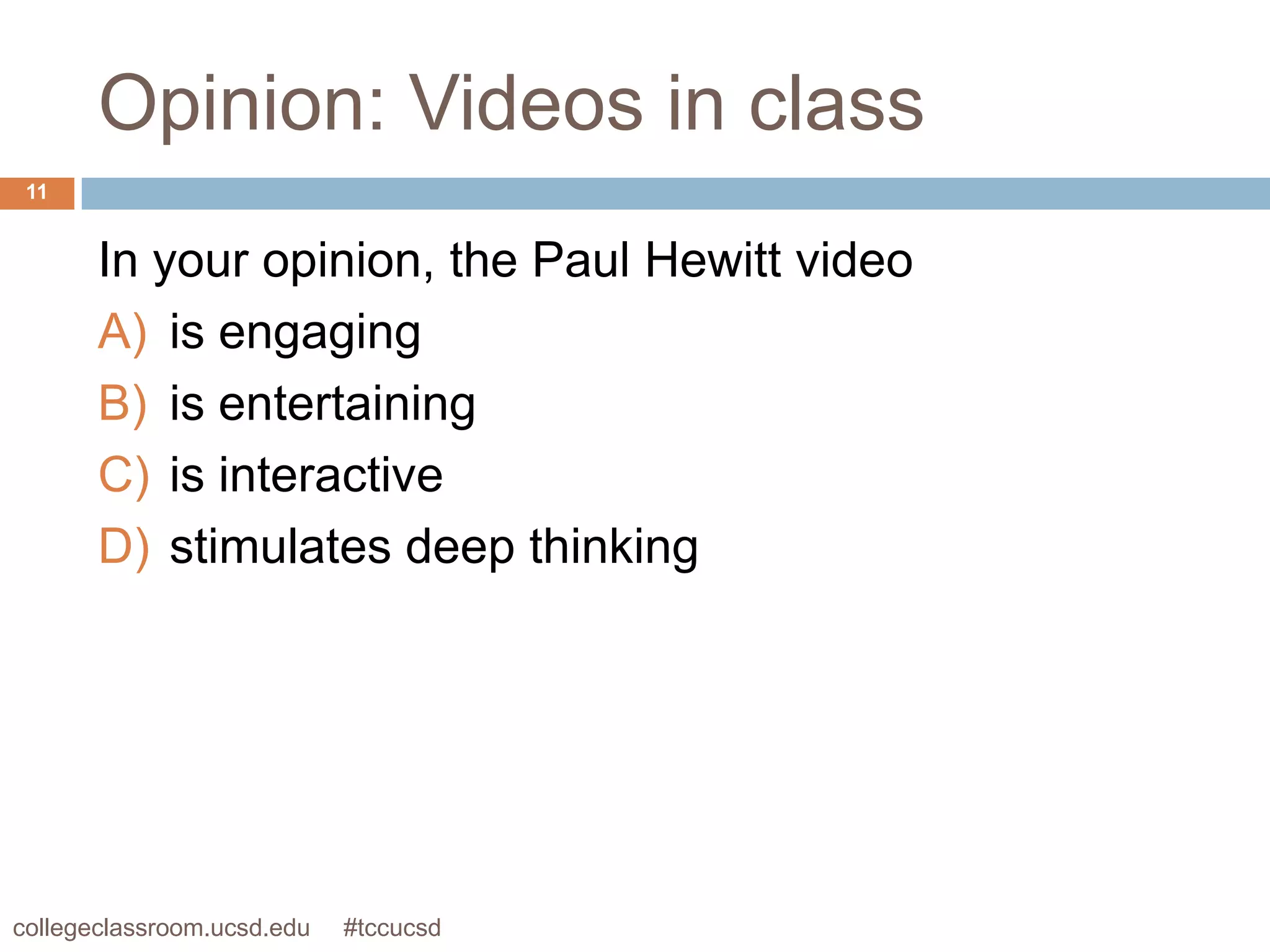
       In your opinion, the Paul Hewitt video
       A) is engaging
       B) is entertaining
       C) is interactive
       D) stimulates deep thinking


collegeclassroom.ucsd.edu   #tccucsd
Videos in class
 12


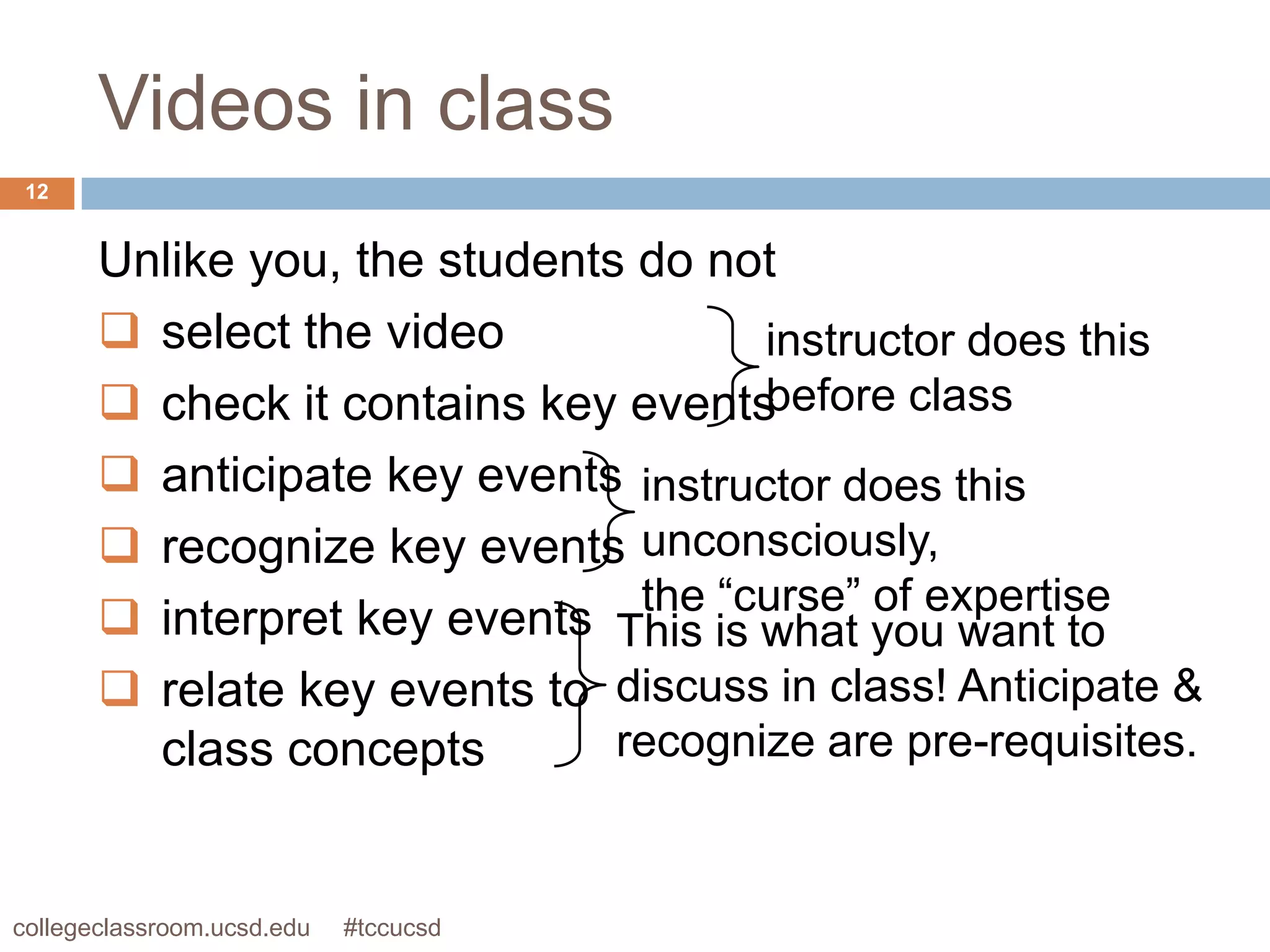
       Unlike you, the students do not
        select the video             instructor does this
        check it contains key events before class
        anticipate key events instructor does this
        recognize key events unconsciously,
                                the “curse” of expertise
        interpret key events This is what you want to
        relate key events to discuss in class! Anticipate &
         class concepts        recognize are pre-requisites.


collegeclassroom.ucsd.edu   #tccucsd
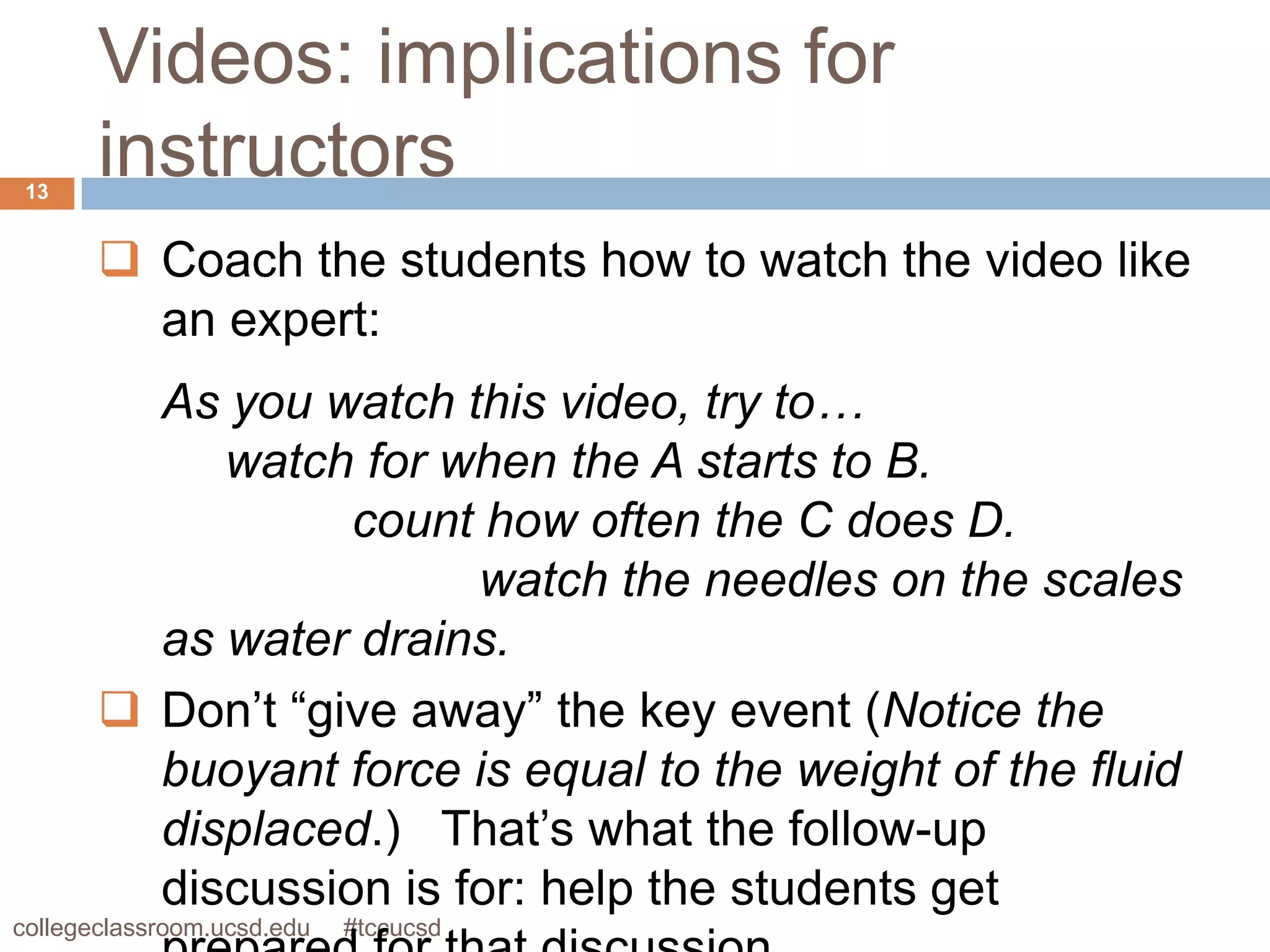
Videos: implications for
 13
       instructors
        Coach the students how to watch the video like
         an expert:
         As you watch this video, try to…
            watch for when the A starts to B.
                  count how often the C does D.
                        watch the needles on the scales
         as water drains.
        Don’t “give away” the key event (Notice the
         buoyant force is equal to the weight of the fluid
         displaced.) That’s what the follow-up
         discussion is for: help the students get
collegeclassroom.ucsd.edu   #tccucsd
14


        student-centered instruction

       peer instruction w clickers
       worksheets
       interactive demonstrations
       videos
       surveys of opinions
       reading quizzes
       discussions


collegeclassroom.ucsd.edu   #tccucsd
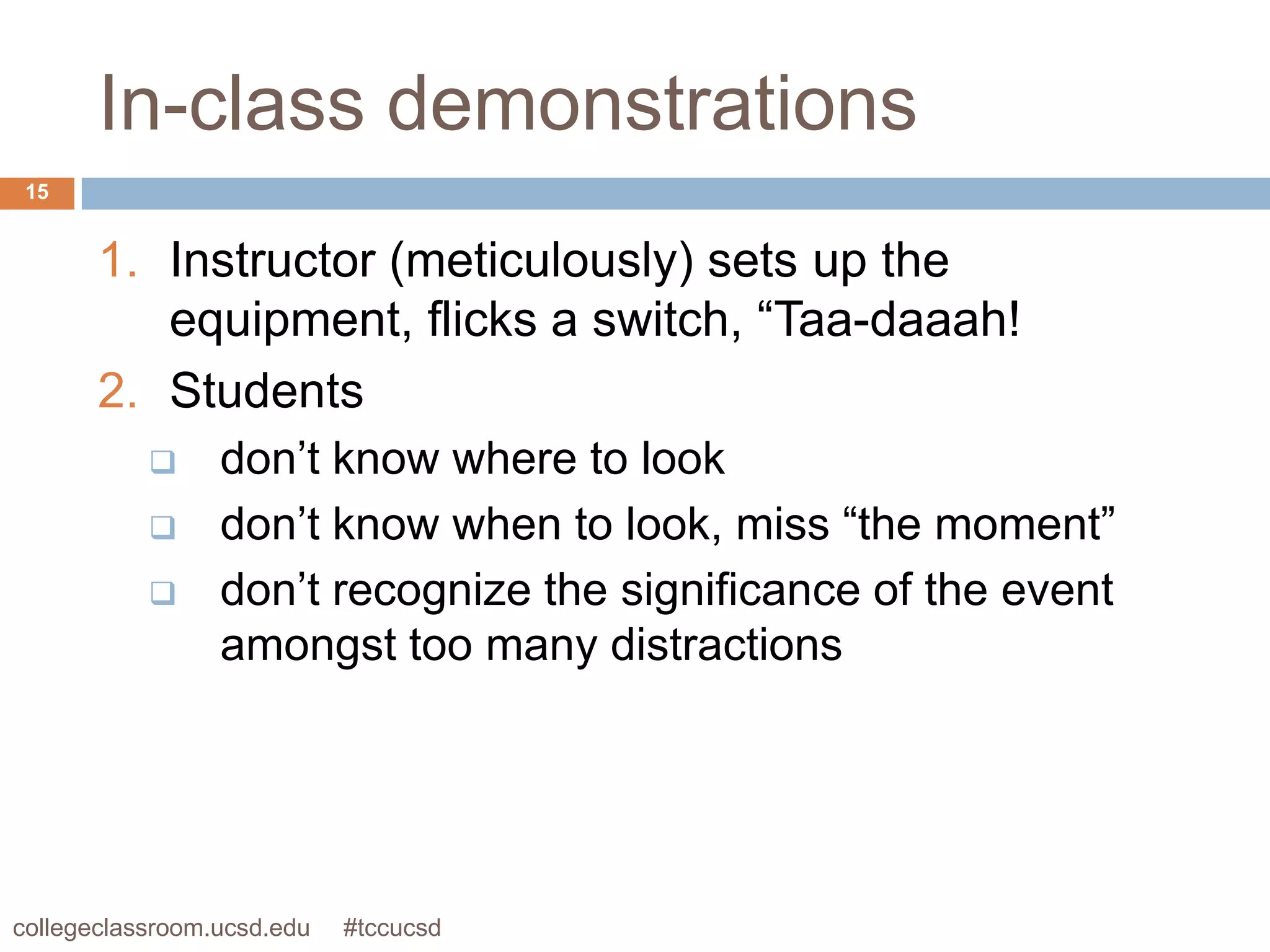
In-class demonstrations
 15


       1. Instructor (meticulously) sets up the
          equipment, flicks a switch, “Taa-daaah!
       2. Students
                don’t know where to look
                don’t know when to look, miss “the moment”
                don’t recognize the significance of the event
                 amongst too many distractions


collegeclassroom.ucsd.edu   #tccucsd
Interactive Lecture Demos (ILD)
 16
       [3]
       To engage students and focus their attention on
       the key event, get students to make a
       prediction (using clickers, for example)


collegeclassroom.ucsd.edu   #tccucsd
Clicker question
 17


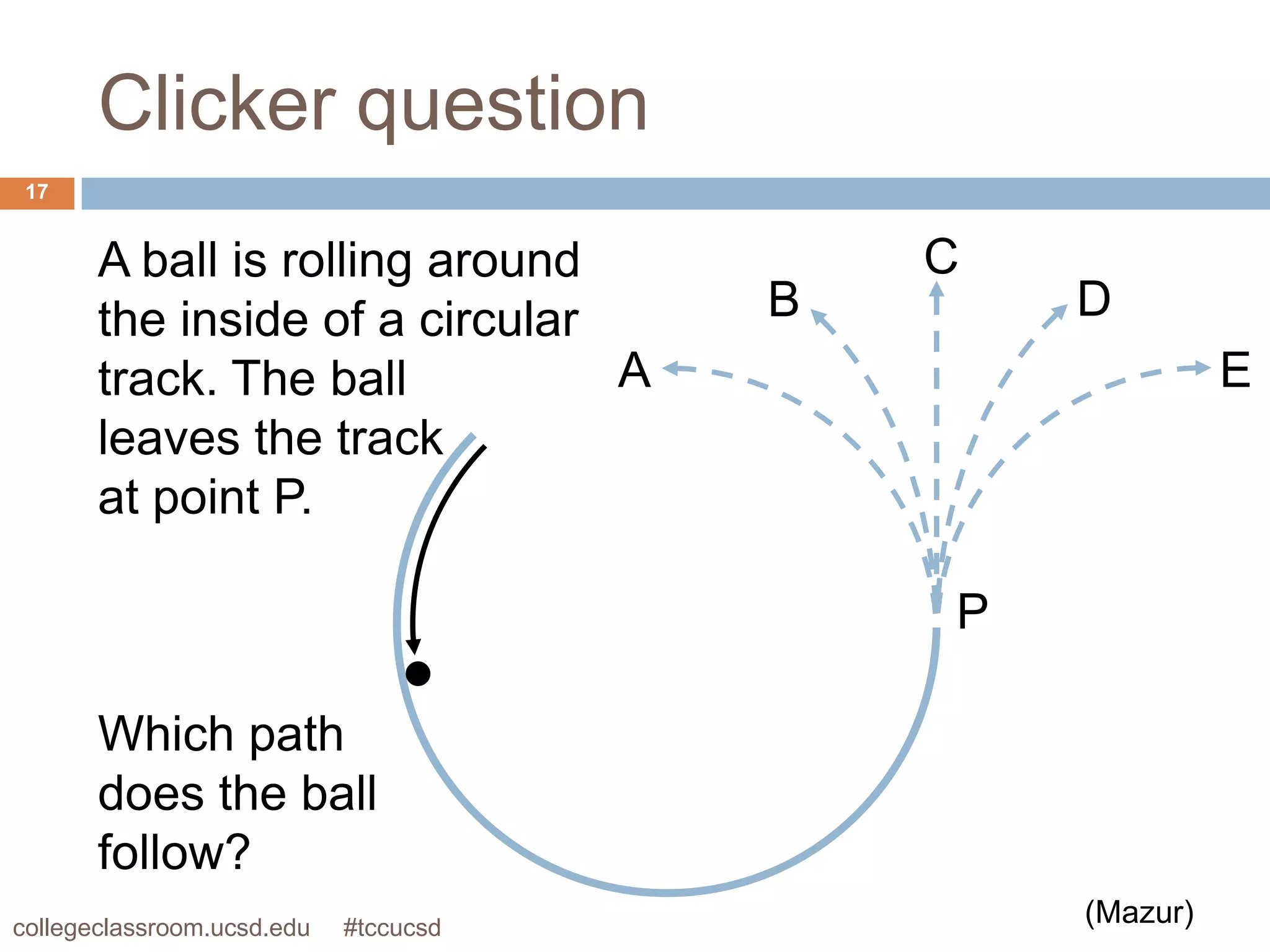
       A ball is rolling around            C
       the inside of a circular        B       D
       track. The ball          A                        E
       leaves the track
       at point P.

                                           P

       Which path
       does the ball
       follow?
collegeclassroom.ucsd.edu   #tccucsd
                                               (Mazur)
Interactive Lecture Demos (ILD)
 18
       [3]
       After the prediction, each student
        cares about the outcome (“Did I get it right?”)
        knows where to look (can anticipate
          phenomenon)
        knows when to look (sees phenomenon occur)
        gets immediate feedback about his/her
          understanding of the concept
        is prepared for your explanation

        (don’t be afraid to mess with their heads –
collegeclassroom.ucsd.edu   #tccucsd
19


        student-centered instruction

       peer instruction w clickers
       worksheets
       interactive demonstrations
       videos
       surveys of opinions
       reading quizzes
       discussions


collegeclassroom.ucsd.edu   #tccucsd
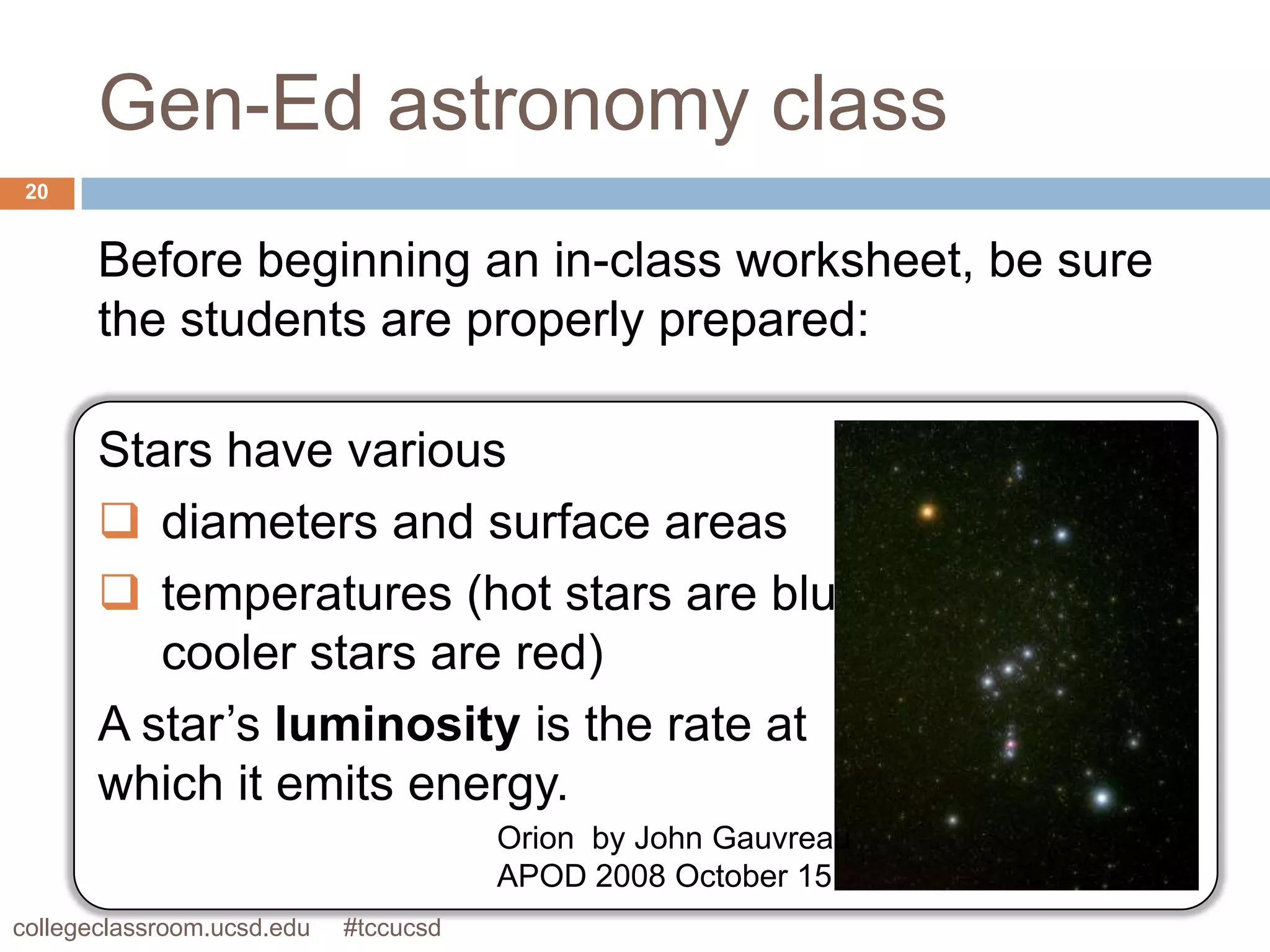
Gen-Ed astronomy class
 20


       Before beginning an in-class worksheet, be sure
       the students are properly prepared:

       Stars have various
        diameters and surface areas
        temperatures (hot stars are blue,
          cooler stars are red)
       A star’s luminosity is the rate at
       which it emits energy.
                                       Orion by John Gauvreau
                                       APOD 2008 October 15
collegeclassroom.ucsd.edu   #tccucsd
21


       In class, we did a worksheet about cooking
       spaghetti and then, by analogy, the temperature,
       size and luminosity of stars.

       The worksheet is removed from this slide deck
       because it is copyrighted.


collegeclassroom.ucsd.edu   #tccucsd
In-class worksheets
 22


        carefully-designed sequence of questions
         guide students through the exploration of a
         concept
        first few questions may be trivial – checks
         students read intro paragraph, gives them
         confidence
        give formative feedback along the way
        most effective when done collaboratively
         (group reaches consensus before answering)
        long, evidence-based history via “Washington
         Tutorials” and “Lecture Tutorials for introductory
         astronomy” (interactive activities in Prather et
collegeclassroom.ucsd.edu   #tccucsd
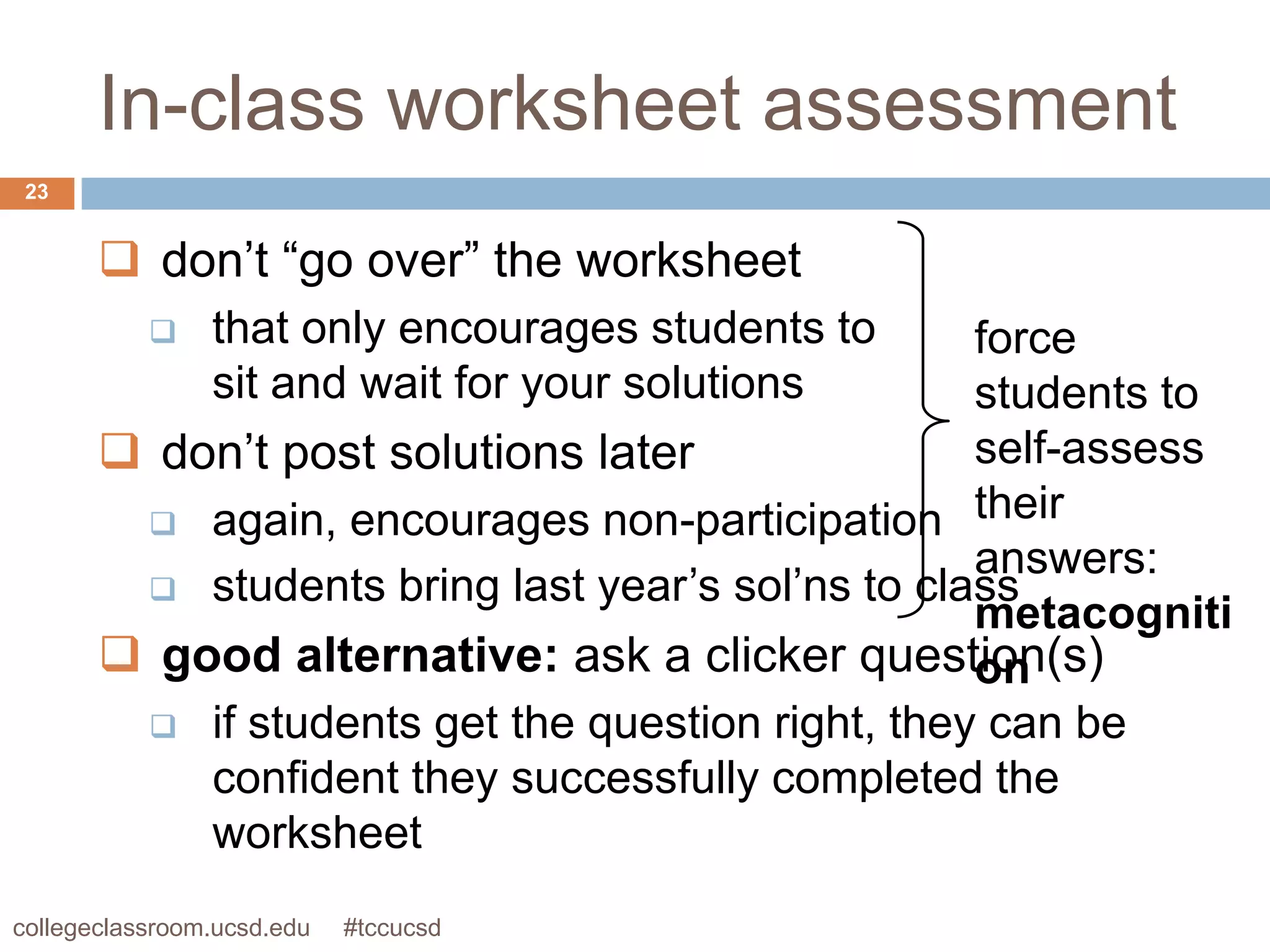
In-class worksheet assessment
 23


        don’t “go over” the worksheet
               that only encourages students to  force
                sit and wait for your solutions   students to
        don’t post solutions later               self-assess
         again, encourages non-participation
                                                  their
                                                  answers:
         students bring last year’s sol’ns to class
                                                  metacogniti
        good alternative: ask a clicker question(s)
                                                  on
         if students get the question right, they can be
           confident they successfully completed the
           worksheet
collegeclassroom.ucsd.edu   #tccucsd
Clicker question
 24


       You observe two stars with the same luminosity
       and determine that one is larger than the other.
       Which star has the greater temperature?

         A)    the smaller star
         B)    the larger star
         C)    the temperatures are the same
         D)    there is insufficient information to answer this
               question


collegeclassroom.ucsd.edu   #tccucsd
                                                  (Prather et al., [4])
25


        student-centered instruction

       peer instruction w clickers
       worksheets
       interactive demonstrations
       videos
       surveys of opinions
       reading quizzes
       discussions


collegeclassroom.ucsd.edu   #tccucsd
Clicker question
 26


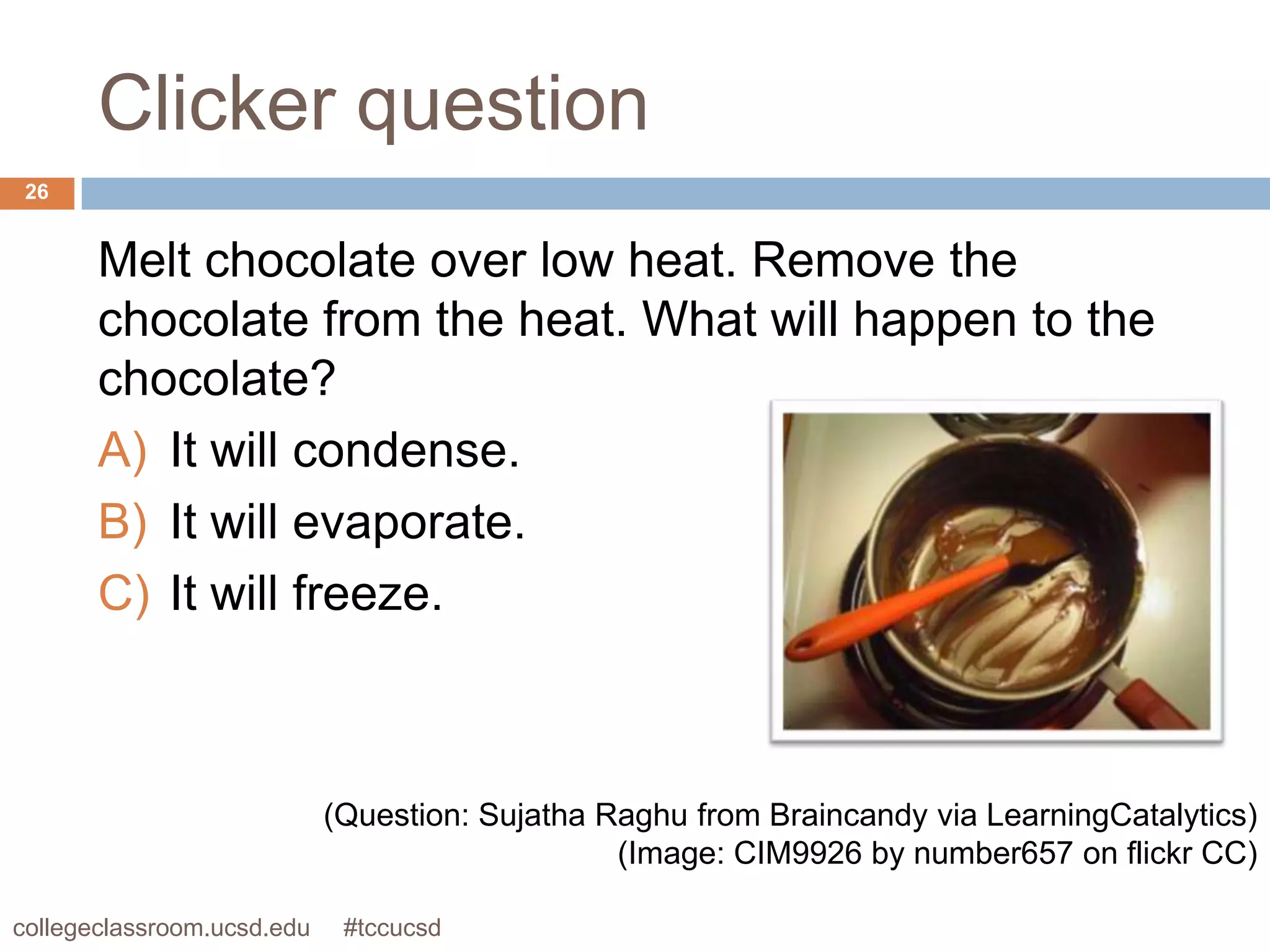
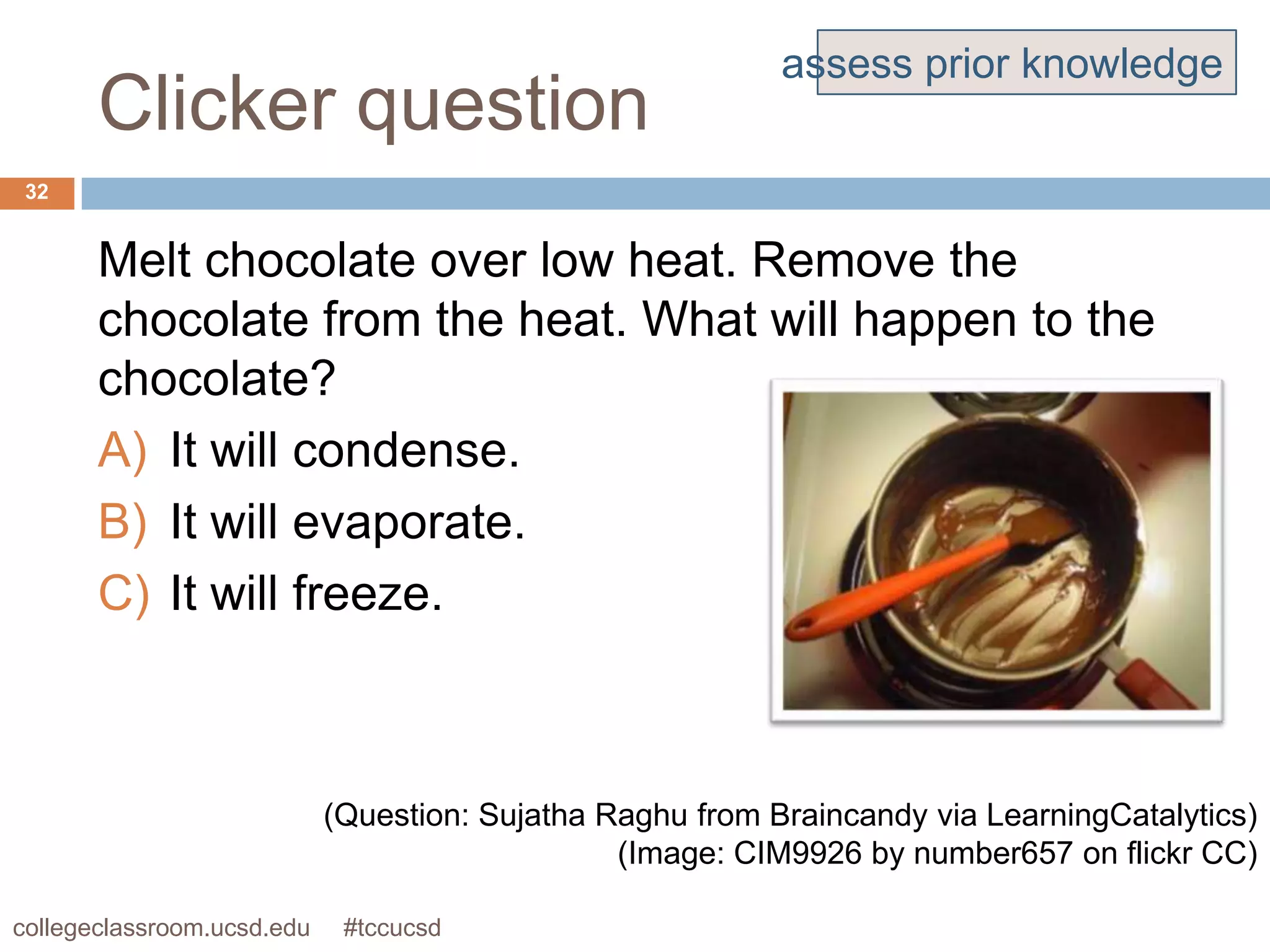
       Melt chocolate over low heat. Remove the
       chocolate from the heat. What will happen to the
       chocolate?
       A) It will condense.
       B) It will evaporate.
       C) It will freeze.


                            (Question: Sujatha Raghu from Braincandy via LearningCatalytics)
                                                (Image: CIM9926 by number657 on flickr CC)

collegeclassroom.ucsd.edu    #tccucsd
Typical episode of peer
27
     instruction
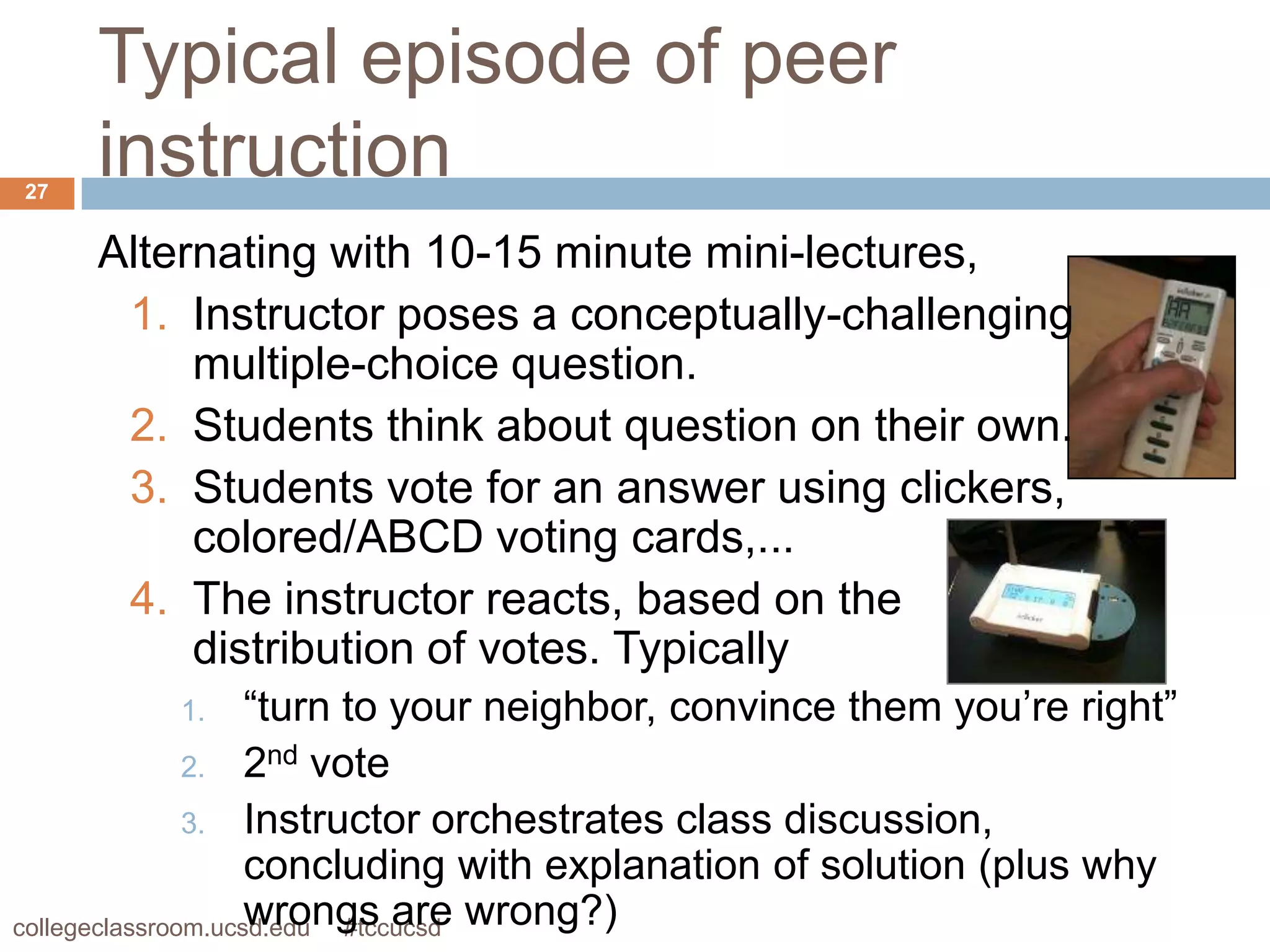
     Alternating with 10-15 minute mini-lectures,
      1. Instructor poses a conceptually-challenging
          multiple-choice question.
      2. Students think about question on their own.
      3. Students vote for an answer using clickers,
          colored/ABCD voting cards,...
      4. The instructor reacts, based on the
          distribution of votes. Typically
          1.        “turn to your neighbor, convince them you’re right”
               2. 2nd vote
               3. Instructor orchestrates class discussion,
                    concluding with explanation of solution (plus why
collegeclassroom.ucsd.edu #tccucsd wrong?)
                    wrongs are
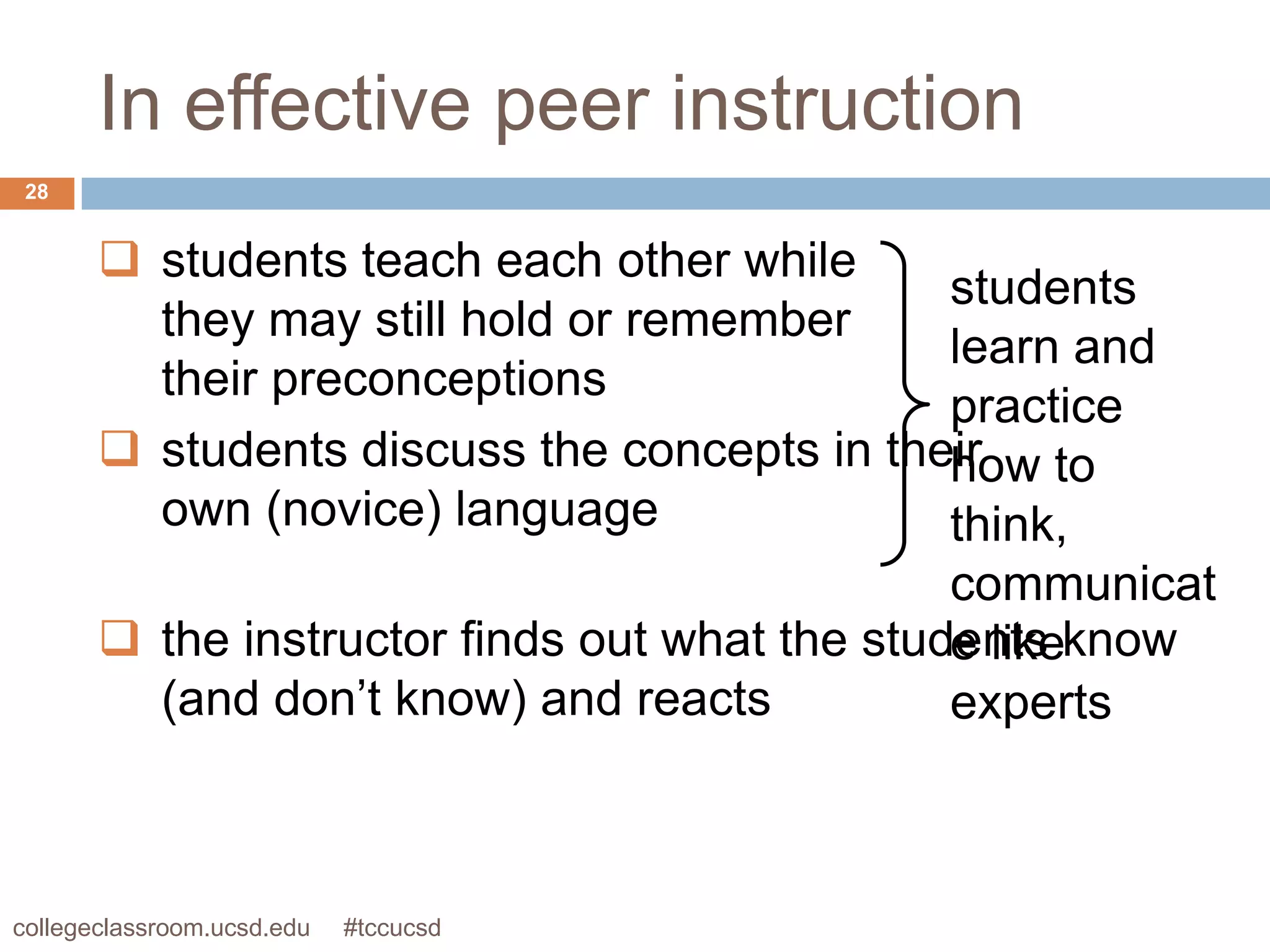
In effective peer instruction
 28


        students teach each other while
                                             students
         they may still hold or remember
                                             learn and
         their preconceptions
                                             practice
        students discuss the concepts in their to
                                             how
         own (novice) language               think,
                                               communicat
        the instructor finds out what the students know
                                               e like
         (and don’t know) and reacts           experts


collegeclassroom.ucsd.edu   #tccucsd
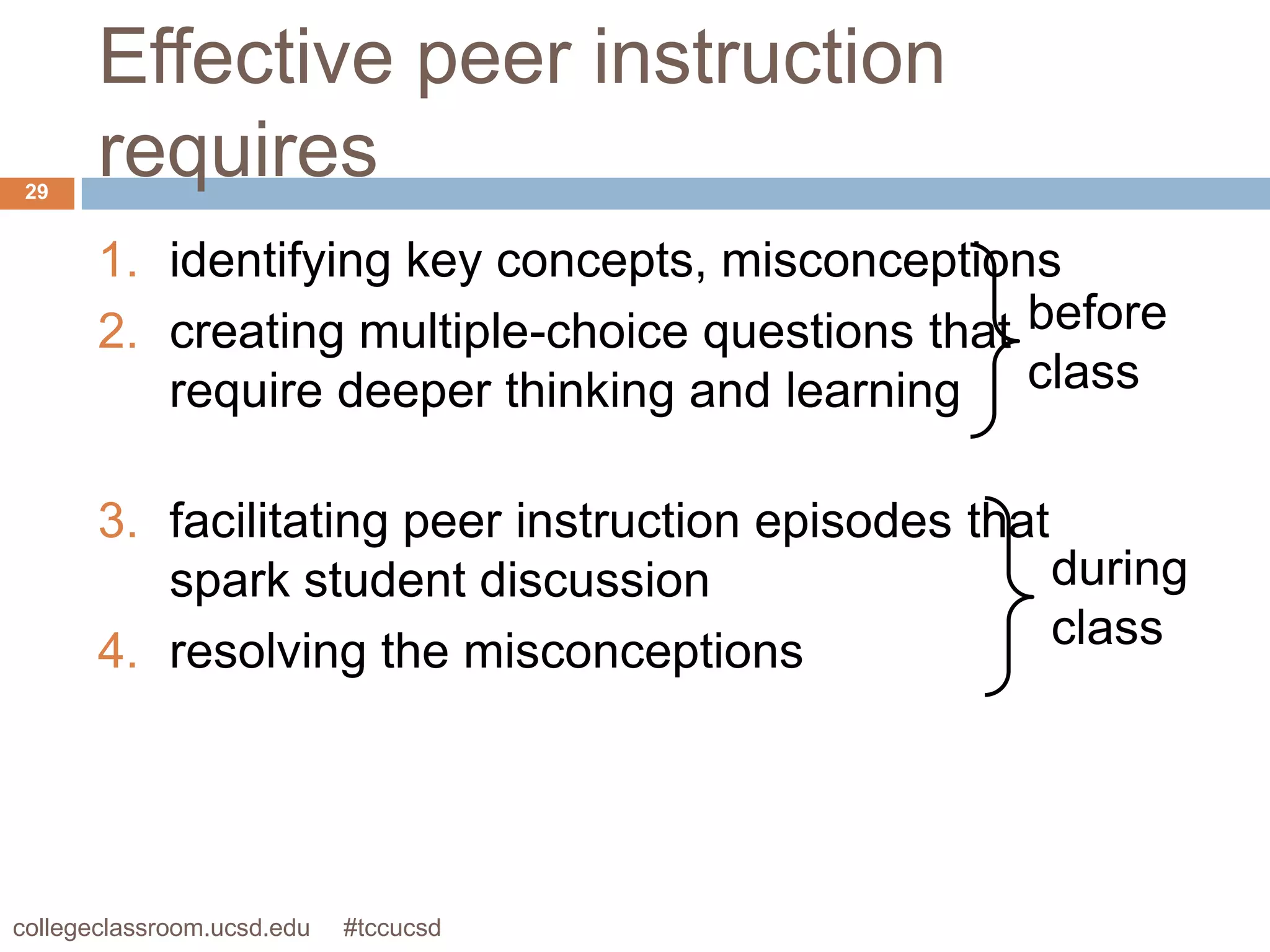
Effective peer instruction
 29
       requires
       1. identifying key concepts, misconceptions
       2. creating multiple-choice questions that before
          require deeper thinking and learning class

       3. facilitating peer instruction episodes that
          spark student discussion                    during
       4. resolving the misconceptions                class


collegeclassroom.ucsd.edu   #tccucsd
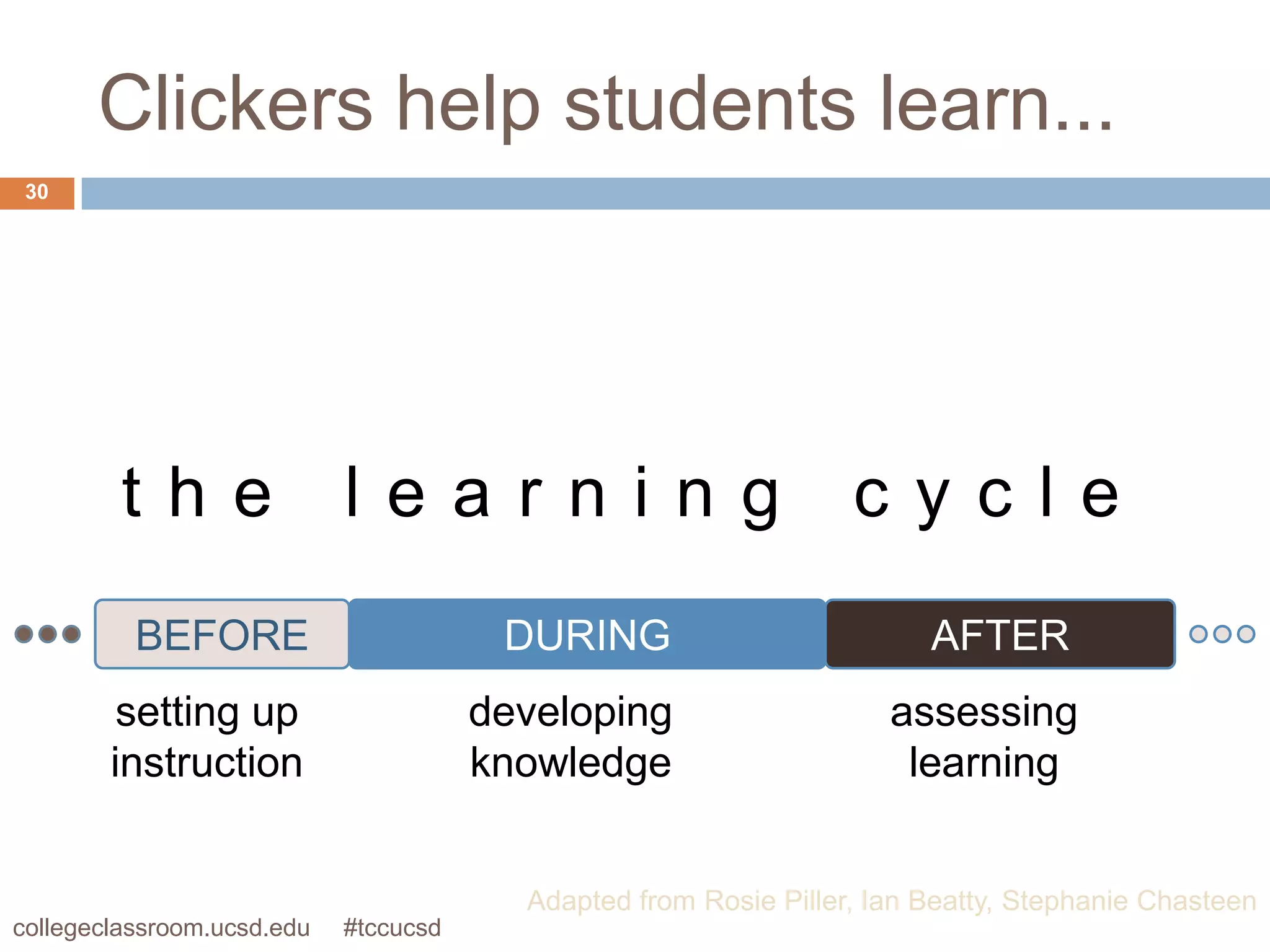
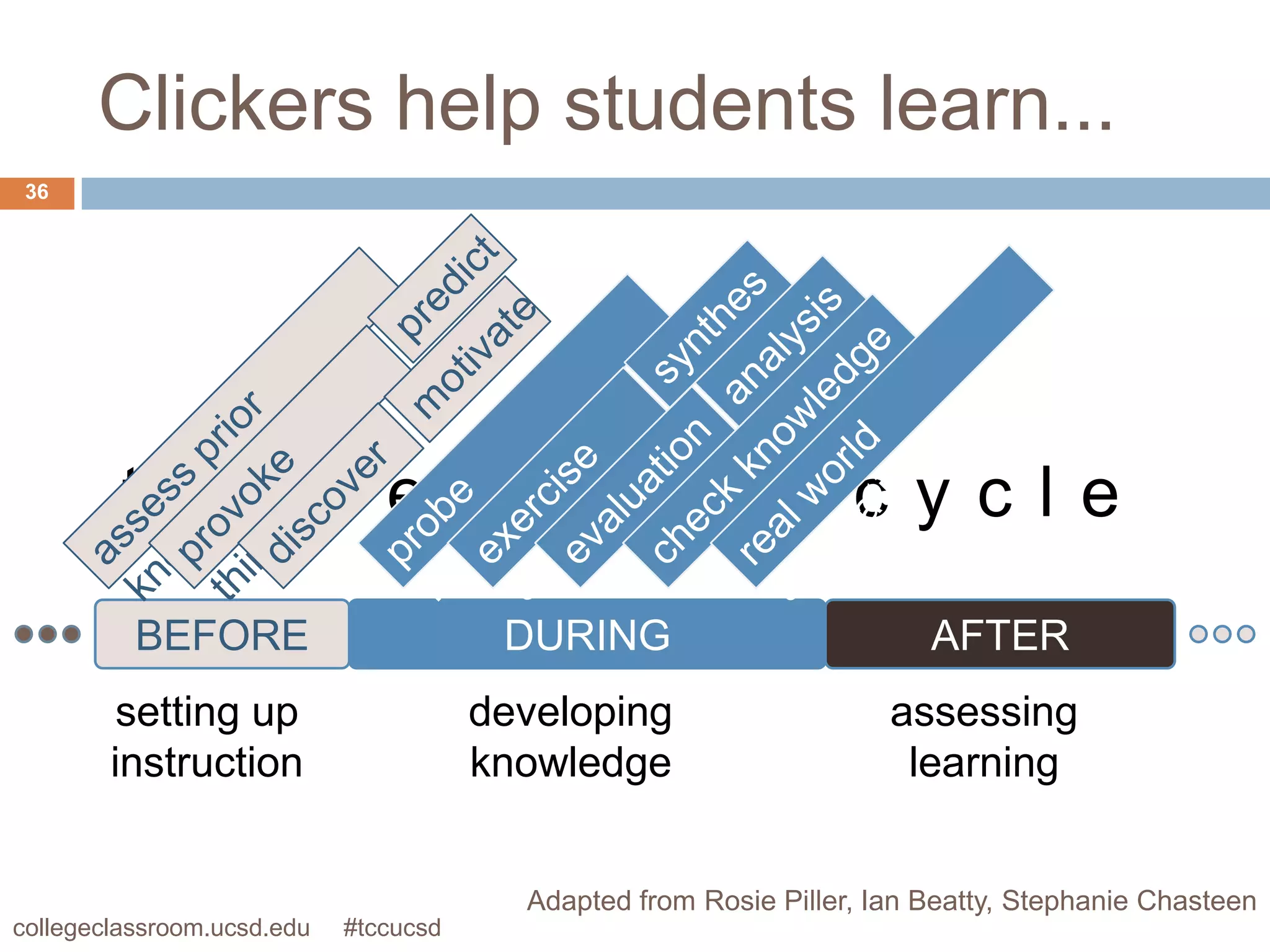
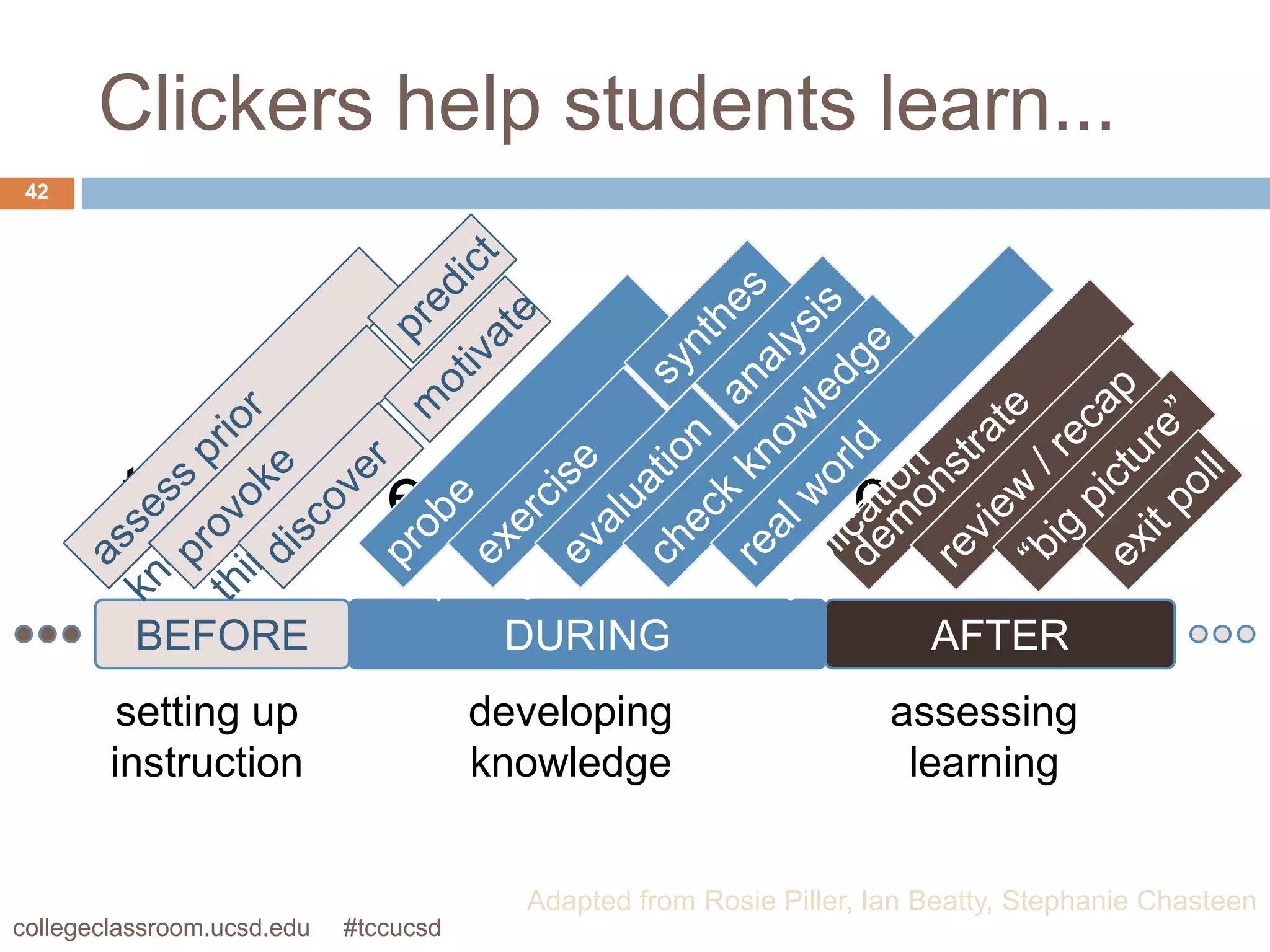
Clickers help students learn...
 30


         the                learning                              cycle
          BEFORE                        DURING                          AFTER
         setting up                    developing                    assessing
        instruction                    knowledge                      learning


                                         Adapted from Rosie Piller, Ian Beatty, Stephanie Chasteen
collegeclassroom.ucsd.edu   #tccucsd
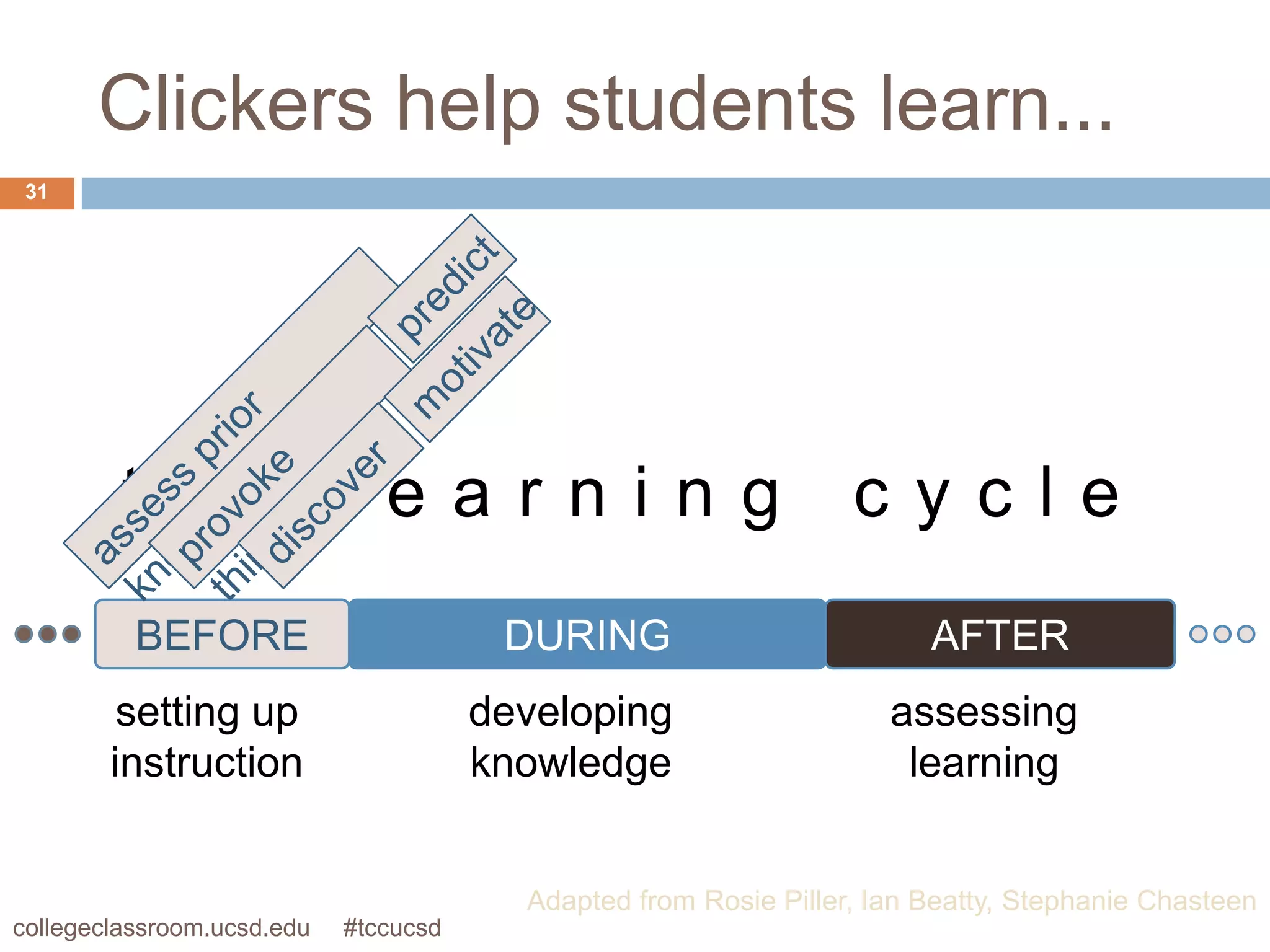
Clickers help students learn...
 31


         the                learning                              cycle
          BEFORE                        DURING                          AFTER
         setting up                    developing                    assessing
        instruction                    knowledge                      learning


                                         Adapted from Rosie Piller, Ian Beatty, Stephanie Chasteen
collegeclassroom.ucsd.edu   #tccucsd
assess prior knowledge
       Clicker question
 32


       Melt chocolate over low heat. Remove the
       chocolate from the heat. What will happen to the
       chocolate?
       A) It will condense.
       B) It will evaporate.
       C) It will freeze.


                            (Question: Sujatha Raghu from Braincandy via LearningCatalytics)
                                                (Image: CIM9926 by number657 on flickr CC)

collegeclassroom.ucsd.edu    #tccucsd
motivate
       Clicker question
 33


       In your opinion, which had the most positive
       impact on the modern world?

         A)    coffee
         B)    tea
         C)    chocolate
         D)    spice
         E)    sugar


                                               (Herbst, UCSD)
collegeclassroom.ucsd.edu   #tccucsd
provoke thinking
      Clicker question
34


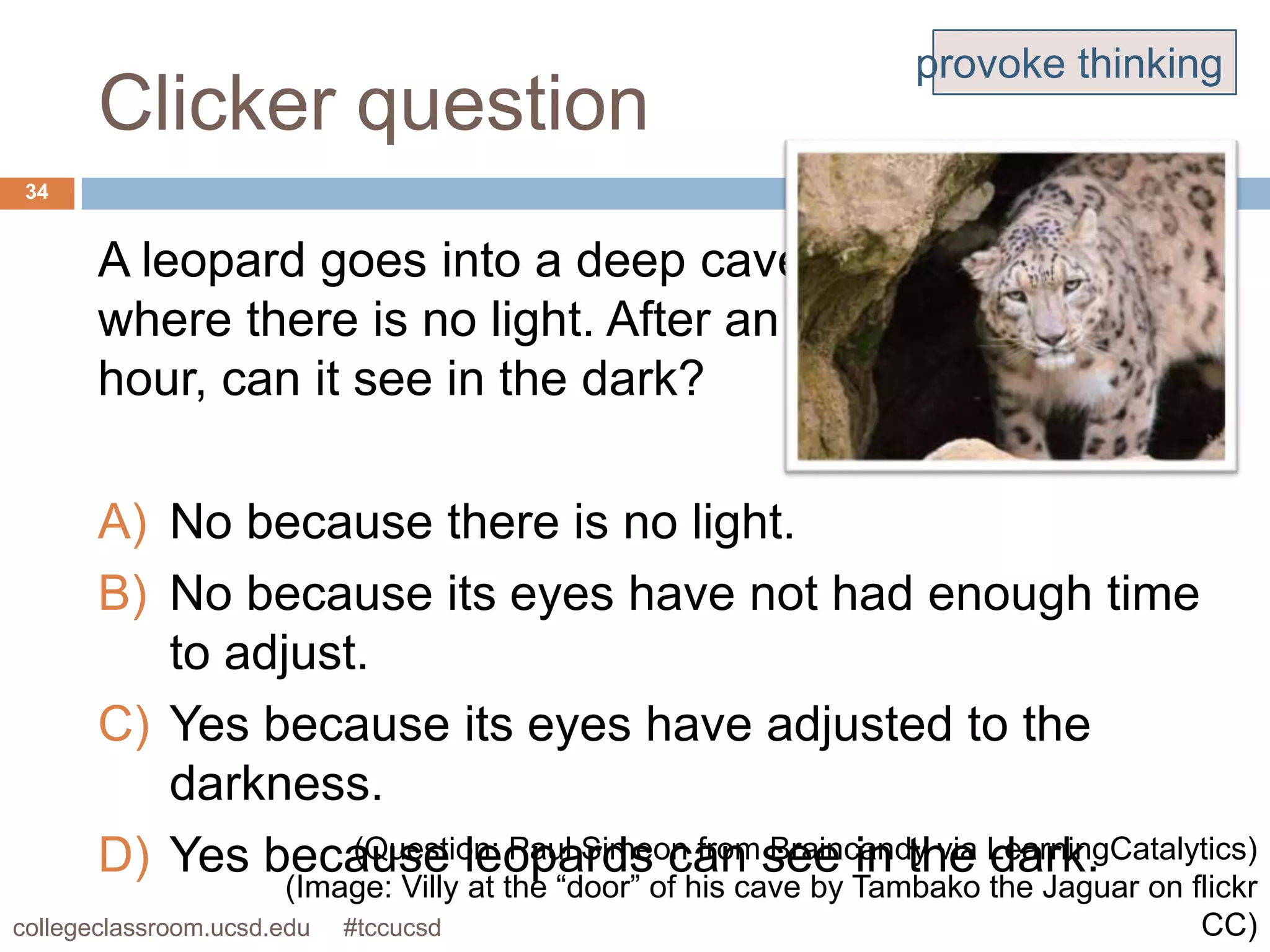
      A leopard goes into a deep cave
      where there is no light. After an
      hour, can it see in the dark?

      A) No because there is no light.
      B) No because its eyes have not had enough time
         to adjust.
      C) Yes because its eyes have adjusted to the
         darkness.
      D) Yes because leopards can see in the LearningCatalytics)
                  (Question: Paul Simeon from Braincandy via dark.
                       (Image: Villy at the “door” of his cave by Tambako the Jaguar on flickr
collegeclassroom.ucsd.edu #tccucsd                                                       CC)
predict
       Clicker question
 35


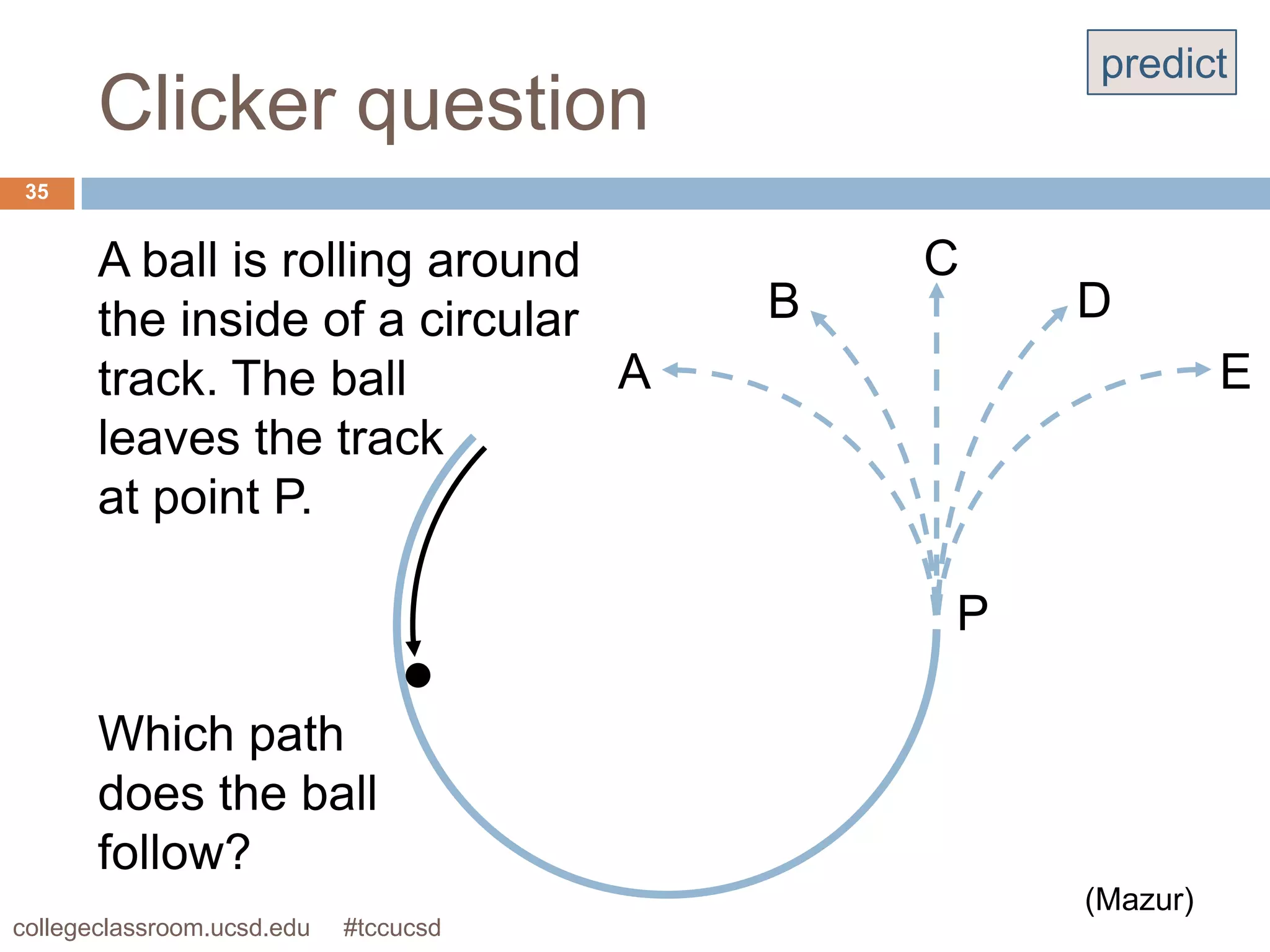
       A ball is rolling around            C
       the inside of a circular        B       D
       track. The ball          A                        E
       leaves the track
       at point P.

                                           P

       Which path
       does the ball
       follow?
                                               (Mazur)
collegeclassroom.ucsd.edu   #tccucsd
Clickers help students learn...
 36


         the                learning                              cycle
          BEFORE                        DURING                          AFTER
         setting up                    developing                    assessing
        instruction                    knowledge                      learning


                                         Adapted from Rosie Piller, Ian Beatty, Stephanie Chasteen
collegeclassroom.ucsd.edu   #tccucsd
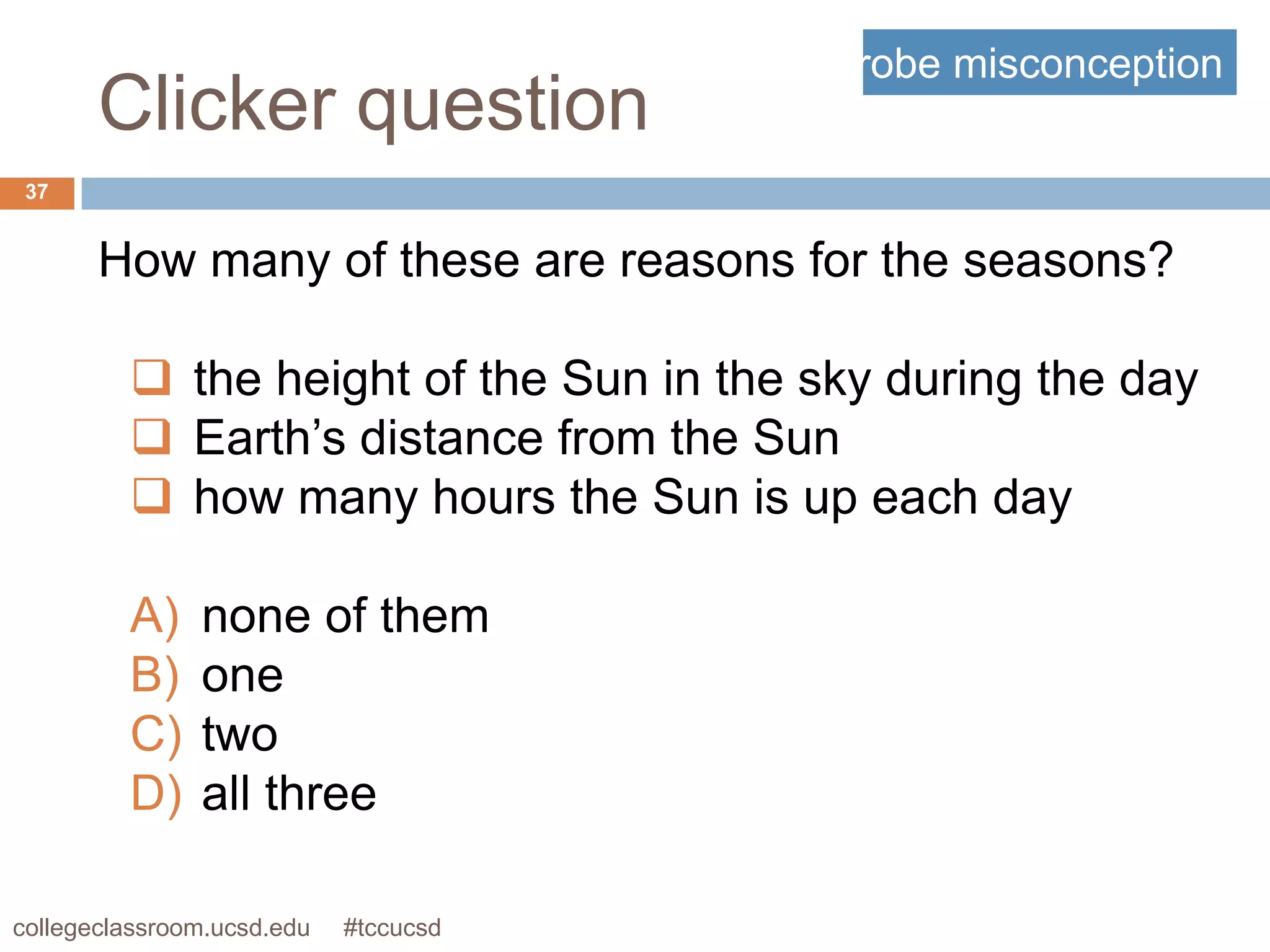
probe misconception
       Clicker question
 37


       How many of these are reasons for the seasons?

          the height of the Sun in the sky during the day
          Earth’s distance from the Sun
          how many hours the Sun is up each day

         A)    none of them
         B)    one
         C)    two
         D)    all three

collegeclassroom.ucsd.edu   #tccucsd
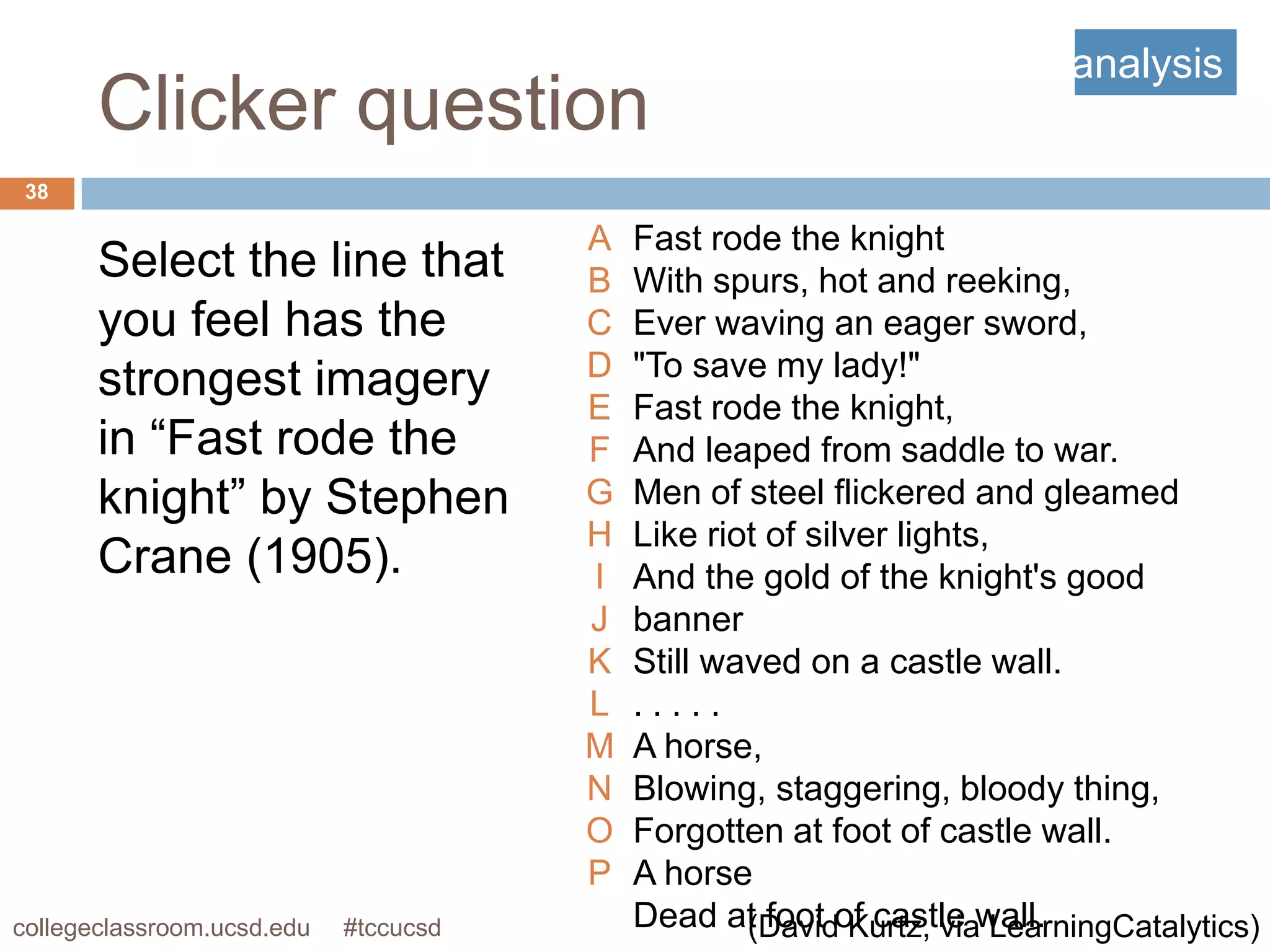
analysis
       Clicker question
 38

                                       A   Fast rode the knight
       Select the line that            B   With spurs, hot and reeking,
       you feel has the                C   Ever waving an eager sword,
                                       D   "To save my lady!"
       strongest imagery               E   Fast rode the knight,
       in “Fast rode the               F   And leaped from saddle to war.
       knight” by Stephen              G   Men of steel flickered and gleamed
                                       H   Like riot of silver lights,
       Crane (1905).                   I   And the gold of the knight's good
                                       J   banner
                                       K   Still waved on a castle wall.
                                       L   .....
                                       M   A horse,
                                       N   Blowing, staggering, bloody thing,
                                       O   Forgotten at foot of castle wall.
                                       P   A horse
collegeclassroom.ucsd.edu   #tccucsd       Dead at foot of castle wall.
                                                   (David Kurtz, via LearningCatalytics)
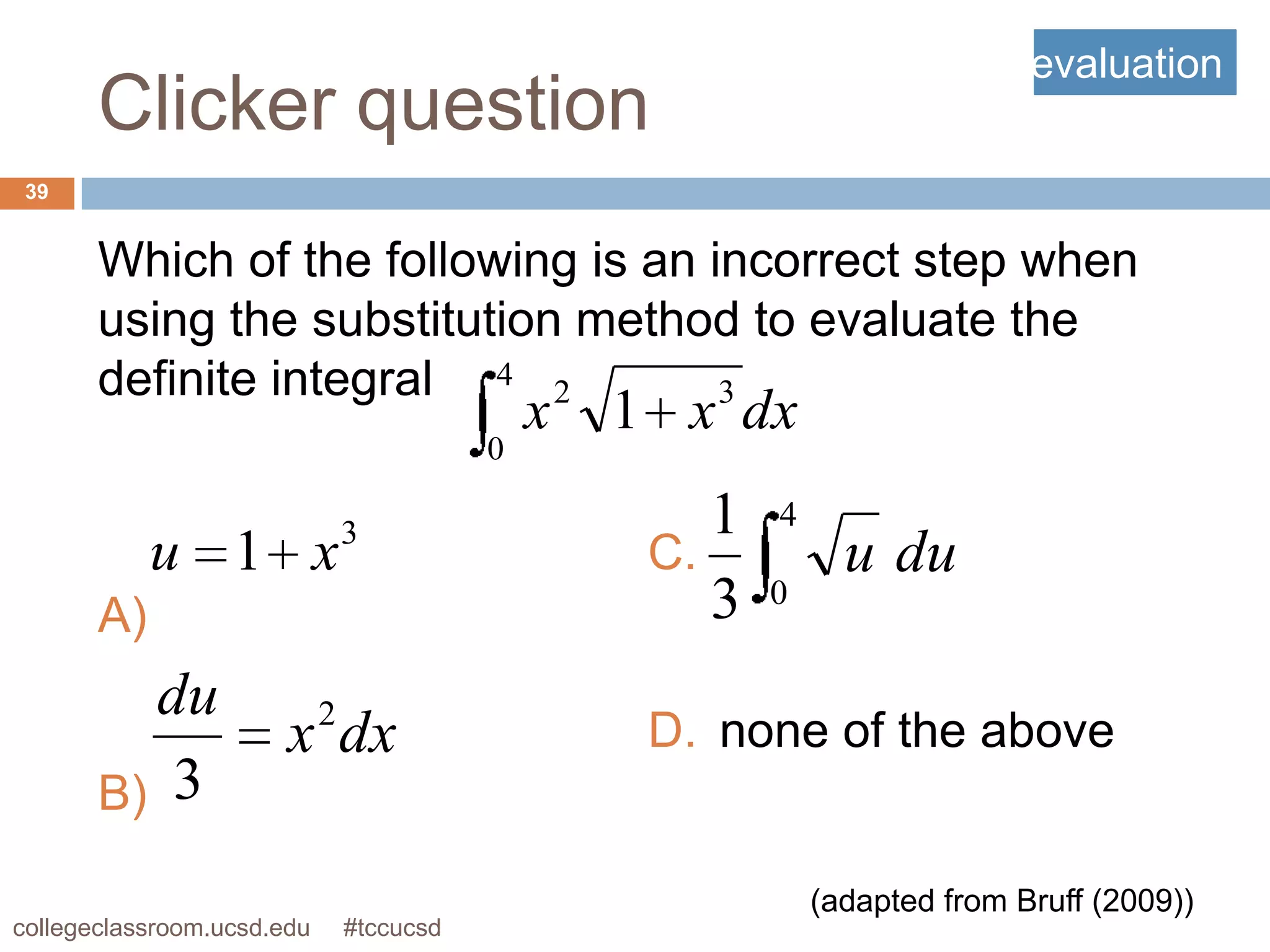
evaluation
       Clicker question
 39


       Which of the following is an incorrect step when
       using the substitution method to evaluate the
       definite integral 4 2         3
                                               x   1 x dx
                                           0

                                3                      1   4
            u 1 x                                   C.           u du
       A)                                              3   0


         du                 2
                       x dx                         D. none of the above
       B) 3

                                                               (adapted from Bruff (2009))
collegeclassroom.ucsd.edu       #tccucsd
exercise skill
       Clicker question
 40


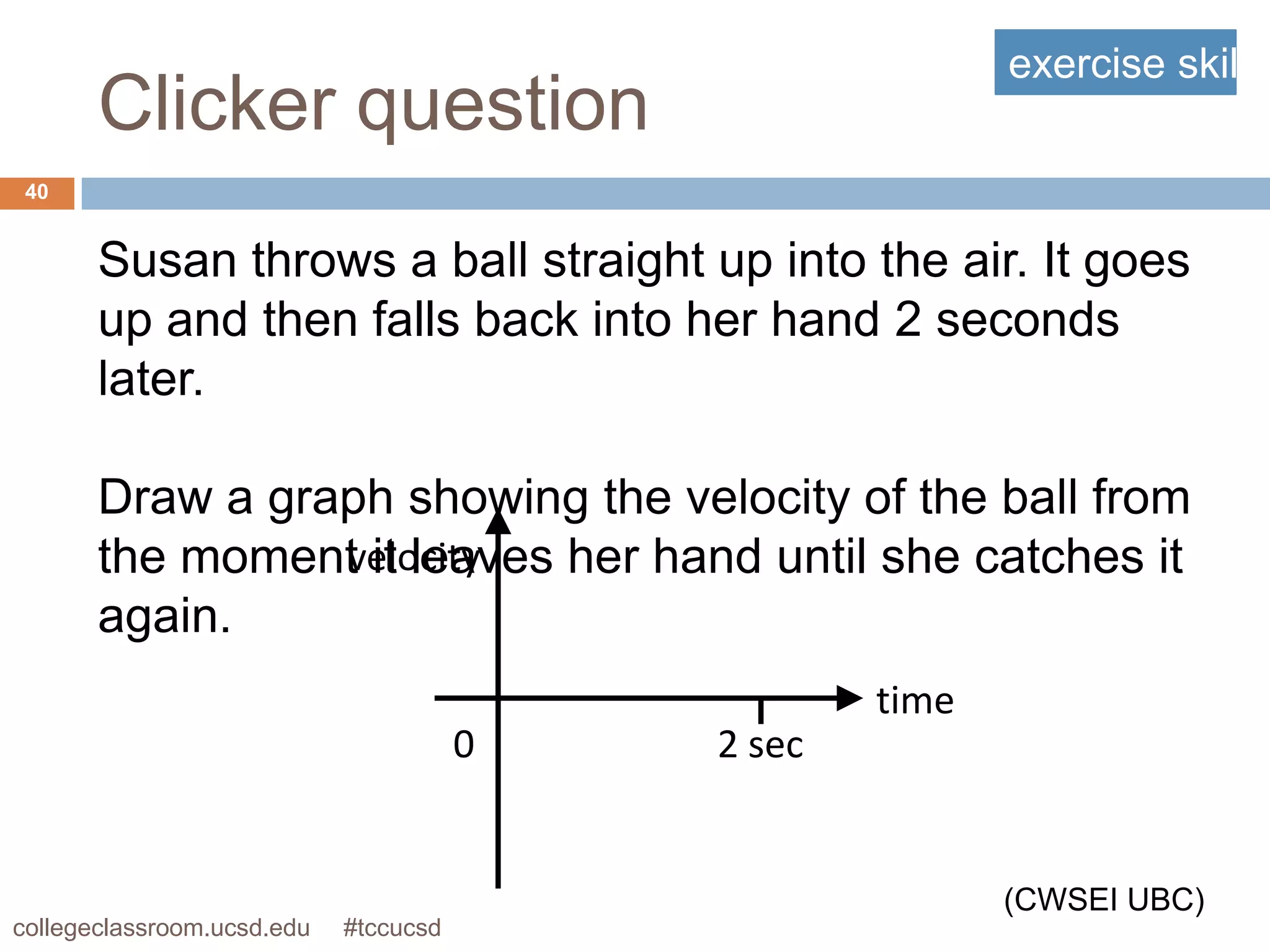
       Susan throws a ball straight up into the air. It goes
       up and then falls back into her hand 2 seconds
       later.

       Draw a graph showing the velocity of the ball from
       the moment it leaves her hand until she catches it
                 velocity
       again.
                                                   time
                                       0   2 sec


                                                          (CWSEI UBC)
collegeclassroom.ucsd.edu   #tccucsd
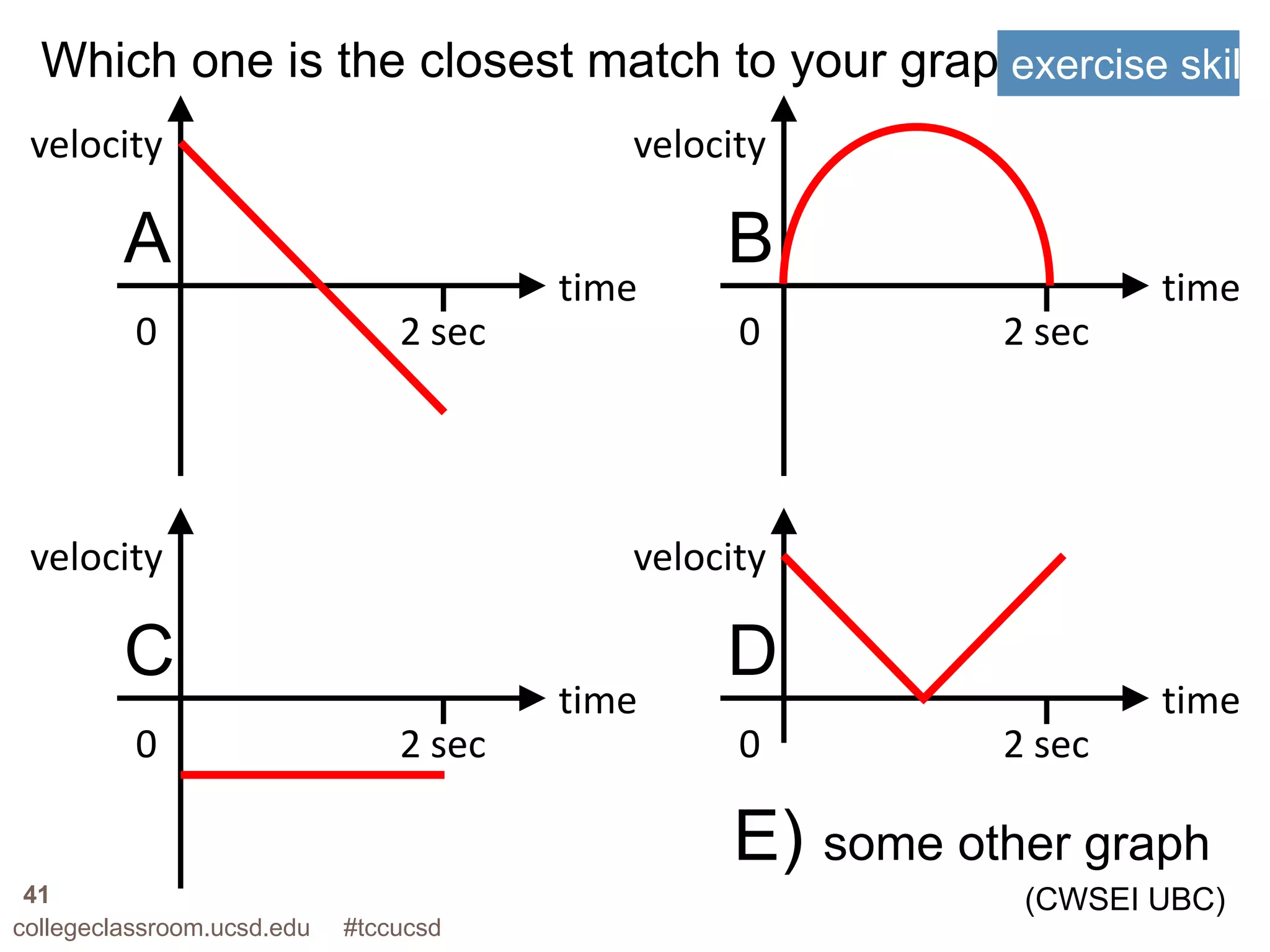
Which one is the closest match to your graph?
                                             exercise skill
 velocity                                  velocity

         A                                      B
                                        time                       time
          0                     2 sec            0         2 sec


 velocity                                  velocity

         C                                      D
                                        time                       time
          0                     2 sec            0         2 sec

                                                 E) some other graph
 41                                                         (CWSEI UBC)
collegeclassroom.ucsd.edu   #tccucsd
Clickers help students learn...
 42


         the                learning                              cycle
          BEFORE                        DURING                          AFTER
         setting up                    developing                    assessing
        instruction                    knowledge                      learning


                                         Adapted from Rosie Piller, Ian Beatty, Stephanie Chasteen
collegeclassroom.ucsd.edu   #tccucsd
demonstrate success
       Clicker question
 43


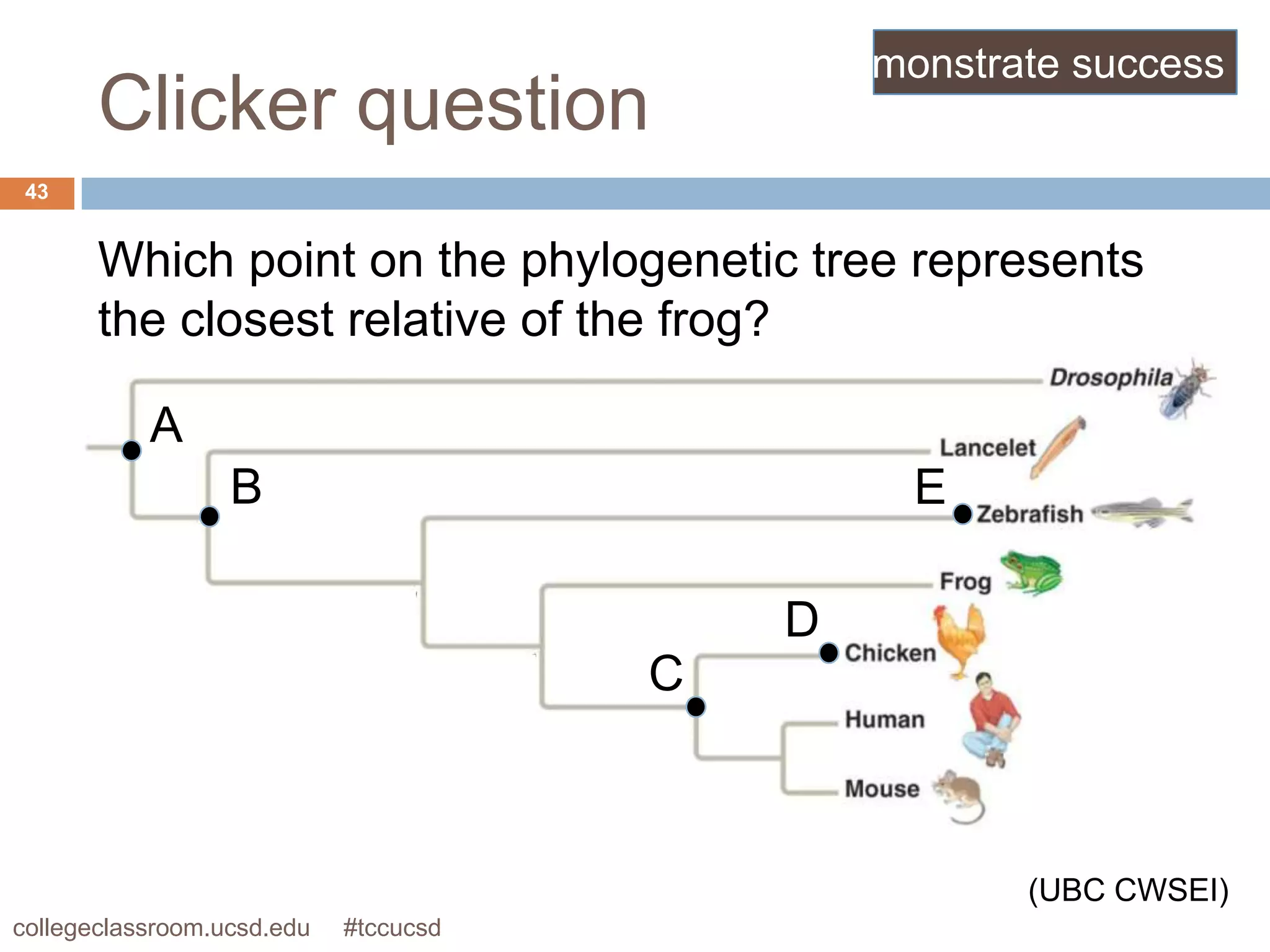
       Which point on the phylogenetic tree represents
       the closest relative of the frog?

           A
                  B                                E

                                           D
                                       C


                                                        (UBC CWSEI)
collegeclassroom.ucsd.edu   #tccucsd
review / recap
       Clicker question
 44


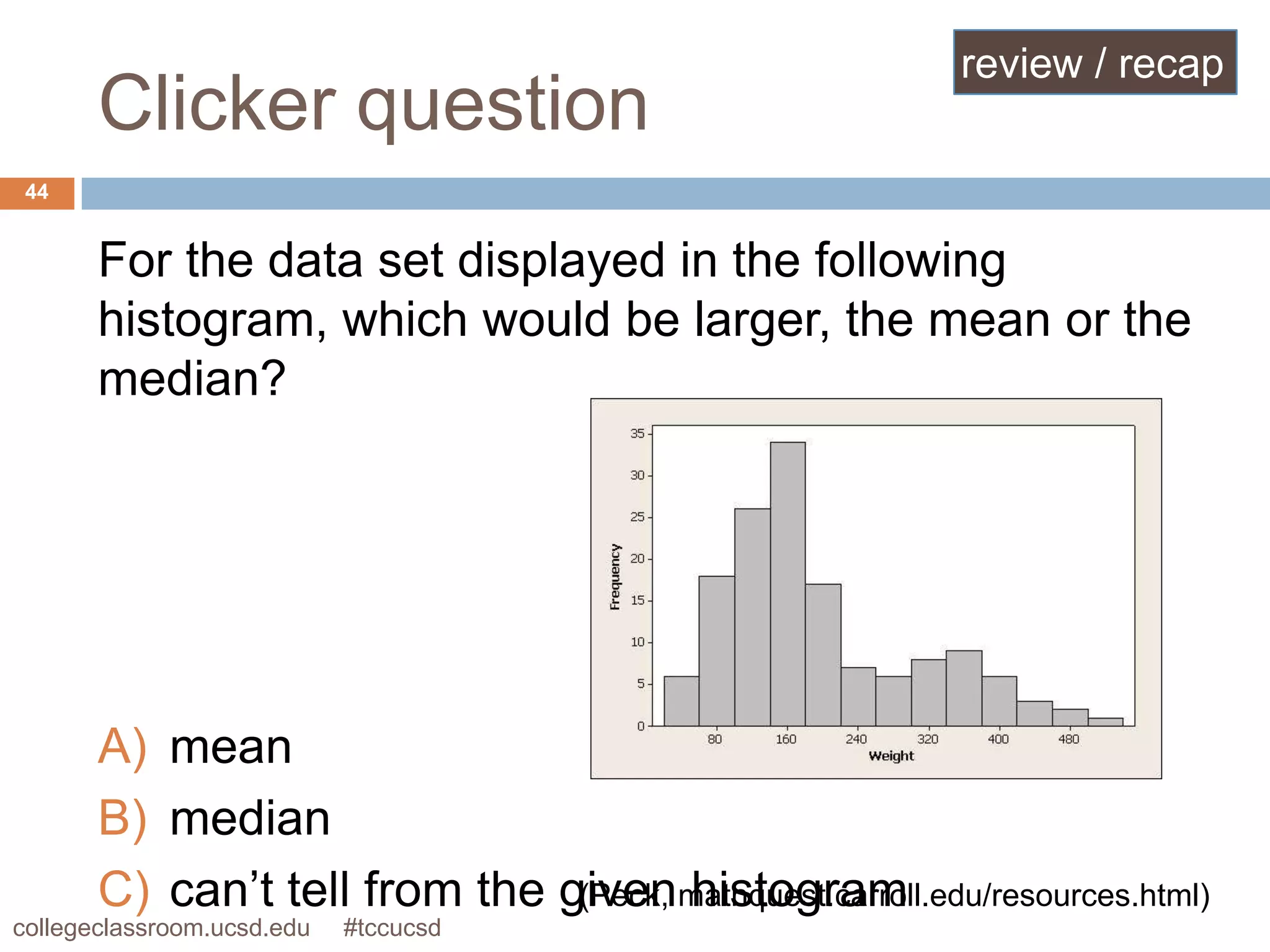
       For the data set displayed in the following
       histogram, which would be larger, the mean or the
       median?


       A) mean
       B) median
       C) can’t tell from the givenmathquest.carroll.edu/resources.html)
                               (Peck, histogram
collegeclassroom.ucsd.edu   #tccucsd
“big picture”
       Clicker question
 45


       In your opinion, which had the most positive
       impact on the modern world?

         A)    coffee
         B)    tea
         C)    chocolate
         D)    spice
         E)    sugar


                                               (Herbst, UCSD)
collegeclassroom.ucsd.edu   #tccucsd
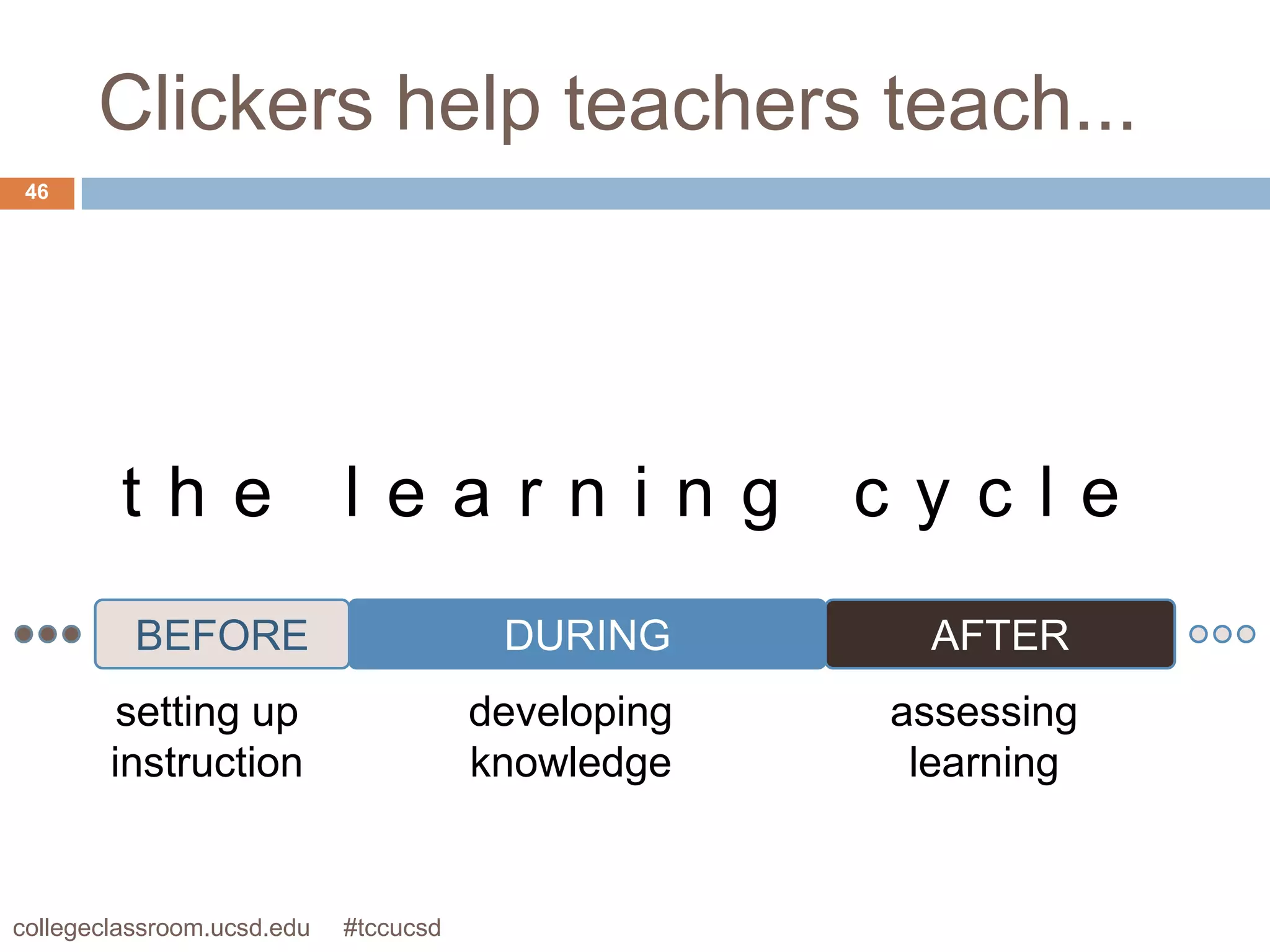
Clickers help teachers teach...
 46


         the                learning                cycle
          BEFORE                        DURING       AFTER
         setting up                    developing   assessing
        instruction                    knowledge     learning


collegeclassroom.ucsd.edu   #tccucsd
Clickers help teachers teach...
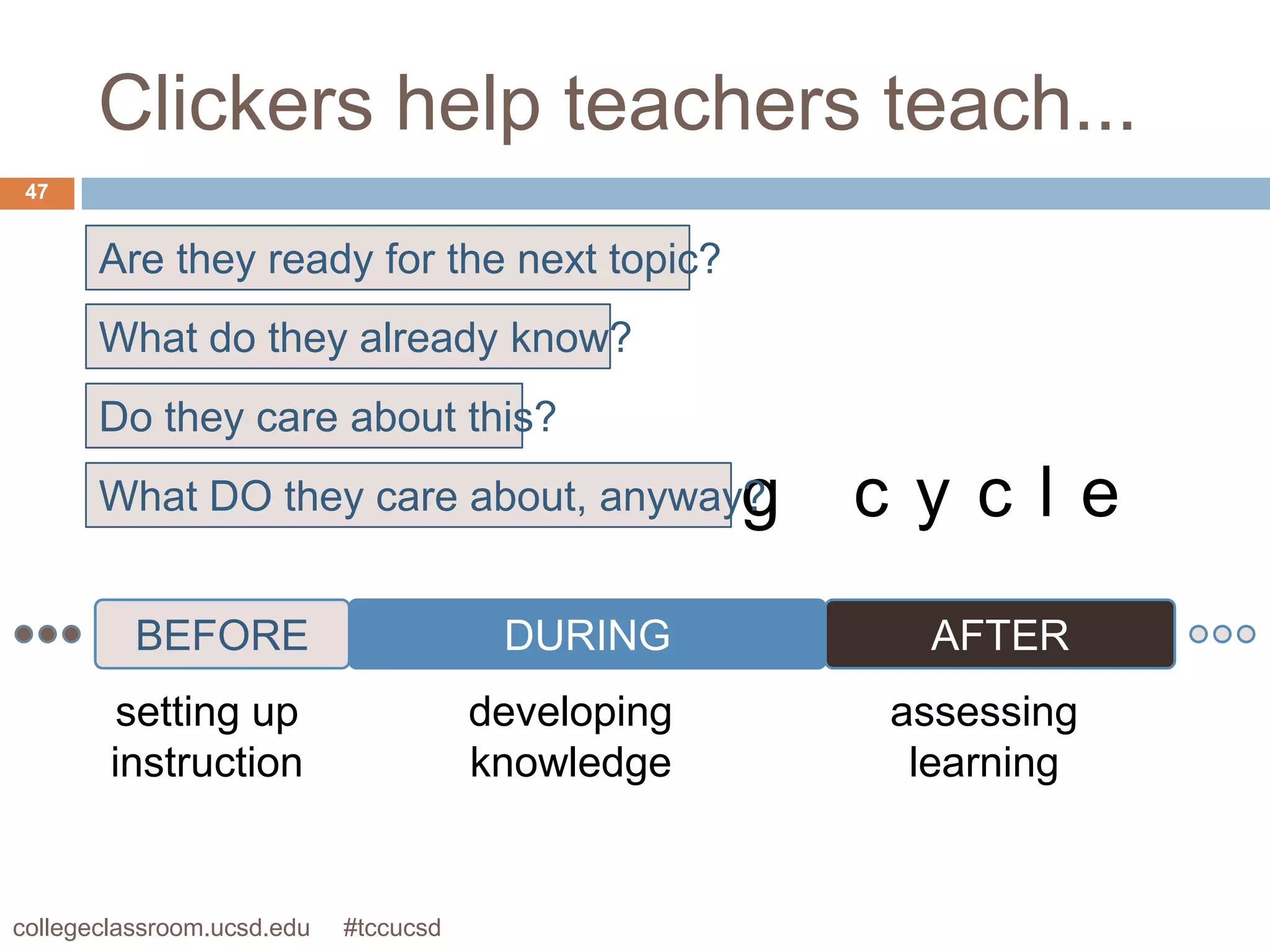
 47


       Are they ready for the next topic?
       What do they already know?
       Do they care about this?

         the                learning
       What DO they care about, anyway?             cycle
          BEFORE                        DURING       AFTER
         setting up                    developing   assessing
        instruction                    knowledge     learning


collegeclassroom.ucsd.edu   #tccucsd
Clickers help teachers teach...
 48


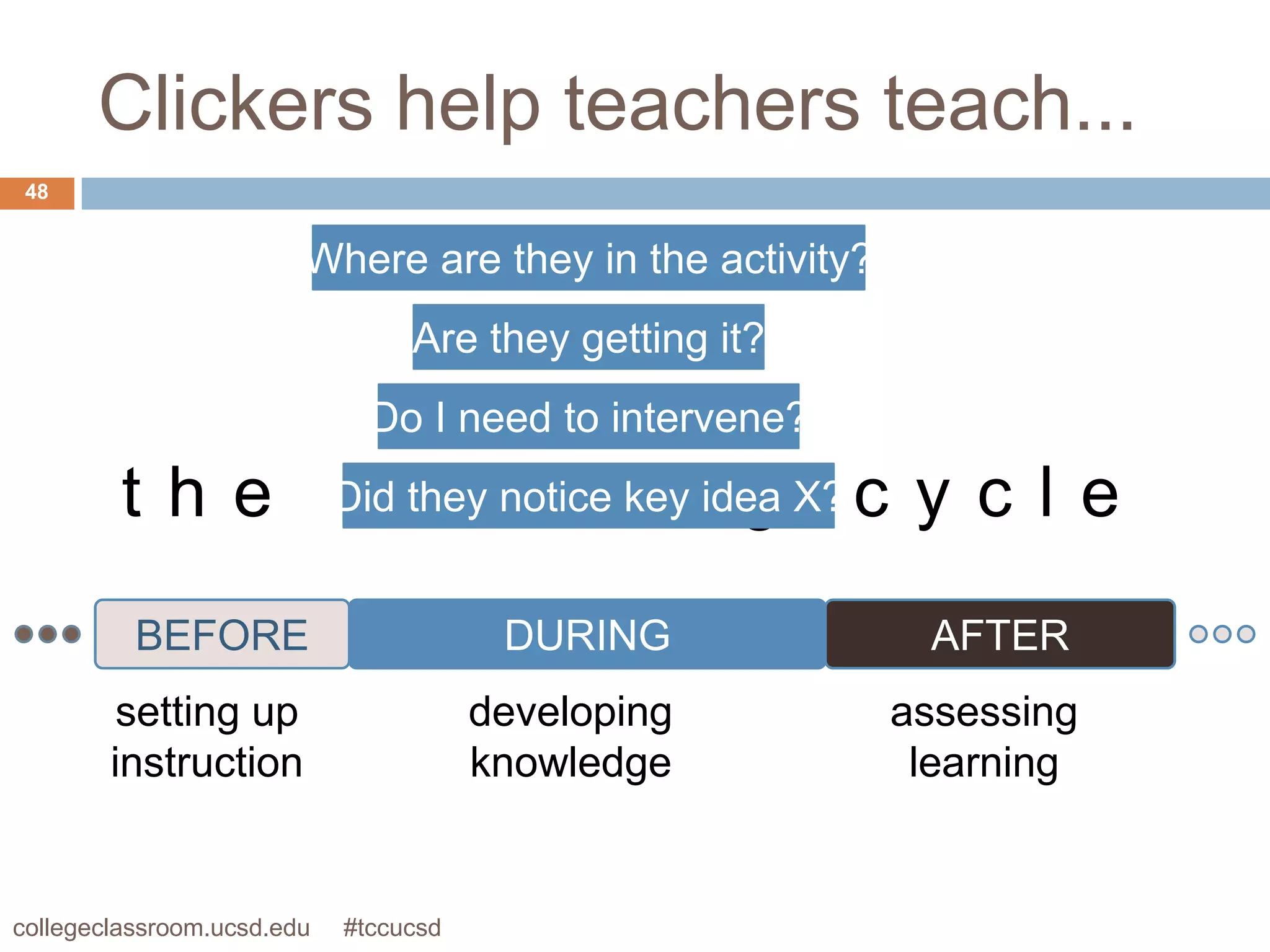
                        Where are they in the activity?
                                 Are they getting it?
                              Do I need to intervene?
         the                learning
                            Did they notice key idea X?   cycle
          BEFORE                        DURING             AFTER
         setting up                    developing         assessing
        instruction                    knowledge           learning


collegeclassroom.ucsd.edu   #tccucsd
Clickers help teachers teach...
 49


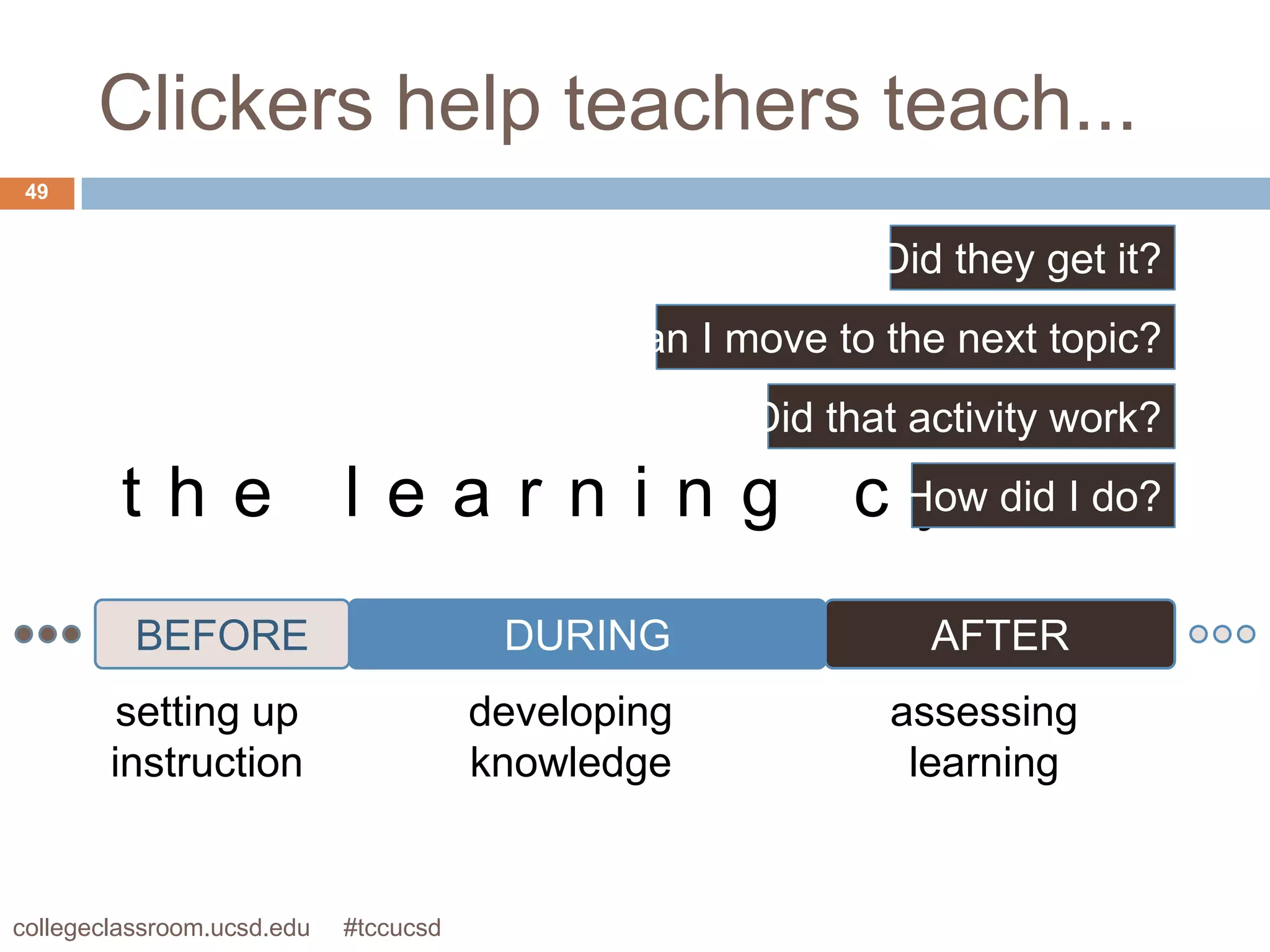
                                                            Did they get it?
                                              Can I move to the next topic?
                                                     Did that activity work?
         the                learning                      c Howcdid Ie
                                                            y l do?
          BEFORE                        DURING                 AFTER
         setting up                    developing           assessing
        instruction                    knowledge             learning


collegeclassroom.ucsd.edu   #tccucsd
What makes a good clicker
 50
      question?
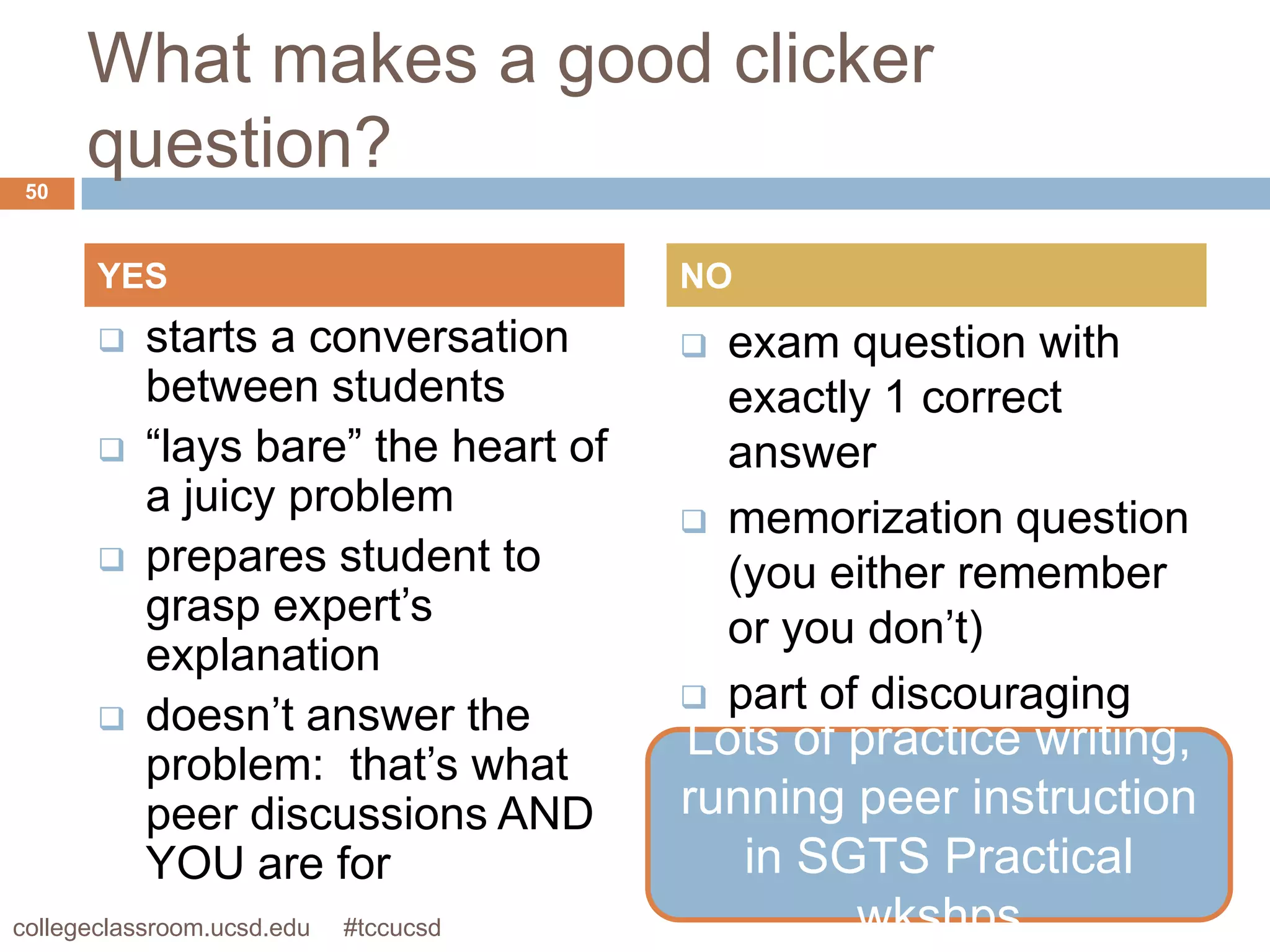
       YES                             NO
          starts a conversation        exam question with
           between students              exactly 1 correct
          “lays bare” the heart of      answer
           a juicy problem              memorization question
          prepares student to           (you either remember
           grasp expert’s                or you don’t)
           explanation
                                        part of discouraging
          doesn’t answer the
                                       Lots of practice writing,
                                         lecture-quiz-lecture-
           problem: that’s what
           peer discussions AND        running peer instruction
                                         quiz-lecture... cycle
           YOU are for                      in SGTS Practical
collegeclassroom.ucsd.edu   #tccucsd             wkshps
Week 9:
First Day of Class
       The College Classroom
           March 6, 2013
References
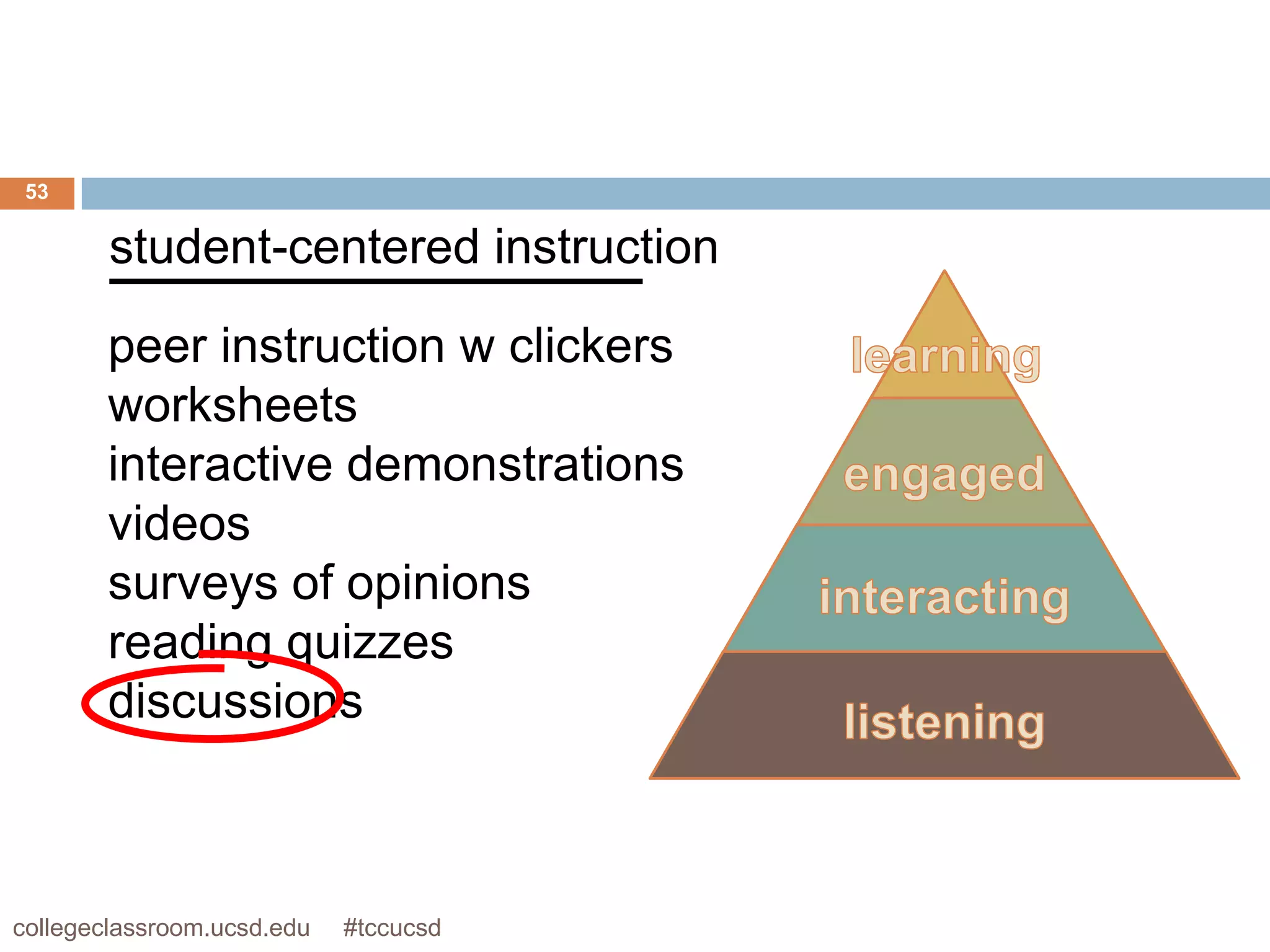
52


        1. National Research Council (2000). How People Learn:
              Brain, Mind, Experience, and School: Expanded
              Edition. J.D. Bransford, A.L Brown & R.R. Cocking
              (Eds.),Washington, DC: The National Academies
              Press.
        2. Prather, E.E, Rudolph, A.L., Brissenden, G., &
              Schlingman, W.M. (2009). A national study assessing
              the teaching and learning of introductory astronomy.
              Part I. The effect of interactive instruction. Am. J. Phys.
              66, 64-74.
        3. Get the full story of ILDs at
              serc.carleton.edu/introgeo/demonstrations/index.html
        4. Prather, E.E., Slater, T.F., Adams, J.P., & Brissenden,
              G. (2007). Lecture Tutorials for Introductory Astronomy.
              (2e). San Francisco, CA: Pearson Addison-Wesley.
collegeclassroom.ucsd.edu #tccucsd
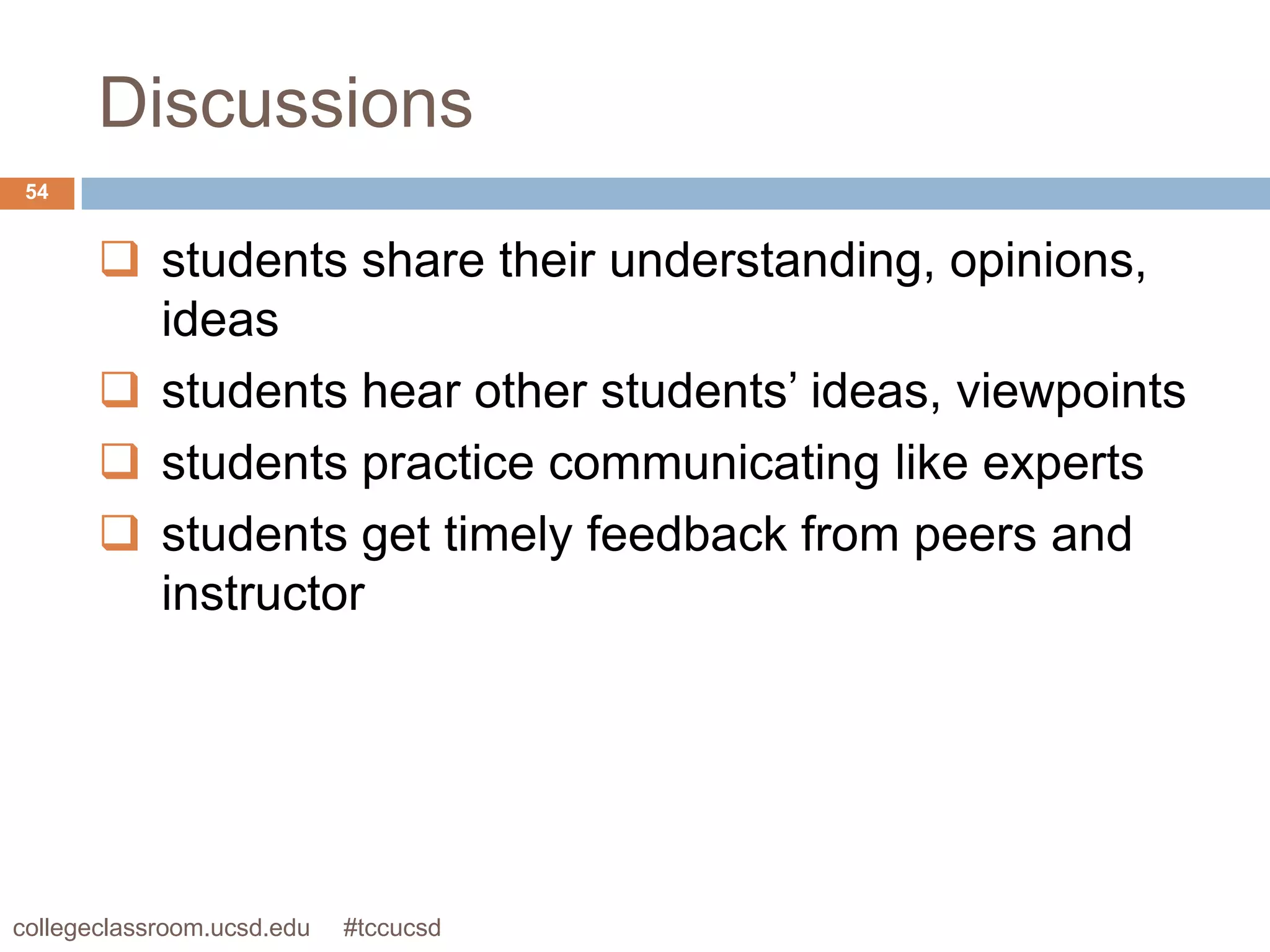
53


        student-centered instruction

       peer instruction w clickers
       worksheets
       interactive demonstrations
       videos
       surveys of opinions
       reading quizzes
       discussions


collegeclassroom.ucsd.edu   #tccucsd
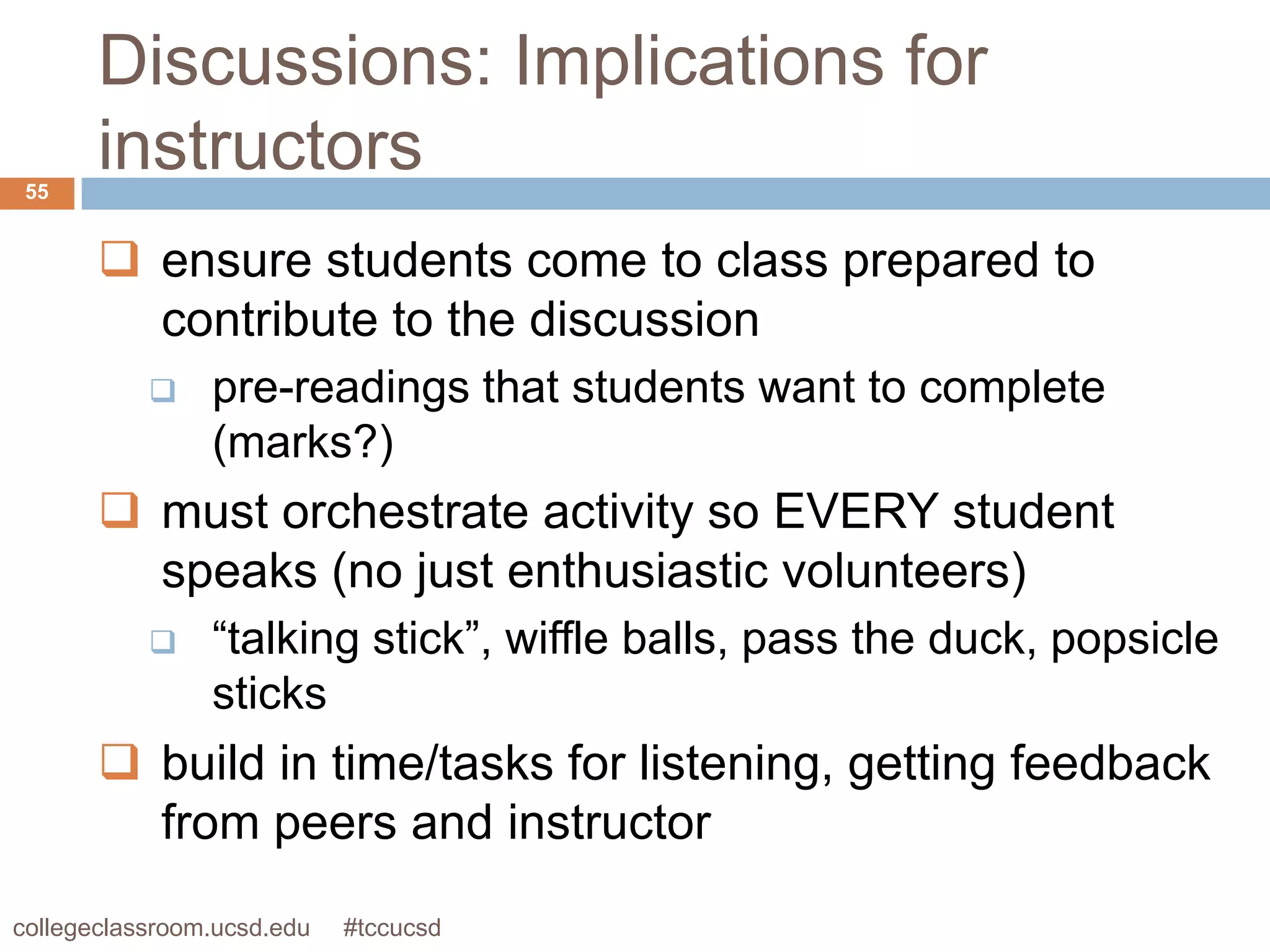
Discussions
 54


        students share their understanding, opinions,
         ideas
        students hear other students’ ideas, viewpoints
        students practice communicating like experts
        students get timely feedback from peers and
         instructor


collegeclassroom.ucsd.edu   #tccucsd
Discussions: Implications for
 55
       instructors
        ensure students come to class prepared to
         contribute to the discussion
               pre-readings that students want to complete
                (marks?)
        must orchestrate activity so EVERY student
         speaks (no just enthusiastic volunteers)
               “talking stick”, wiffle balls, pass the duck, popsicle
                sticks
        build in time/tasks for listening, getting feedback
         from peers and instructor
collegeclassroom.ucsd.edu   #tccucsd

The College Classroom Week 8 - Alternatives to Lecture

  • 1.
    Week 8: Alternatives toLecture The College Classroom February 27, 2013
  • 2.
    2 traditional lecture student-centered instruction collegeclassroom.ucsd.edu #tccucsd
  • 3.
    Key Finding 3 3 A “metacognitive” approach to instruction can help students learn to take control of their own learning by defining learning goals and monitoring their progress in achieving them. (How People Learn [1], p. 18) Instructors need to provide opportunities for students to practice being metacognitive – thinking about their own thinking collegeclassroom.ucsd.edu #tccucsd
  • 4.
    Key Finding 2 4 To develop competence in an area, students must: a) have a deep foundation of factual knowledge, b) understand facts and ideas in the context of a conceptual framework, and c) organize knowledge in ways that facilitate (How People Learn [1], p. 16) retrieval and application. These are characteristics of expertize (together with metacognition) collegeclassroom.ucsd.edu #tccucsd
  • 5.
    Key Finding 1 5 Students come to the classroom with preconceptions about how the world works. If their initial understanding is not engaged, they may fail to grasp the new concepts and information that are taught, or they may learn them for the purposes of a test but revert Learn [1], their (How People to p. 14) preconceptions outside of the classroom. Instructors must draw out Instruction must students’ pre- be student- existing centered. understandings. collegeclassroom.ucsd.edu #tccucsd
  • 6.
    Learning requires interaction[2] 6 collegeclassroom.ucsd.edu #tccucsd
  • 7.
    Learning requires interaction[2] 7 Learning gain: 100% 0.50 % of class time NOT 0 lecturing pre-test post-test collegeclassroom.ucsd.edu #tccucsd
  • 8.
    Learning requires interaction[2] 8 1 2 3 4 collegeclassroom.ucsd.edu #tccucsd
  • 9.
    9 student-centered instruction peer instruction w clickers worksheets interactive demonstrations videos surveys of opinions reading quizzes discussions collegeclassroom.ucsd.edu #tccucsd
  • 10.
    Archimedes’ Principle 10 In today’s Physics class, we’re going to study buoyancy and Archimedes’ Principle. http://tinyurl.com/TCCdemo (Paul Hewitt video) (Image: Wikimedia Commons – public domain) collegeclassroom.ucsd.edu #tccucsd
  • 11.
    Opinion: Videos inclass 11 In your opinion, the Paul Hewitt video A) is engaging B) is entertaining C) is interactive D) stimulates deep thinking collegeclassroom.ucsd.edu #tccucsd
  • 12.
    Videos in class 12 Unlike you, the students do not  select the video instructor does this  check it contains key events before class  anticipate key events instructor does this  recognize key events unconsciously, the “curse” of expertise  interpret key events This is what you want to  relate key events to discuss in class! Anticipate & class concepts recognize are pre-requisites. collegeclassroom.ucsd.edu #tccucsd
  • 13.
    Videos: implications for 13 instructors  Coach the students how to watch the video like an expert: As you watch this video, try to… watch for when the A starts to B. count how often the C does D. watch the needles on the scales as water drains.  Don’t “give away” the key event (Notice the buoyant force is equal to the weight of the fluid displaced.) That’s what the follow-up discussion is for: help the students get collegeclassroom.ucsd.edu #tccucsd
  • 14.
    14 student-centered instruction peer instruction w clickers worksheets interactive demonstrations videos surveys of opinions reading quizzes discussions collegeclassroom.ucsd.edu #tccucsd
  • 15.
    In-class demonstrations 15 1. Instructor (meticulously) sets up the equipment, flicks a switch, “Taa-daaah! 2. Students  don’t know where to look  don’t know when to look, miss “the moment”  don’t recognize the significance of the event amongst too many distractions collegeclassroom.ucsd.edu #tccucsd
  • 16.
    Interactive Lecture Demos(ILD) 16 [3] To engage students and focus their attention on the key event, get students to make a prediction (using clickers, for example) collegeclassroom.ucsd.edu #tccucsd
  • 17.
    Clicker question 17 A ball is rolling around C the inside of a circular B D track. The ball A E leaves the track at point P. P Which path does the ball follow? collegeclassroom.ucsd.edu #tccucsd (Mazur)
  • 18.
    Interactive Lecture Demos(ILD) 18 [3] After the prediction, each student  cares about the outcome (“Did I get it right?”)  knows where to look (can anticipate phenomenon)  knows when to look (sees phenomenon occur)  gets immediate feedback about his/her understanding of the concept  is prepared for your explanation  (don’t be afraid to mess with their heads – collegeclassroom.ucsd.edu #tccucsd
  • 19.
    19 student-centered instruction peer instruction w clickers worksheets interactive demonstrations videos surveys of opinions reading quizzes discussions collegeclassroom.ucsd.edu #tccucsd
  • 20.
    Gen-Ed astronomy class 20 Before beginning an in-class worksheet, be sure the students are properly prepared: Stars have various  diameters and surface areas  temperatures (hot stars are blue, cooler stars are red) A star’s luminosity is the rate at which it emits energy. Orion by John Gauvreau APOD 2008 October 15 collegeclassroom.ucsd.edu #tccucsd
  • 21.
    21 In class, we did a worksheet about cooking spaghetti and then, by analogy, the temperature, size and luminosity of stars. The worksheet is removed from this slide deck because it is copyrighted. collegeclassroom.ucsd.edu #tccucsd
  • 22.
    In-class worksheets 22  carefully-designed sequence of questions guide students through the exploration of a concept  first few questions may be trivial – checks students read intro paragraph, gives them confidence  give formative feedback along the way  most effective when done collaboratively (group reaches consensus before answering)  long, evidence-based history via “Washington Tutorials” and “Lecture Tutorials for introductory astronomy” (interactive activities in Prather et collegeclassroom.ucsd.edu #tccucsd
  • 23.
    In-class worksheet assessment 23  don’t “go over” the worksheet  that only encourages students to force sit and wait for your solutions students to  don’t post solutions later self-assess  again, encourages non-participation their answers:  students bring last year’s sol’ns to class metacogniti  good alternative: ask a clicker question(s) on  if students get the question right, they can be confident they successfully completed the worksheet collegeclassroom.ucsd.edu #tccucsd
  • 24.
    Clicker question 24 You observe two stars with the same luminosity and determine that one is larger than the other. Which star has the greater temperature? A) the smaller star B) the larger star C) the temperatures are the same D) there is insufficient information to answer this question collegeclassroom.ucsd.edu #tccucsd (Prather et al., [4])
  • 25.
    25 student-centered instruction peer instruction w clickers worksheets interactive demonstrations videos surveys of opinions reading quizzes discussions collegeclassroom.ucsd.edu #tccucsd
  • 26.
    Clicker question 26 Melt chocolate over low heat. Remove the chocolate from the heat. What will happen to the chocolate? A) It will condense. B) It will evaporate. C) It will freeze. (Question: Sujatha Raghu from Braincandy via LearningCatalytics) (Image: CIM9926 by number657 on flickr CC) collegeclassroom.ucsd.edu #tccucsd
  • 27.
    Typical episode ofpeer 27 instruction Alternating with 10-15 minute mini-lectures, 1. Instructor poses a conceptually-challenging multiple-choice question. 2. Students think about question on their own. 3. Students vote for an answer using clickers, colored/ABCD voting cards,... 4. The instructor reacts, based on the distribution of votes. Typically 1. “turn to your neighbor, convince them you’re right” 2. 2nd vote 3. Instructor orchestrates class discussion, concluding with explanation of solution (plus why collegeclassroom.ucsd.edu #tccucsd wrong?) wrongs are
  • 28.
    In effective peerinstruction 28  students teach each other while students they may still hold or remember learn and their preconceptions practice  students discuss the concepts in their to how own (novice) language think, communicat  the instructor finds out what the students know e like (and don’t know) and reacts experts collegeclassroom.ucsd.edu #tccucsd
  • 29.
    Effective peer instruction 29 requires 1. identifying key concepts, misconceptions 2. creating multiple-choice questions that before require deeper thinking and learning class 3. facilitating peer instruction episodes that spark student discussion during 4. resolving the misconceptions class collegeclassroom.ucsd.edu #tccucsd
  • 30.
    Clickers help studentslearn... 30 the learning cycle BEFORE DURING AFTER setting up developing assessing instruction knowledge learning Adapted from Rosie Piller, Ian Beatty, Stephanie Chasteen collegeclassroom.ucsd.edu #tccucsd
  • 31.
    Clickers help studentslearn... 31 the learning cycle BEFORE DURING AFTER setting up developing assessing instruction knowledge learning Adapted from Rosie Piller, Ian Beatty, Stephanie Chasteen collegeclassroom.ucsd.edu #tccucsd
  • 32.
    assess prior knowledge Clicker question 32 Melt chocolate over low heat. Remove the chocolate from the heat. What will happen to the chocolate? A) It will condense. B) It will evaporate. C) It will freeze. (Question: Sujatha Raghu from Braincandy via LearningCatalytics) (Image: CIM9926 by number657 on flickr CC) collegeclassroom.ucsd.edu #tccucsd
  • 33.
    motivate Clicker question 33 In your opinion, which had the most positive impact on the modern world? A) coffee B) tea C) chocolate D) spice E) sugar (Herbst, UCSD) collegeclassroom.ucsd.edu #tccucsd
  • 34.
    provoke thinking Clicker question 34 A leopard goes into a deep cave where there is no light. After an hour, can it see in the dark? A) No because there is no light. B) No because its eyes have not had enough time to adjust. C) Yes because its eyes have adjusted to the darkness. D) Yes because leopards can see in the LearningCatalytics) (Question: Paul Simeon from Braincandy via dark. (Image: Villy at the “door” of his cave by Tambako the Jaguar on flickr collegeclassroom.ucsd.edu #tccucsd CC)
  • 35.
    predict Clicker question 35 A ball is rolling around C the inside of a circular B D track. The ball A E leaves the track at point P. P Which path does the ball follow? (Mazur) collegeclassroom.ucsd.edu #tccucsd
  • 36.
    Clickers help studentslearn... 36 the learning cycle BEFORE DURING AFTER setting up developing assessing instruction knowledge learning Adapted from Rosie Piller, Ian Beatty, Stephanie Chasteen collegeclassroom.ucsd.edu #tccucsd
  • 37.
    probe misconception Clicker question 37 How many of these are reasons for the seasons?  the height of the Sun in the sky during the day  Earth’s distance from the Sun  how many hours the Sun is up each day A) none of them B) one C) two D) all three collegeclassroom.ucsd.edu #tccucsd
  • 38.
    analysis Clicker question 38 A Fast rode the knight Select the line that B With spurs, hot and reeking, you feel has the C Ever waving an eager sword, D "To save my lady!" strongest imagery E Fast rode the knight, in “Fast rode the F And leaped from saddle to war. knight” by Stephen G Men of steel flickered and gleamed H Like riot of silver lights, Crane (1905). I And the gold of the knight's good J banner K Still waved on a castle wall. L ..... M A horse, N Blowing, staggering, bloody thing, O Forgotten at foot of castle wall. P A horse collegeclassroom.ucsd.edu #tccucsd Dead at foot of castle wall. (David Kurtz, via LearningCatalytics)
  • 39.
    evaluation Clicker question 39 Which of the following is an incorrect step when using the substitution method to evaluate the definite integral 4 2 3 x 1 x dx 0 3 1 4 u 1 x C. u du A) 3 0 du 2 x dx D. none of the above B) 3 (adapted from Bruff (2009)) collegeclassroom.ucsd.edu #tccucsd
  • 40.
    exercise skill Clicker question 40 Susan throws a ball straight up into the air. It goes up and then falls back into her hand 2 seconds later. Draw a graph showing the velocity of the ball from the moment it leaves her hand until she catches it velocity again. time 0 2 sec (CWSEI UBC) collegeclassroom.ucsd.edu #tccucsd
  • 41.
    Which one isthe closest match to your graph? exercise skill velocity velocity A B time time 0 2 sec 0 2 sec velocity velocity C D time time 0 2 sec 0 2 sec E) some other graph 41 (CWSEI UBC) collegeclassroom.ucsd.edu #tccucsd
  • 42.
    Clickers help studentslearn... 42 the learning cycle BEFORE DURING AFTER setting up developing assessing instruction knowledge learning Adapted from Rosie Piller, Ian Beatty, Stephanie Chasteen collegeclassroom.ucsd.edu #tccucsd
  • 43.
    demonstrate success Clicker question 43 Which point on the phylogenetic tree represents the closest relative of the frog? A B E D C (UBC CWSEI) collegeclassroom.ucsd.edu #tccucsd
  • 44.
    review / recap Clicker question 44 For the data set displayed in the following histogram, which would be larger, the mean or the median? A) mean B) median C) can’t tell from the givenmathquest.carroll.edu/resources.html) (Peck, histogram collegeclassroom.ucsd.edu #tccucsd
  • 45.
    “big picture” Clicker question 45 In your opinion, which had the most positive impact on the modern world? A) coffee B) tea C) chocolate D) spice E) sugar (Herbst, UCSD) collegeclassroom.ucsd.edu #tccucsd
  • 46.
    Clickers help teachersteach... 46 the learning cycle BEFORE DURING AFTER setting up developing assessing instruction knowledge learning collegeclassroom.ucsd.edu #tccucsd
  • 47.
    Clickers help teachersteach... 47 Are they ready for the next topic? What do they already know? Do they care about this? the learning What DO they care about, anyway? cycle BEFORE DURING AFTER setting up developing assessing instruction knowledge learning collegeclassroom.ucsd.edu #tccucsd
  • 48.
    Clickers help teachersteach... 48 Where are they in the activity? Are they getting it? Do I need to intervene? the learning Did they notice key idea X? cycle BEFORE DURING AFTER setting up developing assessing instruction knowledge learning collegeclassroom.ucsd.edu #tccucsd
  • 49.
    Clickers help teachersteach... 49 Did they get it? Can I move to the next topic? Did that activity work? the learning c Howcdid Ie y l do? BEFORE DURING AFTER setting up developing assessing instruction knowledge learning collegeclassroom.ucsd.edu #tccucsd
  • 50.
    What makes agood clicker 50 question? YES NO  starts a conversation  exam question with between students exactly 1 correct  “lays bare” the heart of answer a juicy problem  memorization question  prepares student to (you either remember grasp expert’s or you don’t) explanation  part of discouraging  doesn’t answer the Lots of practice writing, lecture-quiz-lecture- problem: that’s what peer discussions AND running peer instruction quiz-lecture... cycle YOU are for in SGTS Practical collegeclassroom.ucsd.edu #tccucsd wkshps
  • 51.
    Week 9: First Dayof Class The College Classroom March 6, 2013
  • 52.
    References 52 1. National Research Council (2000). How People Learn: Brain, Mind, Experience, and School: Expanded Edition. J.D. Bransford, A.L Brown & R.R. Cocking (Eds.),Washington, DC: The National Academies Press. 2. Prather, E.E, Rudolph, A.L., Brissenden, G., & Schlingman, W.M. (2009). A national study assessing the teaching and learning of introductory astronomy. Part I. The effect of interactive instruction. Am. J. Phys. 66, 64-74. 3. Get the full story of ILDs at serc.carleton.edu/introgeo/demonstrations/index.html 4. Prather, E.E., Slater, T.F., Adams, J.P., & Brissenden, G. (2007). Lecture Tutorials for Introductory Astronomy. (2e). San Francisco, CA: Pearson Addison-Wesley. collegeclassroom.ucsd.edu #tccucsd
  • 53.
    53 student-centered instruction peer instruction w clickers worksheets interactive demonstrations videos surveys of opinions reading quizzes discussions collegeclassroom.ucsd.edu #tccucsd
  • 54.
    Discussions 54  students share their understanding, opinions, ideas  students hear other students’ ideas, viewpoints  students practice communicating like experts  students get timely feedback from peers and instructor collegeclassroom.ucsd.edu #tccucsd
  • 55.
    Discussions: Implications for 55 instructors  ensure students come to class prepared to contribute to the discussion  pre-readings that students want to complete (marks?)  must orchestrate activity so EVERY student speaks (no just enthusiastic volunteers)  “talking stick”, wiffle balls, pass the duck, popsicle sticks  build in time/tasks for listening, getting feedback from peers and instructor collegeclassroom.ucsd.edu #tccucsd