Week 1: Introduction
      The College Classroom
         January 9, 2013
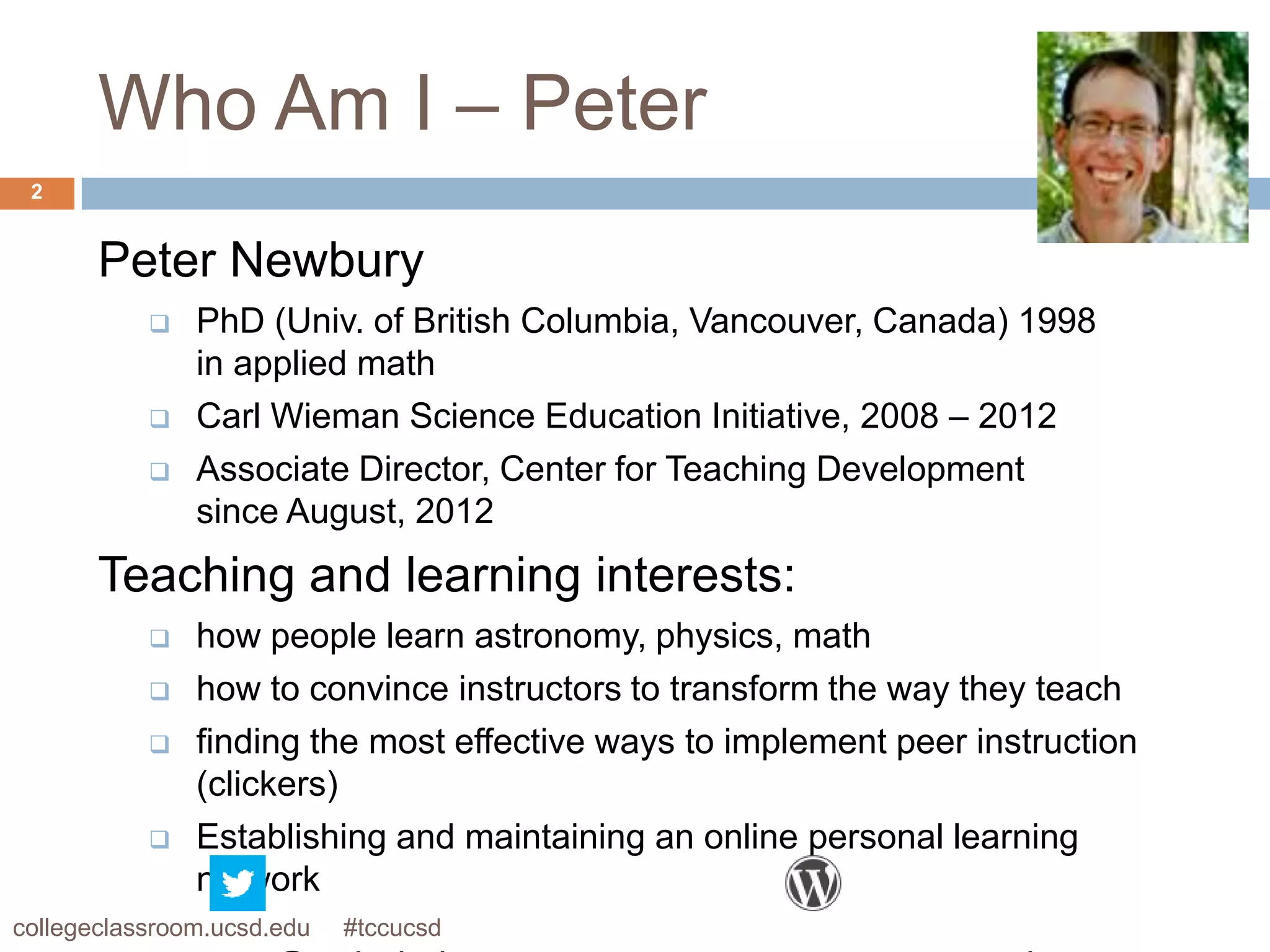
Who Am I – Peter
 2


       Peter Newbury
              PhD (Univ. of British Columbia, Vancouver, Canada) 1998
               in applied math
              Carl Wieman Science Education Initiative, 2008 – 2012
              Associate Director, Center for Teaching Development
               since August, 2012
       Teaching and learning interests:
              how people learn astronomy, physics, math
              how to convince instructors to transform the way they teach
              finding the most effective ways to implement peer instruction
               (clickers)
              Establishing and maintaining an online personal learning
               network
collegeclassroom.ucsd.edu   #tccucsd
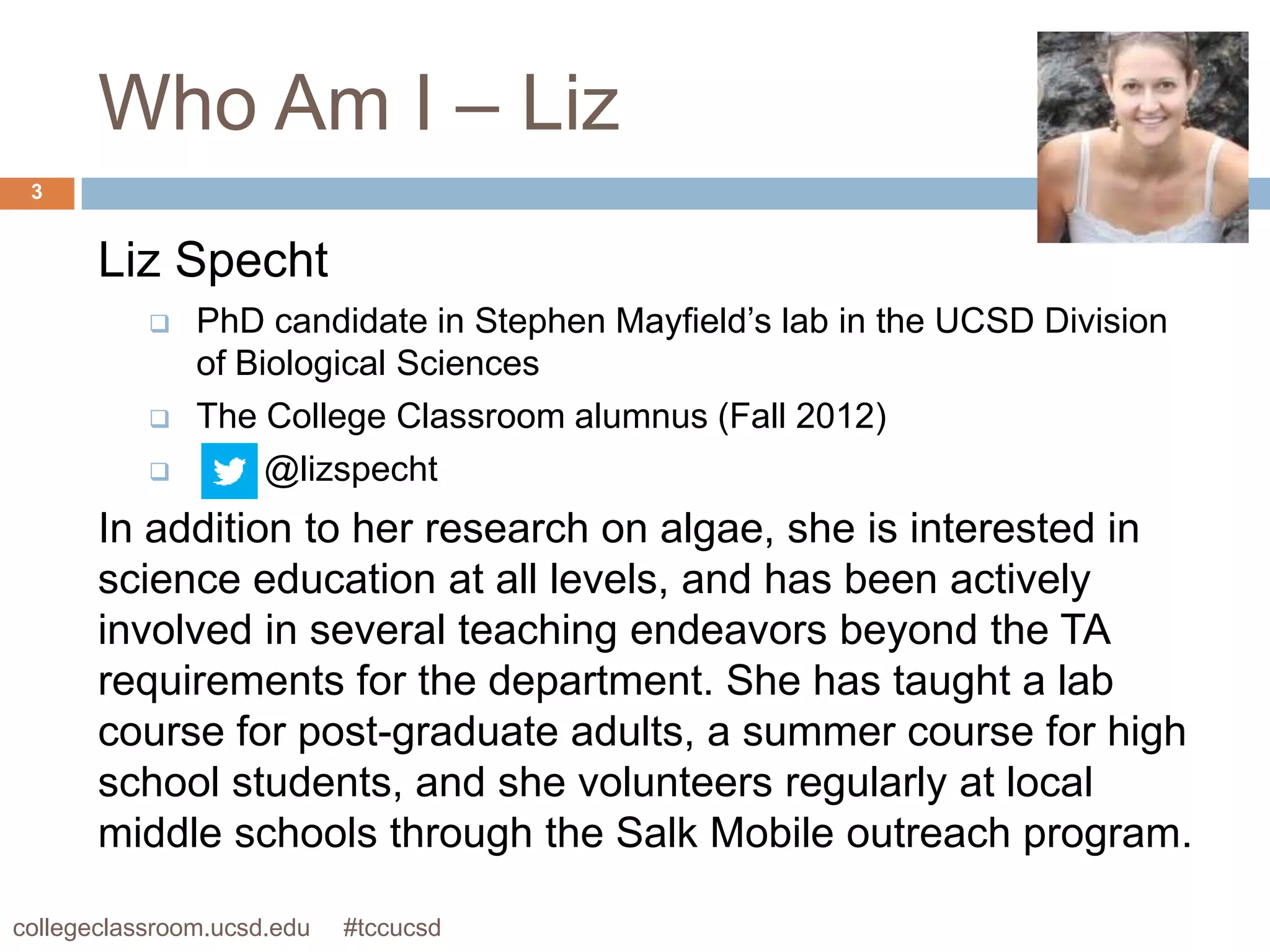
Who Am I – Liz
 3


       Liz Specht
              PhD candidate in Stephen Mayfield’s lab in the UCSD Division
               of Biological Sciences
              The College Classroom alumnus (Fall 2012)
                   @lizspecht
       In addition to her research on algae, she is interested in
       science education at all levels, and has been actively
       involved in several teaching endeavors beyond the TA
       requirements for the department. She has taught a lab
       course for post-graduate adults, a summer course for high
       school students, and she volunteers regularly at local
       middle schools through the Salk Mobile outreach program.

collegeclassroom.ucsd.edu   #tccucsd
Who are you?
4


        Why are you taking The College Classroom?
        A) I’m looking for a tenure-track academic
              position and knowing about teaching will help
              me get a job.
        B) I have little/no teaching experience and I want
              to get some.
        C) I’ve taught before and I want to become a
              better instructor.
        D) I’m interested in the theory and pedagogy of
              teaching and learning.
        E) other
collegeclassroom.ucsd.edu #tccucsd
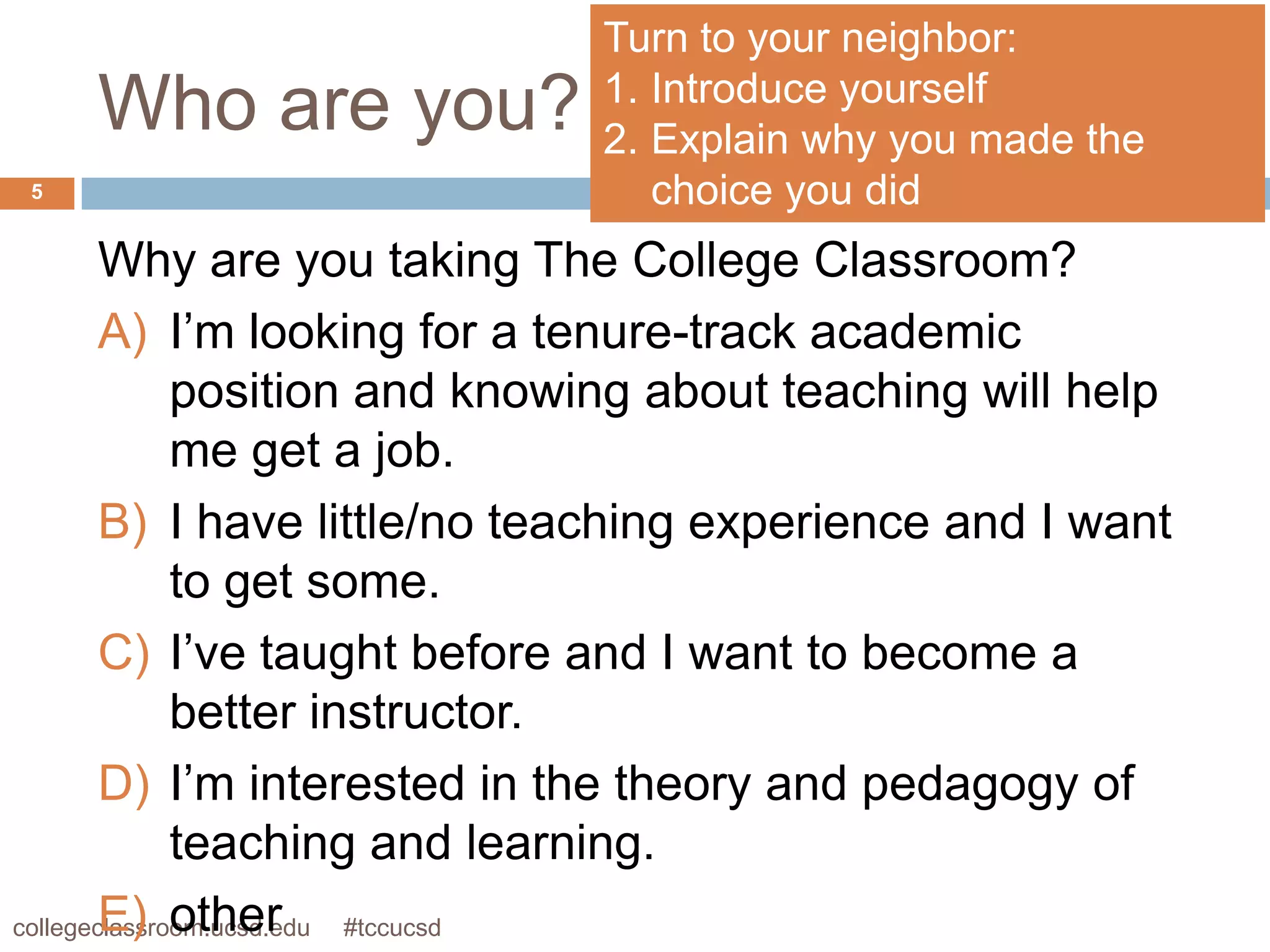
Turn to your neighbor:
                              1. Introduce yourself
    Who are you?              2. Explain why you made the
5                                choice you did
        Why are you taking The College Classroom?
        A) I’m looking for a tenure-track academic
              position and knowing about teaching will help
              me get a job.
        B) I have little/no teaching experience and I want
              to get some.
        C) I’ve taught before and I want to become a
              better instructor.
        D) I’m interested in the theory and pedagogy of
              teaching and learning.
        E) other
collegeclassroom.ucsd.edu #tccucsd
A quick survey:
 6


       We have people with different backgrounds in our
       audience: Raise your hand if this is you:
           Who experienced undergraduate education in the US?
           Who has had a teaching experience before?
           Who has given a technical talk?
           Who has English as a second language?
           Who has been a student in a large (150+ students)
           class?


collegeclassroom.ucsd.edu   #tccucsd
Introduction to teaching and learning
in higher education
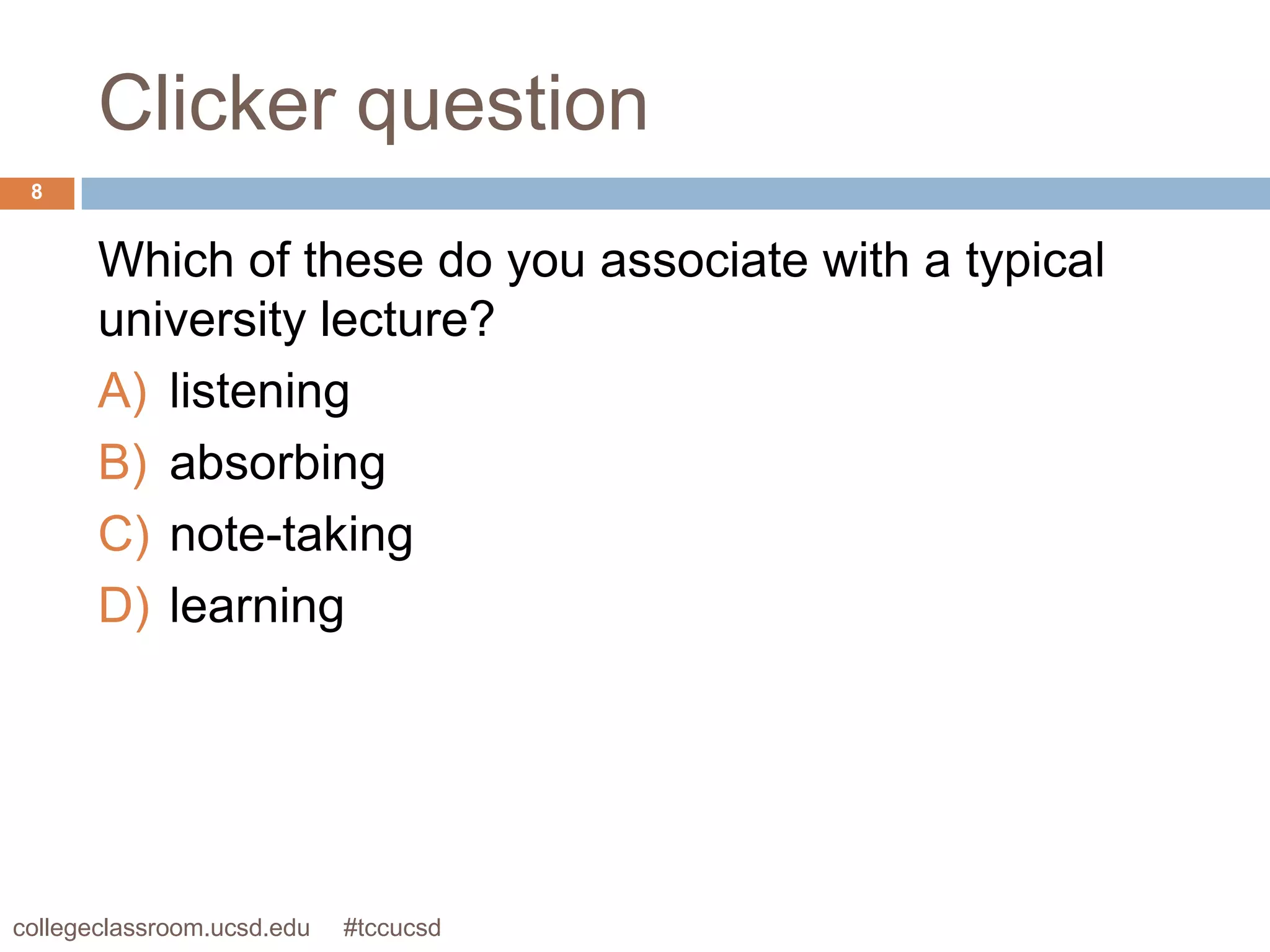
Clicker question
 8


       Which of these do you associate with a typical
       university lecture?
       A) listening
       B) absorbing
       C) note-taking
       D) learning


collegeclassroom.ucsd.edu   #tccucsd
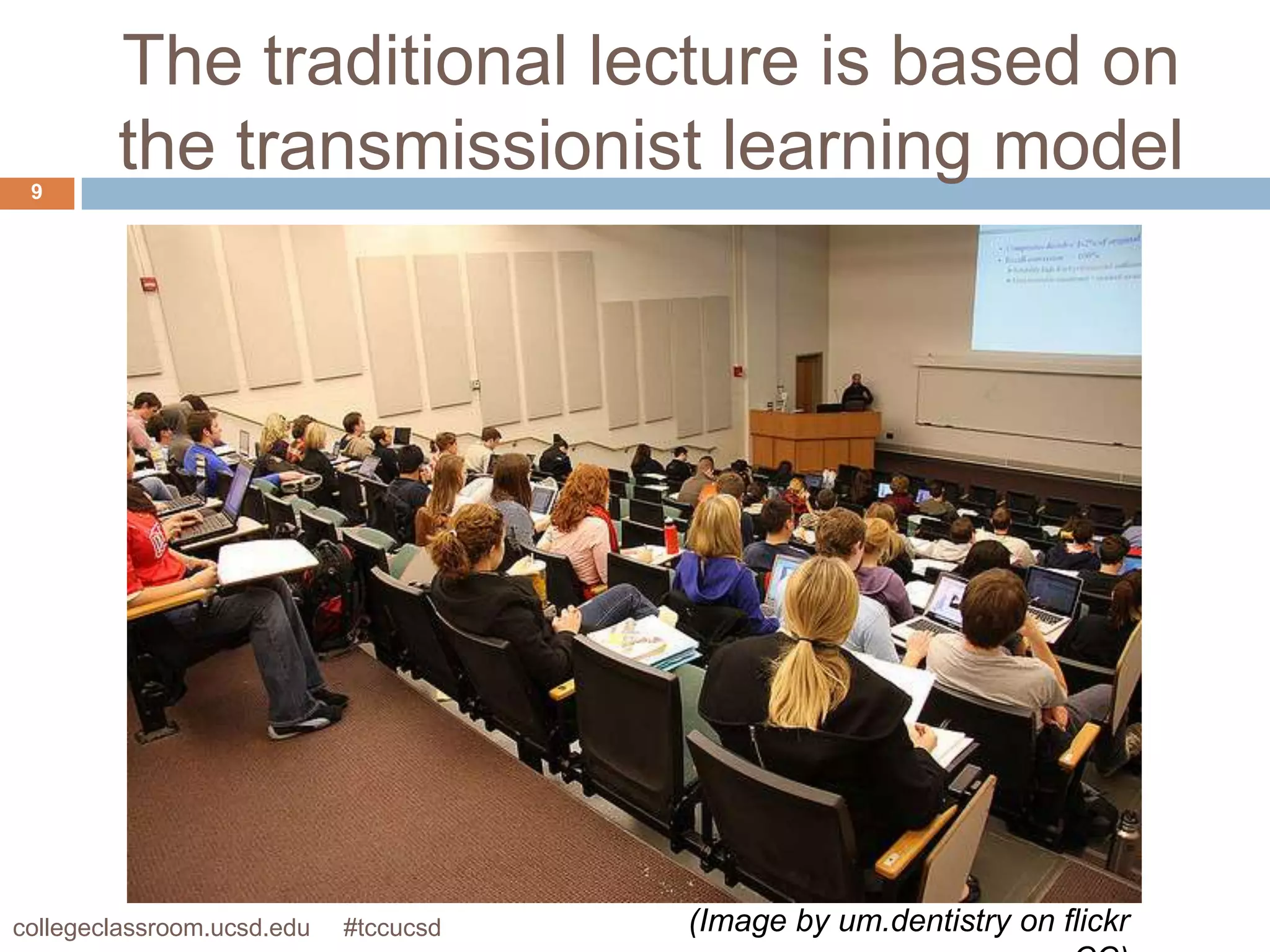
The traditional lecture is based on
 9
        the transmissionist learning model


collegeclassroom.ucsd.edu   #tccucsd   (Image by um.dentistry on flickr
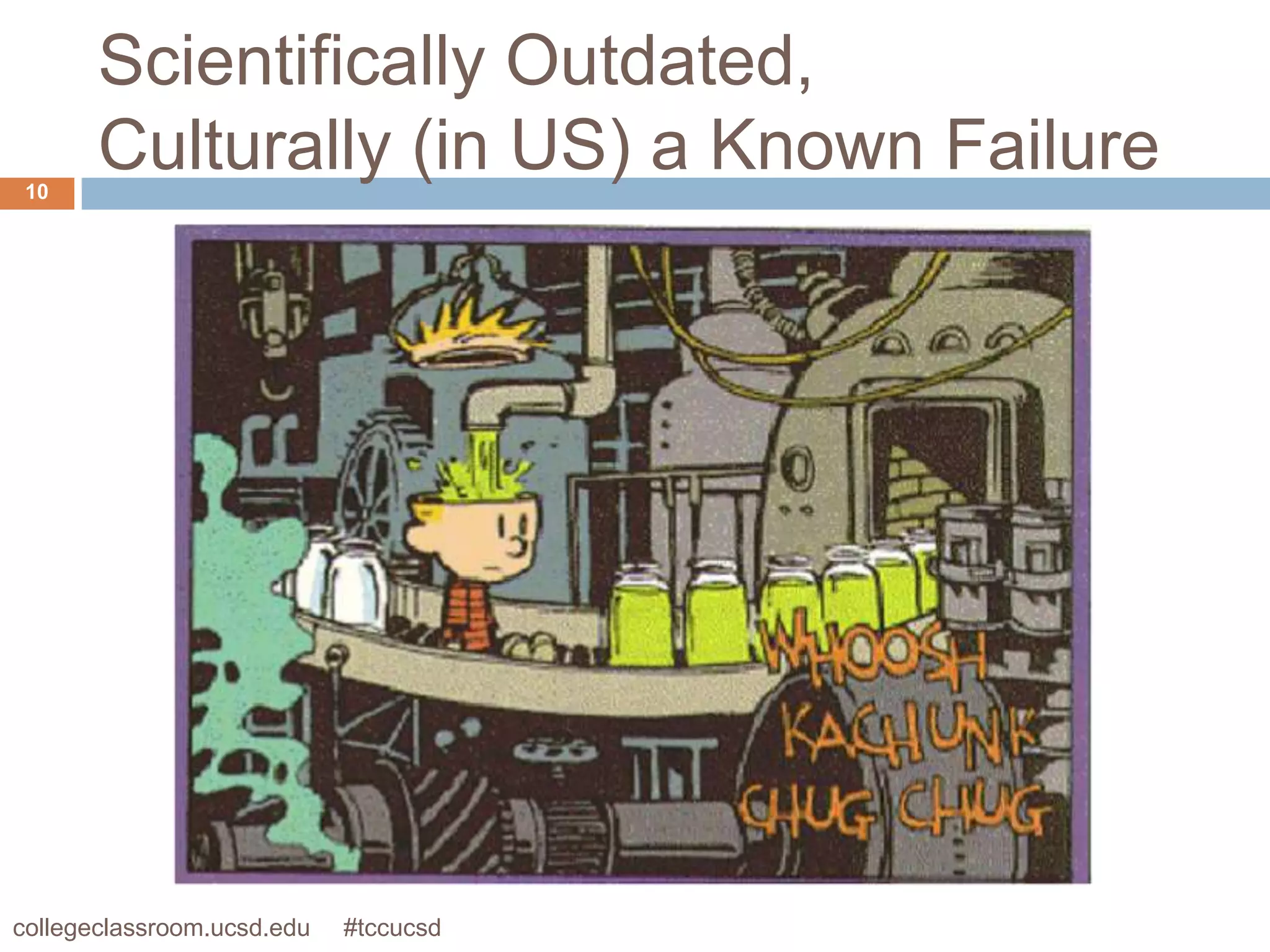
Scientifically Outdated,
 10
       Culturally (in US) a Known Failure


collegeclassroom.ucsd.edu   #tccucsd
How People Learn [1]
 11


       People actively construct their own knowledge
               Individual
               Based in pre-existing understanding

       Biologically, learning changes the brain
               Proteins form, Neurons fire
               Technology allowing us to observe learning as it
                happens (fMRI)


 [1] How People Learn: Brain, Mind, Experience and School Expanded Edition. Ed. Bransford
collegeclassroom.ucsd.edu   #tccucsd
How People Learn [1]
 12


              Learning is not about what
                    professors do.
        It’s about what THE LEARNER does!

                        Corollary:
              Students do not LEARN just
          by listening to the professor explain

 [1] How People Learn: Brain, Mind, Experience and School Expanded Edition. Ed. Bransford
collegeclassroom.ucsd.edu   #tccucsd
Let’s have a learning
 13
       experience…


collegeclassroom.ucsd.edu   #tccucsd
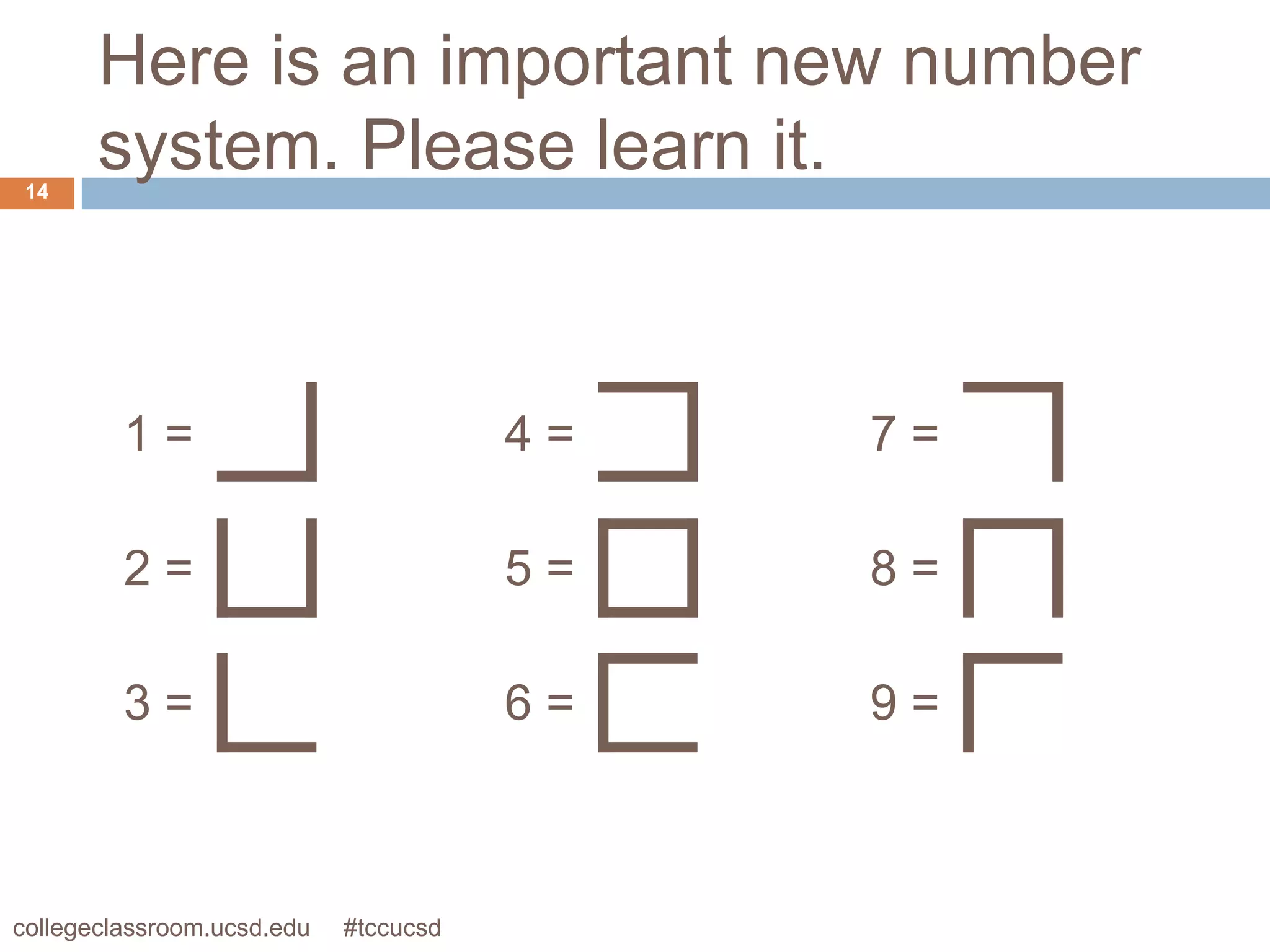
Here is an important new number
 14
       system. Please learn it.


         1=                            4=   7=

         2=                            5=   8=

         3=                            6=   9=


collegeclassroom.ucsd.edu   #tccucsd
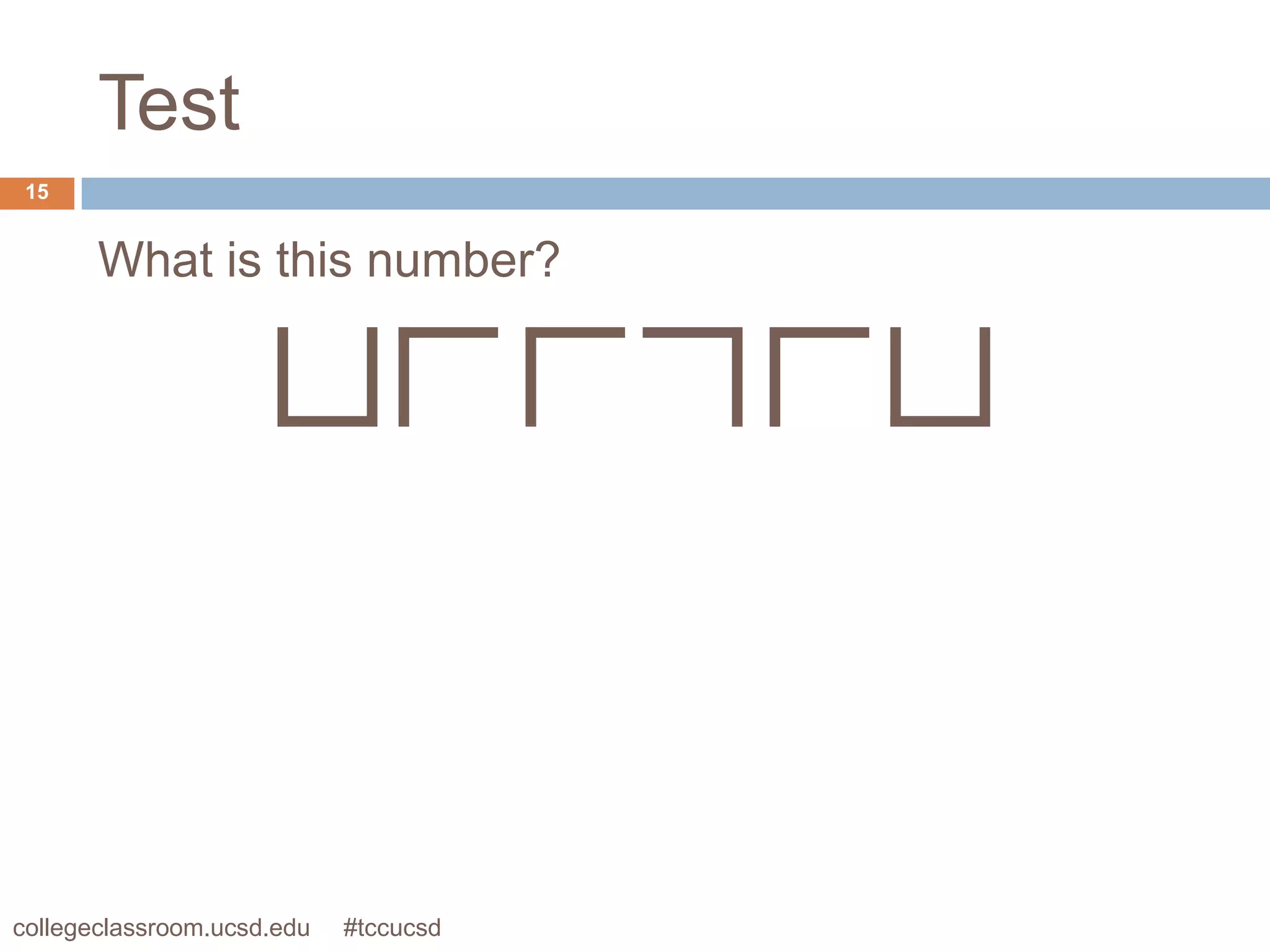
Test
 15


       What is this number?


collegeclassroom.ucsd.edu   #tccucsd
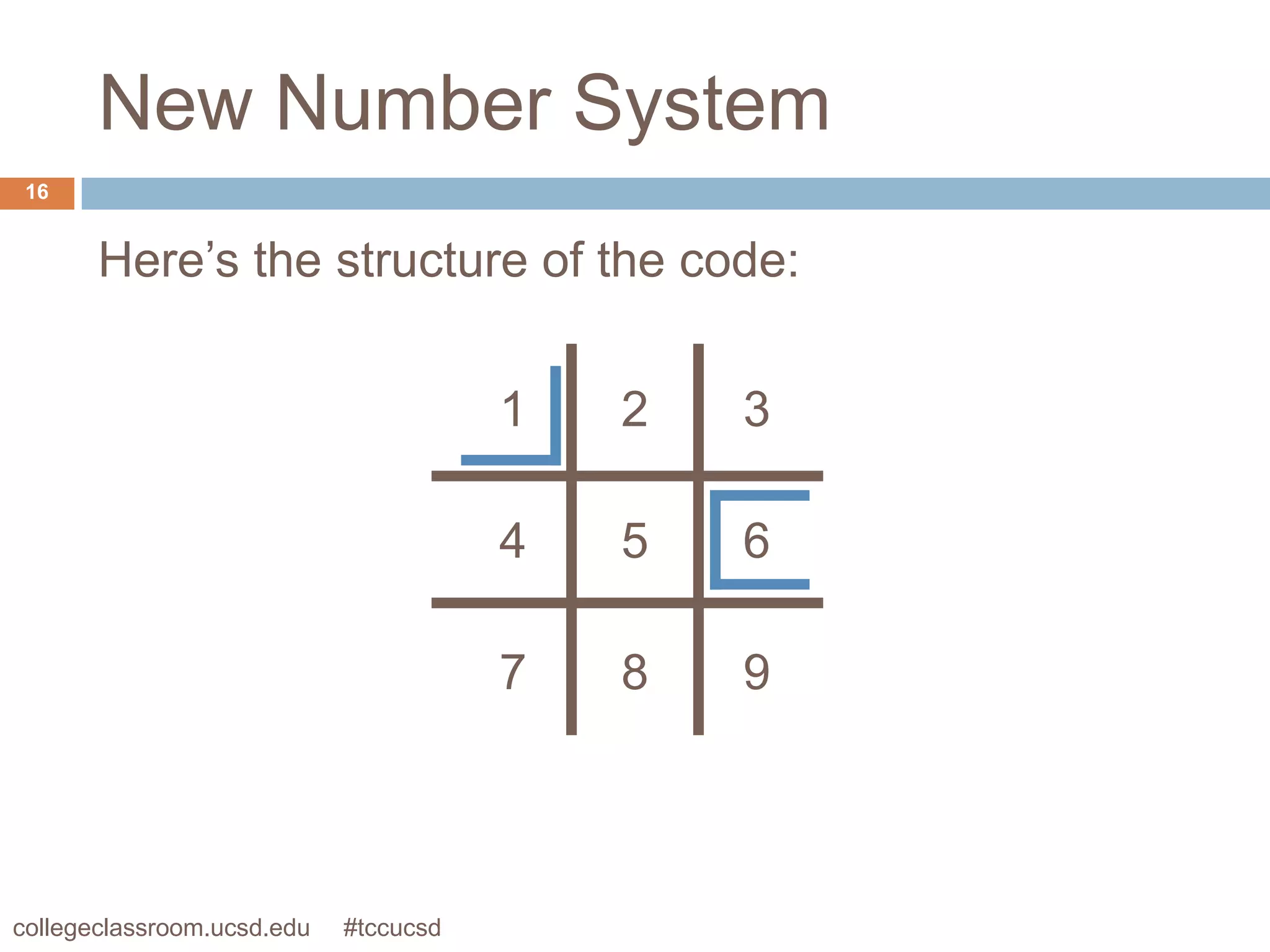
New Number System
 16


       Here’s the structure of the code:


                                       1   2   3

                                       4   5   6

                                       7   8   9


collegeclassroom.ucsd.edu   #tccucsd
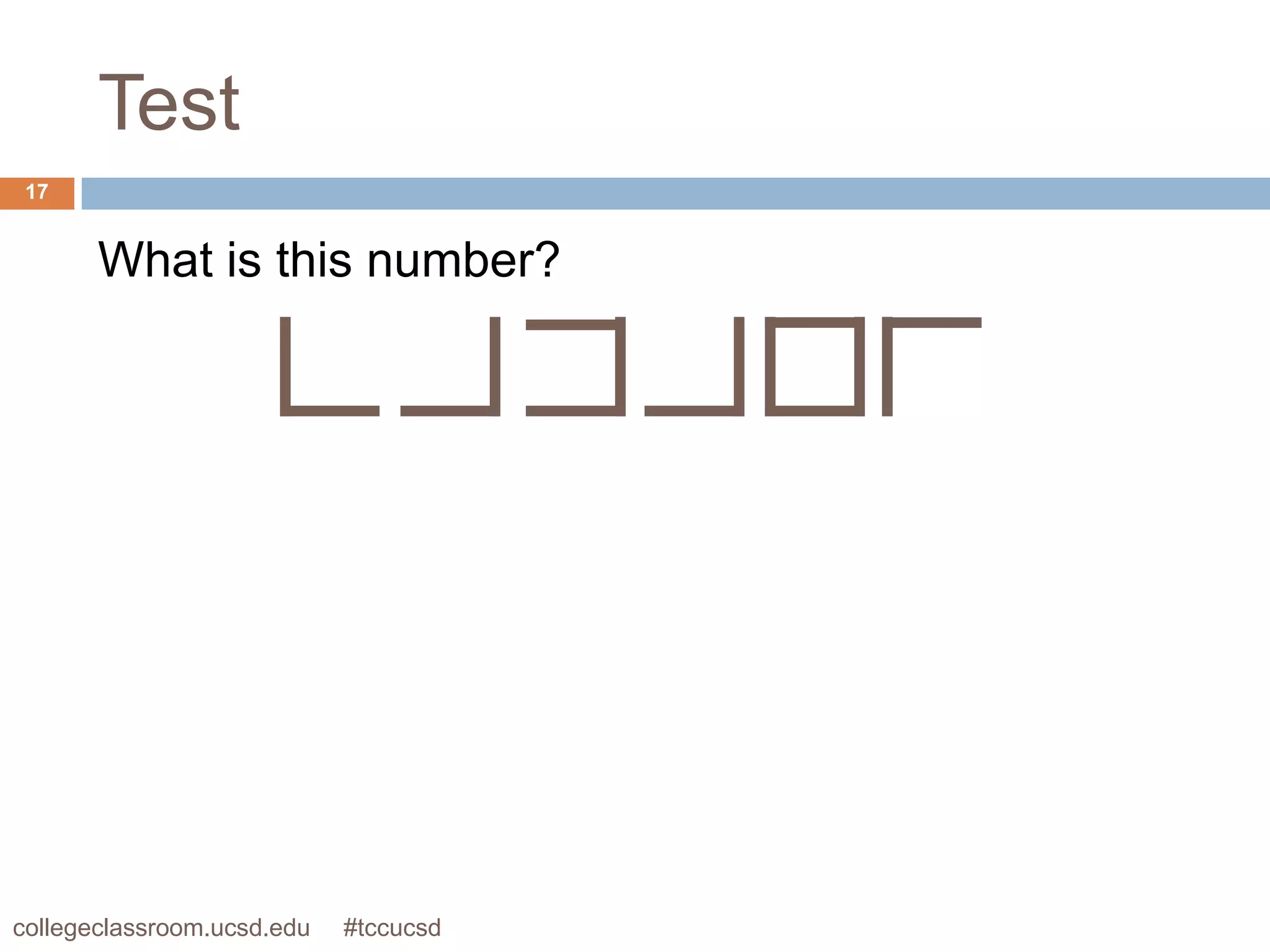
Test
 17


       What is this number?


collegeclassroom.ucsd.edu   #tccucsd
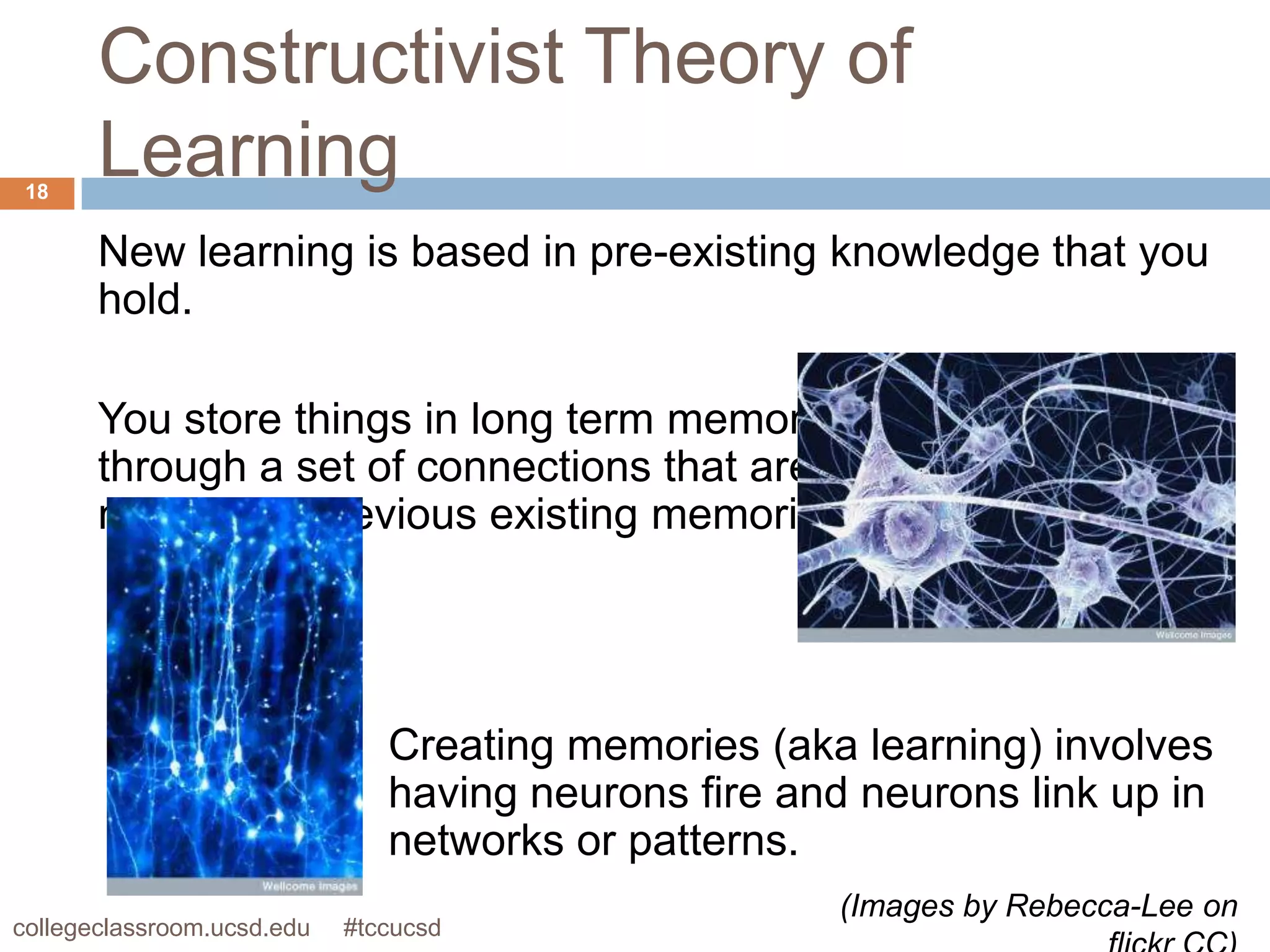
Constructivist Theory of
 18
       Learning
       New learning is based in pre-existing knowledge that you
       hold.

       You store things in long term memory
       through a set of connections that are
       made with previous existing memories.


                               Creating memories (aka learning) involves
                               having neurons fire and neurons link up in
                               networks or patterns.
                                                     (Images by Rebecca-Lee on
collegeclassroom.ucsd.edu   #tccucsd
Course Information
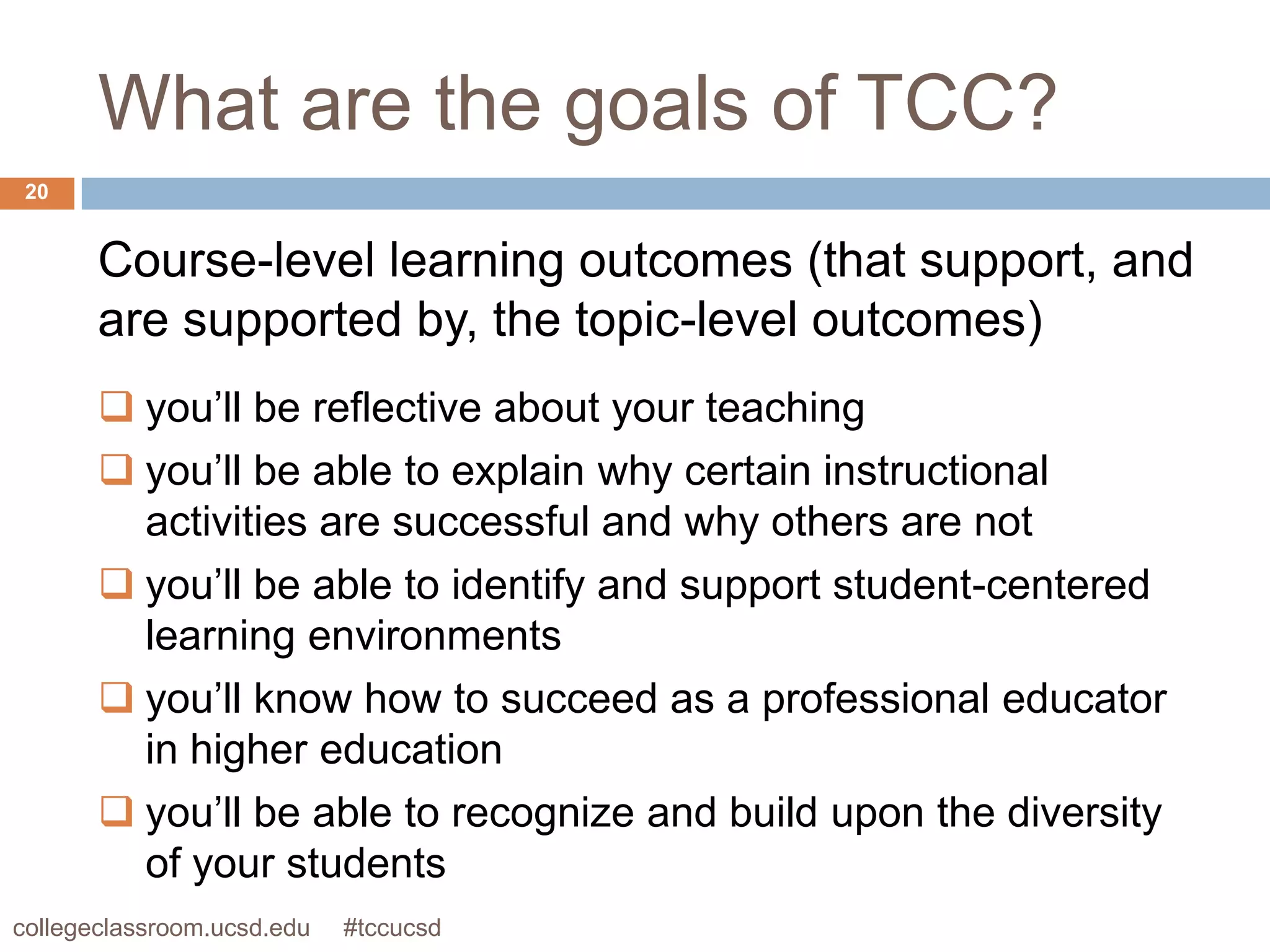
What are the goals of TCC?
 20


       Course-level learning outcomes (that support, and
       are supported by, the topic-level outcomes)
        you’ll be reflective about your teaching
        you’ll be able to explain why certain instructional
         activities are successful and why others are not
        you’ll be able to identify and support student-centered
         learning environments
        you’ll know how to succeed as a professional educator
         in higher education
        you’ll be able to recognize and build upon the diversity
         of your students
collegeclassroom.ucsd.edu   #tccucsd
What are the goals of TCC?
 21


       Many topic-level learning outcomes in
       1. modern theory of Constructivist learning
                For example, by the end of the course, you’ll be
             able to have an elevator conversation describing the
             importance of metacognition in learning.


collegeclassroom.ucsd.edu   #tccucsd
What are the goals of TCC?
 22


       Many topic-level learning outcomes in
       2. best practices for the college classroom
                For example, by the end of the course, you’ll be
             able to write a peer instruction (clicker) question and
             explain to a colleague the rationale behind the
             question and choices and describe how it can be
             incorporated into the lesson.


collegeclassroom.ucsd.edu   #tccucsd
What are the goals of TCC?
 23


       Many topic-level learning outcomes in
       3. how to be a successful, professional educator
                For example, by the end of the course, you’ll be
             able to begin to build a personal learning network
             (PLN) by, for example, posting to a Wordpress blog,
             interacting on Twitter and collaborating with others
             using google docs.


collegeclassroom.ucsd.edu   #tccucsd
TCC goals: Executive Summary
 24

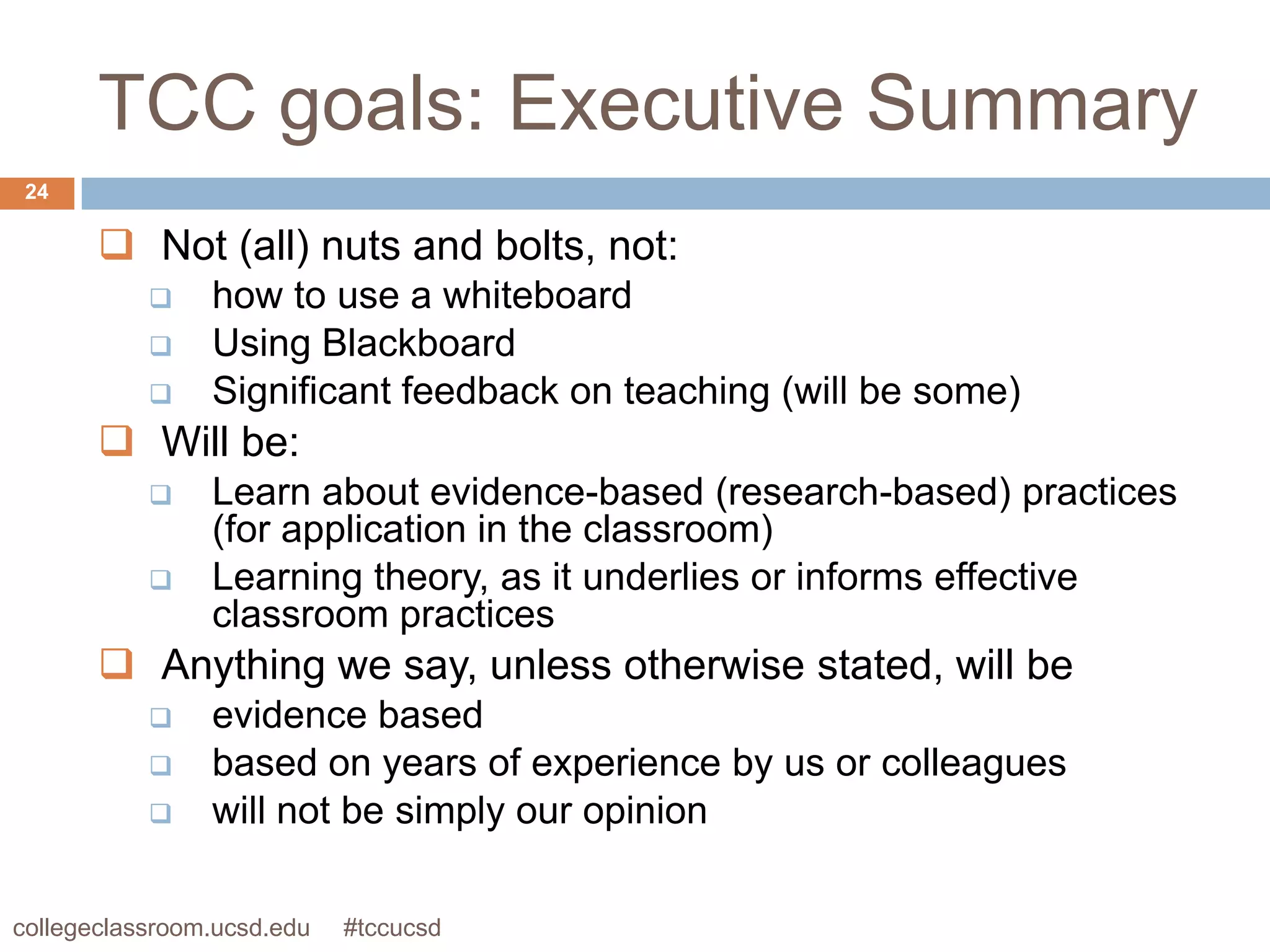
        Not (all) nuts and bolts, not:
               how to use a whiteboard
               Using Blackboard
               Significant feedback on teaching (will be some)
        Will be:
               Learn about evidence-based (research-based) practices
                (for application in the classroom)
               Learning theory, as it underlies or informs effective
                classroom practices
        Anything we say, unless otherwise stated, will be
               evidence based
               based on years of experience by us or colleagues
               will not be simply our opinion

collegeclassroom.ucsd.edu   #tccucsd
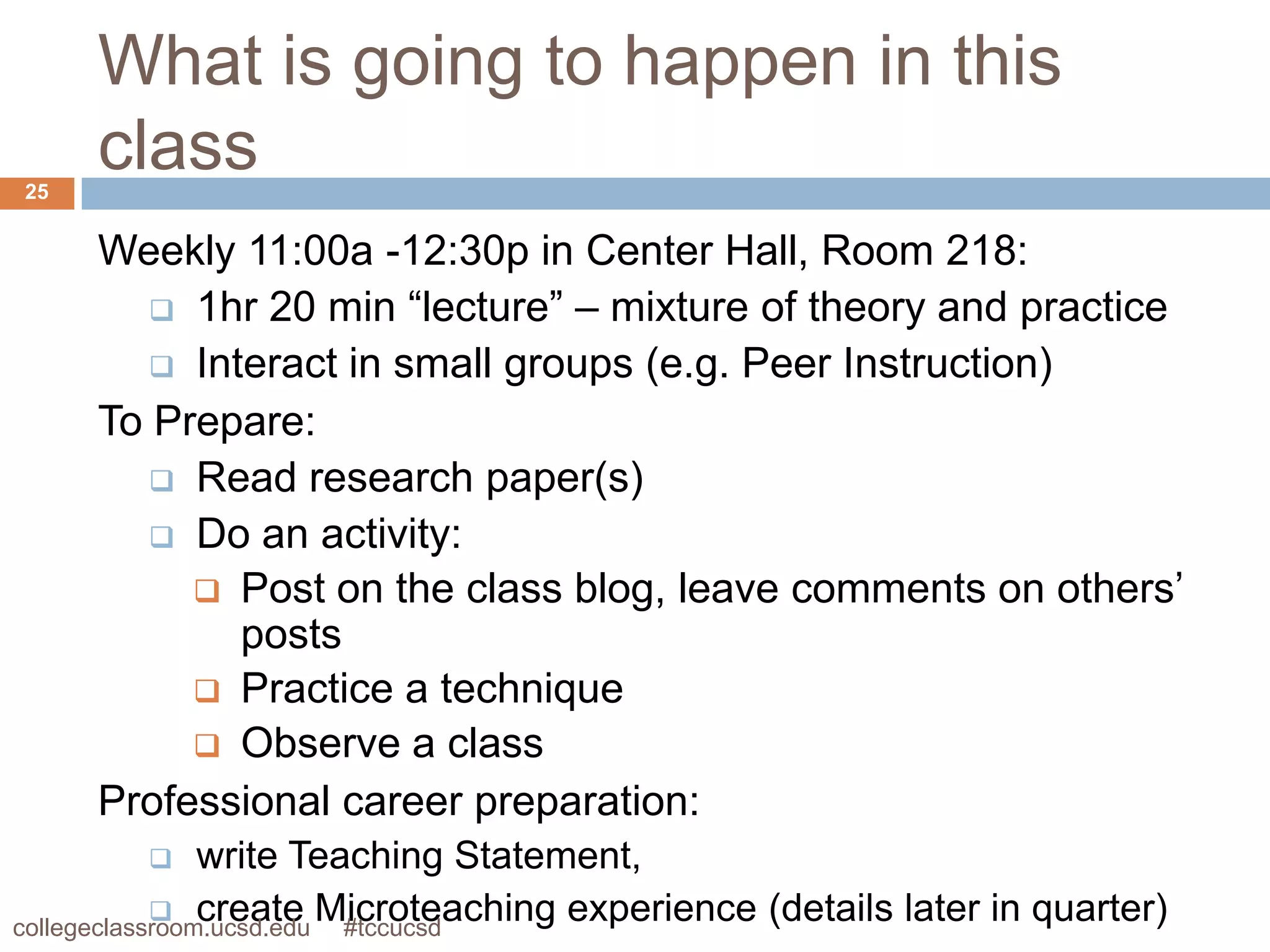
What is going to happen in this
25
     class
     Weekly 11:00a -12:30p in Center Hall, Room 218:
         1hr 20 min “lecture” – mixture of theory and practice
         Interact in small groups (e.g. Peer Instruction)
     To Prepare:
         Read research paper(s)
         Do an activity:
           Post on the class blog, leave comments on others’
             posts
           Practice a technique
           Observe a class
     Professional career preparation:
               write Teaching Statement,
             create Microteaching experience (details later in quarter)
collegeclassroom.ucsd.edu #tccucsd
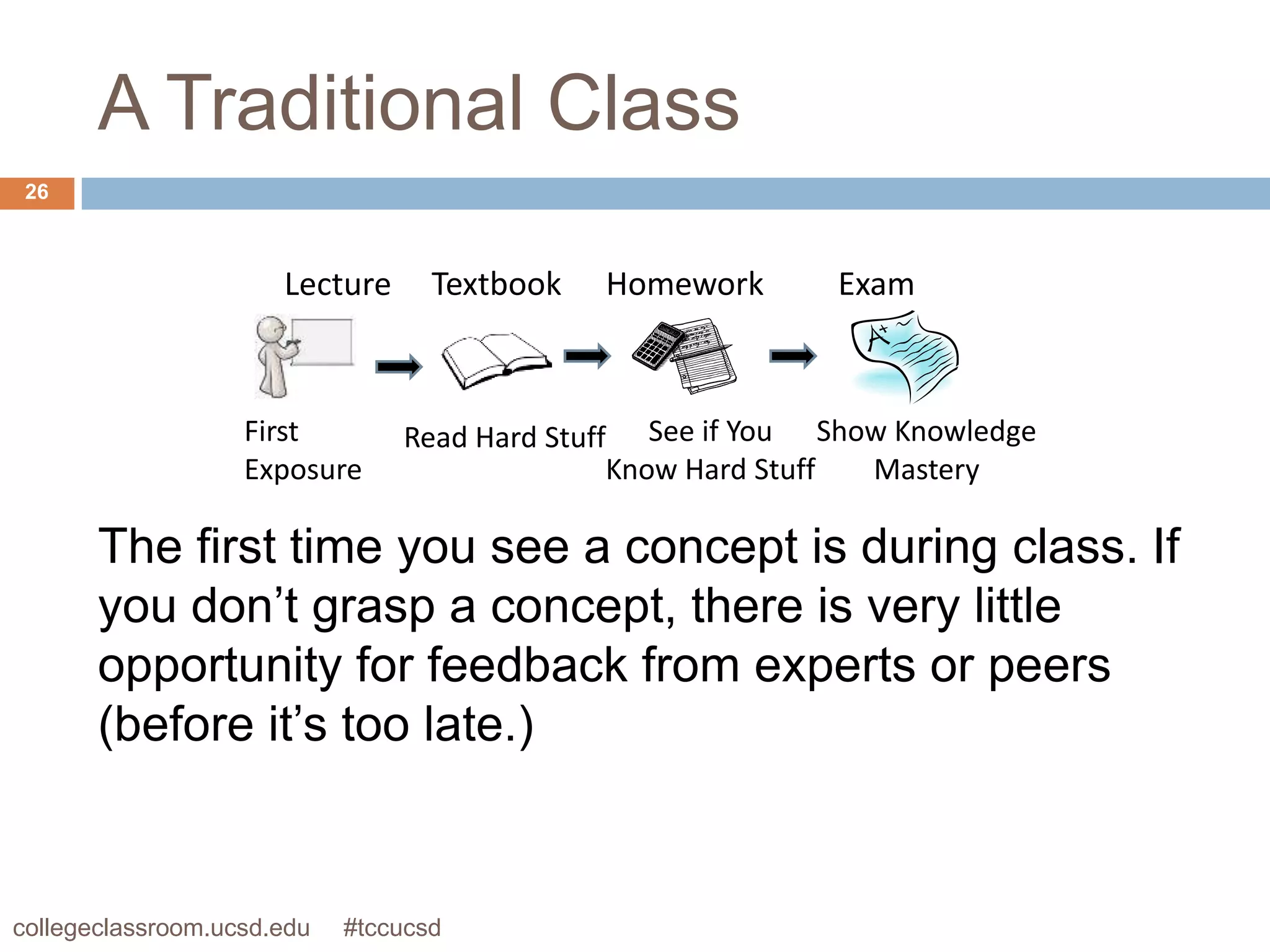
A Traditional Class
 26


                      Lecture      Textbook   Homework      Exam


                   First        Read Hard Stuff See if You Show Knowledge
                   Exposure                    Know Hard Stuff Mastery

       The first time you see a concept is during class. If
       you don’t grasp a concept, there is very little
       opportunity for feedback from experts or peers
       (before it’s too late.)


collegeclassroom.ucsd.edu   #tccucsd
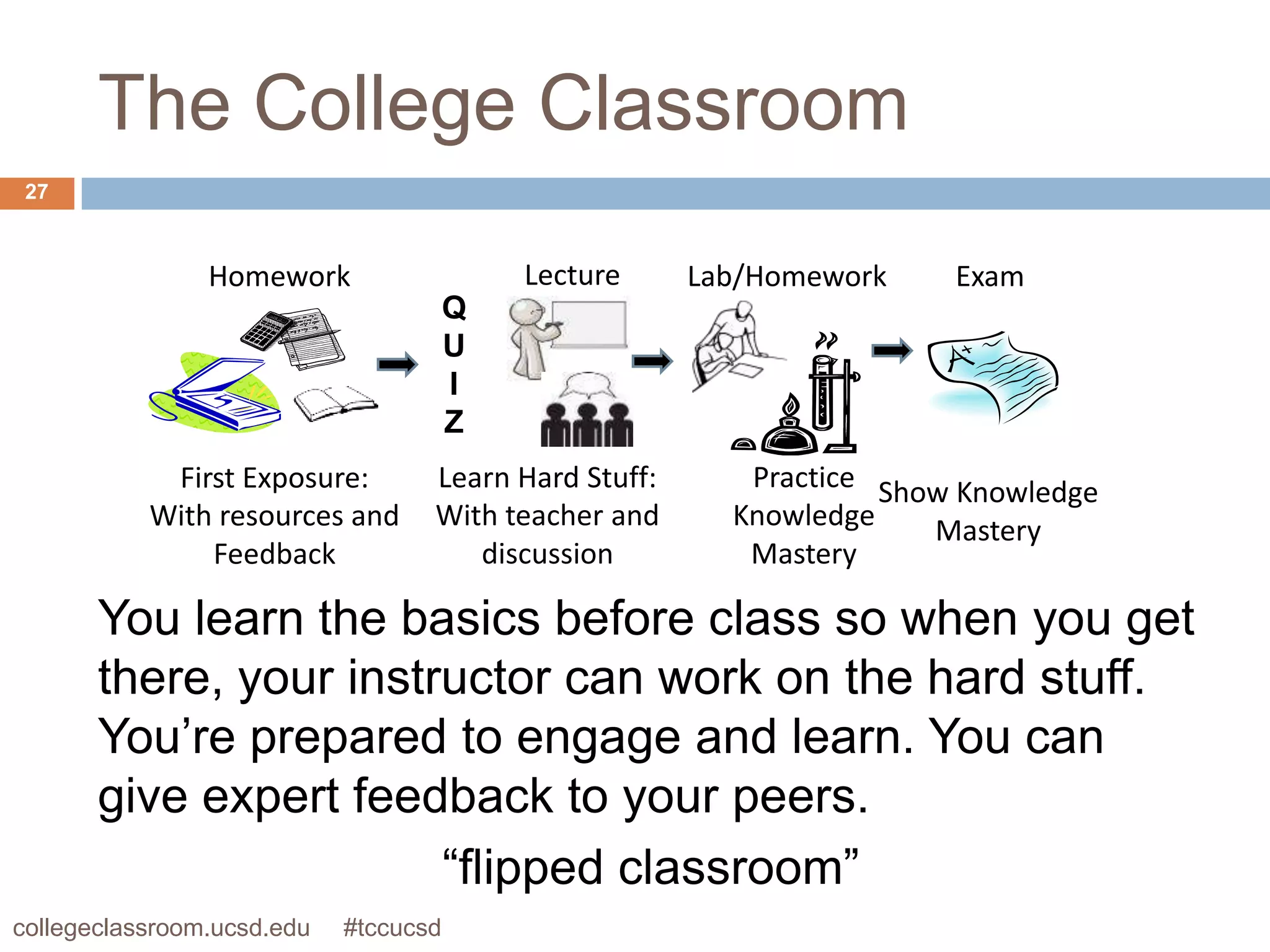
The College Classroom
 27


                Homework                   Lecture     Lab/Homework    Exam
                                       Q
                                       U
                                       I
                                       Z
            First Exposure:        Learn Hard Stuff:      Practice Show Knowledge
           With resources and      With teacher and      Knowledge    Mastery
               Feedback               discussion          Mastery

       You learn the basics before class so when you get
       there, your instructor can work on the hard stuff.
       You’re prepared to engage and learn. You can
       give expert feedback to your peers.
                        “flipped classroom”
collegeclassroom.ucsd.edu   #tccucsd
collegeclassroom.ucsd.edu
 28


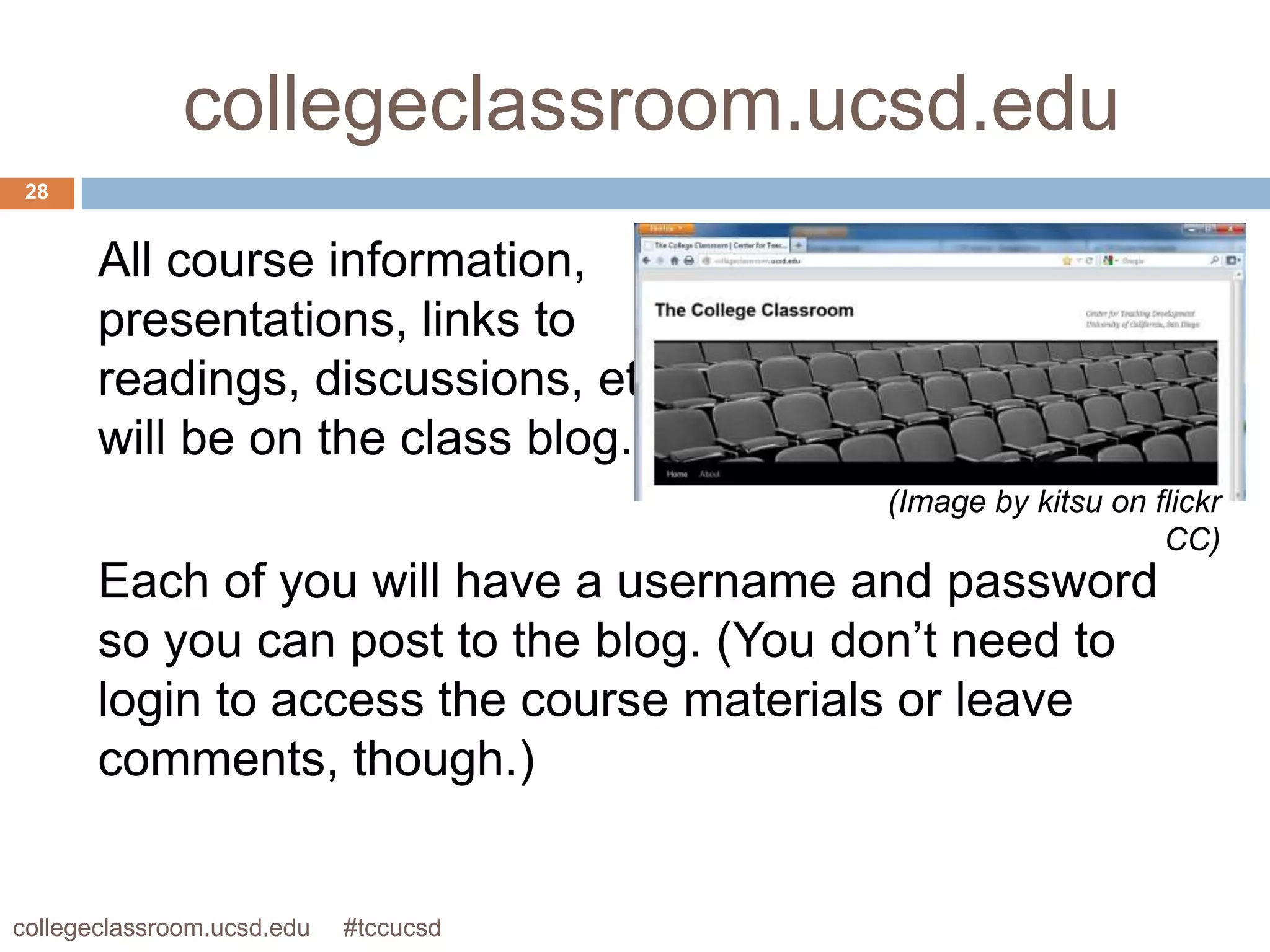
       All course information,
       presentations, links to
       readings, discussions, etc
       will be on the class blog.
                                         (Image by kitsu on flickr
                                                             CC)
       Each of you will have a username and password
       so you can post to the blog. (You don’t need to
       login to access the course materials or leave
       comments, though.)


collegeclassroom.ucsd.edu   #tccucsd
Clicker question
 29


       Which best describes your experience with blogs?
       A) I don’t have any experience with blogs.
       B) I read blog occasionally
       C) I read blogs often and leave comments
       D) I’ve written posts on someone else’s blog
       E) I have my own blog


collegeclassroom.ucsd.edu   #tccucsd
Course blog is public so
 30


        I can only provide links to copyrighted articles,
         not the articles (PDF) themselves
               you may need to be on-campus so you can use
                UCSD credentials to access subscriptions
               you may be able to connect from home with the
                UCSD web proxy server (search Blink for “web
                proxy”)
        Your posts and comments will be visible to the
         public: learn to be careful about what and how
         you write.
        If you include pictures in your posts, they must
collegeclassroom.ucsd.edu   #tccucsd
Course blog is public so
31


        Your posts will be part of your online identity.
        Privacy options:
        1. You can use your real name and UCSD
              username.
        2. You can use a pseudonym and username to
              protect your identity. (Only Liz and I will know
              your identity, though you may wish to share it
              with your classmates.)
        3. You may already have an online identity
              because you already blog, use Google+,
              Twitter, Pinterest, Linkedin, facebook. You’re
collegeclassroom.ucsd.edu #tccucsd
How you will be assessed
 32


       The College Classroom is not an official UCSD
       course. You will not receive an grade on your
       transcript.
       To receive a completion certificate (and for
       SGTSs, to be qualified to teach in the summer),
       you must
        Attend all sessions
        Thoughtfully complete all assigned work.
        Contribute during class in a professional,
          collegial manner.
             If you need to attend a conference, job interview or
collegeclassroom.ucsd.edu
                      #tccucsd
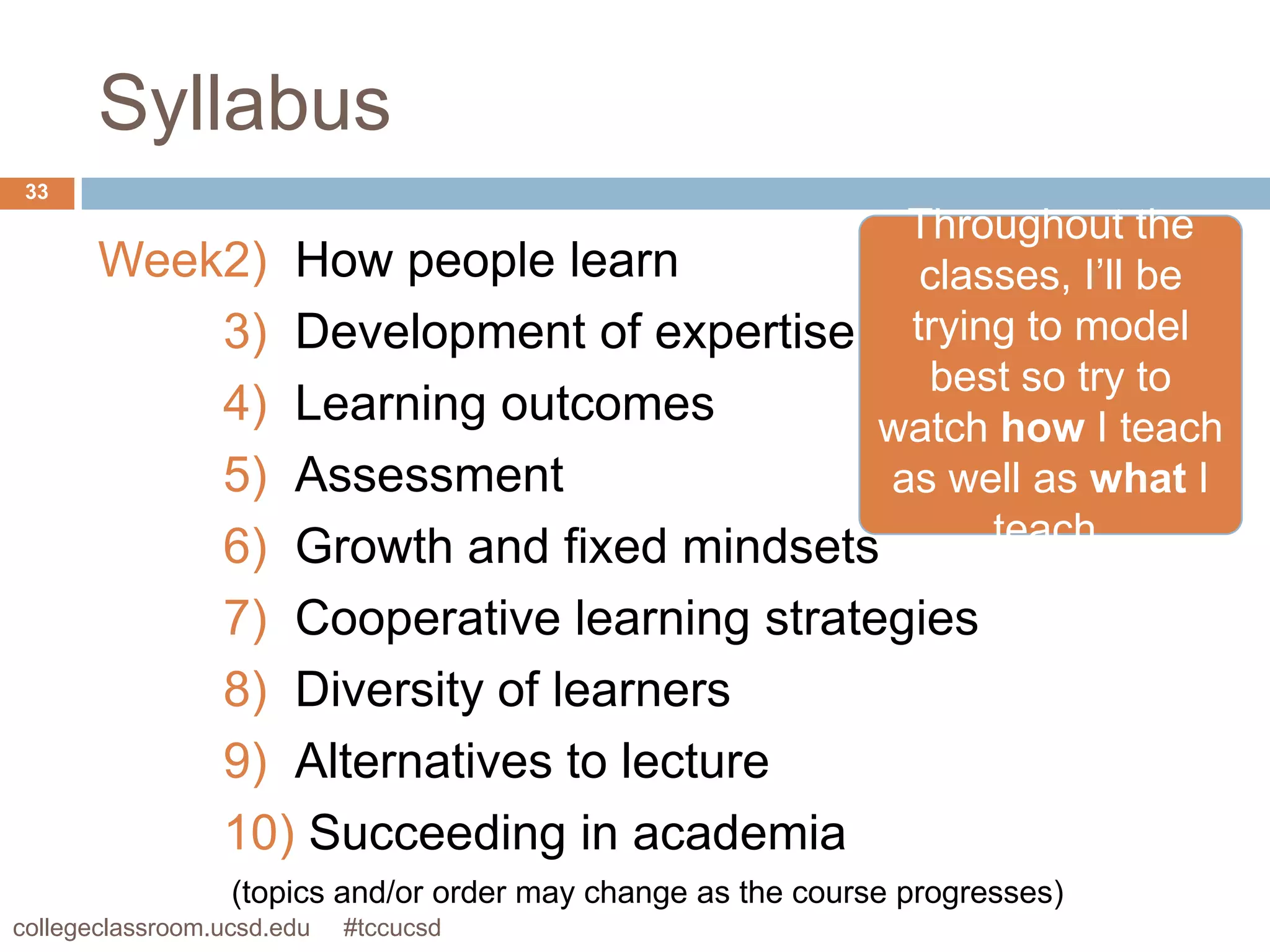
Syllabus
 33
                                                  Throughout the
       Week2)          How people learn           classes, I’ll be
           3)          Development of expertise trying to model
                                                   best so try to
           4)          Learning outcomes        watch how I teach
           5)          Assessment                as well as what I
           6)          Growth and fixed mindsets      teach.

           7) Cooperative learning strategies
           8) Diversity of learners
           9) Alternatives to lecture
           10) Succeeding in academia
                  (topics and/or order may change as the course progresses)
collegeclassroom.ucsd.edu   #tccucsd
Homework for Week 2:
 34


       Visit the course blog. Contact info for Peter and
       Liz is on the About page.

       Find the homework for Week 2 (to be completed
       before the Week 2 session on Jan 16.)

       You will need the password to access certain
       items. The password is ________________.


collegeclassroom.ucsd.edu   #tccucsd

College Classroom - Week 1

  • 1.
    Week 1: Introduction The College Classroom January 9, 2013
  • 2.
    Who Am I– Peter 2 Peter Newbury  PhD (Univ. of British Columbia, Vancouver, Canada) 1998 in applied math  Carl Wieman Science Education Initiative, 2008 – 2012  Associate Director, Center for Teaching Development since August, 2012 Teaching and learning interests:  how people learn astronomy, physics, math  how to convince instructors to transform the way they teach  finding the most effective ways to implement peer instruction (clickers)  Establishing and maintaining an online personal learning network collegeclassroom.ucsd.edu #tccucsd
  • 3.
    Who Am I– Liz 3 Liz Specht  PhD candidate in Stephen Mayfield’s lab in the UCSD Division of Biological Sciences  The College Classroom alumnus (Fall 2012)  @lizspecht In addition to her research on algae, she is interested in science education at all levels, and has been actively involved in several teaching endeavors beyond the TA requirements for the department. She has taught a lab course for post-graduate adults, a summer course for high school students, and she volunteers regularly at local middle schools through the Salk Mobile outreach program. collegeclassroom.ucsd.edu #tccucsd
  • 4.
    Who are you? 4 Why are you taking The College Classroom? A) I’m looking for a tenure-track academic position and knowing about teaching will help me get a job. B) I have little/no teaching experience and I want to get some. C) I’ve taught before and I want to become a better instructor. D) I’m interested in the theory and pedagogy of teaching and learning. E) other collegeclassroom.ucsd.edu #tccucsd
  • 5.
    Turn to yourneighbor: 1. Introduce yourself Who are you? 2. Explain why you made the 5 choice you did Why are you taking The College Classroom? A) I’m looking for a tenure-track academic position and knowing about teaching will help me get a job. B) I have little/no teaching experience and I want to get some. C) I’ve taught before and I want to become a better instructor. D) I’m interested in the theory and pedagogy of teaching and learning. E) other collegeclassroom.ucsd.edu #tccucsd
  • 6.
    A quick survey: 6 We have people with different backgrounds in our audience: Raise your hand if this is you: Who experienced undergraduate education in the US? Who has had a teaching experience before? Who has given a technical talk? Who has English as a second language? Who has been a student in a large (150+ students) class? collegeclassroom.ucsd.edu #tccucsd
  • 7.
    Introduction to teachingand learning in higher education
  • 8.
    Clicker question 8 Which of these do you associate with a typical university lecture? A) listening B) absorbing C) note-taking D) learning collegeclassroom.ucsd.edu #tccucsd
  • 9.
    The traditional lectureis based on 9 the transmissionist learning model collegeclassroom.ucsd.edu #tccucsd (Image by um.dentistry on flickr
  • 10.
    Scientifically Outdated, 10 Culturally (in US) a Known Failure collegeclassroom.ucsd.edu #tccucsd
  • 11.
    How People Learn[1] 11 People actively construct their own knowledge  Individual  Based in pre-existing understanding Biologically, learning changes the brain  Proteins form, Neurons fire  Technology allowing us to observe learning as it happens (fMRI) [1] How People Learn: Brain, Mind, Experience and School Expanded Edition. Ed. Bransford collegeclassroom.ucsd.edu #tccucsd
  • 12.
    How People Learn[1] 12 Learning is not about what professors do. It’s about what THE LEARNER does! Corollary: Students do not LEARN just by listening to the professor explain [1] How People Learn: Brain, Mind, Experience and School Expanded Edition. Ed. Bransford collegeclassroom.ucsd.edu #tccucsd
  • 13.
    Let’s have alearning 13 experience… collegeclassroom.ucsd.edu #tccucsd
  • 14.
    Here is animportant new number 14 system. Please learn it. 1= 4= 7= 2= 5= 8= 3= 6= 9= collegeclassroom.ucsd.edu #tccucsd
  • 15.
    Test 15 What is this number? collegeclassroom.ucsd.edu #tccucsd
  • 16.
    New Number System 16 Here’s the structure of the code: 1 2 3 4 5 6 7 8 9 collegeclassroom.ucsd.edu #tccucsd
  • 17.
    Test 17 What is this number? collegeclassroom.ucsd.edu #tccucsd
  • 18.
    Constructivist Theory of 18 Learning New learning is based in pre-existing knowledge that you hold. You store things in long term memory through a set of connections that are made with previous existing memories. Creating memories (aka learning) involves having neurons fire and neurons link up in networks or patterns. (Images by Rebecca-Lee on collegeclassroom.ucsd.edu #tccucsd
  • 19.
  • 20.
    What are thegoals of TCC? 20 Course-level learning outcomes (that support, and are supported by, the topic-level outcomes)  you’ll be reflective about your teaching  you’ll be able to explain why certain instructional activities are successful and why others are not  you’ll be able to identify and support student-centered learning environments  you’ll know how to succeed as a professional educator in higher education  you’ll be able to recognize and build upon the diversity of your students collegeclassroom.ucsd.edu #tccucsd
  • 21.
    What are thegoals of TCC? 21 Many topic-level learning outcomes in 1. modern theory of Constructivist learning For example, by the end of the course, you’ll be able to have an elevator conversation describing the importance of metacognition in learning. collegeclassroom.ucsd.edu #tccucsd
  • 22.
    What are thegoals of TCC? 22 Many topic-level learning outcomes in 2. best practices for the college classroom For example, by the end of the course, you’ll be able to write a peer instruction (clicker) question and explain to a colleague the rationale behind the question and choices and describe how it can be incorporated into the lesson. collegeclassroom.ucsd.edu #tccucsd
  • 23.
    What are thegoals of TCC? 23 Many topic-level learning outcomes in 3. how to be a successful, professional educator For example, by the end of the course, you’ll be able to begin to build a personal learning network (PLN) by, for example, posting to a Wordpress blog, interacting on Twitter and collaborating with others using google docs. collegeclassroom.ucsd.edu #tccucsd
  • 24.
    TCC goals: ExecutiveSummary 24  Not (all) nuts and bolts, not:  how to use a whiteboard  Using Blackboard  Significant feedback on teaching (will be some)  Will be:  Learn about evidence-based (research-based) practices (for application in the classroom)  Learning theory, as it underlies or informs effective classroom practices  Anything we say, unless otherwise stated, will be  evidence based  based on years of experience by us or colleagues  will not be simply our opinion collegeclassroom.ucsd.edu #tccucsd
  • 25.
    What is goingto happen in this 25 class Weekly 11:00a -12:30p in Center Hall, Room 218:  1hr 20 min “lecture” – mixture of theory and practice  Interact in small groups (e.g. Peer Instruction) To Prepare:  Read research paper(s)  Do an activity:  Post on the class blog, leave comments on others’ posts  Practice a technique  Observe a class Professional career preparation:  write Teaching Statement,  create Microteaching experience (details later in quarter) collegeclassroom.ucsd.edu #tccucsd
  • 26.
    A Traditional Class 26 Lecture Textbook Homework Exam First Read Hard Stuff See if You Show Knowledge Exposure Know Hard Stuff Mastery The first time you see a concept is during class. If you don’t grasp a concept, there is very little opportunity for feedback from experts or peers (before it’s too late.) collegeclassroom.ucsd.edu #tccucsd
  • 27.
    The College Classroom 27 Homework Lecture Lab/Homework Exam Q U I Z First Exposure: Learn Hard Stuff: Practice Show Knowledge With resources and With teacher and Knowledge Mastery Feedback discussion Mastery You learn the basics before class so when you get there, your instructor can work on the hard stuff. You’re prepared to engage and learn. You can give expert feedback to your peers. “flipped classroom” collegeclassroom.ucsd.edu #tccucsd
  • 28.
    collegeclassroom.ucsd.edu 28 All course information, presentations, links to readings, discussions, etc will be on the class blog. (Image by kitsu on flickr CC) Each of you will have a username and password so you can post to the blog. (You don’t need to login to access the course materials or leave comments, though.) collegeclassroom.ucsd.edu #tccucsd
  • 29.
    Clicker question 29 Which best describes your experience with blogs? A) I don’t have any experience with blogs. B) I read blog occasionally C) I read blogs often and leave comments D) I’ve written posts on someone else’s blog E) I have my own blog collegeclassroom.ucsd.edu #tccucsd
  • 30.
    Course blog ispublic so 30  I can only provide links to copyrighted articles, not the articles (PDF) themselves  you may need to be on-campus so you can use UCSD credentials to access subscriptions  you may be able to connect from home with the UCSD web proxy server (search Blink for “web proxy”)  Your posts and comments will be visible to the public: learn to be careful about what and how you write.  If you include pictures in your posts, they must collegeclassroom.ucsd.edu #tccucsd
  • 31.
    Course blog ispublic so 31 Your posts will be part of your online identity. Privacy options: 1. You can use your real name and UCSD username. 2. You can use a pseudonym and username to protect your identity. (Only Liz and I will know your identity, though you may wish to share it with your classmates.) 3. You may already have an online identity because you already blog, use Google+, Twitter, Pinterest, Linkedin, facebook. You’re collegeclassroom.ucsd.edu #tccucsd
  • 32.
    How you willbe assessed 32 The College Classroom is not an official UCSD course. You will not receive an grade on your transcript. To receive a completion certificate (and for SGTSs, to be qualified to teach in the summer), you must  Attend all sessions  Thoughtfully complete all assigned work.  Contribute during class in a professional, collegial manner. If you need to attend a conference, job interview or collegeclassroom.ucsd.edu #tccucsd
  • 33.
    Syllabus 33 Throughout the Week2) How people learn classes, I’ll be 3) Development of expertise trying to model best so try to 4) Learning outcomes watch how I teach 5) Assessment as well as what I 6) Growth and fixed mindsets teach. 7) Cooperative learning strategies 8) Diversity of learners 9) Alternatives to lecture 10) Succeeding in academia (topics and/or order may change as the course progresses) collegeclassroom.ucsd.edu #tccucsd
  • 34.
    Homework for Week2: 34 Visit the course blog. Contact info for Peter and Liz is on the About page. Find the homework for Week 2 (to be completed before the Week 2 session on Jan 16.) You will need the password to access certain items. The password is ________________. collegeclassroom.ucsd.edu #tccucsd

Editor's Notes

  • #10 The how is most important… and it also applies to teaching any course.
  • #12 The how is most important… and it also applies to teaching any course.
  • #13 The how is most important… and it also applies to teaching any course.