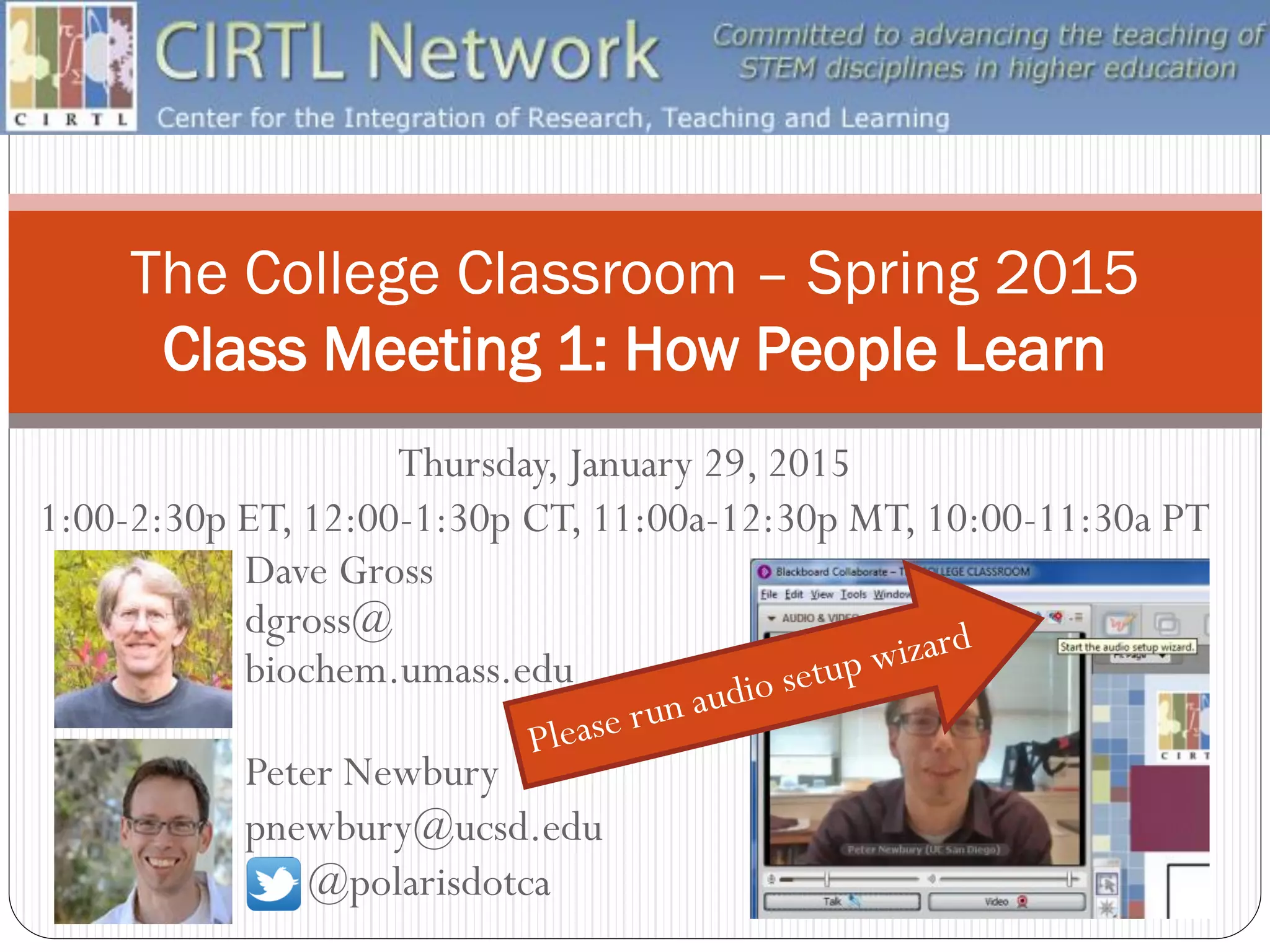
The College Classroom – Spring 2015
Class Meeting 1: How People Learn
Dave Gross
dgross@
biochem.umass.edu
Thursday, January 29, 2015
1:00-2:30p ET, 12:00-1:30p CT, 11:00a-12:30p MT, 10:00-11:30a PT
Peter Newbury
pnewbury@ucsd.edu
@polarisdotca
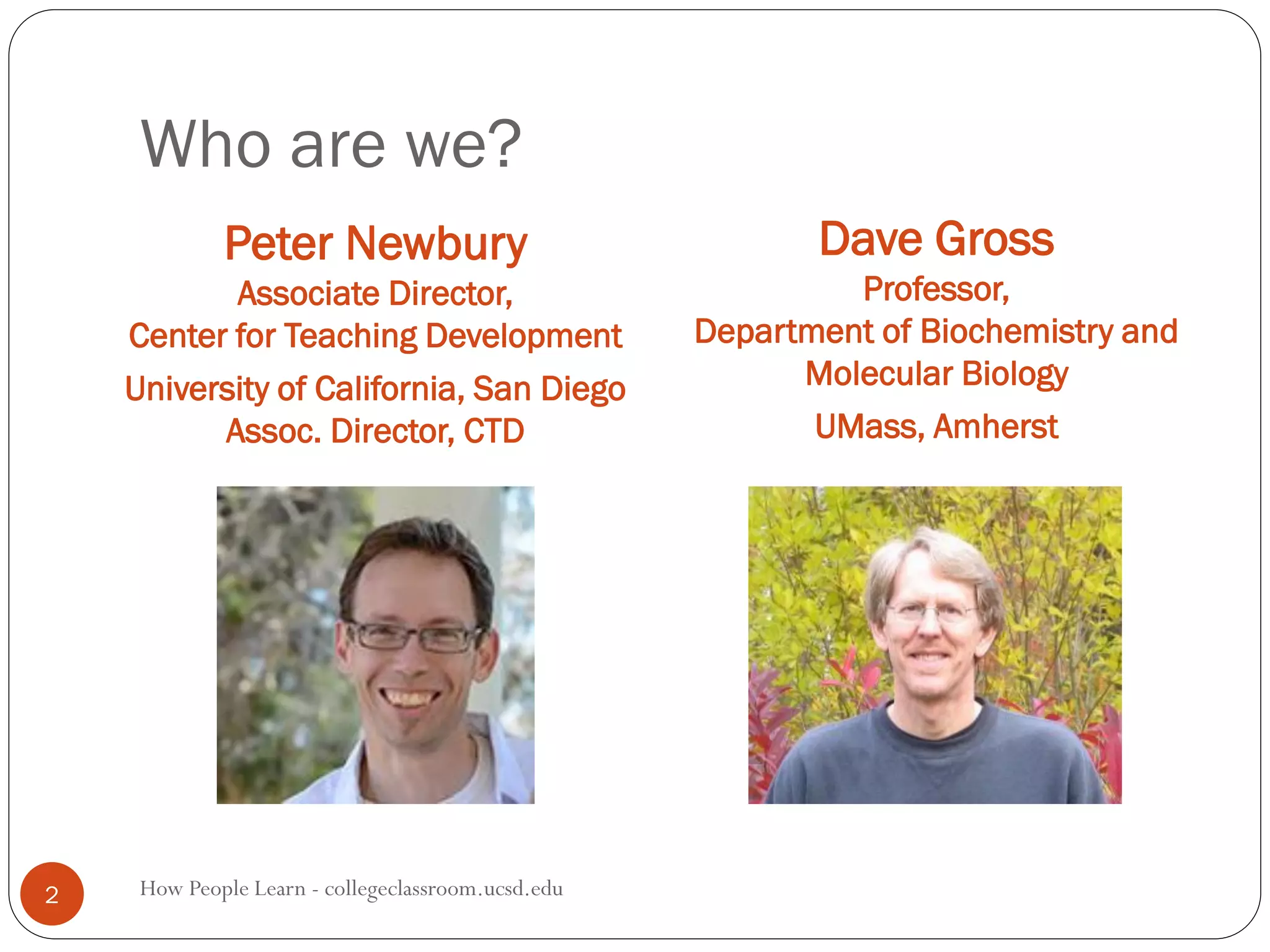
Who are we?
Dave Gross
Professor,
Department of Biochemistry and
Molecular Biology
UMass, Amherst
Peter Newbury
Associate Director,
Center for Teaching Development
University of California, San Diego
Assoc. Director, CTD
How People Learn - collegeclassroom.ucsd.edu2
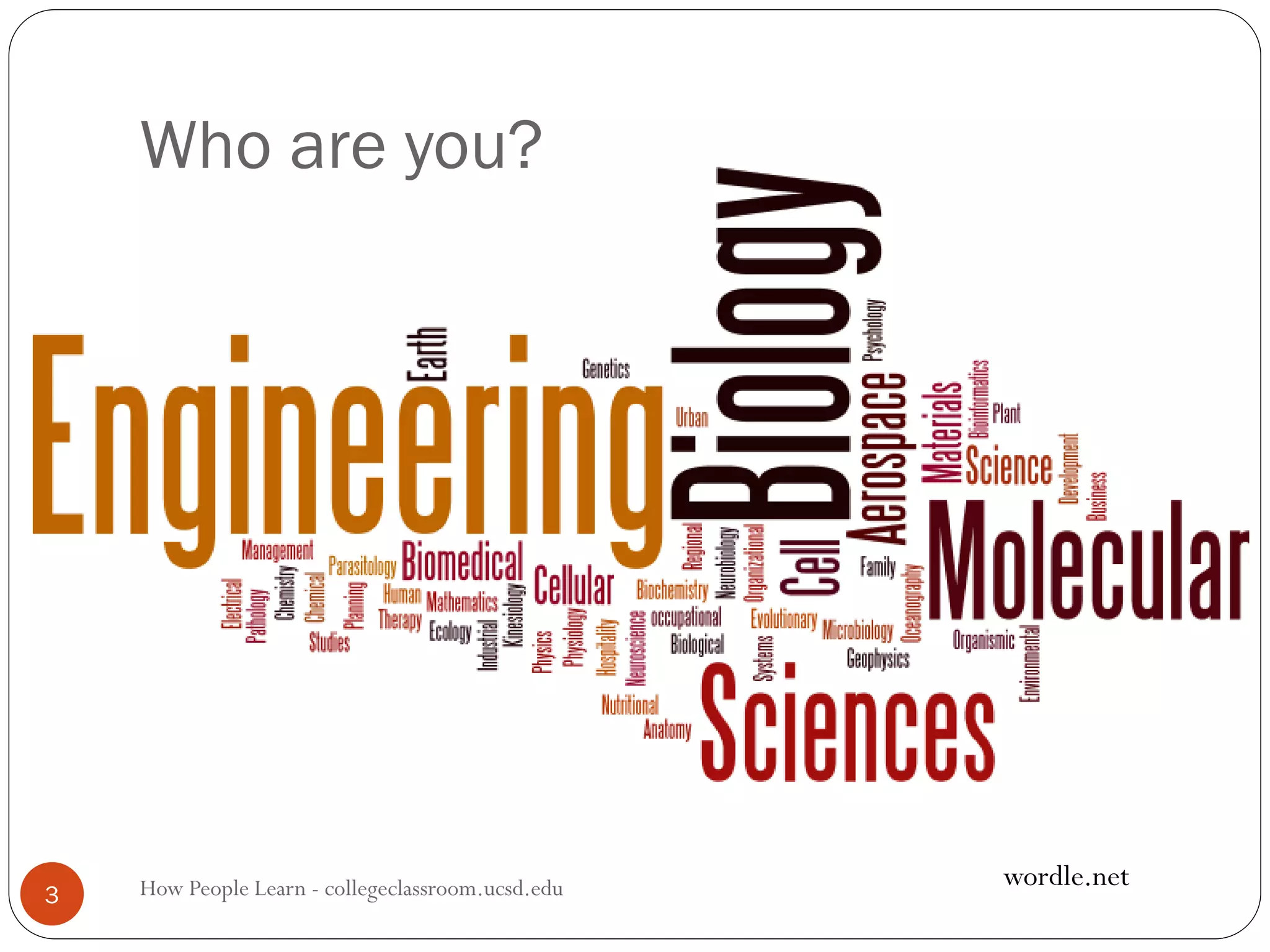
Who are you?
How People Learn - collegeclassroom.ucsd.edu3
wordle.net
Who are you?
How People Learn - collegeclassroom.ucsd.edu4
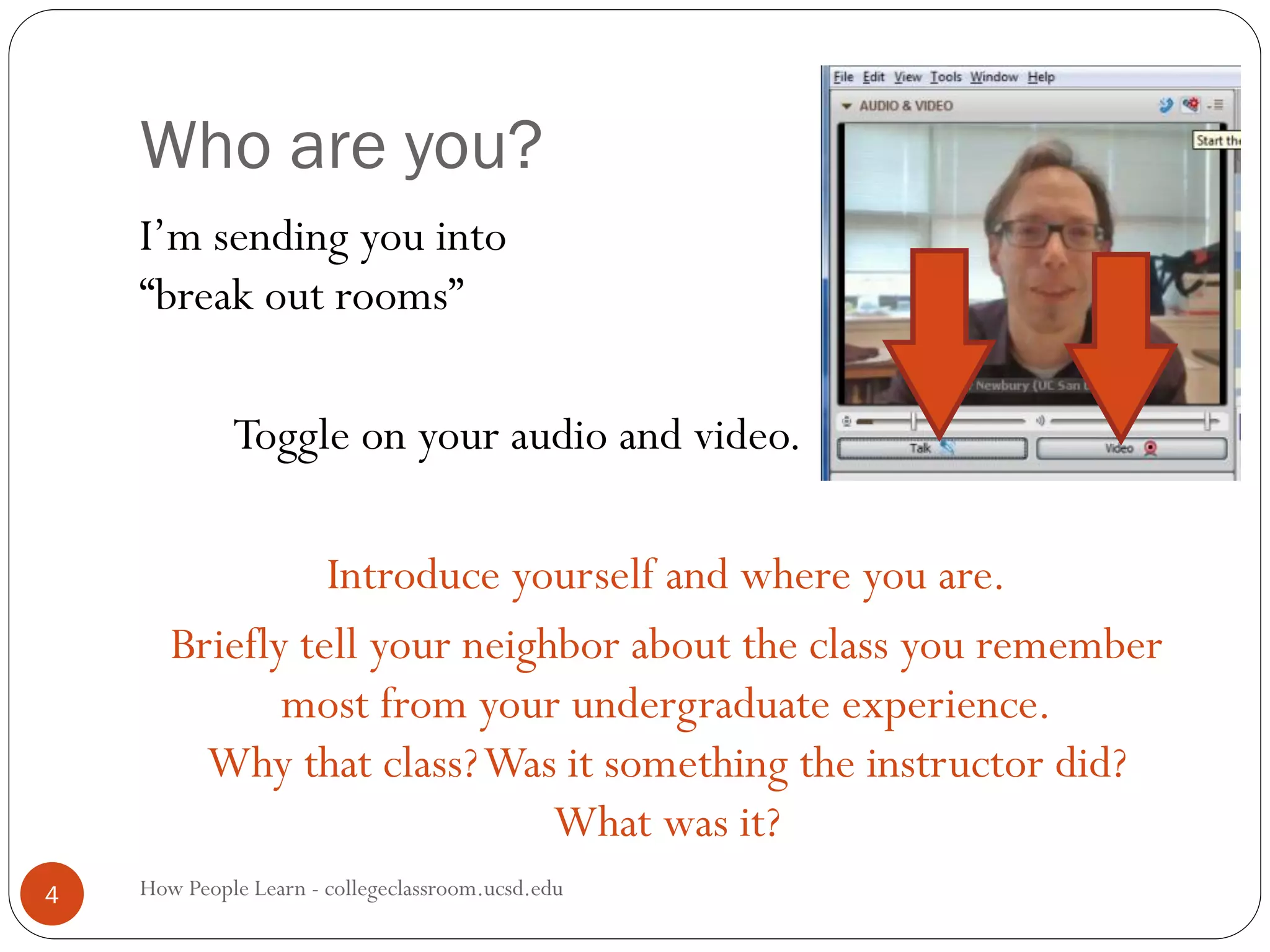
I’m sending you into
“break out rooms”
Toggle on your audio and video.
Introduce yourself and where you are.
Briefly tell your neighbor about the class you remember
most from your undergraduate experience.
Why that class?Was it something the instructor did?
What was it?
Why are we here?
How People Learn - collegeclassroom.ucsd.edu5
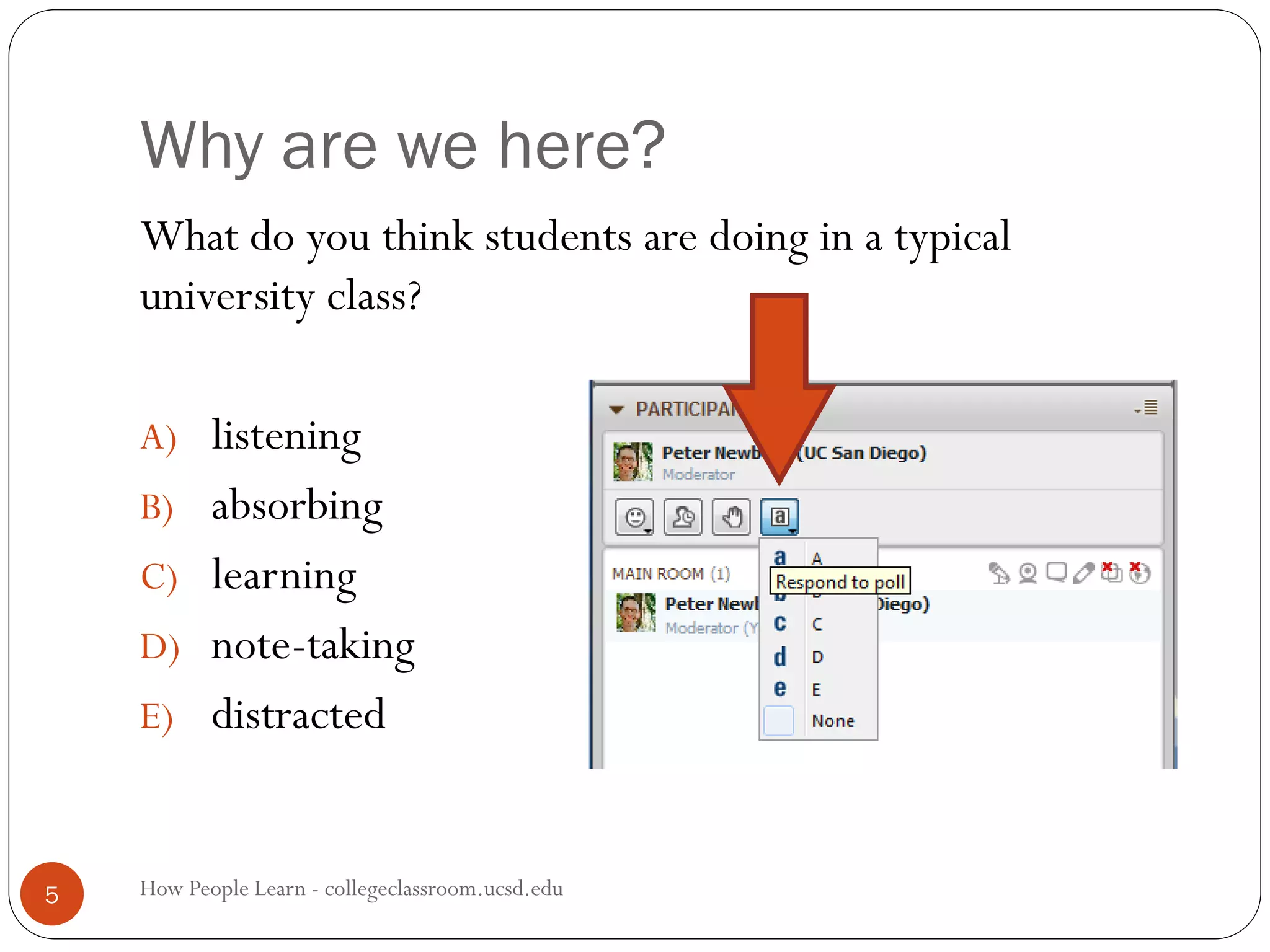
What do you think students are doing in a typical
university class?
A) listening
B) absorbing
C) learning
D) note-taking
E) distracted
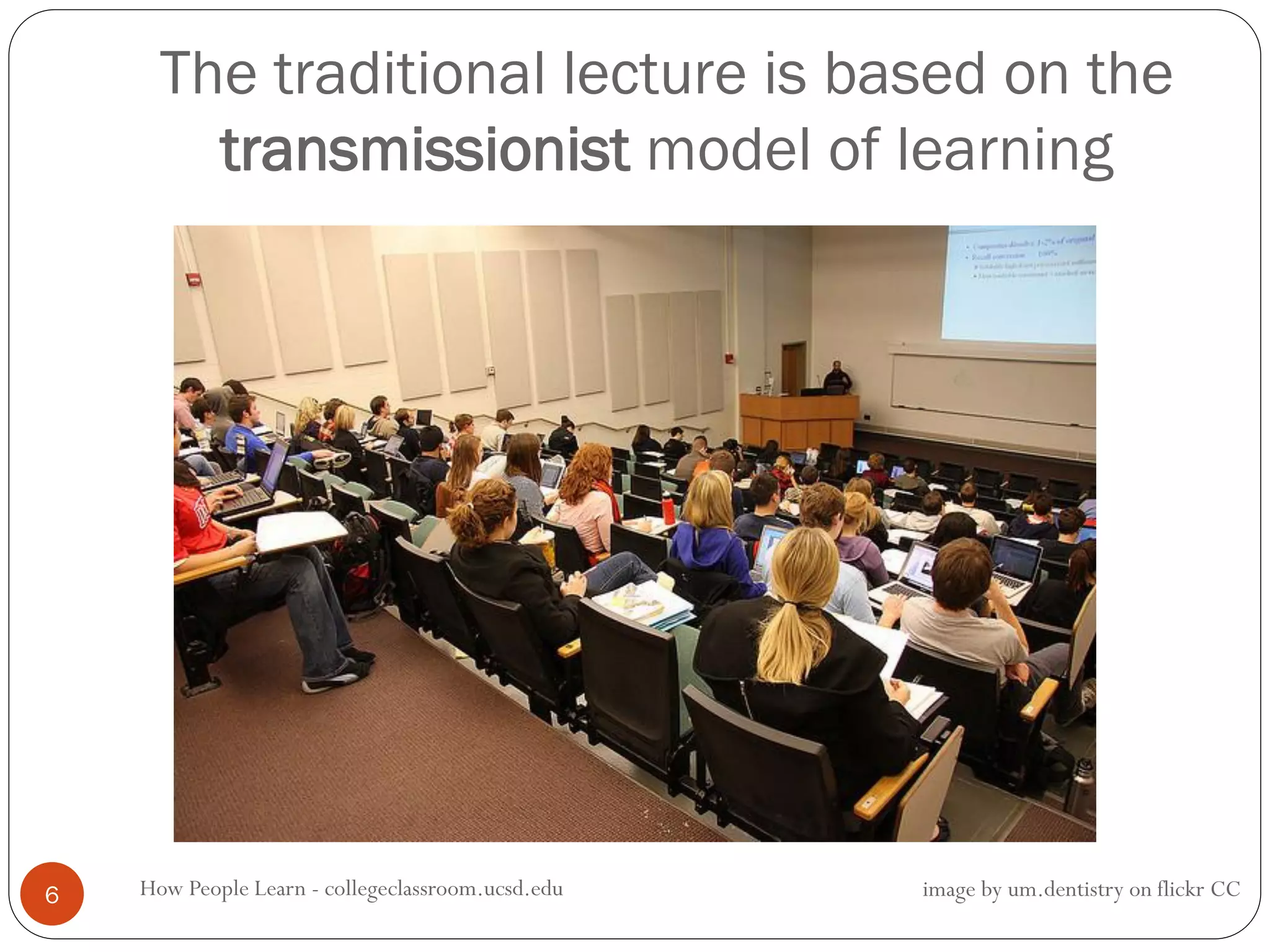
The traditional lecture is based on the
transmissionist model of learning
How People Learn - collegeclassroom.ucsd.edu6 image by um.dentistry on flickr CC
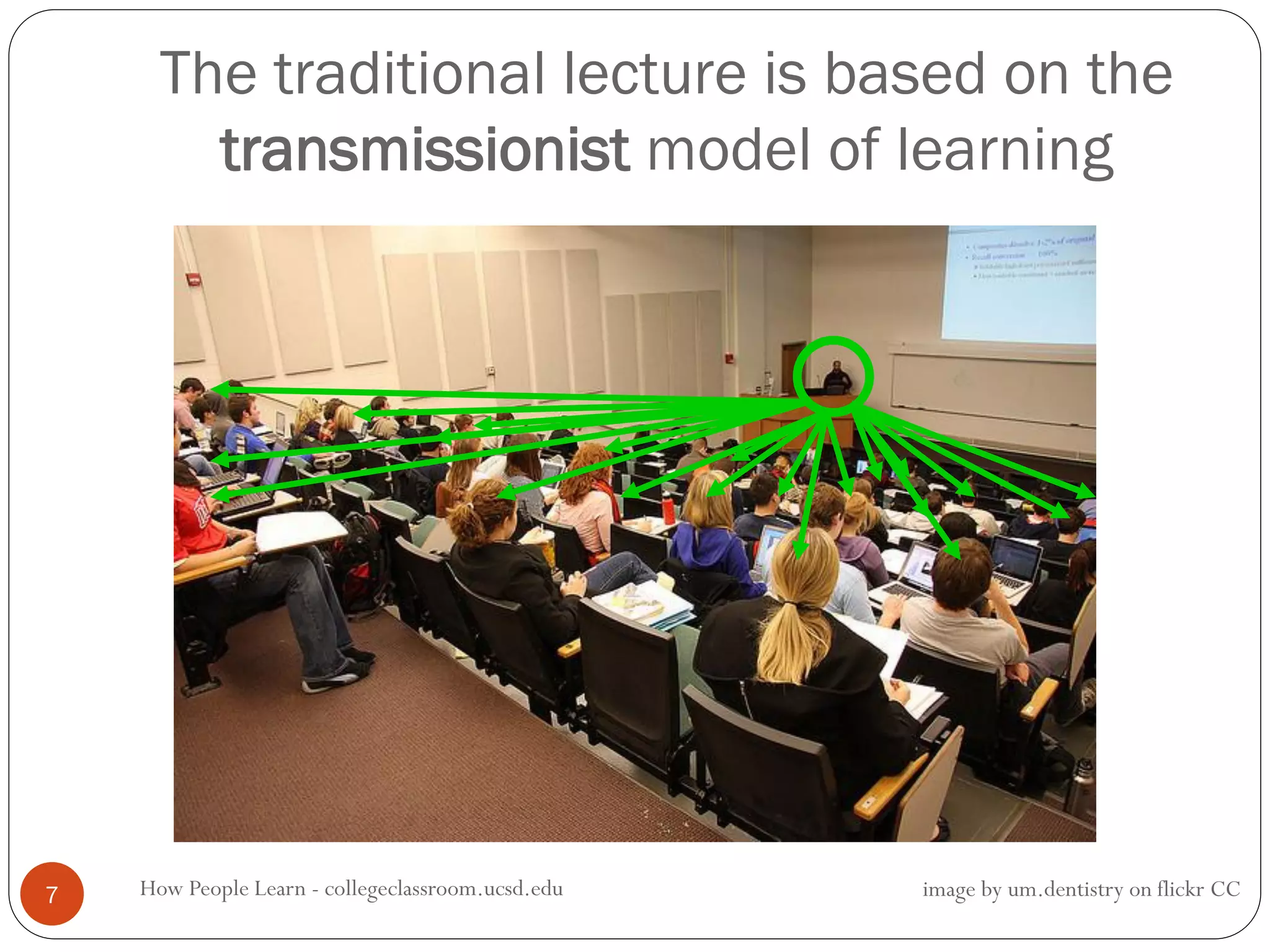
The traditional lecture is based on the
transmissionist model of learning
How People Learn - collegeclassroom.ucsd.edu7 image by um.dentistry on flickr CC
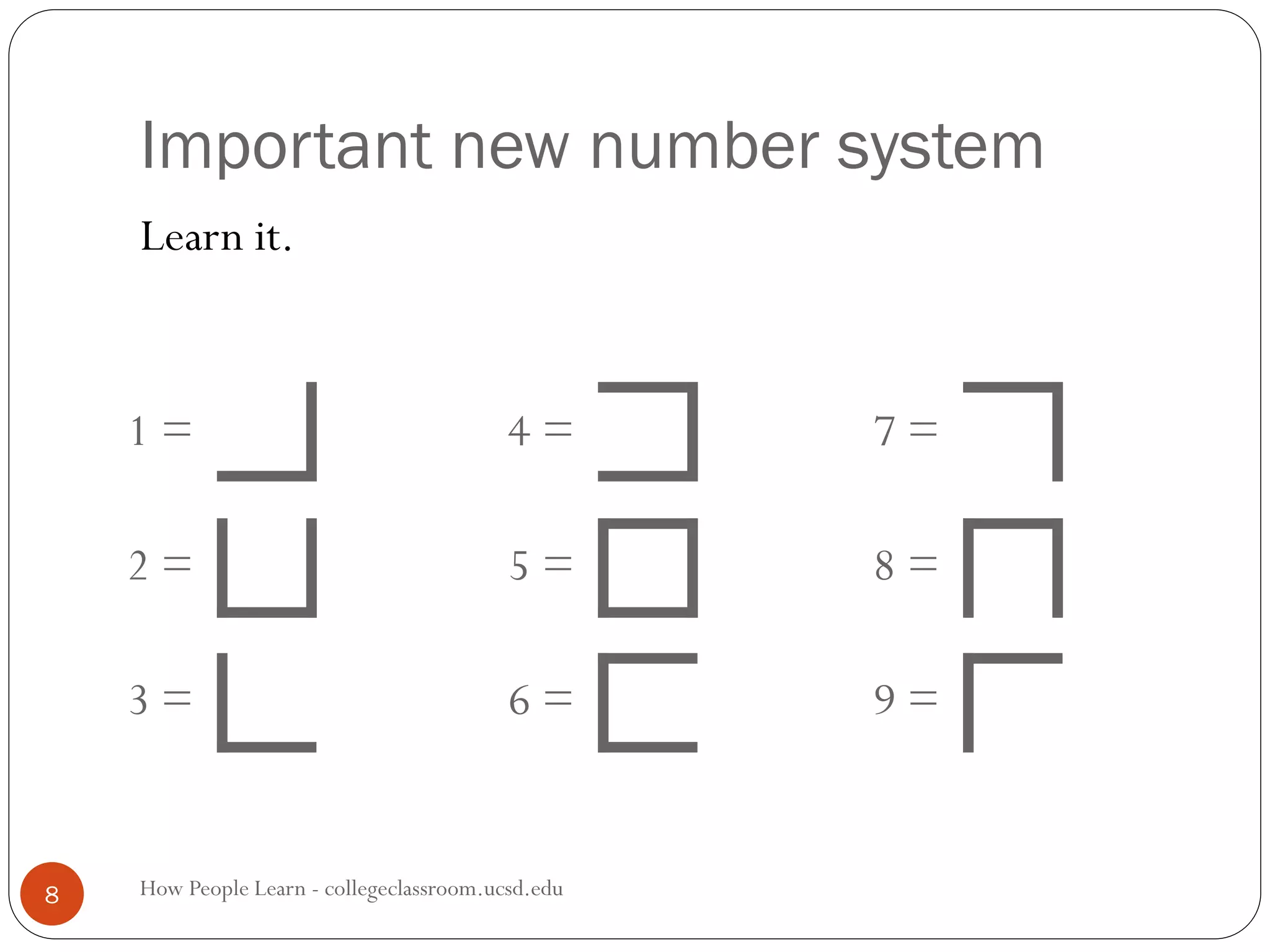
Important new number system
How People Learn - collegeclassroom.ucsd.edu8
Learn it.
1 = 4 = 7 =
2 = 5 = 8 =
3 = 6 = 9 =
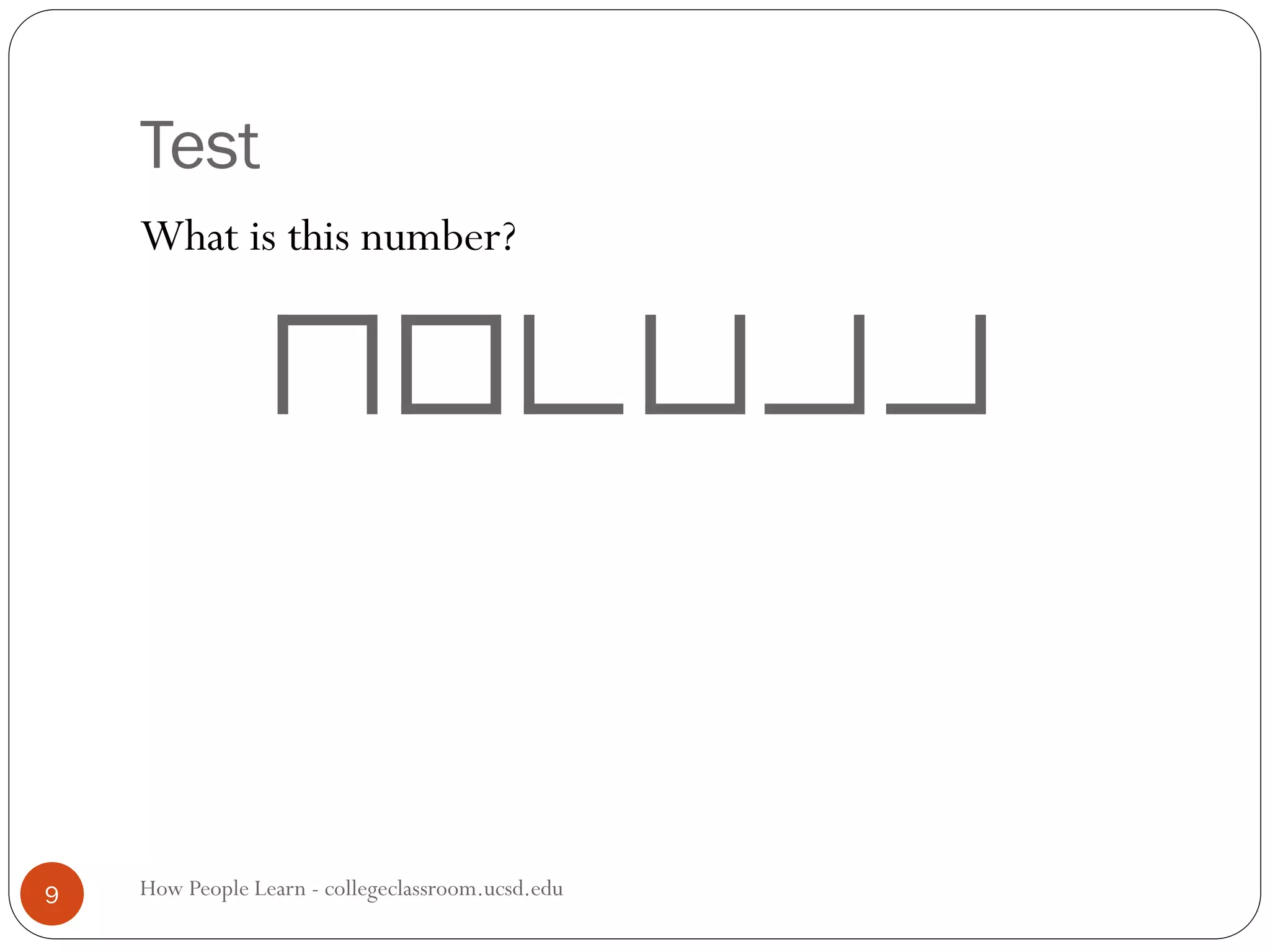
Test
How People Learn - collegeclassroom.ucsd.edu9
What is this number?
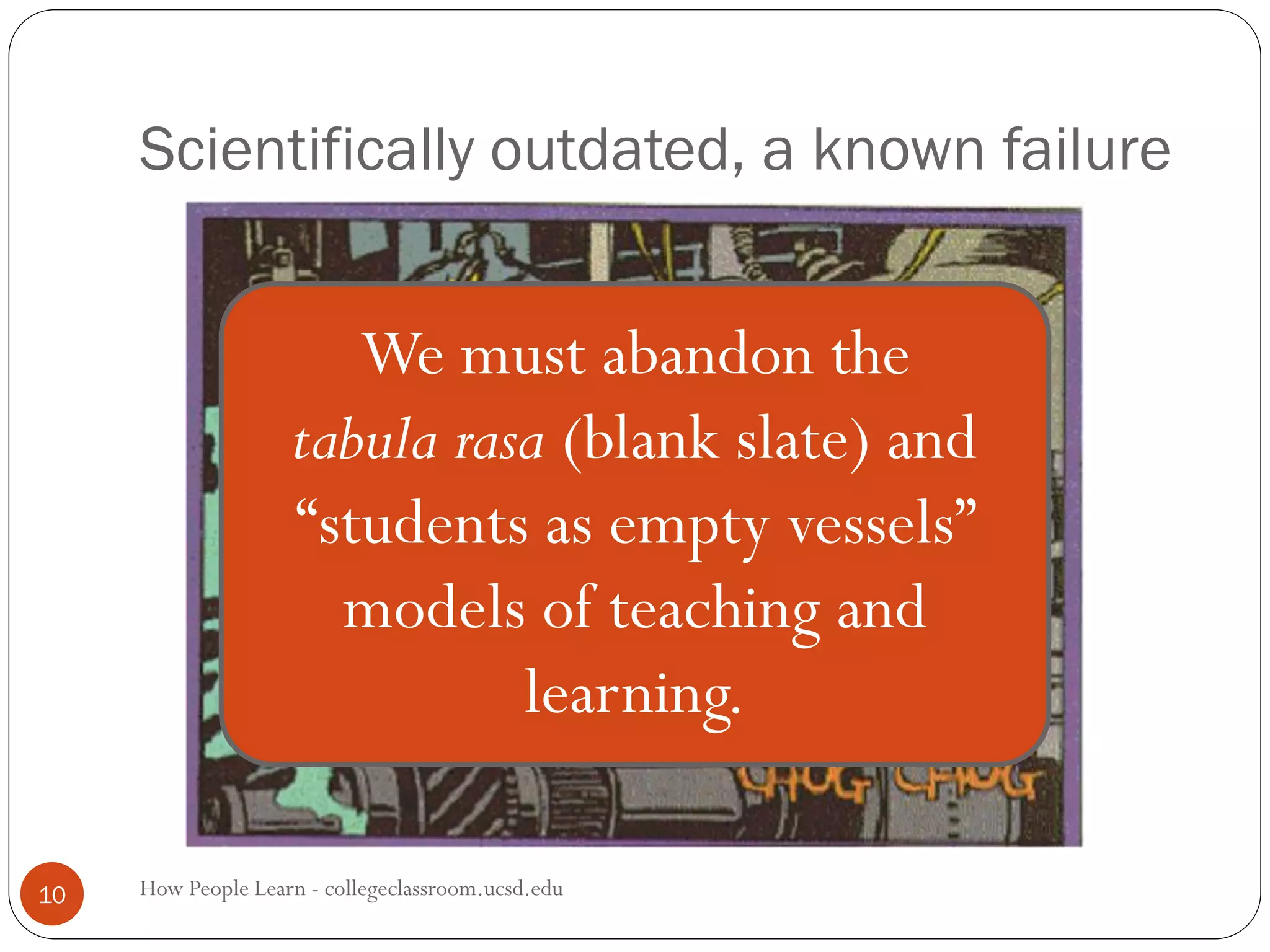
Scientifically outdated, a known failure
How People Learn - collegeclassroom.ucsd.edu10
We must abandon the
tabula rasa (blank slate) and
“students as empty vessels”
models of teaching and
learning.
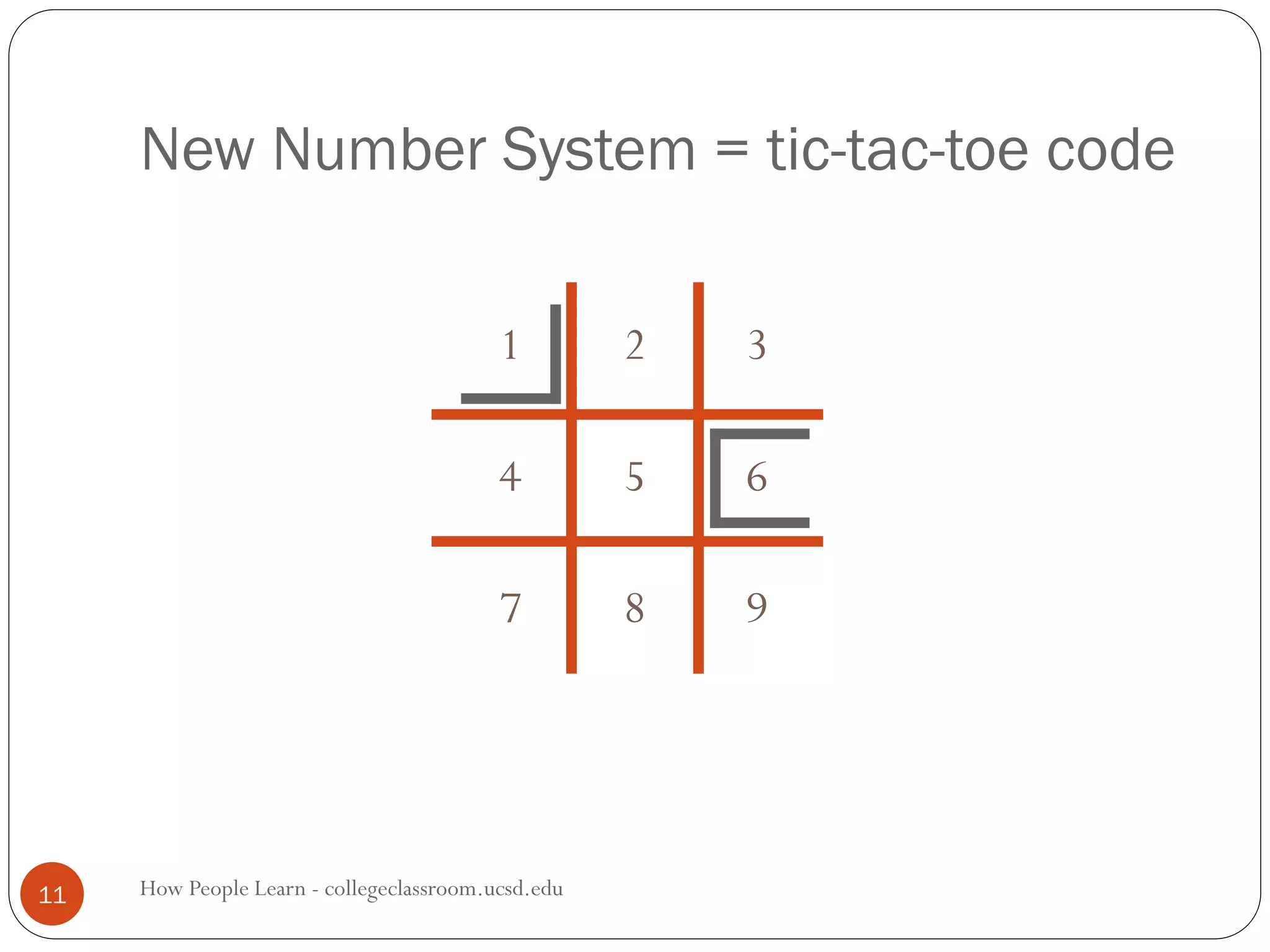
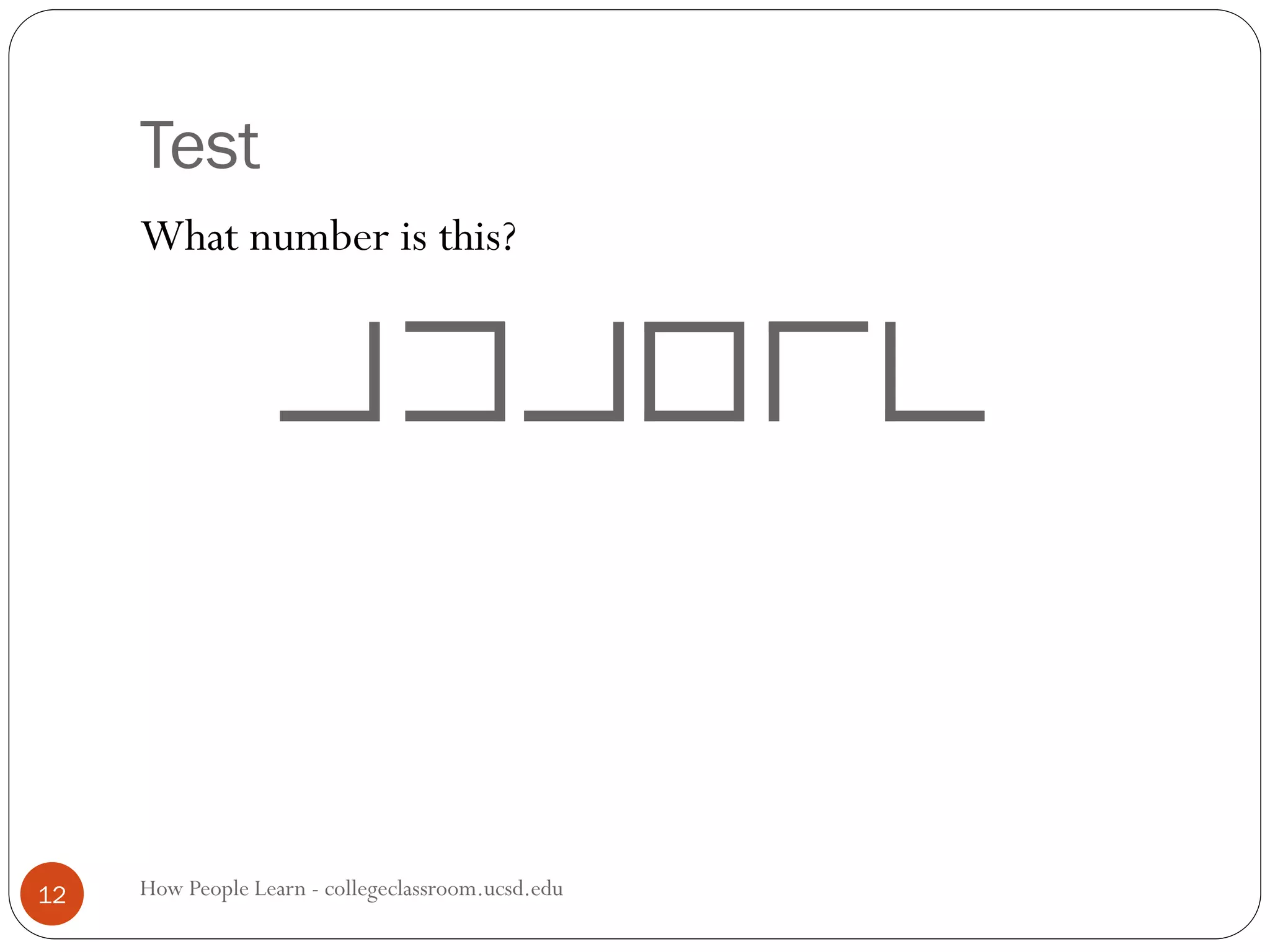
New Number System = tic-tac-toe code
How People Learn - collegeclassroom.ucsd.edu11
1 2 3
4 5 6
7 8 9
Test
How People Learn - collegeclassroom.ucsd.edu12
What number is this?
Constructivist Theory of Learning
How People Learn - collegeclassroom.ucsd.edu13
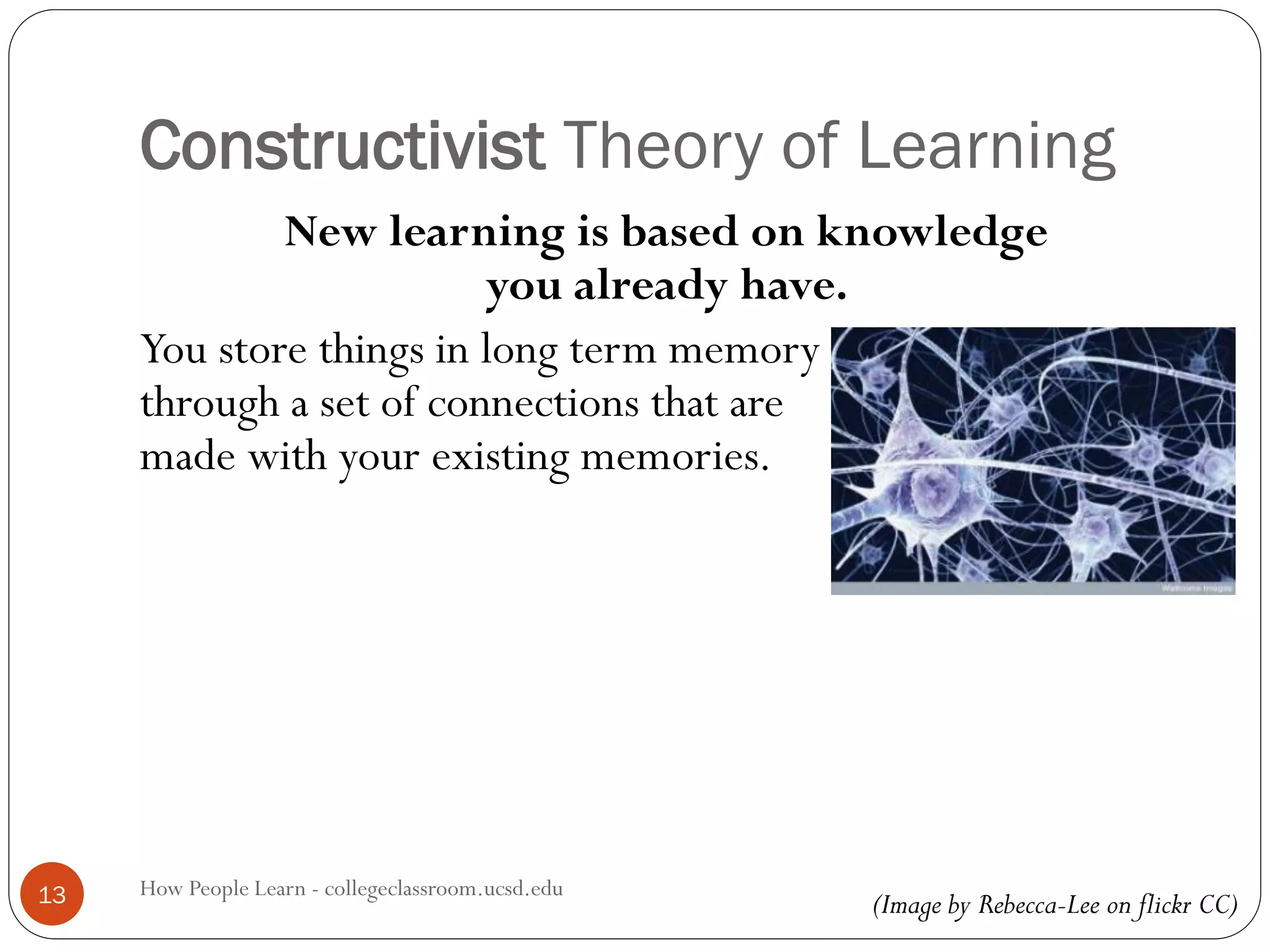
New learning is based on knowledge
you already have.
You store things in long term memory
through a set of connections that are
made with your existing memories.
(Image by Rebecca-Lee on flickr CC)
Constructivist Theory of Learning
How People Learn - collegeclassroom.ucsd.edu14
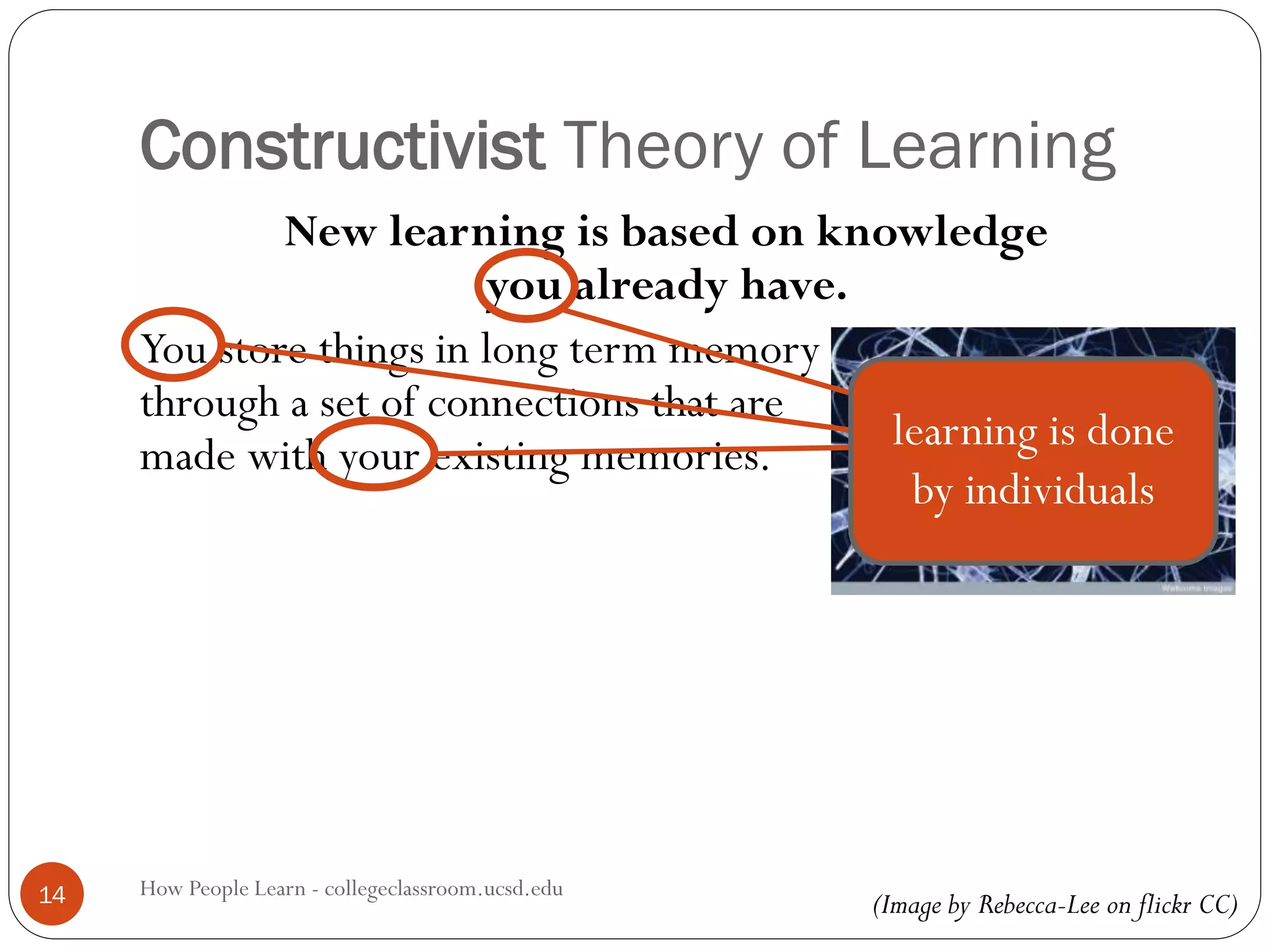
New learning is based on knowledge
you already have.
You store things in long term memory
through a set of connections that are
made with your existing memories.
(Image by Rebecca-Lee on flickr CC)
learning is done
by individuals
15 How People Learn - collegeclassroom.ucsd.edu
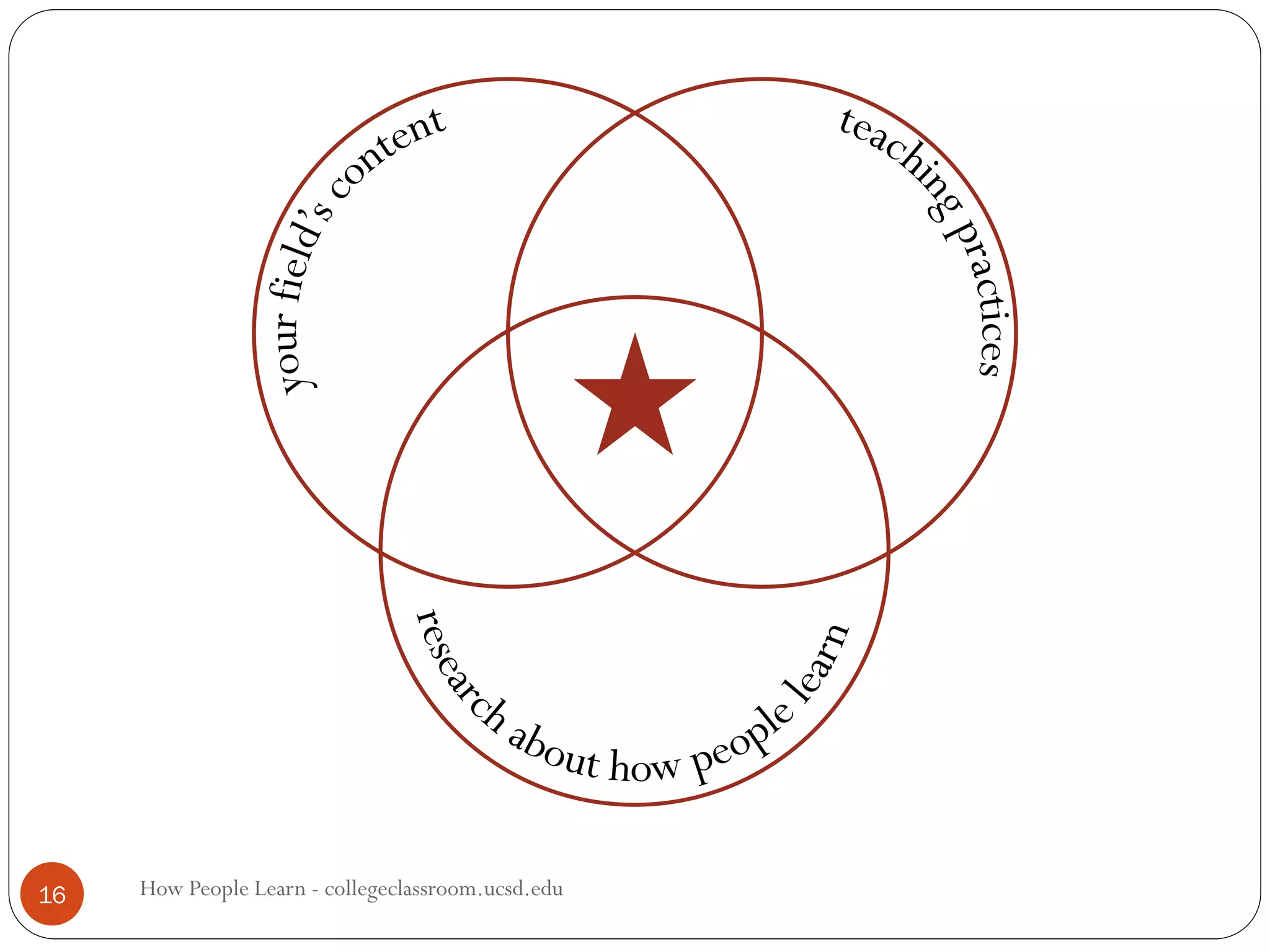
16 How People Learn - collegeclassroom.ucsd.edu
How People Learn
How People Learn - collegeclassroom.ucsd.edu17
3 Key Findings
3 Implications forTeaching
3 Designs for Classroom Environment
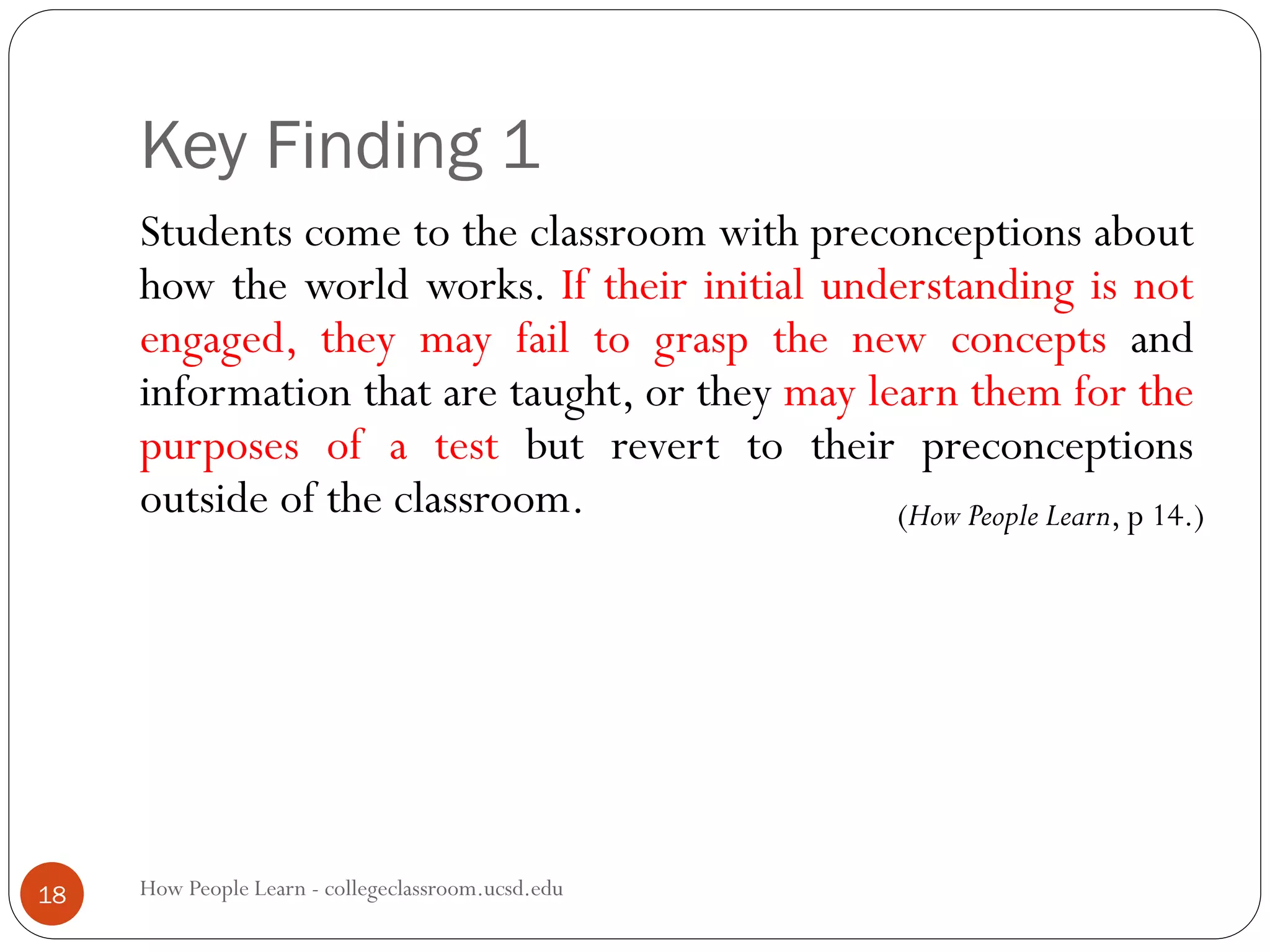
Key Finding 1
How People Learn - collegeclassroom.ucsd.edu18
Students come to the classroom with preconceptions about
how the world works. If their initial understanding is not
engaged, they may fail to grasp the new concepts and
information that are taught, or they may learn them for the
purposes of a test but revert to their preconceptions
outside of the classroom. (How People Learn, p 14.)
Implications for Teaching 1
How People Learn - collegeclassroom.ucsd.edu19
Teachers must draw out and work with the preexisting
understandings that their students bring with them.
(How People Learn, p 19.)
How People Learn - collegeclassroom.ucsd.edu20
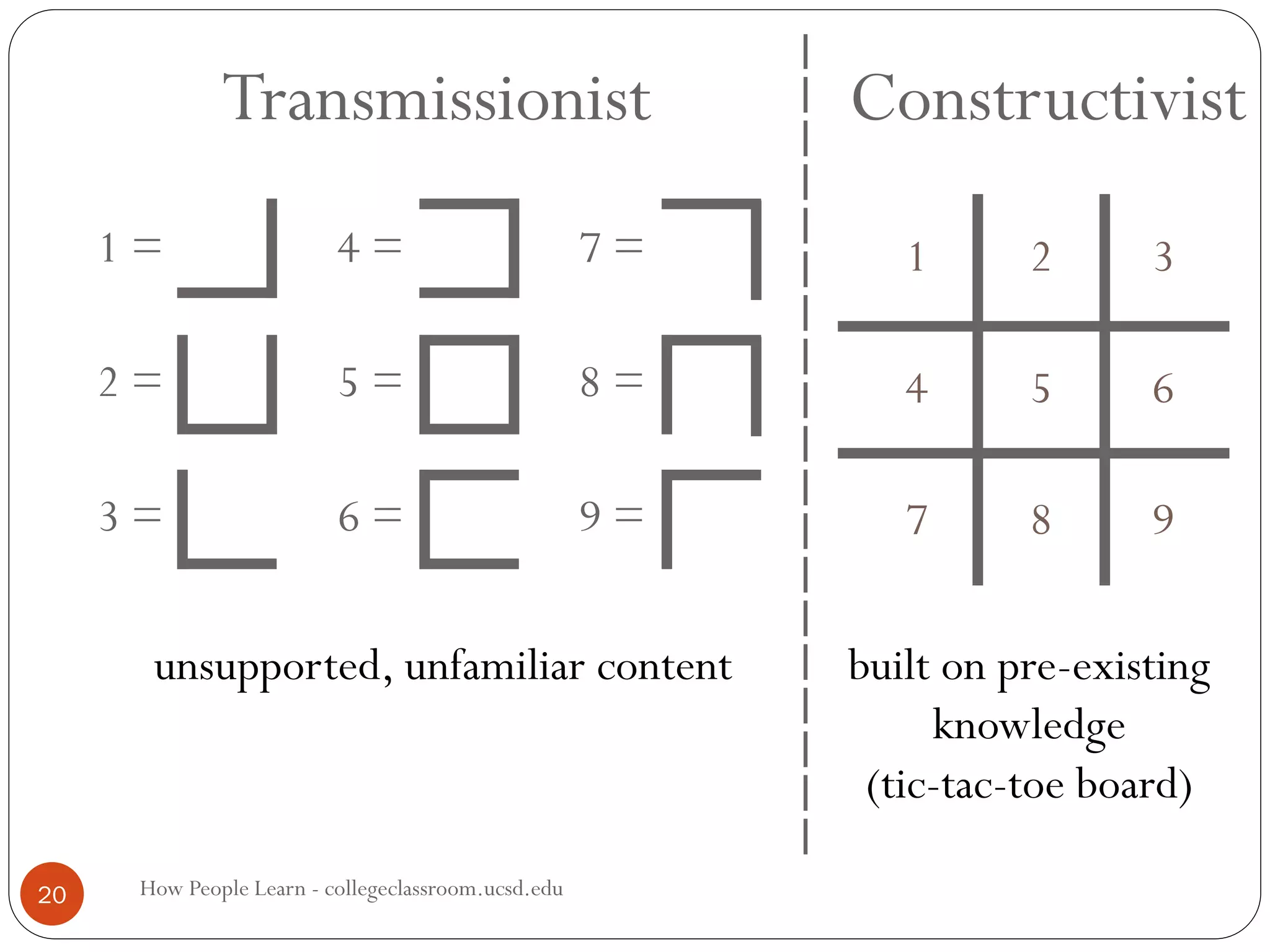
1 = 4 = 7 =
2 = 5 = 8 =
3 = 6 = 9 =
1 2 3
4 5 6
7 8 9
unsupported, unfamiliar content built on pre-existing
knowledge
(tic-tac-toe board)
Transmissionist Constructivist
Implications for Teaching 1
How People Learn - collegeclassroom.ucsd.edu21
Teachers must draw out and work with the preexisting
understandings that their students bring with them.
(How People Learn, p 19.)
Schools and classrooms must be learner centered.
(How People Learn, p. 23)
Classroom Environments 1
Learning requires interaction [3]
How People Learn - collegeclassroom.ucsd.edu22
Learning requires interaction [3]
How People Learn - collegeclassroom.ucsd.edu23
% of class time
NOT lecturing
Learning requires interaction [3]
How People Learn - collegeclassroom.ucsd.edu24
% of class time
NOT lecturing
Learning gain:
pre-test
0
100%
Learning requires interaction [3]
How People Learn - collegeclassroom.ucsd.edu25
% of class time
NOT lecturing
Learning gain:
pre-test
0
100%
post-test
Learning requires interaction [3]
How People Learn - collegeclassroom.ucsd.edu26
% of class time
NOT lecturing
Learning gain:
pre-test
0
100%
post-test
0.50
Learning requires interaction [3]
How People Learn - collegeclassroom.ucsd.edu27
52 classes of sizes 25 to 100+ students, at 2-
and 4-yr colleges and research universities
across US. Every student wrote an astronomy
test (twice). Each points shows average
learning gain in one class.
Learning requires interaction [3]
How People Learn - collegeclassroom.ucsd.edu28
Learning requires interaction [3]
How People Learn - collegeclassroom.ucsd.edu29
1 2
3 4
Learning requires interaction [3]
How People Learn - collegeclassroom.ucsd.edu30
1 2
3 4
In a moment but not yet, you’ll meet with
3-4 others in a break out room.You’ll have
5 minutes to
1. select the person who will speak for your
room: the person whose first name comes
earliest in the alphabet
2. interpret the data – what story do they
tell? Be prepared to share your ideas with
the rest of the class.
Learning requires interaction [3]
How People Learn - collegeclassroom.ucsd.edu31
1 2
3 4
Learning requires interaction [3]
How People Learn - collegeclassroom.ucsd.edu32
1 2
3 4
Key Finding 2
How People Learn - collegeclassroom.ucsd.edu33
To develop competence in an area, students must:
a) have a deep foundation of factual knowledge,
b) understand facts and ideas in the context of a
conceptual framework, and
c) organize knowledge in ways that facilitate
retrieval and application.
(How People Learn,p 16.)
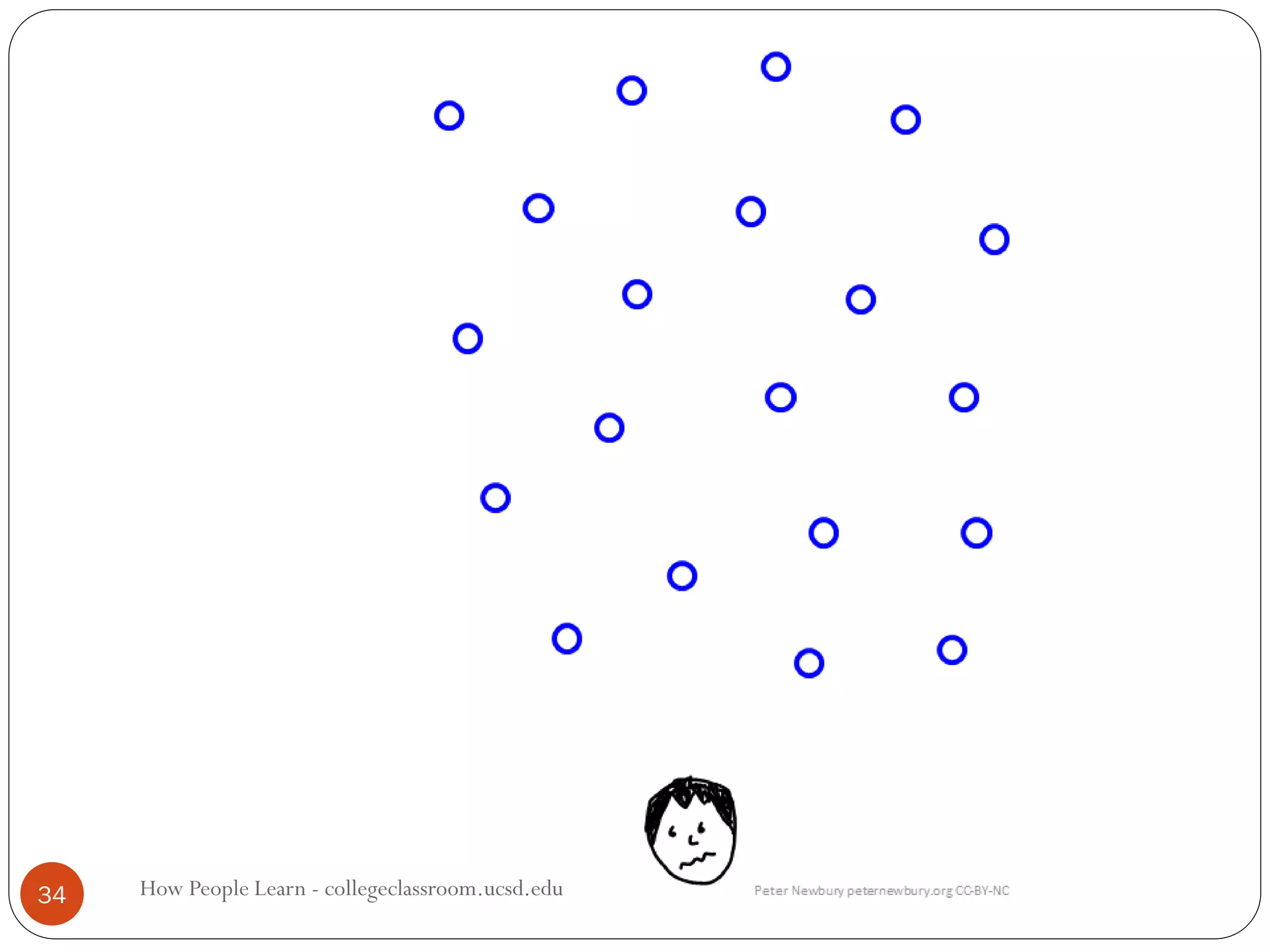
How People Learn - collegeclassroom.ucsd.edu34
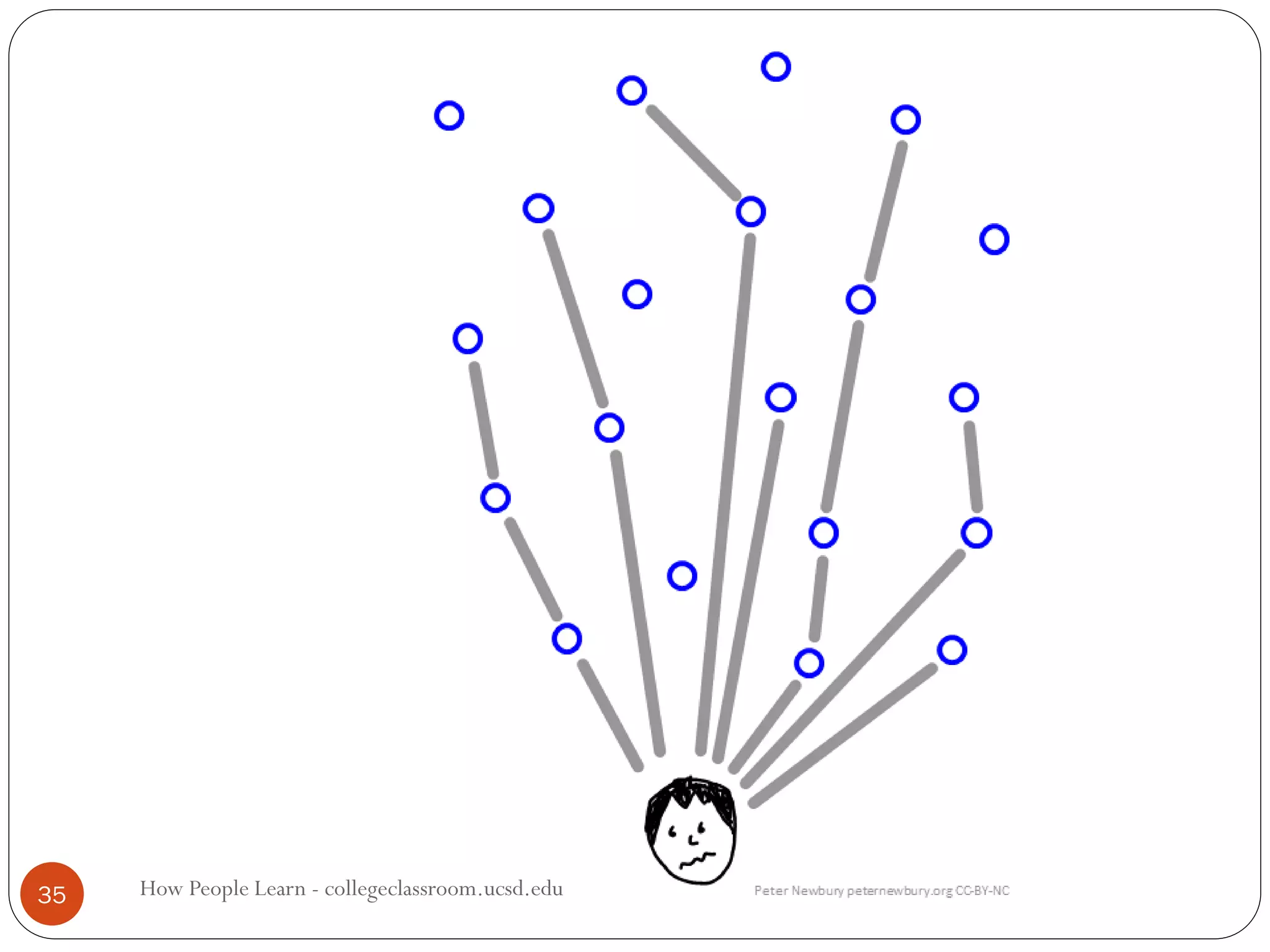
How People Learn - collegeclassroom.ucsd.edu35
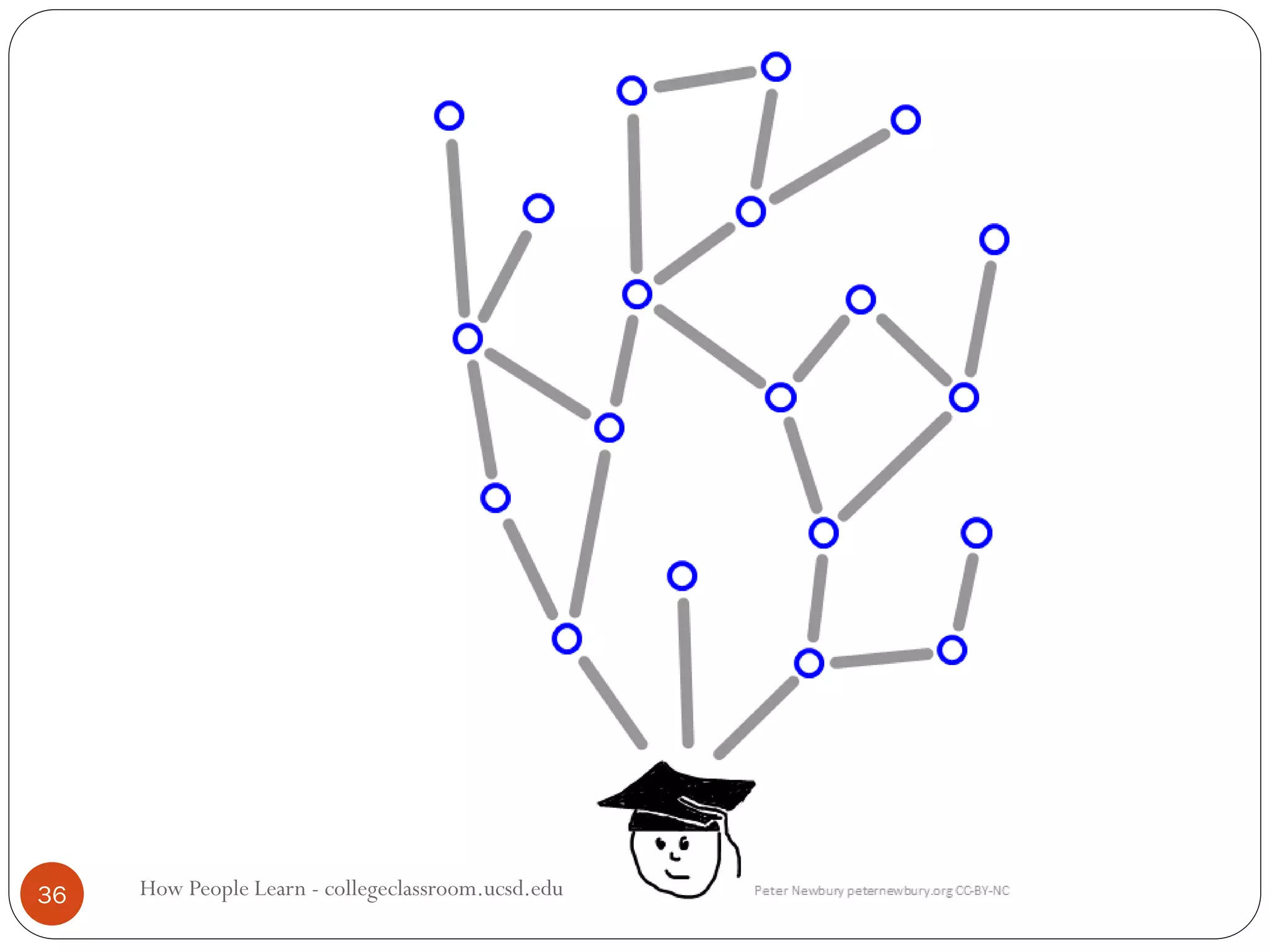
How People Learn - collegeclassroom.ucsd.edu36
Why Your Students Don’t Understand You
How People Learn - collegeclassroom.ucsd.edu37
Expert brains differ from novice brains because
 novices lack rich, networked connections, cannot make
inferences, cannot reliably retrieve information
 notices have preconceptions that distract, confuse,
hinder
 novices lack automization (“muscle memory”) resulting
in cognitive overload
Implications for Teaching 2
How People Learn - collegeclassroom.ucsd.edu38
Teachers must teach some subject matter in depth,
providing many examples in which the same concept is at
work and providing a firm foundation of factual
knowledge. (How People Learn,p 20.)
Implications for Teaching 2
How People Learn - collegeclassroom.ucsd.edu39
Teachers must teach some subject matter in depth,
providing many examples in which the same concept is at
work and providing a firm foundation of factual
knowledge.
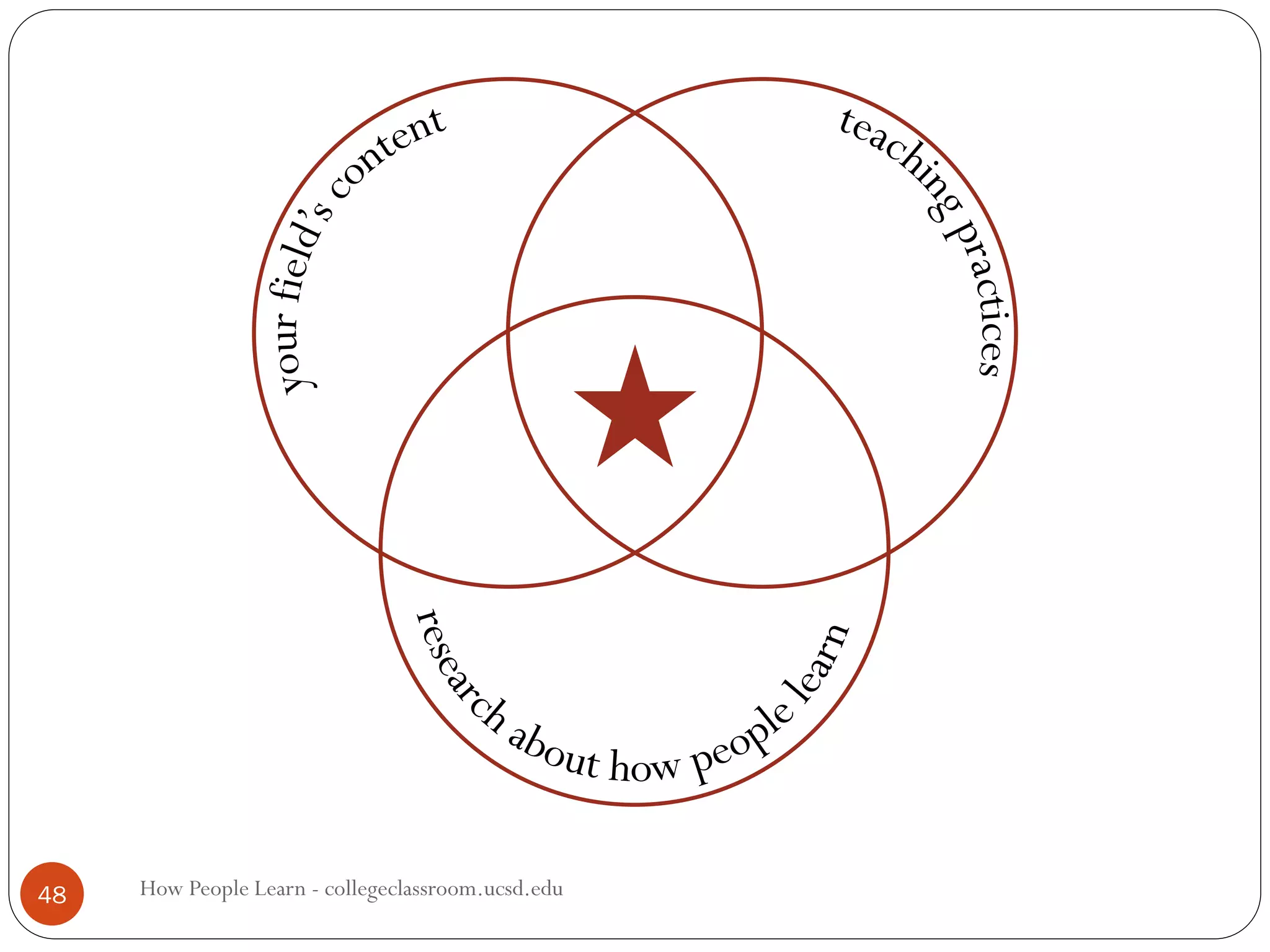
Classroom Environments 2
To provide a knowledge-centered environment, attention
must be given to what is taught (information, subject
matter), why it is taught (understanding), and what
competence or mastery looks like.
(How People Learn,p 20.)
(How People Learn,p 24.)
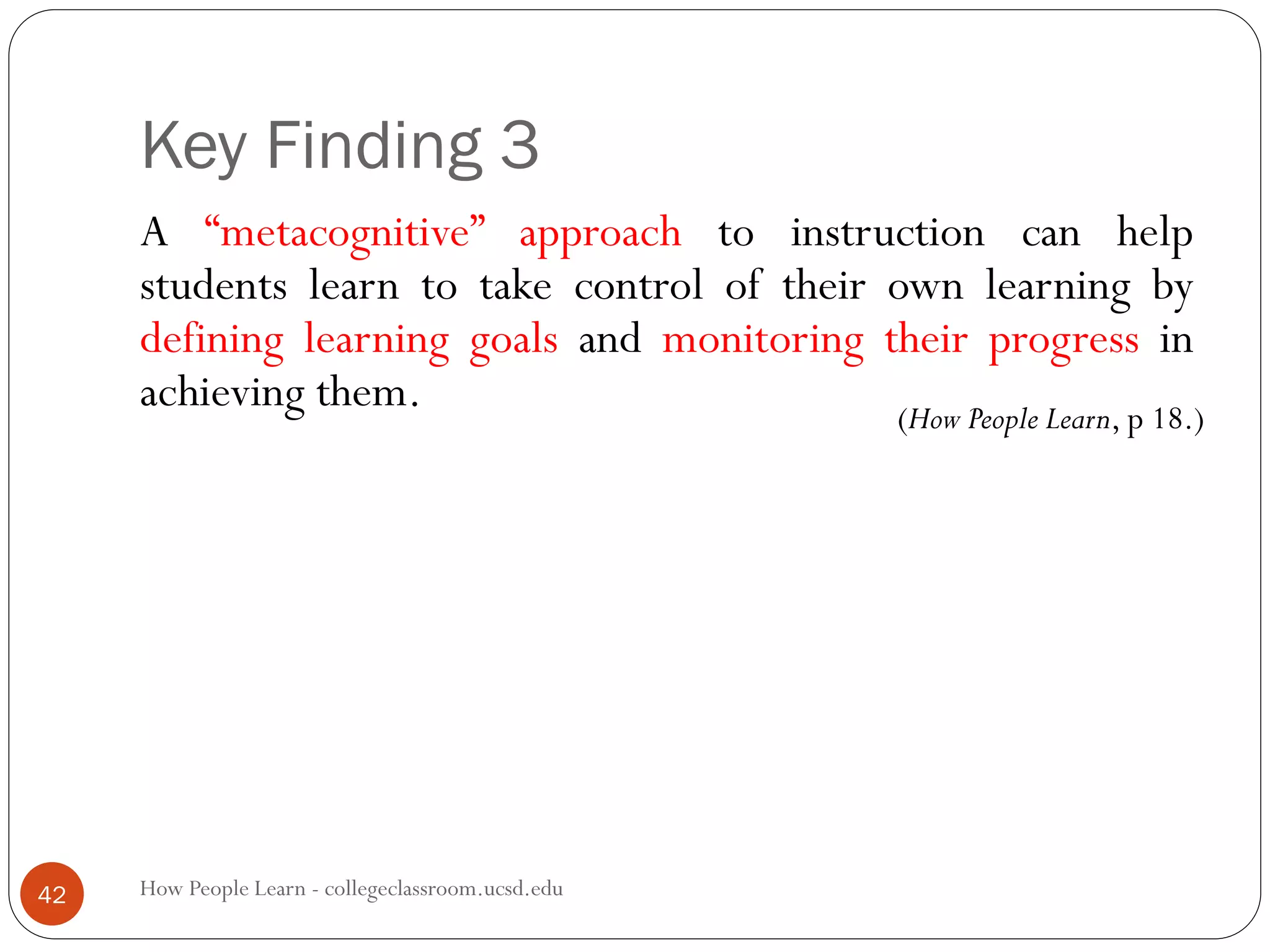
Key Finding 3
How People Learn - collegeclassroom.ucsd.edu40
A “metacognitive” approach to instruction can help
students learn to take control of their own learning by
defining learning goals and monitoring their progress in
achieving them. (How People Learn, p 18.)
Aside: metacognition
How People Learn - collegeclassroom.ucsd.edu41
Metacognition refers to one’s knowledge concerning one’s
own cognitive processes or anything related to them. For
example, I am engaging in metacognition if I notice that I am
having more trouble learningA than B.
([4], [5])
cognitionmeta
Key Finding 3
How People Learn - collegeclassroom.ucsd.edu42
A “metacognitive” approach to instruction can help
students learn to take control of their own learning by
defining learning goals and monitoring their progress in
achieving them. (How People Learn, p 18.)
Implications for Teaching 3
How People Learn - collegeclassroom.ucsd.edu43
The teaching of metacognitive skills should be integrated
into the curriculum in a variety of subject areas.
(How People Learn, p 21.)
Implications for Teaching 3
How People Learn - collegeclassroom.ucsd.edu44
The teaching of metacognitive skills should be integrated
into the curriculum in a variety of subject areas.
Classroom Environments 3
Formative assessments — ongoing assessments designed to
make students’ thinking visible to both teachers and
students — are essential.
(How People Learn, p 21.)
(How People Learn, p 24.)
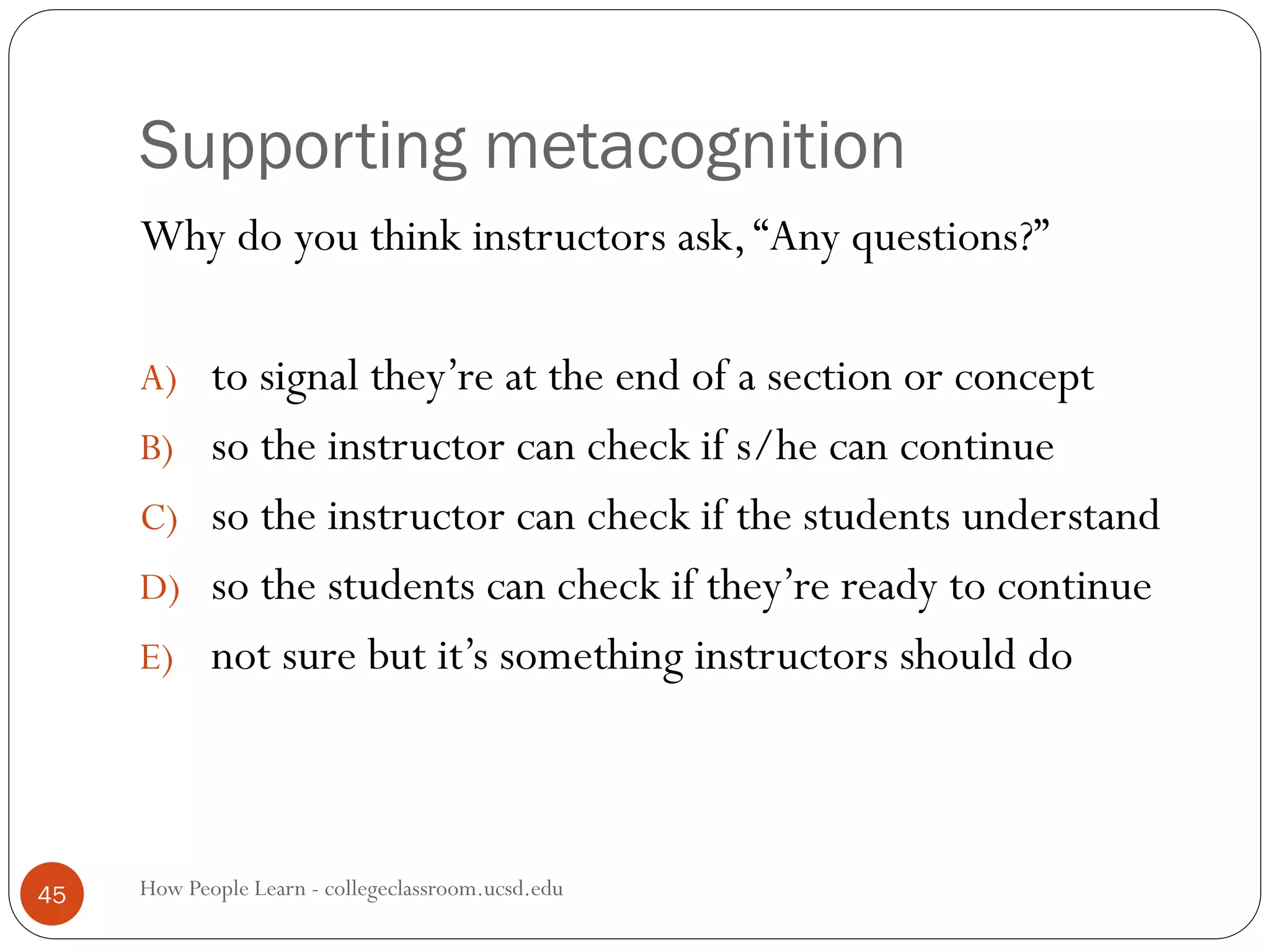
Supporting metacognition
How People Learn - collegeclassroom.ucsd.edu45
Why do you think instructors ask,“Any questions?”
A) to signal they’re at the end of a section or concept
B) so the instructor can check if s/he can continue
C) so the instructor can check if the students understand
D) so the students can check if they’re ready to continue
E) not sure but it’s something instructors should do
Supporting metacognition
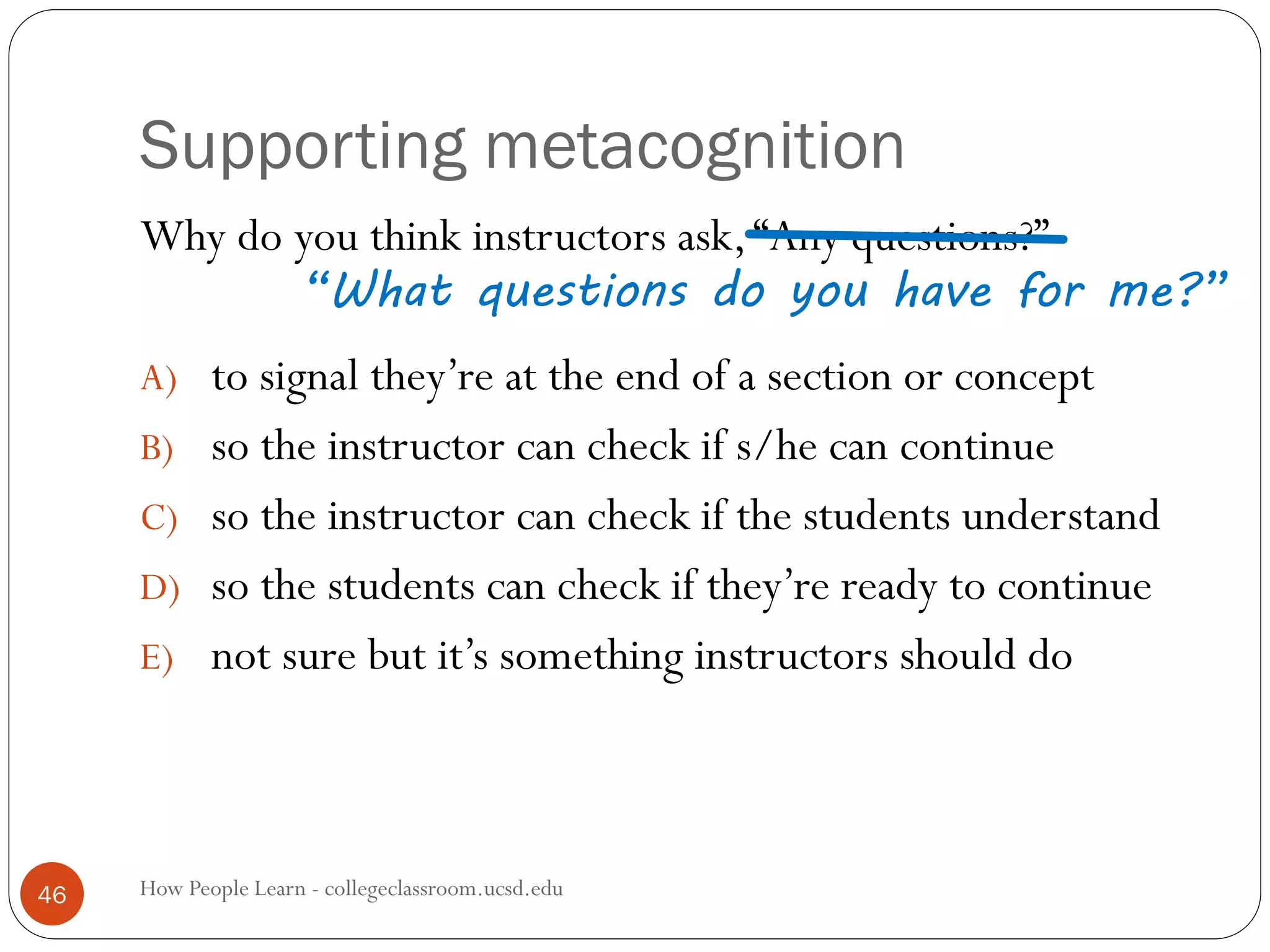
How People Learn - collegeclassroom.ucsd.edu46
Why do you think instructors ask,“Any questions?”
A) to signal they’re at the end of a section or concept
B) so the instructor can check if s/he can continue
C) so the instructor can check if the students understand
D) so the students can check if they’re ready to continue
E) not sure but it’s something instructors should do
“What questions do you have for me?”
Supporting metacognition
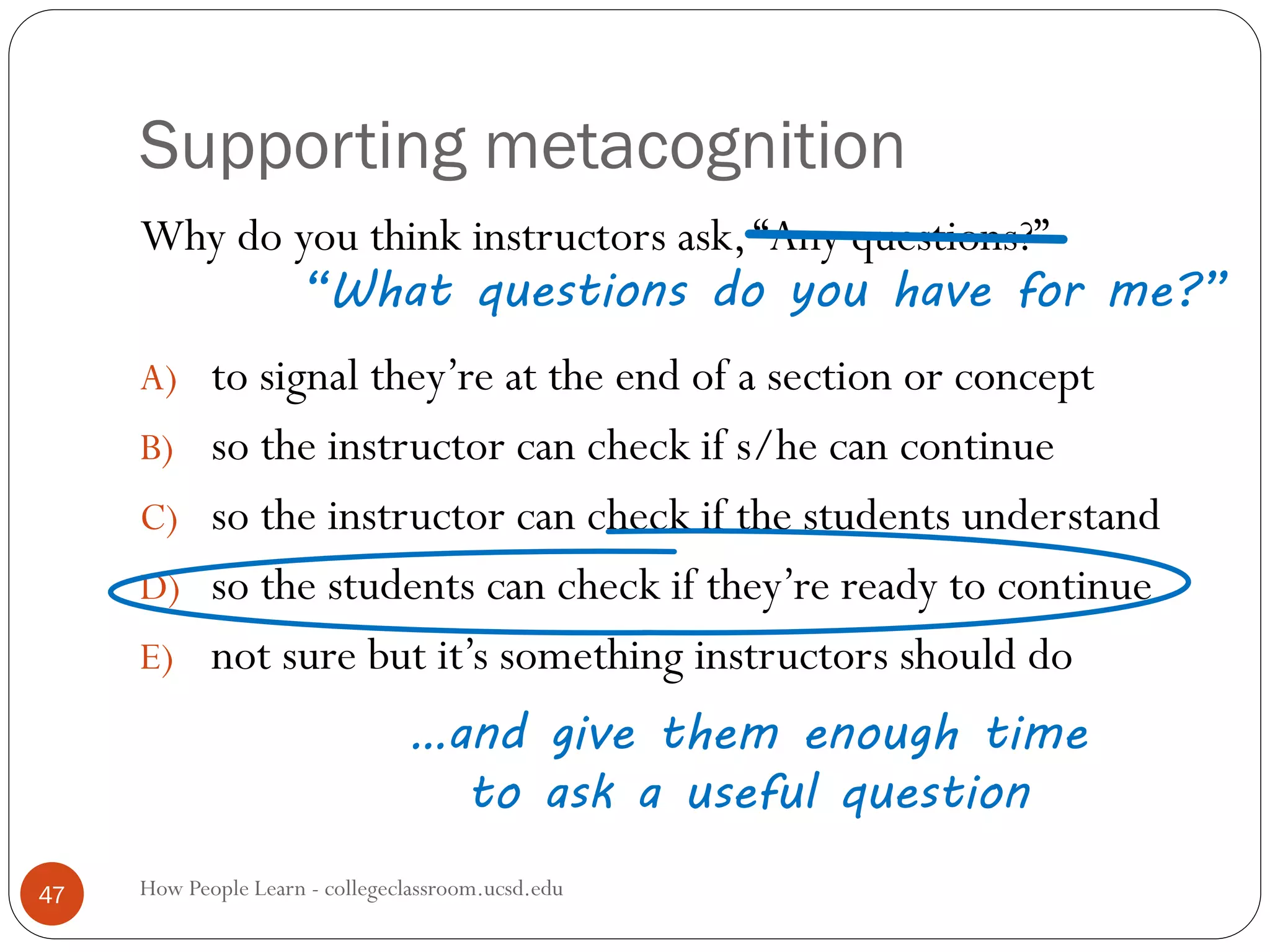
How People Learn - collegeclassroom.ucsd.edu47
Why do you think instructors ask,“Any questions?”
A) to signal they’re at the end of a section or concept
B) so the instructor can check if s/he can continue
C) so the instructor can check if the students understand
D) so the students can check if they’re ready to continue
E) not sure but it’s something instructors should do
“What questions do you have for me?”
…and give them enough time
to ask a useful question
48 How People Learn - collegeclassroom.ucsd.edu
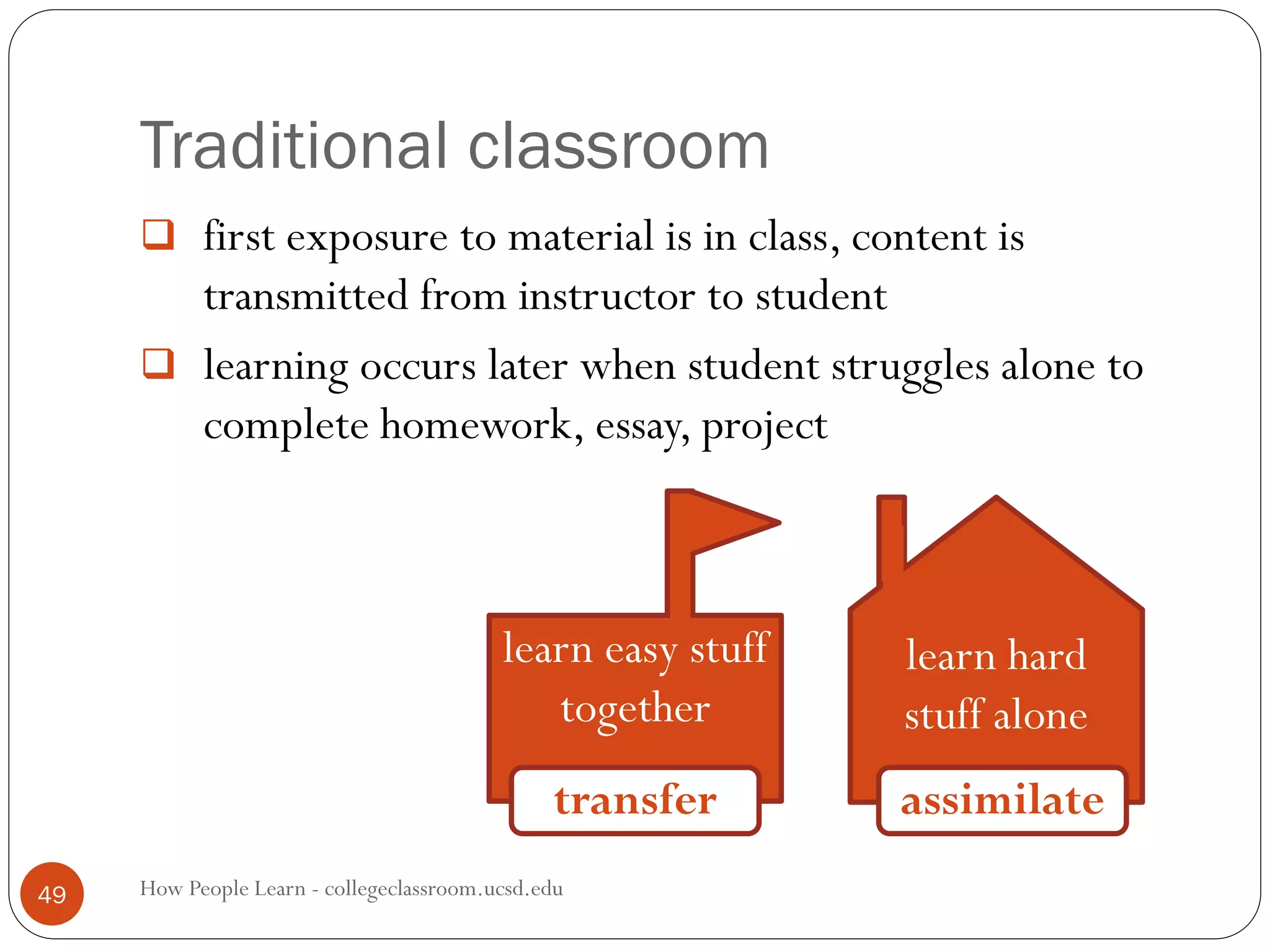
Traditional classroom
How People Learn - collegeclassroom.ucsd.edu49
 first exposure to material is in class, content is
transmitted from instructor to student
 learning occurs later when student struggles alone to
complete homework, essay, project
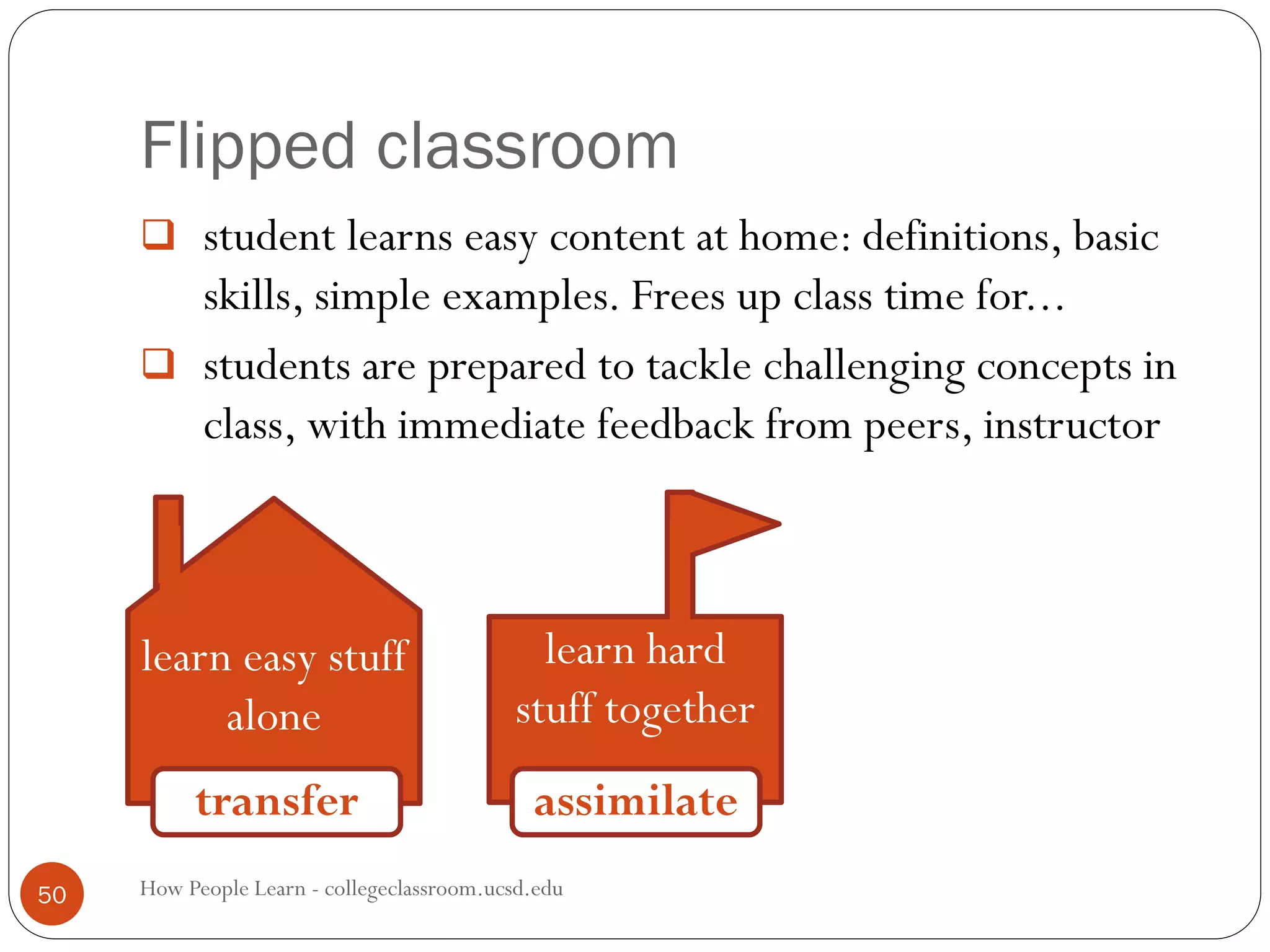
learn easy stuff
together
learn hard
stuff alone
transfer assimilate
Flipped classroom
How People Learn - collegeclassroom.ucsd.edu50
 student learns easy content at home: definitions, basic
skills, simple examples. Frees up class time for...
 students are prepared to tackle challenging concepts in
class, with immediate feedback from peers, instructor
learn hard
stuff together
learn easy stuff
alone
transfer assimilate
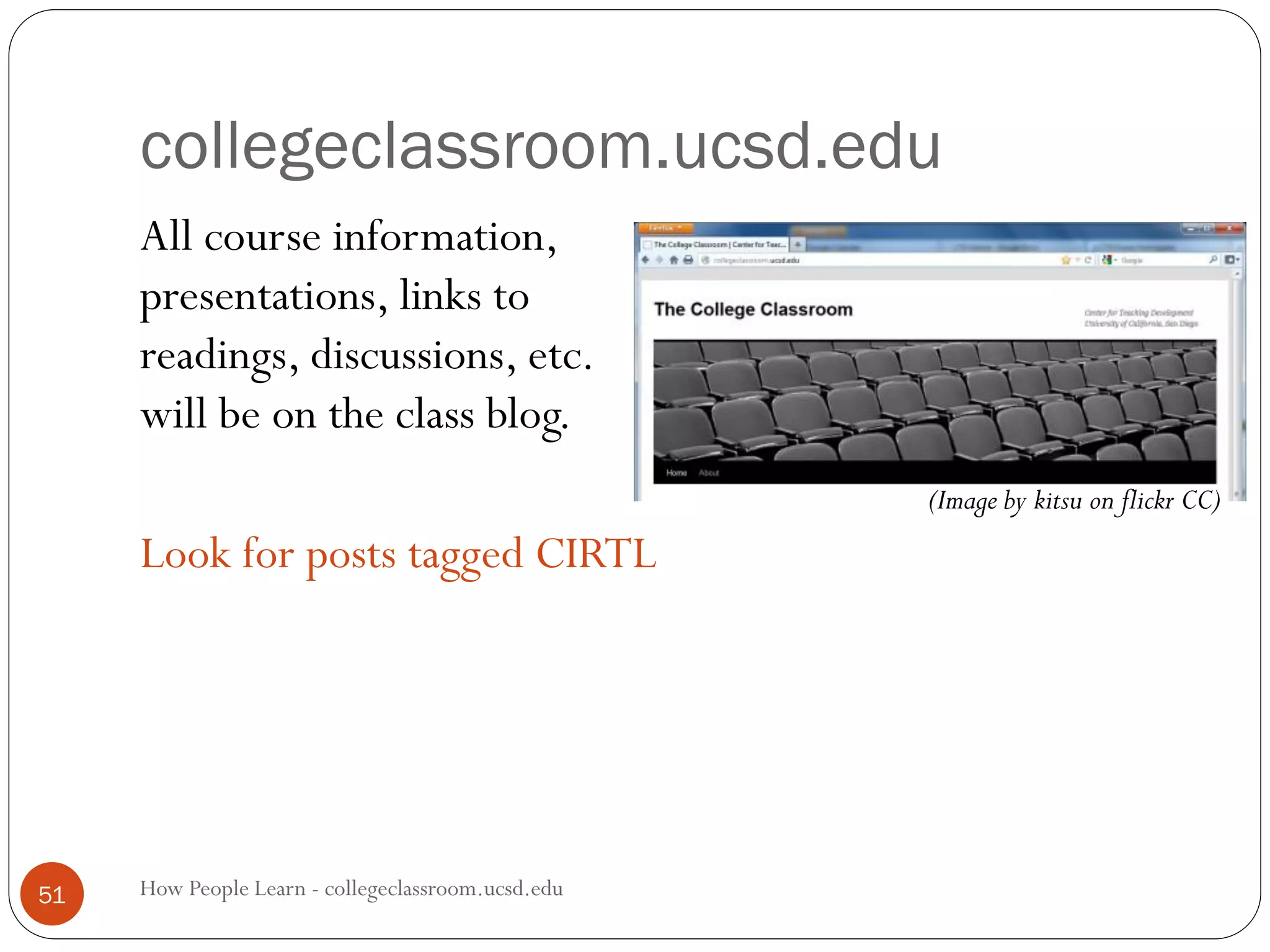
collegeclassroom.ucsd.edu
How People Learn - collegeclassroom.ucsd.edu51
All course information,
presentations, links to
readings, discussions, etc.
will be on the class blog.
Look for posts tagged CIRTL
(Image by kitsu on flickr CC)
Course blog is public so
How People Learn - collegeclassroom.ucsd.edu52
 I can only provide links to copyrighted articles, not the
articles (PDF) themselves
 you may need to be on-campus so you can use your
institution’s credentials to access subscriptions
 Your posts and comments will be visible to the public.
Be aware of what and how you write: your posts
become part of your digital footprint.
 If you include pictures in your posts, they must not be
protected by copyright (use Creative Commons pix?)
How you will be assessed
How People Learn - collegeclassroom.ucsd.edu53
To receive a completion certificate, you must
 attend all sessions
 thoughtfully complete all assigned work.
 contribute during class in a professional, collegial
manner.
Some of you are taking the course for credit.We will track
and assess your participation and your work.
Class Meeting 2:
Supporting expert-like thinking
Watch for communication with a description of tasks to complete
before next class.
How People Learn - collegeclassroom.ucsd.edu54
References
How People Learn - collegeclassroom.ucsd.edu55
1. National Research Council (2000). How People Learn:Brain,Mind,Experience,
and School:Expanded Edition. J.D. Bransford,A.L Brown & R.R. Cocking
(Eds.),Washington, DC:The NationalAcademies Press.
2. Bain, K. (2004). What the best college teachers do. Cambridge, MA: Harvard
University Press.
3. Prather, E.E, Rudolph,A.L., Brissenden, G., & Schlingman,W.M. (2009). A
national study assessing the teaching and learning of introductory astronomy.Part I.
The effect of interactive instruction.Am. J. Phys. 77, 4, 320-330.
4. Flavell, J. H. (1976). Metacognitive aspects of problem solving. In L. B.
Resnick (Ed.),The nature of intelligence (pp.231-236). Hillsdale, NJ:
Erlbaum.
5. Brame, C. (2013).Thinking about metacognition. [blog] January, 2013,
Available at: http://cft.vanderbilt.edu/2013/01/thinking-about-
metacognition/ [Accessed: 14 Jan 2013].

CIRTL Class Meeting 1: How People Learn

  • 1.
    The College Classroom– Spring 2015 Class Meeting 1: How People Learn Dave Gross dgross@ biochem.umass.edu Thursday, January 29, 2015 1:00-2:30p ET, 12:00-1:30p CT, 11:00a-12:30p MT, 10:00-11:30a PT Peter Newbury pnewbury@ucsd.edu @polarisdotca
  • 2.
    Who are we? DaveGross Professor, Department of Biochemistry and Molecular Biology UMass, Amherst Peter Newbury Associate Director, Center for Teaching Development University of California, San Diego Assoc. Director, CTD How People Learn - collegeclassroom.ucsd.edu2
  • 3.
    Who are you? HowPeople Learn - collegeclassroom.ucsd.edu3 wordle.net
  • 4.
    Who are you? HowPeople Learn - collegeclassroom.ucsd.edu4 I’m sending you into “break out rooms” Toggle on your audio and video. Introduce yourself and where you are. Briefly tell your neighbor about the class you remember most from your undergraduate experience. Why that class?Was it something the instructor did? What was it?
  • 5.
    Why are wehere? How People Learn - collegeclassroom.ucsd.edu5 What do you think students are doing in a typical university class? A) listening B) absorbing C) learning D) note-taking E) distracted
  • 6.
    The traditional lectureis based on the transmissionist model of learning How People Learn - collegeclassroom.ucsd.edu6 image by um.dentistry on flickr CC
  • 7.
    The traditional lectureis based on the transmissionist model of learning How People Learn - collegeclassroom.ucsd.edu7 image by um.dentistry on flickr CC
  • 8.
    Important new numbersystem How People Learn - collegeclassroom.ucsd.edu8 Learn it. 1 = 4 = 7 = 2 = 5 = 8 = 3 = 6 = 9 =
  • 9.
    Test How People Learn- collegeclassroom.ucsd.edu9 What is this number?
  • 10.
    Scientifically outdated, aknown failure How People Learn - collegeclassroom.ucsd.edu10 We must abandon the tabula rasa (blank slate) and “students as empty vessels” models of teaching and learning.
  • 11.
    New Number System= tic-tac-toe code How People Learn - collegeclassroom.ucsd.edu11 1 2 3 4 5 6 7 8 9
  • 12.
    Test How People Learn- collegeclassroom.ucsd.edu12 What number is this?
  • 13.
    Constructivist Theory ofLearning How People Learn - collegeclassroom.ucsd.edu13 New learning is based on knowledge you already have. You store things in long term memory through a set of connections that are made with your existing memories. (Image by Rebecca-Lee on flickr CC)
  • 14.
    Constructivist Theory ofLearning How People Learn - collegeclassroom.ucsd.edu14 New learning is based on knowledge you already have. You store things in long term memory through a set of connections that are made with your existing memories. (Image by Rebecca-Lee on flickr CC) learning is done by individuals
  • 15.
    15 How PeopleLearn - collegeclassroom.ucsd.edu
  • 16.
    16 How PeopleLearn - collegeclassroom.ucsd.edu
  • 17.
    How People Learn HowPeople Learn - collegeclassroom.ucsd.edu17 3 Key Findings 3 Implications forTeaching 3 Designs for Classroom Environment
  • 18.
    Key Finding 1 HowPeople Learn - collegeclassroom.ucsd.edu18 Students come to the classroom with preconceptions about how the world works. If their initial understanding is not engaged, they may fail to grasp the new concepts and information that are taught, or they may learn them for the purposes of a test but revert to their preconceptions outside of the classroom. (How People Learn, p 14.)
  • 19.
    Implications for Teaching1 How People Learn - collegeclassroom.ucsd.edu19 Teachers must draw out and work with the preexisting understandings that their students bring with them. (How People Learn, p 19.)
  • 20.
    How People Learn- collegeclassroom.ucsd.edu20 1 = 4 = 7 = 2 = 5 = 8 = 3 = 6 = 9 = 1 2 3 4 5 6 7 8 9 unsupported, unfamiliar content built on pre-existing knowledge (tic-tac-toe board) Transmissionist Constructivist
  • 21.
    Implications for Teaching1 How People Learn - collegeclassroom.ucsd.edu21 Teachers must draw out and work with the preexisting understandings that their students bring with them. (How People Learn, p 19.) Schools and classrooms must be learner centered. (How People Learn, p. 23) Classroom Environments 1
  • 22.
    Learning requires interaction[3] How People Learn - collegeclassroom.ucsd.edu22
  • 23.
    Learning requires interaction[3] How People Learn - collegeclassroom.ucsd.edu23 % of class time NOT lecturing
  • 24.
    Learning requires interaction[3] How People Learn - collegeclassroom.ucsd.edu24 % of class time NOT lecturing Learning gain: pre-test 0 100%
  • 25.
    Learning requires interaction[3] How People Learn - collegeclassroom.ucsd.edu25 % of class time NOT lecturing Learning gain: pre-test 0 100% post-test
  • 26.
    Learning requires interaction[3] How People Learn - collegeclassroom.ucsd.edu26 % of class time NOT lecturing Learning gain: pre-test 0 100% post-test 0.50
  • 27.
    Learning requires interaction[3] How People Learn - collegeclassroom.ucsd.edu27 52 classes of sizes 25 to 100+ students, at 2- and 4-yr colleges and research universities across US. Every student wrote an astronomy test (twice). Each points shows average learning gain in one class.
  • 28.
    Learning requires interaction[3] How People Learn - collegeclassroom.ucsd.edu28
  • 29.
    Learning requires interaction[3] How People Learn - collegeclassroom.ucsd.edu29 1 2 3 4
  • 30.
    Learning requires interaction[3] How People Learn - collegeclassroom.ucsd.edu30 1 2 3 4 In a moment but not yet, you’ll meet with 3-4 others in a break out room.You’ll have 5 minutes to 1. select the person who will speak for your room: the person whose first name comes earliest in the alphabet 2. interpret the data – what story do they tell? Be prepared to share your ideas with the rest of the class.
  • 31.
    Learning requires interaction[3] How People Learn - collegeclassroom.ucsd.edu31 1 2 3 4
  • 32.
    Learning requires interaction[3] How People Learn - collegeclassroom.ucsd.edu32 1 2 3 4
  • 33.
    Key Finding 2 HowPeople Learn - collegeclassroom.ucsd.edu33 To develop competence in an area, students must: a) have a deep foundation of factual knowledge, b) understand facts and ideas in the context of a conceptual framework, and c) organize knowledge in ways that facilitate retrieval and application. (How People Learn,p 16.)
  • 34.
    How People Learn- collegeclassroom.ucsd.edu34
  • 35.
    How People Learn- collegeclassroom.ucsd.edu35
  • 36.
    How People Learn- collegeclassroom.ucsd.edu36
  • 37.
    Why Your StudentsDon’t Understand You How People Learn - collegeclassroom.ucsd.edu37 Expert brains differ from novice brains because  novices lack rich, networked connections, cannot make inferences, cannot reliably retrieve information  notices have preconceptions that distract, confuse, hinder  novices lack automization (“muscle memory”) resulting in cognitive overload
  • 38.
    Implications for Teaching2 How People Learn - collegeclassroom.ucsd.edu38 Teachers must teach some subject matter in depth, providing many examples in which the same concept is at work and providing a firm foundation of factual knowledge. (How People Learn,p 20.)
  • 39.
    Implications for Teaching2 How People Learn - collegeclassroom.ucsd.edu39 Teachers must teach some subject matter in depth, providing many examples in which the same concept is at work and providing a firm foundation of factual knowledge. Classroom Environments 2 To provide a knowledge-centered environment, attention must be given to what is taught (information, subject matter), why it is taught (understanding), and what competence or mastery looks like. (How People Learn,p 20.) (How People Learn,p 24.)
  • 40.
    Key Finding 3 HowPeople Learn - collegeclassroom.ucsd.edu40 A “metacognitive” approach to instruction can help students learn to take control of their own learning by defining learning goals and monitoring their progress in achieving them. (How People Learn, p 18.)
  • 41.
    Aside: metacognition How PeopleLearn - collegeclassroom.ucsd.edu41 Metacognition refers to one’s knowledge concerning one’s own cognitive processes or anything related to them. For example, I am engaging in metacognition if I notice that I am having more trouble learningA than B. ([4], [5]) cognitionmeta
  • 42.
    Key Finding 3 HowPeople Learn - collegeclassroom.ucsd.edu42 A “metacognitive” approach to instruction can help students learn to take control of their own learning by defining learning goals and monitoring their progress in achieving them. (How People Learn, p 18.)
  • 43.
    Implications for Teaching3 How People Learn - collegeclassroom.ucsd.edu43 The teaching of metacognitive skills should be integrated into the curriculum in a variety of subject areas. (How People Learn, p 21.)
  • 44.
    Implications for Teaching3 How People Learn - collegeclassroom.ucsd.edu44 The teaching of metacognitive skills should be integrated into the curriculum in a variety of subject areas. Classroom Environments 3 Formative assessments — ongoing assessments designed to make students’ thinking visible to both teachers and students — are essential. (How People Learn, p 21.) (How People Learn, p 24.)
  • 45.
    Supporting metacognition How PeopleLearn - collegeclassroom.ucsd.edu45 Why do you think instructors ask,“Any questions?” A) to signal they’re at the end of a section or concept B) so the instructor can check if s/he can continue C) so the instructor can check if the students understand D) so the students can check if they’re ready to continue E) not sure but it’s something instructors should do
  • 46.
    Supporting metacognition How PeopleLearn - collegeclassroom.ucsd.edu46 Why do you think instructors ask,“Any questions?” A) to signal they’re at the end of a section or concept B) so the instructor can check if s/he can continue C) so the instructor can check if the students understand D) so the students can check if they’re ready to continue E) not sure but it’s something instructors should do “What questions do you have for me?”
  • 47.
    Supporting metacognition How PeopleLearn - collegeclassroom.ucsd.edu47 Why do you think instructors ask,“Any questions?” A) to signal they’re at the end of a section or concept B) so the instructor can check if s/he can continue C) so the instructor can check if the students understand D) so the students can check if they’re ready to continue E) not sure but it’s something instructors should do “What questions do you have for me?” …and give them enough time to ask a useful question
  • 48.
    48 How PeopleLearn - collegeclassroom.ucsd.edu
  • 49.
    Traditional classroom How PeopleLearn - collegeclassroom.ucsd.edu49  first exposure to material is in class, content is transmitted from instructor to student  learning occurs later when student struggles alone to complete homework, essay, project learn easy stuff together learn hard stuff alone transfer assimilate
  • 50.
    Flipped classroom How PeopleLearn - collegeclassroom.ucsd.edu50  student learns easy content at home: definitions, basic skills, simple examples. Frees up class time for...  students are prepared to tackle challenging concepts in class, with immediate feedback from peers, instructor learn hard stuff together learn easy stuff alone transfer assimilate
  • 51.
    collegeclassroom.ucsd.edu How People Learn- collegeclassroom.ucsd.edu51 All course information, presentations, links to readings, discussions, etc. will be on the class blog. Look for posts tagged CIRTL (Image by kitsu on flickr CC)
  • 52.
    Course blog ispublic so How People Learn - collegeclassroom.ucsd.edu52  I can only provide links to copyrighted articles, not the articles (PDF) themselves  you may need to be on-campus so you can use your institution’s credentials to access subscriptions  Your posts and comments will be visible to the public. Be aware of what and how you write: your posts become part of your digital footprint.  If you include pictures in your posts, they must not be protected by copyright (use Creative Commons pix?)
  • 53.
    How you willbe assessed How People Learn - collegeclassroom.ucsd.edu53 To receive a completion certificate, you must  attend all sessions  thoughtfully complete all assigned work.  contribute during class in a professional, collegial manner. Some of you are taking the course for credit.We will track and assess your participation and your work.
  • 54.
    Class Meeting 2: Supportingexpert-like thinking Watch for communication with a description of tasks to complete before next class. How People Learn - collegeclassroom.ucsd.edu54
  • 55.
    References How People Learn- collegeclassroom.ucsd.edu55 1. National Research Council (2000). How People Learn:Brain,Mind,Experience, and School:Expanded Edition. J.D. Bransford,A.L Brown & R.R. Cocking (Eds.),Washington, DC:The NationalAcademies Press. 2. Bain, K. (2004). What the best college teachers do. Cambridge, MA: Harvard University Press. 3. Prather, E.E, Rudolph,A.L., Brissenden, G., & Schlingman,W.M. (2009). A national study assessing the teaching and learning of introductory astronomy.Part I. The effect of interactive instruction.Am. J. Phys. 77, 4, 320-330. 4. Flavell, J. H. (1976). Metacognitive aspects of problem solving. In L. B. Resnick (Ed.),The nature of intelligence (pp.231-236). Hillsdale, NJ: Erlbaum. 5. Brame, C. (2013).Thinking about metacognition. [blog] January, 2013, Available at: http://cft.vanderbilt.edu/2013/01/thinking-about- metacognition/ [Accessed: 14 Jan 2013].