







Learning systems
                    Red Cross Red Crescent Learning network
                        Reda Sadki, Senior officer for Learning systems
                        International Federation of Red Cross and Red Crescent Societies


Thursday, June 21, 12
The black hole

                        Black Hole Outburst in Spiral Galaxy M83 (NASA, Chandra, Hubble, 04/30/12)


Thursday, June 21, 12
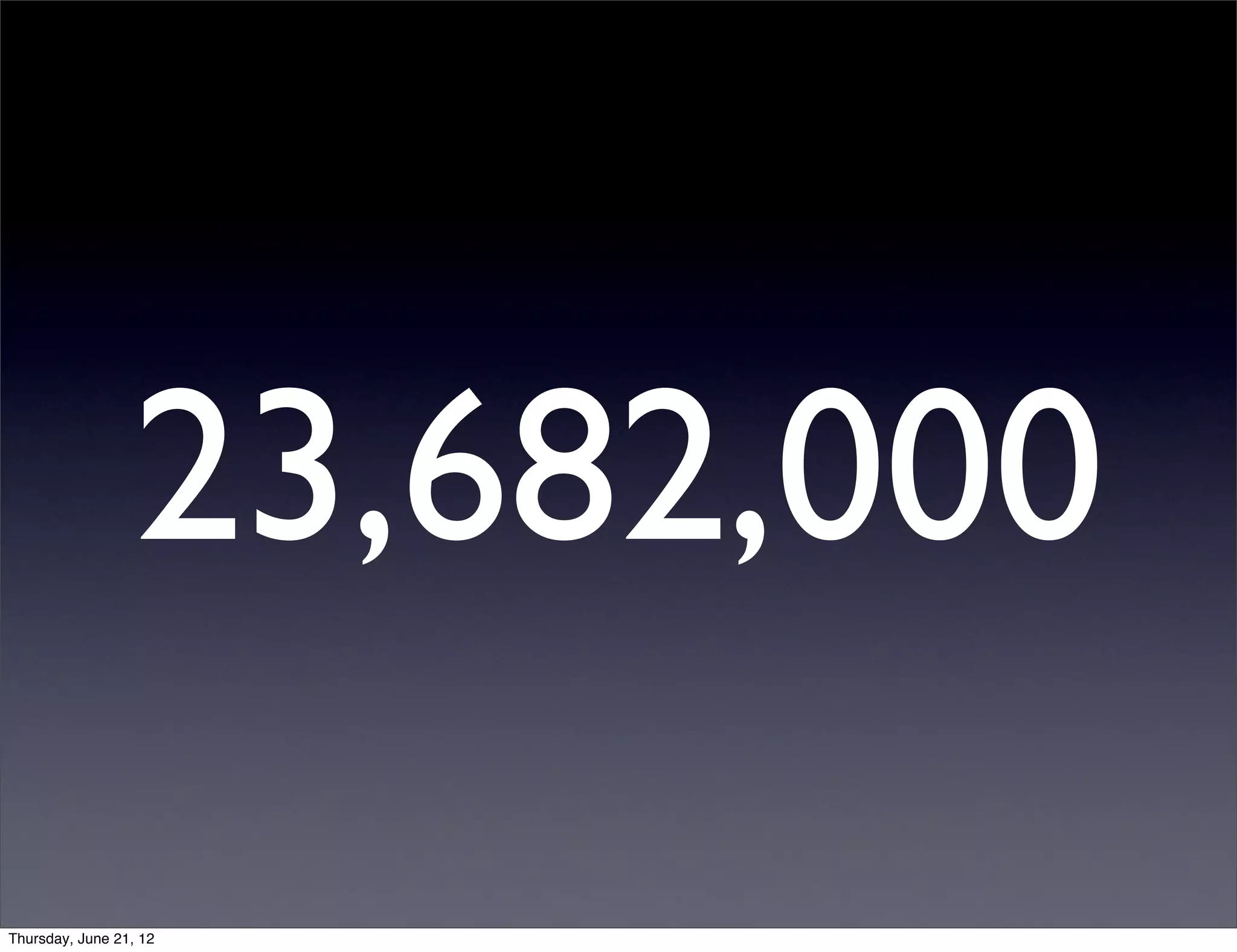
23,682,000
Thursday, June 21, 12
50
Thursday, June 21, 12
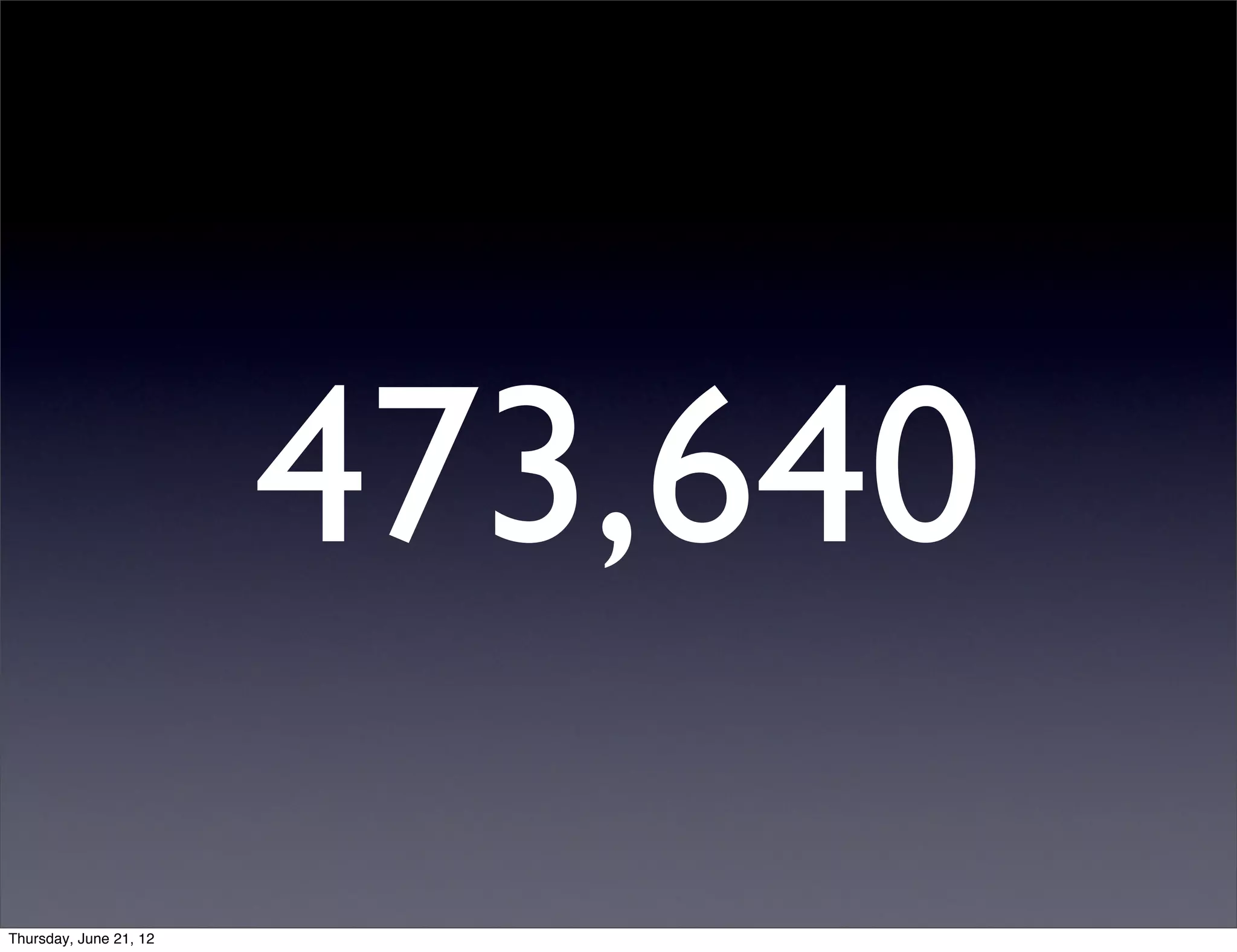
473,640
Thursday, June 21, 12
54
Thursday, June 21, 12
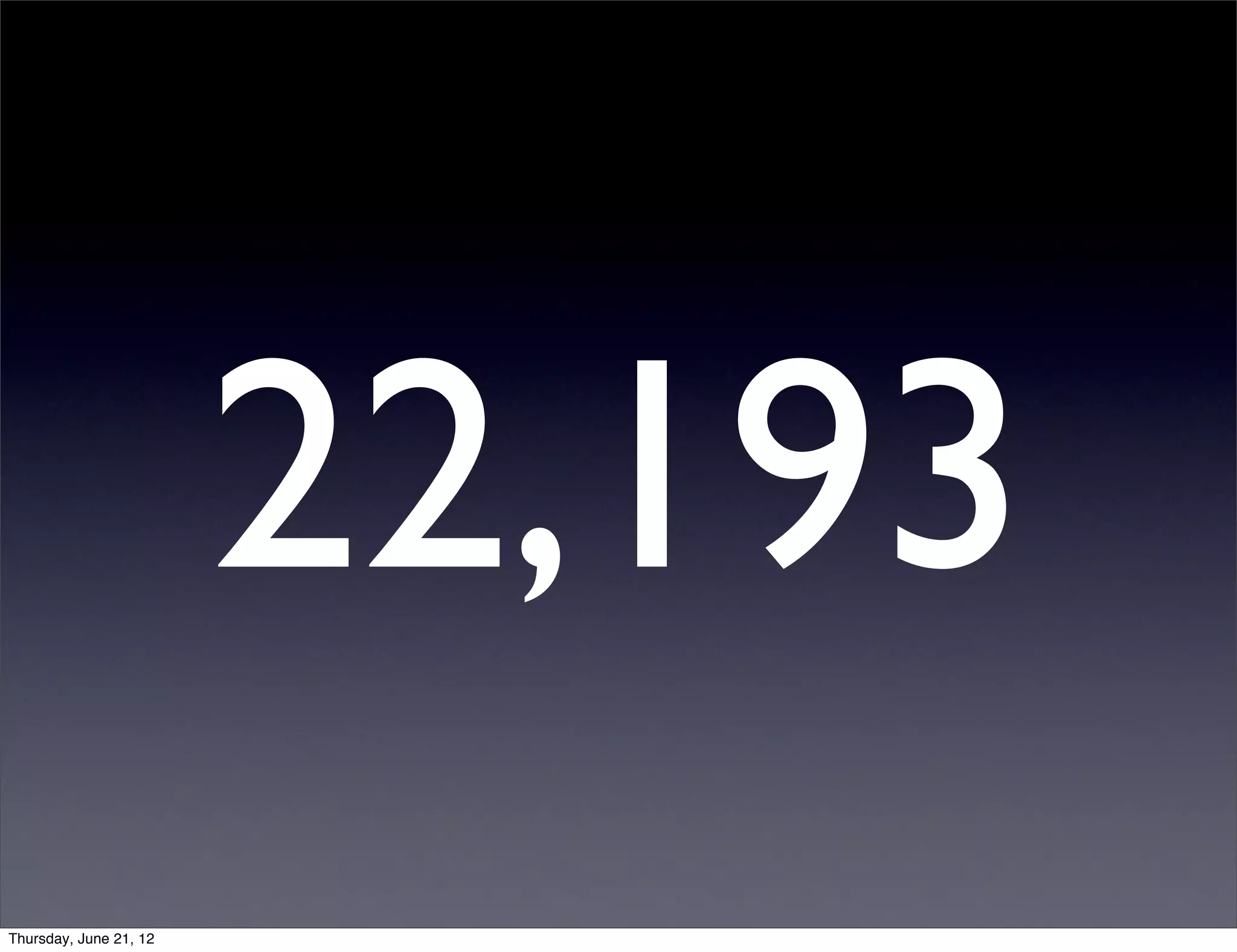
22,193
Thursday, June 21, 12
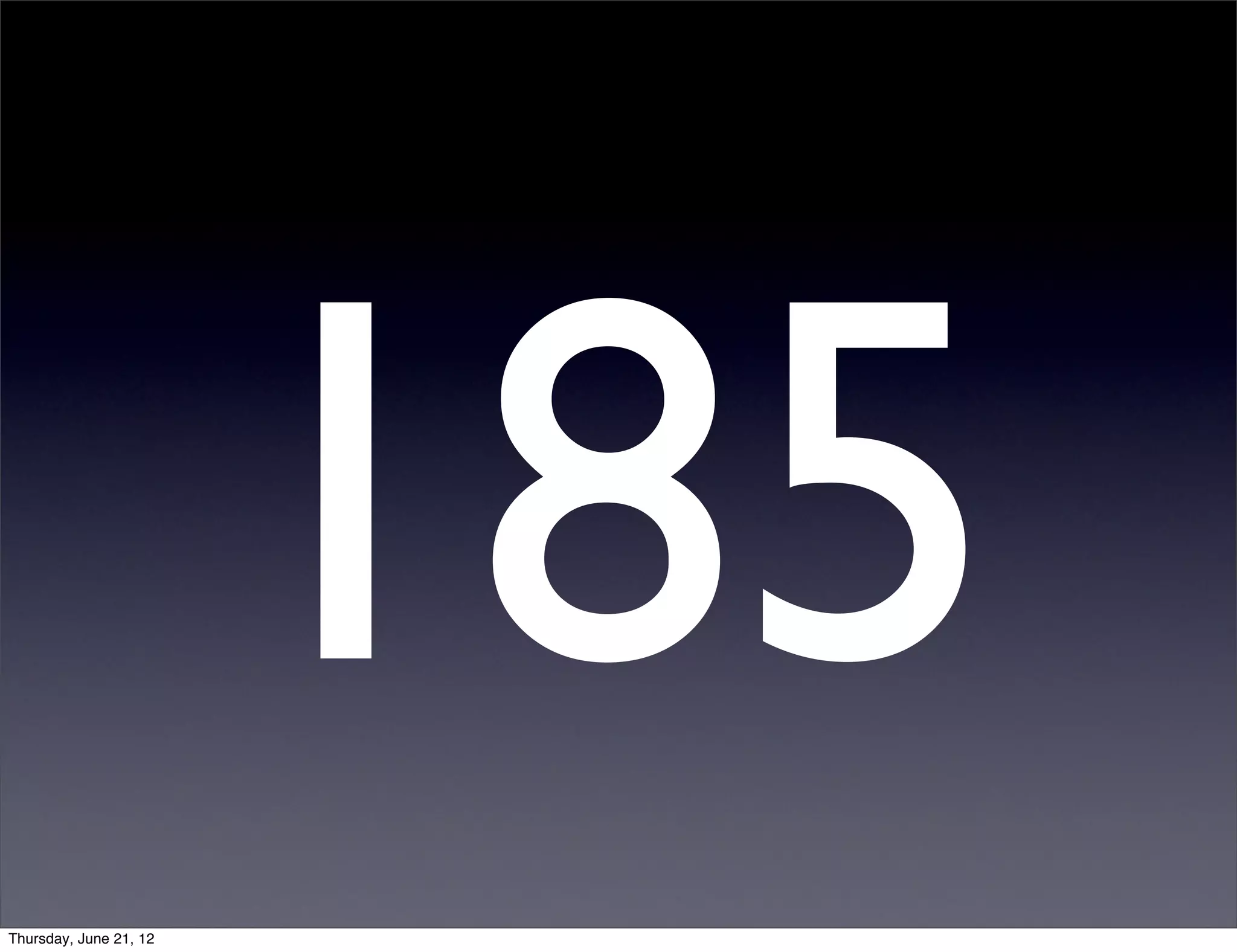
185
Thursday, June 21, 12
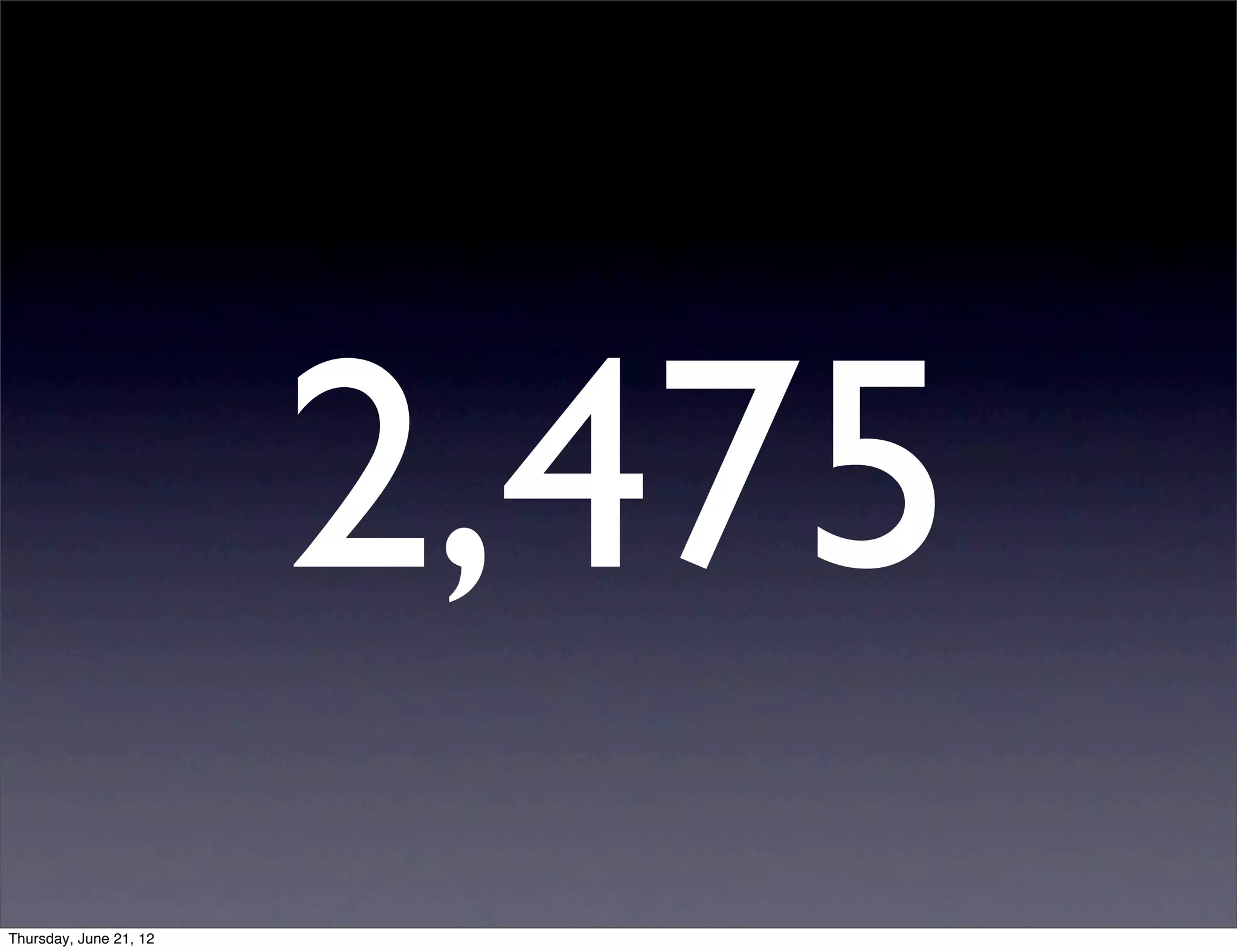
2,475
Thursday, June 21, 12
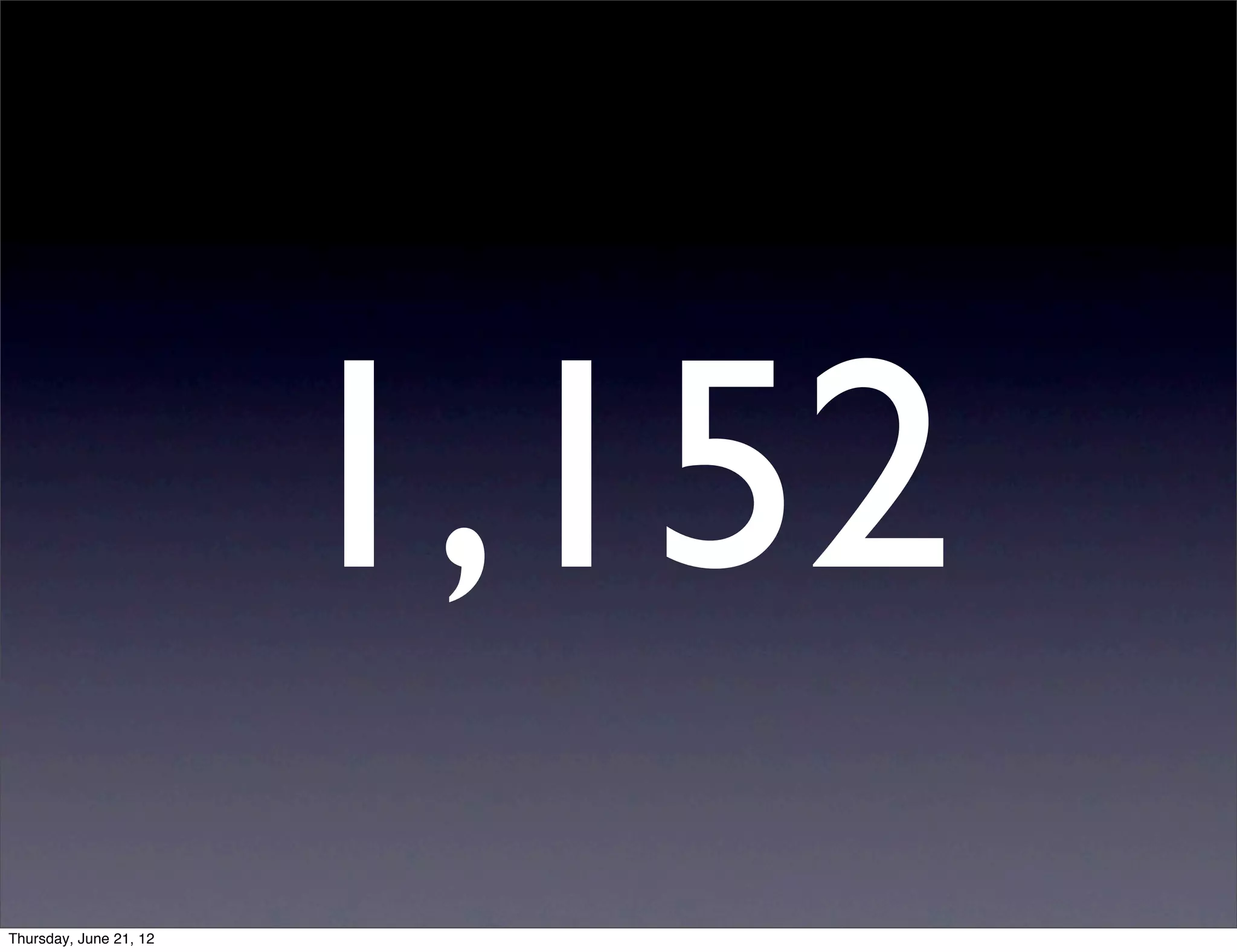
1,152
Thursday, June 21, 12
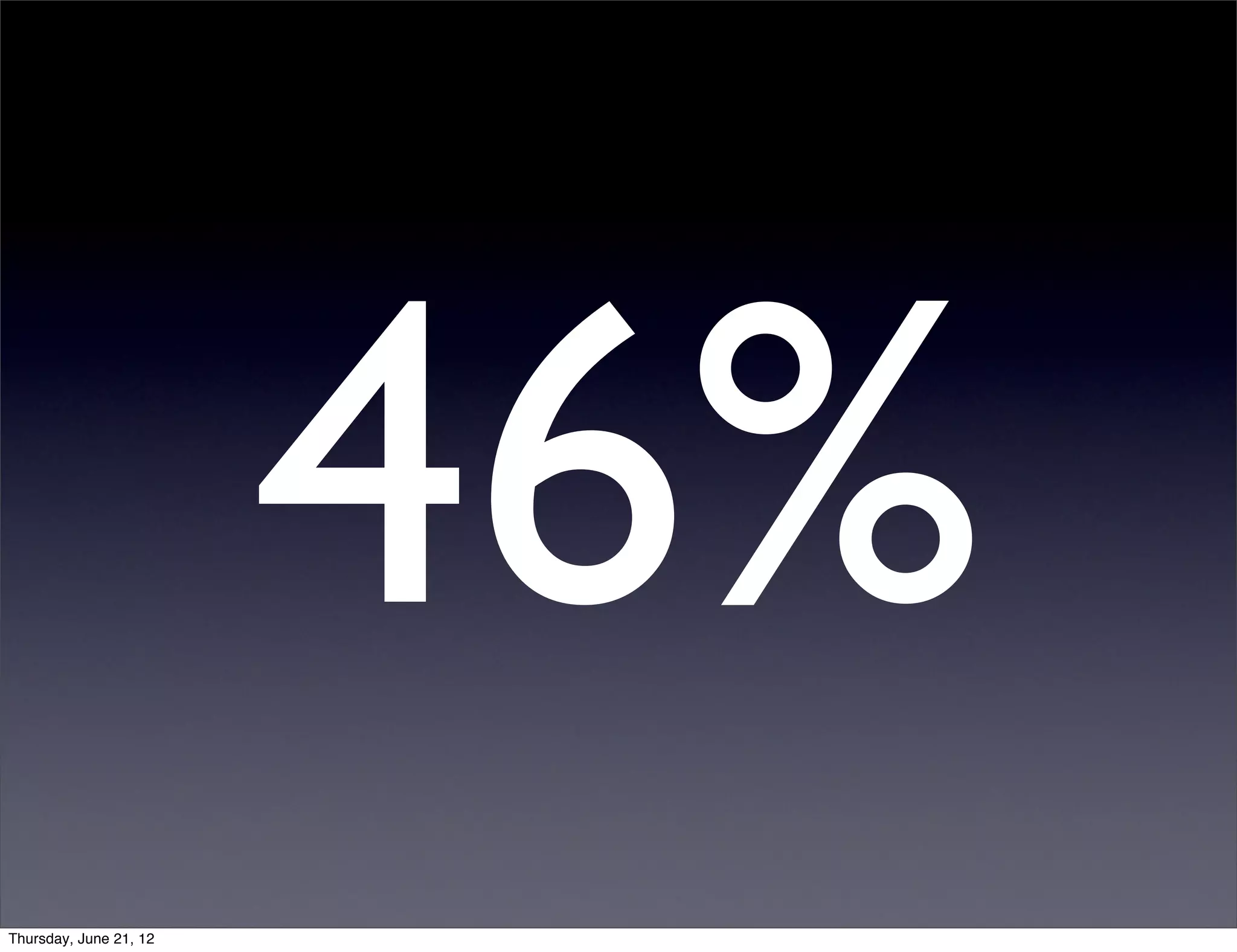
46%
Thursday, June 21, 12
5,166,000
Thursday, June 21, 12
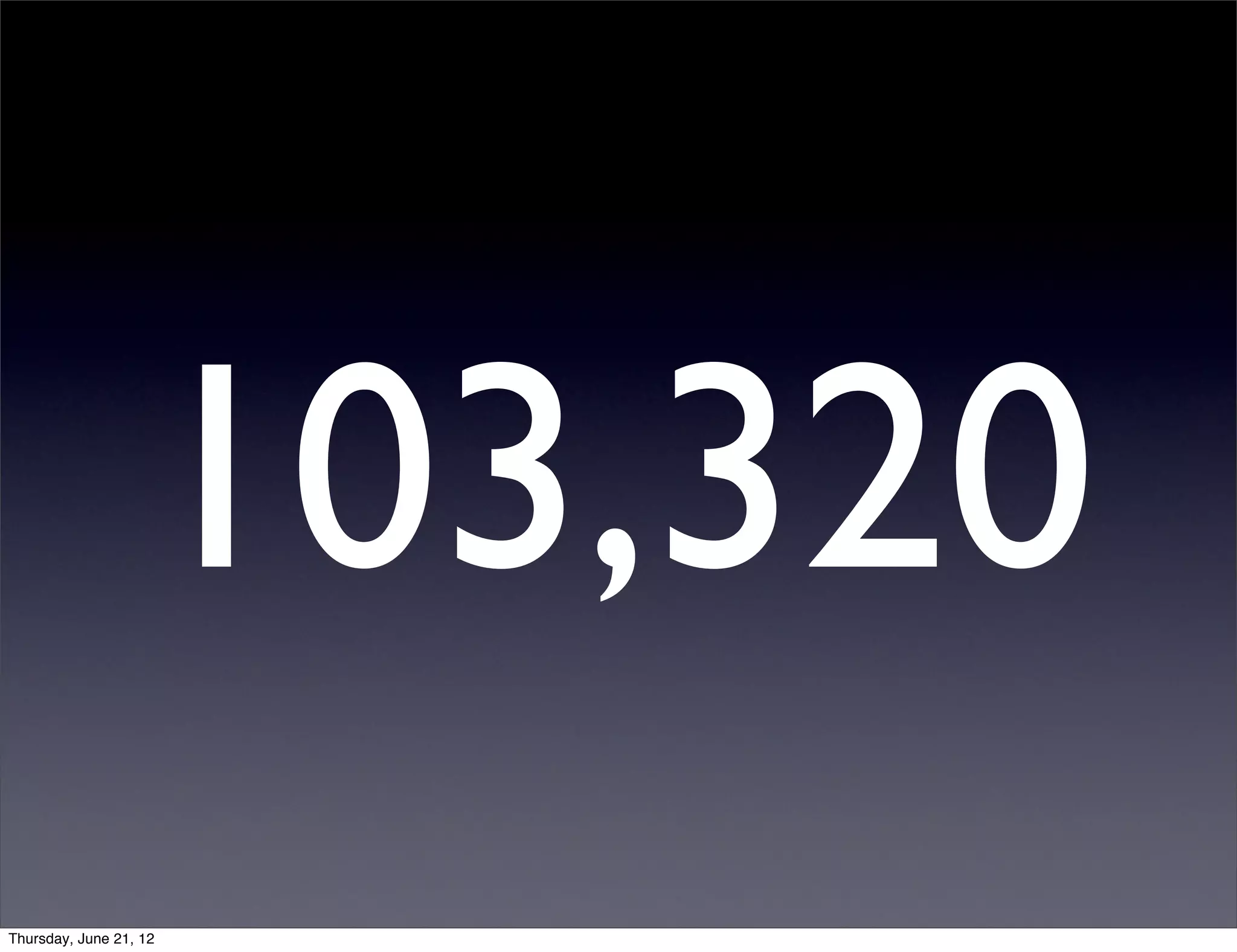
103,320
Thursday, June 21, 12
75,000
Thursday, June 21, 12
0.73


Thursday, June 21, 12
68
Thursday, June 21, 12
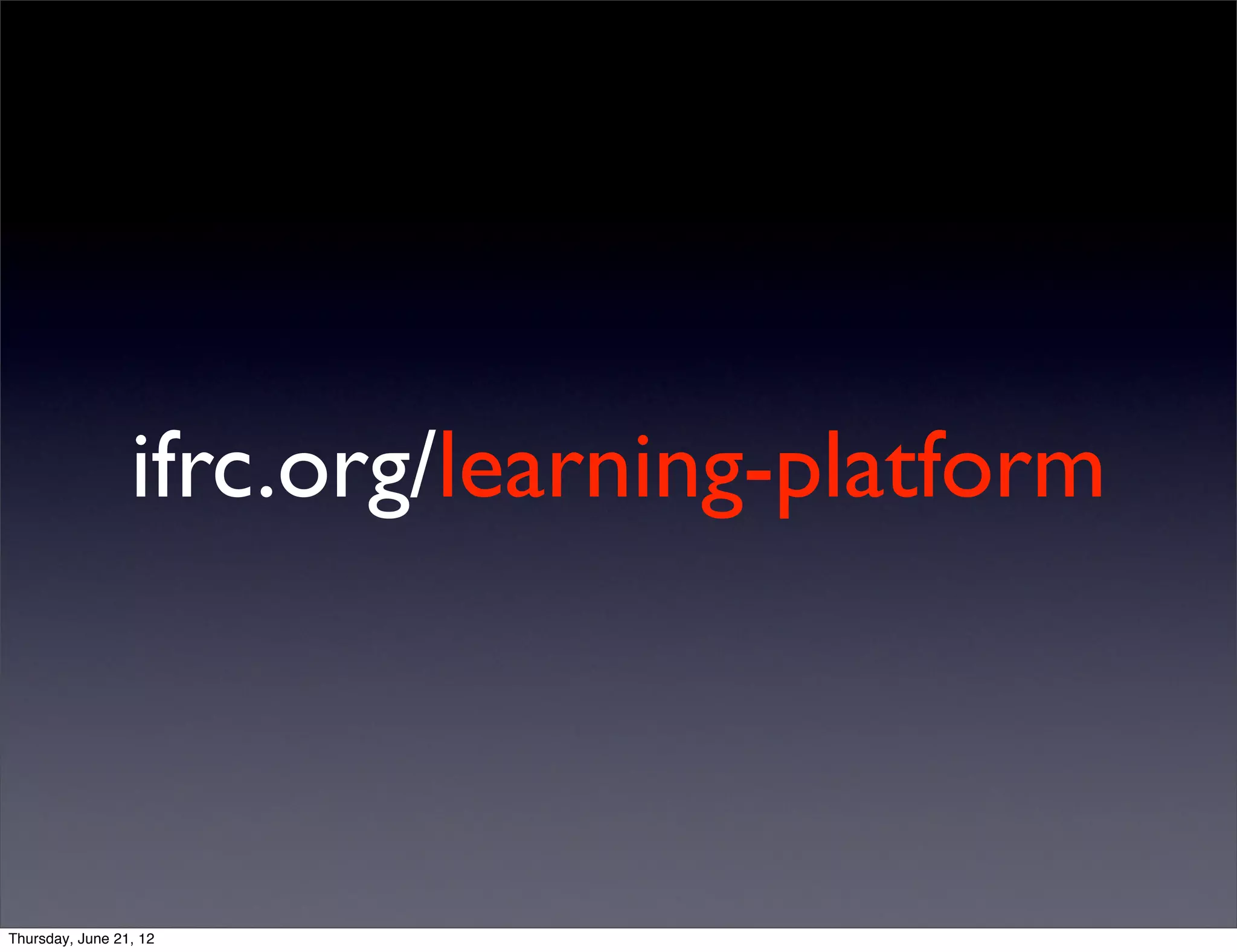
ifrc.org/learning-platform


Thursday, June 21, 12
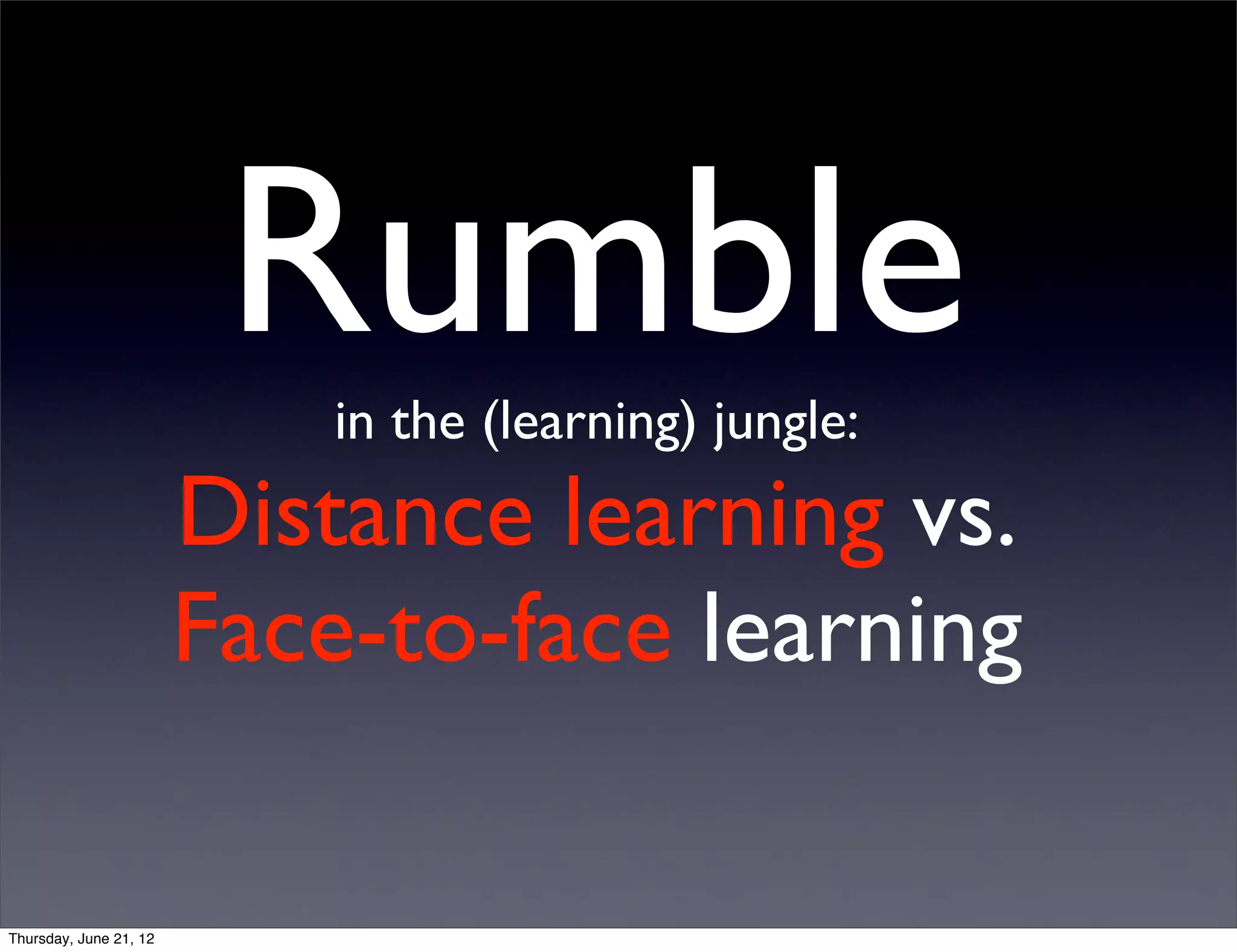
Rumble
                            in the (learning) jungle:
                        Distance learning vs.
                        Face-to-face learning

Thursday, June 21, 12
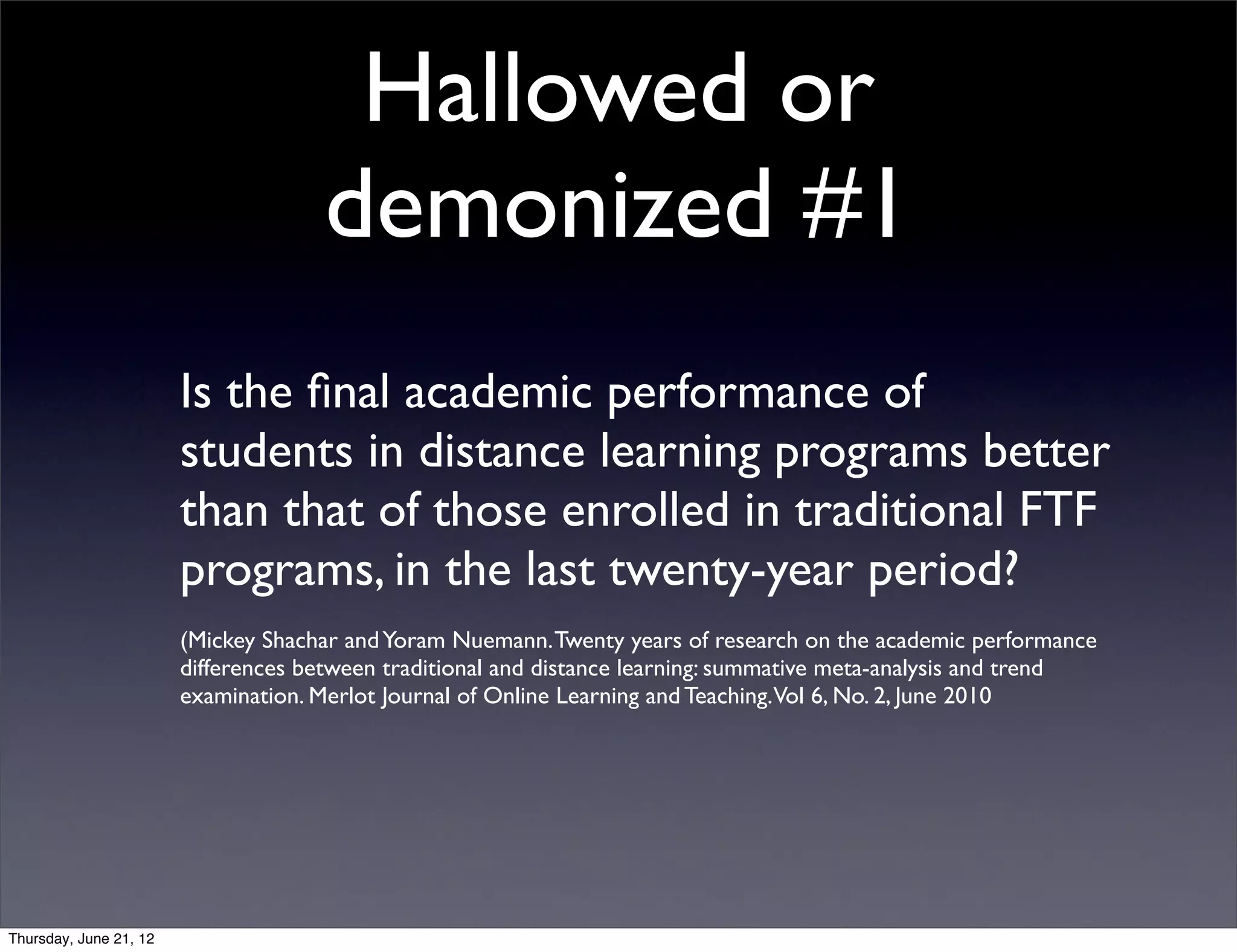
Hallowed or
                                     demonized #1
                        Is the final academic performance of
                        students in distance learning programs better
                        than that of those enrolled in traditional FTF
                        programs, in the last twenty-year period?
                        (Mickey Shachar and Yoram Nuemann. Twenty years of research on the academic performance
                        differences between traditional and distance learning: summative meta-analysis and trend
                        examination. Merlot Journal of Online Learning and Teaching.Vol 6, No. 2, June 2010


Thursday, June 21, 12
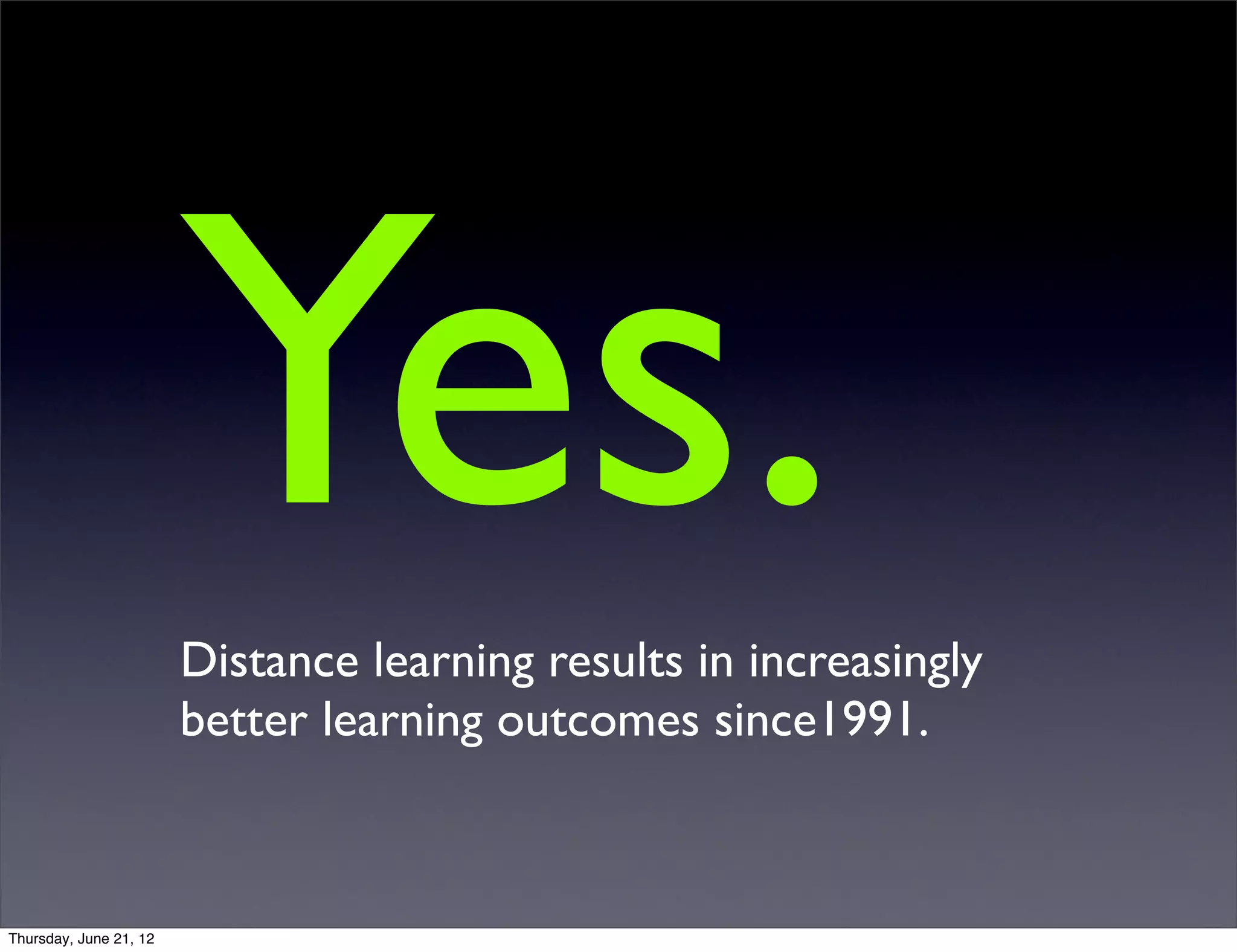
Yes.
                        Distance learning results in increasingly
                        better learning outcomes since1991.


Thursday, June 21, 12
Hallowed or
                                  demonized #2
                        Does supplementing face-to-face
                        instruction with online
                        instruction enhance learning?
                        U.S. Department of Education. Evaluation of evidence-based practices
                        in online learning: a meta-analysis and review of online learning
                        studies. September 2010.


Thursday, June 21, 12
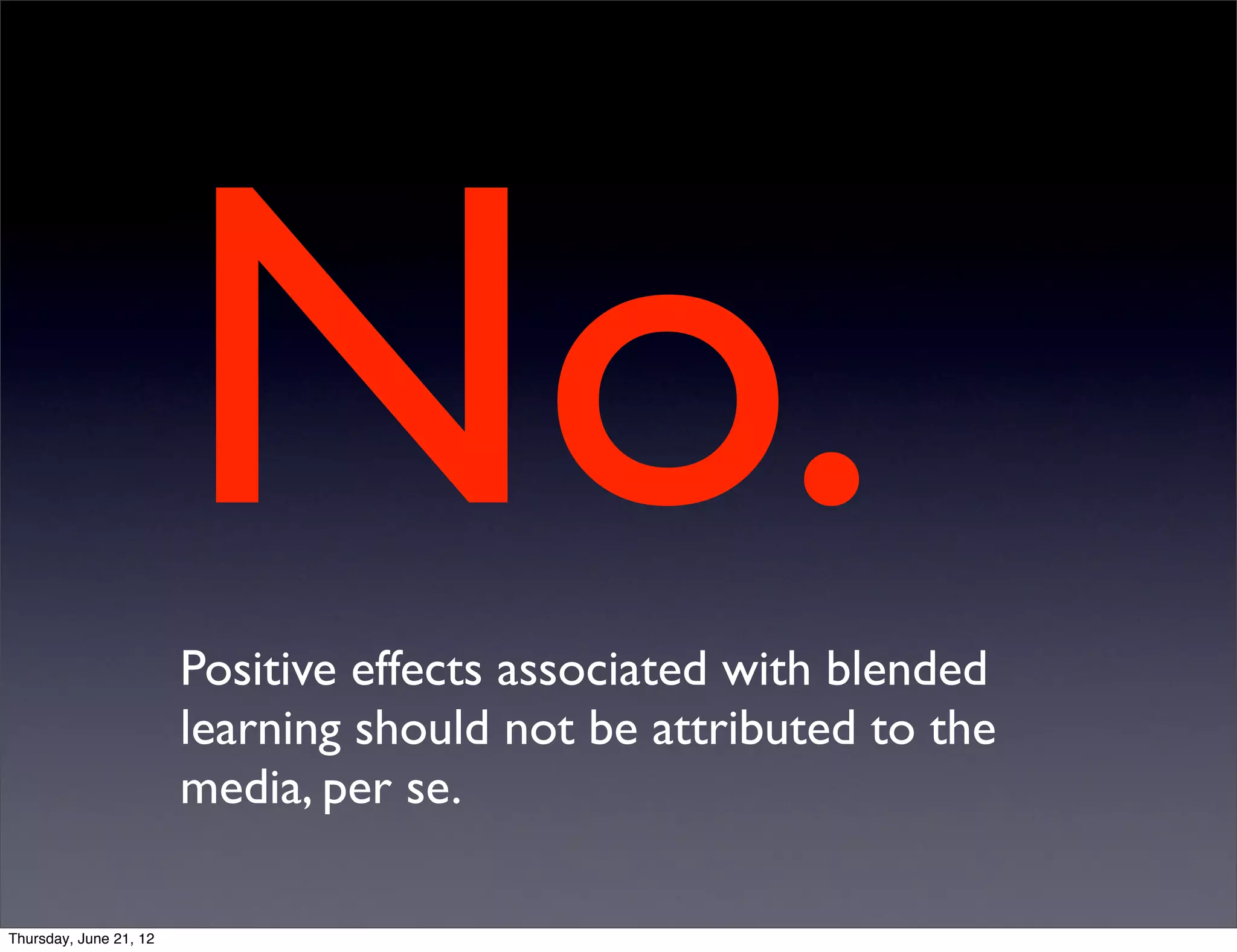
No.
                        Positive effects associated with blended
                        learning should not be attributed to the
                        media, per se.

Thursday, June 21, 12
ifrc.org/learning-platform


Thursday, June 21, 12
Building online learning
                 for the Red Cross Red Crescent


Thursday, June 21, 12
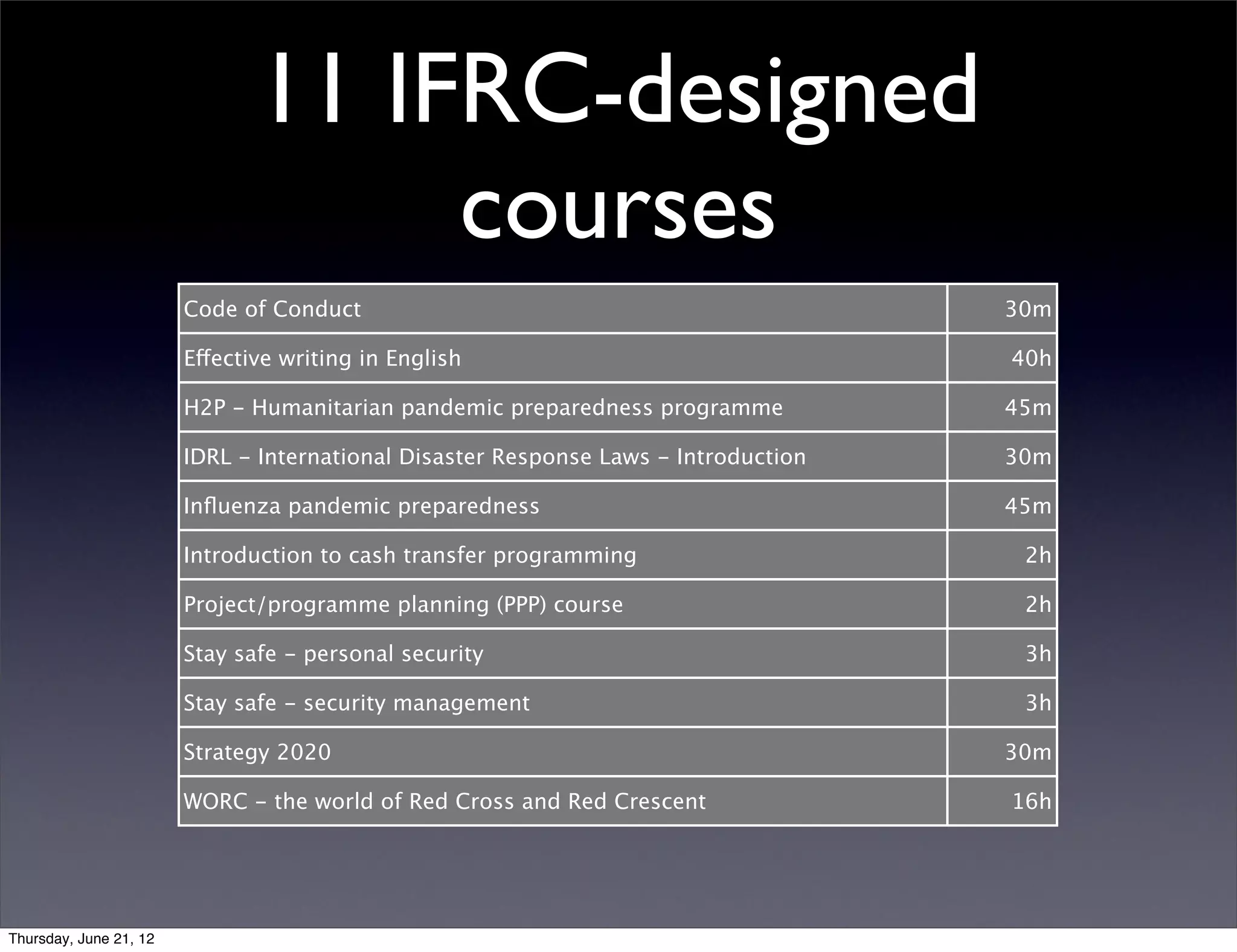
11 IFRC-designed
                                    courses
                        Code of Conduct                                              30m

                        Effective writing in English                                 40h

                        H2P - Humanitarian pandemic preparedness programme           45m

                        IDRL - International Disaster Response Laws - Introduction   30m

                        Influenza pandemic preparedness                               45m

                        Introduction to cash transfer programming                     2h

                        Project/programme planning (PPP) course                       2h

                        Stay safe - personal security                                 3h

                        Stay safe - security management                               3h

                        Strategy 2020                                                30m

                        WORC - the world of Red Cross and Red Crescent               16h


Thursday, June 21, 12
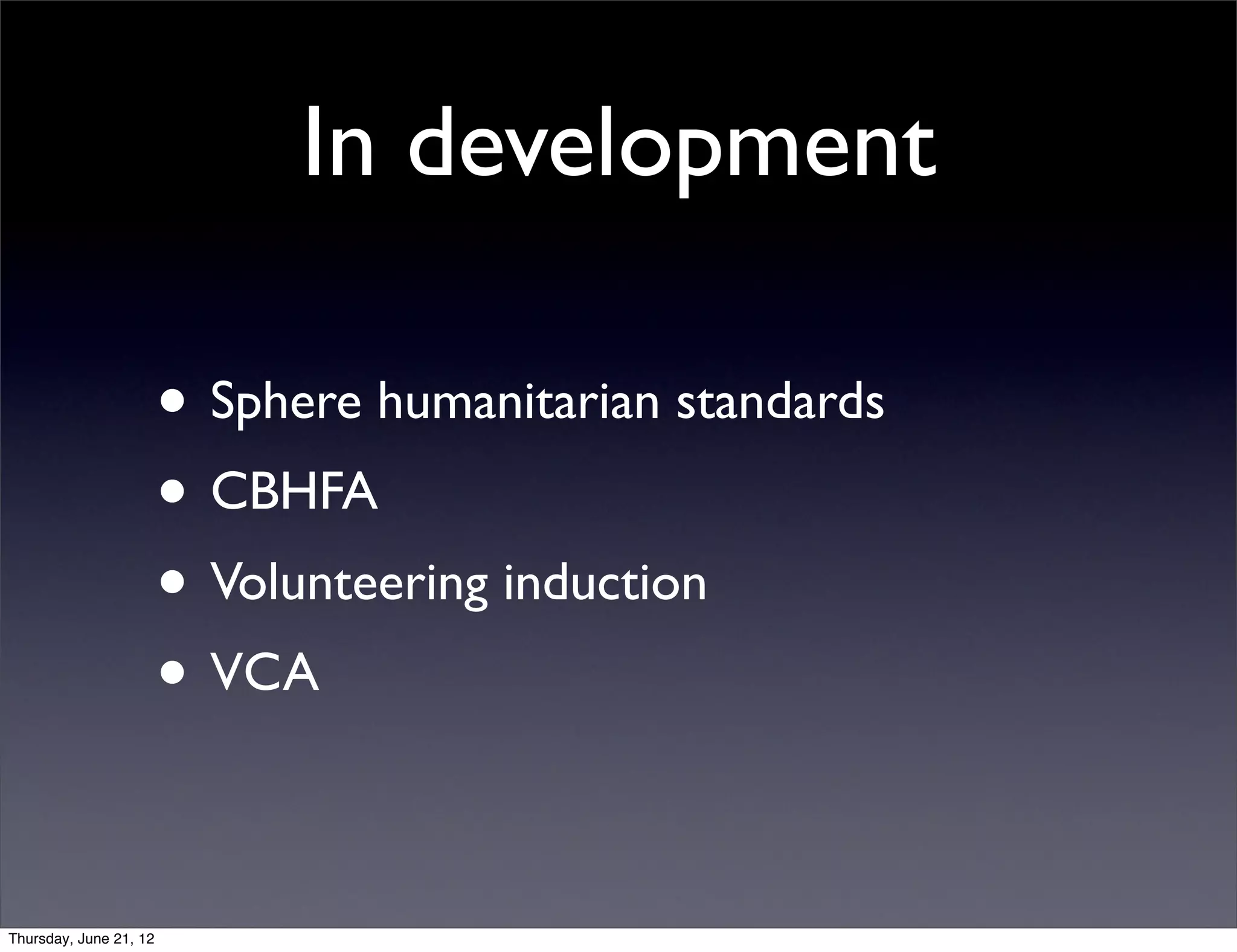
In development

                        • Sphere humanitarian standards
                        • CBHFA
                        • Volunteering induction
                        • VCA

Thursday, June 21, 12
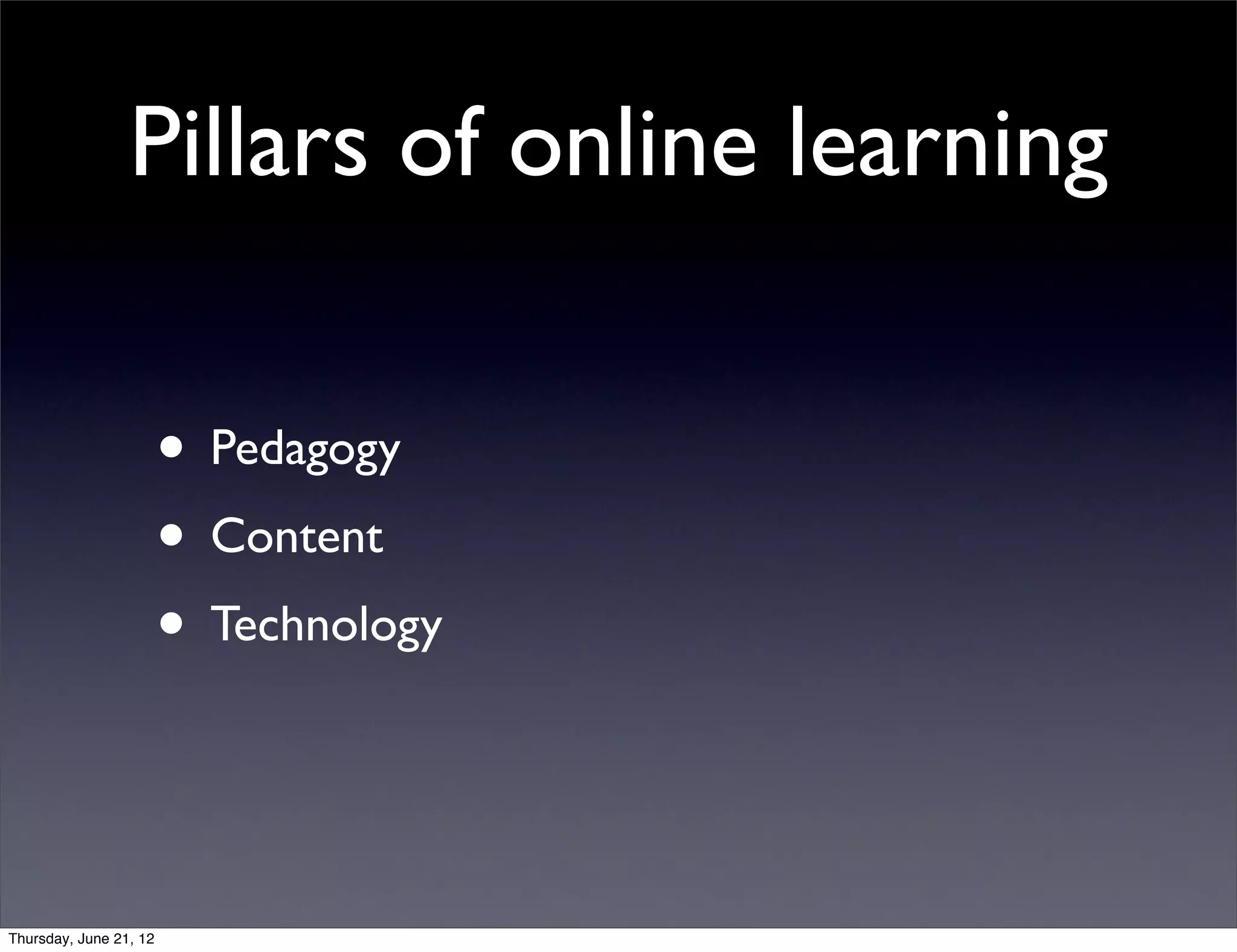
Pillars of online learning

                        • Pedagogy
                        • Content
                        • Technology


Thursday, June 21, 12
A Red Cross
                  Red Crescent pedagogy?
                        • Learning continuum (academic partnerships)
                        • Global learning (“productive diversity”)
                        • Informal learning
                        • Experience-based knowledge transmission
                        • Social network dependent
                        • Research and learning agenda
Thursday, June 21, 12
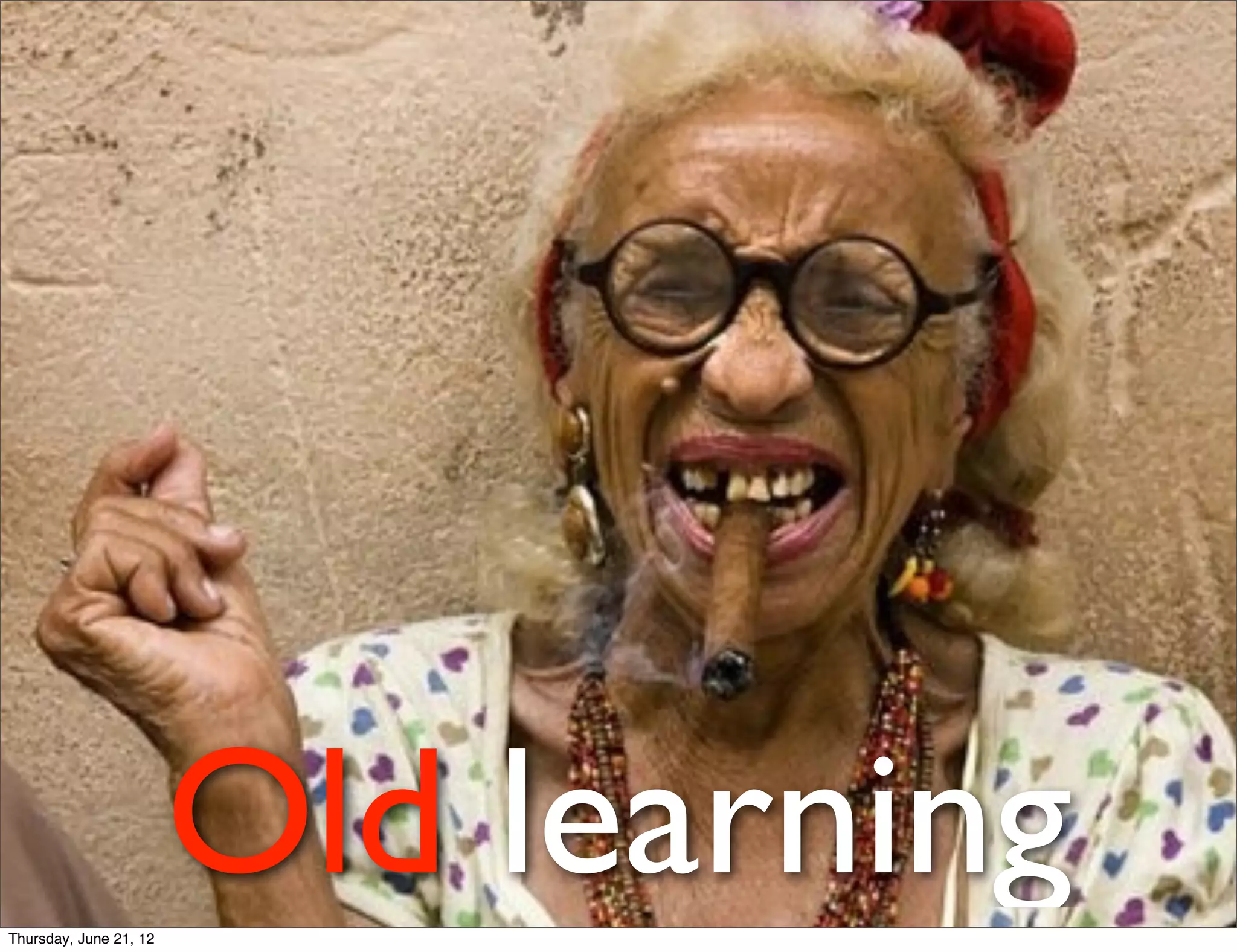
                        Old learning
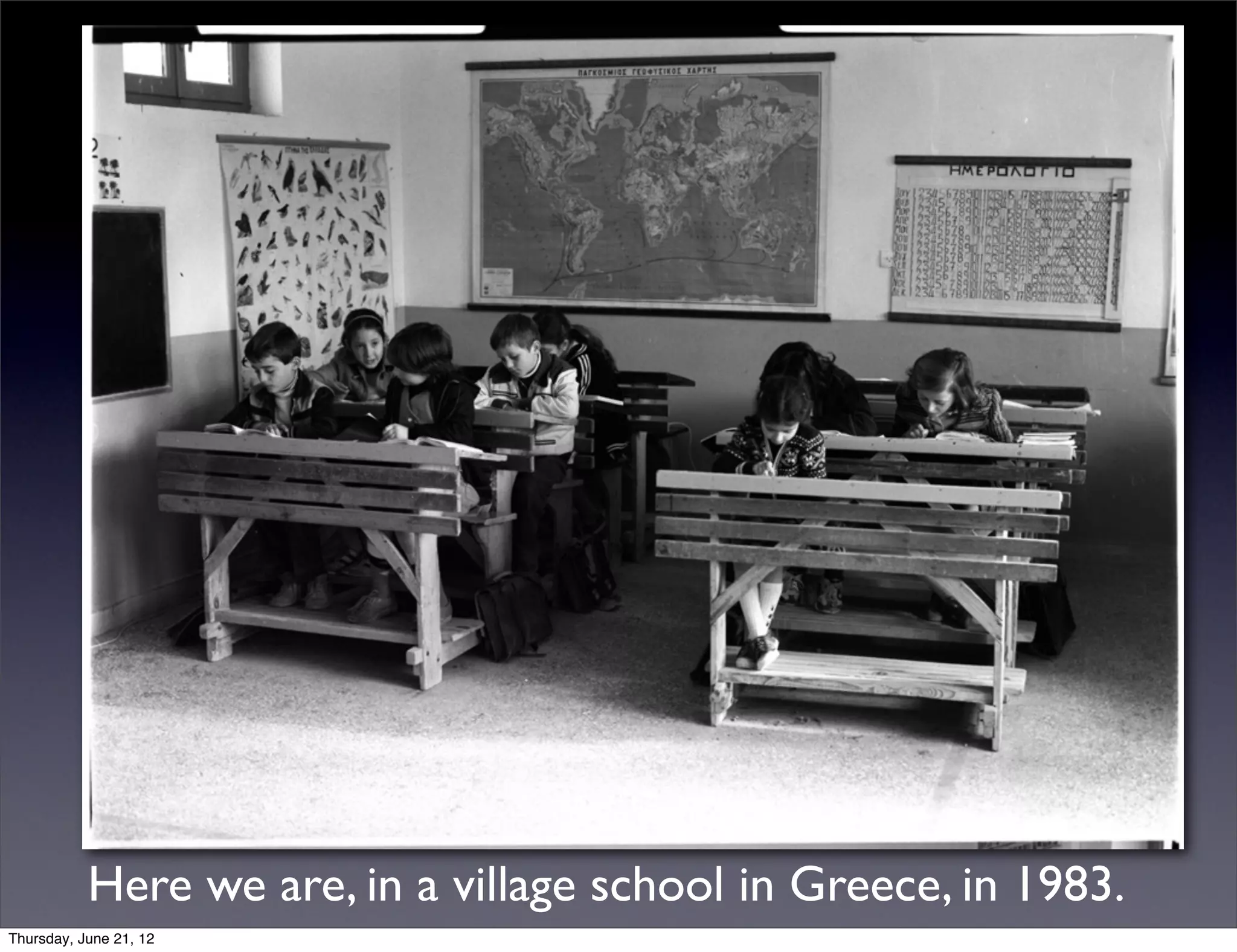
Here we are, in a village school in Greece, in 1983.
Thursday, June 21, 12
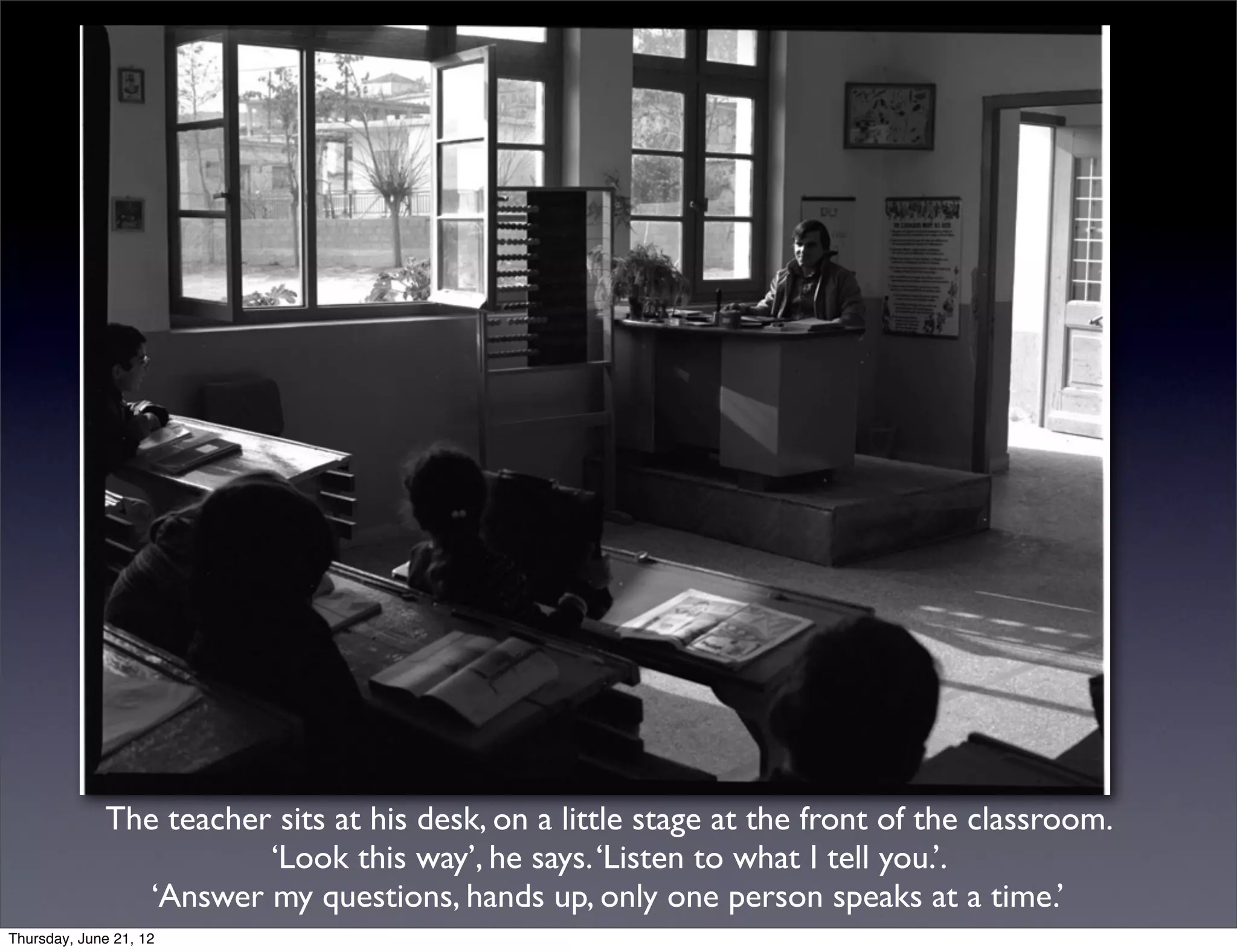
The teacher sits at his desk, on a little stage at the front of the classroom.
                        ‘Look this way’, he says. ‘Listen to what I tell you.’.
                ‘Answer my questions, hands up, only one person speaks at a time.’
Thursday, June 21, 12
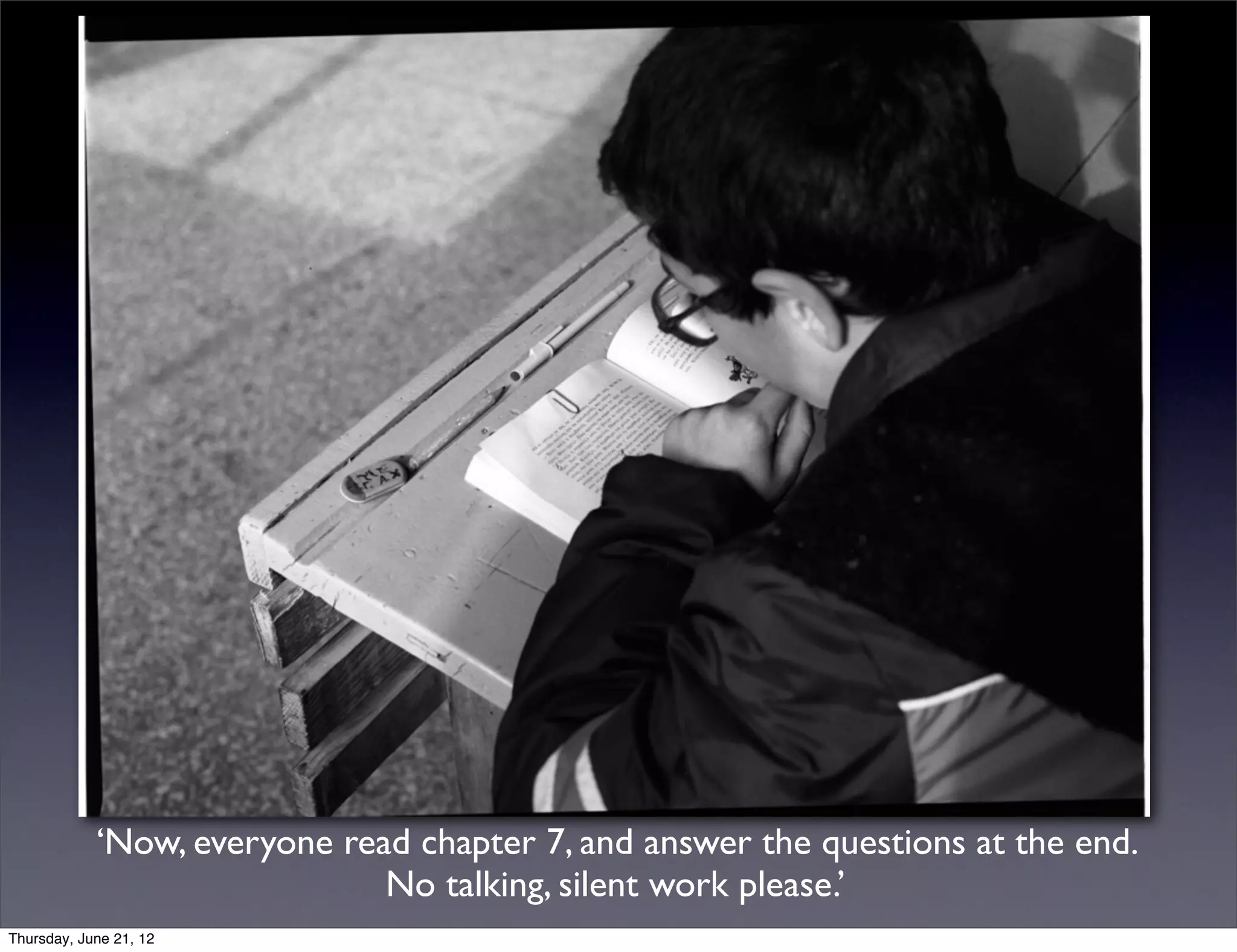
‘Now, everyone read chapter 7, and answer the questions at the end.
                              No talking, silent work please.’
Thursday, June 21, 12
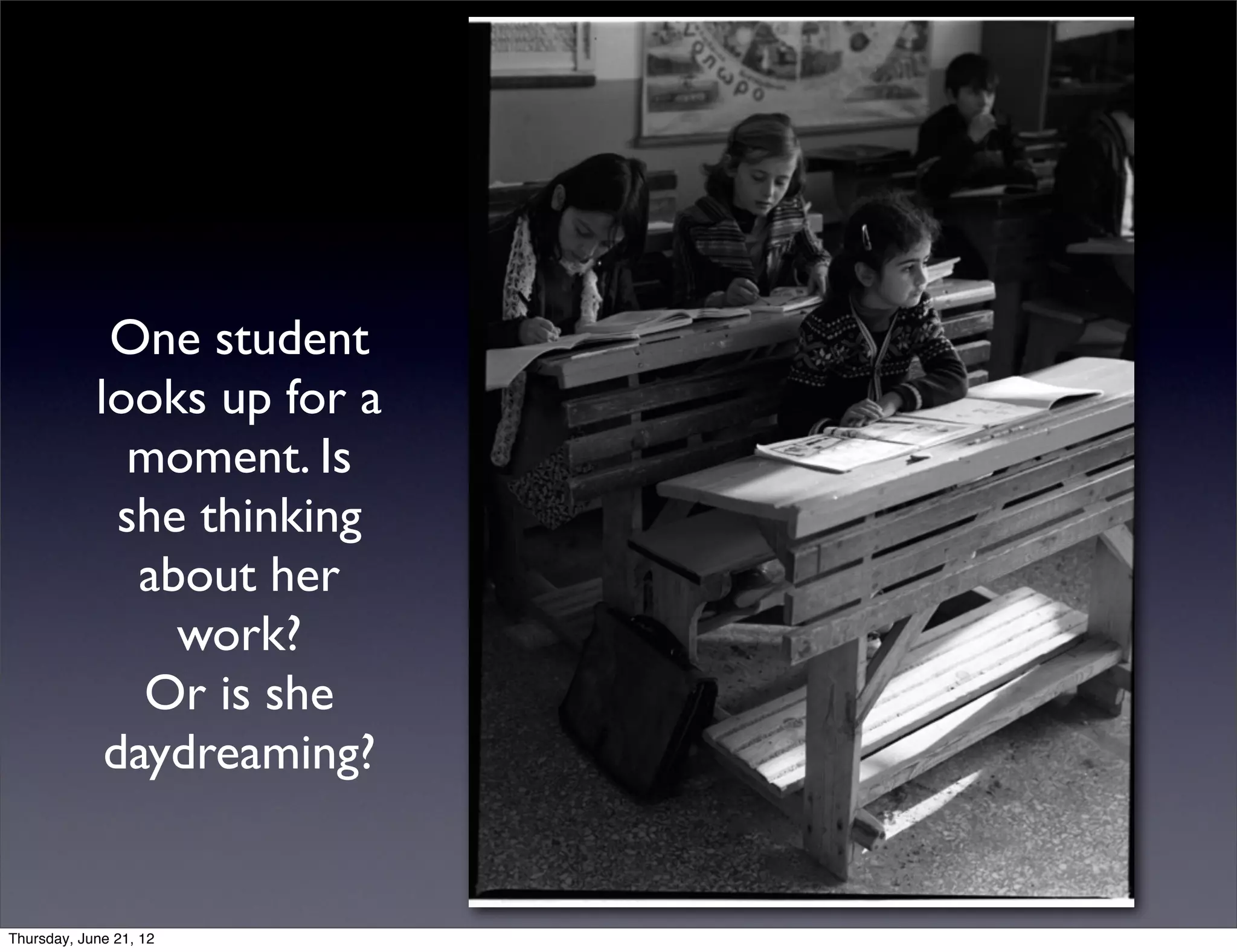
One student
            looks up for a
              moment. Is
              she thinking
               about her
                 work?
               Or is she
             daydreaming?


Thursday, June 21, 12
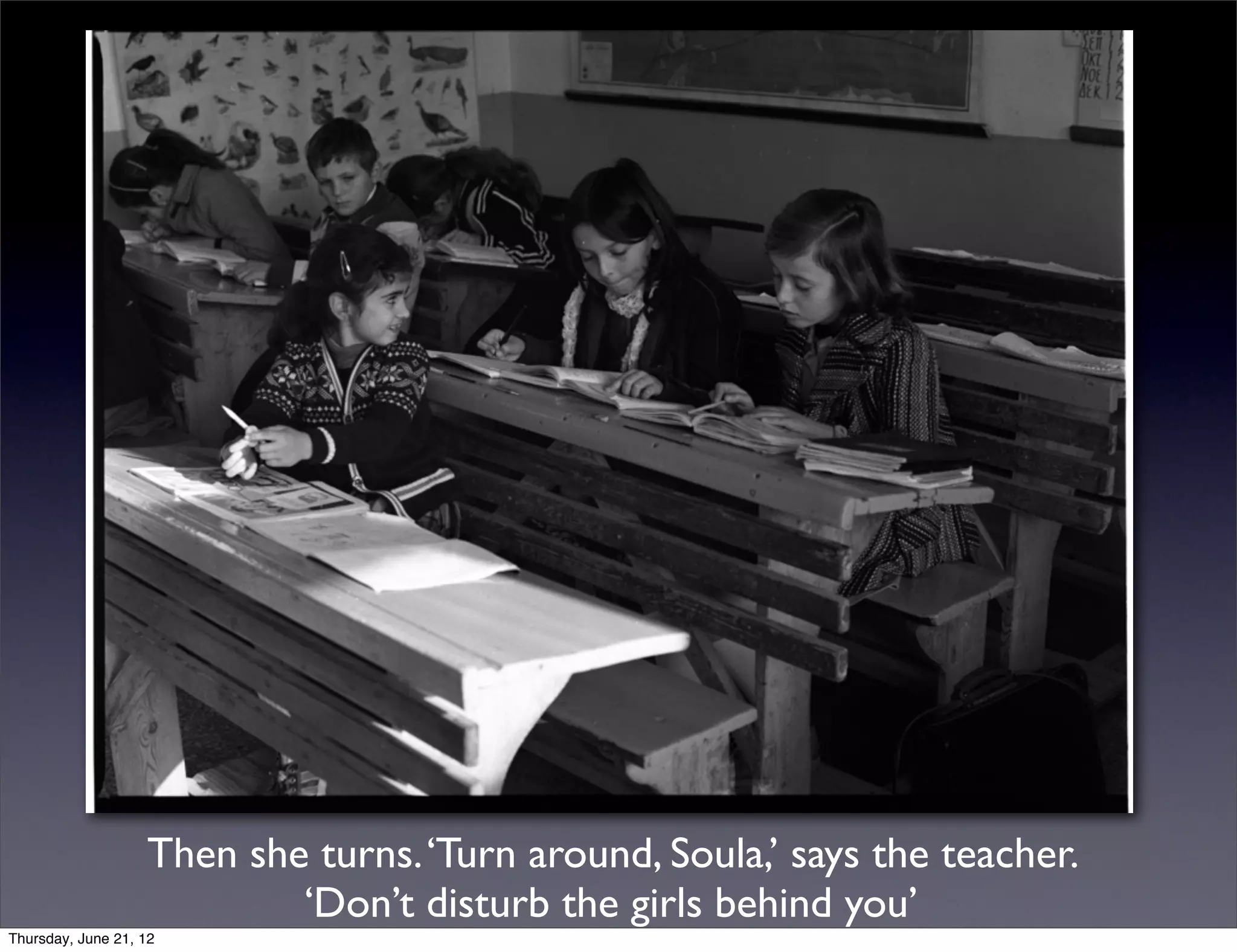
Then she turns. ‘Turn around, Soula,’ says the teacher.
                           ‘Don’t disturb the girls behind you’
Thursday, June 21, 12
The classroom is a communications and
                knowledge architecture.
                Here is the pedagogical design of this
                classroom in Greece in 1983, and tens of
                thousands others like it before and since:

        Some typical discursive flows:
        ✓Teacher talks -> students listen.
        ✓Teacher Q. -> students A. (‘hands up!’, ‘one at a time!’).
        ✓Teacher says ‘read chapter 7’ -> students read and
         memorize.
        ✓Teacher sets test -> students respond with correctly
         memorized answers.


Thursday, June 21, 12
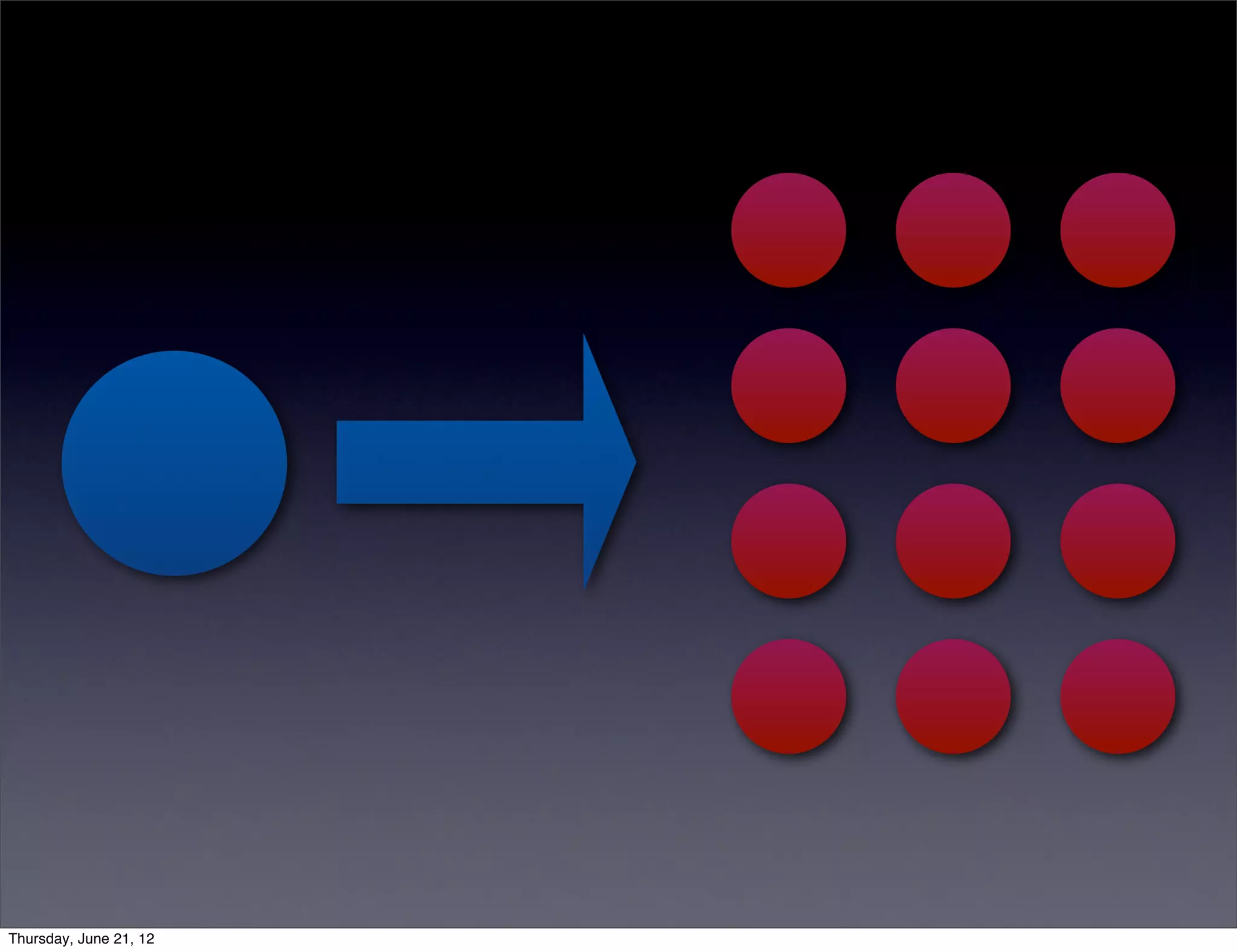
Here, by contrast is the communication and
           knowledge architecture of the online classroom
           we want.

      Some typical discursive flows:
      • Teacher scaffolds peer <-> peer feedback.
      • All students involved simultaneously in constructive
        peer <-> peer learning dialogue.
      • An active, knowledge producing community.
      • Continuous formative assessment, supplementing
        teacher assessments with structured self and peer
        assessments.


Thursday, June 21, 12
Online learning changes role of the teacher
              and the responsibilities of learners.

                  Teaching and learning will never be the
                               same again.


                        But how?
Thursday, June 21, 12
What
                        do we want?

Thursday, June 21, 12
Collaborative
                        Learners create together, giving each other
                        feedback (and even feedback on feedback),
                        sharing their inspirations and discoveries.
                        Within their knowledge communities,
                        learners are connected through individual
                        learner profiles.


Thursday, June 21, 12
Flexible
                        Learners work at their own pace, according
                        to their own interests and capabilities, while
                        teachers track their progress easily through
                        multiple views and match progress against
                        learning standards.


Thursday, June 21, 12
Motivating
                        Learners are inspired to create through
                        embedding sound, image, and video within
                        their texts for digital storytelling, lab reports
                        with recorded experiments, local oral history
                        projects, and more. They receive immediate
                        feedback from other learners and from a
                        range of computer-assisted tools in time to
                        improve their work. Learner successes are
                        shared with classmates, parents, and other
                        classes in a web portfolio.
Thursday, June 21, 12
Participatory
                        Learners can join and lead project groups,
                        post and share files, and start and engage in
                        discussions at the assignment- and
                        knowledge community-levels.


Thursday, June 21, 12
Supportive
                        Learners have access to tools that not only
                        help them to improve their work, but also
                        their knowledge of the writing process and
                        mastery of written forms, from grammar to
                        structure to genre, within English Language
                        Arts and across other disciplines that require
                        extended written or multimedia reports,
                        such as Science and Social Studies.


Thursday, June 21, 12
Assessment
                        A rich learning information environment,
                        supporting:
                • diagnostic assessment – finding out
                        what students already know and still need to
                        learn
                • formative assessment – rich, rapidly
                        responsive feedback that directly supports
                        student learning


Thursday, June 21, 12
Learning should be:

                    • Collaborative
                    • Flexible
                    • Motivating
                    • Participatory
                    • Supportive

Thursday, June 21, 12
Why
                    do we want it?
Thursday, June 21, 12
a time of disruptive change
                    ...in society, education


Thursday, June 21, 12
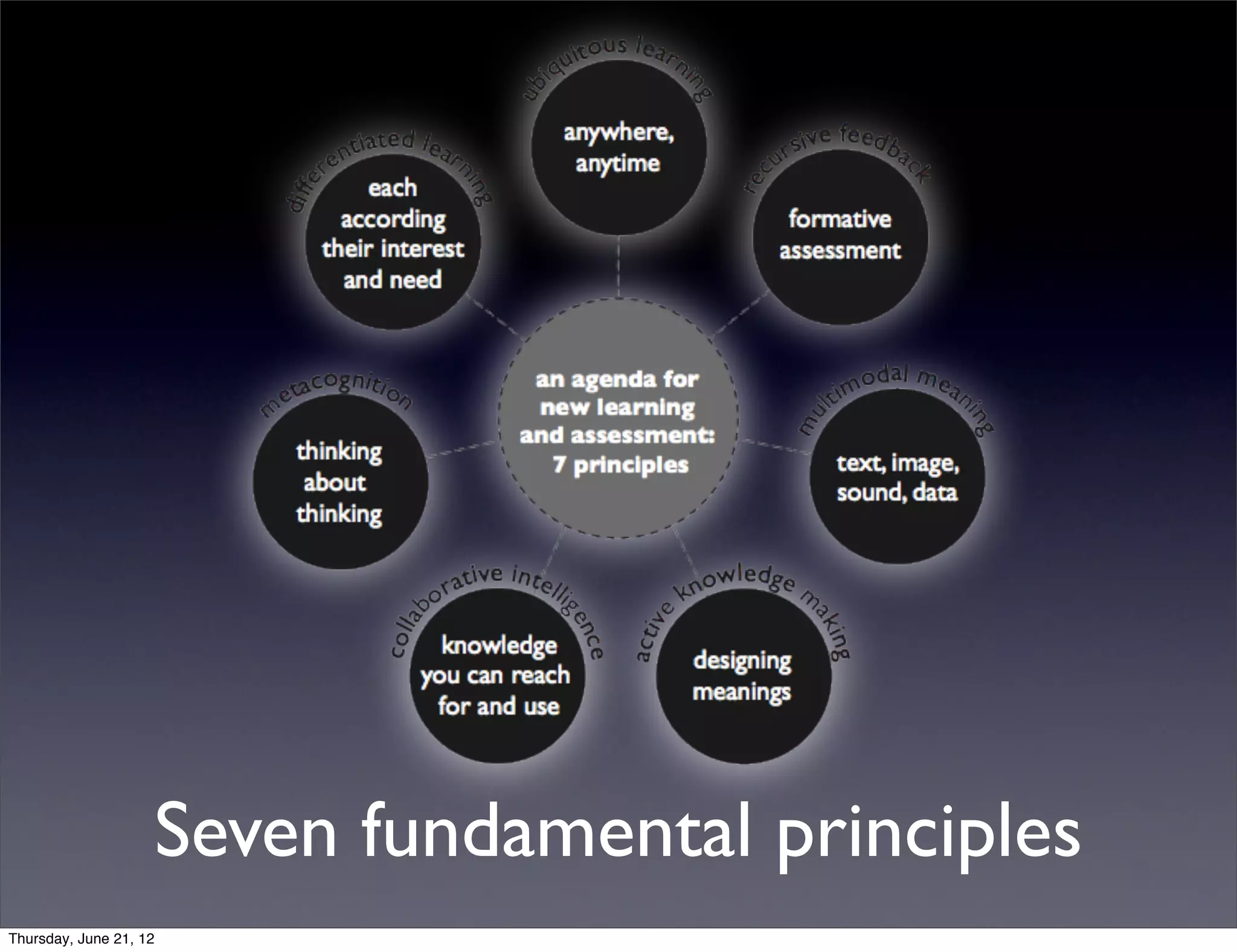
Seven fundamental principles
Thursday, June 21, 12
1.Ubiquitous learning

                        • students using social media, Web. 2.0
                        • learn anywhere, anytime
                        • cloud computing


Thursday, June 21, 12
2. Recursive feedback


                        • recursive feedback
                        • “Work and dialogue about the work”


Thursday, June 21, 12
Feedback tools

                        • Review (against a rubric)
                        • Annotations (in-text commentary)
                        • Checker (by the software, natural language
                          processing)
                        • Survey (knowledge assessments)

Thursday, June 21, 12
3. Multimodal meaning


                        • adding image, video, audio and any other
                          datafile
                        • a fully multimodal workspace


Thursday, June 21, 12
4. Active knowledge
                                 making

                        • students as knowledge makers,
                        • not just knowledge consumers
                        • supplementing heritage hierarchical
                          knowledge flows with lateral knowledge
                          flows


Thursday, June 21, 12
Balance of agency shifts

                        • readers <=> writers (e.g. in the social
                          media)
                        • producers <=> consumers (e.g.
                          ‘prosumers’)


Thursday, June 21, 12
5. Collaborative
                           intelligence


Thursday, June 21, 12
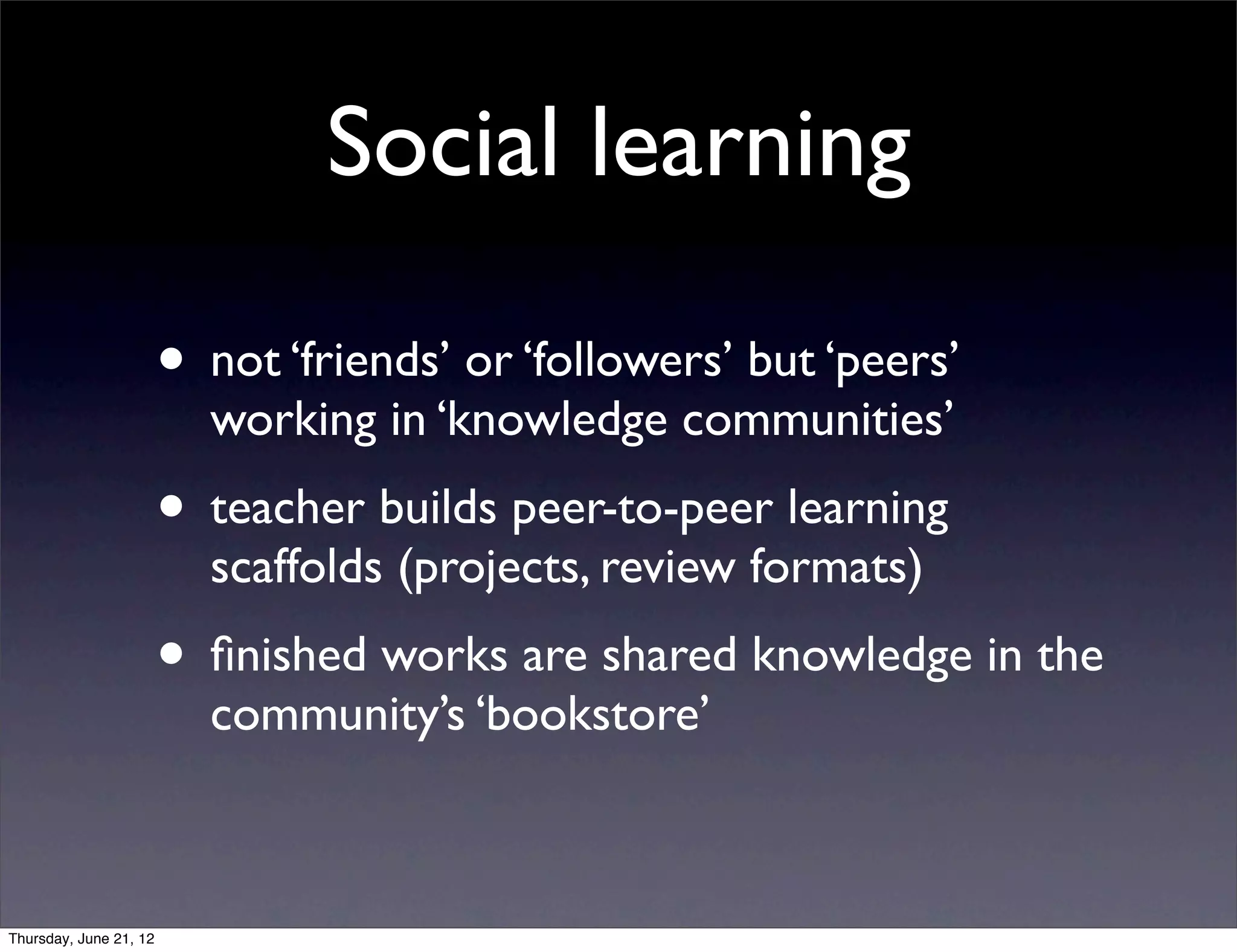
Social learning

                        • not ‘friends’ or ‘followers’ but ‘peers’
                          working in ‘knowledge communities’
                        • teacher builds peer-to-peer learning
                          scaffolds (projects, review formats)
                        • finished works are shared knowledge in the
                          community’s ‘bookstore’


Thursday, June 21, 12
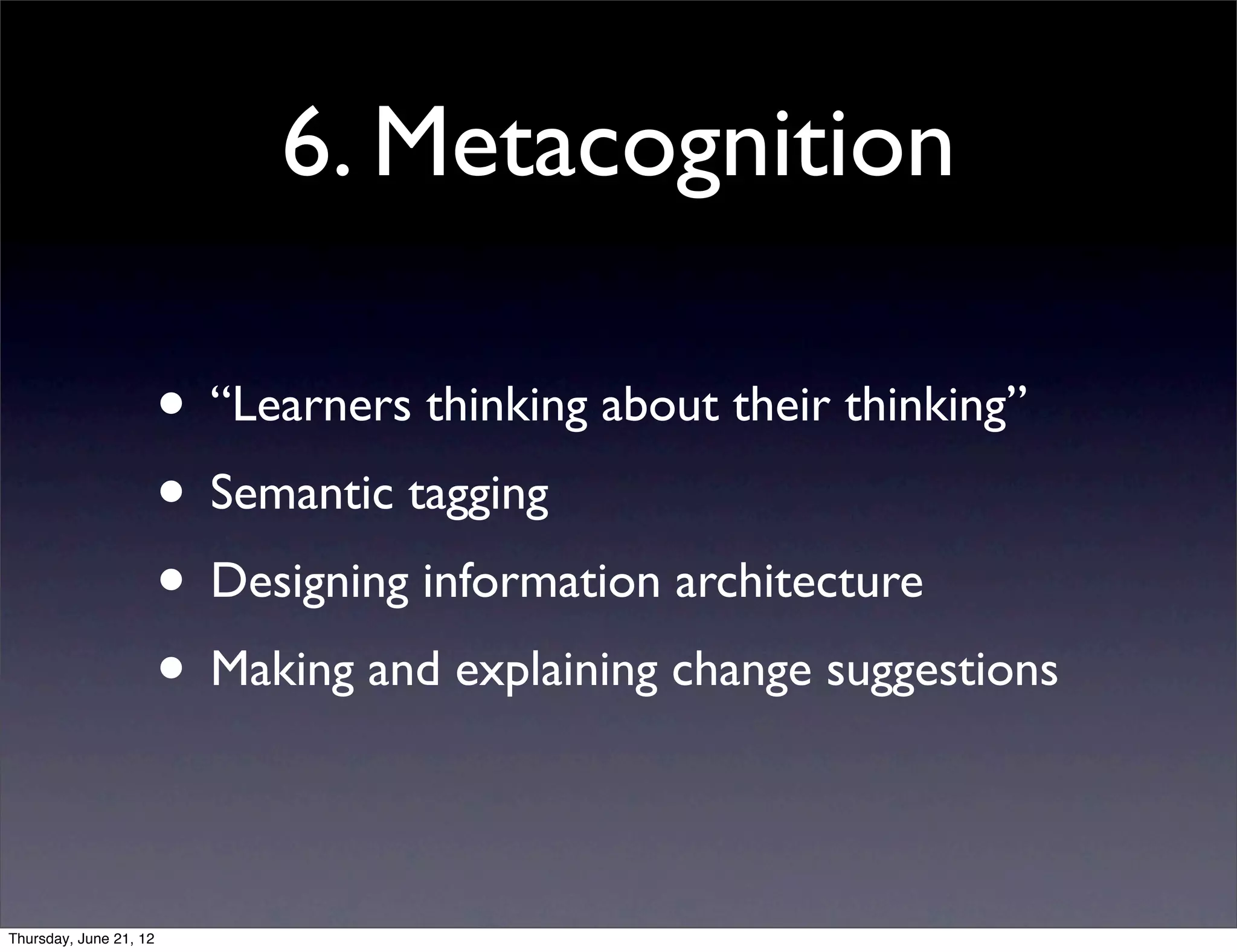
6. Metacognition

                        • “Learners thinking about their thinking”
                        • Semantic tagging
                        • Designing information architecture
                        • Making and explaining change suggestions

Thursday, June 21, 12
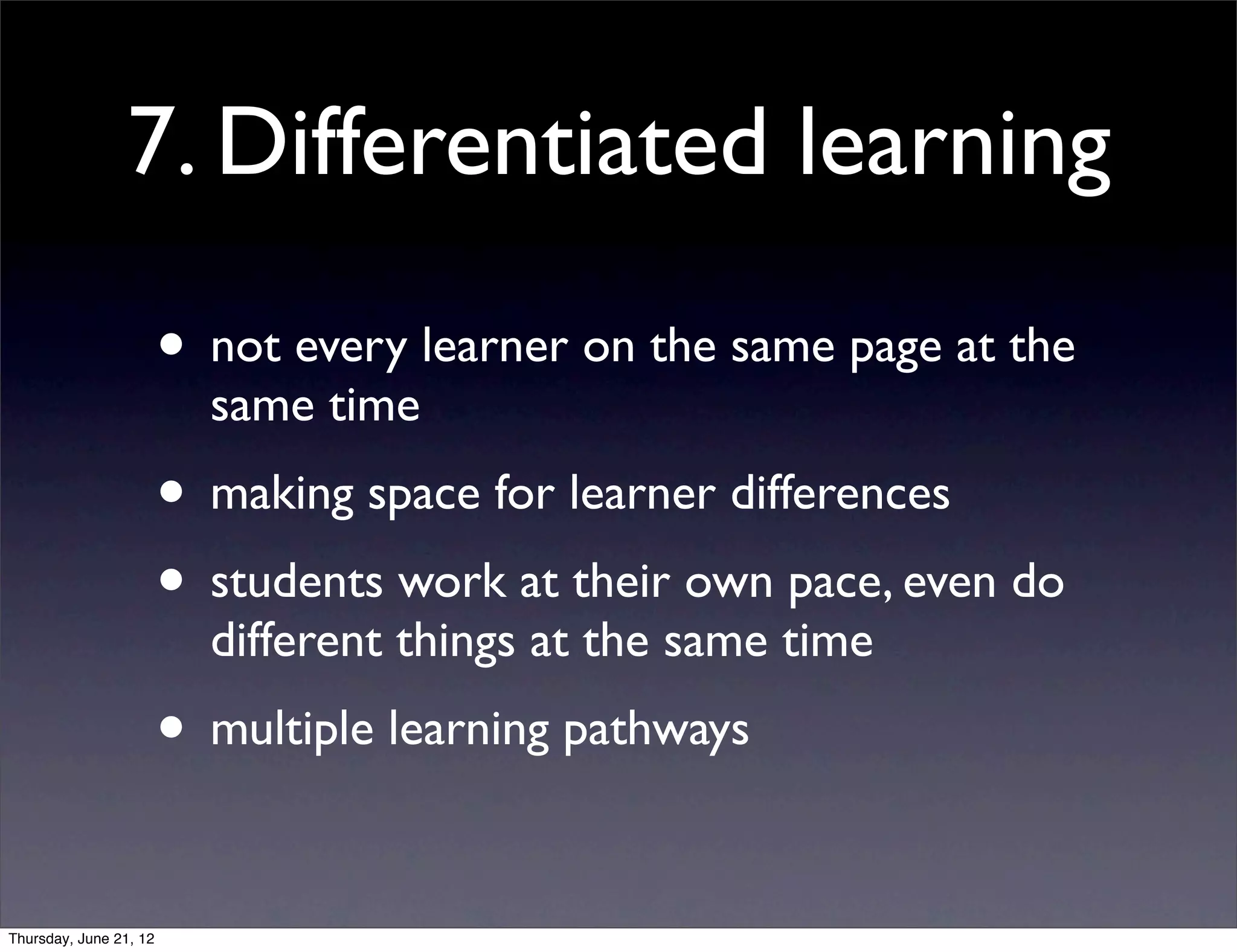
7. Differentiated learning

                        • not every learner on the same page at the
                          same time
                        • making space for learner differences
                        • students work at their own pace, even do
                          different things at the same time
                        • multiple learning pathways

Thursday, June 21, 12
if we are all learners
                                now


Thursday, June 21, 12
a teaching environment
                           that is
                  a learning environment


Thursday, June 21, 12
machine learning
                        supporting student learning
                        supporting teacher learning
                              supporting…


Thursday, June 21, 12
learning
                        is the new teaching


Thursday, June 21, 12
teaching
                        is the new learning


Thursday, June 21, 12
things we have always
                           aspired to do in
                              education


Thursday, June 21, 12
but now


Thursday, June 21, 12
a new
                      economy of effort
                   (the seven affordances)


Thursday, June 21, 12
Learning about learning

                    www.NewLearningOnline.com
                    Scholar, a new tool for online learning
                    learning.cgscholar.com
                    Kalantzis, Mary and Bill Cope. 2008. New
                    Learning: Elements of a Science of Education.
                    Cambridge UK: Cambridge University Press.


Thursday, June 21, 12
Trends in
                   online learning
Thursday, June 21, 12
flipped classroom


Thursday, June 21, 12
Open access

Thursday, June 21, 12
MOOC
                        Massive Open Online Course


Thursday, June 21, 12
Post-campus

Thursday, June 21, 12
reda.sadki@ifrc.org
                        International Federation of Red Cross and Red Crescent Societies
                    Red Cross Red Crescent Learning network
                                         www.ifrc.org/learning


Thursday, June 21, 12
So you want to
                 build a course...?

Thursday, June 21, 12
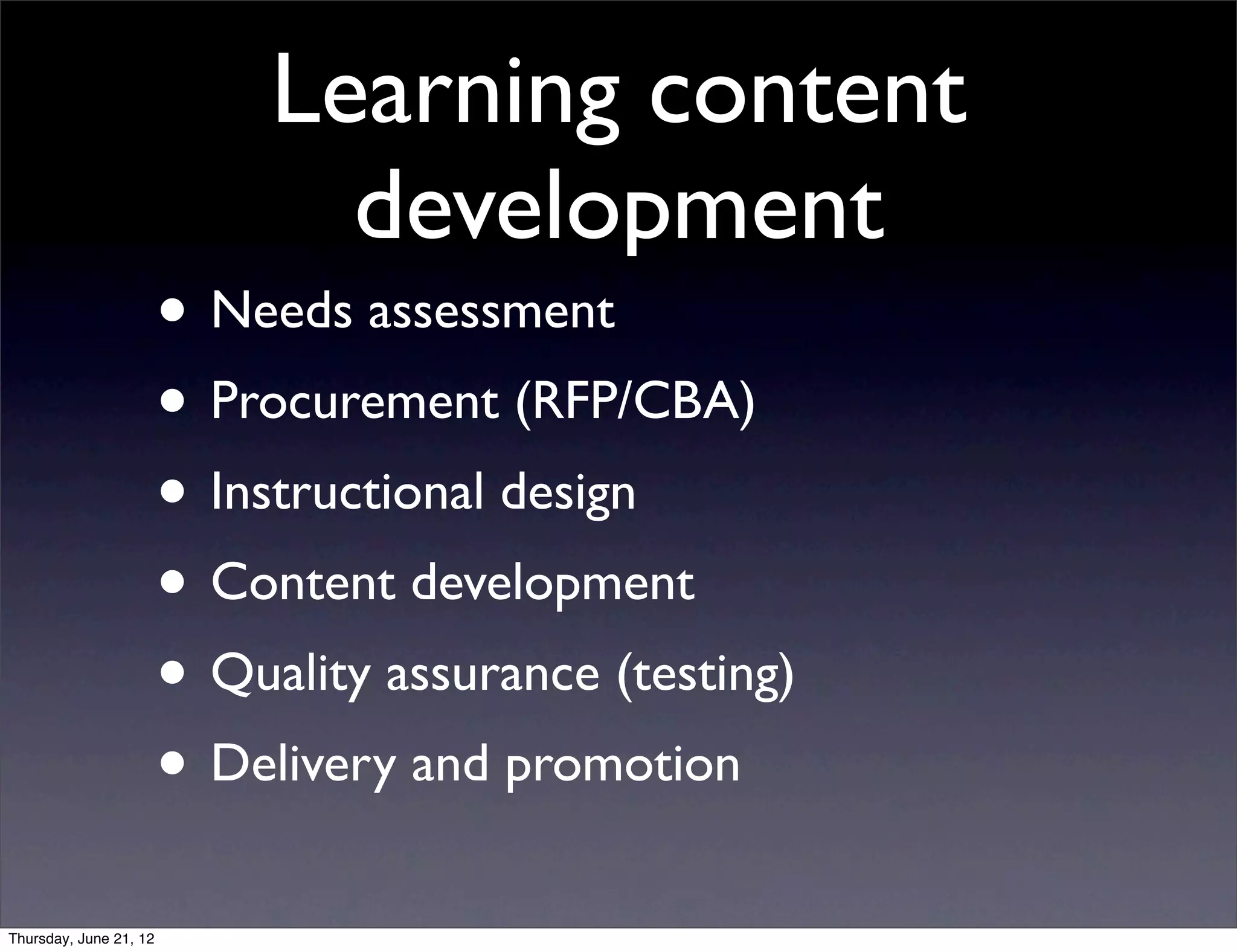
Learning content
                               development
                        • Needs assessment
                        • Procurement (RFP/CBA)
                        • Instructional design
                        • Content development
                        • Quality assurance (testing)
                        • Delivery and promotion
Thursday, June 21, 12
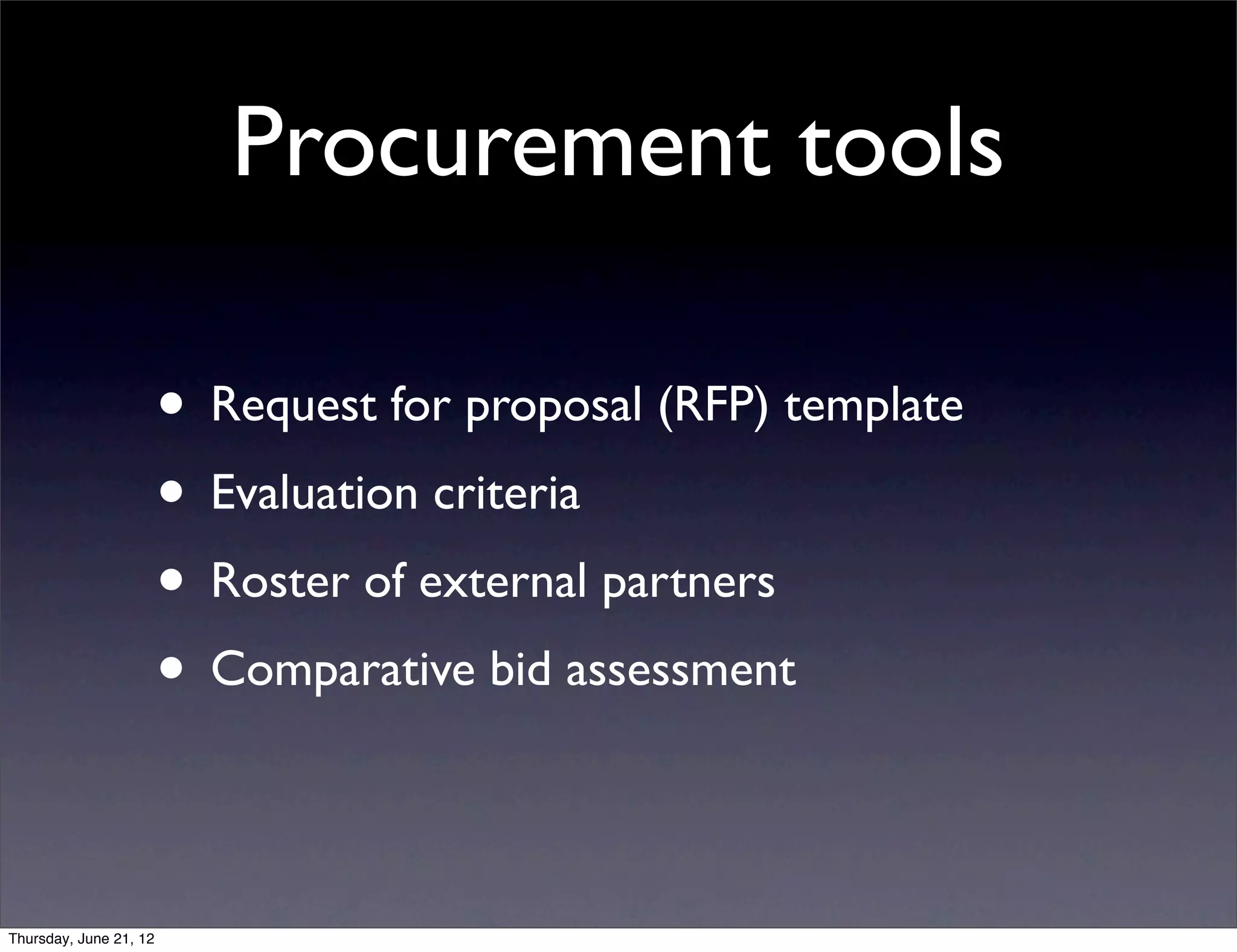
Procurement tools

                        • Request for proposal (RFP) template
                        • Evaluation criteria
                        • Roster of external partners
                        • Comparative bid assessment

Thursday, June 21, 12
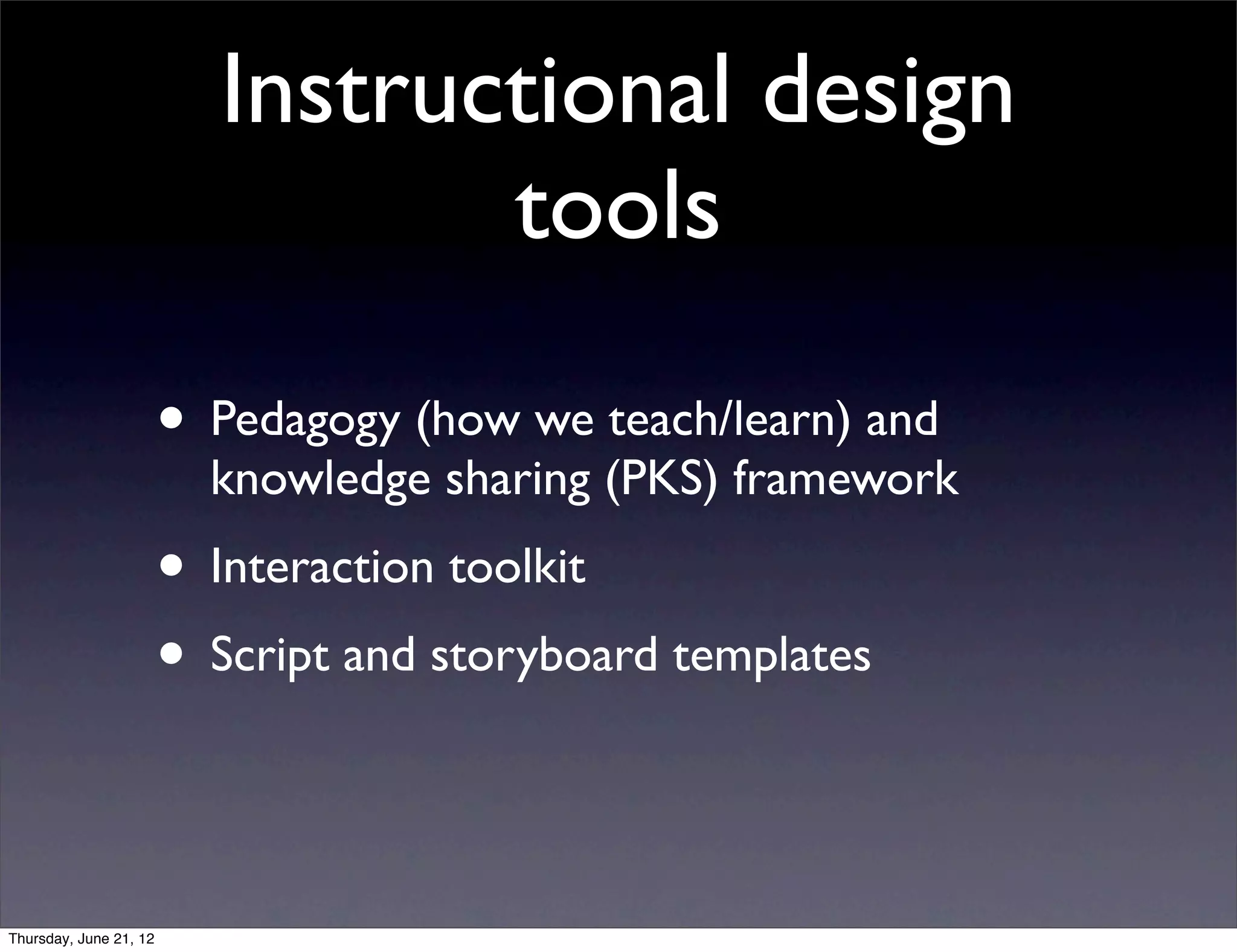
Instructional design
                                 tools

                        • Pedagogy (how we teach/learn) and
                          knowledge sharing (PKS) framework
                        • Interaction toolkit
                        • Script and storyboard templates


Thursday, June 21, 12
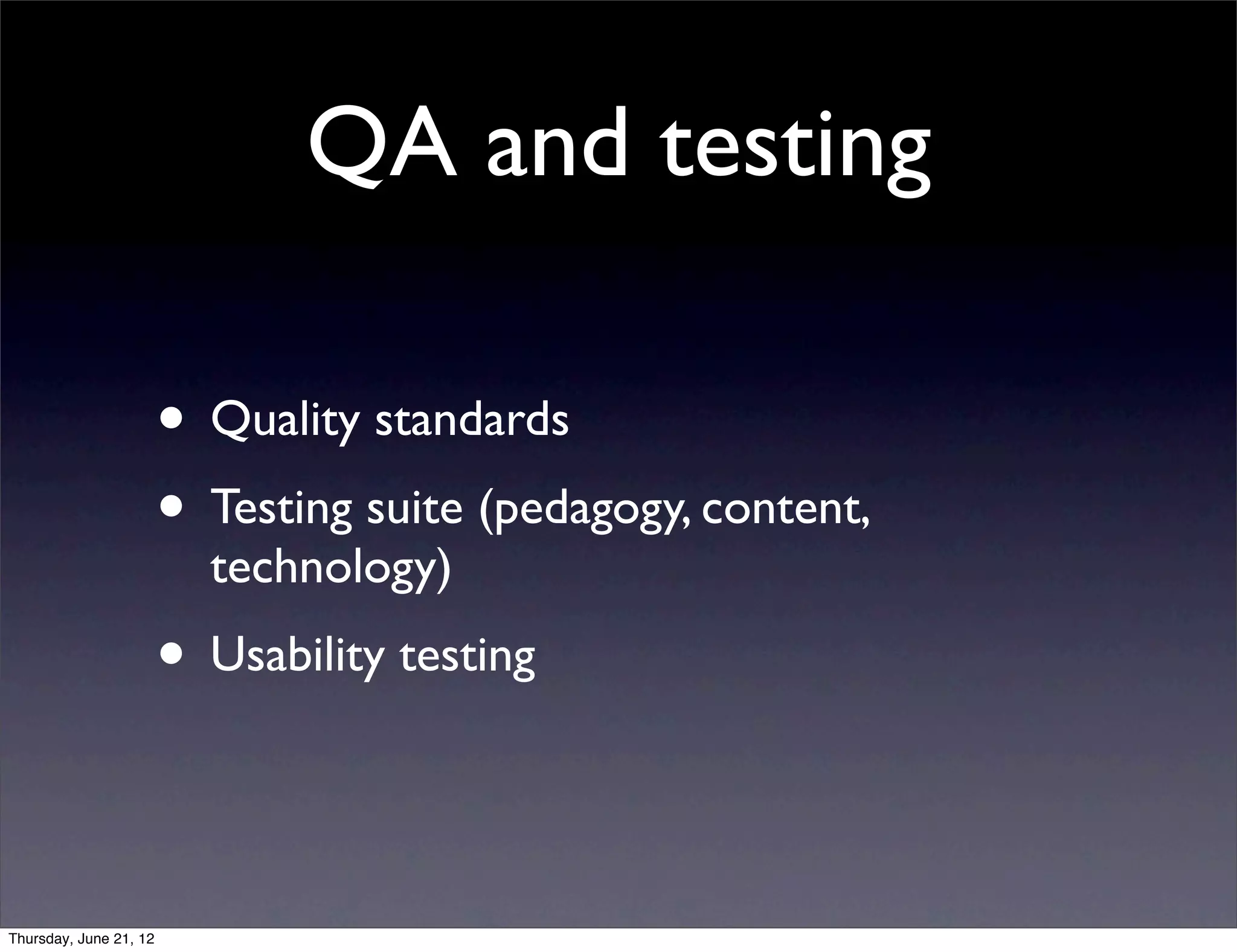
QA and testing

                        • Quality standards
                        • Testing suite (pedagogy, content,
                          technology)
                        • Usability testing


Thursday, June 21, 12
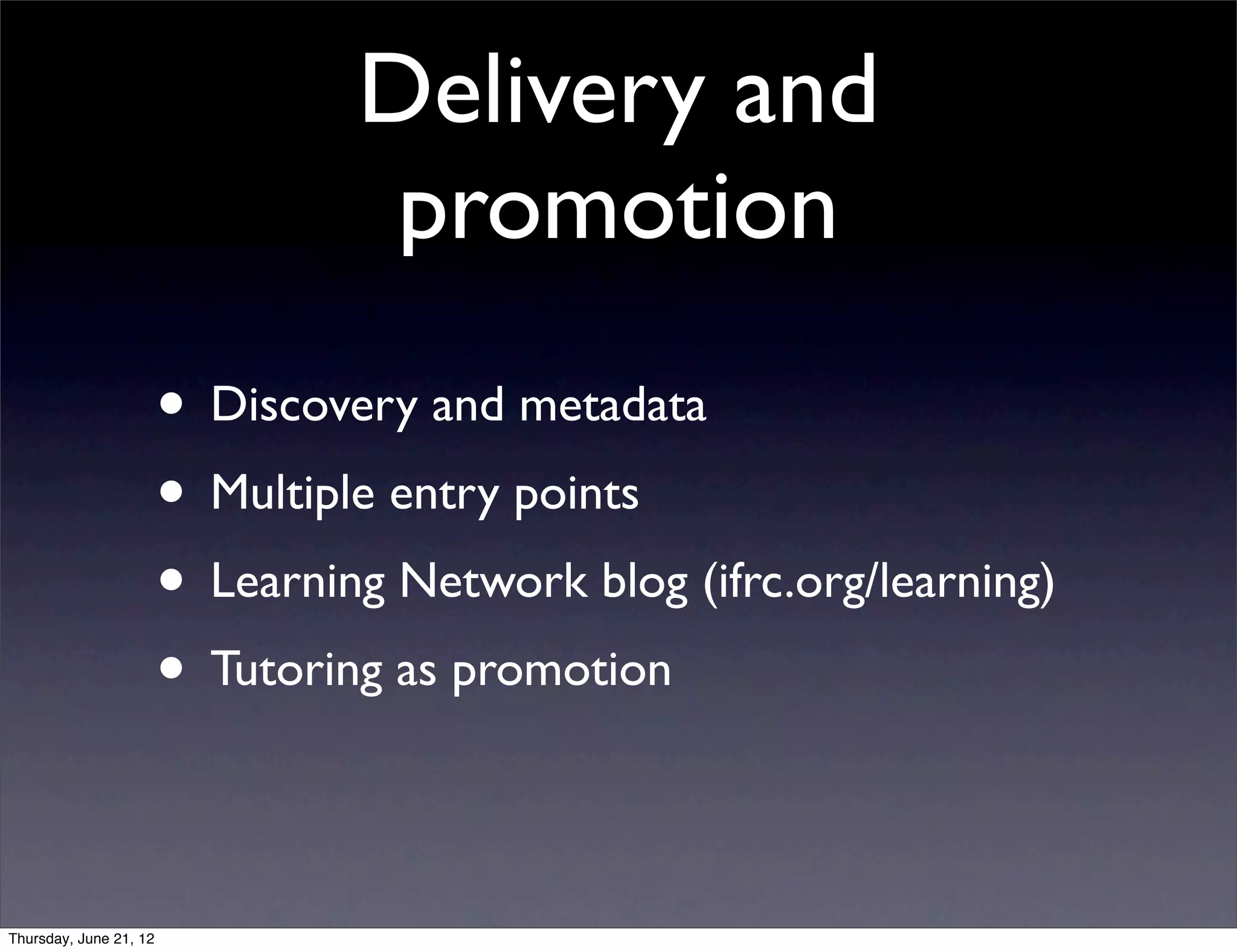
Delivery and
                                  promotion
                        • Discovery and metadata
                        • Multiple entry points
                        • Learning Network blog (ifrc.org/learning)
                        • Tutoring as promotion

Thursday, June 21, 12

Red Cross Red Crescent Learning network

  • 1.
    Learning systems Red Cross Red Crescent Learning network Reda Sadki, Senior officer for Learning systems International Federation of Red Cross and Red Crescent Societies Thursday, June 21, 12
  • 2.
    The black hole Black Hole Outburst in Spiral Galaxy M83 (NASA, Chandra, Hubble, 04/30/12) Thursday, June 21, 12
  • 3.
  • 4.
  • 5.
  • 6.
  • 7.
  • 8.
  • 9.
  • 10.
  • 11.
  • 12.
  • 13.
  • 14.
  • 15.
  • 16.
  • 17.
  • 18.
    Rumble in the (learning) jungle: Distance learning vs. Face-to-face learning Thursday, June 21, 12
  • 19.
    Hallowed or demonized #1 Is the final academic performance of students in distance learning programs better than that of those enrolled in traditional FTF programs, in the last twenty-year period? (Mickey Shachar and Yoram Nuemann. Twenty years of research on the academic performance differences between traditional and distance learning: summative meta-analysis and trend examination. Merlot Journal of Online Learning and Teaching.Vol 6, No. 2, June 2010 Thursday, June 21, 12
  • 20.
    Yes. Distance learning results in increasingly better learning outcomes since1991. Thursday, June 21, 12
  • 21.
    Hallowed or demonized #2 Does supplementing face-to-face instruction with online instruction enhance learning? U.S. Department of Education. Evaluation of evidence-based practices in online learning: a meta-analysis and review of online learning studies. September 2010. Thursday, June 21, 12
  • 22.
    No. Positive effects associated with blended learning should not be attributed to the media, per se. Thursday, June 21, 12
  • 23.
  • 24.
    Building online learning for the Red Cross Red Crescent Thursday, June 21, 12
  • 25.
    11 IFRC-designed courses Code of Conduct 30m Effective writing in English 40h H2P - Humanitarian pandemic preparedness programme 45m IDRL - International Disaster Response Laws - Introduction 30m Influenza pandemic preparedness 45m Introduction to cash transfer programming 2h Project/programme planning (PPP) course 2h Stay safe - personal security 3h Stay safe - security management 3h Strategy 2020 30m WORC - the world of Red Cross and Red Crescent 16h Thursday, June 21, 12
  • 26.
    In development • Sphere humanitarian standards • CBHFA • Volunteering induction • VCA Thursday, June 21, 12
  • 27.
    Pillars of onlinelearning • Pedagogy • Content • Technology Thursday, June 21, 12
  • 28.
    A Red Cross Red Crescent pedagogy? • Learning continuum (academic partnerships) • Global learning (“productive diversity”) • Informal learning • Experience-based knowledge transmission • Social network dependent • Research and learning agenda Thursday, June 21, 12
  • 29.
    Thursday, June 21,12 Old learning
  • 30.
    Here we are,in a village school in Greece, in 1983. Thursday, June 21, 12
  • 31.
    The teacher sitsat his desk, on a little stage at the front of the classroom. ‘Look this way’, he says. ‘Listen to what I tell you.’. ‘Answer my questions, hands up, only one person speaks at a time.’ Thursday, June 21, 12
  • 32.
    ‘Now, everyone readchapter 7, and answer the questions at the end. No talking, silent work please.’ Thursday, June 21, 12
  • 33.
    One student looks up for a moment. Is she thinking about her work? Or is she daydreaming? Thursday, June 21, 12
  • 34.
    Then she turns.‘Turn around, Soula,’ says the teacher. ‘Don’t disturb the girls behind you’ Thursday, June 21, 12
  • 35.
    The classroom isa communications and knowledge architecture. Here is the pedagogical design of this classroom in Greece in 1983, and tens of thousands others like it before and since: Some typical discursive flows: ✓Teacher talks -> students listen. ✓Teacher Q. -> students A. (‘hands up!’, ‘one at a time!’). ✓Teacher says ‘read chapter 7’ -> students read and memorize. ✓Teacher sets test -> students respond with correctly memorized answers. Thursday, June 21, 12
  • 36.
  • 37.
    Here, by contrastis the communication and knowledge architecture of the online classroom we want. Some typical discursive flows: • Teacher scaffolds peer <-> peer feedback. • All students involved simultaneously in constructive peer <-> peer learning dialogue. • An active, knowledge producing community. • Continuous formative assessment, supplementing teacher assessments with structured self and peer assessments. Thursday, June 21, 12
  • 38.
  • 39.
    Online learning changesrole of the teacher and the responsibilities of learners. Teaching and learning will never be the same again. But how? Thursday, June 21, 12
  • 40.
    What do we want? Thursday, June 21, 12
  • 41.
    Collaborative Learners create together, giving each other feedback (and even feedback on feedback), sharing their inspirations and discoveries. Within their knowledge communities, learners are connected through individual learner profiles. Thursday, June 21, 12
  • 42.
    Flexible Learners work at their own pace, according to their own interests and capabilities, while teachers track their progress easily through multiple views and match progress against learning standards. Thursday, June 21, 12
  • 43.
    Motivating Learners are inspired to create through embedding sound, image, and video within their texts for digital storytelling, lab reports with recorded experiments, local oral history projects, and more. They receive immediate feedback from other learners and from a range of computer-assisted tools in time to improve their work. Learner successes are shared with classmates, parents, and other classes in a web portfolio. Thursday, June 21, 12
  • 44.
    Participatory Learners can join and lead project groups, post and share files, and start and engage in discussions at the assignment- and knowledge community-levels. Thursday, June 21, 12
  • 45.
    Supportive Learners have access to tools that not only help them to improve their work, but also their knowledge of the writing process and mastery of written forms, from grammar to structure to genre, within English Language Arts and across other disciplines that require extended written or multimedia reports, such as Science and Social Studies. Thursday, June 21, 12
  • 46.
    Assessment A rich learning information environment, supporting: • diagnostic assessment – finding out what students already know and still need to learn • formative assessment – rich, rapidly responsive feedback that directly supports student learning Thursday, June 21, 12
  • 47.
    Learning should be: • Collaborative • Flexible • Motivating • Participatory • Supportive Thursday, June 21, 12
  • 48.
    Why do we want it? Thursday, June 21, 12
  • 49.
    a time ofdisruptive change ...in society, education Thursday, June 21, 12
  • 50.
  • 51.
    1.Ubiquitous learning • students using social media, Web. 2.0 • learn anywhere, anytime • cloud computing Thursday, June 21, 12
  • 52.
    2. Recursive feedback • recursive feedback • “Work and dialogue about the work” Thursday, June 21, 12
  • 53.
    Feedback tools • Review (against a rubric) • Annotations (in-text commentary) • Checker (by the software, natural language processing) • Survey (knowledge assessments) Thursday, June 21, 12
  • 54.
    3. Multimodal meaning • adding image, video, audio and any other datafile • a fully multimodal workspace Thursday, June 21, 12
  • 55.
    4. Active knowledge making • students as knowledge makers, • not just knowledge consumers • supplementing heritage hierarchical knowledge flows with lateral knowledge flows Thursday, June 21, 12
  • 56.
    Balance of agencyshifts • readers <=> writers (e.g. in the social media) • producers <=> consumers (e.g. ‘prosumers’) Thursday, June 21, 12
  • 57.
    5. Collaborative intelligence Thursday, June 21, 12
  • 58.
    Social learning • not ‘friends’ or ‘followers’ but ‘peers’ working in ‘knowledge communities’ • teacher builds peer-to-peer learning scaffolds (projects, review formats) • finished works are shared knowledge in the community’s ‘bookstore’ Thursday, June 21, 12
  • 59.
    6. Metacognition • “Learners thinking about their thinking” • Semantic tagging • Designing information architecture • Making and explaining change suggestions Thursday, June 21, 12
  • 60.
    7. Differentiated learning • not every learner on the same page at the same time • making space for learner differences • students work at their own pace, even do different things at the same time • multiple learning pathways Thursday, June 21, 12
  • 61.
    if we areall learners now Thursday, June 21, 12
  • 62.
    a teaching environment that is a learning environment Thursday, June 21, 12
  • 63.
    machine learning supporting student learning supporting teacher learning supporting… Thursday, June 21, 12
  • 64.
    learning is the new teaching Thursday, June 21, 12
  • 65.
    teaching is the new learning Thursday, June 21, 12
  • 66.
    things we havealways aspired to do in education Thursday, June 21, 12
  • 67.
  • 68.
    a new economy of effort (the seven affordances) Thursday, June 21, 12
  • 69.
    Learning about learning www.NewLearningOnline.com Scholar, a new tool for online learning learning.cgscholar.com Kalantzis, Mary and Bill Cope. 2008. New Learning: Elements of a Science of Education. Cambridge UK: Cambridge University Press. Thursday, June 21, 12
  • 70.
    Trends in online learning Thursday, June 21, 12
  • 71.
  • 72.
  • 73.
    MOOC Massive Open Online Course Thursday, June 21, 12
  • 74.
  • 75.
    reda.sadki@ifrc.org International Federation of Red Cross and Red Crescent Societies Red Cross Red Crescent Learning network www.ifrc.org/learning Thursday, June 21, 12
  • 76.
    So you wantto build a course...? Thursday, June 21, 12
  • 77.
    Learning content development • Needs assessment • Procurement (RFP/CBA) • Instructional design • Content development • Quality assurance (testing) • Delivery and promotion Thursday, June 21, 12
  • 78.
    Procurement tools • Request for proposal (RFP) template • Evaluation criteria • Roster of external partners • Comparative bid assessment Thursday, June 21, 12
  • 79.
    Instructional design tools • Pedagogy (how we teach/learn) and knowledge sharing (PKS) framework • Interaction toolkit • Script and storyboard templates Thursday, June 21, 12
  • 80.
    QA and testing • Quality standards • Testing suite (pedagogy, content, technology) • Usability testing Thursday, June 21, 12
  • 81.
    Delivery and promotion • Discovery and metadata • Multiple entry points • Learning Network blog (ifrc.org/learning) • Tutoring as promotion Thursday, June 21, 12