slides and resources: http://tinyurl.com/Alt2LecSp2013

 CTD WEEKLY WORKSHOPS:
 ALTERNATIVES TO LECTURE

            Peter Newbury
            Center for Teaching Development,
            University of California, San Diego
            pnewbury@ucsd.edu              @polarisdotca
            ctd.ucsd.edu                   #ctducsd


            Tuesday, April 16, 2013 11:00 am – 12:00 pm
            Center Hall, Room 316
Key Finding 1
    Students come to the classroom with preconceptions about
    how the world works. If their initial understanding is not
    engaged, they may fail to grasp the new concepts and
    information that are taught, or they may learn them for
    the purposes of a test but revert to their preconceptions
    outside of the classroom.
                                         (How People Learn [1], p. 14)

                     Instructors must
                    draw out students’     Instruction must be
                       pre-existing         student-centered.
                     understandings.

2   Alternatives to Lecture
Key Finding 2
    To develop competence in an area, students must:
        a) have a deep foundation of factual knowledge,
        b) understand facts and ideas in the context of a
            conceptual framework, and
        c) organize knowledge in ways that facilitate
            retrieval and application.
                                      (How People Learn [1], p. 16)

                    These are         Instructors need to
                 characteristics of      give students
                                      opportunities to be
                      expertize        more expert-like.
3   Alternatives to Lecture
Key Finding 3
    A “metacognitive” approach to instruction can help
    students learn to take control of their own learning by
    defining learning goals and monitoring their progress in
    achieving them.
                                                (How People Learn [1], p. 18)


                       Instructors need to provide
                       opportunities for students to
                     practice being metacognitive –
                    thinking about their own thinking

4   Alternatives to Lecture
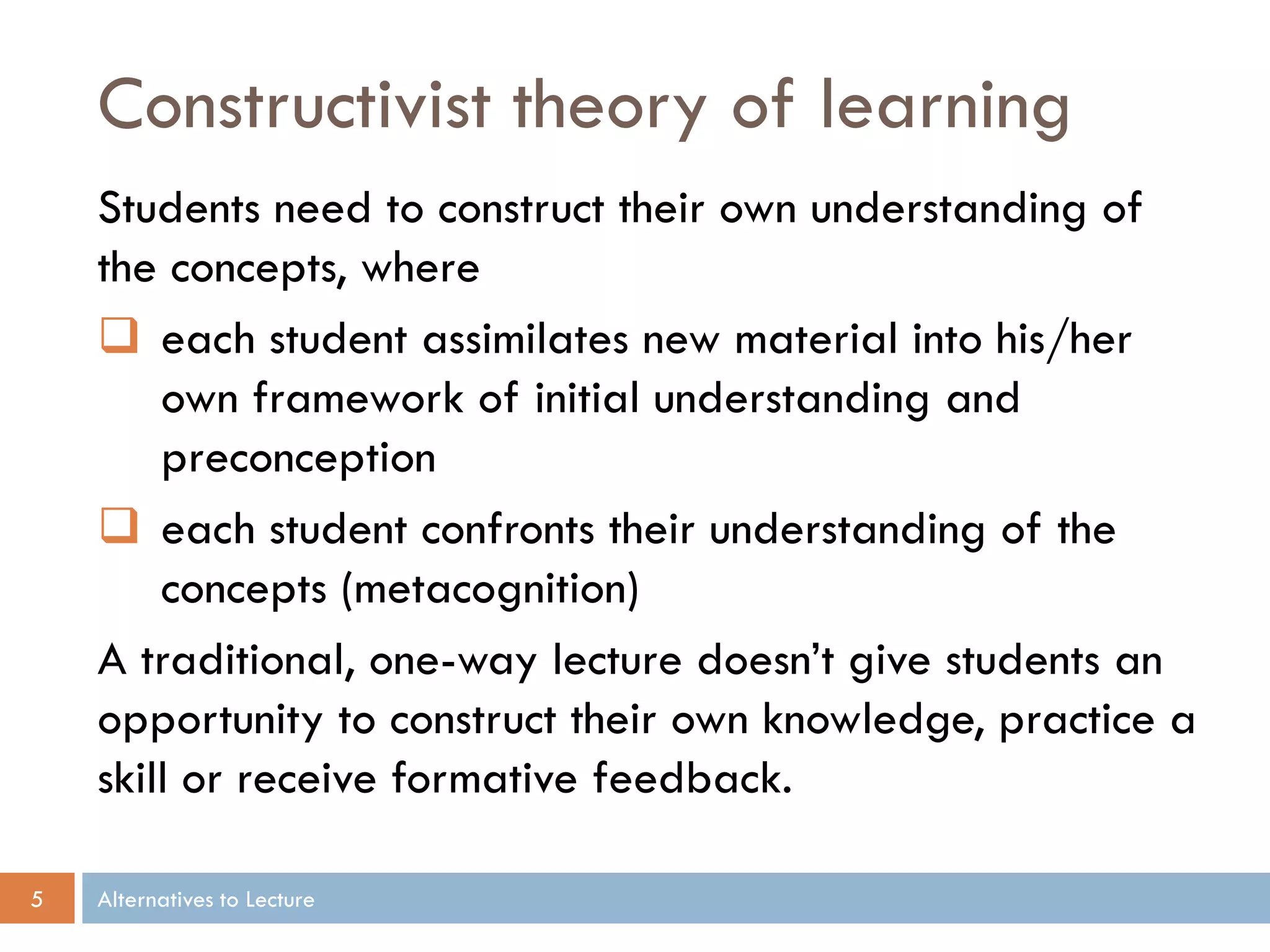
Constructivist theory of learning
    Students need to construct their own understanding of
    the concepts, where
     each student assimilates new material into his/her
        own framework of initial understanding and
        preconception
     each student confronts their understanding of the
        concepts (metacognition)
    A traditional, one-way lecture doesn’t give students an
    opportunity to construct their own knowledge, practice a
    skill or receive formative feedback.

5   Alternatives to Lecture
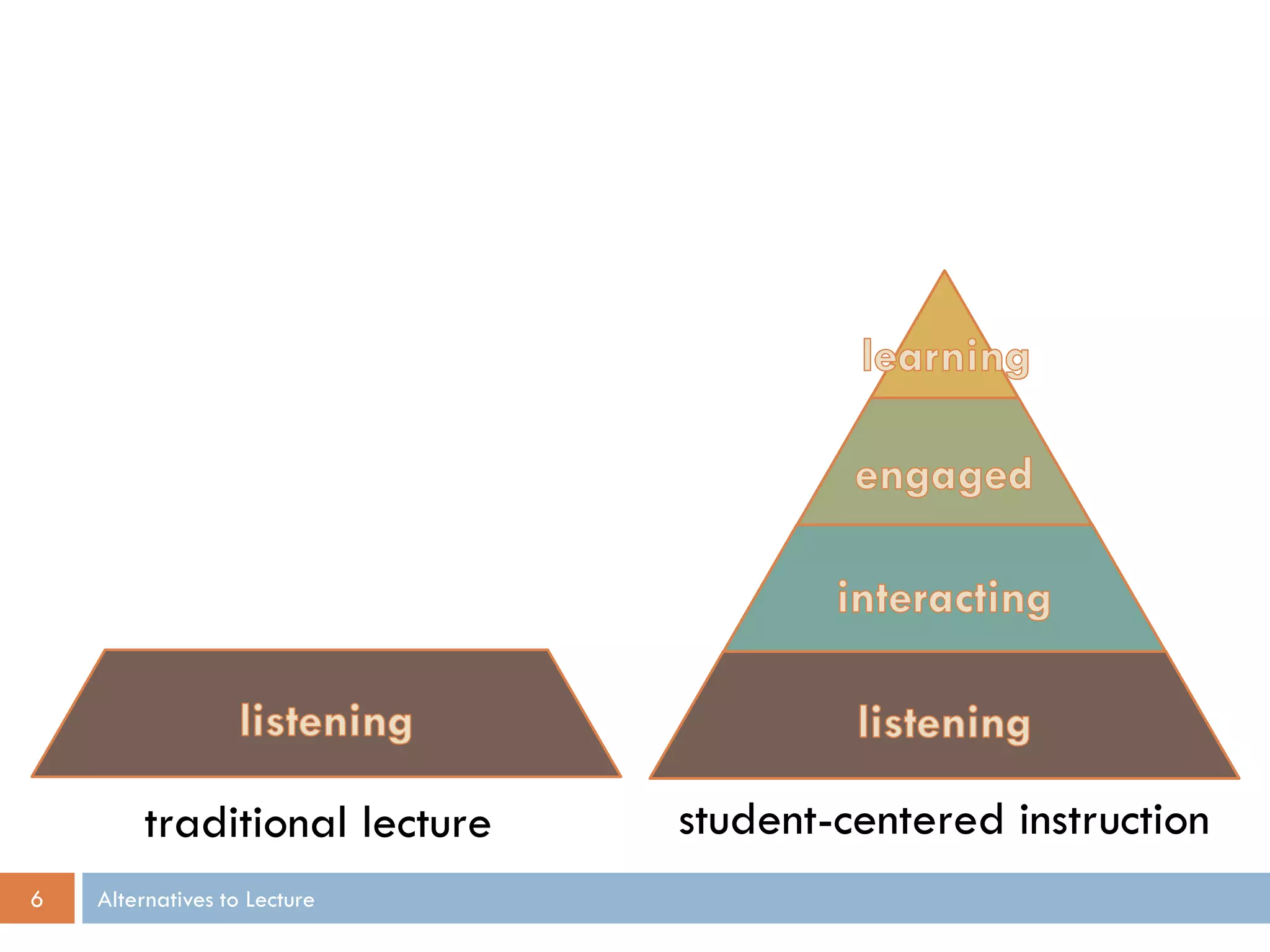
traditional lecture   student-centered instruction
6   Alternatives to Lecture
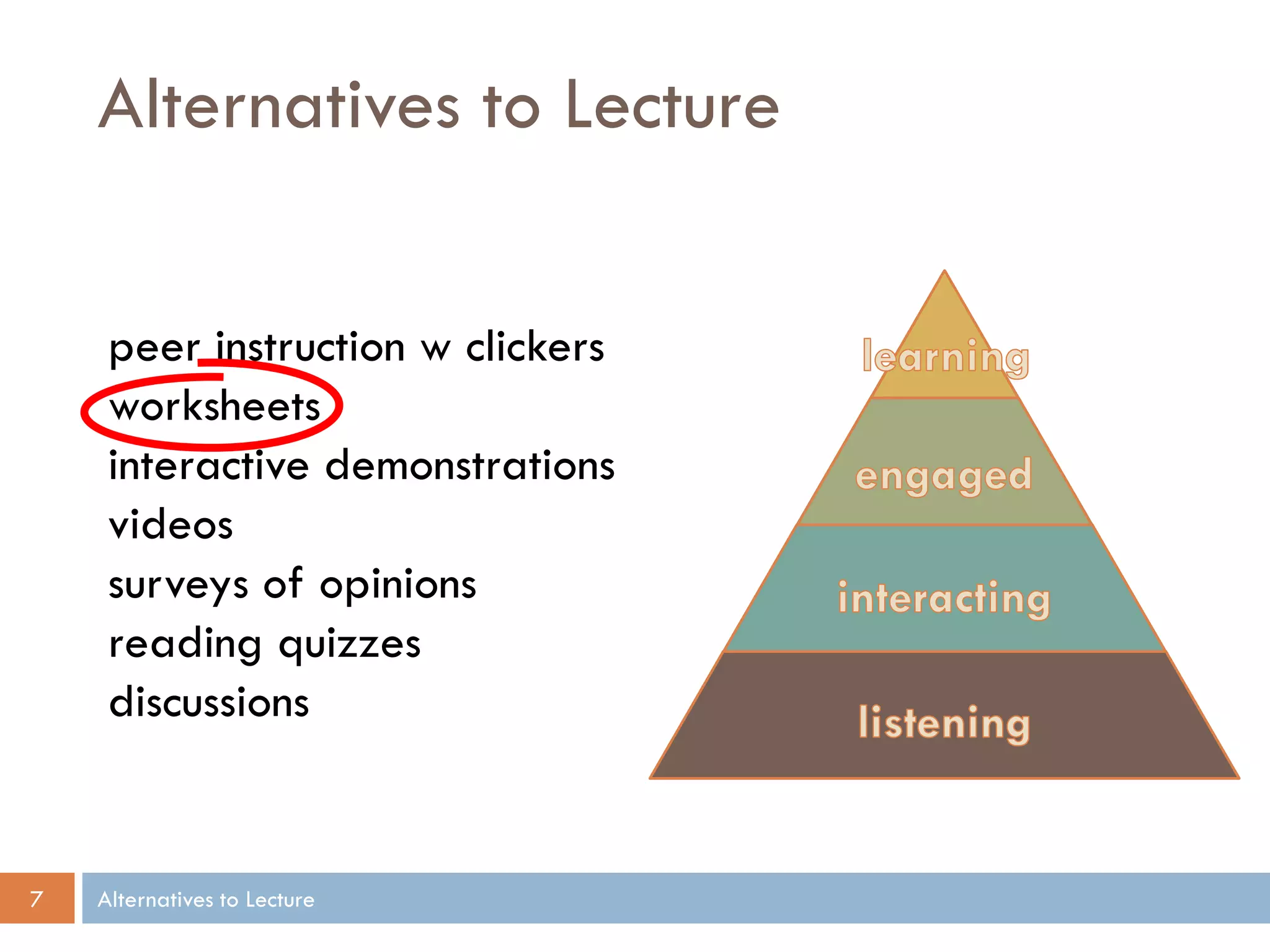
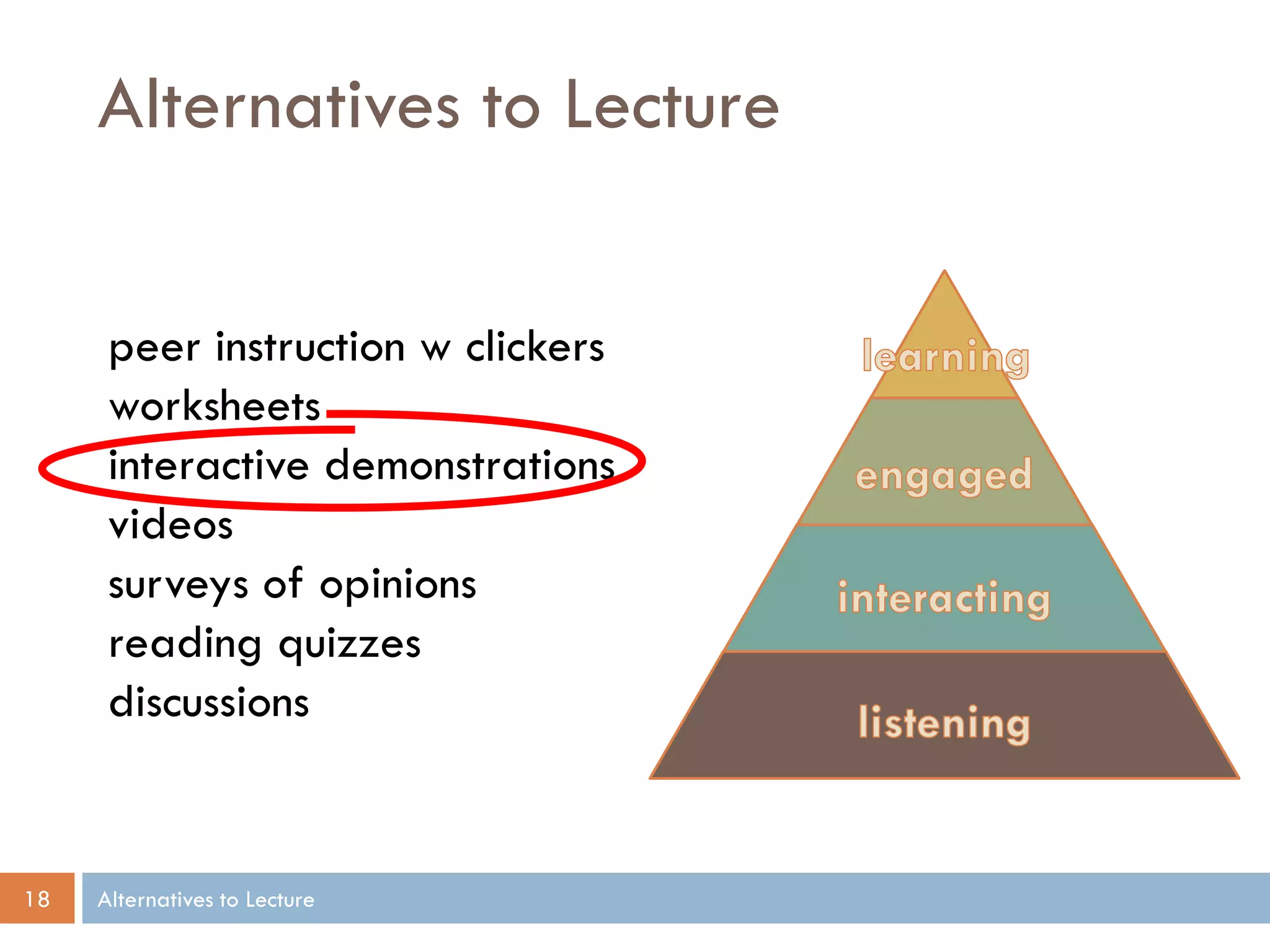
Alternatives to Lecture


     peer instruction w clickers
     worksheets
     interactive demonstrations
     videos
     surveys of opinions
     reading quizzes
     discussions


7   Alternatives to Lecture
In-class worksheets
    Before beginning an in-class worksheet, be sure the
    students are properly prepared:

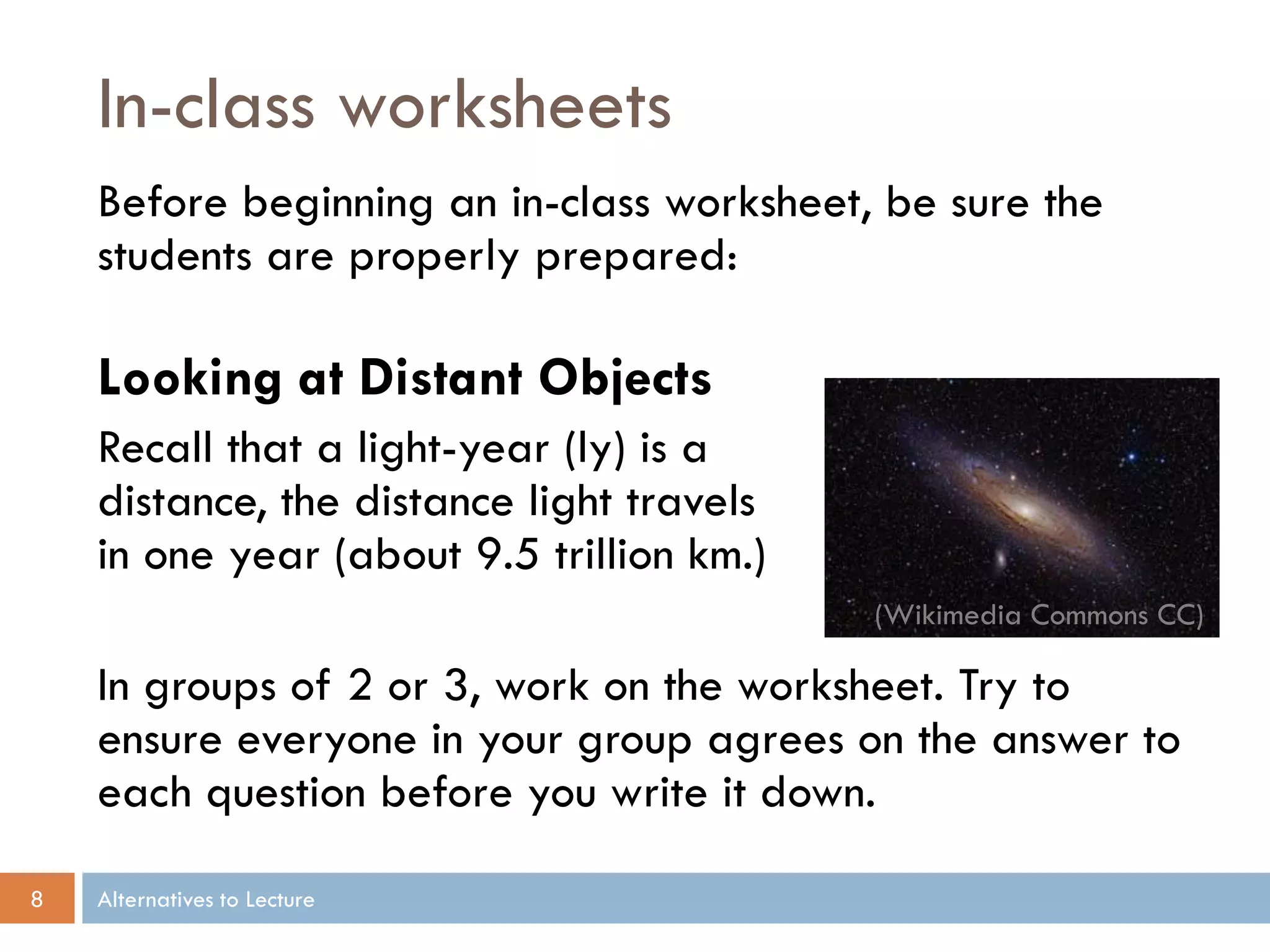
    Looking at Distant Objects
    Recall that a light-year (ly) is a
    distance, the distance light travels
    in one year (about 9.5 trillion km.)
                                           (Wikimedia Commons CC)

    In groups of 2 or 3, work on the worksheet. Try to
    ensure everyone in your group agrees on the answer to
    each question before you write it down.

8   Alternatives to Lecture
Clicker question
    Imagine that you simultaneously receive two pictures of two
    people that live on planets orbiting two different stars. Each
    picture shows the people at their 21st birthday parties.
    Which of the following do you think is the most plausible
    interpretation?
    A) Both people are the same age but at different distances
        from you.
    B) The people are actually different ages but at the same
        distance from you.
    C) The person that is closer to you is actually the older of
        the two people.
    D) The person that is farther from you is actually the older
        of the two people.
                                                     (Prather et. al [4])

9   Alternatives to Lecture
In-class worksheets
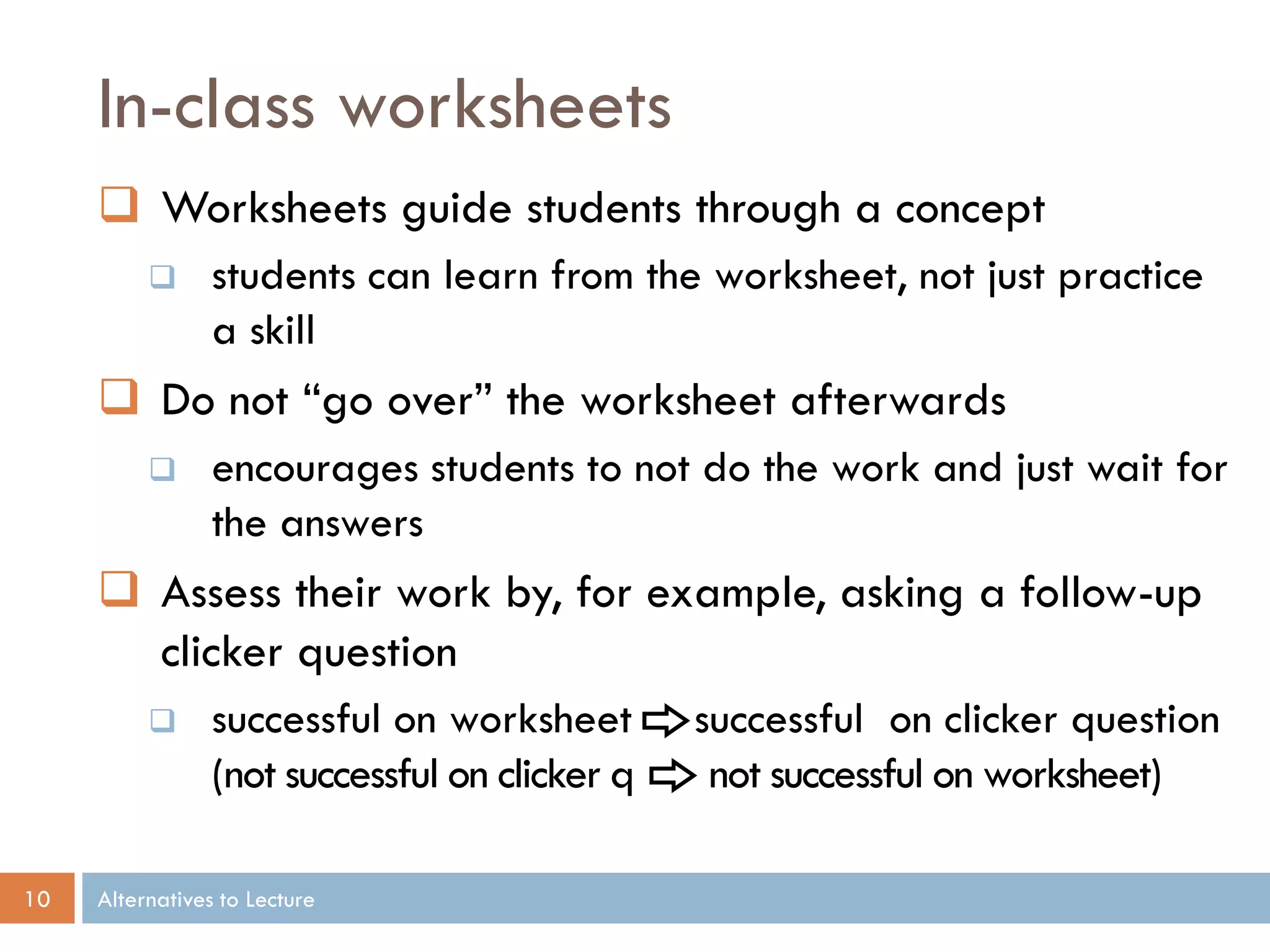
      Worksheets guide students through a concept
                students can learn from the worksheet, not just practice
                 a skill
      Do not “go over” the worksheet afterwards
                encourages students to not do the work and just wait for
                 the answers
      Assess their work by, for example, asking a follow-up
       clicker question
                successful on worksheet        successful on clicker question
                 (not successful on clicker q    not successful on worksheet)

10   Alternatives to Lecture
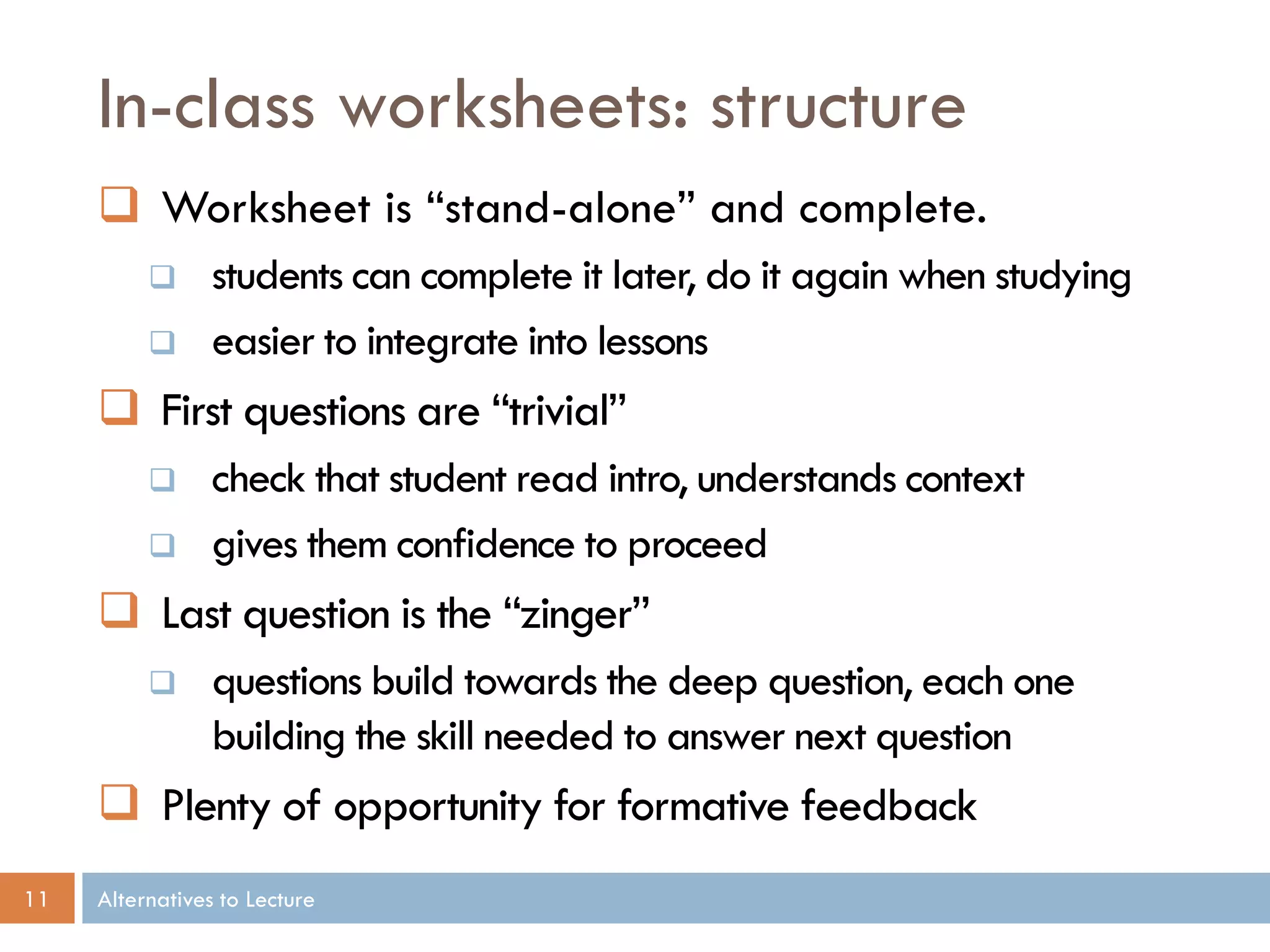
In-class worksheets: structure
      Worksheet is “stand-alone” and complete.
                students can complete it later, do it again when studying
                easier to integrate into lessons
      First questions are “trivial”
                check that student read intro, understands context
                gives them confidence to proceed
      Last question is the “zinger”
                questions build towards the deep question, each one
                 building the skill needed to answer next question
      Plenty of opportunity for formative feedback
11   Alternatives to Lecture
In-class worksheet: resources
                                 Washington Tutorials (physics)
                               www.phys.washington.edu/groups/peg/tut.html


                  Lecture-Tutorials for Introductory Astronomy
     astronomy101.jpl.nasa.gov/teachingstrategies/teachingdetails/?StrategyID=9


     Format and structure can be adapted to other fields:
     (use the astronomy Lecture-Tutorials as a template)


12   Alternatives to Lecture
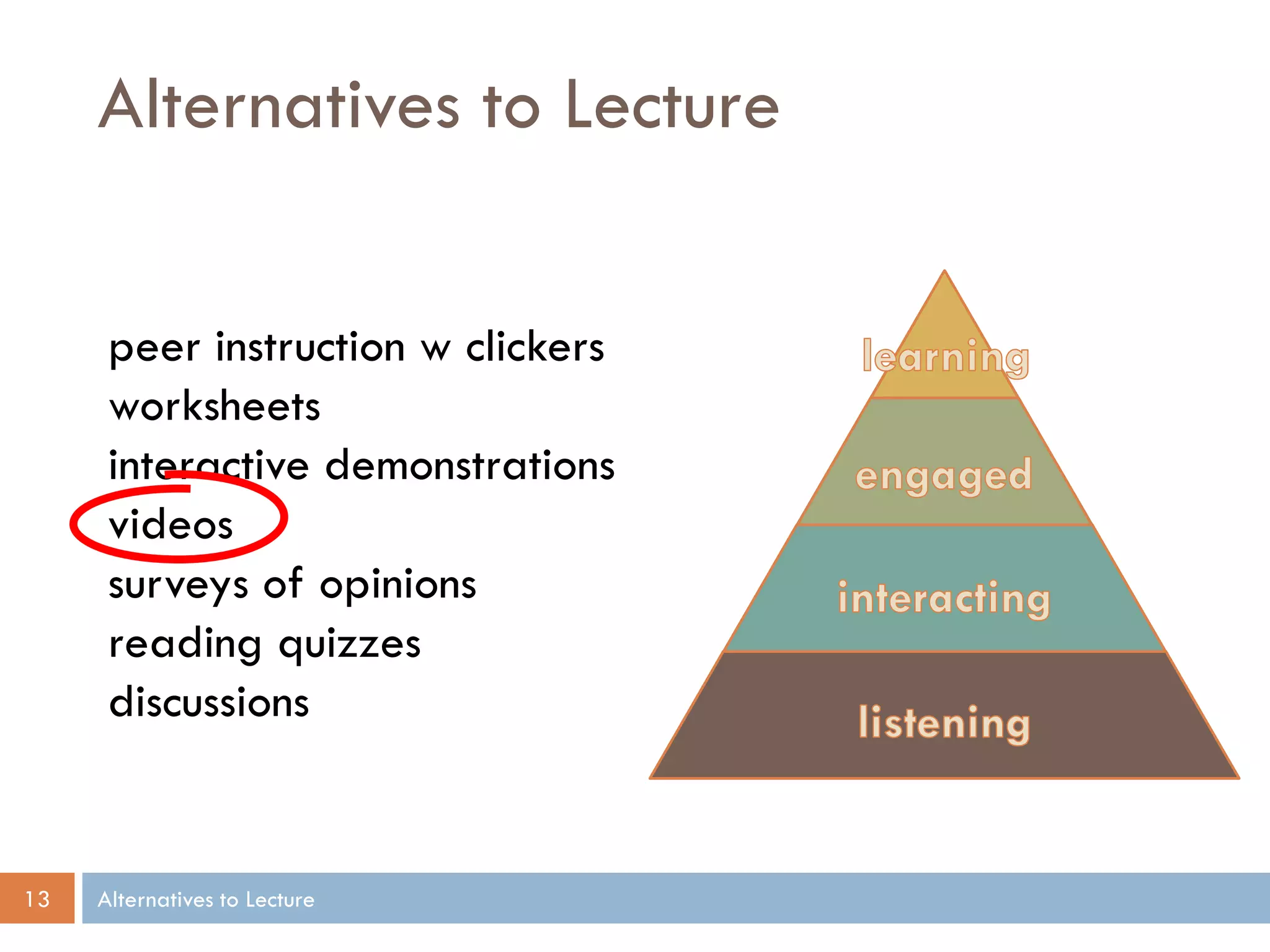
Alternatives to Lecture


      peer instruction w clickers
      worksheets
      interactive demonstrations
      videos
      surveys of opinions
      reading quizzes
      discussions


13   Alternatives to Lecture
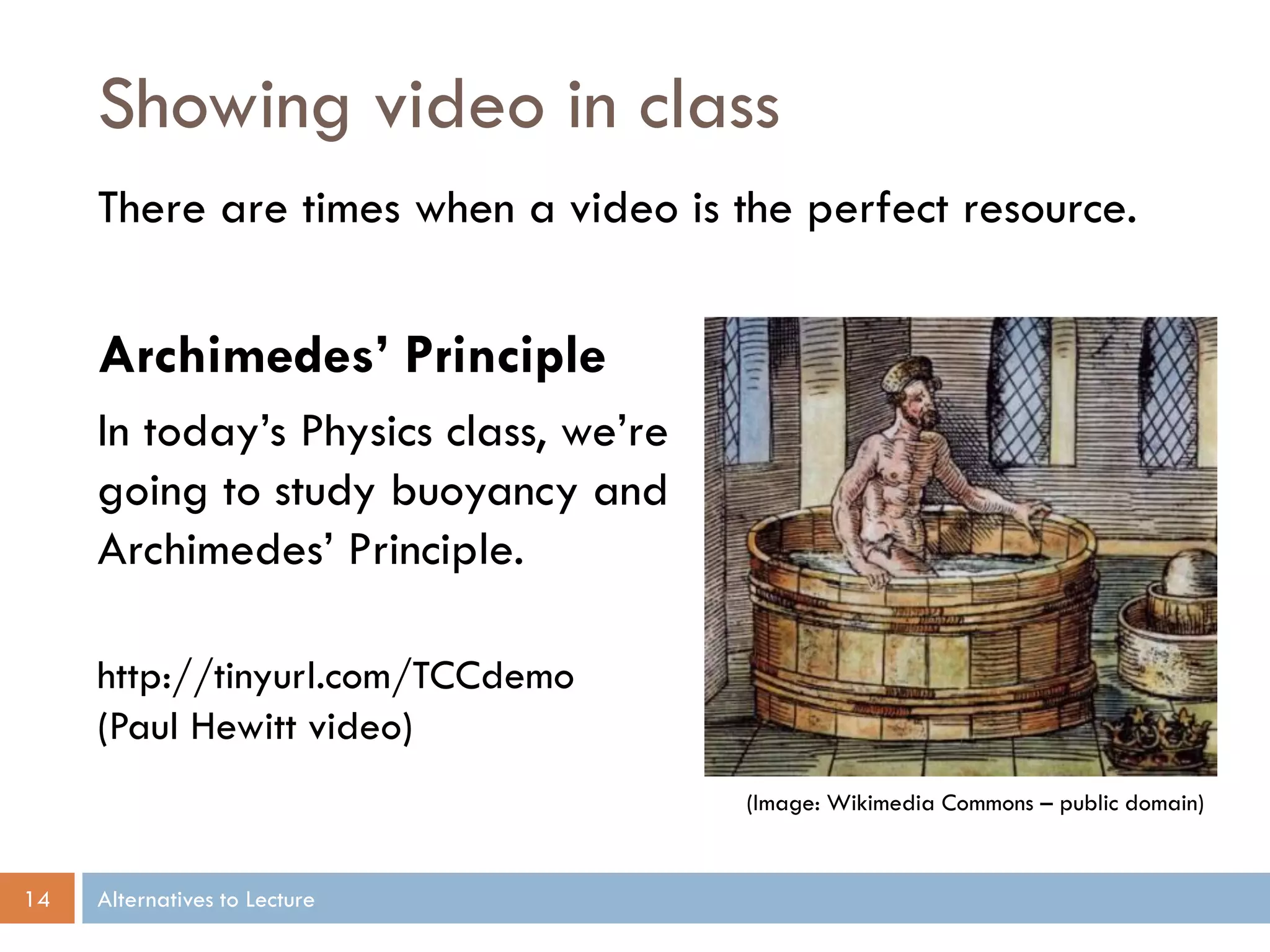
Showing video in class
     There are times when a video is the perfect resource.


     Archimedes’ Principle
     In today’s Physics class, we’re
     going to study buoyancy and
     Archimedes’ Principle.

     http://tinyurl.com/TCCdemo
     (Paul Hewitt video)
                                       (Image: Wikimedia Commons – public domain)


14   Alternatives to Lecture
Opinion: Videos in class
     In your opinion, the Paul Hewitt video
      is engaging?
      is entertaining?
      is interactive?
      stimulates deep thinking?


15   Alternatives to Lecture
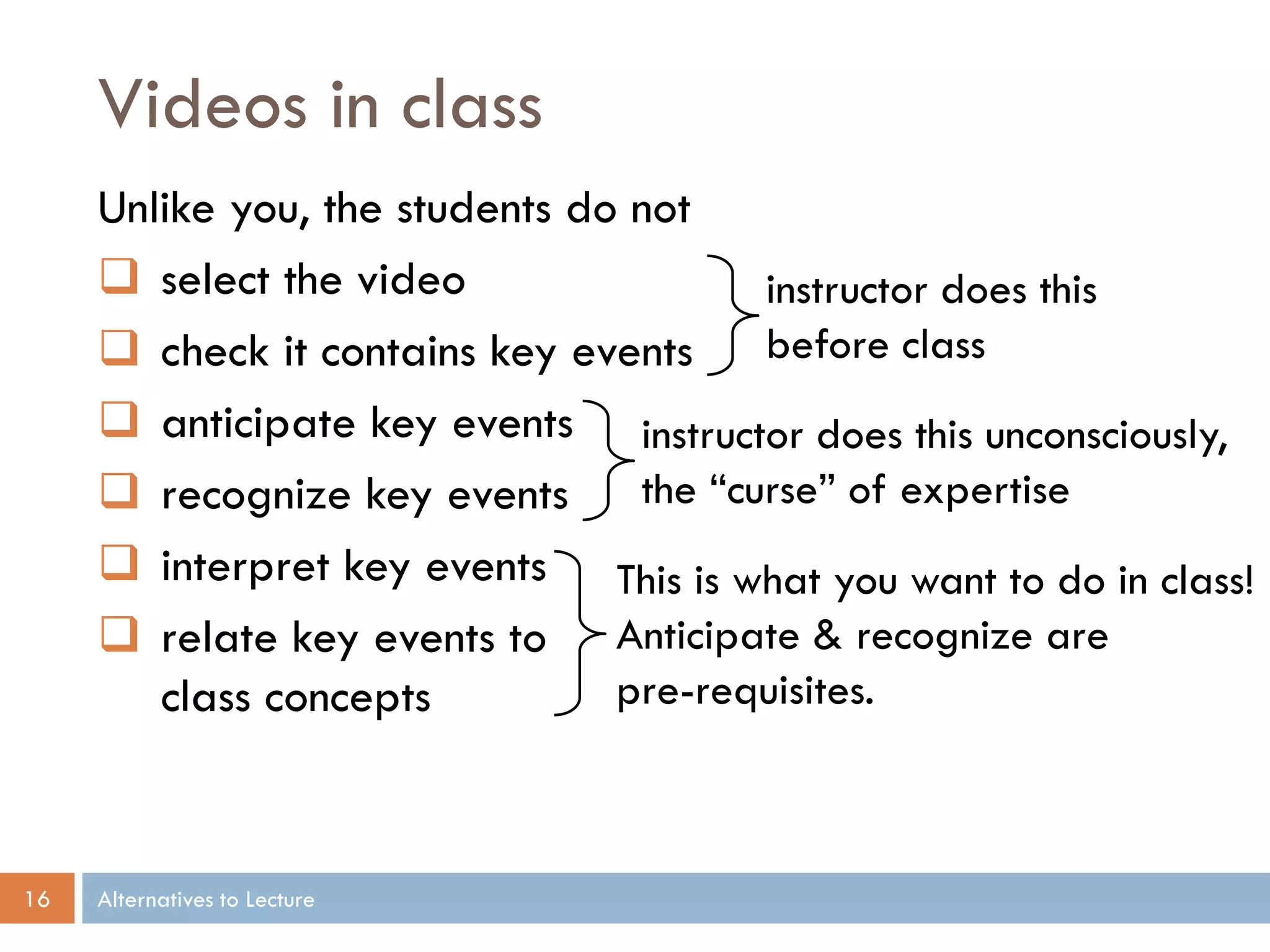
Videos in class
     Unlike you, the students do not
      select the video                instructor does this
      check it contains key events before class
      anticipate key events instructor does this unconsciously,
      recognize key events the “curse” of expertise
      interpret key events This is what you want to do in class!
      relate key events to Anticipate & recognize are
        class concepts          pre-requisites.


16   Alternatives to Lecture
Videos: implications for instructors
      Coach the students how to watch the video like an
       expert:
       As you watch this video, try to…
          watch for when the A starts to B.
          count how often the C does D.
          watch the needles on the scales as water drains.
      Don’t “give away” the key event (Notice the buoyant
       force is equal to the weight of the fluid displaced.)
       That’s what the follow-up discussion is for: help the
       students get prepared for that discussion.

17   Alternatives to Lecture
Alternatives to Lecture


      peer instruction w clickers
      worksheets
      interactive demonstrations
      videos
      surveys of opinions
      reading quizzes
      discussions


18   Alternatives to Lecture
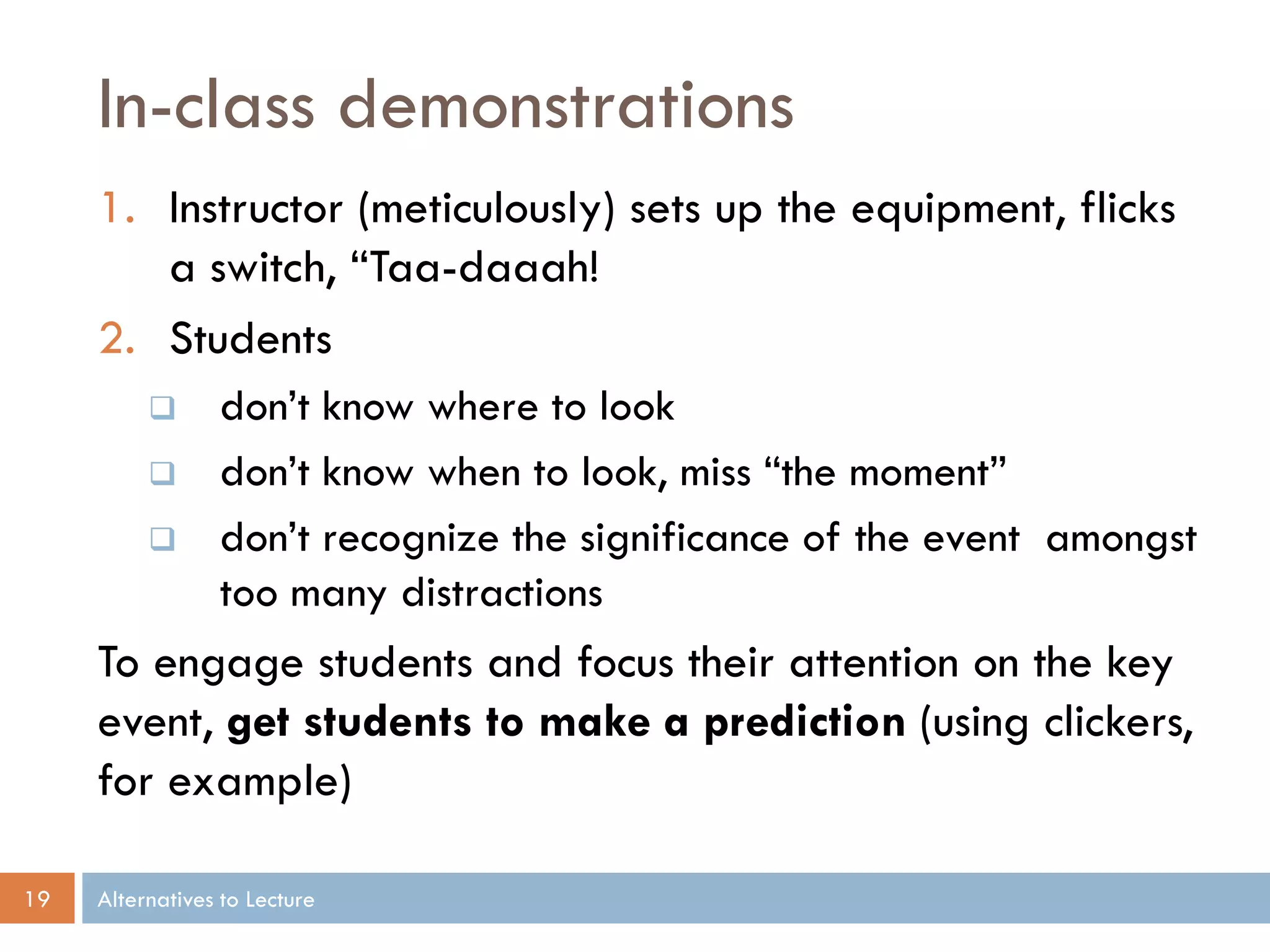
In-class demonstrations
     1. Instructor (meticulously) sets up the equipment, flicks
        a switch, “Taa-daaah!
     2. Students
                don’t know where to look
                don’t know when to look, miss “the moment”
                don’t recognize the significance of the event amongst
                 too many distractions
     To engage students and focus their attention on the key
     event, get students to make a prediction (using clickers,
     for example)

19   Alternatives to Lecture
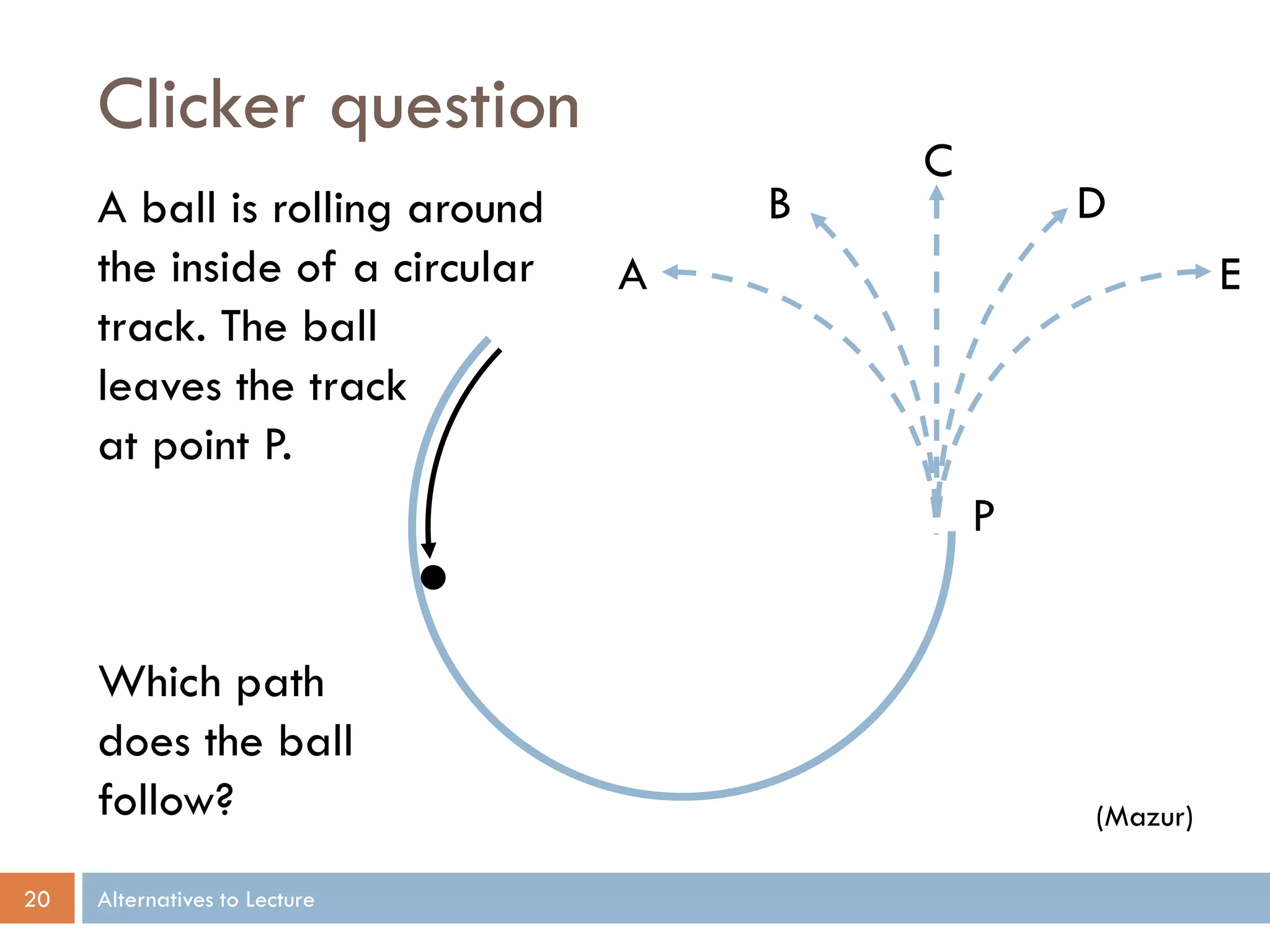
Clicker question
                                        C
     A ball is rolling around       B           D
     the inside of a circular   A                         E
     track. The ball
     leaves the track
     at point P.
                                            P


     Which path
     does the ball
     follow?                                    (Mazur)

20   Alternatives to Lecture
Interactive Lecture Demos (ILD) [3]
     By making a prediction, each student
      cares about the outcome (“Did I get it right?”)
      knows where to look (can anticipate phenomenon)
      knows when to look (sees phenomenon occur)
      gets immediate feedback about his/her
        understanding of the concept
      is prepared for your explanation

      (don’t be afraid to mess with their heads – inclined
       table example)
21   Alternatives to Lecture
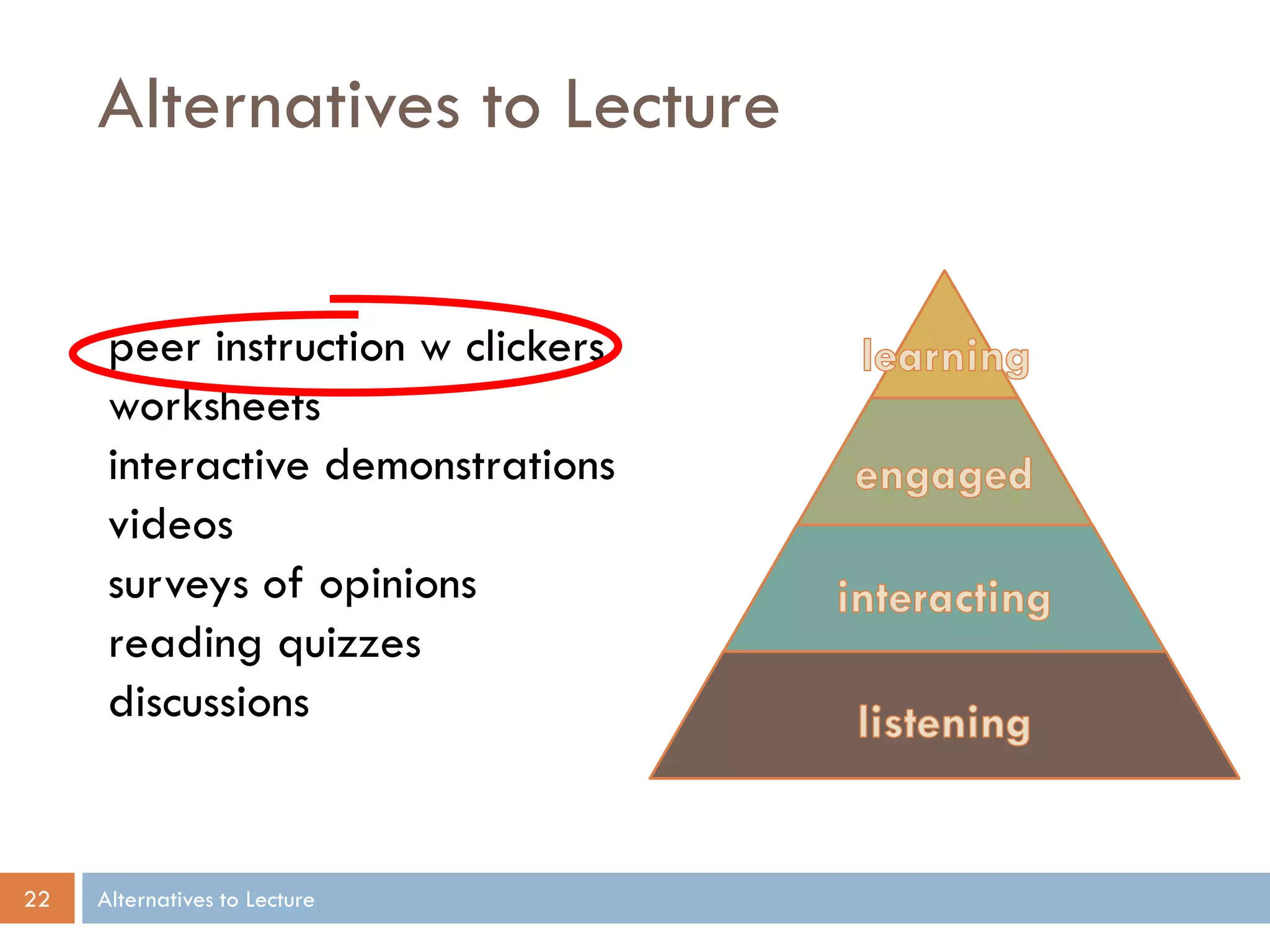
Alternatives to Lecture


      peer instruction w clickers
      worksheets
      interactive demonstrations
      videos
      surveys of opinions
      reading quizzes
      discussions


22   Alternatives to Lecture
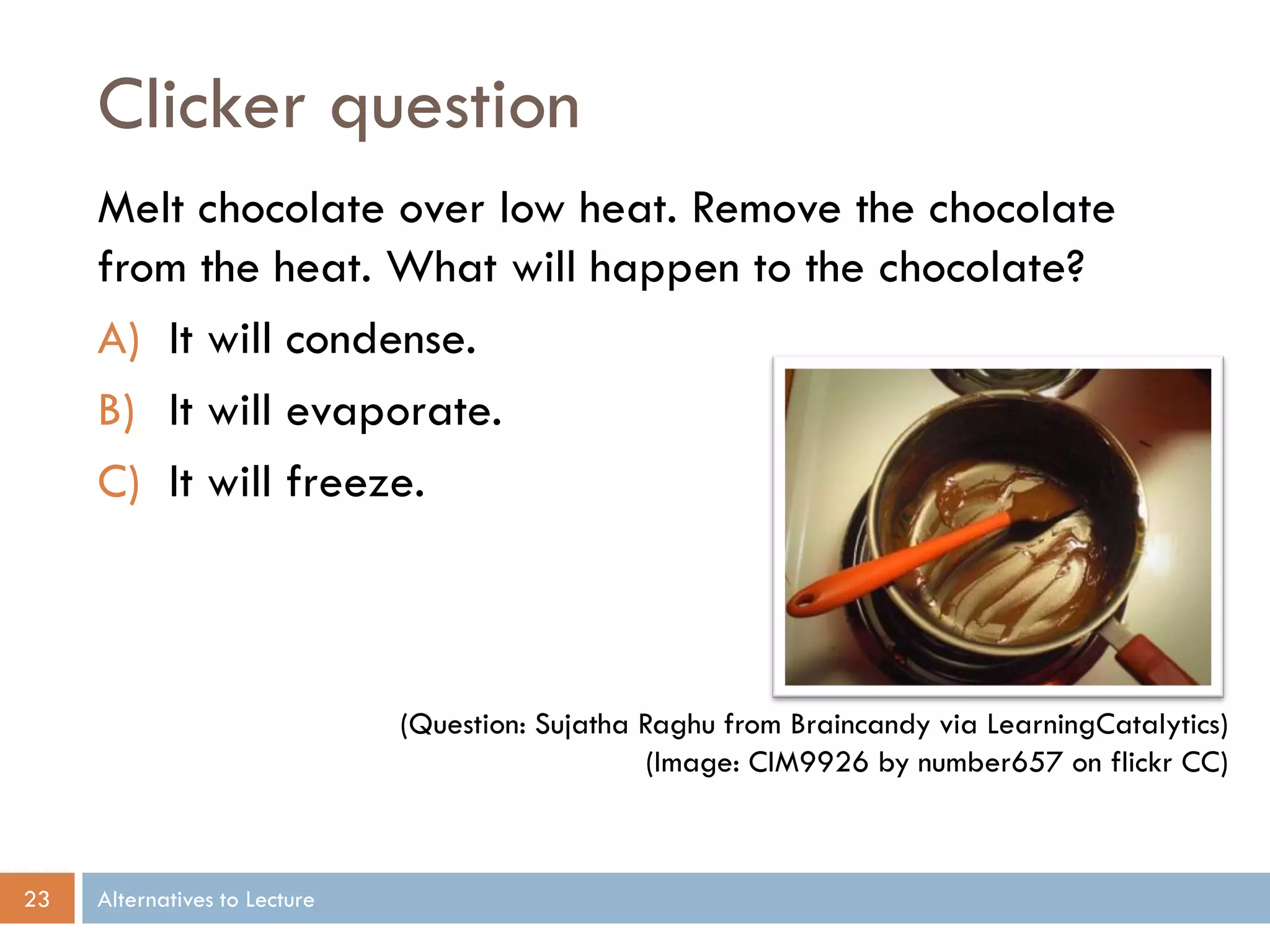
Clicker question
     Melt chocolate over low heat. Remove the chocolate
     from the heat. What will happen to the chocolate?
     A) It will condense.
     B) It will evaporate.
     C) It will freeze.


                               (Question: Sujatha Raghu from Braincandy via LearningCatalytics)
                                                   (Image: CIM9926 by number657 on flickr CC)


23   Alternatives to Lecture
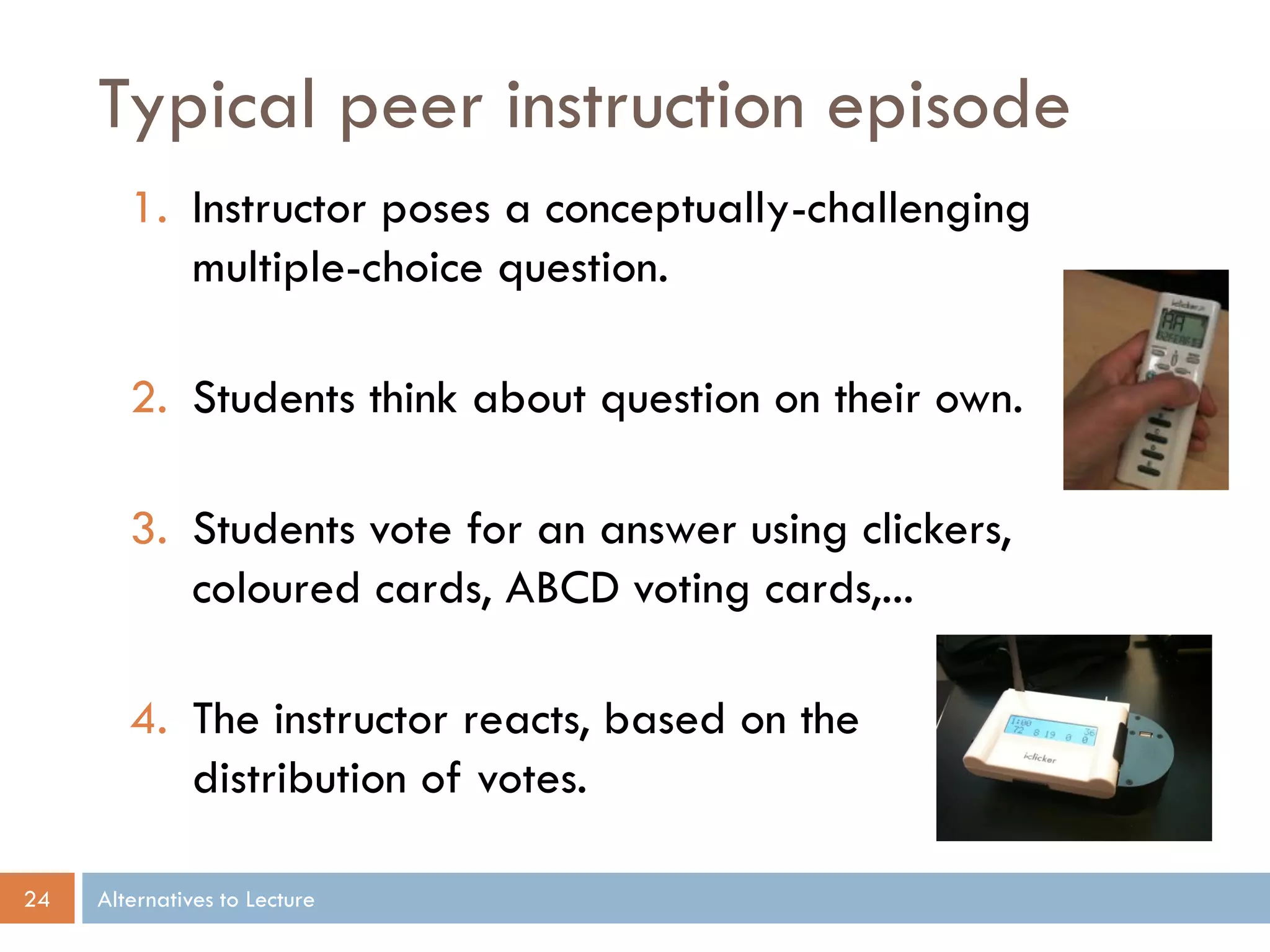
Typical peer instruction episode
        1. Instructor poses a conceptually-challenging
           multiple-choice question.

        2. Students think about question on their own.

        3. Students vote for an answer using clickers,
           coloured cards, ABCD voting cards,...

        4. The instructor reacts, based on the
           distribution of votes.

24   Alternatives to Lecture
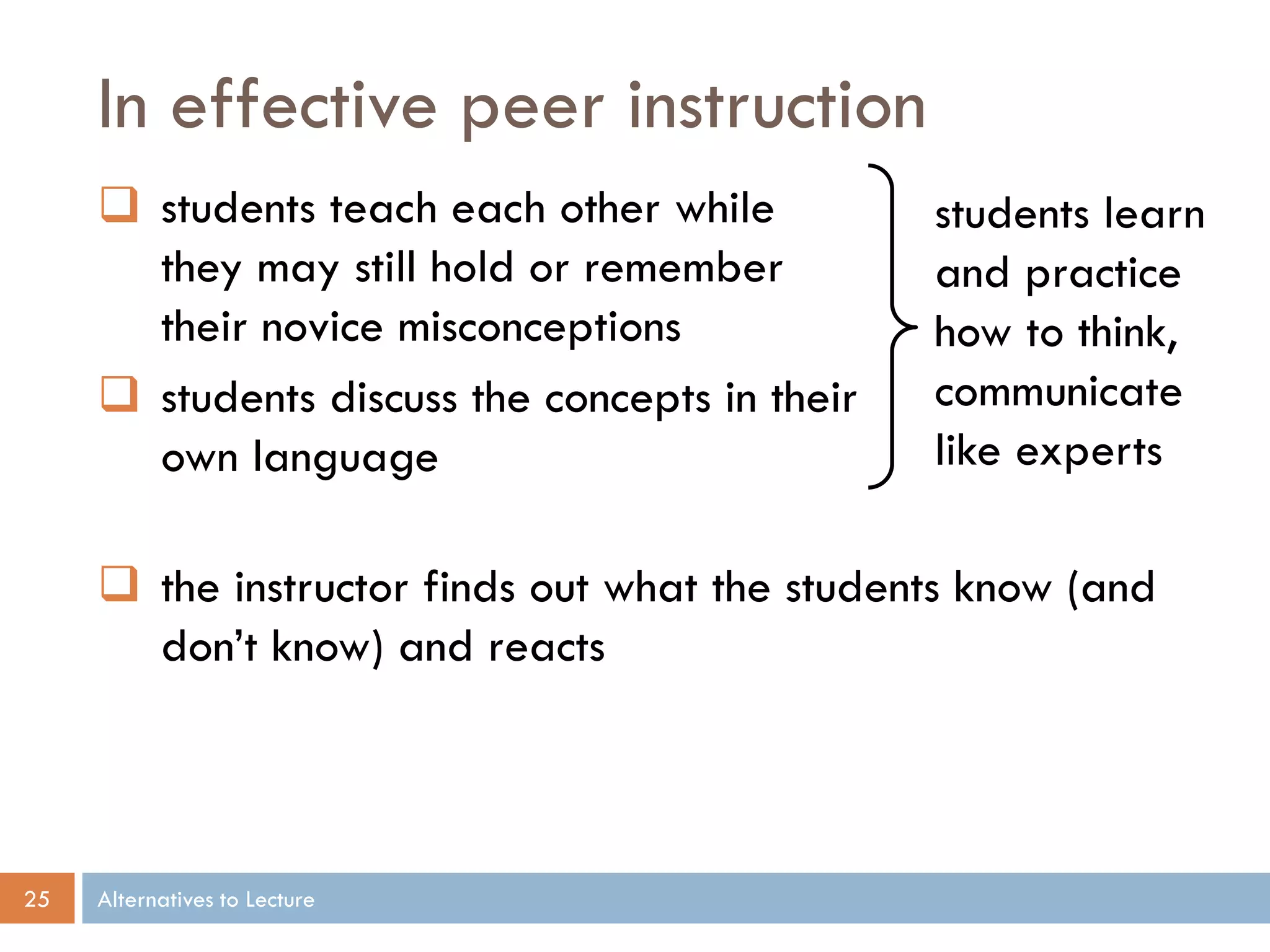
In effective peer instruction
      students teach each other while          students learn
       they may still hold or remember          and practice
       their novice misconceptions              how to think,
      students discuss the concepts in their   communicate
       own language                             like experts

      the instructor finds out what the students know (and
       don’t know) and reacts


25   Alternatives to Lecture
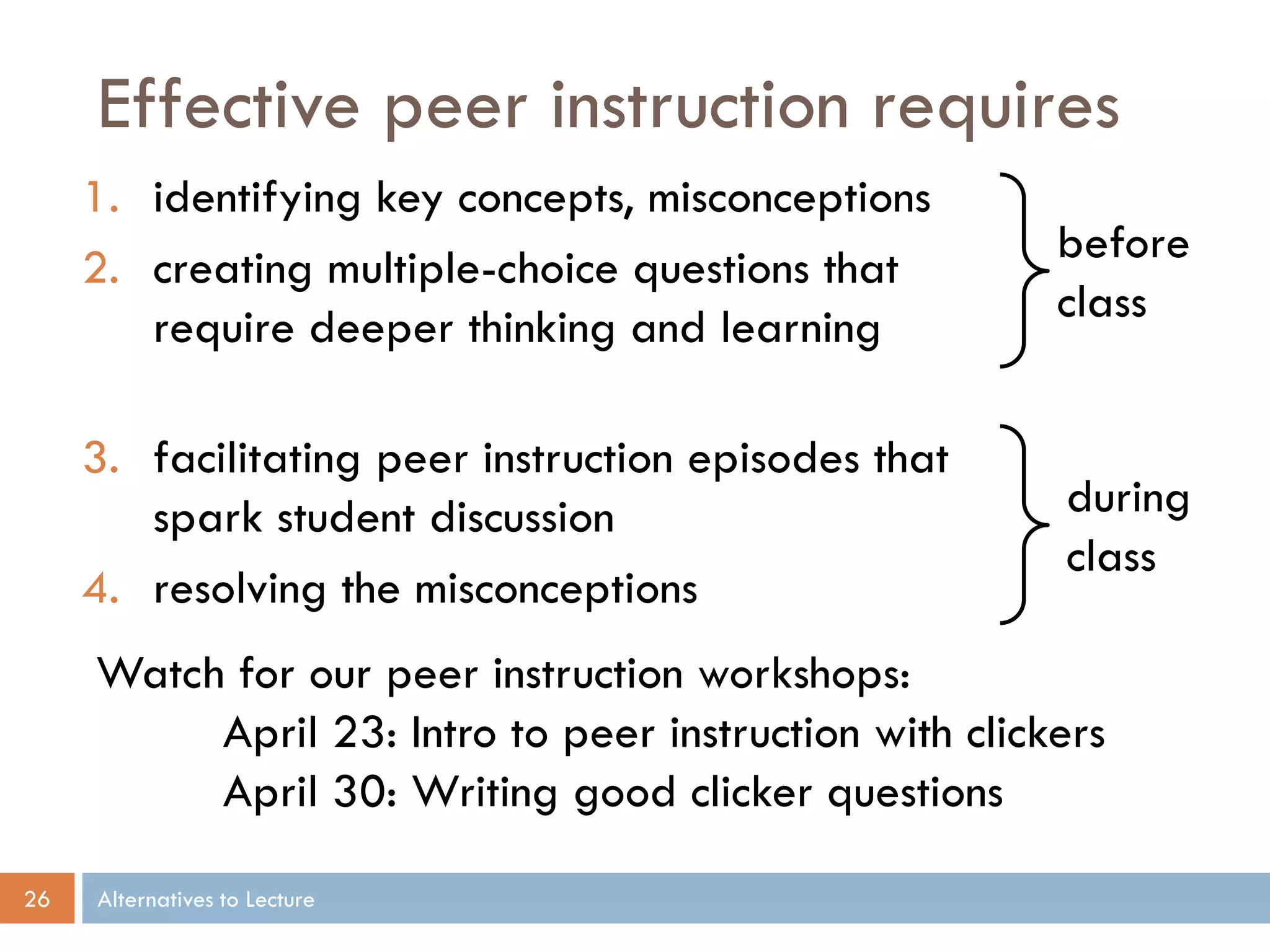
Effective peer instruction requires
     1. identifying key concepts, misconceptions
                                                        before
     2. creating multiple-choice questions that
                                                        class
        require deeper thinking and learning

     3. facilitating peer instruction episodes that
        spark student discussion                        during
                                                        class
     4. resolving the misconceptions
     Watch for our peer instruction workshops:
          April 23: Intro to peer instruction with clickers
          April 30: Writing good clicker questions

26   Alternatives to Lecture
Alternatives to Lecture
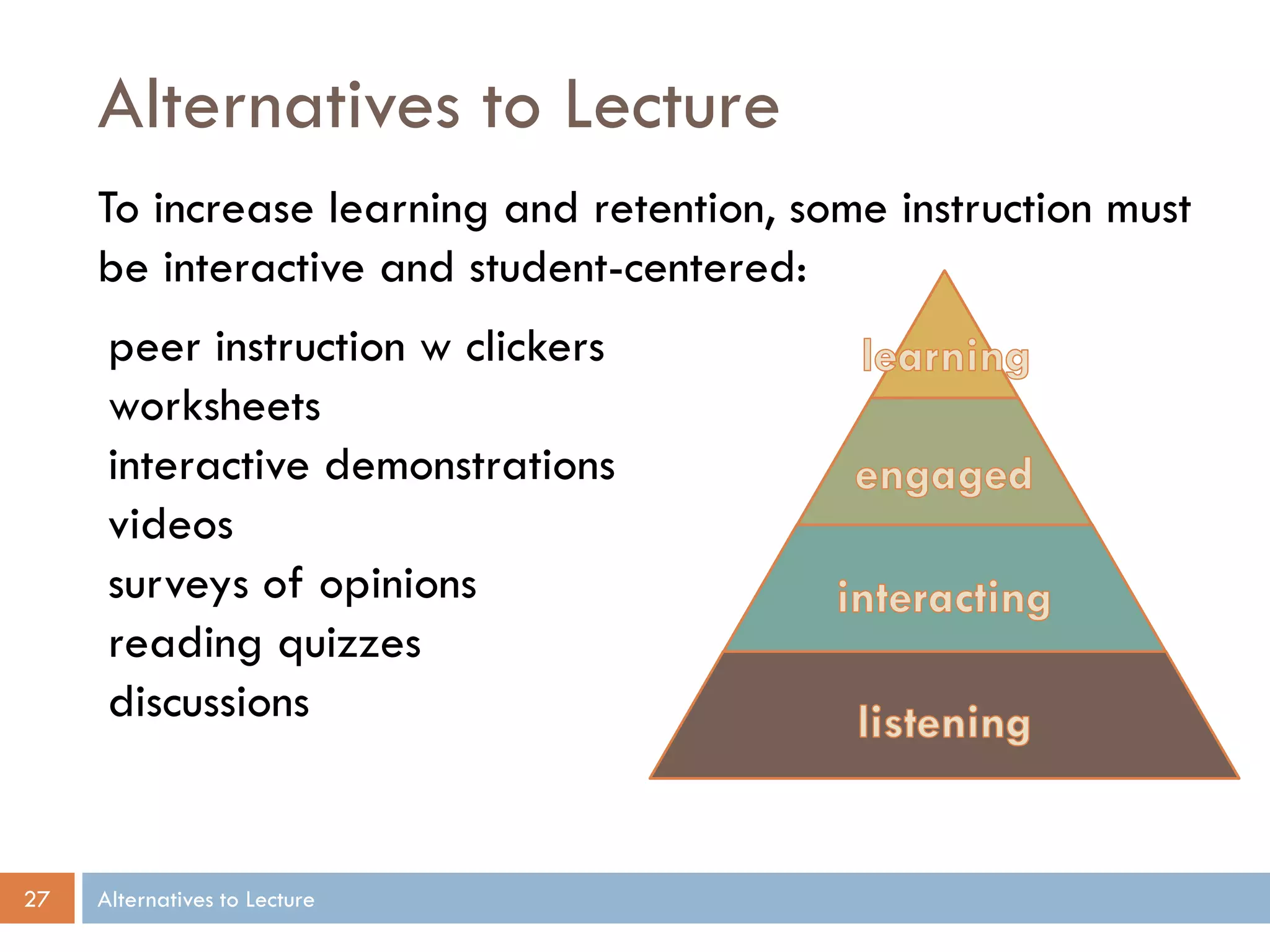
     To increase learning and retention, some instruction must
     be interactive and student-centered:
      peer instruction w clickers
      worksheets
      interactive demonstrations
      videos
      surveys of opinions
      reading quizzes
      discussions


27   Alternatives to Lecture
References
     1. National Research Council (2000). How People Learn: Brain,
        Mind, Experience, and School: Expanded Edition. J.D.
        Bransford, A.L Brown & R.R. Cocking (Eds.),Washington, DC:
        The National Academies Press.
     2. Hake, R.R. (1998). Interactive-engagement versus traditional
        methods: A six-thousand-student survey of mechanics test
        data for introductory physics courses. Am. J. Phys. 66, 64-74.
     3. Get the full story of interactive lecture demos (ILDs) at
        serc.carleton.edu/introgeo/demonstrations/index.html
     4. Prather, E.E., Slater, T.F., Adams, J.P., & Brissenden, G. (2007).
        Lecture Tutorials for Introductory Astronomy. (2e). San
        Francisco, CA: Pearson Addison-Wesley.

28   Alternatives to Lecture
slides and resources: http://tinyurl.com/Alt2LecSp2013

 CTD WEEKLY WORKSHOPS:
 ALTERNATIVES TO LECTURE

            Peter Newbury
            Center for Teaching Development,
            University of California, San Diego
            pnewbury@ucsd.edu              @polarisdotca
            ctd.ucsd.edu                   #ctducsd


            Tuesday, April 16, 2013 11:00 am – 12:00 pm
            Center Hall, Room 316

Alternatives to Lecture

  • 1.
    slides and resources:http://tinyurl.com/Alt2LecSp2013 CTD WEEKLY WORKSHOPS: ALTERNATIVES TO LECTURE Peter Newbury Center for Teaching Development, University of California, San Diego pnewbury@ucsd.edu @polarisdotca ctd.ucsd.edu #ctducsd Tuesday, April 16, 2013 11:00 am – 12:00 pm Center Hall, Room 316
  • 2.
    Key Finding 1 Students come to the classroom with preconceptions about how the world works. If their initial understanding is not engaged, they may fail to grasp the new concepts and information that are taught, or they may learn them for the purposes of a test but revert to their preconceptions outside of the classroom. (How People Learn [1], p. 14) Instructors must draw out students’ Instruction must be pre-existing student-centered. understandings. 2 Alternatives to Lecture
  • 3.
    Key Finding 2 To develop competence in an area, students must: a) have a deep foundation of factual knowledge, b) understand facts and ideas in the context of a conceptual framework, and c) organize knowledge in ways that facilitate retrieval and application. (How People Learn [1], p. 16) These are Instructors need to characteristics of give students opportunities to be expertize more expert-like. 3 Alternatives to Lecture
  • 4.
    Key Finding 3 A “metacognitive” approach to instruction can help students learn to take control of their own learning by defining learning goals and monitoring their progress in achieving them. (How People Learn [1], p. 18) Instructors need to provide opportunities for students to practice being metacognitive – thinking about their own thinking 4 Alternatives to Lecture
  • 5.
    Constructivist theory oflearning Students need to construct their own understanding of the concepts, where  each student assimilates new material into his/her own framework of initial understanding and preconception  each student confronts their understanding of the concepts (metacognition) A traditional, one-way lecture doesn’t give students an opportunity to construct their own knowledge, practice a skill or receive formative feedback. 5 Alternatives to Lecture
  • 6.
    traditional lecture student-centered instruction 6 Alternatives to Lecture
  • 7.
    Alternatives to Lecture peer instruction w clickers worksheets interactive demonstrations videos surveys of opinions reading quizzes discussions 7 Alternatives to Lecture
  • 8.
    In-class worksheets Before beginning an in-class worksheet, be sure the students are properly prepared: Looking at Distant Objects Recall that a light-year (ly) is a distance, the distance light travels in one year (about 9.5 trillion km.) (Wikimedia Commons CC) In groups of 2 or 3, work on the worksheet. Try to ensure everyone in your group agrees on the answer to each question before you write it down. 8 Alternatives to Lecture
  • 9.
    Clicker question Imagine that you simultaneously receive two pictures of two people that live on planets orbiting two different stars. Each picture shows the people at their 21st birthday parties. Which of the following do you think is the most plausible interpretation? A) Both people are the same age but at different distances from you. B) The people are actually different ages but at the same distance from you. C) The person that is closer to you is actually the older of the two people. D) The person that is farther from you is actually the older of the two people. (Prather et. al [4]) 9 Alternatives to Lecture
  • 10.
    In-class worksheets  Worksheets guide students through a concept  students can learn from the worksheet, not just practice a skill  Do not “go over” the worksheet afterwards  encourages students to not do the work and just wait for the answers  Assess their work by, for example, asking a follow-up clicker question  successful on worksheet successful on clicker question (not successful on clicker q not successful on worksheet) 10 Alternatives to Lecture
  • 11.
    In-class worksheets: structure  Worksheet is “stand-alone” and complete.  students can complete it later, do it again when studying  easier to integrate into lessons  First questions are “trivial”  check that student read intro, understands context  gives them confidence to proceed  Last question is the “zinger”  questions build towards the deep question, each one building the skill needed to answer next question  Plenty of opportunity for formative feedback 11 Alternatives to Lecture
  • 12.
    In-class worksheet: resources Washington Tutorials (physics) www.phys.washington.edu/groups/peg/tut.html Lecture-Tutorials for Introductory Astronomy astronomy101.jpl.nasa.gov/teachingstrategies/teachingdetails/?StrategyID=9 Format and structure can be adapted to other fields: (use the astronomy Lecture-Tutorials as a template) 12 Alternatives to Lecture
  • 13.
    Alternatives to Lecture peer instruction w clickers worksheets interactive demonstrations videos surveys of opinions reading quizzes discussions 13 Alternatives to Lecture
  • 14.
    Showing video inclass There are times when a video is the perfect resource. Archimedes’ Principle In today’s Physics class, we’re going to study buoyancy and Archimedes’ Principle. http://tinyurl.com/TCCdemo (Paul Hewitt video) (Image: Wikimedia Commons – public domain) 14 Alternatives to Lecture
  • 15.
    Opinion: Videos inclass In your opinion, the Paul Hewitt video  is engaging?  is entertaining?  is interactive?  stimulates deep thinking? 15 Alternatives to Lecture
  • 16.
    Videos in class Unlike you, the students do not  select the video instructor does this  check it contains key events before class  anticipate key events instructor does this unconsciously,  recognize key events the “curse” of expertise  interpret key events This is what you want to do in class!  relate key events to Anticipate & recognize are class concepts pre-requisites. 16 Alternatives to Lecture
  • 17.
    Videos: implications forinstructors  Coach the students how to watch the video like an expert: As you watch this video, try to… watch for when the A starts to B. count how often the C does D. watch the needles on the scales as water drains.  Don’t “give away” the key event (Notice the buoyant force is equal to the weight of the fluid displaced.) That’s what the follow-up discussion is for: help the students get prepared for that discussion. 17 Alternatives to Lecture
  • 18.
    Alternatives to Lecture peer instruction w clickers worksheets interactive demonstrations videos surveys of opinions reading quizzes discussions 18 Alternatives to Lecture
  • 19.
    In-class demonstrations 1. Instructor (meticulously) sets up the equipment, flicks a switch, “Taa-daaah! 2. Students  don’t know where to look  don’t know when to look, miss “the moment”  don’t recognize the significance of the event amongst too many distractions To engage students and focus their attention on the key event, get students to make a prediction (using clickers, for example) 19 Alternatives to Lecture
  • 20.
    Clicker question C A ball is rolling around B D the inside of a circular A E track. The ball leaves the track at point P. P Which path does the ball follow? (Mazur) 20 Alternatives to Lecture
  • 21.
    Interactive Lecture Demos(ILD) [3] By making a prediction, each student  cares about the outcome (“Did I get it right?”)  knows where to look (can anticipate phenomenon)  knows when to look (sees phenomenon occur)  gets immediate feedback about his/her understanding of the concept  is prepared for your explanation  (don’t be afraid to mess with their heads – inclined table example) 21 Alternatives to Lecture
  • 22.
    Alternatives to Lecture peer instruction w clickers worksheets interactive demonstrations videos surveys of opinions reading quizzes discussions 22 Alternatives to Lecture
  • 23.
    Clicker question Melt chocolate over low heat. Remove the chocolate from the heat. What will happen to the chocolate? A) It will condense. B) It will evaporate. C) It will freeze. (Question: Sujatha Raghu from Braincandy via LearningCatalytics) (Image: CIM9926 by number657 on flickr CC) 23 Alternatives to Lecture
  • 24.
    Typical peer instructionepisode 1. Instructor poses a conceptually-challenging multiple-choice question. 2. Students think about question on their own. 3. Students vote for an answer using clickers, coloured cards, ABCD voting cards,... 4. The instructor reacts, based on the distribution of votes. 24 Alternatives to Lecture
  • 25.
    In effective peerinstruction  students teach each other while students learn they may still hold or remember and practice their novice misconceptions how to think,  students discuss the concepts in their communicate own language like experts  the instructor finds out what the students know (and don’t know) and reacts 25 Alternatives to Lecture
  • 26.
    Effective peer instructionrequires 1. identifying key concepts, misconceptions before 2. creating multiple-choice questions that class require deeper thinking and learning 3. facilitating peer instruction episodes that spark student discussion during class 4. resolving the misconceptions Watch for our peer instruction workshops: April 23: Intro to peer instruction with clickers April 30: Writing good clicker questions 26 Alternatives to Lecture
  • 27.
    Alternatives to Lecture To increase learning and retention, some instruction must be interactive and student-centered: peer instruction w clickers worksheets interactive demonstrations videos surveys of opinions reading quizzes discussions 27 Alternatives to Lecture
  • 28.
    References 1. National Research Council (2000). How People Learn: Brain, Mind, Experience, and School: Expanded Edition. J.D. Bransford, A.L Brown & R.R. Cocking (Eds.),Washington, DC: The National Academies Press. 2. Hake, R.R. (1998). Interactive-engagement versus traditional methods: A six-thousand-student survey of mechanics test data for introductory physics courses. Am. J. Phys. 66, 64-74. 3. Get the full story of interactive lecture demos (ILDs) at serc.carleton.edu/introgeo/demonstrations/index.html 4. Prather, E.E., Slater, T.F., Adams, J.P., & Brissenden, G. (2007). Lecture Tutorials for Introductory Astronomy. (2e). San Francisco, CA: Pearson Addison-Wesley. 28 Alternatives to Lecture
  • 29.
    slides and resources:http://tinyurl.com/Alt2LecSp2013 CTD WEEKLY WORKSHOPS: ALTERNATIVES TO LECTURE Peter Newbury Center for Teaching Development, University of California, San Diego pnewbury@ucsd.edu @polarisdotca ctd.ucsd.edu #ctducsd Tuesday, April 16, 2013 11:00 am – 12:00 pm Center Hall, Room 316