Group Members-
 SS/16/011 EMIC JAYALAL
 SS/16/13 YELANI GUNASEKARA
 SS/16/017 SS PAHALAWATTE
• History
• Company Profile
• Mission & Vision
• Market Share
• Claim as ethical business
• Supplier guiding principle
• Quality and promises
• Unethical practices by cola
• Unethical nature by cola
• Excessive water usage ( kerala)
• Corporate governance mechanism by cola
• Case study base question
Road Map
3
1886 1891
Coca Cola
BORNIn a drug store
Coca Cola’s first
BOTTLING
occurred
4
1899
Thefirst bottling
AGREEMENT
wasdone
1909
400 Coca-Colaplants
BOTTLING
were operating
5
1930
Thecompany started moving
GLOBALY
1960
New
BRANDS
were Introduced
6
Salesfor the first year wereonly
$50
7
Now number of cokebottles sold eachday
1.8 billion
8
Coca-Cola
Isthe most recognized wordin the worldafter
Okay
9
Total number of Coca-Cola
Products
3,500
10
Number of worldwide Coke
employees
100,000
11
Company Profile 12
Name TheCoca ColaCompany
Industries served Beverages
Geographic areasserved Worldwide
Headquarters Atlanta, Georgia,U.S.
CurrentCEO James Quincey
Revenue 41.86 billion USD
2016
Profit $12.16 billion
2016
Employees 100,000
Coca Cola In India
 • Coca-Cola, the corporate nourishing global community with the worlds
largest selling soft drink concentrates since 1886, returns to India in 1993
after a gap of 16 years.
 • With the acquisitions of major brands in India it went on to be known as
The Hindustan Coca Cola Beverages Pvt Ltd.
 Hindustan Coca-Cola Beverages Private Limited is a 100% company
owned Bottler. • The company has 3 business regions, and operates out of
22 locations across India. • Their business model includes manufacturing
the beverage,
13
Company profile
 Coca- cola was India’s leading soft rink unit in 1977.when it was ‘kicked
out’ of India after a new Janata Government when came to the power.
India after it refuse to reveal its secret formula of coca- cola and dilute its
stake in its Indian unit as required by the foreign exchange regulation Act.
 On its return in 1993, it took over ownership of the nation’s top soft- drink
brands.it bought out for Rs3500 million a clutch of popular Indian soft
drinks brands including Thums up, Limca, Citra etc. which enabled them to
get 66% market share.
Cont.;
 The vast Indian operation comprises 25 wholly company owned bottling
operations and another 24 franchisee owned bottling operations.
 In India the company directly employees approximately 6,000 people and
indirectly creates employment for more than 125,000 people in related
industries though their vast procument,supply and distribution system.
15
Vision 16
• People: Beagreat place to work where peopleare
inspired to be the best they canbe.
• Portfolio: Bring to the world aportfolio of quality
beverage brands that anticipate and satisfy
people's desires and needs.
• Partners: Nurture awinning network of customers
and suppliers, together we create mutual, enduring
value.
Vision 17
• Planet: Bearesponsible citizen that makesa
difference by helping build and support sustainable
communities.
• Profit: Maximize long-term return to shareowners
while being mindful of our overallresponsibilities.
• Productivity: Beahighly effective, lean and fast-
moving organization.
 Leadership: The courage to shape a better future
 Collaboration: Leverage collective genius
 Integrity: Be real
 Accountability: If it is to be, it's up to me
 Passion: Committed in heart and mind
 Diversity: As inclusive as our brands
 Quality: What we do, we do well
Values 18
The Coca Cola Company Mission
To refresh the world in mind, body
and spirit
To inspire moments of optimism and
happiness through our brands and
actions
To create value and make a
difference
19
Worldwide Share 20
Marketing Mix 4Ps
21
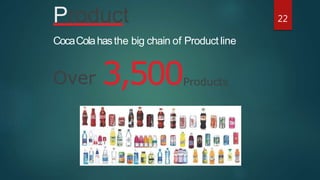
Product 22
CocaColahasthe big chain of Product line
Over 3,500Products
Price 23
Earlier Cokeused cost based pricing
Ascompetition started, now Cokehasshifted to
competitive pricing
strategy
VS
Place
Target Market is Entire Planet
24
Segmentation
Coke’s commercials basically based
on young generations.
25
Promotion 26
•Getting shelvesat EyeCatching Position
•Print media
•Tvcommercials
•Billboards and holdingsetc
27
Coca cola claim of ethical business
 Code of business conduct- this code serve as guide to company’s actions,
advancing and protecting core values of honesty, Honesty, Integrity,
Diversity, Quality, Respect , Responsibility and Accountability.
 Environmental policy: It promises to operate company`s facilities taking
into account all applicable environment safely and health rule.
28
Supplier Guiding principals
The Company expects supplier to follow the following principles
 Built on the Compliance of Perfection: Company claims that it is built on
trust.
 Good corporate citizenship for long term business success.
 Share value as foundation of relationship.
 Fair employment practice with employees with a commitment to human
right, at workplace.
29
Cont.’
 Better communication with employees in local language and posted in a accessible place.
 Provide better working environment within the organization.
 Safe workplace with policies and practice in place.
 Employ labor under legal working age and protection from unlawful abuse or harassment.
 Compensate fair wages and benefits to employees.
 The company expects suppliers to conduct business in a way that protect and preserve the
environment
30
Quality and promises
 Keeping high quality promise in marketplace is their long term business
objective.
 Coca cola is a brand of refreshment because of-
1. The symbol of quality
2. Customer and consumer satisfaction
3. A responsible citizen of the world
 Company promises to provide consistently attractive return to the owners
and to their business.
31
Unethical practices by Coca Cola
Several complaints against company`s operations and its business:
Lack of transparency and Accountability:
 The company is not listed on stock exchange. Unlisting enables flexibility to company to hide
their unethical decisions and wrong practices.
 De-listing kills competition and hides true picture of unethical practices such as manufacturing
cost or pricing policies.
 Company can escape the inspection of the investors, analyst and the media
32
Lack of Marketing Ethics
The company accused of adopting unethical marketing practices such as
 Offering products/services against the interest of society.
 Discrimination in pricing
 Making tall claims in advertising
 Misleading sales promotion
 Targeting inappropriate audience like children
33
Unhealthy Practice
 The company had provoked a no. of boycotts and protests as a result of
its perceived low health and hygiene standards and adverse impact on the
environment.
 The contamination by high level of cadmium, lead and chromium found in
effluent sludge of 8 out of 16 bottling plants was much more in excess to
the acceptable central pollution control board(CPCB) standards.
 The company has been the subject of allegation such as monopolistic
practices and racist employment practice
34
Unhealthy nature of Colas
 FDA in Mumbai has advised school to ban the sale of colas, and also
prevent any advertisement of aerated drinks in their premises.
 FDA commissioner Ramesh Kumar warms that soft drinks cause obesity
and tooth decay, besides posing other health risk due to presence of
chemical, such as Landane, a confirmed cancer causing chemical,
Malathion, DDT and Chlorpyrifos
 American Epidemiologist reported that colas are associated with bone
mineral density loss and their consumption may increase osteoporosis risk
in older women
35
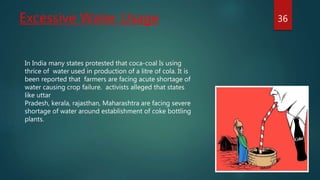
Excessive Water Usage 36
In India many states protested that coca-coal Is using
thrice of water used in production of a litre of cola. It is
been reported that farmers are facing acute shortage of
water causing crop failure. activists alleged that states
like uttar
Pradesh, kerala, rajasthan, Maharashtra are facing severe
shortage of water around establishment of coke bottling
plants.
kerala
 In 1998,coca-cola`s bottling plant was set up at plachimada,Kerala. Local
villagers been complain of depleting water level for their cultivation.
 Company dumped waste sludge on land of local farmer claiming it as
useful fertilizer. Research found that it contain toxic chemicals including
lead and cadmium.
 On 15-01-2005,over 1000 people took part in blockading the entrance of
the plant to shut down permanently.
 The day also marked 1000`th day anniversary of permanent dharna(vigil)
in front of factory gate.
 The plant remained shut down over a year due to intense community
pressure.
37
Cont.
 In other states almost the scene was same. there was one major issue
linked with every state and that was shortage of water for irrigation
process as water level drops to a significant amount.
38
Coca cola claim of ethical business
 Code of business conduct- this code serve as guide to company’s actions,
advancing and protecting core values of honesty, Integrity, Diversity,
Quality, Respect , Responsibility and Accountability.
 Environmental policy: It promises to operate company`s facilities taking
into account all applicable environment safely and health rule.
39
Supplier Guiding principals
The Company expects supplier to follow the following principles
 Built on the Compliance of Perfection: Company claims that it is built on
trust.
 Good corporate citizenship for long term business success.
 Share value as foundation of relationship.
 Fair employment practice with employees with a commitment to human
right, at workplace.
40
Cont.’
 Better communication with employees in local language and posted in a accessible place.
 Provide better working environment within the
 organization.
 Safe workplace with policies and practice in place.
 Employ labor under legal working age and protection from unlawful abuse or harassment.
 Compensate fair wages and benefits to employees.
 The company expects suppliers to conduct business in a way that protect and preserve the
environment
41
Quality and promises
 Keeping high quality promise in marketplace is their long term business
objective.
 Coca cola is a brand of refreshment because of-
1. The symbol of quality
2. Customer and consumer satisfaction
3. A responsible citizen of the world
 Company promises to provide consistently attractive return to the owners
and to their business.
42
Unethical practices by Coca Cola
Several complaints against company`s operations and its business:
Lack of transparency and Accountability:
 The company is not listed on stock exchange. Unlist enables flexibility to company to hide their
unethical decisions and wrong practices.
 De-listing kills competition and hides true picture of unethical practices such as manufacturing
cost or pricing policies.
 Company can escape the inspection of the investors, analyst and the media
43
Lack of Marketing Ethics
The company accused of adopting unethical marketing practices such as
 Offering products/services against the interest of society.
 Discrimination in pricing
 Making tall claims in advertising
 Misleading sales promotion
 Targeting inappropriate audience like children
44
Unhealthy Practice
 The company had provoked a no. of boycotts and protests as a result of
its perceived low health and hygiene standards and adverse impact on the
environment.
 The contamination by high level of cadmium, lead and chromium found in
effluent sludge of 8 out of 16 bottling plants was much more in excess to
the acceptable central pollution control board(CPCB) standards.
 The company has been the subject of allegation such as monopolistic
practices and racist employment practice
45
Unhealthy nature of Colas
 FDA in Mumbai has advised school to ban the sale of colas, and also
prevent any advertisement of aerated drinks in their premises.
 FDA commissioner Ramesh Kumar warms that soft drinks cause obesity
and tooth decay, besides posing other health risk due to presence of
chemical, such as Landane, a confirmed cancer causing chemical,
Malathion, DDT and Chlorpyrifos
 American Epidemiologist reported that colas are associated with bone
mineral density loss and their consumption may increase osteoporosis risk
in older women
46
Excessive Water Usage 47
In India many states protested that coca-coal Is using
thrice of water used in production of a litre of cola. It is
been reported that farmers are facing acute shortage of
water causing crop failure. activists alleged that states
like uttar
Pradesh, kerala, rajasthan, Maharashtra are facing severe
shortage of water around establishment of coke bottling
plants.
kerala
 In 1998,coca-cola`s bottling plant was set up at plachimada,Kerala. Local
villagers been complain of depleting water level for their cultivation.
 Company dumped waste sludge on land of local farmer claiming it as
useful fertilizer. Research found that it contain toxic chemicals including
lead and cadmium.
 On 15-01-2005,over 1000 people took part in blockading the entrance of
the plant to shut down permanently.
 The day also marked 1000`th day anniversary of permanent dharna(vigil)
in front of factory gate.
 The plant remained shut down over a year due to intense community
pressure.
48
Cont.
 In other states almost the scene was same. there was one major issue
linked with every state and that was shortage of water for irrigation
process as water level drops to a significant amount.
49
Corporate governance for Coca-Cola
 Corporate governance policies include
1. Annual evaluation of the CEO’s performance and the board performance as a whole
2. Guidelines on how a director is determine to be independent from the Coca-Cola company
 Ethical disputes handle by
1. Creating community programed world wide
2. Hiring public relations companies to contest disputes
3. Establishing complaint hotlines
50
Cont.
 Company activities
1. Created programs for HIV and AIDS testing, treatment, and prevention in
Haiti and South Africa
2. Started using plantbottle
3. Reusing recycled cans and bottles
 Coca- cola is also facing ethical issues;
1. Over consumption of water at overseas factories
2. Pesticides from water suppliers
3. Health concern (tooth decay, weight gain )
51
Question 1
The Cola controversy in India
 A debate over water usage, accusation over pesticide content and
sweeteners, as well as more general concerns in India over the
unhealthiness of fizzy drinks are plaguing the brand.
 “Coca-Cola has never been a stranger to controversy” says N
Chandramouli who is a brand expert and the chief executive of Trust
Research Advisory.
 The boycott of Atlanta-based Coca-Cola and its rivals PepsiCo.
 The ongoing battle between farmers and industries for water in India.
 Coca-Cola being withdrawn from the country in1977.
 Retailers can earn higher margins on local brands.
52
Cont.
 It is a known fact that multi national companies like Coca-Cola and
PepsiCo adopt different standards when it comes to the use of materials in
their soft drinks.
 Developed countries such as the united states of America sources inputs
with a higher standard in the production while developing countries like
India uses materials with a low quality.
 The lower the quality of the materials used in the production, the higher
the risks associated.
53
Question 2
 Firstly it is stated in the case study that the soft drinks are not the only
products that had shown pesticide residues greater than the permissible
values imposed by the European Union.
 It was stated also that Cola companies have cited government surveys to
have revealed that day to day products such as milk having 3080 times
higher, vegetables having 69700 times higher and fruits having 111600
times higher pesticide residue.
 Thus it would not unfair for just soft drinks to be banned.
54
 In 2003 a non-profit organization, the Center for Science an Environment, pointed out that the carbonated drinks produced
by soft drink manufacturers in India including the multinational giants Coca cola an Pepsi co. contained toxins including
Lindane, ddt, malathion and chlorpyrifos. All which are pesticides that may contribute to the development of cancer and
breakdown of the human immune system.
 CSE claimed to have found pesticide residues up to 36 times the levels permitted under European Union regulations in
Pepsi's soft drinks and 30 times the amount in Cola products. It also claimed that the same products tested in the united
states had no such residue.
 With this bad publicity Coca – Cola had already registered a 15 percent drop in sales. Angered by this Coca Cola and
PepsiCo though firmly denied the validity of the claims made by the CSE. The companies launched an aggressive
campaigned against the study stating that it is unscientific an biased. They also accused the director of the CES of
‘brandjacking’( making use of the Cola brand name to draw attention to CES campaign.
 All this let to the initiation of a political storm that in turn led to the initiation of a parliamentary committee to look into the
charges. The analysis carried out by this committee reported the confirmation of the claims made by the CES and were
praised for its findings.
 This led to the increase of the regulations imposed by the government.
 However Cola and PepsiCo continued to sell the products even though it was labeled dangerous. This was adequately
proved by an august 2006 study by the CES
55
 In their defense Coca – Cola and Pepsi claimed their soft drinks to be safe and conform
to all Indian and international standards. They also argued that other foodstuff like tea
and milk also contain pesticide levels higher than that permissible but only their product
was getting all the unwanted attention.
 While the arch rivals in the industry, coca cola and Pepsi worked together to prove the
CES findings to be unscientific and biased the general public seem to sympathize with
those affected by the unhealthy products.
 This became a much larger problem when the American Ambassidor to india cautioned
that the bad reports and actions against cola companies would adversely affect
American investments in India.
 Within india too there was some opposition to the move to ban the soft drinks. Their
were two parties, one against and the other for the banning of the product
 The expert committee which reviewed the CES report on its second report said ‘The
committee has concluded that based on the information and data provided earlier and
subsequently by the CES, the results obtained cannot be accepted on its face value
and data provided ‘ and a ban was not imposed
56
References
 www.coca-cola.com/global/
 https://www.kibin.com
 www.123helpme.com
 www.essay.uk.com › Free essays › Business essays
 https://www.majortests.com/essay/The-Coca-Cola-Company-560488.html
57

Coca cola case study

  • 2.
    Group Members-  SS/16/011EMIC JAYALAL  SS/16/13 YELANI GUNASEKARA  SS/16/017 SS PAHALAWATTE
  • 3.
    • History • CompanyProfile • Mission & Vision • Market Share • Claim as ethical business • Supplier guiding principle • Quality and promises • Unethical practices by cola • Unethical nature by cola • Excessive water usage ( kerala) • Corporate governance mechanism by cola • Case study base question Road Map 3
  • 4.
    1886 1891 Coca Cola BORNIna drug store Coca Cola’s first BOTTLING occurred 4
  • 5.
  • 6.
  • 7.
    Salesfor the firstyear wereonly $50 7
  • 8.
    Now number ofcokebottles sold eachday 1.8 billion 8
  • 9.
    Coca-Cola Isthe most recognizedwordin the worldafter Okay 9
  • 10.
    Total number ofCoca-Cola Products 3,500 10
  • 11.
    Number of worldwideCoke employees 100,000 11
  • 12.
    Company Profile 12 NameTheCoca ColaCompany Industries served Beverages Geographic areasserved Worldwide Headquarters Atlanta, Georgia,U.S. CurrentCEO James Quincey Revenue 41.86 billion USD 2016 Profit $12.16 billion 2016 Employees 100,000
  • 13.
    Coca Cola InIndia  • Coca-Cola, the corporate nourishing global community with the worlds largest selling soft drink concentrates since 1886, returns to India in 1993 after a gap of 16 years.  • With the acquisitions of major brands in India it went on to be known as The Hindustan Coca Cola Beverages Pvt Ltd.  Hindustan Coca-Cola Beverages Private Limited is a 100% company owned Bottler. • The company has 3 business regions, and operates out of 22 locations across India. • Their business model includes manufacturing the beverage, 13
  • 14.
    Company profile  Coca-cola was India’s leading soft rink unit in 1977.when it was ‘kicked out’ of India after a new Janata Government when came to the power. India after it refuse to reveal its secret formula of coca- cola and dilute its stake in its Indian unit as required by the foreign exchange regulation Act.  On its return in 1993, it took over ownership of the nation’s top soft- drink brands.it bought out for Rs3500 million a clutch of popular Indian soft drinks brands including Thums up, Limca, Citra etc. which enabled them to get 66% market share.
  • 15.
    Cont.;  The vastIndian operation comprises 25 wholly company owned bottling operations and another 24 franchisee owned bottling operations.  In India the company directly employees approximately 6,000 people and indirectly creates employment for more than 125,000 people in related industries though their vast procument,supply and distribution system. 15
  • 16.
    Vision 16 • People:Beagreat place to work where peopleare inspired to be the best they canbe. • Portfolio: Bring to the world aportfolio of quality beverage brands that anticipate and satisfy people's desires and needs. • Partners: Nurture awinning network of customers and suppliers, together we create mutual, enduring value.
  • 17.
    Vision 17 • Planet:Bearesponsible citizen that makesa difference by helping build and support sustainable communities. • Profit: Maximize long-term return to shareowners while being mindful of our overallresponsibilities. • Productivity: Beahighly effective, lean and fast- moving organization.
  • 18.
     Leadership: Thecourage to shape a better future  Collaboration: Leverage collective genius  Integrity: Be real  Accountability: If it is to be, it's up to me  Passion: Committed in heart and mind  Diversity: As inclusive as our brands  Quality: What we do, we do well Values 18
  • 19.
    The Coca ColaCompany Mission To refresh the world in mind, body and spirit To inspire moments of optimism and happiness through our brands and actions To create value and make a difference 19
  • 20.
  • 21.
  • 22.
    Product 22 CocaColahasthe bigchain of Product line Over 3,500Products
  • 23.
    Price 23 Earlier Cokeusedcost based pricing Ascompetition started, now Cokehasshifted to competitive pricing strategy VS
  • 24.
    Place Target Market isEntire Planet 24
  • 25.
    Segmentation Coke’s commercials basicallybased on young generations. 25
  • 26.
    Promotion 26 •Getting shelvesatEyeCatching Position •Print media •Tvcommercials •Billboards and holdingsetc
  • 27.
  • 28.
    Coca cola claimof ethical business  Code of business conduct- this code serve as guide to company’s actions, advancing and protecting core values of honesty, Honesty, Integrity, Diversity, Quality, Respect , Responsibility and Accountability.  Environmental policy: It promises to operate company`s facilities taking into account all applicable environment safely and health rule. 28
  • 29.
    Supplier Guiding principals TheCompany expects supplier to follow the following principles  Built on the Compliance of Perfection: Company claims that it is built on trust.  Good corporate citizenship for long term business success.  Share value as foundation of relationship.  Fair employment practice with employees with a commitment to human right, at workplace. 29
  • 30.
    Cont.’  Better communicationwith employees in local language and posted in a accessible place.  Provide better working environment within the organization.  Safe workplace with policies and practice in place.  Employ labor under legal working age and protection from unlawful abuse or harassment.  Compensate fair wages and benefits to employees.  The company expects suppliers to conduct business in a way that protect and preserve the environment 30
  • 31.
    Quality and promises Keeping high quality promise in marketplace is their long term business objective.  Coca cola is a brand of refreshment because of- 1. The symbol of quality 2. Customer and consumer satisfaction 3. A responsible citizen of the world  Company promises to provide consistently attractive return to the owners and to their business. 31
  • 32.
    Unethical practices byCoca Cola Several complaints against company`s operations and its business: Lack of transparency and Accountability:  The company is not listed on stock exchange. Unlisting enables flexibility to company to hide their unethical decisions and wrong practices.  De-listing kills competition and hides true picture of unethical practices such as manufacturing cost or pricing policies.  Company can escape the inspection of the investors, analyst and the media 32
  • 33.
    Lack of MarketingEthics The company accused of adopting unethical marketing practices such as  Offering products/services against the interest of society.  Discrimination in pricing  Making tall claims in advertising  Misleading sales promotion  Targeting inappropriate audience like children 33
  • 34.
    Unhealthy Practice  Thecompany had provoked a no. of boycotts and protests as a result of its perceived low health and hygiene standards and adverse impact on the environment.  The contamination by high level of cadmium, lead and chromium found in effluent sludge of 8 out of 16 bottling plants was much more in excess to the acceptable central pollution control board(CPCB) standards.  The company has been the subject of allegation such as monopolistic practices and racist employment practice 34
  • 35.
    Unhealthy nature ofColas  FDA in Mumbai has advised school to ban the sale of colas, and also prevent any advertisement of aerated drinks in their premises.  FDA commissioner Ramesh Kumar warms that soft drinks cause obesity and tooth decay, besides posing other health risk due to presence of chemical, such as Landane, a confirmed cancer causing chemical, Malathion, DDT and Chlorpyrifos  American Epidemiologist reported that colas are associated with bone mineral density loss and their consumption may increase osteoporosis risk in older women 35
  • 36.
    Excessive Water Usage36 In India many states protested that coca-coal Is using thrice of water used in production of a litre of cola. It is been reported that farmers are facing acute shortage of water causing crop failure. activists alleged that states like uttar Pradesh, kerala, rajasthan, Maharashtra are facing severe shortage of water around establishment of coke bottling plants.
  • 37.
    kerala  In 1998,coca-cola`sbottling plant was set up at plachimada,Kerala. Local villagers been complain of depleting water level for their cultivation.  Company dumped waste sludge on land of local farmer claiming it as useful fertilizer. Research found that it contain toxic chemicals including lead and cadmium.  On 15-01-2005,over 1000 people took part in blockading the entrance of the plant to shut down permanently.  The day also marked 1000`th day anniversary of permanent dharna(vigil) in front of factory gate.  The plant remained shut down over a year due to intense community pressure. 37
  • 38.
    Cont.  In otherstates almost the scene was same. there was one major issue linked with every state and that was shortage of water for irrigation process as water level drops to a significant amount. 38
  • 39.
    Coca cola claimof ethical business  Code of business conduct- this code serve as guide to company’s actions, advancing and protecting core values of honesty, Integrity, Diversity, Quality, Respect , Responsibility and Accountability.  Environmental policy: It promises to operate company`s facilities taking into account all applicable environment safely and health rule. 39
  • 40.
    Supplier Guiding principals TheCompany expects supplier to follow the following principles  Built on the Compliance of Perfection: Company claims that it is built on trust.  Good corporate citizenship for long term business success.  Share value as foundation of relationship.  Fair employment practice with employees with a commitment to human right, at workplace. 40
  • 41.
    Cont.’  Better communicationwith employees in local language and posted in a accessible place.  Provide better working environment within the  organization.  Safe workplace with policies and practice in place.  Employ labor under legal working age and protection from unlawful abuse or harassment.  Compensate fair wages and benefits to employees.  The company expects suppliers to conduct business in a way that protect and preserve the environment 41
  • 42.
    Quality and promises Keeping high quality promise in marketplace is their long term business objective.  Coca cola is a brand of refreshment because of- 1. The symbol of quality 2. Customer and consumer satisfaction 3. A responsible citizen of the world  Company promises to provide consistently attractive return to the owners and to their business. 42
  • 43.
    Unethical practices byCoca Cola Several complaints against company`s operations and its business: Lack of transparency and Accountability:  The company is not listed on stock exchange. Unlist enables flexibility to company to hide their unethical decisions and wrong practices.  De-listing kills competition and hides true picture of unethical practices such as manufacturing cost or pricing policies.  Company can escape the inspection of the investors, analyst and the media 43
  • 44.
    Lack of MarketingEthics The company accused of adopting unethical marketing practices such as  Offering products/services against the interest of society.  Discrimination in pricing  Making tall claims in advertising  Misleading sales promotion  Targeting inappropriate audience like children 44
  • 45.
    Unhealthy Practice  Thecompany had provoked a no. of boycotts and protests as a result of its perceived low health and hygiene standards and adverse impact on the environment.  The contamination by high level of cadmium, lead and chromium found in effluent sludge of 8 out of 16 bottling plants was much more in excess to the acceptable central pollution control board(CPCB) standards.  The company has been the subject of allegation such as monopolistic practices and racist employment practice 45
  • 46.
    Unhealthy nature ofColas  FDA in Mumbai has advised school to ban the sale of colas, and also prevent any advertisement of aerated drinks in their premises.  FDA commissioner Ramesh Kumar warms that soft drinks cause obesity and tooth decay, besides posing other health risk due to presence of chemical, such as Landane, a confirmed cancer causing chemical, Malathion, DDT and Chlorpyrifos  American Epidemiologist reported that colas are associated with bone mineral density loss and their consumption may increase osteoporosis risk in older women 46
  • 47.
    Excessive Water Usage47 In India many states protested that coca-coal Is using thrice of water used in production of a litre of cola. It is been reported that farmers are facing acute shortage of water causing crop failure. activists alleged that states like uttar Pradesh, kerala, rajasthan, Maharashtra are facing severe shortage of water around establishment of coke bottling plants.
  • 48.
    kerala  In 1998,coca-cola`sbottling plant was set up at plachimada,Kerala. Local villagers been complain of depleting water level for their cultivation.  Company dumped waste sludge on land of local farmer claiming it as useful fertilizer. Research found that it contain toxic chemicals including lead and cadmium.  On 15-01-2005,over 1000 people took part in blockading the entrance of the plant to shut down permanently.  The day also marked 1000`th day anniversary of permanent dharna(vigil) in front of factory gate.  The plant remained shut down over a year due to intense community pressure. 48
  • 49.
    Cont.  In otherstates almost the scene was same. there was one major issue linked with every state and that was shortage of water for irrigation process as water level drops to a significant amount. 49
  • 50.
    Corporate governance forCoca-Cola  Corporate governance policies include 1. Annual evaluation of the CEO’s performance and the board performance as a whole 2. Guidelines on how a director is determine to be independent from the Coca-Cola company  Ethical disputes handle by 1. Creating community programed world wide 2. Hiring public relations companies to contest disputes 3. Establishing complaint hotlines 50
  • 51.
    Cont.  Company activities 1.Created programs for HIV and AIDS testing, treatment, and prevention in Haiti and South Africa 2. Started using plantbottle 3. Reusing recycled cans and bottles  Coca- cola is also facing ethical issues; 1. Over consumption of water at overseas factories 2. Pesticides from water suppliers 3. Health concern (tooth decay, weight gain ) 51
  • 52.
    Question 1 The Colacontroversy in India  A debate over water usage, accusation over pesticide content and sweeteners, as well as more general concerns in India over the unhealthiness of fizzy drinks are plaguing the brand.  “Coca-Cola has never been a stranger to controversy” says N Chandramouli who is a brand expert and the chief executive of Trust Research Advisory.  The boycott of Atlanta-based Coca-Cola and its rivals PepsiCo.  The ongoing battle between farmers and industries for water in India.  Coca-Cola being withdrawn from the country in1977.  Retailers can earn higher margins on local brands. 52
  • 53.
    Cont.  It isa known fact that multi national companies like Coca-Cola and PepsiCo adopt different standards when it comes to the use of materials in their soft drinks.  Developed countries such as the united states of America sources inputs with a higher standard in the production while developing countries like India uses materials with a low quality.  The lower the quality of the materials used in the production, the higher the risks associated. 53
  • 54.
    Question 2  Firstlyit is stated in the case study that the soft drinks are not the only products that had shown pesticide residues greater than the permissible values imposed by the European Union.  It was stated also that Cola companies have cited government surveys to have revealed that day to day products such as milk having 3080 times higher, vegetables having 69700 times higher and fruits having 111600 times higher pesticide residue.  Thus it would not unfair for just soft drinks to be banned. 54
  • 55.
     In 2003a non-profit organization, the Center for Science an Environment, pointed out that the carbonated drinks produced by soft drink manufacturers in India including the multinational giants Coca cola an Pepsi co. contained toxins including Lindane, ddt, malathion and chlorpyrifos. All which are pesticides that may contribute to the development of cancer and breakdown of the human immune system.  CSE claimed to have found pesticide residues up to 36 times the levels permitted under European Union regulations in Pepsi's soft drinks and 30 times the amount in Cola products. It also claimed that the same products tested in the united states had no such residue.  With this bad publicity Coca – Cola had already registered a 15 percent drop in sales. Angered by this Coca Cola and PepsiCo though firmly denied the validity of the claims made by the CSE. The companies launched an aggressive campaigned against the study stating that it is unscientific an biased. They also accused the director of the CES of ‘brandjacking’( making use of the Cola brand name to draw attention to CES campaign.  All this let to the initiation of a political storm that in turn led to the initiation of a parliamentary committee to look into the charges. The analysis carried out by this committee reported the confirmation of the claims made by the CES and were praised for its findings.  This led to the increase of the regulations imposed by the government.  However Cola and PepsiCo continued to sell the products even though it was labeled dangerous. This was adequately proved by an august 2006 study by the CES 55
  • 56.
     In theirdefense Coca – Cola and Pepsi claimed their soft drinks to be safe and conform to all Indian and international standards. They also argued that other foodstuff like tea and milk also contain pesticide levels higher than that permissible but only their product was getting all the unwanted attention.  While the arch rivals in the industry, coca cola and Pepsi worked together to prove the CES findings to be unscientific and biased the general public seem to sympathize with those affected by the unhealthy products.  This became a much larger problem when the American Ambassidor to india cautioned that the bad reports and actions against cola companies would adversely affect American investments in India.  Within india too there was some opposition to the move to ban the soft drinks. Their were two parties, one against and the other for the banning of the product  The expert committee which reviewed the CES report on its second report said ‘The committee has concluded that based on the information and data provided earlier and subsequently by the CES, the results obtained cannot be accepted on its face value and data provided ‘ and a ban was not imposed 56
  • 57.
    References  www.coca-cola.com/global/  https://www.kibin.com www.123helpme.com  www.essay.uk.com › Free essays › Business essays  https://www.majortests.com/essay/The-Coca-Cola-Company-560488.html 57