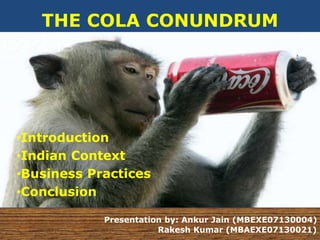
THE COLA CONUNDRUM 
Presentation by: Ankur Jain (MBEXE07130004) 
Rakesh Kumar (MBAEXE07130021) 
•Introduction 
•Indian Context 
•Business Practices 
•Conclusion
COCA-COLA’S HISTORY 
Coca cola was concocted by pharmacist 
John Pemberton and was first introduced as 
a health tonic in Atlanta , Georgia in 1885. 
The company makes an annual profit of 
approximately US$15 billion and has a huge 
marketing budget of US$2million per 
annum. 
The company operates almost in all 
countries of world selling as many as 
12,500 drinks every second. 
The Cola Conundrum 2/14
COCA-COLA IN INDIA 
Coca-cola was India’s leading soft drink unit in 
1977 when it was ‘kicked out” by Government of 
India after it refused to reveal its secret formula 
of coca-cola and dilute its stake in its Indian unit 
as required by the Foreign Exchange Regulation 
Act. 
 On its return in 1993, It took over ownership of 
the nation’s top soft-drink brands. It bought out 
for Rs 3500 million a clutch of popular Indian soft 
drinks brands including Thums up, Gold spot, 
Limca, Citra and Maaza which enabled them to 
get 66% market share. 
The Cola Conundrum 3/14
COCA-COLA IN INDIA 
The vast Indian operation comprises 25 wholly 
company owned bottling operations and another 
24 franchisee owned bottling operations. 
 In India the company directly employs 
approximately 6,000 people and indirectly 
creates employment for more than 125,000 
people in related industries though their vast 
procurement, supply and distribution system. 
These facts speak that Coca-Cola is an integral 
player in the Indian economy. 
The Cola Conundrum 4/14
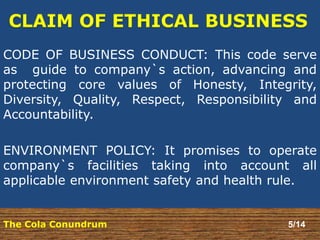
CODE OF BUSINESS CONDUCT: This code serve 
as guide to company`s action, advancing and 
protecting core values of Honesty, Integrity, 
Diversity, Quality, Respect, Responsibility and 
Accountability. 
ENVIRONMENT POLICY: It promises to operate 
company`s facilities taking into account all 
applicable environment safety and health rule. 
The Cola Conundrum 5/14
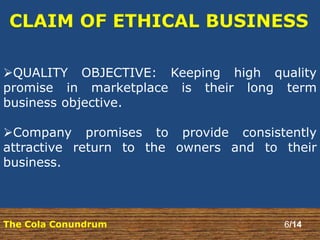
QUALITY OBJECTIVE: Keeping high quality 
promise in marketplace is their long term 
business objective. 
Company promises to provide consistently 
attractive return to the owners and to their 
business. 
The Cola Conundrum 6/14
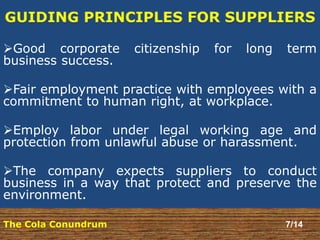
Good corporate citizenship for long term 
business success. 
Fair employment practice with employees with a 
commitment to human right, at workplace. 
Employ labor under legal working age and 
protection from unlawful abuse or harassment. 
The company expects suppliers to conduct 
business in a way that protect and preserve the 
environment. 
The Cola Conundrum 7/14
UNETHICAL PRACTICES 
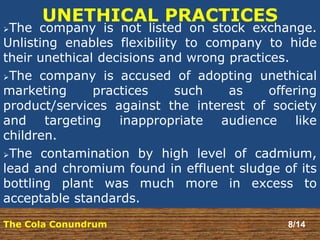
The company is not listed on stock exchange. 
Unlisting enables flexibility to company to hide 
their unethical decisions and wrong practices. 
The company is accused of adopting unethical 
marketing practices such as offering 
product/services against the interest of society 
and targeting inappropriate audience like 
children. 
The contamination by high level of cadmium, 
lead and chromium found in effluent sludge of its 
bottling plant was much more in excess to 
acceptable standards. 
The Cola Conundrum 8/14
EXCESSIVE WATER USAGE 
 In India many states protested that coca- cola i 
uses three times as much water to produce a litre 
of coke. It has been reported that farmers are 
facing acute shortage of water causing crop 
failure. Activists alleged that states like Uttar 
Pradesh, Kerala, Rajasthan, Maharashtra are 
facing severe shortage of water around 
establishment of coke bottling plant. 
The Cola Conundrum 9/14
PESTICIDE CONTROVERSY (2003-2006) 
 According to CSE (Center for Science 
Environment) coca-coal contain toxins including 
lindane, DDT, Malathian, chloropyrophys etc. 
Pesticide can result into cancer and breaking 
down of immune system. 
About 57 samples were collected from 25 
bottling plants from 12 different states and it was 
found that drinks were containing 24 times 
higher amount of pesticides that of allowed. 
The Cola Conundrum 10/14
DEFENSES CLAIMED 
Coca-Cola angrily denied allegations that their 
products manufactured in India contained toxin 
levels far above the norms permitted in the 
developed world. 
Coca-Cola claimed that their soft drink is safe in 
every aspect and up to Indian standards. 
There are other food stuffs in market which 
contain much higher level of pesticide. 
In the end they managed to have “clean chit” 
from TERI (The Energy and Resource Institute). 
The Cola Conundrum 11/14
CONCLUSION 
 Every coin has two faces and results or 
conclusion can be drawn from both aspects. 
 it very much depend on which side you choose 
to present your answer. 
The Cola Conundrum 12/14
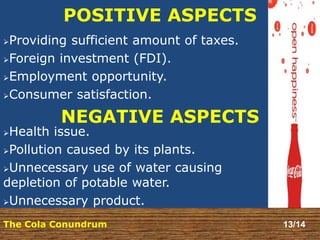
POSITIVE ASPECTS 
Providing sufficient amount of taxes. 
Foreign investment (FDI). 
Employment opportunity. 
Consumer satisfaction. 
NEGATIVE ASPECTS 
Health issue. 
Pollution caused by its plants. 
Unnecessary use of water causing 
depletion of potable water. 
Unnecessary product. 
The Cola Conundrum 13/14
Any question? 
The Cola Conundrum 14/14

Cola Conundrum

  • 1.
    THE COLA CONUNDRUM Presentation by: Ankur Jain (MBEXE07130004) Rakesh Kumar (MBAEXE07130021) •Introduction •Indian Context •Business Practices •Conclusion
  • 2.
    COCA-COLA’S HISTORY Cocacola was concocted by pharmacist John Pemberton and was first introduced as a health tonic in Atlanta , Georgia in 1885. The company makes an annual profit of approximately US$15 billion and has a huge marketing budget of US$2million per annum. The company operates almost in all countries of world selling as many as 12,500 drinks every second. The Cola Conundrum 2/14
  • 3.
    COCA-COLA IN INDIA Coca-cola was India’s leading soft drink unit in 1977 when it was ‘kicked out” by Government of India after it refused to reveal its secret formula of coca-cola and dilute its stake in its Indian unit as required by the Foreign Exchange Regulation Act.  On its return in 1993, It took over ownership of the nation’s top soft-drink brands. It bought out for Rs 3500 million a clutch of popular Indian soft drinks brands including Thums up, Gold spot, Limca, Citra and Maaza which enabled them to get 66% market share. The Cola Conundrum 3/14
  • 4.
    COCA-COLA IN INDIA The vast Indian operation comprises 25 wholly company owned bottling operations and another 24 franchisee owned bottling operations.  In India the company directly employs approximately 6,000 people and indirectly creates employment for more than 125,000 people in related industries though their vast procurement, supply and distribution system. These facts speak that Coca-Cola is an integral player in the Indian economy. The Cola Conundrum 4/14
  • 5.
    CODE OF BUSINESSCONDUCT: This code serve as guide to company`s action, advancing and protecting core values of Honesty, Integrity, Diversity, Quality, Respect, Responsibility and Accountability. ENVIRONMENT POLICY: It promises to operate company`s facilities taking into account all applicable environment safety and health rule. The Cola Conundrum 5/14
  • 6.
    QUALITY OBJECTIVE: Keepinghigh quality promise in marketplace is their long term business objective. Company promises to provide consistently attractive return to the owners and to their business. The Cola Conundrum 6/14
  • 7.
    Good corporate citizenshipfor long term business success. Fair employment practice with employees with a commitment to human right, at workplace. Employ labor under legal working age and protection from unlawful abuse or harassment. The company expects suppliers to conduct business in a way that protect and preserve the environment. The Cola Conundrum 7/14
  • 8.
    UNETHICAL PRACTICES Thecompany is not listed on stock exchange. Unlisting enables flexibility to company to hide their unethical decisions and wrong practices. The company is accused of adopting unethical marketing practices such as offering product/services against the interest of society and targeting inappropriate audience like children. The contamination by high level of cadmium, lead and chromium found in effluent sludge of its bottling plant was much more in excess to acceptable standards. The Cola Conundrum 8/14
  • 9.
    EXCESSIVE WATER USAGE  In India many states protested that coca- cola i uses three times as much water to produce a litre of coke. It has been reported that farmers are facing acute shortage of water causing crop failure. Activists alleged that states like Uttar Pradesh, Kerala, Rajasthan, Maharashtra are facing severe shortage of water around establishment of coke bottling plant. The Cola Conundrum 9/14
  • 10.
    PESTICIDE CONTROVERSY (2003-2006)  According to CSE (Center for Science Environment) coca-coal contain toxins including lindane, DDT, Malathian, chloropyrophys etc. Pesticide can result into cancer and breaking down of immune system. About 57 samples were collected from 25 bottling plants from 12 different states and it was found that drinks were containing 24 times higher amount of pesticides that of allowed. The Cola Conundrum 10/14
  • 11.
    DEFENSES CLAIMED Coca-Colaangrily denied allegations that their products manufactured in India contained toxin levels far above the norms permitted in the developed world. Coca-Cola claimed that their soft drink is safe in every aspect and up to Indian standards. There are other food stuffs in market which contain much higher level of pesticide. In the end they managed to have “clean chit” from TERI (The Energy and Resource Institute). The Cola Conundrum 11/14
  • 12.
    CONCLUSION  Everycoin has two faces and results or conclusion can be drawn from both aspects.  it very much depend on which side you choose to present your answer. The Cola Conundrum 12/14
  • 13.
    POSITIVE ASPECTS Providingsufficient amount of taxes. Foreign investment (FDI). Employment opportunity. Consumer satisfaction. NEGATIVE ASPECTS Health issue. Pollution caused by its plants. Unnecessary use of water causing depletion of potable water. Unnecessary product. The Cola Conundrum 13/14
  • 14.
    Any question? TheCola Conundrum 14/14