01.10.08 The cellphone:  ultimate distraction or powerful learning tool?  Steve Vosloo
The growing disconnect Cellphones: pros and cons Challenge
“ There is now an extraordinary contrast between the high levels of activity that characterise children's consumer cultures and the passivity that increasingly suffuses their schooling.” (Buckingham, 2003)‏
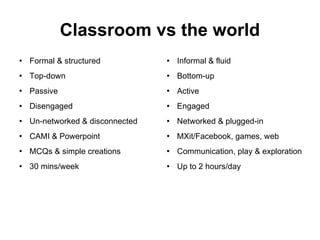
Classroom vs the world Formal & structured Top-down Passive Disengaged Un-networked & disconnected CAMI & Powerpoint MCQs & simple creations 30 mins/week Informal & fluid Bottom-up Active Engaged Networked & plugged-in MXit/Facebook, games, web Communication, play & exploration Up to 2 hours/day
Classroom vs the world
“ ICT in schools is predicated on the ‘top-down’ understanding that we know how children should be learning from technology rather than seeking to learn from their existing practices.” ( Their Space , 2007)‏
 
Cellphone affordances Pervasive Low-cost Content delivery and creation medium Klopfer (Jenkins 2008): Portability  - can take it to different sites and move around within a location Social interactivity  - can exchange data and collaborate with other people face-to-face Connectivity  - a common network that creates a true shared environment
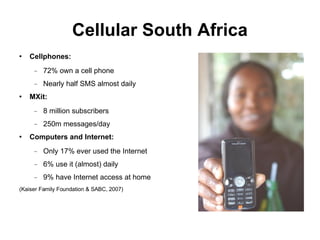
Cellular South Africa Cellphones: 72% own a cell phone Nearly half SMS almost daily MXit:  8 million subscribers 250m messages/day Computers and Internet: Only 17% ever used the Internet 6% use it (almost) daily 9% have Internet access at home (Kaiser Family Foundation & SABC, 2007)‏
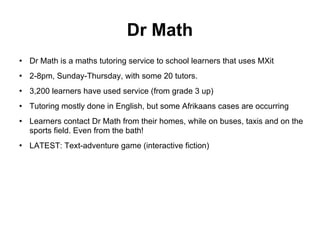
Dr Math Dr Math is a maths tutoring service to school learners that uses MXit 2-8pm, Sunday-Thursday, with some 20 tutors. 3,200 learners have used service (from grade 3 up)‏ Tutoring mostly done in English, but some Afrikaans cases are occurring Learners contact Dr Math from their homes, while on buses, taxis and on the sports field. Even from the bath! LATEST: Text-adventure game (interactive fiction)‏
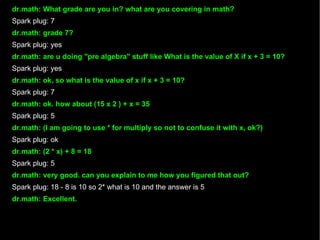
dr.math: What grade are you in? what are you covering in math? Spark plug: 7 dr.math: grade 7? Spark plug: yes dr.math: are u doing "pre algebra" stuff like What is the value of X if x + 3 = 10? Spark plug: yes dr.math: ok, so what is the value of x if x + 3 = 10? Spark plug: 7 dr.math: ok. how about (15 x 2 ) + x = 35 Spark plug: 5 dr.math: (I am going to use * for multiply so not to confuse it with x, ok?)‏ Spark plug: ok dr.math: (2 * x) + 8 = 18 Spark plug: 5 dr.math: very good. can you explain to me how you figured that out? Spark plug: 18 - 8 is 10 so 2* what is 10 and the answer is 5 dr.math: Excellent.
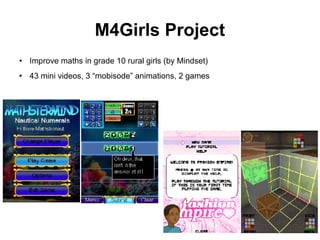
M4Girls Project Improve maths in grade 10 rural girls (by Mindset)‏ 43 mini videos, 3 “mobisode” animations, 2 games
Alternate Reality Game ARG: an interactive narrative that uses the real world as a platform, often involving multiple media and game elements, to tell a story that may be affected by participants' ideas or actions. (Wikipedia)‏ Think “Finders Keepers” but played  collectively  using web, email, SMS, voice, video, etc. Collaborative problem-solving Skills: collective intelligence, judgement, transmedia navigation (Jenkins et al, 2006)‏
Reading/writing cellphone Using the cellphone as a “book” delivery and authoring tool Serialised m-novels: e.g. 28 chapters, 900 characters (Novel Idea)‏ Othello as an m-novel? Communities engaging literacy practices of writing and reviewing
But ... 1) Distraction 2) Antisocial? 3) Risk of violence/abuse 4) Effect on reading and writing? 5) Cost
What do these things have in common? Printing press Film Comics Rock 'n roll
Challenge Consider ways to exploit cellphone  affordances  to support teaching and learning, while limiting the  distraction and risk factors Only  YOU  can do this ...
Thank you Email [email_address] Blog innovatingeducation.wordpress.com Games and learning group groups.google.com/group/galsa Slides www.slideshare.net/stevevosloo

The cellphone: ultimate distraction or powerful learning tool?

  • 1.
    01.10.08 The cellphone: ultimate distraction or powerful learning tool? Steve Vosloo
  • 2.
    The growing disconnectCellphones: pros and cons Challenge
  • 3.
    “ There isnow an extraordinary contrast between the high levels of activity that characterise children's consumer cultures and the passivity that increasingly suffuses their schooling.” (Buckingham, 2003)‏
  • 4.
    Classroom vs theworld Formal & structured Top-down Passive Disengaged Un-networked & disconnected CAMI & Powerpoint MCQs & simple creations 30 mins/week Informal & fluid Bottom-up Active Engaged Networked & plugged-in MXit/Facebook, games, web Communication, play & exploration Up to 2 hours/day
  • 5.
  • 6.
    “ ICT inschools is predicated on the ‘top-down’ understanding that we know how children should be learning from technology rather than seeking to learn from their existing practices.” ( Their Space , 2007)‏
  • 7.
  • 8.
    Cellphone affordances PervasiveLow-cost Content delivery and creation medium Klopfer (Jenkins 2008): Portability - can take it to different sites and move around within a location Social interactivity - can exchange data and collaborate with other people face-to-face Connectivity - a common network that creates a true shared environment
  • 9.
    Cellular South AfricaCellphones: 72% own a cell phone Nearly half SMS almost daily MXit: 8 million subscribers 250m messages/day Computers and Internet: Only 17% ever used the Internet 6% use it (almost) daily 9% have Internet access at home (Kaiser Family Foundation & SABC, 2007)‏
  • 10.
    Dr Math DrMath is a maths tutoring service to school learners that uses MXit 2-8pm, Sunday-Thursday, with some 20 tutors. 3,200 learners have used service (from grade 3 up)‏ Tutoring mostly done in English, but some Afrikaans cases are occurring Learners contact Dr Math from their homes, while on buses, taxis and on the sports field. Even from the bath! LATEST: Text-adventure game (interactive fiction)‏
  • 11.
    dr.math: What gradeare you in? what are you covering in math? Spark plug: 7 dr.math: grade 7? Spark plug: yes dr.math: are u doing "pre algebra" stuff like What is the value of X if x + 3 = 10? Spark plug: yes dr.math: ok, so what is the value of x if x + 3 = 10? Spark plug: 7 dr.math: ok. how about (15 x 2 ) + x = 35 Spark plug: 5 dr.math: (I am going to use * for multiply so not to confuse it with x, ok?)‏ Spark plug: ok dr.math: (2 * x) + 8 = 18 Spark plug: 5 dr.math: very good. can you explain to me how you figured that out? Spark plug: 18 - 8 is 10 so 2* what is 10 and the answer is 5 dr.math: Excellent.
  • 12.
    M4Girls Project Improvemaths in grade 10 rural girls (by Mindset)‏ 43 mini videos, 3 “mobisode” animations, 2 games
  • 13.
    Alternate Reality GameARG: an interactive narrative that uses the real world as a platform, often involving multiple media and game elements, to tell a story that may be affected by participants' ideas or actions. (Wikipedia)‏ Think “Finders Keepers” but played collectively using web, email, SMS, voice, video, etc. Collaborative problem-solving Skills: collective intelligence, judgement, transmedia navigation (Jenkins et al, 2006)‏
  • 14.
    Reading/writing cellphone Usingthe cellphone as a “book” delivery and authoring tool Serialised m-novels: e.g. 28 chapters, 900 characters (Novel Idea)‏ Othello as an m-novel? Communities engaging literacy practices of writing and reviewing
  • 15.
    But ... 1)Distraction 2) Antisocial? 3) Risk of violence/abuse 4) Effect on reading and writing? 5) Cost
  • 16.
    What do thesethings have in common? Printing press Film Comics Rock 'n roll
  • 17.
    Challenge Consider waysto exploit cellphone affordances to support teaching and learning, while limiting the distraction and risk factors Only YOU can do this ...
  • 18.
    Thank you Email[email_address] Blog innovatingeducation.wordpress.com Games and learning group groups.google.com/group/galsa Slides www.slideshare.net/stevevosloo