
The Evolution of
Mobile phones
1973-2015
Presentation by Mohit & Manoj
History of Mobile Phones
 Alexander Graham Bell invented telephone and 1878 he
made the first phone call.
 Motorola introduced some of its first cell phones during
the 1980s.
 Those phones were completely different from the devices
we have today since from no side they were cost
effective and handy.
 The first Smartphone was developed by IBM & BellSouth
which came out to in public in 1993.
 These Smartphones are advancing at a very fast pace and
are not restricted to just internet browsing or playing games.
 Now you can do every possible thing with these modern
handheld devices.
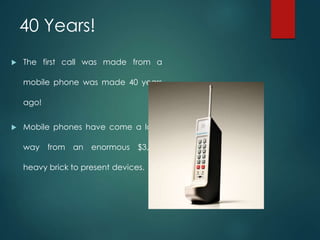
 The first call was made from a
mobile phone was made 40 years
ago!
 Mobile phones have come a long
way from an enormous $3,995
heavy brick to present devices.
40 Years!
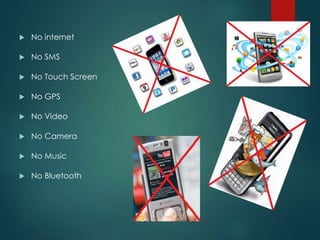
 No internet
 No SMS
 No Touch Screen
 No GPS
 No Video
 No Camera
 No Music
 No Bluetooth
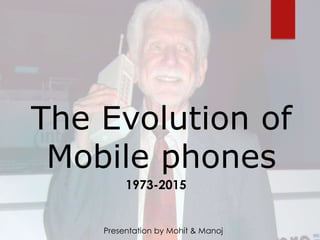
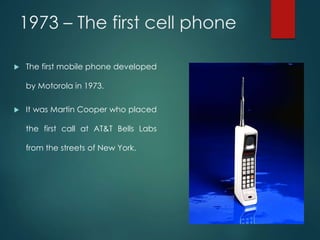
1973 – The first cell phone
 The first mobile phone developed
by Motorola in 1973.
 It was Martin Cooper who placed
the first call at AT&T Bells Labs
from the streets of New York.
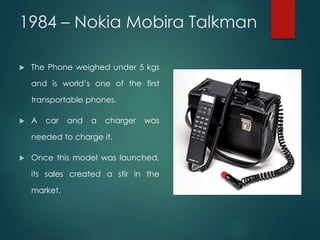
1984 – Nokia Mobira Talkman
 The Phone weighed under 5 kgs
and is world’s one of the first
transportable phones.
 A car and a charger was
needed to charge it.
 Once this model was launched,
its sales created a stir in the
market.
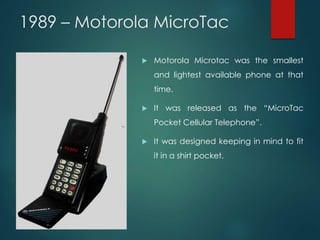
1989 – Motorola MicroTac
 Motorola Microtac was the smallest
and lightest available phone at that
time.
 It was released as the “MicroTac
Pocket Cellular Telephone”.
 It was designed keeping in mind to fit
it in a shirt pocket.
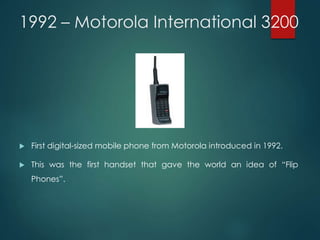
1992 – Motorola International 3200
 First digital-sized mobile phone from Motorola introduced in 1992.
 This was the first handset that gave the world an idea of “Flip
Phones”.
 The International 3200 was crafted to enable mobile phones to
use the original analog cell technology.
 Like its predecessors, 3200’s shape and size was similar to a long
brick with numeric buttons on the narrow side, along with the
earphone and microphone.
 In Germany, it was called knochen, due to the resemblance in
shape between it and a bone.
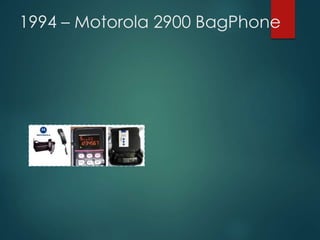
1994 – Motorola 2900 BagPhone
 Motorola introduced a very powerful line of mobile phones in
1992.
 These phones put out 3 watts of power (as opposed to 0.6
watts that today's cell phones output) which made them
popular for truckers, boaters, and people in rural areas.
 Because of their durability, many of these phones are still in
working order today.
Time changes, and so
does technology
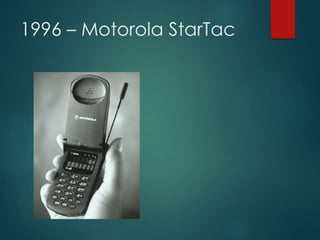
1996 – Motorola StarTac
 Before the StarTAC came along, cell phones were bricks.
Motorola wowed the industry with this 3.1 ounce wonder.
 The handset is best remembered today as being the first
clamshell phone—a form factor that set the design
precedent for years to come.
 The StarTAC handset helped drive
mainstream cell phone adoption, selling
around 60 million units over the course of its
long life.
 The phone also gets points for introducing
the vibrating ring.
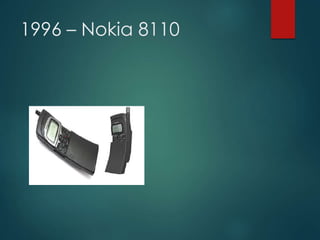
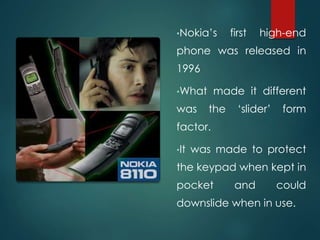
1996 – Nokia 8110
•Nokia’s first high-end
phone was released in
1996
•What made it different
was the ‘slider’ form
factor.
•It was made to protect
the keypad when kept in
pocket and could
downslide when in use.
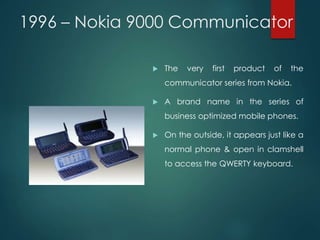
1996 – Nokia 9000 Communicator
 The very first product of the
communicator series from Nokia.
 A brand name in the series of
business optimized mobile phones.
 On the outside, it appears just like a
normal phone & open in clamshell
to access the QWERTY keyboard.
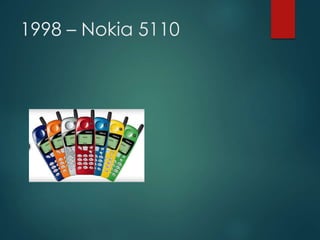
1998 – Nokia 5110
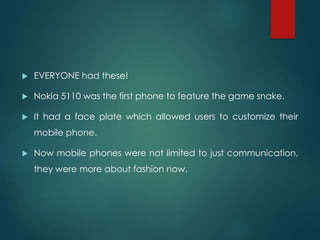
 EVERYONE had these!
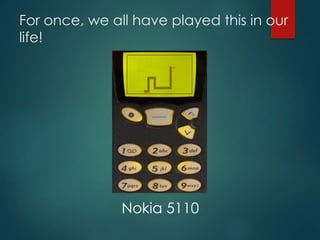
 Nokia 5110 was the first phone to feature the game snake.
 It had a face plate which allowed users to customize their
mobile phone.
 Now mobile phones were not limited to just communication,
they were more about fashion now.
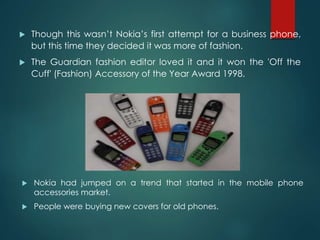
 Nokia had jumped on a trend that started in the mobile phone
accessories market.
 People were buying new covers for old phones.
 Though this wasn’t Nokia’s first attempt for a business phone,
but this time they decided it was more of fashion.
 The Guardian fashion editor loved it and it won the 'Off the
Cuff' (Fashion) Accessory of the Year Award 1998.
For once, we all have played this in our
life!
Nokia 5110
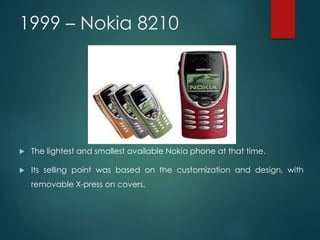
1999 – Nokia 8210
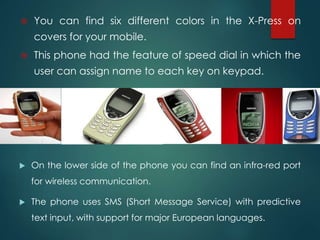
 The lightest and smallest available Nokia phone at that time.
 Its selling point was based on the customization and design, with
removable X-press on covers.
 On the lower side of the phone you can find an infra-red port
for wireless communication.
 The phone uses SMS (Short Message Service) with predictive
text input, with support for major European languages.
 You can find six different colors in the X-Press on
covers for your mobile.
 This phone had the feature of speed dial in which the
user can assign name to each key on keypad.
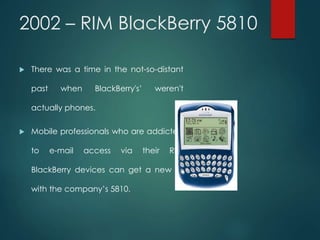
2002 – RIM BlackBerry 5810
 There was a time in the not-so-distant
past when BlackBerry's’ weren't
actually phones.
 Mobile professionals who are addicted
to e-mail access via their RIM
BlackBerry devices can get a new fix
with the company’s 5810.
 They were data-only devices, used by professionals, like
lawyers, who needed constant access to their e-mail.
 The reputation of the BlackBerry began to change in 2002,
however, when Research In Motion released the BlackBerry
5810.
 This was the first BlackBerry to feature a built-in phone. Alas,
the device lacked a speaker and a microphone, so you had
to use a headset to make calls.
2002 – Sanyo SCP - 5300
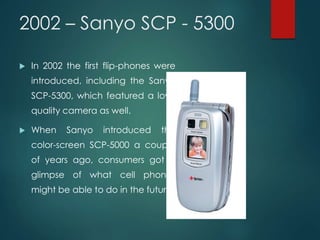
 In 2002 the first flip-phones were
introduced, including the Sanyo
SCP-5300, which featured a low-
quality camera as well.
 When Sanyo introduced the
color-screen SCP-5000 a couple
of years ago, consumers got a
glimpse of what cell phones
might be able to do in the future.
 Features which made this phone stand out of the crowd
are :
 Vibrant color display
 Built-in camera with flash
 Compatible with Sprint PCS Business Connection
software
 Comes with extended battery; solid call quality.
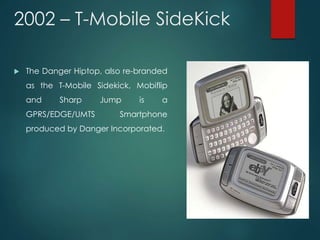
2002 – T-Mobile SideKick
 The Danger Hiptop, also re-branded
as the T-Mobile Sidekick, Mobiflip
and Sharp Jump is a
GPRS/EDGE/UMTS Smartphone
produced by Danger Incorporated.
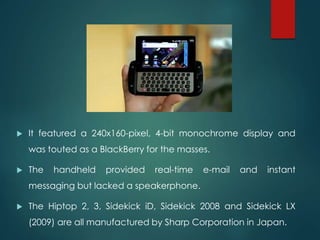
 It featured a 240x160-pixel, 4-bit monochrome display and
was touted as a BlackBerry for the masses.
 The handheld provided real-time e-mail and instant
messaging but lacked a speakerphone.
 The Hiptop 2, 3, Sidekick iD, Sidekick 2008 and Sidekick LX
(2009) are all manufactured by Sharp Corporation in Japan.
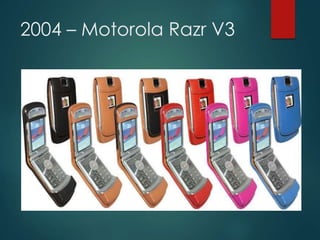
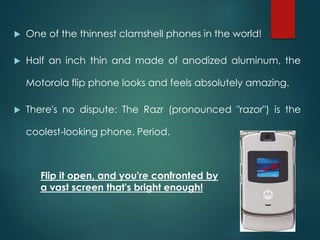
2004 – Motorola Razr V3
 One of the thinnest clamshell phones in the world!
 Half an inch thin and made of anodized aluminum, the
Motorola flip phone looks and feels absolutely amazing.
 There's no dispute: The Razr (pronounced "razor") is the
coolest-looking phone. Period.
Flip it open, and you're confronted by
a vast screen that's bright enough!
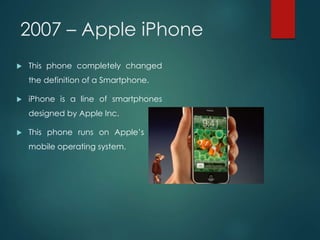
2007 – Apple iPhone
 This phone completely changed
the definition of a Smartphone.
 iPhone is a line of smartphones
designed by Apple Inc.
 This phone runs on Apple’s iOS
mobile operating system.
 Apple created the device during a secretive and unprecedented
collaboration with AT&T, formerly Cingular Wireless.
 The development cost of the collaboration was estimated to have
been $150 million over a thirty-month period.
 This phone was immediately listed amongst the best inventions of
2007.
 As termed by a press release “The Original iPhone” has been
discontinued when its successor iPhone 3G was released.
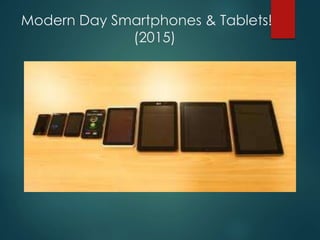
Modern Day Smartphones & Tablets!
(2015)
What Next ?

The evolution of cellphone

  • 1.
    The Evolution of Mobilephones 1973-2015 Presentation by Mohit & Manoj
  • 2.
    History of MobilePhones  Alexander Graham Bell invented telephone and 1878 he made the first phone call.  Motorola introduced some of its first cell phones during the 1980s.  Those phones were completely different from the devices we have today since from no side they were cost effective and handy.
  • 3.
     The firstSmartphone was developed by IBM & BellSouth which came out to in public in 1993.  These Smartphones are advancing at a very fast pace and are not restricted to just internet browsing or playing games.  Now you can do every possible thing with these modern handheld devices.
  • 4.
     The firstcall was made from a mobile phone was made 40 years ago!  Mobile phones have come a long way from an enormous $3,995 heavy brick to present devices. 40 Years!
  • 5.
     No internet No SMS  No Touch Screen  No GPS  No Video  No Camera  No Music  No Bluetooth
  • 6.
    1973 – Thefirst cell phone  The first mobile phone developed by Motorola in 1973.  It was Martin Cooper who placed the first call at AT&T Bells Labs from the streets of New York.
  • 7.
    1984 – NokiaMobira Talkman  The Phone weighed under 5 kgs and is world’s one of the first transportable phones.  A car and a charger was needed to charge it.  Once this model was launched, its sales created a stir in the market.
  • 8.
    1989 – MotorolaMicroTac  Motorola Microtac was the smallest and lightest available phone at that time.  It was released as the “MicroTac Pocket Cellular Telephone”.  It was designed keeping in mind to fit it in a shirt pocket.
  • 9.
    1992 – MotorolaInternational 3200  First digital-sized mobile phone from Motorola introduced in 1992.  This was the first handset that gave the world an idea of “Flip Phones”.
  • 10.
     The International3200 was crafted to enable mobile phones to use the original analog cell technology.  Like its predecessors, 3200’s shape and size was similar to a long brick with numeric buttons on the narrow side, along with the earphone and microphone.  In Germany, it was called knochen, due to the resemblance in shape between it and a bone.
  • 11.
    1994 – Motorola2900 BagPhone
  • 12.
     Motorola introduceda very powerful line of mobile phones in 1992.  These phones put out 3 watts of power (as opposed to 0.6 watts that today's cell phones output) which made them popular for truckers, boaters, and people in rural areas.  Because of their durability, many of these phones are still in working order today.
  • 13.
    Time changes, andso does technology
  • 14.
  • 15.
     Before theStarTAC came along, cell phones were bricks. Motorola wowed the industry with this 3.1 ounce wonder.  The handset is best remembered today as being the first clamshell phone—a form factor that set the design precedent for years to come.
  • 16.
     The StarTAChandset helped drive mainstream cell phone adoption, selling around 60 million units over the course of its long life.  The phone also gets points for introducing the vibrating ring.
  • 17.
  • 18.
    •Nokia’s first high-end phonewas released in 1996 •What made it different was the ‘slider’ form factor. •It was made to protect the keypad when kept in pocket and could downslide when in use.
  • 19.
    1996 – Nokia9000 Communicator  The very first product of the communicator series from Nokia.  A brand name in the series of business optimized mobile phones.  On the outside, it appears just like a normal phone & open in clamshell to access the QWERTY keyboard.
  • 20.
  • 21.
     EVERYONE hadthese!  Nokia 5110 was the first phone to feature the game snake.  It had a face plate which allowed users to customize their mobile phone.  Now mobile phones were not limited to just communication, they were more about fashion now.
  • 22.
     Nokia hadjumped on a trend that started in the mobile phone accessories market.  People were buying new covers for old phones.  Though this wasn’t Nokia’s first attempt for a business phone, but this time they decided it was more of fashion.  The Guardian fashion editor loved it and it won the 'Off the Cuff' (Fashion) Accessory of the Year Award 1998.
  • 23.
    For once, weall have played this in our life! Nokia 5110
  • 24.
    1999 – Nokia8210  The lightest and smallest available Nokia phone at that time.  Its selling point was based on the customization and design, with removable X-press on covers.
  • 25.
     On thelower side of the phone you can find an infra-red port for wireless communication.  The phone uses SMS (Short Message Service) with predictive text input, with support for major European languages.  You can find six different colors in the X-Press on covers for your mobile.  This phone had the feature of speed dial in which the user can assign name to each key on keypad.
  • 26.
    2002 – RIMBlackBerry 5810  There was a time in the not-so-distant past when BlackBerry's’ weren't actually phones.  Mobile professionals who are addicted to e-mail access via their RIM BlackBerry devices can get a new fix with the company’s 5810.
  • 27.
     They weredata-only devices, used by professionals, like lawyers, who needed constant access to their e-mail.  The reputation of the BlackBerry began to change in 2002, however, when Research In Motion released the BlackBerry 5810.  This was the first BlackBerry to feature a built-in phone. Alas, the device lacked a speaker and a microphone, so you had to use a headset to make calls.
  • 28.
    2002 – SanyoSCP - 5300  In 2002 the first flip-phones were introduced, including the Sanyo SCP-5300, which featured a low- quality camera as well.  When Sanyo introduced the color-screen SCP-5000 a couple of years ago, consumers got a glimpse of what cell phones might be able to do in the future.
  • 29.
     Features whichmade this phone stand out of the crowd are :  Vibrant color display  Built-in camera with flash  Compatible with Sprint PCS Business Connection software  Comes with extended battery; solid call quality.
  • 30.
    2002 – T-MobileSideKick  The Danger Hiptop, also re-branded as the T-Mobile Sidekick, Mobiflip and Sharp Jump is a GPRS/EDGE/UMTS Smartphone produced by Danger Incorporated.
  • 31.
     It featureda 240x160-pixel, 4-bit monochrome display and was touted as a BlackBerry for the masses.  The handheld provided real-time e-mail and instant messaging but lacked a speakerphone.  The Hiptop 2, 3, Sidekick iD, Sidekick 2008 and Sidekick LX (2009) are all manufactured by Sharp Corporation in Japan.
  • 32.
  • 33.
     One ofthe thinnest clamshell phones in the world!  Half an inch thin and made of anodized aluminum, the Motorola flip phone looks and feels absolutely amazing.  There's no dispute: The Razr (pronounced "razor") is the coolest-looking phone. Period. Flip it open, and you're confronted by a vast screen that's bright enough!
  • 34.
    2007 – AppleiPhone  This phone completely changed the definition of a Smartphone.  iPhone is a line of smartphones designed by Apple Inc.  This phone runs on Apple’s iOS mobile operating system.
  • 35.
     Apple createdthe device during a secretive and unprecedented collaboration with AT&T, formerly Cingular Wireless.  The development cost of the collaboration was estimated to have been $150 million over a thirty-month period.  This phone was immediately listed amongst the best inventions of 2007.  As termed by a press release “The Original iPhone” has been discontinued when its successor iPhone 3G was released.
  • 36.
    Modern Day Smartphones& Tablets! (2015)
  • 37.