HR’s Powerful
Influence
EMPLOYEE SELECTION:
HOW TO TALK YOUR HIRING MANAGER OUT OF DISMISSING
A CANDIDATE FOR HAVING MUSTARD ON HIS TIE
Setting
Expectations
Responding
to Objections
Guiding Post-
Interview
Analysis
OVERVIEW
SETTING EXPECTATIONS
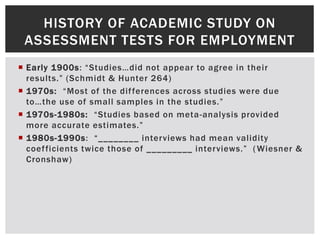
 Early 1900s: “Studies…did not appear to agree in their
results.” (Schmidt & Hunter 264)
 1970s: “Most of the differences across studies were due
to…the use of small samples in the studies.”
 1970s-1980s: “Studies based on meta-analysis provided
more accurate estimates.”
 1980s-1990s: “________ interviews had mean validity
coefficients twice those of _________ interviews.” (Wiesner &
Cronshaw)
HISTORY OF ACADEMIC STUDY ON
ASSESSMENT TESTS FOR EMPLOYMENT
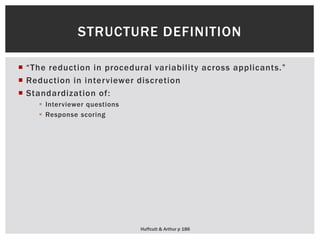
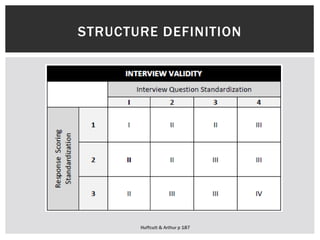
 “The reduction in procedural variability across applicants.”
 Reduction in interviewer discretion
 Standardization of:
 Interviewer questions
 Response scoring
STRUCTURE DEFINITION
Huffcutt & Arthur p 186
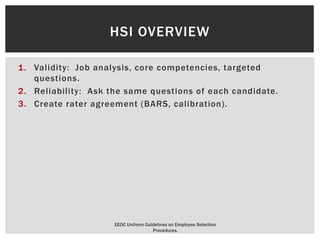
1. Validity: Job analysis, core competencies, targeted
questions.
2. Reliability: Ask the same questions of each candidate.
3. Create rater agreement (BARS, calibration).
EEOC Uniform Guidelines on Employee Selection
Procedures.
HSI OVERVIEW
STRUCTURE DEFINITION
Huffcutt & Arthur p 187
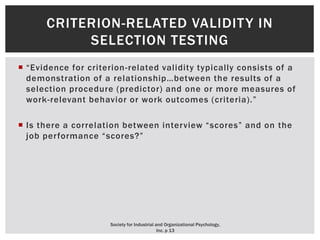
 “Evidence for criterion-related validity typically consists of a
demonstration of a relationship…between the results of a
selection procedure (predictor) and one or more measures of
work-relevant behavior or work outcomes (criteria).”
 Is there a correlation between interview “scores” and on the
job performance “scores?”
CRITERION-RELATED VALIDITY IN
SELECTION TESTING
Society for Industrial and Organizational Psychology,
Inc. p 13
 Is there really any evidence to support using a structured
approach?
MAKING THE CASE FOR THE (H)SI
 Conduct your own validation study internally
 Correlation between criterion and predictors
 Same process as validating a pre-employment test (e.g.
cognitive abilities test)
MAKING THE CASE (CONTINUED)
RESPONDING TO
OBJECTIONS
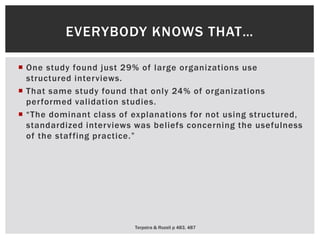
 One study found just 29% of large organizations use
structured interviews.
 That same study found that only 24% of organizations
performed validation studies.
 “The dominant class of explanations for not using structured,
standardized interviews was beliefs concerning the usefulness
of the staffing practice.”
Terpstra & Rozell p 483, 487
EVERYBODY KNOWS THAT…
 What reasons have hiring managers given to support their
reticence to using a structured interviews?
WHAT OBJECTIONS HAVE YOU HEARD?
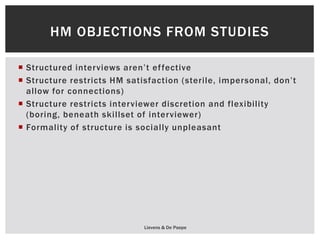
 Structured interviews aren’t effective
 Structure restricts HM satisfaction (sterile, impersonal, don’t
allow for connections)
 Structure restricts interviewer discretion and flexibility
(boring, beneath skillset of interviewer)
 Formality of structure is socially unpleasant
Lievens & De Paepe
HM OBJECTIONS FROM STUDIES
 Structure requires preparation
 Structure restricts an “experienced” HM from using their
expertise
 Complex jobs (e.g. Sales Mgr) aren’t conducive to structure
HM RESISTANCE (CONTINUED)
GUIDING THE
POST-INTERVIEW
ANALYSIS DISCUSSION
 Complete the structured guide in its entirety before discussion
begins (including scoring)
 Then frame discussion by talking through the interview guide
sections
 Start with scores, and ask HMs to support their answers
YOU SET THE AGENDA
 Start with the score
 Weight the predictors in the event of a tie
 Take legitimate “X-Factors” into consideration (carefully)
 Interviewing is one part of the overall assessment picture
COMPARISONS
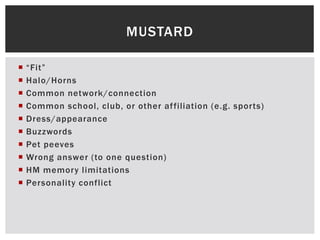
 “Fit”
 Halo/Horns
 Common network/connection
 Common school, club, or other affiliation (e.g. sports)
 Dress/appearance
 Buzzwords
 Pet peeves
 Wrong answer (to one question)
 HM memory limitations
 Personality conflict
MUSTARD
 Three Brave Volunteers
THREE CANDIDATE EXERCISE
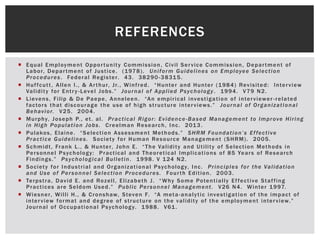
REFERENCES
 Equal Employment Opportunity Commission, Civil Service Commission, Department of
Labor, Department of Justice. (1978). Uniform Guidelines on Employee Selection
Procedures. Federal Register. 43. 38290-38315.
 Huffcutt, Allen I., & Arthur, Jr., Winfred. “Hunter and Hunter (1984) Revisited: Interview
Validity for Entry -Level Jobs.” Journal of Applied Psychology. 1994. V79 N2.
 Lievens, Filip & De Paepe, Anneleen. “An empirical investigation of interviewer -related
factors that discourage the use of high structure interviews.” Journal of Organizational
Behavior. V25. 2004.
 Murphy, Joseph P., et. al. Practical Rigor: Evidence-Based Management to Improve Hiring
in High Population Jobs. Creelman Research, Inc. 2013.
 Pulakos, Elaine. “Selection Assessment Methods.” SHRM Foundation’s Effective
Practice Guidelines. Society for Human Resource Management (SHRM). 2005.
 Schmidt, Frank L., & Hunter, John E. “The Validity and Utility of Selection Methods in
Personnel Psychology: Practical and Theoretical Implications of 85 Years of Research
Findings.” Psychological Bulletin. 1998. V 124 N2.
 Society for Industrial and Organizational Psychology, Inc. Principles for the Validation
and Use of Personnel Selection Procedures. Fourth Edition. 2003.
 Terpstra, David E. and Rozell, Elizabeth J. “Why Some Potentially Effective Staffing
Practices are Seldom Used.” Public Personnel Management. V26 N4. Winter 1997.
 Wiesner, Willi H., & Cronshaw, Steven F. “A meta-analytic investigation of the impact of
interview format and degree of structure on the validity of the employment interview.”
Journal of Occupational Psychology. 1988. V61.

The Case for Structured Interviews

  • 1.
    HR’s Powerful Influence EMPLOYEE SELECTION: HOWTO TALK YOUR HIRING MANAGER OUT OF DISMISSING A CANDIDATE FOR HAVING MUSTARD ON HIS TIE
  • 2.
  • 3.
  • 4.
     Early 1900s:“Studies…did not appear to agree in their results.” (Schmidt & Hunter 264)  1970s: “Most of the differences across studies were due to…the use of small samples in the studies.”  1970s-1980s: “Studies based on meta-analysis provided more accurate estimates.”  1980s-1990s: “________ interviews had mean validity coefficients twice those of _________ interviews.” (Wiesner & Cronshaw) HISTORY OF ACADEMIC STUDY ON ASSESSMENT TESTS FOR EMPLOYMENT
  • 5.
     “The reductionin procedural variability across applicants.”  Reduction in interviewer discretion  Standardization of:  Interviewer questions  Response scoring STRUCTURE DEFINITION Huffcutt & Arthur p 186
  • 6.
    1. Validity: Jobanalysis, core competencies, targeted questions. 2. Reliability: Ask the same questions of each candidate. 3. Create rater agreement (BARS, calibration). EEOC Uniform Guidelines on Employee Selection Procedures. HSI OVERVIEW
  • 7.
  • 8.
     “Evidence forcriterion-related validity typically consists of a demonstration of a relationship…between the results of a selection procedure (predictor) and one or more measures of work-relevant behavior or work outcomes (criteria).”  Is there a correlation between interview “scores” and on the job performance “scores?” CRITERION-RELATED VALIDITY IN SELECTION TESTING Society for Industrial and Organizational Psychology, Inc. p 13
  • 9.
     Is therereally any evidence to support using a structured approach? MAKING THE CASE FOR THE (H)SI
  • 10.
     Conduct yourown validation study internally  Correlation between criterion and predictors  Same process as validating a pre-employment test (e.g. cognitive abilities test) MAKING THE CASE (CONTINUED)
  • 11.
  • 12.
     One studyfound just 29% of large organizations use structured interviews.  That same study found that only 24% of organizations performed validation studies.  “The dominant class of explanations for not using structured, standardized interviews was beliefs concerning the usefulness of the staffing practice.” Terpstra & Rozell p 483, 487 EVERYBODY KNOWS THAT…
  • 13.
     What reasonshave hiring managers given to support their reticence to using a structured interviews? WHAT OBJECTIONS HAVE YOU HEARD?
  • 14.
     Structured interviewsaren’t effective  Structure restricts HM satisfaction (sterile, impersonal, don’t allow for connections)  Structure restricts interviewer discretion and flexibility (boring, beneath skillset of interviewer)  Formality of structure is socially unpleasant Lievens & De Paepe HM OBJECTIONS FROM STUDIES
  • 15.
     Structure requirespreparation  Structure restricts an “experienced” HM from using their expertise  Complex jobs (e.g. Sales Mgr) aren’t conducive to structure HM RESISTANCE (CONTINUED)
  • 16.
  • 17.
     Complete thestructured guide in its entirety before discussion begins (including scoring)  Then frame discussion by talking through the interview guide sections  Start with scores, and ask HMs to support their answers YOU SET THE AGENDA
  • 18.
     Start withthe score  Weight the predictors in the event of a tie  Take legitimate “X-Factors” into consideration (carefully)  Interviewing is one part of the overall assessment picture COMPARISONS
  • 19.
     “Fit”  Halo/Horns Common network/connection  Common school, club, or other affiliation (e.g. sports)  Dress/appearance  Buzzwords  Pet peeves  Wrong answer (to one question)  HM memory limitations  Personality conflict MUSTARD
  • 20.
     Three BraveVolunteers THREE CANDIDATE EXERCISE
  • 21.
    REFERENCES  Equal EmploymentOpportunity Commission, Civil Service Commission, Department of Labor, Department of Justice. (1978). Uniform Guidelines on Employee Selection Procedures. Federal Register. 43. 38290-38315.  Huffcutt, Allen I., & Arthur, Jr., Winfred. “Hunter and Hunter (1984) Revisited: Interview Validity for Entry -Level Jobs.” Journal of Applied Psychology. 1994. V79 N2.  Lievens, Filip & De Paepe, Anneleen. “An empirical investigation of interviewer -related factors that discourage the use of high structure interviews.” Journal of Organizational Behavior. V25. 2004.  Murphy, Joseph P., et. al. Practical Rigor: Evidence-Based Management to Improve Hiring in High Population Jobs. Creelman Research, Inc. 2013.  Pulakos, Elaine. “Selection Assessment Methods.” SHRM Foundation’s Effective Practice Guidelines. Society for Human Resource Management (SHRM). 2005.  Schmidt, Frank L., & Hunter, John E. “The Validity and Utility of Selection Methods in Personnel Psychology: Practical and Theoretical Implications of 85 Years of Research Findings.” Psychological Bulletin. 1998. V 124 N2.  Society for Industrial and Organizational Psychology, Inc. Principles for the Validation and Use of Personnel Selection Procedures. Fourth Edition. 2003.  Terpstra, David E. and Rozell, Elizabeth J. “Why Some Potentially Effective Staffing Practices are Seldom Used.” Public Personnel Management. V26 N4. Winter 1997.  Wiesner, Willi H., & Cronshaw, Steven F. “A meta-analytic investigation of the impact of interview format and degree of structure on the validity of the employment interview.” Journal of Occupational Psychology. 1988. V61.