Job Safety/Hazard Analysis
February 2022 Safety Presentation by Your Risk Management Team
What is a
Job Safety
Analysis
(JSA/JHA)?
Method of identifying
hazards
Means of breaking the
process down
System for employees to
easily understand and correct
hazards
A Job
Safety
Analysis:
existing hazards
Identifies
potential hazards
Identifies
corrective actions
Prioritizes
or eliminates hazards
Reduces
Benefits of
Job Hazard
Analysis
Reduces injuries
Reduces absenteeism
Increases productivity
Increases morale
Protects employees
Assists in standard-specific compliance
(e.g., personal protective equipment)
It also creates a safer work
environment for your
employees
Who
Should be
Involved in
a JSA Write
Up?
Safety personnel, HR, Admin, Accounting
Supervisors
Equipment Operators
Engineers
Installation and Repair Personnel
Construction Crews
Frankly, anyone willing to help the
cause.
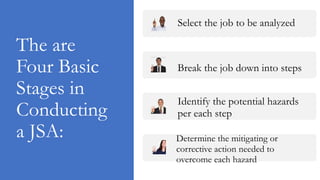
The are
Four Basic
Stages in
Conducting
a JSA:
Select the job to be analyzed
Break the job down into steps
Identify the potential hazards
per each step
Determine the mitigating or
corrective action needed to
overcome each hazard
Selection
of Job or
Task
Factors to be
Considered in
Setting a
Priority for
Analysis
(Selection) of
Jobs Include:
Accident frequency and severity: jobs where accidents
occur frequently or where they occur infrequently but
result in disabling injuries.
Potential for severe injuries or illnesses: the
consequences of an accident, hazardous condition, or
exposure to harmful substance are potentially severe.
Newly established jobs: due to lack of experience in
these jobs, hazards may not be evident or anticipated.
Modified jobs: new hazards may be associated with
changes in job procedures.
Infrequently performed jobs: workers may be at
greater risk when undertaking non-routine jobs, and a
JSA provides a means of reviewing hazards.
Breaking Down
the Job/Task
into Steps and
Identifying
Potential
Hazards
Breaking Down the Job
List each job
step in order
of occurrence
01
Describe each
action
02
Examine each
step for
hazards
03
Conduct a
“what if”
scenario for
each step
04
Listing and Describing
List the most basic steps
needed to complete the task
from start to finish.
You do not have to write a screen play, but
you do need to be precise. When you list
the action needed, remember, your next
step will be to determine potential hazards
per each of them.
When
Attempting to
Determine
Potential
Hazards,
Consider the
following
Questions:
Can any body part get
caught in or between
objects?
Do tools, machines, or
equipment present any
hazards?
Can the worker make
harmful contact with
moving objects?
Can the worker slip, trip,
or fall?
Can the worker suffer
strain from lifting,
pushing, or pulling?
Is the worker exposed to
extreme heat or cold?
Is excessive noise or
vibration a problem?
Is there a danger from
falling objects?
Is lighting a problem?
Can weather conditions
affect safety?
Is harmful radiation a
possibility?
Can contact be made with
hot, toxic, or caustic
substances?
Are there dusts, fumes,
mists, or vapors in the
air?
Also Consider:
Sharp edges
Employee jewelry
Potential for being caught in between
Worker posture/balance
Hazardous movements
“Struck by” hazards
Suspended loads
Environmental hazards
Hazard Evaluations
What PPE is available?
Has worker been trained?
Is the worker positioned properly?
Is lockout/tagout used?
What is the flow of work?
What are the sources of chemicals,
noise, etc.
Are slips, trips, and falls a
possibility?
Ok, You’ve:
Identified the job/task to evaluate,
You’ve listed the steps needed to complete
the job/task, and
You’ve listed the potential hazards/dangers
per each step.
Now that you are aware of known hazards
your employees are facing, you must
mitigate them.
This is
Where the
Hierarchy
of Controls
Comes into
Play
The H.O.C. and How it Functions
The best way to control hazards is to start from the
TOP.
Eliminate: We can all agreed that it is always best to just
get rid of the hazard. Remove the hazard. Simple. No,
not always. If this doesn’t work, move to the next
control, Substitution.
1. ELIMINATION
It may be possible to try the next step of
substation of you cannot eliminate or get rid of
the hazard altogether. Try to use something
different. A different chemical, a different tool,
or a different doohicky that doesn’t pose the
same risk or hazard.
2. SUBSTITUTION
Engineering Controls often take place during the design
and manufacturing process, but not always. An example
would be placing nonslip tape on steps and/or stair ways
on equipment. It could also be placing a hand-rail, a mid-
rail and a toe-board across an elevated work-space where
people are working below, as examples.
3. ENGINEERING CONTROLS
Administrative Controls usually take the form of policies or
procedures given out by management at some level. It can
look like specific training initiatives, new equipment, job
rotation, or even corporate wide orders to “not do, or do”
something specific.
Work Practice can take the form of new procedures and
operational practices learned in the training or purchase of new
equipment from the administration. It might manifest itself in
the elimination of steps in the procedure that are unnecessary
therefore allowing for better production.
4. ADMINISTRATIVE
CONTROLS/WORK PRACTICES
Finally, your last line of defense. The final option in your
arsenal, to solve a known hazard, is the assessment and
issuance of Personal Protective Equipment to your
personnel. You will notice this is the last control you
should try. Often, it is the first. However, wouldn’t it be
better if the hazard could be eliminated, therefore, you
wouldn’t have to worry about the PPE failing, or your
employees forgetting to wear it?
5. PPE
Consider Revising the JSA When
• When an accident or injury occurs
• When the job changes
• After a close call
• When a dangerous situation is
identified
• Following an employee complaint
• If equipment suffers damage
• Per a scheduled review (e.g.,
biannually)
• Daily!!
Please see attached document of a blank JSA.
Feel free to use, edit, change and make this
blank JSA fit your needs.
MARILYN AND CRAIG
mab@telcominsgrp.com csr@telcominsgrp.com
301 220-1085 903 424-7452

February Safety Training

  • 1.
    Job Safety/Hazard Analysis February2022 Safety Presentation by Your Risk Management Team
  • 2.
    What is a JobSafety Analysis (JSA/JHA)? Method of identifying hazards Means of breaking the process down System for employees to easily understand and correct hazards
  • 3.
    A Job Safety Analysis: existing hazards Identifies potentialhazards Identifies corrective actions Prioritizes or eliminates hazards Reduces
  • 4.
    Benefits of Job Hazard Analysis Reducesinjuries Reduces absenteeism Increases productivity Increases morale Protects employees Assists in standard-specific compliance (e.g., personal protective equipment)
  • 5.
    It also createsa safer work environment for your employees
  • 6.
    Who Should be Involved in aJSA Write Up? Safety personnel, HR, Admin, Accounting Supervisors Equipment Operators Engineers Installation and Repair Personnel Construction Crews Frankly, anyone willing to help the cause.
  • 7.
    The are Four Basic Stagesin Conducting a JSA: Select the job to be analyzed Break the job down into steps Identify the potential hazards per each step Determine the mitigating or corrective action needed to overcome each hazard
  • 8.
  • 9.
    Factors to be Consideredin Setting a Priority for Analysis (Selection) of Jobs Include: Accident frequency and severity: jobs where accidents occur frequently or where they occur infrequently but result in disabling injuries. Potential for severe injuries or illnesses: the consequences of an accident, hazardous condition, or exposure to harmful substance are potentially severe. Newly established jobs: due to lack of experience in these jobs, hazards may not be evident or anticipated. Modified jobs: new hazards may be associated with changes in job procedures. Infrequently performed jobs: workers may be at greater risk when undertaking non-routine jobs, and a JSA provides a means of reviewing hazards.
  • 10.
    Breaking Down the Job/Task intoSteps and Identifying Potential Hazards
  • 11.
    Breaking Down theJob List each job step in order of occurrence 01 Describe each action 02 Examine each step for hazards 03 Conduct a “what if” scenario for each step 04
  • 12.
    Listing and Describing Listthe most basic steps needed to complete the task from start to finish. You do not have to write a screen play, but you do need to be precise. When you list the action needed, remember, your next step will be to determine potential hazards per each of them.
  • 13.
    When Attempting to Determine Potential Hazards, Consider the following Questions: Canany body part get caught in or between objects? Do tools, machines, or equipment present any hazards? Can the worker make harmful contact with moving objects? Can the worker slip, trip, or fall? Can the worker suffer strain from lifting, pushing, or pulling? Is the worker exposed to extreme heat or cold? Is excessive noise or vibration a problem? Is there a danger from falling objects? Is lighting a problem? Can weather conditions affect safety? Is harmful radiation a possibility? Can contact be made with hot, toxic, or caustic substances? Are there dusts, fumes, mists, or vapors in the air?
  • 14.
    Also Consider: Sharp edges Employeejewelry Potential for being caught in between Worker posture/balance Hazardous movements “Struck by” hazards Suspended loads Environmental hazards
  • 15.
    Hazard Evaluations What PPEis available? Has worker been trained? Is the worker positioned properly? Is lockout/tagout used? What is the flow of work? What are the sources of chemicals, noise, etc. Are slips, trips, and falls a possibility?
  • 16.
    Ok, You’ve: Identified thejob/task to evaluate, You’ve listed the steps needed to complete the job/task, and You’ve listed the potential hazards/dangers per each step. Now that you are aware of known hazards your employees are facing, you must mitigate them.
  • 17.
    This is Where the Hierarchy ofControls Comes into Play
  • 18.
    The H.O.C. andHow it Functions The best way to control hazards is to start from the TOP. Eliminate: We can all agreed that it is always best to just get rid of the hazard. Remove the hazard. Simple. No, not always. If this doesn’t work, move to the next control, Substitution. 1. ELIMINATION
  • 19.
    It may bepossible to try the next step of substation of you cannot eliminate or get rid of the hazard altogether. Try to use something different. A different chemical, a different tool, or a different doohicky that doesn’t pose the same risk or hazard. 2. SUBSTITUTION
  • 20.
    Engineering Controls oftentake place during the design and manufacturing process, but not always. An example would be placing nonslip tape on steps and/or stair ways on equipment. It could also be placing a hand-rail, a mid- rail and a toe-board across an elevated work-space where people are working below, as examples. 3. ENGINEERING CONTROLS
  • 21.
    Administrative Controls usuallytake the form of policies or procedures given out by management at some level. It can look like specific training initiatives, new equipment, job rotation, or even corporate wide orders to “not do, or do” something specific. Work Practice can take the form of new procedures and operational practices learned in the training or purchase of new equipment from the administration. It might manifest itself in the elimination of steps in the procedure that are unnecessary therefore allowing for better production. 4. ADMINISTRATIVE CONTROLS/WORK PRACTICES
  • 22.
    Finally, your lastline of defense. The final option in your arsenal, to solve a known hazard, is the assessment and issuance of Personal Protective Equipment to your personnel. You will notice this is the last control you should try. Often, it is the first. However, wouldn’t it be better if the hazard could be eliminated, therefore, you wouldn’t have to worry about the PPE failing, or your employees forgetting to wear it? 5. PPE
  • 23.
    Consider Revising theJSA When • When an accident or injury occurs • When the job changes • After a close call • When a dangerous situation is identified • Following an employee complaint • If equipment suffers damage • Per a scheduled review (e.g., biannually) • Daily!!
  • 24.
    Please see attacheddocument of a blank JSA. Feel free to use, edit, change and make this blank JSA fit your needs.
  • 25.
    MARILYN AND CRAIG mab@telcominsgrp.comcsr@telcominsgrp.com 301 220-1085 903 424-7452

Editor's Notes