The First Inter-Party
Government
• Leaving Cert History
• Government, Economy and
Society in the Republic of
Ireland 1949-1989
• Clann na Poblachta & The 1948 General
Election
• The Formation of the Government
• Agricultural Policy and Industrial Policy
• Declaration of a Republic
• Sean MacBride and the Dept of External Affairs
• Dr. Noel Browne and the TB Crisis
• The Mother and Child Scheme
• Archbishop John Charles McQuaid
The First Inter-Party
Government
Clann na Poblachta
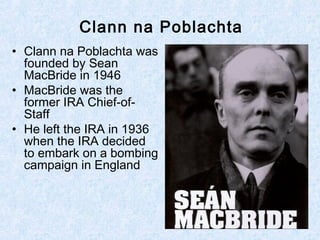
• Clann na Poblachta was
founded by Sean
MacBride in 1946
• MacBride was the
former IRA Chief-of-
Staff
• He left the IRA in 1936
when the IRA decided
to embark on a bombing
campaign in England
Clann na Poblachta
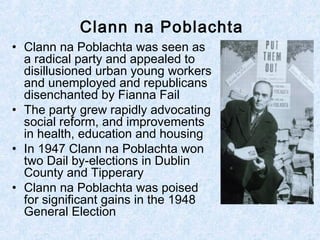
• Clann na Poblachta was seen as
a radical party and appealed to
disillusioned urban young workers
and unemployed and republicans
disenchanted by Fianna Fail
• The party grew rapidly advocating
social reform, and improvements
in health, education and housing
• In 1947 Clann na Poblachta won
two Dail by-elections in Dublin
County and Tipperary
• Clann na Poblachta was poised
for significant gains in the 1948
General Election
Clann na Poblachta
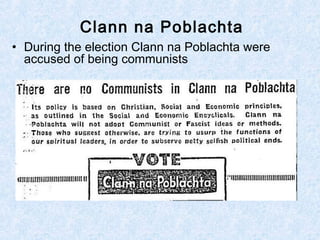
• During the election Clann na Poblachta were
accused of being communists
• In an attempt to cut across the growth of
Clann na Poblachta, Eamon DeValera
calls a snap election for 4th
February 1948
• Fianna Fail altered the constituency
boundaries in an attempt to win extra
seats
• Fianna Fail was expected to win the
election
• A desire for anyone but Fianna Fail
The 1948 General Election
• Issues
- continuing rationing since WW2
- massive inflation in the economy
- wage caps for workers
- ongoing teachers strike against
low pay
- bad weather, a poor harvest and
low income for farmers
• There were also allegations of bribery
and corruption against public officials
The 1948 General Election
• Result
Fianna Fail 68 seats (-8)
Fine Gael 31 seats (+1)
Labour 14 seats (+6)
Clann na Poblachta 10 seats (+10)
Clann na Talmhan 7 seats (-2)
National Labour 5 seats (+1)
Monetary Reform Party 1 seat (NC)
Independents 11 seats (+1)
The 1948 General Election
• Clann na Poblachta receive 14% of
the vote but only get 7% of the seats
• The party ran 93 candidates – running
2-3 candidates in every constituency
• This was a mistake as it spread the vote
around too many candidates and
resulted in Clann na Poblachta losing
seats it should have won
http://electionsireland.org/result.cfm?election=
The 1948 General Election
• Fianna Fail – 68 seats
• Everyone else – 79 seats
• Negotiations began between all the
parties excluding Fianna Fail
• Leader of Fine Gael, Richard Mulcahy
agreed to stand aside as Taoiseach to
facilitate an agreement
• The first Inter-Party Government is
formed
The Formation of the
Government
• Taoiseach – John A Costello (FG)
• Tánaiste – William Norton (LP)
• Finance – Patrick McGilligan (FG)
• Education – Richard Mulcahy (FG)
• External Affairs – Sean MacBride (C na P)
• Agriculture – James Dillon (Ind)
• Health – Noel Browne (C na P)
• Land & Fisheries – Joseph Blowick
(CnaT)
• Posts & Telegraphs – Jim Everett
(NatLab)
Main Government Ministers
• Anglo-Irish Trade Agreement with Britain
• Improved prices and increased volumes of
Irish agricultural produce
• The Land Rehabilitation Project was
established to bring uncultivated land into
production. Despite large amounts of
government money the numbers working
on the land continued to drop
• Continued dominance of pasture farming
led to small farms being uneconomical
Agriculture
• Raw materials were again available after
WW2
• Irish manufacturing expanded by 50%
between 1946-1949
• Increased consumer spending from
wartime savings was spent on foreign
imports
• Belief that government should invest in
the economy to create more jobs
Industry
• Sean MacBride drafted an application for
funds from the Marshall Plan
• A condition was the drawing up of a long
term economic plan
• ‘Ireland’s Long-Term Recovery Programme’
• Between 1949-1951 Ireland received
$125million – mostly as loans
• The government set up –
- The Central Statistics Office
- Córás Tráchtála
- The Industrial Development Authority
• Modest industrial expansion
The Marshall Plan
• During the 1948 Election some members of
Fine Gael campaigned in favour of remaining
in the British Commonwealth
• John A Costello felt that if the South was
declared a republic the IRA would not have
any excuse to be active in the South
• During a visit to Canada in Sept 1948
Costello made public an intention of
declaring a republic
• The Republic of Ireland became official at
Easter 1949
• The change had little impact – Britain still
needed Irish workers for its economy
Declaring a Republic
• In 1948 Ireland became a founding member
of the Council of Europe
• In 1949 Ireland rejected an invitation to join
NATO. MacBride declared that Ireland could
not join as long as Britain continued to rule
the North
• Ireland joined the Organisation for Economic
Cooperation and Development (OECD) as a
condition for receiving money from the
Marshall Plan
External Affairs
• In 1949 the British government responded to the
declaration of the Irish republic by passing the
Ireland Act.
• This act contained guarantees that Northern
Ireland would remain part of Britain unless the
Northern Ireland Parliament decided otherwise.
• The Irish government, especially MacBride,
were angered by this and launched a campaign
against partition.
• Meetings and rallies were held. The Irish
government helped nationalist candidates in the
North. Diplomats raised partition repeatedly.
• Little impact except further alienating Unionists.
Anti-Partition Campaign
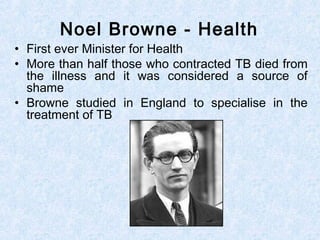
• First ever Minister for Health
• More than half those who contracted TB died from
the illness and it was considered a source of
shame
• Browne studied in England to specialise in the
treatment of TB
Noel Browne - Health
• The government backed an eradication programme and
funded it from the Hospital Sweepstakes
• Special hospitals (sanatoria) were built
• By 1950 there were 5,500 hospital beds
• New drugs helped
Noel Browne - Health
• Deaths from TB
1947 – 124 per 100,000 population
1951 – 73 per 100,000 population
1957 – 24 per 100,000 population
• Having successfully initiated the campaign to
eradicate TB – Browne now turned to healthcare
for mothers and children
Noel Browne - Health
• In 1947 Fianna Fail established the Dept of Health
and introduced a Health Act
• More than 80 out of every 100,000 babies died
during their first year of life
• 100 women died in childbirth every year
• The Health Act proposed free medical care for
mothers and children up to 16 years of age
• The Catholic Church secretly told Fianna Fail that
they were opposed to the Act
• Fianna Fail left government before it could be
debated in the Dail
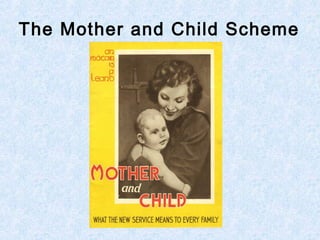
The Mother and Child Scheme
• When Noel Browne became minister he attempted
to implement the Health Act
• Most doctors opposed the Mother and Child
Scheme – they wanted ‘means testing’
• Doctors did not want to lose their fees from private
patients
• They did not want a British style free National
Health Service where they would be employed by
the state
• The doctors had powerful allies in the Catholic
bishops
The Mother and Child Scheme
• The Bishops supported means testing
• They regarded free health care for all mothers and
children as a form of socialism that would make
the state too powerful
• Browne argued that means testing would lead to
poor people being victimised – that people would
be stigmatised because they couldn’t afford
healthcare
• Browne refused to compromise
The Mother and Child Scheme
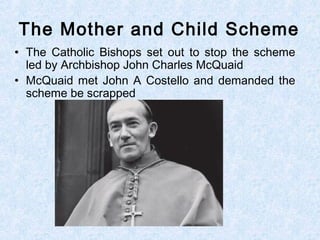
• The Catholic Bishops set out to stop the scheme
led by Archbishop John Charles McQuaid
• McQuaid met John A Costello and demanded the
scheme be scrapped
The Mother and Child Scheme
• Quotes
"...they [the Archbishops and bishops] feel bound by
their office to consider whether the proposals are in
accordance with Catholic moral teaching,“
"Doctors trained in institutions in which we have no
confidence may be appointed as medical officers ...
and may give gynaecological care not in accordance
with Catholic principles”
letter argued - health provision and physical education
for children were solely the "right" of parents and not
the State's concern
The Mother and Child Scheme
• Catholic Bishops felt it could lead to contraception
and abortion
• Church of Ireland also opposed the scheme on the
basis that it was ‘communist’ interference in the
family
• Some government ministers felt that Browne was
‘tactless’ in his dealings with the Bishops
• In April 1951 Clann na Poblachta TDs met and
demanded Browne resign as minister. Costello told
Browne he would sack him if he didn’t resign
The Mother and Child Scheme
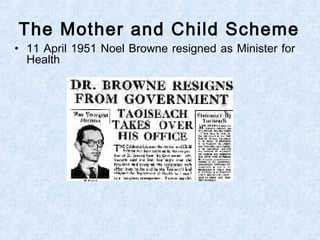
• 11 April 1951 Noel Browne resigned as Minister for
Health
The Mother and Child Scheme
• A month after Browne’s resignation the government
called a general election
• Browne was very popular and his removal as
Minister for Health did serious damage to the
government
• Rising prices and a rising balance of payments
deficit caused problems for the government
• The government also lost the support of two
Farmers TDs over rising milk prices.
General Election 1951
General
Election 1951
• Result
Fianna Fail 69 seats (+1)
Fine Gael 40 seats (+9)
Labour 16 seats (-3)
Clann na Talmhan 6 seats (-1)
Clann na Poblachta 2 seats (-8)
Independents 14 seats (+3)
• The Independents included Noel Browne, another
former CnaP TD, Jack McQuillan and a former CnaP
councillor, Michael ffrench-O’Carroll, who resigned
from CnaP in support of Browne
• Independents, including Browne supported a minority
Fianna Fail government
General Election 1951
• Born in Co. Cavan in 1895
• Studies in Rome and then became Dean
of Blackrock College
• Appointed Archbishop of Dublin in 1940
• Keen interest in educational and social
matters
• Was head of the Catholic Headmasters
Association
• Promoted charity to alleviate social
problems
Archbishop John Charles
McQuaid
• Believed in segregating schools on
religious ground and encouraged nuns
and brothers to open schools
• He supported the ban on Catholics
attending Trinity without the permission of
their bishop
• He exercised strict control over the clergy
• In later years he was seen as a
reactionary figure
• In recent times he has been implicated in
the cover-up of paedophile priests
Archbishop John Charles
McQuaid
• Presentation prepared by:
• Dominic Haugh
• St. Particks Comprehensive School
• Shannon
• Co. Clare
• Presentation can be used for educational purposes only – all rights remain with author

First inter party government revision

  • 1.
    The First Inter-Party Government •Leaving Cert History • Government, Economy and Society in the Republic of Ireland 1949-1989
  • 2.
    • Clann naPoblachta & The 1948 General Election • The Formation of the Government • Agricultural Policy and Industrial Policy • Declaration of a Republic • Sean MacBride and the Dept of External Affairs • Dr. Noel Browne and the TB Crisis • The Mother and Child Scheme • Archbishop John Charles McQuaid The First Inter-Party Government
  • 3.
    Clann na Poblachta •Clann na Poblachta was founded by Sean MacBride in 1946 • MacBride was the former IRA Chief-of- Staff • He left the IRA in 1936 when the IRA decided to embark on a bombing campaign in England
  • 4.
    Clann na Poblachta •Clann na Poblachta was seen as a radical party and appealed to disillusioned urban young workers and unemployed and republicans disenchanted by Fianna Fail • The party grew rapidly advocating social reform, and improvements in health, education and housing • In 1947 Clann na Poblachta won two Dail by-elections in Dublin County and Tipperary • Clann na Poblachta was poised for significant gains in the 1948 General Election
  • 5.
    Clann na Poblachta •During the election Clann na Poblachta were accused of being communists
  • 6.
    • In anattempt to cut across the growth of Clann na Poblachta, Eamon DeValera calls a snap election for 4th February 1948 • Fianna Fail altered the constituency boundaries in an attempt to win extra seats • Fianna Fail was expected to win the election • A desire for anyone but Fianna Fail The 1948 General Election
  • 7.
    • Issues - continuingrationing since WW2 - massive inflation in the economy - wage caps for workers - ongoing teachers strike against low pay - bad weather, a poor harvest and low income for farmers • There were also allegations of bribery and corruption against public officials The 1948 General Election
  • 8.
    • Result Fianna Fail68 seats (-8) Fine Gael 31 seats (+1) Labour 14 seats (+6) Clann na Poblachta 10 seats (+10) Clann na Talmhan 7 seats (-2) National Labour 5 seats (+1) Monetary Reform Party 1 seat (NC) Independents 11 seats (+1) The 1948 General Election
  • 9.
    • Clann naPoblachta receive 14% of the vote but only get 7% of the seats • The party ran 93 candidates – running 2-3 candidates in every constituency • This was a mistake as it spread the vote around too many candidates and resulted in Clann na Poblachta losing seats it should have won http://electionsireland.org/result.cfm?election= The 1948 General Election
  • 10.
    • Fianna Fail– 68 seats • Everyone else – 79 seats • Negotiations began between all the parties excluding Fianna Fail • Leader of Fine Gael, Richard Mulcahy agreed to stand aside as Taoiseach to facilitate an agreement • The first Inter-Party Government is formed The Formation of the Government
  • 11.
    • Taoiseach –John A Costello (FG) • Tánaiste – William Norton (LP) • Finance – Patrick McGilligan (FG) • Education – Richard Mulcahy (FG) • External Affairs – Sean MacBride (C na P) • Agriculture – James Dillon (Ind) • Health – Noel Browne (C na P) • Land & Fisheries – Joseph Blowick (CnaT) • Posts & Telegraphs – Jim Everett (NatLab) Main Government Ministers
  • 12.
    • Anglo-Irish TradeAgreement with Britain • Improved prices and increased volumes of Irish agricultural produce • The Land Rehabilitation Project was established to bring uncultivated land into production. Despite large amounts of government money the numbers working on the land continued to drop • Continued dominance of pasture farming led to small farms being uneconomical Agriculture
  • 13.
    • Raw materialswere again available after WW2 • Irish manufacturing expanded by 50% between 1946-1949 • Increased consumer spending from wartime savings was spent on foreign imports • Belief that government should invest in the economy to create more jobs Industry
  • 14.
    • Sean MacBridedrafted an application for funds from the Marshall Plan • A condition was the drawing up of a long term economic plan • ‘Ireland’s Long-Term Recovery Programme’ • Between 1949-1951 Ireland received $125million – mostly as loans • The government set up – - The Central Statistics Office - Córás Tráchtála - The Industrial Development Authority • Modest industrial expansion The Marshall Plan
  • 15.
    • During the1948 Election some members of Fine Gael campaigned in favour of remaining in the British Commonwealth • John A Costello felt that if the South was declared a republic the IRA would not have any excuse to be active in the South • During a visit to Canada in Sept 1948 Costello made public an intention of declaring a republic • The Republic of Ireland became official at Easter 1949 • The change had little impact – Britain still needed Irish workers for its economy Declaring a Republic
  • 16.
    • In 1948Ireland became a founding member of the Council of Europe • In 1949 Ireland rejected an invitation to join NATO. MacBride declared that Ireland could not join as long as Britain continued to rule the North • Ireland joined the Organisation for Economic Cooperation and Development (OECD) as a condition for receiving money from the Marshall Plan External Affairs
  • 17.
    • In 1949the British government responded to the declaration of the Irish republic by passing the Ireland Act. • This act contained guarantees that Northern Ireland would remain part of Britain unless the Northern Ireland Parliament decided otherwise. • The Irish government, especially MacBride, were angered by this and launched a campaign against partition. • Meetings and rallies were held. The Irish government helped nationalist candidates in the North. Diplomats raised partition repeatedly. • Little impact except further alienating Unionists. Anti-Partition Campaign
  • 18.
    • First everMinister for Health • More than half those who contracted TB died from the illness and it was considered a source of shame • Browne studied in England to specialise in the treatment of TB Noel Browne - Health
  • 19.
    • The governmentbacked an eradication programme and funded it from the Hospital Sweepstakes • Special hospitals (sanatoria) were built • By 1950 there were 5,500 hospital beds • New drugs helped Noel Browne - Health
  • 20.
    • Deaths fromTB 1947 – 124 per 100,000 population 1951 – 73 per 100,000 population 1957 – 24 per 100,000 population • Having successfully initiated the campaign to eradicate TB – Browne now turned to healthcare for mothers and children Noel Browne - Health
  • 21.
    • In 1947Fianna Fail established the Dept of Health and introduced a Health Act • More than 80 out of every 100,000 babies died during their first year of life • 100 women died in childbirth every year • The Health Act proposed free medical care for mothers and children up to 16 years of age • The Catholic Church secretly told Fianna Fail that they were opposed to the Act • Fianna Fail left government before it could be debated in the Dail The Mother and Child Scheme
  • 22.
    The Mother andChild Scheme
  • 23.
    • When NoelBrowne became minister he attempted to implement the Health Act • Most doctors opposed the Mother and Child Scheme – they wanted ‘means testing’ • Doctors did not want to lose their fees from private patients • They did not want a British style free National Health Service where they would be employed by the state • The doctors had powerful allies in the Catholic bishops The Mother and Child Scheme
  • 24.
    • The Bishopssupported means testing • They regarded free health care for all mothers and children as a form of socialism that would make the state too powerful • Browne argued that means testing would lead to poor people being victimised – that people would be stigmatised because they couldn’t afford healthcare • Browne refused to compromise The Mother and Child Scheme
  • 25.
    The Mother andChild Scheme
  • 26.
    • The CatholicBishops set out to stop the scheme led by Archbishop John Charles McQuaid • McQuaid met John A Costello and demanded the scheme be scrapped The Mother and Child Scheme
  • 27.
    • Quotes "...they [theArchbishops and bishops] feel bound by their office to consider whether the proposals are in accordance with Catholic moral teaching,“ "Doctors trained in institutions in which we have no confidence may be appointed as medical officers ... and may give gynaecological care not in accordance with Catholic principles” letter argued - health provision and physical education for children were solely the "right" of parents and not the State's concern The Mother and Child Scheme
  • 28.
    • Catholic Bishopsfelt it could lead to contraception and abortion • Church of Ireland also opposed the scheme on the basis that it was ‘communist’ interference in the family • Some government ministers felt that Browne was ‘tactless’ in his dealings with the Bishops • In April 1951 Clann na Poblachta TDs met and demanded Browne resign as minister. Costello told Browne he would sack him if he didn’t resign The Mother and Child Scheme
  • 29.
    • 11 April1951 Noel Browne resigned as Minister for Health The Mother and Child Scheme
  • 30.
    • A monthafter Browne’s resignation the government called a general election • Browne was very popular and his removal as Minister for Health did serious damage to the government • Rising prices and a rising balance of payments deficit caused problems for the government • The government also lost the support of two Farmers TDs over rising milk prices. General Election 1951
  • 31.
  • 32.
    • Result Fianna Fail69 seats (+1) Fine Gael 40 seats (+9) Labour 16 seats (-3) Clann na Talmhan 6 seats (-1) Clann na Poblachta 2 seats (-8) Independents 14 seats (+3) • The Independents included Noel Browne, another former CnaP TD, Jack McQuillan and a former CnaP councillor, Michael ffrench-O’Carroll, who resigned from CnaP in support of Browne • Independents, including Browne supported a minority Fianna Fail government General Election 1951
  • 33.
    • Born inCo. Cavan in 1895 • Studies in Rome and then became Dean of Blackrock College • Appointed Archbishop of Dublin in 1940 • Keen interest in educational and social matters • Was head of the Catholic Headmasters Association • Promoted charity to alleviate social problems Archbishop John Charles McQuaid
  • 34.
    • Believed insegregating schools on religious ground and encouraged nuns and brothers to open schools • He supported the ban on Catholics attending Trinity without the permission of their bishop • He exercised strict control over the clergy • In later years he was seen as a reactionary figure • In recent times he has been implicated in the cover-up of paedophile priests Archbishop John Charles McQuaid
  • 35.
    • Presentation preparedby: • Dominic Haugh • St. Particks Comprehensive School • Shannon • Co. Clare • Presentation can be used for educational purposes only – all rights remain with author