The Lemass
Governments
• Government, Economy and Society in
the Republic of Ireland
• 1949-1989
1957 Election
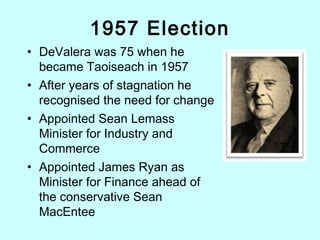
• DeValera was 75 when he
became Taoiseach in 1957
• After years of stagnation he
recognised the need for change
• Appointed Sean Lemass
Minister for Industry and
Commerce
• Appointed James Ryan as
Minister for Finance ahead of
the conservative Sean
MacEntee
DeV resigns
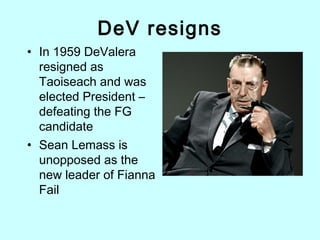
• In 1959 DeValera
resigned as
Taoiseach and was
elected President –
defeating the FG
candidate
• Sean Lemass is
unopposed as the
new leader of Fianna
Fail
Sean Lemass
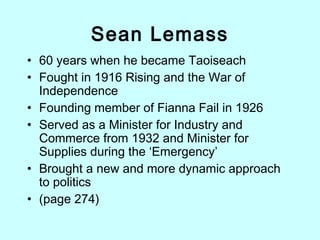
• 60 years when he became Taoiseach
• Fought in 1916 Rising and the War of
Independence
• Founding member of Fianna Fail in 1926
• Served as a Minister for Industry and
Commerce from 1932 and Minister for
Supplies during the ‘Emergency’
• Brought a new and more dynamic approach
to politics
• (page 274)
Approach to Economy
• Lemass supported protectionism and the idea
of self-sufficiency in the 1930s and 1940s
• Realised that it wasn’t working and advocated
change in the 1950s
• Between 1959-1966 Lemass presided over
unprecedented economic expansion
• Helped by favourable external economic
circumstances
• Supported by a new approach by the civil
service
TK Whitaker
• Secretary of the Department of Finance in
1956
• Following on from the approach of Gerald
Sweetman, Minister for Finance in the
Second Inter-Party government who
encouraged foreign investment
• In 1958 the Dept of Finance carried out a
comprehensive survey of the Irish Economy
• This report was to lead to a new policy – The
First Programme of Economic Expansion
Emerging from Isolation
• Ireland developed new economic links –
especially with Britain and Europe
• Ireland played a bigger role in World Affairs
• Attempted to establish better relations with
Northern Ireland
Economic Development
• Ireland applied to join the European
Economic Community (founded in 1957)
• Sean Lemass believed that a small nation
would benefit from closer links with Europe.
• Ireland’s application was linked to a similar
application from Britain – both were blocked
by French President Charles DeGaulle
• Ireland’s application was delayed by 10
years
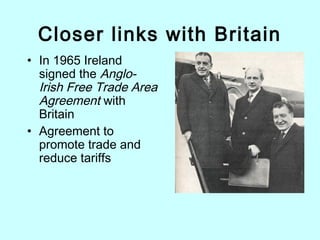
Closer links with Britain
• In 1965 Ireland
signed the Anglo-
Irish Free Trade Area
Agreement with
Britain
• Agreement to
promote trade and
reduce tariffs
Ireland and the United
Nations• Lemass expanded Ireland’s role in
international affairs by actively participating in
the United Nations
• In 1960 the Irish ambassador to the UN was
President of the General Assembly
• Ireland was a member of the Security Council
in 1962
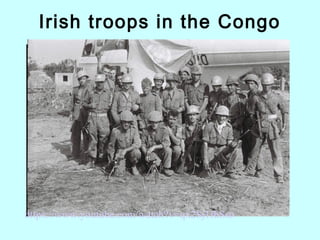
• Irish troops participated in a peacekeeping
role in the Congo from 1960-1964
• In all 26 Irish soldiers died in the Congo
Irish troops in the Congo
https://www.youtube.com/watch?v=qx2Sj1fhSso
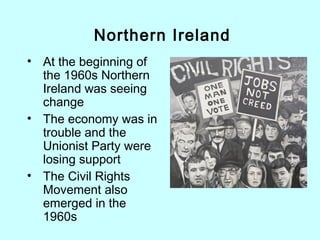
• At the beginning of
the 1960s Northern
Ireland was seeing
change
• The economy was in
trouble and the
Unionist Party were
losing support
• The Civil Rights
Movement also
emerged in the
1960s
Northern Ireland
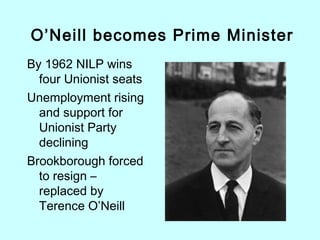
By 1962 NILP wins
four Unionist seats
Unemployment rising
and support for
Unionist Party
declining
Brookborough forced
to resign –
replaced by
Terence O’Neill
O’Neill becomes Prime Minister
O’Neill declared:
‘Our task will be literally to transform
Ulster’
‘make Northern Ireland economically
stronger and prosperous … and to build
bridges between the two traditions within
our community’
O’Neill becomes Prime Minister
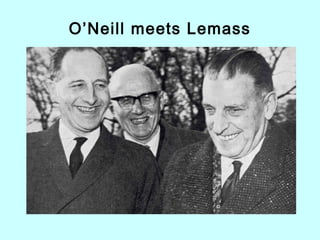
O’Neill meets Lemass
• 1965 O’Neill invites Lemass to Belfast
• Lemass tells O’Neill: ‘I shall get into
terrible trouble for this’
• O’Neill the one in trouble – didn’t tell his
cabinet until the morning of the meeting
• Protests organised by Ian Paisley
O’Neill meets Lemass
• O’Neill made reconciliation official policy
• However, only introduced minor reforms
• Tensions around anniversary of 1916
Rising
• UVF reformed - ‘Known IRA men will be
executed mercilessly and without
hesitation’ - killed two innocent Catholics
and elderly Protestant woman
Jan. 1964 - The Campaign for Social Justice
in Northern Ireland was formed
1965 Gerry Fitt forms ‘Campaign for
Democracy in Ulster’ - sponsored by sixty
MPs
Northern Ireland Civil Rights Association
(1967)
Derry Unemployed Action Committee (1965)
Derry Housing Association (1967)
Civil Rights Movement in
Northern Ireland

The Lemass Governments revision

  • 1.
    The Lemass Governments • Government,Economy and Society in the Republic of Ireland • 1949-1989
  • 2.
    1957 Election • DeValerawas 75 when he became Taoiseach in 1957 • After years of stagnation he recognised the need for change • Appointed Sean Lemass Minister for Industry and Commerce • Appointed James Ryan as Minister for Finance ahead of the conservative Sean MacEntee
  • 3.
    DeV resigns • In1959 DeValera resigned as Taoiseach and was elected President – defeating the FG candidate • Sean Lemass is unopposed as the new leader of Fianna Fail
  • 4.
    Sean Lemass • 60years when he became Taoiseach • Fought in 1916 Rising and the War of Independence • Founding member of Fianna Fail in 1926 • Served as a Minister for Industry and Commerce from 1932 and Minister for Supplies during the ‘Emergency’ • Brought a new and more dynamic approach to politics • (page 274)
  • 5.
    Approach to Economy •Lemass supported protectionism and the idea of self-sufficiency in the 1930s and 1940s • Realised that it wasn’t working and advocated change in the 1950s • Between 1959-1966 Lemass presided over unprecedented economic expansion • Helped by favourable external economic circumstances • Supported by a new approach by the civil service
  • 6.
    TK Whitaker • Secretaryof the Department of Finance in 1956 • Following on from the approach of Gerald Sweetman, Minister for Finance in the Second Inter-Party government who encouraged foreign investment • In 1958 the Dept of Finance carried out a comprehensive survey of the Irish Economy • This report was to lead to a new policy – The First Programme of Economic Expansion
  • 7.
    Emerging from Isolation •Ireland developed new economic links – especially with Britain and Europe • Ireland played a bigger role in World Affairs • Attempted to establish better relations with Northern Ireland
  • 8.
    Economic Development • Irelandapplied to join the European Economic Community (founded in 1957) • Sean Lemass believed that a small nation would benefit from closer links with Europe. • Ireland’s application was linked to a similar application from Britain – both were blocked by French President Charles DeGaulle • Ireland’s application was delayed by 10 years
  • 9.
    Closer links withBritain • In 1965 Ireland signed the Anglo- Irish Free Trade Area Agreement with Britain • Agreement to promote trade and reduce tariffs
  • 10.
    Ireland and theUnited Nations• Lemass expanded Ireland’s role in international affairs by actively participating in the United Nations • In 1960 the Irish ambassador to the UN was President of the General Assembly • Ireland was a member of the Security Council in 1962 • Irish troops participated in a peacekeeping role in the Congo from 1960-1964 • In all 26 Irish soldiers died in the Congo
  • 11.
    Irish troops inthe Congo https://www.youtube.com/watch?v=qx2Sj1fhSso
  • 12.
    • At thebeginning of the 1960s Northern Ireland was seeing change • The economy was in trouble and the Unionist Party were losing support • The Civil Rights Movement also emerged in the 1960s Northern Ireland
  • 13.
    By 1962 NILPwins four Unionist seats Unemployment rising and support for Unionist Party declining Brookborough forced to resign – replaced by Terence O’Neill O’Neill becomes Prime Minister
  • 14.
    O’Neill declared: ‘Our taskwill be literally to transform Ulster’ ‘make Northern Ireland economically stronger and prosperous … and to build bridges between the two traditions within our community’ O’Neill becomes Prime Minister
  • 15.
    O’Neill meets Lemass •1965 O’Neill invites Lemass to Belfast • Lemass tells O’Neill: ‘I shall get into terrible trouble for this’ • O’Neill the one in trouble – didn’t tell his cabinet until the morning of the meeting • Protests organised by Ian Paisley
  • 16.
  • 17.
    O’Neill meets Lemass •O’Neill made reconciliation official policy • However, only introduced minor reforms • Tensions around anniversary of 1916 Rising • UVF reformed - ‘Known IRA men will be executed mercilessly and without hesitation’ - killed two innocent Catholics and elderly Protestant woman
  • 18.
    Jan. 1964 -The Campaign for Social Justice in Northern Ireland was formed 1965 Gerry Fitt forms ‘Campaign for Democracy in Ulster’ - sponsored by sixty MPs Northern Ireland Civil Rights Association (1967) Derry Unemployed Action Committee (1965) Derry Housing Association (1967) Civil Rights Movement in Northern Ireland